Hold my hand, if you love me
Come to see gumusservi
Hold my hand, be mine
Come to see the moonshine
1. Illegally
distilled
alcohol
2. Smuggled
whisky
3. Nonsense
4. Moonlight
VOCABULARY TEACHING: IMPLICIT
VS EXPLICIT INSTRUCTION
By Mohamed Sujaau
10024
BATEFL / CST305
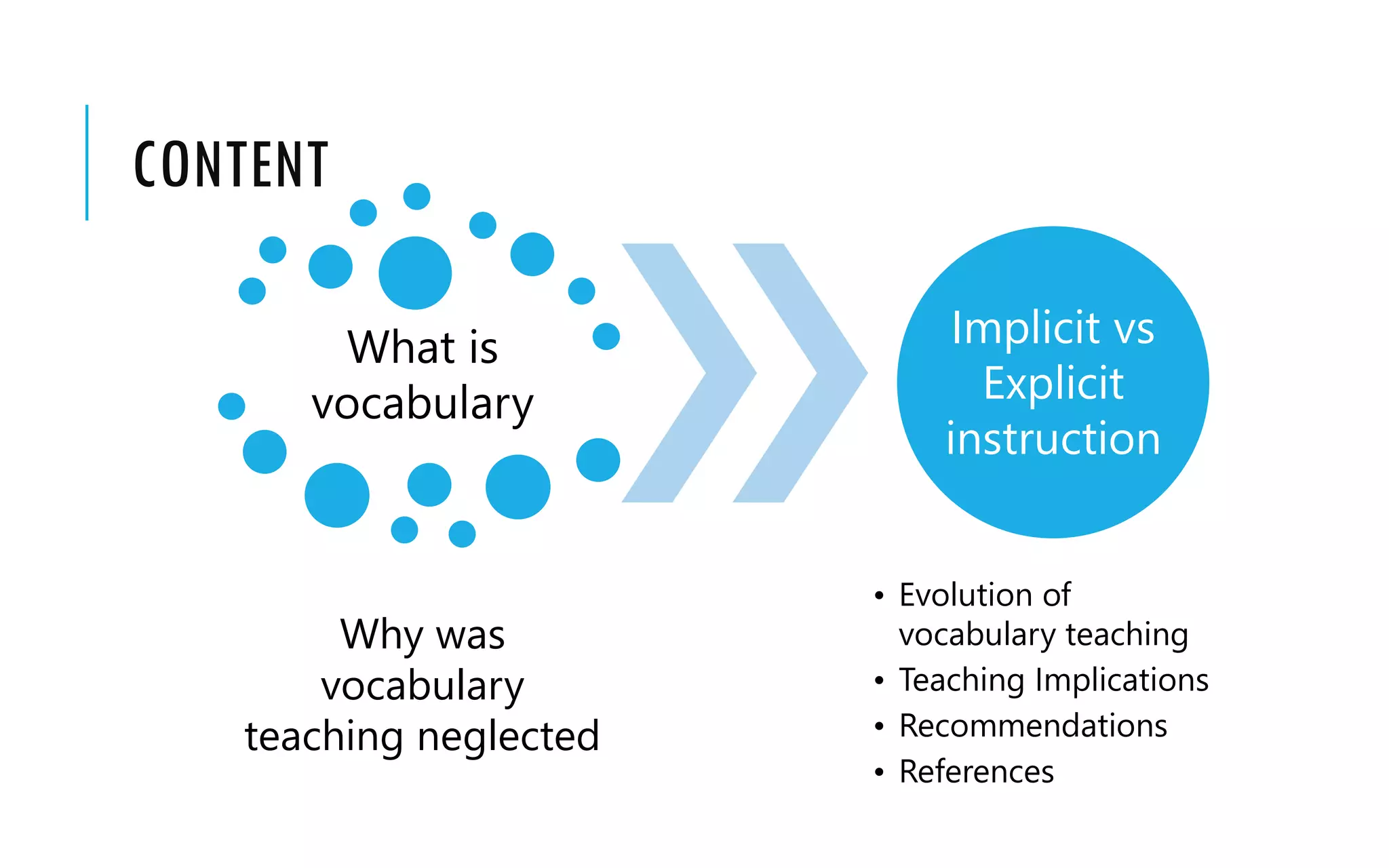
CONTENT
What is
vocabulary
Why was
vocabulary
teaching neglected
Implicit vs
Explicit
instruction
• Evolution of
vocabulary teaching
• Teaching Implications
• Recommendations
• References
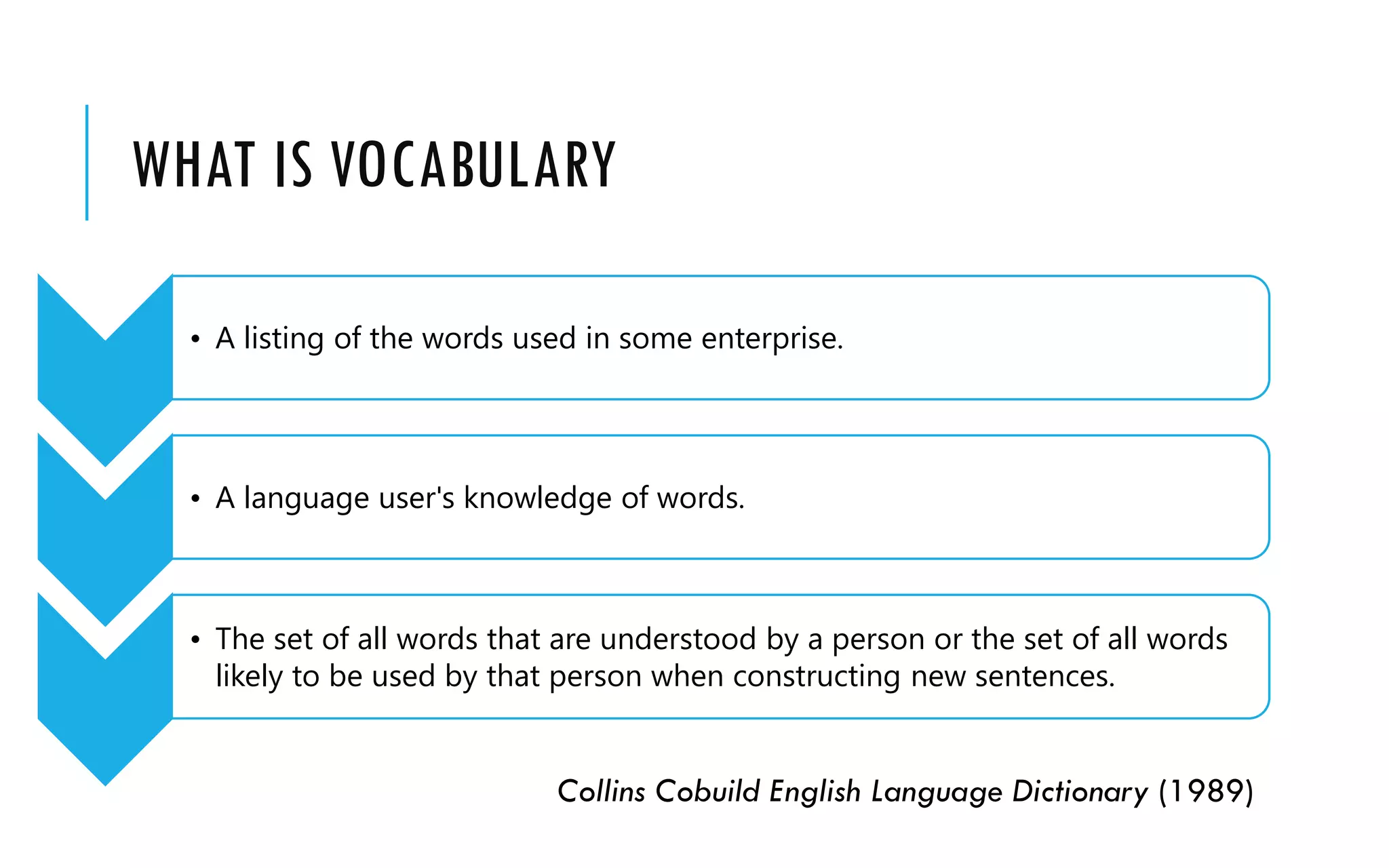
WHAT IS VOCABULARY
• A listing of the words used in some enterprise.
• A language user's knowledge of words.
• The set of all words that are understood by a person or the set of all words
likely to be used by that person when constructing new sentences.
Collins Cobuild English Language Dictionary (1989)
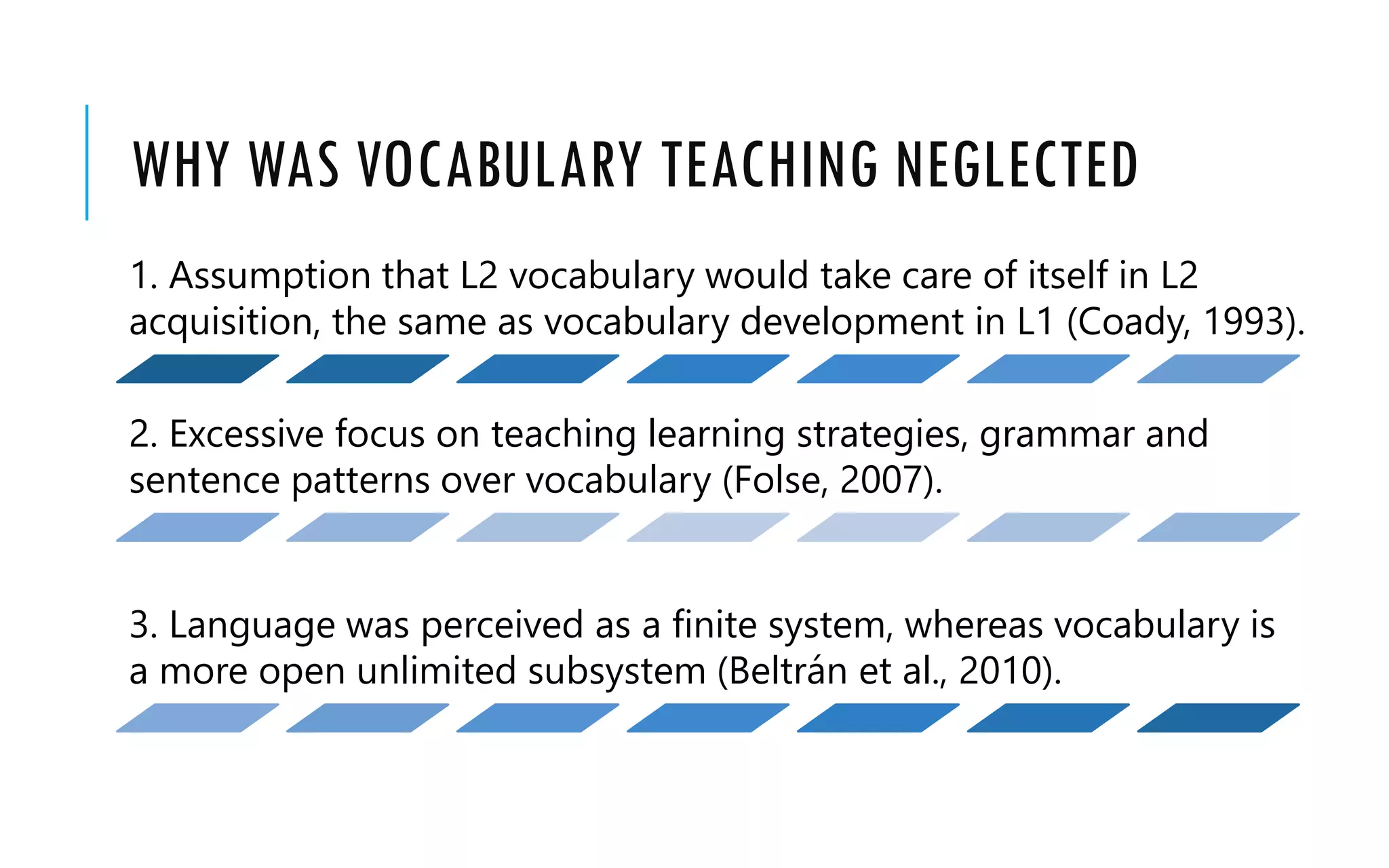
WHY WAS VOCABULARY TEACHING NEGLECTED
1. Assumption that L2 vocabulary would take care of itself in L2
acquisition, the same as vocabulary development in L1 (Coady, 1993).
2. Excessive focus on teaching learning strategies, grammar and
sentence patterns over vocabulary (Folse, 2007).
3. Language was perceived as a finite system, whereas vocabulary is
a more open unlimited subsystem (Beltrán et al., 2010).
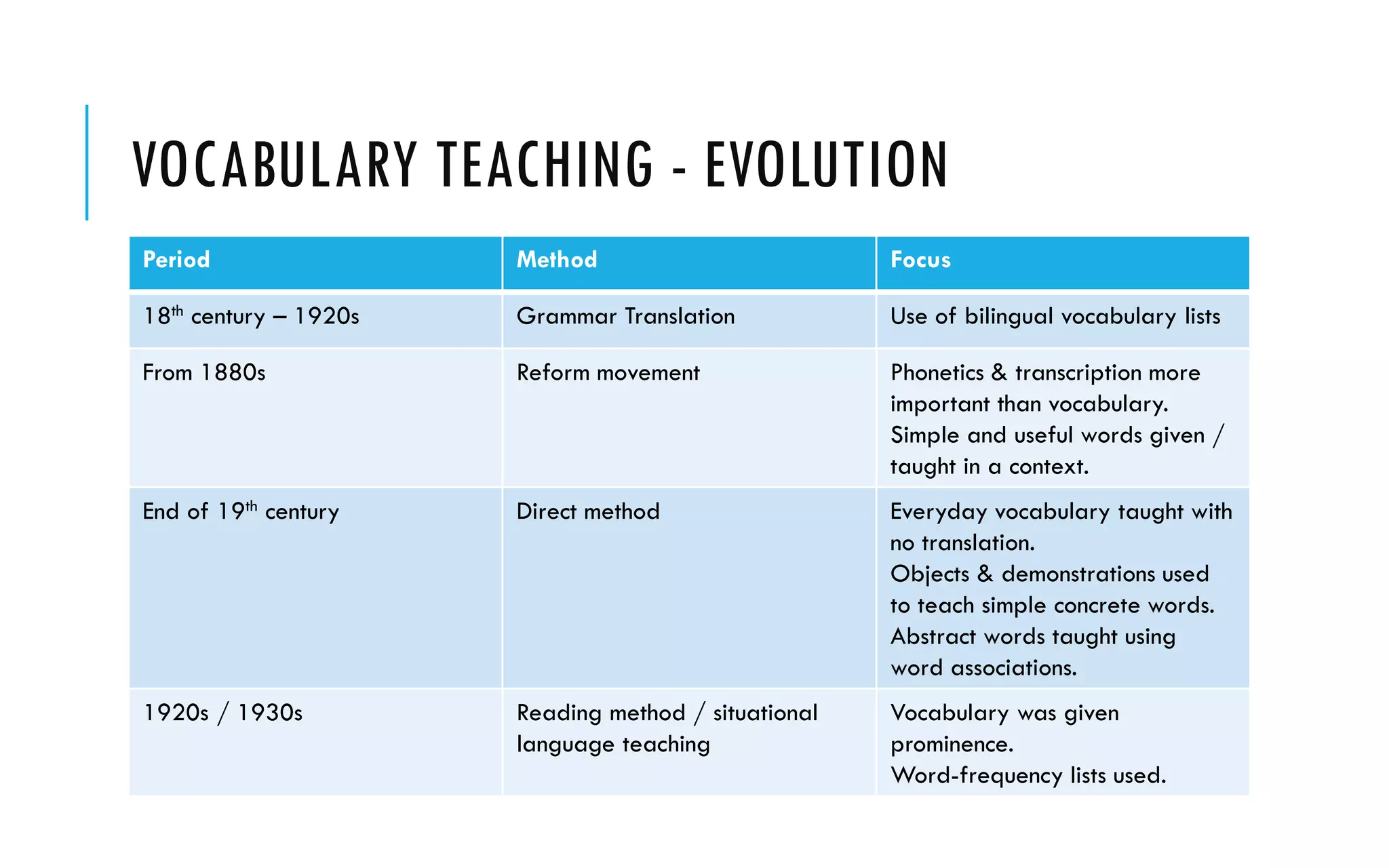
VOCABULARY TEACHING - EVOLUTION
Period Method Focus
18th century – 1920s Grammar Translation Use of bilingual vocabulary lists
From 1880s Reform movement Phonetics & transcription more
important than vocabulary.
Simple and useful words given /
taught in a context.
End of 19th century Direct method Everyday vocabulary taught with
no translation.
Objects & demonstrations used
to teach simple concrete words.
Abstract words taught using
word associations.
1920s / 1930s Reading method / situational
language teaching
Vocabulary was given
prominence.
Word-frequency lists used.
VOCABULARY TEACHING - EVOLUTION
Period Method Focus
1940s Audio Lingual Simple & similar vocabulary.
Language habits & exposure.
Drilling.
Overemphasis on grammar.
1970s Communicative Language
Teaching
Vocabulary is not primary focus.
Appropriate use of language
varieties.
Emphasis on language as
discourse.
1980s The Natural Approach Contextual, not direct translation.
Like L1, it can be acquired.
From 1980s Current perspectives Role of vocabulary emphasized.
(Espinosa, 2003)
VOCABULARY TEACHING - EVOLUTION
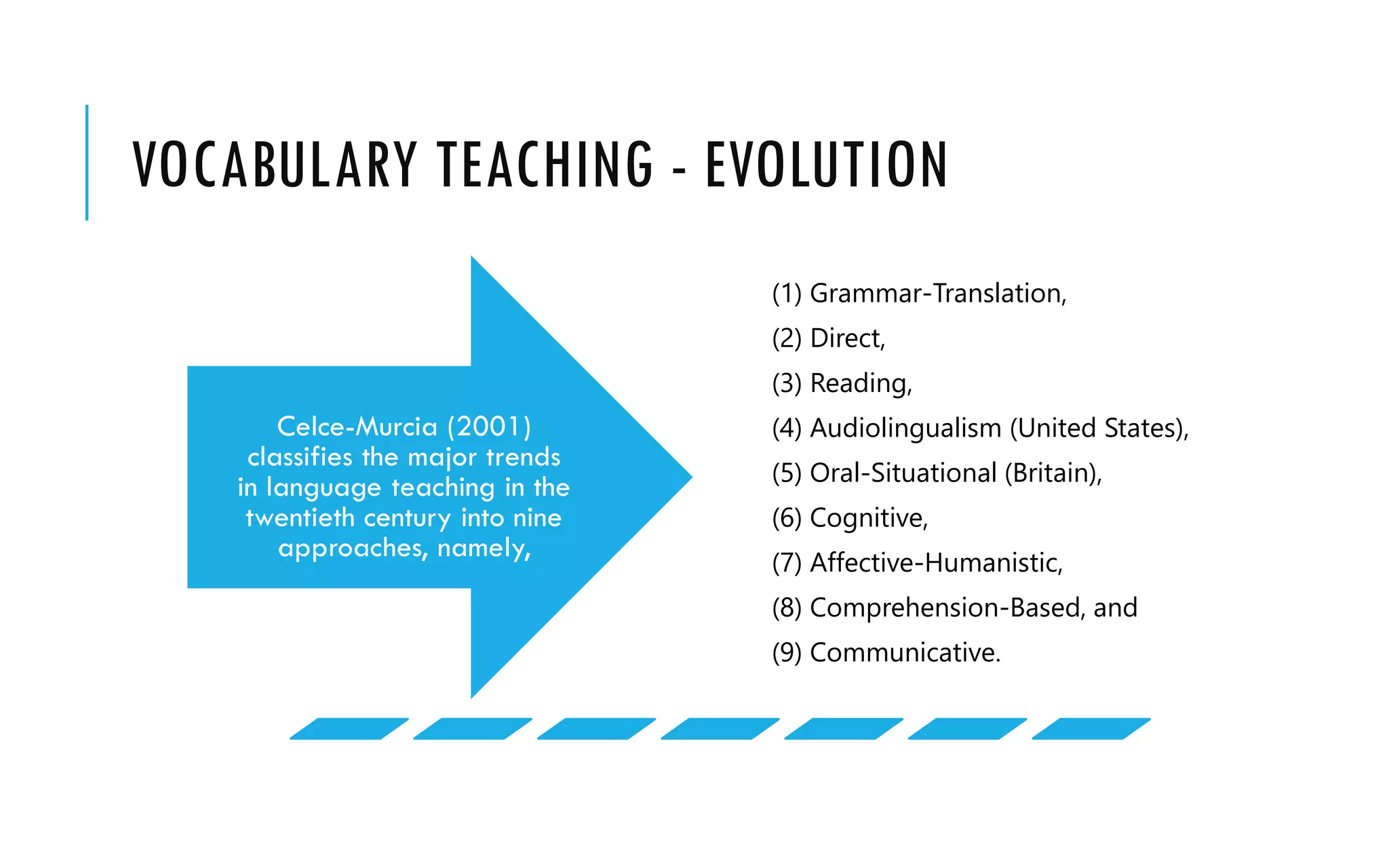
(1) Grammar-Translation,
(2) Direct,
(3) Reading,
(4) Audiolingualism (United States),
(5) Oral-Situational (Britain),
(6) Cognitive,
(7) Affective-Humanistic,
(8) Comprehension-Based, and
(9) Communicative.
Celce-Murcia (2001)
classifies the major trends
in language teaching in the
twentieth century into nine
approaches, namely,
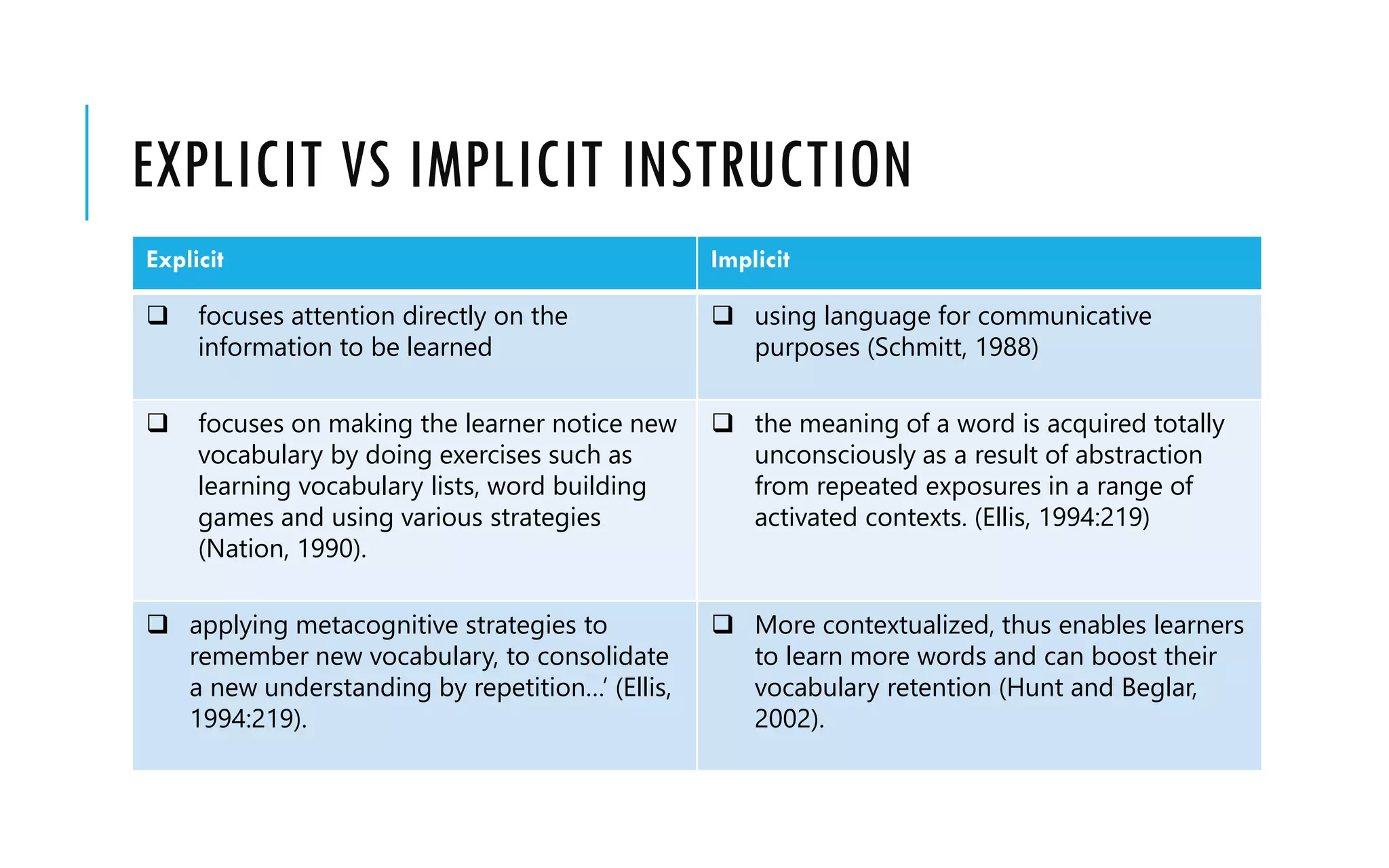
EXPLICIT VS IMPLICIT INSTRUCTION
Explicit Implicit
 focuses attention directly on the
information to be learned
 using language for communicative
purposes (Schmitt, 1988)
 focuses on making the learner notice new
vocabulary by doing exercises such as
learning vocabulary lists, word building
games and using various strategies
(Nation, 1990).
 the meaning of a word is acquired totally
unconsciously as a result of abstraction
from repeated exposures in a range of
activated contexts. (Ellis, 1994:219)
 applying metacognitive strategies to
remember new vocabulary, to consolidate
a new understanding by repetition…’ (Ellis,
1994:219).
 More contextualized, thus enables learners
to learn more words and can boost their
vocabulary retention (Hunt and Beglar,
2002).
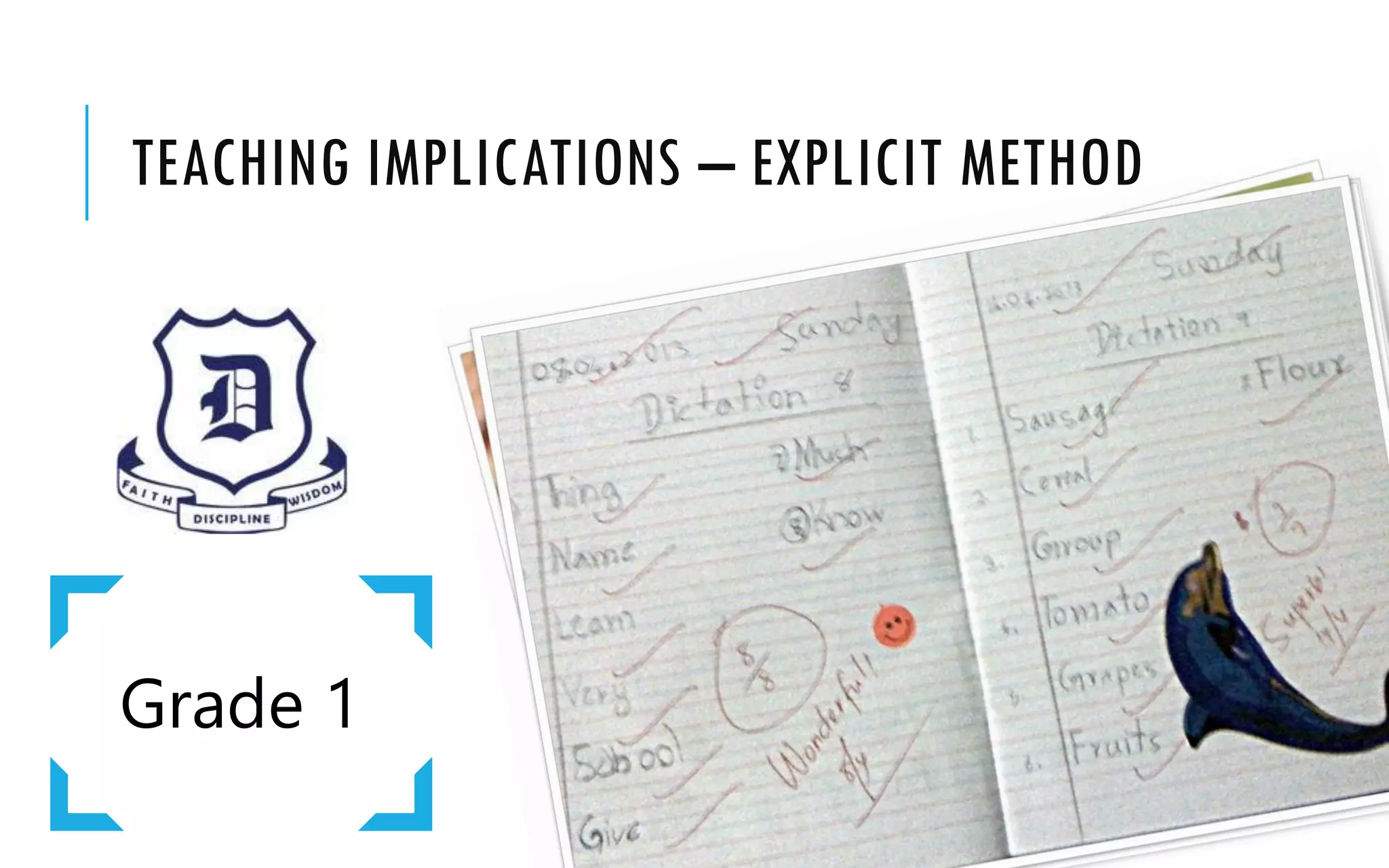
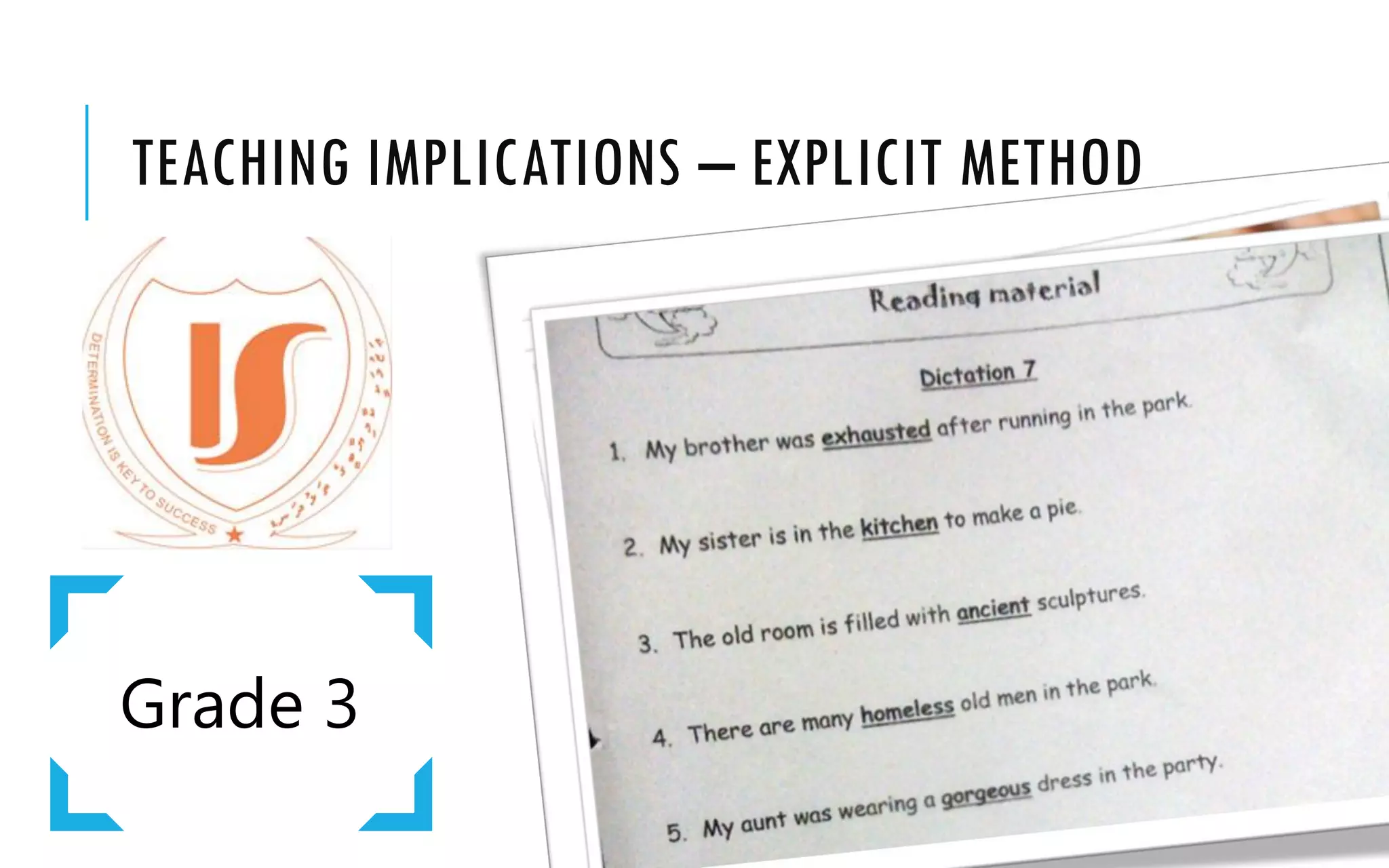
TEACHING IMPLICATIONS – EXPLICIT METHOD
Grade 1
TEACHING IMPLICATIONS – EXPLICIT METHOD
Grade 3
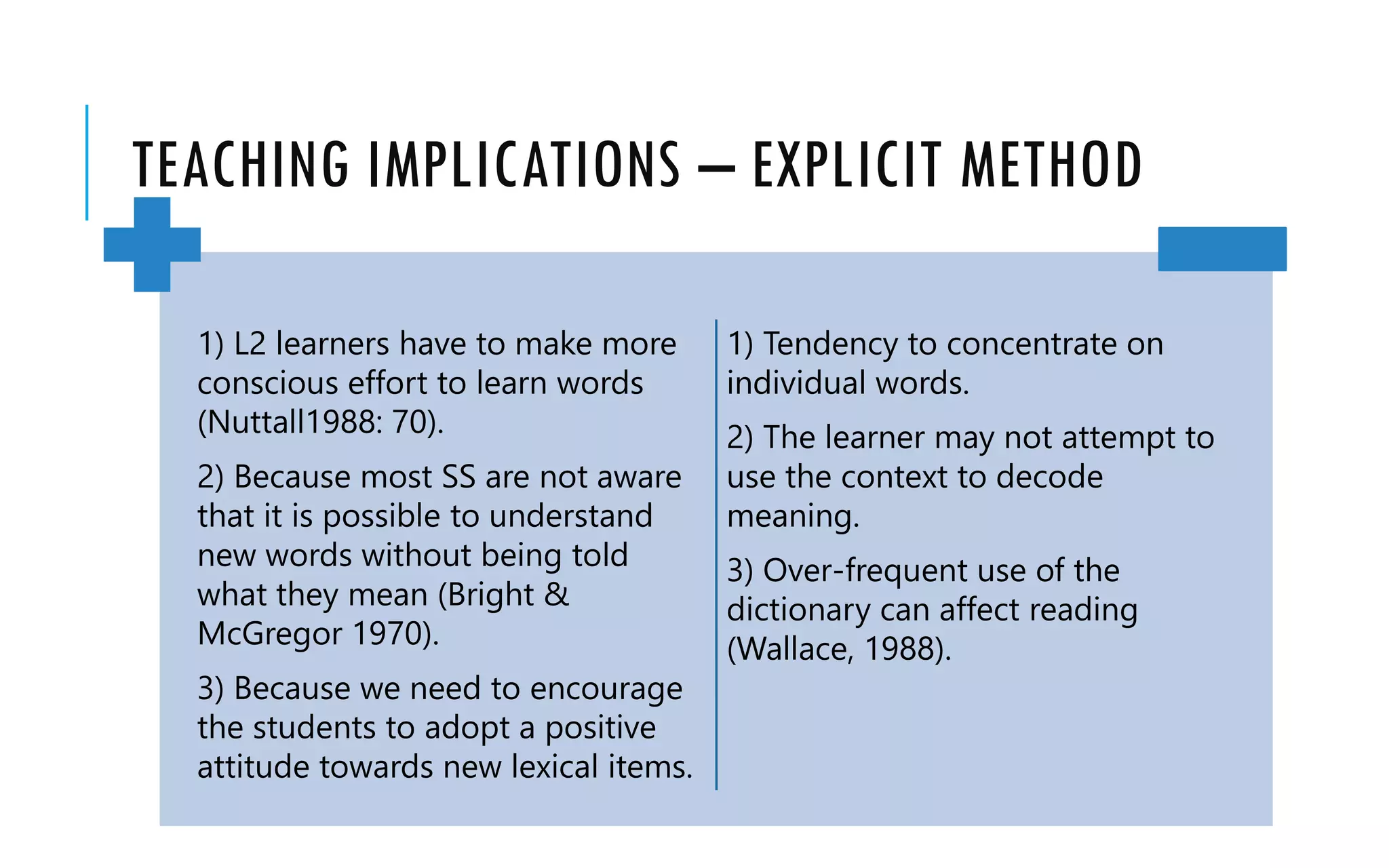
TEACHING IMPLICATIONS – EXPLICIT METHOD
1) L2 learners have to make more
conscious effort to learn words
(Nuttall1988: 70).
2) Because most SS are not aware
that it is possible to understand
new words without being told
what they mean (Bright &
McGregor 1970).
3) Because we need to encourage
the students to adopt a positive
attitude towards new lexical items.
1) Tendency to concentrate on
individual words.
2) The learner may not attempt to
use the context to decode
meaning.
3) Over-frequent use of the
dictionary can affect reading
(Wallace, 1988).
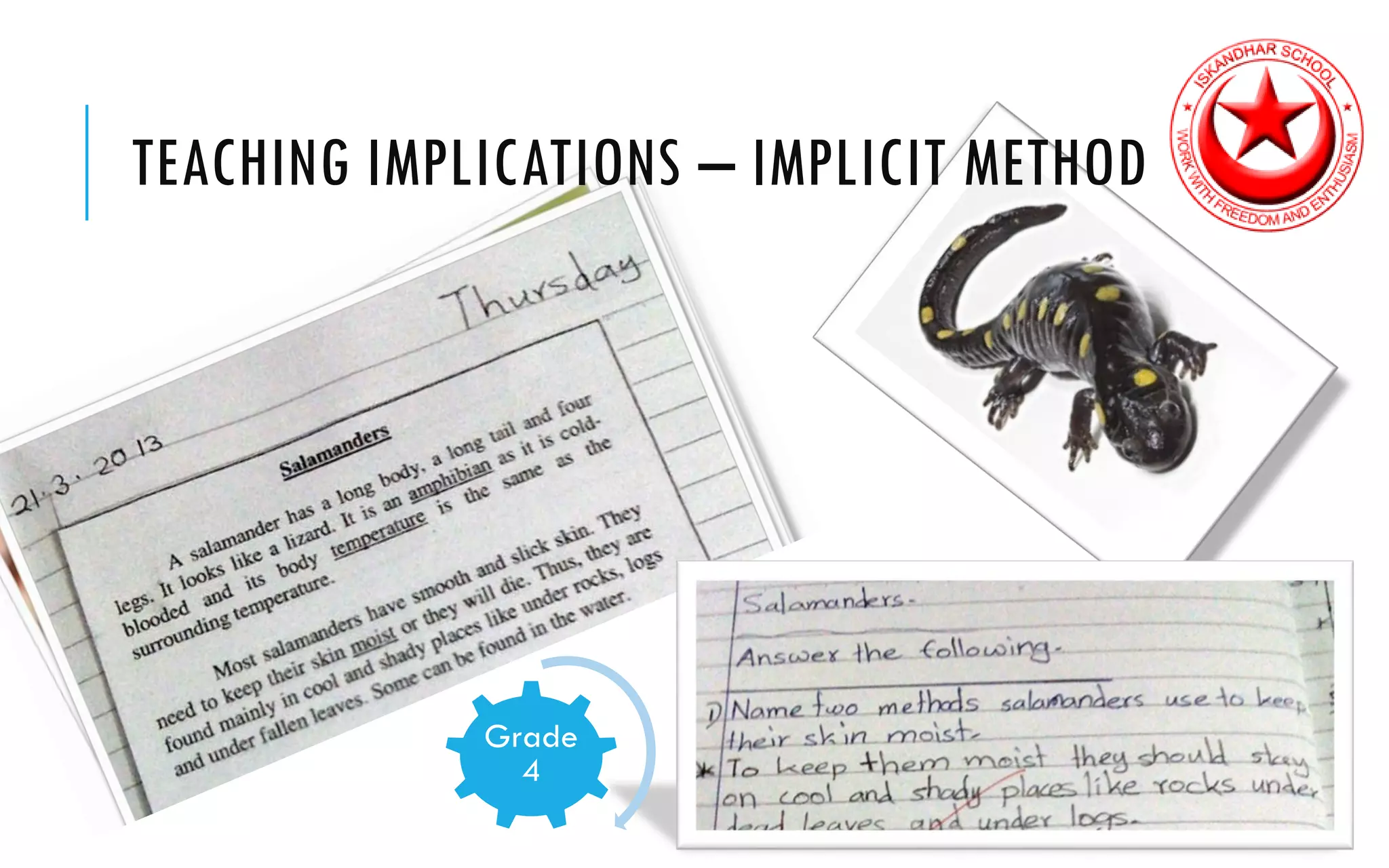
TEACHING IMPLICATIONS – IMPLICIT METHOD
Grade
4
TEACHING IMPLICATIONS – IMPLICIT METHOD
1) To infer meaning from context
in the same way native speakers
or competent speakers of a
foreign language do.
2) To show SS that many words
can just be ignored.
3) Better able to use the word in
the needed context or situation.
4) More meaningful, authentic,
fosters autonomy.
1) Depends hugely on reading
ability (Haynes, 1990).
2) Depends on learners’
motivation.
3) Learners might not be able to
infer the correct meaning.
4) What if learners do not have
the vocabulary knowledge to
decipher?
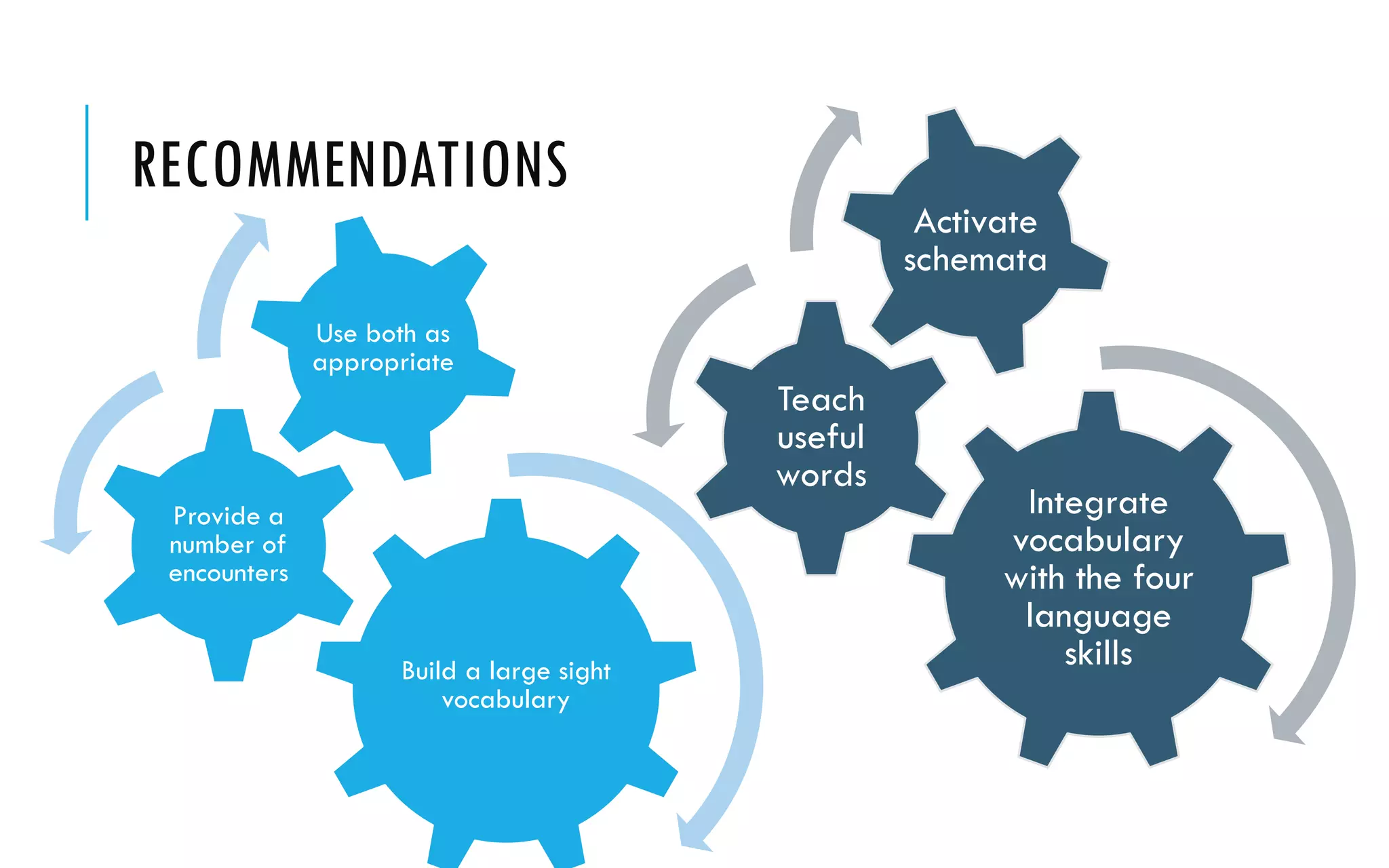
RECOMMENDATIONS
Integrate
vocabulary
with the four
language
skills
Teach
useful
words
Activate
schemata
Build a large sight
vocabulary
Provide a
number of
encounters
Use both as
appropriate
Arigatho, Shukran, Shukriyya & Thank you!
REFERENCES
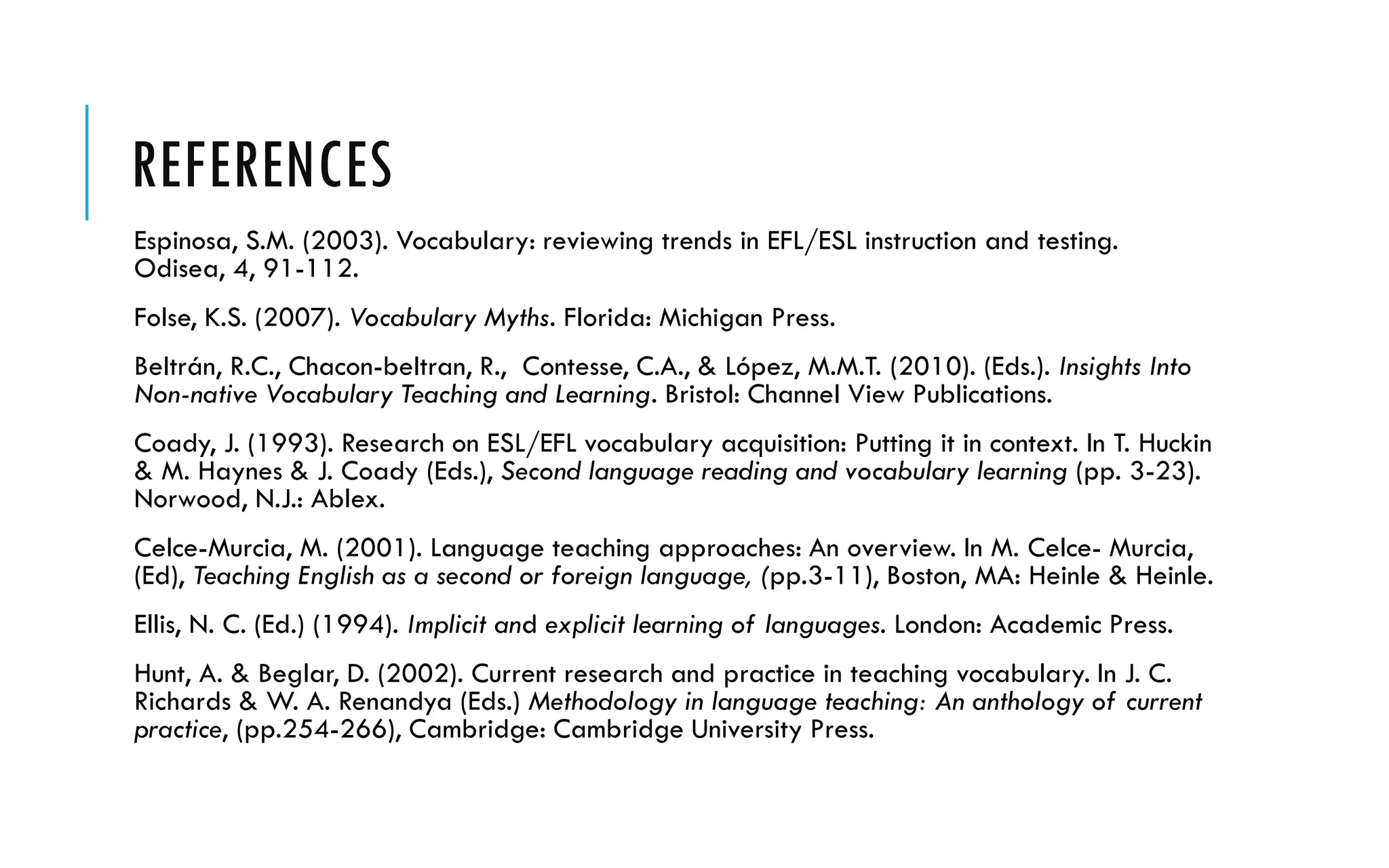
Espinosa, S.M. (2003). Vocabulary: reviewing trends in EFL/ESL instruction and testing.
Odisea, 4, 91-112.
Folse, K.S. (2007). Vocabulary Myths. Florida: Michigan Press.
Beltrán, R.C., Chacon-beltran, R., Contesse, C.A., & López, M.M.T. (2010). (Eds.). Insights Into
Non-native Vocabulary Teaching and Learning. Bristol: Channel View Publications.
Coady, J. (1993). Research on ESL/EFL vocabulary acquisition: Putting it in context. In T. Huckin
& M. Haynes & J. Coady (Eds.), Second language reading and vocabulary learning (pp. 3-23).
Norwood, N.J.: Ablex.
Celce-Murcia, M. (2001). Language teaching approaches: An overview. In M. Celce- Murcia,
(Ed), Teaching English as a second or foreign language, (pp.3-11), Boston, MA: Heinle & Heinle.
Ellis, N. C. (Ed.) (1994). Implicit and explicit learning of languages. London: Academic Press.
Hunt, A. & Beglar, D. (2002). Current research and practice in teaching vocabulary. In J. C.
Richards & W. A. Renandya (Eds.) Methodology in language teaching: An anthology of current
practice, (pp.254-266), Cambridge: Cambridge University Press.
REFERENCES
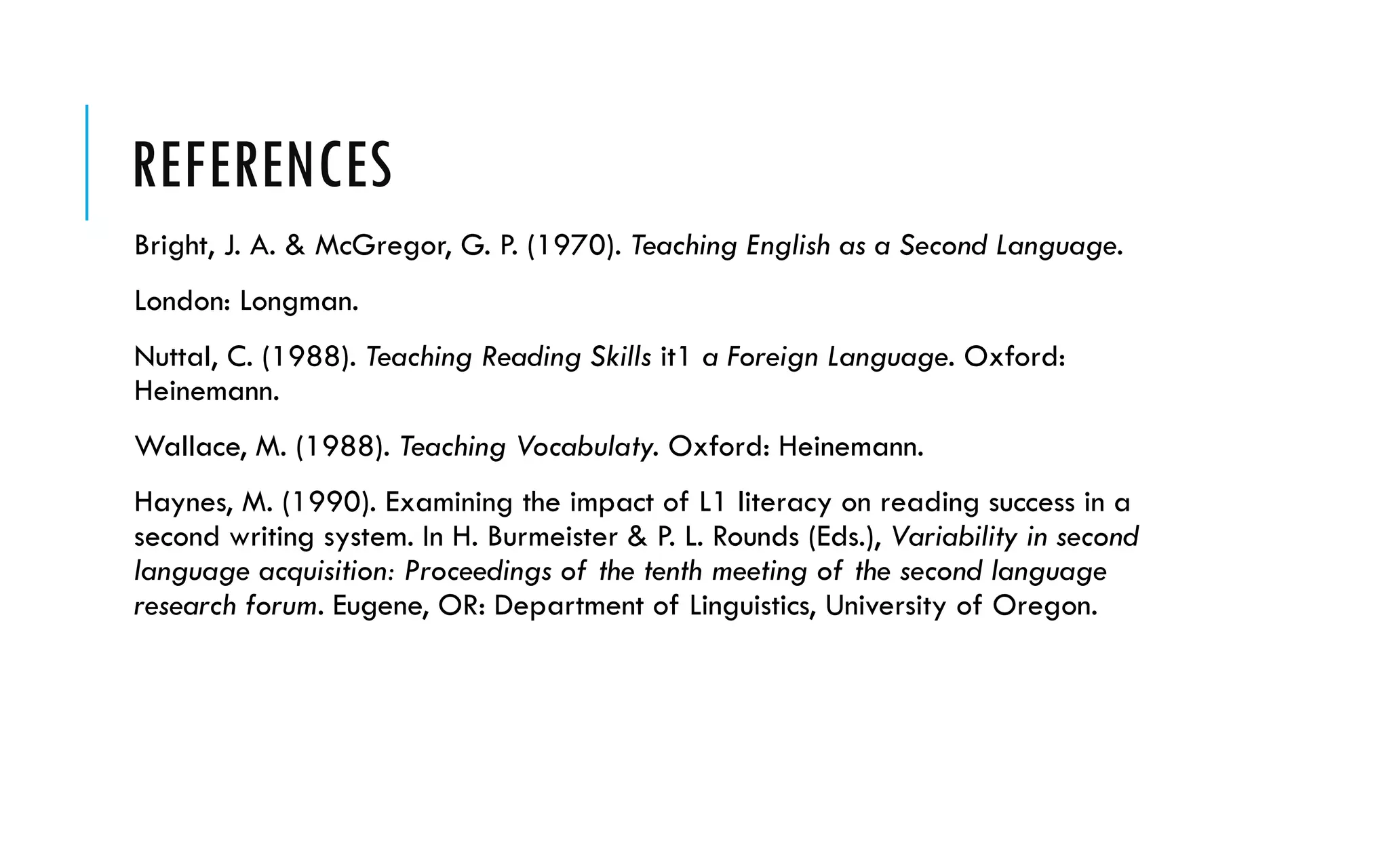
Bright, J. A. & McGregor, G. P. (1970). Teaching English as a Second Language.
London: Longman.
Nuttal, C. (1988). Teaching Reading Skills it1 a Foreign Language. Oxford:
Heinemann.
Wallace, M. (1988). Teaching Vocabulaty. Oxford: Heinemann.
Haynes, M. (1990). Examining the impact of L1 literacy on reading success in a
second writing system. In H. Burmeister & P. L. Rounds (Eds.), Variability in second
language acquisition: Proceedings of the tenth meeting of the second language
research forum. Eugene, OR: Department of Linguistics, University of Oregon.

Vocabulary Teaching: Implicit vs Explicit Instruction

  • 1.
    Hold my hand,if you love me Come to see gumusservi
  • 3.
    Hold my hand,be mine Come to see the moonshine 1. Illegally distilled alcohol 2. Smuggled whisky 3. Nonsense 4. Moonlight
  • 4.
    VOCABULARY TEACHING: IMPLICIT VSEXPLICIT INSTRUCTION By Mohamed Sujaau 10024 BATEFL / CST305
  • 5.
    CONTENT What is vocabulary Why was vocabulary teachingneglected Implicit vs Explicit instruction • Evolution of vocabulary teaching • Teaching Implications • Recommendations • References
  • 6.
    WHAT IS VOCABULARY •A listing of the words used in some enterprise. • A language user's knowledge of words. • The set of all words that are understood by a person or the set of all words likely to be used by that person when constructing new sentences. Collins Cobuild English Language Dictionary (1989)
  • 7.
    WHY WAS VOCABULARYTEACHING NEGLECTED 1. Assumption that L2 vocabulary would take care of itself in L2 acquisition, the same as vocabulary development in L1 (Coady, 1993). 2. Excessive focus on teaching learning strategies, grammar and sentence patterns over vocabulary (Folse, 2007). 3. Language was perceived as a finite system, whereas vocabulary is a more open unlimited subsystem (Beltrán et al., 2010).
  • 8.
    VOCABULARY TEACHING -EVOLUTION Period Method Focus 18th century – 1920s Grammar Translation Use of bilingual vocabulary lists From 1880s Reform movement Phonetics & transcription more important than vocabulary. Simple and useful words given / taught in a context. End of 19th century Direct method Everyday vocabulary taught with no translation. Objects & demonstrations used to teach simple concrete words. Abstract words taught using word associations. 1920s / 1930s Reading method / situational language teaching Vocabulary was given prominence. Word-frequency lists used.
  • 9.
    VOCABULARY TEACHING -EVOLUTION Period Method Focus 1940s Audio Lingual Simple & similar vocabulary. Language habits & exposure. Drilling. Overemphasis on grammar. 1970s Communicative Language Teaching Vocabulary is not primary focus. Appropriate use of language varieties. Emphasis on language as discourse. 1980s The Natural Approach Contextual, not direct translation. Like L1, it can be acquired. From 1980s Current perspectives Role of vocabulary emphasized. (Espinosa, 2003)
  • 10.
    VOCABULARY TEACHING -EVOLUTION (1) Grammar-Translation, (2) Direct, (3) Reading, (4) Audiolingualism (United States), (5) Oral-Situational (Britain), (6) Cognitive, (7) Affective-Humanistic, (8) Comprehension-Based, and (9) Communicative. Celce-Murcia (2001) classifies the major trends in language teaching in the twentieth century into nine approaches, namely,
  • 11.
    EXPLICIT VS IMPLICITINSTRUCTION Explicit Implicit  focuses attention directly on the information to be learned  using language for communicative purposes (Schmitt, 1988)  focuses on making the learner notice new vocabulary by doing exercises such as learning vocabulary lists, word building games and using various strategies (Nation, 1990).  the meaning of a word is acquired totally unconsciously as a result of abstraction from repeated exposures in a range of activated contexts. (Ellis, 1994:219)  applying metacognitive strategies to remember new vocabulary, to consolidate a new understanding by repetition…’ (Ellis, 1994:219).  More contextualized, thus enables learners to learn more words and can boost their vocabulary retention (Hunt and Beglar, 2002).
  • 12.
    TEACHING IMPLICATIONS –EXPLICIT METHOD Grade 1
  • 13.
    TEACHING IMPLICATIONS –EXPLICIT METHOD Grade 3
  • 14.
    TEACHING IMPLICATIONS –EXPLICIT METHOD 1) L2 learners have to make more conscious effort to learn words (Nuttall1988: 70). 2) Because most SS are not aware that it is possible to understand new words without being told what they mean (Bright & McGregor 1970). 3) Because we need to encourage the students to adopt a positive attitude towards new lexical items. 1) Tendency to concentrate on individual words. 2) The learner may not attempt to use the context to decode meaning. 3) Over-frequent use of the dictionary can affect reading (Wallace, 1988).
  • 15.
    TEACHING IMPLICATIONS –IMPLICIT METHOD Grade 4
  • 16.
    TEACHING IMPLICATIONS –IMPLICIT METHOD 1) To infer meaning from context in the same way native speakers or competent speakers of a foreign language do. 2) To show SS that many words can just be ignored. 3) Better able to use the word in the needed context or situation. 4) More meaningful, authentic, fosters autonomy. 1) Depends hugely on reading ability (Haynes, 1990). 2) Depends on learners’ motivation. 3) Learners might not be able to infer the correct meaning. 4) What if learners do not have the vocabulary knowledge to decipher?
  • 17.
    RECOMMENDATIONS Integrate vocabulary with the four language skills Teach useful words Activate schemata Builda large sight vocabulary Provide a number of encounters Use both as appropriate
  • 18.
  • 19.
    REFERENCES Espinosa, S.M. (2003).Vocabulary: reviewing trends in EFL/ESL instruction and testing. Odisea, 4, 91-112. Folse, K.S. (2007). Vocabulary Myths. Florida: Michigan Press. Beltrán, R.C., Chacon-beltran, R., Contesse, C.A., & López, M.M.T. (2010). (Eds.). Insights Into Non-native Vocabulary Teaching and Learning. Bristol: Channel View Publications. Coady, J. (1993). Research on ESL/EFL vocabulary acquisition: Putting it in context. In T. Huckin & M. Haynes & J. Coady (Eds.), Second language reading and vocabulary learning (pp. 3-23). Norwood, N.J.: Ablex. Celce-Murcia, M. (2001). Language teaching approaches: An overview. In M. Celce- Murcia, (Ed), Teaching English as a second or foreign language, (pp.3-11), Boston, MA: Heinle & Heinle. Ellis, N. C. (Ed.) (1994). Implicit and explicit learning of languages. London: Academic Press. Hunt, A. & Beglar, D. (2002). Current research and practice in teaching vocabulary. In J. C. Richards & W. A. Renandya (Eds.) Methodology in language teaching: An anthology of current practice, (pp.254-266), Cambridge: Cambridge University Press.
  • 20.
    REFERENCES Bright, J. A.& McGregor, G. P. (1970). Teaching English as a Second Language. London: Longman. Nuttal, C. (1988). Teaching Reading Skills it1 a Foreign Language. Oxford: Heinemann. Wallace, M. (1988). Teaching Vocabulaty. Oxford: Heinemann. Haynes, M. (1990). Examining the impact of L1 literacy on reading success in a second writing system. In H. Burmeister & P. L. Rounds (Eds.), Variability in second language acquisition: Proceedings of the tenth meeting of the second language research forum. Eugene, OR: Department of Linguistics, University of Oregon.