The multi-store model of memory proposes that memory involves three stages - sensory memory, short-term memory, and long-term memory. According to this model, information is first encoded in sensory memory briefly before being transferred to short-term memory, which can hold around 7 items of information for a limited time. For information to be remembered in the long-term, it must be rehearsed and encoded from short-term memory into long-term memory, where it can be stored indefinitely.
Multi-Store Model of
Memory
Bythe end of this lesson I will be able to…
• Understand the flow of information in memory
• Understand the distinction between encoding, storage and retrieval
• Understand the multi-store explanation of memory
What is memory?
Memoryis our ability to store, retain, & recall information.
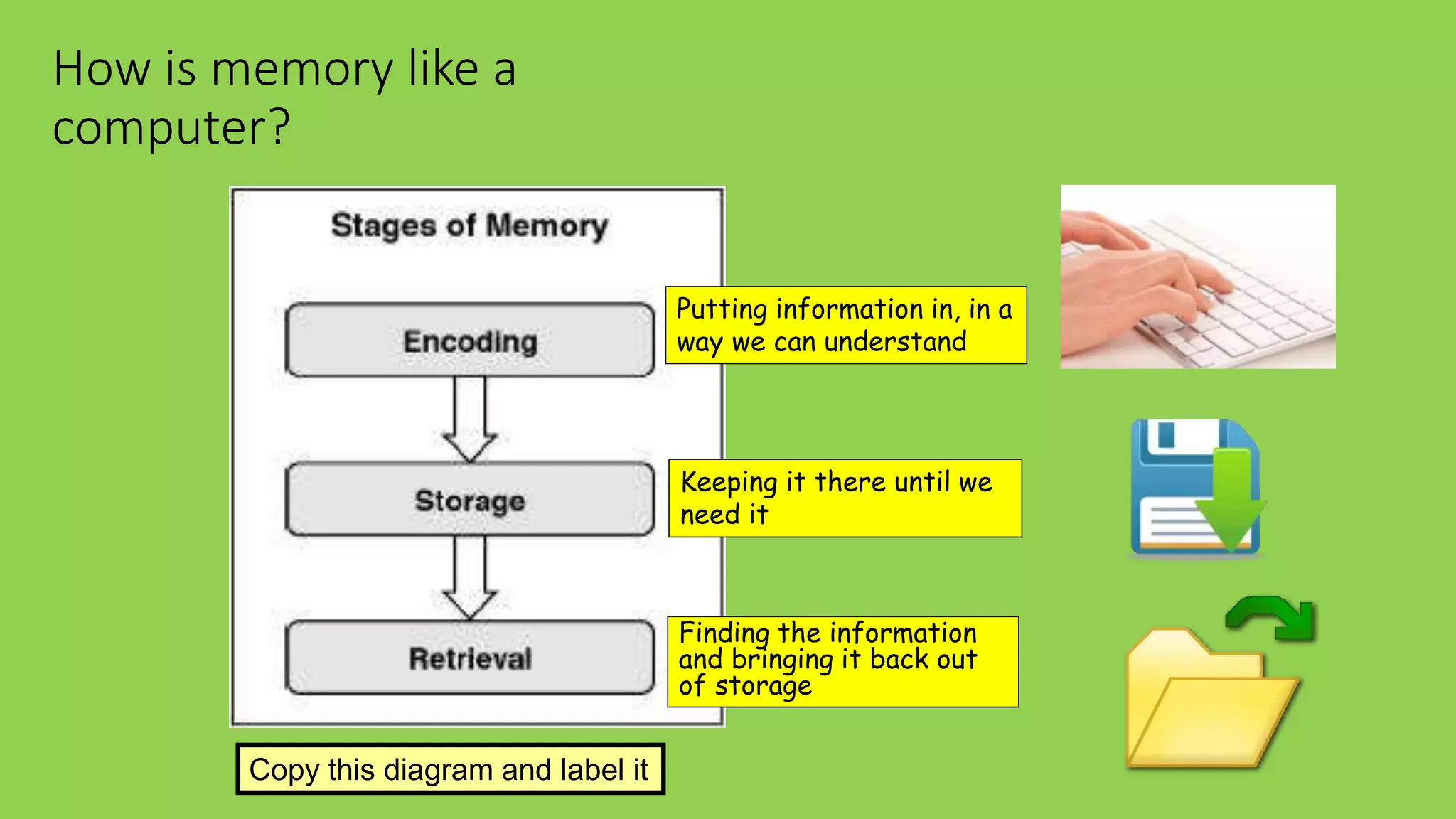
There are 3 things (processes) that our memory needs to do:
1. Encode
2. Store
3. Retrieve
5.
How is memorylike a
computer?
Putting information in, in a
way we can understand
Keeping it there until we
need it
Finding the information
and bringing it back out
of storage
Copy this diagram and label it
6.
Types of Memorystorage
• SM: Sensory Memory (storage) – hold information received from the
senses for a very short period of time
• STM: Short-Term Memory (storage) – holds approximately seven
chunks of information for a limited number of time
• LTM: Long-Term Memory (storage) – holds a vast amount of
information for a very long time
Copy these key words and definitions
7.
No…
NOT a multi-
storey!
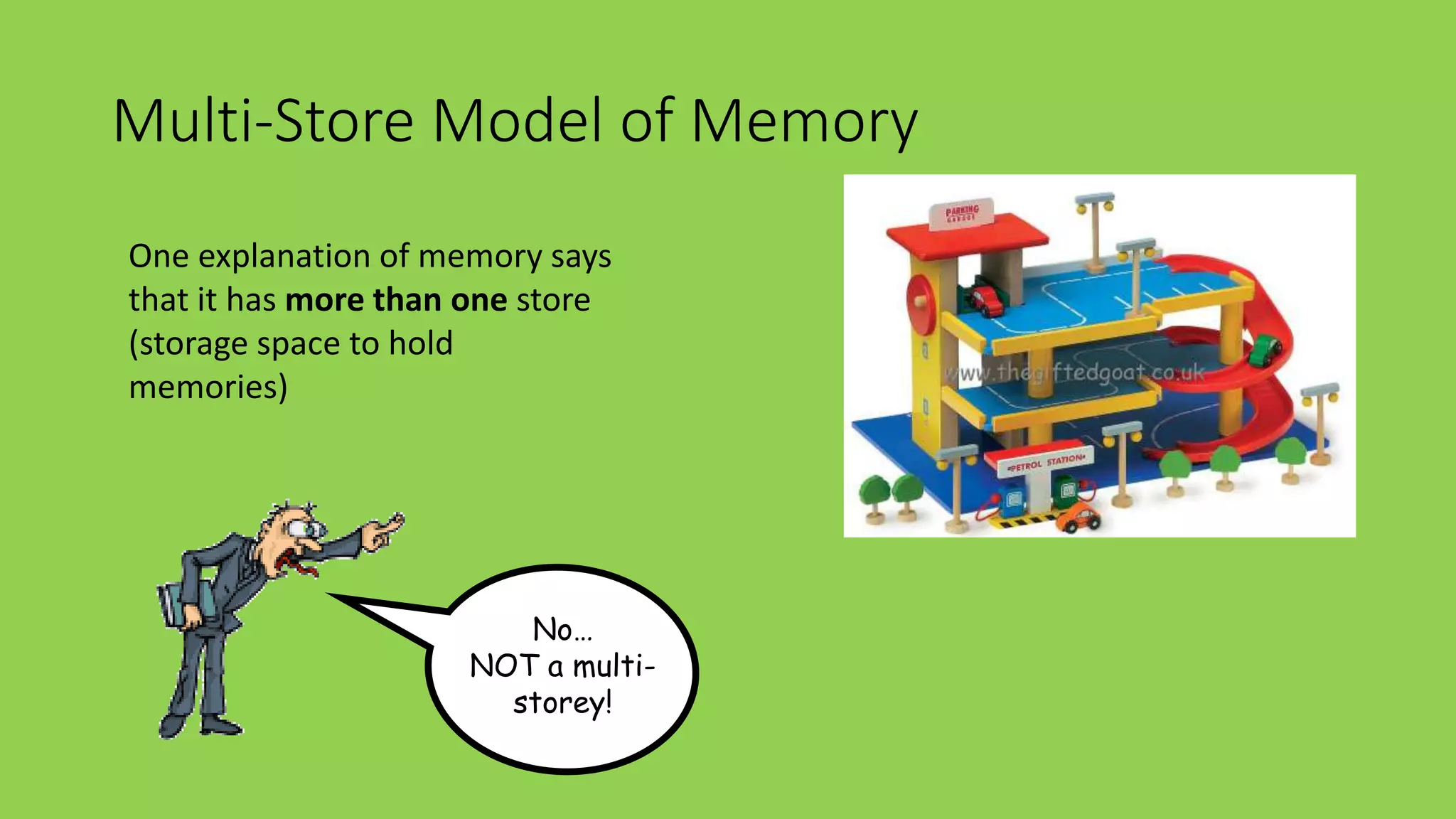
Oneexplanation of memory says
that it has more than one store
(storage space to hold
memories)
Multi-Store Model of Memory
8.
MSM: 1)Sensory Store
1.Information arrives at our
senses
2. This is briefly held in a part of
our memory called the
sensory store
3. But it only stays there for a
very short period of time and
it will quickly fade away if we
don’t do something with it…
Sight
Taste
Touch
Smell
Sound
Sensory
Store
9.
MSM: 2) Short-TermStore
• Experiments have
shown that this store
has a small capacity
• It can hold approx. 7
items or ‘chunks’ of
information
• New info pushes old info
out
SCS
ITV
BBC
GCSE
01634
CBB
WGS
FBI
10.
MSM: 3) LongTerm Store
• Experiments have
shown that this
has a very large
capacity
• Information can
stay there for a
very long time
I remember learning
about Buss and
Plomin when I was
your age!
11.
MSM
• To successfullyremember things
we have to transfer the
information from the short term
to the long term memory.
• Once there we should be able to
remember the information
forever, unless it is lost in some
way.
STM LTM
12.
The Multi-Store Model
Atkinsonand Shiffrin
Incoming
Sensory
Information
Short
Term
Memory
Sensory
Memory
Long
Term
Memory
Information
not encoded
fades
Information
lost by
displacement
Encoding
Encoding
Retrieval
Rehearsal
E.g. the latest
EastEnders
plotline
Rehearsal, or
repeating, can keep
things in your STM
for longer
STM has limited capacity
– some things get
pushed out
We remember
things by
‘retrieving’ them
from our LTM
The
EastEnders
plotline will
stay here
forever
unless it is
lost
13.
Extension – turnit over and draw it from
memory in the back of your books
14.
Quiz
1. What arethe three stages of memory (the first flow diagram you
drew)?
2. What are the three types of memory storage?
3. How long can information stay in our LTM?
4. What did Atkinson and Shiffrin call their model of memory?
5. According to Miller, how much information can we remember in
our STM?
15.
Lesson Plan
1. Recapwhat the model looks like – Gap fill diagram with word bank for differentiation
2. Define/explain what a model is, e.g. tube map
3. Activity – in pairs match cut outs of words and defs: encoding, retrieval, displacement, rehearsal
4. Activity part 2 – stick them in their books in the right order – extension = highlight the key words
5. Attention – how information is registered from senses (application/annecdote)
6. Table – features of STM and LTM, write it in from the boards, one box at a time
7. Gap-fill consolidation of what they have learned so far – differentiation with wordbank
8. MSM in the real world – give an example, then they think of their own and write it as a continuous prose
– will need examples and a structure/sentence starters
9. Evaluation of MSM – Worksheet, tick if true, use easy/obvious ones as false
10. Gap fill summary of what they have learned
11. Exam questions
12. Plenary of 2nd lesson starter – giant model
#13 Get them to draw this on blank pieces of paper. Make sure they title and date. Put it in the middle, will add stuff around it (don’t press next until most of them are nearly done so as not to overload