Chapter 6
Work, Energy and Power
‫الشغل ,الطاقة و القدرة‬
Introduction to Energy (‫)الطاقة‬
concept of energy (‫ )مفهوم الطاقة‬is one of
the most important topics in science and
engineering
 Every physical process that occurs in the
Universe (‫ )الكون‬involves energy and energy
transfers (‫ )انتقال الطاقة‬or transformations
(‫)تحولت الطاقة‬
 Energy is not easily defined
 The
Energy Approach to Problems
 The

energy approach to describing motion is
particularly useful when Newton’s Laws are
difficult or impossible to use

 An

approach will involve changing from a
particle model to a system model


This can be extended to biological organisms,
technological systems and engineering situations
Systems
A


A

system is a small portion of the Universe
We will ignore the details of the rest of the
Universe

critical skill is to identify the system
Valid System Examples
A






valid system may
be a single object or particle
be a collection of objects or particles
be a region of space
vary in size and shape
System Example
A





force applied to an object in empty space
System is the object
Its surface is the system boundary
The force is an influence on the system that acts
across the system boundary
Work (‫)الشغل‬
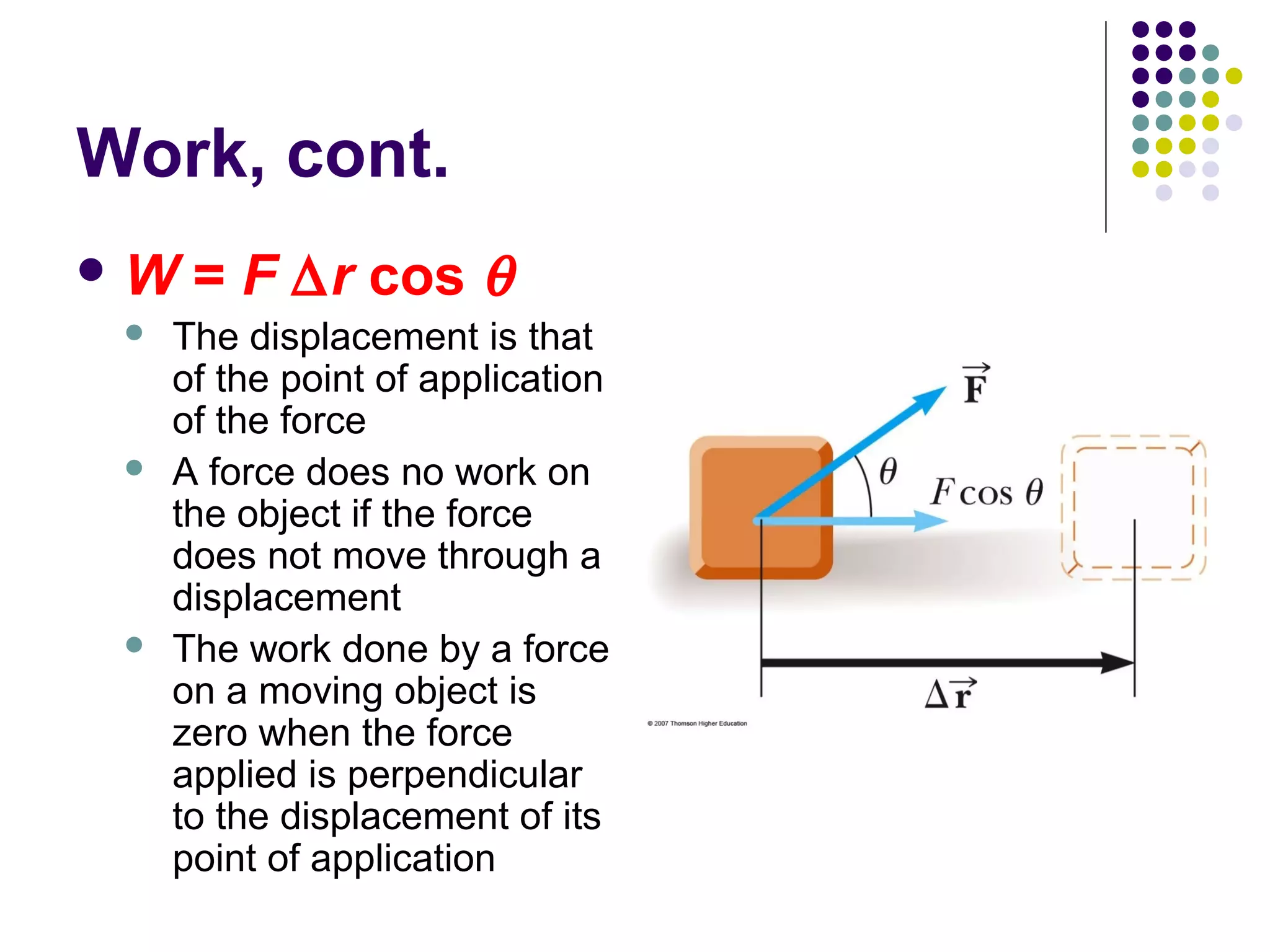
 The

work, W, done on a system by an agent
exerting a constant force on the system is the
product of the magnitude F of the force, the
magnitude ∆r of the displacement of the point
of application of the force, and cos θ, where
θ is the angle between the force and the
displacement vectors
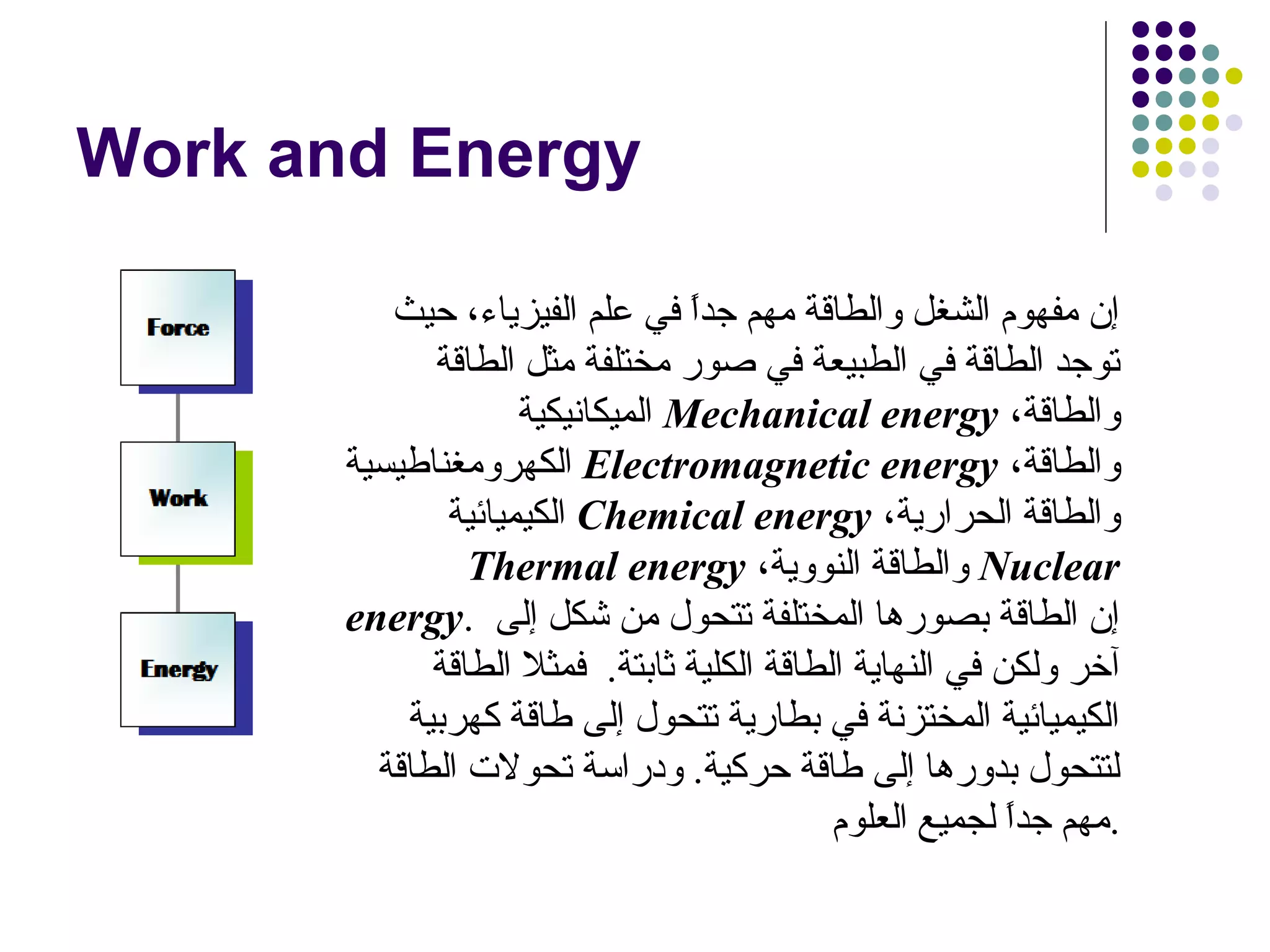
‫‪Work and Energy‬‬
‫إن مفهوم الشغل والطاقة مهم جدا في علم الفيزياء، حيث‬
‫ ً‬
‫توجد الطاقة في الطبيعة في صور مختلفة مثل الطاقة‬
‫والطاقة، ‪ Mechanical energy‬الميكانيكية‬
‫والطاقة، ‪ Electromagnetic energy‬الكهرومغناطيسية‬
‫والطاقة الحرارية، ‪ Chemical energy‬الكيميائية‬
‫‪ Nuclear‬والطاقة النووية، ‪Thermal energy‬‬
‫إن الطاقة بصورها المختلفة تتحول من شكل إلى .‪energy‬‬
‫آخر ولكن في النهاية الطاقة الكلية ثابتة. فمثل الطاقة‬
‫الكيميائية المختزنة في بطارية تتحول إلى طاقة كهربية‬
‫لتتحول بدورها إلى طاقة حركية. ودراسة تحول ت الطاقة‬
‫.مهم جدا لجميع العلوم‬
‫ ً‬
Work, cont.
W






= F ∆r cos θ

The displacement is that
of the point of application
of the force
A force does no work on
the object if the force
does not move through a
displacement
The work done by a force
on a moving object is
zero when the force
applied is perpendicular
to the displacement of its
point of application
Work Example


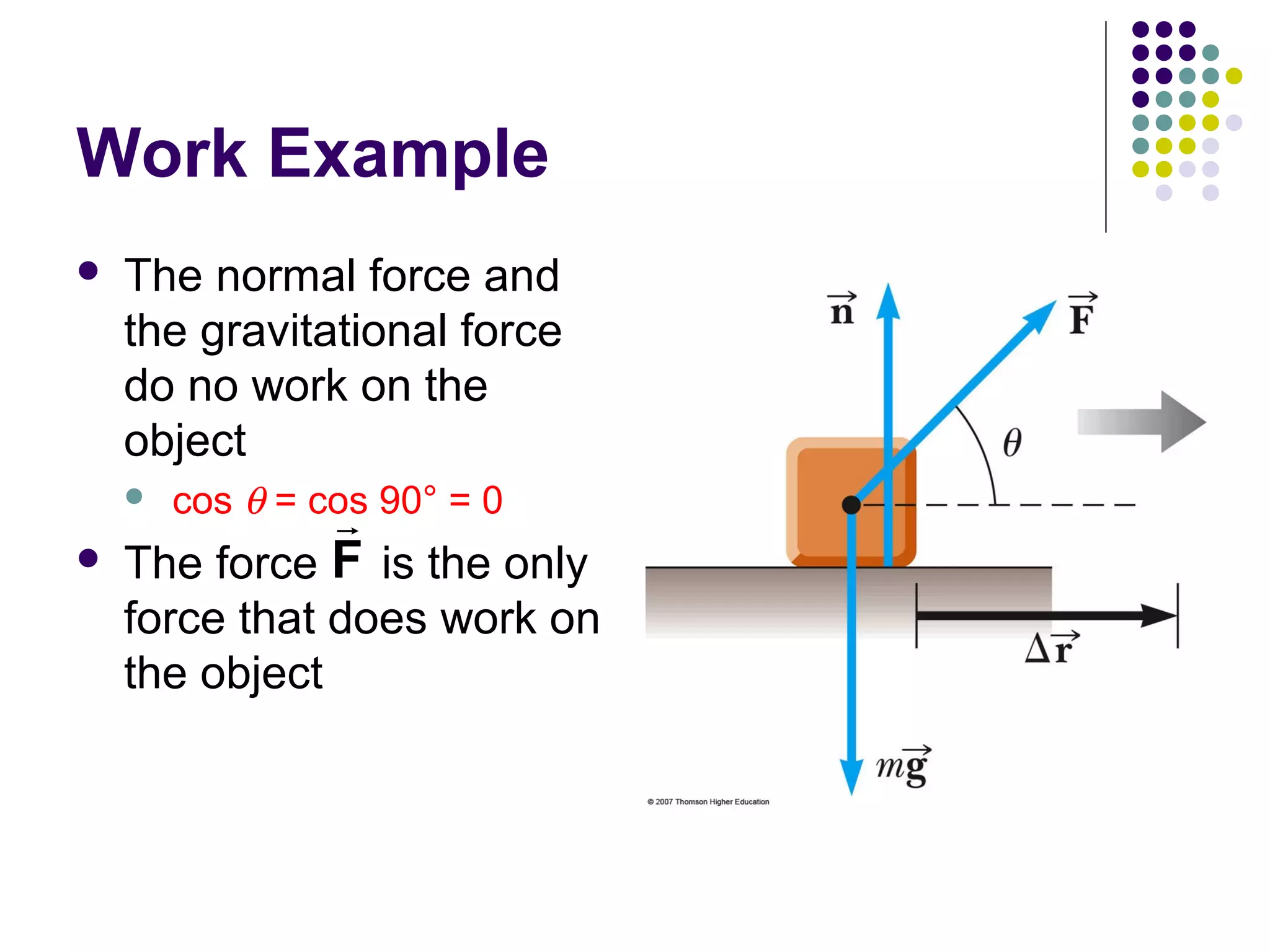
The normal force and
the gravitational force
do no work on the
object




cos θ = cos 90° = 0
r

The force F is the only
force that does work on
the object
More About Work


The system and the agent in the environment doing
the work must both be determined


The part of the environment interacting directly with the
system does work on the system
 Work by the environment on the system




Example: Work done by a hammer (interaction from environment)
on a nail (system)

The sign of the work depends on the direction of the
force relative to the displacementr
r



Work is positive when projection of F onto ∆r is in the
same direction as the displacement
Work is negative when the projection is in the opposite
direction
Units of Work
 Work

is a scalar quantity
 The unit of work is a joule (J)



1 joule = 1 newton . 1 meter
J=N·m
Work Is An Energy Transfer
 This

is important for a system approach to
solving a problem
 If the work is done on a system and it is
positive, energy is transferred to the system
 If the work done on the system is negative,
energy is transferred from the system
Work Is An Energy Transfer,
cont
 If

a system interacts with its environment, this
interaction can be described as a transfer of
energy across the system boundary


This will result in a change in the amount of
energy stored in the system
Scalar Product of Two Vectors


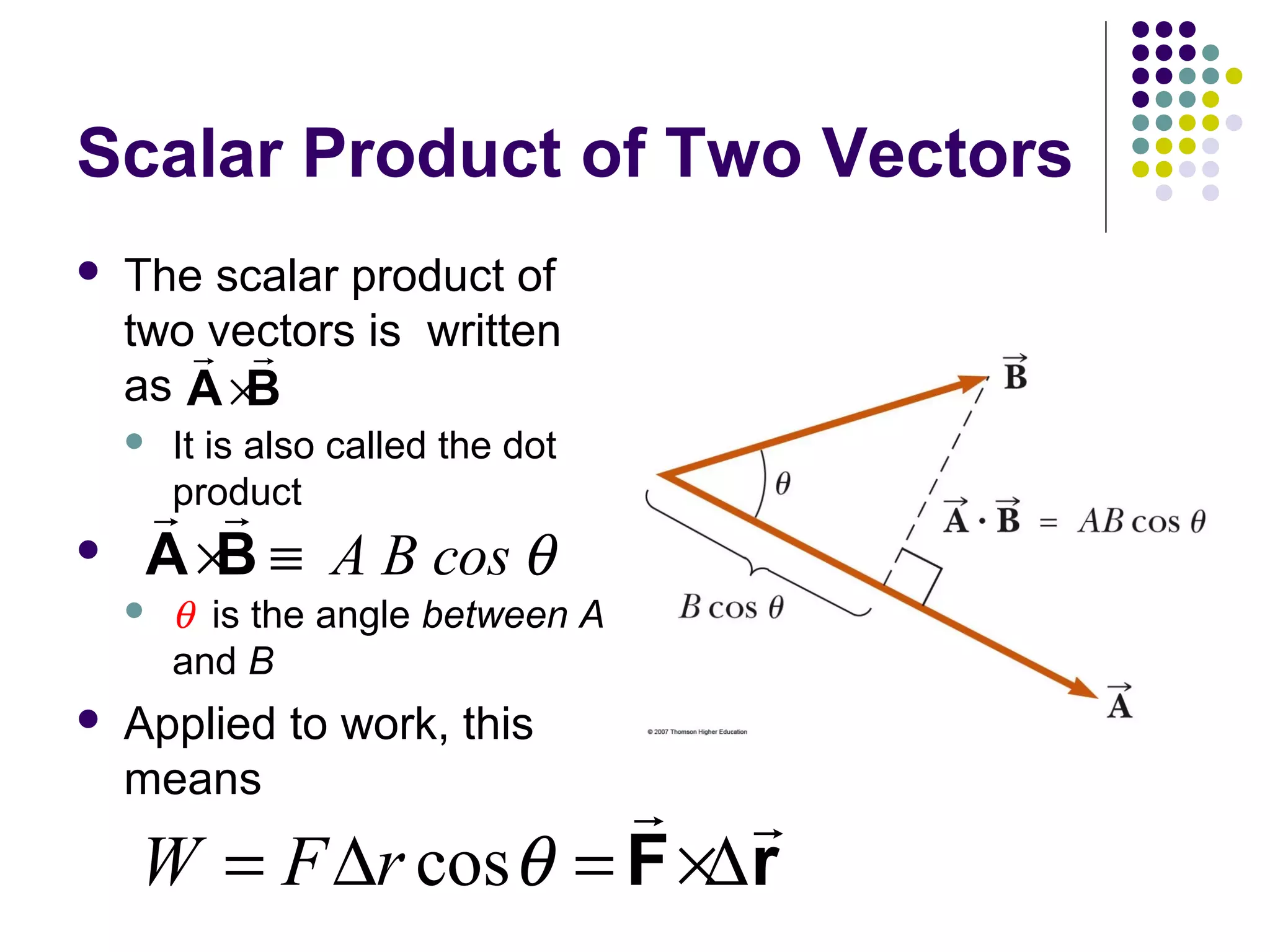
The scalar product of
tworvectors is written
r
as A ×
B




A × ≡ A B cos θ
B




It is also called the dot
rproduct
r

θ is the angle between A
and B

Applied to work, this
means

r r
W = F ∆r cos θ = F ×∆ r
Scalar Product, cont
 The

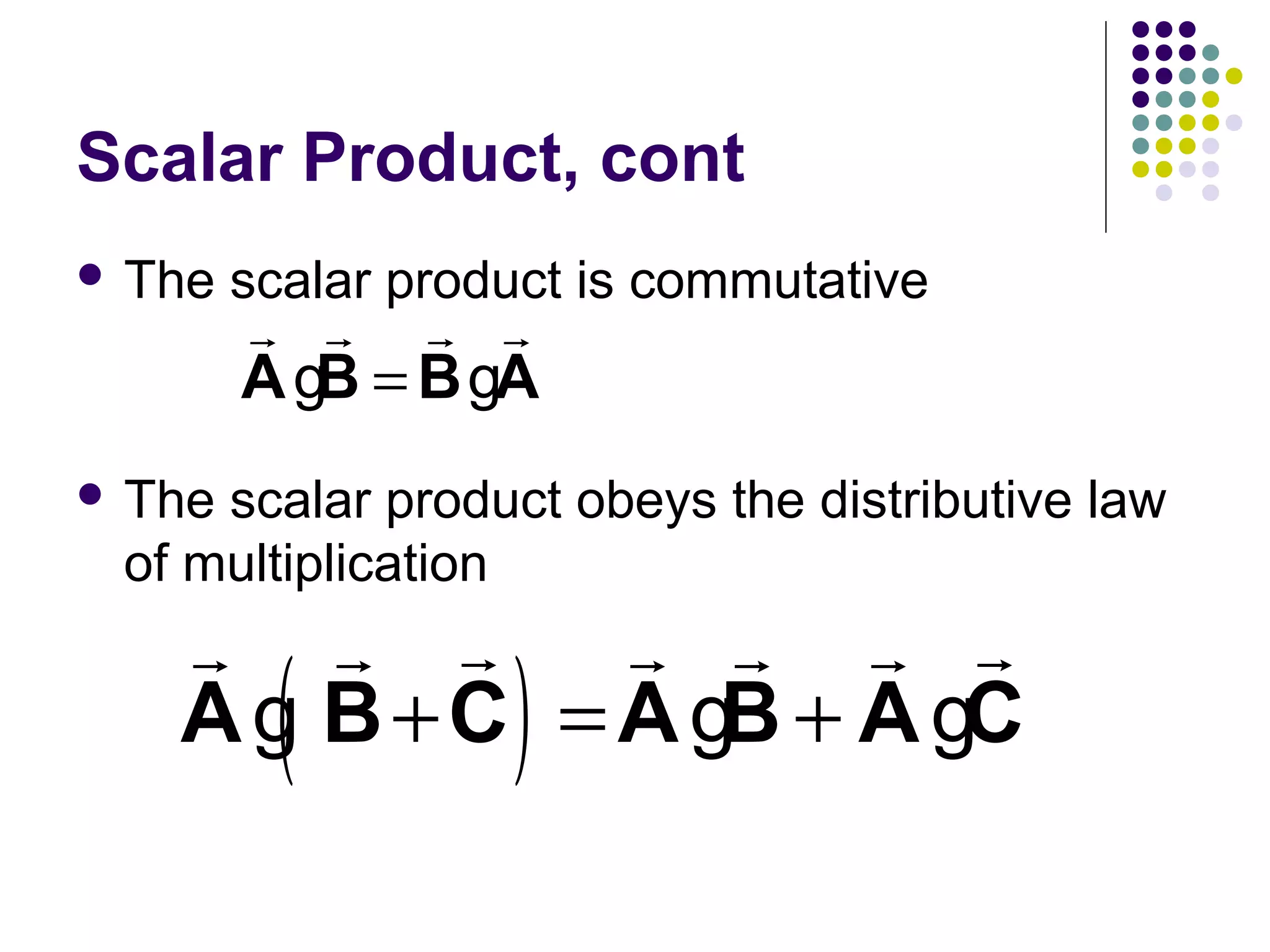
scalar product is commutative

r r r r
A gB = B gA

 The

scalar product obeys the distributive law
of multiplication

r r r
r r r r
A g B + C = A gB + A gC

(

)
Dot Products of Unit Vectors


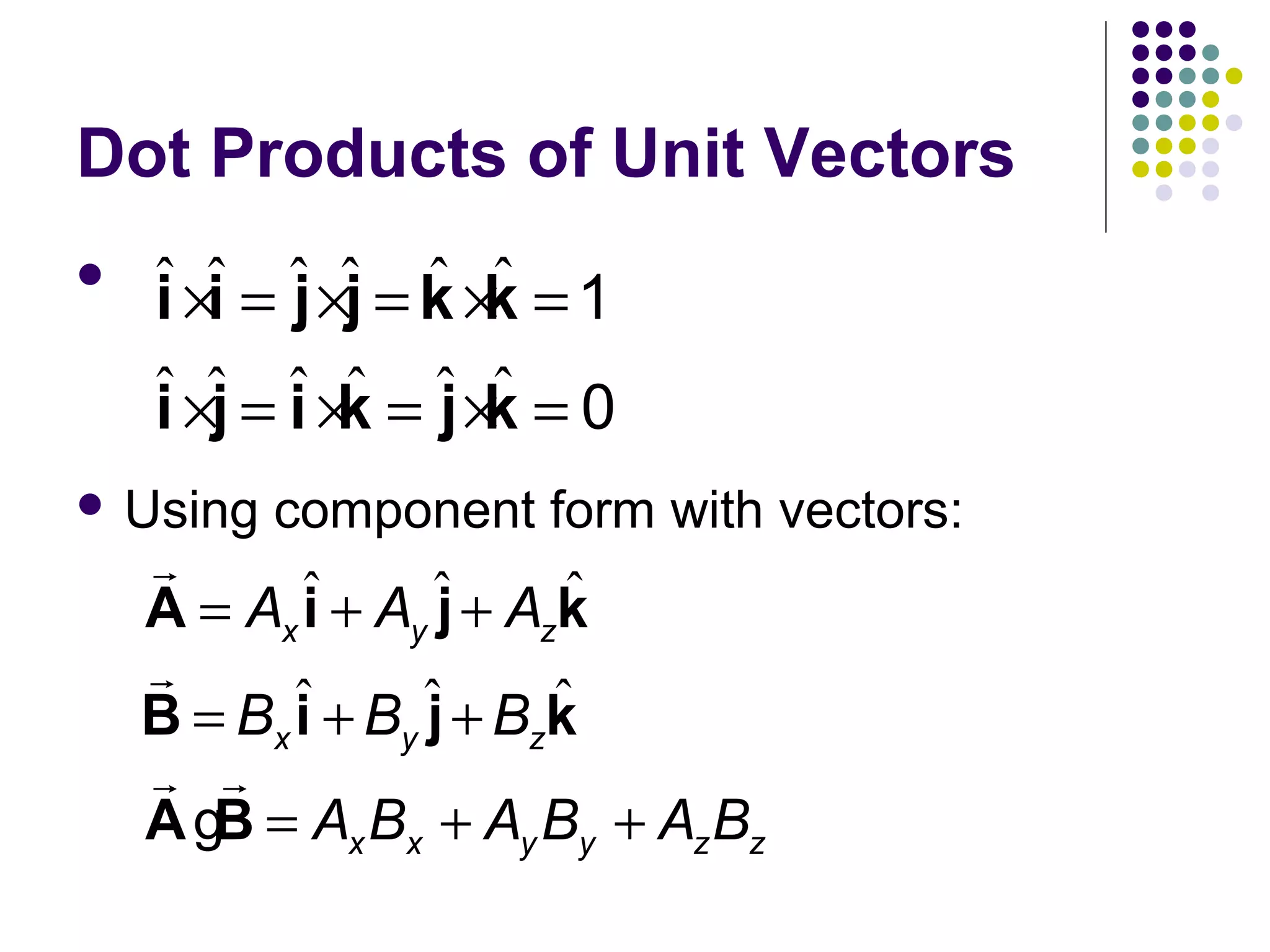
ˆ ׈ = ˆ ׈ = k ׈ = 1
i i j j ˆ k
ˆ ׈ = ˆ ׈ = ˆ ׈ = 0
i j i k j k

 Using

component form with vectors:

r
ˆ
A = Ax ˆ + Ay ˆ + Azk
i
j
r
ˆ
B = Bx ˆ + By ˆ + Bzk
i
j
r r
A gB = Ax Bx + Ay By + Az Bz
Work Done By A Spring






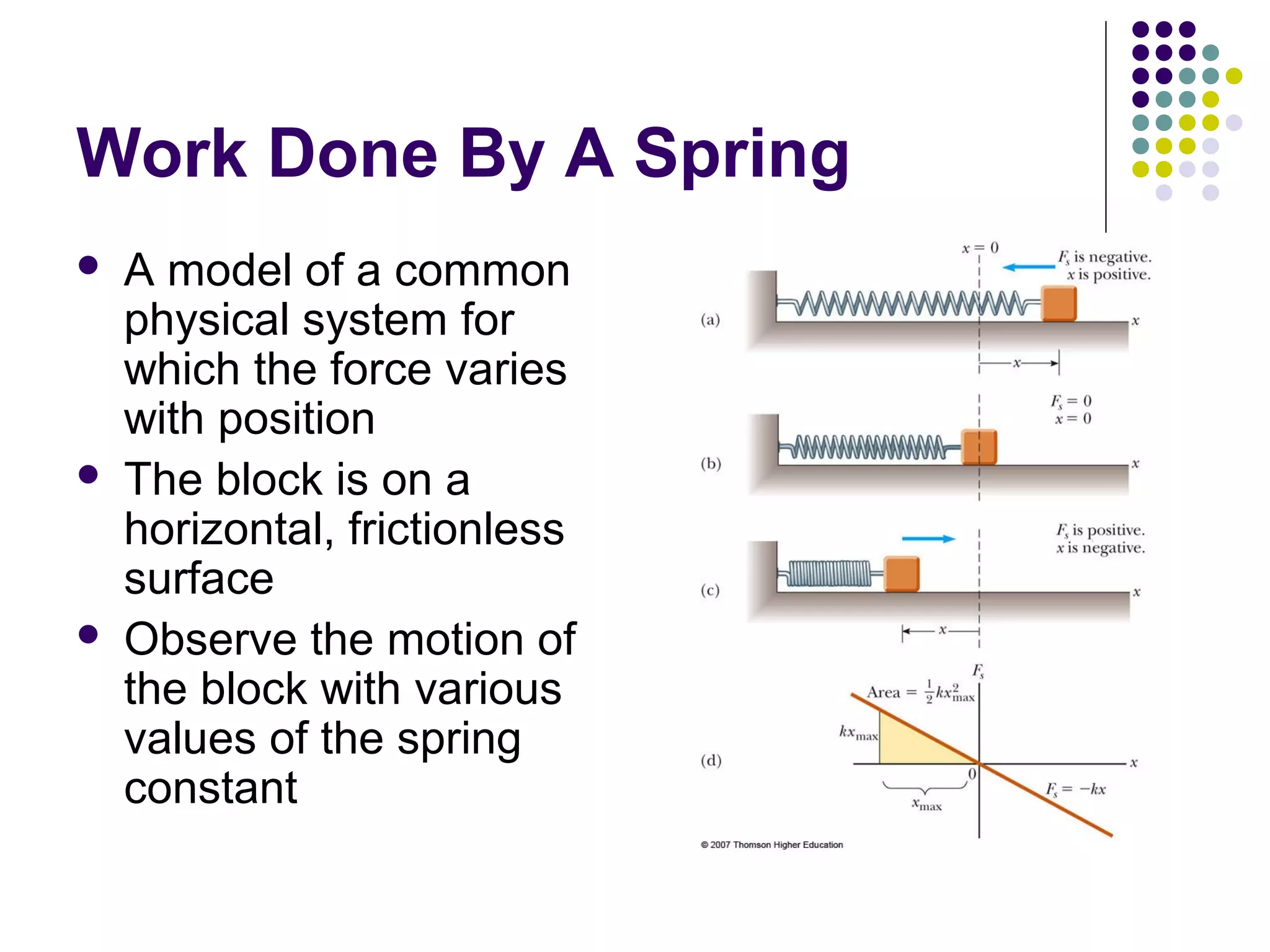
A model of a common
physical system for
which the force varies
with position
The block is on a
horizontal, frictionless
surface
Observe the motion of
the block with various
values of the spring
constant
Hooke’s Law



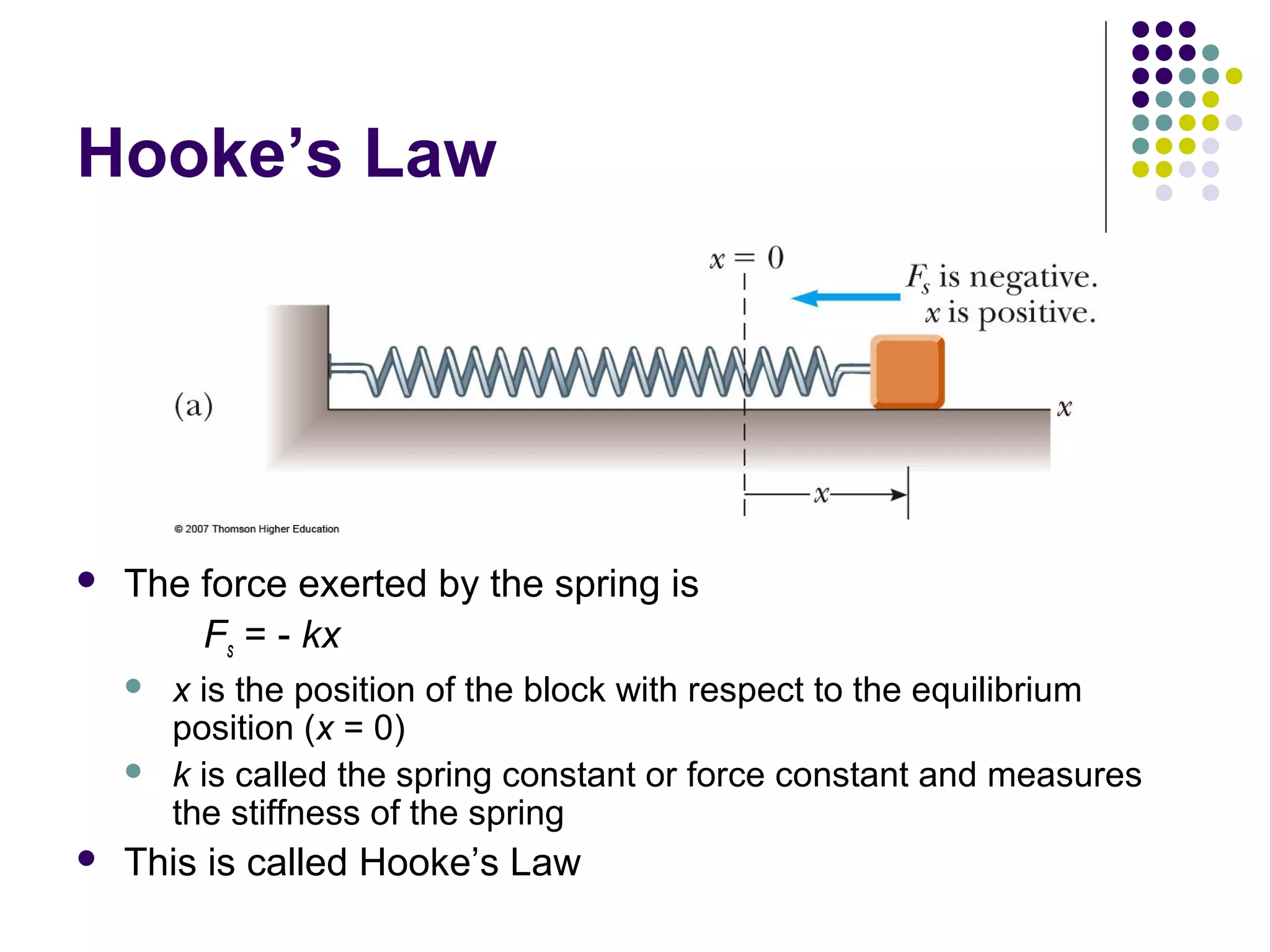
The force exerted by the spring is
Fs = - kx





x is the position of the block with respect to the equilibrium
position (x = 0)
k is called the spring constant or force constant and measures
the stiffness of the spring

This is called Hooke’s Law
Hooke’s Law, cont.






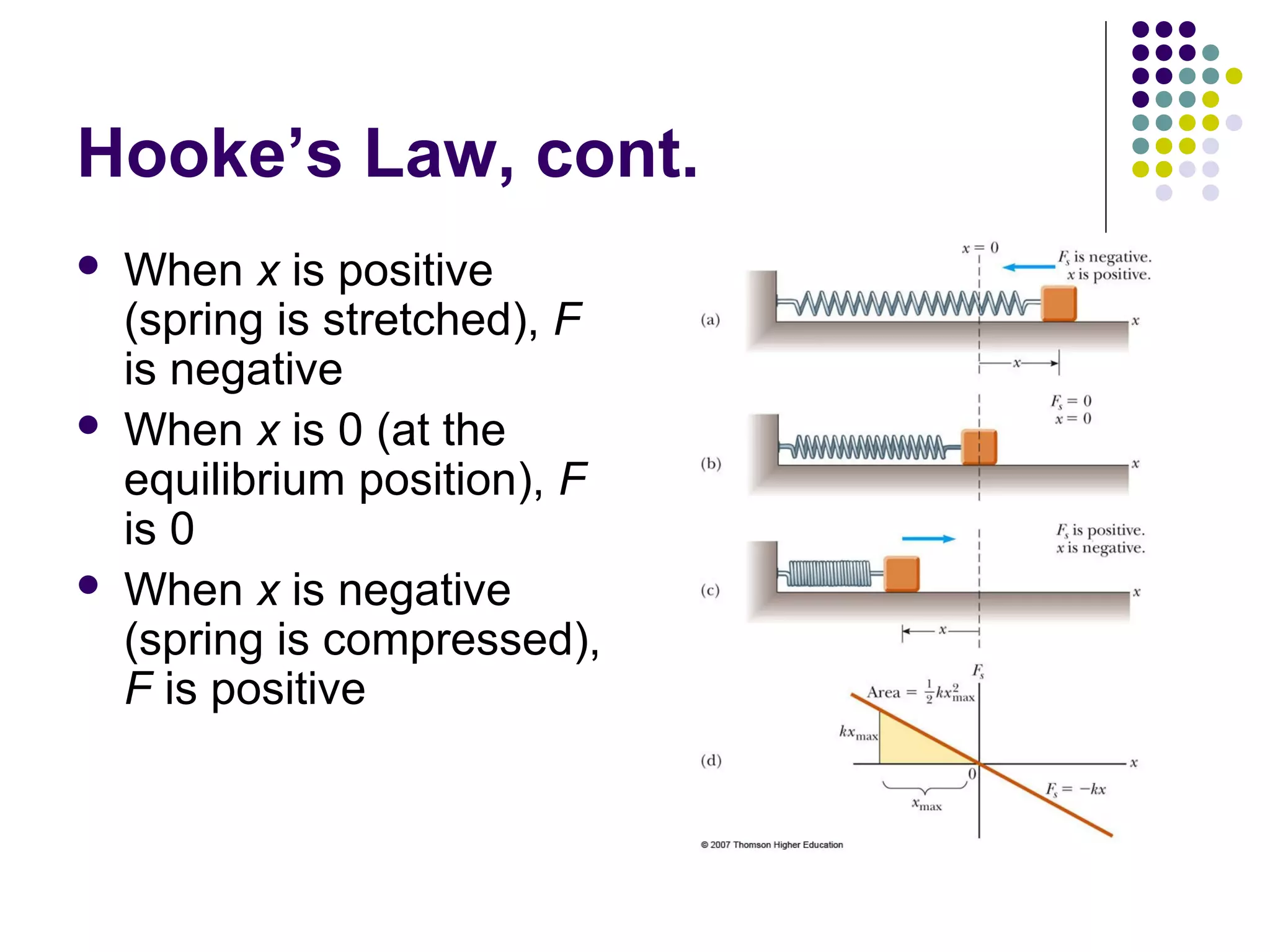
When x is positive
(spring is stretched), F
is negative
When x is 0 (at the
equilibrium position), F
is 0
When x is negative
(spring is compressed),
F is positive
Hooke’s Law, final
 The

force exerted by the spring is always
directed opposite to the displacement from
equilibrium
 The spring force is sometimes called the
restoring force
 If the block is released it will oscillate back
and forth between –x and x
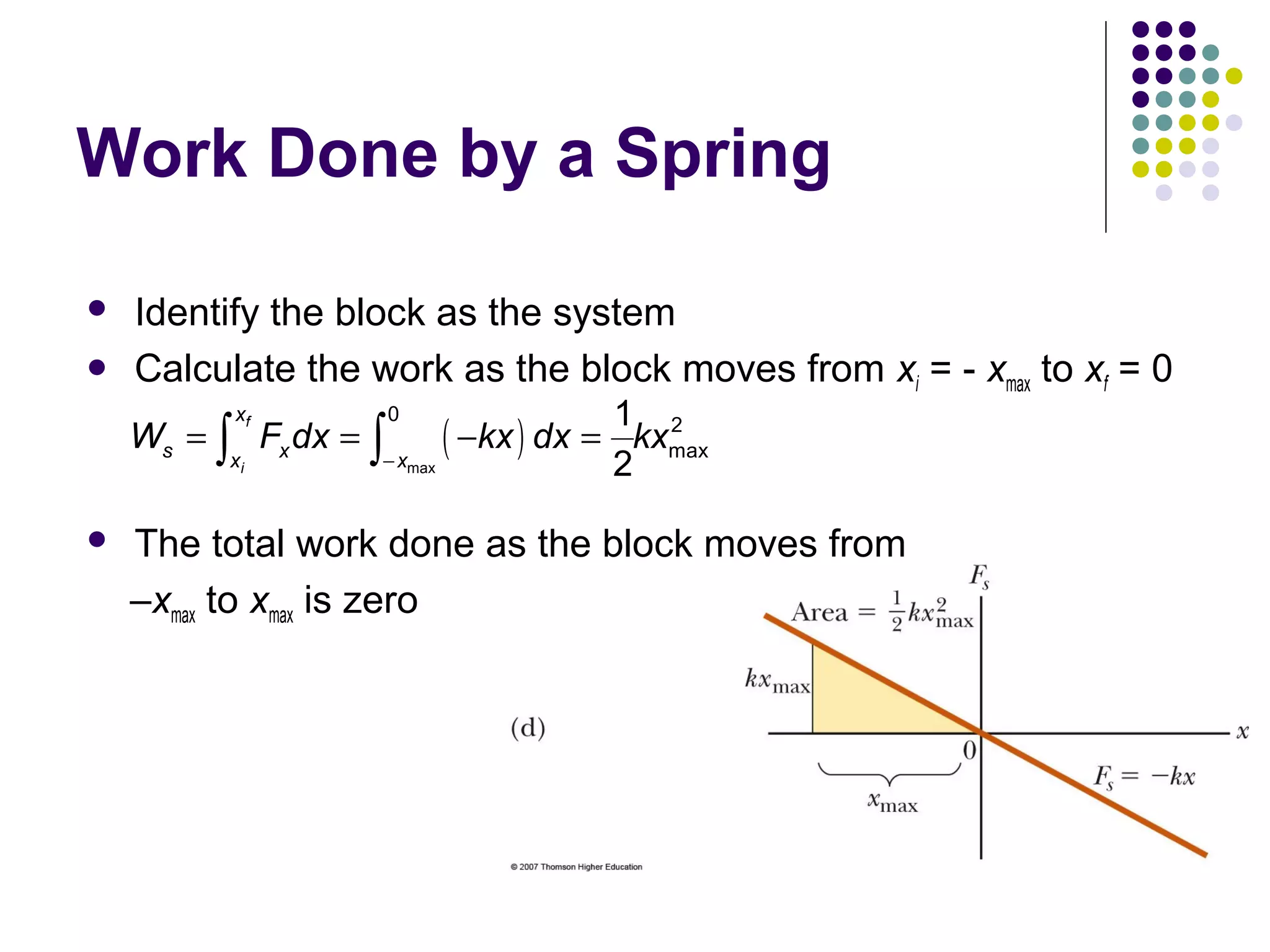
Work Done by a Spring



Identify the block as the system
Calculate the work as the block moves from xi = - xmax to xf = 0
xf

0

xi

− xmax

Ws = ∫ Fx dx = ∫


( −kx ) dx =

1 2
kxmax
2

The total work done as the block moves from
–xmax to xmax is zero
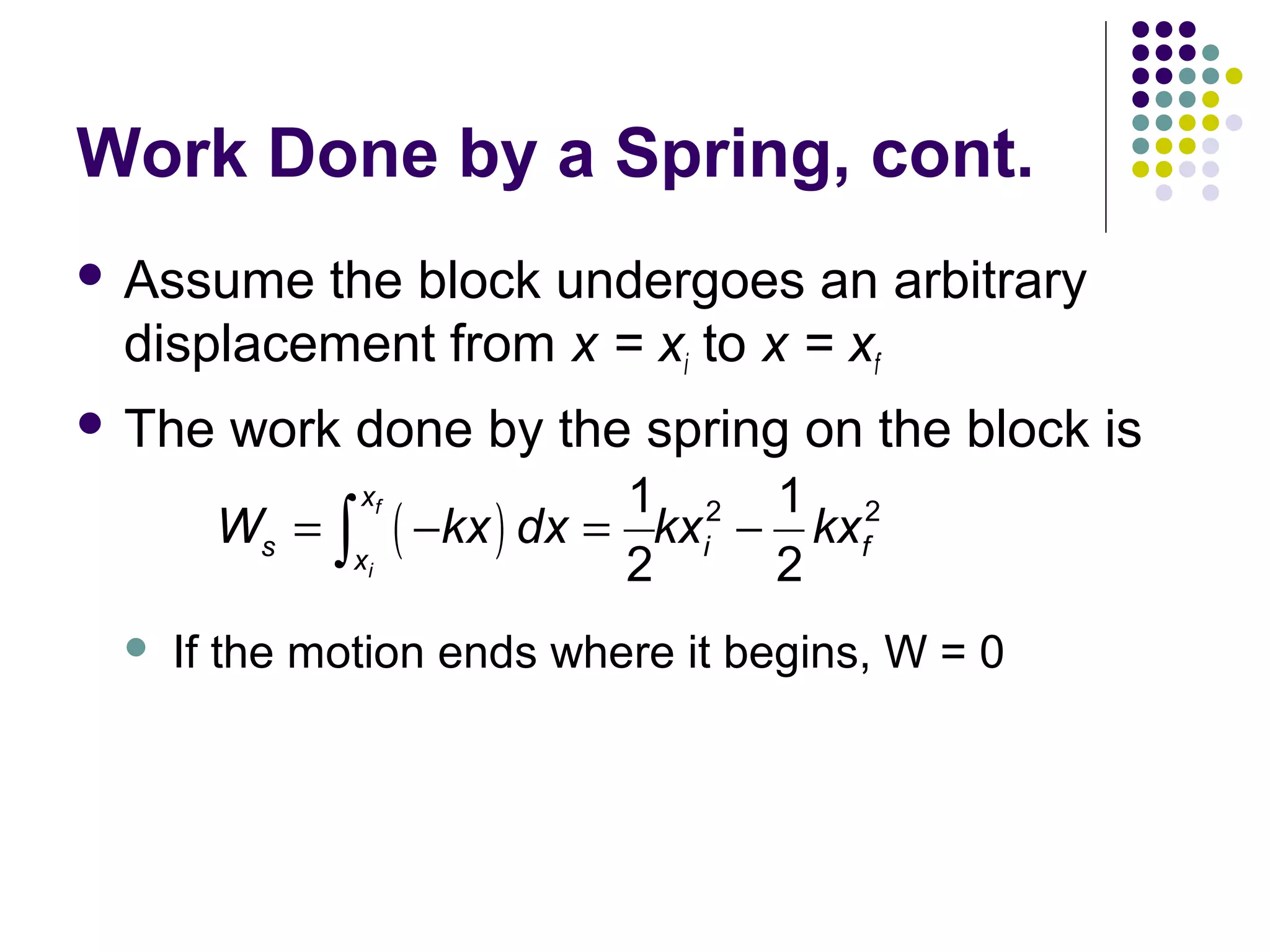
Work Done by a Spring, cont.
 Assume

the block undergoes an arbitrary
displacement from x = xi to x = xf

 The

work done by the spring on the block is
Ws = ∫

xf

xi



1 2 1 2
( −kx ) dx = kxi − kxf
2
2

If the motion ends where it begins, W = 0
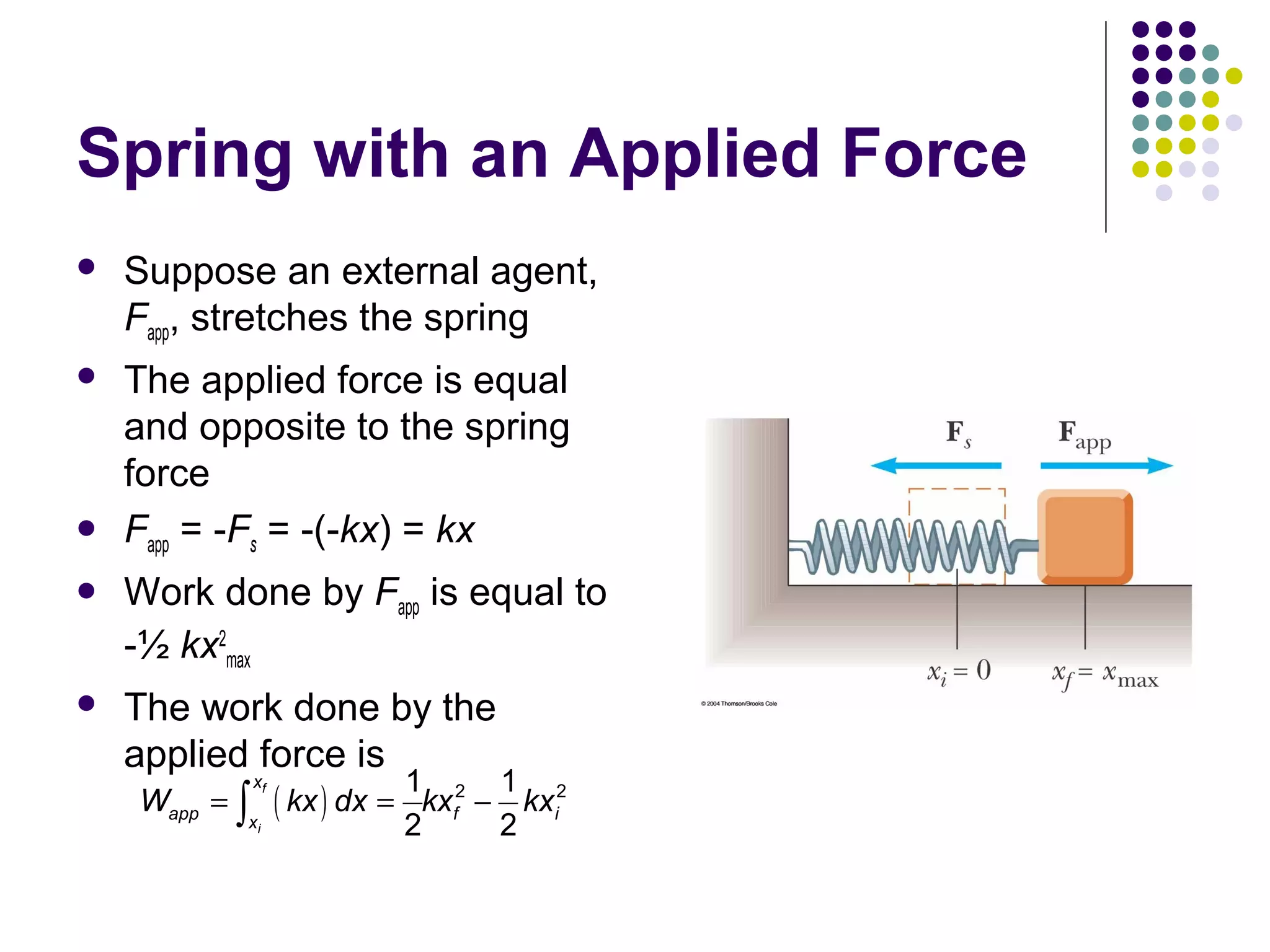
Spring with an Applied Force


Suppose an external agent,
Fapp, stretches the spring



The applied force is equal
and opposite to the spring
force
Fapp = -Fs = -(-kx) = kx




Work done by Fapp is equal to
-½ kx2max



The work done by the
applied force is
Wapp = ∫

xf

xi

( kx ) dx =

1 2 1 2
kxf − kxi
2
2
Kinetic Energy
 Kinetic

Energy is the energy of a particle due
to its motion


K = ½ mv2




A

K is the kinetic energy
m is the mass of the particle
v is the speed of the particle

change in kinetic energy is one possible
result of doing work to transfer energy into a
system
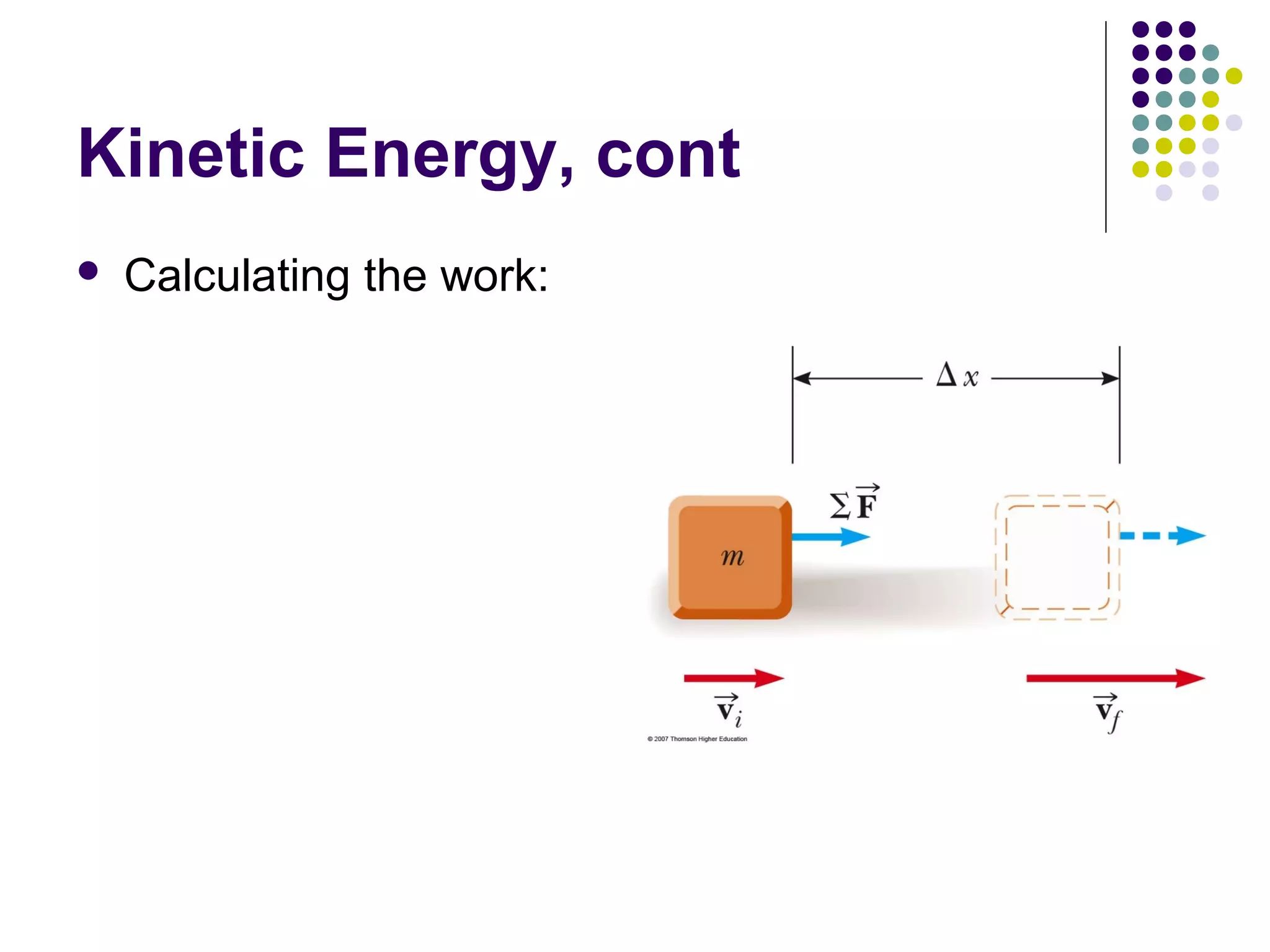
Kinetic Energy, cont


Calculating the work:
Work-Kinetic Energy Theorem




The Work-Kinetic Energy Theorem states
ΣW = Kf – Ki = ∆K
When work is done on a system and the only
change in the system is in its speed, the work done
by the net force equals the change in kinetic energy
of the system.


The speed of the system increases if the work done on it is
positive



The speed of the system decreases if the net work is
negative
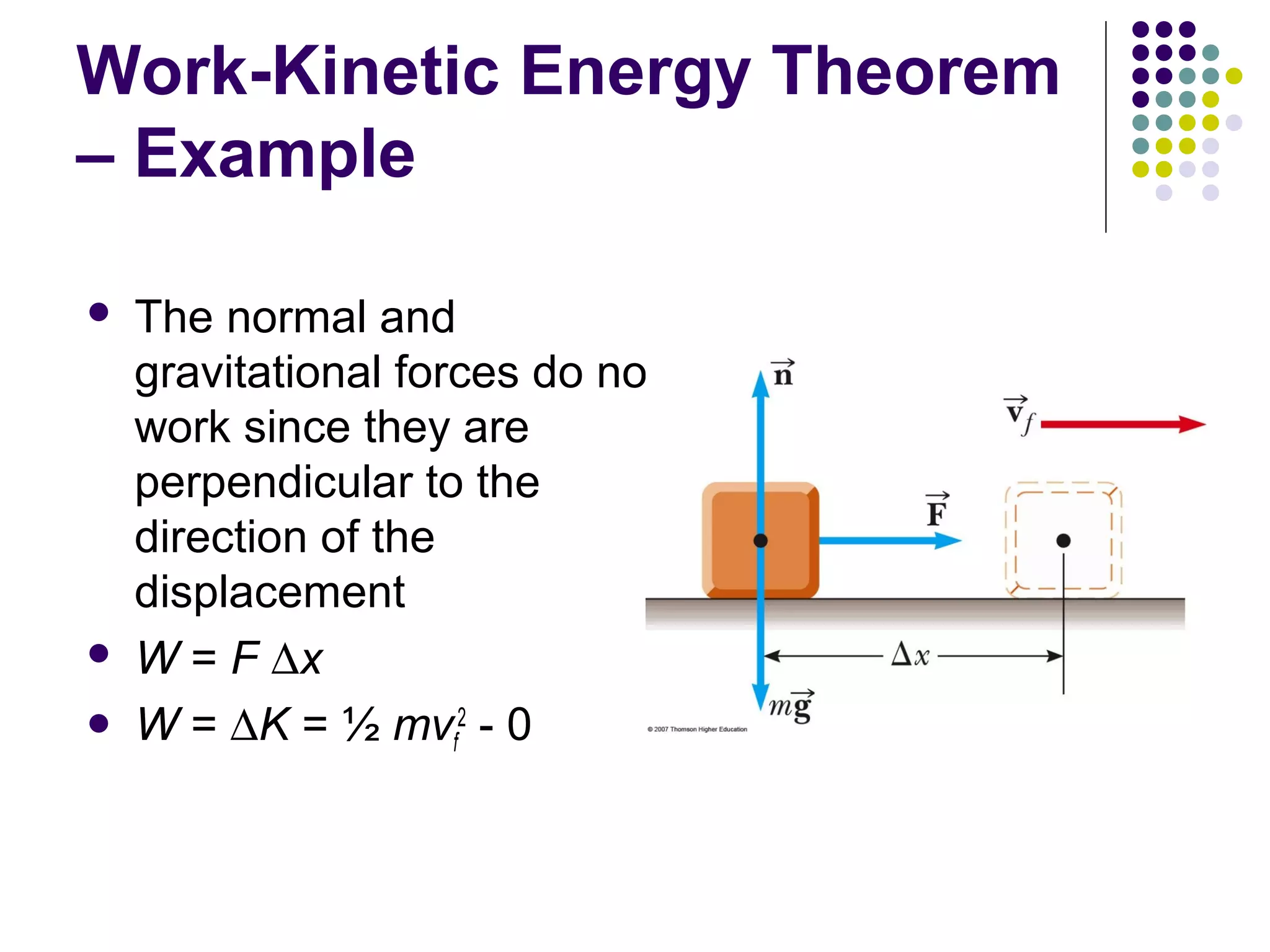
Work-Kinetic Energy Theorem
– Example





The normal and
gravitational forces do no
work since they are
perpendicular to the
direction of the
displacement
W = F ∆x
W = ∆K = ½ mvf2 - 0
Potential Energy
 Potential

energy is energy related to the
configuration of a system in which the
components of the system interact by forces



The forces are internal to the system
Can be associated with only specific types of
forces acting between members of a system
Gravitational Potential Energy




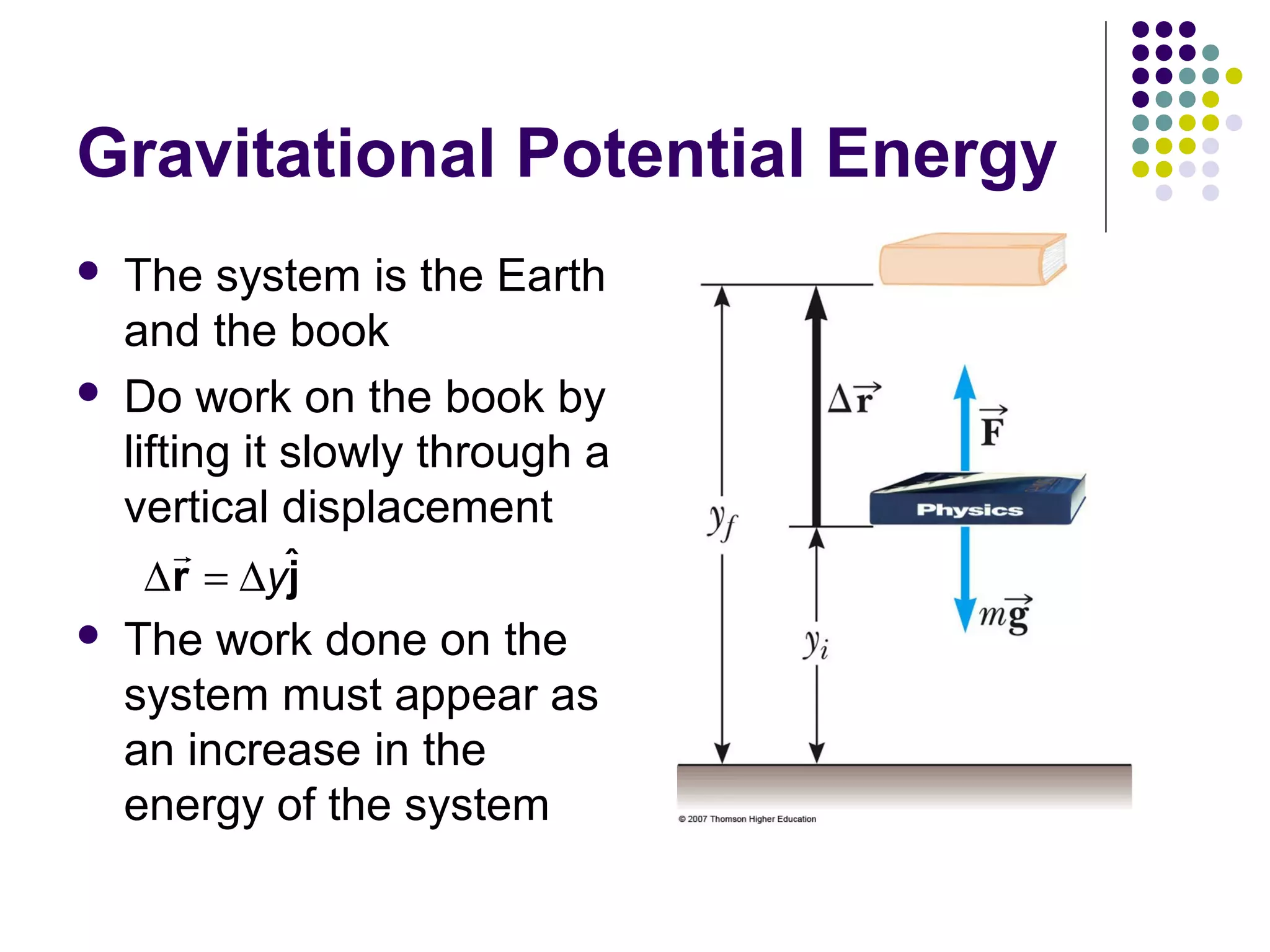
The system is the Earth
and the book
Do work on the book by
lifting it slowly through a
vertical displacement
r
∆ r = ∆yˆ
j



The work done on the
system must appear as
an increase in the
energy of the system
Gravitational Potential Energy,
cont
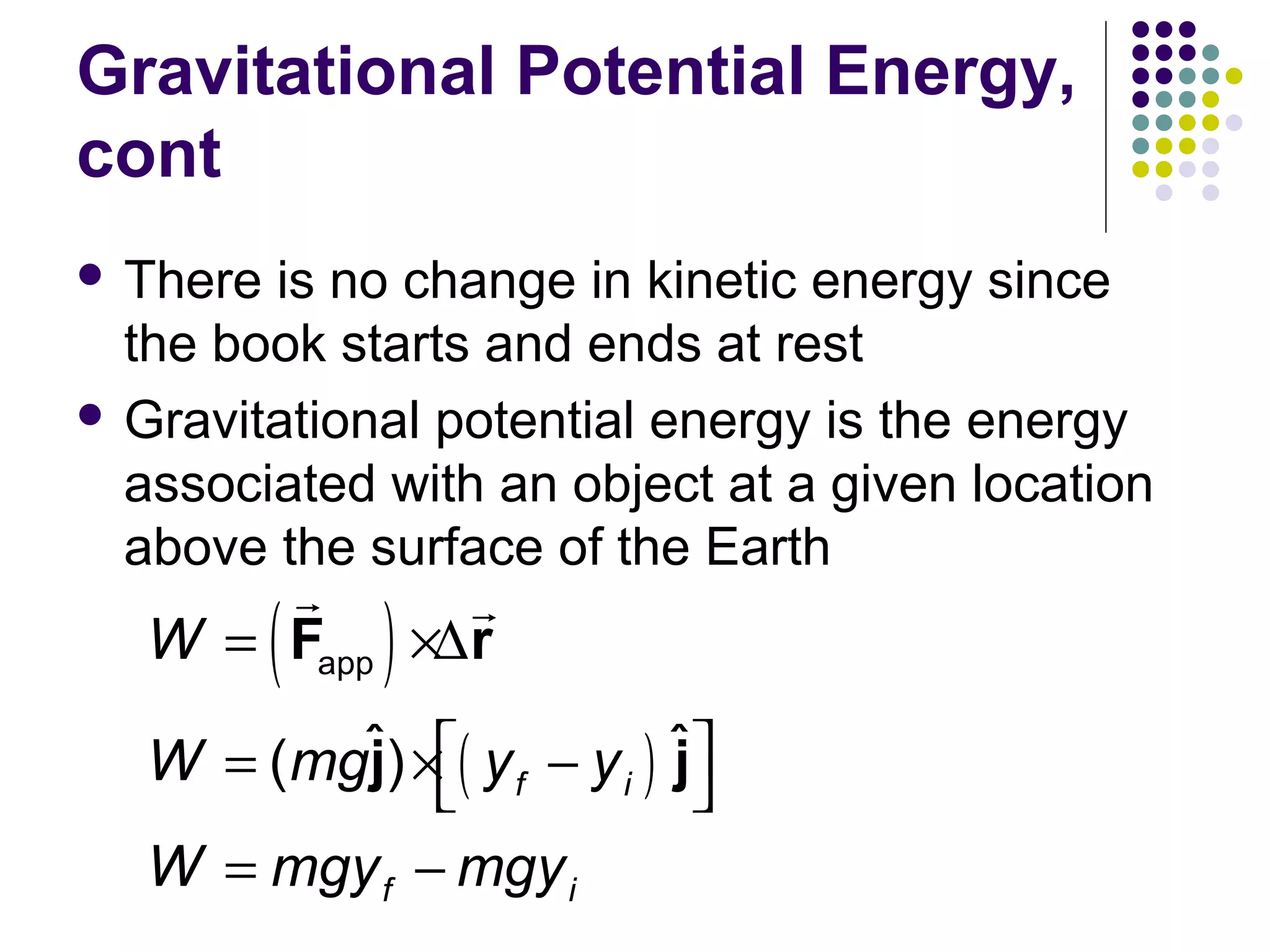
 There

is no change in kinetic energy since
the book starts and ends at rest
 Gravitational potential energy is the energy
associated with an object at a given location
above the surface of the Earth

r
r
W = Fapp ×∆ r

(

)

W = (mgˆ) ×( y f − y i ) ˆ 
j 
j
W = mgy f − mgy i
Gravitational Potential Energy,
final
 The

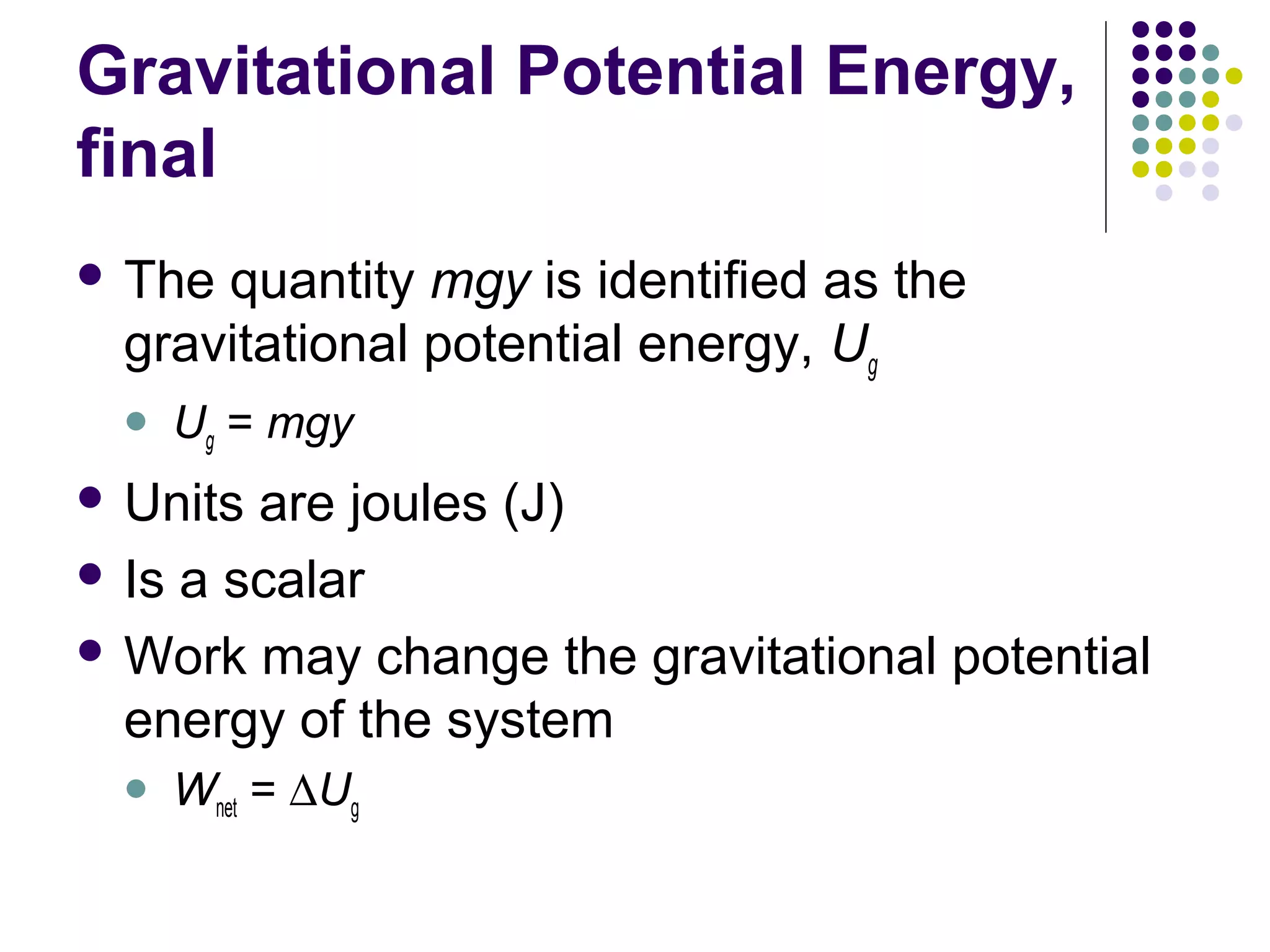
quantity mgy is identified as the
gravitational potential energy, Ug


Ug = mgy

 Units

are joules (J)
 Is a scalar
 Work may change the gravitational potential
energy of the system


Wnet = ∆Ug
Gravitational Potential Energy,
Problem Solving




The gravitational potential energy depends only on
the vertical height of the object above Earth’s
surface
In solving problems, you must choose a reference
configuration for which the gravitational potential
energy is set equal to some reference value,
normally zero


The choice is arbitrary because you normally need the
difference in potential energy, which is independent of the
choice of reference configuration
Elastic Potential Energy





Elastic Potential Energy is associated with a
spring
The force the spring exerts (on a block, for example)
is Fs = - kx
The work done by an external applied force on a
spring-block system is



W = ½ kxf2 – ½ kxi2
The work is equal to the difference between the initial and
final values of an expression related to the configuration of
the system
Elastic Potential Energy, cont








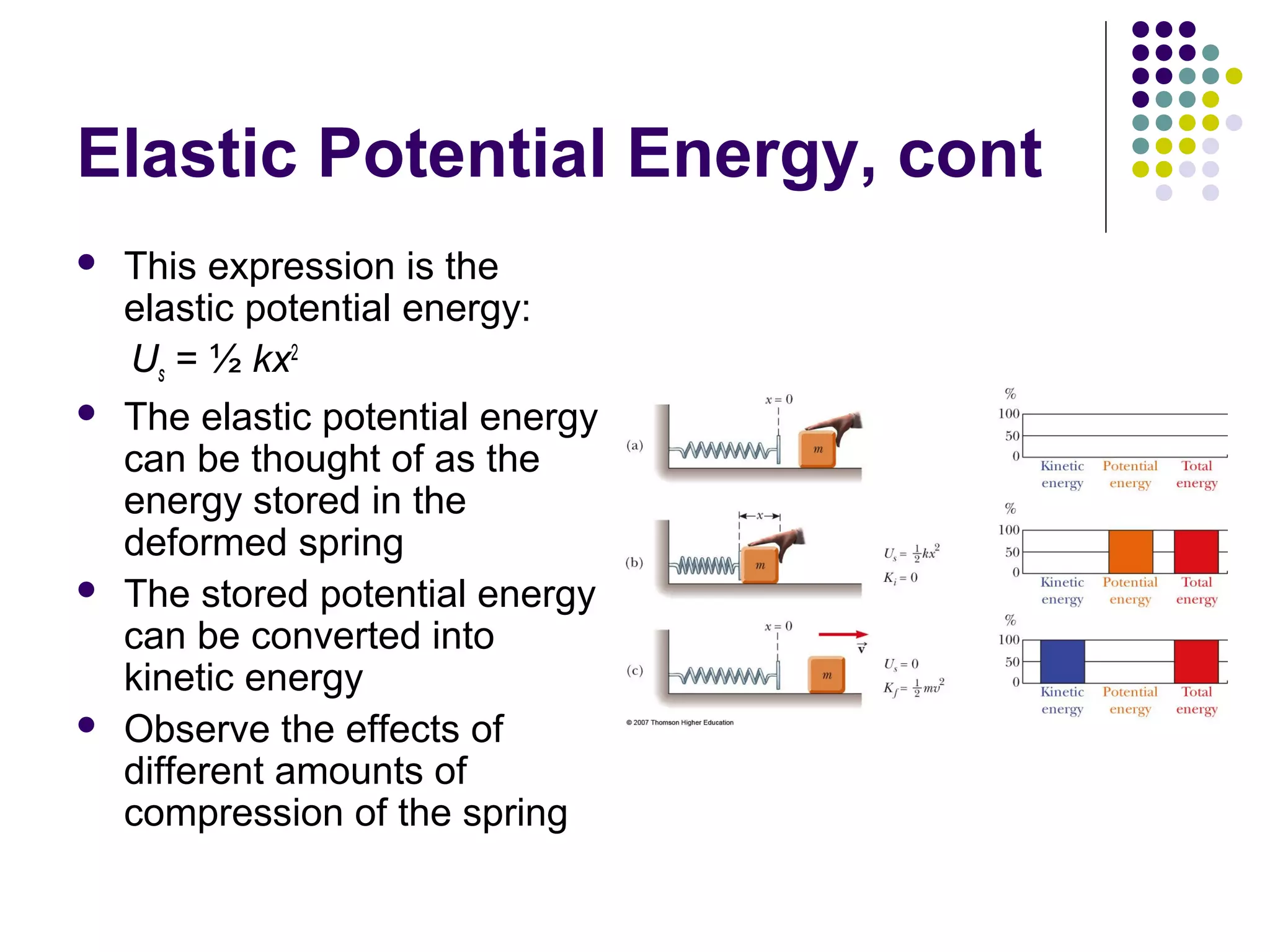
This expression is the
elastic potential energy:
Us = ½ kx2
The elastic potential energy
can be thought of as the
energy stored in the
deformed spring
The stored potential energy
can be converted into
kinetic energy
Observe the effects of
different amounts of
compression of the spring
Elastic Potential Energy, final


The elastic potential energy stored in a spring is
zero whenever the spring is not deformed (U = 0
when x = 0)






The energy is stored in the spring only when the spring is
stretched or compressed

The elastic potential energy is a maximum when the
spring has reached its maximum extension or
compression
The elastic potential energy is always positive


x2 will always be positive
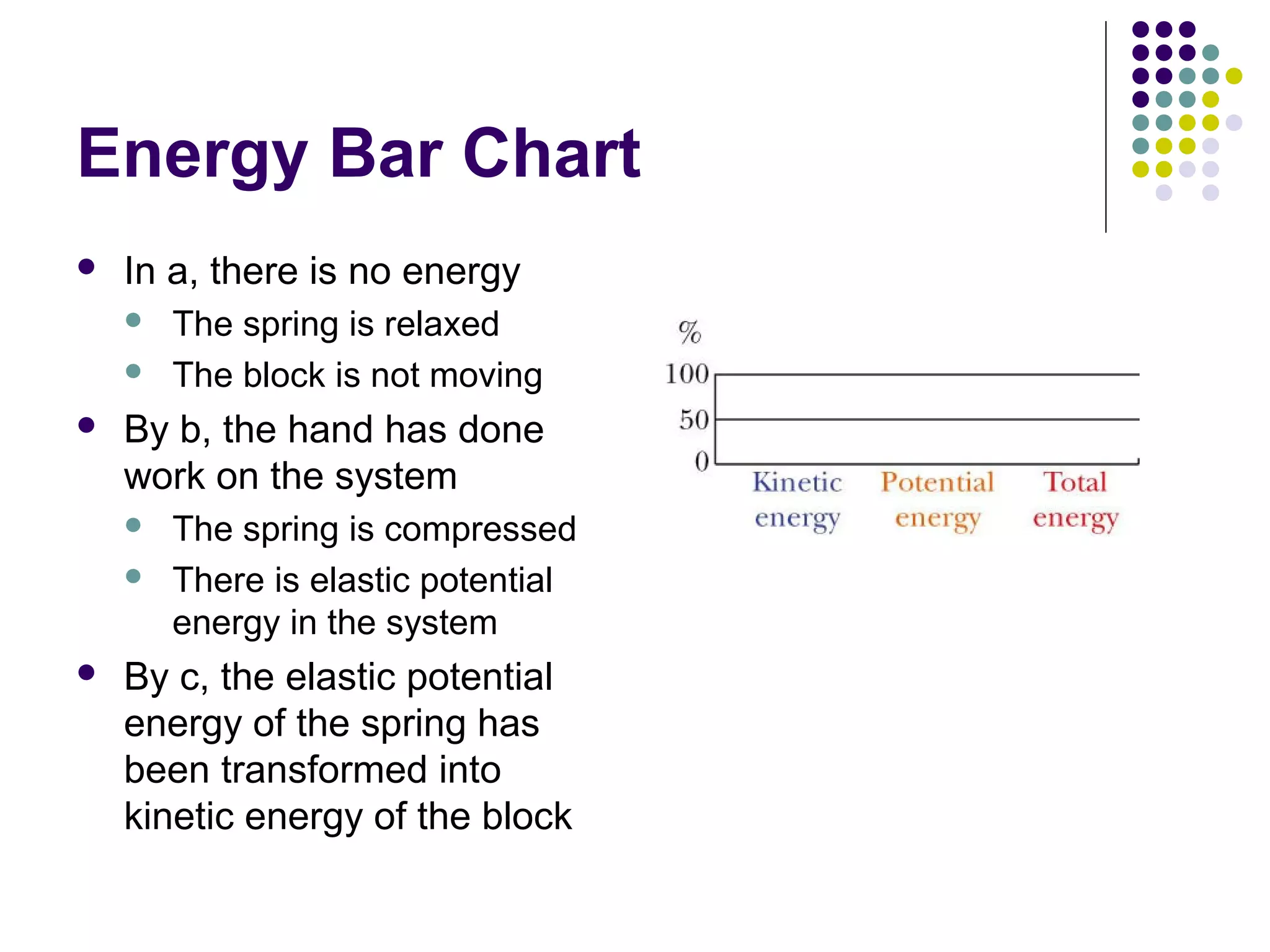
Energy Bar Chart


In a, there is no energy





By b, the hand has done
work on the system





The spring is relaxed
The block is not moving

The spring is compressed
There is elastic potential
energy in the system

By c, the elastic potential
energy of the spring has
been transformed into
kinetic energy of the block
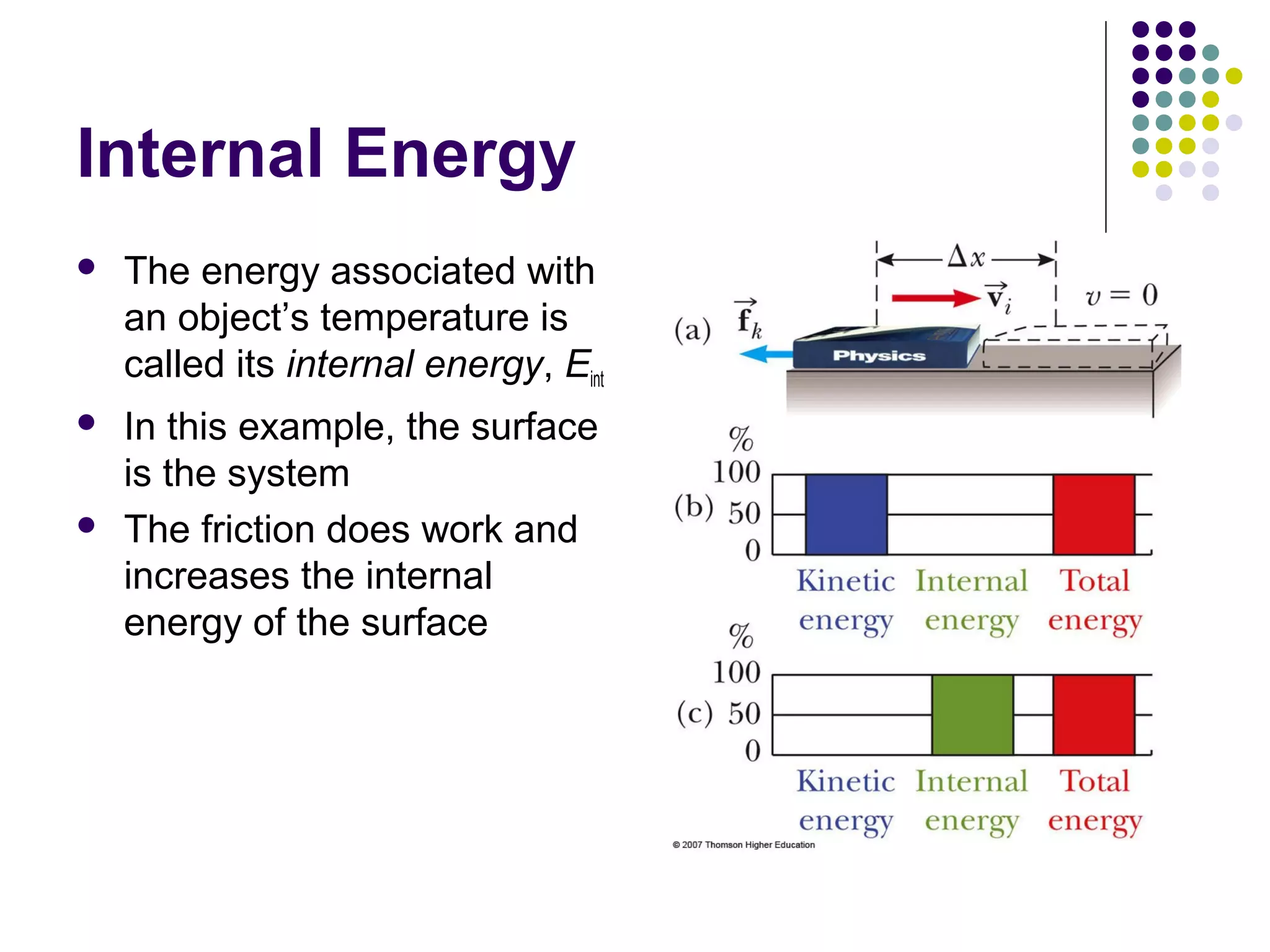
Internal Energy


The energy associated with
an object’s temperature is
called its internal energy, Eint



In this example, the surface
is the system
The friction does work and
increases the internal
energy of the surface


Conservative Forces
 The

work done by a conservative force on a
particle moving between any two points is
independent of the path taken by the particle
 The work done by a conservative force on a
particle moving through any closed path is
zero


A closed path is one in which the beginning and
ending points are the same
Conservative Forces, cont


Examples of conservative forces:





Gravity
Spring force

We can associate a potential energy for a system
with any conservative force acting between
members of the system



This can be done only for conservative forces
In general: WC = - ∆U
Nonconservative Forces
A

nonconservative force does not satisfy the
conditions of conservative forces
 Nonconservative forces acting in a system
cause a change in the mechanical energy of
the system
Nonconservative Forces, cont
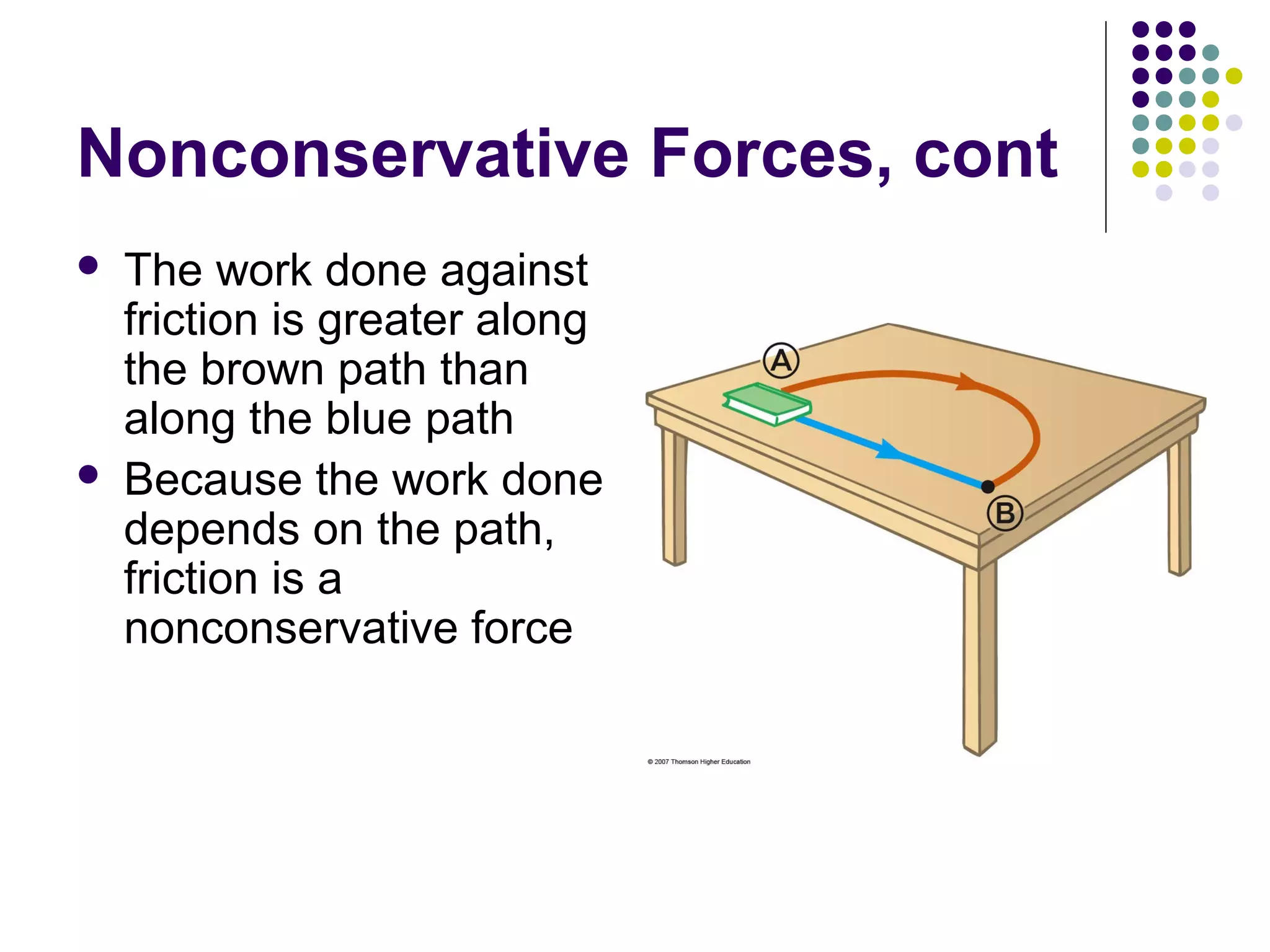




The work done against
friction is greater along
the brown path than
along the blue path
Because the work done
depends on the path,
friction is a
nonconservative force
Conservative Forces and
Potential Energy
 Define

a potential energy function, U, such
that the work done by a conservative force
equals the decrease in the potential energy of
the system
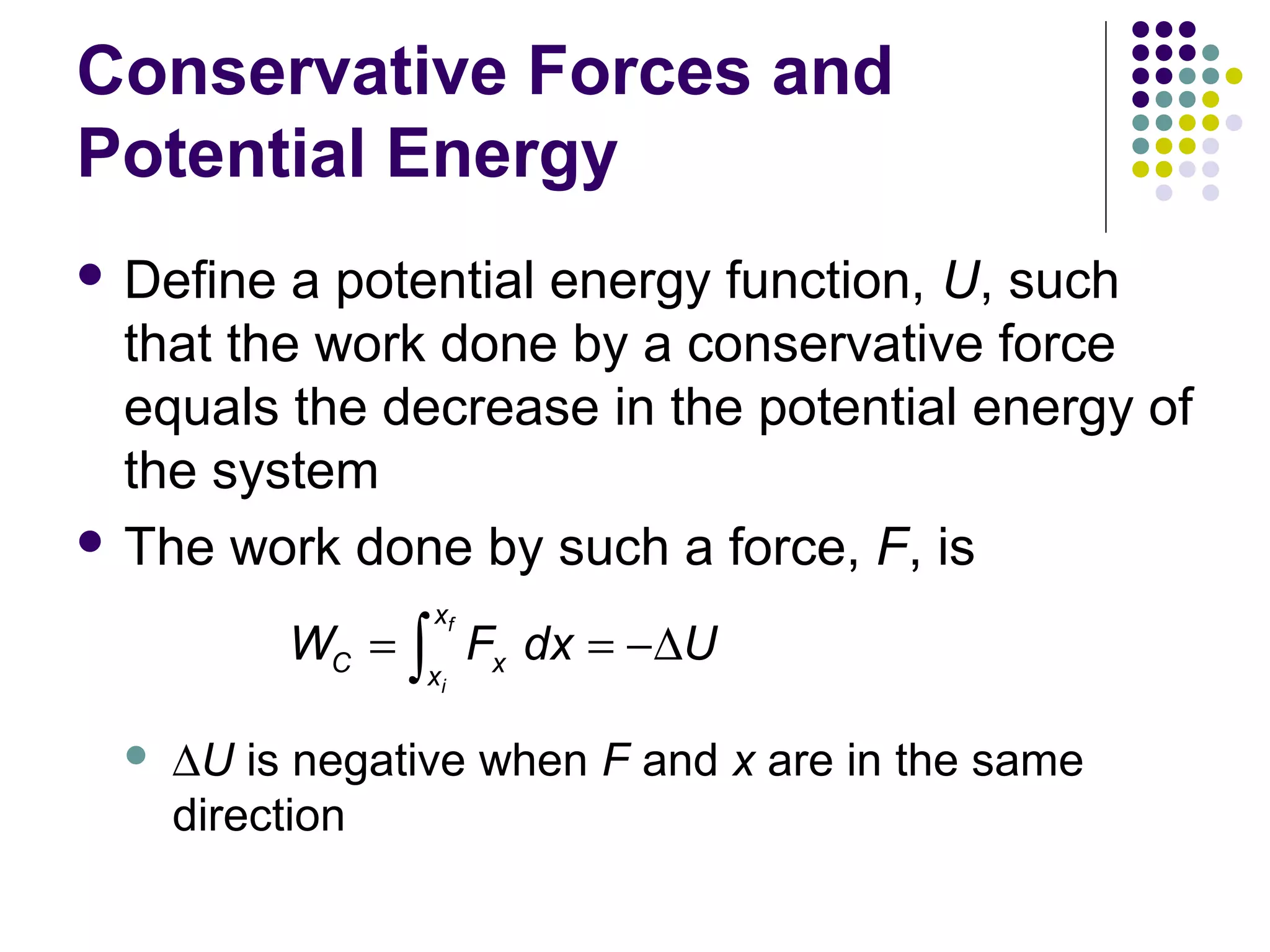
 The work done by such a force, F, is
xf

WC = ∫ Fx dx = −∆U
xi



∆U is negative when F and x are in the same
direction
Conservative Forces and
Potential Energy


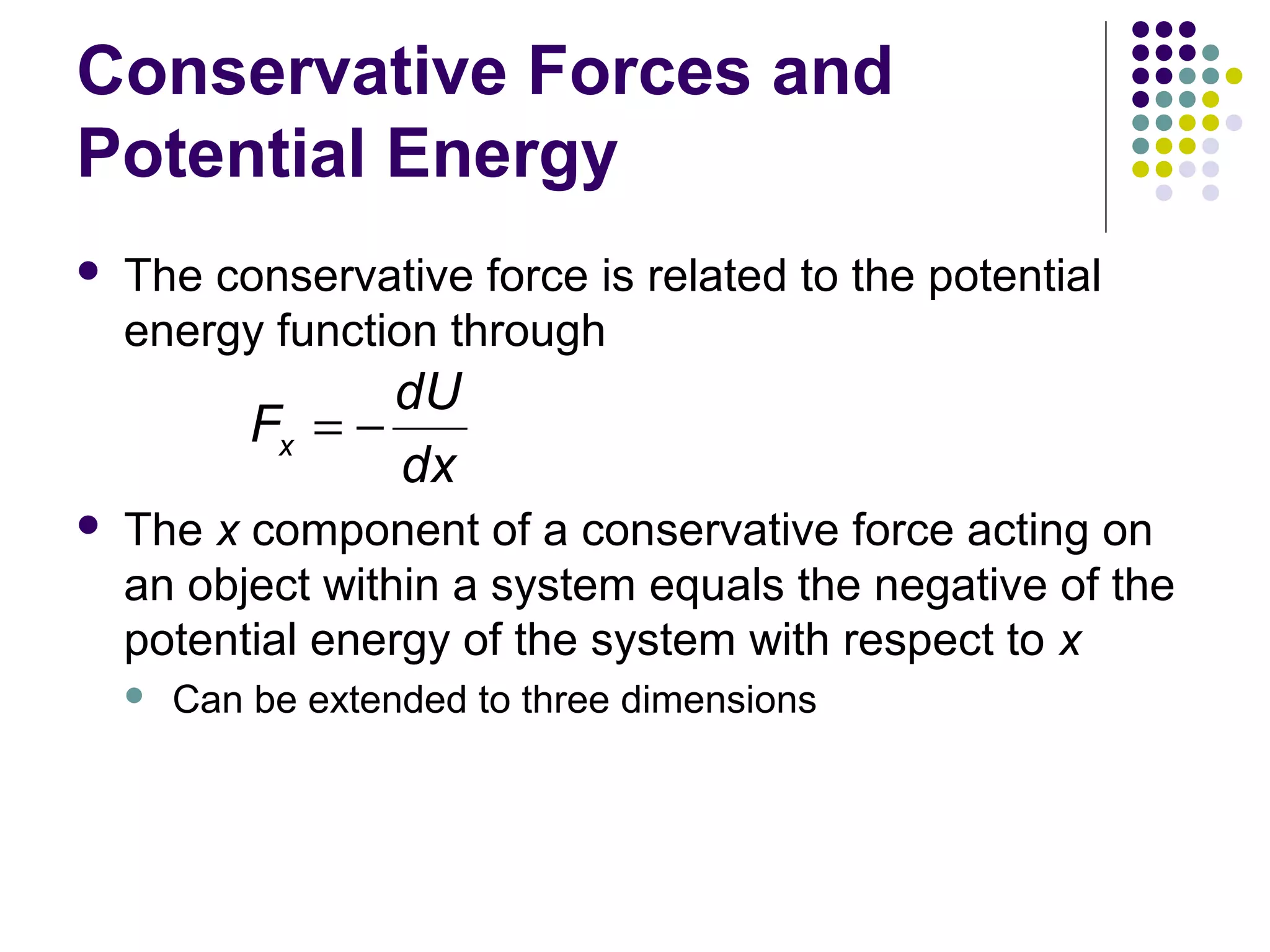
The conservative force is related to the potential
energy function through

dU
Fx = −
dx


The x component of a conservative force acting on
an object within a system equals the negative of the
potential energy of the system with respect to x


Can be extended to three dimensions
Conservative Forces and
Potential Energy – Check
 Look

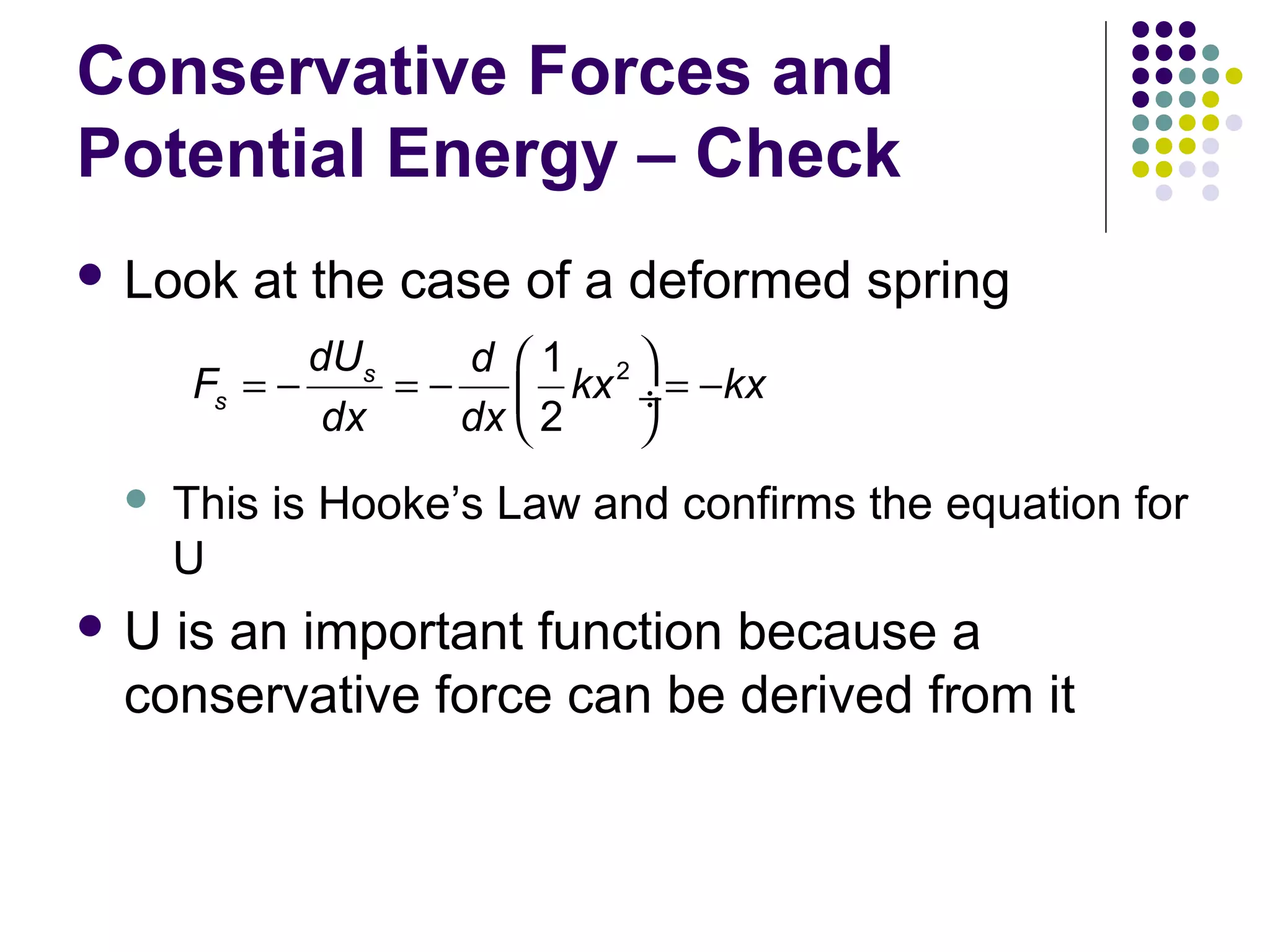
at the case of a deformed spring

dUs
d 1 2
Fs = −
= −  kx ÷ = −kx
dx
dx  2



U

This is Hooke’s Law and confirms the equation for
U

is an important function because a
conservative force can be derived from it
Energy Diagrams and
Equilibrium






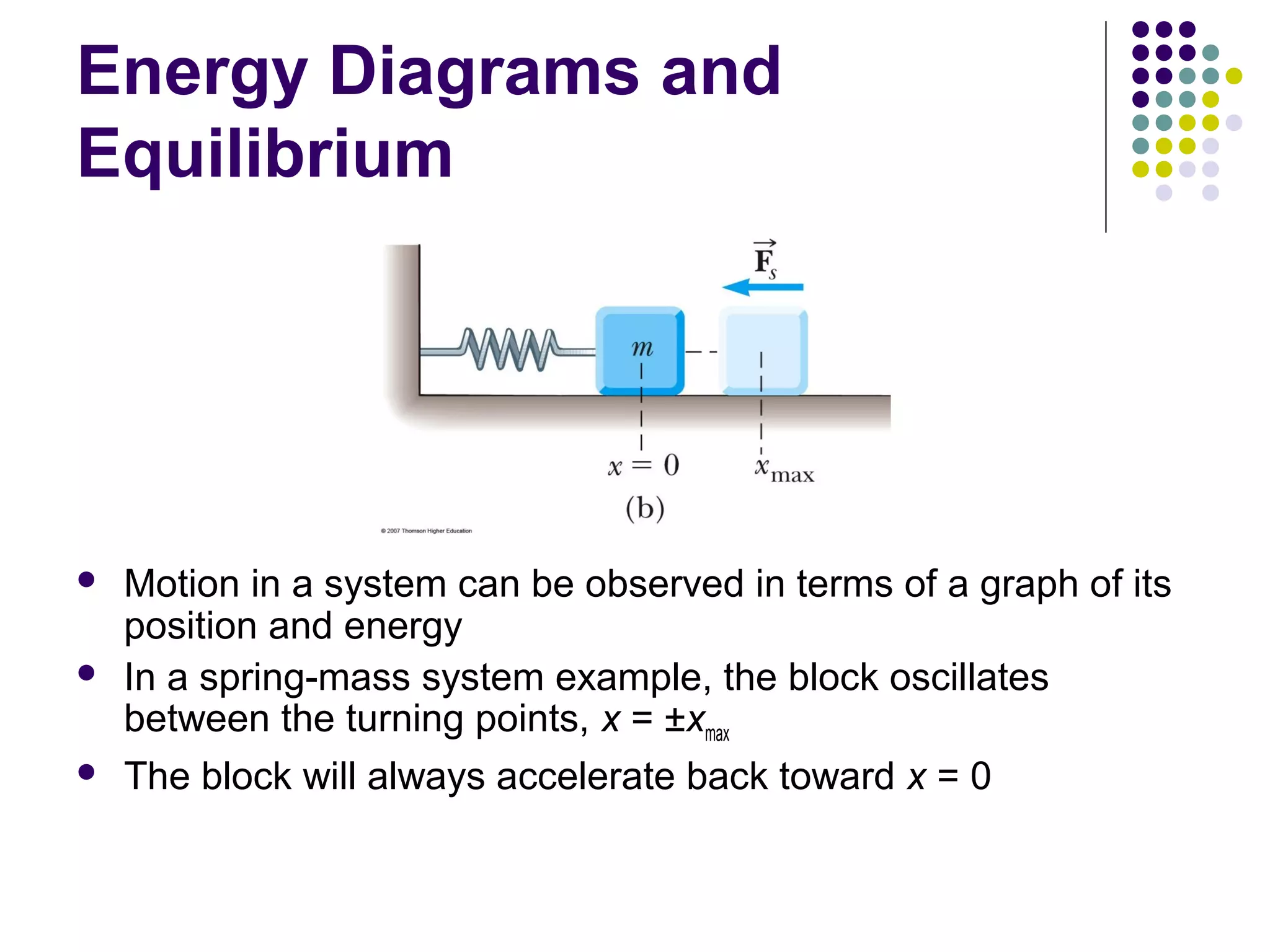
Motion in a system can be observed in terms of a graph of its
position and energy
In a spring-mass system example, the block oscillates
between the turning points, x = ±xmax
The block will always accelerate back toward x = 0
Energy Diagrams and Stable
Equilibrium






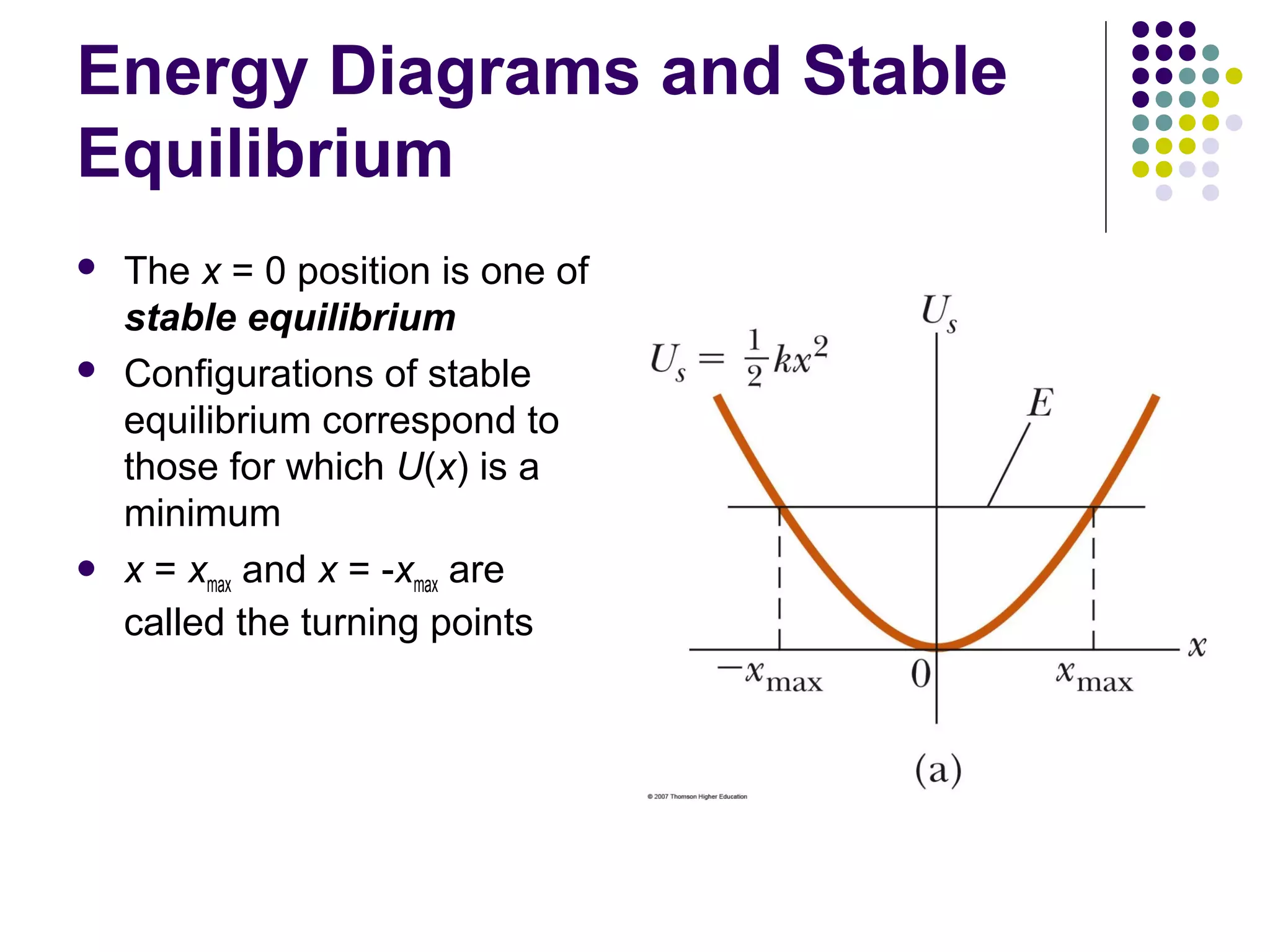
The x = 0 position is one of
stable equilibrium
Configurations of stable
equilibrium correspond to
those for which U(x) is a
minimum
x = xmax and x = -xmax are
called the turning points
Energy Diagrams and Unstable
Equilibrium







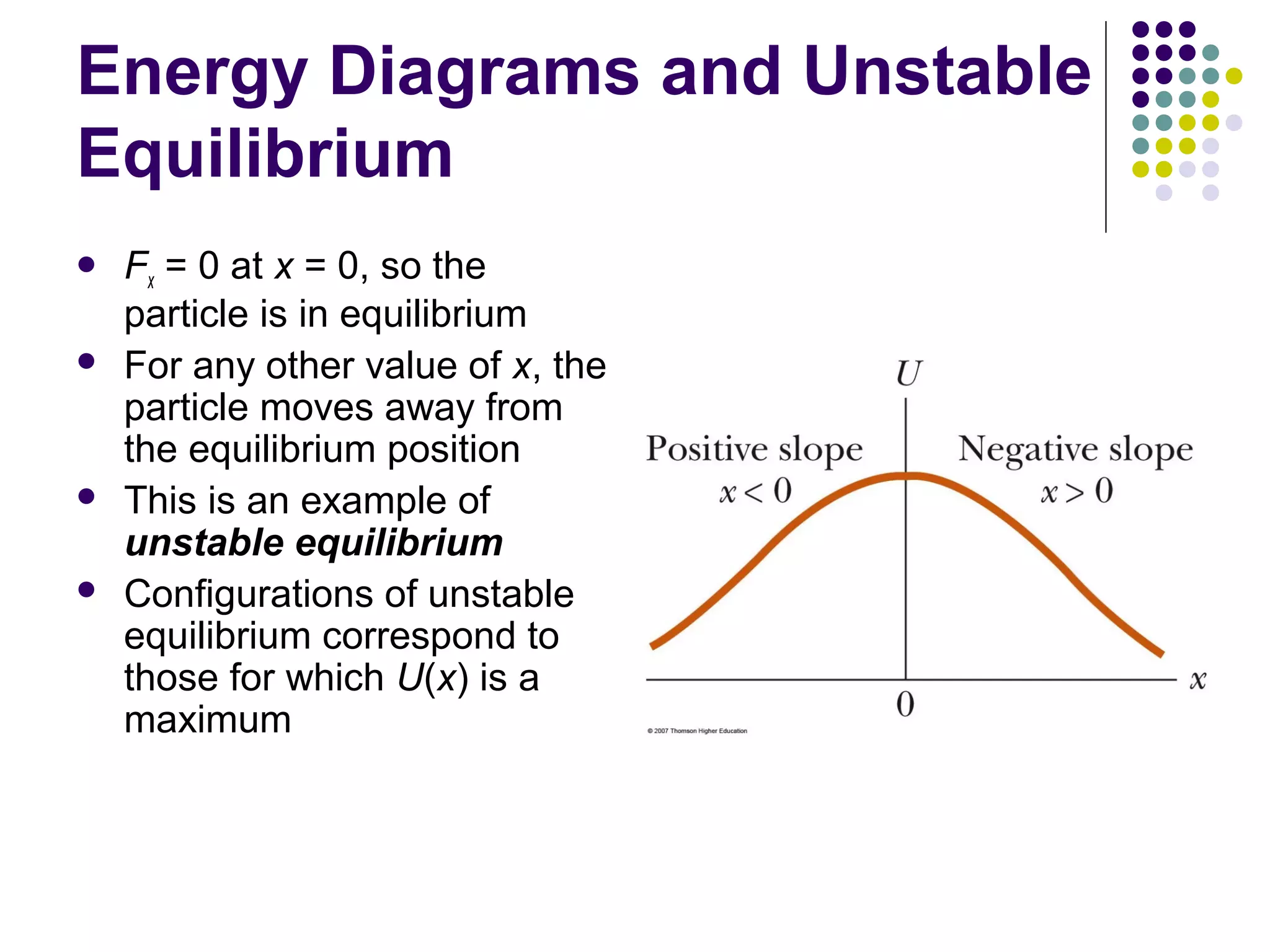
Fx = 0 at x = 0, so the
particle is in equilibrium
For any other value of x, the
particle moves away from
the equilibrium position
This is an example of
unstable equilibrium
Configurations of unstable
equilibrium correspond to
those for which U(x) is a
maximum
Neutral Equilibrium
 Neutral

equilibrium occurs in a configuration
when U is constant over some region
 A small displacement from a position in this
region will produce neither restoring nor
disrupting forces
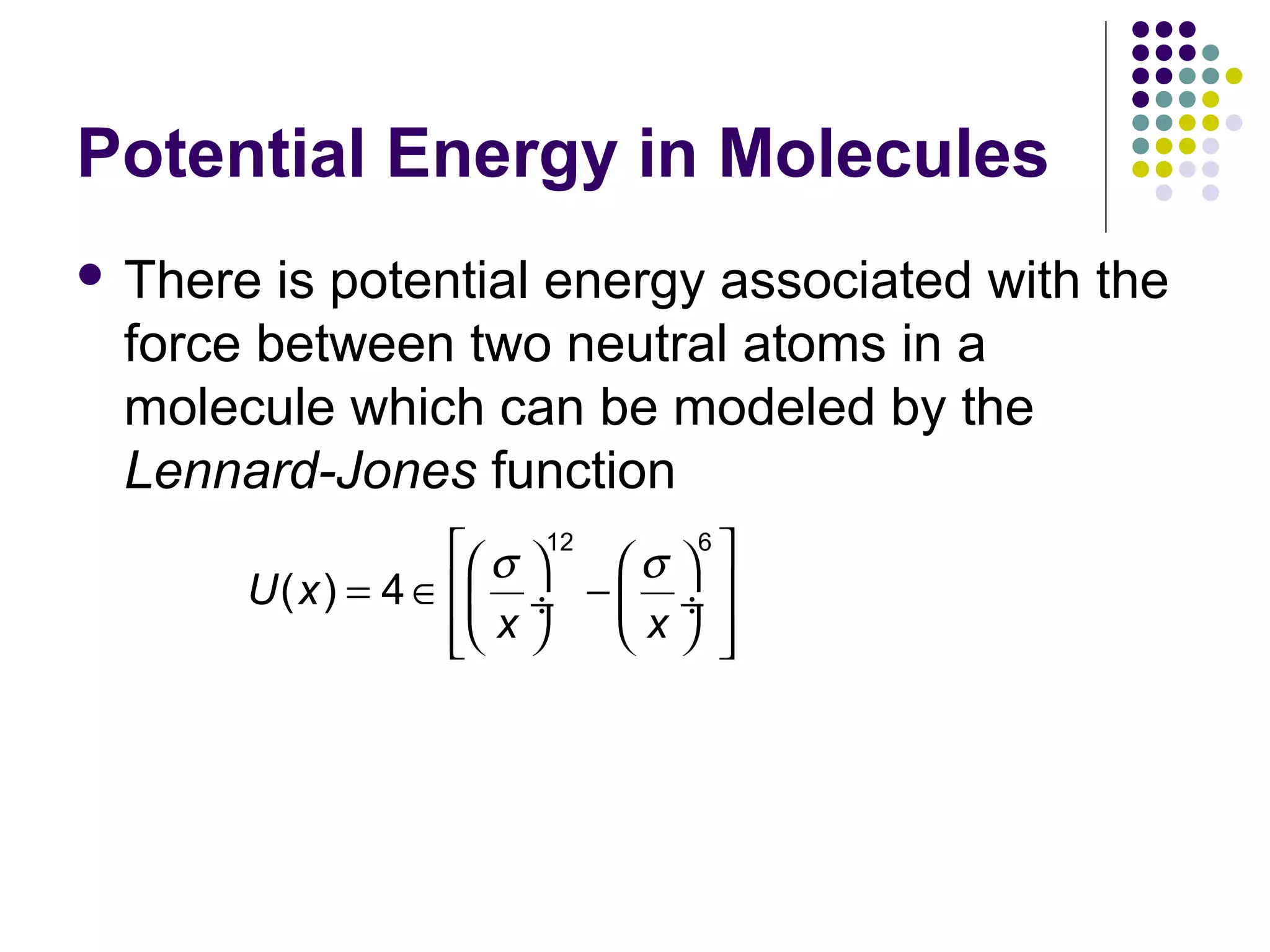
Potential Energy in Molecules
 There

is potential energy associated with the
force between two neutral atoms in a
molecule which can be modeled by the
Lennard-Jones function
 σ 12  σ 6 
U ( x ) = 4 ∈  ÷ −  ÷ 
x 
 x 


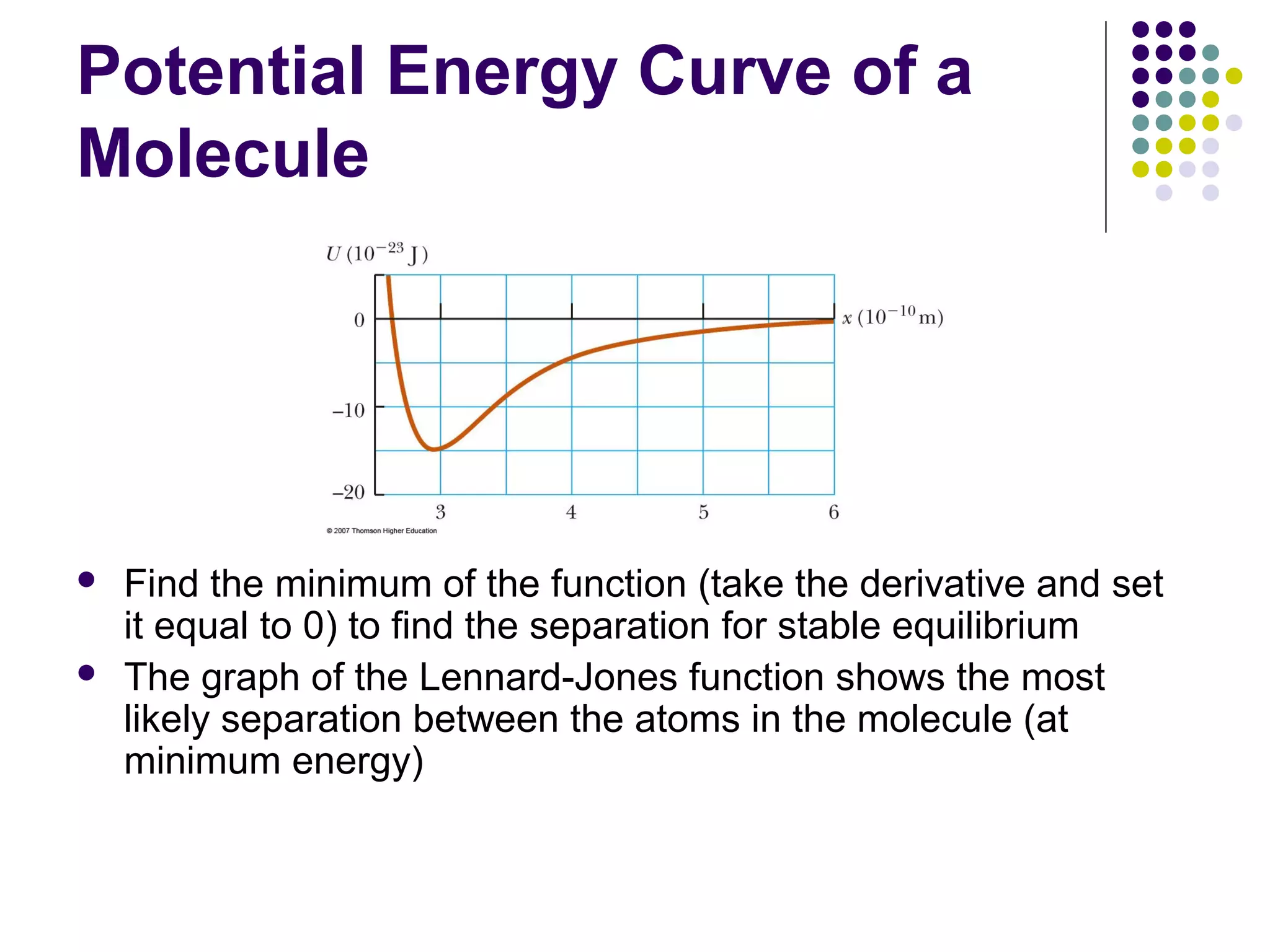
Potential Energy Curve of a
Molecule




Find the minimum of the function (take the derivative and set
it equal to 0) to find the separation for stable equilibrium
The graph of the Lennard-Jones function shows the most
likely separation between the atoms in the molecule (at
minimum energy)

Chapter6: Work, Energy and Power

  • 1.
    Chapter 6 Work, Energyand Power ‫الشغل ,الطاقة و القدرة‬
  • 2.
    Introduction to Energy(‫)الطاقة‬ concept of energy (‫ )مفهوم الطاقة‬is one of the most important topics in science and engineering  Every physical process that occurs in the Universe (‫ )الكون‬involves energy and energy transfers (‫ )انتقال الطاقة‬or transformations (‫)تحولت الطاقة‬  Energy is not easily defined  The
  • 3.
    Energy Approach toProblems  The energy approach to describing motion is particularly useful when Newton’s Laws are difficult or impossible to use  An approach will involve changing from a particle model to a system model  This can be extended to biological organisms, technological systems and engineering situations
  • 4.
    Systems A  A system is asmall portion of the Universe We will ignore the details of the rest of the Universe critical skill is to identify the system
  • 5.
    Valid System Examples A     validsystem may be a single object or particle be a collection of objects or particles be a region of space vary in size and shape
  • 6.
    System Example A    force appliedto an object in empty space System is the object Its surface is the system boundary The force is an influence on the system that acts across the system boundary
  • 7.
    Work (‫)الشغل‬  The work,W, done on a system by an agent exerting a constant force on the system is the product of the magnitude F of the force, the magnitude ∆r of the displacement of the point of application of the force, and cos θ, where θ is the angle between the force and the displacement vectors
  • 8.
    ‫‪Work and Energy‬‬ ‫إنمفهوم الشغل والطاقة مهم جدا في علم الفيزياء، حيث‬ ‫ ً‬ ‫توجد الطاقة في الطبيعة في صور مختلفة مثل الطاقة‬ ‫والطاقة، ‪ Mechanical energy‬الميكانيكية‬ ‫والطاقة، ‪ Electromagnetic energy‬الكهرومغناطيسية‬ ‫والطاقة الحرارية، ‪ Chemical energy‬الكيميائية‬ ‫‪ Nuclear‬والطاقة النووية، ‪Thermal energy‬‬ ‫إن الطاقة بصورها المختلفة تتحول من شكل إلى .‪energy‬‬ ‫آخر ولكن في النهاية الطاقة الكلية ثابتة. فمثل الطاقة‬ ‫الكيميائية المختزنة في بطارية تتحول إلى طاقة كهربية‬ ‫لتتحول بدورها إلى طاقة حركية. ودراسة تحول ت الطاقة‬ ‫.مهم جدا لجميع العلوم‬ ‫ ً‬
  • 9.
    Work, cont. W    = F∆r cos θ The displacement is that of the point of application of the force A force does no work on the object if the force does not move through a displacement The work done by a force on a moving object is zero when the force applied is perpendicular to the displacement of its point of application
  • 10.
    Work Example  The normalforce and the gravitational force do no work on the object   cos θ = cos 90° = 0 r The force F is the only force that does work on the object
  • 11.
    More About Work  Thesystem and the agent in the environment doing the work must both be determined  The part of the environment interacting directly with the system does work on the system  Work by the environment on the system   Example: Work done by a hammer (interaction from environment) on a nail (system) The sign of the work depends on the direction of the force relative to the displacementr r   Work is positive when projection of F onto ∆r is in the same direction as the displacement Work is negative when the projection is in the opposite direction
  • 12.
    Units of Work Work is a scalar quantity  The unit of work is a joule (J)   1 joule = 1 newton . 1 meter J=N·m
  • 13.
    Work Is AnEnergy Transfer  This is important for a system approach to solving a problem  If the work is done on a system and it is positive, energy is transferred to the system  If the work done on the system is negative, energy is transferred from the system
  • 14.
    Work Is AnEnergy Transfer, cont  If a system interacts with its environment, this interaction can be described as a transfer of energy across the system boundary  This will result in a change in the amount of energy stored in the system
  • 15.
    Scalar Product ofTwo Vectors  The scalar product of tworvectors is written r as A × B   A × ≡ A B cos θ B   It is also called the dot rproduct r θ is the angle between A and B Applied to work, this means r r W = F ∆r cos θ = F ×∆ r
  • 16.
    Scalar Product, cont The scalar product is commutative r r r r A gB = B gA  The scalar product obeys the distributive law of multiplication r r r r r r r A g B + C = A gB + A gC ( )
  • 17.
    Dot Products ofUnit Vectors  ˆ ׈ = ˆ ׈ = k ׈ = 1 i i j j ˆ k ˆ ׈ = ˆ ׈ = ˆ ׈ = 0 i j i k j k  Using component form with vectors: r ˆ A = Ax ˆ + Ay ˆ + Azk i j r ˆ B = Bx ˆ + By ˆ + Bzk i j r r A gB = Ax Bx + Ay By + Az Bz
  • 18.
    Work Done ByA Spring    A model of a common physical system for which the force varies with position The block is on a horizontal, frictionless surface Observe the motion of the block with various values of the spring constant
  • 19.
    Hooke’s Law  The forceexerted by the spring is Fs = - kx    x is the position of the block with respect to the equilibrium position (x = 0) k is called the spring constant or force constant and measures the stiffness of the spring This is called Hooke’s Law
  • 20.
    Hooke’s Law, cont.    Whenx is positive (spring is stretched), F is negative When x is 0 (at the equilibrium position), F is 0 When x is negative (spring is compressed), F is positive
  • 21.
    Hooke’s Law, final The force exerted by the spring is always directed opposite to the displacement from equilibrium  The spring force is sometimes called the restoring force  If the block is released it will oscillate back and forth between –x and x
  • 22.
    Work Done bya Spring   Identify the block as the system Calculate the work as the block moves from xi = - xmax to xf = 0 xf 0 xi − xmax Ws = ∫ Fx dx = ∫  ( −kx ) dx = 1 2 kxmax 2 The total work done as the block moves from –xmax to xmax is zero
  • 23.
    Work Done bya Spring, cont.  Assume the block undergoes an arbitrary displacement from x = xi to x = xf  The work done by the spring on the block is Ws = ∫ xf xi  1 2 1 2 ( −kx ) dx = kxi − kxf 2 2 If the motion ends where it begins, W = 0
  • 24.
    Spring with anApplied Force  Suppose an external agent, Fapp, stretches the spring  The applied force is equal and opposite to the spring force Fapp = -Fs = -(-kx) = kx   Work done by Fapp is equal to -½ kx2max  The work done by the applied force is Wapp = ∫ xf xi ( kx ) dx = 1 2 1 2 kxf − kxi 2 2
  • 25.
    Kinetic Energy  Kinetic Energyis the energy of a particle due to its motion  K = ½ mv2    A K is the kinetic energy m is the mass of the particle v is the speed of the particle change in kinetic energy is one possible result of doing work to transfer energy into a system
  • 26.
  • 27.
    Work-Kinetic Energy Theorem   TheWork-Kinetic Energy Theorem states ΣW = Kf – Ki = ∆K When work is done on a system and the only change in the system is in its speed, the work done by the net force equals the change in kinetic energy of the system.  The speed of the system increases if the work done on it is positive  The speed of the system decreases if the net work is negative
  • 28.
    Work-Kinetic Energy Theorem –Example    The normal and gravitational forces do no work since they are perpendicular to the direction of the displacement W = F ∆x W = ∆K = ½ mvf2 - 0
  • 29.
    Potential Energy  Potential energyis energy related to the configuration of a system in which the components of the system interact by forces   The forces are internal to the system Can be associated with only specific types of forces acting between members of a system
  • 30.
    Gravitational Potential Energy   Thesystem is the Earth and the book Do work on the book by lifting it slowly through a vertical displacement r ∆ r = ∆yˆ j  The work done on the system must appear as an increase in the energy of the system
  • 31.
    Gravitational Potential Energy, cont There is no change in kinetic energy since the book starts and ends at rest  Gravitational potential energy is the energy associated with an object at a given location above the surface of the Earth r r W = Fapp ×∆ r ( ) W = (mgˆ) ×( y f − y i ) ˆ  j  j W = mgy f − mgy i
  • 32.
    Gravitational Potential Energy, final The quantity mgy is identified as the gravitational potential energy, Ug  Ug = mgy  Units are joules (J)  Is a scalar  Work may change the gravitational potential energy of the system  Wnet = ∆Ug
  • 33.
    Gravitational Potential Energy, ProblemSolving   The gravitational potential energy depends only on the vertical height of the object above Earth’s surface In solving problems, you must choose a reference configuration for which the gravitational potential energy is set equal to some reference value, normally zero  The choice is arbitrary because you normally need the difference in potential energy, which is independent of the choice of reference configuration
  • 34.
    Elastic Potential Energy    ElasticPotential Energy is associated with a spring The force the spring exerts (on a block, for example) is Fs = - kx The work done by an external applied force on a spring-block system is   W = ½ kxf2 – ½ kxi2 The work is equal to the difference between the initial and final values of an expression related to the configuration of the system
  • 35.
    Elastic Potential Energy,cont     This expression is the elastic potential energy: Us = ½ kx2 The elastic potential energy can be thought of as the energy stored in the deformed spring The stored potential energy can be converted into kinetic energy Observe the effects of different amounts of compression of the spring
  • 36.
    Elastic Potential Energy,final  The elastic potential energy stored in a spring is zero whenever the spring is not deformed (U = 0 when x = 0)    The energy is stored in the spring only when the spring is stretched or compressed The elastic potential energy is a maximum when the spring has reached its maximum extension or compression The elastic potential energy is always positive  x2 will always be positive
  • 37.
    Energy Bar Chart  Ina, there is no energy    By b, the hand has done work on the system    The spring is relaxed The block is not moving The spring is compressed There is elastic potential energy in the system By c, the elastic potential energy of the spring has been transformed into kinetic energy of the block
  • 38.
    Internal Energy  The energyassociated with an object’s temperature is called its internal energy, Eint  In this example, the surface is the system The friction does work and increases the internal energy of the surface 
  • 39.
    Conservative Forces  The workdone by a conservative force on a particle moving between any two points is independent of the path taken by the particle  The work done by a conservative force on a particle moving through any closed path is zero  A closed path is one in which the beginning and ending points are the same
  • 40.
    Conservative Forces, cont  Examplesof conservative forces:    Gravity Spring force We can associate a potential energy for a system with any conservative force acting between members of the system   This can be done only for conservative forces In general: WC = - ∆U
  • 41.
    Nonconservative Forces A nonconservative forcedoes not satisfy the conditions of conservative forces  Nonconservative forces acting in a system cause a change in the mechanical energy of the system
  • 42.
    Nonconservative Forces, cont   Thework done against friction is greater along the brown path than along the blue path Because the work done depends on the path, friction is a nonconservative force
  • 43.
    Conservative Forces and PotentialEnergy  Define a potential energy function, U, such that the work done by a conservative force equals the decrease in the potential energy of the system  The work done by such a force, F, is xf WC = ∫ Fx dx = −∆U xi  ∆U is negative when F and x are in the same direction
  • 44.
    Conservative Forces and PotentialEnergy  The conservative force is related to the potential energy function through dU Fx = − dx  The x component of a conservative force acting on an object within a system equals the negative of the potential energy of the system with respect to x  Can be extended to three dimensions
  • 45.
    Conservative Forces and PotentialEnergy – Check  Look at the case of a deformed spring dUs d 1 2 Fs = − = −  kx ÷ = −kx dx dx  2   U This is Hooke’s Law and confirms the equation for U is an important function because a conservative force can be derived from it
  • 46.
    Energy Diagrams and Equilibrium    Motionin a system can be observed in terms of a graph of its position and energy In a spring-mass system example, the block oscillates between the turning points, x = ±xmax The block will always accelerate back toward x = 0
  • 47.
    Energy Diagrams andStable Equilibrium    The x = 0 position is one of stable equilibrium Configurations of stable equilibrium correspond to those for which U(x) is a minimum x = xmax and x = -xmax are called the turning points
  • 48.
    Energy Diagrams andUnstable Equilibrium     Fx = 0 at x = 0, so the particle is in equilibrium For any other value of x, the particle moves away from the equilibrium position This is an example of unstable equilibrium Configurations of unstable equilibrium correspond to those for which U(x) is a maximum
  • 49.
    Neutral Equilibrium  Neutral equilibriumoccurs in a configuration when U is constant over some region  A small displacement from a position in this region will produce neither restoring nor disrupting forces
  • 50.
    Potential Energy inMolecules  There is potential energy associated with the force between two neutral atoms in a molecule which can be modeled by the Lennard-Jones function  σ 12  σ 6  U ( x ) = 4 ∈  ÷ −  ÷  x   x   
  • 51.
    Potential Energy Curveof a Molecule   Find the minimum of the function (take the derivative and set it equal to 0) to find the separation for stable equilibrium The graph of the Lennard-Jones function shows the most likely separation between the atoms in the molecule (at minimum energy)