Analysis and design of gravity
   dam in seismic zone V

 Project by:
 • Mr. Risso Johnny
 • Mr. Kapu Takar
 • Mr. Atan Ketan
 • Mr. Manoj Thorat
 • Mr. Shaikh Arshanaj.
Dam
• Dam is a solid barrier constructed at a suitable
  location across a river valley to store flowing water.

                  Need and Necessity:
•   Irrigation
•   Water for domestic consumption
•   Drought and flood control
•   For navigational facilities
•   Hydroelectric power generation
•   Recreation
•   Development of fish & wild life
•   Soil conservation

                                                       2
History of Dams
• First dam was constructed by the Egyptians in
  2950-2750 B.C, using stone/ brick masonry.
• Earth dam was built first in Mesopotamia
  around 2000 B.C.
• Romans used concrete and mortars around 100
  AD.
• Due to large size and amount of building
  material need to construct earth and gravity
  dams

                                              3
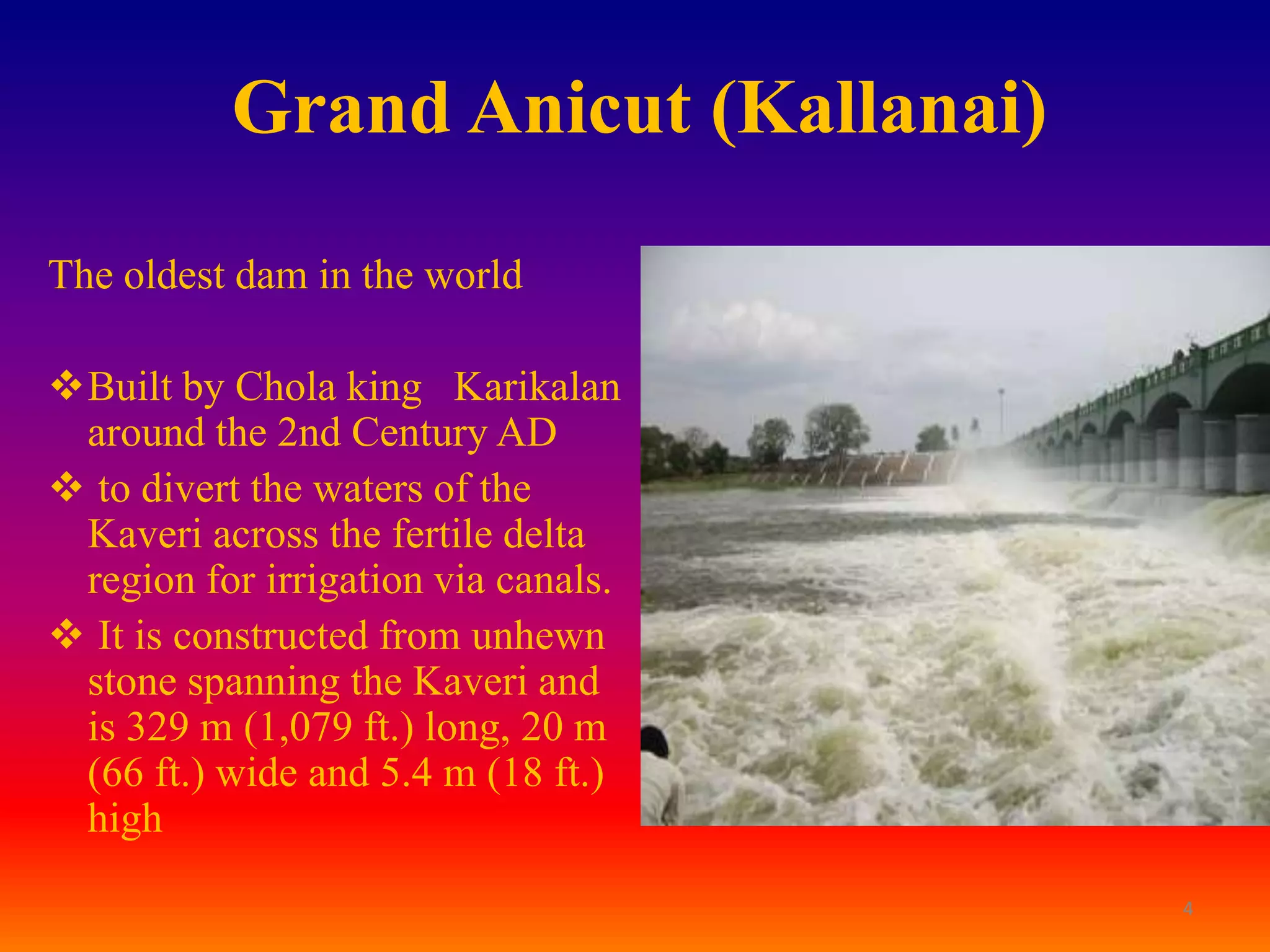
Grand Anicut (Kallanai)

The oldest dam in the world

Built by Chola king Karikalan
 around the 2nd Century AD
 to divert the waters of the
 Kaveri across the fertile delta
 region for irrigation via canals.
 It is constructed from unhewn
 stone spanning the Kaveri and
 is 329 m (1,079 ft.) long, 20 m
 (66 ft.) wide and 5.4 m (18 ft.)
 high
                                     4
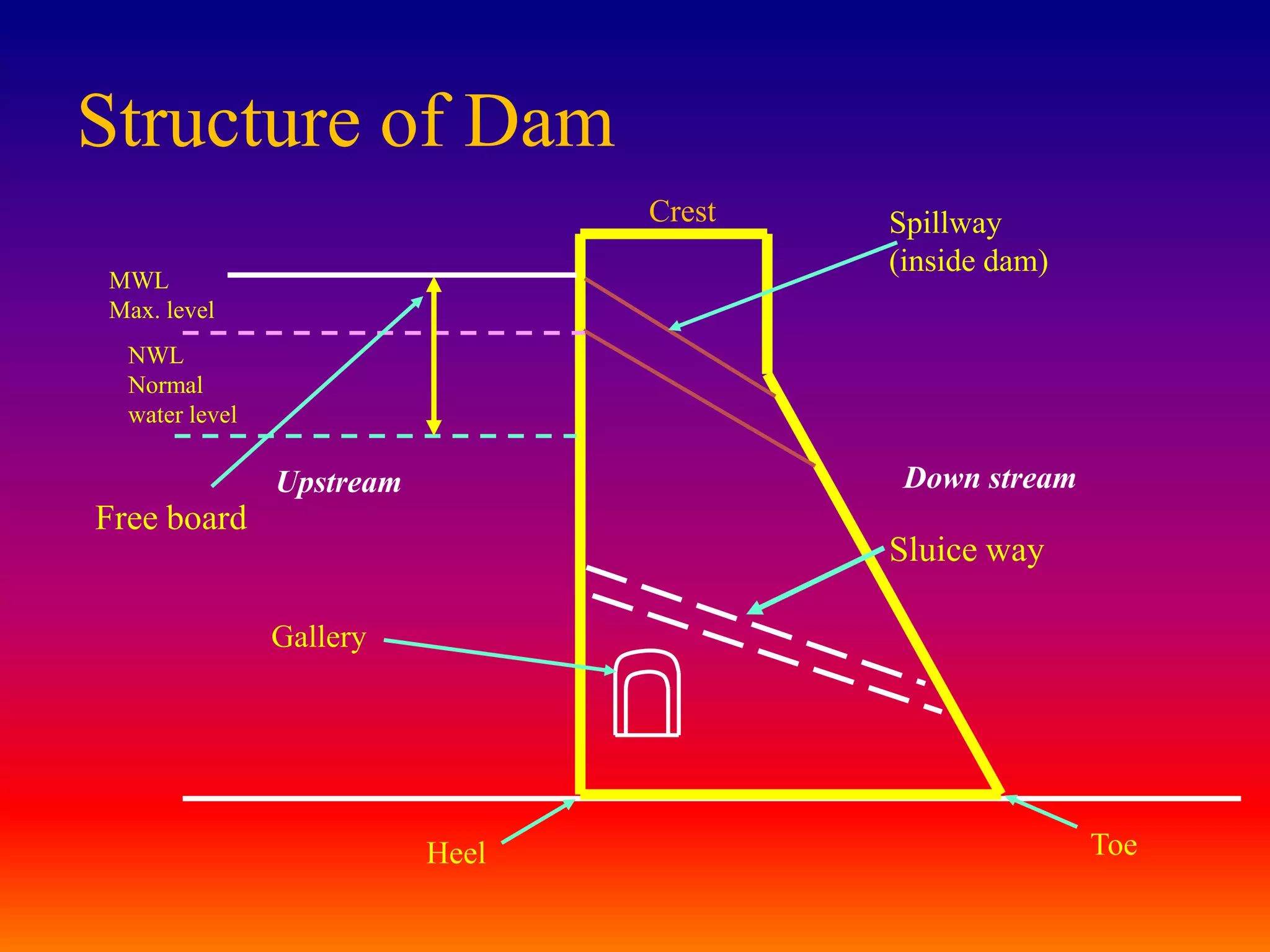
Structure of Dam
                                  Crest   Spillway
                                          (inside dam)
MWL
Max. level
  NWL
  Normal
  water level

                Upstream                   Down stream
Free board
                                          Sluice way

                Gallery


                           Heel                          Toe
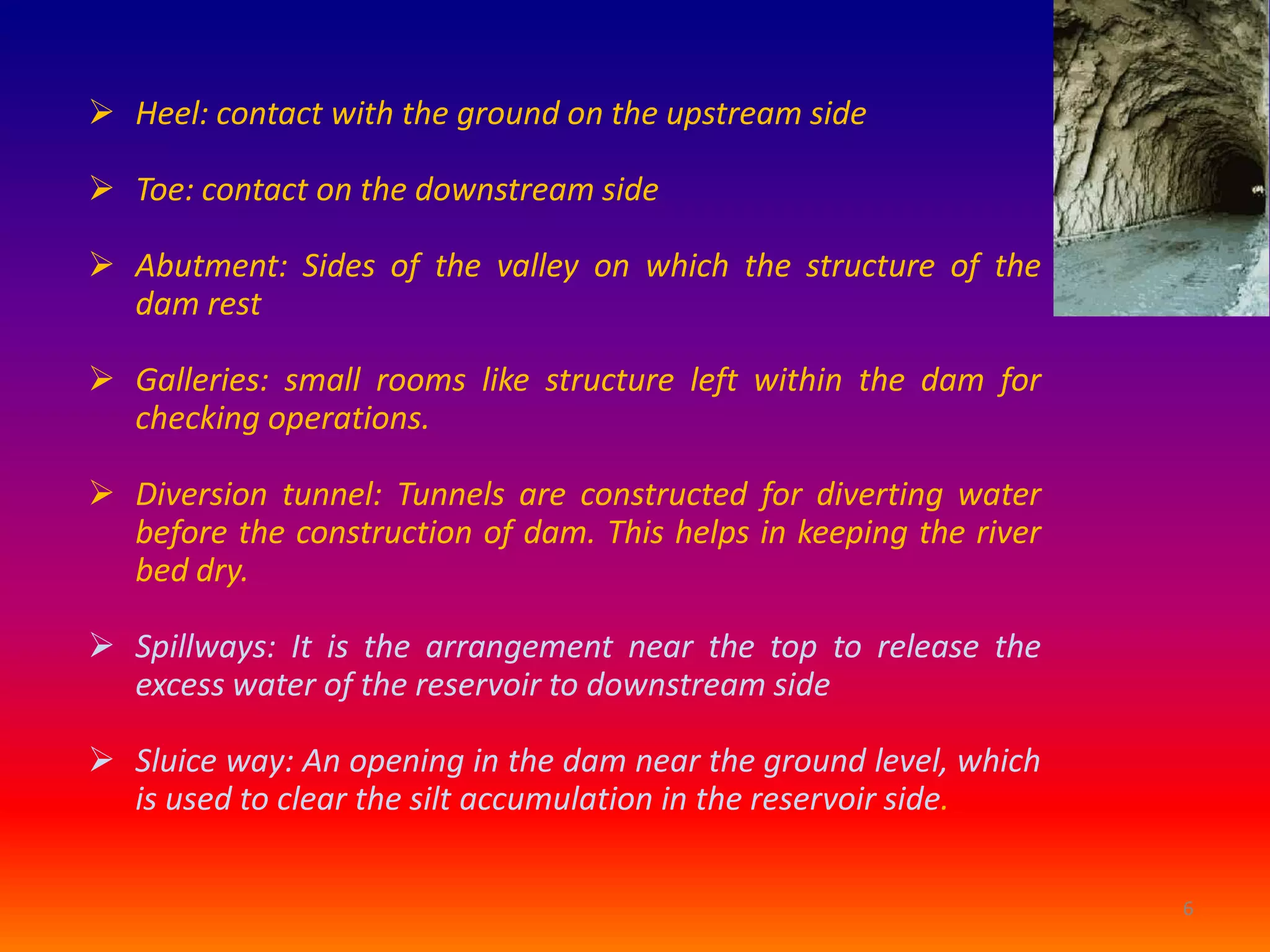
 Heel: contact with the ground on the upstream side

 Toe: contact on the downstream side

 Abutment: Sides of the valley on which the structure of the
  dam rest

 Galleries: small rooms like structure left within the dam for
  checking operations.

 Diversion tunnel: Tunnels are constructed for diverting water
  before the construction of dam. This helps in keeping the river
  bed dry.

 Spillways: It is the arrangement near the top to release the
  excess water of the reservoir to downstream side

 Sluice way: An opening in the dam near the ground level, which
  is used to clear the silt accumulation in the reservoir side.

                                                                    6
TYPES OF
  DAMS:
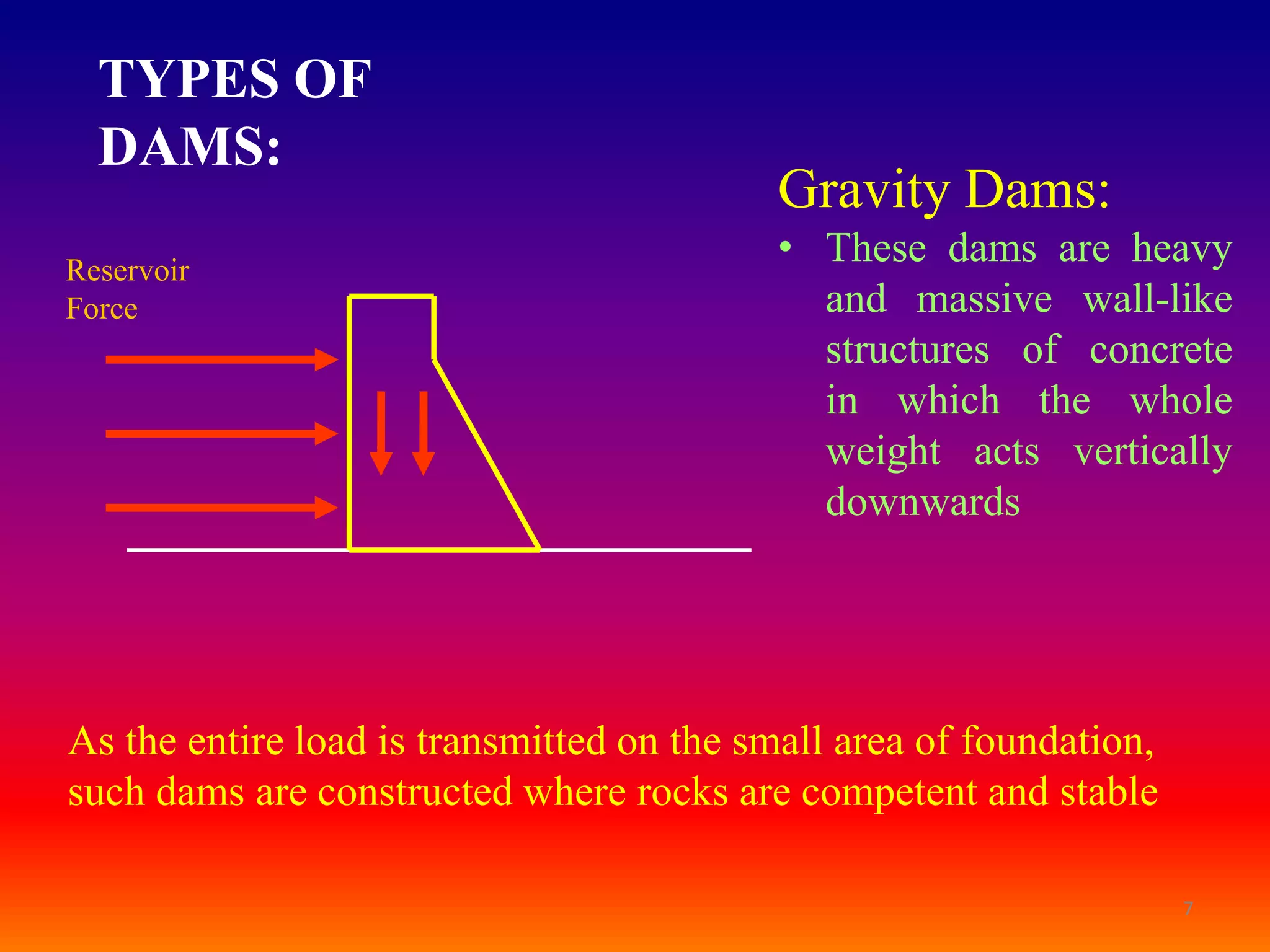
                                          Gravity Dams:
Reservoir
                                          • These dams are heavy
Force                                       and massive wall-like
                                            structures of concrete
                                            in which the whole
                                            weight acts vertically
                                            downwards


As the entire load is transmitted on the small area of foundation,
such dams are constructed where rocks are competent and stable

                                                                     7
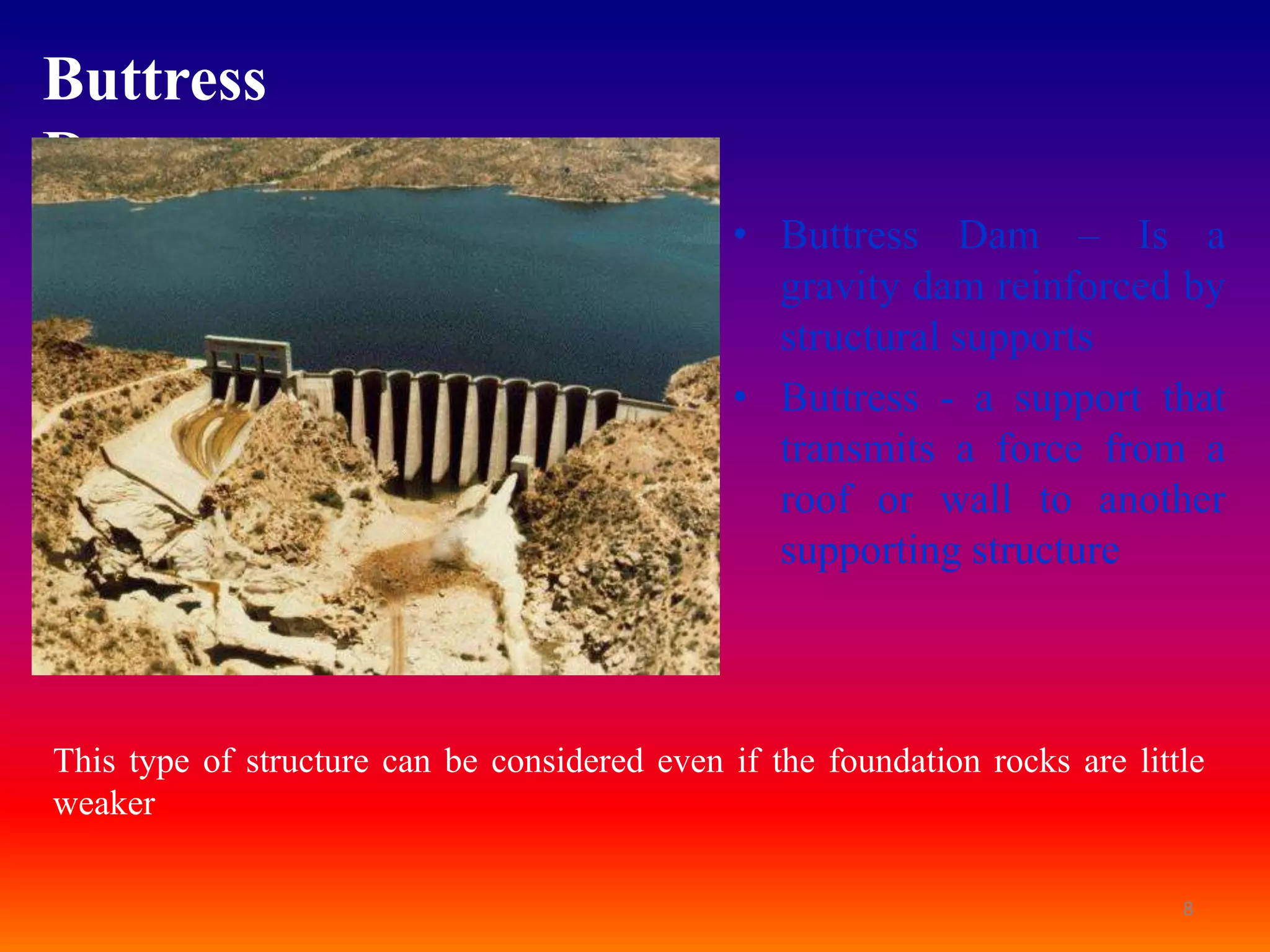
Buttress
Dam:
                                               • Buttress Dam – Is a
                                                 gravity dam reinforced by
                                                 structural supports
                                               • Buttress - a support that
                                                 transmits a force from a
                                                 roof or wall to another
                                                 supporting structure


This type of structure can be considered even if the foundation rocks are little
weaker

                                                                              8
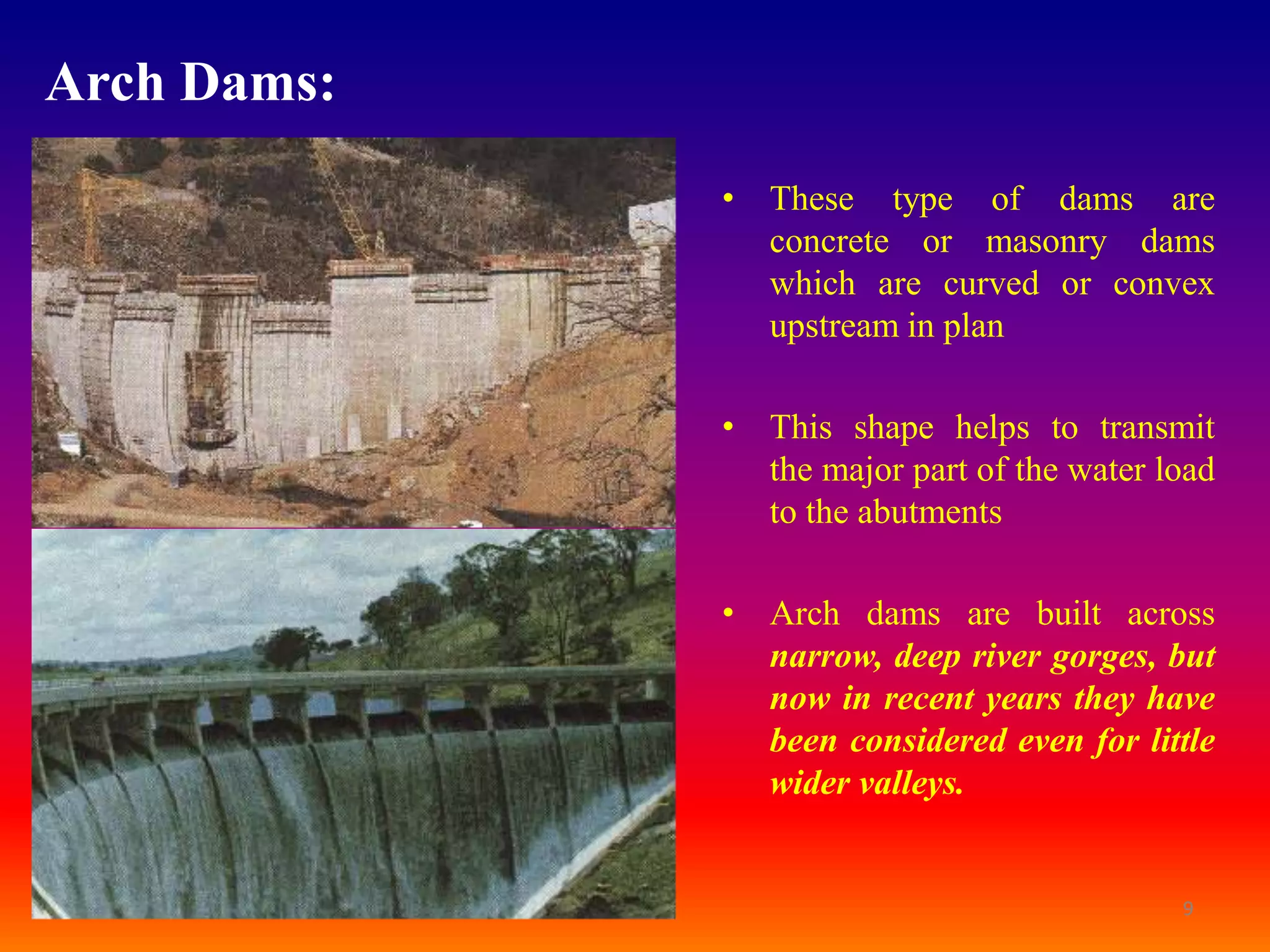
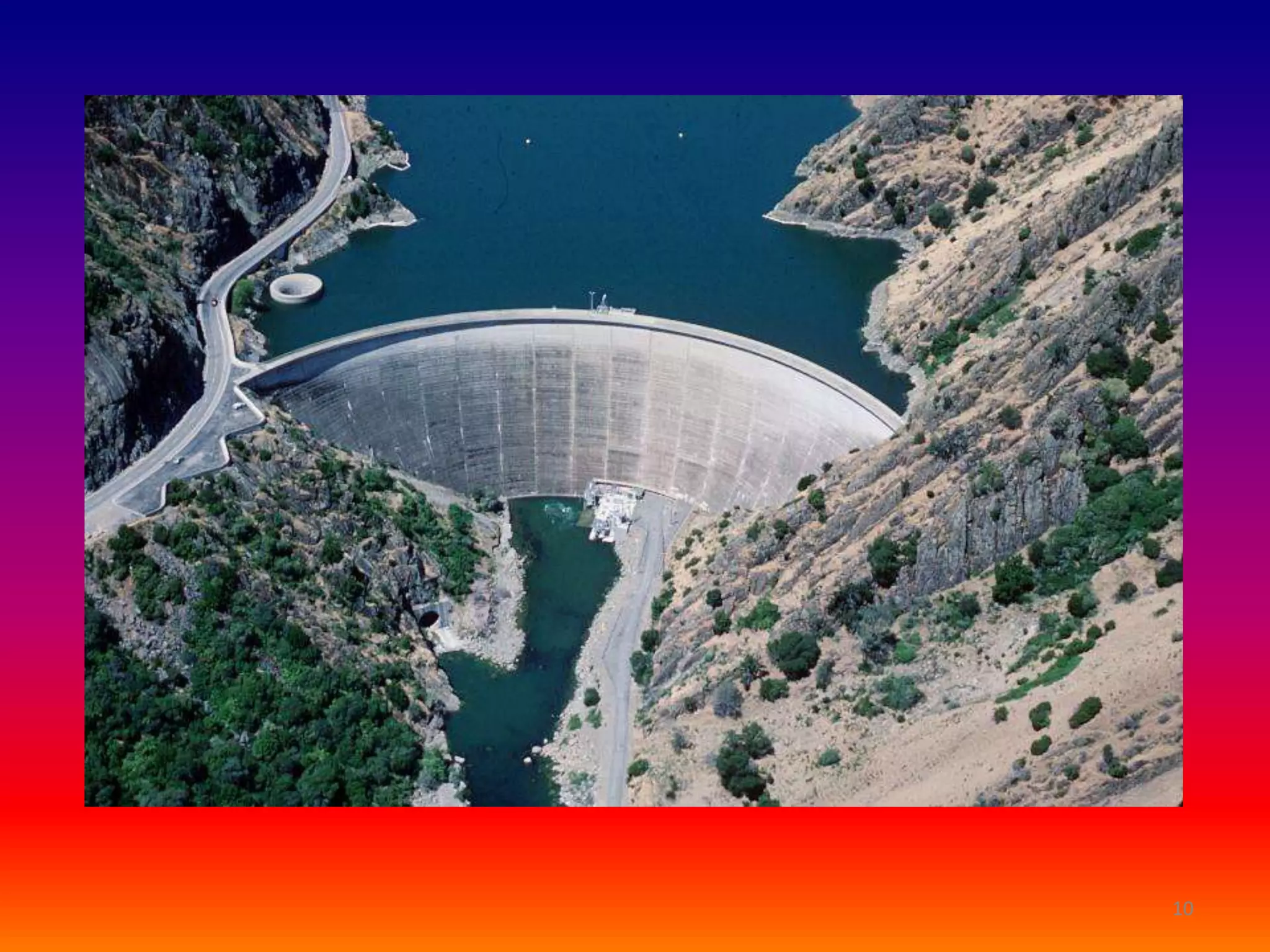
Arch Dams:
             • These type of dams are
               concrete or masonry dams
               which are curved or convex
               upstream in plan

             • This shape helps to transmit
               the major part of the water load
               to the abutments

             • Arch dams are built across
               narrow, deep river gorges, but
               now in recent years they have
               been considered even for little
               wider valleys.


                                            9
10
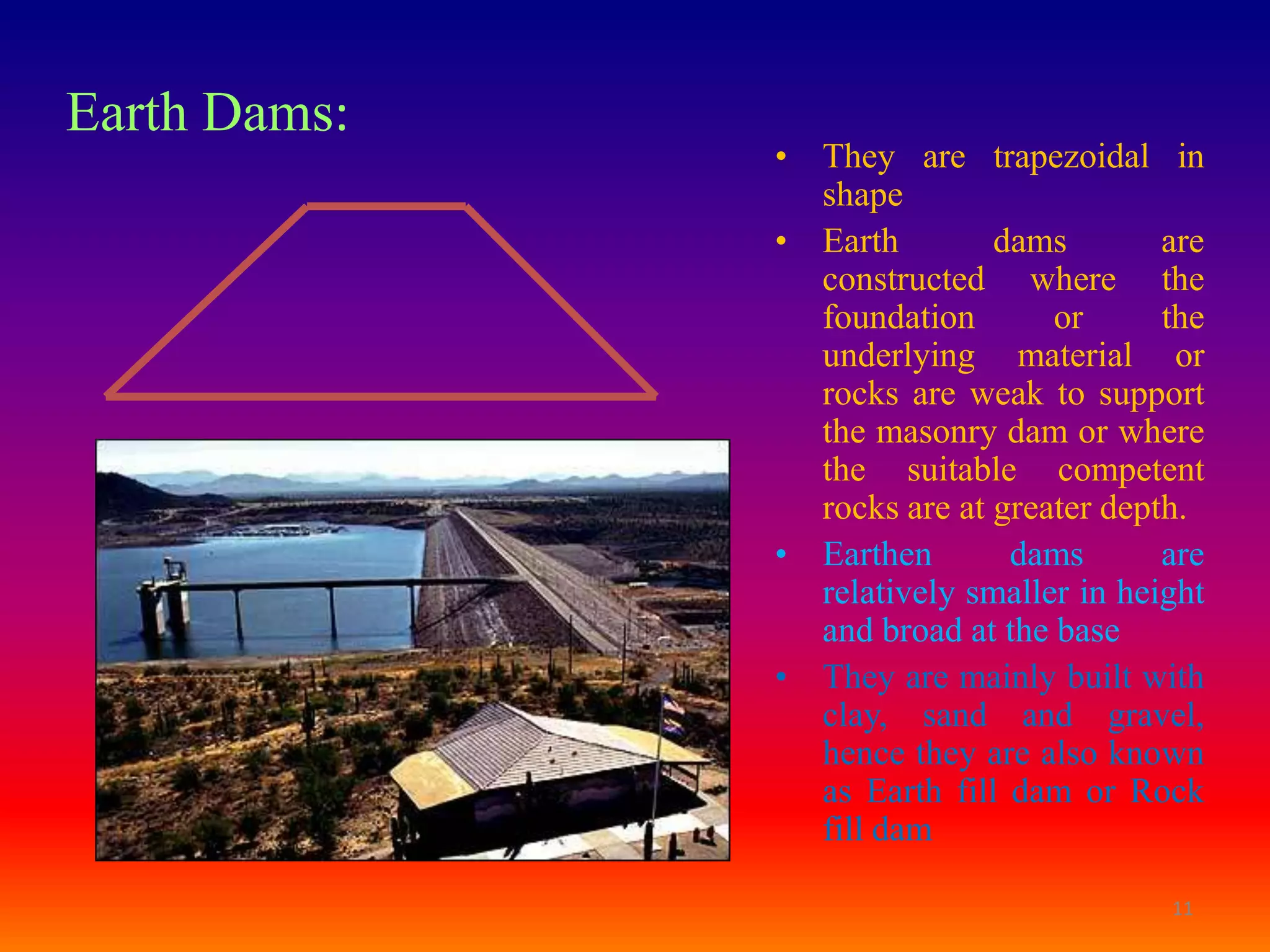
Earth Dams:
              • They are trapezoidal in
                shape
              • Earth        dams        are
                constructed where the
                foundation       or      the
                underlying material or
                rocks are weak to support
                the masonry dam or where
                the suitable competent
                rocks are at greater depth.
              • Earthen       dams       are
                relatively smaller in height
                and broad at the base
              • They are mainly built with
                clay, sand and gravel,
                hence they are also known
                as Earth fill dam or Rock
                fill dam

                                         11
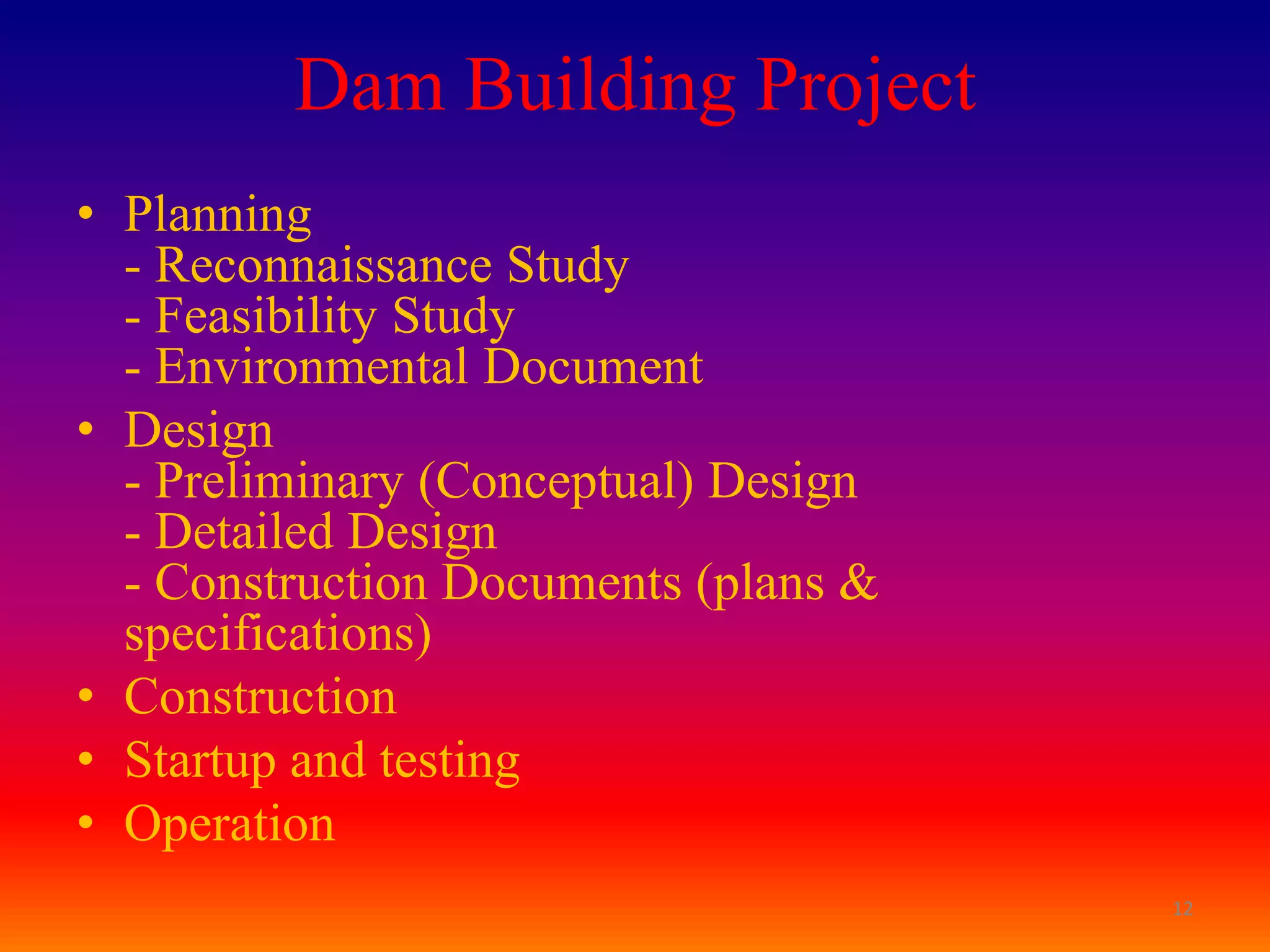
Dam Building Project
• Planning
  - Reconnaissance Study
  - Feasibility Study
  - Environmental Document
• Design
  - Preliminary (Conceptual) Design
  - Detailed Design
  - Construction Documents (plans &
  specifications)
• Construction
• Startup and testing
• Operation
                                      12
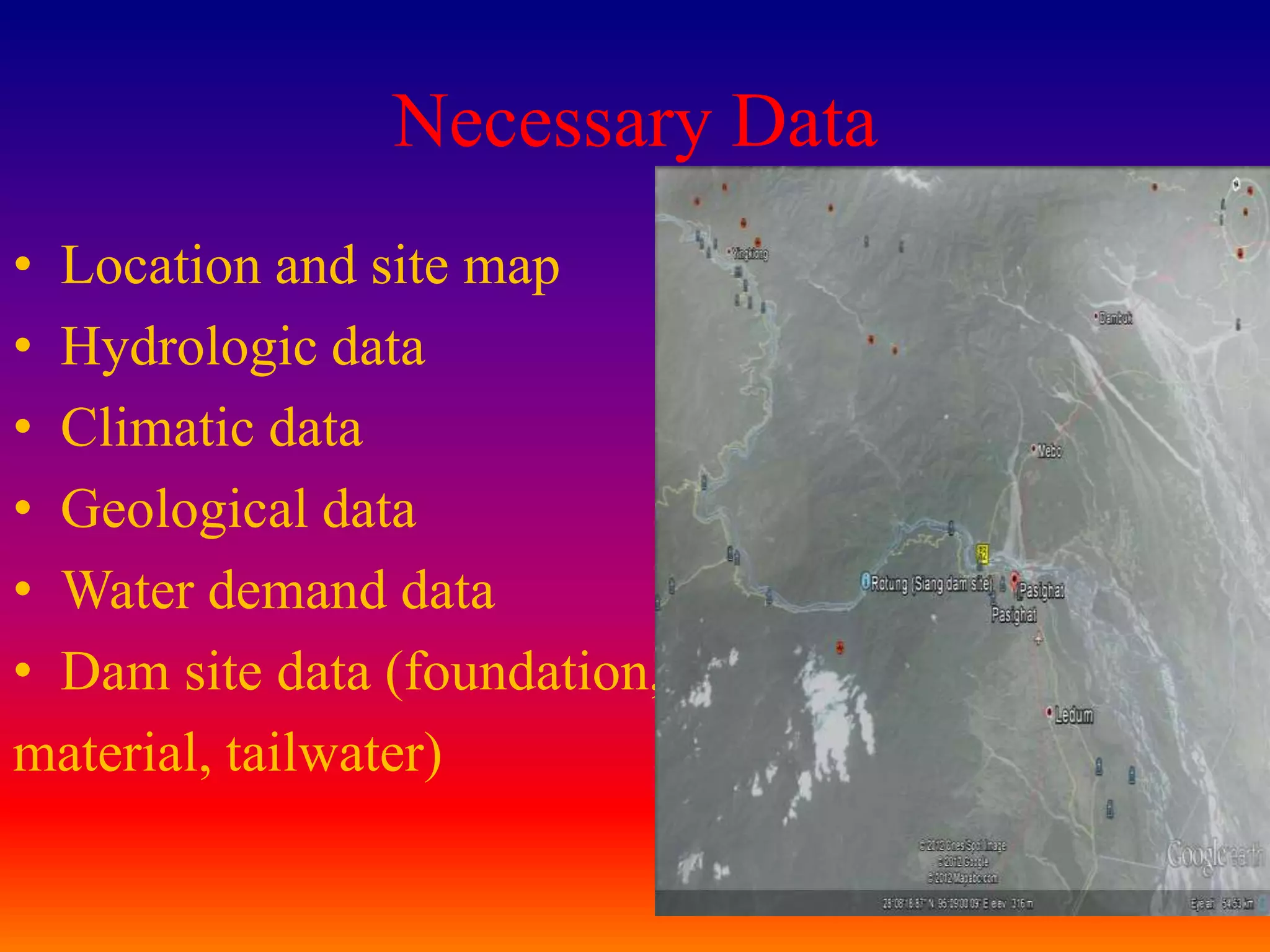
Necessary Data
• Location and site map
• Hydrologic data
• Climatic data
• Geological data
• Water demand data
• Dam site data (foundation,
material, tailwater)

                                 13
SELECTION OF SITES
PLACE MUST BE SUITABLE
NARROW GORGE OR SMALL VALLEY
  WITH ENOUGH CATCHMENT AREA

     WHY DO WE
                  TO STORE A
     NEED A
                  CALCULATED
     LARGE
                  VOLUME OF
     CATCHMENT
                  WATER
     AREA?


                                14
Large storage capacity
Length of dam to constructed is less.
Water-tightness of reservoir.
Good hydrological conditions
Deep reservoir
Small submerged area
Low silt inflow
No objectionable minerals
Low cost of real estate
Site easily accessible

                                         15
INVESTTIGATIONS
 Engineering surveys

 Geological investigations

 Hydrological investigations


                                16
Engineering surveys
 Conducted for dam, reservoir and other
  associated work.

 Topographic survey of the area is carried out
  and the contour plan is prepared

 The horizontal control is usually provided by
  triangulation survey, and the vertical control
  by precise levelling
                                                   17
Geological investigation
 Geological investigations of the dam and
  reservoir site are done for the following
  purposes.

  (i) Suitability of foundation for the dam.
  (ii) Water-tightness of the reservoir basin
  (iii) Location of the quarry sites for the
  construction materials.
                                                18
Hydrological investigations
 The hydrological investigations are conducted
  for the following purposes :

  (i) To study the runoff pattern and storage
  capacity.
  (ii) To determine the maximum discharge at
  the site.


                                                  19
Requirements for Stability
• Modes of failure of a gravity dam:
        Overturning
        Sliding
        Compression or Crushing
        Tension.
The design shall satisfy the following requirements of
stability:
       The dam shall be safe against sliding on any plane or
   combination of planes within the dam, at the foundation or
within the foundation;
       The dam shall be safe against overturning at any plane
   within the dam, at the base, or at any plane below the base;
   and
                                                               20
       The safe unit stresses in the concrete or masonry of the
Reservoir Sedimentation
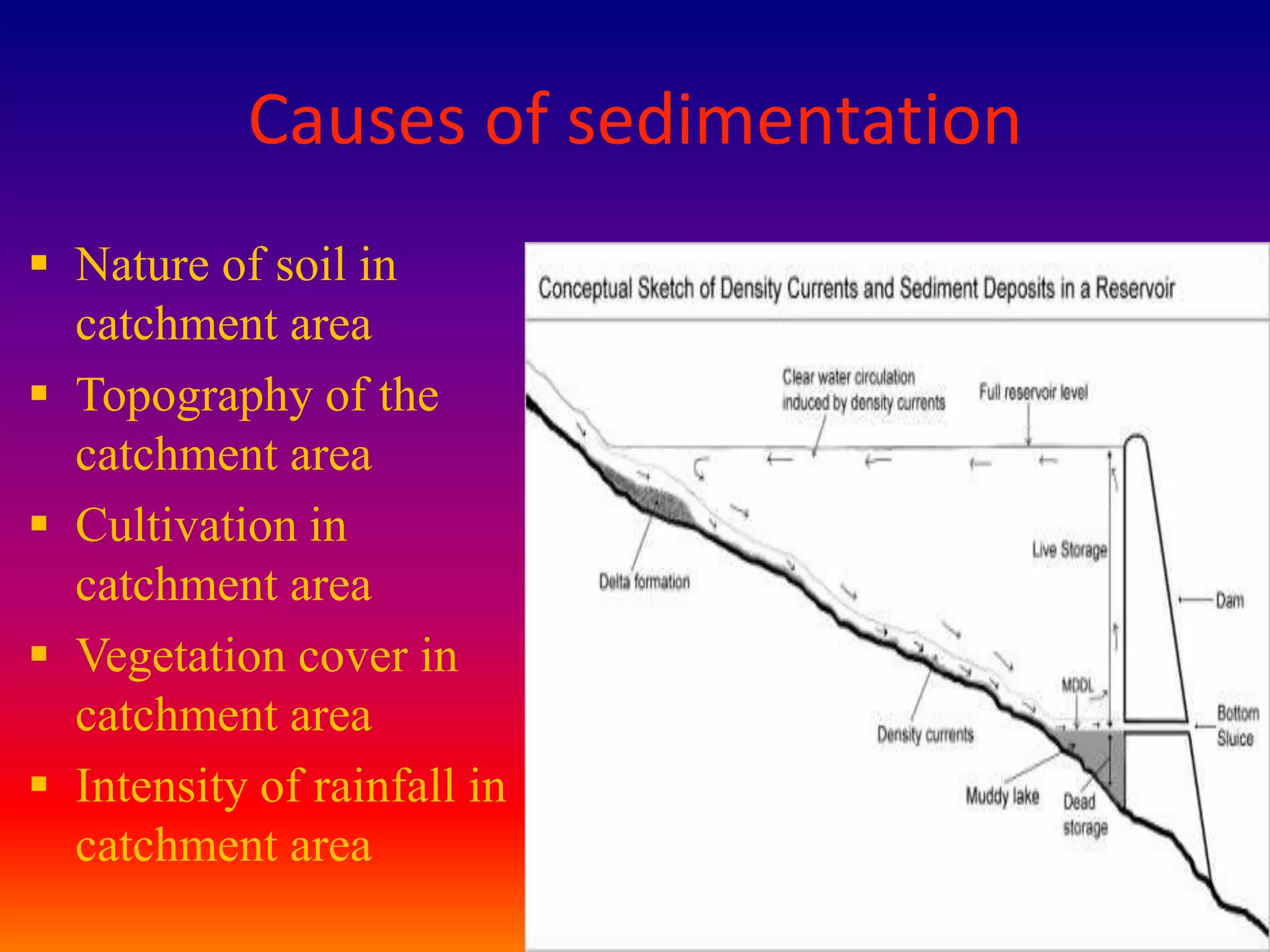
 It is a difficult problem for which an economical
  solution has not yet been discovered, except by
  providing a “dead storage” to accommodate the
  deposits during the life of the dam.


 Disintegration, erosion, transportation, and
  sedimentation, are the different stages leading to
  silting of reservoir.
                                                       21
Causes of sedimentation
 Nature of soil in
  catchment area
 Topography of the
  catchment area
 Cultivation in
  catchment area
 Vegetation cover in
  catchment area
 Intensity of rainfall in
  catchment area
                                     22
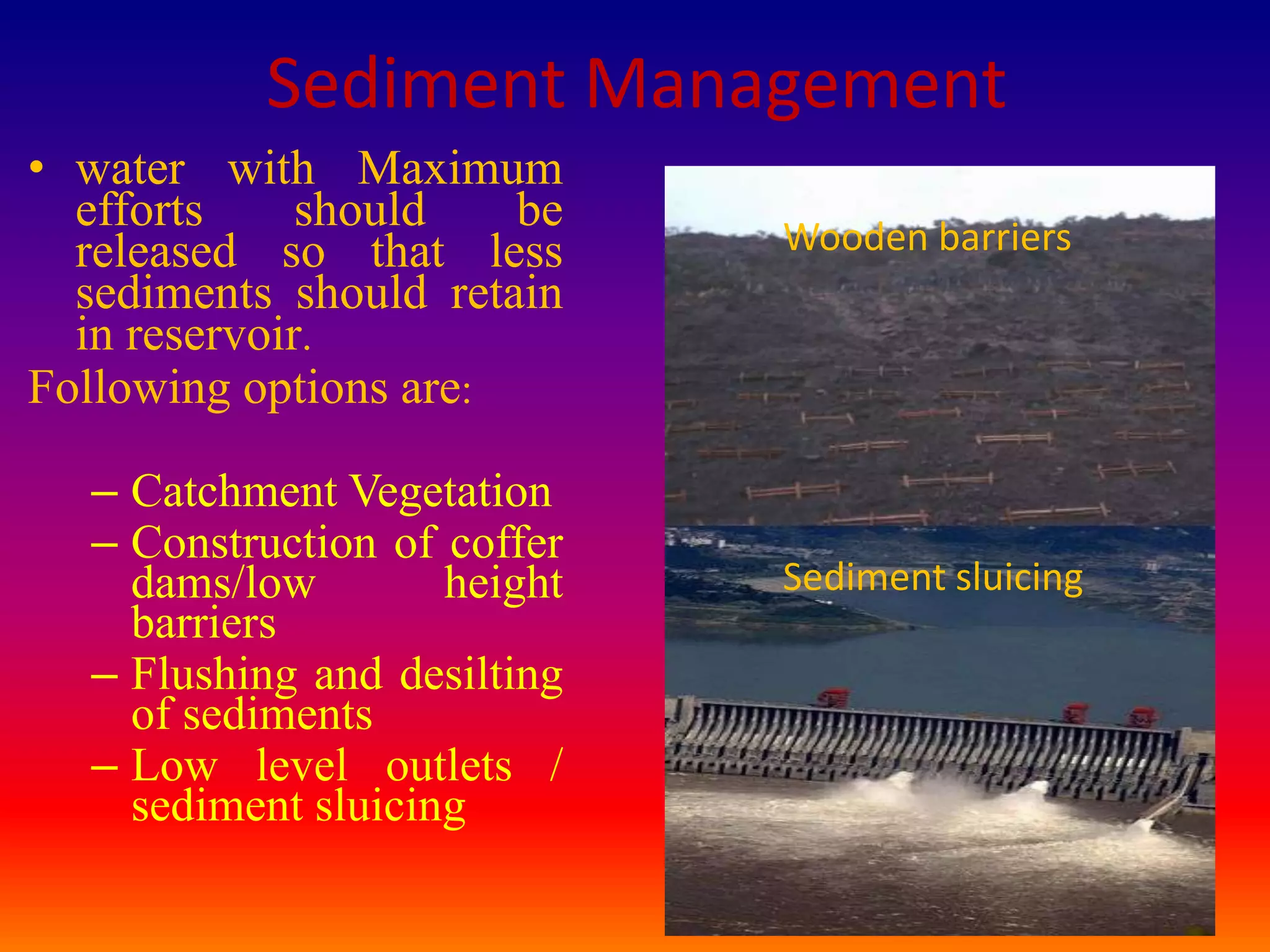
Sediment Management
• water with Maximum
  efforts     should   be
  released so that less      Wooden barriers
  sediments should retain
  in reservoir.
Following options are:

  – Catchment Vegetation
  – Construction of coffer
    dams/low        height   Sediment sluicing
    barriers
  – Flushing and desilting
    of sediments
  – Low level outlets /
    sediment sluicing
                                                 23
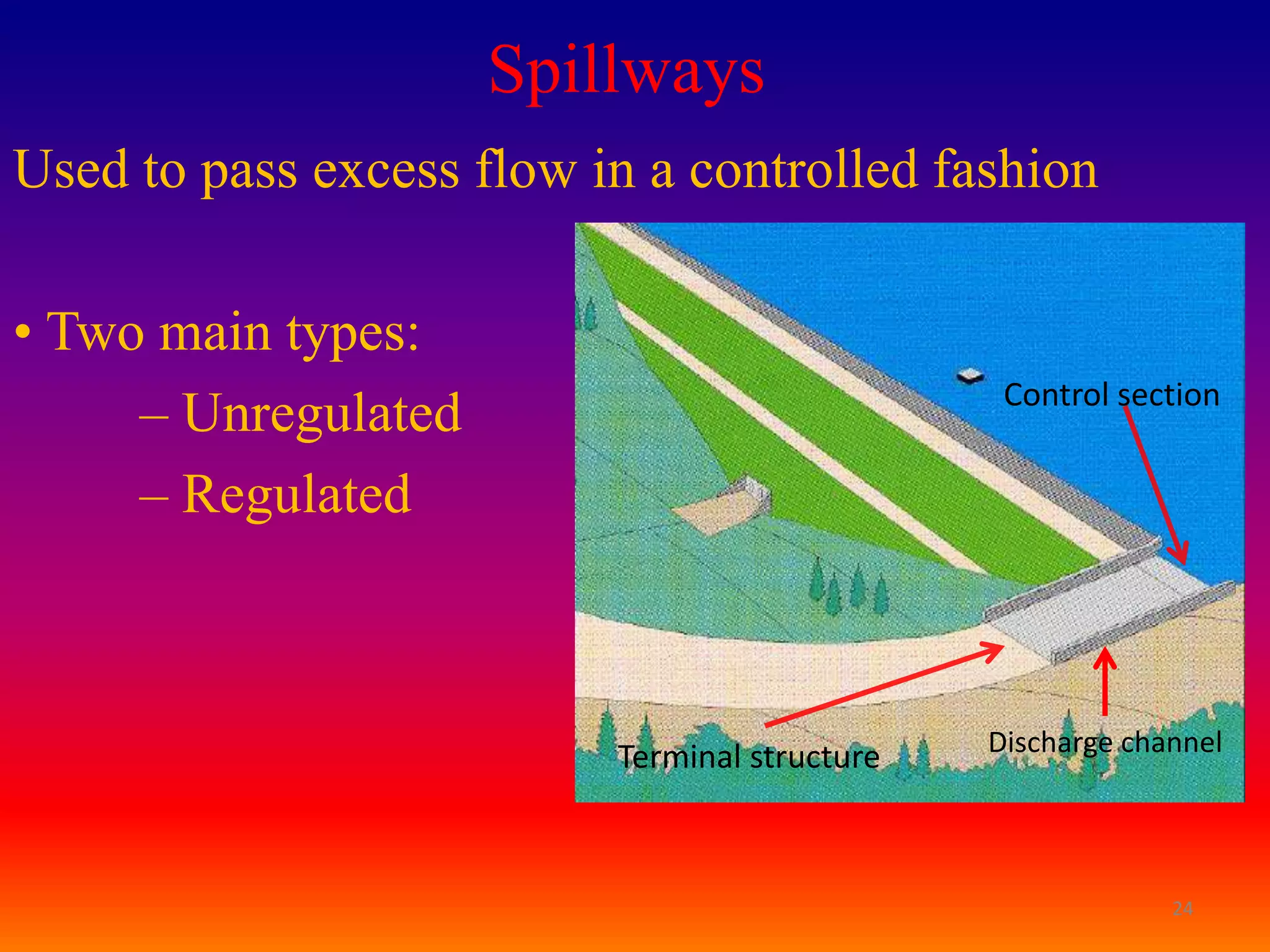
Spillways
Used to pass excess flow in a controlled fashion

• Two main types:
                                                Control section
     – Unregulated
     – Regulated


                          Terminal structure   Discharge channel


                                                            24
SPILLWAYS
Types of Spillways
      a. Overflow spillways

      b. Chute spillways

      c. Side-channel spillways

      d. Shaft spillways

      e. Siphon spillways

      f. Service & Emergency spillways
                                         25
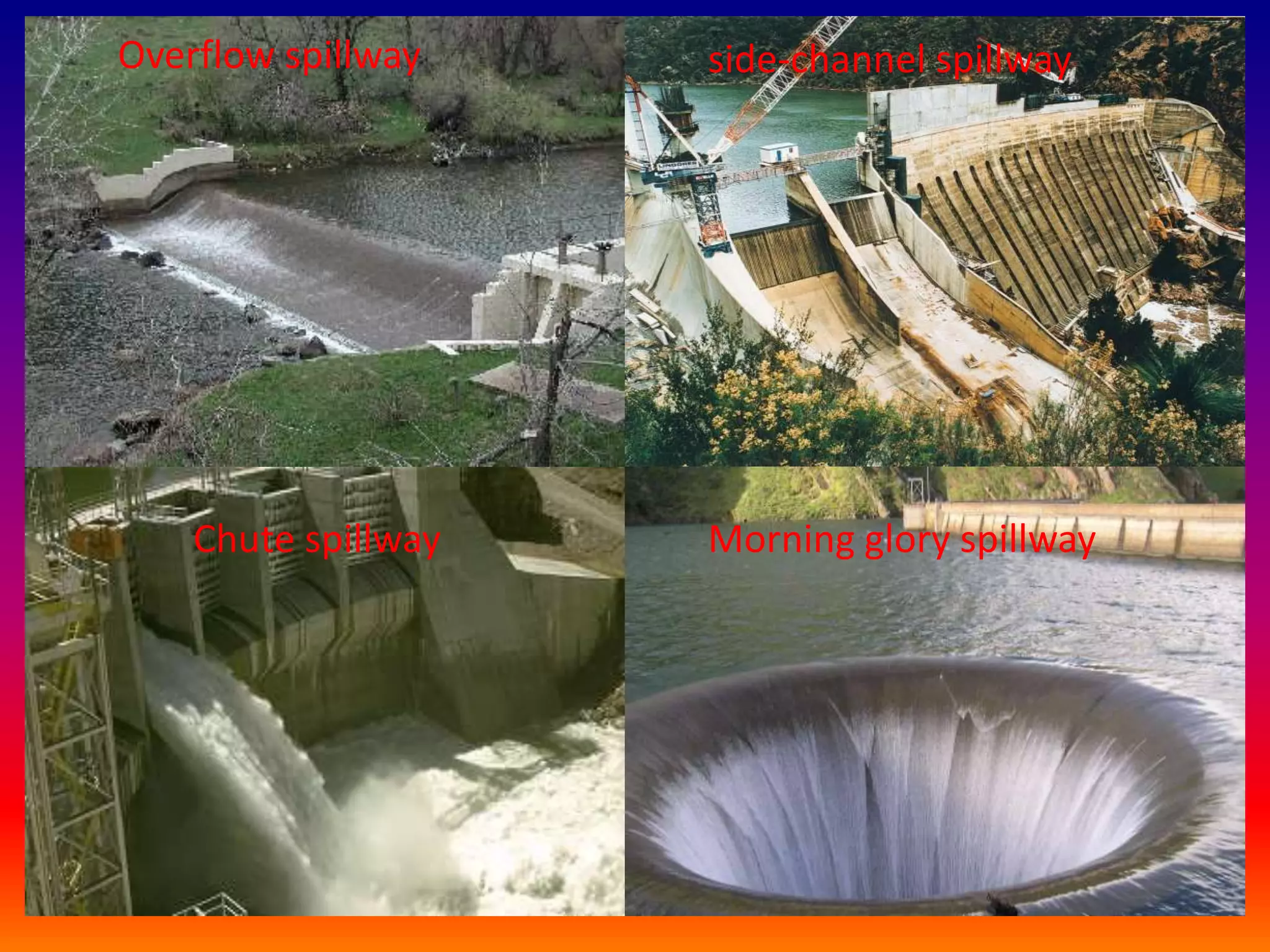
Overflow spillway    side-channel spillway


    Chute spillway   Morning glory spillway


                                              26
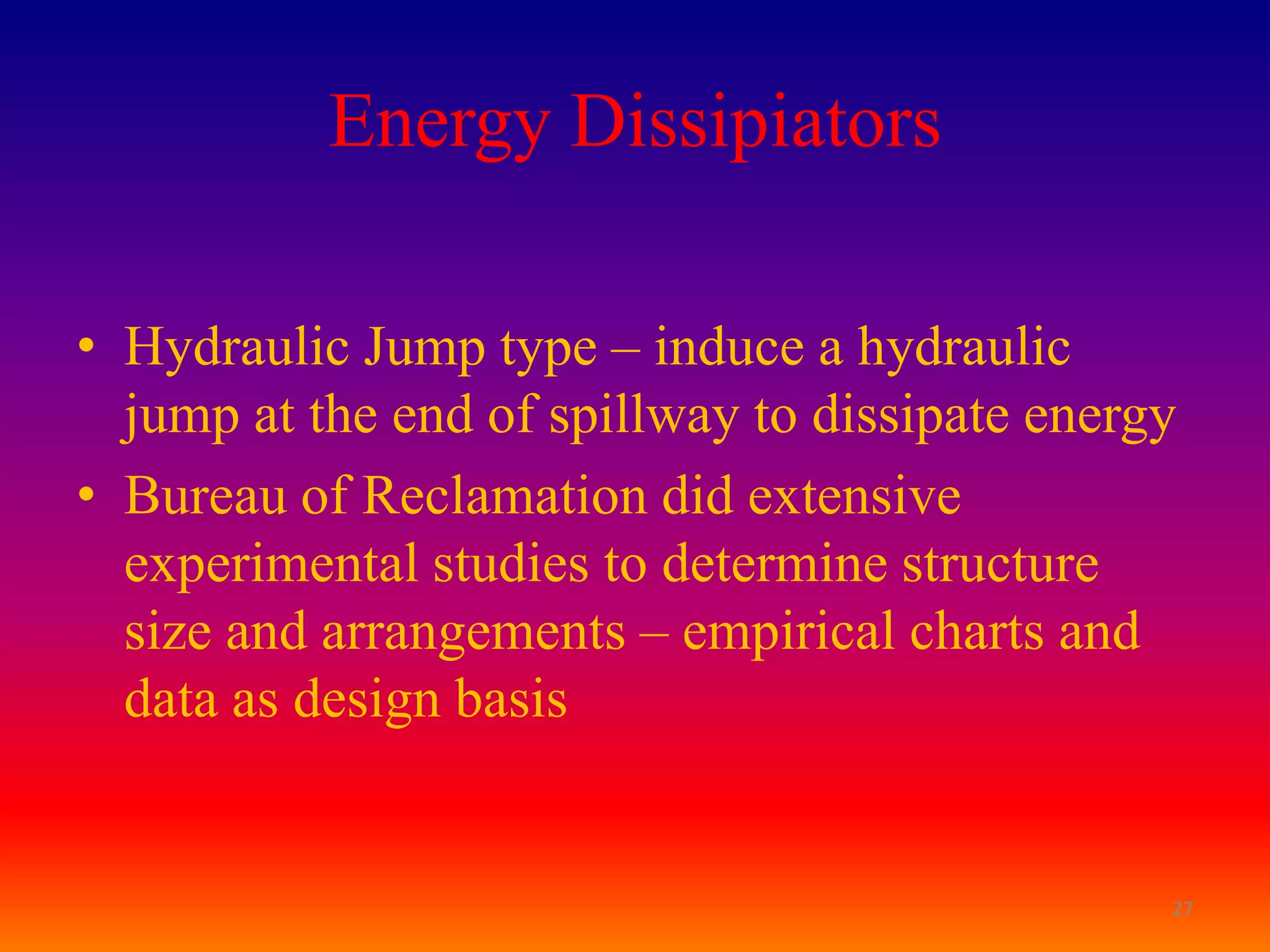
Energy Dissipiators

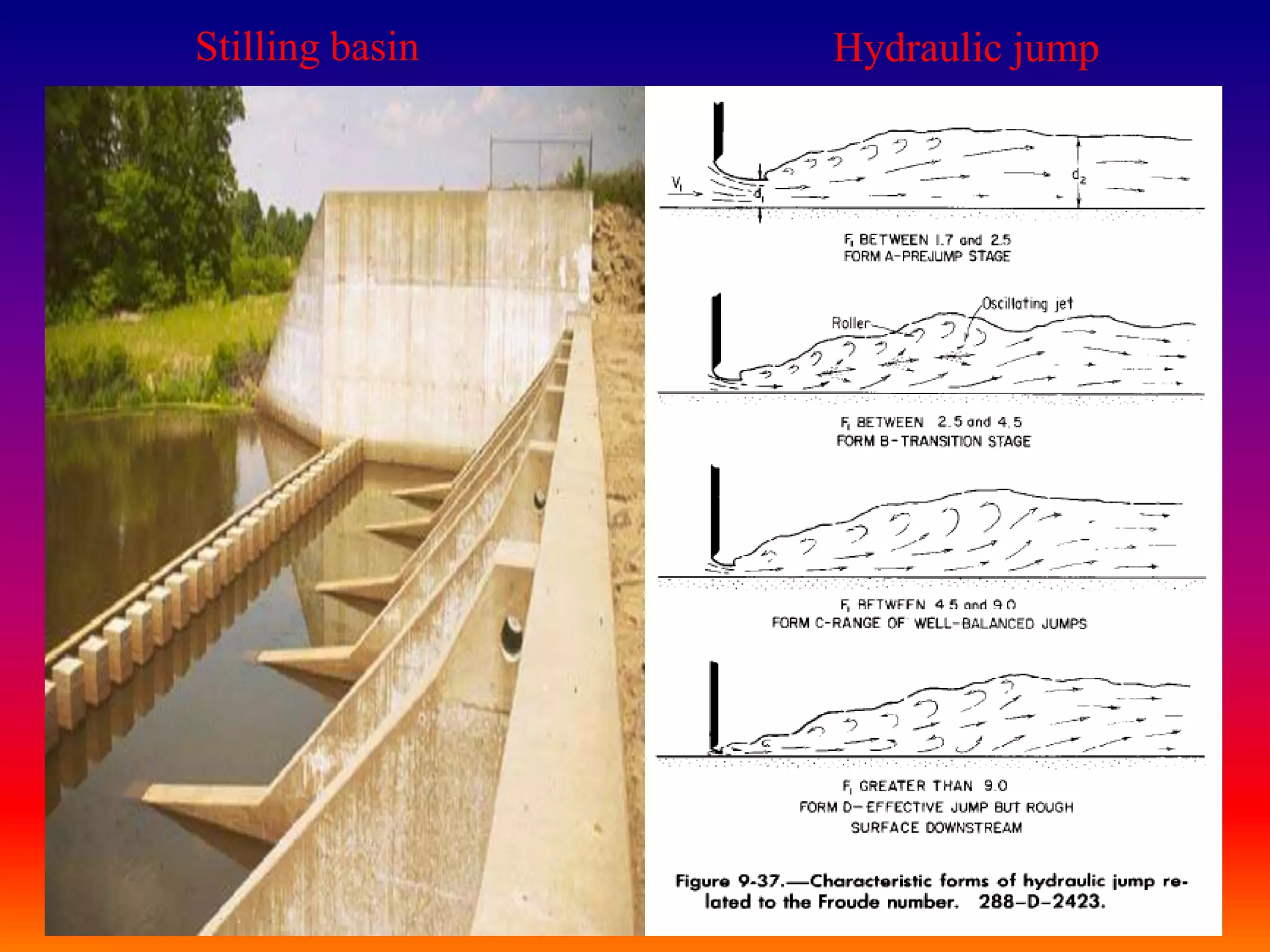
• Hydraulic Jump type – induce a hydraulic
  jump at the end of spillway to dissipate energy
• Bureau of Reclamation did extensive
  experimental studies to determine structure
  size and arrangements – empirical charts and
  data as design basis


                                                27
Stilling basin   Hydraulic jump


                                  28
THANK YOU!!!


               29

design of gravity dam

  • 1.
    Analysis and designof gravity dam in seismic zone V Project by: • Mr. Risso Johnny • Mr. Kapu Takar • Mr. Atan Ketan • Mr. Manoj Thorat • Mr. Shaikh Arshanaj.
  • 2.
    Dam • Dam isa solid barrier constructed at a suitable location across a river valley to store flowing water. Need and Necessity: • Irrigation • Water for domestic consumption • Drought and flood control • For navigational facilities • Hydroelectric power generation • Recreation • Development of fish & wild life • Soil conservation 2
  • 3.
    History of Dams •First dam was constructed by the Egyptians in 2950-2750 B.C, using stone/ brick masonry. • Earth dam was built first in Mesopotamia around 2000 B.C. • Romans used concrete and mortars around 100 AD. • Due to large size and amount of building material need to construct earth and gravity dams 3
  • 4.
    Grand Anicut (Kallanai) Theoldest dam in the world Built by Chola king Karikalan around the 2nd Century AD  to divert the waters of the Kaveri across the fertile delta region for irrigation via canals.  It is constructed from unhewn stone spanning the Kaveri and is 329 m (1,079 ft.) long, 20 m (66 ft.) wide and 5.4 m (18 ft.) high 4
  • 5.
    Structure of Dam Crest Spillway (inside dam) MWL Max. level NWL Normal water level Upstream Down stream Free board Sluice way Gallery Heel Toe
  • 6.
     Heel: contactwith the ground on the upstream side  Toe: contact on the downstream side  Abutment: Sides of the valley on which the structure of the dam rest  Galleries: small rooms like structure left within the dam for checking operations.  Diversion tunnel: Tunnels are constructed for diverting water before the construction of dam. This helps in keeping the river bed dry.  Spillways: It is the arrangement near the top to release the excess water of the reservoir to downstream side  Sluice way: An opening in the dam near the ground level, which is used to clear the silt accumulation in the reservoir side. 6
  • 7.
    TYPES OF DAMS: Gravity Dams: Reservoir • These dams are heavy Force and massive wall-like structures of concrete in which the whole weight acts vertically downwards As the entire load is transmitted on the small area of foundation, such dams are constructed where rocks are competent and stable 7
  • 8.
    Buttress Dam: • Buttress Dam – Is a gravity dam reinforced by structural supports • Buttress - a support that transmits a force from a roof or wall to another supporting structure This type of structure can be considered even if the foundation rocks are little weaker 8
  • 9.
    Arch Dams: • These type of dams are concrete or masonry dams which are curved or convex upstream in plan • This shape helps to transmit the major part of the water load to the abutments • Arch dams are built across narrow, deep river gorges, but now in recent years they have been considered even for little wider valleys. 9
  • 10.
  • 11.
    Earth Dams: • They are trapezoidal in shape • Earth dams are constructed where the foundation or the underlying material or rocks are weak to support the masonry dam or where the suitable competent rocks are at greater depth. • Earthen dams are relatively smaller in height and broad at the base • They are mainly built with clay, sand and gravel, hence they are also known as Earth fill dam or Rock fill dam 11
  • 12.
    Dam Building Project •Planning - Reconnaissance Study - Feasibility Study - Environmental Document • Design - Preliminary (Conceptual) Design - Detailed Design - Construction Documents (plans & specifications) • Construction • Startup and testing • Operation 12
  • 13.
    Necessary Data • Locationand site map • Hydrologic data • Climatic data • Geological data • Water demand data • Dam site data (foundation, material, tailwater) 13
  • 14.
    SELECTION OF SITES PLACEMUST BE SUITABLE NARROW GORGE OR SMALL VALLEY WITH ENOUGH CATCHMENT AREA WHY DO WE TO STORE A NEED A CALCULATED LARGE VOLUME OF CATCHMENT WATER AREA? 14
  • 15.
    Large storage capacity Lengthof dam to constructed is less. Water-tightness of reservoir. Good hydrological conditions Deep reservoir Small submerged area Low silt inflow No objectionable minerals Low cost of real estate Site easily accessible 15
  • 16.
    INVESTTIGATIONS  Engineering surveys Geological investigations  Hydrological investigations 16
  • 17.
    Engineering surveys  Conductedfor dam, reservoir and other associated work.  Topographic survey of the area is carried out and the contour plan is prepared  The horizontal control is usually provided by triangulation survey, and the vertical control by precise levelling 17
  • 18.
    Geological investigation  Geologicalinvestigations of the dam and reservoir site are done for the following purposes. (i) Suitability of foundation for the dam. (ii) Water-tightness of the reservoir basin (iii) Location of the quarry sites for the construction materials. 18
  • 19.
    Hydrological investigations  Thehydrological investigations are conducted for the following purposes : (i) To study the runoff pattern and storage capacity. (ii) To determine the maximum discharge at the site. 19
  • 20.
    Requirements for Stability •Modes of failure of a gravity dam: Overturning Sliding Compression or Crushing Tension. The design shall satisfy the following requirements of stability:  The dam shall be safe against sliding on any plane or combination of planes within the dam, at the foundation or within the foundation;  The dam shall be safe against overturning at any plane within the dam, at the base, or at any plane below the base; and 20  The safe unit stresses in the concrete or masonry of the
  • 21.
    Reservoir Sedimentation  Itis a difficult problem for which an economical solution has not yet been discovered, except by providing a “dead storage” to accommodate the deposits during the life of the dam.  Disintegration, erosion, transportation, and sedimentation, are the different stages leading to silting of reservoir. 21
  • 22.
    Causes of sedimentation Nature of soil in catchment area  Topography of the catchment area  Cultivation in catchment area  Vegetation cover in catchment area  Intensity of rainfall in catchment area 22
  • 23.
    Sediment Management • waterwith Maximum efforts should be released so that less Wooden barriers sediments should retain in reservoir. Following options are: – Catchment Vegetation – Construction of coffer dams/low height Sediment sluicing barriers – Flushing and desilting of sediments – Low level outlets / sediment sluicing 23
  • 24.
    Spillways Used to passexcess flow in a controlled fashion • Two main types: Control section – Unregulated – Regulated Terminal structure Discharge channel 24
  • 25.
    SPILLWAYS Types of Spillways a. Overflow spillways b. Chute spillways c. Side-channel spillways d. Shaft spillways e. Siphon spillways f. Service & Emergency spillways 25
  • 26.
    Overflow spillway side-channel spillway Chute spillway Morning glory spillway 26
  • 27.
    Energy Dissipiators • HydraulicJump type – induce a hydraulic jump at the end of spillway to dissipate energy • Bureau of Reclamation did extensive experimental studies to determine structure size and arrangements – empirical charts and data as design basis 27
  • 28.
    Stilling basin Hydraulic jump 28
  • 29.

Editor's Notes

  • #4 Limestone was used to resist erosion and wave action.Was constructed to prevent erosion and reduce treat of flooding.Large slabs were used as core and external were made with masonry.