DEAF AND DUMB GESTURE
RECOGNIZATION SYSTEM
• MEMBERS:
R.RAJPRIYA
T.R.PRAVEENA
PRE FINAL YEAR ECE STUDENTS
• MENTOR:
Mr.S.J.KUMARESAN,ASP/ECE
RMK ENGINEERING COLLEGE
CHENNAI
PROBLEM:
• In our society we have people with disabilities.
• The technology is developing day by day but no significant developments
are undertaken for the betterment of these people.
• About nine billion people in the world are deaf and dumb
• Communications between deaf-mute and a normal person have always
been a challenging task.
• Sign language helps deaf and dumb people to communicate with other
people.
• But not all people understand sign language.
SOLUTION:
• Hand gesture recognition system is widely used technology for helping the
deaf and dumb people.
• Human hand has remained a popular choice to convey information in
situations where other forms like speech cannot be used.
• We aim for developing an deaf and dumb gesture recognize system for
establishing communication between the deaf and the dumb people.
• Gestures are considered as the most natural expressive way for
communications between human and computers in virtual system.
• Hand gestures which can represent ideas using unique shapes and finger
orientation have a scope for human machine interaction.
MARKET OVERVIEW:
• Deaf and dumb gesture recognition system is an inexpensive
device.
• It is also very efficient device when compared to the existing
devices.
• The main objective of this project is to achieve communication of
deaf-mute people like a normal person.
• It does not require any additional controller or processor.
TARGET CUSTOMER:
• It allows deaf and dumb people to communicate with
others.
• It is a best device for these people to overcome
their disability .
• They can express their views to others.
• This hand gesture recognition system can be used
for interfacing between computer and human using
hand gesture.
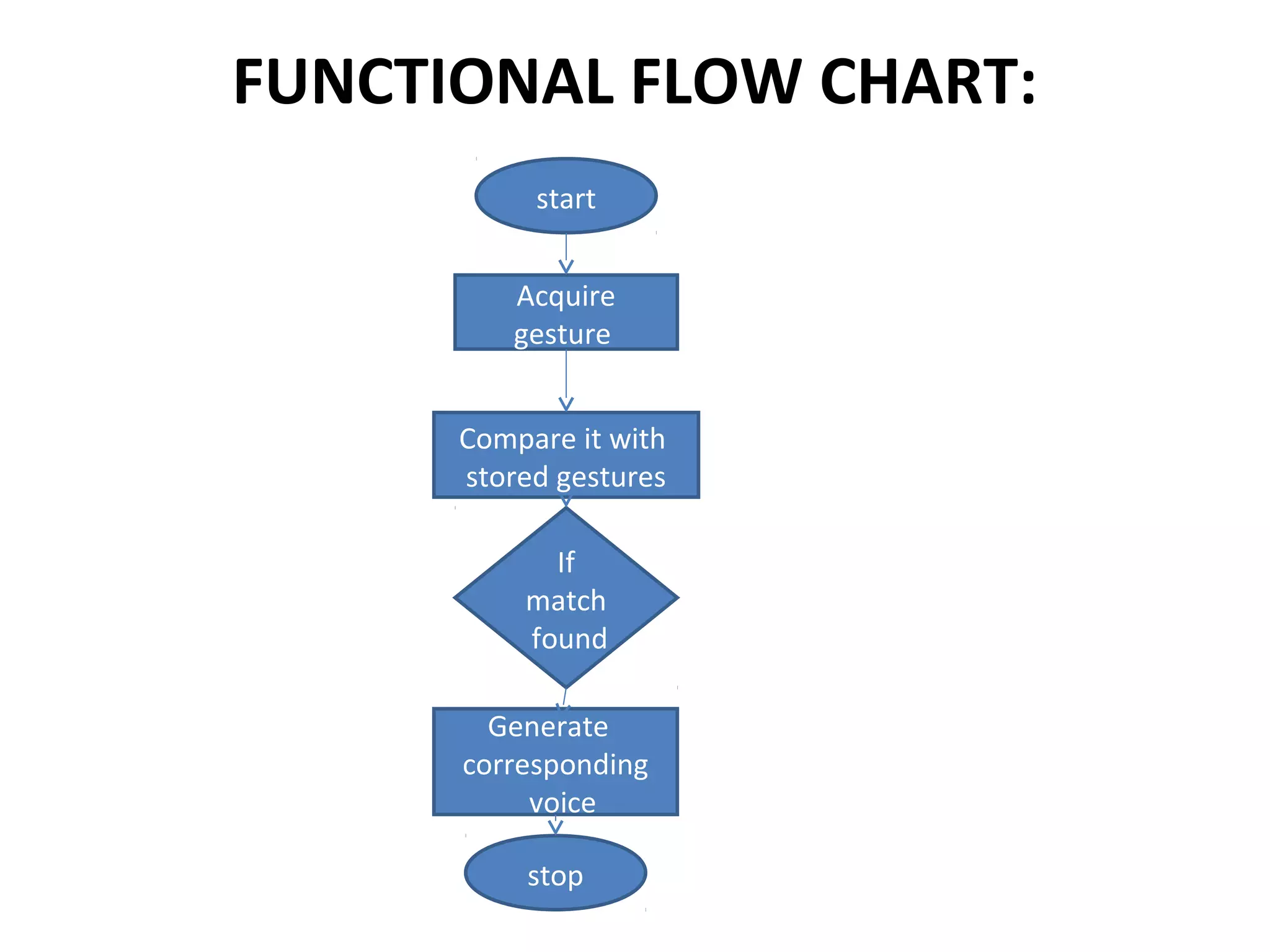
FUNCTIONAL FLOW CHART:
start
Acquire
gesture
Compare it with
stored gestures
If
match
found
Generate
corresponding
voice
stop
TECHNOLOGY USED
• FPGA
 
• CAMERA(C3088)
• UART MODULE
 
• Memory controller
 
• Feature extraction module
 
• Gesture recognition module
 
• LCD Display
 
• APR9600
EY DIFFERENTIATOR:
• This device does not include any additional controllers 
or processors. 
 
• This project can be developed in order to achieve easy 
usage of the device.
• It is compatible and power consumption is also less.
 
• It does not include any processing of signals as in other 
 devices.
 
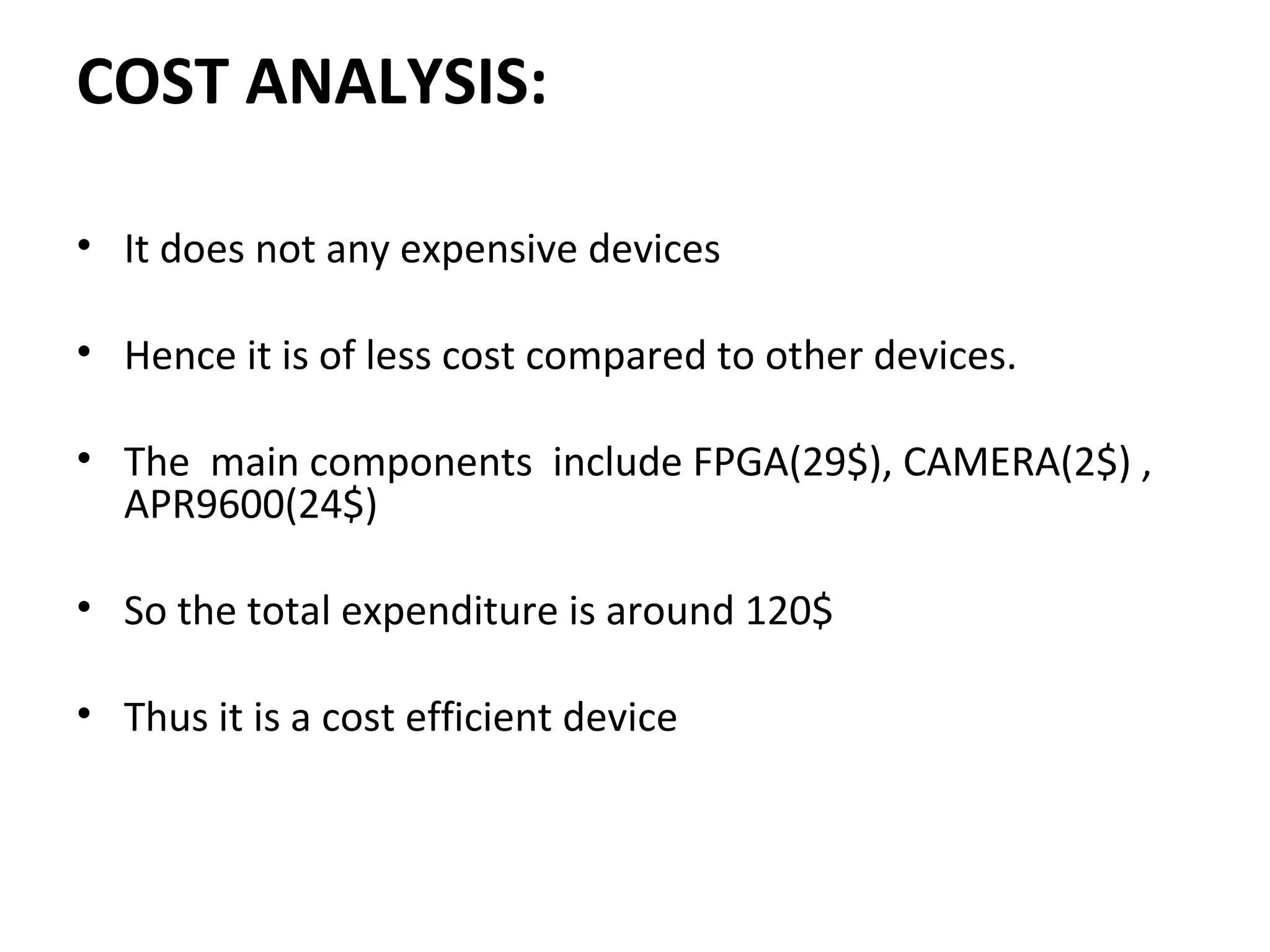
COST ANALYSIS:
• It does not any expensive devices 
 
• Hence it is of less cost compared to other devices.
• The  main components  include FPGA(29$), CAMERA(2$) , 
APR9600(24$)
 
• So the total expenditure is around 120$
 
• Thus it is a cost efficient device
 
 
FUTURE PLANS:
• This device can be developed into a device that
includes various sign languages in different countries.
• We want to make it into a complete product that
makes the deaf and dumb people to communicate like
a normal people.
• We want to produce a product for blind people that
converts the information in any hand written notes,
newspaper or books into a audio signal that these
people can here.
Deaf and Dump Gesture Recognition System

  • 1.
    DEAF AND DUMBGESTURE RECOGNIZATION SYSTEM • MEMBERS: R.RAJPRIYA T.R.PRAVEENA PRE FINAL YEAR ECE STUDENTS • MENTOR: Mr.S.J.KUMARESAN,ASP/ECE RMK ENGINEERING COLLEGE CHENNAI
  • 2.
    PROBLEM: • In oursociety we have people with disabilities. • The technology is developing day by day but no significant developments are undertaken for the betterment of these people. • About nine billion people in the world are deaf and dumb • Communications between deaf-mute and a normal person have always been a challenging task. • Sign language helps deaf and dumb people to communicate with other people. • But not all people understand sign language.
  • 3.
    SOLUTION: • Hand gesturerecognition system is widely used technology for helping the deaf and dumb people. • Human hand has remained a popular choice to convey information in situations where other forms like speech cannot be used. • We aim for developing an deaf and dumb gesture recognize system for establishing communication between the deaf and the dumb people. • Gestures are considered as the most natural expressive way for communications between human and computers in virtual system. • Hand gestures which can represent ideas using unique shapes and finger orientation have a scope for human machine interaction.
  • 4.
    MARKET OVERVIEW: • Deafand dumb gesture recognition system is an inexpensive device. • It is also very efficient device when compared to the existing devices. • The main objective of this project is to achieve communication of deaf-mute people like a normal person. • It does not require any additional controller or processor.
  • 5.
    TARGET CUSTOMER: • Itallows deaf and dumb people to communicate with others. • It is a best device for these people to overcome their disability . • They can express their views to others. • This hand gesture recognition system can be used for interfacing between computer and human using hand gesture.
  • 6.
    FUNCTIONAL FLOW CHART: start Acquire gesture Compareit with stored gestures If match found Generate corresponding voice stop
  • 7.
    TECHNOLOGY USED • FPGA   •CAMERA(C3088) • UART MODULE   • Memory controller   • Feature extraction module   • Gesture recognition module   • LCD Display   • APR9600
  • 8.
    EY DIFFERENTIATOR: • This device does not include any additional controllers  or processors.    •This project can be developed in order to achieve easy  usage of the device. • It is compatible and power consumption is also less.   • It does not include any processing of signals as in other   devices.  
  • 9.
    COST ANALYSIS: • It does not any expensive devices    •Hence it is of less cost compared to other devices. • The  main components  include FPGA(29$), CAMERA(2$) ,  APR9600(24$)   • So the total expenditure is around 120$   • Thus it is a cost efficient device    
  • 10.
    FUTURE PLANS: • Thisdevice can be developed into a device that includes various sign languages in different countries. • We want to make it into a complete product that makes the deaf and dumb people to communicate like a normal people. • We want to produce a product for blind people that converts the information in any hand written notes, newspaper or books into a audio signal that these people can here.