Teens and Social Media An Overview Amanda Lenhart New York Department of Health & Mental Hygiene April 10, 2009
Road map Teen internet use basics Teen tech tool ownership How teens communicate Social networks Mobile phones Young adults & communication Young adults and online health Wrap up
Methodology RDD surveys with teens 12 to 17 and a parent or guardian Sept-Nov 2007 (n=700) Nov-Feb 2008 (n=1102) Focus groups RDD surveys of adults on online health information seeking
Growth of internet use over time
Teen internet use basics 93% of teens 12-17 go online 89% of online teens go online from home, and most of them go online from home most often 77% of teen go online at school 71% go online from friends or relatives house 60% go online from a library 66% of households with teens go online via broadband, 22% via dial up, and 10% do not have access at home. 63% of online teens go online daily
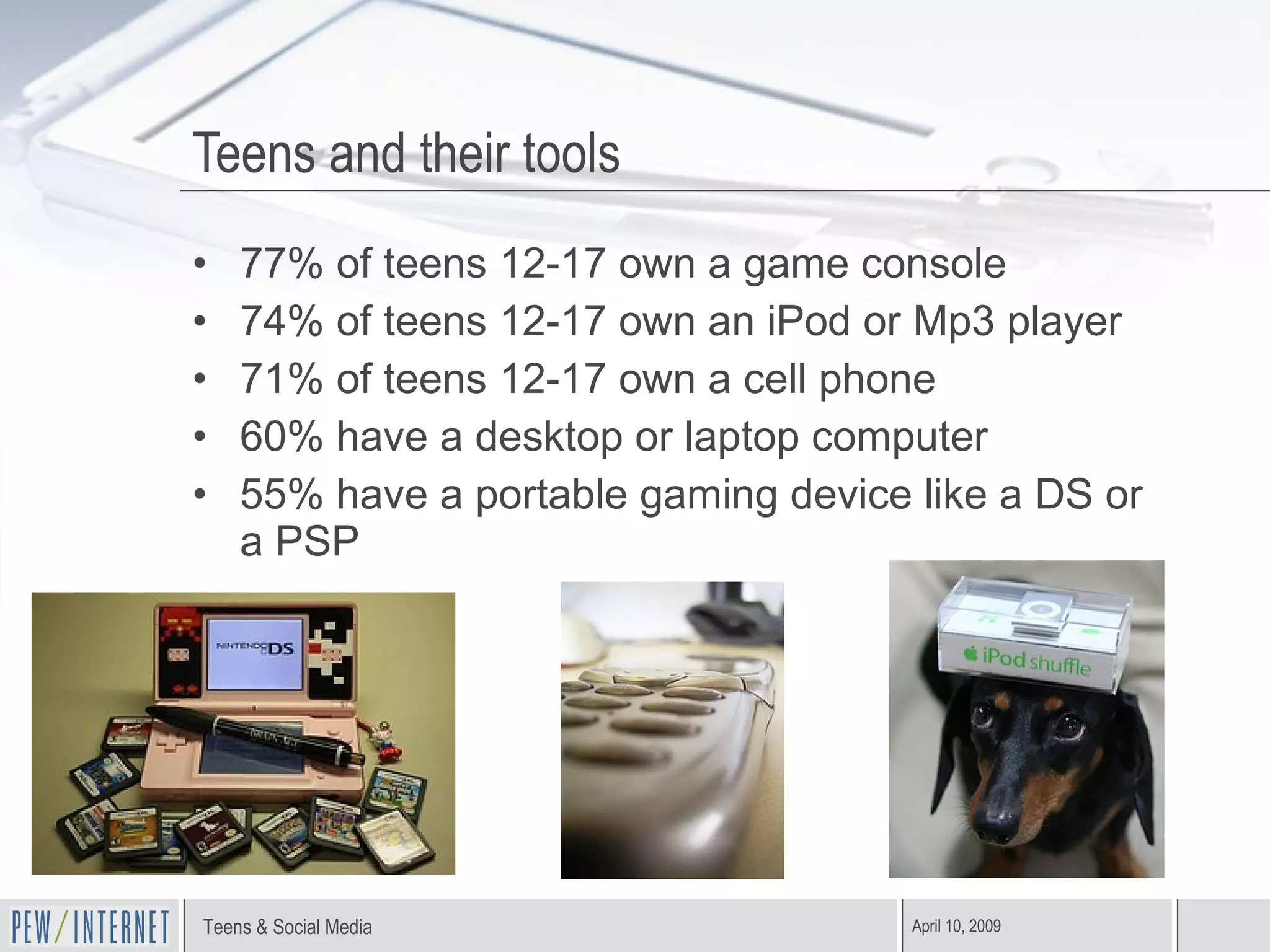
Teens and their tools 77% of teens 12-17 own a game console 74% of teens 12-17 own an iPod or Mp3 player 71% of teens 12-17 own a cell phone 60% have a desktop or laptop computer 55% have a portable gaming device like a DS or a PSP
How has tool ownership changed? Cell phone ownership is way up: 45% of 12-17 year olds had them in 2004 63% in 2006 71% in early 2008. Computer ownership is stable at least over the past two years Caveat: Concept of “ownership” varies from device to device
Online activities: Teens 97% of teens play video games 81% go to websites about movies, TV shows, music groups or sports stars you are interested in 65% use an online social networking site 63% go online to get news or information about current events or politics 57% have watched a video on video-sharing site like YouTube* 55% go online to get information about a college or university* 38% buy things online like books, clothing or music* 28% look online for health, dieting or physical fitness information* 27% keep a blog or online journal 19% have downloaded a podcast* 18% have visited a chat room* 11% have a website
How teens communicate All teens: 95% of teens spend time with friends face to face 88% of teens talk to their friends on a landline 67% of teens talk to their friends on their cell phone 65% of teens send email to friends 61% send messages to friends through social networking sites 60% of online teens send instant messages to friends 58% of teens send text messages to friends
How teens communicate daily Everyday: 51% of teens (with cell phones) talk on their cell phones 42% of teens (who use SNS) send messages through social networking sites like MySpace or Facebook 38% of teens send text messages to each other 32% of teens talk to friends on a landline phone 29% spend time with friends in person doing social activities outside of school 26% send instant messages 16% send email
Changes since 2006 Up: texting Stable: SNS, email, in person, cell phone Down: IM, landline (more saying that they never do this, or use it less than once a week) What teens don’t do? Twitter.
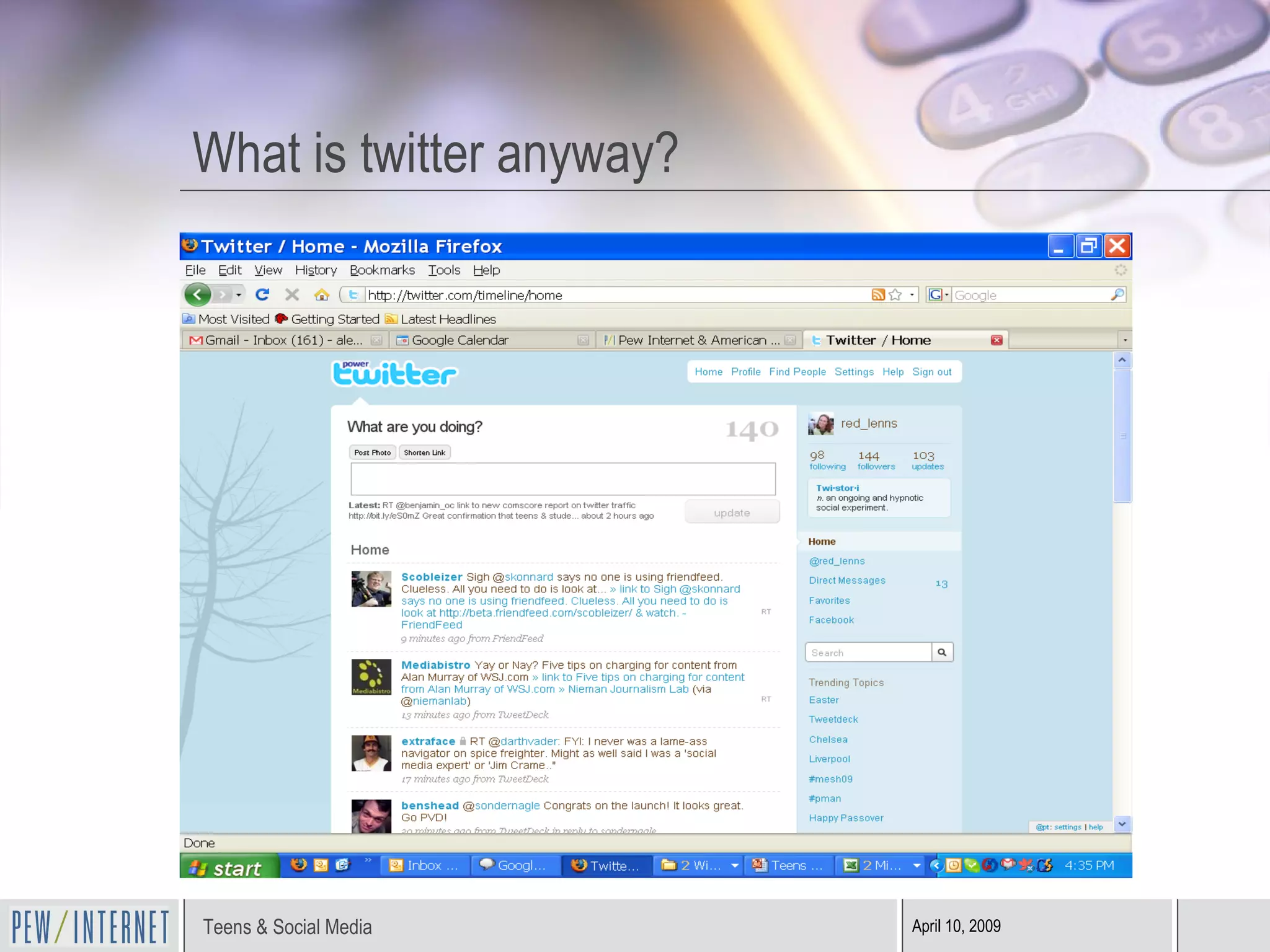
What is twitter anyway?
Likelihood of Twitter use by age
 
Social networking sites 65% of online teens have a profile online Girls, particularly older girls, more likely to use SNS than boys (86% of girls 15-17 have profile online, compared to 69% of boys 15-17) Age is major factor 12 -14 year-olds; 38% have an online profile 15 -17 year-olds; 77% have an online profile Other demographic factors not significant Income Race/ethnicity
Social networking activities 83% of social network users have added comments to a friend’s picture 77% post messages to friend’s page or wall 71% send private messages to friends within the SNS 66% post comments on a friends blog 54% send bulletins or group messages to all their friends 54% send IMs or text messages to friends through the SNS All activities (except comments on pictures and sending IM/txts via sns are down since 2006)
Mobile phones 71% of teens ages 12-17 have a mobile phone Up from 65% in Fall 2006 and 45% in Fall 2004 88% of parents have mobile phones No significant difference in mobile phone ownership by race/ethnicity Some differences by socio-economic status – but mostly a minor bump up in the highest income and education brackets. Age is very important – huge bump up in mobile phone ownership at age 14  52% of 12-13 year olds have a mobile phone At age 14 jumps to 72%  By 17 its 84% of teens have a mobile phone No gender differences in ownership
Young adults and communication 91% of 18-31 use the internet 89% of 18-31 use email 75% of Gen Y get news online 70% of Gen Y (ages 18-31) use social network sites 57% of Gen Y use IM 18% of 18-31 use twitter 74% of Gen Y have a cell phone  85% of Gen Y use cell phone to send texts 38% of Gen Y use cell phone to access internet
Young adults and online health 79% of online young adults 18-29 look for health information Similar to other age groups except 65+ who are less likely  Health information that young adults are more likely to seek than other cohorts: Exercise or fitness information (55%) Sexual health information (21%) Immunizations or vaccination information (18%) Problems with drugs or alcohol (14%) How to quit smoking (13%) 22% of teens go online to look for information about a health topic that’s hard to talk about like drug use, sexual health or depression.*
Adults and online health Overall, women are much more likely to look online for any health information Highly educated internet users are also more likely to look online for health information of all kinds. Half of health information searches are for someone else 2/3rds of health searches start at search engines Typically visit two or more sites during a health search session
Wrap up Small signs of social network fatigue MySpace still relevant Mobile is ascendant Don’t forget about other mobile devices – not just mobile phones, but mp3 players, smart phones and portable gaming devices More video integration into social networks in the future?
Thank You! Amanda Lenhart [email_address] http://www.pewinternet.org

Teens and Social Media: An Overview

  • 1.
    Teens and SocialMedia An Overview Amanda Lenhart New York Department of Health & Mental Hygiene April 10, 2009
  • 2.
    Road map Teeninternet use basics Teen tech tool ownership How teens communicate Social networks Mobile phones Young adults & communication Young adults and online health Wrap up
  • 3.
    Methodology RDD surveyswith teens 12 to 17 and a parent or guardian Sept-Nov 2007 (n=700) Nov-Feb 2008 (n=1102) Focus groups RDD surveys of adults on online health information seeking
  • 4.
    Growth of internetuse over time
  • 5.
    Teen internet usebasics 93% of teens 12-17 go online 89% of online teens go online from home, and most of them go online from home most often 77% of teen go online at school 71% go online from friends or relatives house 60% go online from a library 66% of households with teens go online via broadband, 22% via dial up, and 10% do not have access at home. 63% of online teens go online daily
  • 6.
    Teens and theirtools 77% of teens 12-17 own a game console 74% of teens 12-17 own an iPod or Mp3 player 71% of teens 12-17 own a cell phone 60% have a desktop or laptop computer 55% have a portable gaming device like a DS or a PSP
  • 7.
    How has toolownership changed? Cell phone ownership is way up: 45% of 12-17 year olds had them in 2004 63% in 2006 71% in early 2008. Computer ownership is stable at least over the past two years Caveat: Concept of “ownership” varies from device to device
  • 8.
    Online activities: Teens97% of teens play video games 81% go to websites about movies, TV shows, music groups or sports stars you are interested in 65% use an online social networking site 63% go online to get news or information about current events or politics 57% have watched a video on video-sharing site like YouTube* 55% go online to get information about a college or university* 38% buy things online like books, clothing or music* 28% look online for health, dieting or physical fitness information* 27% keep a blog or online journal 19% have downloaded a podcast* 18% have visited a chat room* 11% have a website
  • 9.
    How teens communicateAll teens: 95% of teens spend time with friends face to face 88% of teens talk to their friends on a landline 67% of teens talk to their friends on their cell phone 65% of teens send email to friends 61% send messages to friends through social networking sites 60% of online teens send instant messages to friends 58% of teens send text messages to friends
  • 10.
    How teens communicatedaily Everyday: 51% of teens (with cell phones) talk on their cell phones 42% of teens (who use SNS) send messages through social networking sites like MySpace or Facebook 38% of teens send text messages to each other 32% of teens talk to friends on a landline phone 29% spend time with friends in person doing social activities outside of school 26% send instant messages 16% send email
  • 11.
    Changes since 2006Up: texting Stable: SNS, email, in person, cell phone Down: IM, landline (more saying that they never do this, or use it less than once a week) What teens don’t do? Twitter.
  • 12.
  • 13.
  • 14.
  • 15.
    Social networking sites65% of online teens have a profile online Girls, particularly older girls, more likely to use SNS than boys (86% of girls 15-17 have profile online, compared to 69% of boys 15-17) Age is major factor 12 -14 year-olds; 38% have an online profile 15 -17 year-olds; 77% have an online profile Other demographic factors not significant Income Race/ethnicity
  • 16.
    Social networking activities83% of social network users have added comments to a friend’s picture 77% post messages to friend’s page or wall 71% send private messages to friends within the SNS 66% post comments on a friends blog 54% send bulletins or group messages to all their friends 54% send IMs or text messages to friends through the SNS All activities (except comments on pictures and sending IM/txts via sns are down since 2006)
  • 17.
    Mobile phones 71%of teens ages 12-17 have a mobile phone Up from 65% in Fall 2006 and 45% in Fall 2004 88% of parents have mobile phones No significant difference in mobile phone ownership by race/ethnicity Some differences by socio-economic status – but mostly a minor bump up in the highest income and education brackets. Age is very important – huge bump up in mobile phone ownership at age 14 52% of 12-13 year olds have a mobile phone At age 14 jumps to 72% By 17 its 84% of teens have a mobile phone No gender differences in ownership
  • 18.
    Young adults andcommunication 91% of 18-31 use the internet 89% of 18-31 use email 75% of Gen Y get news online 70% of Gen Y (ages 18-31) use social network sites 57% of Gen Y use IM 18% of 18-31 use twitter 74% of Gen Y have a cell phone 85% of Gen Y use cell phone to send texts 38% of Gen Y use cell phone to access internet
  • 19.
    Young adults andonline health 79% of online young adults 18-29 look for health information Similar to other age groups except 65+ who are less likely Health information that young adults are more likely to seek than other cohorts: Exercise or fitness information (55%) Sexual health information (21%) Immunizations or vaccination information (18%) Problems with drugs or alcohol (14%) How to quit smoking (13%) 22% of teens go online to look for information about a health topic that’s hard to talk about like drug use, sexual health or depression.*
  • 20.
    Adults and onlinehealth Overall, women are much more likely to look online for any health information Highly educated internet users are also more likely to look online for health information of all kinds. Half of health information searches are for someone else 2/3rds of health searches start at search engines Typically visit two or more sites during a health search session
  • 21.
    Wrap up Smallsigns of social network fatigue MySpace still relevant Mobile is ascendant Don’t forget about other mobile devices – not just mobile phones, but mp3 players, smart phones and portable gaming devices More video integration into social networks in the future?
  • 22.
    Thank You! AmandaLenhart [email_address] http://www.pewinternet.org