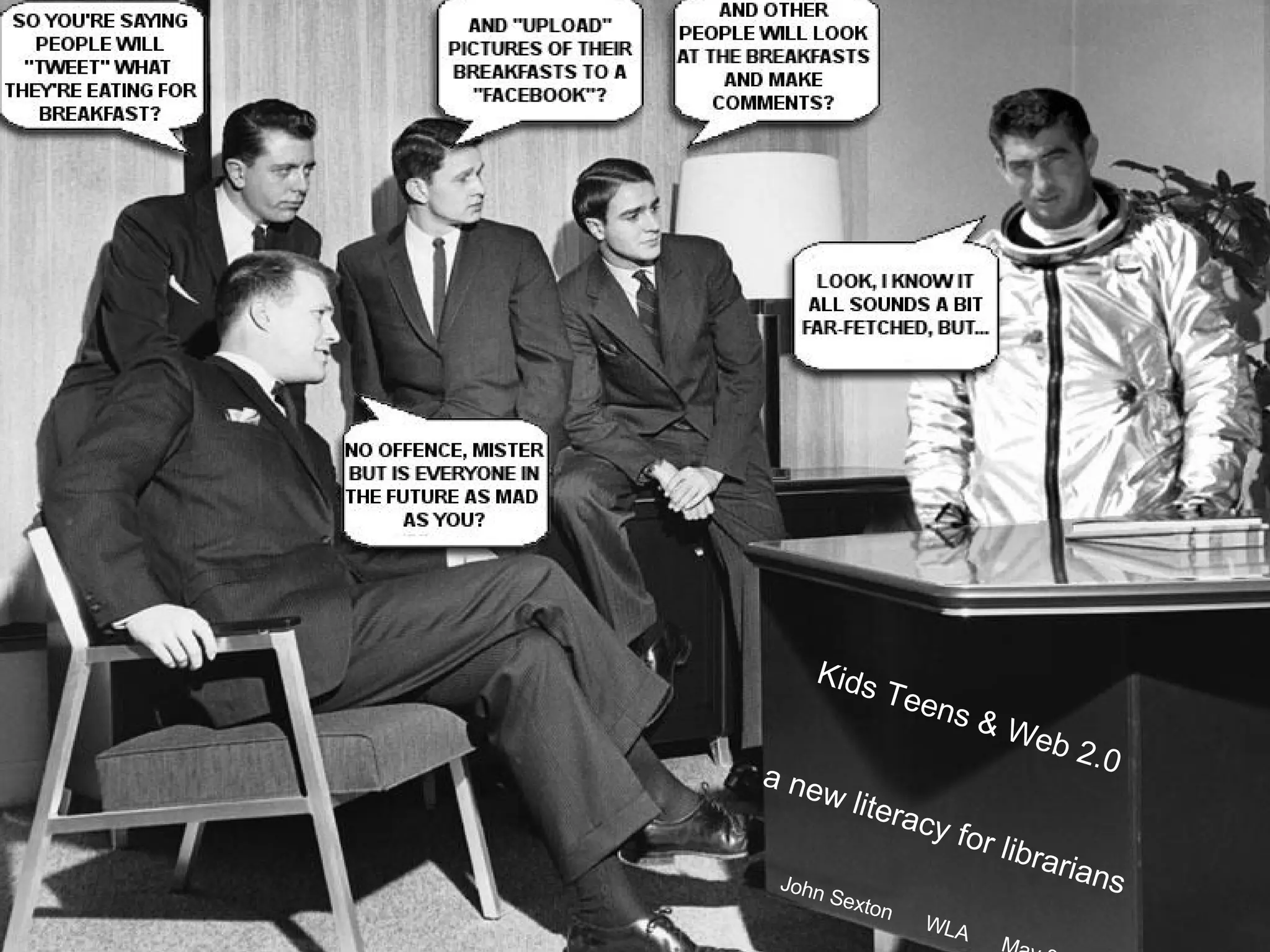
Kids Teens & Web 2.0 a new literacy for librarians John Sexton  WLA  May 8, 2008
 
 
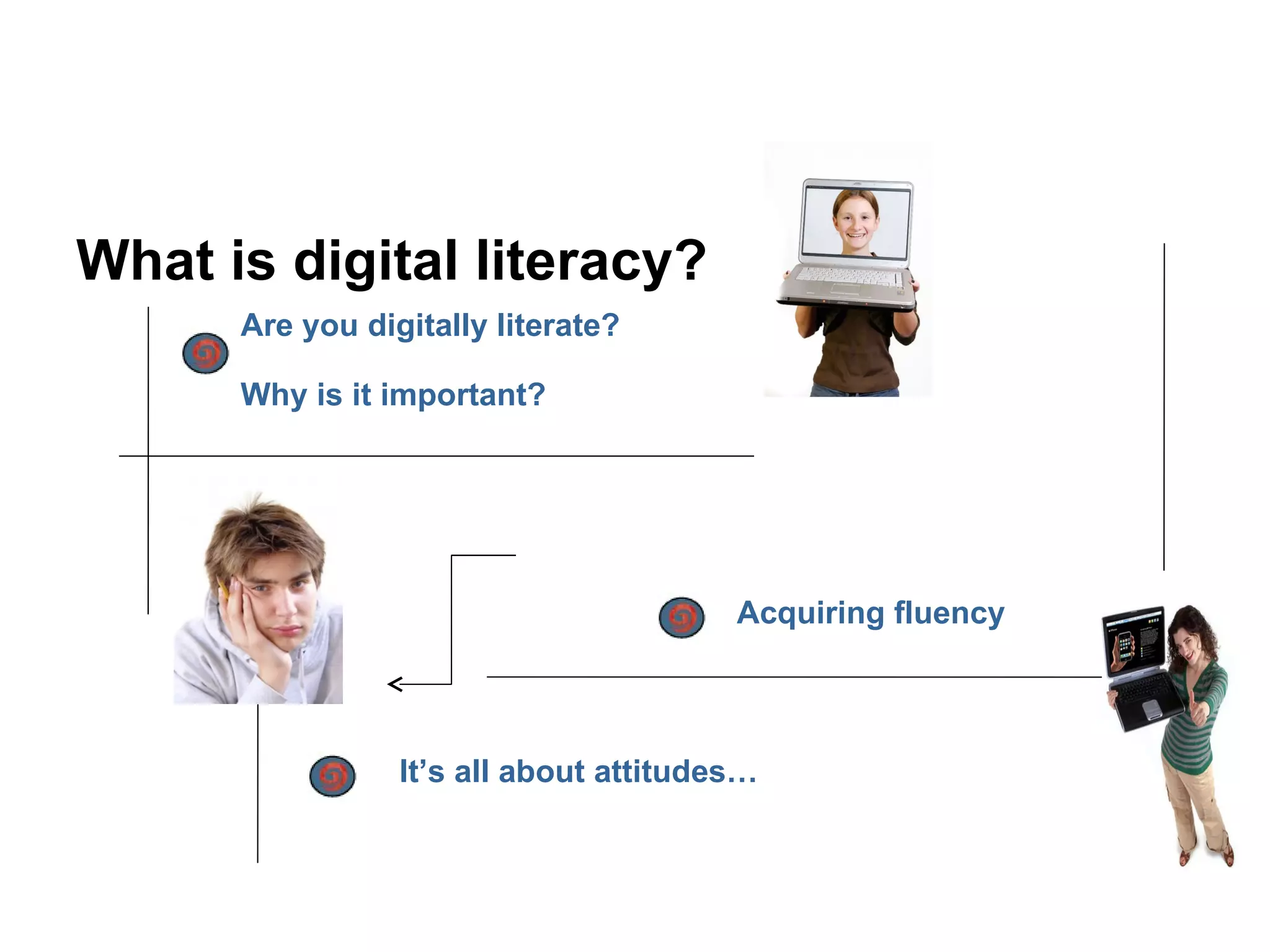
What is digital literacy? Are you digitally literate? Why is it important? Acquiring fluency It’s all about attitudes…
the ability to understand and use information in multiple formats from a wide range of sources when it is presented via computers.   the ability to locate, organize, understand, evaluate, and create information using digital technology (…). Digitally literate people can communicate and work more efficiently, especially with those who possess the same knowledge and skills. http://tinyurl.com/dn3uhw http://tinyurl.com/d5k9hm what is digital literacy?
(…) as we move further into the 21st century when all will have grown up in the era of digital technology, the distinction between digital natives and digital immigrants will become less relevant. Clearly, as we work to create and improve the future, we need to imagine a new set of distinctions. I suggest we think in terms of digital wisdom. Prensky, M. , “ H. Sapiens Digital: From Digital Immigrants and Digital Natives to Digital Wisdom ”,  http://tinyurl.com/b9whuh what is digital literacy?
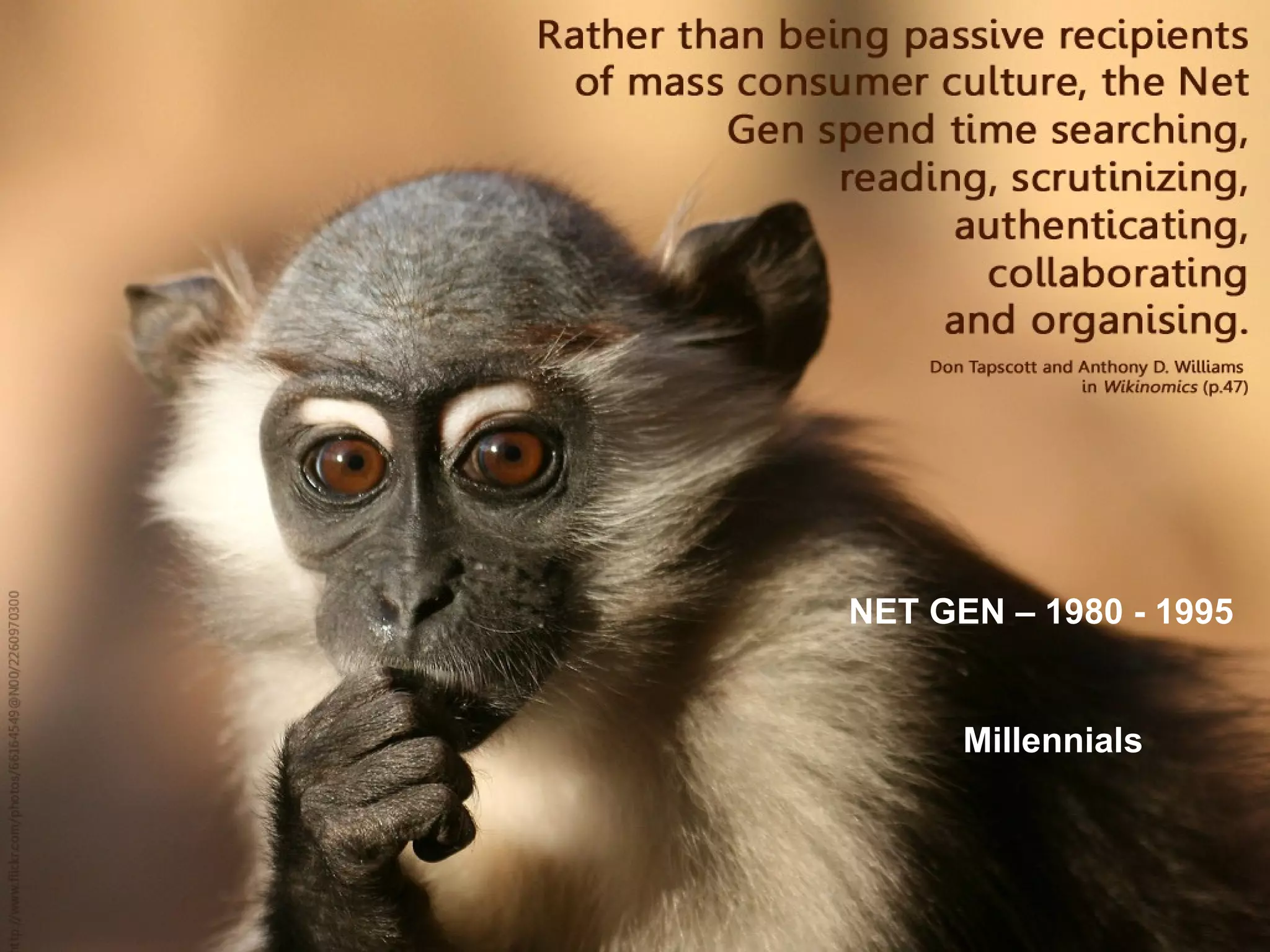
NET GEN – 1980 - 1995 Millennials
I have five or more friends who I met on the Net I check my email first thing in the morning When going out in town I first check the web for suggestions / directions I share my digital photos online for friends and family to see I often use my credit card to pay online I often download or buy music online I read at least five blogs a day I post comments on other people’s blogs I have my own blog that I update regularly are you digitally literate?
are you digitally literate? I am a member of at least one social networking site I often chat with friends / colleagues via instant messaging software I often share amusing websites / videos with friends and colleagues I’ve edited a Wikipedia entry I use my mobile phone primarily for texting I get my news online, not from a newspaper I don’t watch live TV, but record it and watch it when I like I met my partner online  
are you digitally literate?


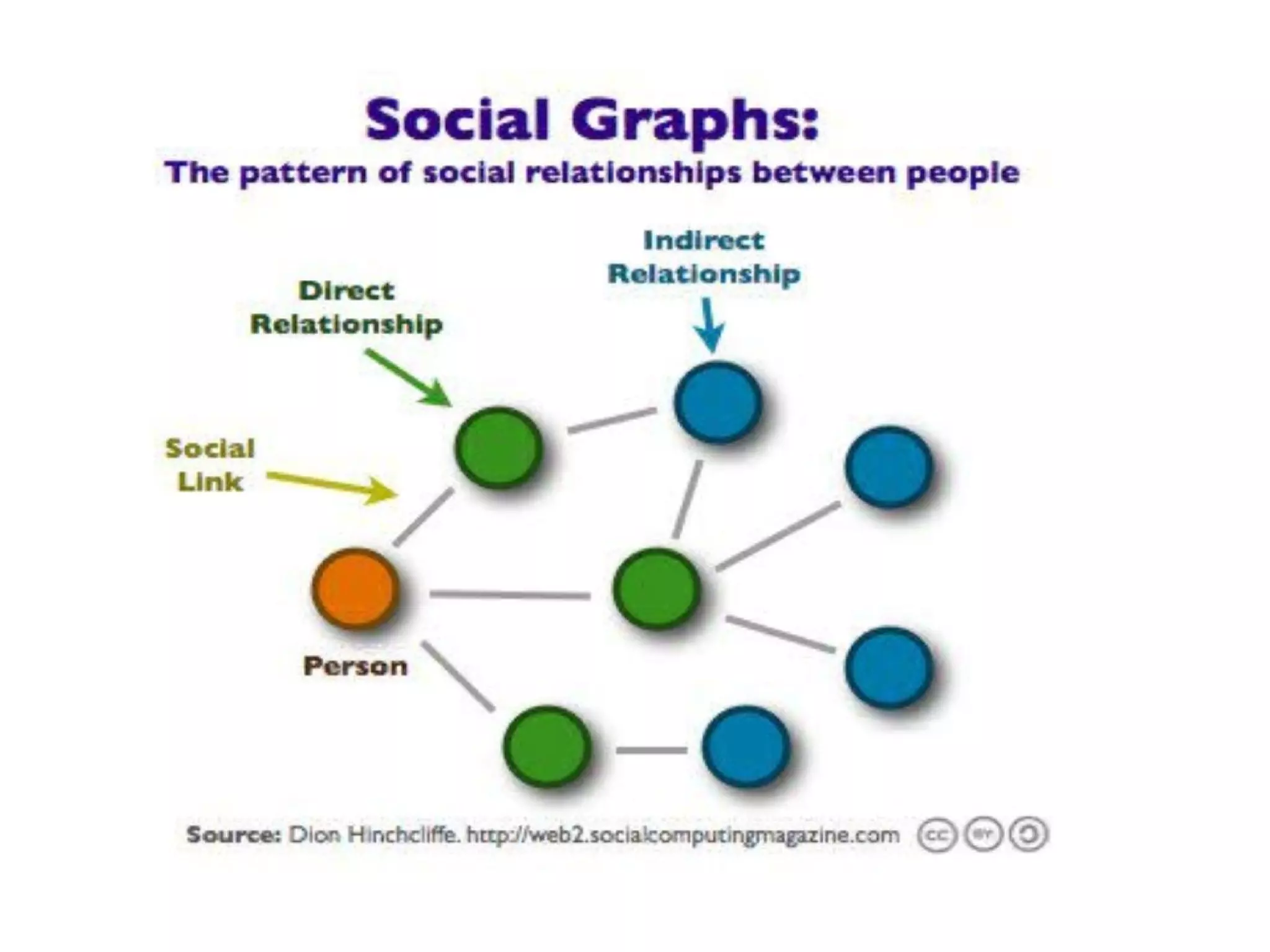
What is Social Media? User created content – More than just wikis and blogs! Published online at various sites Promotes the sharing of information and ideas freely Designed for collaboration What is Social Networking? A type of social media site Users create profiles to represent themselves Profiles are connected based on interests or behavior Designed for work and for fun
 
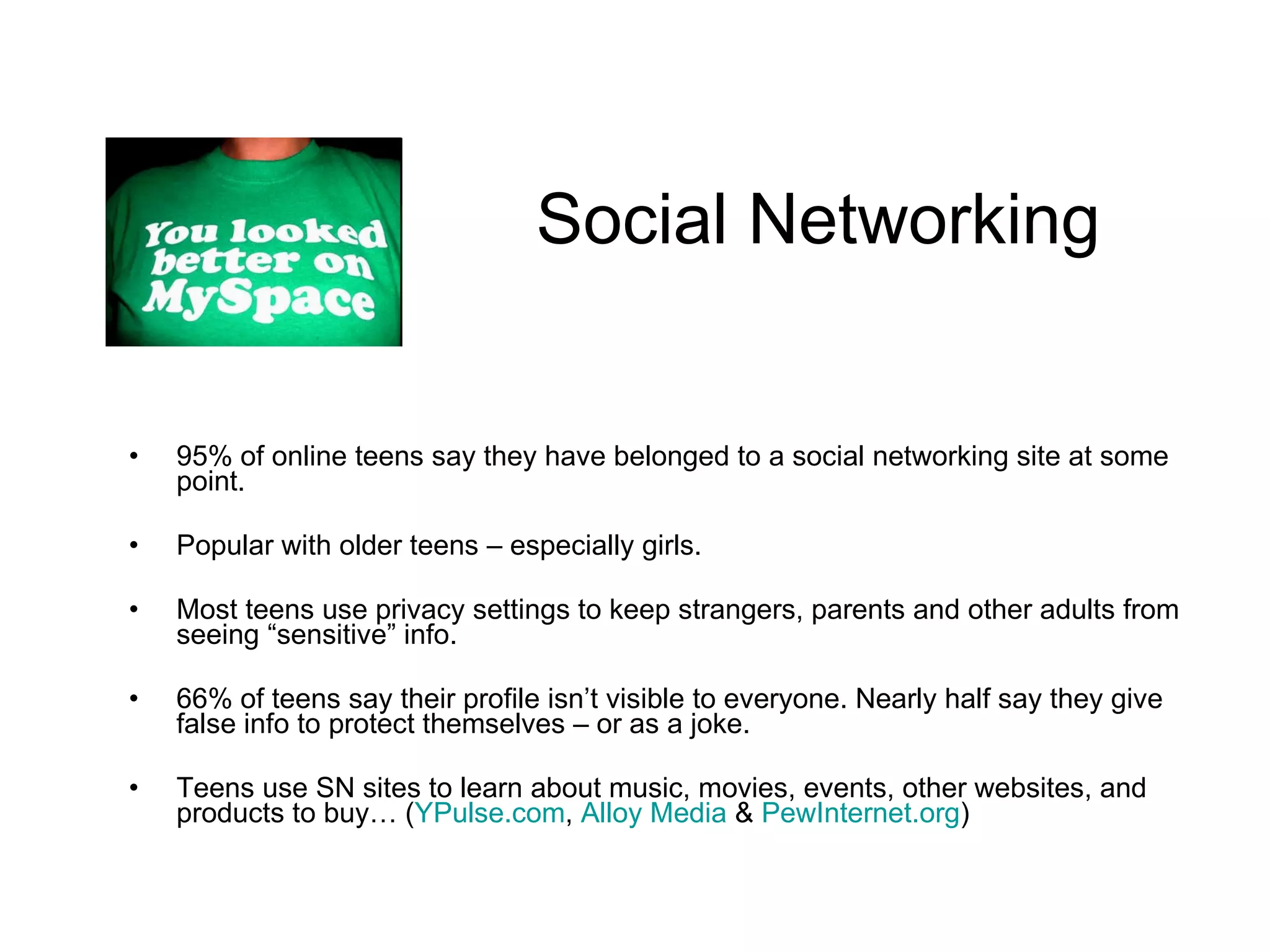
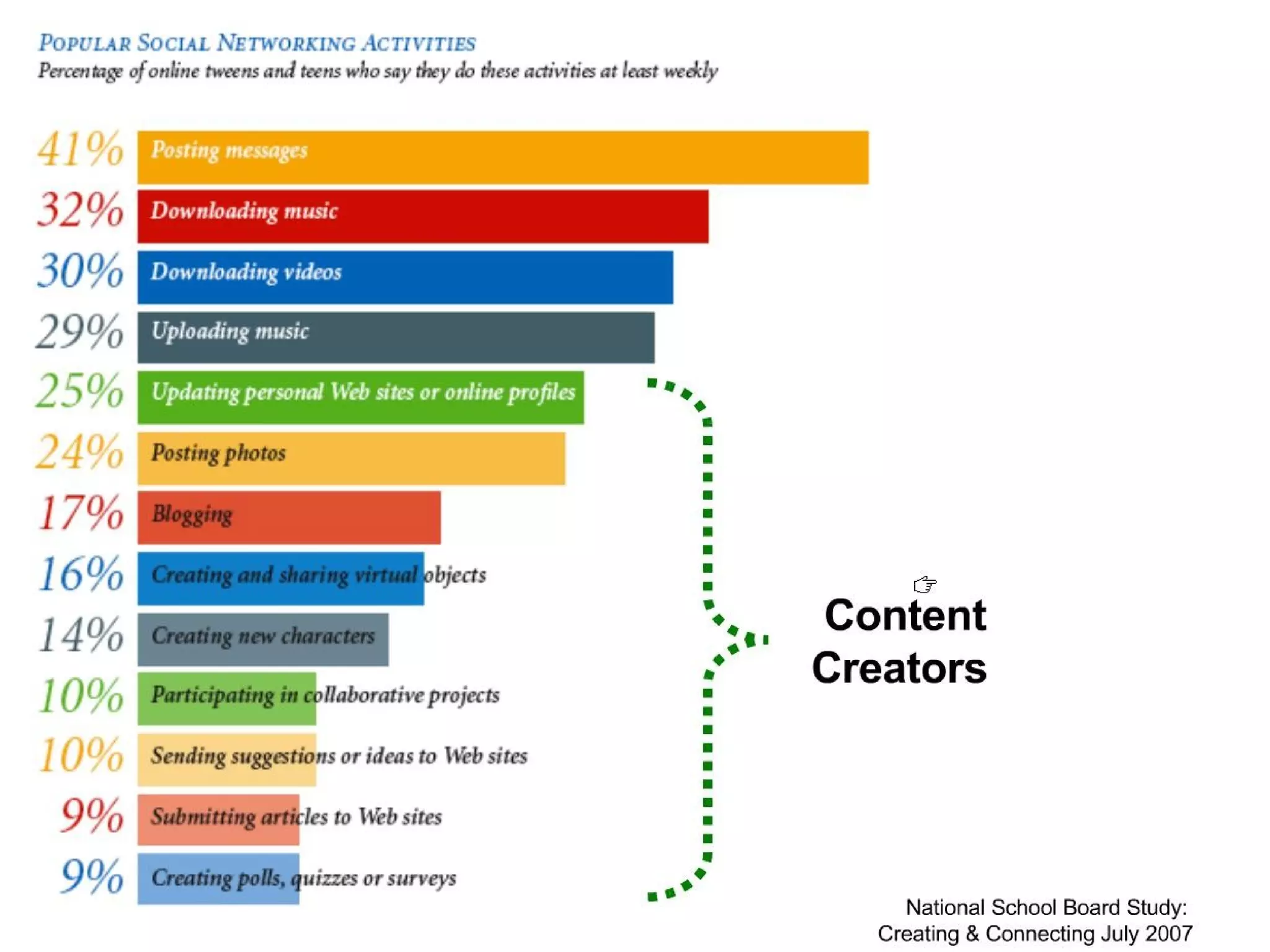
Social Networking 95% of online teens say they have belonged to a social networking site at some point.  Popular with older teens – especially girls. Most teens use privacy settings to keep strangers, parents and other adults from seeing “sensitive” info.  66% of teens say their profile isn’t visible to everyone. Nearly half say they give false info to protect themselves – or as a joke. Teens use SN sites to learn about music, movies, events, other websites, and products to buy… ( YPulse.com ,  Alloy Media  &  PewInternet.org )
 
Why is it important?
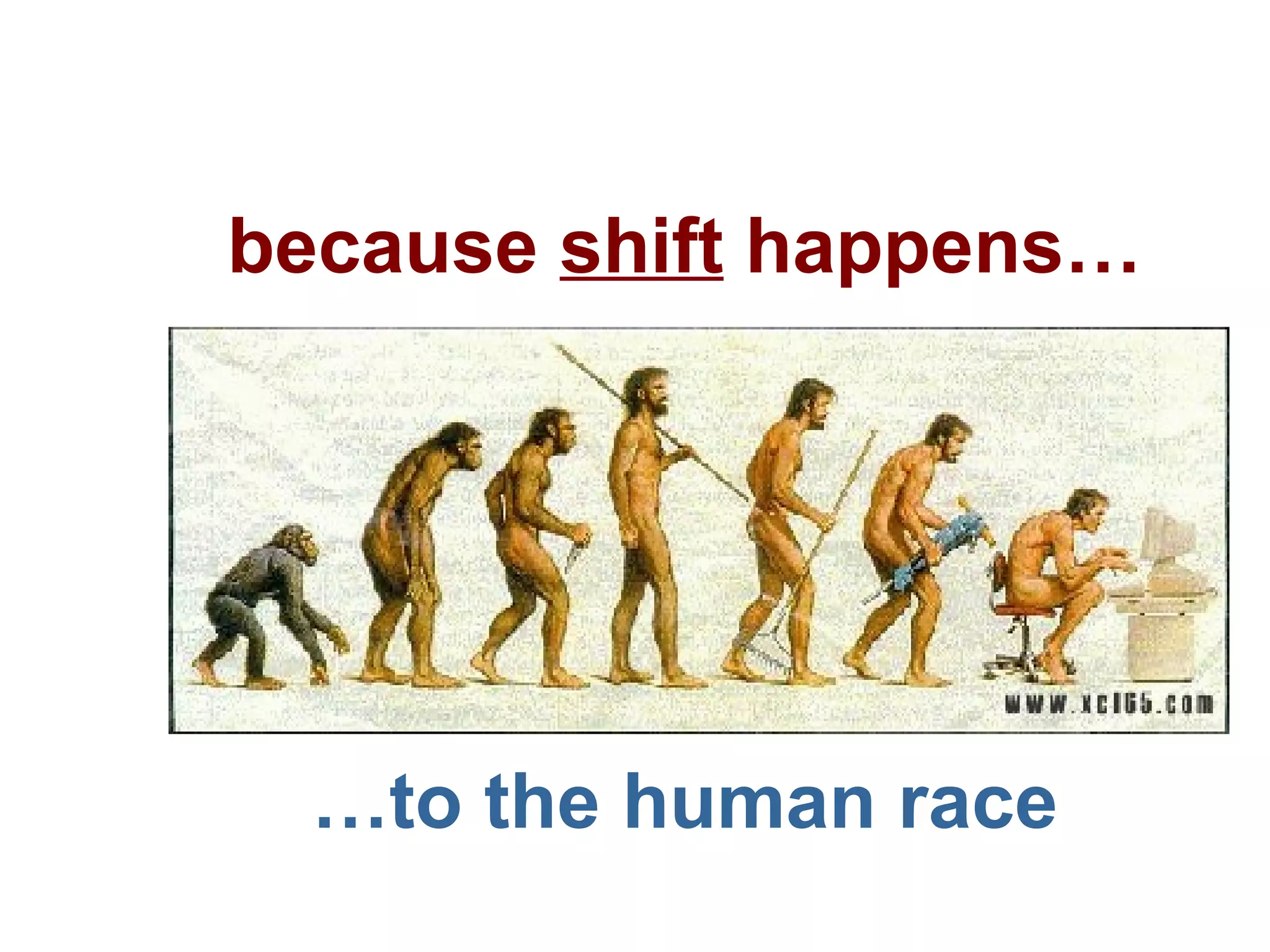
… to the human race because  shift  happens…


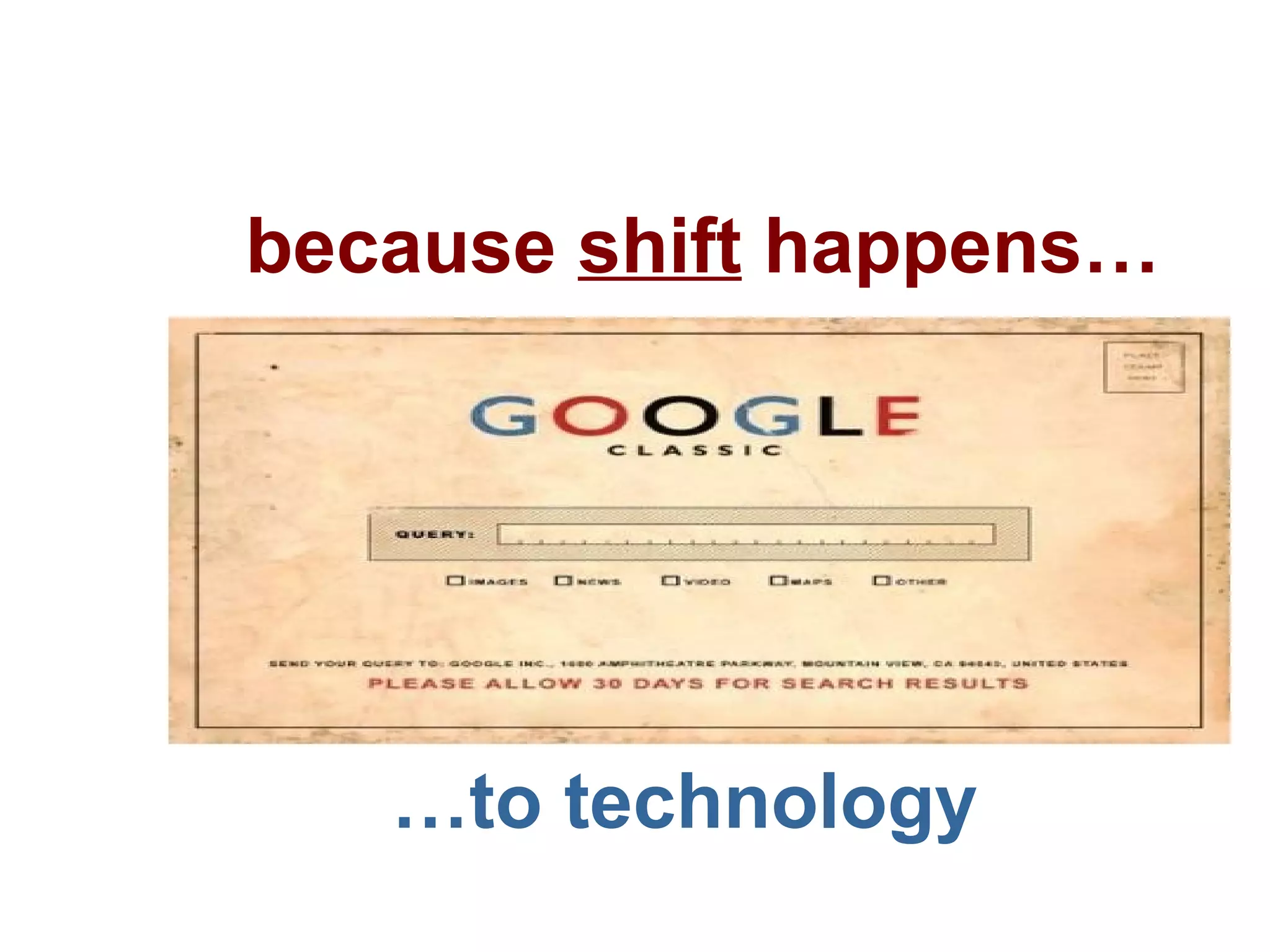
because  shift  happens… … to technology


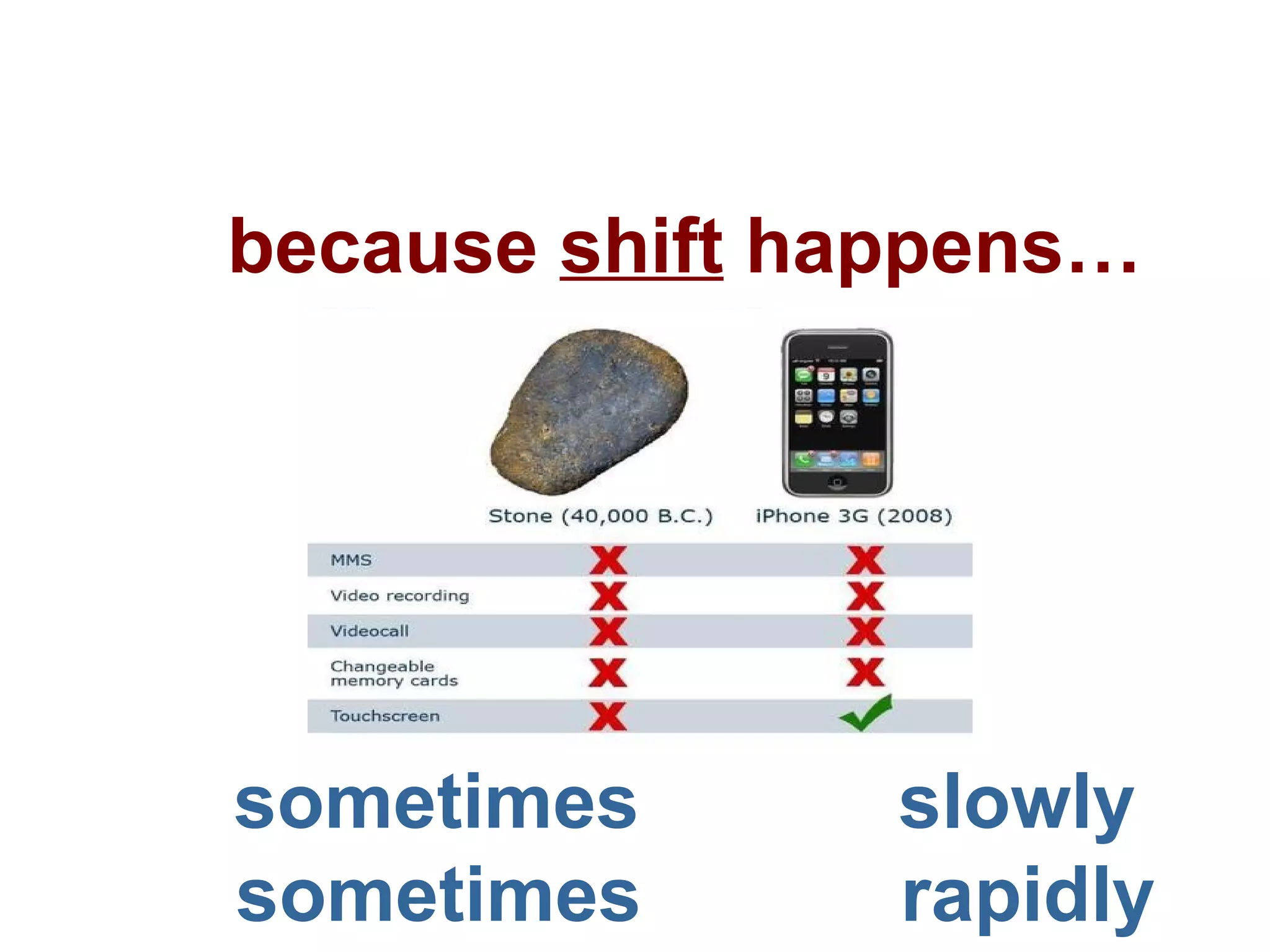
because  shift  happens… sometimes  slowly sometimes  rapidly


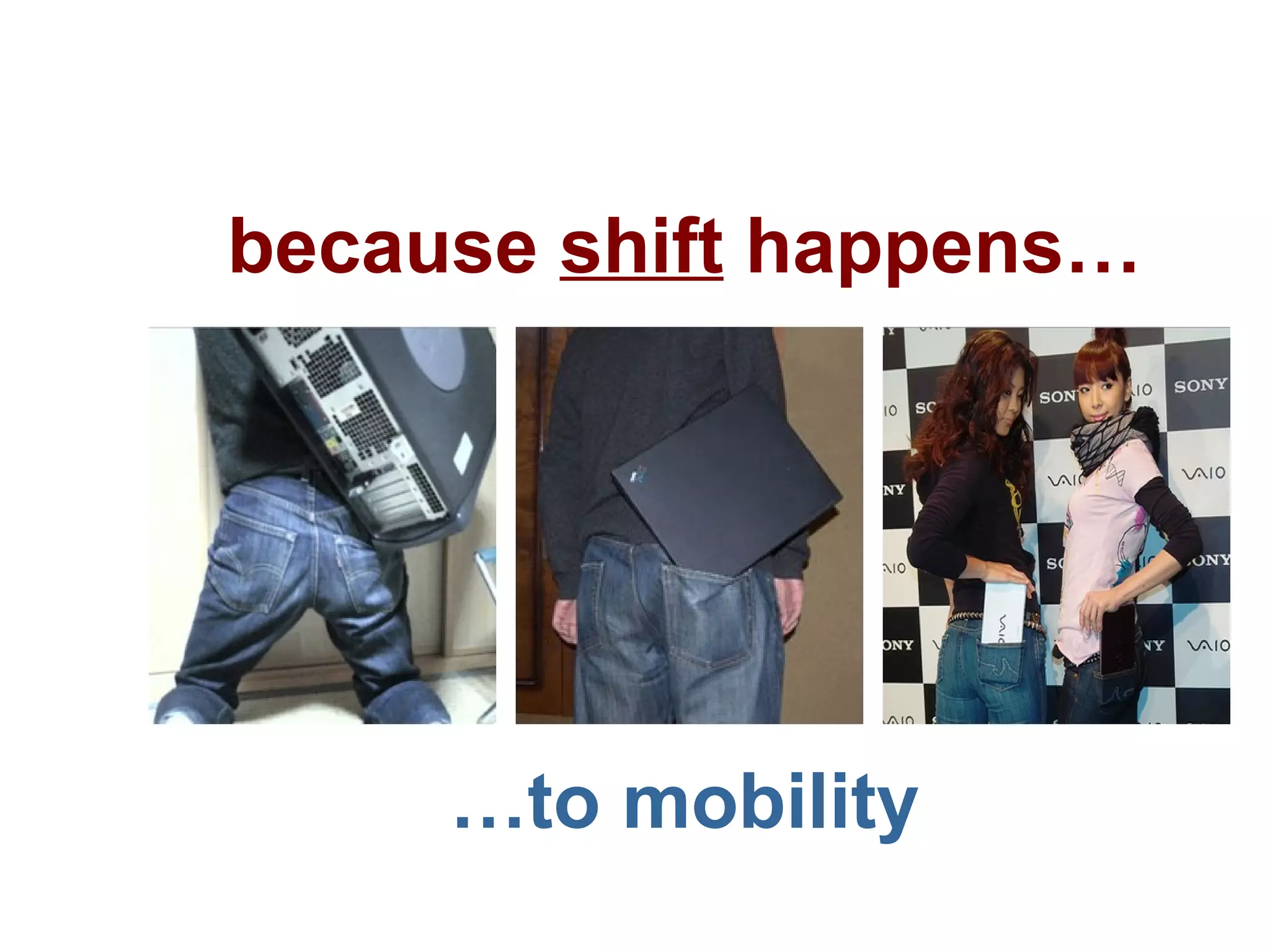
because  shift  happens… … to mobility
 
 
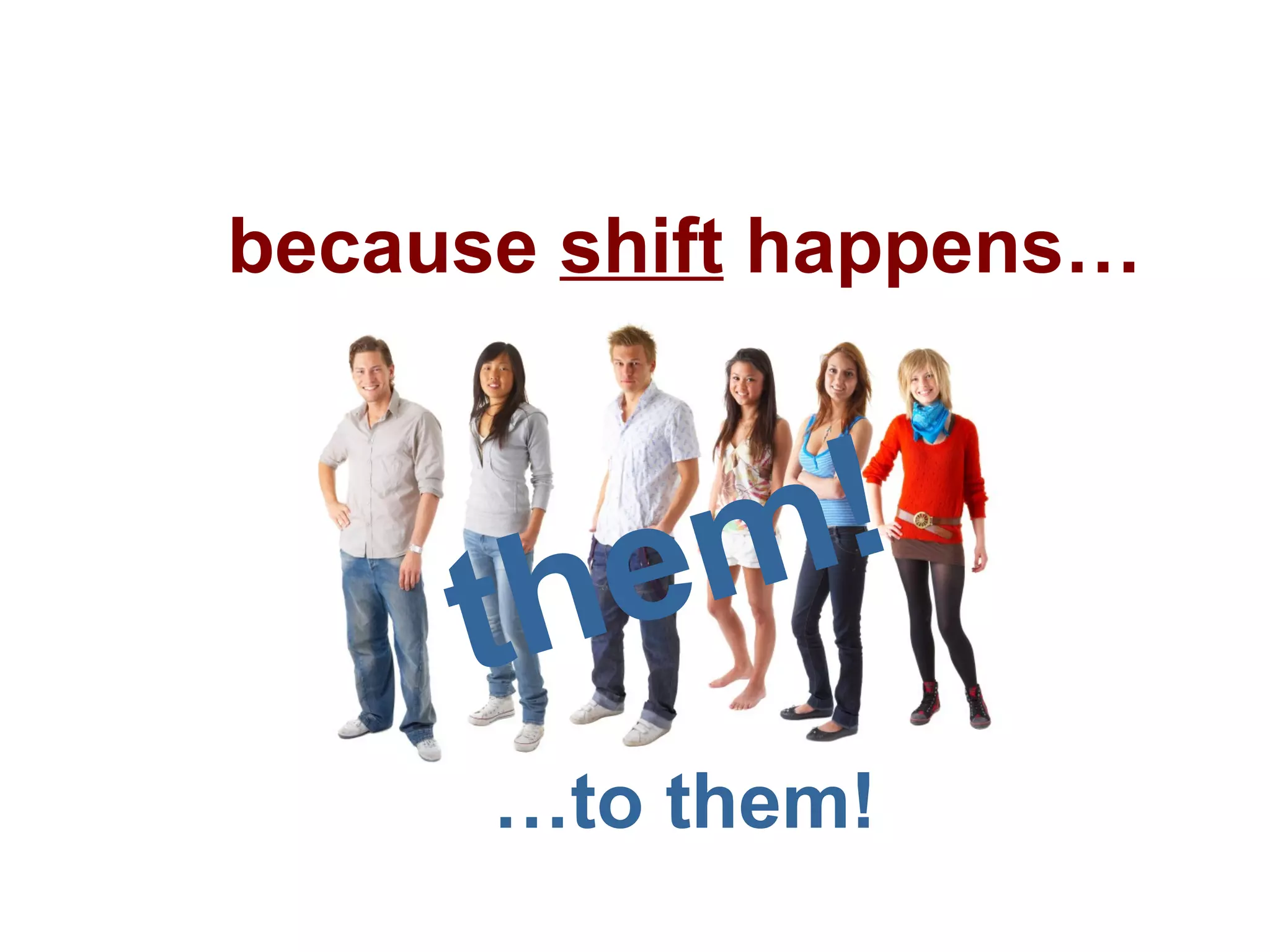
because  shift  happens… them! … to them!
 
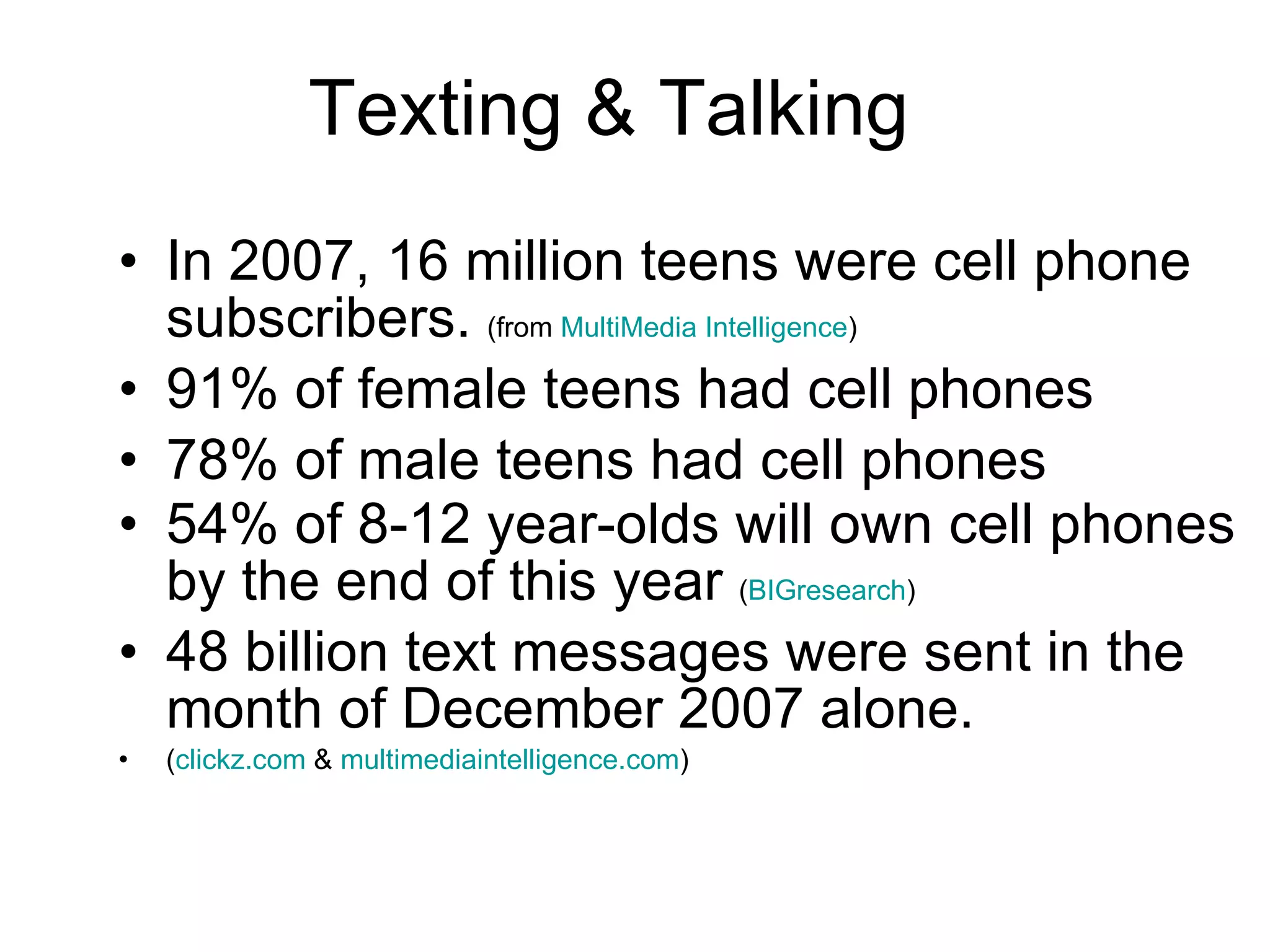
In 2007, 16 million teens were cell phone subscribers.  (from  MultiMedia Intelligence ) 91% of female teens had cell phones 78% of male teens had cell phones 54% of 8-12 year-olds will own cell phones by the end of this year  ( BIGresearch ) 48 billion text messages were sent in the month of December 2007 alone. ( clickz.com  &  multimediaintelligence.com ) Texting & Talking
IM & Teens 1 in 3 teens use their cell phone to IM. Send IMs from their social network profiles. 55% of teen IM users have used IM to do homework.   (Only 22% have used IM for dating!) 43% use IM to say things they wouldn’t say in person.  Multi-tasking: They’re also uploading photos, updating their blog or profile & researching for school while sending IMs. ( AP-AOL IM Trends Survey , 2007)
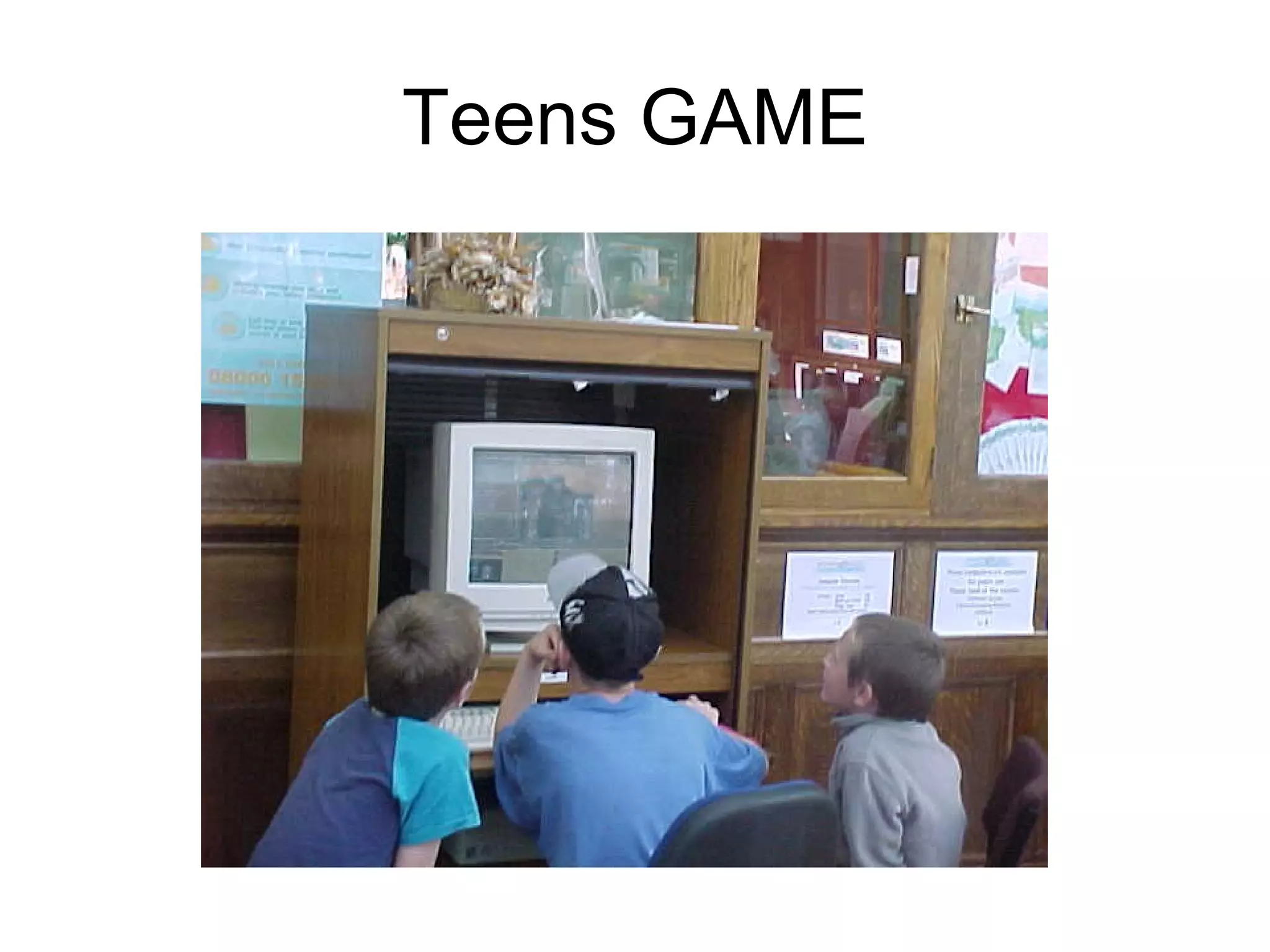
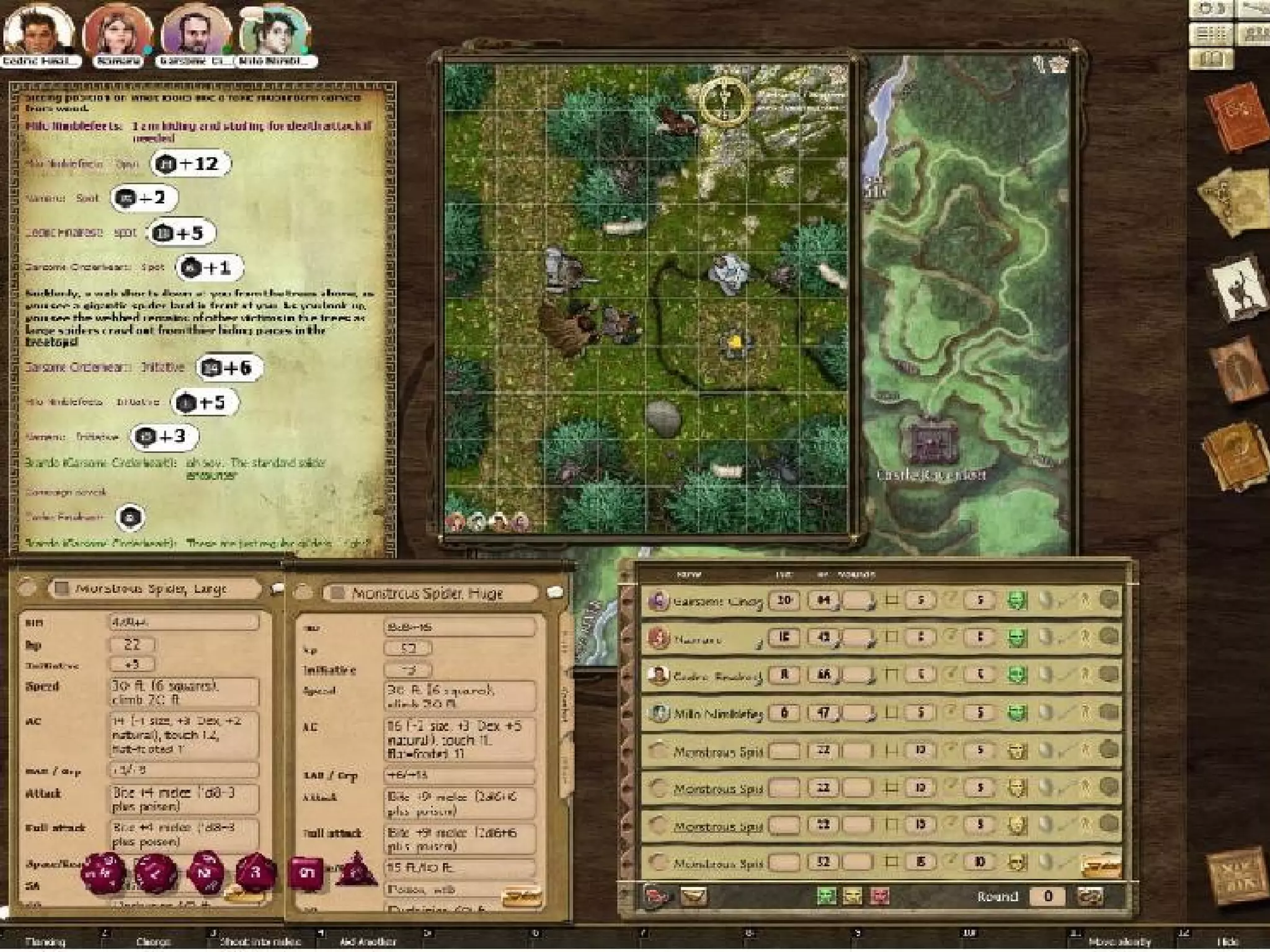
Teens GAME
 
Teens Use Gadgets Access information, communicate with others and experience media anywhere they go. 84% of teens indicate they own at least one personal media device.  (Desktop, laptop, cell or PDA) 44% have more than one!  ( www.pewinternet.org )


I get the opportunity of "hanging" with students daily. Are they  tech-comfy ?  You bet.  Tech-savvy ? Not even close in many cases.  Just because our students and kids are digital natives (or digital residents?), it doesn't mean they are tech-literate.  Mike Sansone - http://tinyurl.com/4m3dlq Librarians! Your 'Digital Natives' Still Need You
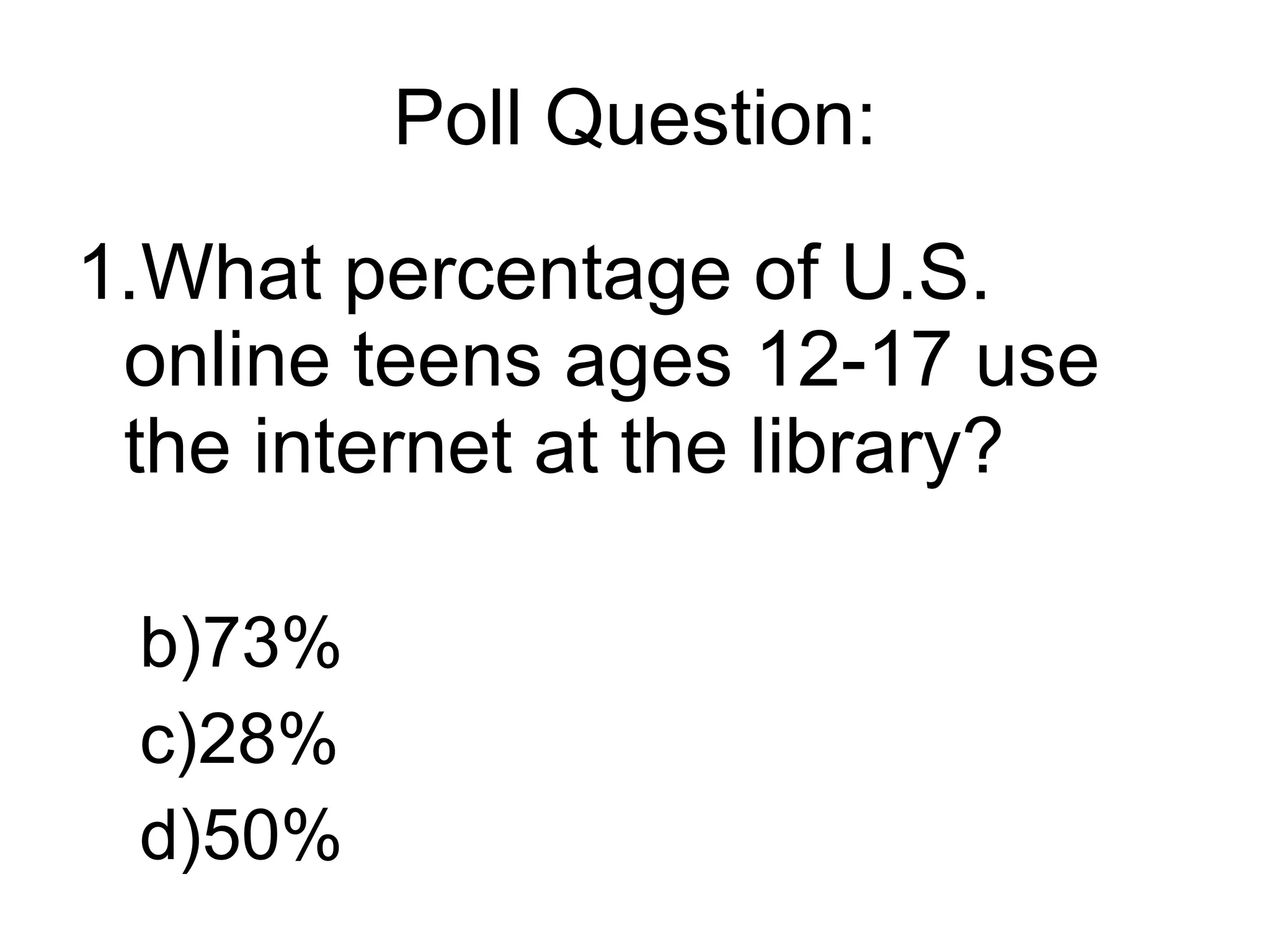
Poll Question: What percentage of U.S. online teens ages 12-17 use the internet at the library? 73% 28% 50%
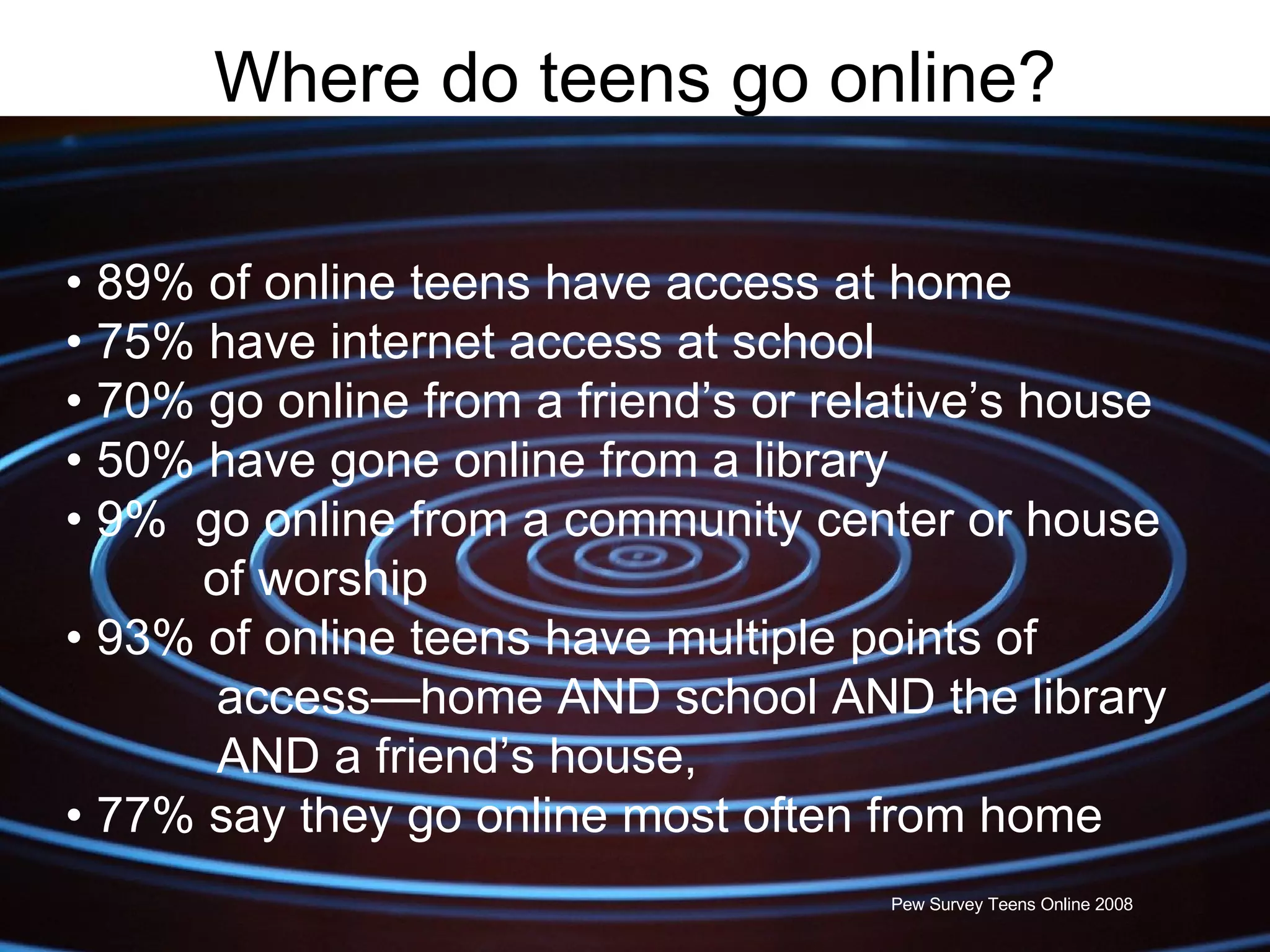
Where do teens go online? •  89% of online teens have access at home •  75% have internet access at school •  70% go online from a friend’s or relative’s house •  50% have gone online from a library •  9%  go online from a community center or house of worship •  93% of online teens have multiple points of access—home AND school AND the library  AND a friend’s house,  •  77% say they go online most often from home Pew Survey Teens Online 2008
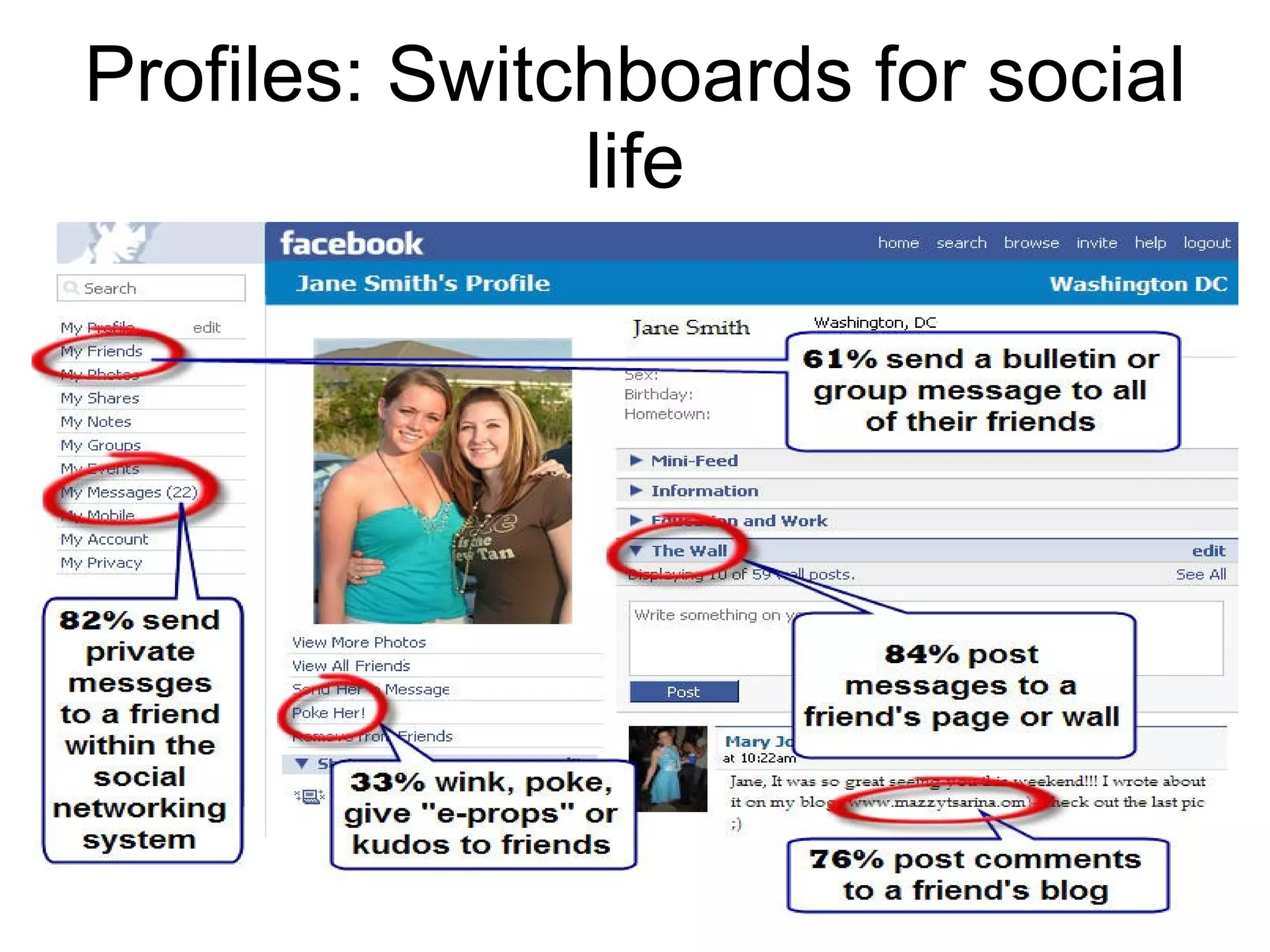
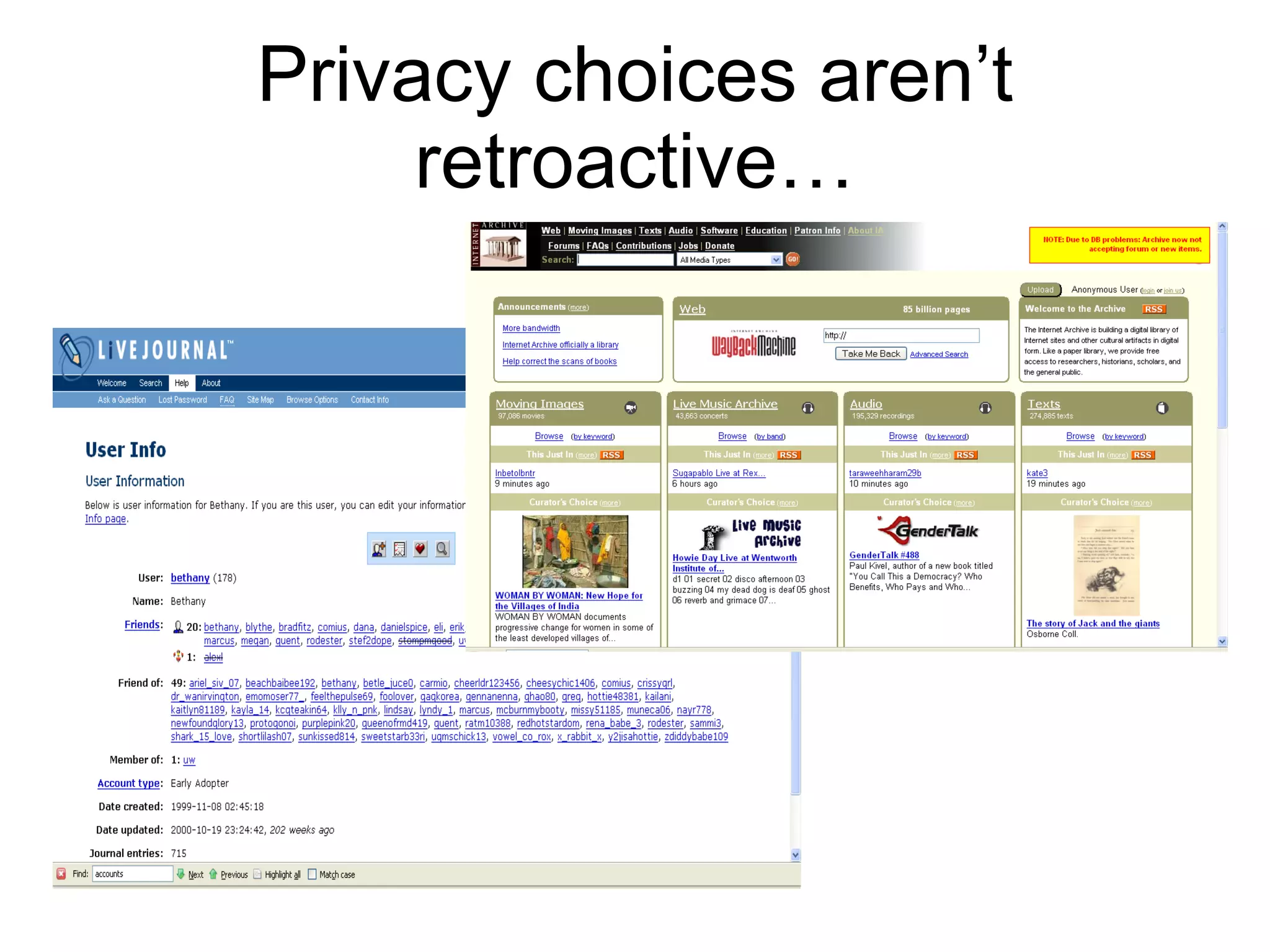
Profiles: Switchboards for social life
Privacy choices aren’t retroactive…


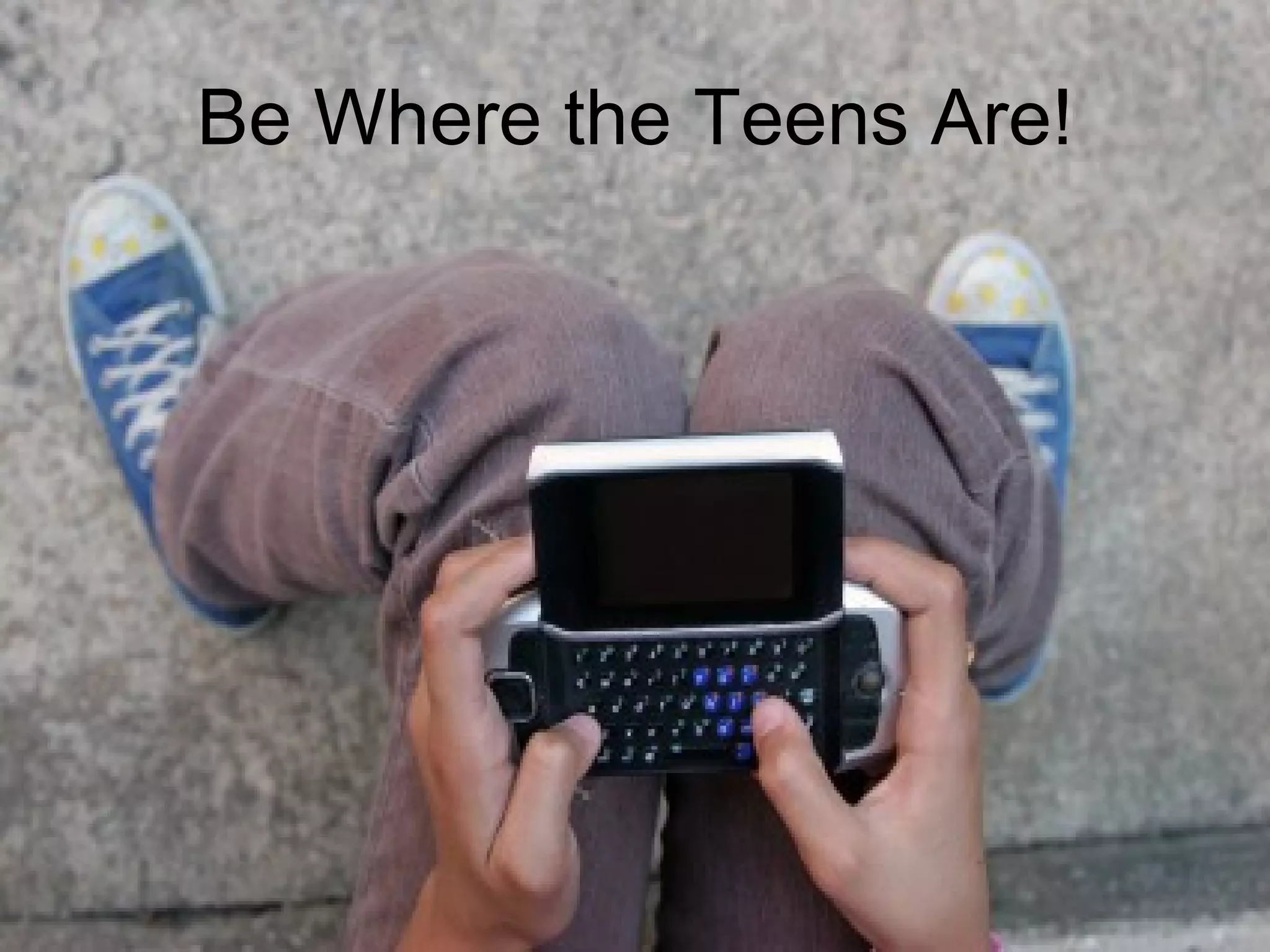
Be Where the Teens Are!
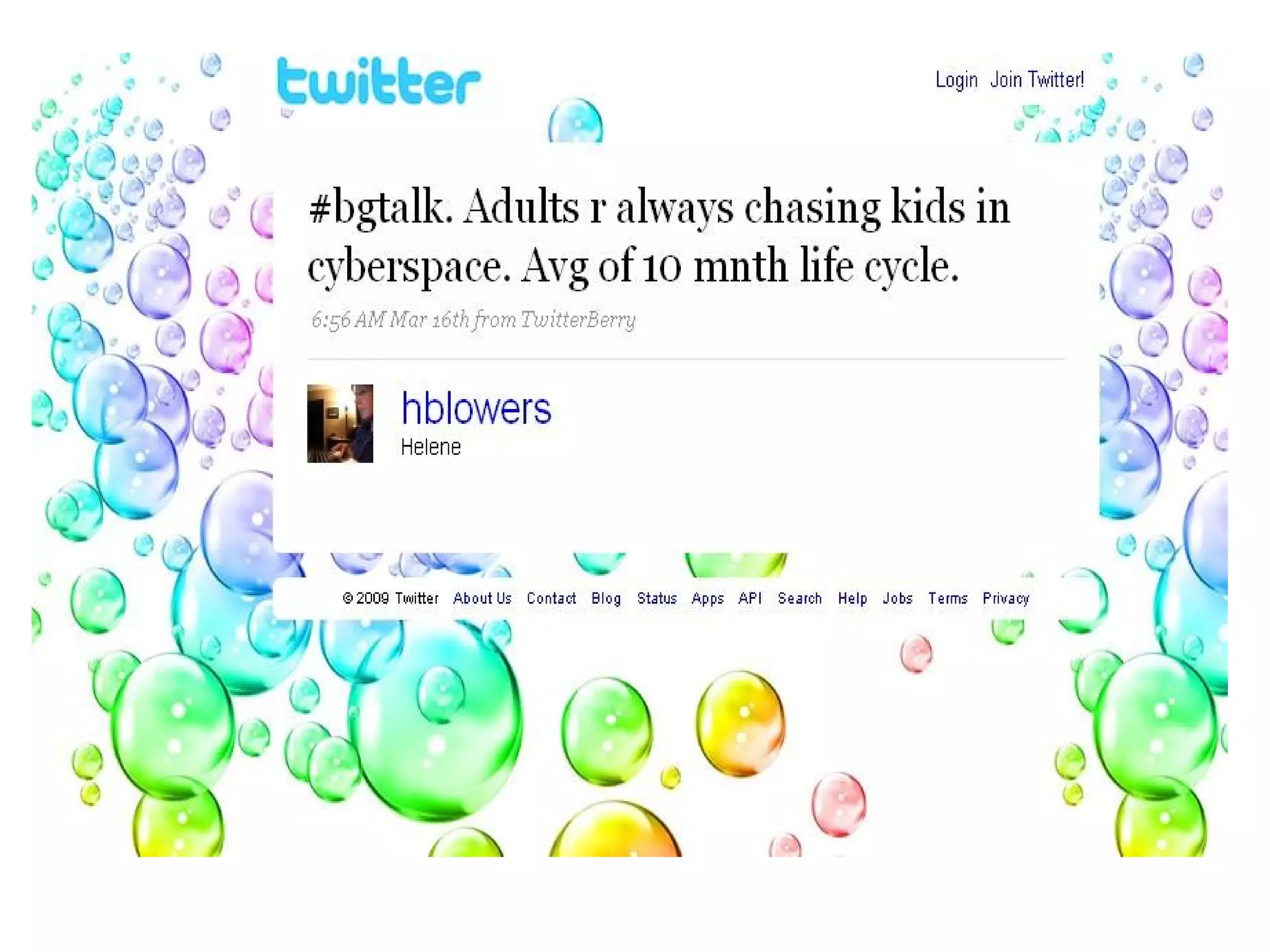
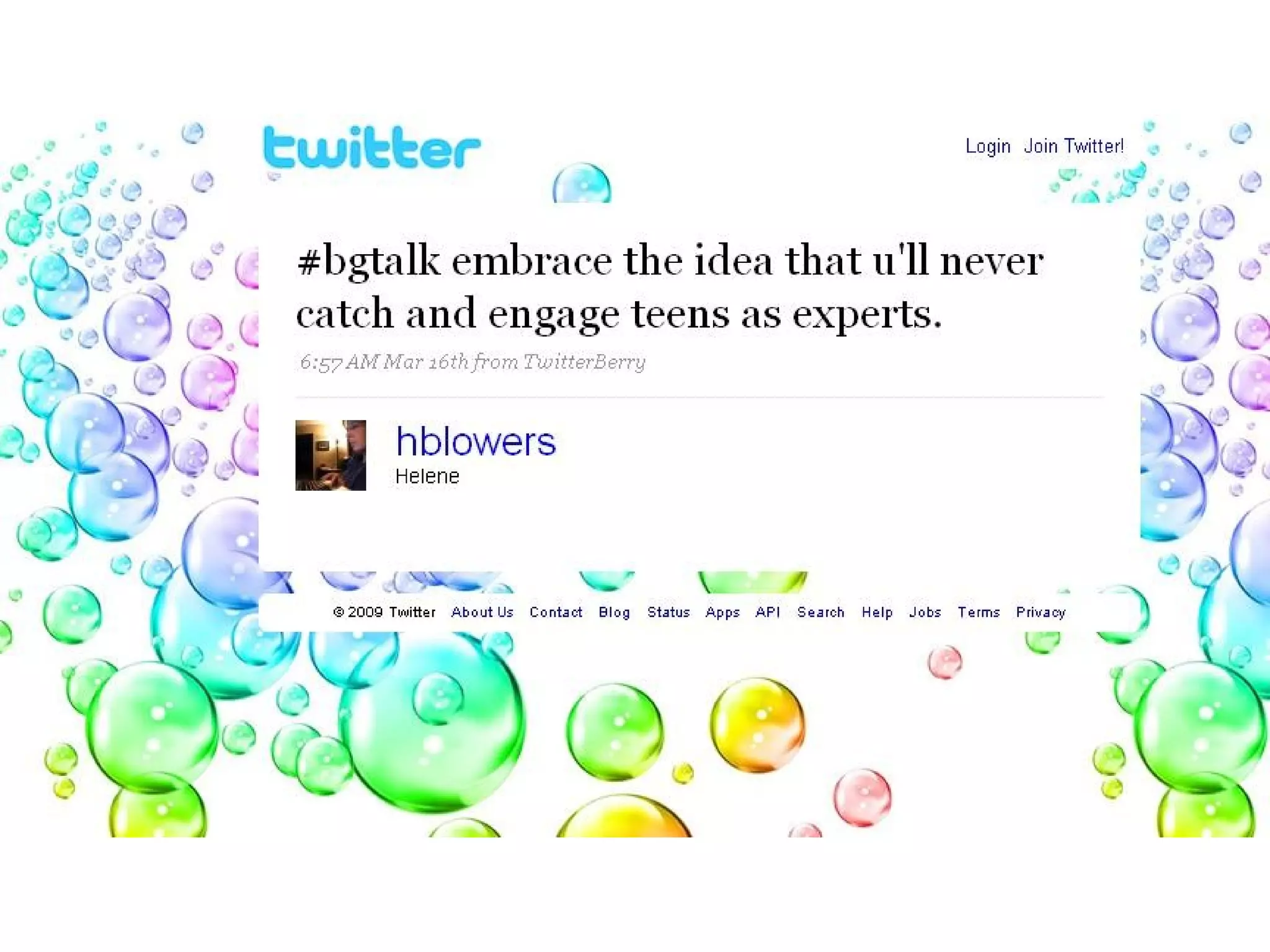
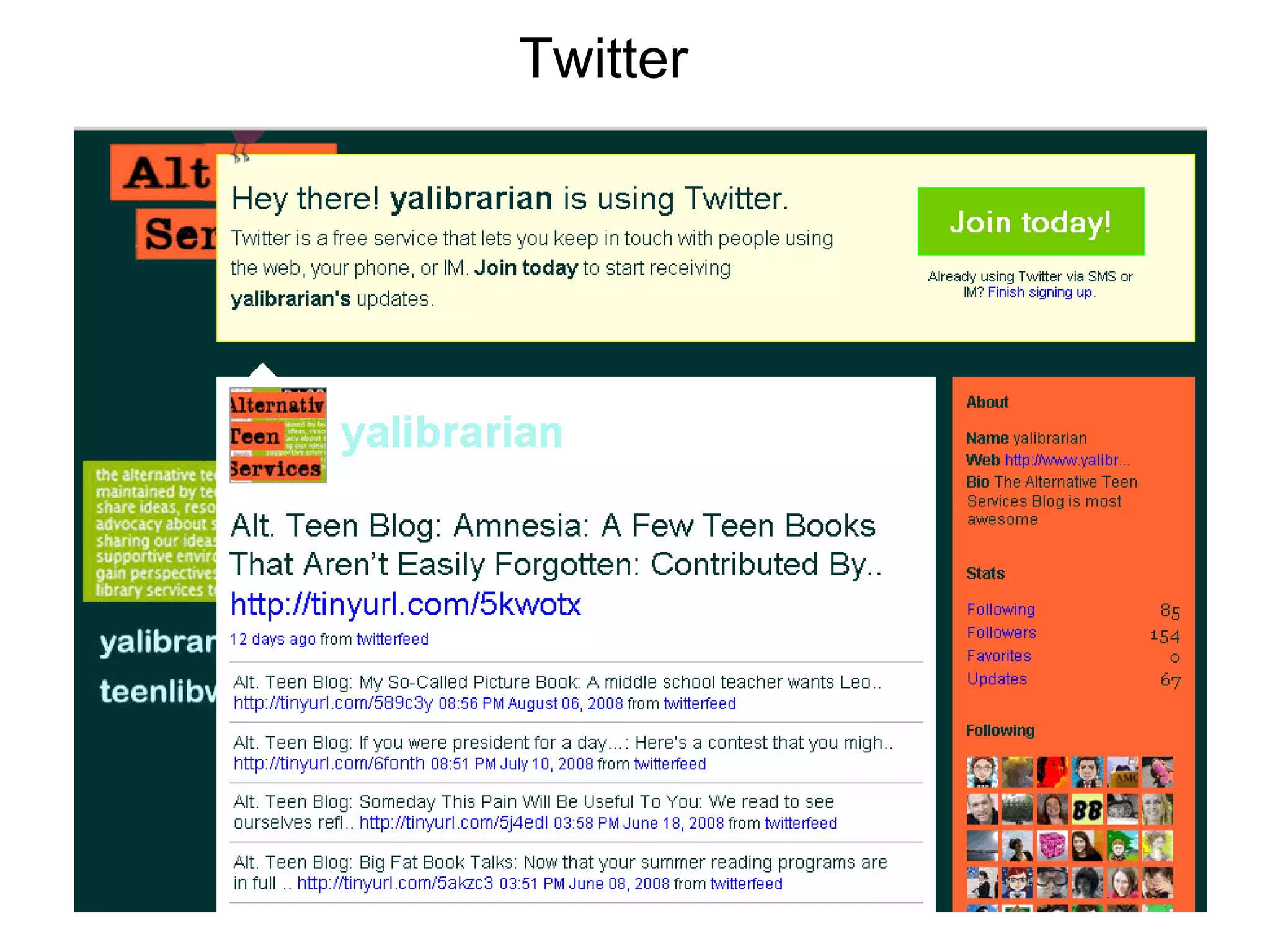
Twitter
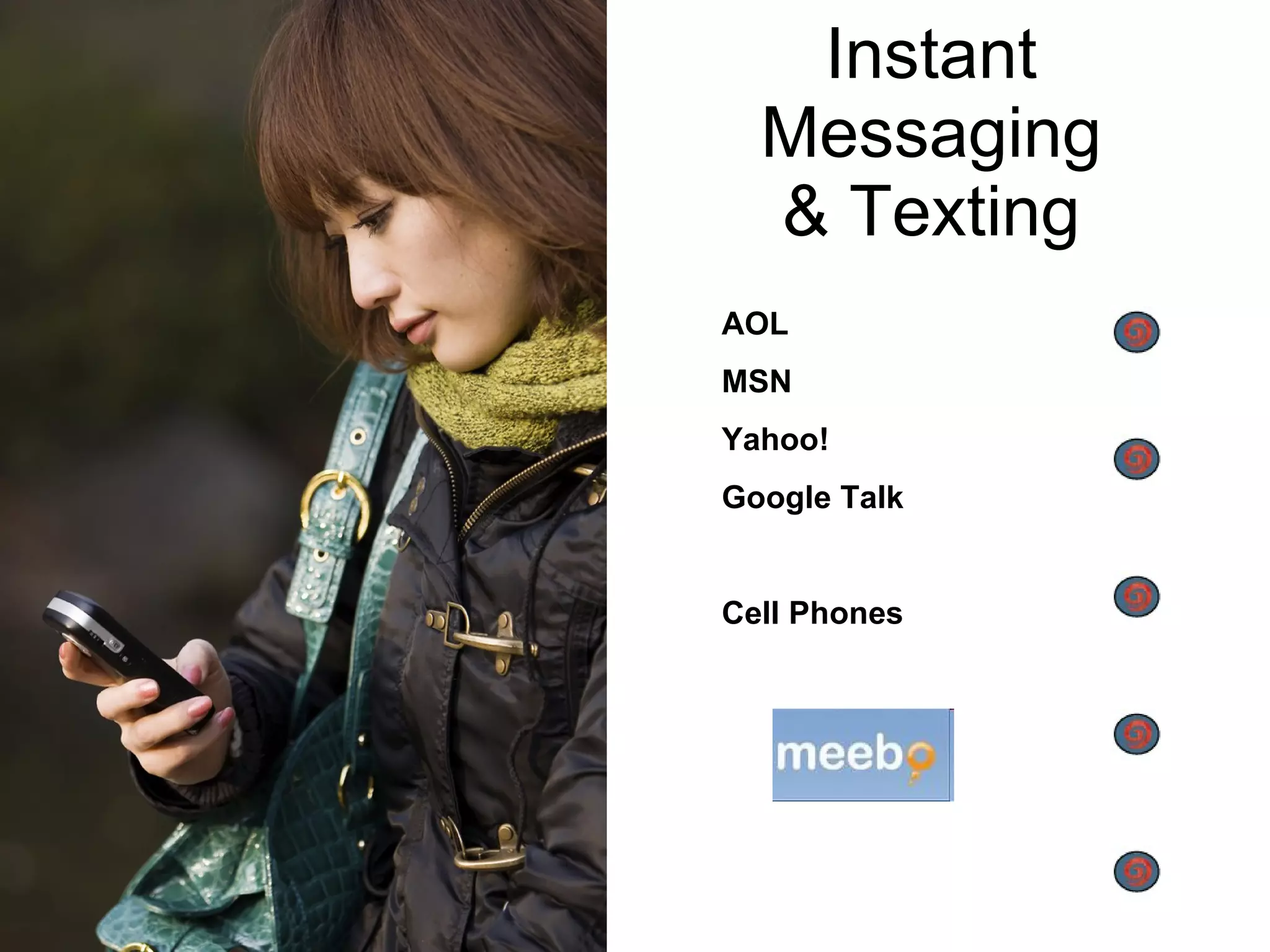
Instant Messaging & Texting AOL MSN Yahoo! Google Talk Cell Phones
Fan Fiction Online Summer Reading  www.readsinMA.org Online Reading Management :  Goodreads, Library Thing, Shelfari Virtual Author Visits Skype Chats With Authors Podcasts  www.gabcast.com Runescape Club Avatars  www.faceyourmanga.com Blogger Bookclubs Gaming Clubs Youtube Clubs Library Programs with Teens and Tweens


Our Brand = Our Values Identity Creativity Quality Safety Opportunity Sharing Privacy Advocacy Engage Enrich Empower Helene Blowers Columbus Public Library
Thank You John Sexton Westchester Library System

WLA Presentation

  • 1.
    Kids Teens &Web 2.0 a new literacy for librarians John Sexton WLA May 8, 2008
  • 2.
  • 3.
  • 4.
    What is digitalliteracy? Are you digitally literate? Why is it important? Acquiring fluency It’s all about attitudes…
  • 5.
    the ability tounderstand and use information in multiple formats from a wide range of sources when it is presented via computers. the ability to locate, organize, understand, evaluate, and create information using digital technology (…). Digitally literate people can communicate and work more efficiently, especially with those who possess the same knowledge and skills. http://tinyurl.com/dn3uhw http://tinyurl.com/d5k9hm what is digital literacy?
  • 6.
    (…) as wemove further into the 21st century when all will have grown up in the era of digital technology, the distinction between digital natives and digital immigrants will become less relevant. Clearly, as we work to create and improve the future, we need to imagine a new set of distinctions. I suggest we think in terms of digital wisdom. Prensky, M. , “ H. Sapiens Digital: From Digital Immigrants and Digital Natives to Digital Wisdom ”, http://tinyurl.com/b9whuh what is digital literacy?
  • 7.
    NET GEN –1980 - 1995 Millennials
  • 8.
    I have fiveor more friends who I met on the Net I check my email first thing in the morning When going out in town I first check the web for suggestions / directions I share my digital photos online for friends and family to see I often use my credit card to pay online I often download or buy music online I read at least five blogs a day I post comments on other people’s blogs I have my own blog that I update regularly are you digitally literate?
  • 9.
    are you digitallyliterate? I am a member of at least one social networking site I often chat with friends / colleagues via instant messaging software I often share amusing websites / videos with friends and colleagues I’ve edited a Wikipedia entry I use my mobile phone primarily for texting I get my news online, not from a newspaper I don’t watch live TV, but record it and watch it when I like I met my partner online 
  • 10.
  • 11.
  • 12.
  • 13.
  • 14.
    What is SocialMedia? User created content – More than just wikis and blogs! Published online at various sites Promotes the sharing of information and ideas freely Designed for collaboration What is Social Networking? A type of social media site Users create profiles to represent themselves Profiles are connected based on interests or behavior Designed for work and for fun
  • 15.
  • 16.
    Social Networking 95%of online teens say they have belonged to a social networking site at some point. Popular with older teens – especially girls. Most teens use privacy settings to keep strangers, parents and other adults from seeing “sensitive” info. 66% of teens say their profile isn’t visible to everyone. Nearly half say they give false info to protect themselves – or as a joke. Teens use SN sites to learn about music, movies, events, other websites, and products to buy… ( YPulse.com , Alloy Media & PewInternet.org )
  • 17.
  • 18.
    Why is itimportant?
  • 19.
    … to thehuman race because shift happens…
  • 20.
  • 21.
  • 22.
  • 23.
  • 24.
  • 25.
  • 26.
  • 27.
    because shift happens… … to technology
  • 28.
  • 29.
  • 30.
  • 31.
    because shift happens… sometimes slowly sometimes rapidly
  • 32.
  • 33.
  • 34.
  • 35.
  • 36.
    because shift happens… … to mobility
  • 37.
  • 38.
  • 39.
    because shift happens… them! … to them!
  • 40.
  • 41.
    In 2007, 16million teens were cell phone subscribers. (from MultiMedia Intelligence ) 91% of female teens had cell phones 78% of male teens had cell phones 54% of 8-12 year-olds will own cell phones by the end of this year ( BIGresearch ) 48 billion text messages were sent in the month of December 2007 alone. ( clickz.com & multimediaintelligence.com ) Texting & Talking
  • 42.
    IM & Teens1 in 3 teens use their cell phone to IM. Send IMs from their social network profiles. 55% of teen IM users have used IM to do homework. (Only 22% have used IM for dating!) 43% use IM to say things they wouldn’t say in person. Multi-tasking: They’re also uploading photos, updating their blog or profile & researching for school while sending IMs. ( AP-AOL IM Trends Survey , 2007)
  • 43.
  • 44.
  • 45.
    Teens Use GadgetsAccess information, communicate with others and experience media anywhere they go. 84% of teens indicate they own at least one personal media device. (Desktop, laptop, cell or PDA) 44% have more than one! ( www.pewinternet.org )
  • 46.
  • 47.
  • 48.
  • 49.
  • 50.
    I get theopportunity of "hanging" with students daily. Are they tech-comfy ?  You bet. Tech-savvy ? Not even close in many cases. Just because our students and kids are digital natives (or digital residents?), it doesn't mean they are tech-literate. Mike Sansone - http://tinyurl.com/4m3dlq Librarians! Your 'Digital Natives' Still Need You
  • 51.
    Poll Question: Whatpercentage of U.S. online teens ages 12-17 use the internet at the library? 73% 28% 50%
  • 52.
    Where do teensgo online? • 89% of online teens have access at home • 75% have internet access at school • 70% go online from a friend’s or relative’s house • 50% have gone online from a library • 9% go online from a community center or house of worship • 93% of online teens have multiple points of access—home AND school AND the library AND a friend’s house, • 77% say they go online most often from home Pew Survey Teens Online 2008
  • 53.
  • 54.
  • 55.
  • 56.
  • 57.
  • 58.
  • 59.
    Be Where theTeens Are!
  • 60.
  • 61.
    Instant Messaging &Texting AOL MSN Yahoo! Google Talk Cell Phones
  • 62.
    Fan Fiction OnlineSummer Reading www.readsinMA.org Online Reading Management : Goodreads, Library Thing, Shelfari Virtual Author Visits Skype Chats With Authors Podcasts www.gabcast.com Runescape Club Avatars www.faceyourmanga.com Blogger Bookclubs Gaming Clubs Youtube Clubs Library Programs with Teens and Tweens
  • 63.
  • 64.
  • 65.
  • 66.
  • 67.
    Our Brand =Our Values Identity Creativity Quality Safety Opportunity Sharing Privacy Advocacy Engage Enrich Empower Helene Blowers Columbus Public Library
  • 68.
    Thank You JohnSexton Westchester Library System