INDICATORS OF
IMMIGRANT INTEGRATION
Yves Breem
Thomas Liebig
Cécile Thoreau
International Migration Division
Directorate for Employment, Labour and
Social Affairs
Settling In 2015
Paris, 10 June 2015
Overview
• Joint work with the European Commission
• First broad international comparison across all EU and OECD
countries of the outcomes for immigrants and their children
• 34 key indicators on the integration of immigrants and their
children, including:
– Extensive contextual information on the demographic characteristics of immigrants
and their children
– Five main areas of integration: Employment, education and skills, social inclusion,
civic engagement and social cohesion
• 2 special chapters:
– Third-country nationals in the EU (“Zaragoza indicators”)
– Youth with a migration background
• Peer groups of countries which have a similar relative size and
composition of the immigrant population
In the OECD, one person in five has a migration
background
Population share of immigrants and of native-born offspring of immigrants, around 2013
Percentage of the total population
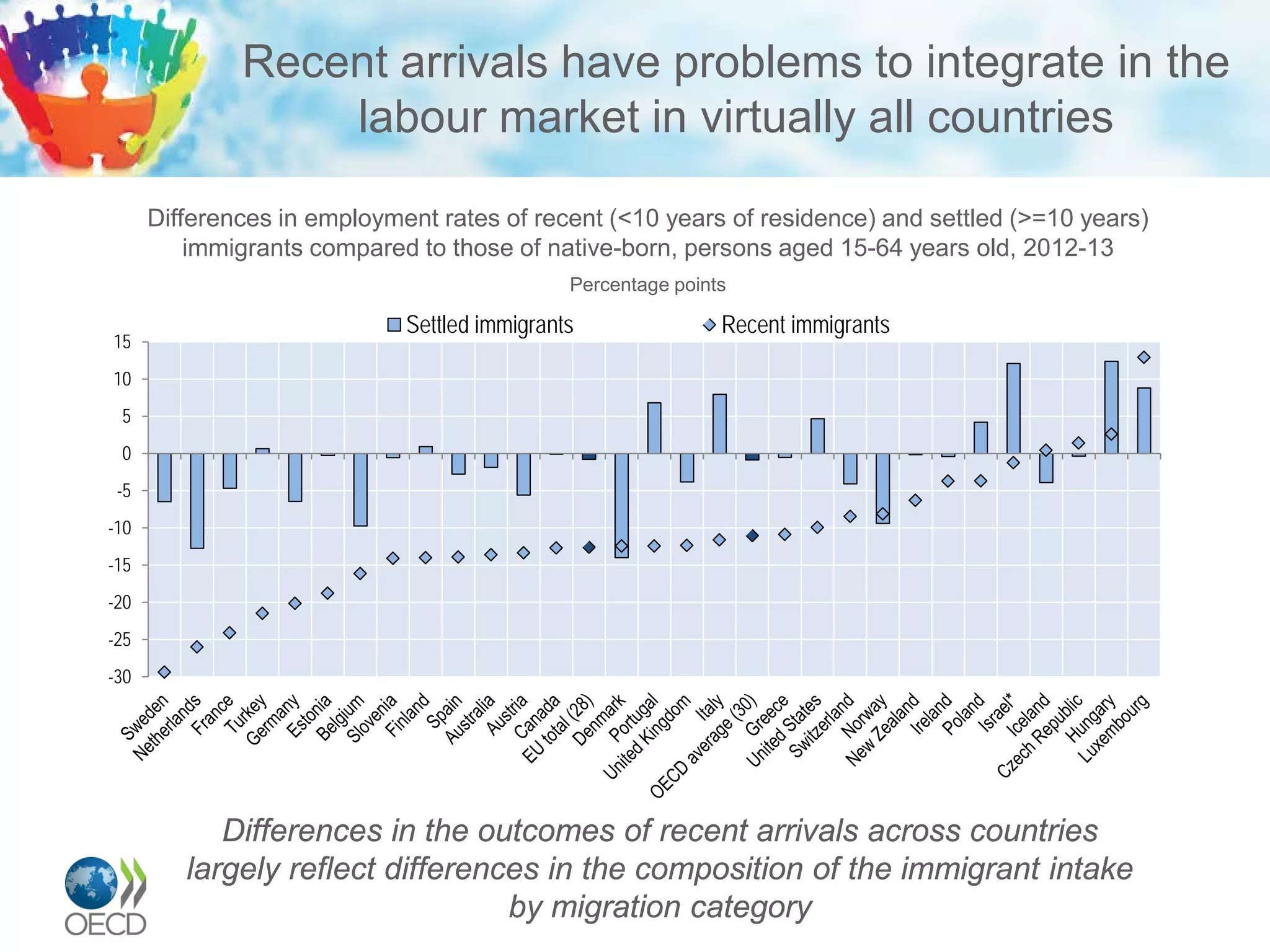
Recent arrivals have problems to integrate in the
labour market in virtually all countries
Differences in employment rates of recent (<10 years of residence) and settled (>=10 years)
immigrants compared to those of native-born, persons aged 15-64 years old, 2012-13
Percentage points
Differences in the outcomes of recent arrivals across countries
largely reflect differences in the composition of the immigrant intake
by migration category
-30
-25
-20
-15
-10
-5
0
5
10
15
Settled immigrants Recent immigrants
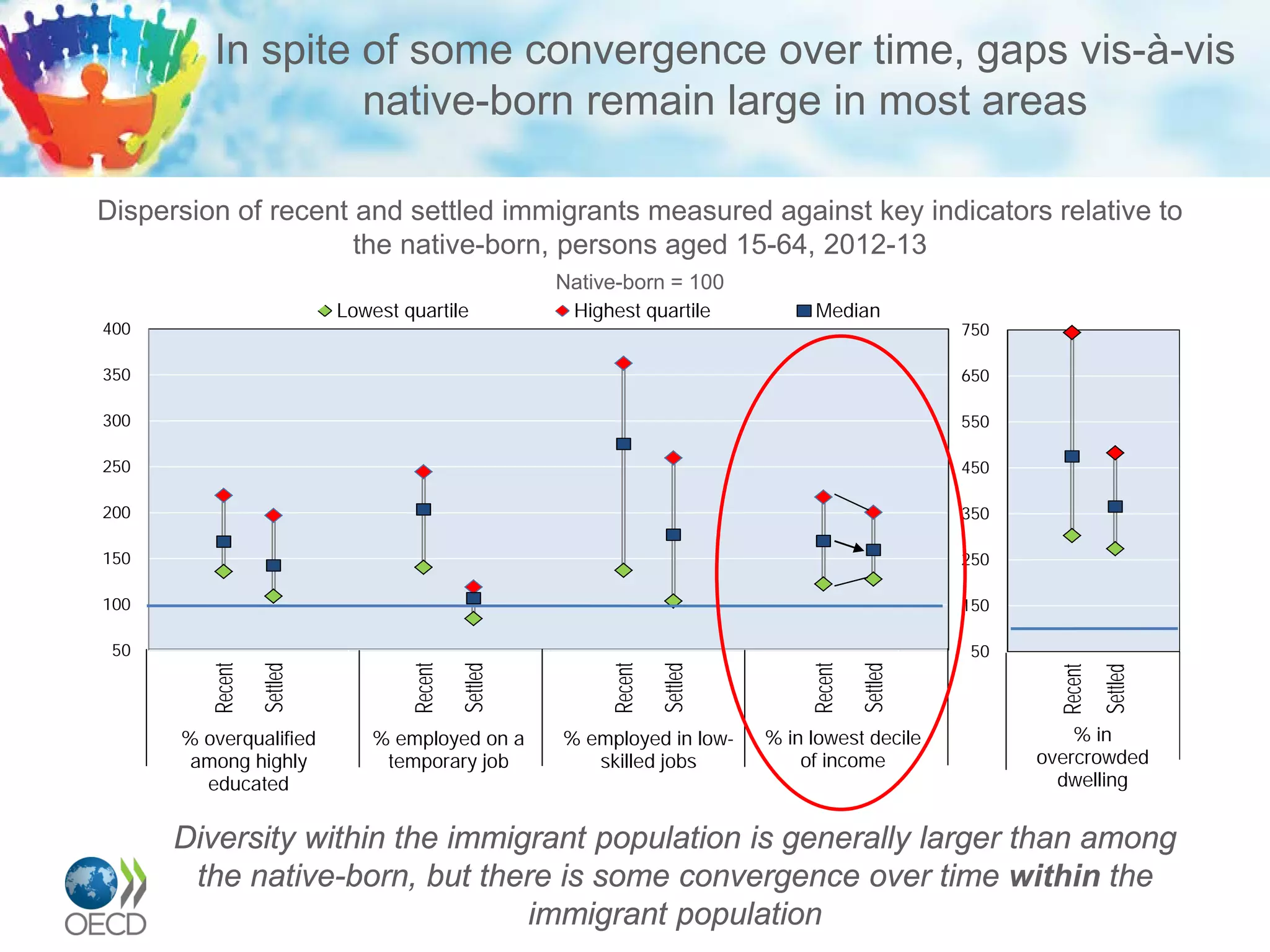
In spite of some convergence over time, gaps vis-à-vis
native-born remain large in most areas
Dispersion of recent and settled immigrants measured against key indicators relative to
the native-born, persons aged 15-64, 2012-13
Native-born = 100
Diversity within the immigrant population is generally larger than among
the native-born, but there is some convergence over time within the
immigrant population
50
100
150
200
250
300
350
400
Recent
Settled
Recent
Settled
Recent
Settled
Recent
Settled
% overqualified
among highly
educated
% employed on a
temporary job
% employed in low-
skilled jobs
% in lowest
decile f income
Lowest quartile Highest quartile Median
% in lowest decile
of income
50
150
250
350
450
550
650
750
Recent
Settled
% in
overcrowded
dwelling
% in
overcrowded
dwelling
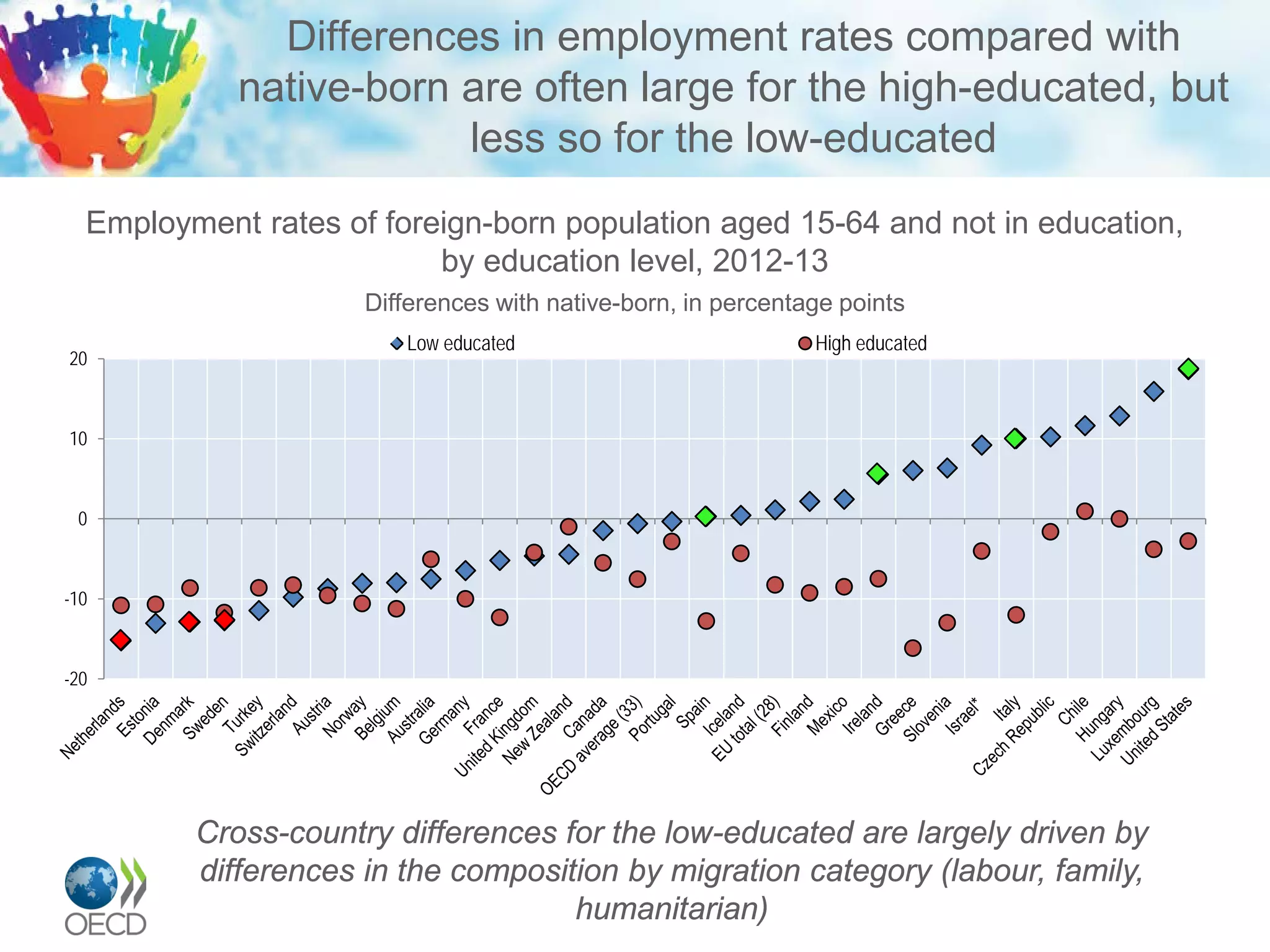
Differences in employment rates compared with
native-born are often large for the high-educated, but
less so for the low-educated
Employment rates of foreign-born population aged 15-64 and not in education,
by education level, 2012-13
Differences with native-born, in percentage points
Cross-country differences for the low-educated are largely driven by
differences in the composition by migration category (labour, family,
humanitarian)
-20
-10
0
10
20
Low educated High educated
Qualification is not a guarantee of success for
immigrants
• The share of high-educated among the immigrant population
has grown by four percentage points since 2006-07
• High-educated immigrants face more difficulties in getting a
job than their native-born peers…
• …and when in employment, those with foreign education face
a much higher incidence of overqualification
– 41% vs. 29% for those with host-country qualification
– Almost two-thirds immigrants have foreign qualifications
• As a result, tertiary qualifications do not necessarily protect
from poor living conditions
– 11% face in-work poverty (5% for their native-born peers)
Low-educated are relatively often employed, but their
long-term integration outcomes tend to be
unfavourable
• High employment rates come often at the price of low
job quality
• The result is a high incidence of in-work poverty (37%
vs. 17% for low-educated native-born) and overcrowded
housing conditions (29% vs. 11%)
• Many lack basic skills
– 32% of immigrants have only basic skills (native-born: 13%)
– Only half of those employed participate in job-related training,
compared with two thirds for their native-born peers
– This raises the question of employability
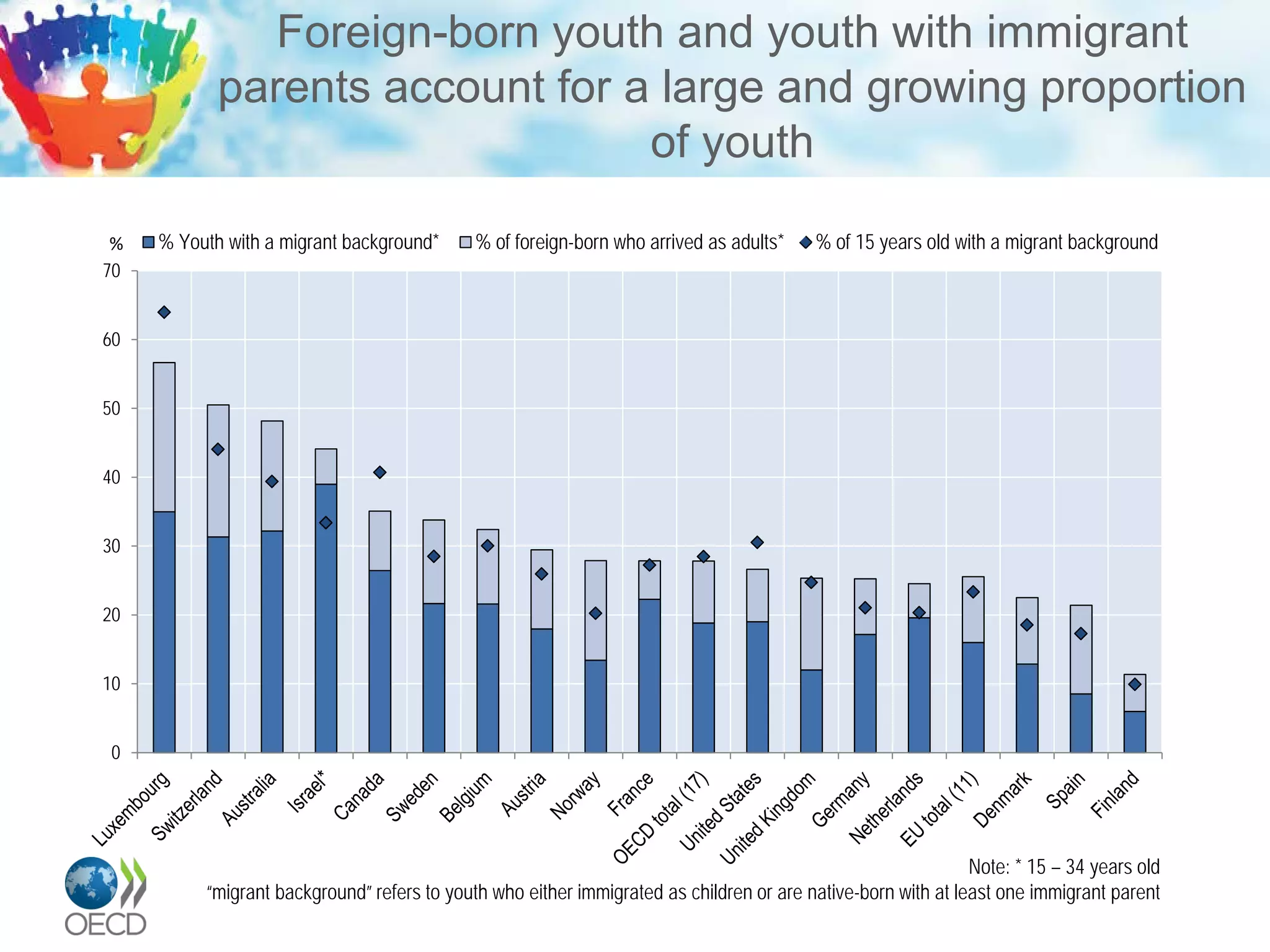
Foreign-born youth and youth with immigrant
parents account for a large and growing proportion
of youth
0
10
20
30
40
50
60
70
% Youth with a migrant background* % of foreign-born who arrived as adults* % of 15 years old with a migrant background%
Note: * 15 – 34 years old
“migrant background” refers to youth who either immigrated as children or are native-born with at least one immigrant parent
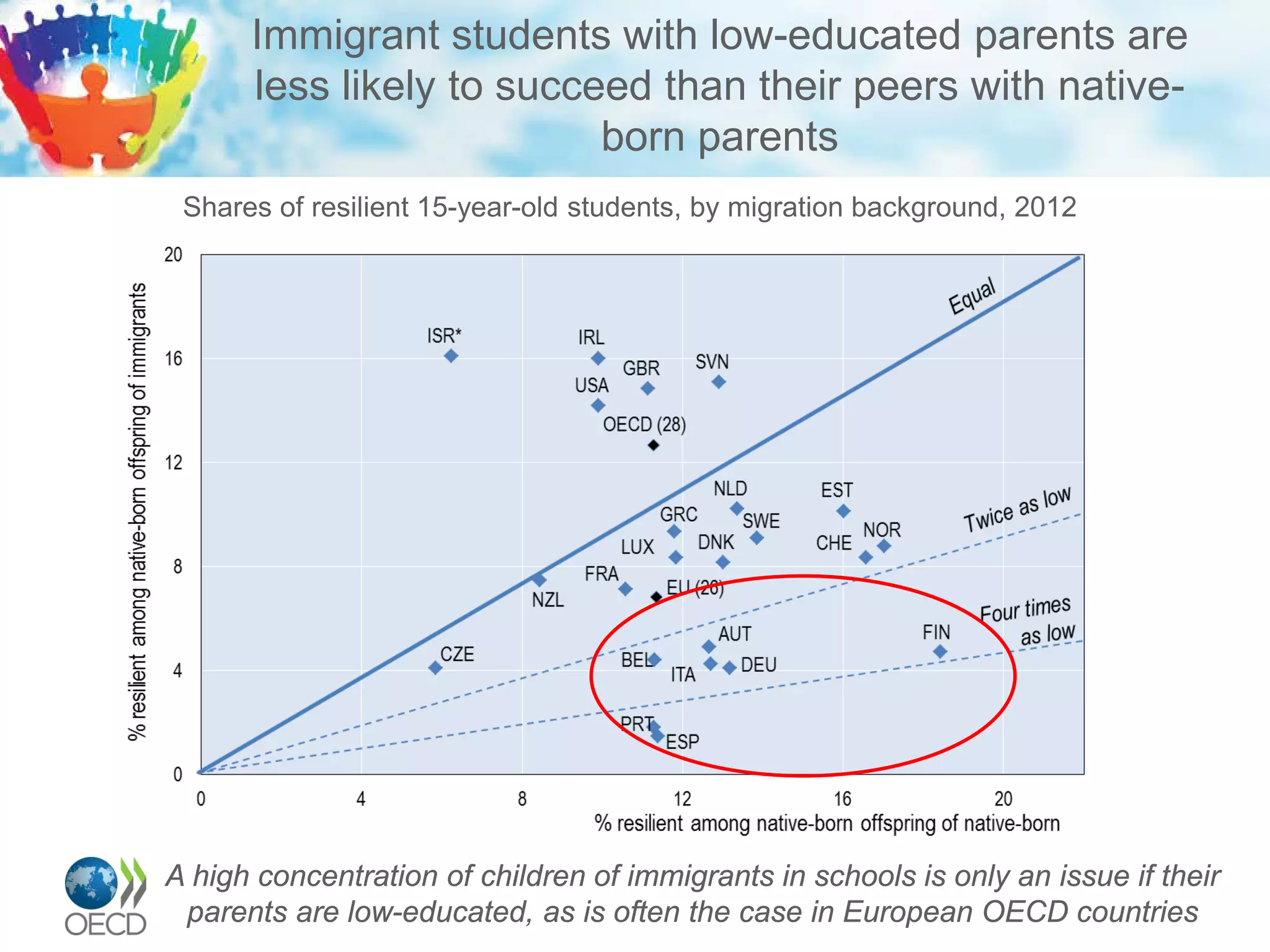
Immigrant students with low-educated parents are
less likely to succeed than their peers with native-
born parents
Shares of resilient 15-year-old students, by migration background, 2012
A high concentration of children of immigrants in schools is only an issue if their
parents are low-educated, as is often the case in European OECD countries
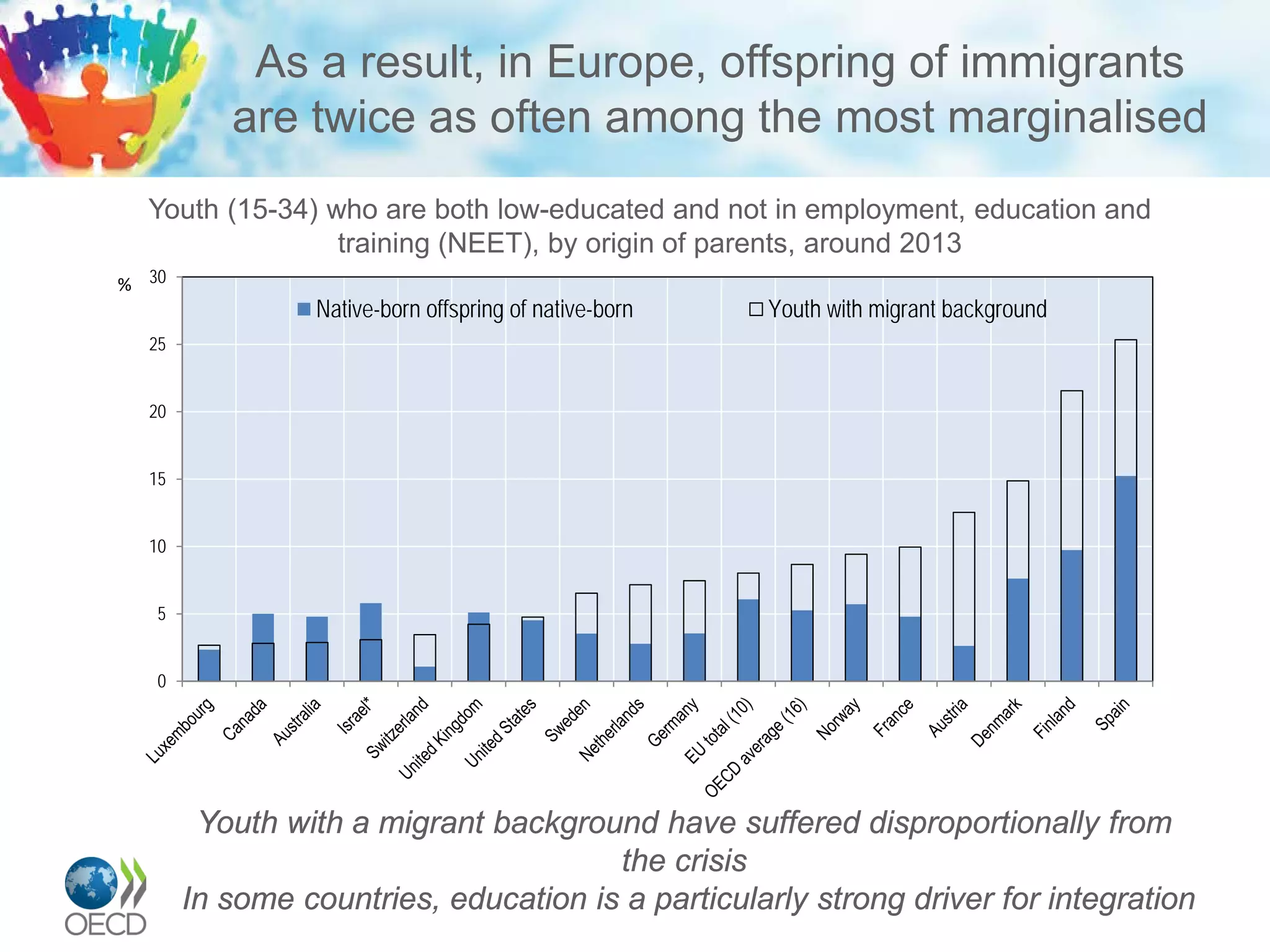
As a result, in Europe, offspring of immigrants
are twice as often among the most marginalised
Youth (15-34) who are both low-educated and not in employment, education and
training (NEET), by origin of parents, around 2013
Youth with a migrant background have suffered disproportionally from
the crisis
In some countries, education is a particularly strong driver for integration
0
5
10
15
20
25
30
Native-born offspring of native-born Youth with migrant background
%
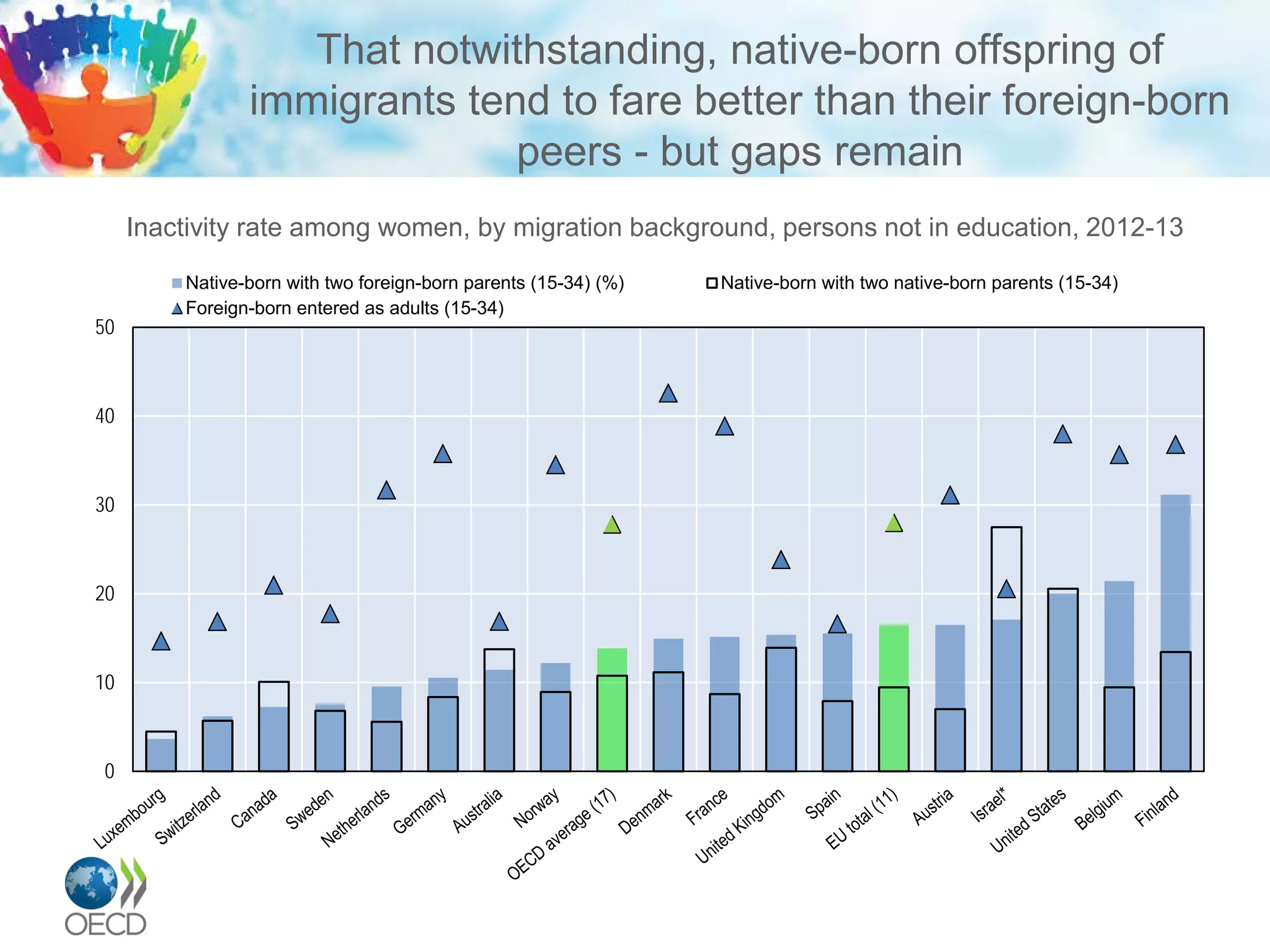
That notwithstanding, native-born offspring of
immigrants tend to fare better than their foreign-born
peers - but gaps remain
Inactivity rate among women, by migration background, persons not in education, 2012-13
0
10
20
30
40
50
Native-born with two foreign-born parents (15-34) (%) Native-born with two native-born parents (15-34)
Foreign-born entered as adults (15-34)
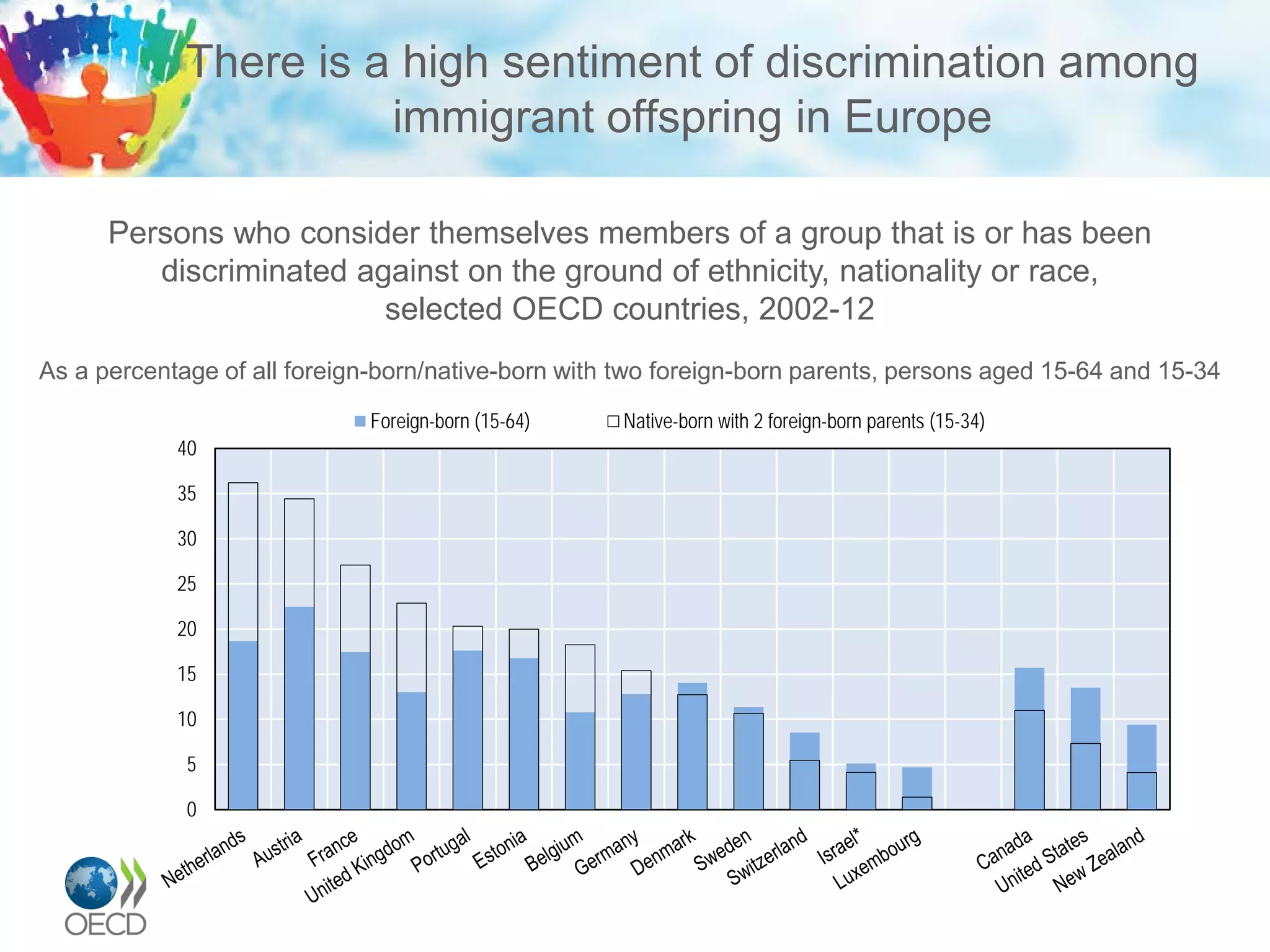
There is a high sentiment of discrimination among
immigrant offspring in Europe
Persons who consider themselves members of a group that is or has been
discriminated against on the ground of ethnicity, nationality or race,
selected OECD countries, 2002-12
As a percentage of all foreign-born/native-born with two foreign-born parents, persons aged 15-64 and 15-34
0
5
10
15
20
25
30
35
40
Foreign-born (15-64) Native-born with 2 foreign-born parents (15-34)
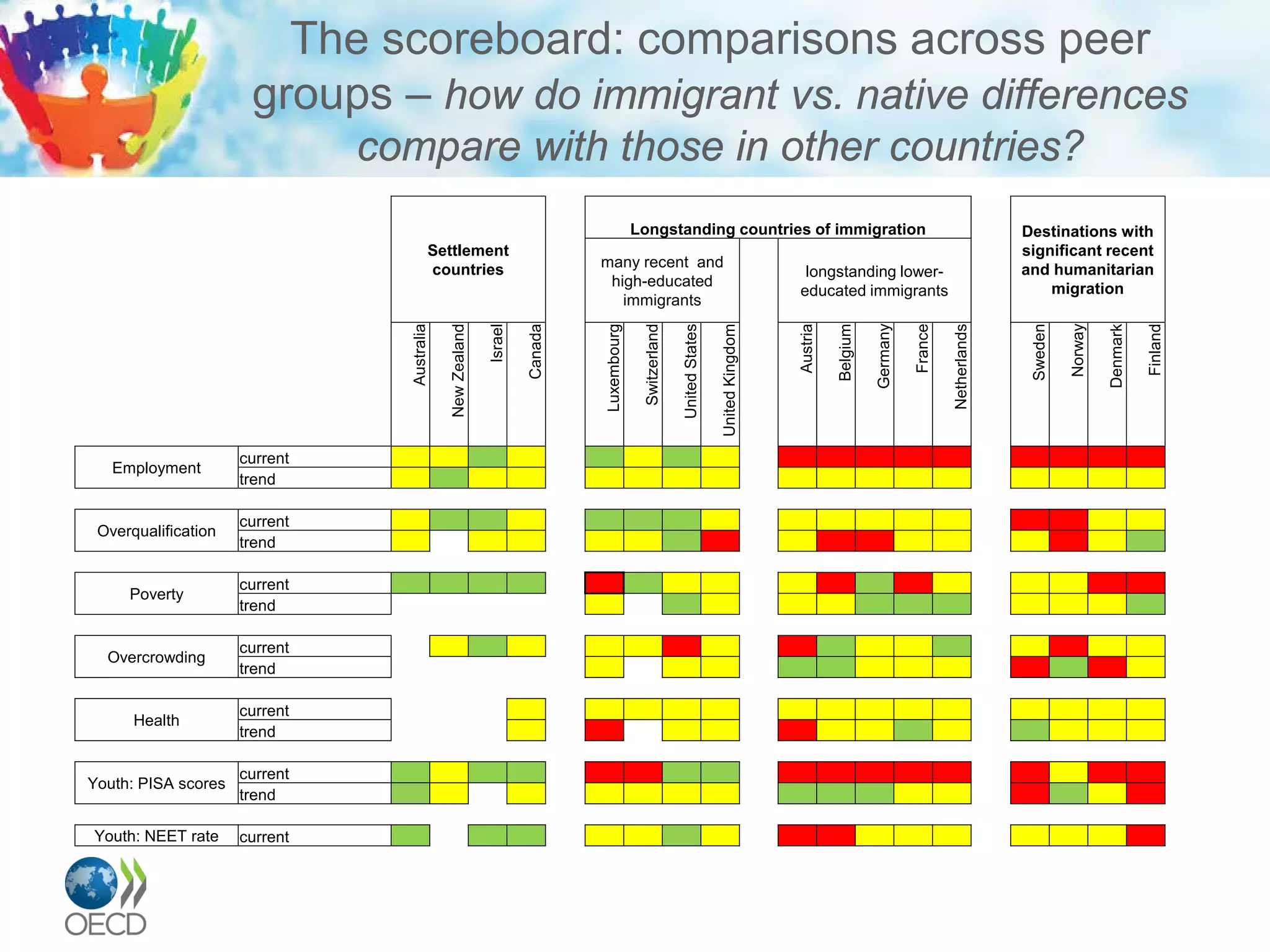
The scoreboard: comparisons across peer
groups – how do immigrant vs. native differences
compare with those in other countries?
14
Settlement
countries
Longstanding countries of immigration Destinations with
significant recent
and humanitarian
migration
many recent and
high-educated
immigrants
longstanding lower-
educated immigrants
Australia
NewZealand
Israel
Canada
Luxembourg
Switzerland
UnitedStates
UnitedKingdom
Austria
Belgium
Germany
France
Netherlands
Sweden
Norway
Denmark
Finland
Employment
current
trend
Overqualification
current
trend
Poverty
current
trend
Overcrowding
current
trend
Health
current
trend
Youth: PISA scores
current
trend
Youth: NEET rate current
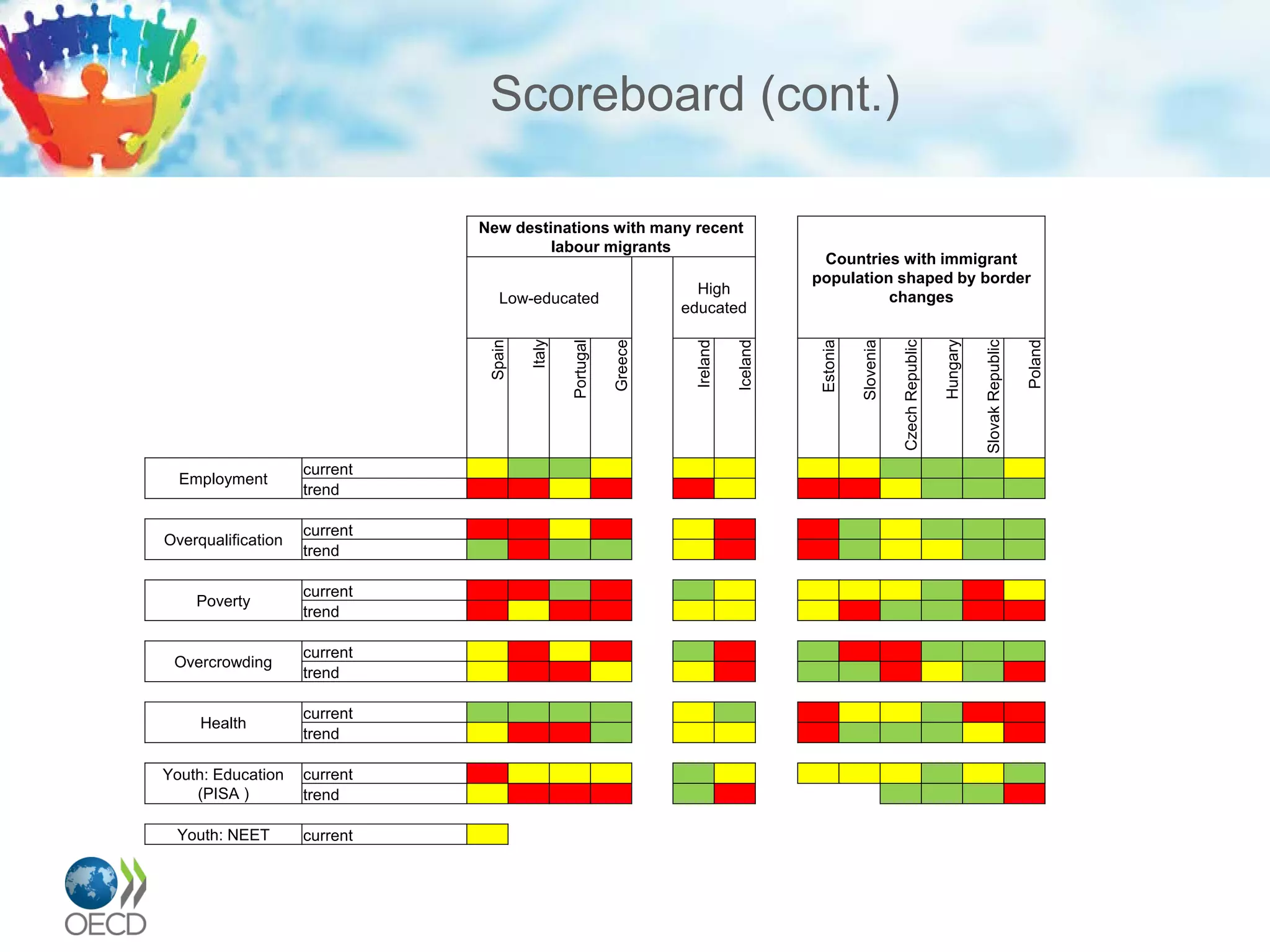
Scoreboard (cont.)
15
New destinations with many recent
labour migrants
Countries with immigrant
population shaped by border
changesLow-educated
High
educated
Spain
Italy
Portugal
Greece
Ireland
Iceland
Estonia
Slovenia
CzechRepublic
Hungary
SlovakRepublic
Poland
Employment
current
trend
Overqualification
current
trend
Poverty
current
trend
Overcrowding
current
trend
Health
current
trend
Youth: Education
(PISA )
current
trend
Youth: NEET current

Indicators of immigrant integration settling in 2015

  • 1.
    INDICATORS OF IMMIGRANT INTEGRATION YvesBreem Thomas Liebig Cécile Thoreau International Migration Division Directorate for Employment, Labour and Social Affairs Settling In 2015 Paris, 10 June 2015
  • 2.
    Overview • Joint workwith the European Commission • First broad international comparison across all EU and OECD countries of the outcomes for immigrants and their children • 34 key indicators on the integration of immigrants and their children, including: – Extensive contextual information on the demographic characteristics of immigrants and their children – Five main areas of integration: Employment, education and skills, social inclusion, civic engagement and social cohesion • 2 special chapters: – Third-country nationals in the EU (“Zaragoza indicators”) – Youth with a migration background • Peer groups of countries which have a similar relative size and composition of the immigrant population
  • 3.
    In the OECD,one person in five has a migration background Population share of immigrants and of native-born offspring of immigrants, around 2013 Percentage of the total population
  • 4.
    Recent arrivals haveproblems to integrate in the labour market in virtually all countries Differences in employment rates of recent (<10 years of residence) and settled (>=10 years) immigrants compared to those of native-born, persons aged 15-64 years old, 2012-13 Percentage points Differences in the outcomes of recent arrivals across countries largely reflect differences in the composition of the immigrant intake by migration category -30 -25 -20 -15 -10 -5 0 5 10 15 Settled immigrants Recent immigrants
  • 5.
    In spite ofsome convergence over time, gaps vis-à-vis native-born remain large in most areas Dispersion of recent and settled immigrants measured against key indicators relative to the native-born, persons aged 15-64, 2012-13 Native-born = 100 Diversity within the immigrant population is generally larger than among the native-born, but there is some convergence over time within the immigrant population 50 100 150 200 250 300 350 400 Recent Settled Recent Settled Recent Settled Recent Settled % overqualified among highly educated % employed on a temporary job % employed in low- skilled jobs % in lowest decile f income Lowest quartile Highest quartile Median % in lowest decile of income 50 150 250 350 450 550 650 750 Recent Settled % in overcrowded dwelling % in overcrowded dwelling
  • 6.
    Differences in employmentrates compared with native-born are often large for the high-educated, but less so for the low-educated Employment rates of foreign-born population aged 15-64 and not in education, by education level, 2012-13 Differences with native-born, in percentage points Cross-country differences for the low-educated are largely driven by differences in the composition by migration category (labour, family, humanitarian) -20 -10 0 10 20 Low educated High educated
  • 7.
    Qualification is nota guarantee of success for immigrants • The share of high-educated among the immigrant population has grown by four percentage points since 2006-07 • High-educated immigrants face more difficulties in getting a job than their native-born peers… • …and when in employment, those with foreign education face a much higher incidence of overqualification – 41% vs. 29% for those with host-country qualification – Almost two-thirds immigrants have foreign qualifications • As a result, tertiary qualifications do not necessarily protect from poor living conditions – 11% face in-work poverty (5% for their native-born peers)
  • 8.
    Low-educated are relativelyoften employed, but their long-term integration outcomes tend to be unfavourable • High employment rates come often at the price of low job quality • The result is a high incidence of in-work poverty (37% vs. 17% for low-educated native-born) and overcrowded housing conditions (29% vs. 11%) • Many lack basic skills – 32% of immigrants have only basic skills (native-born: 13%) – Only half of those employed participate in job-related training, compared with two thirds for their native-born peers – This raises the question of employability
  • 9.
    Foreign-born youth andyouth with immigrant parents account for a large and growing proportion of youth 0 10 20 30 40 50 60 70 % Youth with a migrant background* % of foreign-born who arrived as adults* % of 15 years old with a migrant background% Note: * 15 – 34 years old “migrant background” refers to youth who either immigrated as children or are native-born with at least one immigrant parent
  • 10.
    Immigrant students withlow-educated parents are less likely to succeed than their peers with native- born parents Shares of resilient 15-year-old students, by migration background, 2012 A high concentration of children of immigrants in schools is only an issue if their parents are low-educated, as is often the case in European OECD countries
  • 11.
    As a result,in Europe, offspring of immigrants are twice as often among the most marginalised Youth (15-34) who are both low-educated and not in employment, education and training (NEET), by origin of parents, around 2013 Youth with a migrant background have suffered disproportionally from the crisis In some countries, education is a particularly strong driver for integration 0 5 10 15 20 25 30 Native-born offspring of native-born Youth with migrant background %
  • 12.
    That notwithstanding, native-bornoffspring of immigrants tend to fare better than their foreign-born peers - but gaps remain Inactivity rate among women, by migration background, persons not in education, 2012-13 0 10 20 30 40 50 Native-born with two foreign-born parents (15-34) (%) Native-born with two native-born parents (15-34) Foreign-born entered as adults (15-34)
  • 13.
    There is ahigh sentiment of discrimination among immigrant offspring in Europe Persons who consider themselves members of a group that is or has been discriminated against on the ground of ethnicity, nationality or race, selected OECD countries, 2002-12 As a percentage of all foreign-born/native-born with two foreign-born parents, persons aged 15-64 and 15-34 0 5 10 15 20 25 30 35 40 Foreign-born (15-64) Native-born with 2 foreign-born parents (15-34)
  • 14.
    The scoreboard: comparisonsacross peer groups – how do immigrant vs. native differences compare with those in other countries? 14 Settlement countries Longstanding countries of immigration Destinations with significant recent and humanitarian migration many recent and high-educated immigrants longstanding lower- educated immigrants Australia NewZealand Israel Canada Luxembourg Switzerland UnitedStates UnitedKingdom Austria Belgium Germany France Netherlands Sweden Norway Denmark Finland Employment current trend Overqualification current trend Poverty current trend Overcrowding current trend Health current trend Youth: PISA scores current trend Youth: NEET rate current
  • 15.
    Scoreboard (cont.) 15 New destinationswith many recent labour migrants Countries with immigrant population shaped by border changesLow-educated High educated Spain Italy Portugal Greece Ireland Iceland Estonia Slovenia CzechRepublic Hungary SlovakRepublic Poland Employment current trend Overqualification current trend Poverty current trend Overcrowding current trend Health current trend Youth: Education (PISA ) current trend Youth: NEET current