Principle of PCR and applications 
Methee Sriprapun, PhD 
Division of Clinical Microbiology 
Faculty of Medical Technology 
Huachiew Chalermprakiet University 
Email: sriprapun.m@gmail.com
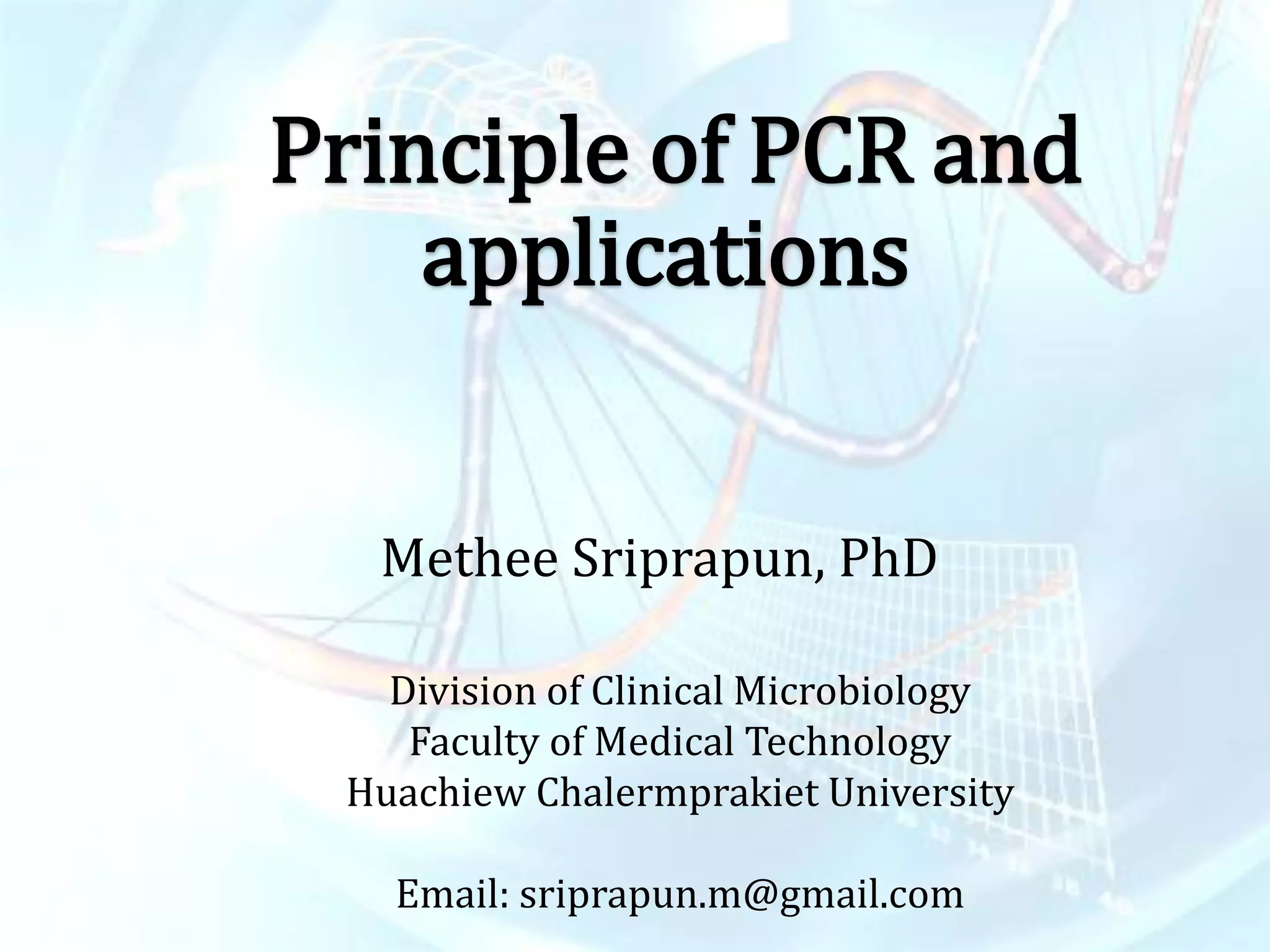
PCR (polymerase chain reaction) 
“การสังเคราะห์และเพิ่มจานวนชิ้นส่วน DNA ที่ต้องการในหลอด ทดลองอย่างต่อเนื่องเป็นลูกโซ่โดยอาศัยการเร่งปฏิกิริยาของ DNA polymerase ที่ทนความร้อน” 
https://www.neb.com/~/media/NebUs/Page%20Images/Applications/DNA%20Amplification%20and%20PCR/pcr.jpg
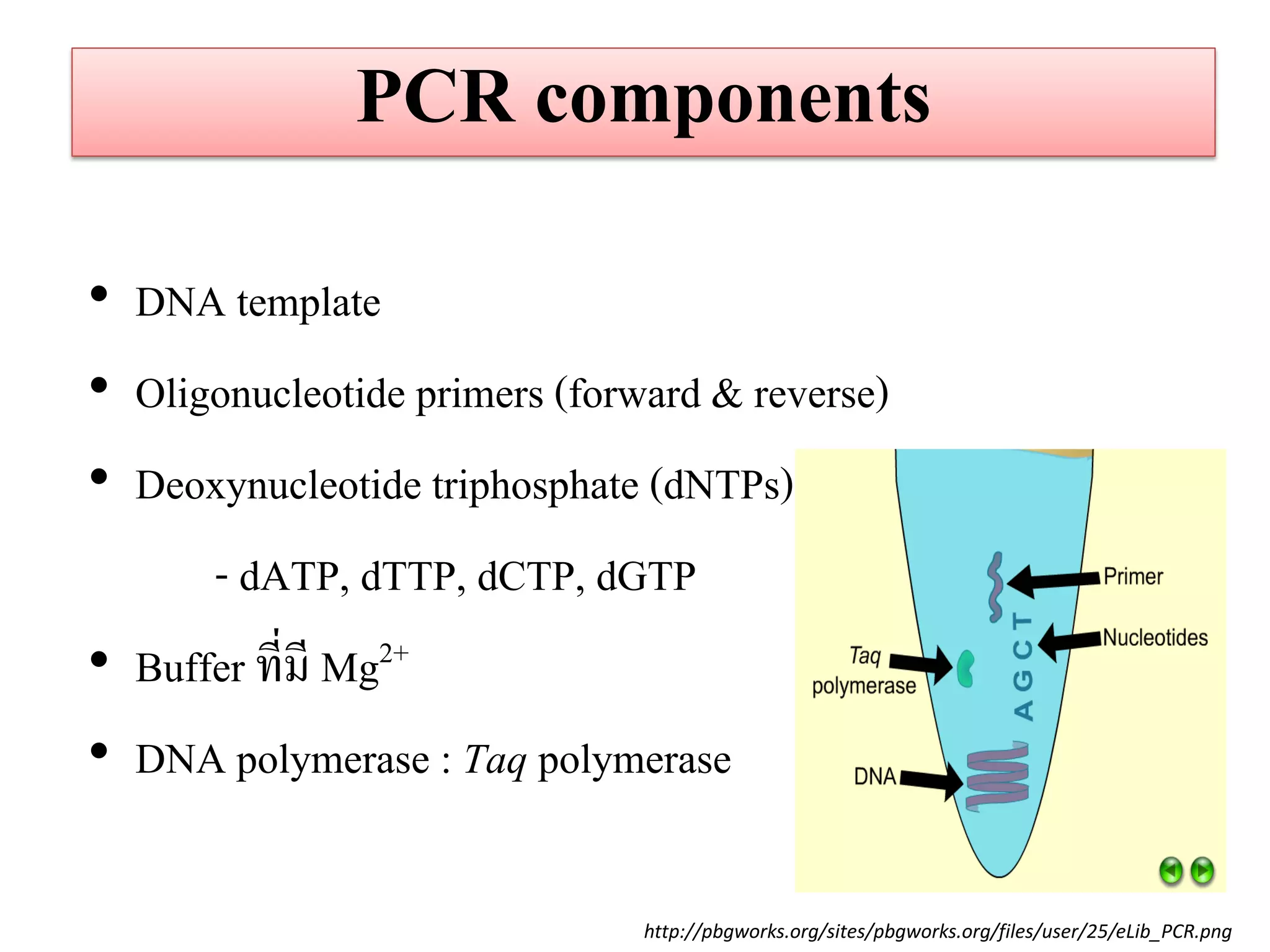
PCR components 
•DNA template 
•Oligonucleotide primers (forward & reverse) 
•Deoxynucleotide triphosphate (dNTPs) 
- dATP, dTTP, dCTP, dGTP 
•Buffer ที่มี Mg2+ 
•DNA polymerase : Taq polymerase 
http://pbgworks.org/sites/pbgworks.org/files/user/25/eLib_PCR.png
DNA Template 
•Extracted from cells or tissues 
•Check purity of extracted DNA: A260/A280  1.7 – 2.0 
•Using optimum concentration (เช่น 0.02-5g/50l) 
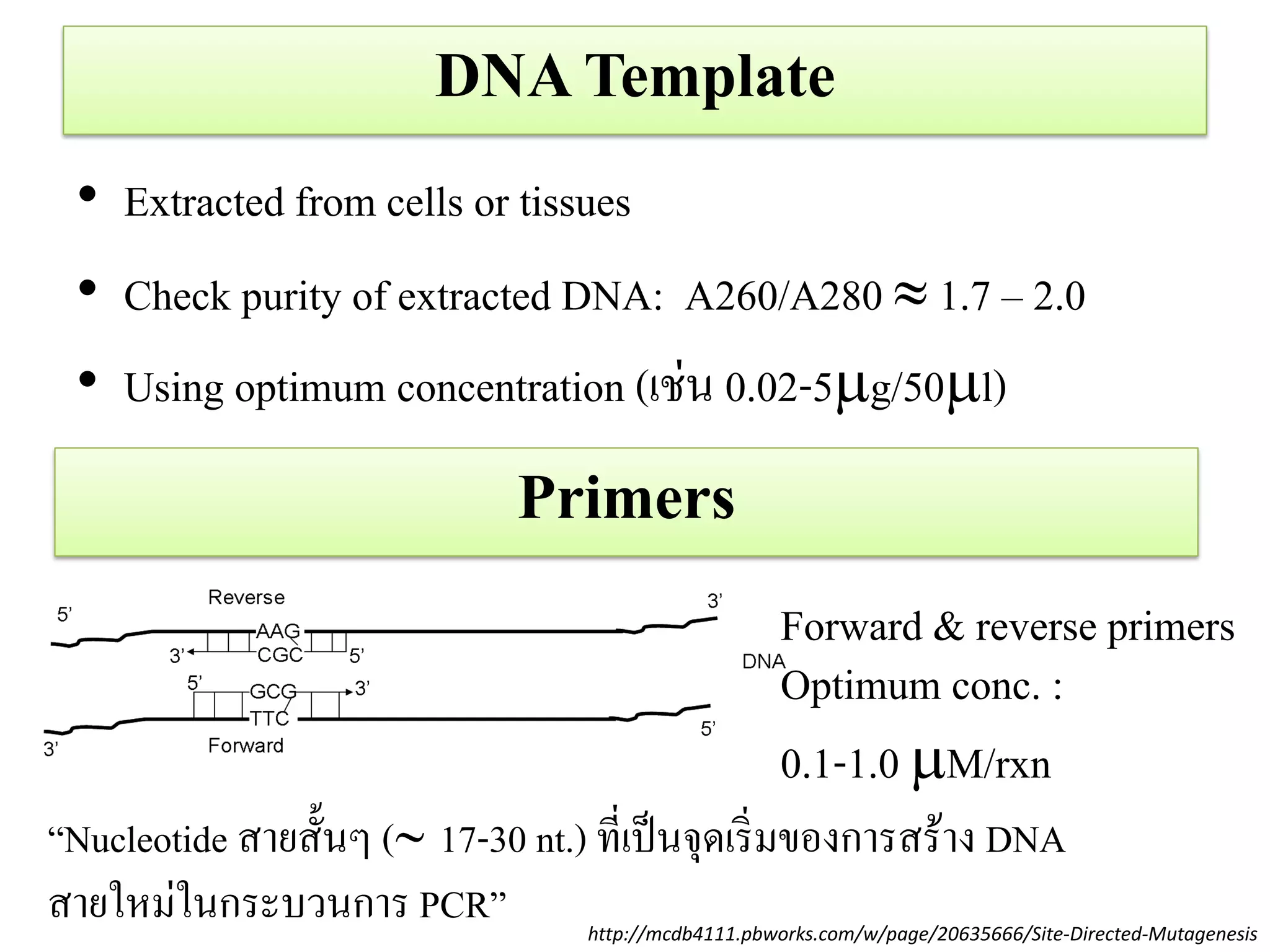
Primers 
http://mcdb4111.pbworks.com/w/page/20635666/Site-Directed-Mutagenesis 
Forward & reverse primers 
Optimum conc. : 
0.1-1.0 M/rxn 
“Nucleotide สายสั้นๆ (17-30 nt.) ที่เป็นจุดเริ่มของการสร้าง DNA 
สายใหม่ในกระบวนการ PCR”
Deoxynucleotide triphosphate (dNTPs) 
•Mixture of dATP, dTTP, dCTP and dGTP 
•20-200 M 
PCR buffer 
•ทาให้ปฏิกิริยา PCR เป็นไปได้อย่างเหมาะสม 
•Tris HCl, KCl, MgCl2 
•Optimization of [Mg2+] is necessary  1.5-2.0 mM 
•Mg2+  cofactor of Taq DNA polymerase 
•มักถูกเตรียมในรูปของ 10X, 5X, 2X
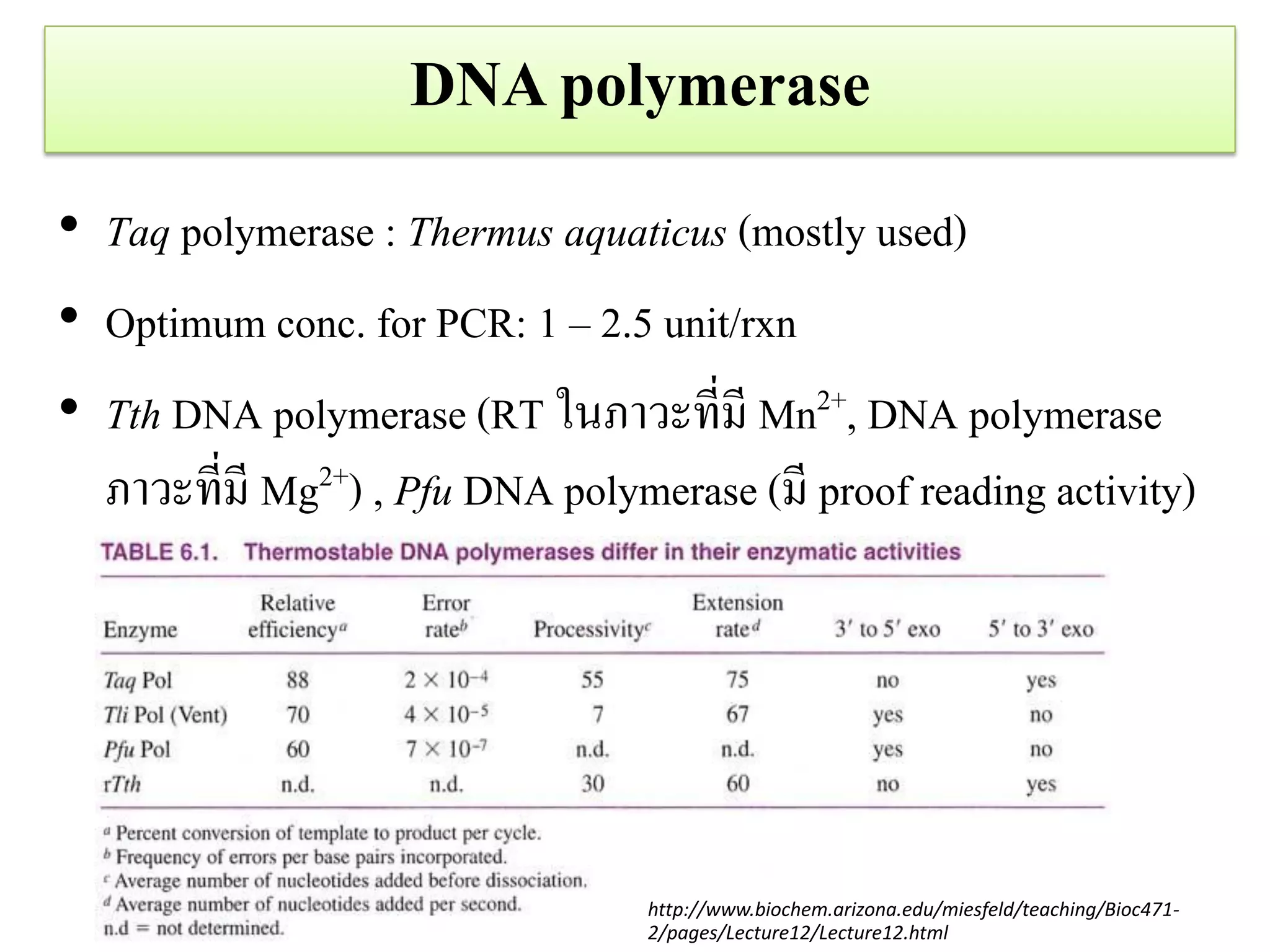
•Taq polymerase : Thermus aquaticus (mostly used) 
•Optimum conc. for PCR: 1 – 2.5 unit/rxn •Tth DNA polymerase (RT ในภาวะที่มี Mn2+, DNA polymerase ภาวะที่มี Mg2+) , Pfu DNA polymerase (มี proof reading activity) 
DNA polymerase 
http://www.biochem.arizona.edu/miesfeld/teaching/Bioc471- 2/pages/Lecture12/Lecture12.html
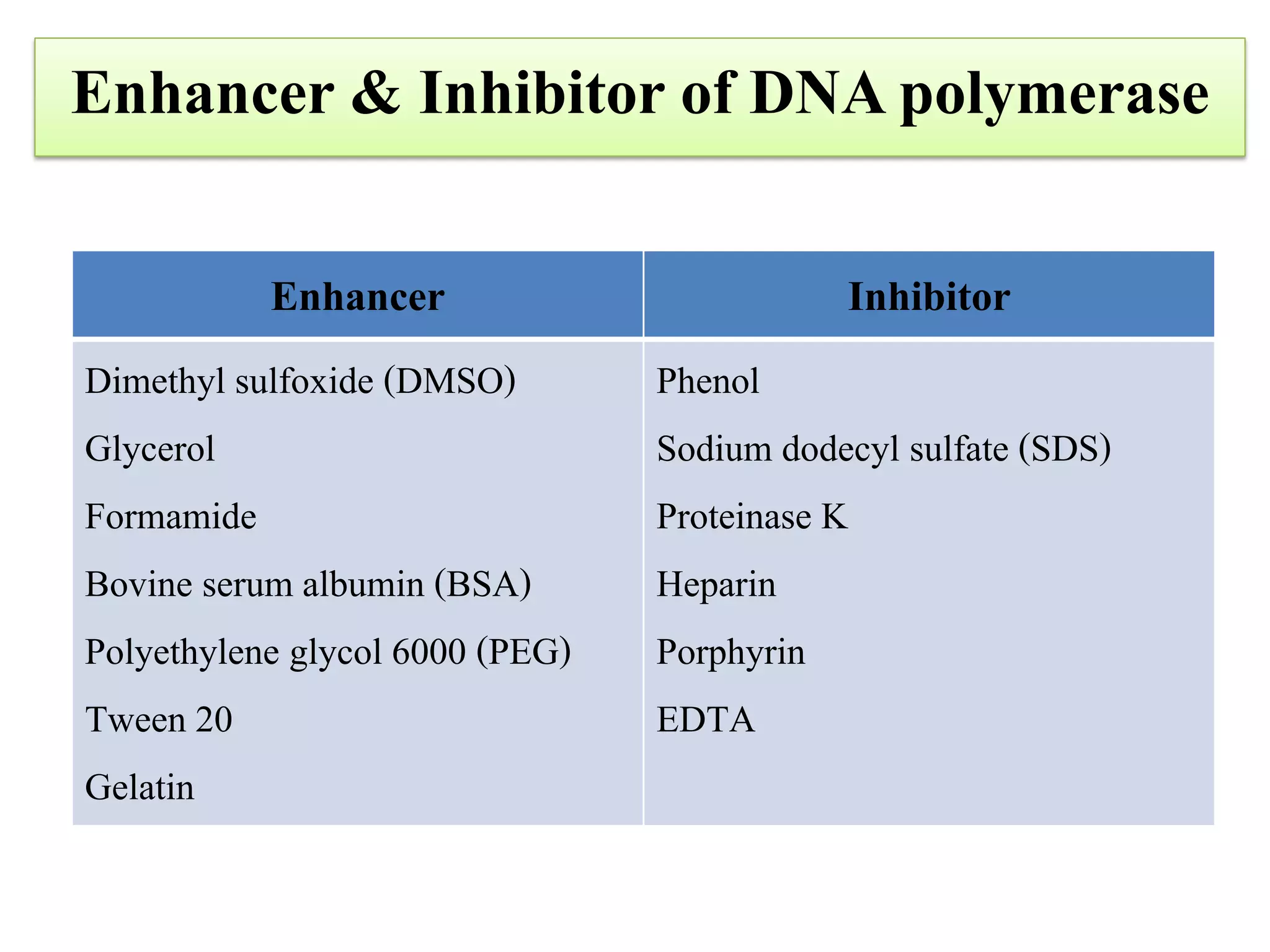
Enhancer & Inhibitor of DNA polymerase 
Enhancer 
Inhibitor 
Dimethyl sulfoxide (DMSO) 
Glycerol 
Formamide 
Bovine serum albumin (BSA) 
Polyethylene glycol 6000 (PEG) 
Tween 20 
Gelatin 
Phenol 
Sodium dodecyl sulfate (SDS) 
Proteinase K 
Heparin 
Porphyrin 
EDTA
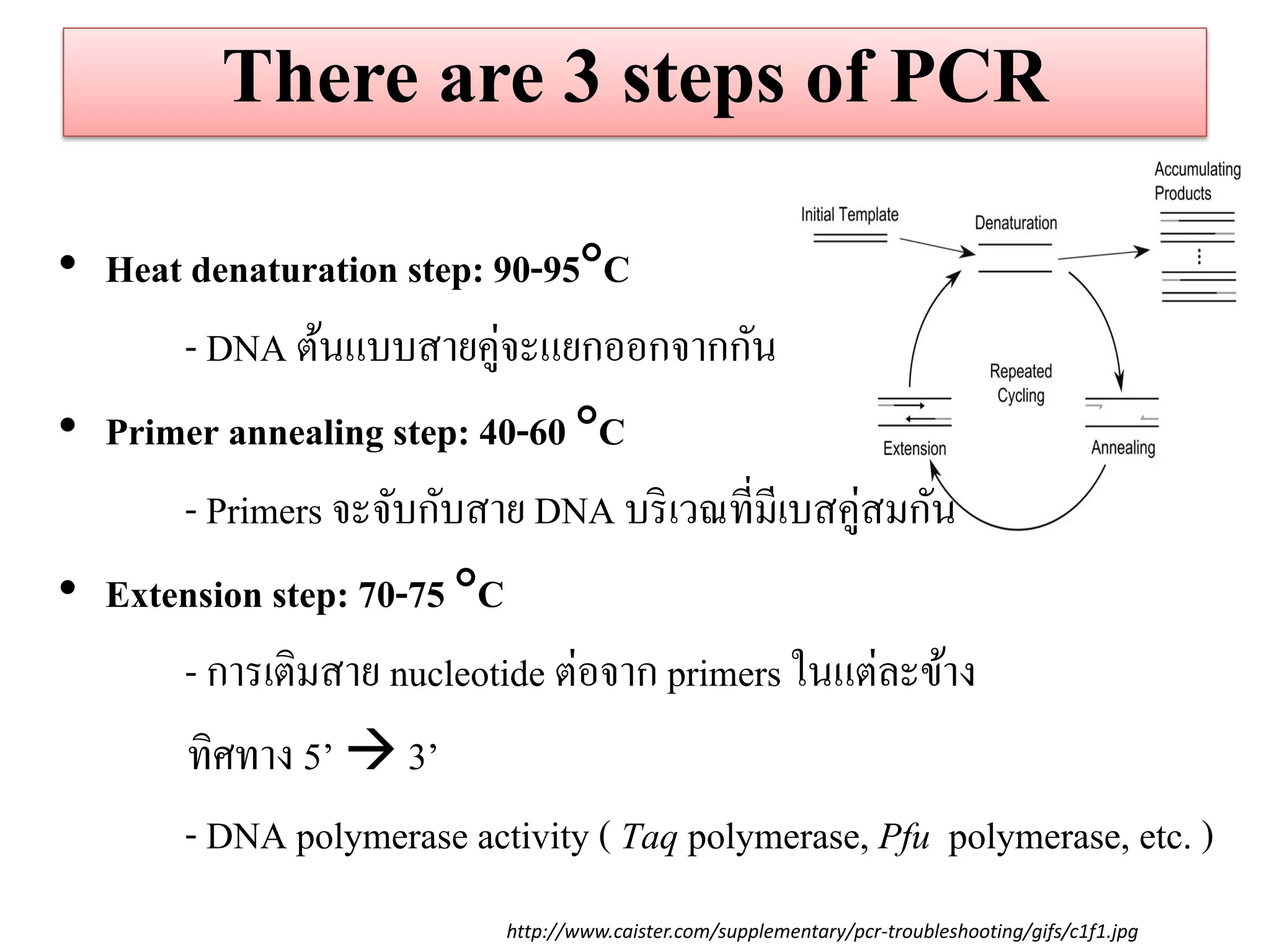
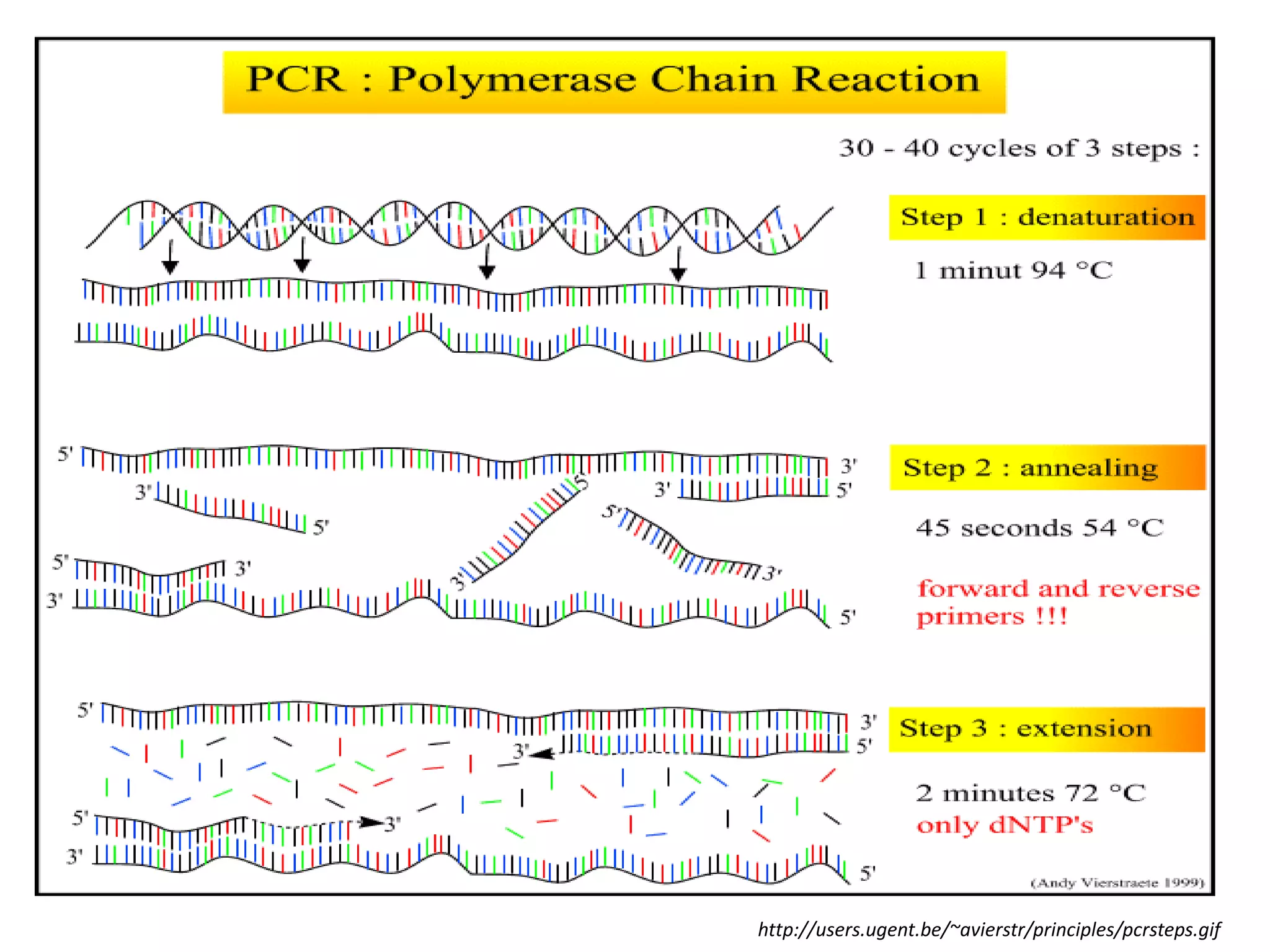
There are 3 steps of PCR 
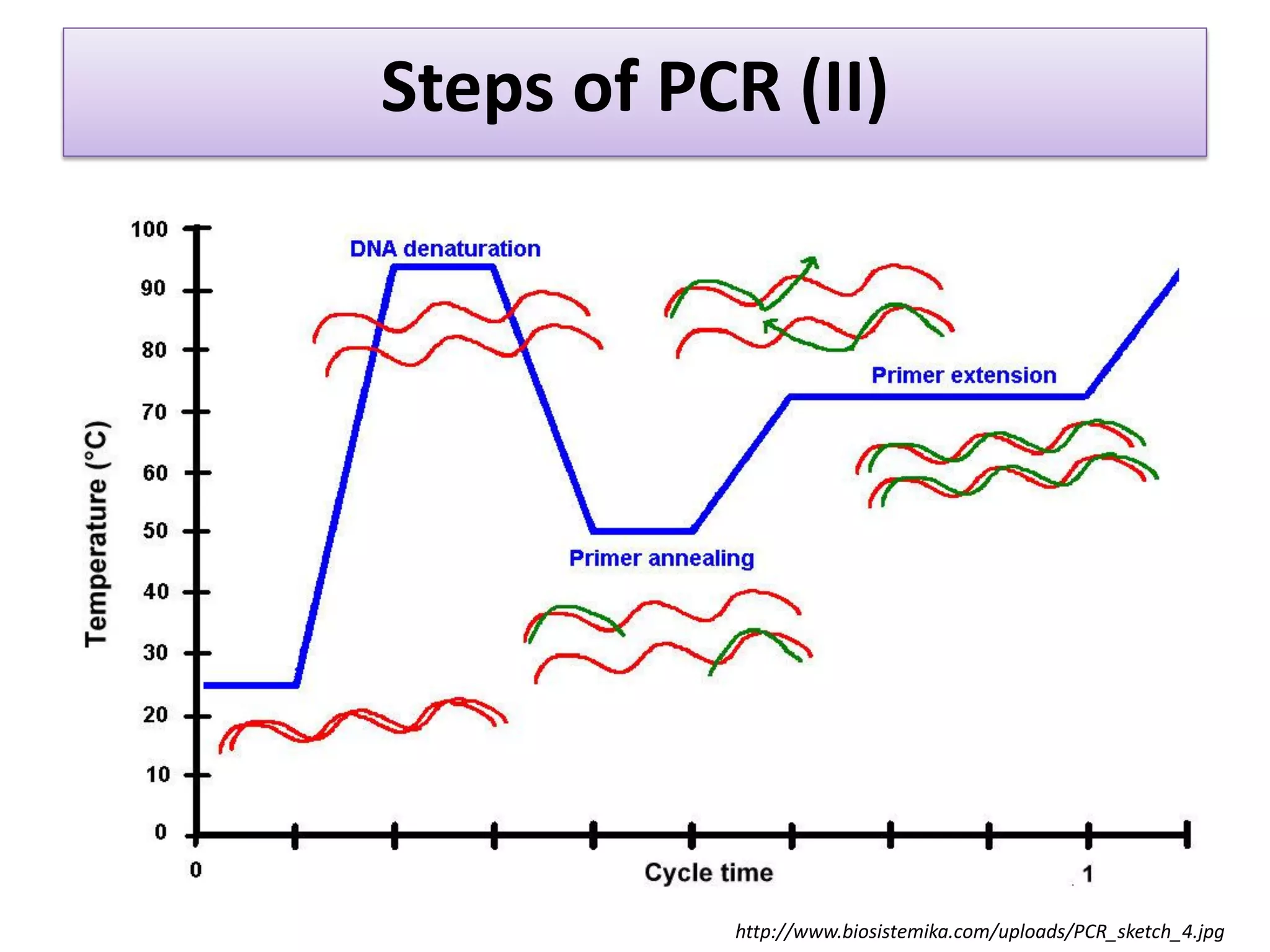
•Heat denaturation step: 90-95C 
- DNA ต้นแบบสายคู่จะแยกออกจากกัน 
•Primer annealing step: 40-60 C 
- Primers จะจับกับสาย DNA บริเวณที่มีเบสคู่สมกัน 
•Extension step: 70-75 C 
- การเติมสาย nucleotide ต่อจาก primers ในแต่ละข้าง 
ทิศทาง 5’  3’ 
- DNA polymerase activity ( Taq polymerase, Pfu polymerase, etc. ) 
http://www.caister.com/supplementary/pcr-troubleshooting/gifs/c1f1.jpg
http://users.ugent.be/~avierstr/principles/pcrsteps.gif
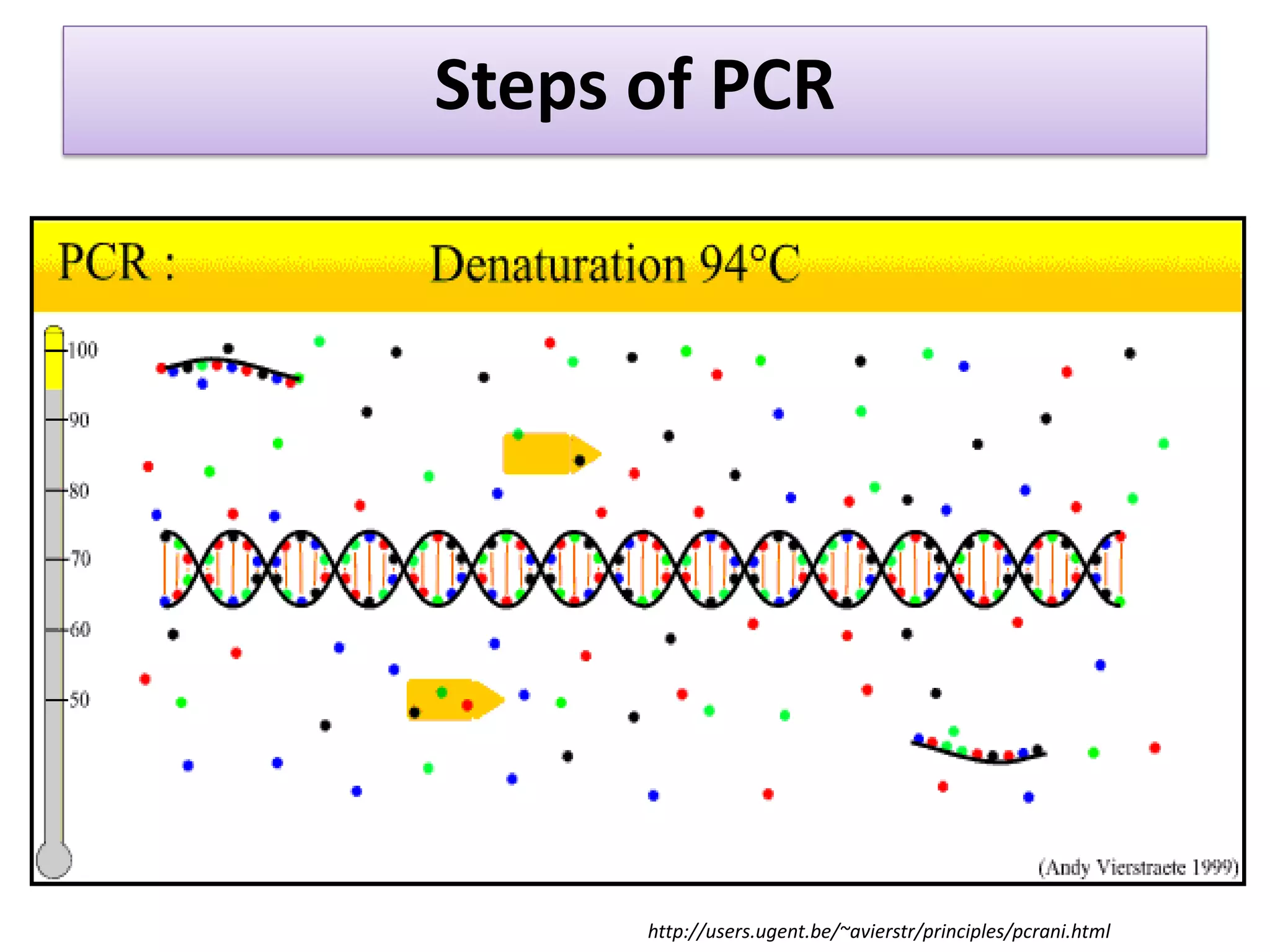
Steps of PCR 
http://users.ugent.be/~avierstr/principles/pcrani.html
Steps of PCR (II) 
http://www.biosistemika.com/uploads/PCR_sketch_4.jpg
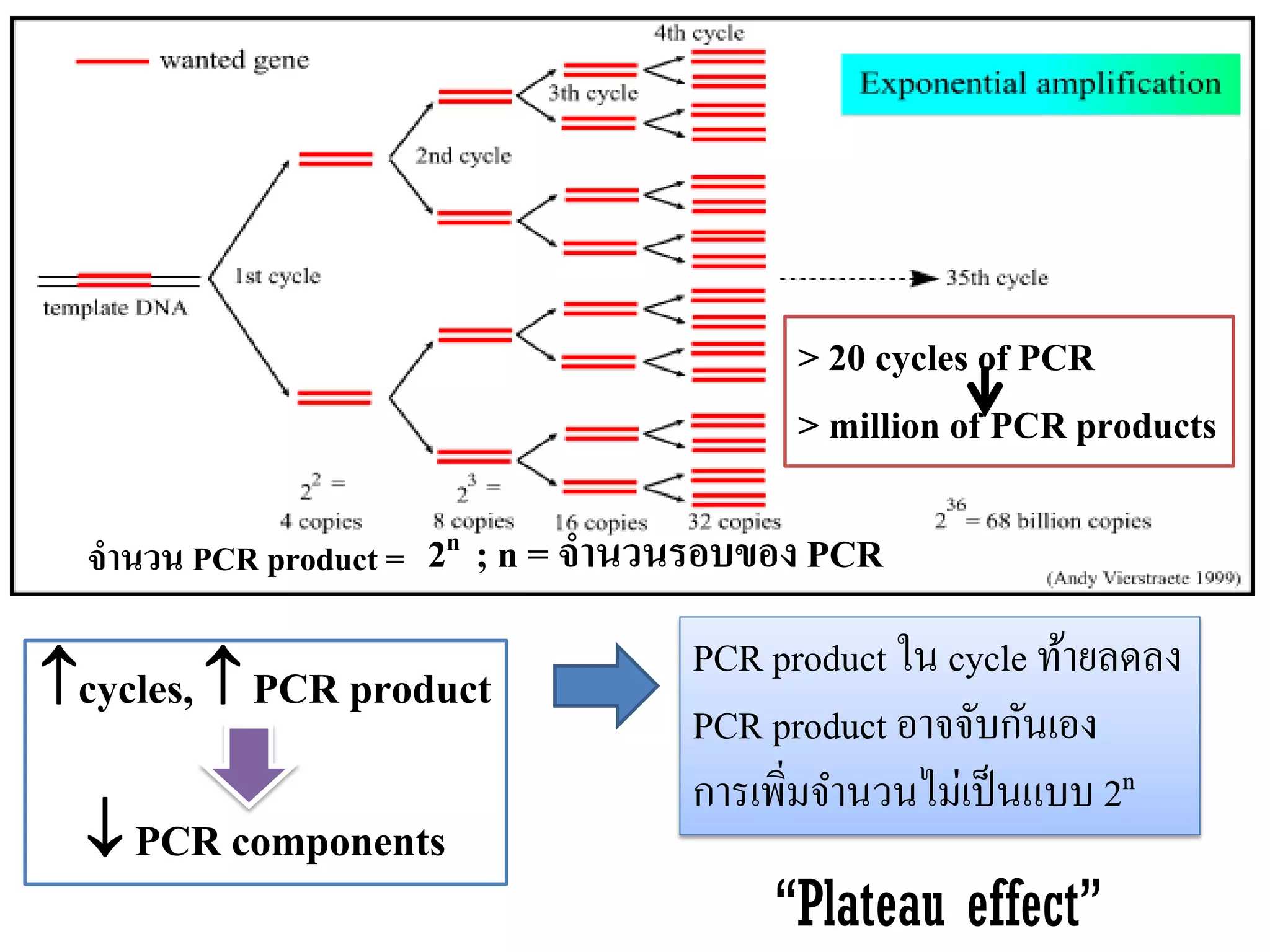
2n ; n = จำนวนรอบของ PCR 
จำนวน PCR product = 
> 20 cycles of PCR 
> million of PCR products 
cycles,  PCR product  PCR components 
PCR product ใน cycle ท้ายลดลง 
PCR product อาจจับกันเอง 
การเพิ่มจานวนไม่เป็นแบบ 2n 
“Plateau effect”
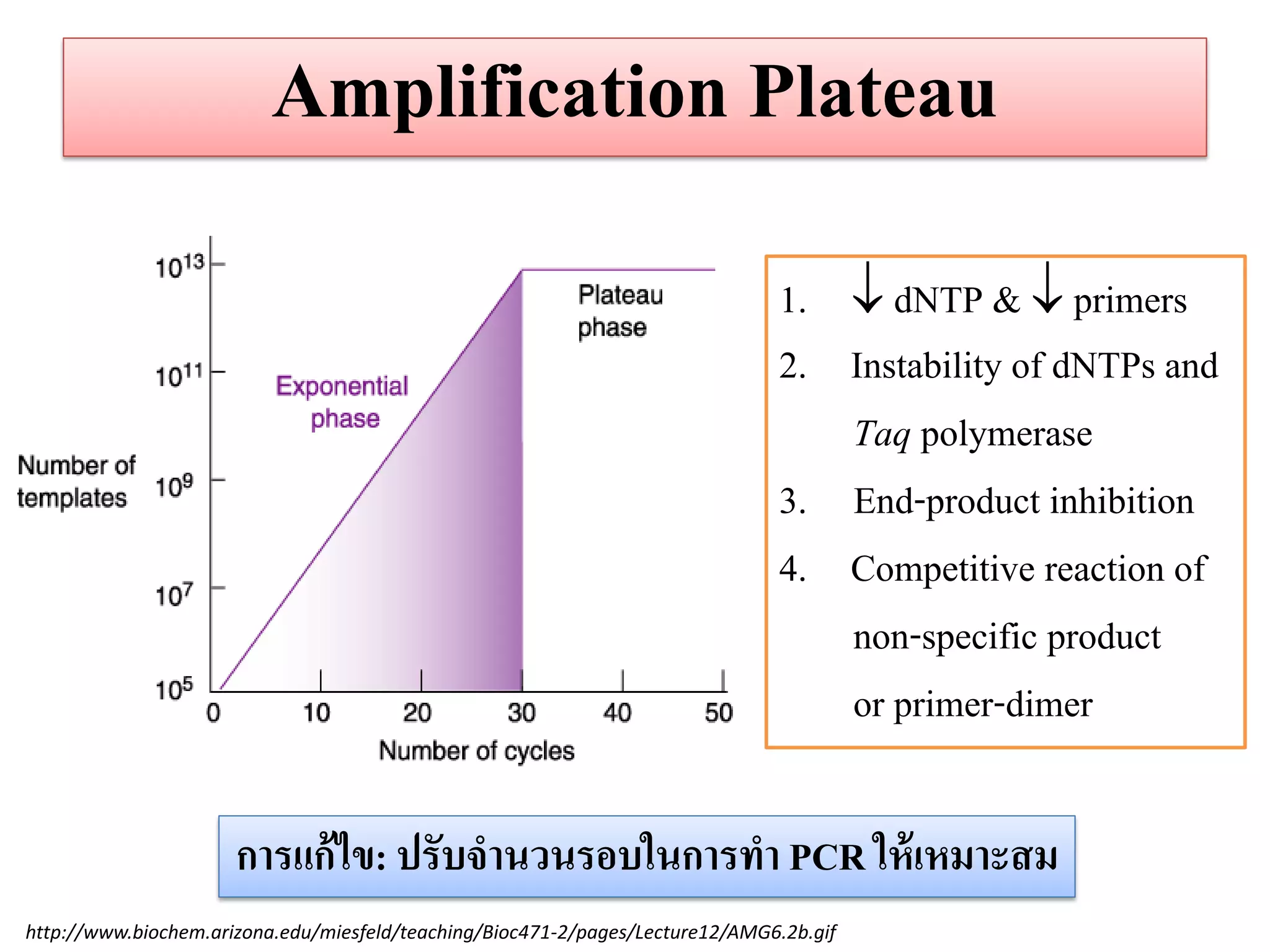
Amplification Plateau 
http://www.biochem.arizona.edu/miesfeld/teaching/Bioc471-2/pages/Lecture12/AMG6.2b.gif 
1. dNTP &  primers 
2.Instability of dNTPs and Taq polymerase 3. End-product inhibition 
4.Competitive reaction of non-specific product or primer-dimer 
กำรแก้ไข: ปรับจำนวนรอบในกำรทำ PCR ให้เหมำะสม
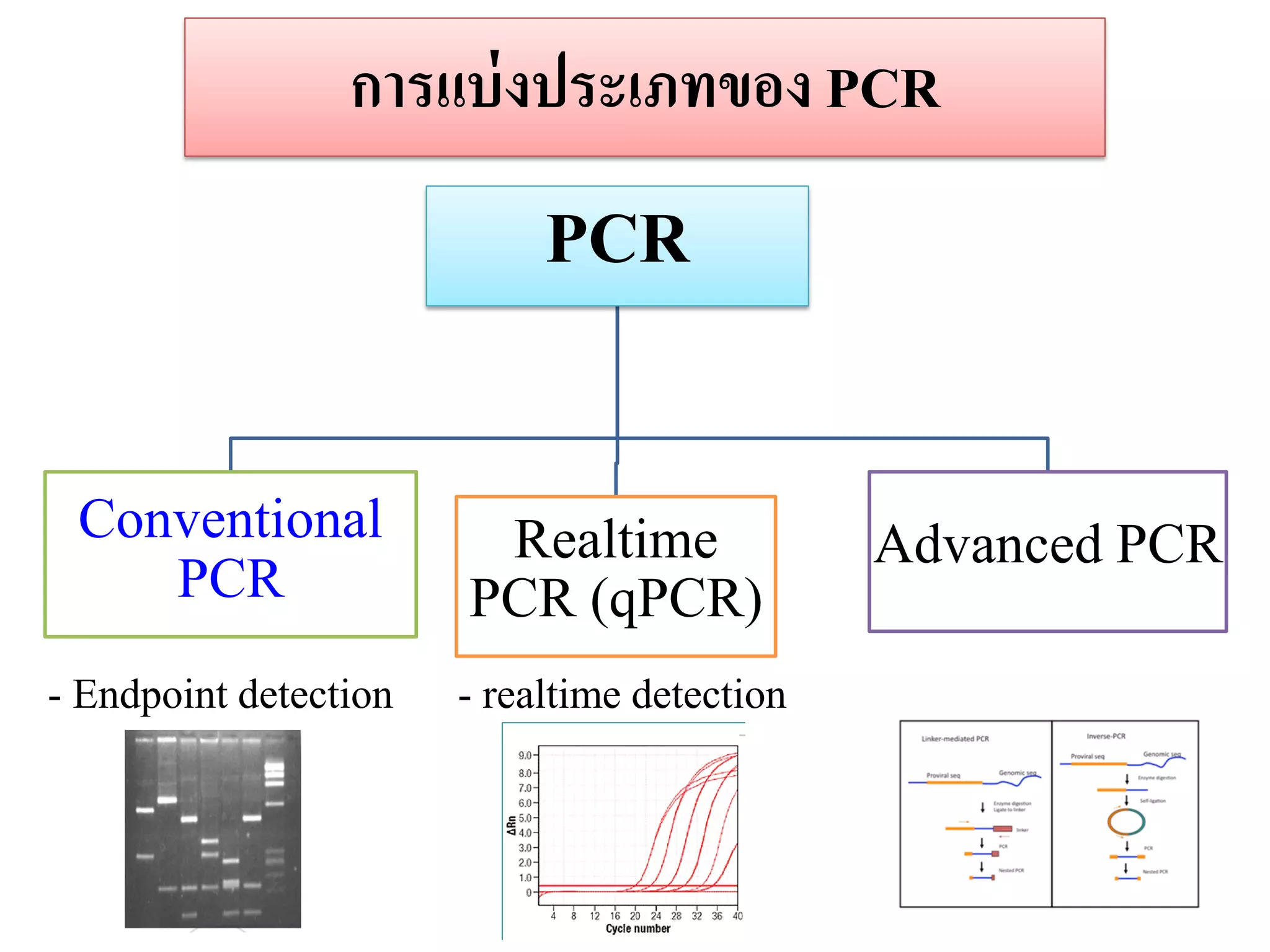
กำรแบ่งประเภทของ PCR 
PCR 
Conventional PCR 
Realtime PCR (qPCR) 
Advanced PCR 
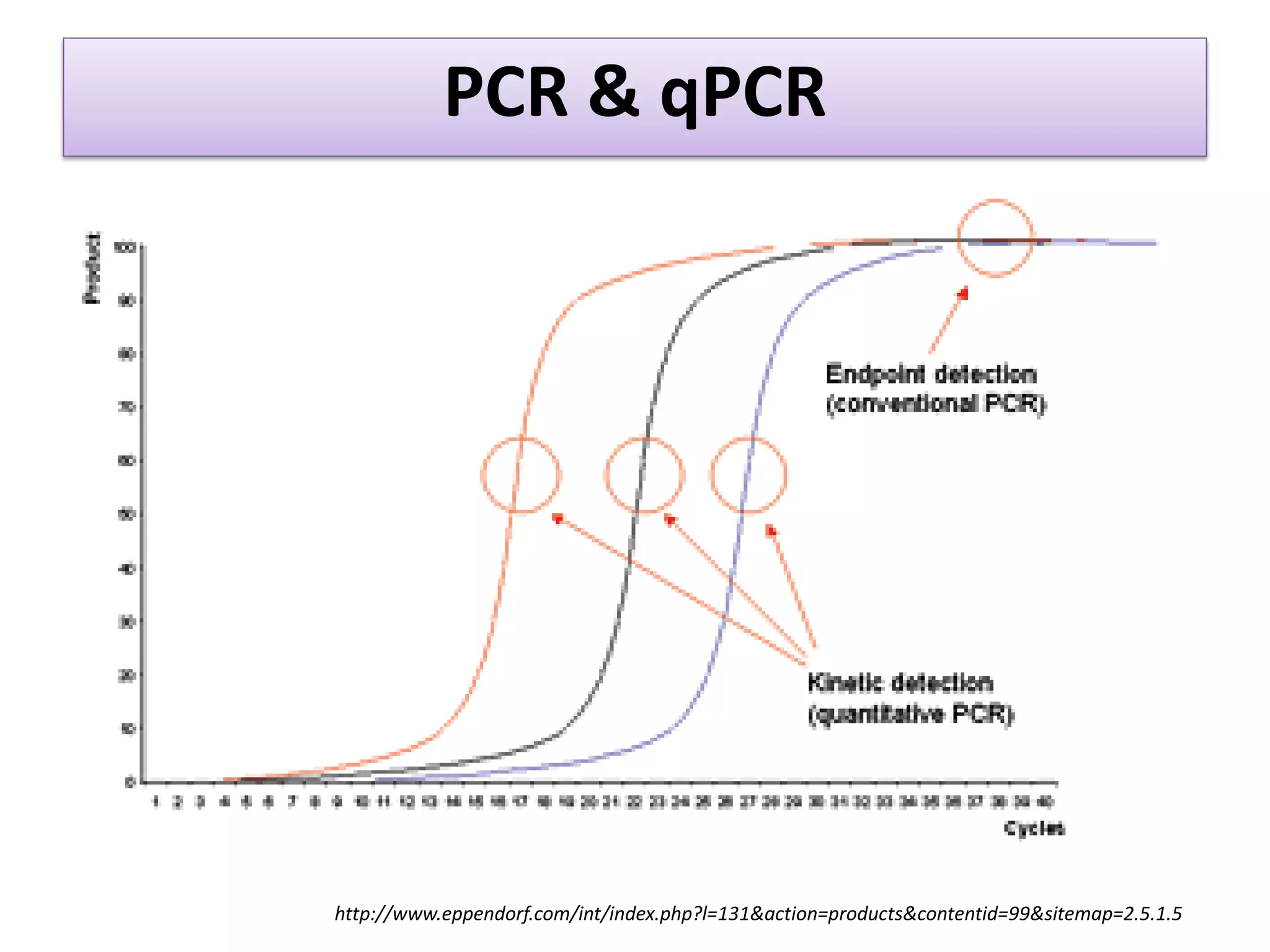
- Endpoint detection 
- realtime detection
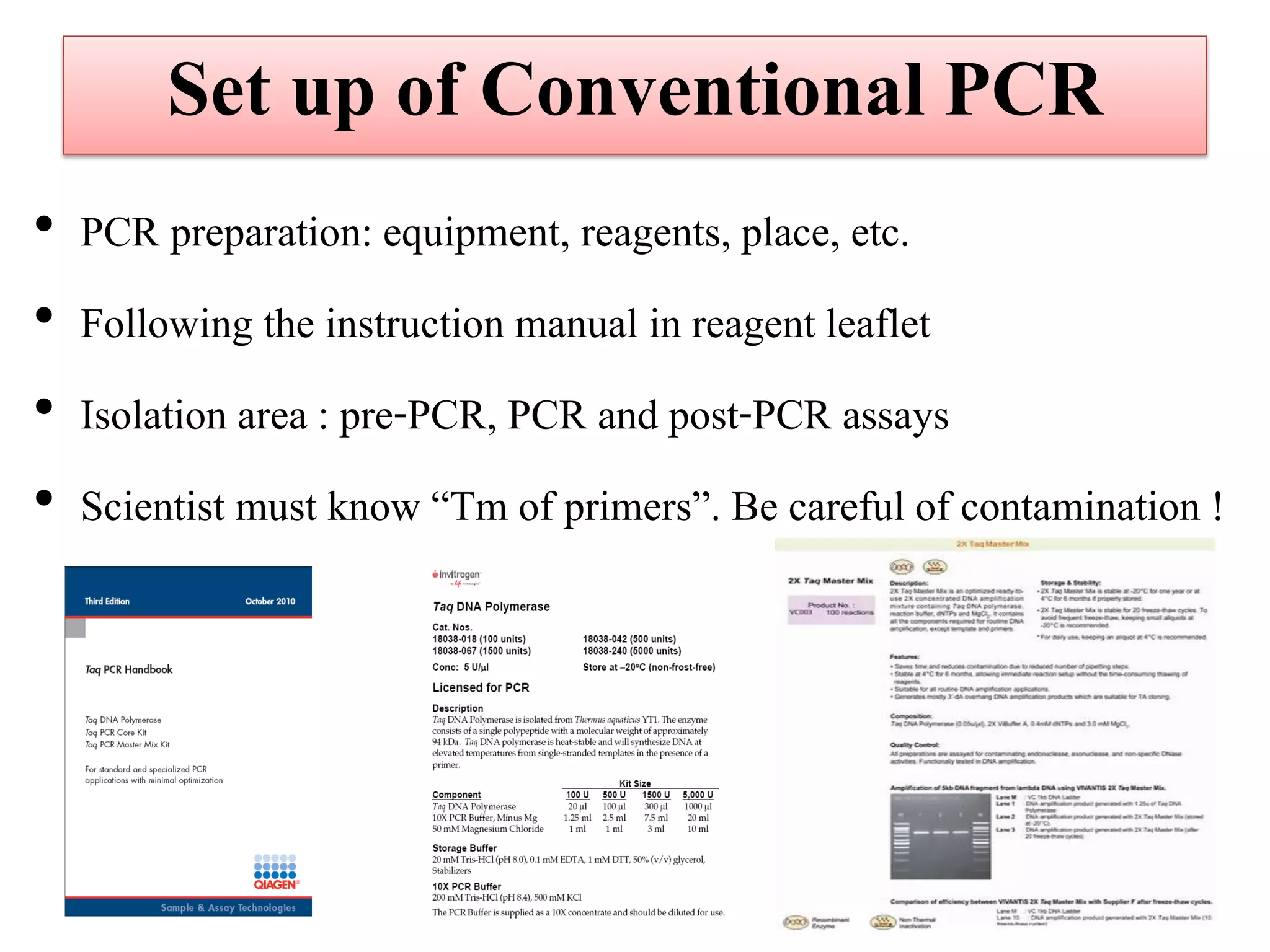
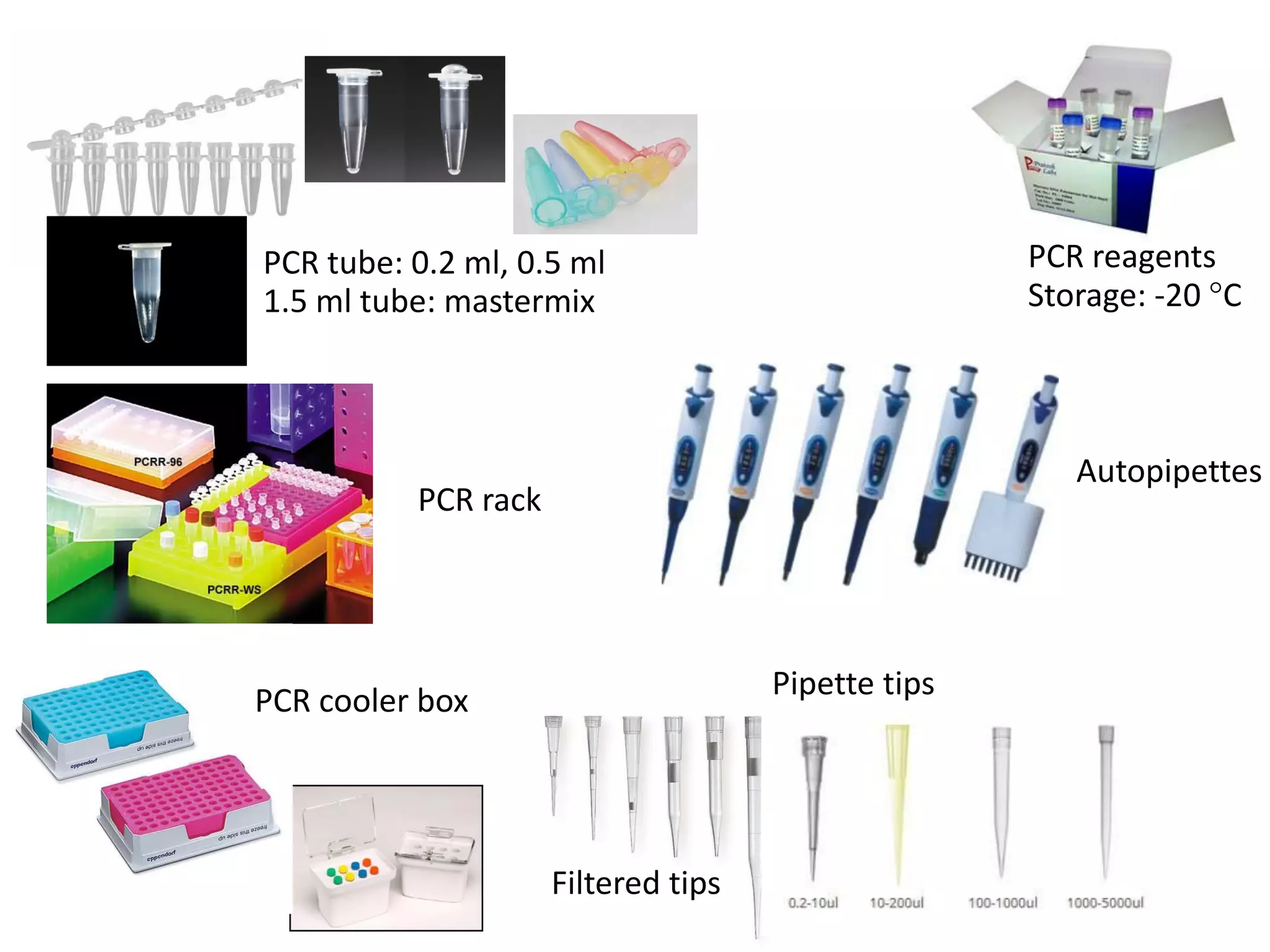
•PCR preparation: equipment, reagents, place, etc. 
•Following the instruction manual in reagent leaflet 
•Isolation area : pre-PCR, PCR and post-PCR assays 
•Scientist must know “Tm of primers”. Be careful of contamination ! 
Set up of Conventional PCR
PCR tube: 0.2 ml, 0.5 ml 1.5 ml tube: mastermix 
PCR rack 
PCR reagents 
Storage: -20 C 
PCR cooler box 
Pipette tips 
Autopipettes 
Filtered tips
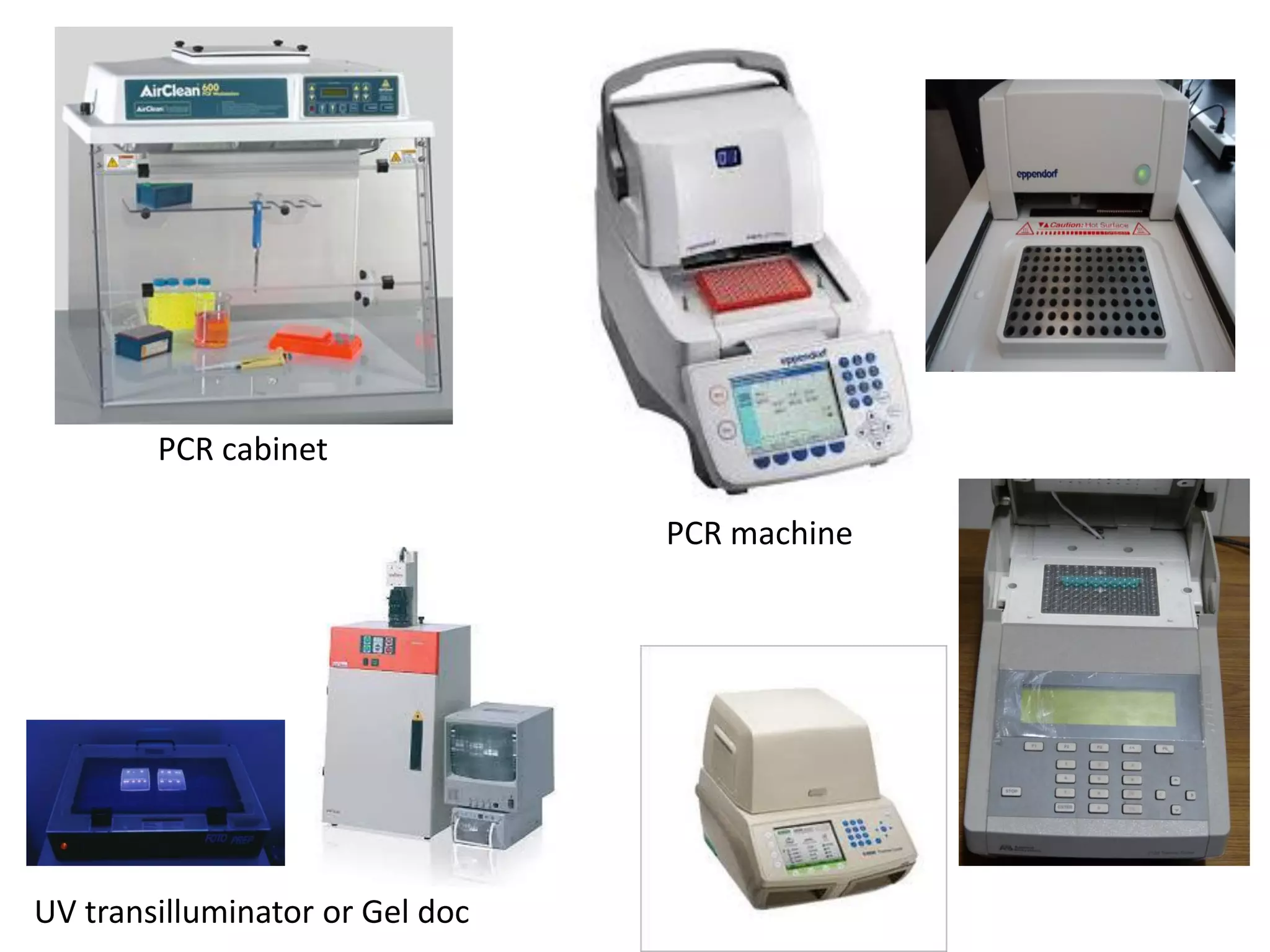
PCR cabinet 
PCR machine 
UV transilluminator or Gel doc
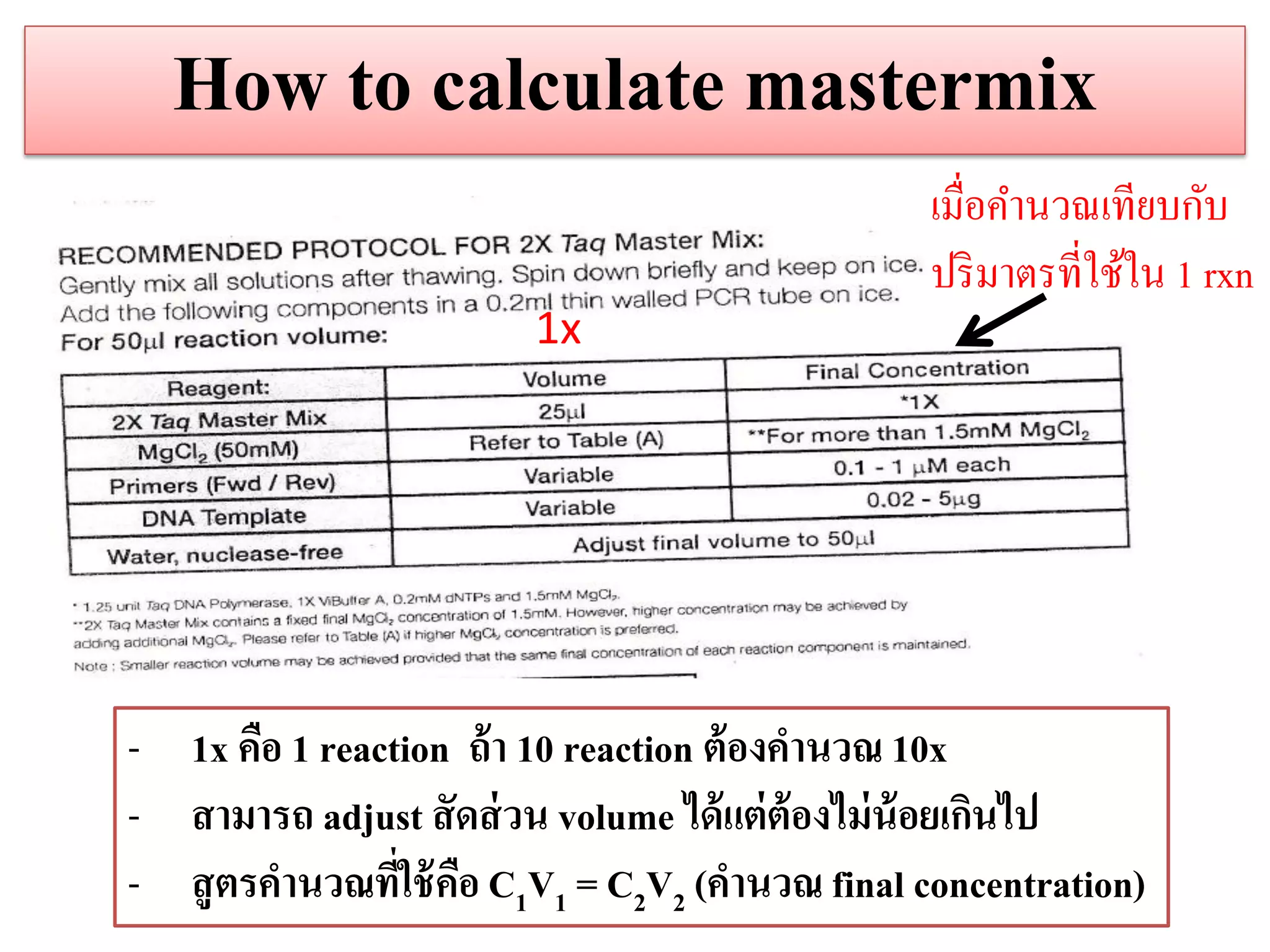
How to calculate mastermix 
1x 
เมื่อคานวณเทียบกับ 
ปริมาตรที่ใช้ใน 1 rxn 
-1x คือ 1 reaction ถ้ำ 10 reaction ต้องคำนวณ 10x 
-สำมำรถ adjust สัดส่วน volume ได้แต่ต้องไม่น้อยเกินไป 
-สูตรคำนวณที่ใช้คือ C1V1 = C2V2 (คำนวณ final concentration)
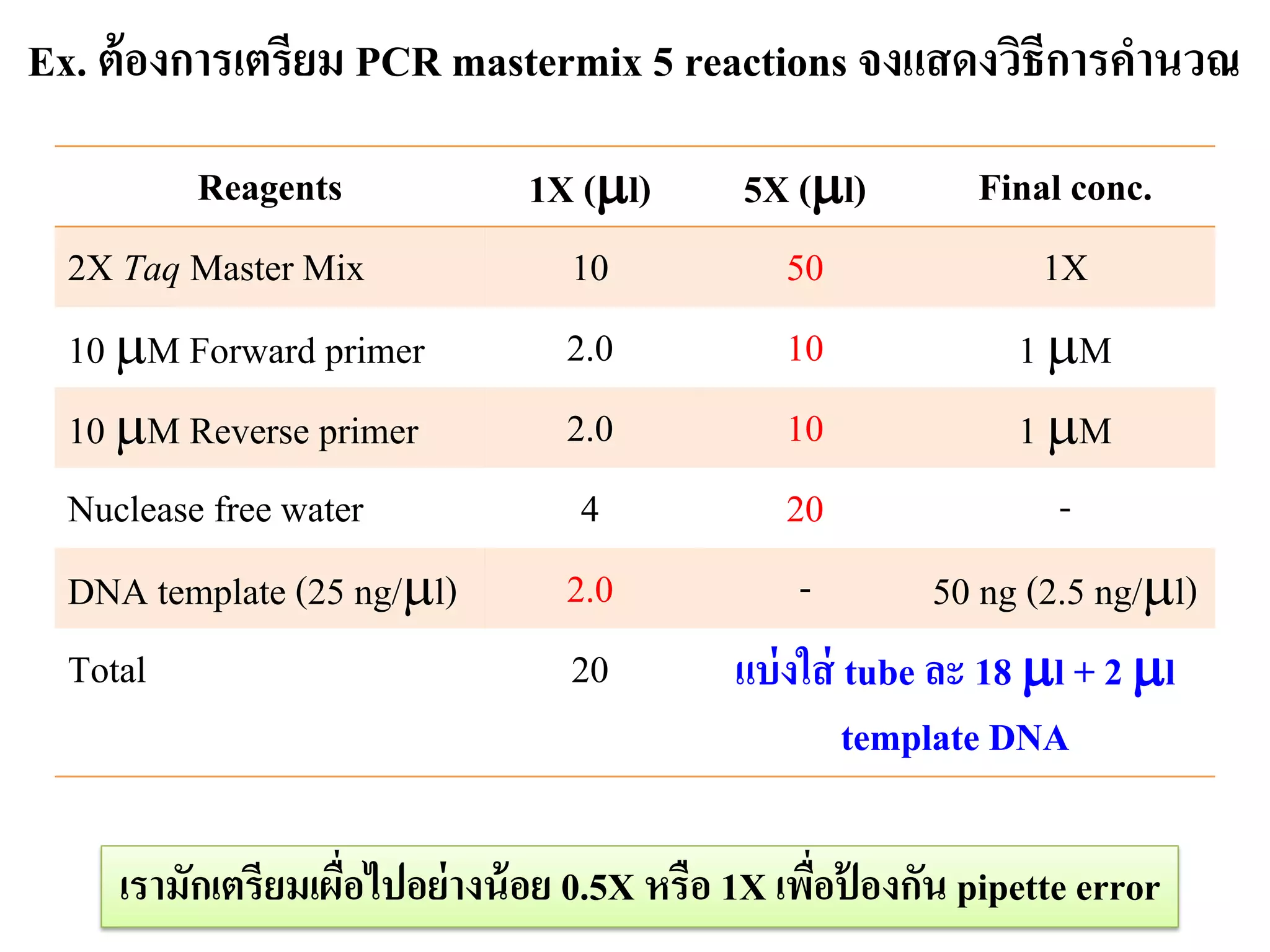
Ex. ต้องกำรเตรียม PCR mastermix 5 reactions จงแสดงวิธีกำรคำนวณ 
เรำมักเตรียมเผื่อไปอย่ำงน้อย 0.5X หรือ 1X เพื่อป้องกัน pipette error 
Reagents 
1X (l) 
5X (l) 
Final conc. 
2X Taq Master Mix 
10 
50 
1X 
10 M Forward primer 
2.0 
10 
1 M 
10 M Reverse primer 
2.0 
10 
1 M 
Nuclease free water 
4 
20 
- 
DNA template (25 ng/l) 
2.0 
- 
50 ng (2.5 ng/l) 
Total 
20 
แบ่งใส่ tube ละ 18 l + 2 l template DNA
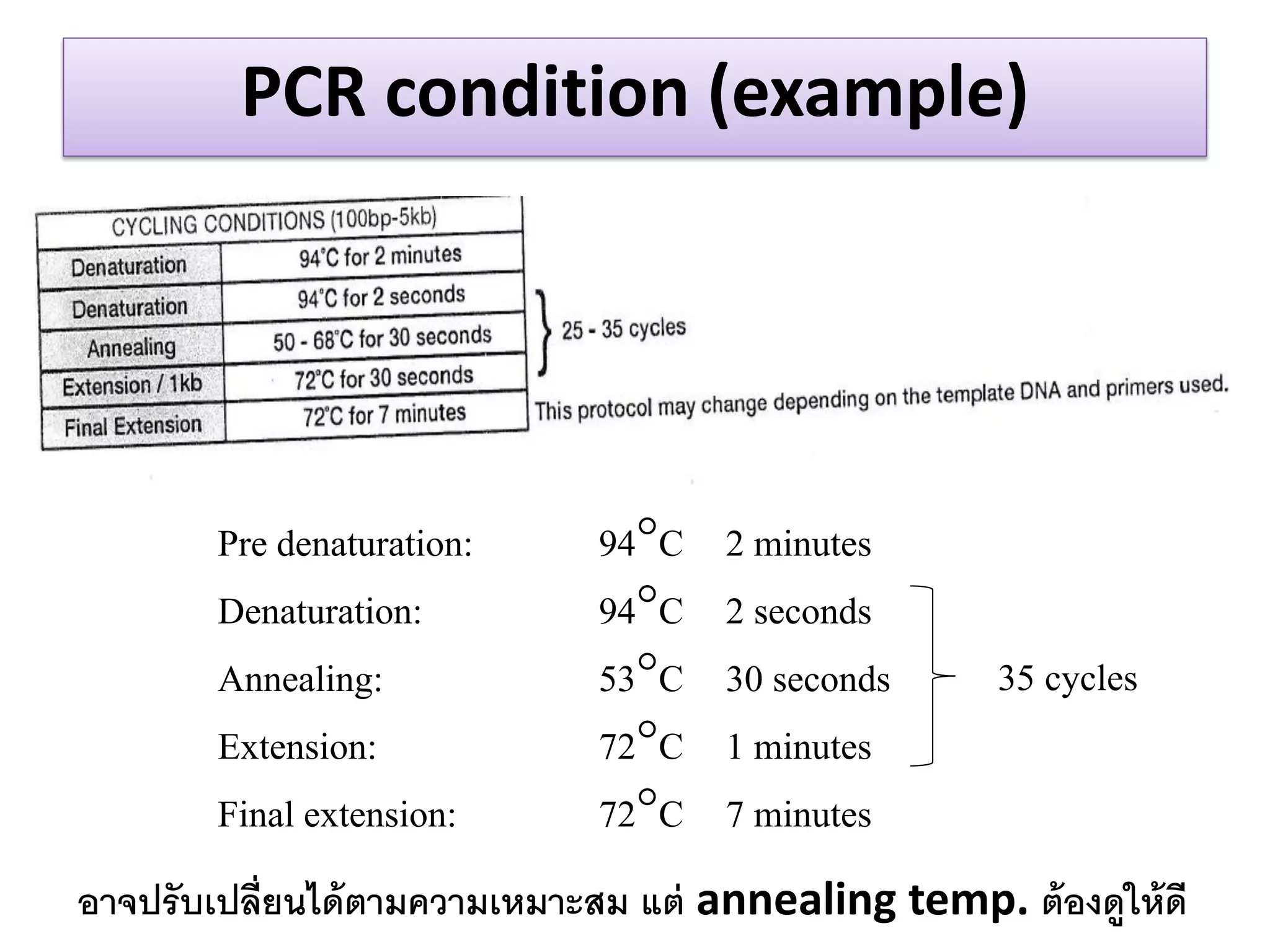
PCR condition (example) 
Pre denaturation: 94C 2 minutes 
Denaturation: 94C 2 seconds 
Annealing: 53C 30 seconds 
Extension: 72C 1 minutes 
Final extension: 72C 7 minutes 
35 cycles 
อาจปรับเปลี่ยนได้ตามความเหมาะสม แต่ annealing temp. ต้องดูให้ดี
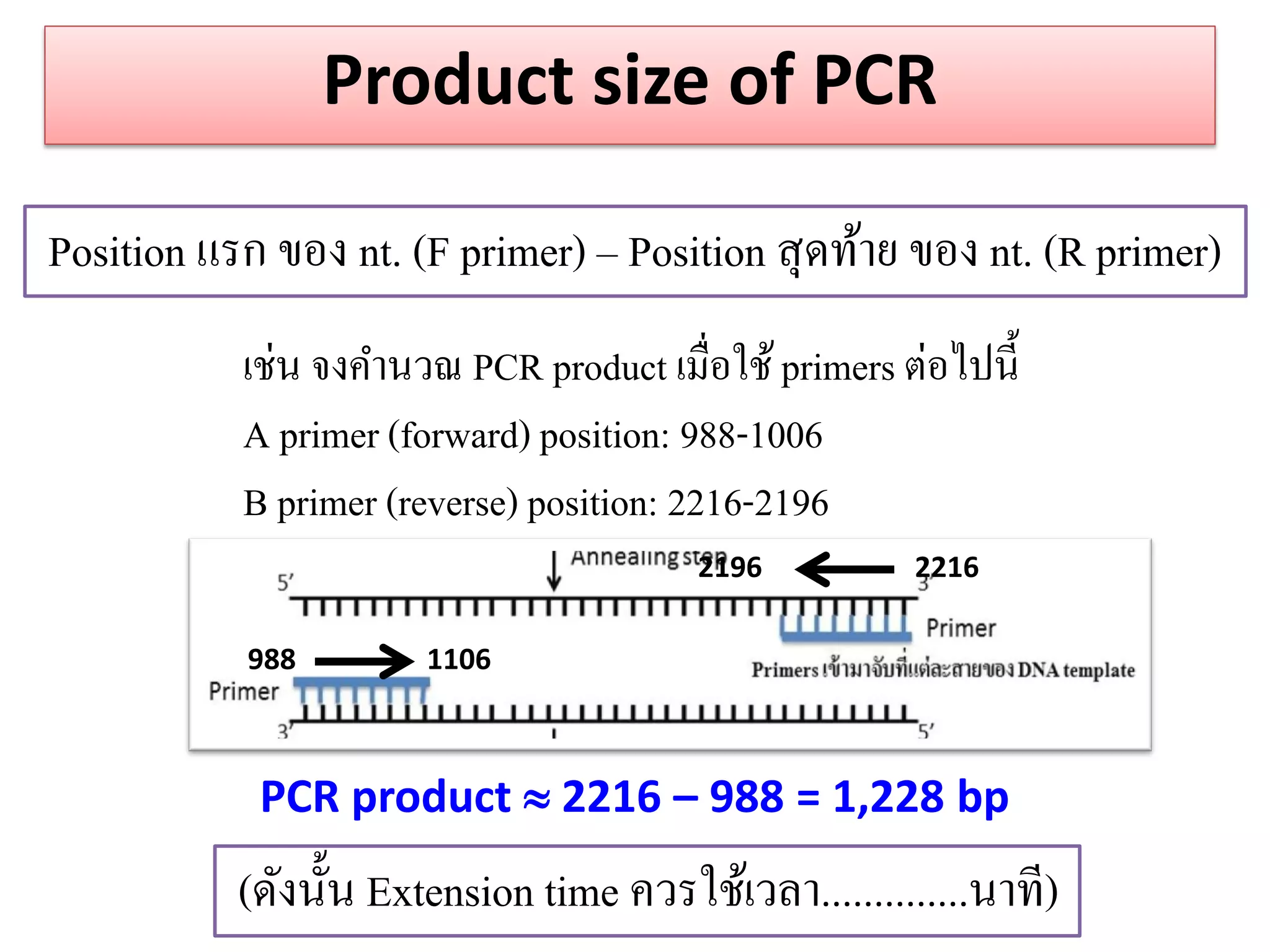
Product size of PCR 
Position แรก ของ nt. (F primer) – Position สุดท้าย ของ nt. (R primer) 
เช่น จงคานวณ PCR product เมื่อใช้ primers ต่อไปนี้ A primer (forward) position: 988-1006 B primer (reverse) position: 2216-2196 
988 1106 
2196 2216 
PCR product  2216 – 988 = 1,228 bp 
(ดังนั้น Extension time ควรใช้เวลา..............นาที)
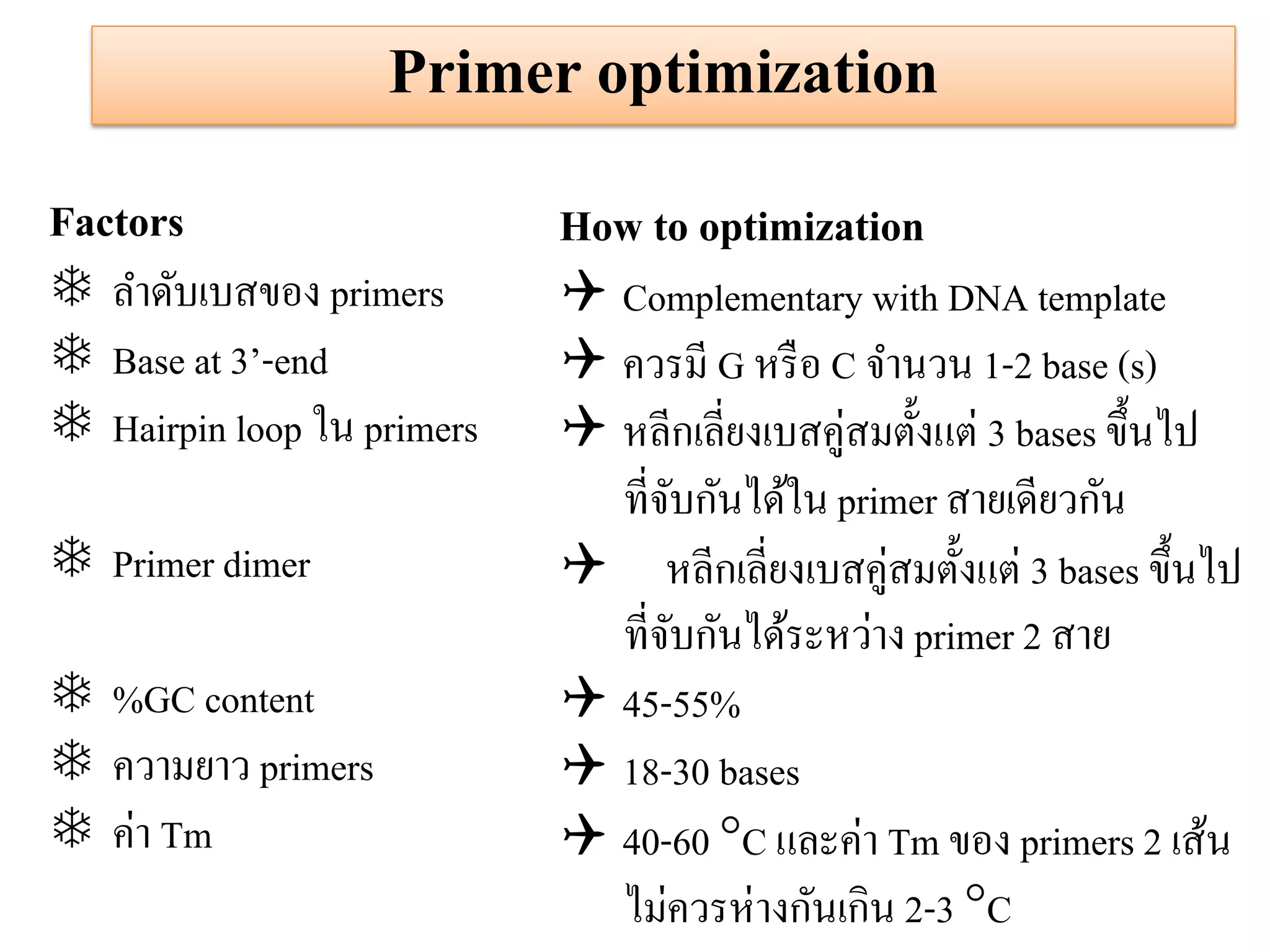
Primer optimization 
Factors 
ลาดับเบสของ primers 
Base at 3’-end 
Hairpin loop ใน primers 
Primer dimer 
%GC content 
ความยาว primers 
ค่า Tm 
How to optimization 
Complementary with DNA template 
ควรมี G หรือ C จานวน 1-2 base (s) 
หลีกเลี่ยงเบสคู่สมตั้งแต่ 3 bases ขึ้นไป ที่จับกันได้ใน primer สายเดียวกัน หลีกเลี่ยงเบสคู่สมตั้งแต่ 3 bases ขึ้นไป ที่จับกันได้ระหว่าง primer 2 สาย 
45-55% 
18-30 bases 
40-60 C และค่า Tm ของ primers 2 เส้น ไม่ควรห่างกันเกิน 2-3 C
Optimization of thermal cycle condition 
Annealing temperature: ต่ากว่า Tm of primer  5 C 
Cycles of PCR :  25-35 cycles 
Optimum [Mg2+] = 1.5 – 2.0 mM 
การเพิ่ม-ลด มีผลต่อการเพิ่มปริมาณ product 
pH 8.3 Total volume: 10-100 l 
Tm= 2 x (no. of [A+T]) + 4 x (no. of [G+C]) 
Optimization of Mg2+ concentration 
Optimization of pH in reaction
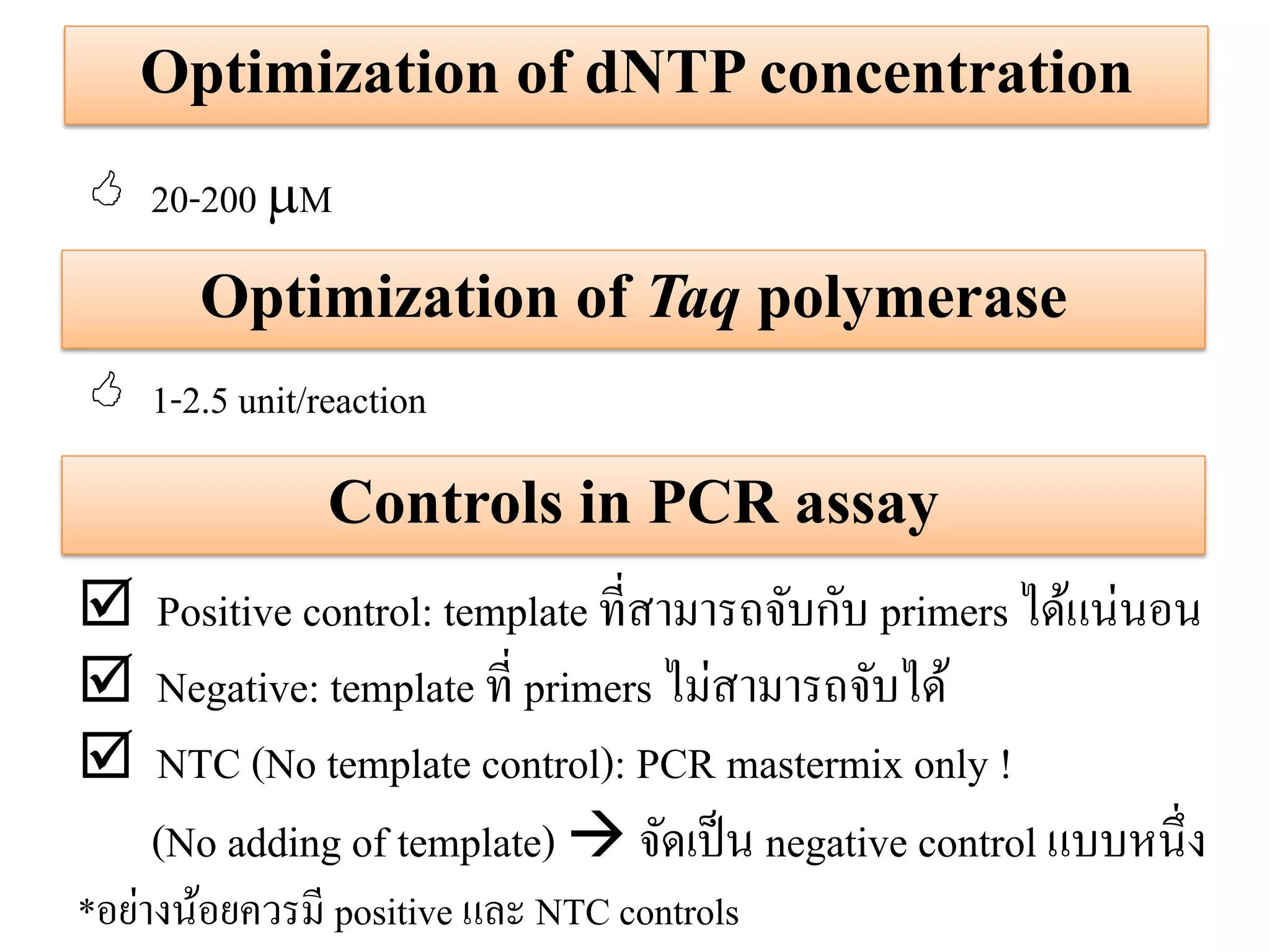
Optimization of dNTP concentration 
Optimization of Taq polymerase 
20-200 M 
1-2.5 unit/reaction 
Controls in PCR assay 
Positive control: template ที่สามารถจับกับ primers ได้แน่นอน 
Negative: template ที่ primers ไม่สามารถจับได้ 
NTC (No template control): PCR mastermix only ! (No adding of template)  จัดเป็น negative control แบบหนึ่ง *อย่างน้อยควรมี positive และ NTC controls
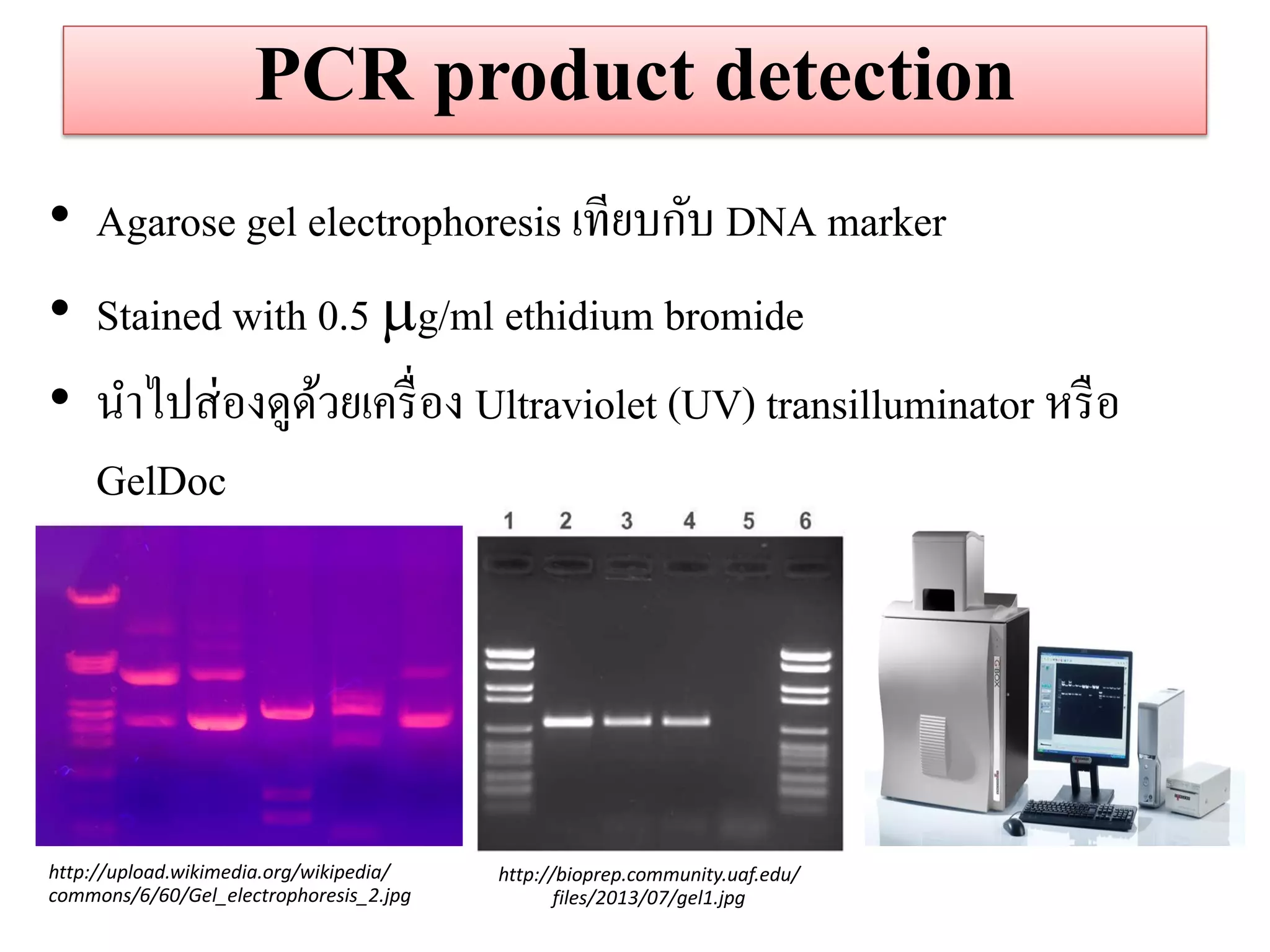
PCR product detection 
•Agarose gel electrophoresis เทียบกับ DNA marker 
•Stained with 0.5 g/ml ethidium bromide •นาไปส่องดูด้วยเครื่อง Ultraviolet (UV) transilluminator หรือ GelDoc 
http://upload.wikimedia.org/wikipedia/ 
commons/6/60/Gel_electrophoresis_2.jpg 
http://bioprep.community.uaf.edu/ files/2013/07/gel1.jpg
•To separate DNA fragment or PCR product 
•Agarose gel electrophoresis 
•Polyacrylamide gel electrophoresis 
Electrophoresis of DNA or PCR product
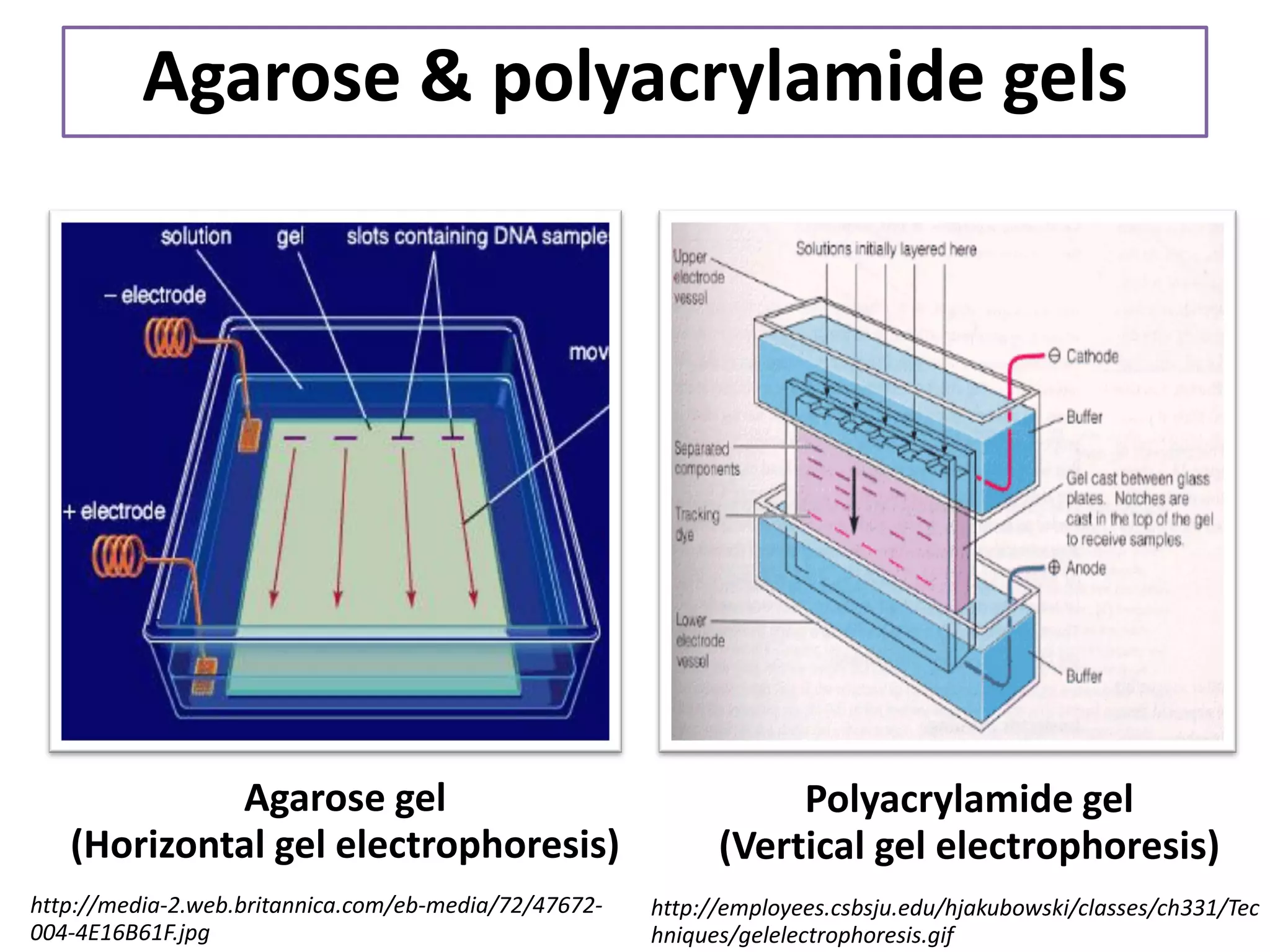
Agarose & polyacrylamide gels 
Polyacrylamide gel (Vertical gel electrophoresis) 
http://employees.csbsju.edu/hjakubowski/classes/ch331/Techniques/gelelectrophoresis.gif 
Agarose gel (Horizontal gel electrophoresis) 
http://media-2.web.britannica.com/eb-media/72/47672- 004-4E16B61F.jpg
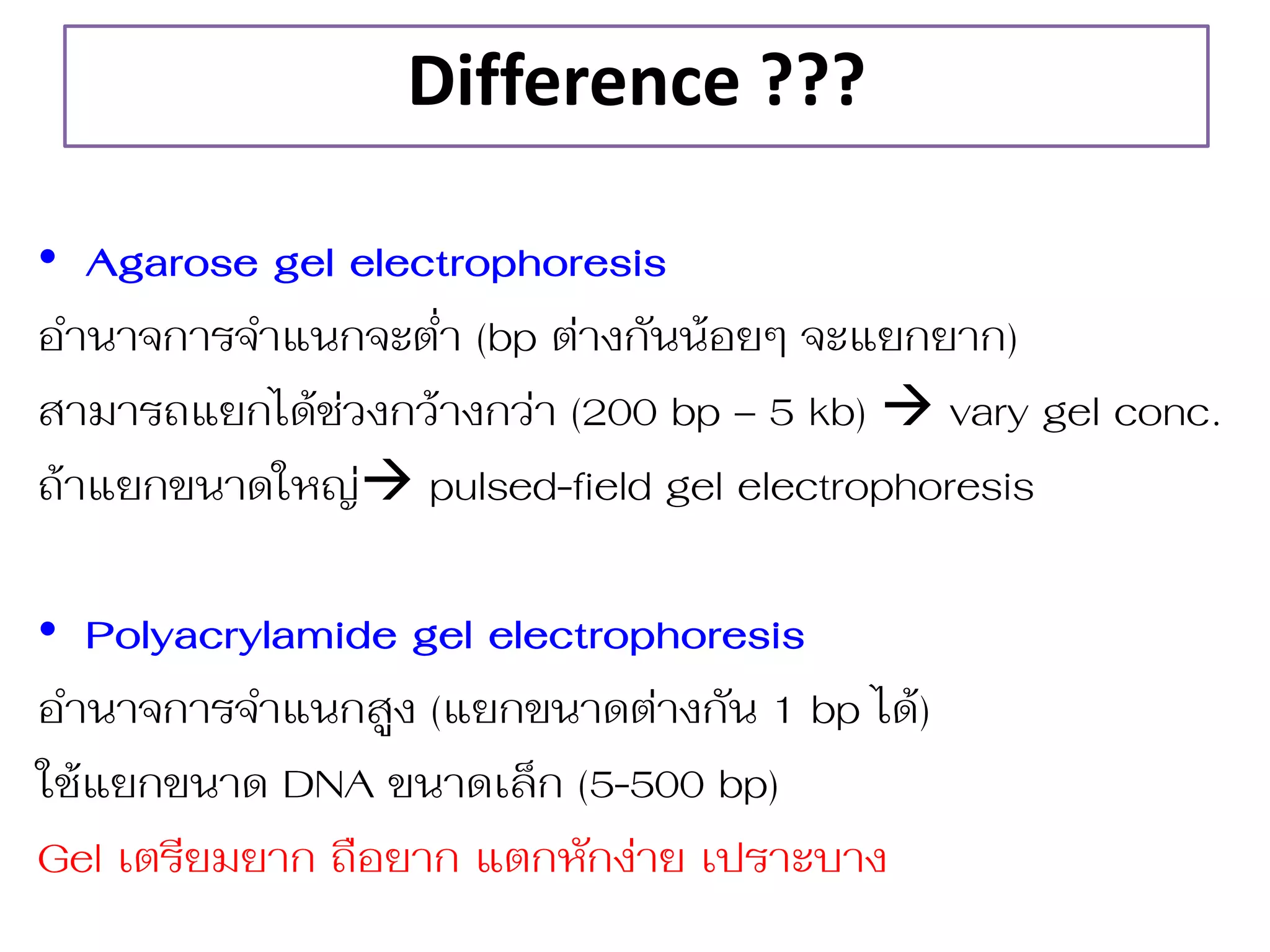
Difference ??? 
•Agarose gel electrophoresis 
อ่ำนำจกำรจ่ำแนกจะต่ำ (bp ต่ำงกันน้อยๆ จะแยกยำก) 
สำมำรถแยกได้ช่วงกว้ำงกว่ำ (200 bp – 5 kb)  vary gel conc. 
ถ้ำแยกขนำดใหญ่ pulsed-field gel electrophoresis 
•Polyacrylamide gel electrophoresis 
อ่ำนำจกำรจ่ำแนกสูง (แยกขนำดต่ำงกัน 1 bp ได้) 
ใช้แยกขนำด DNA ขนำดเล็ก (5-500 bp) 
Gel เตรียมยำก ถือยำก แตกหักง่ำย เปรำะบำง
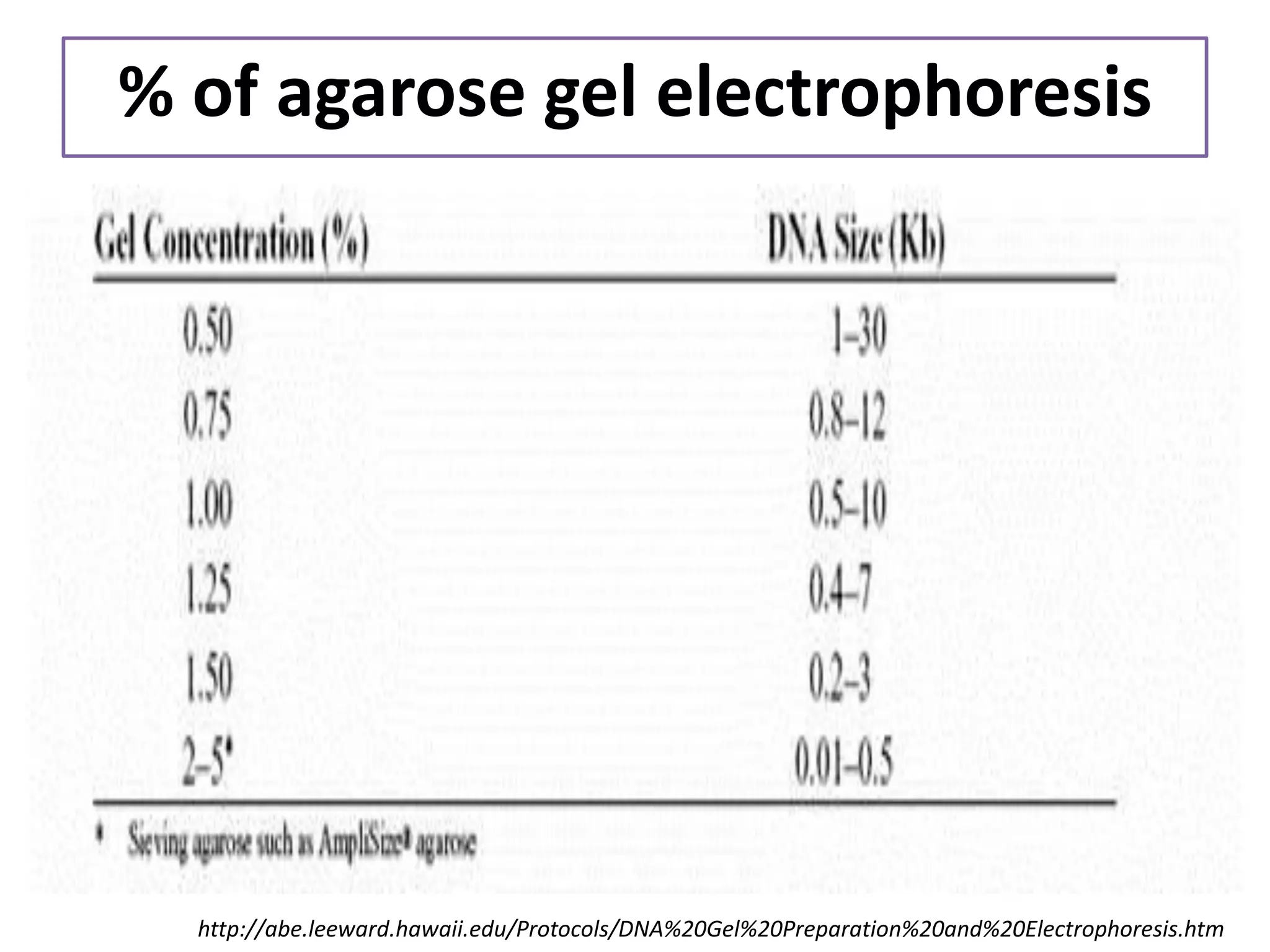
% of agarose gel electrophoresis 
http://abe.leeward.hawaii.edu/Protocols/DNA%20Gel%20Preparation%20and%20Electrophoresis.htm
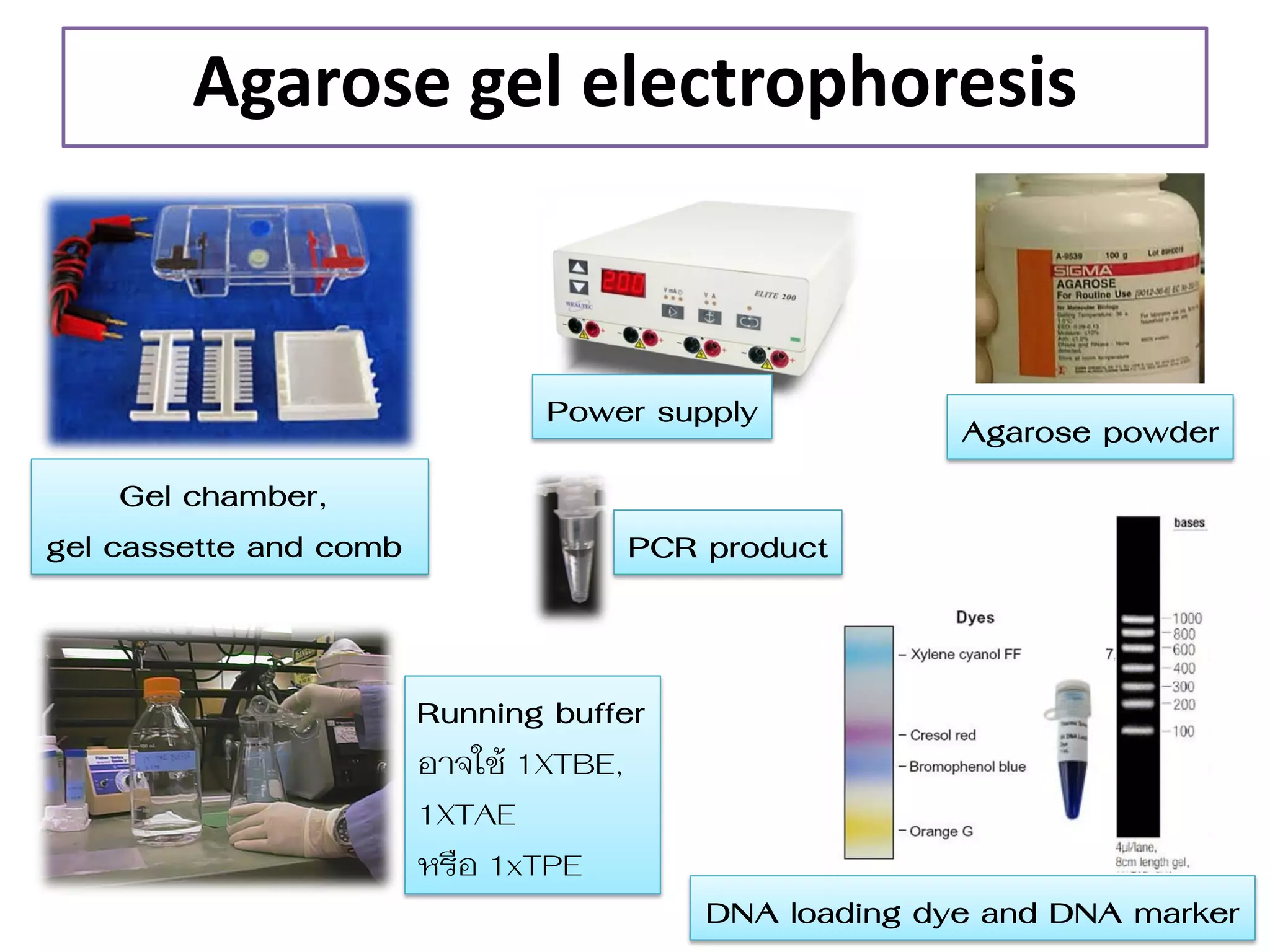
Agarose gel electrophoresis 
Running buffer 
อำจใช้ 1XTBE, 
1XTAE 
หรือ 1xTPE 
Gel chamber, gel cassette and comb 
Power supply 
Agarose powder 
PCR product 
DNA loading dye and DNA marker
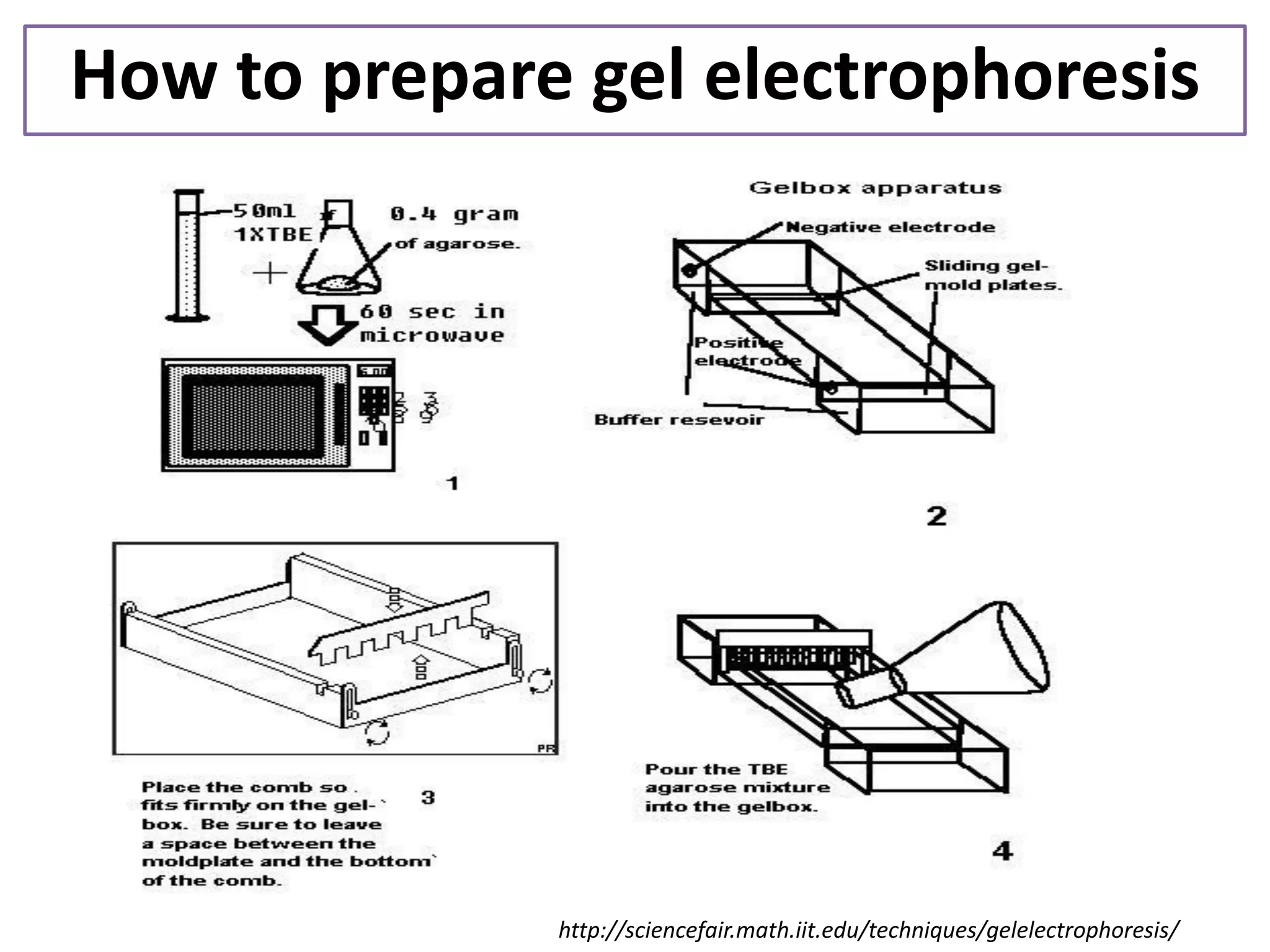
How to prepare gel electrophoresis 
http://sciencefair.math.iit.edu/techniques/gelelectrophoresis/
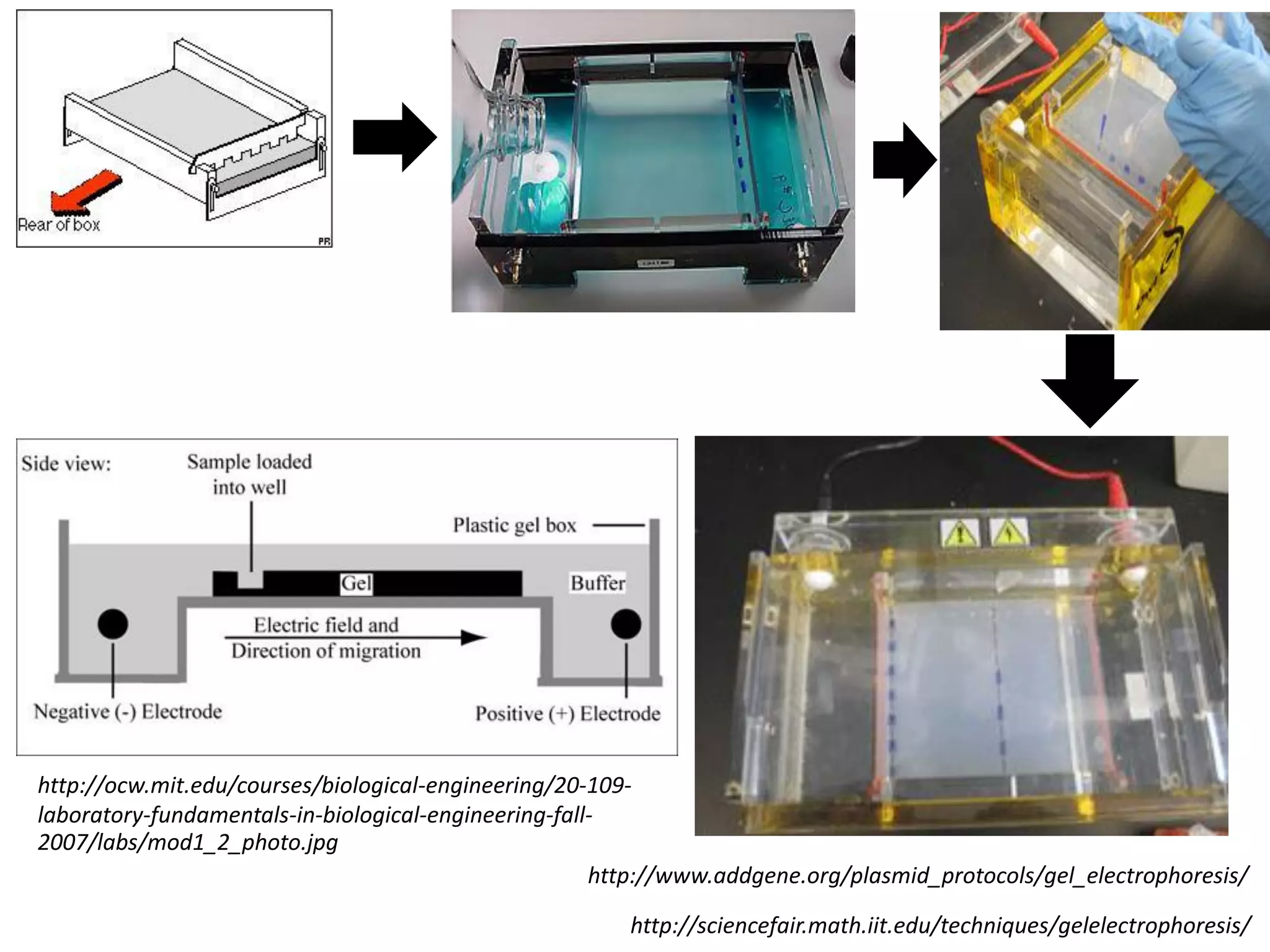
http://www.addgene.org/plasmid_protocols/gel_electrophoresis/ 
http://sciencefair.math.iit.edu/techniques/gelelectrophoresis/ 
http://ocw.mit.edu/courses/biological-engineering/20-109- laboratory-fundamentals-in-biological-engineering-fall- 2007/labs/mod1_2_photo.jpg
Gel electrophoresis 
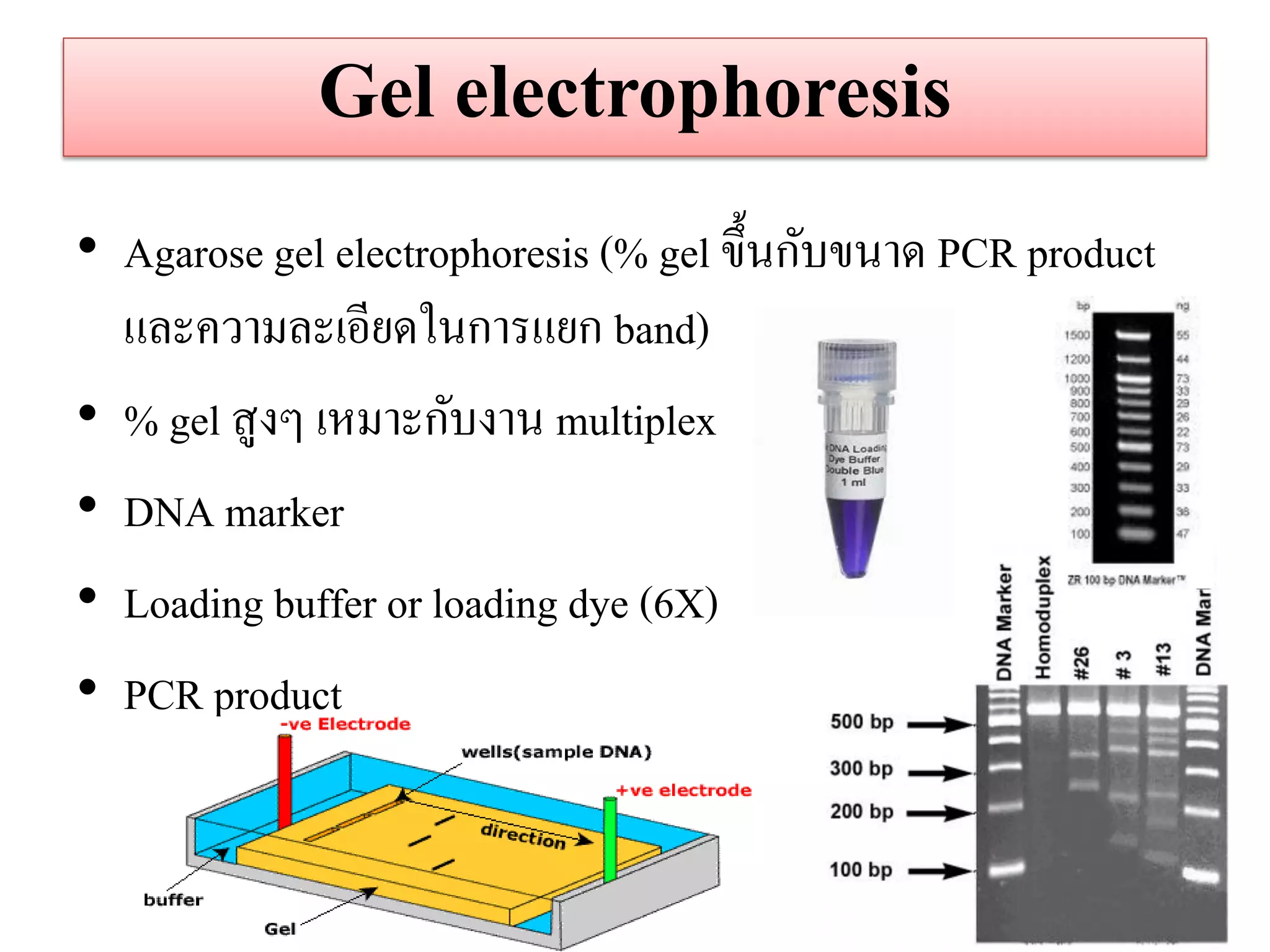
•Agarose gel electrophoresis (% gel ขึ้นกับขนาด PCR product และความละเอียดในการแยก band) 
•% gel สูงๆ เหมาะกับงาน multiplex 
•DNA marker 
•Loading buffer or loading dye (6X) 
•PCR product
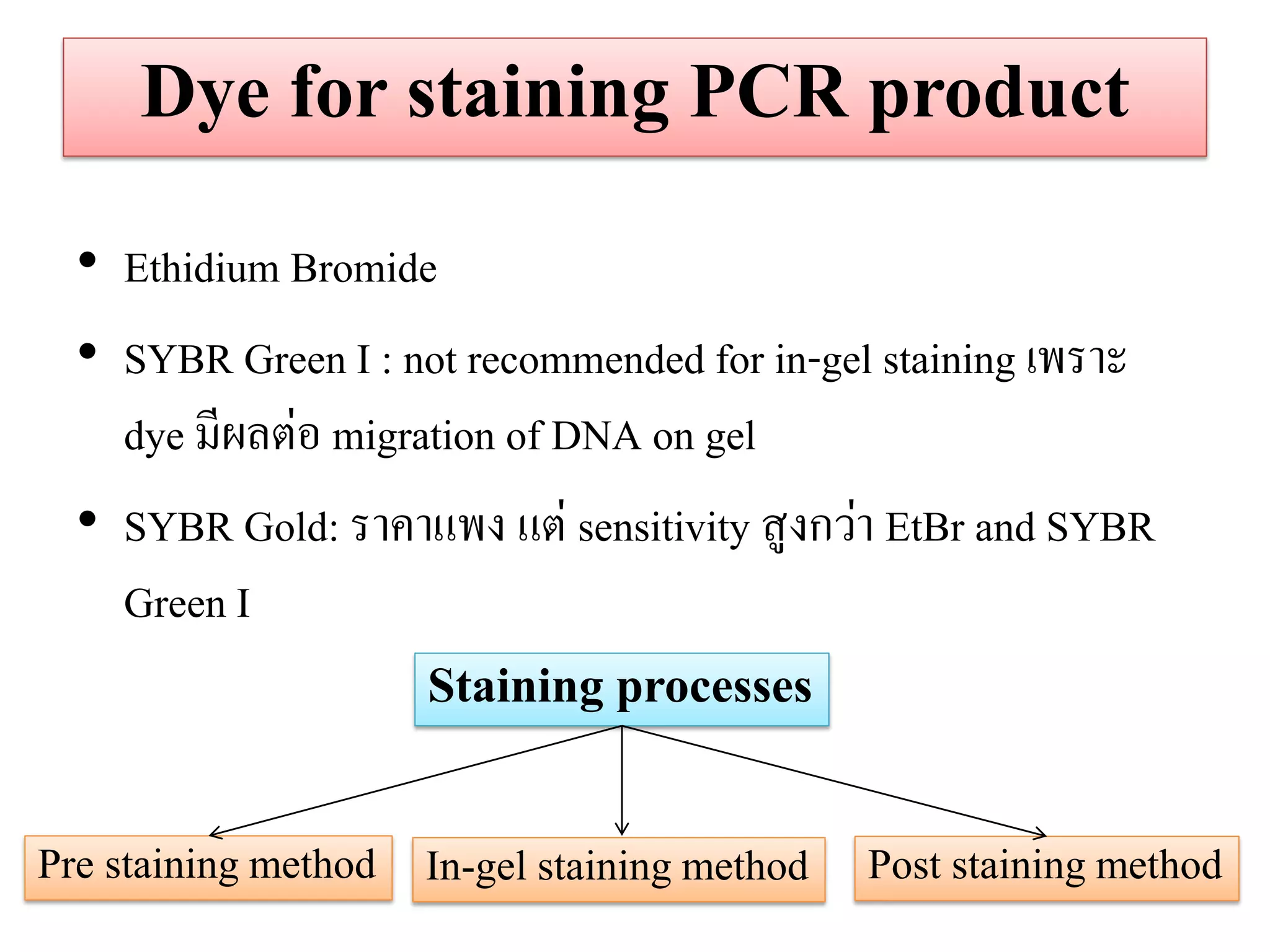
Dye for staining PCR product 
•Ethidium Bromide 
•SYBR Green I : not recommended for in-gel staining เพราะ dye มีผลต่อ migration of DNA on gel •SYBR Gold: ราคาแพง แต่ sensitivity สูงกว่า EtBr and SYBR Green I 
Staining processes 
Pre staining method 
Post staining method 
In-gel staining method
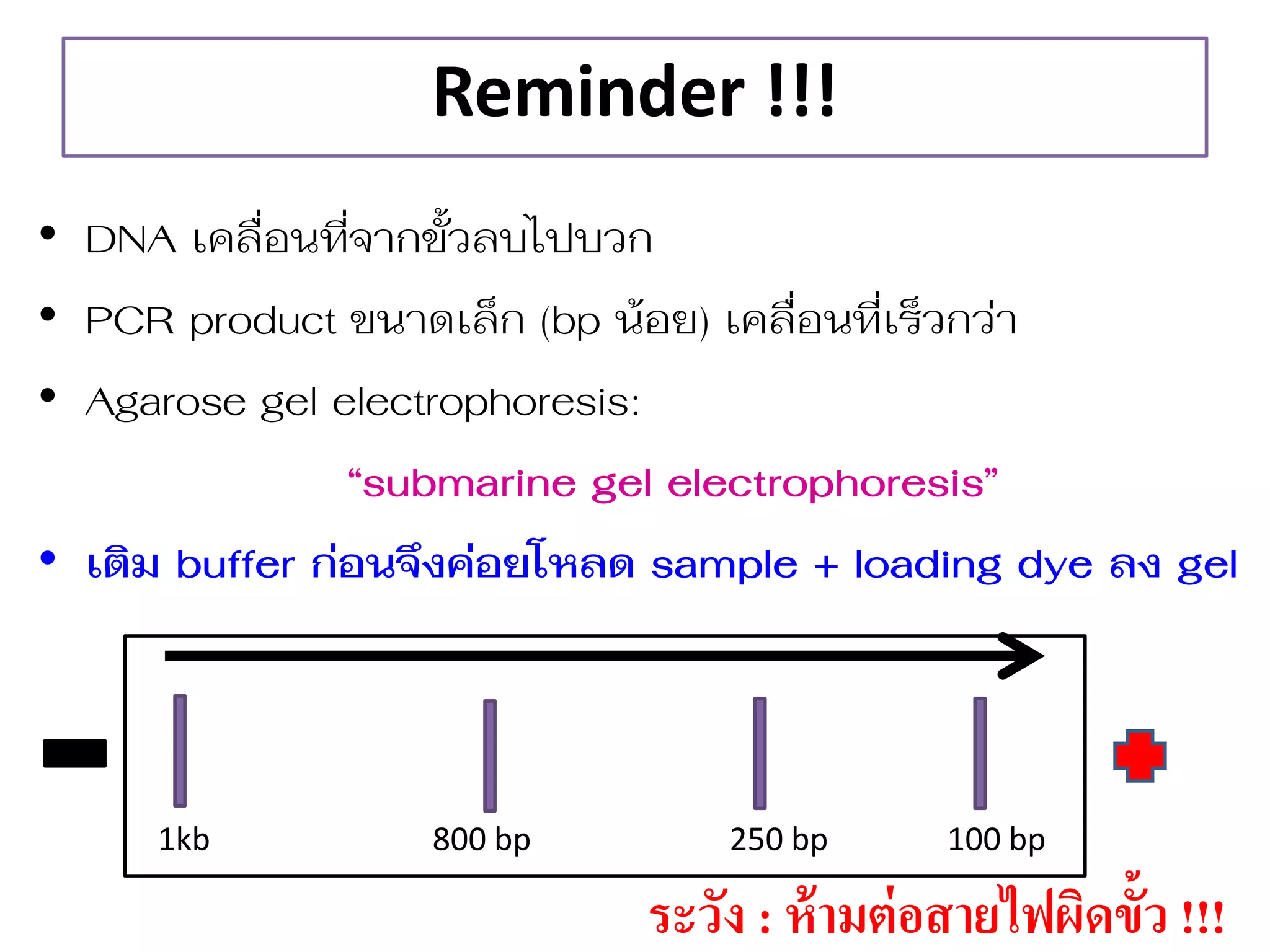
Reminder !!! 
•DNA เคลื อนที จำกขั้วลบไปบวก 
•PCR product ขนำดเล็ก (bp น้อย) เคลื อนที เร็วกว่ำ 
•Agarose gel electrophoresis: 
“submarine gel electrophoresis” 
•เติม buffer ก่อนจึงค่อยโหลด sample + loading dye ลง gel 
ระวัง : ห้ำมต่อสำยไฟผิดขั้ว !!! 
1kb 800 bp 250 bp 100 bp
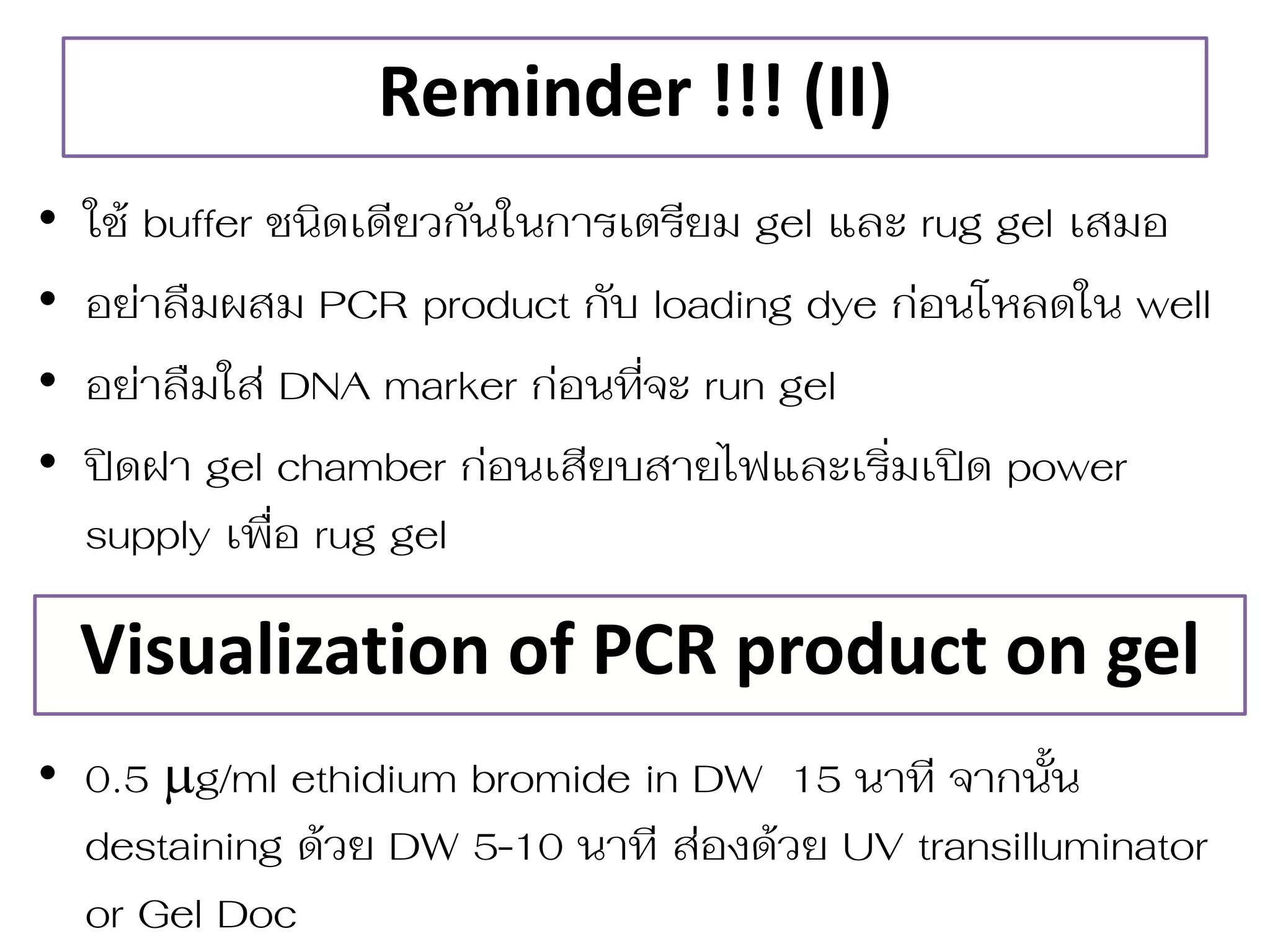
Reminder !!! (II) 
•ใช้ buffer ชนิดเดียวกันในกำรเตรียม gel และ rug gel เสมอ 
•อย่ำลืมผสม PCR product กับ loading dye ก่อนโหลดใน well 
•อย่ำลืมใส่ DNA marker ก่อนที จะ run gel 
•ปิดฝำ gel chamber ก่อนเสียบสำยไฟและเริ มเปิด power supply เพื อ rug gel 
•0.5 g/ml ethidium bromide in DW 15 นำที จำกนั้น destaining ด้วย DW 5-10 นำที ส่องด้วย UV transilluminator or Gel Doc 
Visualization of PCR product on gel
เกร็ดความรู้ 
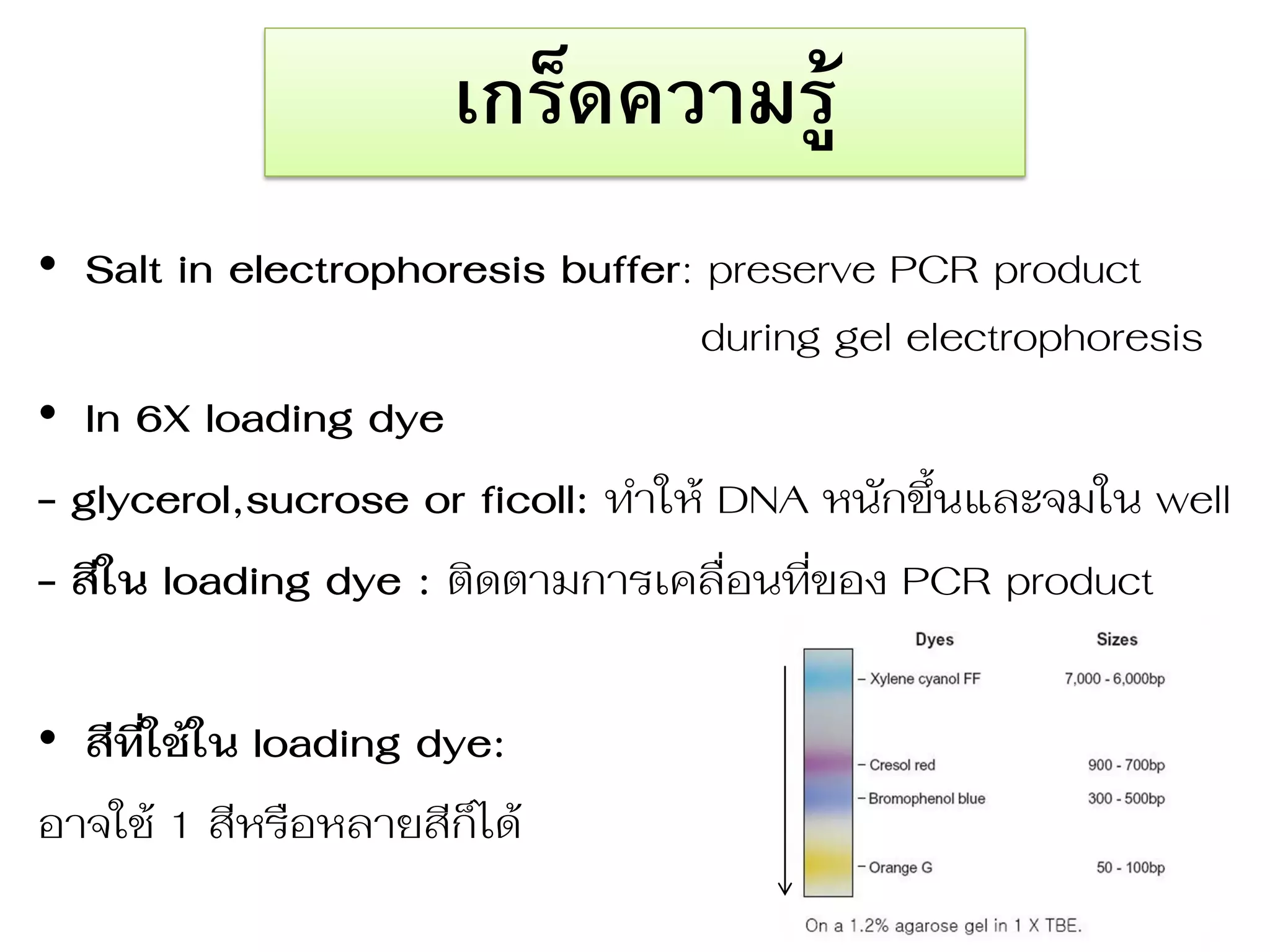
•Salt in electrophoresis buffer: preserve PCR product during gel electrophoresis 
•In 6X loading dye 
- glycerol,sucrose or ficoll: ท่ำให้ DNA หนักขึ้นและจมใน well 
- สีใน loading dye : ติดตำมกำรเคลื อนที ของ PCR product 
•สีที่ใช้ใน loading dye: 
อำจใช้ 1 สีหรือหลำยสีก็ได้
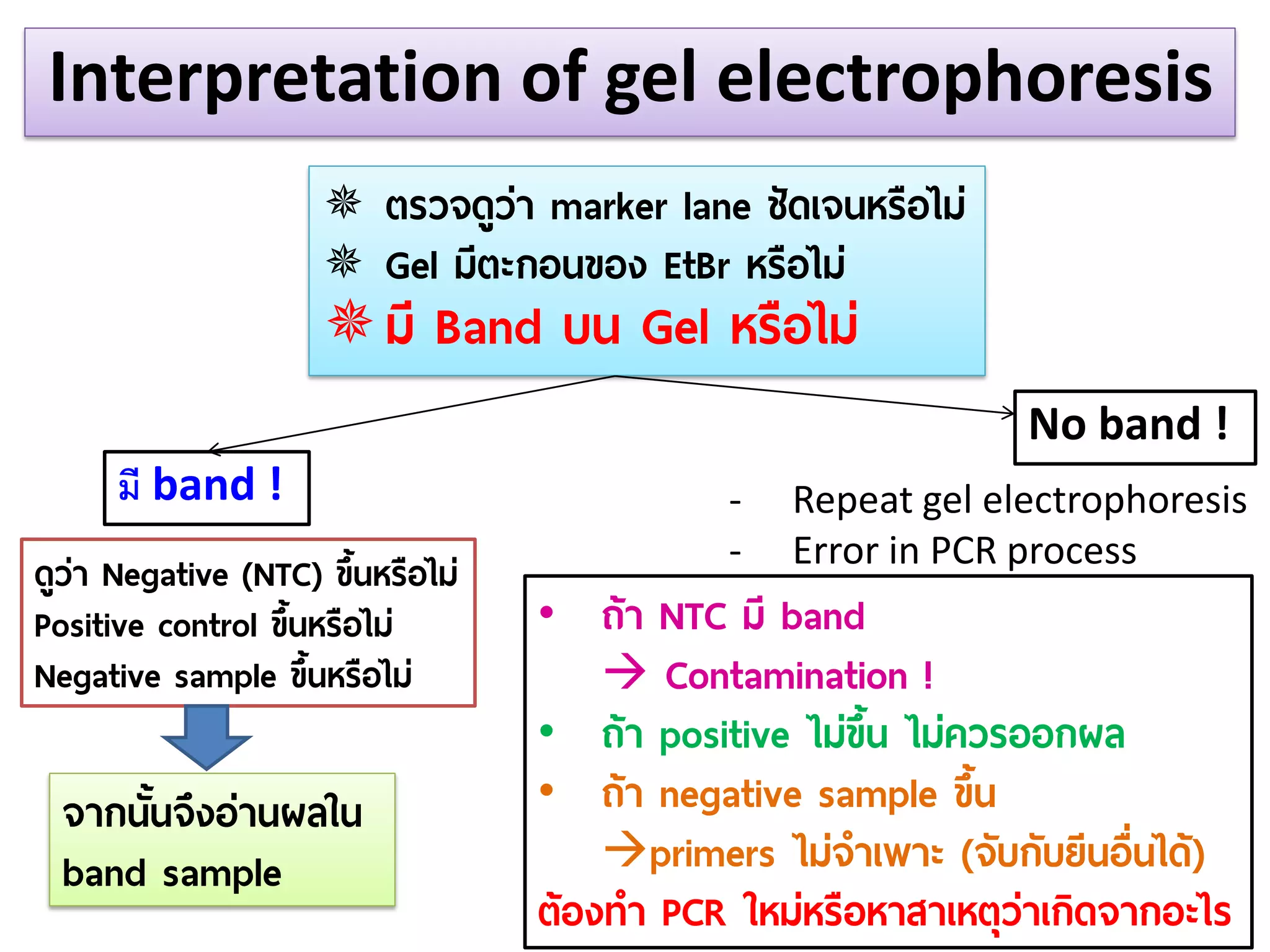
Interpretation of gel electrophoresis 
ตรวจดูว่า marker lane ชัดเจนหรือไม่ 
Gel มีตะกอนของ EtBr หรือไม่ 
มี Band บน Gel หรือไม่ 
No band ! 
-Repeat gel electrophoresis 
-Error in PCR process 
มี band ! 
ดูว่า Negative (NTC) ขึ้นหรือไม่ 
Positive control ขึ้นหรือไม่ 
Negative sample ขึ้นหรือไม่ 
จากนั้นจึงอ่านผลใน 
band sample 
•ถ้า NTC มี band  Contamination ! 
•ถ้า positive ไม่ขึ้น ไม่ควรออกผล 
•ถ้า negative sample ขึ้น primers ไม่จาเพาะ (จับกับยีนอื่นได้) ต้องทา PCR ใหม่หรือหาสาเหตุว่าเกิดจากอะไร
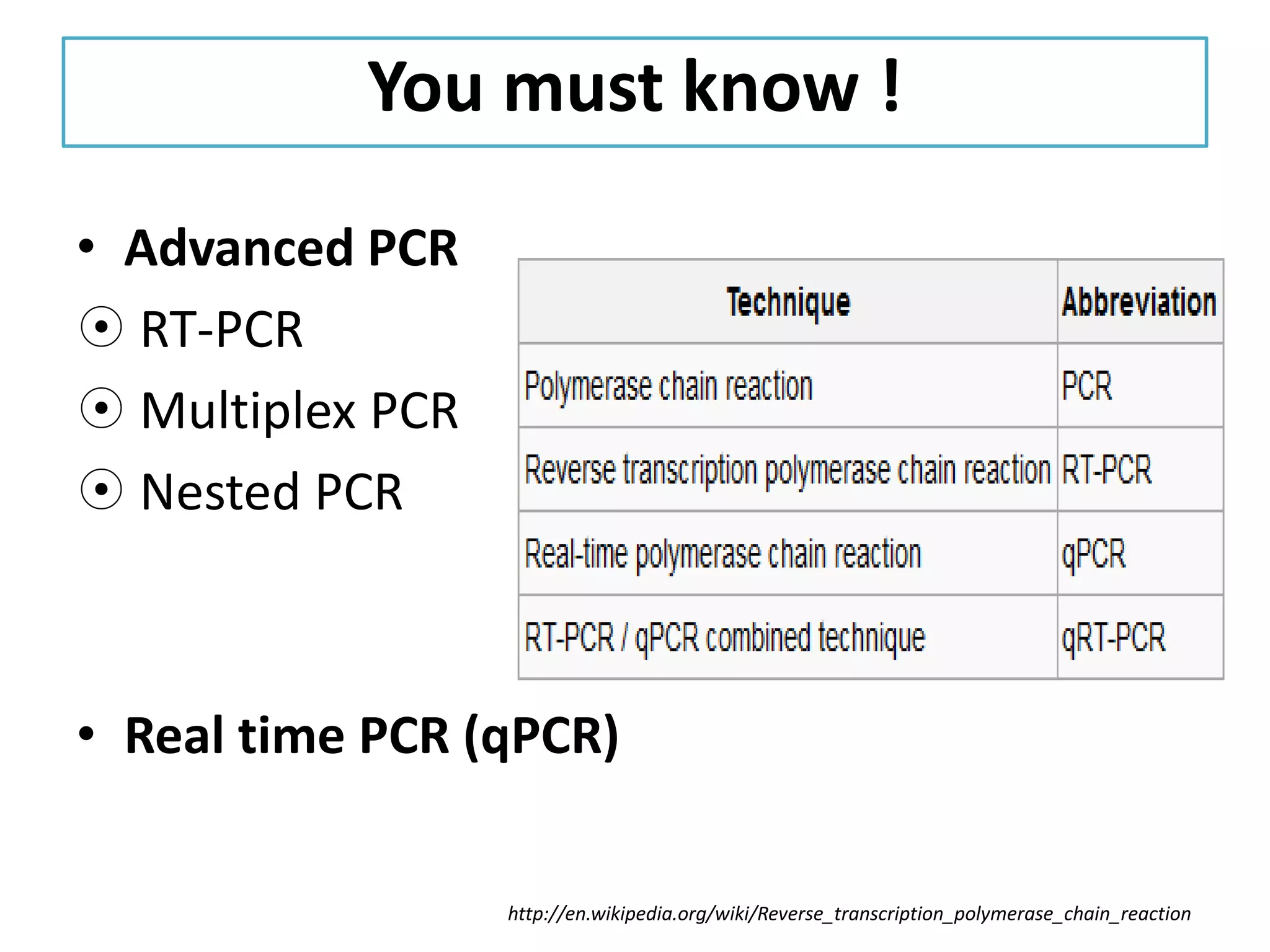
You must know ! 
•Advanced PCR 
 RT-PCR 
 Multiplex PCR 
 Nested PCR 
•Real time PCR (qPCR) 
http://en.wikipedia.org/wiki/Reverse_transcription_polymerase_chain_reaction
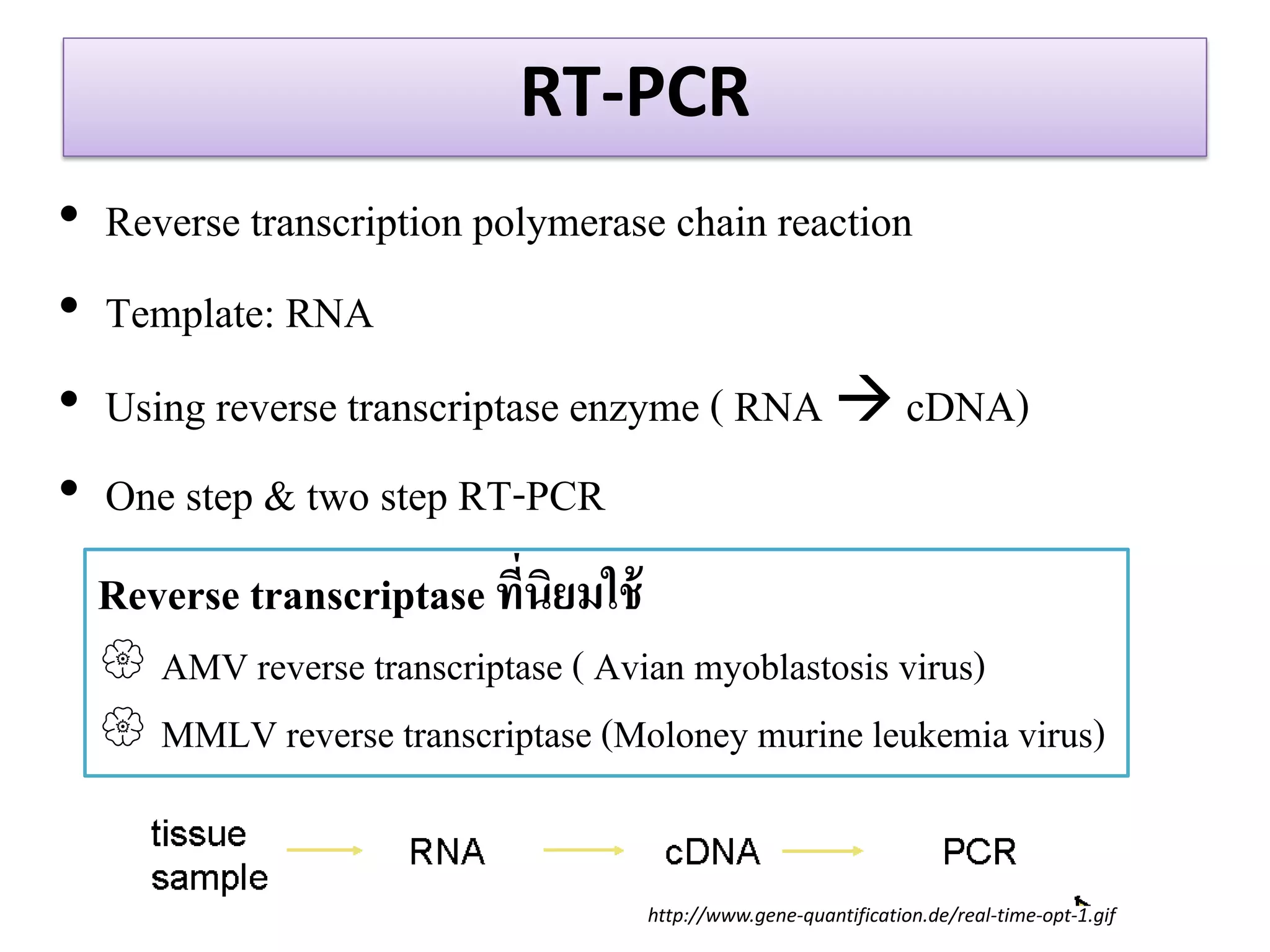
RT-PCR 
•Reverse transcription polymerase chain reaction 
•Template: RNA 
•Using reverse transcriptase enzyme ( RNA  cDNA) 
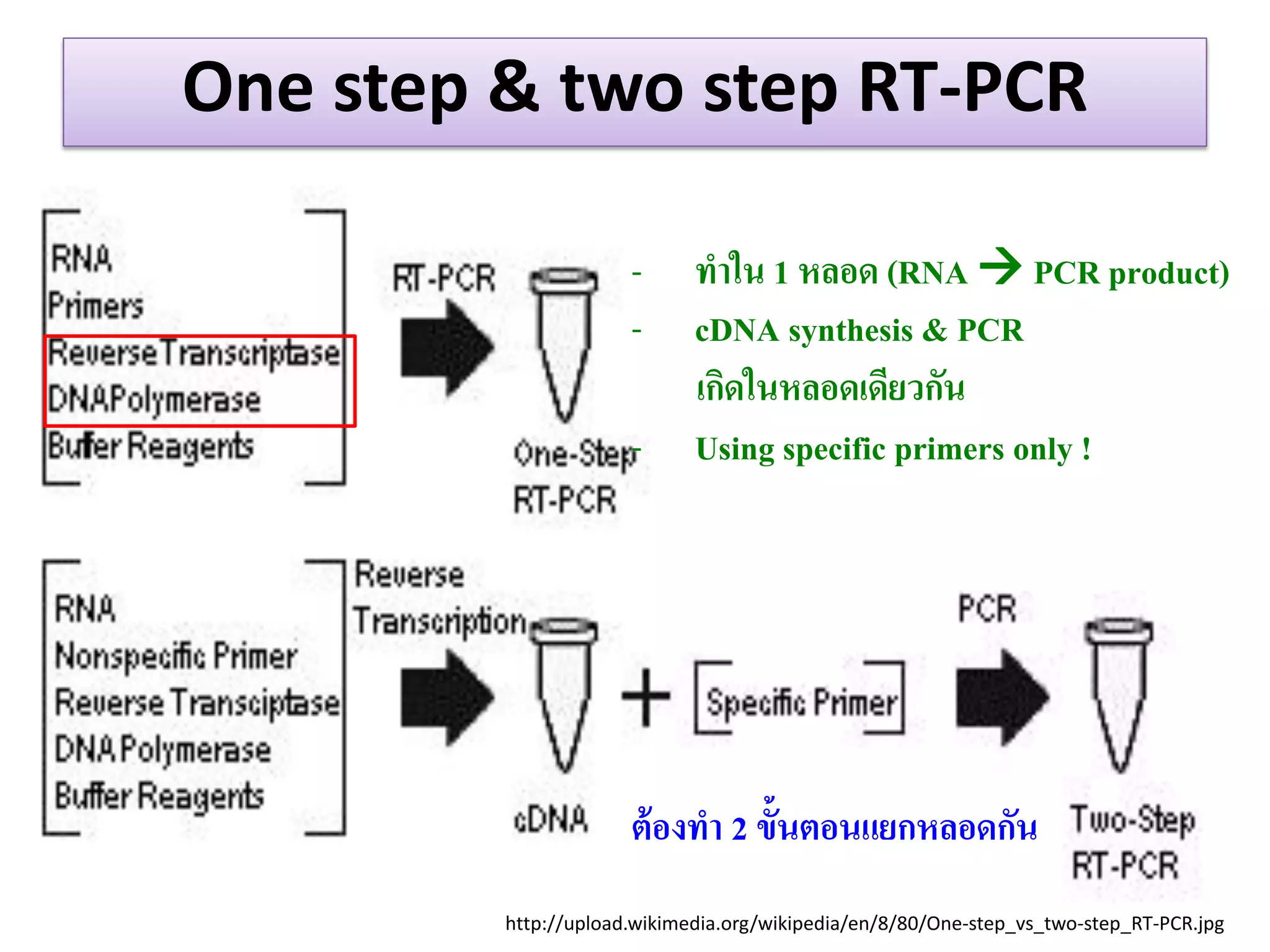
•One step & two step RT-PCR 
Reverse transcriptase ที่นิยมใช้ 
AMV reverse transcriptase ( Avian myoblastosis virus) 
MMLV reverse transcriptase (Moloney murine leukemia virus) 
http://www.gene-quantification.de/real-time-opt-1.gif
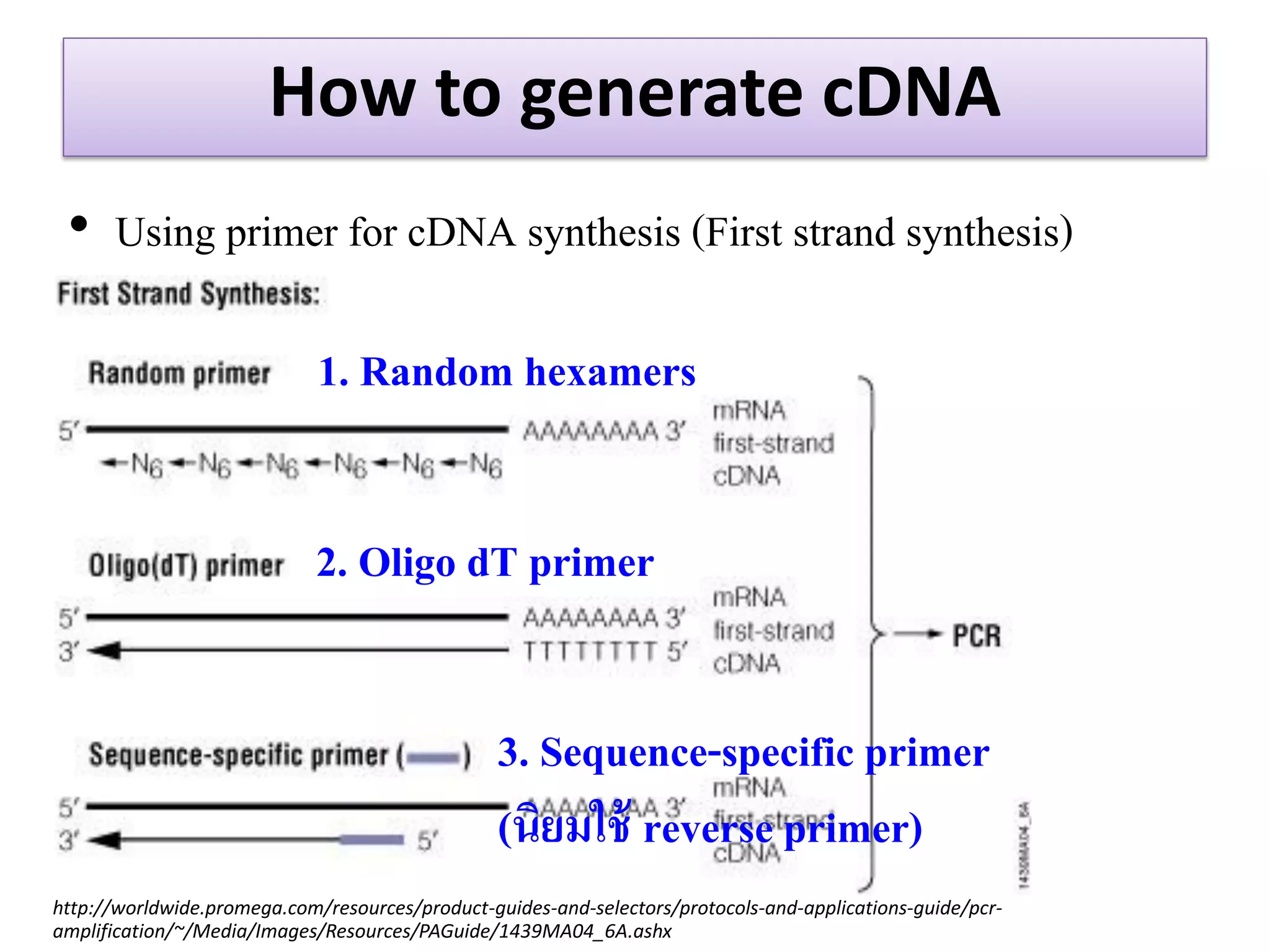
How to generate cDNA 
•Using primer for cDNA synthesis (First strand synthesis) 
http://worldwide.promega.com/resources/product-guides-and-selectors/protocols-and-applications-guide/pcr- amplification/~/Media/Images/Resources/PAGuide/1439MA04_6A.ashx 
1. Random hexamers 
2. Oligo dT primer 
3. Sequence-specific primer (นิยมใช้ reverse primer)
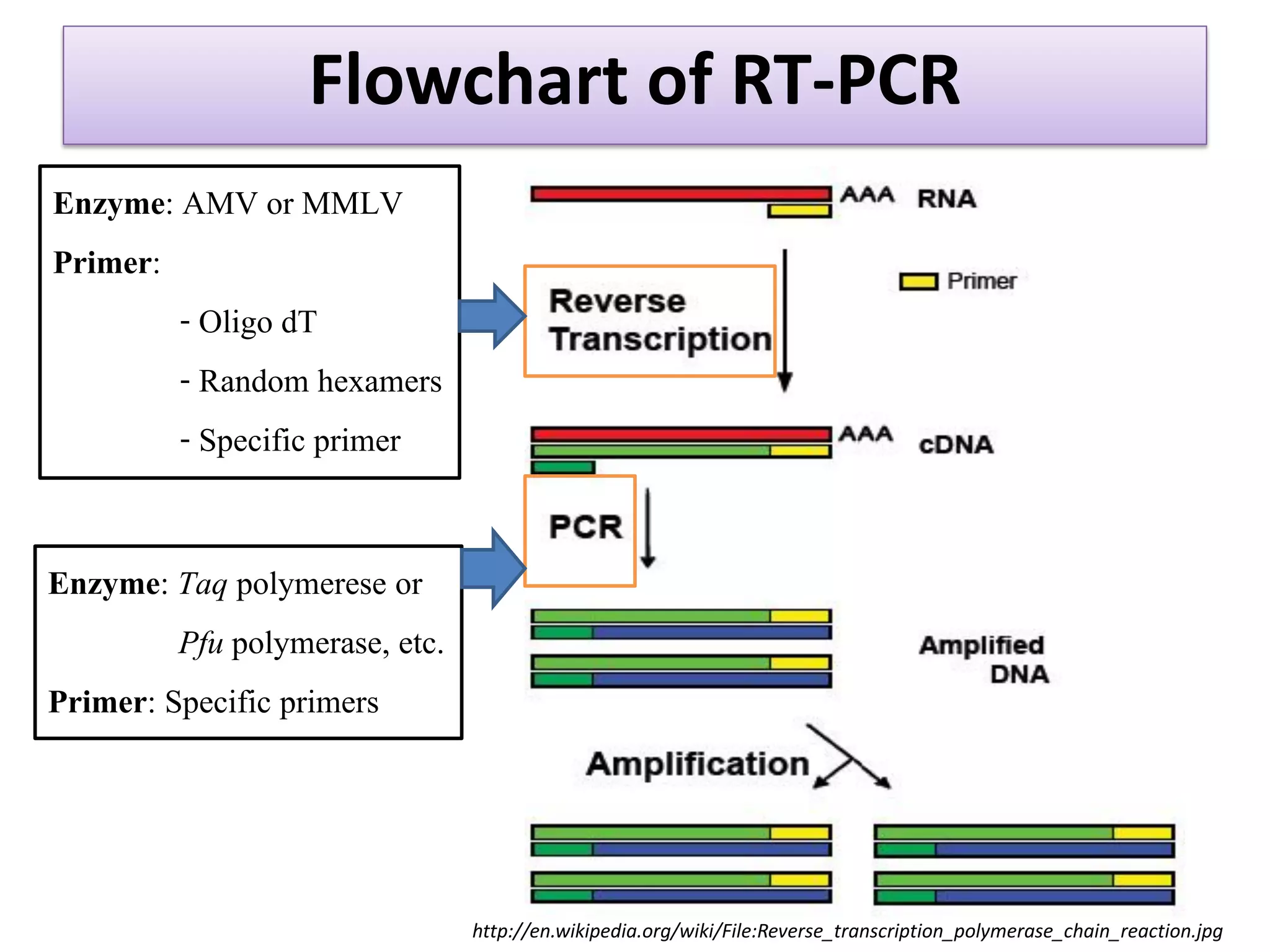
Flowchart of RT-PCR 
http://en.wikipedia.org/wiki/File:Reverse_transcription_polymerase_chain_reaction.jpg 
Enzyme: AMV or MMLV 
Primer: 
- Oligo dT 
- Random hexamers 
- Specific primer 
Enzyme: Taq polymerese or Pfu polymerase, etc. Primer: Specific primers
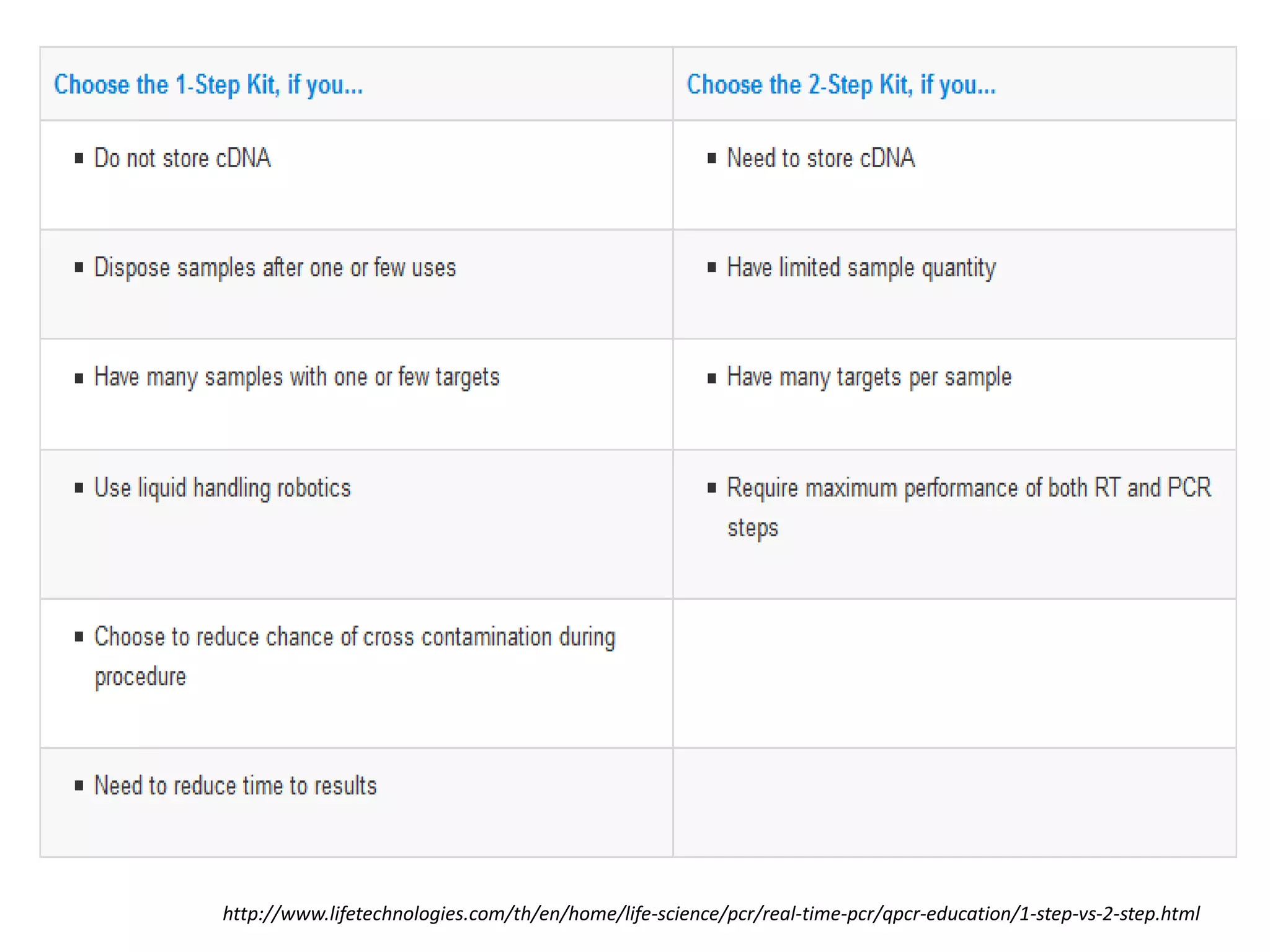
One step & two step RT-PCR 
http://upload.wikimedia.org/wikipedia/en/8/80/One-step_vs_two-step_RT-PCR.jpg 
-ทำใน 1 หลอด (RNA  PCR product) 
-cDNA synthesis & PCR เกิดในหลอดเดียวกัน 
-Using specific primers only ! 
ต้องทำ 2 ขั้นตอนแยกหลอดกัน
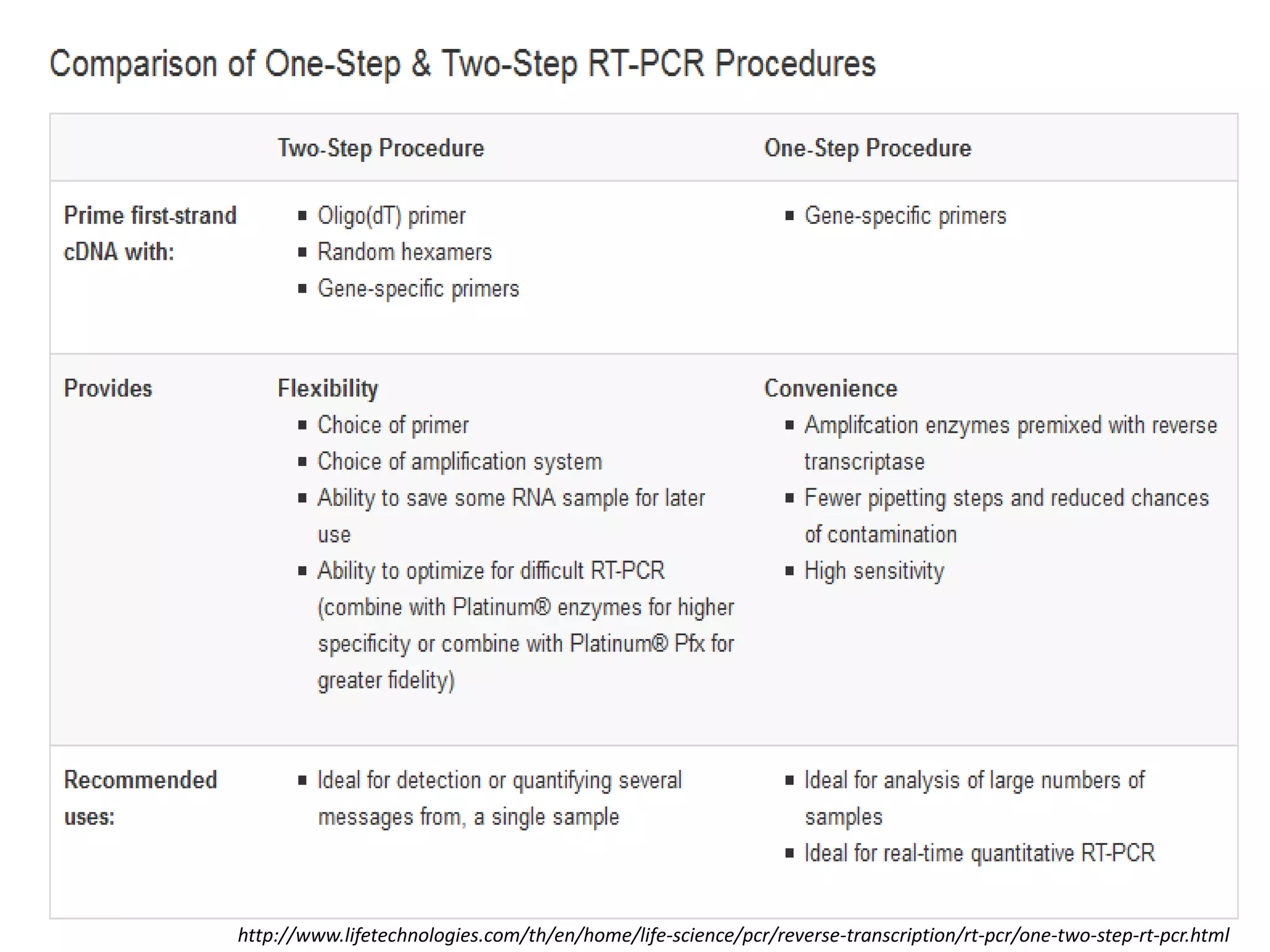
http://www.lifetechnologies.com/th/en/home/life-science/pcr/reverse-transcription/rt-pcr/one-two-step-rt-pcr.html
http://www.lifetechnologies.com/th/en/home/life-science/pcr/real-time-pcr/qpcr-education/1-step-vs-2-step.html
ข้อควรระวังในกำรทำงำนกับ RNA 
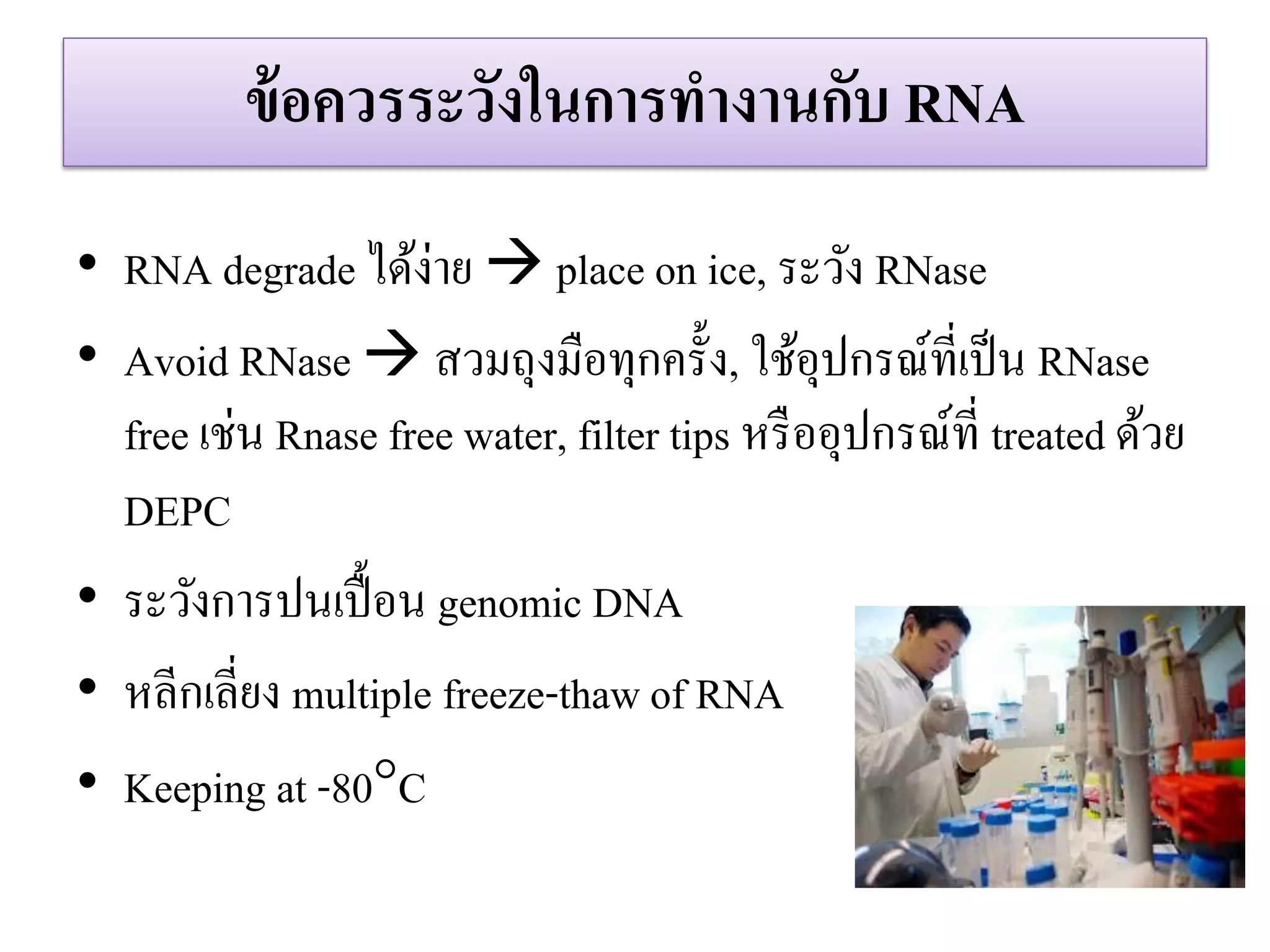
•RNA degrade ได้ง่าย  place on ice, ระวัง RNase •Avoid RNase  สวมถุงมือทุกครั้ง, ใช้อุปกรณ์ที่เป็น RNase free เช่น Rnase free water, filter tips หรืออุปกรณ์ที่ treated ด้วย DEPC 
•ระวังการปนเปื้อน genomic DNA 
•หลีกเลี่ยง multiple freeze-thaw of RNA 
•Keeping at -80C
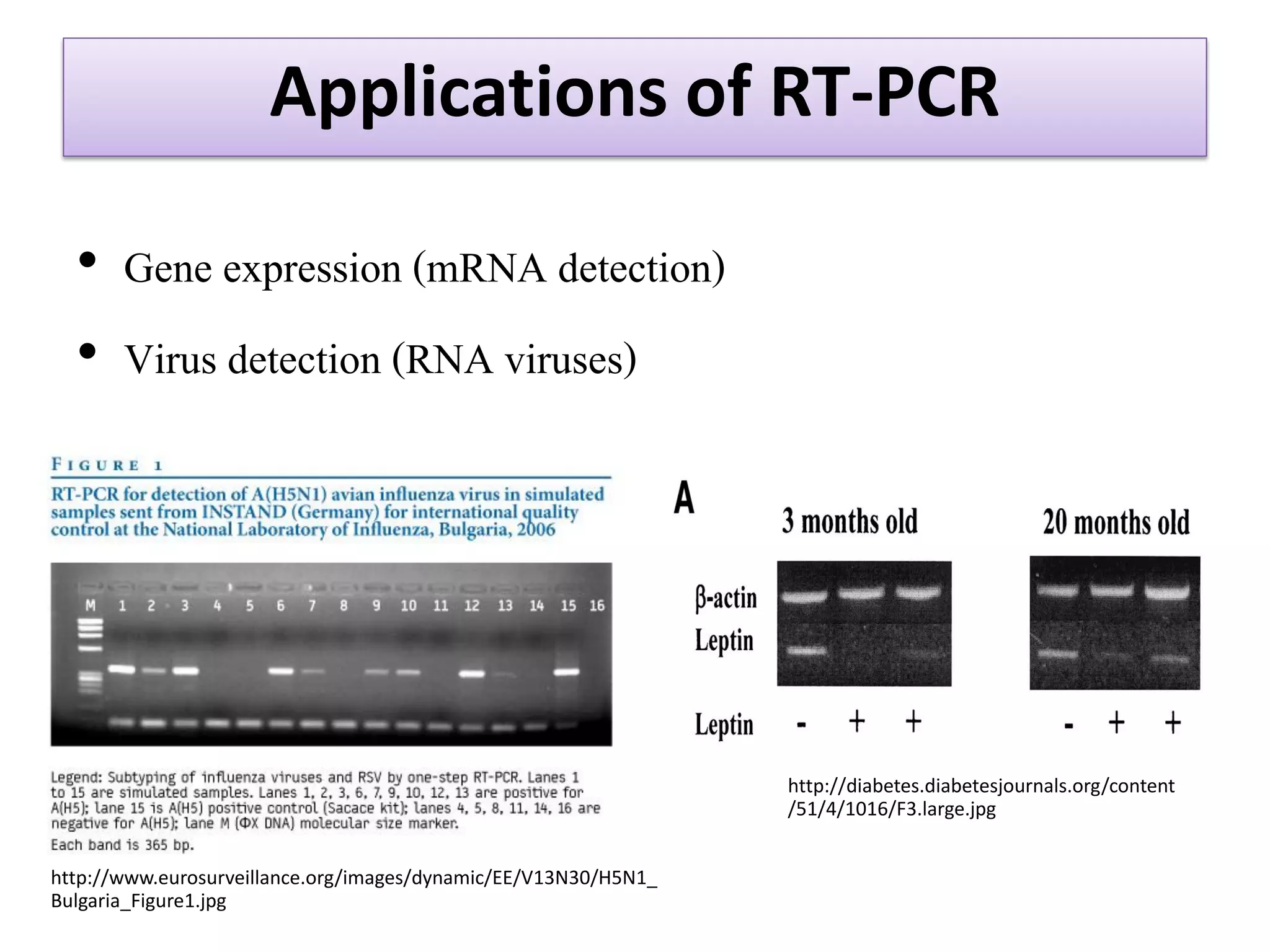
Applications of RT-PCR 
•Gene expression (mRNA detection) 
•Virus detection (RNA viruses) 
http://www.eurosurveillance.org/images/dynamic/EE/V13N30/H5N1_ Bulgaria_Figure1.jpg 
http://diabetes.diabetesjournals.org/content 
/51/4/1016/F3.large.jpg
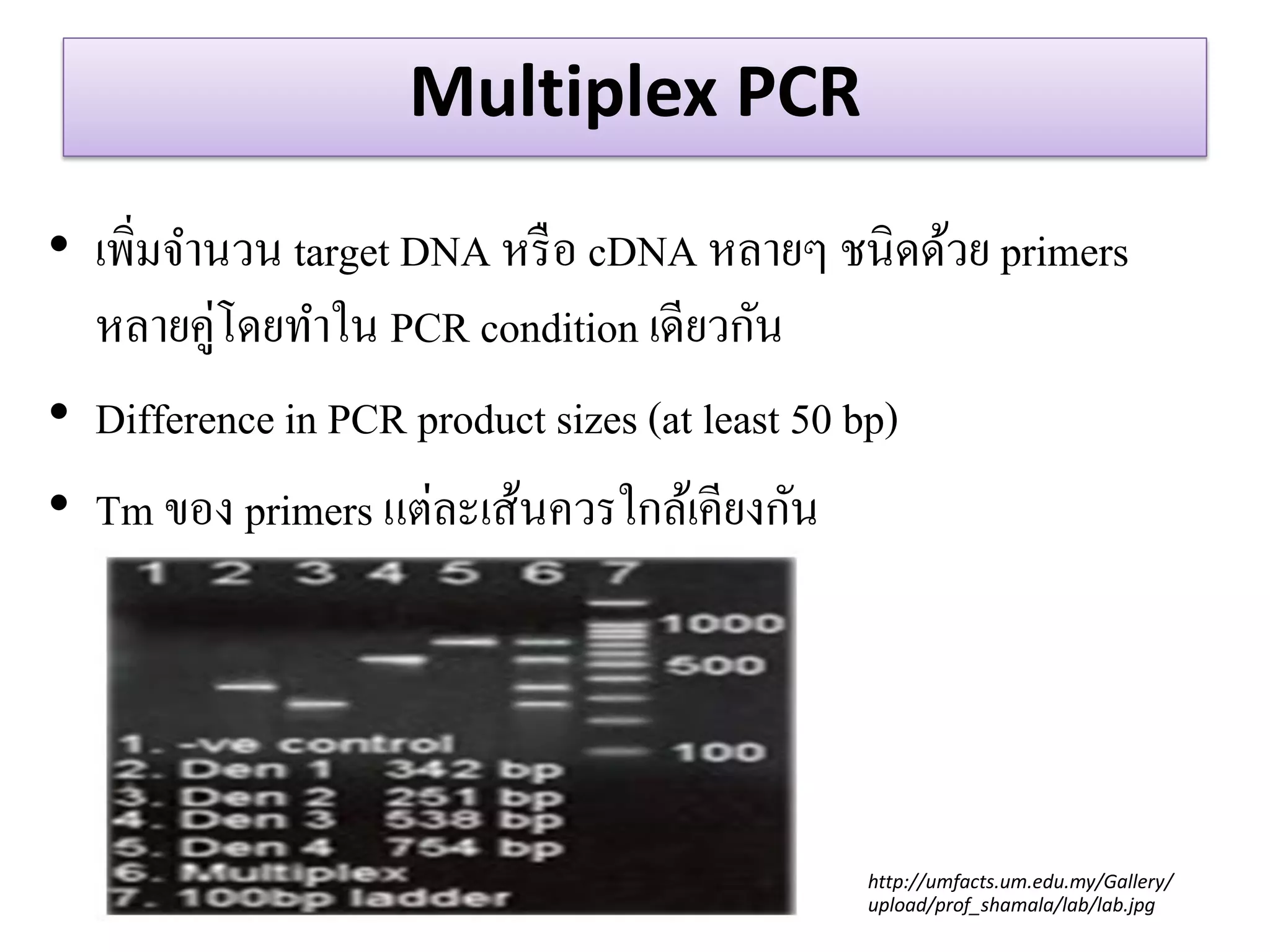
Multiplex PCR 
•เพิ่มจานวน target DNA หรือ cDNA หลายๆ ชนิดด้วย primers หลายคู่โดยทาใน PCR condition เดียวกัน 
•Difference in PCR product sizes (at least 50 bp) 
•Tm ของ primers แต่ละเส้นควรใกล้เคียงกัน 
http://umfacts.um.edu.my/Gallery/ 
upload/prof_shamala/lab/lab.jpg
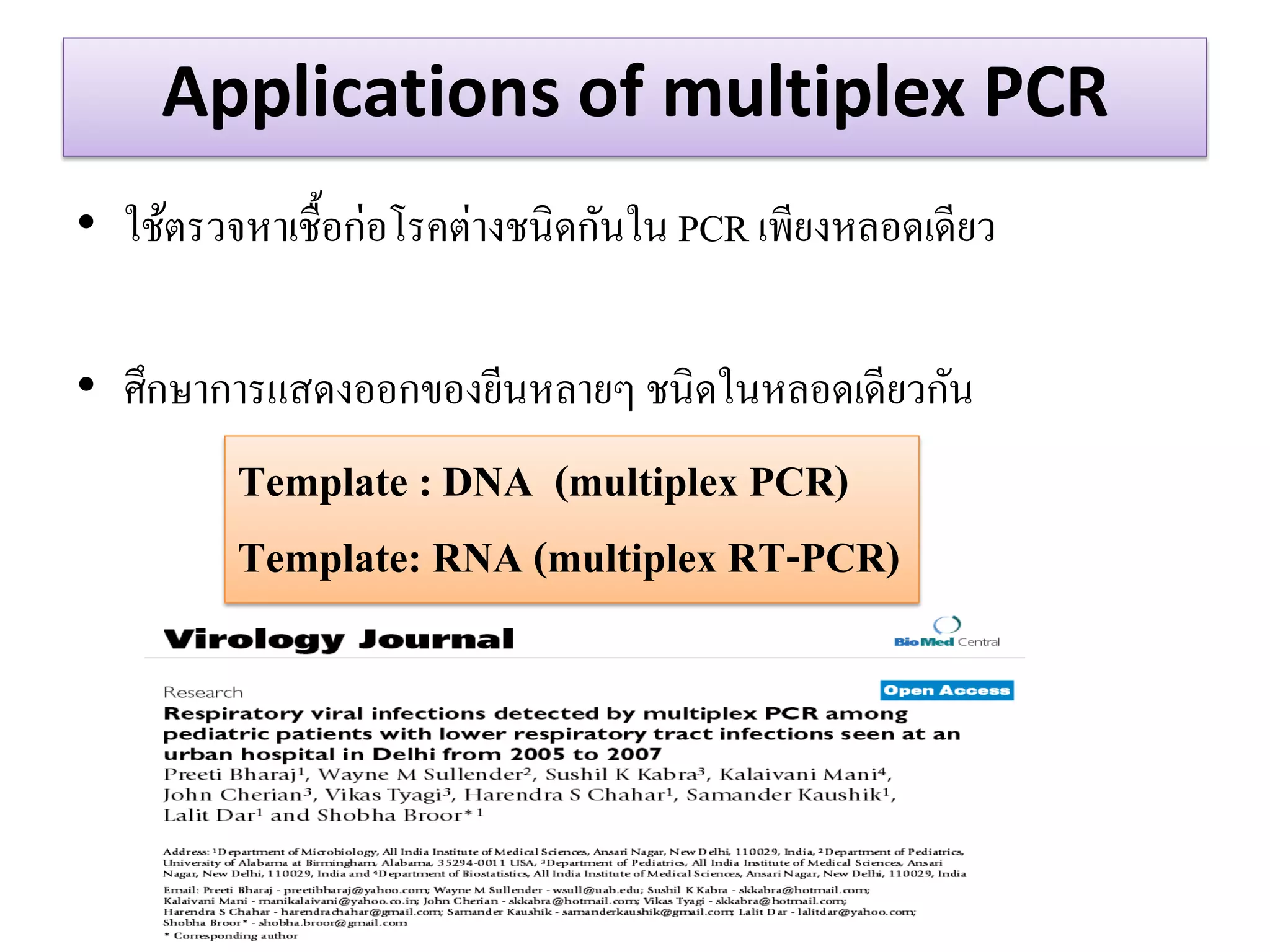
Applications of multiplex PCR 
•ใช้ตรวจหาเชื้อก่อโรคต่างชนิดกันใน PCR เพียงหลอดเดียว 
•ศึกษาการแสดงออกของยีนหลายๆ ชนิดในหลอดเดียวกัน 
Template : DNA (multiplex PCR) Template: RNA (multiplex RT-PCR)
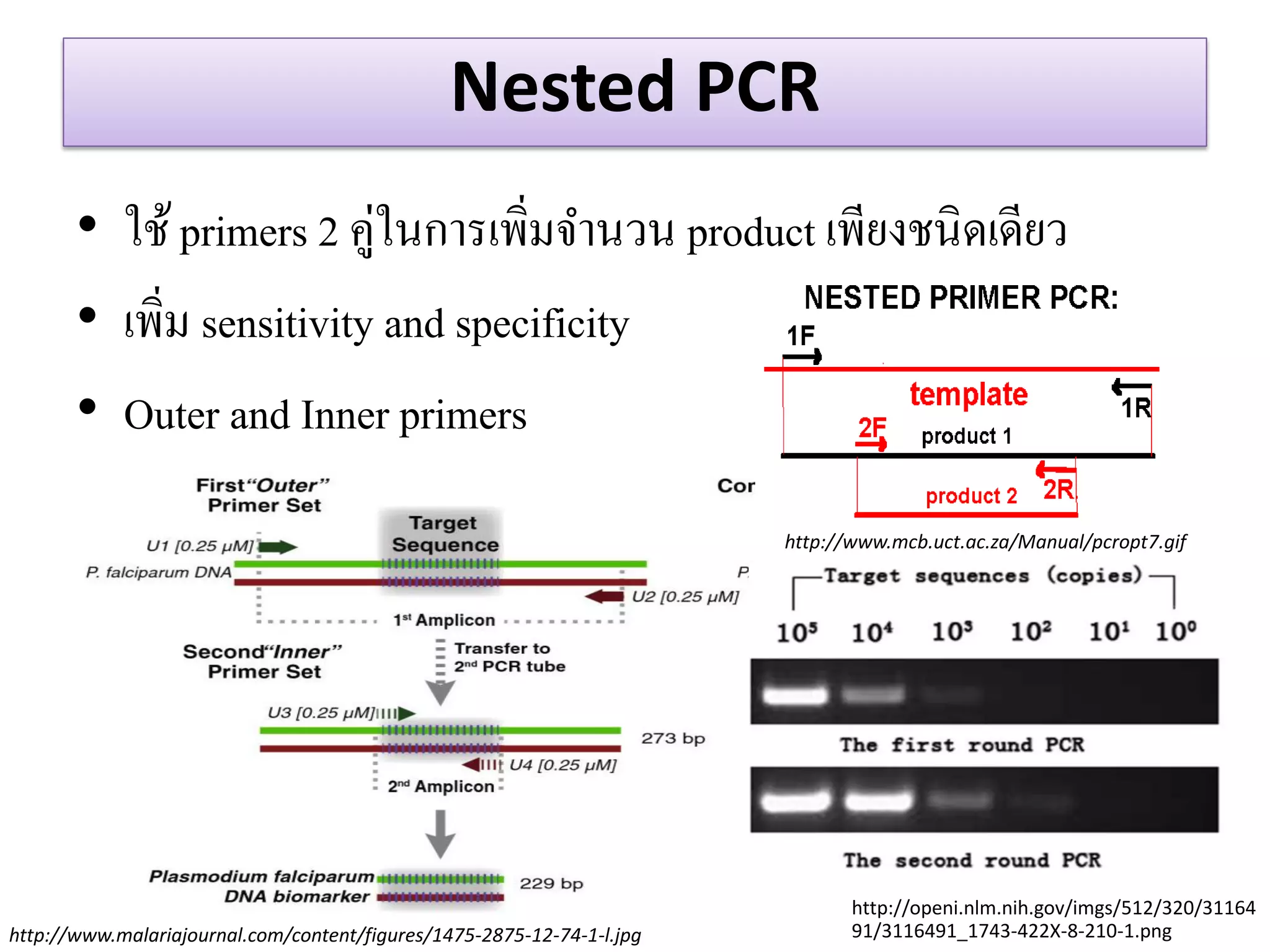
Nested PCR 
•ใช้ primers 2 คู่ในการเพิ่มจานวน product เพียงชนิดเดียว 
•เพิ่ม sensitivity and specificity 
•Outer and Inner primers 
http://www.mcb.uct.ac.za/Manual/pcropt7.gif 
http://www.malariajournal.com/content/figures/1475-2875-12-74-1-l.jpg 
http://openi.nlm.nih.gov/imgs/512/320/3116491/3116491_1743-422X-8-210-1.png
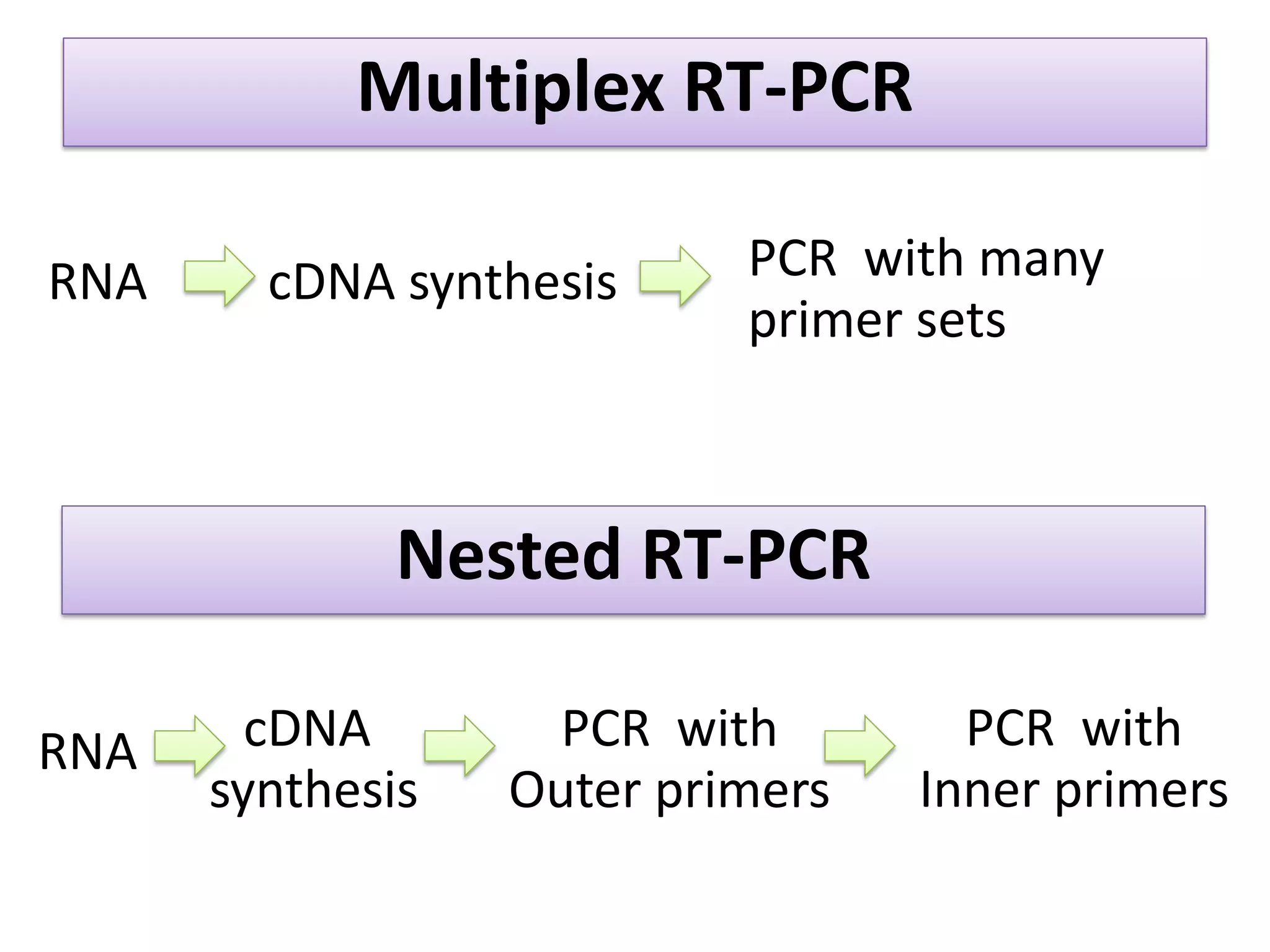
Multiplex RT-PCR 
Nested RT-PCR 
RNA 
cDNA synthesis 
PCR with many primer sets 
RNA 
cDNA 
synthesis 
PCR with Outer primers 
PCR with 
Inner primers
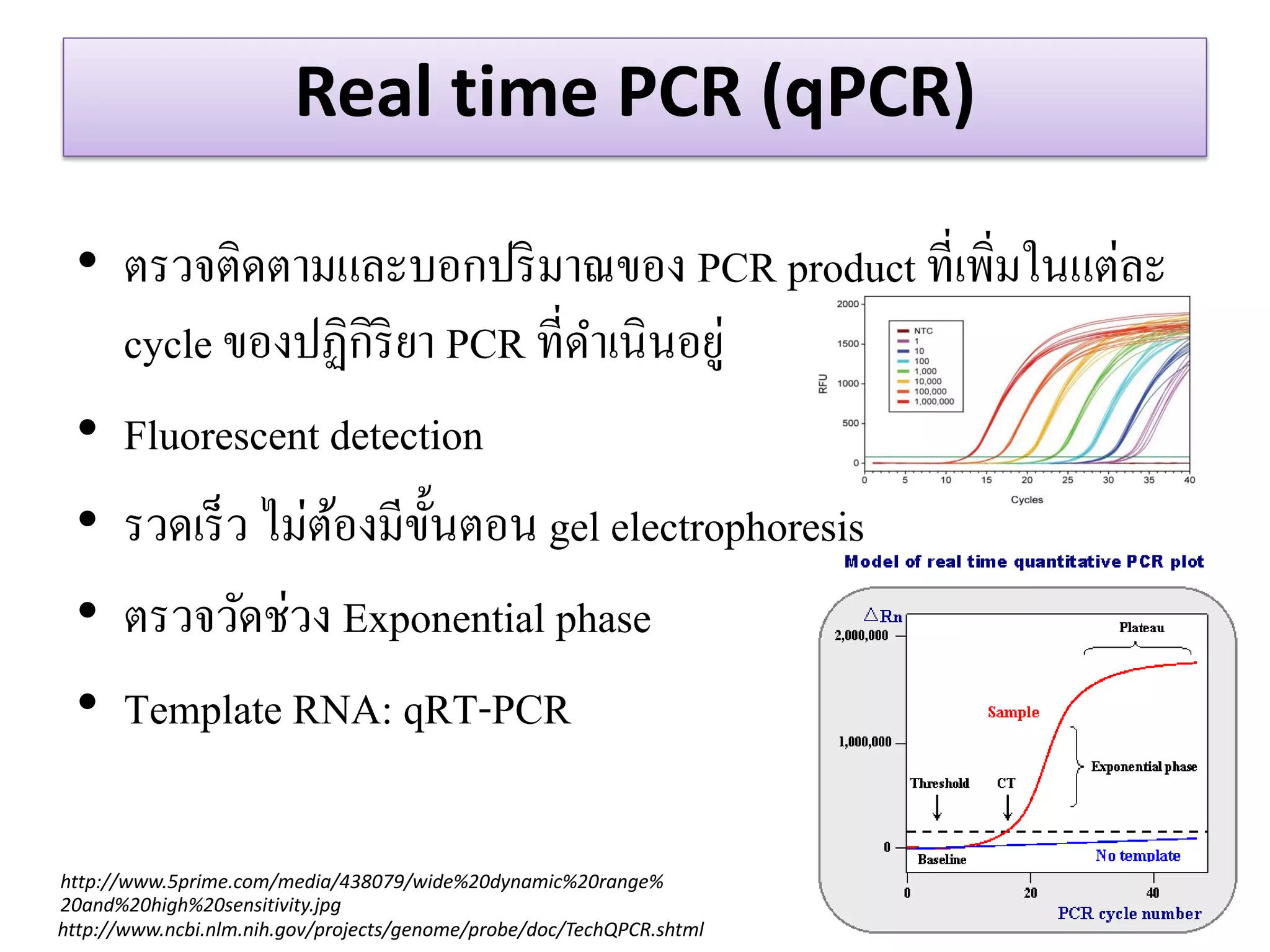
Real time PCR (qPCR) 
•ตรวจติดตามและบอกปริมาณของ PCR product ที่เพิ่มในแต่ละ cycle ของปฏิกิริยา PCR ที่ดาเนินอยู่ 
•Fluorescent detection 
•รวดเร็ว ไม่ต้องมีขั้นตอน gel electrophoresis 
•ตรวจวัดช่วง Exponential phase 
•Template RNA: qRT-PCR 
http://www.ncbi.nlm.nih.gov/projects/genome/probe/doc/TechQPCR.shtml 
http://www.5prime.com/media/438079/wide%20dynamic%20range% 20and%20high%20sensitivity.jpg
PCR & qPCR 
http://www.eppendorf.com/int/index.php?l=131&action=products&contentid=99&sitemap=2.5.1.5
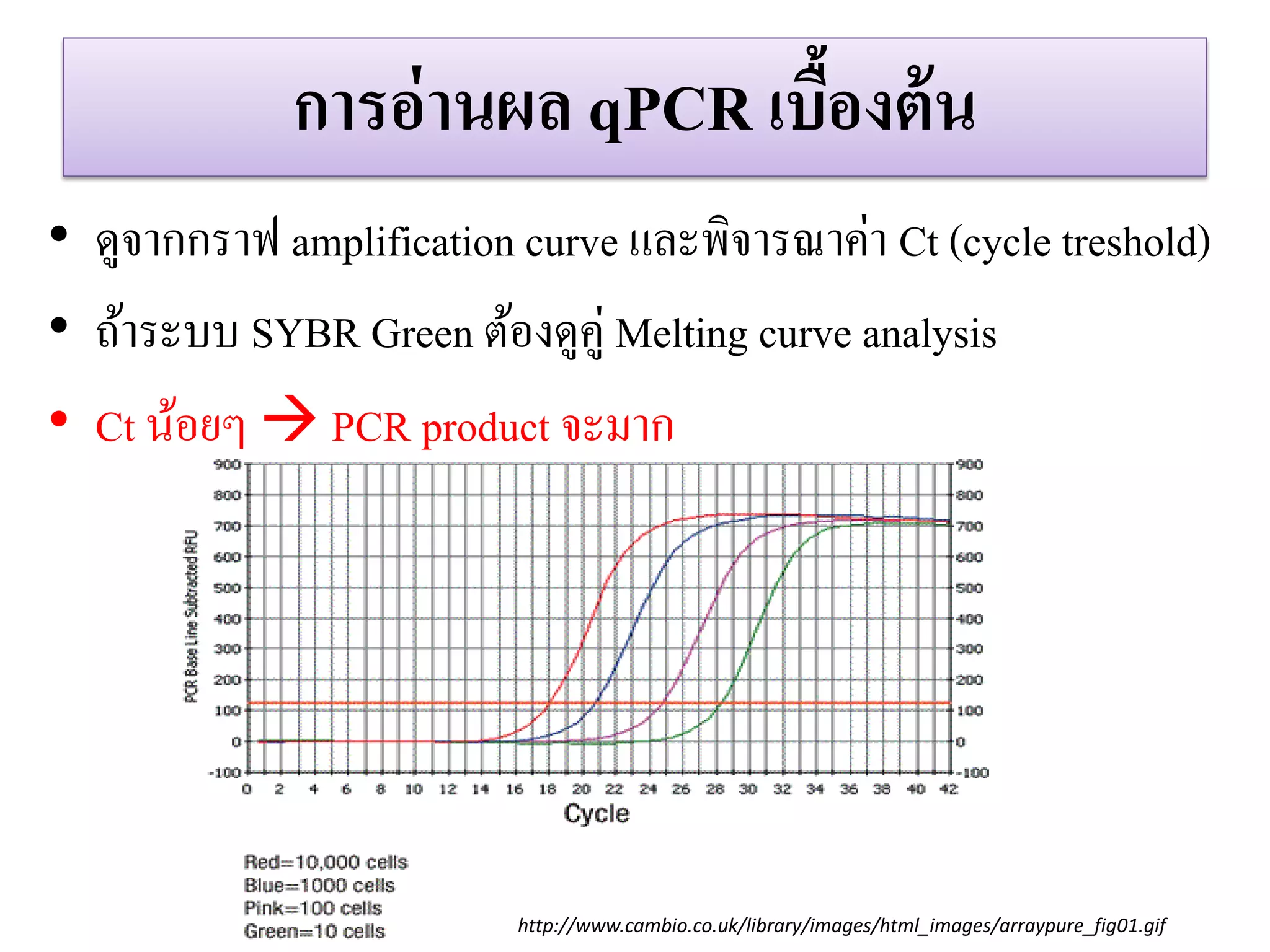
กำรอ่ำนผล qPCR เบื้องต้น 
•ดูจากกราฟ amplification curve และพิจารณาค่า Ct (cycle treshold) 
•ถ้าระบบ SYBR Green ต้องดูคู่ Melting curve analysis 
•Ct น้อยๆ  PCR product จะมาก 
http://www.cambio.co.uk/library/images/html_images/arraypure_fig01.gif
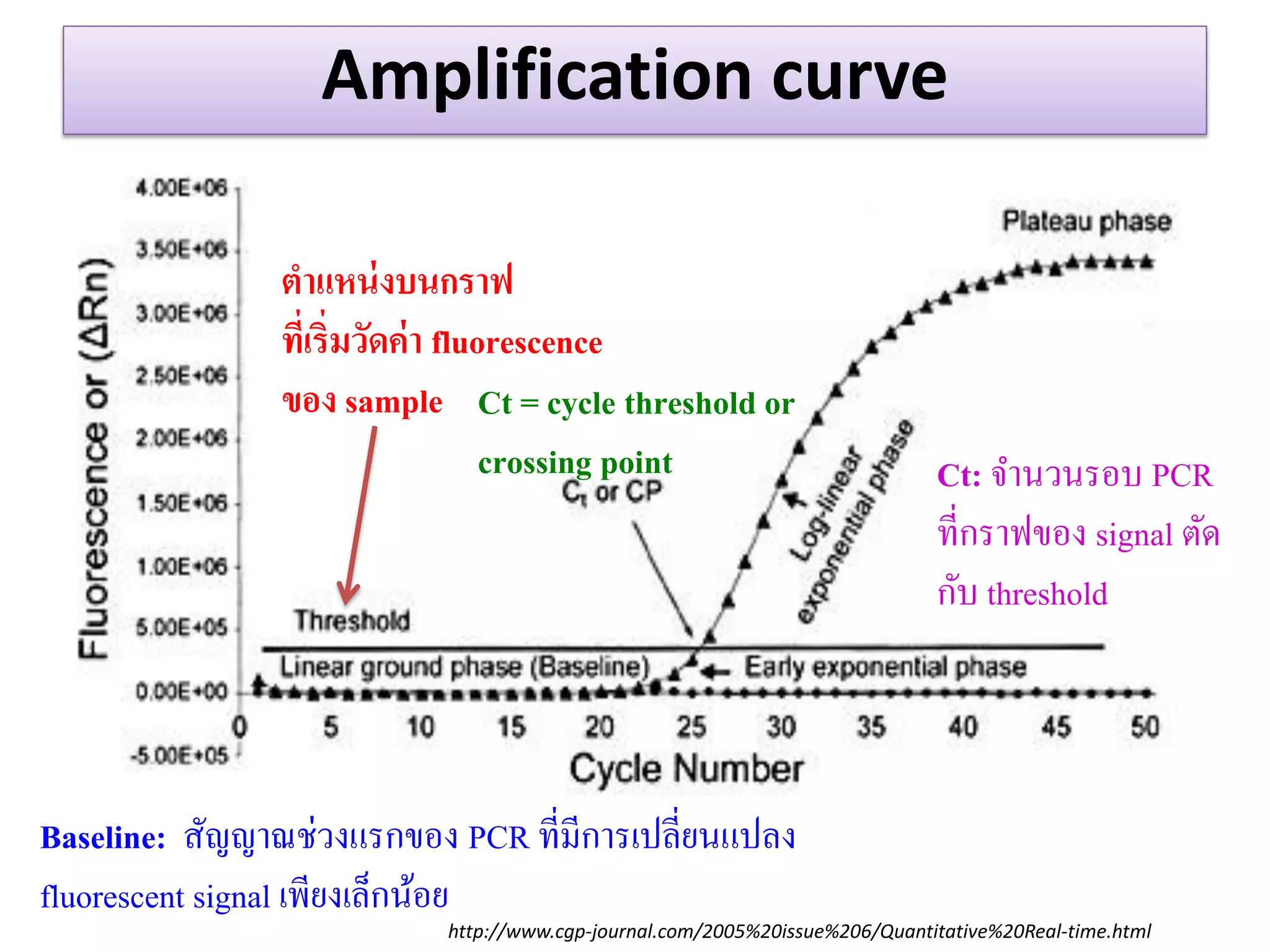
Amplification curve 
http://www.cgp-journal.com/2005%20issue%206/Quantitative%20Real-time.html 
ตำแหน่งบนกรำฟ 
ที่เริ่มวัดค่ำ fluorescence 
ของ sample 
Baseline: สัญญาณช่วงแรกของ PCR ที่มีการเปลี่ยนแปลง 
fluorescent signal เพียงเล็กน้อย 
Ct = cycle threshold or 
crossing point 
Ct: จานวนรอบ PCR 
ที่กราฟของ signal ตัด 
กับ threshold
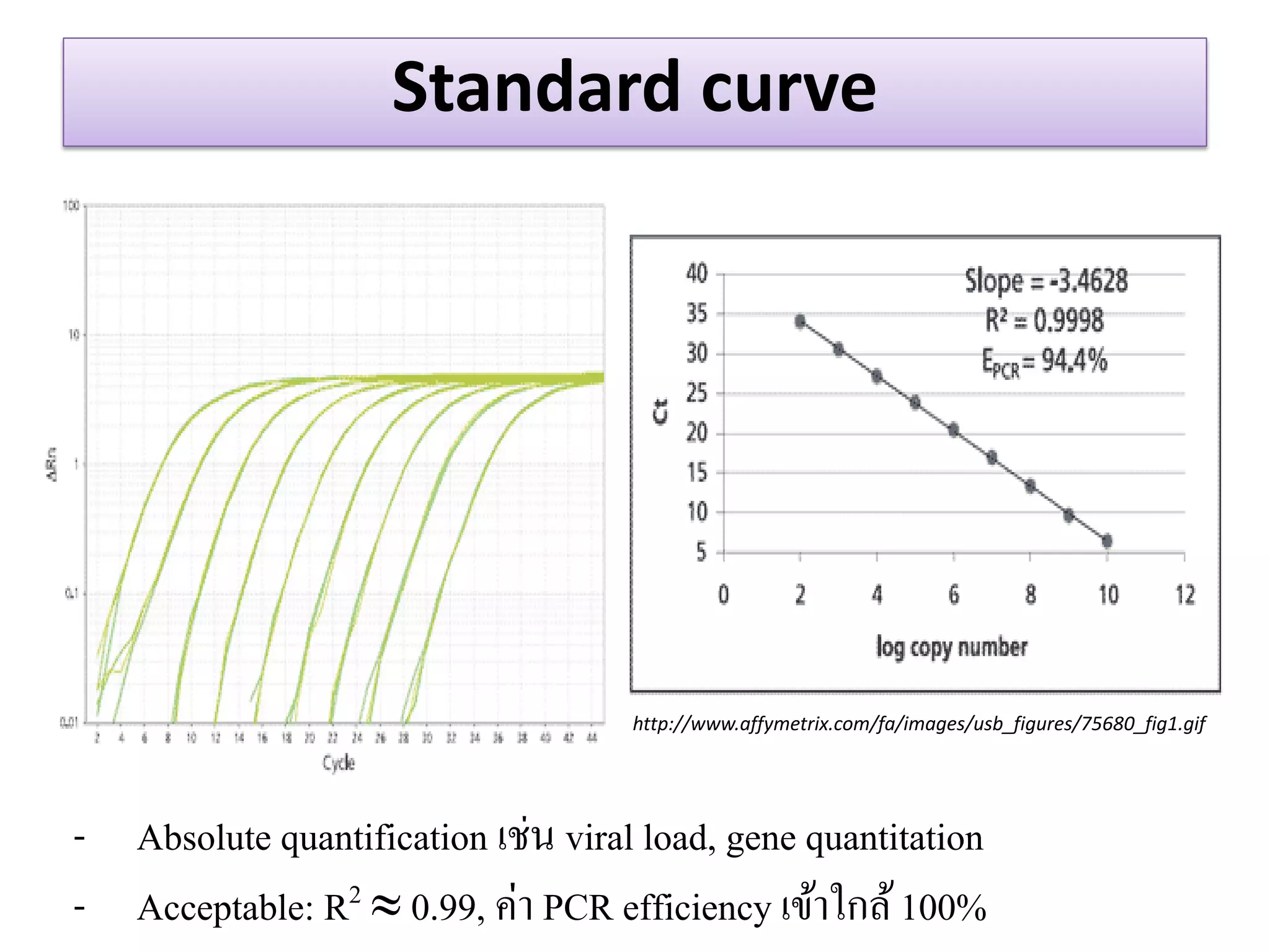
Standard curve 
-Absolute quantification เช่น viral load, gene quantitation 
-Acceptable: R2  0.99, ค่า PCR efficiency เข้าใกล้ 100% 
http://www.affymetrix.com/fa/images/usb_figures/75680_fig1.gif
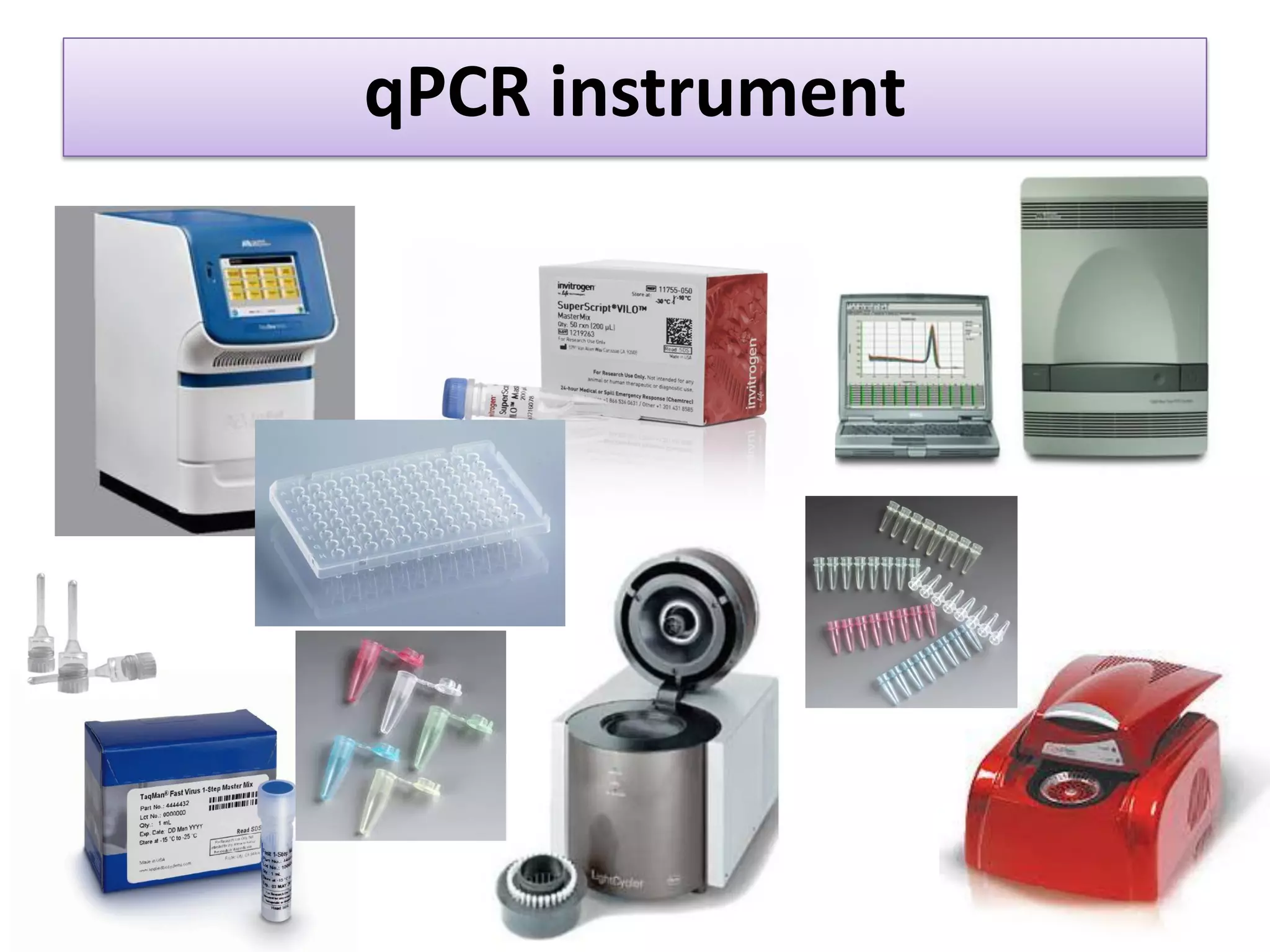
qPCR instrument
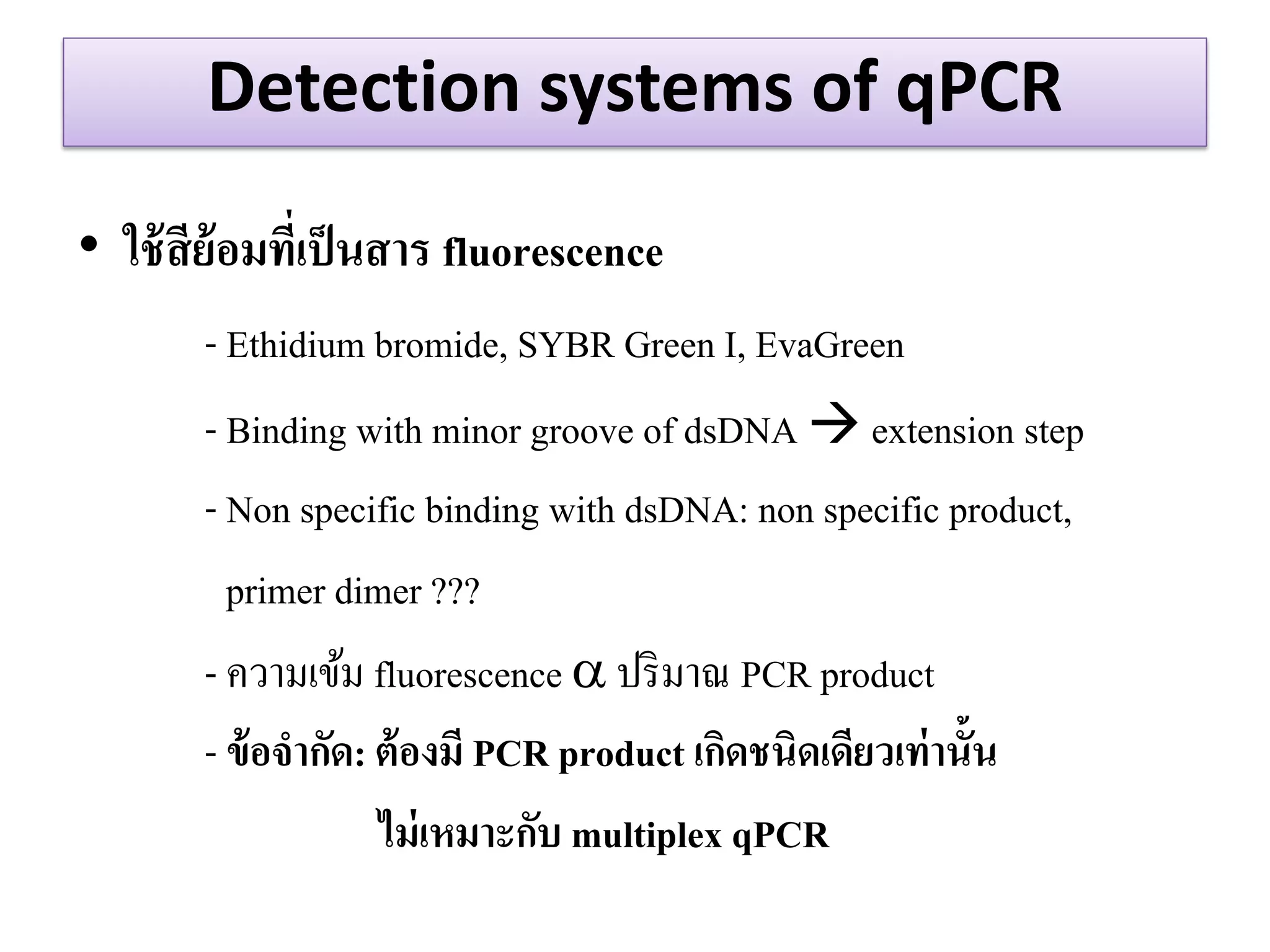
Detection systems of qPCR 
•ใช้สีย้อมที่เป็นสาร fluorescence 
- Ethidium bromide, SYBR Green I, EvaGreen 
- Binding with minor groove of dsDNA  extension step 
- Non specific binding with dsDNA: non specific product, 
primer dimer ??? 
- ความเข้ม fluorescence  ปริมาณ PCR product 
- ข้อจากัด: ต้องมี PCR product เกิดชนิดเดียวเท่านั้น 
ไม่เหมาะกับ multiplex qPCR
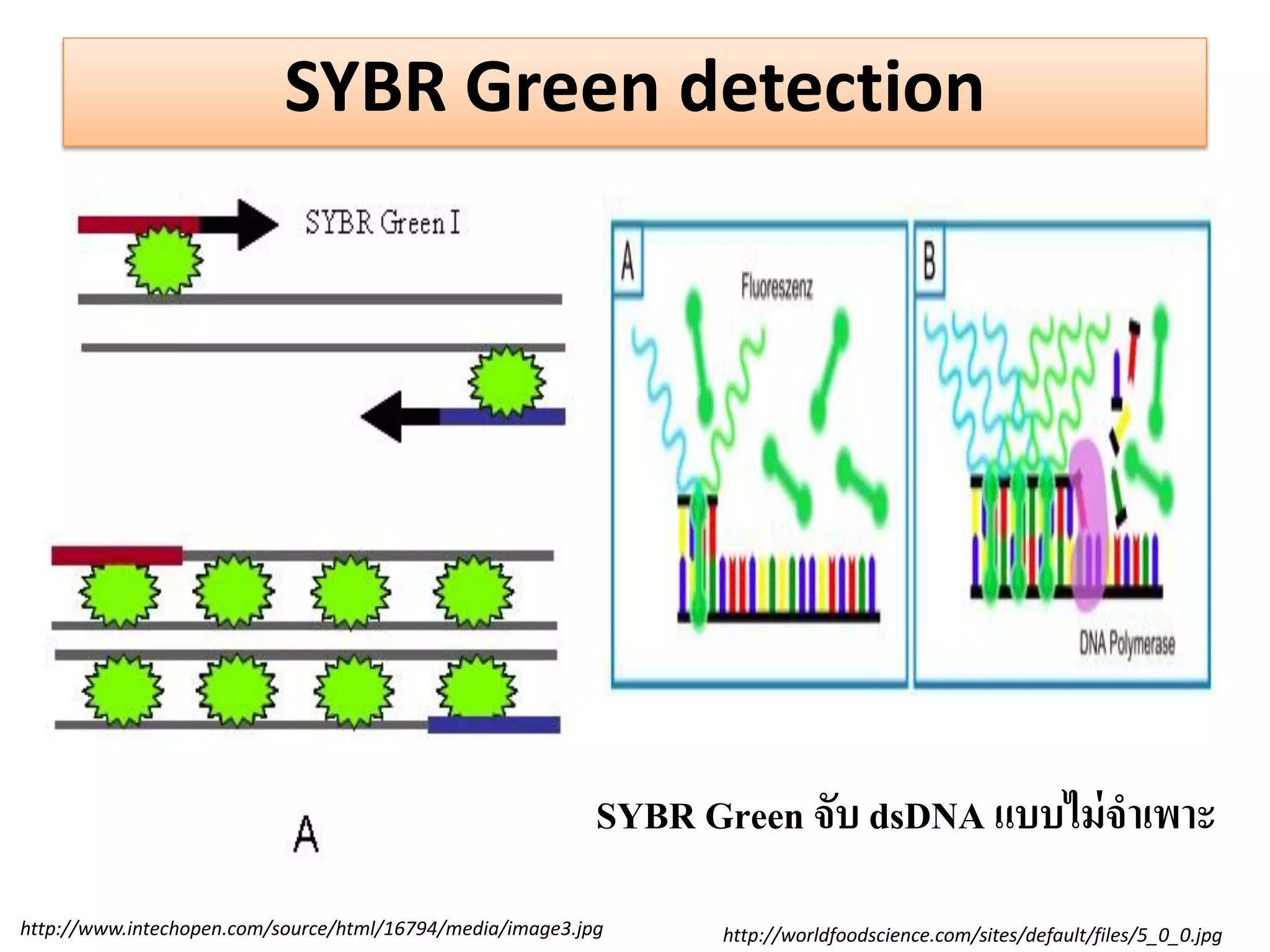
SYBR Green detection 
http://www.intechopen.com/source/html/16794/media/image3.jpg 
http://worldfoodscience.com/sites/default/files/5_0_0.jpg 
SYBR Green จับ dsDNA แบบไม่จำเพำะ
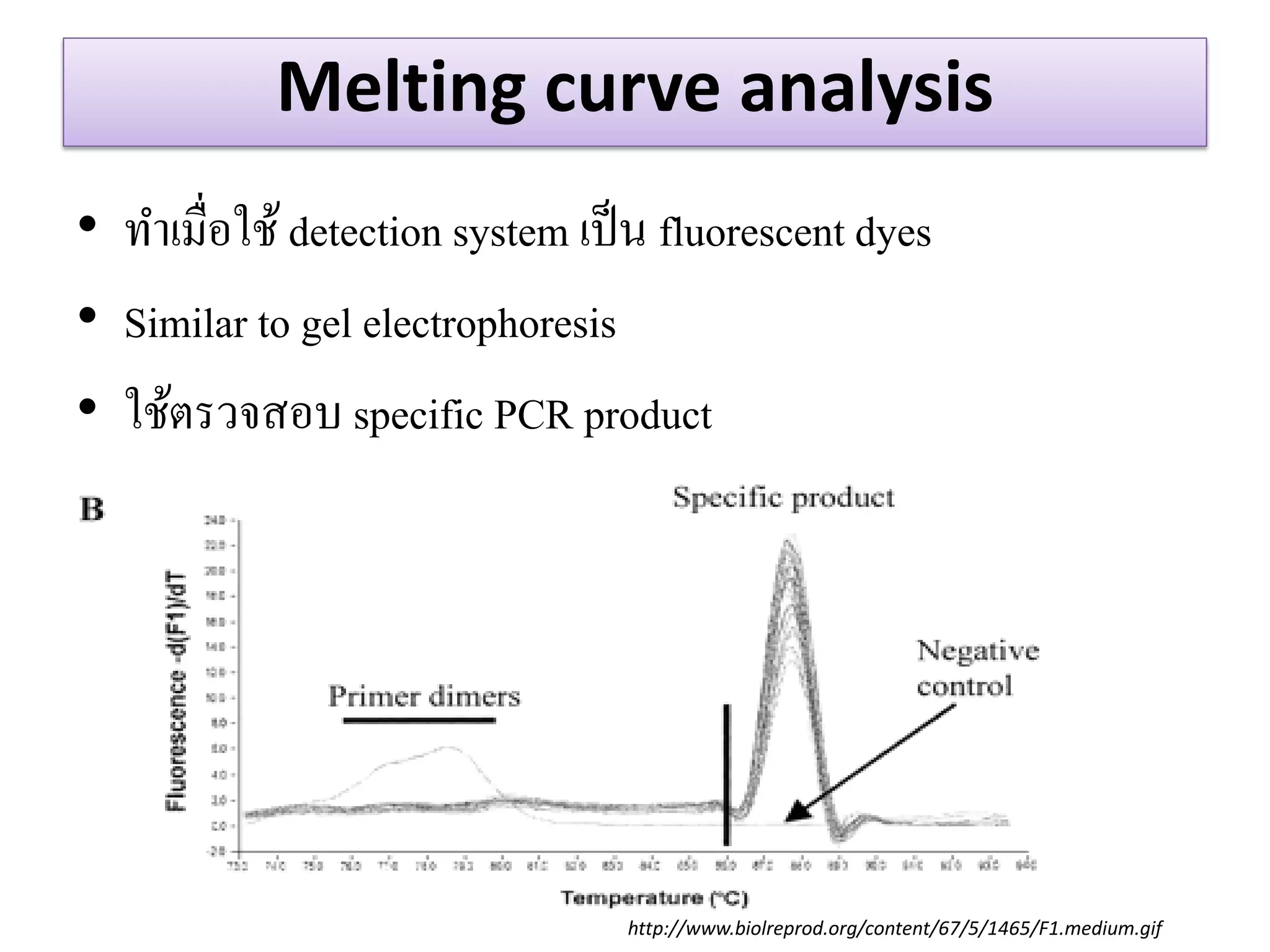
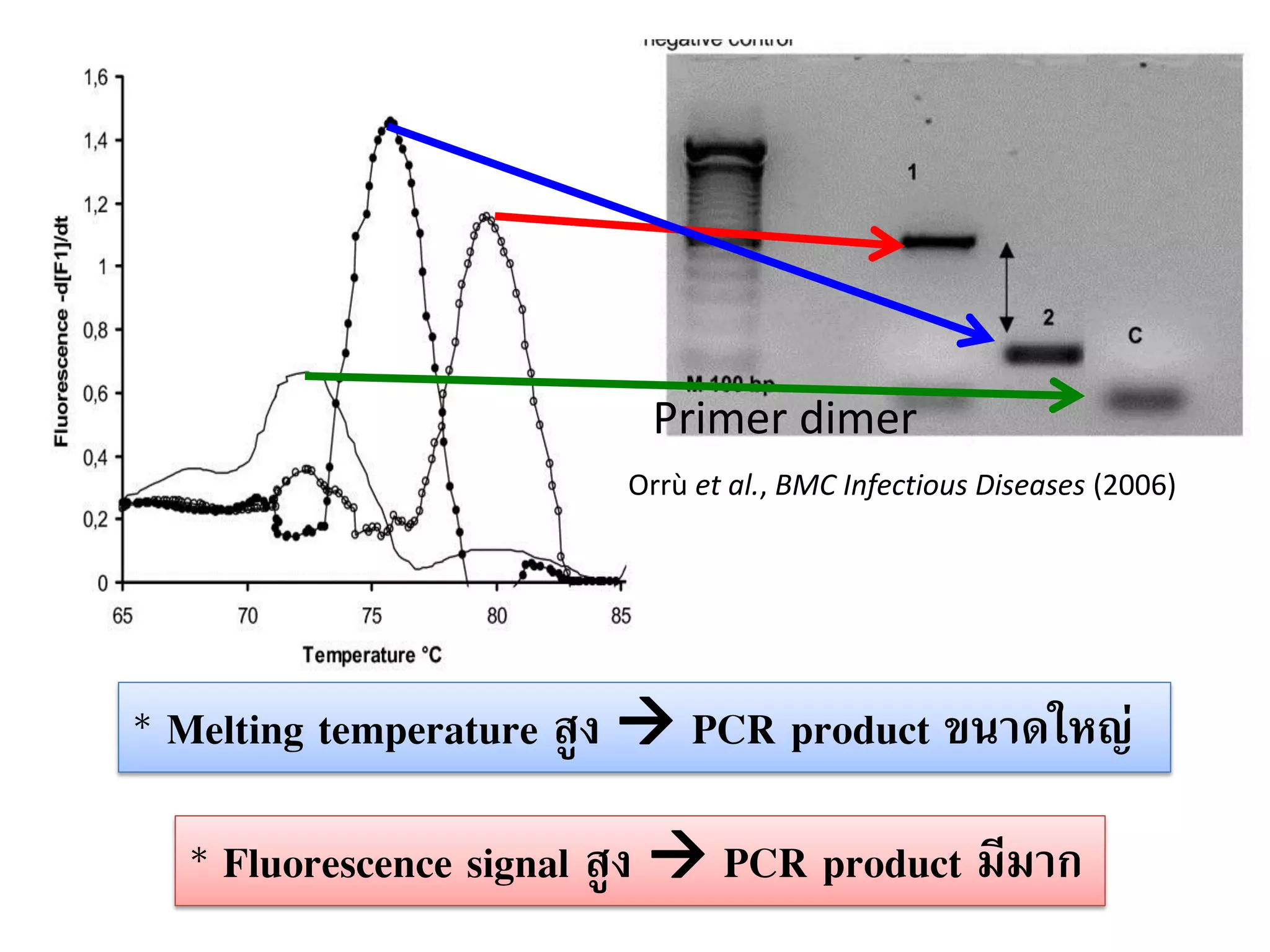
Melting curve analysis 
•ทาเมื่อใช้ detection system เป็น fluorescent dyes 
•Similar to gel electrophoresis 
•ใช้ตรวจสอบ specific PCR product 
http://www.biolreprod.org/content/67/5/1465/F1.medium.gif
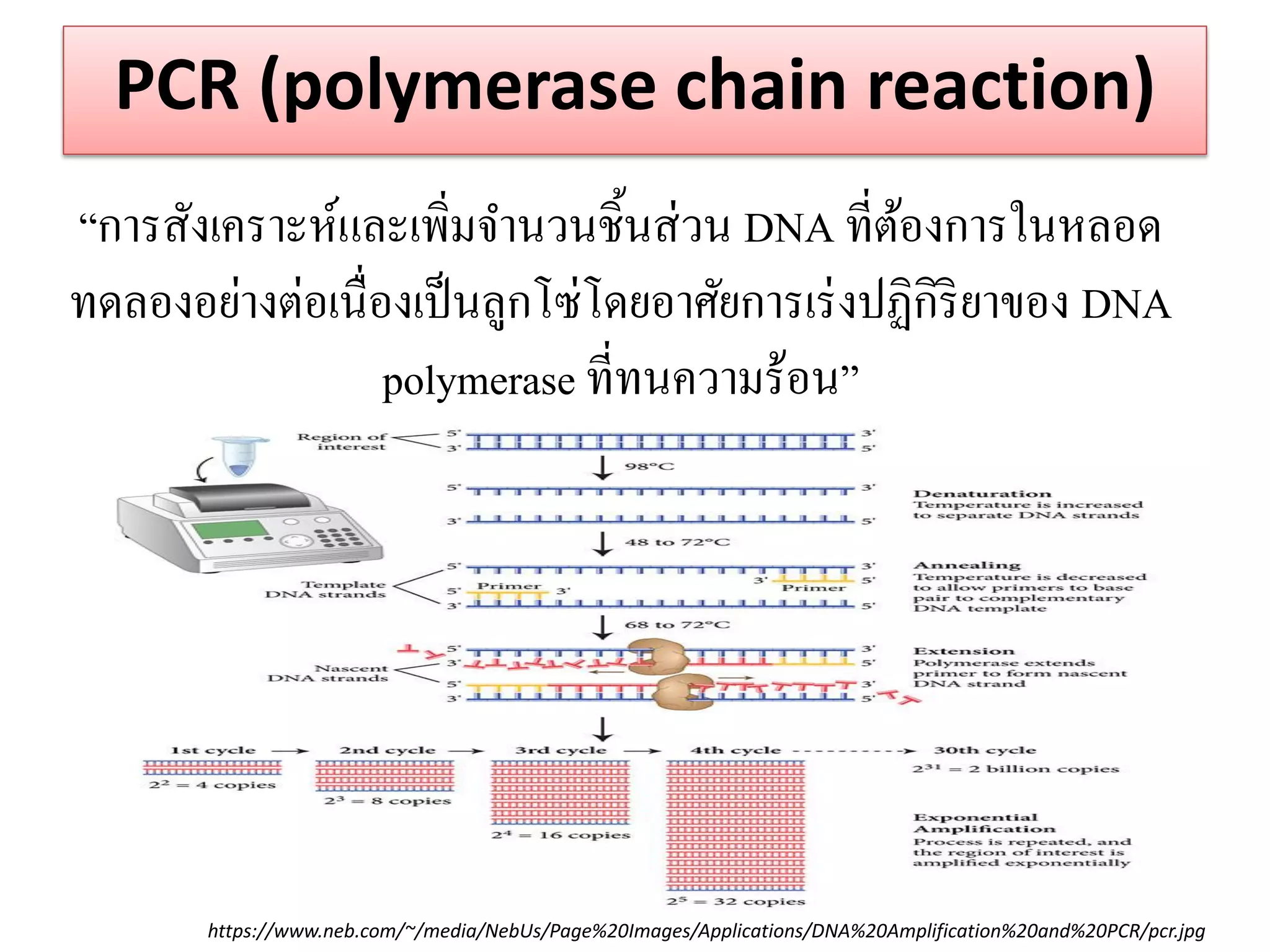
* Melting temperature สูง  PCR product ขนาดใหญ่ 
* Fluorescence signal สูง  PCR product มีมาก 
Primer dimer 
Orrù et al., BMC Infectious Diseases (2006)
Soliman RH et al., PUJ (2009) 
Orrù et al. BMC Infectious Diseases 2006
Detection systems of qPCR (II) 
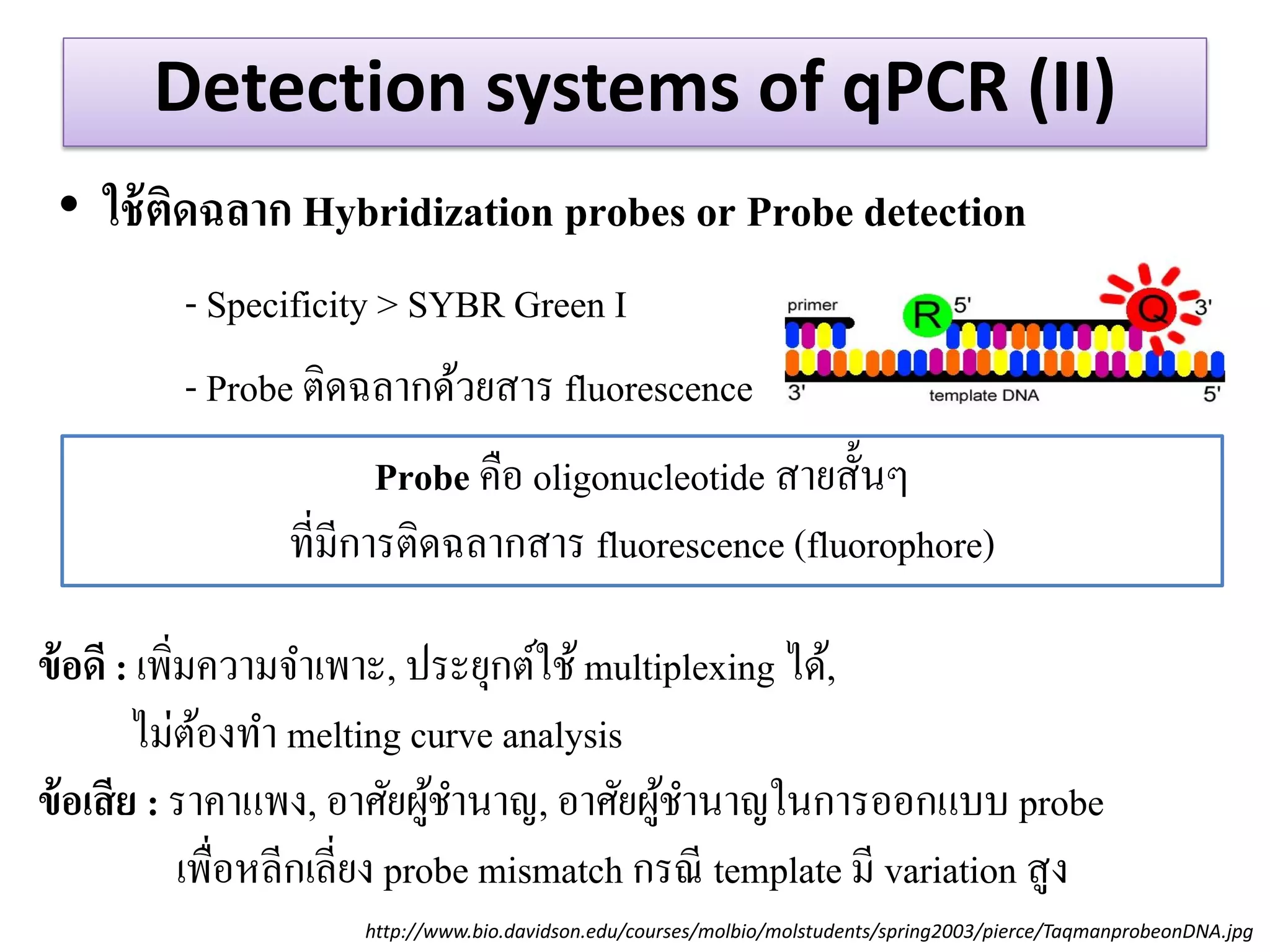
•ใช้ติดฉลาก Hybridization probes or Probe detection 
- Specificity > SYBR Green I 
- Probe ติดฉลากด้วยสาร fluorescence 
Probe คือ oligonucleotide สายสั้นๆ 
ที่มีการติดฉลากสาร fluorescence (fluorophore) 
http://www.bio.davidson.edu/courses/molbio/molstudents/spring2003/pierce/TaqmanprobeonDNA.jpg 
ข้อดี : เพิ่มความจาเพาะ, ประยุกต์ใช้ multiplexing ได้, 
ไม่ต้องทา melting curve analysis 
ข้อเสีย : ราคาแพง, อาศัยผู้ชานาญ, อาศัยผู้ชานาญในการออกแบบ probe 
เพื่อหลีกเลี่ยง probe mismatch กรณี template มี variation สูง
Probe detection 
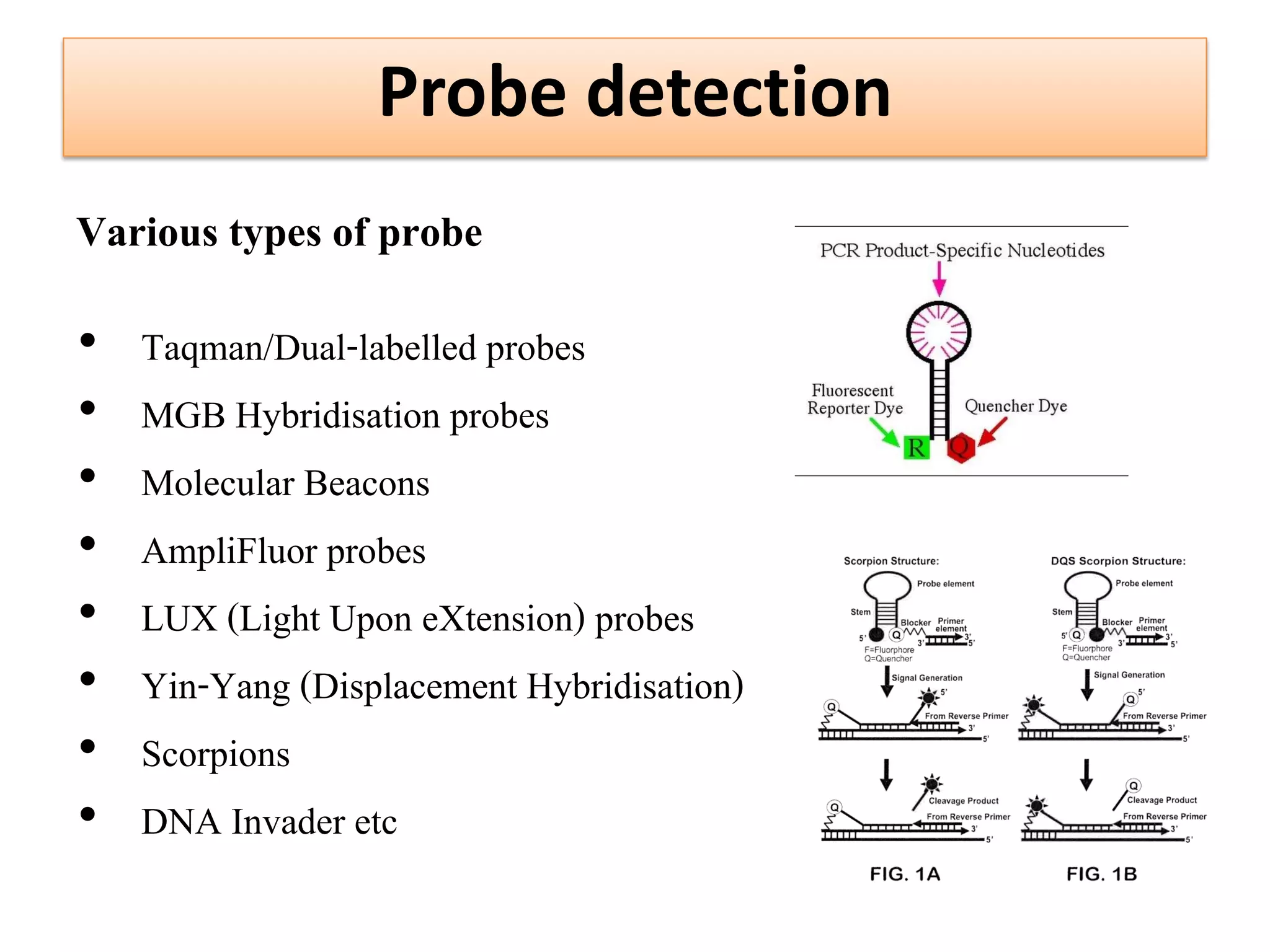
Various types of probe 
•Taqman/Dual-labelled probes 
•MGB Hybridisation probes 
•Molecular Beacons 
•AmpliFluor probes 
•LUX (Light Upon eXtension) probes 
•Yin-Yang (Displacement Hybridisation) 
•Scorpions 
•DNA Invader etc
Types of probe 
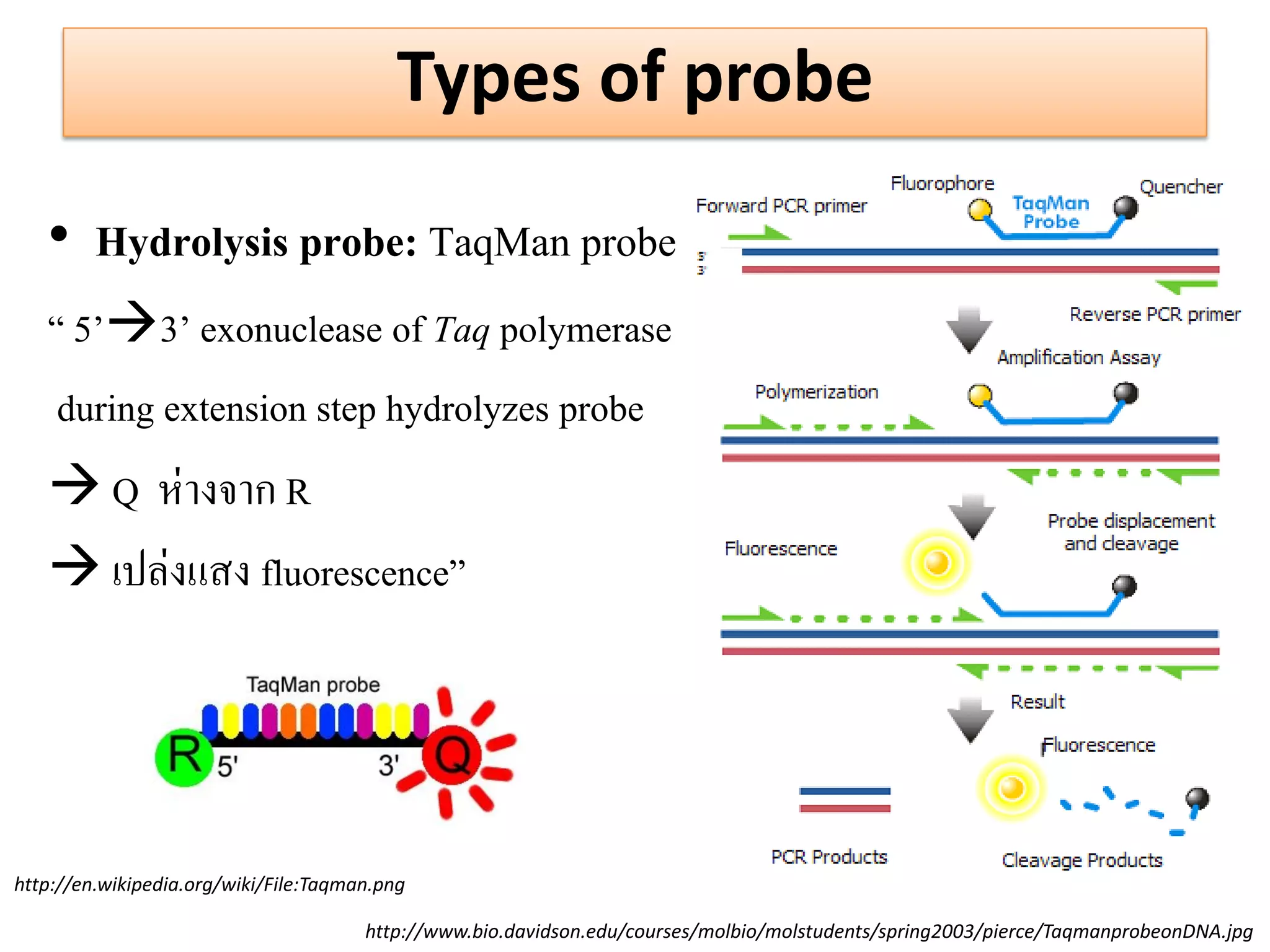
•Hydrolysis probe: TaqMan probe 
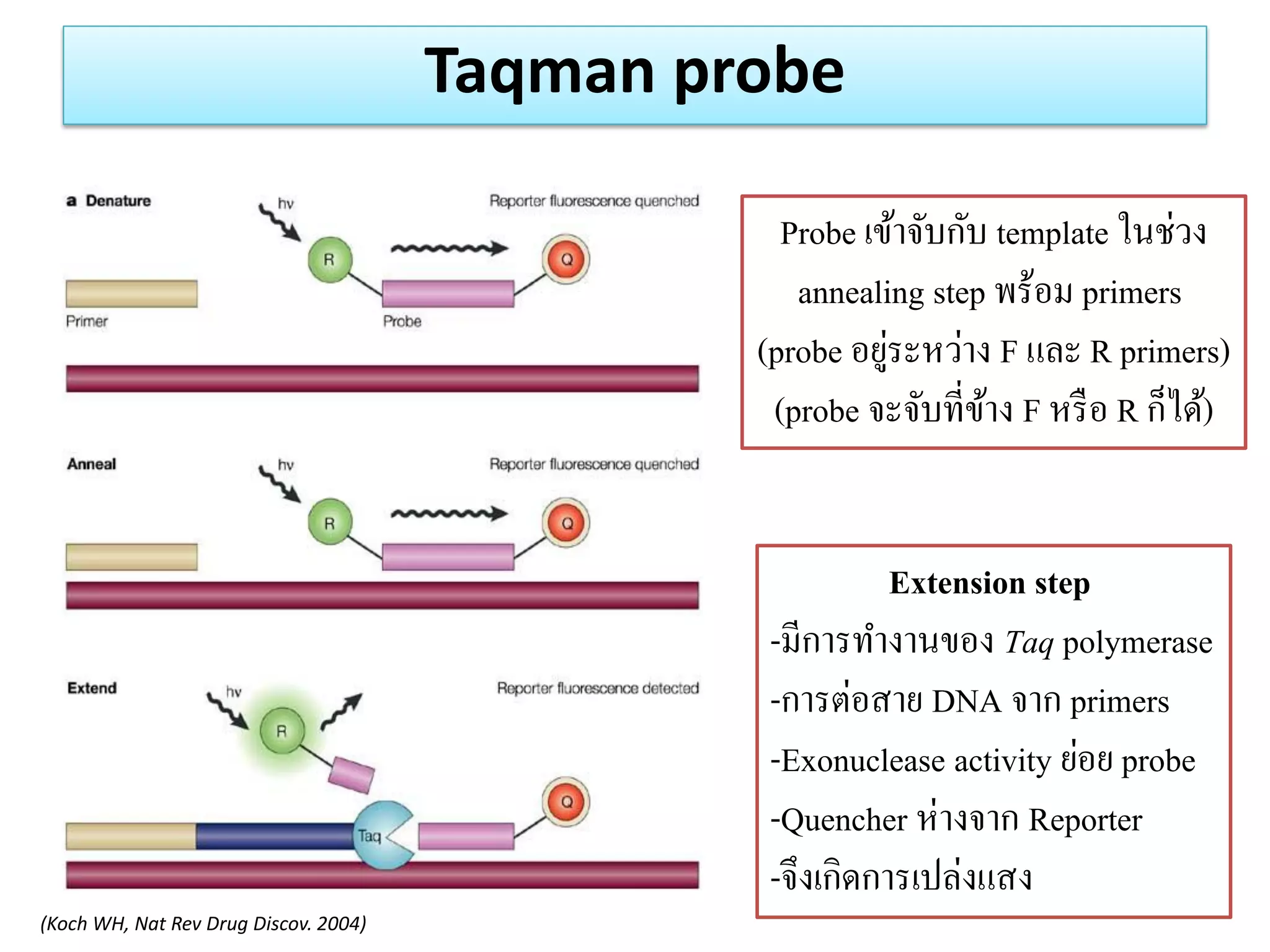
“ 5’3’ exonuclease of Taq polymerase 
during extension step hydrolyzes probe 
 Q ห่างจาก R 
 เปล่งแสง fluorescence” 
http://www.bio.davidson.edu/courses/molbio/molstudents/spring2003/pierce/TaqmanprobeonDNA.jpg 
http://en.wikipedia.org/wiki/File:Taqman.png
Taqman probe 
(Koch WH, Nat Rev Drug Discov. 2004) 
Probe เข้าจับกับ template ในช่วง 
annealing step พร้อม primers 
(probe อยู่ระหว่าง F และ R primers) 
(probe จะจับที่ข้าง F หรือ R ก็ได้) 
Extension step -มีการทางานของ Taq polymerase -การต่อสาย DNA จาก primers -Exonuclease activity ย่อย probe -Quencher ห่างจาก Reporter -จึงเกิดการเปล่งแสง
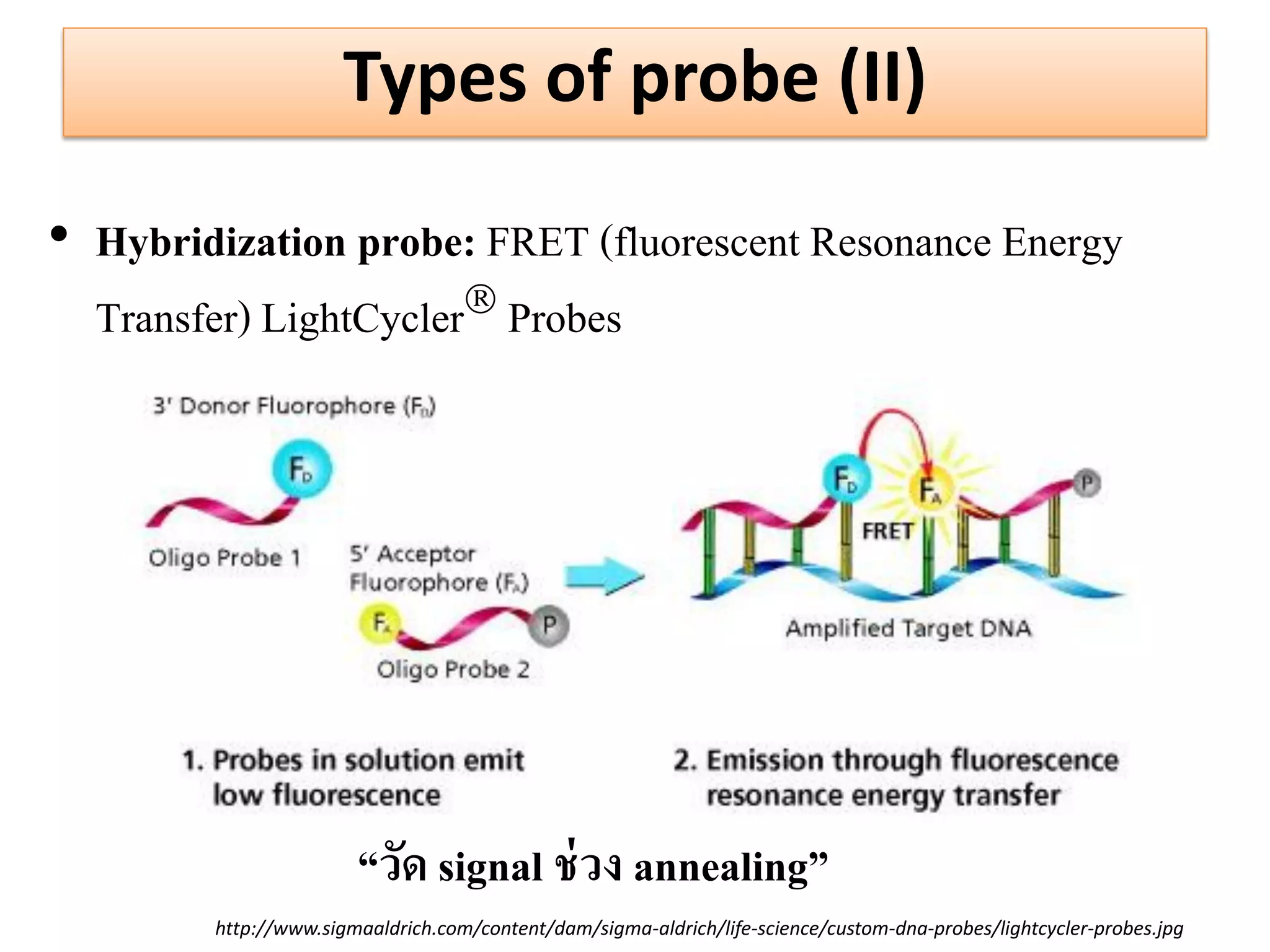
Types of probe (II) 
•Hybridization probe: FRET (fluorescent Resonance Energy Transfer) LightCycler Probes 
http://www.sigmaaldrich.com/content/dam/sigma-aldrich/life-science/custom-dna-probes/lightcycler-probes.jpg 
“วัด signal ช่วง annealing”
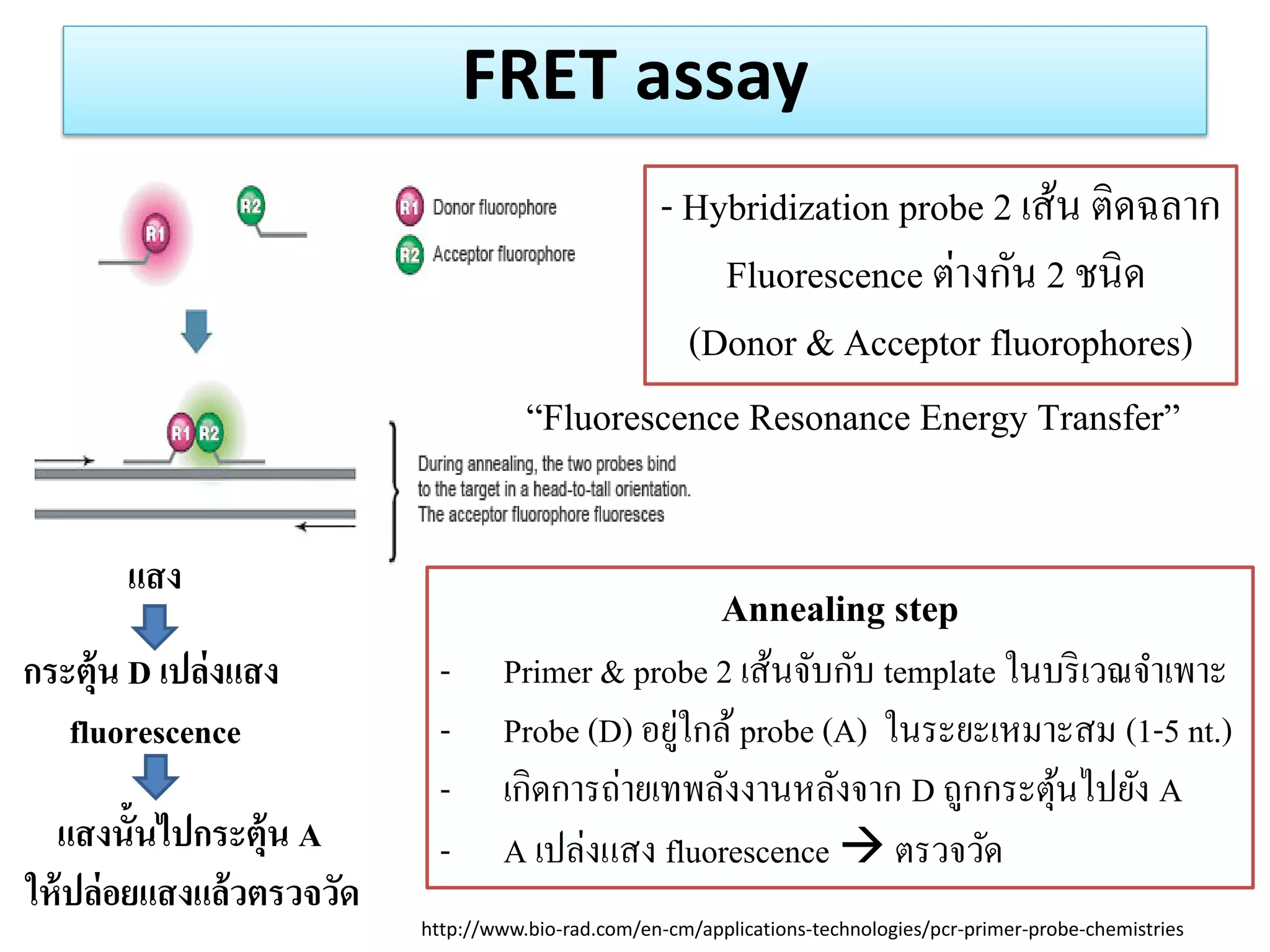
FRET assay 
http://www.bio-rad.com/en-cm/applications-technologies/pcr-primer-probe-chemistries 
- Hybridization probe 2 เส้น ติดฉลาก 
Fluorescence ต่างกัน 2 ชนิด 
(Donor & Acceptor fluorophores) 
Annealing step 
-Primer & probe 2 เส้นจับกับ template ในบริเวณจาเพาะ 
-Probe (D) อยู่ใกล้ probe (A) ในระยะเหมาะสม (1-5 nt.) 
-เกิดการถ่ายเทพลังงานหลังจาก D ถูกกระตุ้นไปยัง A 
-A เปล่งแสง fluorescence  ตรวจวัด 
แสง 
กระตุ้น D เปล่งแสง fluorescence 
แสงนั้นไปกระตุ้น A 
ให้ปล่อยแสงแล้วตรวจวัด 
“Fluorescence Resonance Energy Transfer”
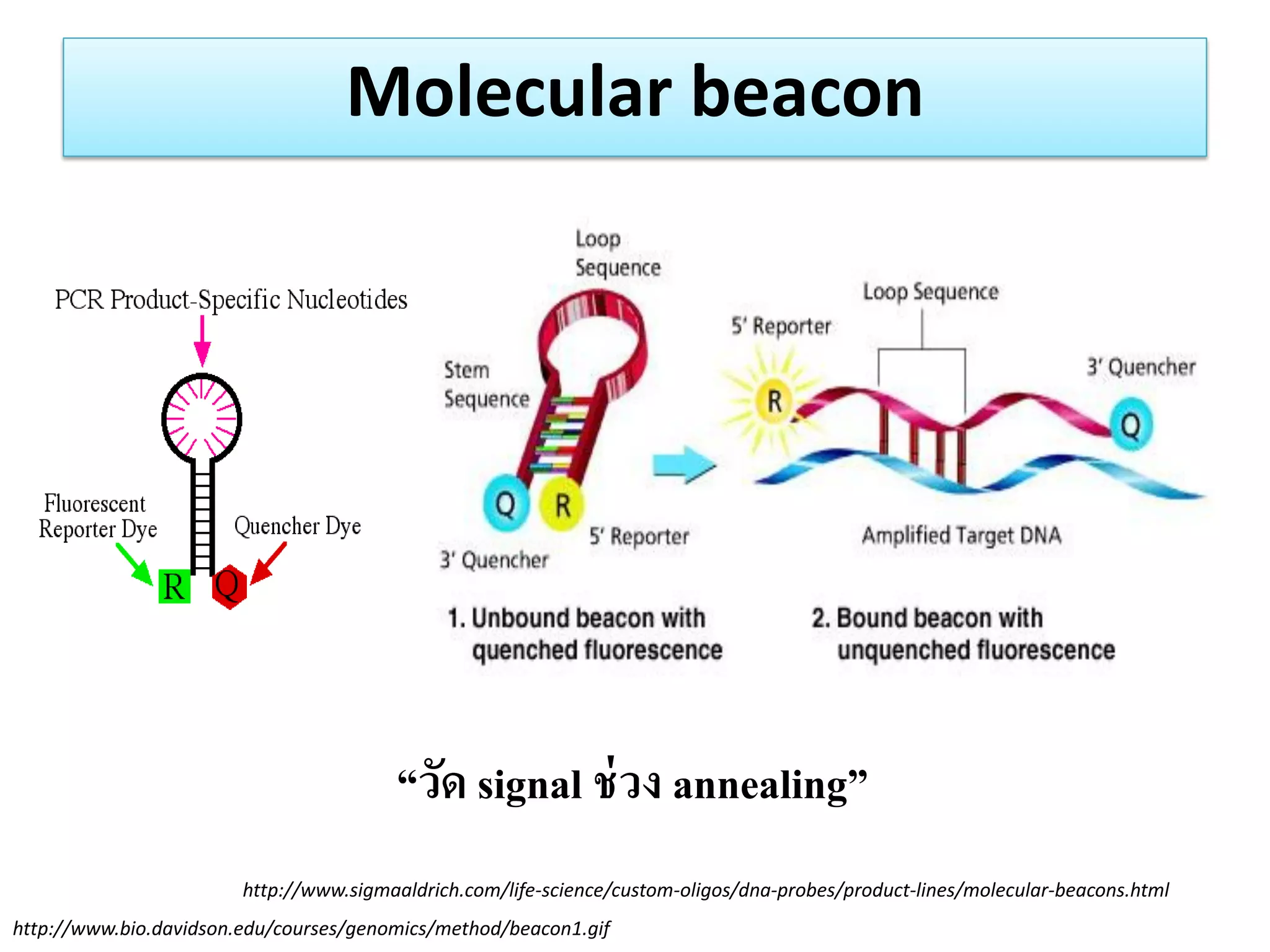
Molecular beacon 
http://www.bio.davidson.edu/courses/genomics/method/beacon1.gif 
“วัด signal ช่วง annealing” 
http://www.sigmaaldrich.com/life-science/custom-oligos/dna-probes/product-lines/molecular-beacons.html
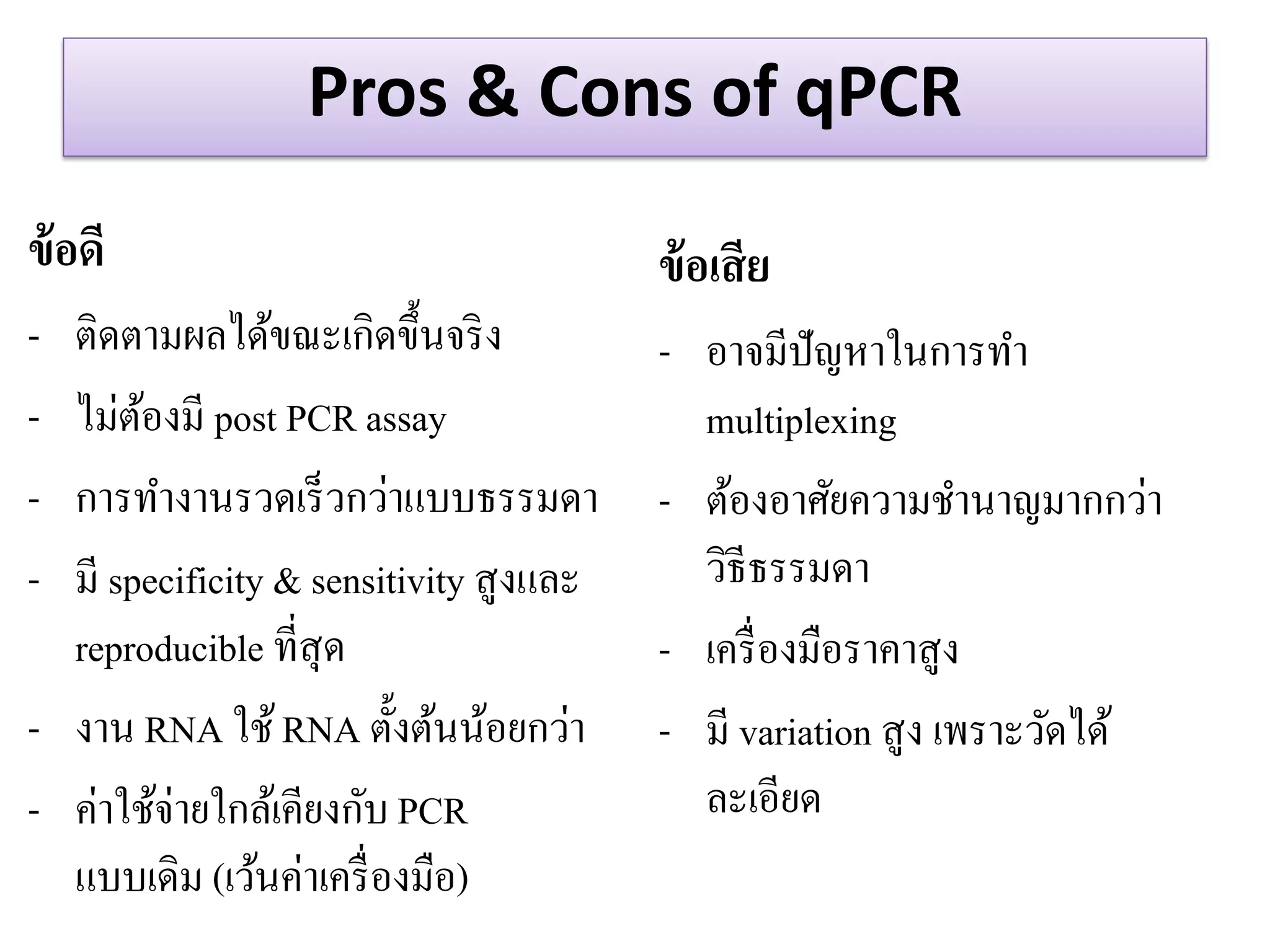
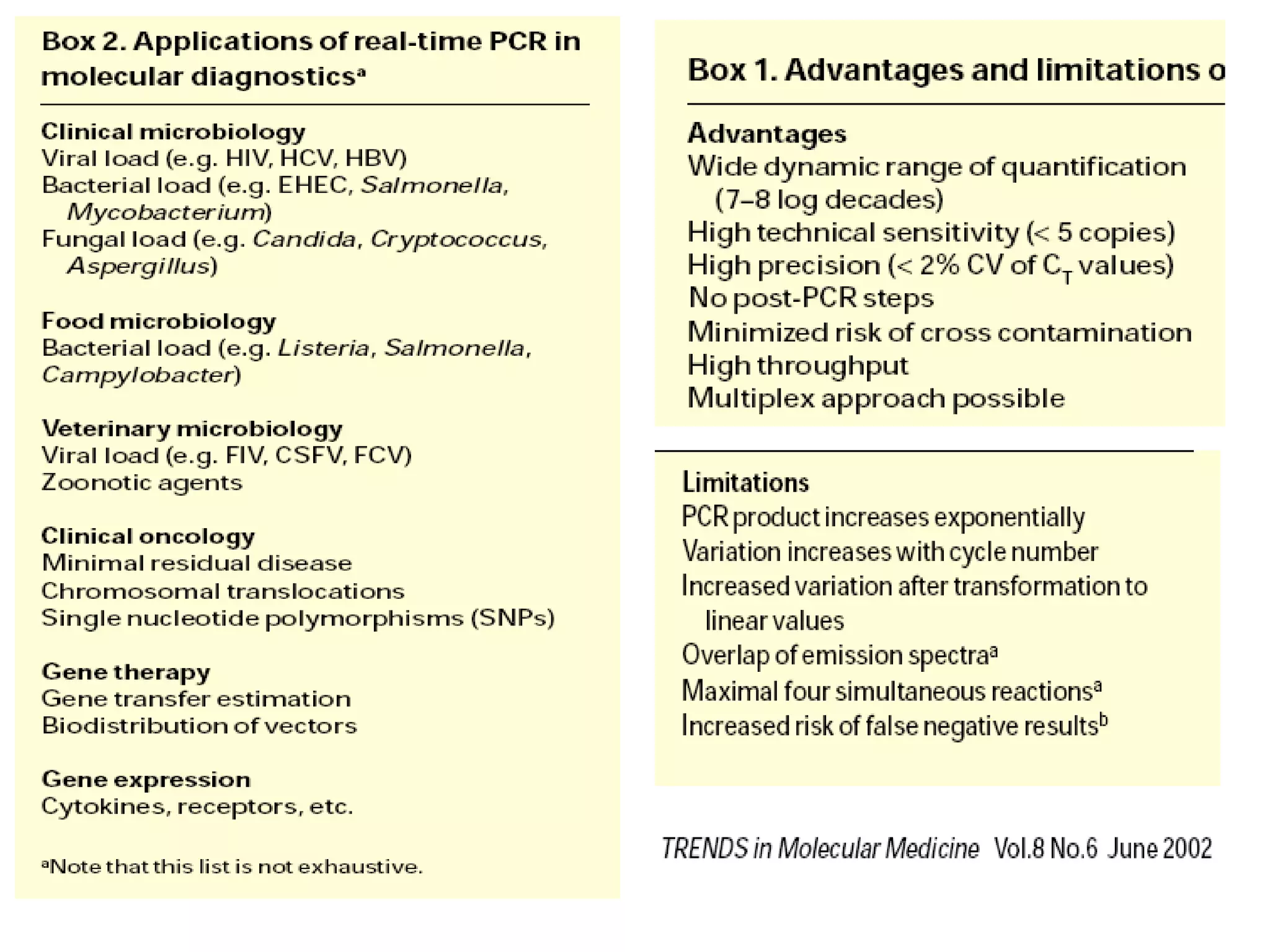
Pros & Cons of qPCR 
ข้อดี 
-ติดตามผลได้ขณะเกิดขึ้นจริง 
-ไม่ต้องมี post PCR assay 
-การทางานรวดเร็วกว่าแบบธรรมดา -มี specificity & sensitivity สูงและ reproducible ที่สุด -งาน RNA ใช้ RNA ตั้งต้นน้อยกว่า -ค่าใช้จ่ายใกล้เคียงกับ PCR แบบเดิม (เว้นค่าเครื่องมือ) 
ข้อเสีย -อาจมีปัญหาในการทา multiplexing 
-ต้องอาศัยความชานาญมากกว่า วิธีธรรมดา 
-เครื่องมือราคาสูง -มี variation สูง เพราะวัดได้ ละเอียด
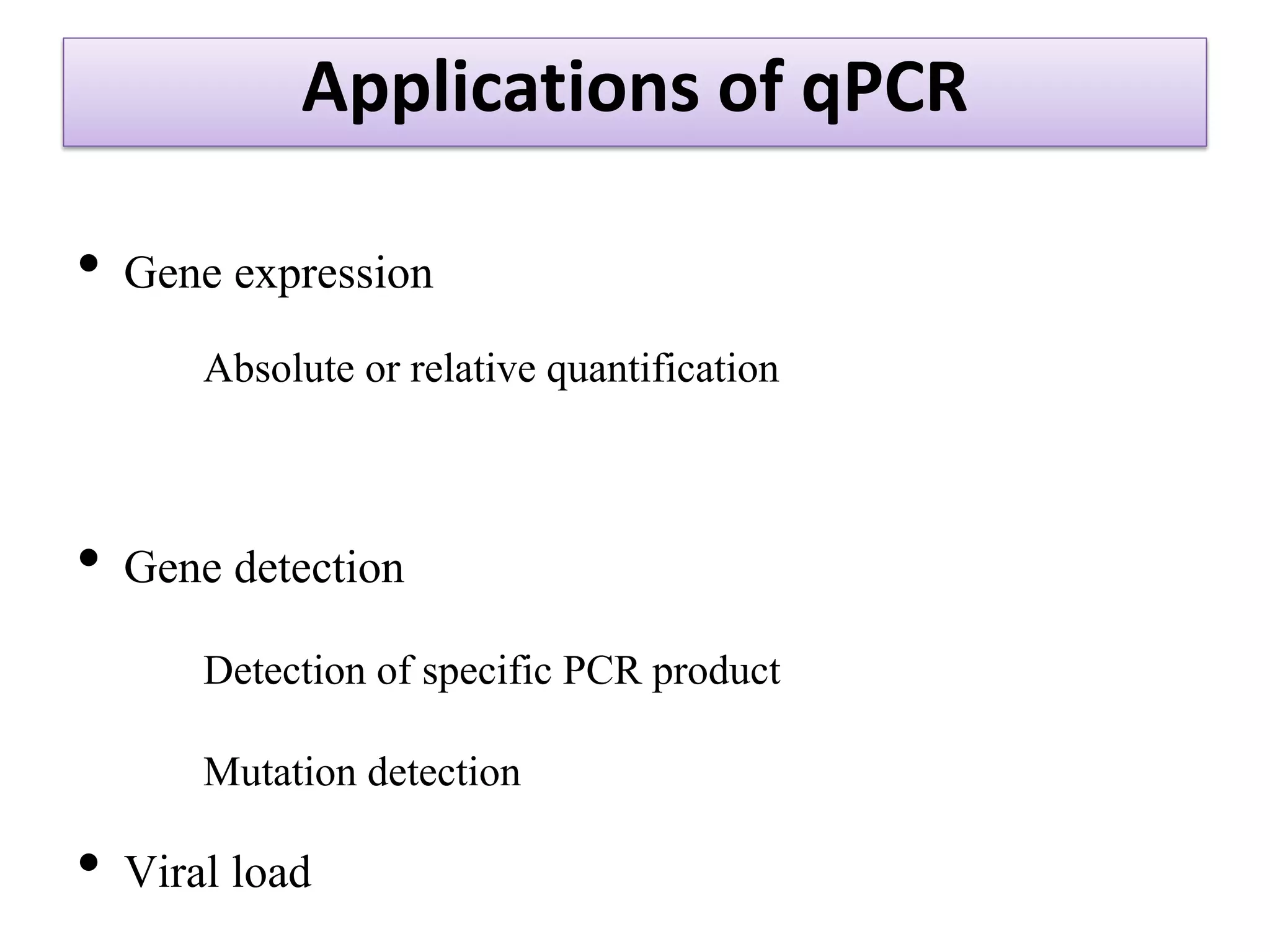
Applications of qPCR 
•Gene expression 
Absolute or relative quantification 
•Gene detection 
Detection of specific PCR product 
Mutation detection 
•Viral load
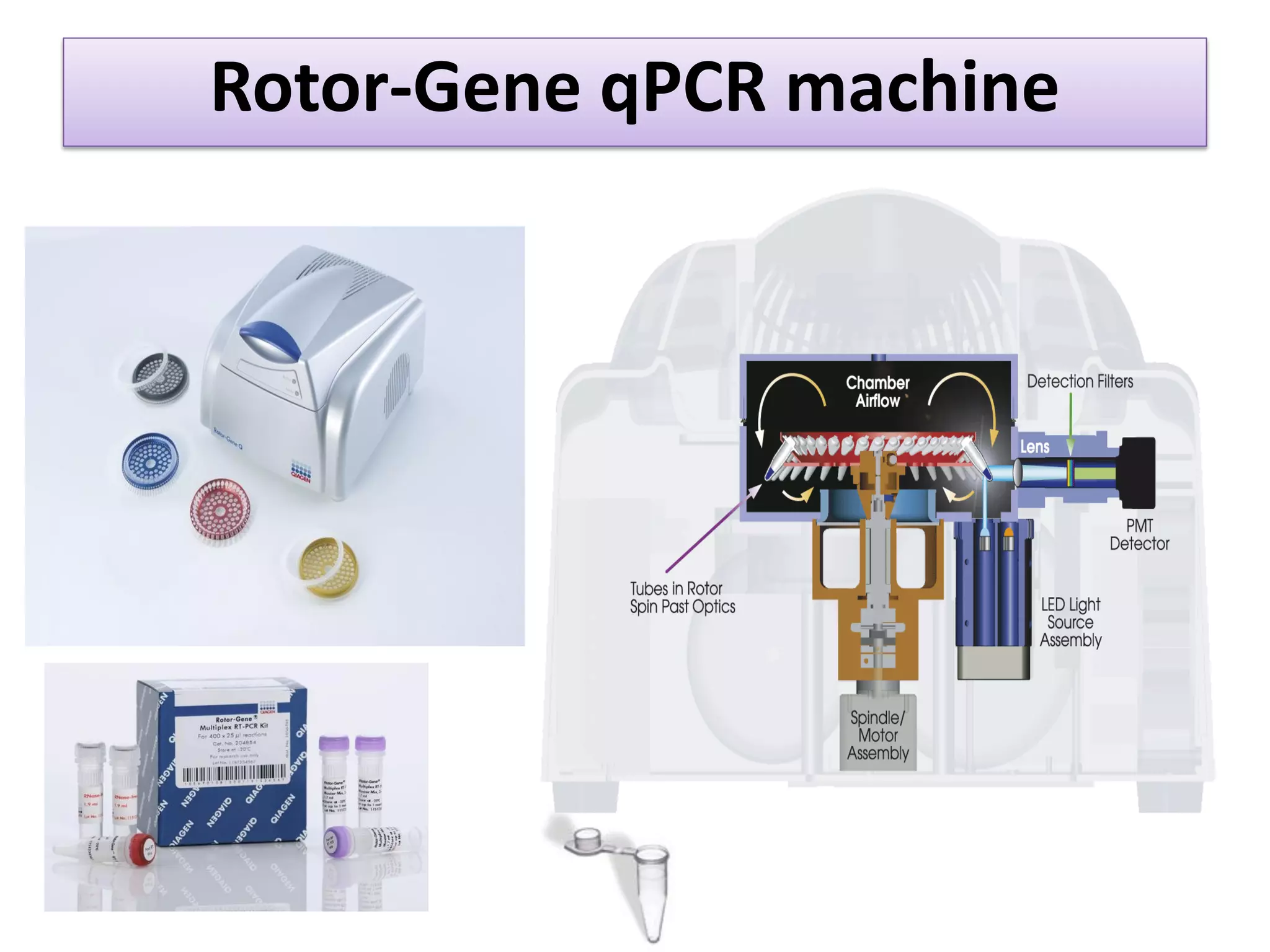
Rotor-Gene qPCR machine
PCR troubleshooting 
•ไม่มี PCR product หรือมีน้อย 
สำเหตุ 
-Reagents / PCR machine 
-Primers 
-Annealing temperature 
-Reaction เกิดไม่ดี 
-Incomplete denaturation of DNA template - Presence of inhibitors 
กำรแก้ไข 
-ทา positive control 
-Change primers 
-Decrease temperature 
-Mg2+, pH, [primers], [dNTPs], solvent optimization 
-Increase temperature or time of denaturation - Purified DNA template
PCR troubleshooting (II) 
•มี primer dimer มำก  PCR product น้อยหรือไม่มี 
สำเหตุ 
-คู่ primers มีเบสคู่สม 
กำรแก้ไข 
-เลือก primers ใหม่ 
-Annealing temperature and [Mg2+] optimization
PCR troubleshooting (III) 
•Non-specific PCR products 
สำเหตุ 
-Non-specific primer binding 
กำรแก้ไข 
-annealing temperature 
-Adjust [Mg2+] and pH 
- primers and/or enzyme 
-Using Hot Start PCR 
http://www.biochem.arizona.edu/miesfeld/teaching/Bioc471-2/pages/Lecture12/Lecture12.html
PCR troubleshooting (IV) 
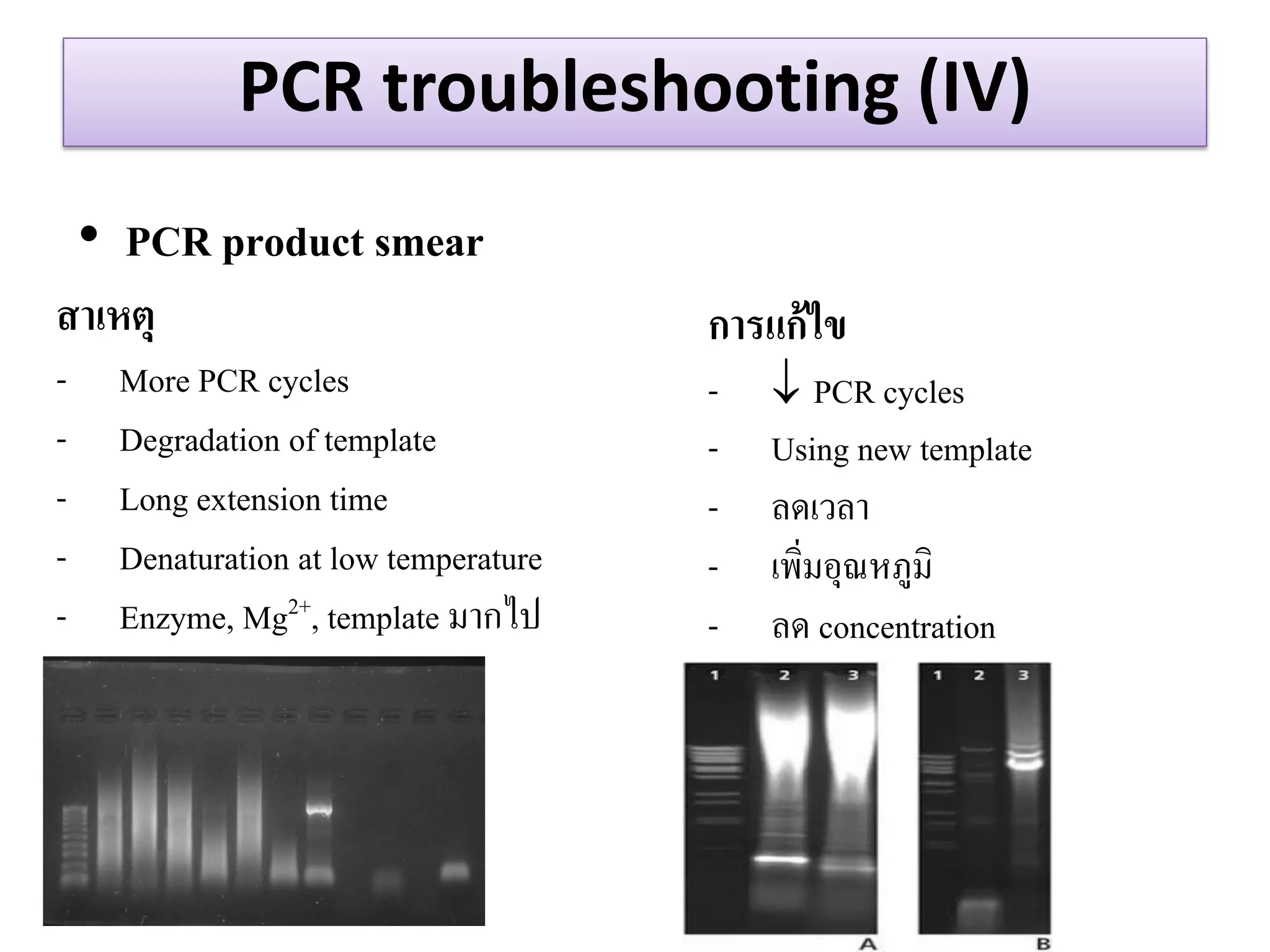
•PCR product smear 
สำเหตุ 
-More PCR cycles 
-Degradation of template 
-Long extension time 
-Denaturation at low temperature 
-Enzyme, Mg2+, template มากไป 
กำรแก้ไข 
-PCR cycles 
-Using new template 
-ลดเวลา 
-เพิ่มอุณหภูมิ 
-ลด concentration
กำรลดกำรปนเปื้อนจำกขั้นตอน PCR 
-Reduce false positive from exogenous sources 
-Tips for better PCR assay 
-Nucleic extraction, pre-PCR, PCR and post-PCR
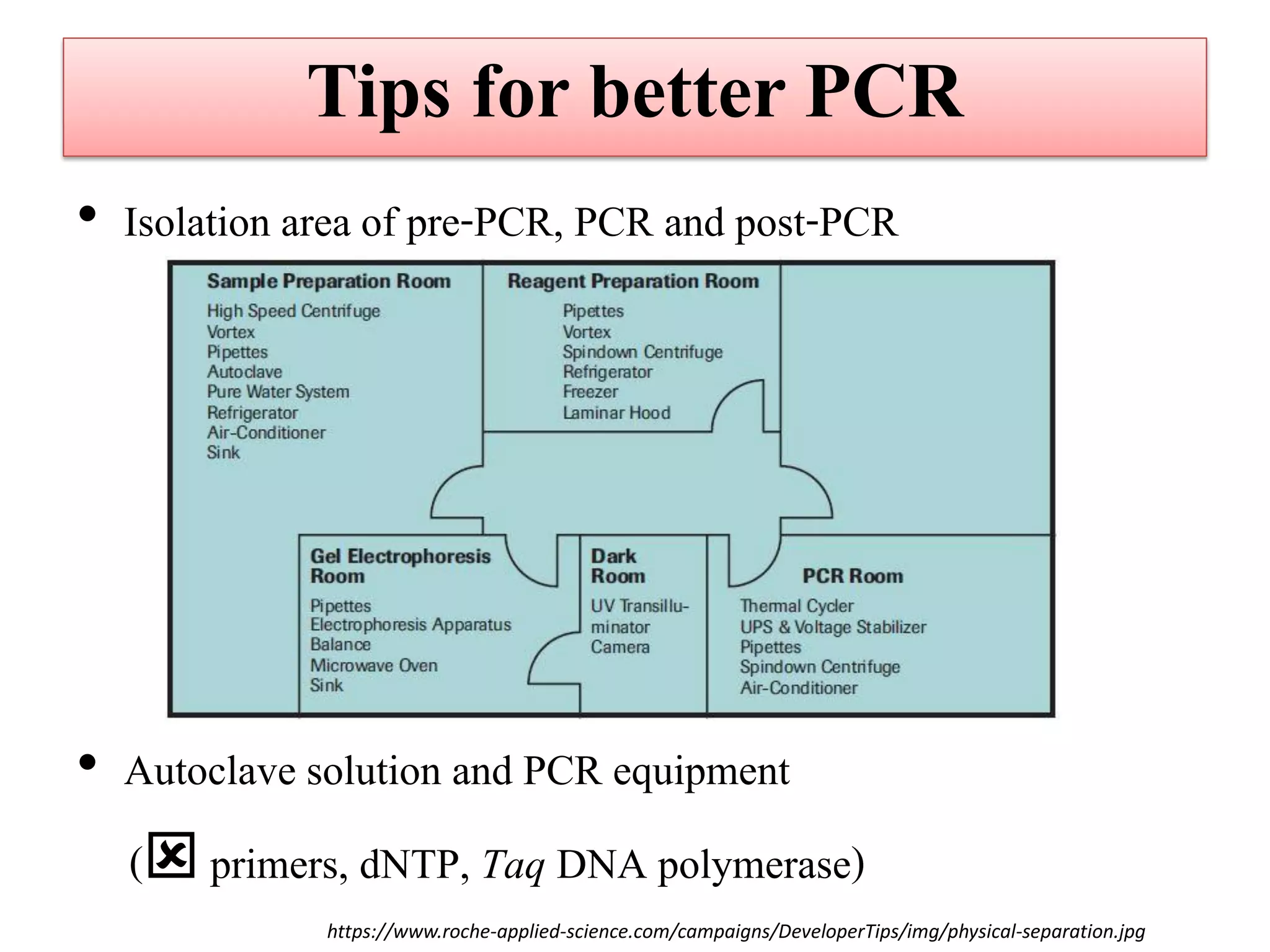
Tips for better PCR 
•Isolation area of pre-PCR, PCR and post-PCR 
•Autoclave solution and PCR equipment 
( primers, dNTP, Taq DNA polymerase) 
https://www.roche-applied-science.com/campaigns/DeveloperTips/img/physical-separation.jpg
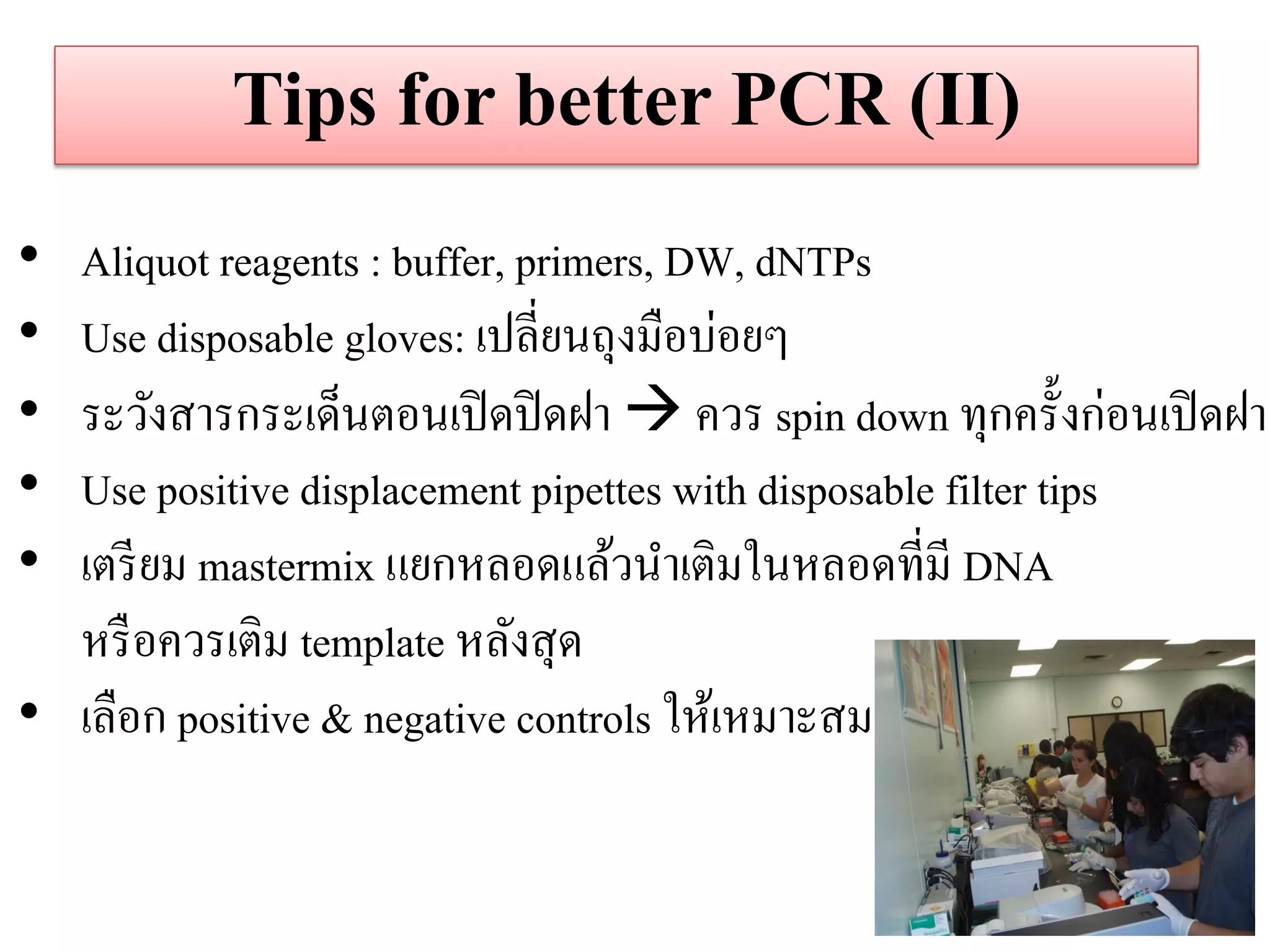
Tips for better PCR (II) 
•Aliquot reagents : buffer, primers, DW, dNTPs 
•Use disposable gloves: เปลี่ยนถุงมือบ่อยๆ 
•ระวังสารกระเด็นตอนเปิดปิดฝา  ควร spin down ทุกครั้งก่อนเปิดฝา 
•Use positive displacement pipettes with disposable filter tips 
•เตรียม mastermix แยกหลอดแล้วนาเติมในหลอดที่มี DNA หรือควรเติม template หลังสุด 
•เลือก positive & negative controls ให้เหมาะสม
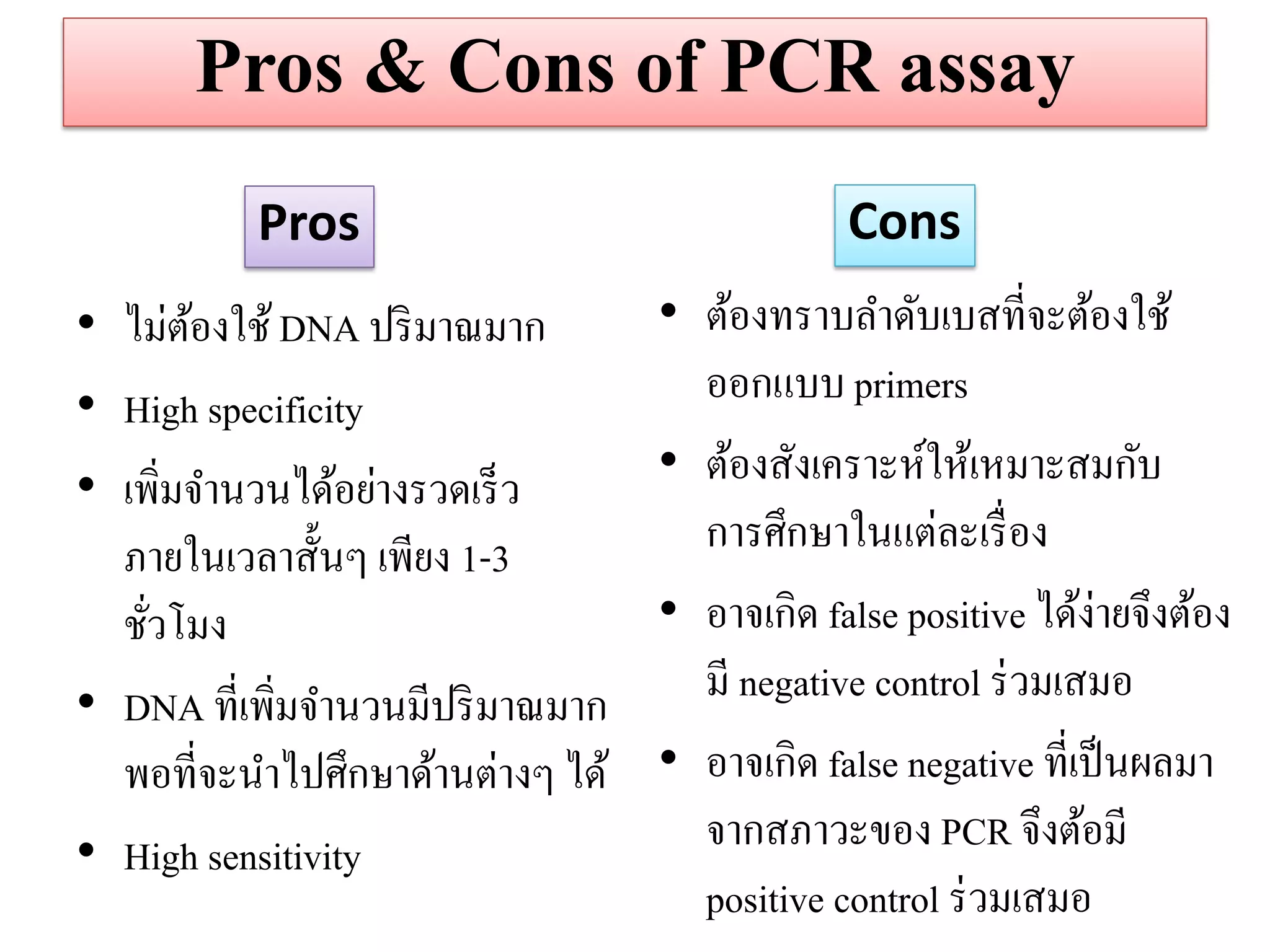
Pros & Cons of PCR assay 
•ไม่ต้องใช้ DNA ปริมาณมาก 
•High specificity 
•เพิ่มจานวนได้อย่างรวดเร็ว ภายในเวลาสั้นๆ เพียง 1-3 ชั่วโมง •DNA ที่เพิ่มจานวนมีปริมาณมาก พอที่จะนาไปศึกษาด้านต่างๆ ได้ 
•High sensitivity 
•ต้องทราบลาดับเบสที่จะต้องใช้ ออกแบบ primers 
•ต้องสังเคราะห์ให้เหมาะสมกับ การศึกษาในแต่ละเรื่อง •อาจเกิด false positive ได้ง่ายจึงต้อง มี negative control ร่วมเสมอ •อาจเกิด false negative ที่เป็นผลมา จากสภาวะของ PCR จึงต้อมี positive control ร่วมเสมอ 
Pros 
Cons
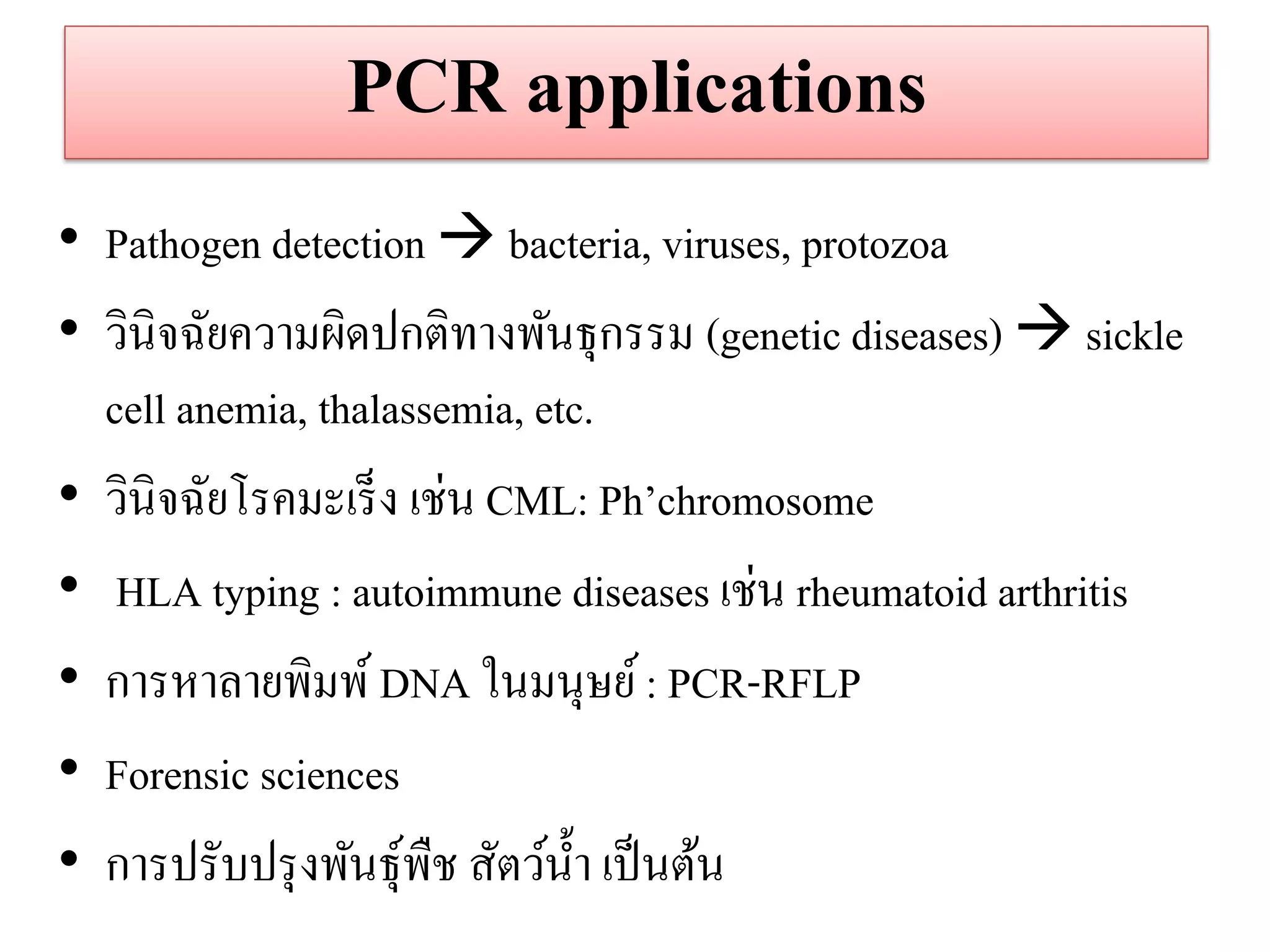
PCR applications 
•Pathogen detection  bacteria, viruses, protozoa •วินิจฉัยความผิดปกติทางพันธุกรรม (genetic diseases)  sickle cell anemia, thalassemia, etc. 
•วินิจฉัยโรคมะเร็ง เช่น CML: Ph’chromosome 
• HLA typing : autoimmune diseases เช่น rheumatoid arthritis 
•การหาลายพิมพ์ DNA ในมนุษย์ : PCR-RFLP 
•Forensic sciences 
•การปรับปรุงพันธุ์พืช สัตว์น้า เป็นต้น
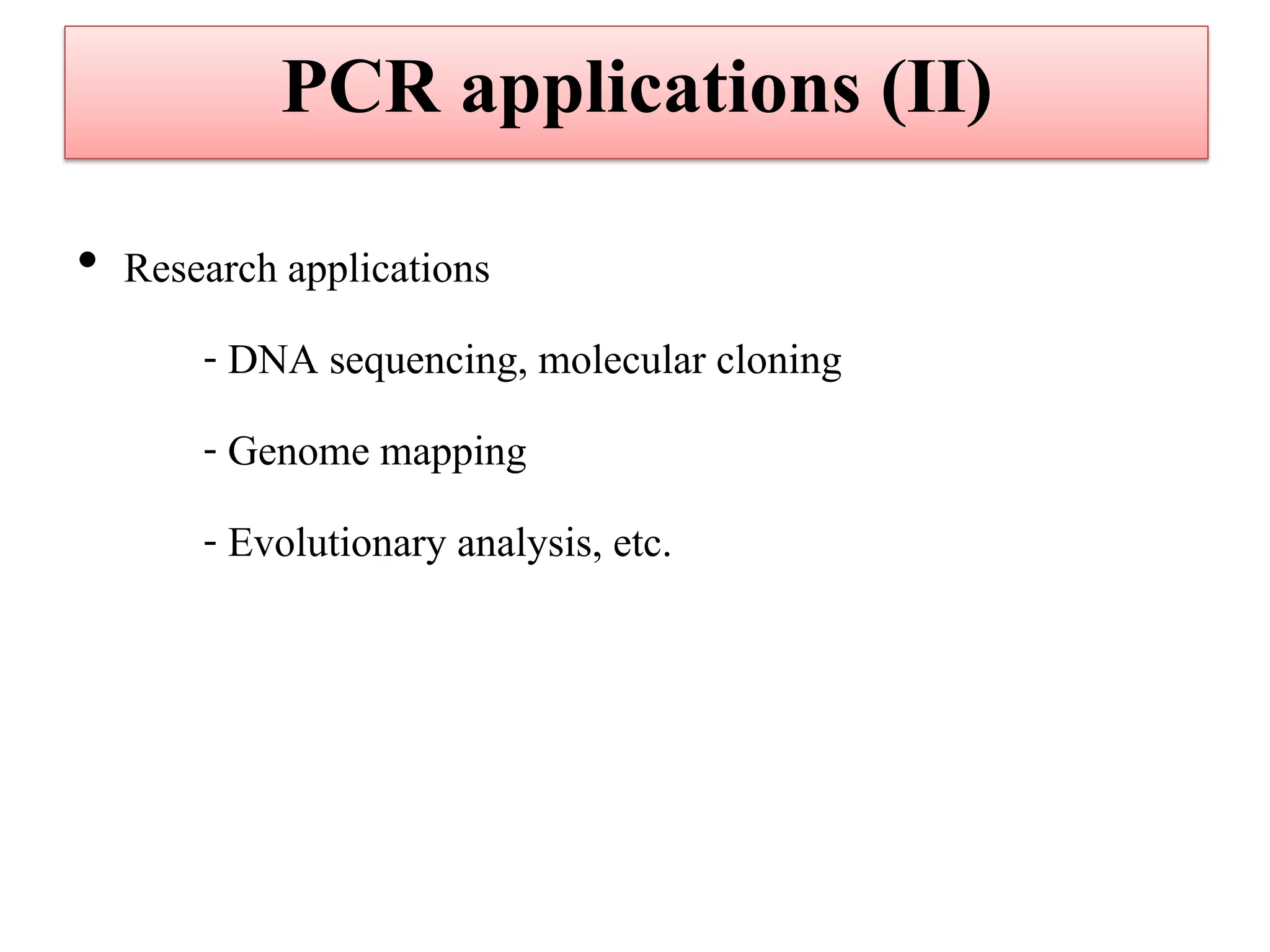
•Research applications 
- DNA sequencing, molecular cloning 
- Genome mapping 
- Evolutionary analysis, etc. 
PCR applications (II)
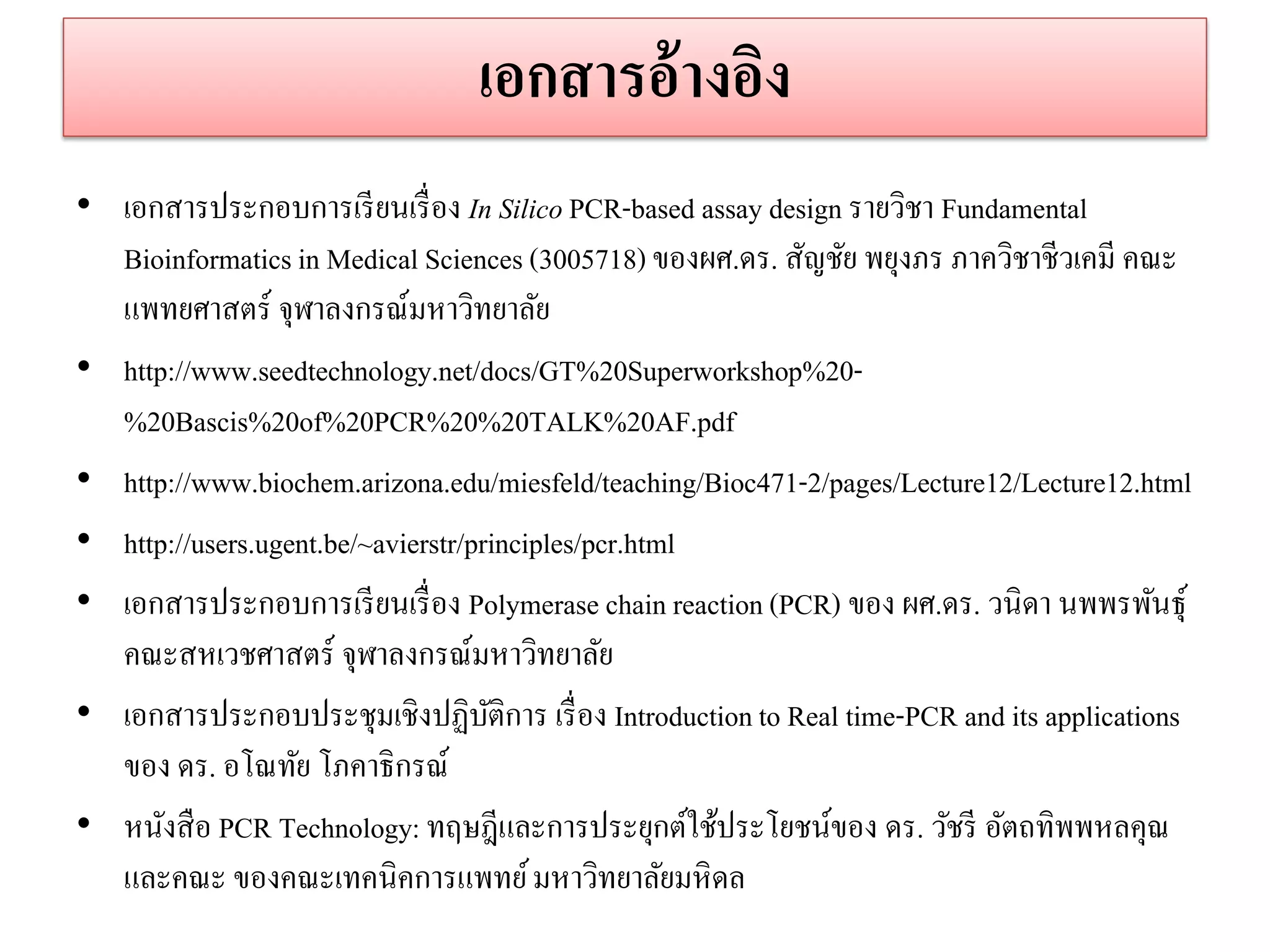
เอกสำรอ้ำงอิง 
•เอกสารประกอบการเรียนเรื่อง In Silico PCR-based assay design รายวิชา Fundamental Bioinformatics in Medical Sciences (3005718) ของผศ.ดร. สัญชัย พยุงภร ภาควิชาชีวเคมี คณะ แพทยศาสตร์ จุฬาลงกรณ์มหาวิทยาลัย 
•http://www.seedtechnology.net/docs/GT%20Superworkshop%20- %20Bascis%20of%20PCR%20%20TALK%20AF.pdf 
•http://www.biochem.arizona.edu/miesfeld/teaching/Bioc471-2/pages/Lecture12/Lecture12.html 
•http://users.ugent.be/~avierstr/principles/pcr.html •เอกสารประกอบการเรียนเรื่อง Polymerase chain reaction (PCR) ของ ผศ.ดร. วนิดา นพพรพันธุ์ คณะสหเวชศาสตร์ จุฬาลงกรณ์มหาวิทยาลัย •เอกสารประกอบประชุมเชิงปฏิบัติการ เรื่อง Introduction to Real time-PCR and its applications ของ ดร. อโณทัย โภคาธิกรณ์ •หนังสือ PCR Technology: ทฤษฎีและการประยุกต์ใช้ประโยชน์ของ ดร. วัชรี อัตถทิพพหลคุณ และคณะ ของคณะเทคนิคการแพทย์ มหาวิทยาลัยมหิดล
เอกสำรอ้ำงอิง (II) 
•หนังสือเวชศาสตร์โมเลกุล : Molecular medicine บรรณาธิการ สุรางค์ นุชประยูร, จินตนา จิรถาวร, ณัฎฐิยา หิรัญกาญจน์ ของคณะแพทยศาสตร์ จุฬาลงกรณ์มหาวิทยาลัย •เอกสารวิชาการของ รศ. ดร. วีระพงศ์ ลุลิตานนท์ และคณะเรื่อง (สามารถอ่าน online ได้) 
1. พื้นฐานเทคนิค Polymerase Chain Reaction 
2. การออกแบบ PCR primers 
3. พื้นฐาน Real Time Polymerase Chain Reaction 
4. การลดและการป้องกันการปนเปื้อนในงาน PCR

Principle of PCR

  • 1.
    Principle of PCRand applications Methee Sriprapun, PhD Division of Clinical Microbiology Faculty of Medical Technology Huachiew Chalermprakiet University Email: sriprapun.m@gmail.com
  • 2.
    PCR (polymerase chainreaction) “การสังเคราะห์และเพิ่มจานวนชิ้นส่วน DNA ที่ต้องการในหลอด ทดลองอย่างต่อเนื่องเป็นลูกโซ่โดยอาศัยการเร่งปฏิกิริยาของ DNA polymerase ที่ทนความร้อน” https://www.neb.com/~/media/NebUs/Page%20Images/Applications/DNA%20Amplification%20and%20PCR/pcr.jpg
  • 3.
    PCR components •DNAtemplate •Oligonucleotide primers (forward & reverse) •Deoxynucleotide triphosphate (dNTPs) - dATP, dTTP, dCTP, dGTP •Buffer ที่มี Mg2+ •DNA polymerase : Taq polymerase http://pbgworks.org/sites/pbgworks.org/files/user/25/eLib_PCR.png
  • 4.
    DNA Template •Extractedfrom cells or tissues •Check purity of extracted DNA: A260/A280  1.7 – 2.0 •Using optimum concentration (เช่น 0.02-5g/50l) Primers http://mcdb4111.pbworks.com/w/page/20635666/Site-Directed-Mutagenesis Forward & reverse primers Optimum conc. : 0.1-1.0 M/rxn “Nucleotide สายสั้นๆ (17-30 nt.) ที่เป็นจุดเริ่มของการสร้าง DNA สายใหม่ในกระบวนการ PCR”
  • 5.
    Deoxynucleotide triphosphate (dNTPs) •Mixture of dATP, dTTP, dCTP and dGTP •20-200 M PCR buffer •ทาให้ปฏิกิริยา PCR เป็นไปได้อย่างเหมาะสม •Tris HCl, KCl, MgCl2 •Optimization of [Mg2+] is necessary  1.5-2.0 mM •Mg2+  cofactor of Taq DNA polymerase •มักถูกเตรียมในรูปของ 10X, 5X, 2X
  • 6.
    •Taq polymerase :Thermus aquaticus (mostly used) •Optimum conc. for PCR: 1 – 2.5 unit/rxn •Tth DNA polymerase (RT ในภาวะที่มี Mn2+, DNA polymerase ภาวะที่มี Mg2+) , Pfu DNA polymerase (มี proof reading activity) DNA polymerase http://www.biochem.arizona.edu/miesfeld/teaching/Bioc471- 2/pages/Lecture12/Lecture12.html
  • 7.
    Enhancer & Inhibitorof DNA polymerase Enhancer Inhibitor Dimethyl sulfoxide (DMSO) Glycerol Formamide Bovine serum albumin (BSA) Polyethylene glycol 6000 (PEG) Tween 20 Gelatin Phenol Sodium dodecyl sulfate (SDS) Proteinase K Heparin Porphyrin EDTA
  • 8.
    There are 3steps of PCR •Heat denaturation step: 90-95C - DNA ต้นแบบสายคู่จะแยกออกจากกัน •Primer annealing step: 40-60 C - Primers จะจับกับสาย DNA บริเวณที่มีเบสคู่สมกัน •Extension step: 70-75 C - การเติมสาย nucleotide ต่อจาก primers ในแต่ละข้าง ทิศทาง 5’  3’ - DNA polymerase activity ( Taq polymerase, Pfu polymerase, etc. ) http://www.caister.com/supplementary/pcr-troubleshooting/gifs/c1f1.jpg
  • 9.
  • 10.
    Steps of PCR http://users.ugent.be/~avierstr/principles/pcrani.html
  • 11.
    Steps of PCR(II) http://www.biosistemika.com/uploads/PCR_sketch_4.jpg
  • 12.
    2n ; n= จำนวนรอบของ PCR จำนวน PCR product = > 20 cycles of PCR > million of PCR products cycles,  PCR product  PCR components PCR product ใน cycle ท้ายลดลง PCR product อาจจับกันเอง การเพิ่มจานวนไม่เป็นแบบ 2n “Plateau effect”
  • 13.
    Amplification Plateau http://www.biochem.arizona.edu/miesfeld/teaching/Bioc471-2/pages/Lecture12/AMG6.2b.gif 1. dNTP &  primers 2.Instability of dNTPs and Taq polymerase 3. End-product inhibition 4.Competitive reaction of non-specific product or primer-dimer กำรแก้ไข: ปรับจำนวนรอบในกำรทำ PCR ให้เหมำะสม
  • 14.
    กำรแบ่งประเภทของ PCR PCR Conventional PCR Realtime PCR (qPCR) Advanced PCR - Endpoint detection - realtime detection
  • 15.
    •PCR preparation: equipment,reagents, place, etc. •Following the instruction manual in reagent leaflet •Isolation area : pre-PCR, PCR and post-PCR assays •Scientist must know “Tm of primers”. Be careful of contamination ! Set up of Conventional PCR
  • 16.
    PCR tube: 0.2ml, 0.5 ml 1.5 ml tube: mastermix PCR rack PCR reagents Storage: -20 C PCR cooler box Pipette tips Autopipettes Filtered tips
  • 17.
    PCR cabinet PCRmachine UV transilluminator or Gel doc
  • 18.
    How to calculatemastermix 1x เมื่อคานวณเทียบกับ ปริมาตรที่ใช้ใน 1 rxn -1x คือ 1 reaction ถ้ำ 10 reaction ต้องคำนวณ 10x -สำมำรถ adjust สัดส่วน volume ได้แต่ต้องไม่น้อยเกินไป -สูตรคำนวณที่ใช้คือ C1V1 = C2V2 (คำนวณ final concentration)
  • 19.
    Ex. ต้องกำรเตรียม PCRmastermix 5 reactions จงแสดงวิธีกำรคำนวณ เรำมักเตรียมเผื่อไปอย่ำงน้อย 0.5X หรือ 1X เพื่อป้องกัน pipette error Reagents 1X (l) 5X (l) Final conc. 2X Taq Master Mix 10 50 1X 10 M Forward primer 2.0 10 1 M 10 M Reverse primer 2.0 10 1 M Nuclease free water 4 20 - DNA template (25 ng/l) 2.0 - 50 ng (2.5 ng/l) Total 20 แบ่งใส่ tube ละ 18 l + 2 l template DNA
  • 20.
    PCR condition (example) Pre denaturation: 94C 2 minutes Denaturation: 94C 2 seconds Annealing: 53C 30 seconds Extension: 72C 1 minutes Final extension: 72C 7 minutes 35 cycles อาจปรับเปลี่ยนได้ตามความเหมาะสม แต่ annealing temp. ต้องดูให้ดี
  • 21.
    Product size ofPCR Position แรก ของ nt. (F primer) – Position สุดท้าย ของ nt. (R primer) เช่น จงคานวณ PCR product เมื่อใช้ primers ต่อไปนี้ A primer (forward) position: 988-1006 B primer (reverse) position: 2216-2196 988 1106 2196 2216 PCR product  2216 – 988 = 1,228 bp (ดังนั้น Extension time ควรใช้เวลา..............นาที)
  • 22.
    Primer optimization Factors ลาดับเบสของ primers Base at 3’-end Hairpin loop ใน primers Primer dimer %GC content ความยาว primers ค่า Tm How to optimization Complementary with DNA template ควรมี G หรือ C จานวน 1-2 base (s) หลีกเลี่ยงเบสคู่สมตั้งแต่ 3 bases ขึ้นไป ที่จับกันได้ใน primer สายเดียวกัน หลีกเลี่ยงเบสคู่สมตั้งแต่ 3 bases ขึ้นไป ที่จับกันได้ระหว่าง primer 2 สาย 45-55% 18-30 bases 40-60 C และค่า Tm ของ primers 2 เส้น ไม่ควรห่างกันเกิน 2-3 C
  • 23.
    Optimization of thermalcycle condition Annealing temperature: ต่ากว่า Tm of primer  5 C Cycles of PCR :  25-35 cycles Optimum [Mg2+] = 1.5 – 2.0 mM การเพิ่ม-ลด มีผลต่อการเพิ่มปริมาณ product pH 8.3 Total volume: 10-100 l Tm= 2 x (no. of [A+T]) + 4 x (no. of [G+C]) Optimization of Mg2+ concentration Optimization of pH in reaction
  • 24.
    Optimization of dNTPconcentration Optimization of Taq polymerase 20-200 M 1-2.5 unit/reaction Controls in PCR assay Positive control: template ที่สามารถจับกับ primers ได้แน่นอน Negative: template ที่ primers ไม่สามารถจับได้ NTC (No template control): PCR mastermix only ! (No adding of template)  จัดเป็น negative control แบบหนึ่ง *อย่างน้อยควรมี positive และ NTC controls
  • 25.
    PCR product detection •Agarose gel electrophoresis เทียบกับ DNA marker •Stained with 0.5 g/ml ethidium bromide •นาไปส่องดูด้วยเครื่อง Ultraviolet (UV) transilluminator หรือ GelDoc http://upload.wikimedia.org/wikipedia/ commons/6/60/Gel_electrophoresis_2.jpg http://bioprep.community.uaf.edu/ files/2013/07/gel1.jpg
  • 26.
    •To separate DNAfragment or PCR product •Agarose gel electrophoresis •Polyacrylamide gel electrophoresis Electrophoresis of DNA or PCR product
  • 27.
    Agarose & polyacrylamidegels Polyacrylamide gel (Vertical gel electrophoresis) http://employees.csbsju.edu/hjakubowski/classes/ch331/Techniques/gelelectrophoresis.gif Agarose gel (Horizontal gel electrophoresis) http://media-2.web.britannica.com/eb-media/72/47672- 004-4E16B61F.jpg
  • 28.
    Difference ??? •Agarosegel electrophoresis อ่ำนำจกำรจ่ำแนกจะต่ำ (bp ต่ำงกันน้อยๆ จะแยกยำก) สำมำรถแยกได้ช่วงกว้ำงกว่ำ (200 bp – 5 kb)  vary gel conc. ถ้ำแยกขนำดใหญ่ pulsed-field gel electrophoresis •Polyacrylamide gel electrophoresis อ่ำนำจกำรจ่ำแนกสูง (แยกขนำดต่ำงกัน 1 bp ได้) ใช้แยกขนำด DNA ขนำดเล็ก (5-500 bp) Gel เตรียมยำก ถือยำก แตกหักง่ำย เปรำะบำง
  • 29.
    % of agarosegel electrophoresis http://abe.leeward.hawaii.edu/Protocols/DNA%20Gel%20Preparation%20and%20Electrophoresis.htm
  • 30.
    Agarose gel electrophoresis Running buffer อำจใช้ 1XTBE, 1XTAE หรือ 1xTPE Gel chamber, gel cassette and comb Power supply Agarose powder PCR product DNA loading dye and DNA marker
  • 31.
    How to preparegel electrophoresis http://sciencefair.math.iit.edu/techniques/gelelectrophoresis/
  • 32.
  • 33.
    Gel electrophoresis •Agarosegel electrophoresis (% gel ขึ้นกับขนาด PCR product และความละเอียดในการแยก band) •% gel สูงๆ เหมาะกับงาน multiplex •DNA marker •Loading buffer or loading dye (6X) •PCR product
  • 34.
    Dye for stainingPCR product •Ethidium Bromide •SYBR Green I : not recommended for in-gel staining เพราะ dye มีผลต่อ migration of DNA on gel •SYBR Gold: ราคาแพง แต่ sensitivity สูงกว่า EtBr and SYBR Green I Staining processes Pre staining method Post staining method In-gel staining method
  • 35.
    Reminder !!! •DNAเคลื อนที จำกขั้วลบไปบวก •PCR product ขนำดเล็ก (bp น้อย) เคลื อนที เร็วกว่ำ •Agarose gel electrophoresis: “submarine gel electrophoresis” •เติม buffer ก่อนจึงค่อยโหลด sample + loading dye ลง gel ระวัง : ห้ำมต่อสำยไฟผิดขั้ว !!! 1kb 800 bp 250 bp 100 bp
  • 36.
    Reminder !!! (II) •ใช้ buffer ชนิดเดียวกันในกำรเตรียม gel และ rug gel เสมอ •อย่ำลืมผสม PCR product กับ loading dye ก่อนโหลดใน well •อย่ำลืมใส่ DNA marker ก่อนที จะ run gel •ปิดฝำ gel chamber ก่อนเสียบสำยไฟและเริ มเปิด power supply เพื อ rug gel •0.5 g/ml ethidium bromide in DW 15 นำที จำกนั้น destaining ด้วย DW 5-10 นำที ส่องด้วย UV transilluminator or Gel Doc Visualization of PCR product on gel
  • 37.
    เกร็ดความรู้ •Salt inelectrophoresis buffer: preserve PCR product during gel electrophoresis •In 6X loading dye - glycerol,sucrose or ficoll: ท่ำให้ DNA หนักขึ้นและจมใน well - สีใน loading dye : ติดตำมกำรเคลื อนที ของ PCR product •สีที่ใช้ใน loading dye: อำจใช้ 1 สีหรือหลำยสีก็ได้
  • 38.
    Interpretation of gelelectrophoresis ตรวจดูว่า marker lane ชัดเจนหรือไม่ Gel มีตะกอนของ EtBr หรือไม่ มี Band บน Gel หรือไม่ No band ! -Repeat gel electrophoresis -Error in PCR process มี band ! ดูว่า Negative (NTC) ขึ้นหรือไม่ Positive control ขึ้นหรือไม่ Negative sample ขึ้นหรือไม่ จากนั้นจึงอ่านผลใน band sample •ถ้า NTC มี band  Contamination ! •ถ้า positive ไม่ขึ้น ไม่ควรออกผล •ถ้า negative sample ขึ้น primers ไม่จาเพาะ (จับกับยีนอื่นได้) ต้องทา PCR ใหม่หรือหาสาเหตุว่าเกิดจากอะไร
  • 39.
    You must know! •Advanced PCR  RT-PCR  Multiplex PCR  Nested PCR •Real time PCR (qPCR) http://en.wikipedia.org/wiki/Reverse_transcription_polymerase_chain_reaction
  • 40.
    RT-PCR •Reverse transcriptionpolymerase chain reaction •Template: RNA •Using reverse transcriptase enzyme ( RNA  cDNA) •One step & two step RT-PCR Reverse transcriptase ที่นิยมใช้ AMV reverse transcriptase ( Avian myoblastosis virus) MMLV reverse transcriptase (Moloney murine leukemia virus) http://www.gene-quantification.de/real-time-opt-1.gif
  • 41.
    How to generatecDNA •Using primer for cDNA synthesis (First strand synthesis) http://worldwide.promega.com/resources/product-guides-and-selectors/protocols-and-applications-guide/pcr- amplification/~/Media/Images/Resources/PAGuide/1439MA04_6A.ashx 1. Random hexamers 2. Oligo dT primer 3. Sequence-specific primer (นิยมใช้ reverse primer)
  • 42.
    Flowchart of RT-PCR http://en.wikipedia.org/wiki/File:Reverse_transcription_polymerase_chain_reaction.jpg Enzyme: AMV or MMLV Primer: - Oligo dT - Random hexamers - Specific primer Enzyme: Taq polymerese or Pfu polymerase, etc. Primer: Specific primers
  • 43.
    One step &two step RT-PCR http://upload.wikimedia.org/wikipedia/en/8/80/One-step_vs_two-step_RT-PCR.jpg -ทำใน 1 หลอด (RNA  PCR product) -cDNA synthesis & PCR เกิดในหลอดเดียวกัน -Using specific primers only ! ต้องทำ 2 ขั้นตอนแยกหลอดกัน
  • 44.
  • 45.
  • 46.
    ข้อควรระวังในกำรทำงำนกับ RNA •RNAdegrade ได้ง่าย  place on ice, ระวัง RNase •Avoid RNase  สวมถุงมือทุกครั้ง, ใช้อุปกรณ์ที่เป็น RNase free เช่น Rnase free water, filter tips หรืออุปกรณ์ที่ treated ด้วย DEPC •ระวังการปนเปื้อน genomic DNA •หลีกเลี่ยง multiple freeze-thaw of RNA •Keeping at -80C
  • 47.
    Applications of RT-PCR •Gene expression (mRNA detection) •Virus detection (RNA viruses) http://www.eurosurveillance.org/images/dynamic/EE/V13N30/H5N1_ Bulgaria_Figure1.jpg http://diabetes.diabetesjournals.org/content /51/4/1016/F3.large.jpg
  • 48.
    Multiplex PCR •เพิ่มจานวนtarget DNA หรือ cDNA หลายๆ ชนิดด้วย primers หลายคู่โดยทาใน PCR condition เดียวกัน •Difference in PCR product sizes (at least 50 bp) •Tm ของ primers แต่ละเส้นควรใกล้เคียงกัน http://umfacts.um.edu.my/Gallery/ upload/prof_shamala/lab/lab.jpg
  • 49.
    Applications of multiplexPCR •ใช้ตรวจหาเชื้อก่อโรคต่างชนิดกันใน PCR เพียงหลอดเดียว •ศึกษาการแสดงออกของยีนหลายๆ ชนิดในหลอดเดียวกัน Template : DNA (multiplex PCR) Template: RNA (multiplex RT-PCR)
  • 50.
    Nested PCR •ใช้primers 2 คู่ในการเพิ่มจานวน product เพียงชนิดเดียว •เพิ่ม sensitivity and specificity •Outer and Inner primers http://www.mcb.uct.ac.za/Manual/pcropt7.gif http://www.malariajournal.com/content/figures/1475-2875-12-74-1-l.jpg http://openi.nlm.nih.gov/imgs/512/320/3116491/3116491_1743-422X-8-210-1.png
  • 51.
    Multiplex RT-PCR NestedRT-PCR RNA cDNA synthesis PCR with many primer sets RNA cDNA synthesis PCR with Outer primers PCR with Inner primers
  • 52.
    Real time PCR(qPCR) •ตรวจติดตามและบอกปริมาณของ PCR product ที่เพิ่มในแต่ละ cycle ของปฏิกิริยา PCR ที่ดาเนินอยู่ •Fluorescent detection •รวดเร็ว ไม่ต้องมีขั้นตอน gel electrophoresis •ตรวจวัดช่วง Exponential phase •Template RNA: qRT-PCR http://www.ncbi.nlm.nih.gov/projects/genome/probe/doc/TechQPCR.shtml http://www.5prime.com/media/438079/wide%20dynamic%20range% 20and%20high%20sensitivity.jpg
  • 53.
    PCR & qPCR http://www.eppendorf.com/int/index.php?l=131&action=products&contentid=99&sitemap=2.5.1.5
  • 54.
    กำรอ่ำนผล qPCR เบื้องต้น •ดูจากกราฟ amplification curve และพิจารณาค่า Ct (cycle treshold) •ถ้าระบบ SYBR Green ต้องดูคู่ Melting curve analysis •Ct น้อยๆ  PCR product จะมาก http://www.cambio.co.uk/library/images/html_images/arraypure_fig01.gif
  • 55.
    Amplification curve http://www.cgp-journal.com/2005%20issue%206/Quantitative%20Real-time.html ตำแหน่งบนกรำฟ ที่เริ่มวัดค่ำ fluorescence ของ sample Baseline: สัญญาณช่วงแรกของ PCR ที่มีการเปลี่ยนแปลง fluorescent signal เพียงเล็กน้อย Ct = cycle threshold or crossing point Ct: จานวนรอบ PCR ที่กราฟของ signal ตัด กับ threshold
  • 56.
    Standard curve -Absolutequantification เช่น viral load, gene quantitation -Acceptable: R2  0.99, ค่า PCR efficiency เข้าใกล้ 100% http://www.affymetrix.com/fa/images/usb_figures/75680_fig1.gif
  • 57.
  • 58.
    Detection systems ofqPCR •ใช้สีย้อมที่เป็นสาร fluorescence - Ethidium bromide, SYBR Green I, EvaGreen - Binding with minor groove of dsDNA  extension step - Non specific binding with dsDNA: non specific product, primer dimer ??? - ความเข้ม fluorescence  ปริมาณ PCR product - ข้อจากัด: ต้องมี PCR product เกิดชนิดเดียวเท่านั้น ไม่เหมาะกับ multiplex qPCR
  • 59.
    SYBR Green detection http://www.intechopen.com/source/html/16794/media/image3.jpg http://worldfoodscience.com/sites/default/files/5_0_0.jpg SYBR Green จับ dsDNA แบบไม่จำเพำะ
  • 60.
    Melting curve analysis •ทาเมื่อใช้ detection system เป็น fluorescent dyes •Similar to gel electrophoresis •ใช้ตรวจสอบ specific PCR product http://www.biolreprod.org/content/67/5/1465/F1.medium.gif
  • 61.
    * Melting temperatureสูง  PCR product ขนาดใหญ่ * Fluorescence signal สูง  PCR product มีมาก Primer dimer Orrù et al., BMC Infectious Diseases (2006)
  • 62.
    Soliman RH etal., PUJ (2009) Orrù et al. BMC Infectious Diseases 2006
  • 63.
    Detection systems ofqPCR (II) •ใช้ติดฉลาก Hybridization probes or Probe detection - Specificity > SYBR Green I - Probe ติดฉลากด้วยสาร fluorescence Probe คือ oligonucleotide สายสั้นๆ ที่มีการติดฉลากสาร fluorescence (fluorophore) http://www.bio.davidson.edu/courses/molbio/molstudents/spring2003/pierce/TaqmanprobeonDNA.jpg ข้อดี : เพิ่มความจาเพาะ, ประยุกต์ใช้ multiplexing ได้, ไม่ต้องทา melting curve analysis ข้อเสีย : ราคาแพง, อาศัยผู้ชานาญ, อาศัยผู้ชานาญในการออกแบบ probe เพื่อหลีกเลี่ยง probe mismatch กรณี template มี variation สูง
  • 64.
    Probe detection Varioustypes of probe •Taqman/Dual-labelled probes •MGB Hybridisation probes •Molecular Beacons •AmpliFluor probes •LUX (Light Upon eXtension) probes •Yin-Yang (Displacement Hybridisation) •Scorpions •DNA Invader etc
  • 65.
    Types of probe •Hydrolysis probe: TaqMan probe “ 5’3’ exonuclease of Taq polymerase during extension step hydrolyzes probe  Q ห่างจาก R  เปล่งแสง fluorescence” http://www.bio.davidson.edu/courses/molbio/molstudents/spring2003/pierce/TaqmanprobeonDNA.jpg http://en.wikipedia.org/wiki/File:Taqman.png
  • 66.
    Taqman probe (KochWH, Nat Rev Drug Discov. 2004) Probe เข้าจับกับ template ในช่วง annealing step พร้อม primers (probe อยู่ระหว่าง F และ R primers) (probe จะจับที่ข้าง F หรือ R ก็ได้) Extension step -มีการทางานของ Taq polymerase -การต่อสาย DNA จาก primers -Exonuclease activity ย่อย probe -Quencher ห่างจาก Reporter -จึงเกิดการเปล่งแสง
  • 67.
    Types of probe(II) •Hybridization probe: FRET (fluorescent Resonance Energy Transfer) LightCycler Probes http://www.sigmaaldrich.com/content/dam/sigma-aldrich/life-science/custom-dna-probes/lightcycler-probes.jpg “วัด signal ช่วง annealing”
  • 68.
    FRET assay http://www.bio-rad.com/en-cm/applications-technologies/pcr-primer-probe-chemistries - Hybridization probe 2 เส้น ติดฉลาก Fluorescence ต่างกัน 2 ชนิด (Donor & Acceptor fluorophores) Annealing step -Primer & probe 2 เส้นจับกับ template ในบริเวณจาเพาะ -Probe (D) อยู่ใกล้ probe (A) ในระยะเหมาะสม (1-5 nt.) -เกิดการถ่ายเทพลังงานหลังจาก D ถูกกระตุ้นไปยัง A -A เปล่งแสง fluorescence  ตรวจวัด แสง กระตุ้น D เปล่งแสง fluorescence แสงนั้นไปกระตุ้น A ให้ปล่อยแสงแล้วตรวจวัด “Fluorescence Resonance Energy Transfer”
  • 69.
    Molecular beacon http://www.bio.davidson.edu/courses/genomics/method/beacon1.gif “วัด signal ช่วง annealing” http://www.sigmaaldrich.com/life-science/custom-oligos/dna-probes/product-lines/molecular-beacons.html
  • 70.
    Pros & Consof qPCR ข้อดี -ติดตามผลได้ขณะเกิดขึ้นจริง -ไม่ต้องมี post PCR assay -การทางานรวดเร็วกว่าแบบธรรมดา -มี specificity & sensitivity สูงและ reproducible ที่สุด -งาน RNA ใช้ RNA ตั้งต้นน้อยกว่า -ค่าใช้จ่ายใกล้เคียงกับ PCR แบบเดิม (เว้นค่าเครื่องมือ) ข้อเสีย -อาจมีปัญหาในการทา multiplexing -ต้องอาศัยความชานาญมากกว่า วิธีธรรมดา -เครื่องมือราคาสูง -มี variation สูง เพราะวัดได้ ละเอียด
  • 71.
    Applications of qPCR •Gene expression Absolute or relative quantification •Gene detection Detection of specific PCR product Mutation detection •Viral load
  • 72.
  • 74.
    PCR troubleshooting •ไม่มีPCR product หรือมีน้อย สำเหตุ -Reagents / PCR machine -Primers -Annealing temperature -Reaction เกิดไม่ดี -Incomplete denaturation of DNA template - Presence of inhibitors กำรแก้ไข -ทา positive control -Change primers -Decrease temperature -Mg2+, pH, [primers], [dNTPs], solvent optimization -Increase temperature or time of denaturation - Purified DNA template
  • 75.
    PCR troubleshooting (II) •มี primer dimer มำก  PCR product น้อยหรือไม่มี สำเหตุ -คู่ primers มีเบสคู่สม กำรแก้ไข -เลือก primers ใหม่ -Annealing temperature and [Mg2+] optimization
  • 76.
    PCR troubleshooting (III) •Non-specific PCR products สำเหตุ -Non-specific primer binding กำรแก้ไข -annealing temperature -Adjust [Mg2+] and pH - primers and/or enzyme -Using Hot Start PCR http://www.biochem.arizona.edu/miesfeld/teaching/Bioc471-2/pages/Lecture12/Lecture12.html
  • 77.
    PCR troubleshooting (IV) •PCR product smear สำเหตุ -More PCR cycles -Degradation of template -Long extension time -Denaturation at low temperature -Enzyme, Mg2+, template มากไป กำรแก้ไข -PCR cycles -Using new template -ลดเวลา -เพิ่มอุณหภูมิ -ลด concentration
  • 78.
    กำรลดกำรปนเปื้อนจำกขั้นตอน PCR -Reducefalse positive from exogenous sources -Tips for better PCR assay -Nucleic extraction, pre-PCR, PCR and post-PCR
  • 79.
    Tips for betterPCR •Isolation area of pre-PCR, PCR and post-PCR •Autoclave solution and PCR equipment ( primers, dNTP, Taq DNA polymerase) https://www.roche-applied-science.com/campaigns/DeveloperTips/img/physical-separation.jpg
  • 80.
    Tips for betterPCR (II) •Aliquot reagents : buffer, primers, DW, dNTPs •Use disposable gloves: เปลี่ยนถุงมือบ่อยๆ •ระวังสารกระเด็นตอนเปิดปิดฝา  ควร spin down ทุกครั้งก่อนเปิดฝา •Use positive displacement pipettes with disposable filter tips •เตรียม mastermix แยกหลอดแล้วนาเติมในหลอดที่มี DNA หรือควรเติม template หลังสุด •เลือก positive & negative controls ให้เหมาะสม
  • 81.
    Pros & Consof PCR assay •ไม่ต้องใช้ DNA ปริมาณมาก •High specificity •เพิ่มจานวนได้อย่างรวดเร็ว ภายในเวลาสั้นๆ เพียง 1-3 ชั่วโมง •DNA ที่เพิ่มจานวนมีปริมาณมาก พอที่จะนาไปศึกษาด้านต่างๆ ได้ •High sensitivity •ต้องทราบลาดับเบสที่จะต้องใช้ ออกแบบ primers •ต้องสังเคราะห์ให้เหมาะสมกับ การศึกษาในแต่ละเรื่อง •อาจเกิด false positive ได้ง่ายจึงต้อง มี negative control ร่วมเสมอ •อาจเกิด false negative ที่เป็นผลมา จากสภาวะของ PCR จึงต้อมี positive control ร่วมเสมอ Pros Cons
  • 82.
    PCR applications •Pathogendetection  bacteria, viruses, protozoa •วินิจฉัยความผิดปกติทางพันธุกรรม (genetic diseases)  sickle cell anemia, thalassemia, etc. •วินิจฉัยโรคมะเร็ง เช่น CML: Ph’chromosome • HLA typing : autoimmune diseases เช่น rheumatoid arthritis •การหาลายพิมพ์ DNA ในมนุษย์ : PCR-RFLP •Forensic sciences •การปรับปรุงพันธุ์พืช สัตว์น้า เป็นต้น
  • 83.
    •Research applications -DNA sequencing, molecular cloning - Genome mapping - Evolutionary analysis, etc. PCR applications (II)
  • 84.
    เอกสำรอ้ำงอิง •เอกสารประกอบการเรียนเรื่อง InSilico PCR-based assay design รายวิชา Fundamental Bioinformatics in Medical Sciences (3005718) ของผศ.ดร. สัญชัย พยุงภร ภาควิชาชีวเคมี คณะ แพทยศาสตร์ จุฬาลงกรณ์มหาวิทยาลัย •http://www.seedtechnology.net/docs/GT%20Superworkshop%20- %20Bascis%20of%20PCR%20%20TALK%20AF.pdf •http://www.biochem.arizona.edu/miesfeld/teaching/Bioc471-2/pages/Lecture12/Lecture12.html •http://users.ugent.be/~avierstr/principles/pcr.html •เอกสารประกอบการเรียนเรื่อง Polymerase chain reaction (PCR) ของ ผศ.ดร. วนิดา นพพรพันธุ์ คณะสหเวชศาสตร์ จุฬาลงกรณ์มหาวิทยาลัย •เอกสารประกอบประชุมเชิงปฏิบัติการ เรื่อง Introduction to Real time-PCR and its applications ของ ดร. อโณทัย โภคาธิกรณ์ •หนังสือ PCR Technology: ทฤษฎีและการประยุกต์ใช้ประโยชน์ของ ดร. วัชรี อัตถทิพพหลคุณ และคณะ ของคณะเทคนิคการแพทย์ มหาวิทยาลัยมหิดล
  • 85.
    เอกสำรอ้ำงอิง (II) •หนังสือเวชศาสตร์โมเลกุล: Molecular medicine บรรณาธิการ สุรางค์ นุชประยูร, จินตนา จิรถาวร, ณัฎฐิยา หิรัญกาญจน์ ของคณะแพทยศาสตร์ จุฬาลงกรณ์มหาวิทยาลัย •เอกสารวิชาการของ รศ. ดร. วีระพงศ์ ลุลิตานนท์ และคณะเรื่อง (สามารถอ่าน online ได้) 1. พื้นฐานเทคนิค Polymerase Chain Reaction 2. การออกแบบ PCR primers 3. พื้นฐาน Real Time Polymerase Chain Reaction 4. การลดและการป้องกันการปนเปื้อนในงาน PCR