Sprint Planning in
Scrum
And how to do it without tearing your eyes
out.
The Scrum Guide Says…
Scrum prescribes four, formal events for inspection and
adaptation…:
• Daily Scrum
• Sprint Review
• Sprint Retrospective
• Sprint Planning
The Scrum Guide Says…
Q. What is planned at the Sprint Planning?
A. The work to be performed
Q. Who creates this plan?
A. The entire Scrum Team
Q. How long is it?
A. Eight hours for 30-day Sprint and usually less for shorter
Sprints.
The Scrum Guide Says…
Sprint Planning answers two questions:
What can be delivered in the Increment resulting from the
upcoming Sprint?
How will the work needed to deliver the Increment be achieved?
The Scrum Guide Says…
The Development Team
works to forecast the
functionality that will be
developed during the
Sprint.
The Product Owner
discusses the objective
that the Sprint should
achieve and the Product
Backlog items that, if
completed in the Sprint,
would achieve the Sprint
Goal
What can be delivered in the Increment resulting from the upcoming
Sprint?
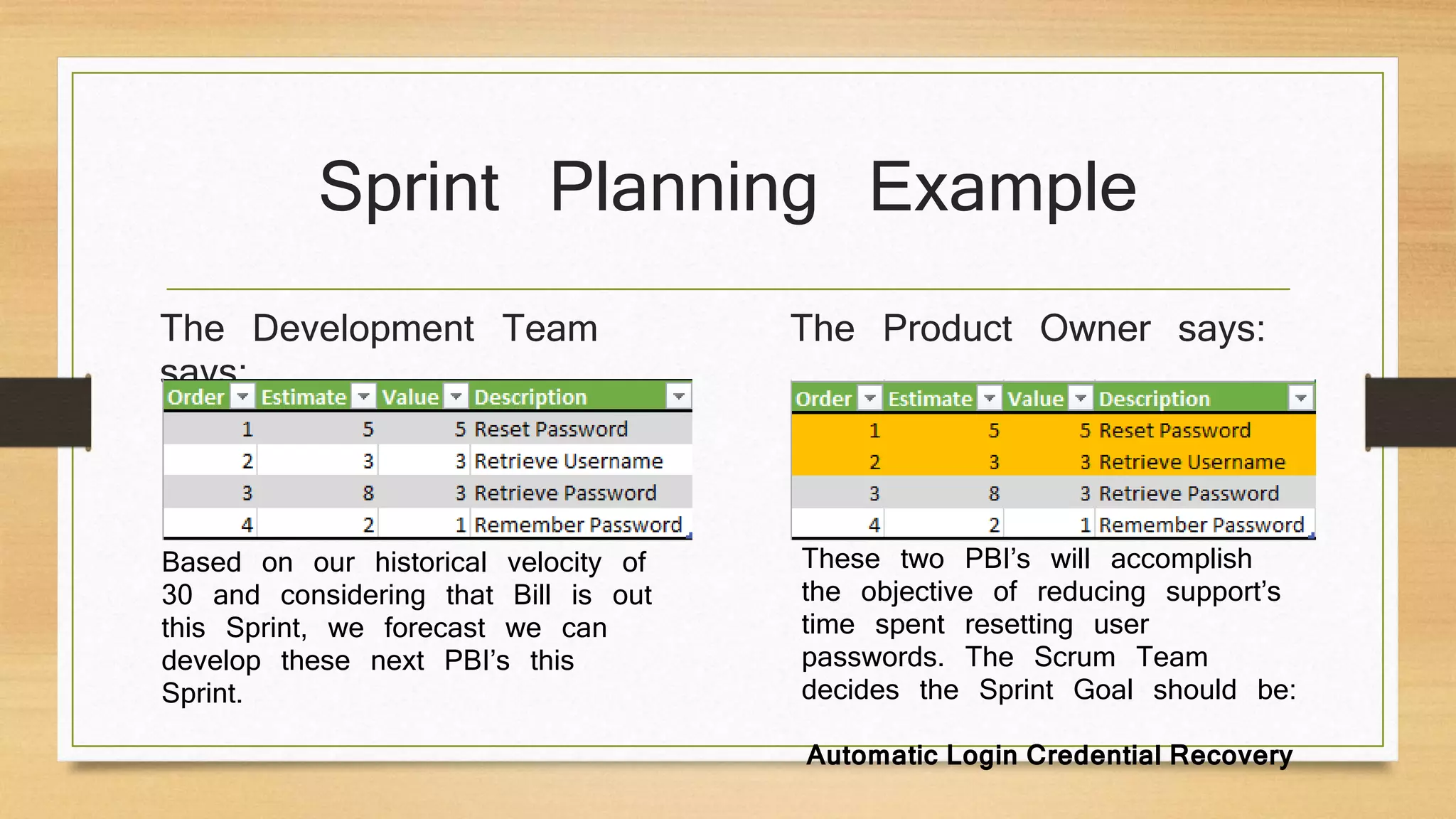
Sprint Planning Example
The Development Team
says:
The Product Owner says:
These two PBI’s will accomplish
the objective of reducing support’s
time spent resetting user
passwords. The Scrum Team
decides the Sprint Goal should be:
Automatic Login Credential Recovery
Based on our historical velocity of
30 and considering that Bill is out
this Sprint, we forecast we can
develop these next PBI’s this
Sprint.
The Scrum Guide Says…
The Development Team
decides how it will build
this functionality into a
“Done” product Increment
during the Sprint.
The Product Owner can
help clarify the selected
Product Backlog items and
make trade-offs.
How will the work needed to deliver the Increment be achieved?
The Scrum Guide Says…
By the end of the Sprint Planning, the Development Team
should be able to explain to the Product Owner and
Scrum Master how it intends to work as a self-organizing
team to accomplish the Sprint Goal and create the
anticipated Increment.
How will the work needed to deliver the Increment be achieved?
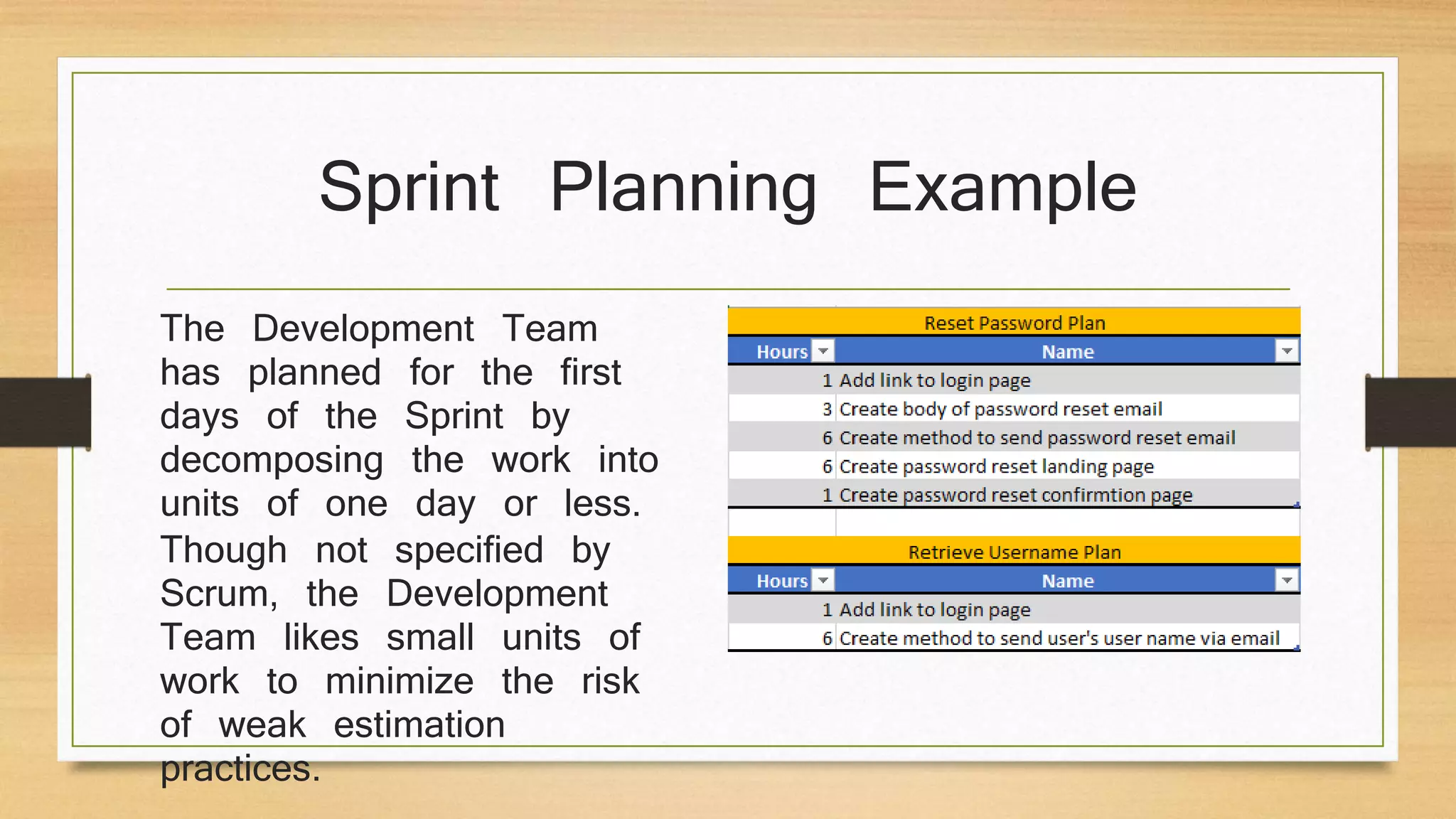
Sprint Planning Example
The Development Team
has planned for the first
days of the Sprint by
decomposing the work into
units of one day or less.
Though not specified by
Scrum, the Development
Team likes small units of
work to minimize the risk
of weak estimation
practices.
Quick Review
Q. Who works to forecast the functionality that will be
developed during the Sprint?
A. The Development Team
Quick Review
Q. What is planned at the Sprint Planning?
A. The work to be performed
Q. Who creates this plan?
A. The entire Scrum Team
Q. How long is it?
A. Eight hours for 30-day Sprint and usually less for shorter
Sprints.
Quick Review
Q. Who crafts the Sprint Goal?
A. The entire Scrum Team
Quick Review
Q. What 3 inputs does the Development Team use to
forecast the functionality that will be developed during the
Sprint?
A1. The Product Backlog
A2. The Development Team’s past performance
A3. The Development Team’s projected capacity
Quotations Set the Stage
“What are you preparing. You’re always preparing. Just
go!” – Dark Helmet, Space Balls 1987
“An ounce of prevention is worth a pound of cure.” – My
Mom, Every Time I Had to Clean My Room
“Just a spoonful of sugar makes the medicine go down in
the most delightful way!” – My personal life coach, Mary
Poppins
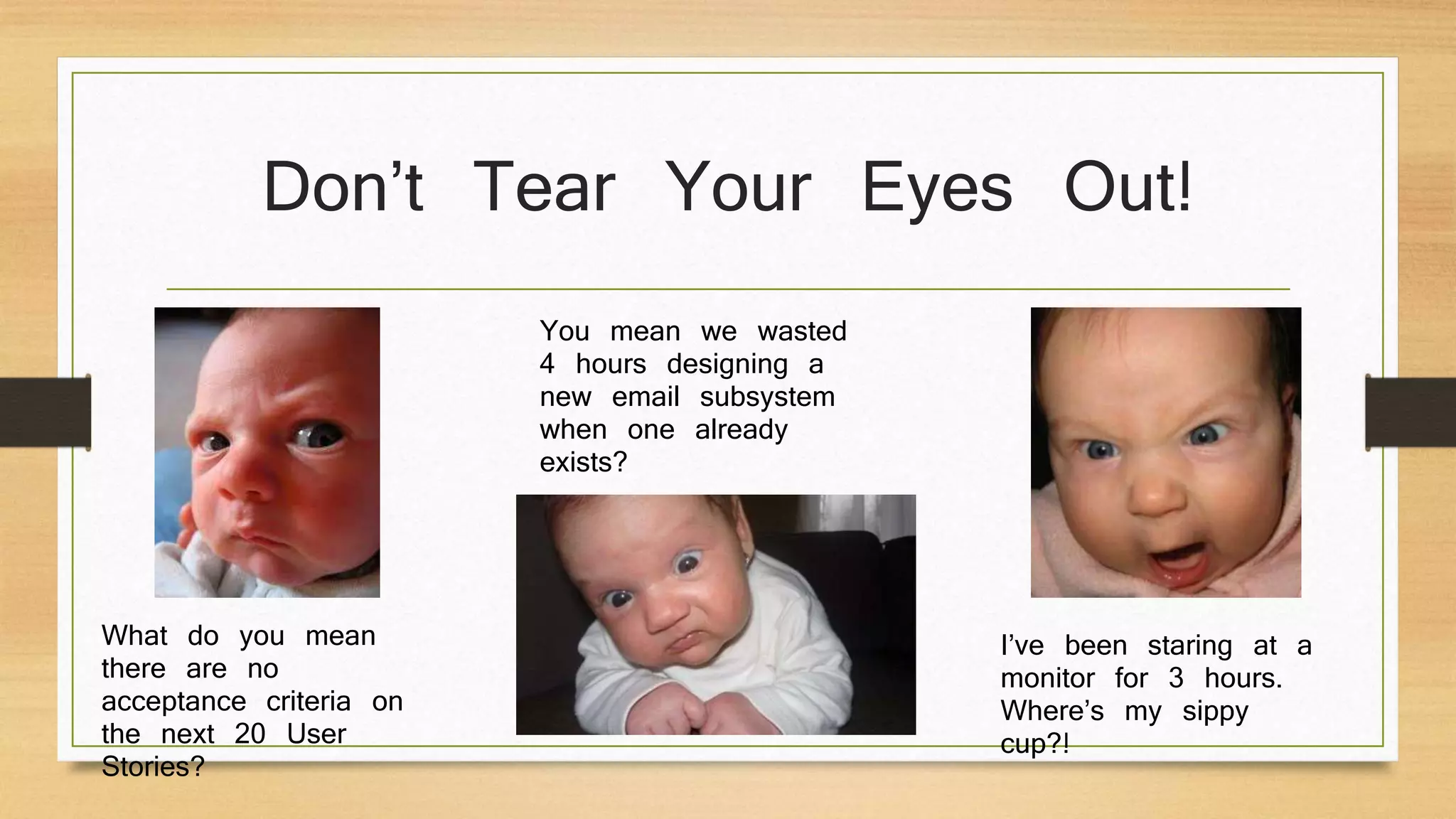
Don’t Tear Your Eyes Out!
What do you mean
there are no
acceptance criteria on
the next 20 User
Stories?
You mean we wasted
4 hours designing a
new email subsystem
when one already
exists?
I’ve been staring at a
monitor for 3 hours.
Where’s my sippy
cup?!
Refine that Backlog
Set aside focused time to understand the Product
Backlog.
Craft just enough, just in time.
Stagger Refinement for maximum, “cognitive
stewing” without impeding.
Anticipate Challenges
Lack of cross-functionality for work
Customer collaboration e.g. requirement questions
Reduced capacity
Keep it Fresh
Take frequent breaks if needed
Encourage all to participate actively
Change the format to engage the mind differently
Provide fizzy beverages
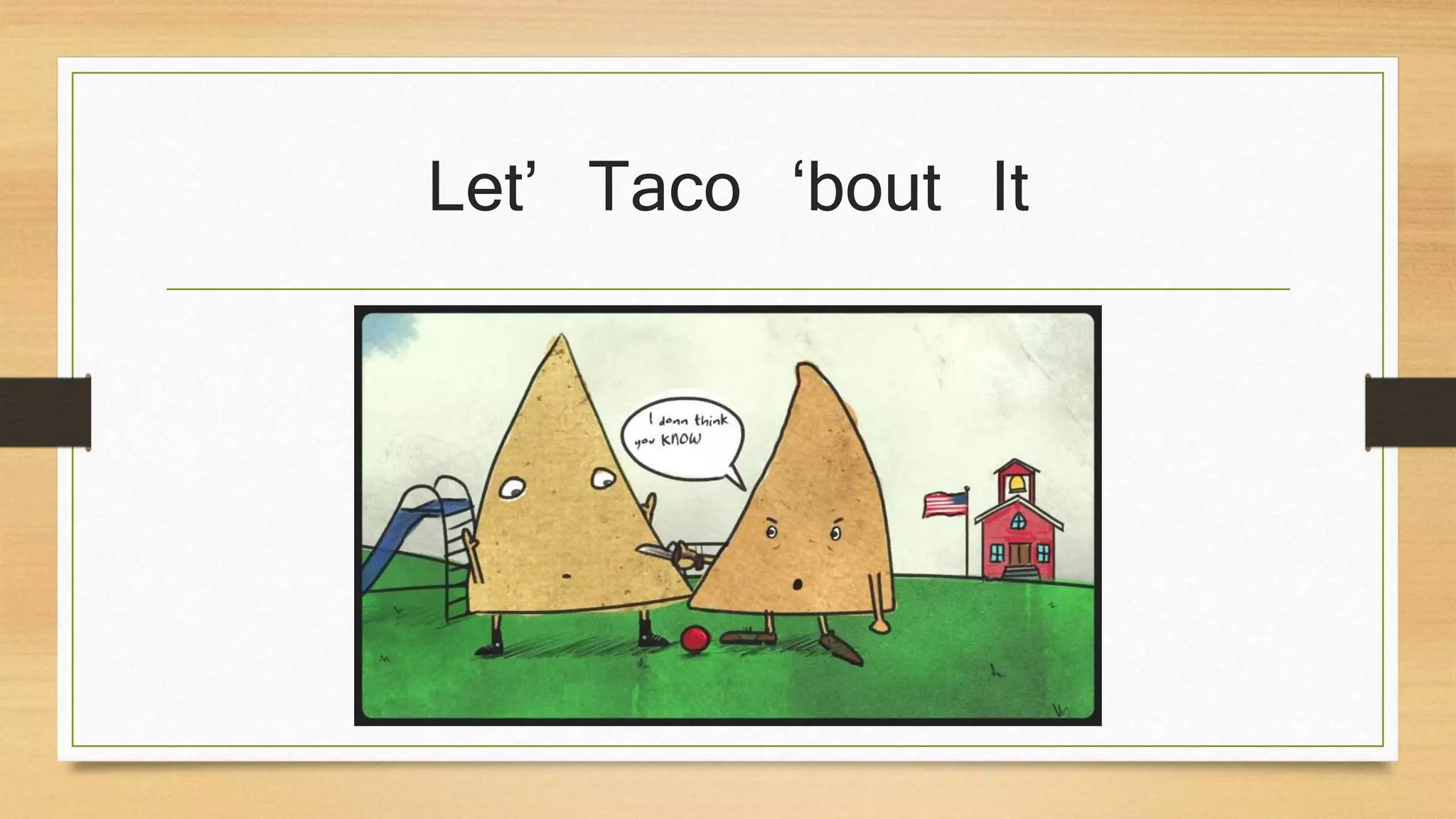
Let’ Taco ‘bout It
Happy Planning!

Sprint Planning in Scrum and How to do it without Tearing Your Eyes Out

  • 1.
    Sprint Planning in Scrum Andhow to do it without tearing your eyes out.
  • 2.
    The Scrum GuideSays… Scrum prescribes four, formal events for inspection and adaptation…: • Daily Scrum • Sprint Review • Sprint Retrospective • Sprint Planning
  • 3.
    The Scrum GuideSays… Q. What is planned at the Sprint Planning? A. The work to be performed Q. Who creates this plan? A. The entire Scrum Team Q. How long is it? A. Eight hours for 30-day Sprint and usually less for shorter Sprints.
  • 4.
    The Scrum GuideSays… Sprint Planning answers two questions: What can be delivered in the Increment resulting from the upcoming Sprint? How will the work needed to deliver the Increment be achieved?
  • 5.
    The Scrum GuideSays… The Development Team works to forecast the functionality that will be developed during the Sprint. The Product Owner discusses the objective that the Sprint should achieve and the Product Backlog items that, if completed in the Sprint, would achieve the Sprint Goal What can be delivered in the Increment resulting from the upcoming Sprint?
  • 6.
    Sprint Planning Example TheDevelopment Team says: The Product Owner says: These two PBI’s will accomplish the objective of reducing support’s time spent resetting user passwords. The Scrum Team decides the Sprint Goal should be: Automatic Login Credential Recovery Based on our historical velocity of 30 and considering that Bill is out this Sprint, we forecast we can develop these next PBI’s this Sprint.
  • 7.
    The Scrum GuideSays… The Development Team decides how it will build this functionality into a “Done” product Increment during the Sprint. The Product Owner can help clarify the selected Product Backlog items and make trade-offs. How will the work needed to deliver the Increment be achieved?
  • 8.
    The Scrum GuideSays… By the end of the Sprint Planning, the Development Team should be able to explain to the Product Owner and Scrum Master how it intends to work as a self-organizing team to accomplish the Sprint Goal and create the anticipated Increment. How will the work needed to deliver the Increment be achieved?
  • 9.
    Sprint Planning Example TheDevelopment Team has planned for the first days of the Sprint by decomposing the work into units of one day or less. Though not specified by Scrum, the Development Team likes small units of work to minimize the risk of weak estimation practices.
  • 10.
    Quick Review Q. Whoworks to forecast the functionality that will be developed during the Sprint? A. The Development Team
  • 11.
    Quick Review Q. Whatis planned at the Sprint Planning? A. The work to be performed Q. Who creates this plan? A. The entire Scrum Team Q. How long is it? A. Eight hours for 30-day Sprint and usually less for shorter Sprints.
  • 12.
    Quick Review Q. Whocrafts the Sprint Goal? A. The entire Scrum Team
  • 13.
    Quick Review Q. What3 inputs does the Development Team use to forecast the functionality that will be developed during the Sprint? A1. The Product Backlog A2. The Development Team’s past performance A3. The Development Team’s projected capacity
  • 14.
    Quotations Set theStage “What are you preparing. You’re always preparing. Just go!” – Dark Helmet, Space Balls 1987 “An ounce of prevention is worth a pound of cure.” – My Mom, Every Time I Had to Clean My Room “Just a spoonful of sugar makes the medicine go down in the most delightful way!” – My personal life coach, Mary Poppins
  • 15.
    Don’t Tear YourEyes Out! What do you mean there are no acceptance criteria on the next 20 User Stories? You mean we wasted 4 hours designing a new email subsystem when one already exists? I’ve been staring at a monitor for 3 hours. Where’s my sippy cup?!
  • 16.
    Refine that Backlog Setaside focused time to understand the Product Backlog. Craft just enough, just in time. Stagger Refinement for maximum, “cognitive stewing” without impeding.
  • 17.
    Anticipate Challenges Lack ofcross-functionality for work Customer collaboration e.g. requirement questions Reduced capacity
  • 18.
    Keep it Fresh Takefrequent breaks if needed Encourage all to participate actively Change the format to engage the mind differently Provide fizzy beverages
  • 19.
  • 20.