HR
201
201

Trends
Outlook
About ERC

4

Introduction

5

Legal

17

Healthcare & Benefits

30

Compensation

35

Talent Management

48

Hiring

55

Conclusion

56

Sources

Table of Contents

3
www.yourERC.com • 440-684-9700

We’re ERC, and we make workplaces better!
ERC is Ohio's leading HR organization. ERC membership provides
employers access to an incredible amount of information, expertise and
cost savings that supports the attraction, retention and development of
great employees.
ERC members have access to the following services to help support their
HR function:

Survey Data

HR Help Desk

Online Tools

Networking

Cost Savings

Additional Services at ERC
In addition to our five core membership services, ERC offers HR and
workplace-related services including training, consulting, coaching and
assessments.
ERC hosts the NorthCoast 99 program, which annually honors Northeast
Ohio’s top workplaces. ERC Health is a health insurance program that
rewards employers for their employees’ participation in health and wellness
activities.
For more information about ERC, please visit our site at:
www.yourERC.com.

Copyright © 2013 ERC (Employers Resource Council)

3
Introduction

M

any notable trends
emerged throughout
2013 which will
affect employers’
initiatives related to legal
compliance, health care/
benefits, compensation, talent
management, and hiring in
2014.

In summary, there were a few significant federal
employment law developments and Supreme
Court rulings in 2013, as well as continued
heightened enforcement among the federal
agencies. Health care reform, however, was the
biggest compliance issue affecting employers
this past year, and will continue to be heading
into 2014, as new rules are finalized and
employers prepare for key regulations that take
effect in 2015.
In the area of compensation, there were
continued modest pay increases. More
employers appear to be compensating
strategically, with a compensation philosophy
and focus on pay for performance. Organizations
are also becoming somewhat more transparent
and communicative about their compensation
practices. In the realm of benefits, wellness
programs continued to be enhanced and
employers seem to be offering voluntary benefits
to a greater degree. More attention on work/
life programs, including flexible scheduling and
stress management, also was prevalent among
employers in 2013.

But, above all, health care benefits was the
primary concern for most employers.
Many of same talent management and hiring
challenges persisted in 2013. Employers
face opportunities to improve employee
engagement, performance management,
rewards and recognition, the candidate and
new-hire experience; and the ways in which
they attract, retain, manage, and develop
talent. Faced with a shortage of skilled talent,
employers are increasingly using social media
and strategic online recruiting methods to
find workers. In addition, leadership and
employee development continue to be areas
of concern and priority for employers, and are
being affected by certain demographic needs
and interests, including women and younger
workers.
Employers will be operating with quite a bit of
uncertainty in the health care and compliance
arenas in 2014. It appears that the main
challenges employers will face are related to
health care, the changing benefits landscape,
difficulties in finding skilled talent, and struggles
with engaging and retaining current talent
with modest pay increases and lagging talent
management practices.
The following e-book summarizes the most
important HR trends that surfaced throughout
2013 and several trends you should expect
and plan for heading into 2014 – supported by
both national and local research. It also includes
detailed commentary from local subject-matter
experts in Northeast Ohio on trends they’ve
observed this year and how those will affect HR
in 2014. These combined research and subject
matter insights serve to provide you with a
summary of key trends to be aware of during
2014.

PLEASE NOTE: By providing you with research information that may be contained in this message, the Employers Resource Council (ERC) is not providing a qualified
legal opinion concerning any particular human resource issue. As such, research information that ERC provides to its members should not be relied upon or considered
a substitute for legal advice. The information that we provide is for general employer use and not necessarily for individual application. We also recommend that you
consult your legal counsel regarding workplace matters when and if appropriate.

Copyright © 2013 ERC (Employers Resource Council)

4
Legal

I

n 2013, a few notable changes to
federal employment law regulations
were made. These included changes
to the Family Medical Leave Act
(FMLA), a revised I-9 form, and new
HIPPA rules. Also, during 2013, a
few important decisions made by the
Supreme Court affected employers,
most significantly the federal Defense
of Marriage Act being struck down,
and the clarification of the definition of
a supervisor under Title VII of the Civil
Rights Act. The Supreme Court will
consider other employment law-related
decisions that affect employers in 2014.

Finally, the outcomes of numerous court
cases in 2013 offer new guidance and warn
employers of potential liabilities. Case law
will continue to be an important source
of direction on employment law matters,
particularly for the Family Medical Leave
Act (FMLA), the Americans with Disabilities
Act (ADA), and the Fair Labor Standards Act
(FLSA). More cases involving social media
and/or social media postings as evidence
emerged in 2013 as well, and this will likely
continue in 2014.

Additionally, while the National Labor
Relations Board's (NLRB) activity was
less pronounced in 2013, the Equal
Employment Opportunity Commission
(EEOC) continued to remain very busy
with a variety of discrimination issues.
Heading into 2014, employers should
expect that EEOC activity will continue
to be high, and that the NLRB will likely
be more active as well. In addition, there
are a few reforms being considered
by the government, pertaining to
immigration, workplace flexibility, and
social media privacy.

Copyright © 2013 ERC (Employers Resource Council)

5
Legal
Little NLRB activity in
2013, but that could
change next year.
There was very little NLRB activity in 2013 with the
U.S. Court of Appeals for the District of Columbia
Circuit ruling that President Barack Obama acted
unconstitutionally when he made three recess
appointments to the NLRB.
The ruling has been appealed to the U.S.
Supreme Court. While the ruling invalidates
NLRB decisions made from January 4th until now,
employers should continue to use the NLRB's
guidance until its decisions are ruled binding or
not.[111]
In the meantime, there was some activity with
regard to the NLRB that affected employers. The
United States Court of Appeals struck down a rule
by the NLRB which required organizations to post
a notice to inform employees about their rights
under the National Labor Relations Act (NLRA),
asserting that all three enforcement provisions in
the rule were unlawful. Additionally, the Senate
voted to confirm five nominees to the NLRB, three
Democratic nominees and two Republicans.

Upcoming Supreme
Court decisions will
affect employers in
2014.
The Supreme Court started hearing arguments
for several important cases in October featuring
issues affecting the Employee Retirement Income
Security Act (ERISA), FLSA, the President's power
to make recess appointments to the NLRB, and
whistleblower protections under the SarbanesOxley Act (SOX). The outcomes of these cases
could meaningfully affect employers heading
into 2014.
Specifically, the Supreme Court will review
whether a statute of limitations can run upon
a clear repudiation of rights; what "changing
clothes" means with respect to FLSA and
compensable time; if the President can make
recess appointments; and whether employees
of privately held contractors or subcontractors
of public companies can bring retaliation claims
under SOX.[62]

With a fully-constituted Board heading into 2014,
organizations should expect the NLRB to be more
active and revisit issues that were put on hold in
2013.

Copyright © 2013 ERC (Employers Resource Council)

6
Legal
Immigration reform
that would affect
employers continues to
be considered.
There has been quite a bit of activity in the U.S.
legislature regarding changes to immigration
laws this year. Though nothing has passed yet,
several different pieces of possible legislation
emerged during 2013 that could affect the cap
for H-1B workers, visa programs, E-Verify, and
green cards.
Proposed legislation this year specifically
included requiring the use of E-Verify, increasing
the number of H-1B visas with further flexibility
to raise the cap based on demand for highly
skilled jobs, increasing the percentage of
employment-based green cards that are granted,
and providing exemptions to certain immigrants
based on education or ability in the STEM fields.
Although there have been so many different
bills proposed in Congress this year regarding
immigration, some of which are very significant,
it is unclear what direction reform will take at this
time.
Nonetheless, employers can expect that
immigration reform will surface again during
2014 as President Obama has said that he will
press immigration reform immediately after the
current fiscal issues are addressed in Congress.

DOMA ruled
unconstitutional;
affects employers’
benefits practices.
In June, the Supreme Court struck down the
federal Defense of Marriage Act (DOMA) in
United States v. Windsor. The Court ruled that
section 3 in DOMA was unconstitutional as it
deprives individuals of equal liberty protected in
the Fifth Amendment.
Depending on the state and if it recognizes
same-sex marriages, the Court’s decision affects
employee benefits and protections. In any state
that recognizes same-sex marriages, employers
will be required to treat same-sex couples the
same as opposite sex couples in regards to
offering COBRA continuation coverage, allowing
spouses to use FMLA (if eligible and qualified),
being subject to flexible spending and health
savings account rules, attaining eligibility for
immigration benefits,[129] and recognizing samesex spouses to determine surviving spouse
annuities or death benefits.[67]
The IRS and the U.S. Treasury Department also
ruled that married same-sex couples will be
treated as married for federal tax purposes,
regardless of whether the couple lives in a
jurisdiction that recognizes same-sex marriage.
[66]

The overturning of DOMA brought to light samesex issues in the workplace, and could be the
beginning of more related legislation to protect
same-sex rights.
Copyright © 2013 ERC (Employers Resource Council)

7
Legal
Definition of a
supervisor & causation
standards for retaliation
claims were clarified by
the Supreme Court.

FMLA protections were
expanded.
This past year, the Department of Labor (DOL)
issued a final rule which implemented two
important expansions of protections under
FMLA. Employers are now required to use new
forms to administer FMLA. One of the expansions
provided families of eligible veterans with the
same FMLA leave that is available to families of
military service members. It also allowed more
military families to take leave for activities that
arise when a service member is deployed. The
other expansion modified existing rules so that
airline personnel and flight crews are better able
to use FMLA’s protections. [59]
In 2013, the DOL also clarified factors an employer
must consider when an employee requests leave
to care for an adult child. The guidance addressed
two issues 1) the age of onset of a disability for a son
or daughter affecting the parent's ability to take
FMLA leave and 2) the impact of the Americans
with Disabilities Act Amendment Act (ADAAA) on
the FMLA definition of son or daughter. The DOL
specified that the age of the onset of the disability
is irrelevant to the determination of whether an
individual is considered a "son or daughter"
under FMLA. This means that employees whose
children became disabled after the age of 18 are
eligible to take FMLA-protected leave to care for
them. [58]
Copyright © 2013 ERC (Employers Resource Council)

This year, the Supreme Court clarified two
important issues for employers: definition of a
supervisor and causation standards for retaliation
claims.
The Supreme Court clarified the definition of a
supervisor under Title VII of the Civil Rights Act in
Vance v. Ball State University as someone who can
take a “tangible employment action” and make a
“significant change in employment status, such
as hiring, firing, failing to promote, reassignment
with significantly different responsibilities,
or a decision causing a significant change in
benefits.”[127] The Court found the EEOC's
definition of a supervisor to be too broad, and
the revised definition narrows the scope of an
employer’s liability under Title VII.[89]
Also, in University of Texas Southwestern Medical
Center v. Nassar, the Supreme Court held that
proof of retaliation as the primary reason that
the employer acted as it did is required for Title
VII retaliation claims. A plaintiff must be able to
prove that retaliation was not just a “motivating
factor” for an adverse action taken against them,
and that retaliation directly caused an employer
to take the adverse employment action.[23]

8
Legal
HIPAA rule went into
effect.
The Department of Health and Human Services
(HHS) issued a new final omnibus rule this year,
which increased protections related to privacy
and security for health information established
under the Health Insurance Portability and
Accountability Act of 1996 (HIPAA). The primary
areas addressed in the rule include privacy/
security, breach notification, enforcement, and
genetic information.
Covered entities and business associates were
required to make changes to privacy notices
and policies, security policies authorization
forms, training materials, and business associate
agreements. They were also required to add a
new privacy-agreement requirement between
business associates and any subcontractors.[81]

I-9 Form was revised.
A revised I-9 Form was released in March of this
year by the U.S. Citizenship and Immigration
Services (USCIS). The form, which is required to
verify the identity and employment authorization
of individuals hired for employment in the U.S.,
was improved with new fields, reformatting, and
clearer instructions. Employers needed to start
using the new form as of May 7, 2013 for all newhires and reverifications.
Compliance with the new I-9 form requirements
is essential. There has been a significant increase
in the number of I-9 audits in recent years
because there has been a rise in the number of
I-9 forms with errors and complaints issued to
the U.S. Immigration and Customs Enforcement.
There are fines attached to these errors, and in
addition, fines for any “knowing violations” can
be particularly hefty.[137]
Copyright © 2013 ERC (Employers Resource Council)

9
Legal
More states pass
workplace social media
privacy laws.
The number of states that have passed laws related
to workplace social media use and monitoring
continued to increase this year. Generallyspeaking, such laws have made it unlawful for an
employer to request or require that a prospective
employee provide their social media password as
a condition of attaining employment.
According to the National Conference of State
Legislatures, ten states have enacted social
media privacy legislation in 2013. They include
Arkansas, Colorado, Illinois, Nevada, New
Jersey, New Mexico, Oregon, Utah, Vermont,
and Washington. Six states passed legislation in
2012, California, Delaware, Illinois, Maryland,
Michigan, and New Jersey. A total of 36 states
have introduced legislation or have it pending.
Ohio has not passed any legislation yet.[110]
Nationally, although bills have been introduced
in Congress which provide similar protections,
there has been no significant movement towards
passing social media privacy legislation, which
may be prompting the increasing number of
states to pass laws.

Payroll cards
experienced legal
scrutiny.
This year, the use of payroll cards experienced
legal scrutiny, based on an investigation
launched by New York’s Attorney General. New
York’s Attorney General began investigating
companies that pay hourly employees using

Copyright © 2013 ERC (Employers Resource Council)

prepaid payroll cards, with the concern that
fees associated with pay card withdrawals may
be insufficiently disclosed, or excessive, or that
the cards may decrease employees’ take-home
pay, which could, in some cases, result in pay
below the minimum wage. In addition, payroll
cards may not comply with state laws governing
printed payroll statements and written consent
for using the cards; federal law which prohibits
mandatory use of prepaid payroll cards as
a condition of employment; and collective
bargaining agreements.[139]
Some employers use prepaid payroll cards as an
alternative form of electronic wage payment as
they carry many benefits. In a recent local survey
by ERC, 14% reported using payroll cards. They
are similar to debit cards, and generally offered
to employees who do not have access to, or who
do not want to use, direct deposit. Payroll cards
typically give employees free access to their
funds or access to them at a significantly lower
cost than those charged by check cashers, and
also benefit employers with lower costs and fees.
Electronic wage payment reduces employers’
costs relative to creating, processing, and
reconciling paper checks. Employers should
be cautious with using prepaid payroll card
systems and make sure that these systems are in
compliance with state and federal laws. [125]

10
Legal
Ohio Shared-Work
program signed into
law.
This year, Governor John Kasich signed into law
House Bill 37 which sets the stage for Ohio’s
Shared-Work Ohio program. The program is
essentially a layoff aversion tool that employers
will be able to use to avoid laying off workers so
that they can retain their workforce, let employees
keep their jobs and benefits, and avoid the high
costs of hiring and training new workers.
The Shared-Work Ohio program allows Ohio
companies to reduce workers’ hours instead
of implementing layoffs, and further enables
workers to retain their benefits and qualify
for unemployment for any reduced hours
they incur. [135] Another added benefit of the
program is that employers who opt to use the
shared-work program can avoid increases to
their unemployment insurance premium rates,
whereas employers who choose a traditional
layoff instead of the shared work program, will
incur higher unemployment taxes. Employers will
need to apply or opt into the program, pay 5% of
the unemployment costs, and be responsible for
maintaining full health insurance and retirement
benefits for affected workers. [25]

DOL eliminates
minimum wage and
overtime exemption for
home care aides.
The Department of Labor's Wage and Hour
Division issued a final rule this past fall which
eliminates the FLSA’s minimum wage and
overtime exemption for home care workers. This
rule goes into effect on January 1, 2015.
Under the rule, most direct care workers (certified
nursing assistants, home health aides, personal
care aides, caregivers, and companions) will be
classified as non-exempt and entitled to receive
at least the federal minimum wage and overtime
pay protections. In addition, as of January 1,
2015, third party employers and agencies may
no longer claim an overtime pay exemption for
live-in domestic workers. Employers will also be
required to keep time and pay records for nonexempt direct care workers they employ. [56]

Copyright © 2013 ERC (Employers Resource Council)

11
Legal
Cases point to new FLSA
lawsuit trends.
The Federal Judicial Center reported in 2013 that
lawsuits under FLSA have hit a new record. In the
past year, 7,764 cases have been filed in federal
court, which is a 10% increase from 2012, and
nearly a 400% increase from 10 years ago. [117]
The majority of the lawsuits deal with
misclassification of exempt employees, which has
led to millions of dollars paid out from lawsuits to
employees who were misclassified as “exempt”
by their employers, when they were technically
“non-exempt” and needed to be provided with
overtime for work performed above 40 hours
per week. Among the commonly misclassified
workers include brokers, analysts, computer
technicians, and sales professionals. [117]

company's FLSA violations. This particular case is
a reminder to employers that the personal risks
of FLSA non-compliance can be significant, and
that CEOs or other individuals with operational
responsibilities, who directly affect the nature
and conditions of employment, could be liable.
[31]

These cases, in addition to the rise in FLSA
lawsuits, suggest that proper FLSA compliance
continues to be extremely important, and that
non-compliance could be very costly.

Also, a few recent lawsuits point to individual
liability under FLSA, as well as possible criminal
convictions that could result from failing to
comply with the law's requirements. For
example, in October of 2013, the Department
of Labor (DOL) reported that three managers
at High Performance Ropes of America were
guilty of felony counts in an FLSA case, which
included making false statements, withholding
information, and aiding illegal entry into the U.S.
While felony or criminal convictions for managers
under FLSA are atypical, the case serves as a
warning for organizations of the propensity for
more severe legal outcomes. [57]
In another court case, Irizarry v. Catsimatidis, a
court found that the company’s owner and CEO
constituted an “employer” under FLSA and
was therefore liable, even though there was no
conclusive evidence that he directly managed
the employees who claimed the lawsuit against
the company, nor was directly responsible for the

Copyright © 2013 ERC (Employers Resource Council)

12
Legal
Congress considers
comp-time and
workplace flexibility
legislation.

OFCCP issued final
rules to improve job
prospects for veterans
and the disabled.

In 2013, two bills were introduced and considered
by Congress which would offer employees the
option to take comp time in lieu of overtime pay.

The government continues to make headway in
trying to enhance job opportunities for veterans
and the disabled. This year, the Office of Federal
Contract Compliance Programs (OFCCP) issued
final rules to improve job opportunities with
federal contractors for veterans and people with
disabilities. The rules mainly establish specific
actions contractors need to take in the areas of
recruitment, training, recordkeeping, and policy
dissemination.

Earlier this year, the Working Families Flexibility
Act of 2013 was introduced, which passed the
House of Representatives in May. A different bill,
the Family Friendly and Workplace Flexibility
Act, which included largely the same content,
was proposed this past October. Both bills were
proposed by Republicans, which may show
support for workplace flexibility legislation.
The bill would give employees the choice to elect
for paid time off (comp time) in lieu of overtime
payments for hours worked. Employees would
receive 1.5 hours of comp time for every hour of
overtime worked. It is intended to help provide
employees with flexible work arrangements
and better enable them to balance their work
and family demands. Essentially, the proposed
legislation would create a flexible credit-hour
program in which employees could work
overtime hours in order to accrue paid time which
may be taken later. [92]

Copyright © 2013 ERC (Employers Resource Council)

Specifically, the final rules establish a 7 percent
goal for qualified individuals with disabilities for
government contractors and subcontractors.
Contractors will be required to apply the goal to
each job group, with the exception of contractors
with 100 or fewer employees, where the goal
may be applied to the entire workforce rather
than each of the job groups.
The rules also implement the Vietnam Era
Veterans' Readjustment Assistance Act to
improve job opportunities for protected veterans.
They require federal contractors to establish
hiring benchmarks for protected veterans, and
strengthen recordkeeping requirements so that
contractors can assess the effectiveness of their
recruitment efforts.[138]

13
Legal
Discrimination based
on pregnancy, religion,
and obesity emerged as
key legal topics.
According to the Equal Employment Opportunity
Commission (EEOC), pregnancy discrimination
claims have been steadily rising over the past
15 years. This year, the EEOC also claimed that
one of its six national priorities is to address
issues involving pregnancy-related limitations.
Employers need to be mindful of their obligations
relative to pregnant women’s rights in the
Pregnancy Discrimination Act (PDA), FMLA, and
FLSA. Some states are also considering bills which
would require employers to make reasonable
accommodations for employees with pregnancyrelated needs.
Additionally, this year, religious discrimination
emerged as more of an issue in the workplace.
Not only were there a number of charges filed
by the EEOC involving religion in the workplace,
but fringe religions were posing challenges in
terms of employer accommodations.[82] Also,
a national study uncovered that many workers
are witnessing incidences of religious bias and
discrimination at work, and uncovered a common
failure by organizations to accommodate
employees’ religious needs. Many workers also
reported that their companies have taken no
actions to stop religious bias in the workplace.[142]

were also a few new cases involving obesity
discrimination in the workplace, specifically
related to not being able to perform the essential
functions of the job. [71] The EEOC Commissioner
commented on the topic recently, saying that
while morbid obesity has often not been limiting
enough to qualify as a disability, courts are
beginning to revaluate this viewpoint. [30]

Finally, obesity discrimination materialized as
a key issue. While obesity is not considered a
disability under the ADA, the EEOC has said that
morbid obesity can potentially rise to the level of
disability, and the American Medical Association
has officially designated obesity as a disease and
disability, which may increase the likelihood that
obesity becomes a form of discrimination. There
Copyright © 2013 ERC (Employers Resource Council)

14
Legal
OSHA targets safety
with hazardous
chemicals.
This year, the Occupational Safety and Health
Administration (OSHA) implemented more efforts
to help employers keep employees safe when they
work with hazardous chemicals.
✓ Revised Hazard Communication Standard.
Includes the use of new labeling elements and a
standardized format for Safety Data Sheets. Also
includes specific requirements to train workers
on new labels and SDSs on the chemicals in their
workplace by December 1, 2013. [113]
✓ Toolkit. Provides employers and workers with
information, methods, tools, and guidance to
make decisions regarding finding safer substitutes
and eliminating hazardous chemicals. [114]
✓ Annotated PEL Tables. Revises “Annotated
Permissible Exposure Limits” which establish
mandatory limits on the amount of a substance in
the air to protect workers against the health effects
of certain hazardous chemicals. [114]

2013 Case Law Update
The following court cases in 2013 yielded several
important insights for employers with regard to
administering employment laws, namely FMLA,
ADA, and workers' compensation. This list is not
exhaustive of court outcomes related to these laws,
but includes some of the most pertinent cases.
✓ In Lineberry v. Detroit Medical Center, a federal
district court ruled that an employer is entitled to
fire an employee if they have an "honest belief"
that he or she is abusing FMLA leave. The Facebook
postings used to substantiate her dishonesty were
upheld.

Copyright © 2013 ERC (Employers Resource Council)

✓ In White v. Dana Light Axle Manufacturing, the
Sixth U.S. Circuit Court of Appeals confirmed that
organizations do not need to loosen their rules for
calling in absences to request FMLA leave when
they have notice and procedural requirements.
✓ In EEOC v. Houston Funding II Limited, a court
found that an employer who terminates a woman
for lactating or wanting to lactate at work violates
Title VII of the Civil Rights Act and the Pregnancy
Discrimination Act.
✓ In Rodriguez vs. Valley Vista Services, an employee
was deemed to be wrongfully terminated by a
court for her suffering from panic attacks because
her supervisor failed to provide her with sufficient
leave time and other accommodations, further
underscoring the importance of treating mental
disabilities the same as others.
✓ In Knutson v. Schwan Food Company, an
employer's documentation regarding essential
functions of the job can influence courts in cases
involving ADA. Even job duties that are not
performed regularly can be considered essential
job functions if employees are required to perform
them from time to time.
✓ In Lu v. Longs Drug Stores, transferring an
employee to a different supervisor was found to
not be a required accommodation under ADA.
✓ In Feist v. Louisiana, a court ruled that an
accommodation request does not need to be tied
to an essential function, such as a closer parking
spot, as was requested in the case. Employers must
also consider whether an accommodation request
is reasonable under the circumstances and cannot
consider a request unreasonable only based on
the fact that it does not relate to an employee's
essential job functions.
✓ The Supreme Court of Ohio held that in order for
a mental injury to be compensable under the Ohio
workers’ compensation system, it must arise “from
an injury or occupational disease sustained by
that claimant or where the claimant’s psychiatric
conditions have arisen from sexual conduct in
which the claimant was forced by threat of physical
harm to engage or participate.”

15
Legal

“

We have seen the following trends in our practice emerge over the last year and we expect
them to continue into 2014. Some of these trends are social media password protection laws,
background checks and ban-the-box legislation, and the expansion of anti-discrimination laws.
With the emergence of social media, issues are constantly coming up in the employment context.
Most recently, over thirteen states have enacted laws that prohibit employers from asking
employees to provide their social media passwords, including: Arkansas, California, Colorado,
Illinois, Maryland, Michigan, Nevada, New Jersey, New Mexico, Oregon, Utah, Vermont and
Washington. While Ohio is not among the states that have passed legislation, legislation has
been proposed in Ohio that would seek to expand protections to applicants and employees
with respect to social media passwords. The legislation in Ohio is not expected to pass, but
other states will likely continue in this trend.
The Equal Employment Opportunity Commission has continued to advance its agenda against
blanket background checks, and we have seen more litigation about this issue. The EEOC issued
guidance in 2012 regarding criminal background checks. In addition, many states have also
enacted “ban-the-box” legislation which prohibits employers from asking questions regarding
criminal history on job applications. Four states have passed laws prohibiting such application
questions, and over 40 local municipalities have also enacted “ban-the-box” legislation. While
Ohio doesn’t have a “ban-the-box” provision, Ohio has joined several other states in providing
protections to employers from tort liability for negligent hiring and retention claims when hiring
individuals that have pleaded guilty to or been convicted of certain criminal convictions.
Lastly, we expect to see a push to expand anti-discrimination statutes. The Senate recently passed
a bill that would prohibit discrimination against gay, bisexual and transgender Americans. While
it isn’t likely to pass the Republican-led House, it is likely a “preview of coming attractions.” Many
states and municipalities already ban discrimination based upon these protected categories and
a federal prohibition will likely come at some point in the future."

- Stefanie L. Baker, Associate at Fisher & Phillips LLP
ERC Preferred Partner

Copyright © 2013 ERC (Employers Resource Council)

16
Healthcare & Benefits

I

n 2013, most of the benefits trends
that emerged were related to
health care and the Affordable Care
Act’s (ACA) impact on employers.
Although several key provisions of the
ACA have been delayed for employers,
there were several developments that
affected organizations, including the
individual mandate, establishment of
health insurance exchanges, and new
rules on outcome-based wellness
incentives.

Beyond the health care landscape,
wellness program offerings as well
as voluntary benefits continued to
expand in 2013. Employee stress,
work/life balance, and flexibility were
also key benefits-related issues this
year; and more employers appear
to be putting in place resources and
practices, such as employee assistance,
stress management, and flexible work
programs.

The major health care reform
requirements have been delayed
until January 2015, and there is a
continued focus on the changing
health care landscape. In addition,
multiple studies this year pointed to
a lack of knowledge in the workforce
regarding health insurance and
specifically, health care reform. For
this coming year’s open-enrollment,
employers should prepare to
communicate with their workforce
about health care reform, including
the potential impact of the law on
their business, as well as about the
exchanges and health care options
available.

Copyright © 2013 ERC (Employers Resource Council)

17
Healthcare & Benefits
Affordable Care Act
employer mandate
delayed until 2015.
The employer "pay or play" mandate of the ACA,
which requires that employers with 50 or more
employees offer health insurance to full time
employees working 30 or more hours per week
or pay a penalty, will go into effect January 1,
2015.
The delay was intended to allow the government
to simplify reporting requirements and provide
organizations with more time to comply with
the mandate, adapt their health benefits, and
test new reporting systems. Despite the delay,
however, employers have been encouraged by
the government to maintain or expand health
care coverage during 2014, in preparation for the
effective date.
To date, most employers recognize the value
of providing health care coverage and plan to
“play” under the mandate versus pay a penalty.

Individual health
insurance mandate goes
into effect Jan 2014.
The individual health insurance mandate,
required under the ACA, goes into effect January
1, 2014. All individuals will be required to attain
health insurance coverage either through their
employer or via the exchanges set up by the
government. The coverage they obtain must
meet the requirements for minimum essential
coverage, otherwise individuals will need to
change their coverage or pay a penalty on their
federal income tax return.
Individuals can purchase coverage through
a variety of means, including the federal and
Copyright © 2013 ERC (Employers Resource Council)

state health insurance exchanges which were
established as of October 2013.
The IRS published final regulations for the
individual mandate as well as minimum essential
coverage. The regulations state which types of
health care coverage meet the minimum essential
coverage requirements and which individuals
are exempt from the "shared responsibility
payment."[152]
Employers not only needed to provide notice
to employees of their health care options in the
exchanges in October, but also must inform
employees about continued health care coverage
under the Consolidated Omnibus Budget
Reconciliation Act (COBRA). Updated notices
that employers must provide include revisions to
inform individuals of options available through
the health care exchanges.
In addition, the Small Business Health Options
Program (SHOP) are intended to provide an easy
and inexpensive way for small business owners
to provide health insurance by purchasing coverage
online. Though, it’s not expected that businesses
will use the SHOP exchanges, and instead use
their existing brokers, particularly if they already
offer health insurance. It's important to note that
online enrollment for this program has been
delayed, but that employers may still enroll via
paper.[40]

18
Healthcare & Benefits
Guidance on HRAs and
Health FSAs issued for
2014.

ACA information
reporting requirements
will be released in 2014.
During 2014, employers should expect that
ACA information requirements will be clarified,
and hopefully reduced. This past fall, the
Treasury Department and IRS issued proposed
rules to streamline the information-reporting
requirements with which employers must comply
under the ACA.

The IRS and DOL have released guidance, which
is effective for plan years beginning in 2014, on
applying annual limits and preventative care to
defined contribution health care plans. These
include health reimbursement arrangements
(HRAs), health flexible spending arrangements,
and employer payment plans (arrangements that
reimburse employees’ premiums for individual
health insurance coverage) under the ACA.
The guidance indicates that unless an HRA
qualifies as an “excepted benefit” and if it
reimburses employees’ premiums for individual
health insurance on a nontaxable basis, the
federal agencies will consider it to violate the
ACA’s annual limit and preventative care rules.
The guidance also establishes two rules on what
it means for an HRA to be “integrated” with other
coverage as part of a group health plan.[55]

The rules are intended to help reduce and
streamline requirements for employers relative
to information reporting for minimum essential
coverage and for applicable large employers
on health insurance coverage offered under
employer-sponsored plans. The new reporting
requirements will help determine whether
individuals are complying with the ACA’s
individual responsibility requirement and if they
are eligible for premium tax credits because they
lack minimum essential coverage. They will also
help determine if large employers are complying
with the employer-responsibility provisions of
the ACA.
The final rules are expected to be released
in 2014 so that organizations have adequate
time to prepare for compliance with the new
requirements by 2015. [105]
Copyright © 2013 ERC (Employers Resource Council)

19
Healthcare & Benefits
Most employers
are not planning
to eliminate
health plans, but
changes to plan
design are likely.
According to several surveys
published this year, the widespread
majority of employers are planning
to offer health care benefits to
employees in the future, despite the
alternative avenues now available for
employees to obtain health insurance
under the ACA.[149] Many employers,
and employees alike, lack confidence
in the exchange system and its short
and long term sustainability.[65] [147]
Nonetheless, a great deal of research
supports employers’ plans to make
changes to health plans. Areas
in which employers seem to be
either currently or planning to make
changes include spousal coverage,
surcharges for dependents, retiree
coverage, eligibility standards, and
cost-sharing.[16]
In addition, employers’ interest in
using private corporate exchanges
to deliver health care, which are
sponsored by a private company,
is growing. Private exchanges are
separate from state and federal
exchanges and offer benefits to
employers such as reduced and more
controlled costs as well as simplified
administration.[98]

Copyright © 2013 ERC (Employers Resource Council)

20
Healthcare & Benefits

“

With the unprecedented change, and continually evolving
rules of the Affordable Care Act (ACA), employers have started
to embrace the idea of proactive planning for the financial
and administrative implications. As challenges continue to
mount, employers must remain agile, transparent, and intune with the needs of their employees as each milestone on
the timeline is reached (or delayed).
One more recent development that will impact employers in 2014 is the one-year delay of the
employer penalty and reporting provisions, known as the employer mandate, which requires
employers to offer minimum value, affordable health insurance coverage to avoid penalties.
The employer mandate delay provides one additional year to evaluate all options and consider
communication strategies to assist employees with exchange enrollment.
Importantly, the individual health insurance mandate, requiring all Americans to purchase health
insurance, or pay penalties, as of March 31, 2014, was not delayed. As of the Oct. 1 open
enrollment for individuals in the new health insurance exchanges (aka marketplaces), further
confusion has ensued due to technology glitches and miscommunications. In response, the
government extended the open enrollment period by six weeks, now giving citizens until March
31, 2014 to enroll.
In response to the changes brought on by the ACA, organizations are putting more emphasis
on wellness programs as complete risk management strategies. Companies are increasingly
adding wellness programs to their benefit offerings, in efforts to curb costs and mitigate risks.
Additionally, organizations are taking a proactive approach to new communications strategies
surrounding the ACA as part of compliance and overall awareness.
On the insurance front, the added complexities of purchasing insurance are leading to new and
multiple product offerings, defined contributions, self-funding for smaller companies, and even
early renewal strategies – a rare occurrence in the past. The health care industry is also to starting
to experience a trend with health care companies offering a benefit package that includes
smaller based provider networks. These smaller networks often offer better pricing but do limit
the choice the member has with physicians."

- Frank Spinelli, Practice Leader of Middle Market Group Benefits at
the Oswald Companies; ERC Preferred Partner

Copyright © 2013 ERC (Employers Resource Council)

21
Healthcare & Benefits
Health care costs remain Consumer-driven health
stable.
care and HSAs rise in
popularity.
Health care costs remained stable in 2013 and are
projected to remain stable for 2014.[19] Various
national surveys report differing percentages of
health care cost increases, ranging from 4.8% to
7.5%, mostly in the single digits.[11] [99] Several of
the projections were lower than last year or the
same. Locally, average premium increases were
slightly higher than reported national increases,
and hovered around 10%, similar to last year.
Employers need to keep in mind, however, that
these are organizations’ projections, not those of
health insurers. In addition, many of health care
reform's provisions have not been implemented
yet. As health care reform's provisions unfold,
studies are predicting that health insurance rates
will be significantly affected in the long-term, and
as early as 2014, especially depending on the
state.[140] Small employers are expected to be hit
hardest, so cost-management will continue to be
a business priority.

National and local research continues to show
that the prevalence of consumer-driven health
care and specifically health savings accounts
(HSAs), is rising, which has been the trend
over the past few years. More employees are
being covered by these plans and an increasing
number of organizations are offering them to
control health insurance costs. In addition,
research confirms that a substantial percentage
of employers (close to one-third) are considering
offering a consumer-driven health plan in the
next three to five years, as well as a link between
participation in a consumer-driven health plan
and making informed health decisions/positive
health behavior changes.[12]

In fact, research by Willis shows that the main
concerns and priorities for employers when
implementing health care reform are avoiding
cost increases, reducing costs, and ensuring
compliance. So far, however, few employers are
planning to adjust or reduce other benefits to
offset the cost of health care reform compliance.
[155]

Copyright © 2013 ERC (Employers Resource Council)

22
Healthcare & Benefits
Wellness programs
continue to evolve.
During 2013, wellness programs and
initiatives in the workplace continued to
evolve. In addition, more employers are
offering wellness programs, particularly
mid-sized and larger employers.
An increasing number of employers are
offering health and lifestyle coaching
and onsite fitness classes, and the most
common wellness options offered in the
workplace are wellness resources and
information, wellness programs, onsite
flu vaccines, wellness publications, a 24hour nurse line, and health screening
programs, according to SHRM.[132] In
addition, the majority of employers
offer lifestyle management activities
and programs focused on nutrition/
weight, smoking, and fitness, as well as
on-site vaccinations, according to RAND
Corporation.[120]
Locally, in Northeast Ohio, the most
common wellness activities offered
appear to be health education, annual
flu shots, health screenings, health risk
assessments, and smoking cessation.
Other fairly, but less commonly offered
options, were healthy food options,
wellness coaching, disease management,
an annual health fair, and weight
management programs.

Copyright © 2013 ERC (Employers Resource Council)

23
Healthcare & Benefits

“

According to the RAND Health Workplace Wellness Programs
Study, approximately half of U.S employers offer wellness promotion
initiatives. Programs often include wellness screening activities to identify the major health risks
within an organization and implementation of interventions to reduce the risks and promote
healthy lifestyles.
Studies also show that participation in a wellness program over five years is associated with lower
health care costs and decreasing health care use. Our experience at UH found an improvement
among program participants in physical activity (steps measured and time spent doing activity)
over past three years.
In order to engage employees in wellness programs, employers are increasingly offering
participation incentives. Popular incentives include insurance premium reductions and quarterly
cash reimbursements. Many companies have traversed from participation based incentives to a
goal based structure including, number of steps walked as measured by a pedometer, total time
of physical activity and participation in other programs including weight reduction seminars,
stress management and resilience workshops, and health education webinars. Companies are
also increasingly tying goals to biophysical parameters. Participation in wellness programs is also
greater when the senior leadership within the corporation make wellness an organizational and
personal priority.
Structured wellness programs continue to grow in popularity as employers realize that employees
become more motivated to adopt a healthy lifestyle, reducing absenteeism and promoting a
holistically healthy and happy employee."

- Dr. Roy Buchinsky MD, Director of Wellness at University Hospitals
ERC Preferred Partner

Copyright © 2013 ERC (Employers Resource Council)

24
Healthcare & Benefits
New rules for outcomebased wellness
incentives take effect
Jan. 1.
The ACA creates new incentives for employers to
build wellness programs in their workplace and
encourage healthier habits.
This past year, rules were issued for employerbased wellness incentives, which apply to plan
years beginning on or after January 1, 2014. The
rules increase caps on employee incentives for
outcome-based wellness programs, and do not
apply to participation-based wellness programs.

Use of wellness
incentives is rising.
Research shows that more employers are
offering wellness incentives,[132] and generally
frame them as rewards versus penalties.
Studies are continuing to support the use of
wellness incentives, as they tend to correlate to
participation levels in wellness programs.[14] [32]
Several studies have found that many employers
offer wellness incentives, typically in financial
form such as health premium discounts, to
encourage participation in wellness initiatives.
Incentives are most commonly given for
completion of health risk assessments, lifestyle
management programs, and to a lesser degree,
clinical/biometric screenings.[120]
Incentives also are increasingly being awarded
to employees who achieve certain outcomes or
results through health and wellness programs.

Copyright © 2013 ERC (Employers Resource Council)

The maximum financial incentive for outcomebased wellness programs, which have metrics
or specific goals, will increase from 20 to 30
percent of the total cost of coverage (employee
+ employer). For wellness programs with a
tobacco reduction element, the maximum
incentive could be up to 50 percent of the cost of
coverage. In other words, up to 50% of the total
cost of coverage can be tied to outcome-based
incentives, with 30% being specifically assigned
to biometric standards. An additional 20% could
be for tobacco-free standards.
The rules also indicate that employers will
need to provide “reasonable alternatives”
to standards-based wellness programs for
employees with medical conditions who may not
be able to comply with the wellness program’s
requirements. Additionally, the program must
be designed to promote health or prevent
disease, and everyone must be given a second
(alternative) way to earn an outcomes-based
incentive regardless of a previously acquired
medical condition.[60]

25
Healthcare & Benefits
"Use or lose it" rule
changes for flexible
spending accounts.
In 2013, the Treasury Department and IRS
modified the “use-or-lose” rule that applies to
health flexible spending arrangements (FSAs).
The modification allows plan participants to carry
over up to $500 of their unused balances at the
end of the plan year, providing more flexibility to
employees that participate in these accounts.
Employers also have the option of providing
employees with a grace period. The grace period
allows employees to use their unused balances at
the end of the year to pay for qualified expenses
up to two and a half months following year-end.
A health FSA cannot have both a carryover and
grace period, however. It must have one or the
other, or neither.[151]

Rise in e-cigarette usage
is leading employers to
review policies.
Increased usage of e-cigarettes is leading
employers to review their policies with regard to
smoking in the workplace and to have concerns
regarding how to handle these devices.
Experts suggest that employers should include
e-cigarettes among tobacco-use products, as the
Food and Drug Administration (FDA) does not
consider them to be tobacco cessation devices,
and they aren't regulated. The National Business
Group on Health further advises employers
to revise their tobacco-free policies to include
e-cigarettes, and either limit or potentially
even ban e-cigarettes, if it is legal in their state/
jurisdiction.[109] In ERC's latest Wellness Practices

Copyright © 2013 ERC (Employers Resource Council)

Survey, 42% of 102 survey respondents in
Northeast Ohio indicated that they do not allow
use of electronic cigarettes and 28% only allow
them in a designated smoking area (outside).
According to the National Business Group
on Health, because e-cigarettes are not
FDA-approved smoking cessation devices,
employees who use them can be considered
smokers and may not be eligible for lower health
insurance premiums if provided to non-tobacco
users. Employers can treat e-cigarette users the
same as smokers and offer exemptions from
surcharges and/or premium discounts on their
health insurance if they participate in a smoking
cessation program.[109]
Smoking, even with e-cigarettes, can affect health
insurance rates, the wellness of your employees,
and ultimately your organization's bottom line,
so as an employer you can take steps such as
limiting and banning e-cigarettes and treating
users of these devices the same as smokers to
prevent these business repercussions.[91]

26
Healthcare & Benefits
Voluntary benefits
are becoming more
common.
Employers seem to be shifting to voluntary
benefits and products that fill gaps in their current
health insurance and benefit offerings, and cover
expenses for certain extenuating circumstances.
A few studies this year found that voluntary benefits
are not only desired benefits of employees, but
are also becoming more commonly offered by
employers. Voluntary benefits are expected to
become more important over the next five years
based on their convenience, affordability, and
employees' ability to customize their benefits
package to their lifestyle.[148]
The most common voluntary benefits offered
include life, vision, disability, dental, and accident
insurance. A number of employers also offer
critical illness and identity theft insurance, as well
as financial counseling, according to research
by Towers Watson.[148] Other research by Mercer
confirms that accident and hospital indemnity
insurance, theft insurance, and legal assistance
are offered by several employers, though not as
commonly offered as other benefits.[97] Much less
commonly offered voluntary benefits were free/
subsidized parking and pet insurance.[41]

Flexible work schedules
remain common.
Flexible work schedules are common nationally
and in Northeast Ohio. The most common
flexible work practices, offered by the majority
of employers, are flex-time, telecommuting,
part-time options, and allowing for changes to
start and end times. Compressed workweeks,
telecommuting/work from home, shift flexibility
Copyright © 2013 ERC (Employers Resource Council)

changes, and other flexible work practices are
also somewhat common, though less popular.[161]
However, this past year, flexible work schedules
encountered more scrutiny, with decisions made
by a few major public corporations to overhaul
their flexible work programs. Unlike what the
media attention might suggest, these decisions
do not appear to have had any widespread
impact on flexible work practices. Most surveys
have shown very minor changes to flexible
schedule offerings.
Research continues to show that flexible work
yields many benefits for employers in terms of
lower turnover, higher employee engagement
and satisfaction, better employee well-being,
improved productivity/performance, and
heightened work/life balance.[161]
Flexible work schedules are becoming
particularly important because the workforce is
demanding more work/life balance. One study
by Hay Group this past year found that more
than one in four employees at organizations
which were not perceived to support work/life
balance, plan to leave their employers in the next
two years.[80]

27
Healthcare & Benefits

“

As an employee assistance program (EAP), we most often
discuss the need for a flexible work schedule with employees
who are facing dependent care responsibilities. While
flexible work trends are often articulated from the employer’s
perspective, we often find ourselves advocating these
practices from the employee’s perspective.
An EAP often plays the role of educator, coach or advisor to the numerous employees calling
us each day who request help with balancing their work responsibilities with their personal
responsibilities. For most, they are looking for help with addressing the demands placed upon
them when they take on the dual role of working parent, working caregiver, temporary guardian
or devoted spouse and employee.
For many, the EAP can provide them with referrals to programs and services that can provide the
care their loved one needs while they are at work, as well as teach them how to deal with the
emotional toll these issues take on the employee.
Here at ease@work, the number of these types of requests have remained stable over the last
two years, approximately 11% of our calls. But sometimes the resources are not enough. When
employees decide that the best solution is to take time off or to adjust their work schedule to
accommodate the needs of their loved ones, employees can turn to their EAP for guidance on
how to talk with their employer.
We have seen a slight increase in the number of employees who have reported feeling more
confident in knowing how to best work in cooperation with their employer to find creative ways
to take ownership for these personal responsibilities, while honoring their work commitments
because of the support and conversations they’ve received from their EAP.
If the employee has been made aware of their company’s Flexible Work Practices, feels that they
have a manager who is understanding of their situation, and believes the company’s flexible
work practices to be fair, they are more likely to strive to address their personal issues while
being responsible and respectful to the duties of their job. This creates a win-win for both the
employee and employer."

- Janet M. Schiavoni, Director at ease@work
ERC Preferred Partner

Copyright © 2013 ERC (Employers Resource Council)

28
Healthcare & Benefits
Employee stress gains
more attention in the
workplace.
While stress is certainly not a new workplace
issue, it seemed to gain more attention in 2013 as
studies revealed that work is a significant source
of stress for many.
Multiple studies found that the majority of workers
are stressed and that work factors are the primary
sources of stress, including low salaries, lack of
advancement opportunities, heavy workloads;
and not feeling valued, recognized, or heard.
[18]
Other common reasons for stress were work
changes, working in a job that is not one's career
choice, work schedule, work relationships, fears
of being fired or laid off, and lack of influence
or control over how work is completed. Also,
younger employees seem to be more affected by
stress than older workers. [80]
Although stress management programs and
employee assistance resources related to helping
employees cope with stress are expanding in the
workplace, they are still underutilized by most
organizations, despite the benefits they offer. [13]
At a minimum, employee assistance programs
(EAPs) can be an ideal benefit and resource
to help employees address lifestyle and
workplace stressors. Studies report improved
work performance and productivity among
employees who use EAPs to address stressors.
These programs, in addition to formal stress
management or reduction initiatives, can help
employees identify the causes and potential
solutions to stress and promote their well-being.

“

It is not surprising that overall stress is
on the rise. Stress levels at work shot up
when the economic downturn hit and
things do not seem to be getting any less
stressful in the workplace.
The fact that the calls for home stress have
surpassed the calls for work stress during
this past year tells me that the stressful
conditions at work are taking a toll on
people's personal lives to the point
where it is now affecting their home lives.
This shift is a bit ironic, considering the
fact that EAPs are traditionally considered
valuable for the organization in that they
address personal issues at home to reduce
the impact on work performance."

- Pat Gaul, Manager of
Account Services at ease@work
ERC Preferred Partner

[157]

Copyright © 2013 ERC (Employers Resource Council)

29
Compensation

2

013 experienced similar
compensation trends
when compared to
2012, with a few new
developments.
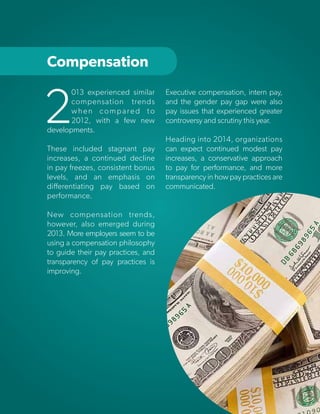
These included stagnant pay
increases, a continued decline
in pay freezes, consistent bonus
levels, and an emphasis on
differentiating pay based on
performance.

Executive compensation, intern pay,
and the gender pay gap were also
pay issues that experienced greater
controversy and scrutiny this year.
Heading into 2014, organizations
can expect continued modest pay
increases, a conservative approach
to pay for performance, and more
transparency in how pay practices are
communicated.

New compensation trends,
however, also emerged during
2013. More employers seem to be
using a compensation philosophy
to guide their pay practices, and
transparency of pay practices is
improving.

Copyright © 2013 ERC (Employers Resource Council)

30
Compensation
More employers
have a compensation
philosophy.
Research this year confirms that more employers
are instituting formal, written compensation
philosophies as compared to a few years ago.
Currently, the majority of organizations have
a formal compensation philosophy, based on
WorldatWork's research.[159]
Compensation philosophies are becoming
more common in explaining an organization's
pay strategy and position in comparison to the
market; the types and mix of rewards offered;
how job performance relates to pay; and how
the organization determines compensation
for its jobs. WorldatWork's research points to
the need for employers to communicate their
compensation philosophy more clearly with
employees to help improve their understanding
of compensation programs and practices.[159]

Pay practice
transparency is
becoming more
common.
Pay practice transparency is seeming to gain
ground in the workplace. Though certainly not
widespread yet, a growing number of employers
are becoming more open and transparent about
their pay practices, evidenced by more sharing
of policies and practices, strategy, market
data, salary ranges, and other compensation
information, though not including individual
salaries.[136]
There seems to be an openness developing in
organizations with regard to eliminating the
secrecy of workplace pay practices and creating
a more transparent environment surrounding
compensation topics. There are undoubtedly
research-supported benefits of sharing more
information regarding compensation, including
enhanced employee perceptions of pay fairness
and a better understanding and appreciation for
the compensation provided.

Copyright © 2013 ERC (Employers Resource Council)

31
Compensation
CEO pay ratio practices
experience increased
public attention.
Earlier this year, Bloomberg News reported that
the gap between CEO and employee pay is
growing, and that CEO compensation is over 200
times higher than the pay of average employees.
This reflects an increase of 20% since 2009. The
ratio is based on the government's industryspecific averages for pay and benefits and the
SEC-required summary compensation table that
companies publish in their shareholder proxy
statements.[75]
In addition, this past fall, The Securities and
Exchange Commission (SEC) has proposed a
rule, under the Dodd-Frank Act, which would
require companies to disclose a pay ratio of
their chief executive officer's compensation
to the median total compensation of all of its
employees (for the last fiscal year).
Under the rule, the SEC would not prescribe
a specific method for organizations to use
when calculating a pay ratio and companies
would have the flexibility to determine the
median annual total compensation among their
employees and make reasonable estimates
when calculating elements of employees' total
compensation. Companies would be required
to disclose the method they used to identify the
median and total compensation as well as any
amounts that are estimated.[128]
But according to Towers Watson, companies are
concerned about the cost and effort involved
in complying with the SEC's proposed CEO
pay ratio disclosure. In a survey it conducted,
over half of respondents were concerned about
complying with the new disclosure requirement,
specifically gathering pay data, determining

Copyright © 2013 ERC (Employers Resource Council)

a data-sampling approach, and identifying the
median employee. Thirty-one percent said their
biggest concern was where their CEO-to-worker
pay ratio stood compared with their peers.[149]

New trends in executive
compensation take
shape.
With increased scrutiny of executive
compensation, companies are being required to
disclose more details about their senior leaders'
compensation, and as a result, are strengthening
executive compensation practices, how
executives' compensation plans are structured,
and the link to performance.
Pricewaterhouse Coopers' research found
that clear and unambiguous, short-term
focused compensation tends to be preferred by
executives. It also found that executives consider
pay practices that are consistent with those of the
organization's competitors to be the most fair.
Additionally, it showed that executives prefer less
risky pay for performance rewards based on clear
and internally controllable measurements, such
as profit, versus external factors.[118]
In addition, Pearl Meyer & Partners reports that a
solid executive compensation strategy should be
linked to the business' needs and achievement
of organizational objectives. It also should be
focused on pay for performance and customized
to reflect business risks at different stages in the
organization's lifecycle.[116]

32
Compensation
Unpaid intern practices
face legal scrutiny.

Gender pay gap shows
no signs of narrowing.

Over the past few years, unpaid internship
practices have experienced more legal scrutiny
in terms of wage and hour lawsuits. But in 2013
alone, unpaid internship lawsuits certainly saw
an unusual uptick from years past. This past year,
unpaid interns filed lawsuits against several large
corporations, most notably including Condé
Nast Publications, Warner Music Group, Atlantic
Recording, Fox Entertainment Group, NBC
Universal, Viacom, Sony, and Universal Music
Group.[90]

Women are earning approximately 77 cents
on the dollar when compared to men in the
workplace, and the gap doesn't appear to be
getting any narrower.[24]

One of the most significant cases involving
unpaid interns in 2013 was Fox Searchlight's.
The U.S. District Court for the Southern District
of New York determined that some of Fox
Searchlight Inc.'s unpaid internships were
illegal, and that interns who worked on the
organization's production film sets were entitled
to compensation under FLSA, even though they
received academic credit for their internship. The
ruling did not suggest that all unpaid internships
are unlawful, but clearly presented a warning to
employers that unpaid internships could carry
costly consequences if they do not meet criteria
set forth by the DOL.[103]
For now, it's unclear how these lawsuits will affect
internships in 2014, though some experts suggest
that they may result in reduced job opportunities
in some industries that have historically used
unpaid interns such as media and publishing.
[90]
It should be noted, however, that research
by the National Association of Colleges and
Employers, as well as local research by ERC and
the Northeast Ohio Council on Higher Education,
show that paid internships are far more common
than unpaid internships.[108] Most employers
understand the competitive benefits of providing
compensation to interns in order to attract quality
intern candidates.
Copyright © 2013 ERC (Employers Resource Council)

The Bureau of Labor Statistics (BLS) published
a report this year which showed that full-time
employed women earn 80.9% of what their fulltime employed male counterparts earn (82.2%).
The BLS reported that the gap widened slightly
since 2005 and is not improving. In addition,
efforts to close the gap appear to be fairly
stagnant.[33] In another study by the National
Partnership for Women and Families on U.S.
Census Bureau data, the median yearly pay for
women who are employed full time is $11,084
less than men's.[82]
With women's issues in the workplace making
more headway in 2013, the gender pay gap
will undoubtedly continue to be part of the
conversation. These recent statistics are a
reminder to employers that when setting
compensation, they are prohibited from
discriminating based on sex under the Equal Pay
Act. Employers must pay employees the same for
"equal work on jobs requiring equal skill, effort,
and responsibility, and which are performed
under similar working conditions."[63]

33
Compensation
Differentiating
pay increases by
performance continues
to be prevalent.

Employers project
2.9%-3.0% pay
increases for
2013/2014.
Salary budget planning surveys for 2013/2014
consistently report average actual pay increases
of about 2.9% for 2013 and project pay increases
of 2.9%-3.0% for 2014 for most levels of
employees, in line with increases of last year.

Numerous surveys suggest that employers are
differentiating pay increases by performance
level. Higher performing employees tend to
receive higher pay increases above the average
increase, while lower performing employees
tend receive lower pay increases below the
average increase.
Average increases for top and average performers
rose in 2013 when compared to 2012. Increases
for top performers average around 4.4% while
increases for average performers average around
2.6%. Employers generally cite average increases
of less than 1% for bottom performers.[15] [102] [160]

Locally, ERC finds that employers are providing
pay increases of 2.9% for 2013 and projecting
the same percentage increase for 2014. Results
of national surveys fluctuate between 2.8% and
3.1%, with the majority indicating 2.9% increases
on average for 2013 and 3.0% increases for
2014.[15] [29] [47] [78] [102] [144] [160] The reasons for these
stagnant pay increases can typically be attributed
to low base salary movement, less hiring and job
expansion, uncertainty regarding the ACA, and
continued economic uncertainty.
The percentage of employers not providing
pay increases or freezing pay continues to
decline across nearly all compensation planning
surveys. Organizations freezing pay are clearly
in the minority, as ERC's research, validated in
other national survey reports, shows that most
employers surveyed are projecting pay increases
in 2014 when compared to the past several years.
Copyright © 2013 ERC (Employers Resource Council)

34
Talent Management

I

n 2013, many employers
continued to be faced with
stagnant engagement,
challenges with retaining
employees and rising turnover, and
struggles with talent management.
N a m e l y, o r g a n i z a t i o n s ’
performance management,
rewards and recognition,
and leadership development
practices are missing the mark in
some respects, despite research
showing that they significantly
influence engagement, retention,
motivation, and productivity.

and new trends in how employers
deliver training are gradually being
implemented. Coaching and
mentoring are also becoming more
common developmental tools.
In addition, shifting workplace
demographics are sparking debate
in the workplace, and causing
employers to rethink and retool their
talent management practices.

Other areas of talent management
have evolved in the past year,
and will likely continue into next
year. Closing skill gaps continues
to be a priority for employers

Copyright © 2013 ERC (Employers Resource Council)

35
Talent Management
Research showcases
trends in engagement
and need for
organizations to focus
on career opportunities
that drive higher
engagement.
Research conducted this year reported several
trends in employee engagement. Not only did
employee engagement remain fairly stagnant in
2013, with no major increases or decreases in
engagement levels, but studies continued to find
relationships between employee engagement
and financial performance.[68]
Gallup found that engagement varies according
to several demographic variables. Specifically,
it found that age and length of service affect
engagement. The generations at the beginning
and end of their careers are more engaged
than the generations in the middle of their
careers. Engagement also tends to be higher for
employees with fewer than six months of service
and lowest for employees with fewer than 10
years of service.[68]
In addition, job type, level, and education also
appear to influence engagement. Managers and
executives are the most engaged. Professional
workers tend to be more engaged than
manufacturing, production, transportation,
and sales workers. Employees with a college
degree are less likely to report having a positive,
engaging workplace experience when compared
to employees with less education.[68] [69]
Another survey by Leadership IQ this year found,
not surprisingly, that high performers were the
most engaged in the majority of organizations.

Copyright © 2013 ERC (Employers Resource Council)

Rarely were middle performers the most engaged,
and they tended to be largely ignored by their
managers. In some organizations, however, low
performers were more motivated, engaged, and
enjoyed working at their organizations more than
middle and high performers. [154]
In terms of what is driving engagement, Aon
Hewitt found that career opportunities was the
top driver that influenced engagement, and that
enabling performance through tools and resources
was the second highest engagement driver.[17]
Despite career development's importance in
driving engagement, programs are lagging in the
workplace. Towers Watson's Talent Management
and Rewards Survey found that few companies
have career paths and only one in four respondents
say that their managers are effective in providing
career management support. Additionally, fewer
than half of organizations say their employees
understand how they can influence their careers
and that employees are able to advance their
careers at their organization given the structure
and tools that are currently in place.[150]

36
Talent Management
Studies report trends
in performance
management practices.
Several new studies report trends in performance
management practices among employers, showcase
performance management best practices, and reveal
what employees want most from the performance
management process.
Early in 2013, SHRM set a performance management
standard which provides organizations with a uniform
way of analyzing and discussing their employee’s
job performance – the first standard established
for performance management. It is a useful set of
best practices for employers, which details several
elements of the performance management process
including manager and employee roles, goal setting,
performance review process and measurement,
performance improvement plans, and connections
to other performance management processes.[131]
A great deal of research this year uncovered
commonalities in factors that drive the success of
performance management processes. Mercer found
that organizations generally have commonalities in
their performance management programs including
setting employee goals, using competencies,
conducting self assessments, incorporating overall
performance ratings, linking performance and pay,
and using a 5-point rating scale. It also showed that
the top driver of successful performance management
was people management skills, specifically setting
employee goals, providing feedback, evaluating
performance, and linking performance to talent
management decisions.[100] Another study conducted
by researchers at Duke University, Harvard Business
School and Yale University this year supported the
use of goal-setting in the performance management
process and found that when employees help create
their own goals, they are more likely to perform at
higher levels.[96]

Copyright © 2013 ERC (Employers Resource Council)

Deloitte's research suggests similar trends in that
immediate feedback, recognition/strength-based
feedback, peer and multi-source feedback, manager
capability to coach effectively, easy and quick access
to performance data, and performance management
technology are crucial elements of performance
management that drive system effectiveness.[53]
Likewise, in a study conducted by the SHRM, 90%
of organizations believe that feedback from an
employee’s direct supervisor plus feedback from their
peers is the most accurate evaluation of performance,
despite the fact that most do not include peer feedback
as part of the evaluation process. In addition, around
half of employers say their performance management
process is not effective and needs to be overhauled.
[134]

Other studies this year report on employees’
perceptions of their organizations’ current
performance management practices. They show that
employees are generally skeptical of performance
reviews, viewing them as unfair and perceiving them
to not be true indicators or performance, reflecting
only a single point of view, making them feel
undervalued, and not accounting for past work. [73]
[87]
Employees believe that development and growth
should be the top goal for performance management,
and that more recognition, peer feedback or feedback
from others, and immediate feedback are desirable
facets of performance management.[73] Similarly,
another survey showed that the widespread majority
of employees prefer face-to-face meetings about their
performance, and younger employees favor more
performance meetings when compared to older
employees.[38]
On a final note, studies also confirm that the majority of
organizations are applying performance management
to executives, including CEOs. This sends a message
that performance expectations, standards, and
accountability are applicable to all levels of the
organization.[86]

37
Talent Management
Quality of management
linked to productivity,
retention, and
engagement.
More and more research continues to show that
manager quality is very important, and that there
are certain behaviors and attributes that make
employees more satisfied with their manager.
Two studies specifically showed that quality of
management matters in terms of productivity,
retention, and engagement.

lives and who had more positive feelings about
interaction with one’s supervisor, were more
engaged.[48]
Finally, another survey by the Workforce Institute
at Kronos this past year on the attributes of the best
managers found that employees favor managers
who are high achievers, honest, goal-oriented,
and compassionate; invest in their professional
development; and praise them directly. [156]
All of this research points to the importance of
ensuring that managers have the right skills and
behaviors.

In a study by DDI, respondents indicated that
their best bosses recognized them appropriately,
supported them without taking over, involved
them in decisions, took time to explain the
reasons behind their decisions, and helped
maintain their self-esteem. Their best bosses
were also considered more likely to help them
be productive, give them sufficient performance
feedback, effectively handle workplace conflict,
empathize when sharing concerns or frustrations,
and help them solve problems. Boss quality was
tied to whether or not employees felt motivated
to give their best to their manager and their
intention to stay at their organization. The
majority of respondents said they would be 2060% more productive under their best boss. [49]
Similarly, in a study by Dale Carnegie Training,
satisfaction with one’s supervisor played a role
in engagement. Around half of employees who
were satisfied with their manager were engaged
and said they learned a lot from their supervisor.
Forty percent of employees who feel empowered
by their supervisor are engaged. Of the 28% of
employees who felt a negative emotion with their
supervisor, fewer than half of these employees
were engaged. Also, employees who perceived
that their managers cared about their personal

Copyright © 2013 ERC (Employers Resource Council)

38
Talent Management
“Big Data” starting to
become more common
in HR departments.
The use of “big data” continues to be a key
focus in workplaces and is affecting not only the
skill sets needed in the workforce, but also HR
departments and how they operate. In addition,
"big data" is becoming more important for
employers in achieving goals and making talent
decisions.

executives perceived analytics to be vital to their
organization, and as a result, analytical skills were
viewed as crucial and in demand.[7] Another study
by the American Management Association found
that HR was perceived to have the least analytical
ability than other functions in the age of “big data,”
and will need to spend more time developing and
honing these skills to improve their function’s
effectiveness.[8]

Organizations are increasingly using data and
analytics to drive better talent acquisition,
performance, engagement, compensation,
learning management, and workforce planning
and retention, to name just a few of its many uses.
Specifically, organizations are using workforce
analytics including employee and leadership
research (e.g. employee focus groups, employee
surveys, exit interviews, employee reward
preferences, line manager feedback, and senior
leadership feedback); external benchmarking
(e.g. competitive market data on pay and benefits,
external benchmark data on talent management
practices, data on marketplace prevalence of
reward and talent management programs, and
trends in total reward design); and organizational
analytics (e.g. business performance analytics,
workforce demographic data, and workforce
performance data).[158]
HR is struggling to manage and use this
information, however. A study by SHL this year
found that that HR is overwhelmed by the amount
of workforce data, dissatisfied with how their
organization manages data, and perceive their
organizations to be ineffective in using talent
analytics.[130]
Additionally, a study by the American
Management Association and Institute for
Corporate Productivity found that most
Copyright © 2013 ERC (Employers Resource Council)

39
Talent Management
considered a valuable developmental tool that
produces long term results.[145] Additionally,
coaching can also be extremely effective at
the line-manager level. In another study by the
Institute for Corporate Productivity this year, use of
one-on-one coaching among frontline managers
was found to have a high correlation with market
performance.[56] Bersin by Deloitte also reports
that organizations with senior leaders who coach
effectively can improve their business results by
21%, on average.[26]

Coaching is being
increasingly used to
develop employees.
A number of surveys this year explored coaching
practices at all levels in the workplace including
coaching for executives, line managers, and
others – even the CEO. Coaching is increasingly
being used to develop leaders for succession,
increase knowledge transfer, improve
performance, drive employee engagement,
reduce attrition, and enhance teamwork. In fact,
coaching from superiors, peers, and external
coaches was ranked the second most commonly
used approach in developing high potentials on
a leadership career track.[54]

But studies have also found that coaching has
room for improvement. As managers are being
encouraged to coach their employees, internal
coaching skills were identified as needing
improvement in a number of studies. In addition,
line leaders who are ineffective at coaching were
seen as a major challenge in the success of high
potential development programs.[54] As a result,
organizations may benefit from enhancing line
leaders’ coaching skills such as in creating shared
goals, asking questions, guiding employees,
giving/receiving feedback, and supporting
employees.

One study by the International Coach Federation in
partnership with PricewaterhouseCoopers found
that coaching is used by many organizations to
achieve optimal performance and effectiveness,
particularly for senior level executives, and is

Copyright © 2013 ERC (Employers Resource Council)

40
Talent Management
Employee retention is
a major challenge for
employers.
Retention is considered a chief concern by
many employers. Thirty-eight percent of 2,100
randomly selected chief financial officers
reported that retaining valuable staff members
was their biggest staffing concern over the next
12 months, according to a survey by Robert Half.
[123]
Another survey by Cornerstone echoes this
trend, reporting that U.S. employers are looking
at more potential turnover in the next year.[43]
Also, a survey by the American Management
Association revealed that turnover is a growing
workplace issue.[4]
In addition to these studies, Hay Group, in
partnership with the Centre for Economics and
Business Research, found that employee turnover
is set to rise in 2014 worldwide, with more workers
expected to “take flight” as economies see more
growth and employment opportunities increase.
Average employee turnover rates over the next
five years are forecasted to rise from 20.6% to
23.4%.[79] Bersin by Deloitte also confirmed the
trend of growing retention concerns this past
year, and attributed it to work environments not
keeping pace, young employees wanting more
career growth than is currently offered to them,
management not understanding how to motivate
workers, and the influx of social media tools
which make it easier to look for a job.[27]
Yet a number of studies pointed to effective
ways to retain talent. A Randstad study found
that bonuses, promotions, a comfortable and
stimulating work environment, having the ability
to share their ideas and opinions, and investments
in training and professional development were
effective retention tools.[121] Meanwhile, Hay

Copyright © 2013 ERC (Employers Resource Council)

Group found that confidence in leadership,
opportunity for career development, autonomy,
a supportive work environment, and appropriate
compensation are key factors affecting employee
retention. Employees who are planning to stay
with their organization for more than two years
score their employers over 20% more favorably on
these five factors than employees who are aiming
to leave in the same period.[79] In another study,
Hay Group also found that lack of organizational
support for work/life balance was tied to turnover.
[80]
Additionally, Cornerstone uncovered that
having a good manager with whom they enjoy
working, feeling appreciated by their supervisor;
and having the opportunity to learn, develop,
and advance were key factors that motivated
employees to stay at their organizations.[43]
While retention appears to be a growing concern
for employers in the coming year, there are also
a number of useful strategies that research has
found which can help organizations retain their
employees.

41
Talent Management
Delivery of rewards
and recognition could
improve.

Work, salary, and job
security remain the most
important work values.

A few surveys conducted on rewards and
recognition show that while the majority of
employers have a recognition program in place
and believe that rewards and recognition is
valuable, rewards and recognition practices are
critical for employee engagement and could
improve in many organizations.

The work itself, compensation, and job security
are consistently among the most important job
attributes to the workforce.

A SHRM and Globoforce study found that
managers and directors are most likely to
recognize others, and executives and top
managers were the least likely to recognize other
employees, yet only 49% of employers believe
that managers effectively recognize and reward
performance and only 26% say that employees
are satisfied with the level of recognition they
receive for doing a good job.[134]
The study also noted that most respondents
believe that feeling appreciated by one’s
supervisor has the most impact on engagement.
Likewise, research by Towers Watson and O.C.
Tanner also shows that how recognition is
delivered and presented to employees affects
their engagement, and that employees are
significantly more engaged when recognition
makes them feel appreciated, feels sincere and
personal, connects accomplishments to company
values, and details specific accomplishments.[112]
In addition, a survey by WorldatWork this
past year reports that recognition programs
are perceived to have a positive effect on
engagement, motivation, and satisfaction –
particularly when there is stronger management
support for recognition. Recognition for length of
service, above and beyond performance, peer to
peer, and motivation of specific behaviors were
the most common types of recognition.[162]
Copyright © 2013 ERC (Employers Resource Council)

In a Monster.com survey, use of skills and abilities,
enjoyment of work, and respect and appreciation
were tied for the top three most important values.
Salary was rated second in importance, and job
security followed, rated third in importance. Other
values that were considered highly important
to job seekers were their supervisor/manager,
training opportunities, performance feedback,
leadership, vacation/paid time off, career
advancement, involvement in decisions, and
corporate culture. Bonuses and work-from-home
options were considered the least important to
job seekers.[106] Additionally, in a study published
in the Employee Benefit Plan Review, salary
and meaningful work were the most important
attributes to workers.[70]
The results of Monster’s survey and the survey
results published in the Employee Benefit Plan
Review mirror those of ERC’s annual survey of over
4,000 top performers in the region, conducted
as part of the NorthCoast 99 program, at least in
terms of attributes considered most important.
In this year’s survey, challenging and meaningful
work was ranked as the most important job
attribute among top performers surveyed, and
compensation and job security followed as the
second and third most important job attributes –
consistent with the findings of Monster’s survey.
Work/life balance, benefits, career development,
leadership, advancement, and autonomy (in
order of importance rankings received) were also
considered important – some of which varied
in importance when compared with Monster’s
survey.

42
Talent Management
Certain training trends
will influence employers
in 2014.
Several training trends emerged during 2013 that
will affect employers’ delivery of learning and
development heading into 2014. They include
the following.
✓ Informal learning, such as discussing best
practices, reading articles and blog posts,
informally talking to mentors, and exchanging
messages with coworkers, is evolving and
more organizations are leveraging it to improve
performance. The majority of organizations plan
to increase their use of informal learning in the
next three years.[21]

✓ Despite an increase in spending, lack of time for
training and development has become a major
impediment to organizations being able to train
and develop their staff. Organizations will need
to find ways to train and develop staff in smaller
increments of time seeing as workers are stretched
for time to develop skills.[3]
✓ Organizations will face challenges in developing
technical, creative, and analytical individuals
(otherwise known as “knowledge workers”), who
have critical skill sets, but who tend to not be as
strong in softer interpersonal skills and people
management.[28]

✓ Although still not very common, mobile learning
will continue to grow. More organizations are
offering learning via mobile devices, which is
an increase from last year. E-learning content
is increasingly being repurposed for mobile
delivery, just-in-time learning, and on-the-job
support.[22]
✓ Mentoring and reverse mentoring are
emerging as important learning tools. Increased
use of mentoring as a developmental tool is
helping organizations pass along older workers’
knowledge to younger employees. More
companies are also using reverse mentoring
in which younger generations are asked to
mentor managers and leaders on social media,
technology, and other relevant topics.[64]
✓ Spending on training and development
is projected to increase. The majority of
organizations project a learning spending increase
in 2014 in the areas of e-learning, leadership and
management development, learning technology,
and performance consulting.[61]

Copyright © 2013 ERC (Employers Resource Council)

43
Talent Management
Leadership
development: a
growing concern
and priority for many
employers.
Employers are becoming concerned about the
lack of future leaders in their organizations and
putting into place practices to develop leaders.
Across several surveys conducted this year on
leadership development, most organizations
view future leadership of their organization
as a high priority.[123] This includes succession
planning, emerging leaders, and leadership
development of young people.[37]
This trend is further supported with the increase in
spending projected for leadership development.
According to a global survey conducted by The
Conference Board and Right Management this
past fall, spending on leadership development
programs is expected to increase over the
next 12 months for 37% of respondents. More
resources are planned to be allocated to a full
spectrum of leadership learning initiatives
including coaching/mentoring, action learning
initiatives such as business challenges and
simulations, and focused skill development.[144]
Likewise, in a survey by Chief Learning Officer
magazine, around half of organizations surveyed
predict a spending increase in leadership and
management development next year, as well as
other areas of training and development.[61]
In addition to more emphasis and investment
in leadership development, research by the
American Society of Training & Development
(ASTD) shows that leadership learning is changing
and now includes more experiences, dialogue,
movement, humor, reflection, and challenge. In
addition, ongoing coaching following training,
regular refreshers, shorter sessions, online
Copyright © 2013 ERC (Employers Resource Council)

learning (webinar and mobile formats), and "justin-time" training and exercises are being used
more often to develop leaders.[20] Another study
by Aberdeen shows that organizations with aboveaverage leadership readiness tend to not only use
formal leadership development programs, but
also stretch assignments, on-the-job or formal
coaching, and coaching or mentoring from
internal sources.[1]
Aberdeen's research also pointed to trends in how
organizations are identifying leaders. Specifically,
organizations say that critical thinking and
cognitive ability assessments, customer or client
feedback, multi-rater/360 assessments, hiring
manager and supervisor feedback, and other
skill/behavioral or scenario-based assessments
are most commonly used to identify leaders.[1]
Leaders also continue to be evaluated based on
certain competencies. Studies suggest that key
competencies of leaders are creating a culture
of engagement, business acumen, embracing
diversity, being politically savvy, adaptability/
versatility, effective communication, learning
ability, multicultural awareness, self-motivation/
discipline, and collaboration.[37]
How organizations define leaders is also
changing. A survey by the American Management
Association revealed that more organizations
consider employees to be leaders based on their
influence and performance, rather than their
specific job level.[5]
This year’s research shows that leadership
development continues to be an extremely
important initiative in workplaces, and is evolving
in terms of how organizations are identifying
leaders and developing them for future roles.

44
Talent Management

“

Requests for leadership development
continue to rise from a few years ago.
Most of the training we deliver is geared
towards improving the skills of those who
lead others.
Also, coaching and mentoring, along
with multi-rater/360 degree assessments,
stretch assignments and book study
groups (among other informal learning
methods) are being used more to
augment leadership development, rather
than just providing training alone."

- Chris Kutsko,
Director, Learning &
Development at ERC

Women’s issues in the
workplace become
popular.
Women’s issues in the workplace pertaining to
compensation, work/life, and leadership gaps
were popular topics in 2013, and will likely
continue to be heading into 2014.

✓ Women tend to receive fewer critical assignments
and projects which give them more attention from
the C-suite and that lead to advancement.
✓ Women are leaving their careers to care for
their families because of workplace problems or
because they either couldn’t find part-time options
or found their part-time schedule problematic and
ended up working more hours than intended.
✓ While a number of women advance to middle
management, the percentage of women who
make it to the C-Suite is dramatically low in
comparison.
In addition, leadership development for women
was a key issue for HR and in the media. Not
only did more research confirm the leadership
gaps in many businesses for women (such as
assertiveness, personal branding, time and
priority management, and business leadership
skill), but it also brought to light the different
leadership development needs that women have
than men, and the leadership competencies that
tend to be stronger in women.[94] Some research
conducted even found that women make better
leaders in the workplace.[9]
Women are a critical demographic in most
businesses and certainly even more so in some
industries. As a result, organizations need to
continue to make sure that they are providing
fair opportunities for them in the workplace and
supporting their unique needs.

There was notable conversation and research
conducted which is putting more pressure on
the workplace to provide adequate support for
women’s needs relative to work/life balance,
family, and career development. The Harvard
Business Review, in particular, published a
“research round-up” of women’s issues in the
workplace and reported the following:[77]

Copyright © 2013 ERC (Employers Resource Council)

45
Talent Management
Studies uncover future
workforce needs.
A study by WorldatWork and Towers Watson
found that the majority of employers are
encountering difficulties attracting and retaining
critically-skilled employees.[158] Another survey by
the American Management Association revealed
four critical skills of critical thinking, creativity,
collaboration, and communication and reported
that there is significant room for improvement
in these competencies among the workforce,
particularly with recent graduates.[6]
To address talent needs, more companies are
using workforce planning and analytics to
identify gaps in skills and talents as more than
half of organizations (57%) are not confident that
educational institutions will generate the talent
needed by their organizations. In fact, Mercer's
research showed that most (77%) have a strategic
workforce plan in place and the majority (60%) of
organizations it surveyed have increased their
investment in talent over the past few years.[101]
Workforce planning activities tend to be more
common among top companies.[88]

Generational issues
sparking workplace
debate.
Generational issues are continuing to be studied
to better understand the impact of Millennials
in the workplace. This year, Pricewaterhouse
Coopers released the largest generational study
conducted to date of more than 40,000 Millennials
and Non-Millennials, which uncovered numerous
trends in understanding how employers attract
and retain them.

Copyright © 2013 ERC (Employers Resource Council)

Studies, including the one by Pricewaterhouse
Coopers as well as ERC's research, generally find
that younger workers (Millennials) are committed
and hardworking, and value work/life balance,
flexibility, a cohesive and team-oriented culture,
opportunities for meaningful and interesting
work, career development, as well as support
and appreciation from their manager. [119] Other
studies report drivers of Millennial retention which
include balance and workload; engaging work,
development, and opportunities; people and
teams; and competitive pay and job opportunities.
[104]

Another survey by Deloitte also supports similar
characteristics of Millennials. Deloitte finds that
Millennials are eager to contribute, take on
responsibility, and advance; expect competitive
pay; value meaningful development opportunities;
and welcome the opportunity to partner with
older and more experienced individuals. These
attributes demand an increasing emphasis on
development and mentoring in the workplace for
employers.[52]

46
Talent Management
Others and purposedriven workplaces
can positively affect
business.
A survey conducted by Deloitte showed that
organizations which focus on creating a culture of
purpose rather than on profits through products
and services that make a positive impact on
clients, employee development and mentorship,
and volunteerism are more likely to be successful
in the long term, by performing well financially,
having a brand that stands out from competitors,
and having strong customer and employee
satisfaction.[51]
Another study by UnitedHealth shows that
employers benefit from employees who
volunteer by reaping lower health care costs,
decreased stress levels, higher productivity, and
development of work skills such as teamwork,
time management, strong relationships with
colleagues, and professional skills/networks.[153]
More research this past year also confirmed
that pro-social behavior in the workplace leads
to positive results. For example, one recent
study found that when organizations offer prosocial bonuses, in which employees have the
opportunity to share bonuses with coworkers and
charities, they experience increased happiness,
job satisfaction, and team performance.[9]
In addition, random acts of kindness in the
workplace such as helping someone, and
acknowledging contributions, were found to
help contribute to positive emotions which lead
to more workplace happiness.[141] Finally, other
research confirms that giving at work – whether
it be time, resources, or help – can be linked to
greater happiness and success.

Copyright © 2013 ERC (Employers Resource Council)

47
Hiring

I

n 2013, employers continued
to struggle with finding critically
skilled employees, particularly
in technical fields. In addition,
social media use for recruiting rose
significantly among employers, and
new online recruiting strategies
continued to be deployed. But,
despite the influx of online recruiting,
research found that employee
referrals still remain one of the most
widely used and most effective
sources.

skilled employees, and continued
increases in online and social mediabased recruiting. There will also be more
pressure on employers to enhance their
hiring processes and make them more
accurate in predicting success on the
job. Similarly, employers will need to
focus on creating enhanced candidate
and new-hire experiences to better
attract and land talent, otherwise their
challenges in finding skilled talent will
be magnified.

Additionally, in 2013, research
noted key areas where employers
are lagging with regard to hiring.
Candidate and new-hire experience
was a notable area needing
improvement among organizations,
with multiple points of research
showing frustration among job
applicants with employers' recruiting
processes. In addition, rising newhire turnover rates within the first year
and ratings by employers regarding
their hiring practices uncovered a
number of hiring process issues in
the workplace.
Heading into 2014, employers
should expect similar trends: modest
Copyright © 2013 ERC (Employers Resource Council)
hiring, difficulties finding highly

48
Hiring
Candidate and new-hire
experience remain areas
needing improvement.
Candidate experience is a key area needing
improvement. This year, research found that
job candidates are frustrated with various
issues in the recruiting process including lack of
responsiveness to or acknowledgement of their
application, lack of follow-up or communication
regarding hiring decisions after an interview,
too much time and difficulty required to apply
for a job, and lack transparency with regard
to compensation for the position and realistic
aspects of the job.[35] [50] [72] [107]
In addition, studies show that the majority of newhires are dissatisfied with the extent to which
expectations set during the hiring process match
those on the job. New-hires commonly feel that
the realities of their new jobs are different from
expectations set by their employers during the
hiring process, with regard to job responsibilities,
work hours, supervisor, senior leadership
competence, compensation, company culture,
and career advancement opportunities.[35] [72]
The studies suggest that candidate experience still
has room for improvement in terms in enhancing
aspects of transparency, responsiveness, and
ease.

Research signals hiring
process deficiencies for
many organizations.
Multiple research studies this year point to hiring
process deficiencies in many organizations.
In a DDI study, less than half of employers rated their
hiring process as highly effective. Issues affecting
hiring mistakes, which resulted in turnover, most
commonly were ineffective interviewing practices,
inaccurate selection systems, overreliance on
hiring manager evaluations, inaccurate assessment
of candidate skills; and unrealistic expectations
of the job, company, and department.[44] Another
study showed that more than half of employers
experienced lost productivity, revenue, and
business opportunities as a result of bad hires who
turned out to be poor performers or weak cultural
fits in the organization.[36]
In addition, PricewaterhouseCoopers/Saratoga
reports rising turnover rates in that nearly one in
four employees leaves voluntarily or involuntarily
within the first year of service. Turnover rates
within the first year of service tend to signal that
something may be wrong in the hiring or recruiting
process.[46]

Copyright © 2013 ERC (Employers Resource Council)

49
Hiring
Social media is
becoming more popular
for recruitment.
Several studies this year suggest that social media,
and especially LinkedIn, are increasingly being
used in the recruitment process, particularly to
recruit passive candidates, search for candidates,
post information about job opportunities, create
interest in jobs, and screen job candidates.
In a survey conducted by the Society for Human
Resource Management (SHRM) this year,
over three-quarters of organizations reported
using social networking websites to recruit
job candidates, which increased by over 20%
since 2011. Also, the study found that the most
common social networking websites used by
employers are overwhelmingly LinkedIn (94%),
but also Facebook (54%) and Twitter (39%).[133]
Similarly, ERC's recent Hiring Trends & Practices
Survey shows that half of employers surveyed use
social media for recruiting, with LinkedIn being
the most commonly used for recruiting (61%).
Additionally, a survey conducted by LinkedIn
reports that social professional networks are
among the most important recruiting sources,
second to employee referrals. The percentage
of respondents that view social professional
networks as an important recruiting source
experienced the largest increase of all the
sources, and many respondents said that they
expect these networks to remain a trend in
the years to come.[93] Other surveys found that
social media is increasingly being used to screen
candidates.[34] [39]
Copyright © 2013 ERC (Employers Resource Council)

“

Social media will play an important role
in recruiting talent in the upcoming year.
Job seekers from all demographics are
using social media as a tool in their job
search, and companies are projecting an
increase in their overall recruiting budget
targeted towards social media in 2014.
To get the most out of social media
tools, employers must assess their overall
recruiting goals and align and measure
the social component accordingly. It
will not be enough just to play in the
space, to be successful employers must
identify the social networks that their
ideal candidates belong to. It is clear that
to attract a senior executive, networks
like Twitter or Facebook are probably not
the best option. Nor are you likely to find
an entry level employee or skilled trades
professional or LinkedIn.
Understanding the demographics of
the social network and engaging with
potential candidates through social
display ads, blogs, gamification, existing
employees' social networks or job
listings will be critical to efficiency and
return on investment. As employers are
solidifying their social media plans for the
upcoming year the biggest challenge will
be ascertaining how social media best
compliments other recruiting tools such
as digital display ads, mobile, search
engine optimization and search engine
marketing to produce optimal results."

- Beth Warholy, Sr. Digital
Specialist at cleveland.com
ERC Preferred Partner

50
Hiring
New trends emerging
in online recruiting
strategies.
As online recruiting is becoming more important
to recruiting success, new strategies are being
developed and used by employers to land
qualified candidates. Specifically, more emphasis
is being placed on targeted messaging and
communications, as well as attractive and
interactive marketing, to ensure that the best
candidates are being recruited.

Despite new sourcing
methods, referrals
remain a common
and effective sourcing
strategy.
Internal employee referrals remain an extremely
common and successful way to find new-hires,
particularly since the recession, and in light of
social networking websites which help broaden
connections and networking.[126]

Effective online recruitment is increasingly being
driven not only by social media practices, but
also by search engine optimization. Though more
commonly used in marketing, search engine
optimization practices such as tying keyword
research to job postings and career webpages,
as well as using Google Analytics to track visitors
to the organization's careers webpage, number
of page views, and other relevant metrics, are
helping organizations target applicants who are
more qualified for positions.[115]

Organizations are consistently reporting that
employee referrals are their most effective sources,
and studies are also finding that employees hired
through employee referrals are significantly more
likely to stay at their employers and more likely to
have a realistic view of their jobs.[71] [126] Employee
referrals account for between 24-33% of all hires
and hires stemming from employee referrals
perform up to 15% better and accept offers 15%
more often than hires sourced elsewhere. They
also tend to have a 25% higher retention rate. [76]

More employers are also embracing emerging
online media for recruitment, such as mobile,
content, multimedia (e.g. video), and interactive
websites. Emerging media is helping to create
stronger employment brands, attract applicants,
and create comprehensive recruitment
communications. Though mobile recruiting is
less commonly used, with 10% of organizations
using a mobile optimized website and around
12% planning to implement one in the next 12
months, according to ERC's Hiring Trends &
Practices Survey, it is a practice employers need
to keep on their radar, as it will likely continue to
gain traction.

Despite the wide use of social media and online
recruiting methods, employee referrals still top
the list in terms of sources that are considered
most effective. And, in fact, social media can
complement employee referral programs by
helping employees stay connected to others and
network with them online.

Copyright © 2013 ERC (Employers Resource Council)

51
Hiring
EEOC targets
background screening
practices; "Ban the Box"
legislation becoming
more common.
The Equal Employment Opportunity Commission
(EEOC) started taking action on employers for
their background screening practices this year.
During 2013, the EEOC filed lawsuits specifically
against BMW and Dollar General, alleging that
their policies and practices are overly broad
with blanket exclusion, and discriminatory
against African Americans because they result in
disparate/adverse impact which may violate Title
VII of the Civil Rights Act. The cases are a reminder
for employers that criminal records are becoming
an increasingly dangerous area for organizations
to tread and that they need to pay attention to
these cases and their outcomes.[44]
In addition, a few more states and cities pursued
"Ban the Box" legislation this year, which generally
makes it unlawful for employers to ask about
convictions on an employment application or
directly. Increasingly, this legislation is including
private employers. "Ban the Box" initiatives seem
to be gaining more momentum, however Ohio
does not yet have a similar law in place.[45]
These two trends related to background screening
practices suggest that employers will need to
pay attention to their hiring and background
screening practices to remain compliant.

Copyright © 2013 ERC (Employers Resource Council)

52
Hiring

“

We’ve seen “ban the box” legislation continue to proliferate,
with more states adopting the regulations for private employers.
Additionally, Target Corporation has adopted the “ban the box” policy nationwide. And on the
heels of increased “ban-the-box” legislation, there is also a movement to restrict the use of credit
histories in pre-employment background screening. This leaves many employers re-evaluating
their use of credit histories in background screening.
We expect the scrutiny on background screening to continue in 2014, and anticipate the EEOC
will continue to closely examine how employers use criminal records in hiring. We also expect
the “ban-the-box” trend to continue to grow. These trends indicate the necessity of employers of
all sizes to regularly reassess their background screening programs to protect their background
screening investment and ensure that they are in compliance with laws and regulations.
As predicted, a notable trend for 2013 was the integration of multiple HRO technologies and
background screening was a big part of that. In 2013 the volume of Corporate Screening
customers opting to integrate our service and technology with their HR platform increased
dramatically. This has occurred for two primary reasons:
Employers continue to move towards viewing background screening as a service purchase more
so than a commodity purchase. Incorporating a background screening vendor’s services into
the hiring and onboarding workflow streamlines process, reduces cost, and creates significant
value for the employer. And maturation of technology. While plug and play may be a bit of an
oversimplification, integrations are easily had these days.
This trend will continue in 2014 as an increasing number of employers realize they can leverage
the service and technology aspects of a background screening service to their benefit."

- Greg Dubecky, President at Corporate Screening Services
ERC Preferred Partner

Copyright © 2013 ERC (Employers Resource Council)

53
Hiring
Skilled talent shortages
persist.
Shortages of skilled talent persisted in 2013,
and are expected to continue heading into
2014. ManpowerGroup found that employers
are continuing to struggle to find skilled talent
specifically for jobs in skilled trades, IT, engineers,
technicians, mechanics, finance and accounting,
and sales.[95] Similarly, survey results released
from Robert Half mirrored this trend, reporting
that the majority of small businesses' biggest
challenge is finding skilled professionals.[124]
The primary reasons for challenges in finding
skilled talent seem to be lack of technical
competencies, lack of soft competencies, lack of
available applicants, applicants looking for more
pay than is offered, and lack of experience.[95]
To overcome skilled talent shortages, employers
are increasingly implementing new strategies
including changing their sourcing tactics, using
networking and employee referrals, working with
professional staffing/niche firms, training and
developing staff, redefining job qualifications,
offering career development opportunities,
partnering with educational institutions to create
curriculum and training aligned with talent needs,
and offering more benefits, compensation,
and training.[95] Less commonly, employers hire
temporary workers, recruit talent from other
cities and allow remote work arrangements, and
pay relocation expenses for candidates to resolve
difficulties in recruiting skilled talent.[2]

“

A growing trend
in the staffing and
recruitment industry
for 2014 is the focus
on technology. From
the way candidates
are using technology to
access jobs, to the application
process, to the high demand for IT
positions, technology remains the vehicle
to success for the future of staffing and
HR professionals. Mobile job hunting
has become overwhelmingly popular
for both passive and active candidates;
requiring companies to rethink website
designs to allow for mobile optimization
and easy user access. Additionally,
employers are turning to technology
by using talent management software
systems to streamline communications
and increase efficiencies internally during
the hiring and on-boarding process.
In addition, there continues to be an
ongoing high demand for IT talent
as companies continue to focus on
automation and improved process
efficiencies. The shrinking talent pool for
seasoned IT professionals and the high
demand for these candidates is causing
employers to realize the need to increase
compensation for the desired skill set,
or reconsider the qualifications of the
position to accommodate candidates in
the market."

- SueAnn Naso, President at
Staffing Solutions Enterprises
ERC Preferred Partner

Copyright © 2013 ERC (Employers Resource Council)

54
Throughout 2014, continue to
visit www.yourERC.com for more
updates and trends about everything
your organization needs to know to stay
competitive in the workplace; remain
compliant; and attract, retain and motivate
your best employees.

Conclusion

While no one knows for certain what 2014
holds for employers and HR, it's safe
to say that many of the legal, health
care, benefits, compensation, talent
management, and hiring trends
summarized in this e-book will
come to fruition, based on the legal
landscape and current HR trends that
have already surfaced this year.
Sources

14. Aon Hewitt (2013). Aon Hewitt Survey
Highlights Important Role of Incentives in U.S.
Employers' Efforts to Improve Workforce Health
and Performance

1. Aberdeen Group (2013). Accelerating
Leadership Development

15. Aon Hewitt (2013). Aon Hewitt Survey Shows
2014 Salary Increases to Reach Highest Levels
since 2008

2. Accountemps (2013). Survey: Companies
Offering Improved Benefits, Higher Pay to Access
Skilled Workers
3. Aerotek (2013). Study: Lack of Time Biggest
Deterrent from Developing Employees
4. AMA Enterprise (2013). Employers Unfazed by
Workers’ Intent to Quit
5. AMA Enterprise (2013). Key Trends Found in
Global Leadership Development
6. American Management Association (2013).
2012 Critical Skills Survey
7. American Management Association (2013).
Demand for Analytical Skills to Grow Sharply
Over Next Five Years, According to New
American Management Association Study
8. American Management Association (2013).
Some Job Functions Have to Catch Up with “Big
Data”
9. Andersen, E. (2013). Why Women Make Better
Leaders. Forbes
10. Anik, L., Aknin, L.B., Norton, M.I., Dunn,
E.W., Q, J. (2013). Prosocial Bonuses Increase
Employee Satisfaction and Team Performance.
Harvard Business School
11. Aon Hewitt (2013). Aon Hewitt Analysis Shows
Lowest U.S. Health Care Cost Increases in More
Than a Decade
12. Aon Hewitt (2013). Aon Hewitt Research
Finds Consumer-Driven Health Plans Continue to
Grow in Popularity
13. Aon Hewitt (2013). Aon Hewitt Research
Shows Employers Taking Steps to Help
Employees Reduce Stress in the Workplace

Copyright © 2013 ERC (Employers Resource Council)

16. Aon Hewitt (2013). Most U.S. Employees
Likely to See Changes When Enrolling in Health
Benefits This Year, Says Aon Hewitt
17. Aon Hewitt (2013). North America Sees
Lowest Levels of Employee Engagement Since
2008, According to Aon Hewitt Analysis; Aon
Hewitt Analysis Finds Managing and Improving
Employee Engagement is Key to Achieving
Revenue Growth and Profitability Goals
18. APA (2013). APA Survey Finds US Employers
Unresponsive to Employee Needs
19. Appleby, J. & Kaiser Health News (2013). How
Quickly Are Health Insurance Premiums Rising?
20. ASTD (2013). 6 Leadership Learning Trends
You Need to Know
21. ASTD (2013). New Research: Informal
Learning Recognized by Organizations, Not
Yet Adopted As a Component of Learning &
Development
22. ASTD & Institute for Corporate Productivity
(2013). Going Mobile: Creating Practices That
Transform Learning
23. Baker Hostetler (2013). U.S. Supreme Court
Declines to Loosen Causation Standards for
Employee Retaliation Claims in University of Texas
Southwestern Medical Center v. Nassar
24. Bassett, L. (2013). Women Still Earned
77 Cents On Men's Dollar In 2012: Report.
Huffington Post
25. Bell, J. (2013). Ohio Latest to Adopt SharedWork Program Designed to Reduce Layoffs.
Columbus Business First

56
Sources
26. Bersin by Deloitte (2011). High-Impact
Performance Management: Maximizing
Performance Coaching
27. Bersin, J. (2013). Employee Retention Now
a Big Issue: Why the Tide has Turned. Bersin by
Deloitte
28. Blessing White (2013). What’s Harder About
Being “Smarter”? The Challenges of Leading
Expert Employees
29. BLR (2013). 2013-2014 Pay Budget Survey
Data: How Do You Compare
30. BNA (2013). EEOC Commissioner Feldblum
Offers Insight on Obesity Discrimination
31. Boehm, T. (2013). Top Official Held Personally
Liable Under FLSA. Fisher & Phillips
32. Buck Consultants (2013). Staying the Course:
Employers Show Commitment to Wellness
Despite Economic Hard Times
33. Bureau of Labor Statistics & BNA (2013).
Gender Pay Gap Widened in 2012, Except for
Tech Pros. Report on Salary Surveys
34. CareerBuilder (2013). More Employers
Finding Reasons Not to Hire Candidates on Social
Media, Finds CareerBuilder Survey
35. CareerBuilder (2013). Seventy-Five Percent
of Workers Who Applied to Jobs through Various
Venues in the Last Year Didn’t Hear Back From
Employers, CareerBuilder Survey Finds
36. CareerBuilder (2013). Two Thirds of U.S.
Employers Say Bad Hires Negatively Affected
Business Last Year
37. Center for Creative Leadership (2012).
Expanding the Leadership Equation: Developing
Next Generation Leaders
38. Ceridian (2013). Pulse of Talent

Copyright © 2013 ERC (Employers Resource Council)

39. Chief Learning Officer (2013). Most
Employers Check Facebook, Twitter of Job
Applicants
40. CNN (2013). Obamacare Delay for Small
Business Exchanges
41. CompData (2012). Voluntary Benefits and
Perks Add Value to Traditional Employer Benefit
Plans
42. CompData (2013). Employers Try New Ways
to Combat High Medical Insurance Costs
43. Cornerstone (2013). Cornerstone
OnDemand 2013 U.S. Employee Report
44. Corporate Screening Services (2013). EEOC
Targets BMW & Dollar General
45. Corporate Screening Services (2013). Rhode
Island "Bans the Box."
46. Cueni-Cohen, J. (2013). Hiring-Process
Quality Drops. HR Executive
47. Culpepper (2013). Culpepper Salary Budget
& Compensation Planning Survey
48. Dale Carnegie Training (2013). Dale Carnegie
Training Uncovers Major Drivers of Employee
Engagement in US Workforce
49. DDI (2013). Lessons for Leaders from People
That Matter: How Employees Around The World
View Their Leaders
50. DDI (2013). Vote of Low Confidence:
Employers and New Employees Question Hiring
Decisions
51. Deloitte (2013). Executives: U.S. Businesses
Not Delivering Societal Impact
52. Deloitte (2013). Generation Y: Powerhouse
of the Global Economy
53. Deloitte (2013). Human Capital Trends 2013:
Leading Indicators
54. DiRomualdo, T. (2013). Coaching: An
Under-Developed Driver of Organizational
Performance. Institute for Corporate Productivity

57
Sources
55. DOL (2013). Application of Market Reform
and Other Provisions of the Affordable Care
Act to HRAs, Health FSAs, and Certain Other
Employer Healthcare Arrangements
56. DOL (2013). Home Care: What are the
Minimum Wage & Overtime Pay Protections
57. DOL (2013) Executives with Texas-based
High Performance Ropes of America Sentenced
to Time Served, Company Ordered to Pay
Employees Back Wages, Penalties
58. DOL (2013). Administrator's Interpretation
No. 2013-1
59. DOL (2013). Family and Medical Leave Act:
Protections Expanded for Military Families and
Airline Flight Crews
60. DOL (2013). Obama Administration
Continues Moving Forward to Implement
Health Care Law by Releasing Final Rules on
Employment-Based Wellness Programs
61. DuBois-Maahs, J. (2013). Spending on
Learning and Development on the Rise. Chief
Learning Officer
62. Eber, S. (2013). Continuing the ProEmployer Trend? What to Watch In the
Supreme Court’s 2013/2014 Term. Retrieved at
laborandemploymentlawcounsel.com
63. EEOC (2013). The Equal Pay Act of 1963
64. Ellis, R. (2013). Reverse Mentoring: Letting
Millennials Lead the Way. ASTD
65. Employee Benefit Research Institute (2013).
Workers Like Their Own Health Plan – The Overall
Health Care System, Not So Much
66. Farrell, J. (2013). IRS Will Treat Same-Sex
Marriages the Same as Heterosexual Ones. BLR

Copyright © 2013 ERC (Employers Resource Council)

67. Fisher & Phillips (2013). Supreme Court Rules
DOMA Is Out, Same-Sex Marriages Are Legal
68. Gallup (2013). State of the American
Workplace: Employee Engagement Insights for
U.S. Business Leaders
69. Gallup (2013). U.S. Managers Boast Best
Work Engagement
70. Giancola, F. (2012). Importance of Pay to
Employees. Employee Benefit Plan Review
71. Giang, V. (2013). Referred Workers Are 20%
Less Likely to Quit Their Jobs. Business Insider
72. Glassdoor (2013). 6 In 10 Employees Say
Job Realities Different Than Expected; Glassdoor
Survey
73. Globoforce (2013). Workforce MoodTracker
Summer 2013 Report: Empowering Employees
to Improve Employee Performance
74. Gould, T. (2013). First ADA Suit Since AMA's
Obesity Policy: Is This the Start of Something
Big? HR Morning
75. Grant, A. (2013). Ratio of CEO Pay to
Employee Pay Growing Bigger. Retrieved at
Cleveland.com
76. Greenberg, A. (2013). Why Employee
Referrals are Your Most Powerful Sourcing
Strategy. Retrieved at info.recruitingdivision.com
77. Harvard Business Review (2013). Women in
the Workplace: A Research Roundup
78. Hay Group (2013). Forecasted 2014 US Base
Salary Increases Remain Stable, While Employees
See Net Gains, New Hay Group Research Finds
79. Hay Group (2013). Global Talent Exodus on
the Horizon as Economic Growth Returns
80. Hay Group (2013). Rising Work-Life Balance
Concerns Tied to Employee Turnover across the
Globe
81. HHS (2013). New Rule Protects Patient
Privacy, Secures Health Information

58
Sources
82. Huffington Post (2013). Women and Equal
Pay: Wage Gap Still Intact, Study Shows
83. Huffington Post (2013). Work Stress on the
Rise: 8 in 10 Americans are Stressed About Their
Jobs, Survey Finds
84. Hyman, J. (2013). Fringe “Religions”
(Veganism?) Raise Interesting Problems for
Accommodation Requests. Ohio Employer Law
Blog
85. Institute for Corporate Productivity (2013).
Companies are Unprepared to Deal with Future
Workforce Needs
86. Institute for Corporate Productivity (2013).
Two-Thirds of High Performance Organizations
Apply Performance Management to Executives
87. Institute for Corporate Productivity (2013).
Don't Wave Goodbye to Performance Reviews
Just Yet
88. Institute for Corporate Productivity (2013).
New i4cp Research Identifies Critical Workforce
Planning Metrics
89. Jackson Lewis (2013). Supreme Court
Clarifies Definition of ‘Supervisor’ in Hostile Work
Environment Cases
90. Jacobs, D. (2013). Unpaid Intern Lawsuits May
Reduce Job Opportunities. Forbes
91. Johnson, S. (2013). Some Employers
Penalizing Workers for E-Cigarette Use. Modern
Healthcare
92. Lee, M. (2013). Lee Introduces Comp-Time
Bill to Help Working Families. Retrieved at lee.
senate.gov
93. LinkedIn (2013). 2013 Global Recruiting
Trends Survey

Copyright © 2013 ERC (Employers Resource Council)

94. Management Research Group (2013).
Management Research Group Studies of Over
7000 Leaders Indicate Several Differences
Between Men and Women When It Comes to
Leadership Behaviors
95. ManpowerGroup (2013). 2013 Talent
Shortage Survey
96. McGraw, M. (2013). Charting Their Own
Path. HR Executive
97. Mercer (2012). Making Smart Benefit Choices
Survey
98. Mercer (2013). Employers Exploring Private
Benefit Exchanges
99. Mercer (2013). Employers Hold the Line on
Health Benefit Cost Per Employee in 2014
100. Mercer (2013). Few Organizations Have
Confidence in the Effectiveness of Their
Performance Management Programs
101. Mercer (2013). Organizations Investing
More in Talent, But is it Paying off?
102. Mercer (2013). Pay Increases for US
Employees Illustrate the "New Normal" By
Staying the Course
103. Mihelich, M. (2013). Federal Court Says
‘Black Swan’ Interns Should Have Been Paid.
Workforce
104. Millennial Branding (2013). Survey Reveals
the Rising Cost of Hiring Workers from the
Millennial Generation.
105. Miller, S. (2013). IRS Issues Proposed PPACA
Rules on Employer-Information Reporting. SHRM
106. Monster (2013). 2013 U.S. Workforce Talent
Survey
107. Moore, R. (2013). Fix the Top 5 Online Job
Search Frustrations for Applicants. ERE.net
108. National Association of Colleges &
Employers (2013). 2013 Internship & Co-Op
Survey

59
Sources
109. National Business Group on Health
(2011). What Employers Need to Know About
E-Cigarettes
110. National Conference of State Legislatures
(2013). Employer Access to Social Media
Usernames and Passwords 2013

122. Right Management (2013). Employers
Worried by Lack of Future Leaders
123. Robert Half (2013). Robert Half Survey
Reveals Retention Is Executives' Main Staffing
Concern
124. Robert Half International (2013). Survey:
Finding Capable Employees Is Greatest
Management Hurdle for Small Businesses
125. Sammer, J. (2013). Keeping Pay Cards
Viable in the Face of Legal Challenges. SHRM

111. NLRB (2013). Statement by Chairman Pearce
on Recess Appointment Ruling

126. Schwartz, N. (2013). In Hiring, a Friend in
Need Is a Prospect, Indeed. The New York Times

112. O.C. Tanner (2013). Best Practices for
Recognizing Employees’ Career Achievement

127. SCOTUS Blog (2012). Argument Preview:
Who is a Supervisor?

113. OSHA (2013). December 1st, 2013
Training Requirements for the Revised Hazard
Communication Standard

128. Securities and Exchange Commission
(2013). SEC Proposes Rules for Pay Ratio
Disclosure

114. OSHA (2013). OSHA Releases New
Resources to Better Protect Workers from
Hazardous Chemicals

129. Shihab & Associates (2013). US Supreme
Court Decision Makes Same-Sex Couples Eligible
for Green Cards

115. Palomino, L. (2013). Watch Your Words: Job
Seekers Aren’t Searching for the Ones You’re
Using. ERE.net

130. SHL (2013). Survey: Most HR Professionals
Overwhelmed With Big Data

116. Pearl Meyer & Partners (2013). 2013
Compensation Committee Agenda: Go Beyond
117. Pechman, L. (2013). The FLSA at 75. The
Huffington Post
118. PricewaterhouseCoopers (2012). Making
Executive Pay Work: The Psychology of Incentives
119. PricewaterhouseCoopers (2013). PwC's
Next Gen: A Global Generational Study Millennial Workers Want Greater Flexibility,
Work/Life Balance, Global Opportunities
120. RAND Corporation (2013). Workplace
Wellness Programs Study
121. Randstad (2012). Want to Retain Me? U.S.
Workers Say ‘Show Me the Money’

Copyright © 2013 ERC (Employers Resource Council)

131. SHRM & ANSI (2013). Performance
Management: American National Standard
132. SHRM (2013). SHRM Employee Benefits
Survey
133. SHRM (2013). SHRM Survey Findings: Social
Networking Websites and Recruiting/Selection
134. SHRM & Globoforce (2013). Employee
Recognition Programs Survey
135. Siegel, J. (2013). New Law Lets Ohio
Companies Cut Hours, Not Jobs. Columbus
Dispatch
136. Silverman, R. (2013). Psst...This Is What Your
Co-Worker Is Paid. The Wall Street Journal Online
137. Smith, A. (2013). Huge Jump in I-9 Audits.
SHRM

60
Sources
138. Smith, A. (2013). OFCCP Backs Away from
Rigid Affirmative Action Requirements for People
with Disabilities. SHRM
139. Smith, P. & Picco, K. (2013). N.Y. Attorney
General Investigates Use of Payroll Cards. Ballard
Spahr
140. Society of Actuaries (2013). Predicts Costs of
the Future
141. Sonnentag, S. & Grant, A. (2013). Doing
Good at Work Fees Good at Home, but Not Right
Away: When and Why Perceived Prosocial Impact
Predicts Positive Affect. Personnel Psychology
142. Tanenbaum Center for Irreligious
Understanding (2013). What American Workers
Really Think About Religion: Tanenbaum’s 2013
Survey of American Workers and Religion
143. The Conference Board & Right Management
(2013). Strategic Leadership Development:
Global Trends and Approaches
144. The Conference Board (2013). U.S. Salary
Increase Budgets for 2014
145. The International Coach Federation &
PricewaterhouseCoopers (2013). 2013 ICF
Organizational Coaching Study
146. The Treasury Department (2013). Continuing
to Implement the ACA in a Careful, Thoughtful
Manner
147. Towers Watson (2013). Health Care Changes
Ahead Survey: Employers’ Actions Today and
Plans for the Future
148. Towers Watson (2013). Importance of
Employer-Sponsored Voluntary Benefits and
Services Expected to Surge, Towers Watson
Survey Finds

Copyright © 2013 ERC (Employers Resource Council)

149. Towers Watson (2013). Majority of U.S.
Public Companies Concerned About Complying
With Proposed CEO Pay Ratio Rule, Towers
Watson Poll Finds
150. Towers Watson (2013). North American
Employers' Career Management Programs
Falling Short.
151. Treasury Department (2013). Treasury
Modifies “Use or Lose” Rule for Health Flexible
Spending Arrangements
152. U.S. Department of Treasury (2013).
Fact Sheet: Individual Shared Responsibility
for Health Insurance Coverage and Minimum
Essential Coverage Final Rules
153. UnitedHealth Group (2013). 2013 Health
and Volunteering Study
154. Weber, L. (2013). Bad at Their Jobs, and
Loving It. The Wall Street Journal
155. Willis (2013). Willis Survey: Employers
Underestimating True Cost of Complying with
Health Care Reform, Stalling on Strategies to
Direct Health Care Spend
156. Workforce Institute at Kronos (2013). Kronos
Boss's Day Survey
157. WorldatWork & Bensinger, DuPont and
Associates (2013). Gender Differences in How
Stress Impacts Job Performance
158. WorldatWork & Towers Watson (2013).
2012-2013 Global Talent Management and
Rewards Study
159. WorldatWork (2012). Compensation
Programs and Practices 2012
160. WorldatWork (2013). 2013/2014 Salary
Budget Survey
161. WorldatWork (2013). Survey on Workplace
Flexibility 2013
162. WorldatWork and ITA Group (2013). Trends
in Employee Recognition

61

HR Trends eBook

  • 1.
  • 2.
    About ERC 4 Introduction 5 Legal 17 Healthcare &Benefits 30 Compensation 35 Talent Management 48 Hiring 55 Conclusion 56 Sources Table of Contents 3
  • 3.
    www.yourERC.com • 440-684-9700 We’reERC, and we make workplaces better! ERC is Ohio's leading HR organization. ERC membership provides employers access to an incredible amount of information, expertise and cost savings that supports the attraction, retention and development of great employees. ERC members have access to the following services to help support their HR function: Survey Data HR Help Desk Online Tools Networking Cost Savings Additional Services at ERC In addition to our five core membership services, ERC offers HR and workplace-related services including training, consulting, coaching and assessments. ERC hosts the NorthCoast 99 program, which annually honors Northeast Ohio’s top workplaces. ERC Health is a health insurance program that rewards employers for their employees’ participation in health and wellness activities. For more information about ERC, please visit our site at: www.yourERC.com. Copyright © 2013 ERC (Employers Resource Council) 3
  • 4.
    Introduction M any notable trends emergedthroughout 2013 which will affect employers’ initiatives related to legal compliance, health care/ benefits, compensation, talent management, and hiring in 2014. In summary, there were a few significant federal employment law developments and Supreme Court rulings in 2013, as well as continued heightened enforcement among the federal agencies. Health care reform, however, was the biggest compliance issue affecting employers this past year, and will continue to be heading into 2014, as new rules are finalized and employers prepare for key regulations that take effect in 2015. In the area of compensation, there were continued modest pay increases. More employers appear to be compensating strategically, with a compensation philosophy and focus on pay for performance. Organizations are also becoming somewhat more transparent and communicative about their compensation practices. In the realm of benefits, wellness programs continued to be enhanced and employers seem to be offering voluntary benefits to a greater degree. More attention on work/ life programs, including flexible scheduling and stress management, also was prevalent among employers in 2013. But, above all, health care benefits was the primary concern for most employers. Many of same talent management and hiring challenges persisted in 2013. Employers face opportunities to improve employee engagement, performance management, rewards and recognition, the candidate and new-hire experience; and the ways in which they attract, retain, manage, and develop talent. Faced with a shortage of skilled talent, employers are increasingly using social media and strategic online recruiting methods to find workers. In addition, leadership and employee development continue to be areas of concern and priority for employers, and are being affected by certain demographic needs and interests, including women and younger workers. Employers will be operating with quite a bit of uncertainty in the health care and compliance arenas in 2014. It appears that the main challenges employers will face are related to health care, the changing benefits landscape, difficulties in finding skilled talent, and struggles with engaging and retaining current talent with modest pay increases and lagging talent management practices. The following e-book summarizes the most important HR trends that surfaced throughout 2013 and several trends you should expect and plan for heading into 2014 – supported by both national and local research. It also includes detailed commentary from local subject-matter experts in Northeast Ohio on trends they’ve observed this year and how those will affect HR in 2014. These combined research and subject matter insights serve to provide you with a summary of key trends to be aware of during 2014. PLEASE NOTE: By providing you with research information that may be contained in this message, the Employers Resource Council (ERC) is not providing a qualified legal opinion concerning any particular human resource issue. As such, research information that ERC provides to its members should not be relied upon or considered a substitute for legal advice. The information that we provide is for general employer use and not necessarily for individual application. We also recommend that you consult your legal counsel regarding workplace matters when and if appropriate. Copyright © 2013 ERC (Employers Resource Council) 4
  • 5.
    Legal I n 2013, afew notable changes to federal employment law regulations were made. These included changes to the Family Medical Leave Act (FMLA), a revised I-9 form, and new HIPPA rules. Also, during 2013, a few important decisions made by the Supreme Court affected employers, most significantly the federal Defense of Marriage Act being struck down, and the clarification of the definition of a supervisor under Title VII of the Civil Rights Act. The Supreme Court will consider other employment law-related decisions that affect employers in 2014. Finally, the outcomes of numerous court cases in 2013 offer new guidance and warn employers of potential liabilities. Case law will continue to be an important source of direction on employment law matters, particularly for the Family Medical Leave Act (FMLA), the Americans with Disabilities Act (ADA), and the Fair Labor Standards Act (FLSA). More cases involving social media and/or social media postings as evidence emerged in 2013 as well, and this will likely continue in 2014. Additionally, while the National Labor Relations Board's (NLRB) activity was less pronounced in 2013, the Equal Employment Opportunity Commission (EEOC) continued to remain very busy with a variety of discrimination issues. Heading into 2014, employers should expect that EEOC activity will continue to be high, and that the NLRB will likely be more active as well. In addition, there are a few reforms being considered by the government, pertaining to immigration, workplace flexibility, and social media privacy. Copyright © 2013 ERC (Employers Resource Council) 5
  • 6.
    Legal Little NLRB activityin 2013, but that could change next year. There was very little NLRB activity in 2013 with the U.S. Court of Appeals for the District of Columbia Circuit ruling that President Barack Obama acted unconstitutionally when he made three recess appointments to the NLRB. The ruling has been appealed to the U.S. Supreme Court. While the ruling invalidates NLRB decisions made from January 4th until now, employers should continue to use the NLRB's guidance until its decisions are ruled binding or not.[111] In the meantime, there was some activity with regard to the NLRB that affected employers. The United States Court of Appeals struck down a rule by the NLRB which required organizations to post a notice to inform employees about their rights under the National Labor Relations Act (NLRA), asserting that all three enforcement provisions in the rule were unlawful. Additionally, the Senate voted to confirm five nominees to the NLRB, three Democratic nominees and two Republicans. Upcoming Supreme Court decisions will affect employers in 2014. The Supreme Court started hearing arguments for several important cases in October featuring issues affecting the Employee Retirement Income Security Act (ERISA), FLSA, the President's power to make recess appointments to the NLRB, and whistleblower protections under the SarbanesOxley Act (SOX). The outcomes of these cases could meaningfully affect employers heading into 2014. Specifically, the Supreme Court will review whether a statute of limitations can run upon a clear repudiation of rights; what "changing clothes" means with respect to FLSA and compensable time; if the President can make recess appointments; and whether employees of privately held contractors or subcontractors of public companies can bring retaliation claims under SOX.[62] With a fully-constituted Board heading into 2014, organizations should expect the NLRB to be more active and revisit issues that were put on hold in 2013. Copyright © 2013 ERC (Employers Resource Council) 6
  • 7.
    Legal Immigration reform that wouldaffect employers continues to be considered. There has been quite a bit of activity in the U.S. legislature regarding changes to immigration laws this year. Though nothing has passed yet, several different pieces of possible legislation emerged during 2013 that could affect the cap for H-1B workers, visa programs, E-Verify, and green cards. Proposed legislation this year specifically included requiring the use of E-Verify, increasing the number of H-1B visas with further flexibility to raise the cap based on demand for highly skilled jobs, increasing the percentage of employment-based green cards that are granted, and providing exemptions to certain immigrants based on education or ability in the STEM fields. Although there have been so many different bills proposed in Congress this year regarding immigration, some of which are very significant, it is unclear what direction reform will take at this time. Nonetheless, employers can expect that immigration reform will surface again during 2014 as President Obama has said that he will press immigration reform immediately after the current fiscal issues are addressed in Congress. DOMA ruled unconstitutional; affects employers’ benefits practices. In June, the Supreme Court struck down the federal Defense of Marriage Act (DOMA) in United States v. Windsor. The Court ruled that section 3 in DOMA was unconstitutional as it deprives individuals of equal liberty protected in the Fifth Amendment. Depending on the state and if it recognizes same-sex marriages, the Court’s decision affects employee benefits and protections. In any state that recognizes same-sex marriages, employers will be required to treat same-sex couples the same as opposite sex couples in regards to offering COBRA continuation coverage, allowing spouses to use FMLA (if eligible and qualified), being subject to flexible spending and health savings account rules, attaining eligibility for immigration benefits,[129] and recognizing samesex spouses to determine surviving spouse annuities or death benefits.[67] The IRS and the U.S. Treasury Department also ruled that married same-sex couples will be treated as married for federal tax purposes, regardless of whether the couple lives in a jurisdiction that recognizes same-sex marriage. [66] The overturning of DOMA brought to light samesex issues in the workplace, and could be the beginning of more related legislation to protect same-sex rights. Copyright © 2013 ERC (Employers Resource Council) 7
  • 8.
    Legal Definition of a supervisor& causation standards for retaliation claims were clarified by the Supreme Court. FMLA protections were expanded. This past year, the Department of Labor (DOL) issued a final rule which implemented two important expansions of protections under FMLA. Employers are now required to use new forms to administer FMLA. One of the expansions provided families of eligible veterans with the same FMLA leave that is available to families of military service members. It also allowed more military families to take leave for activities that arise when a service member is deployed. The other expansion modified existing rules so that airline personnel and flight crews are better able to use FMLA’s protections. [59] In 2013, the DOL also clarified factors an employer must consider when an employee requests leave to care for an adult child. The guidance addressed two issues 1) the age of onset of a disability for a son or daughter affecting the parent's ability to take FMLA leave and 2) the impact of the Americans with Disabilities Act Amendment Act (ADAAA) on the FMLA definition of son or daughter. The DOL specified that the age of the onset of the disability is irrelevant to the determination of whether an individual is considered a "son or daughter" under FMLA. This means that employees whose children became disabled after the age of 18 are eligible to take FMLA-protected leave to care for them. [58] Copyright © 2013 ERC (Employers Resource Council) This year, the Supreme Court clarified two important issues for employers: definition of a supervisor and causation standards for retaliation claims. The Supreme Court clarified the definition of a supervisor under Title VII of the Civil Rights Act in Vance v. Ball State University as someone who can take a “tangible employment action” and make a “significant change in employment status, such as hiring, firing, failing to promote, reassignment with significantly different responsibilities, or a decision causing a significant change in benefits.”[127] The Court found the EEOC's definition of a supervisor to be too broad, and the revised definition narrows the scope of an employer’s liability under Title VII.[89] Also, in University of Texas Southwestern Medical Center v. Nassar, the Supreme Court held that proof of retaliation as the primary reason that the employer acted as it did is required for Title VII retaliation claims. A plaintiff must be able to prove that retaliation was not just a “motivating factor” for an adverse action taken against them, and that retaliation directly caused an employer to take the adverse employment action.[23] 8
  • 9.
    Legal HIPAA rule wentinto effect. The Department of Health and Human Services (HHS) issued a new final omnibus rule this year, which increased protections related to privacy and security for health information established under the Health Insurance Portability and Accountability Act of 1996 (HIPAA). The primary areas addressed in the rule include privacy/ security, breach notification, enforcement, and genetic information. Covered entities and business associates were required to make changes to privacy notices and policies, security policies authorization forms, training materials, and business associate agreements. They were also required to add a new privacy-agreement requirement between business associates and any subcontractors.[81] I-9 Form was revised. A revised I-9 Form was released in March of this year by the U.S. Citizenship and Immigration Services (USCIS). The form, which is required to verify the identity and employment authorization of individuals hired for employment in the U.S., was improved with new fields, reformatting, and clearer instructions. Employers needed to start using the new form as of May 7, 2013 for all newhires and reverifications. Compliance with the new I-9 form requirements is essential. There has been a significant increase in the number of I-9 audits in recent years because there has been a rise in the number of I-9 forms with errors and complaints issued to the U.S. Immigration and Customs Enforcement. There are fines attached to these errors, and in addition, fines for any “knowing violations” can be particularly hefty.[137] Copyright © 2013 ERC (Employers Resource Council) 9
  • 10.
    Legal More states pass workplacesocial media privacy laws. The number of states that have passed laws related to workplace social media use and monitoring continued to increase this year. Generallyspeaking, such laws have made it unlawful for an employer to request or require that a prospective employee provide their social media password as a condition of attaining employment. According to the National Conference of State Legislatures, ten states have enacted social media privacy legislation in 2013. They include Arkansas, Colorado, Illinois, Nevada, New Jersey, New Mexico, Oregon, Utah, Vermont, and Washington. Six states passed legislation in 2012, California, Delaware, Illinois, Maryland, Michigan, and New Jersey. A total of 36 states have introduced legislation or have it pending. Ohio has not passed any legislation yet.[110] Nationally, although bills have been introduced in Congress which provide similar protections, there has been no significant movement towards passing social media privacy legislation, which may be prompting the increasing number of states to pass laws. Payroll cards experienced legal scrutiny. This year, the use of payroll cards experienced legal scrutiny, based on an investigation launched by New York’s Attorney General. New York’s Attorney General began investigating companies that pay hourly employees using Copyright © 2013 ERC (Employers Resource Council) prepaid payroll cards, with the concern that fees associated with pay card withdrawals may be insufficiently disclosed, or excessive, or that the cards may decrease employees’ take-home pay, which could, in some cases, result in pay below the minimum wage. In addition, payroll cards may not comply with state laws governing printed payroll statements and written consent for using the cards; federal law which prohibits mandatory use of prepaid payroll cards as a condition of employment; and collective bargaining agreements.[139] Some employers use prepaid payroll cards as an alternative form of electronic wage payment as they carry many benefits. In a recent local survey by ERC, 14% reported using payroll cards. They are similar to debit cards, and generally offered to employees who do not have access to, or who do not want to use, direct deposit. Payroll cards typically give employees free access to their funds or access to them at a significantly lower cost than those charged by check cashers, and also benefit employers with lower costs and fees. Electronic wage payment reduces employers’ costs relative to creating, processing, and reconciling paper checks. Employers should be cautious with using prepaid payroll card systems and make sure that these systems are in compliance with state and federal laws. [125] 10
  • 11.
    Legal Ohio Shared-Work program signedinto law. This year, Governor John Kasich signed into law House Bill 37 which sets the stage for Ohio’s Shared-Work Ohio program. The program is essentially a layoff aversion tool that employers will be able to use to avoid laying off workers so that they can retain their workforce, let employees keep their jobs and benefits, and avoid the high costs of hiring and training new workers. The Shared-Work Ohio program allows Ohio companies to reduce workers’ hours instead of implementing layoffs, and further enables workers to retain their benefits and qualify for unemployment for any reduced hours they incur. [135] Another added benefit of the program is that employers who opt to use the shared-work program can avoid increases to their unemployment insurance premium rates, whereas employers who choose a traditional layoff instead of the shared work program, will incur higher unemployment taxes. Employers will need to apply or opt into the program, pay 5% of the unemployment costs, and be responsible for maintaining full health insurance and retirement benefits for affected workers. [25] DOL eliminates minimum wage and overtime exemption for home care aides. The Department of Labor's Wage and Hour Division issued a final rule this past fall which eliminates the FLSA’s minimum wage and overtime exemption for home care workers. This rule goes into effect on January 1, 2015. Under the rule, most direct care workers (certified nursing assistants, home health aides, personal care aides, caregivers, and companions) will be classified as non-exempt and entitled to receive at least the federal minimum wage and overtime pay protections. In addition, as of January 1, 2015, third party employers and agencies may no longer claim an overtime pay exemption for live-in domestic workers. Employers will also be required to keep time and pay records for nonexempt direct care workers they employ. [56] Copyright © 2013 ERC (Employers Resource Council) 11
  • 12.
    Legal Cases point tonew FLSA lawsuit trends. The Federal Judicial Center reported in 2013 that lawsuits under FLSA have hit a new record. In the past year, 7,764 cases have been filed in federal court, which is a 10% increase from 2012, and nearly a 400% increase from 10 years ago. [117] The majority of the lawsuits deal with misclassification of exempt employees, which has led to millions of dollars paid out from lawsuits to employees who were misclassified as “exempt” by their employers, when they were technically “non-exempt” and needed to be provided with overtime for work performed above 40 hours per week. Among the commonly misclassified workers include brokers, analysts, computer technicians, and sales professionals. [117] company's FLSA violations. This particular case is a reminder to employers that the personal risks of FLSA non-compliance can be significant, and that CEOs or other individuals with operational responsibilities, who directly affect the nature and conditions of employment, could be liable. [31] These cases, in addition to the rise in FLSA lawsuits, suggest that proper FLSA compliance continues to be extremely important, and that non-compliance could be very costly. Also, a few recent lawsuits point to individual liability under FLSA, as well as possible criminal convictions that could result from failing to comply with the law's requirements. For example, in October of 2013, the Department of Labor (DOL) reported that three managers at High Performance Ropes of America were guilty of felony counts in an FLSA case, which included making false statements, withholding information, and aiding illegal entry into the U.S. While felony or criminal convictions for managers under FLSA are atypical, the case serves as a warning for organizations of the propensity for more severe legal outcomes. [57] In another court case, Irizarry v. Catsimatidis, a court found that the company’s owner and CEO constituted an “employer” under FLSA and was therefore liable, even though there was no conclusive evidence that he directly managed the employees who claimed the lawsuit against the company, nor was directly responsible for the Copyright © 2013 ERC (Employers Resource Council) 12
  • 13.
    Legal Congress considers comp-time and workplaceflexibility legislation. OFCCP issued final rules to improve job prospects for veterans and the disabled. In 2013, two bills were introduced and considered by Congress which would offer employees the option to take comp time in lieu of overtime pay. The government continues to make headway in trying to enhance job opportunities for veterans and the disabled. This year, the Office of Federal Contract Compliance Programs (OFCCP) issued final rules to improve job opportunities with federal contractors for veterans and people with disabilities. The rules mainly establish specific actions contractors need to take in the areas of recruitment, training, recordkeeping, and policy dissemination. Earlier this year, the Working Families Flexibility Act of 2013 was introduced, which passed the House of Representatives in May. A different bill, the Family Friendly and Workplace Flexibility Act, which included largely the same content, was proposed this past October. Both bills were proposed by Republicans, which may show support for workplace flexibility legislation. The bill would give employees the choice to elect for paid time off (comp time) in lieu of overtime payments for hours worked. Employees would receive 1.5 hours of comp time for every hour of overtime worked. It is intended to help provide employees with flexible work arrangements and better enable them to balance their work and family demands. Essentially, the proposed legislation would create a flexible credit-hour program in which employees could work overtime hours in order to accrue paid time which may be taken later. [92] Copyright © 2013 ERC (Employers Resource Council) Specifically, the final rules establish a 7 percent goal for qualified individuals with disabilities for government contractors and subcontractors. Contractors will be required to apply the goal to each job group, with the exception of contractors with 100 or fewer employees, where the goal may be applied to the entire workforce rather than each of the job groups. The rules also implement the Vietnam Era Veterans' Readjustment Assistance Act to improve job opportunities for protected veterans. They require federal contractors to establish hiring benchmarks for protected veterans, and strengthen recordkeeping requirements so that contractors can assess the effectiveness of their recruitment efforts.[138] 13
  • 14.
    Legal Discrimination based on pregnancy,religion, and obesity emerged as key legal topics. According to the Equal Employment Opportunity Commission (EEOC), pregnancy discrimination claims have been steadily rising over the past 15 years. This year, the EEOC also claimed that one of its six national priorities is to address issues involving pregnancy-related limitations. Employers need to be mindful of their obligations relative to pregnant women’s rights in the Pregnancy Discrimination Act (PDA), FMLA, and FLSA. Some states are also considering bills which would require employers to make reasonable accommodations for employees with pregnancyrelated needs. Additionally, this year, religious discrimination emerged as more of an issue in the workplace. Not only were there a number of charges filed by the EEOC involving religion in the workplace, but fringe religions were posing challenges in terms of employer accommodations.[82] Also, a national study uncovered that many workers are witnessing incidences of religious bias and discrimination at work, and uncovered a common failure by organizations to accommodate employees’ religious needs. Many workers also reported that their companies have taken no actions to stop religious bias in the workplace.[142] were also a few new cases involving obesity discrimination in the workplace, specifically related to not being able to perform the essential functions of the job. [71] The EEOC Commissioner commented on the topic recently, saying that while morbid obesity has often not been limiting enough to qualify as a disability, courts are beginning to revaluate this viewpoint. [30] Finally, obesity discrimination materialized as a key issue. While obesity is not considered a disability under the ADA, the EEOC has said that morbid obesity can potentially rise to the level of disability, and the American Medical Association has officially designated obesity as a disease and disability, which may increase the likelihood that obesity becomes a form of discrimination. There Copyright © 2013 ERC (Employers Resource Council) 14
  • 15.
    Legal OSHA targets safety withhazardous chemicals. This year, the Occupational Safety and Health Administration (OSHA) implemented more efforts to help employers keep employees safe when they work with hazardous chemicals. ✓ Revised Hazard Communication Standard. Includes the use of new labeling elements and a standardized format for Safety Data Sheets. Also includes specific requirements to train workers on new labels and SDSs on the chemicals in their workplace by December 1, 2013. [113] ✓ Toolkit. Provides employers and workers with information, methods, tools, and guidance to make decisions regarding finding safer substitutes and eliminating hazardous chemicals. [114] ✓ Annotated PEL Tables. Revises “Annotated Permissible Exposure Limits” which establish mandatory limits on the amount of a substance in the air to protect workers against the health effects of certain hazardous chemicals. [114] 2013 Case Law Update The following court cases in 2013 yielded several important insights for employers with regard to administering employment laws, namely FMLA, ADA, and workers' compensation. This list is not exhaustive of court outcomes related to these laws, but includes some of the most pertinent cases. ✓ In Lineberry v. Detroit Medical Center, a federal district court ruled that an employer is entitled to fire an employee if they have an "honest belief" that he or she is abusing FMLA leave. The Facebook postings used to substantiate her dishonesty were upheld. Copyright © 2013 ERC (Employers Resource Council) ✓ In White v. Dana Light Axle Manufacturing, the Sixth U.S. Circuit Court of Appeals confirmed that organizations do not need to loosen their rules for calling in absences to request FMLA leave when they have notice and procedural requirements. ✓ In EEOC v. Houston Funding II Limited, a court found that an employer who terminates a woman for lactating or wanting to lactate at work violates Title VII of the Civil Rights Act and the Pregnancy Discrimination Act. ✓ In Rodriguez vs. Valley Vista Services, an employee was deemed to be wrongfully terminated by a court for her suffering from panic attacks because her supervisor failed to provide her with sufficient leave time and other accommodations, further underscoring the importance of treating mental disabilities the same as others. ✓ In Knutson v. Schwan Food Company, an employer's documentation regarding essential functions of the job can influence courts in cases involving ADA. Even job duties that are not performed regularly can be considered essential job functions if employees are required to perform them from time to time. ✓ In Lu v. Longs Drug Stores, transferring an employee to a different supervisor was found to not be a required accommodation under ADA. ✓ In Feist v. Louisiana, a court ruled that an accommodation request does not need to be tied to an essential function, such as a closer parking spot, as was requested in the case. Employers must also consider whether an accommodation request is reasonable under the circumstances and cannot consider a request unreasonable only based on the fact that it does not relate to an employee's essential job functions. ✓ The Supreme Court of Ohio held that in order for a mental injury to be compensable under the Ohio workers’ compensation system, it must arise “from an injury or occupational disease sustained by that claimant or where the claimant’s psychiatric conditions have arisen from sexual conduct in which the claimant was forced by threat of physical harm to engage or participate.” 15
  • 16.
    Legal “ We have seenthe following trends in our practice emerge over the last year and we expect them to continue into 2014. Some of these trends are social media password protection laws, background checks and ban-the-box legislation, and the expansion of anti-discrimination laws. With the emergence of social media, issues are constantly coming up in the employment context. Most recently, over thirteen states have enacted laws that prohibit employers from asking employees to provide their social media passwords, including: Arkansas, California, Colorado, Illinois, Maryland, Michigan, Nevada, New Jersey, New Mexico, Oregon, Utah, Vermont and Washington. While Ohio is not among the states that have passed legislation, legislation has been proposed in Ohio that would seek to expand protections to applicants and employees with respect to social media passwords. The legislation in Ohio is not expected to pass, but other states will likely continue in this trend. The Equal Employment Opportunity Commission has continued to advance its agenda against blanket background checks, and we have seen more litigation about this issue. The EEOC issued guidance in 2012 regarding criminal background checks. In addition, many states have also enacted “ban-the-box” legislation which prohibits employers from asking questions regarding criminal history on job applications. Four states have passed laws prohibiting such application questions, and over 40 local municipalities have also enacted “ban-the-box” legislation. While Ohio doesn’t have a “ban-the-box” provision, Ohio has joined several other states in providing protections to employers from tort liability for negligent hiring and retention claims when hiring individuals that have pleaded guilty to or been convicted of certain criminal convictions. Lastly, we expect to see a push to expand anti-discrimination statutes. The Senate recently passed a bill that would prohibit discrimination against gay, bisexual and transgender Americans. While it isn’t likely to pass the Republican-led House, it is likely a “preview of coming attractions.” Many states and municipalities already ban discrimination based upon these protected categories and a federal prohibition will likely come at some point in the future." - Stefanie L. Baker, Associate at Fisher & Phillips LLP ERC Preferred Partner Copyright © 2013 ERC (Employers Resource Council) 16
  • 17.
    Healthcare & Benefits I n2013, most of the benefits trends that emerged were related to health care and the Affordable Care Act’s (ACA) impact on employers. Although several key provisions of the ACA have been delayed for employers, there were several developments that affected organizations, including the individual mandate, establishment of health insurance exchanges, and new rules on outcome-based wellness incentives. Beyond the health care landscape, wellness program offerings as well as voluntary benefits continued to expand in 2013. Employee stress, work/life balance, and flexibility were also key benefits-related issues this year; and more employers appear to be putting in place resources and practices, such as employee assistance, stress management, and flexible work programs. The major health care reform requirements have been delayed until January 2015, and there is a continued focus on the changing health care landscape. In addition, multiple studies this year pointed to a lack of knowledge in the workforce regarding health insurance and specifically, health care reform. For this coming year’s open-enrollment, employers should prepare to communicate with their workforce about health care reform, including the potential impact of the law on their business, as well as about the exchanges and health care options available. Copyright © 2013 ERC (Employers Resource Council) 17
  • 18.
    Healthcare & Benefits AffordableCare Act employer mandate delayed until 2015. The employer "pay or play" mandate of the ACA, which requires that employers with 50 or more employees offer health insurance to full time employees working 30 or more hours per week or pay a penalty, will go into effect January 1, 2015. The delay was intended to allow the government to simplify reporting requirements and provide organizations with more time to comply with the mandate, adapt their health benefits, and test new reporting systems. Despite the delay, however, employers have been encouraged by the government to maintain or expand health care coverage during 2014, in preparation for the effective date. To date, most employers recognize the value of providing health care coverage and plan to “play” under the mandate versus pay a penalty. Individual health insurance mandate goes into effect Jan 2014. The individual health insurance mandate, required under the ACA, goes into effect January 1, 2014. All individuals will be required to attain health insurance coverage either through their employer or via the exchanges set up by the government. The coverage they obtain must meet the requirements for minimum essential coverage, otherwise individuals will need to change their coverage or pay a penalty on their federal income tax return. Individuals can purchase coverage through a variety of means, including the federal and Copyright © 2013 ERC (Employers Resource Council) state health insurance exchanges which were established as of October 2013. The IRS published final regulations for the individual mandate as well as minimum essential coverage. The regulations state which types of health care coverage meet the minimum essential coverage requirements and which individuals are exempt from the "shared responsibility payment."[152] Employers not only needed to provide notice to employees of their health care options in the exchanges in October, but also must inform employees about continued health care coverage under the Consolidated Omnibus Budget Reconciliation Act (COBRA). Updated notices that employers must provide include revisions to inform individuals of options available through the health care exchanges. In addition, the Small Business Health Options Program (SHOP) are intended to provide an easy and inexpensive way for small business owners to provide health insurance by purchasing coverage online. Though, it’s not expected that businesses will use the SHOP exchanges, and instead use their existing brokers, particularly if they already offer health insurance. It's important to note that online enrollment for this program has been delayed, but that employers may still enroll via paper.[40] 18
  • 19.
    Healthcare & Benefits Guidanceon HRAs and Health FSAs issued for 2014. ACA information reporting requirements will be released in 2014. During 2014, employers should expect that ACA information requirements will be clarified, and hopefully reduced. This past fall, the Treasury Department and IRS issued proposed rules to streamline the information-reporting requirements with which employers must comply under the ACA. The IRS and DOL have released guidance, which is effective for plan years beginning in 2014, on applying annual limits and preventative care to defined contribution health care plans. These include health reimbursement arrangements (HRAs), health flexible spending arrangements, and employer payment plans (arrangements that reimburse employees’ premiums for individual health insurance coverage) under the ACA. The guidance indicates that unless an HRA qualifies as an “excepted benefit” and if it reimburses employees’ premiums for individual health insurance on a nontaxable basis, the federal agencies will consider it to violate the ACA’s annual limit and preventative care rules. The guidance also establishes two rules on what it means for an HRA to be “integrated” with other coverage as part of a group health plan.[55] The rules are intended to help reduce and streamline requirements for employers relative to information reporting for minimum essential coverage and for applicable large employers on health insurance coverage offered under employer-sponsored plans. The new reporting requirements will help determine whether individuals are complying with the ACA’s individual responsibility requirement and if they are eligible for premium tax credits because they lack minimum essential coverage. They will also help determine if large employers are complying with the employer-responsibility provisions of the ACA. The final rules are expected to be released in 2014 so that organizations have adequate time to prepare for compliance with the new requirements by 2015. [105] Copyright © 2013 ERC (Employers Resource Council) 19
  • 20.
    Healthcare & Benefits Mostemployers are not planning to eliminate health plans, but changes to plan design are likely. According to several surveys published this year, the widespread majority of employers are planning to offer health care benefits to employees in the future, despite the alternative avenues now available for employees to obtain health insurance under the ACA.[149] Many employers, and employees alike, lack confidence in the exchange system and its short and long term sustainability.[65] [147] Nonetheless, a great deal of research supports employers’ plans to make changes to health plans. Areas in which employers seem to be either currently or planning to make changes include spousal coverage, surcharges for dependents, retiree coverage, eligibility standards, and cost-sharing.[16] In addition, employers’ interest in using private corporate exchanges to deliver health care, which are sponsored by a private company, is growing. Private exchanges are separate from state and federal exchanges and offer benefits to employers such as reduced and more controlled costs as well as simplified administration.[98] Copyright © 2013 ERC (Employers Resource Council) 20
  • 21.
    Healthcare & Benefits “ Withthe unprecedented change, and continually evolving rules of the Affordable Care Act (ACA), employers have started to embrace the idea of proactive planning for the financial and administrative implications. As challenges continue to mount, employers must remain agile, transparent, and intune with the needs of their employees as each milestone on the timeline is reached (or delayed). One more recent development that will impact employers in 2014 is the one-year delay of the employer penalty and reporting provisions, known as the employer mandate, which requires employers to offer minimum value, affordable health insurance coverage to avoid penalties. The employer mandate delay provides one additional year to evaluate all options and consider communication strategies to assist employees with exchange enrollment. Importantly, the individual health insurance mandate, requiring all Americans to purchase health insurance, or pay penalties, as of March 31, 2014, was not delayed. As of the Oct. 1 open enrollment for individuals in the new health insurance exchanges (aka marketplaces), further confusion has ensued due to technology glitches and miscommunications. In response, the government extended the open enrollment period by six weeks, now giving citizens until March 31, 2014 to enroll. In response to the changes brought on by the ACA, organizations are putting more emphasis on wellness programs as complete risk management strategies. Companies are increasingly adding wellness programs to their benefit offerings, in efforts to curb costs and mitigate risks. Additionally, organizations are taking a proactive approach to new communications strategies surrounding the ACA as part of compliance and overall awareness. On the insurance front, the added complexities of purchasing insurance are leading to new and multiple product offerings, defined contributions, self-funding for smaller companies, and even early renewal strategies – a rare occurrence in the past. The health care industry is also to starting to experience a trend with health care companies offering a benefit package that includes smaller based provider networks. These smaller networks often offer better pricing but do limit the choice the member has with physicians." - Frank Spinelli, Practice Leader of Middle Market Group Benefits at the Oswald Companies; ERC Preferred Partner Copyright © 2013 ERC (Employers Resource Council) 21
  • 22.
    Healthcare & Benefits Healthcare costs remain Consumer-driven health stable. care and HSAs rise in popularity. Health care costs remained stable in 2013 and are projected to remain stable for 2014.[19] Various national surveys report differing percentages of health care cost increases, ranging from 4.8% to 7.5%, mostly in the single digits.[11] [99] Several of the projections were lower than last year or the same. Locally, average premium increases were slightly higher than reported national increases, and hovered around 10%, similar to last year. Employers need to keep in mind, however, that these are organizations’ projections, not those of health insurers. In addition, many of health care reform's provisions have not been implemented yet. As health care reform's provisions unfold, studies are predicting that health insurance rates will be significantly affected in the long-term, and as early as 2014, especially depending on the state.[140] Small employers are expected to be hit hardest, so cost-management will continue to be a business priority. National and local research continues to show that the prevalence of consumer-driven health care and specifically health savings accounts (HSAs), is rising, which has been the trend over the past few years. More employees are being covered by these plans and an increasing number of organizations are offering them to control health insurance costs. In addition, research confirms that a substantial percentage of employers (close to one-third) are considering offering a consumer-driven health plan in the next three to five years, as well as a link between participation in a consumer-driven health plan and making informed health decisions/positive health behavior changes.[12] In fact, research by Willis shows that the main concerns and priorities for employers when implementing health care reform are avoiding cost increases, reducing costs, and ensuring compliance. So far, however, few employers are planning to adjust or reduce other benefits to offset the cost of health care reform compliance. [155] Copyright © 2013 ERC (Employers Resource Council) 22
  • 23.
    Healthcare & Benefits Wellnessprograms continue to evolve. During 2013, wellness programs and initiatives in the workplace continued to evolve. In addition, more employers are offering wellness programs, particularly mid-sized and larger employers. An increasing number of employers are offering health and lifestyle coaching and onsite fitness classes, and the most common wellness options offered in the workplace are wellness resources and information, wellness programs, onsite flu vaccines, wellness publications, a 24hour nurse line, and health screening programs, according to SHRM.[132] In addition, the majority of employers offer lifestyle management activities and programs focused on nutrition/ weight, smoking, and fitness, as well as on-site vaccinations, according to RAND Corporation.[120] Locally, in Northeast Ohio, the most common wellness activities offered appear to be health education, annual flu shots, health screenings, health risk assessments, and smoking cessation. Other fairly, but less commonly offered options, were healthy food options, wellness coaching, disease management, an annual health fair, and weight management programs. Copyright © 2013 ERC (Employers Resource Council) 23
  • 24.
    Healthcare & Benefits “ Accordingto the RAND Health Workplace Wellness Programs Study, approximately half of U.S employers offer wellness promotion initiatives. Programs often include wellness screening activities to identify the major health risks within an organization and implementation of interventions to reduce the risks and promote healthy lifestyles. Studies also show that participation in a wellness program over five years is associated with lower health care costs and decreasing health care use. Our experience at UH found an improvement among program participants in physical activity (steps measured and time spent doing activity) over past three years. In order to engage employees in wellness programs, employers are increasingly offering participation incentives. Popular incentives include insurance premium reductions and quarterly cash reimbursements. Many companies have traversed from participation based incentives to a goal based structure including, number of steps walked as measured by a pedometer, total time of physical activity and participation in other programs including weight reduction seminars, stress management and resilience workshops, and health education webinars. Companies are also increasingly tying goals to biophysical parameters. Participation in wellness programs is also greater when the senior leadership within the corporation make wellness an organizational and personal priority. Structured wellness programs continue to grow in popularity as employers realize that employees become more motivated to adopt a healthy lifestyle, reducing absenteeism and promoting a holistically healthy and happy employee." - Dr. Roy Buchinsky MD, Director of Wellness at University Hospitals ERC Preferred Partner Copyright © 2013 ERC (Employers Resource Council) 24
  • 25.
    Healthcare & Benefits Newrules for outcomebased wellness incentives take effect Jan. 1. The ACA creates new incentives for employers to build wellness programs in their workplace and encourage healthier habits. This past year, rules were issued for employerbased wellness incentives, which apply to plan years beginning on or after January 1, 2014. The rules increase caps on employee incentives for outcome-based wellness programs, and do not apply to participation-based wellness programs. Use of wellness incentives is rising. Research shows that more employers are offering wellness incentives,[132] and generally frame them as rewards versus penalties. Studies are continuing to support the use of wellness incentives, as they tend to correlate to participation levels in wellness programs.[14] [32] Several studies have found that many employers offer wellness incentives, typically in financial form such as health premium discounts, to encourage participation in wellness initiatives. Incentives are most commonly given for completion of health risk assessments, lifestyle management programs, and to a lesser degree, clinical/biometric screenings.[120] Incentives also are increasingly being awarded to employees who achieve certain outcomes or results through health and wellness programs. Copyright © 2013 ERC (Employers Resource Council) The maximum financial incentive for outcomebased wellness programs, which have metrics or specific goals, will increase from 20 to 30 percent of the total cost of coverage (employee + employer). For wellness programs with a tobacco reduction element, the maximum incentive could be up to 50 percent of the cost of coverage. In other words, up to 50% of the total cost of coverage can be tied to outcome-based incentives, with 30% being specifically assigned to biometric standards. An additional 20% could be for tobacco-free standards. The rules also indicate that employers will need to provide “reasonable alternatives” to standards-based wellness programs for employees with medical conditions who may not be able to comply with the wellness program’s requirements. Additionally, the program must be designed to promote health or prevent disease, and everyone must be given a second (alternative) way to earn an outcomes-based incentive regardless of a previously acquired medical condition.[60] 25
  • 26.
    Healthcare & Benefits "Useor lose it" rule changes for flexible spending accounts. In 2013, the Treasury Department and IRS modified the “use-or-lose” rule that applies to health flexible spending arrangements (FSAs). The modification allows plan participants to carry over up to $500 of their unused balances at the end of the plan year, providing more flexibility to employees that participate in these accounts. Employers also have the option of providing employees with a grace period. The grace period allows employees to use their unused balances at the end of the year to pay for qualified expenses up to two and a half months following year-end. A health FSA cannot have both a carryover and grace period, however. It must have one or the other, or neither.[151] Rise in e-cigarette usage is leading employers to review policies. Increased usage of e-cigarettes is leading employers to review their policies with regard to smoking in the workplace and to have concerns regarding how to handle these devices. Experts suggest that employers should include e-cigarettes among tobacco-use products, as the Food and Drug Administration (FDA) does not consider them to be tobacco cessation devices, and they aren't regulated. The National Business Group on Health further advises employers to revise their tobacco-free policies to include e-cigarettes, and either limit or potentially even ban e-cigarettes, if it is legal in their state/ jurisdiction.[109] In ERC's latest Wellness Practices Copyright © 2013 ERC (Employers Resource Council) Survey, 42% of 102 survey respondents in Northeast Ohio indicated that they do not allow use of electronic cigarettes and 28% only allow them in a designated smoking area (outside). According to the National Business Group on Health, because e-cigarettes are not FDA-approved smoking cessation devices, employees who use them can be considered smokers and may not be eligible for lower health insurance premiums if provided to non-tobacco users. Employers can treat e-cigarette users the same as smokers and offer exemptions from surcharges and/or premium discounts on their health insurance if they participate in a smoking cessation program.[109] Smoking, even with e-cigarettes, can affect health insurance rates, the wellness of your employees, and ultimately your organization's bottom line, so as an employer you can take steps such as limiting and banning e-cigarettes and treating users of these devices the same as smokers to prevent these business repercussions.[91] 26
  • 27.
    Healthcare & Benefits Voluntarybenefits are becoming more common. Employers seem to be shifting to voluntary benefits and products that fill gaps in their current health insurance and benefit offerings, and cover expenses for certain extenuating circumstances. A few studies this year found that voluntary benefits are not only desired benefits of employees, but are also becoming more commonly offered by employers. Voluntary benefits are expected to become more important over the next five years based on their convenience, affordability, and employees' ability to customize their benefits package to their lifestyle.[148] The most common voluntary benefits offered include life, vision, disability, dental, and accident insurance. A number of employers also offer critical illness and identity theft insurance, as well as financial counseling, according to research by Towers Watson.[148] Other research by Mercer confirms that accident and hospital indemnity insurance, theft insurance, and legal assistance are offered by several employers, though not as commonly offered as other benefits.[97] Much less commonly offered voluntary benefits were free/ subsidized parking and pet insurance.[41] Flexible work schedules remain common. Flexible work schedules are common nationally and in Northeast Ohio. The most common flexible work practices, offered by the majority of employers, are flex-time, telecommuting, part-time options, and allowing for changes to start and end times. Compressed workweeks, telecommuting/work from home, shift flexibility Copyright © 2013 ERC (Employers Resource Council) changes, and other flexible work practices are also somewhat common, though less popular.[161] However, this past year, flexible work schedules encountered more scrutiny, with decisions made by a few major public corporations to overhaul their flexible work programs. Unlike what the media attention might suggest, these decisions do not appear to have had any widespread impact on flexible work practices. Most surveys have shown very minor changes to flexible schedule offerings. Research continues to show that flexible work yields many benefits for employers in terms of lower turnover, higher employee engagement and satisfaction, better employee well-being, improved productivity/performance, and heightened work/life balance.[161] Flexible work schedules are becoming particularly important because the workforce is demanding more work/life balance. One study by Hay Group this past year found that more than one in four employees at organizations which were not perceived to support work/life balance, plan to leave their employers in the next two years.[80] 27
  • 28.
    Healthcare & Benefits “ Asan employee assistance program (EAP), we most often discuss the need for a flexible work schedule with employees who are facing dependent care responsibilities. While flexible work trends are often articulated from the employer’s perspective, we often find ourselves advocating these practices from the employee’s perspective. An EAP often plays the role of educator, coach or advisor to the numerous employees calling us each day who request help with balancing their work responsibilities with their personal responsibilities. For most, they are looking for help with addressing the demands placed upon them when they take on the dual role of working parent, working caregiver, temporary guardian or devoted spouse and employee. For many, the EAP can provide them with referrals to programs and services that can provide the care their loved one needs while they are at work, as well as teach them how to deal with the emotional toll these issues take on the employee. Here at ease@work, the number of these types of requests have remained stable over the last two years, approximately 11% of our calls. But sometimes the resources are not enough. When employees decide that the best solution is to take time off or to adjust their work schedule to accommodate the needs of their loved ones, employees can turn to their EAP for guidance on how to talk with their employer. We have seen a slight increase in the number of employees who have reported feeling more confident in knowing how to best work in cooperation with their employer to find creative ways to take ownership for these personal responsibilities, while honoring their work commitments because of the support and conversations they’ve received from their EAP. If the employee has been made aware of their company’s Flexible Work Practices, feels that they have a manager who is understanding of their situation, and believes the company’s flexible work practices to be fair, they are more likely to strive to address their personal issues while being responsible and respectful to the duties of their job. This creates a win-win for both the employee and employer." - Janet M. Schiavoni, Director at ease@work ERC Preferred Partner Copyright © 2013 ERC (Employers Resource Council) 28
  • 29.
    Healthcare & Benefits Employeestress gains more attention in the workplace. While stress is certainly not a new workplace issue, it seemed to gain more attention in 2013 as studies revealed that work is a significant source of stress for many. Multiple studies found that the majority of workers are stressed and that work factors are the primary sources of stress, including low salaries, lack of advancement opportunities, heavy workloads; and not feeling valued, recognized, or heard. [18] Other common reasons for stress were work changes, working in a job that is not one's career choice, work schedule, work relationships, fears of being fired or laid off, and lack of influence or control over how work is completed. Also, younger employees seem to be more affected by stress than older workers. [80] Although stress management programs and employee assistance resources related to helping employees cope with stress are expanding in the workplace, they are still underutilized by most organizations, despite the benefits they offer. [13] At a minimum, employee assistance programs (EAPs) can be an ideal benefit and resource to help employees address lifestyle and workplace stressors. Studies report improved work performance and productivity among employees who use EAPs to address stressors. These programs, in addition to formal stress management or reduction initiatives, can help employees identify the causes and potential solutions to stress and promote their well-being. “ It is not surprising that overall stress is on the rise. Stress levels at work shot up when the economic downturn hit and things do not seem to be getting any less stressful in the workplace. The fact that the calls for home stress have surpassed the calls for work stress during this past year tells me that the stressful conditions at work are taking a toll on people's personal lives to the point where it is now affecting their home lives. This shift is a bit ironic, considering the fact that EAPs are traditionally considered valuable for the organization in that they address personal issues at home to reduce the impact on work performance." - Pat Gaul, Manager of Account Services at ease@work ERC Preferred Partner [157] Copyright © 2013 ERC (Employers Resource Council) 29
  • 30.
    Compensation 2 013 experienced similar compensationtrends when compared to 2012, with a few new developments. These included stagnant pay increases, a continued decline in pay freezes, consistent bonus levels, and an emphasis on differentiating pay based on performance. Executive compensation, intern pay, and the gender pay gap were also pay issues that experienced greater controversy and scrutiny this year. Heading into 2014, organizations can expect continued modest pay increases, a conservative approach to pay for performance, and more transparency in how pay practices are communicated. New compensation trends, however, also emerged during 2013. More employers seem to be using a compensation philosophy to guide their pay practices, and transparency of pay practices is improving. Copyright © 2013 ERC (Employers Resource Council) 30
  • 31.
    Compensation More employers have acompensation philosophy. Research this year confirms that more employers are instituting formal, written compensation philosophies as compared to a few years ago. Currently, the majority of organizations have a formal compensation philosophy, based on WorldatWork's research.[159] Compensation philosophies are becoming more common in explaining an organization's pay strategy and position in comparison to the market; the types and mix of rewards offered; how job performance relates to pay; and how the organization determines compensation for its jobs. WorldatWork's research points to the need for employers to communicate their compensation philosophy more clearly with employees to help improve their understanding of compensation programs and practices.[159] Pay practice transparency is becoming more common. Pay practice transparency is seeming to gain ground in the workplace. Though certainly not widespread yet, a growing number of employers are becoming more open and transparent about their pay practices, evidenced by more sharing of policies and practices, strategy, market data, salary ranges, and other compensation information, though not including individual salaries.[136] There seems to be an openness developing in organizations with regard to eliminating the secrecy of workplace pay practices and creating a more transparent environment surrounding compensation topics. There are undoubtedly research-supported benefits of sharing more information regarding compensation, including enhanced employee perceptions of pay fairness and a better understanding and appreciation for the compensation provided. Copyright © 2013 ERC (Employers Resource Council) 31
  • 32.
    Compensation CEO pay ratiopractices experience increased public attention. Earlier this year, Bloomberg News reported that the gap between CEO and employee pay is growing, and that CEO compensation is over 200 times higher than the pay of average employees. This reflects an increase of 20% since 2009. The ratio is based on the government's industryspecific averages for pay and benefits and the SEC-required summary compensation table that companies publish in their shareholder proxy statements.[75] In addition, this past fall, The Securities and Exchange Commission (SEC) has proposed a rule, under the Dodd-Frank Act, which would require companies to disclose a pay ratio of their chief executive officer's compensation to the median total compensation of all of its employees (for the last fiscal year). Under the rule, the SEC would not prescribe a specific method for organizations to use when calculating a pay ratio and companies would have the flexibility to determine the median annual total compensation among their employees and make reasonable estimates when calculating elements of employees' total compensation. Companies would be required to disclose the method they used to identify the median and total compensation as well as any amounts that are estimated.[128] But according to Towers Watson, companies are concerned about the cost and effort involved in complying with the SEC's proposed CEO pay ratio disclosure. In a survey it conducted, over half of respondents were concerned about complying with the new disclosure requirement, specifically gathering pay data, determining Copyright © 2013 ERC (Employers Resource Council) a data-sampling approach, and identifying the median employee. Thirty-one percent said their biggest concern was where their CEO-to-worker pay ratio stood compared with their peers.[149] New trends in executive compensation take shape. With increased scrutiny of executive compensation, companies are being required to disclose more details about their senior leaders' compensation, and as a result, are strengthening executive compensation practices, how executives' compensation plans are structured, and the link to performance. Pricewaterhouse Coopers' research found that clear and unambiguous, short-term focused compensation tends to be preferred by executives. It also found that executives consider pay practices that are consistent with those of the organization's competitors to be the most fair. Additionally, it showed that executives prefer less risky pay for performance rewards based on clear and internally controllable measurements, such as profit, versus external factors.[118] In addition, Pearl Meyer & Partners reports that a solid executive compensation strategy should be linked to the business' needs and achievement of organizational objectives. It also should be focused on pay for performance and customized to reflect business risks at different stages in the organization's lifecycle.[116] 32
  • 33.
    Compensation Unpaid intern practices facelegal scrutiny. Gender pay gap shows no signs of narrowing. Over the past few years, unpaid internship practices have experienced more legal scrutiny in terms of wage and hour lawsuits. But in 2013 alone, unpaid internship lawsuits certainly saw an unusual uptick from years past. This past year, unpaid interns filed lawsuits against several large corporations, most notably including Condé Nast Publications, Warner Music Group, Atlantic Recording, Fox Entertainment Group, NBC Universal, Viacom, Sony, and Universal Music Group.[90] Women are earning approximately 77 cents on the dollar when compared to men in the workplace, and the gap doesn't appear to be getting any narrower.[24] One of the most significant cases involving unpaid interns in 2013 was Fox Searchlight's. The U.S. District Court for the Southern District of New York determined that some of Fox Searchlight Inc.'s unpaid internships were illegal, and that interns who worked on the organization's production film sets were entitled to compensation under FLSA, even though they received academic credit for their internship. The ruling did not suggest that all unpaid internships are unlawful, but clearly presented a warning to employers that unpaid internships could carry costly consequences if they do not meet criteria set forth by the DOL.[103] For now, it's unclear how these lawsuits will affect internships in 2014, though some experts suggest that they may result in reduced job opportunities in some industries that have historically used unpaid interns such as media and publishing. [90] It should be noted, however, that research by the National Association of Colleges and Employers, as well as local research by ERC and the Northeast Ohio Council on Higher Education, show that paid internships are far more common than unpaid internships.[108] Most employers understand the competitive benefits of providing compensation to interns in order to attract quality intern candidates. Copyright © 2013 ERC (Employers Resource Council) The Bureau of Labor Statistics (BLS) published a report this year which showed that full-time employed women earn 80.9% of what their fulltime employed male counterparts earn (82.2%). The BLS reported that the gap widened slightly since 2005 and is not improving. In addition, efforts to close the gap appear to be fairly stagnant.[33] In another study by the National Partnership for Women and Families on U.S. Census Bureau data, the median yearly pay for women who are employed full time is $11,084 less than men's.[82] With women's issues in the workplace making more headway in 2013, the gender pay gap will undoubtedly continue to be part of the conversation. These recent statistics are a reminder to employers that when setting compensation, they are prohibited from discriminating based on sex under the Equal Pay Act. Employers must pay employees the same for "equal work on jobs requiring equal skill, effort, and responsibility, and which are performed under similar working conditions."[63] 33
  • 34.
    Compensation Differentiating pay increases by performancecontinues to be prevalent. Employers project 2.9%-3.0% pay increases for 2013/2014. Salary budget planning surveys for 2013/2014 consistently report average actual pay increases of about 2.9% for 2013 and project pay increases of 2.9%-3.0% for 2014 for most levels of employees, in line with increases of last year. Numerous surveys suggest that employers are differentiating pay increases by performance level. Higher performing employees tend to receive higher pay increases above the average increase, while lower performing employees tend receive lower pay increases below the average increase. Average increases for top and average performers rose in 2013 when compared to 2012. Increases for top performers average around 4.4% while increases for average performers average around 2.6%. Employers generally cite average increases of less than 1% for bottom performers.[15] [102] [160] Locally, ERC finds that employers are providing pay increases of 2.9% for 2013 and projecting the same percentage increase for 2014. Results of national surveys fluctuate between 2.8% and 3.1%, with the majority indicating 2.9% increases on average for 2013 and 3.0% increases for 2014.[15] [29] [47] [78] [102] [144] [160] The reasons for these stagnant pay increases can typically be attributed to low base salary movement, less hiring and job expansion, uncertainty regarding the ACA, and continued economic uncertainty. The percentage of employers not providing pay increases or freezing pay continues to decline across nearly all compensation planning surveys. Organizations freezing pay are clearly in the minority, as ERC's research, validated in other national survey reports, shows that most employers surveyed are projecting pay increases in 2014 when compared to the past several years. Copyright © 2013 ERC (Employers Resource Council) 34
  • 35.
    Talent Management I n 2013,many employers continued to be faced with stagnant engagement, challenges with retaining employees and rising turnover, and struggles with talent management. N a m e l y, o r g a n i z a t i o n s ’ performance management, rewards and recognition, and leadership development practices are missing the mark in some respects, despite research showing that they significantly influence engagement, retention, motivation, and productivity. and new trends in how employers deliver training are gradually being implemented. Coaching and mentoring are also becoming more common developmental tools. In addition, shifting workplace demographics are sparking debate in the workplace, and causing employers to rethink and retool their talent management practices. Other areas of talent management have evolved in the past year, and will likely continue into next year. Closing skill gaps continues to be a priority for employers Copyright © 2013 ERC (Employers Resource Council) 35
  • 36.
    Talent Management Research showcases trendsin engagement and need for organizations to focus on career opportunities that drive higher engagement. Research conducted this year reported several trends in employee engagement. Not only did employee engagement remain fairly stagnant in 2013, with no major increases or decreases in engagement levels, but studies continued to find relationships between employee engagement and financial performance.[68] Gallup found that engagement varies according to several demographic variables. Specifically, it found that age and length of service affect engagement. The generations at the beginning and end of their careers are more engaged than the generations in the middle of their careers. Engagement also tends to be higher for employees with fewer than six months of service and lowest for employees with fewer than 10 years of service.[68] In addition, job type, level, and education also appear to influence engagement. Managers and executives are the most engaged. Professional workers tend to be more engaged than manufacturing, production, transportation, and sales workers. Employees with a college degree are less likely to report having a positive, engaging workplace experience when compared to employees with less education.[68] [69] Another survey by Leadership IQ this year found, not surprisingly, that high performers were the most engaged in the majority of organizations. Copyright © 2013 ERC (Employers Resource Council) Rarely were middle performers the most engaged, and they tended to be largely ignored by their managers. In some organizations, however, low performers were more motivated, engaged, and enjoyed working at their organizations more than middle and high performers. [154] In terms of what is driving engagement, Aon Hewitt found that career opportunities was the top driver that influenced engagement, and that enabling performance through tools and resources was the second highest engagement driver.[17] Despite career development's importance in driving engagement, programs are lagging in the workplace. Towers Watson's Talent Management and Rewards Survey found that few companies have career paths and only one in four respondents say that their managers are effective in providing career management support. Additionally, fewer than half of organizations say their employees understand how they can influence their careers and that employees are able to advance their careers at their organization given the structure and tools that are currently in place.[150] 36
  • 37.
    Talent Management Studies reporttrends in performance management practices. Several new studies report trends in performance management practices among employers, showcase performance management best practices, and reveal what employees want most from the performance management process. Early in 2013, SHRM set a performance management standard which provides organizations with a uniform way of analyzing and discussing their employee’s job performance – the first standard established for performance management. It is a useful set of best practices for employers, which details several elements of the performance management process including manager and employee roles, goal setting, performance review process and measurement, performance improvement plans, and connections to other performance management processes.[131] A great deal of research this year uncovered commonalities in factors that drive the success of performance management processes. Mercer found that organizations generally have commonalities in their performance management programs including setting employee goals, using competencies, conducting self assessments, incorporating overall performance ratings, linking performance and pay, and using a 5-point rating scale. It also showed that the top driver of successful performance management was people management skills, specifically setting employee goals, providing feedback, evaluating performance, and linking performance to talent management decisions.[100] Another study conducted by researchers at Duke University, Harvard Business School and Yale University this year supported the use of goal-setting in the performance management process and found that when employees help create their own goals, they are more likely to perform at higher levels.[96] Copyright © 2013 ERC (Employers Resource Council) Deloitte's research suggests similar trends in that immediate feedback, recognition/strength-based feedback, peer and multi-source feedback, manager capability to coach effectively, easy and quick access to performance data, and performance management technology are crucial elements of performance management that drive system effectiveness.[53] Likewise, in a study conducted by the SHRM, 90% of organizations believe that feedback from an employee’s direct supervisor plus feedback from their peers is the most accurate evaluation of performance, despite the fact that most do not include peer feedback as part of the evaluation process. In addition, around half of employers say their performance management process is not effective and needs to be overhauled. [134] Other studies this year report on employees’ perceptions of their organizations’ current performance management practices. They show that employees are generally skeptical of performance reviews, viewing them as unfair and perceiving them to not be true indicators or performance, reflecting only a single point of view, making them feel undervalued, and not accounting for past work. [73] [87] Employees believe that development and growth should be the top goal for performance management, and that more recognition, peer feedback or feedback from others, and immediate feedback are desirable facets of performance management.[73] Similarly, another survey showed that the widespread majority of employees prefer face-to-face meetings about their performance, and younger employees favor more performance meetings when compared to older employees.[38] On a final note, studies also confirm that the majority of organizations are applying performance management to executives, including CEOs. This sends a message that performance expectations, standards, and accountability are applicable to all levels of the organization.[86] 37
  • 38.
    Talent Management Quality ofmanagement linked to productivity, retention, and engagement. More and more research continues to show that manager quality is very important, and that there are certain behaviors and attributes that make employees more satisfied with their manager. Two studies specifically showed that quality of management matters in terms of productivity, retention, and engagement. lives and who had more positive feelings about interaction with one’s supervisor, were more engaged.[48] Finally, another survey by the Workforce Institute at Kronos this past year on the attributes of the best managers found that employees favor managers who are high achievers, honest, goal-oriented, and compassionate; invest in their professional development; and praise them directly. [156] All of this research points to the importance of ensuring that managers have the right skills and behaviors. In a study by DDI, respondents indicated that their best bosses recognized them appropriately, supported them without taking over, involved them in decisions, took time to explain the reasons behind their decisions, and helped maintain their self-esteem. Their best bosses were also considered more likely to help them be productive, give them sufficient performance feedback, effectively handle workplace conflict, empathize when sharing concerns or frustrations, and help them solve problems. Boss quality was tied to whether or not employees felt motivated to give their best to their manager and their intention to stay at their organization. The majority of respondents said they would be 2060% more productive under their best boss. [49] Similarly, in a study by Dale Carnegie Training, satisfaction with one’s supervisor played a role in engagement. Around half of employees who were satisfied with their manager were engaged and said they learned a lot from their supervisor. Forty percent of employees who feel empowered by their supervisor are engaged. Of the 28% of employees who felt a negative emotion with their supervisor, fewer than half of these employees were engaged. Also, employees who perceived that their managers cared about their personal Copyright © 2013 ERC (Employers Resource Council) 38
  • 39.
    Talent Management “Big Data”starting to become more common in HR departments. The use of “big data” continues to be a key focus in workplaces and is affecting not only the skill sets needed in the workforce, but also HR departments and how they operate. In addition, "big data" is becoming more important for employers in achieving goals and making talent decisions. executives perceived analytics to be vital to their organization, and as a result, analytical skills were viewed as crucial and in demand.[7] Another study by the American Management Association found that HR was perceived to have the least analytical ability than other functions in the age of “big data,” and will need to spend more time developing and honing these skills to improve their function’s effectiveness.[8] Organizations are increasingly using data and analytics to drive better talent acquisition, performance, engagement, compensation, learning management, and workforce planning and retention, to name just a few of its many uses. Specifically, organizations are using workforce analytics including employee and leadership research (e.g. employee focus groups, employee surveys, exit interviews, employee reward preferences, line manager feedback, and senior leadership feedback); external benchmarking (e.g. competitive market data on pay and benefits, external benchmark data on talent management practices, data on marketplace prevalence of reward and talent management programs, and trends in total reward design); and organizational analytics (e.g. business performance analytics, workforce demographic data, and workforce performance data).[158] HR is struggling to manage and use this information, however. A study by SHL this year found that that HR is overwhelmed by the amount of workforce data, dissatisfied with how their organization manages data, and perceive their organizations to be ineffective in using talent analytics.[130] Additionally, a study by the American Management Association and Institute for Corporate Productivity found that most Copyright © 2013 ERC (Employers Resource Council) 39
  • 40.
    Talent Management considered avaluable developmental tool that produces long term results.[145] Additionally, coaching can also be extremely effective at the line-manager level. In another study by the Institute for Corporate Productivity this year, use of one-on-one coaching among frontline managers was found to have a high correlation with market performance.[56] Bersin by Deloitte also reports that organizations with senior leaders who coach effectively can improve their business results by 21%, on average.[26] Coaching is being increasingly used to develop employees. A number of surveys this year explored coaching practices at all levels in the workplace including coaching for executives, line managers, and others – even the CEO. Coaching is increasingly being used to develop leaders for succession, increase knowledge transfer, improve performance, drive employee engagement, reduce attrition, and enhance teamwork. In fact, coaching from superiors, peers, and external coaches was ranked the second most commonly used approach in developing high potentials on a leadership career track.[54] But studies have also found that coaching has room for improvement. As managers are being encouraged to coach their employees, internal coaching skills were identified as needing improvement in a number of studies. In addition, line leaders who are ineffective at coaching were seen as a major challenge in the success of high potential development programs.[54] As a result, organizations may benefit from enhancing line leaders’ coaching skills such as in creating shared goals, asking questions, guiding employees, giving/receiving feedback, and supporting employees. One study by the International Coach Federation in partnership with PricewaterhouseCoopers found that coaching is used by many organizations to achieve optimal performance and effectiveness, particularly for senior level executives, and is Copyright © 2013 ERC (Employers Resource Council) 40
  • 41.
    Talent Management Employee retentionis a major challenge for employers. Retention is considered a chief concern by many employers. Thirty-eight percent of 2,100 randomly selected chief financial officers reported that retaining valuable staff members was their biggest staffing concern over the next 12 months, according to a survey by Robert Half. [123] Another survey by Cornerstone echoes this trend, reporting that U.S. employers are looking at more potential turnover in the next year.[43] Also, a survey by the American Management Association revealed that turnover is a growing workplace issue.[4] In addition to these studies, Hay Group, in partnership with the Centre for Economics and Business Research, found that employee turnover is set to rise in 2014 worldwide, with more workers expected to “take flight” as economies see more growth and employment opportunities increase. Average employee turnover rates over the next five years are forecasted to rise from 20.6% to 23.4%.[79] Bersin by Deloitte also confirmed the trend of growing retention concerns this past year, and attributed it to work environments not keeping pace, young employees wanting more career growth than is currently offered to them, management not understanding how to motivate workers, and the influx of social media tools which make it easier to look for a job.[27] Yet a number of studies pointed to effective ways to retain talent. A Randstad study found that bonuses, promotions, a comfortable and stimulating work environment, having the ability to share their ideas and opinions, and investments in training and professional development were effective retention tools.[121] Meanwhile, Hay Copyright © 2013 ERC (Employers Resource Council) Group found that confidence in leadership, opportunity for career development, autonomy, a supportive work environment, and appropriate compensation are key factors affecting employee retention. Employees who are planning to stay with their organization for more than two years score their employers over 20% more favorably on these five factors than employees who are aiming to leave in the same period.[79] In another study, Hay Group also found that lack of organizational support for work/life balance was tied to turnover. [80] Additionally, Cornerstone uncovered that having a good manager with whom they enjoy working, feeling appreciated by their supervisor; and having the opportunity to learn, develop, and advance were key factors that motivated employees to stay at their organizations.[43] While retention appears to be a growing concern for employers in the coming year, there are also a number of useful strategies that research has found which can help organizations retain their employees. 41
  • 42.
    Talent Management Delivery ofrewards and recognition could improve. Work, salary, and job security remain the most important work values. A few surveys conducted on rewards and recognition show that while the majority of employers have a recognition program in place and believe that rewards and recognition is valuable, rewards and recognition practices are critical for employee engagement and could improve in many organizations. The work itself, compensation, and job security are consistently among the most important job attributes to the workforce. A SHRM and Globoforce study found that managers and directors are most likely to recognize others, and executives and top managers were the least likely to recognize other employees, yet only 49% of employers believe that managers effectively recognize and reward performance and only 26% say that employees are satisfied with the level of recognition they receive for doing a good job.[134] The study also noted that most respondents believe that feeling appreciated by one’s supervisor has the most impact on engagement. Likewise, research by Towers Watson and O.C. Tanner also shows that how recognition is delivered and presented to employees affects their engagement, and that employees are significantly more engaged when recognition makes them feel appreciated, feels sincere and personal, connects accomplishments to company values, and details specific accomplishments.[112] In addition, a survey by WorldatWork this past year reports that recognition programs are perceived to have a positive effect on engagement, motivation, and satisfaction – particularly when there is stronger management support for recognition. Recognition for length of service, above and beyond performance, peer to peer, and motivation of specific behaviors were the most common types of recognition.[162] Copyright © 2013 ERC (Employers Resource Council) In a Monster.com survey, use of skills and abilities, enjoyment of work, and respect and appreciation were tied for the top three most important values. Salary was rated second in importance, and job security followed, rated third in importance. Other values that were considered highly important to job seekers were their supervisor/manager, training opportunities, performance feedback, leadership, vacation/paid time off, career advancement, involvement in decisions, and corporate culture. Bonuses and work-from-home options were considered the least important to job seekers.[106] Additionally, in a study published in the Employee Benefit Plan Review, salary and meaningful work were the most important attributes to workers.[70] The results of Monster’s survey and the survey results published in the Employee Benefit Plan Review mirror those of ERC’s annual survey of over 4,000 top performers in the region, conducted as part of the NorthCoast 99 program, at least in terms of attributes considered most important. In this year’s survey, challenging and meaningful work was ranked as the most important job attribute among top performers surveyed, and compensation and job security followed as the second and third most important job attributes – consistent with the findings of Monster’s survey. Work/life balance, benefits, career development, leadership, advancement, and autonomy (in order of importance rankings received) were also considered important – some of which varied in importance when compared with Monster’s survey. 42
  • 43.
    Talent Management Certain trainingtrends will influence employers in 2014. Several training trends emerged during 2013 that will affect employers’ delivery of learning and development heading into 2014. They include the following. ✓ Informal learning, such as discussing best practices, reading articles and blog posts, informally talking to mentors, and exchanging messages with coworkers, is evolving and more organizations are leveraging it to improve performance. The majority of organizations plan to increase their use of informal learning in the next three years.[21] ✓ Despite an increase in spending, lack of time for training and development has become a major impediment to organizations being able to train and develop their staff. Organizations will need to find ways to train and develop staff in smaller increments of time seeing as workers are stretched for time to develop skills.[3] ✓ Organizations will face challenges in developing technical, creative, and analytical individuals (otherwise known as “knowledge workers”), who have critical skill sets, but who tend to not be as strong in softer interpersonal skills and people management.[28] ✓ Although still not very common, mobile learning will continue to grow. More organizations are offering learning via mobile devices, which is an increase from last year. E-learning content is increasingly being repurposed for mobile delivery, just-in-time learning, and on-the-job support.[22] ✓ Mentoring and reverse mentoring are emerging as important learning tools. Increased use of mentoring as a developmental tool is helping organizations pass along older workers’ knowledge to younger employees. More companies are also using reverse mentoring in which younger generations are asked to mentor managers and leaders on social media, technology, and other relevant topics.[64] ✓ Spending on training and development is projected to increase. The majority of organizations project a learning spending increase in 2014 in the areas of e-learning, leadership and management development, learning technology, and performance consulting.[61] Copyright © 2013 ERC (Employers Resource Council) 43
  • 44.
    Talent Management Leadership development: a growingconcern and priority for many employers. Employers are becoming concerned about the lack of future leaders in their organizations and putting into place practices to develop leaders. Across several surveys conducted this year on leadership development, most organizations view future leadership of their organization as a high priority.[123] This includes succession planning, emerging leaders, and leadership development of young people.[37] This trend is further supported with the increase in spending projected for leadership development. According to a global survey conducted by The Conference Board and Right Management this past fall, spending on leadership development programs is expected to increase over the next 12 months for 37% of respondents. More resources are planned to be allocated to a full spectrum of leadership learning initiatives including coaching/mentoring, action learning initiatives such as business challenges and simulations, and focused skill development.[144] Likewise, in a survey by Chief Learning Officer magazine, around half of organizations surveyed predict a spending increase in leadership and management development next year, as well as other areas of training and development.[61] In addition to more emphasis and investment in leadership development, research by the American Society of Training & Development (ASTD) shows that leadership learning is changing and now includes more experiences, dialogue, movement, humor, reflection, and challenge. In addition, ongoing coaching following training, regular refreshers, shorter sessions, online Copyright © 2013 ERC (Employers Resource Council) learning (webinar and mobile formats), and "justin-time" training and exercises are being used more often to develop leaders.[20] Another study by Aberdeen shows that organizations with aboveaverage leadership readiness tend to not only use formal leadership development programs, but also stretch assignments, on-the-job or formal coaching, and coaching or mentoring from internal sources.[1] Aberdeen's research also pointed to trends in how organizations are identifying leaders. Specifically, organizations say that critical thinking and cognitive ability assessments, customer or client feedback, multi-rater/360 assessments, hiring manager and supervisor feedback, and other skill/behavioral or scenario-based assessments are most commonly used to identify leaders.[1] Leaders also continue to be evaluated based on certain competencies. Studies suggest that key competencies of leaders are creating a culture of engagement, business acumen, embracing diversity, being politically savvy, adaptability/ versatility, effective communication, learning ability, multicultural awareness, self-motivation/ discipline, and collaboration.[37] How organizations define leaders is also changing. A survey by the American Management Association revealed that more organizations consider employees to be leaders based on their influence and performance, rather than their specific job level.[5] This year’s research shows that leadership development continues to be an extremely important initiative in workplaces, and is evolving in terms of how organizations are identifying leaders and developing them for future roles. 44
  • 45.
    Talent Management “ Requests forleadership development continue to rise from a few years ago. Most of the training we deliver is geared towards improving the skills of those who lead others. Also, coaching and mentoring, along with multi-rater/360 degree assessments, stretch assignments and book study groups (among other informal learning methods) are being used more to augment leadership development, rather than just providing training alone." - Chris Kutsko, Director, Learning & Development at ERC Women’s issues in the workplace become popular. Women’s issues in the workplace pertaining to compensation, work/life, and leadership gaps were popular topics in 2013, and will likely continue to be heading into 2014. ✓ Women tend to receive fewer critical assignments and projects which give them more attention from the C-suite and that lead to advancement. ✓ Women are leaving their careers to care for their families because of workplace problems or because they either couldn’t find part-time options or found their part-time schedule problematic and ended up working more hours than intended. ✓ While a number of women advance to middle management, the percentage of women who make it to the C-Suite is dramatically low in comparison. In addition, leadership development for women was a key issue for HR and in the media. Not only did more research confirm the leadership gaps in many businesses for women (such as assertiveness, personal branding, time and priority management, and business leadership skill), but it also brought to light the different leadership development needs that women have than men, and the leadership competencies that tend to be stronger in women.[94] Some research conducted even found that women make better leaders in the workplace.[9] Women are a critical demographic in most businesses and certainly even more so in some industries. As a result, organizations need to continue to make sure that they are providing fair opportunities for them in the workplace and supporting their unique needs. There was notable conversation and research conducted which is putting more pressure on the workplace to provide adequate support for women’s needs relative to work/life balance, family, and career development. The Harvard Business Review, in particular, published a “research round-up” of women’s issues in the workplace and reported the following:[77] Copyright © 2013 ERC (Employers Resource Council) 45
  • 46.
    Talent Management Studies uncoverfuture workforce needs. A study by WorldatWork and Towers Watson found that the majority of employers are encountering difficulties attracting and retaining critically-skilled employees.[158] Another survey by the American Management Association revealed four critical skills of critical thinking, creativity, collaboration, and communication and reported that there is significant room for improvement in these competencies among the workforce, particularly with recent graduates.[6] To address talent needs, more companies are using workforce planning and analytics to identify gaps in skills and talents as more than half of organizations (57%) are not confident that educational institutions will generate the talent needed by their organizations. In fact, Mercer's research showed that most (77%) have a strategic workforce plan in place and the majority (60%) of organizations it surveyed have increased their investment in talent over the past few years.[101] Workforce planning activities tend to be more common among top companies.[88] Generational issues sparking workplace debate. Generational issues are continuing to be studied to better understand the impact of Millennials in the workplace. This year, Pricewaterhouse Coopers released the largest generational study conducted to date of more than 40,000 Millennials and Non-Millennials, which uncovered numerous trends in understanding how employers attract and retain them. Copyright © 2013 ERC (Employers Resource Council) Studies, including the one by Pricewaterhouse Coopers as well as ERC's research, generally find that younger workers (Millennials) are committed and hardworking, and value work/life balance, flexibility, a cohesive and team-oriented culture, opportunities for meaningful and interesting work, career development, as well as support and appreciation from their manager. [119] Other studies report drivers of Millennial retention which include balance and workload; engaging work, development, and opportunities; people and teams; and competitive pay and job opportunities. [104] Another survey by Deloitte also supports similar characteristics of Millennials. Deloitte finds that Millennials are eager to contribute, take on responsibility, and advance; expect competitive pay; value meaningful development opportunities; and welcome the opportunity to partner with older and more experienced individuals. These attributes demand an increasing emphasis on development and mentoring in the workplace for employers.[52] 46
  • 47.
    Talent Management Others andpurposedriven workplaces can positively affect business. A survey conducted by Deloitte showed that organizations which focus on creating a culture of purpose rather than on profits through products and services that make a positive impact on clients, employee development and mentorship, and volunteerism are more likely to be successful in the long term, by performing well financially, having a brand that stands out from competitors, and having strong customer and employee satisfaction.[51] Another study by UnitedHealth shows that employers benefit from employees who volunteer by reaping lower health care costs, decreased stress levels, higher productivity, and development of work skills such as teamwork, time management, strong relationships with colleagues, and professional skills/networks.[153] More research this past year also confirmed that pro-social behavior in the workplace leads to positive results. For example, one recent study found that when organizations offer prosocial bonuses, in which employees have the opportunity to share bonuses with coworkers and charities, they experience increased happiness, job satisfaction, and team performance.[9] In addition, random acts of kindness in the workplace such as helping someone, and acknowledging contributions, were found to help contribute to positive emotions which lead to more workplace happiness.[141] Finally, other research confirms that giving at work – whether it be time, resources, or help – can be linked to greater happiness and success. Copyright © 2013 ERC (Employers Resource Council) 47
  • 48.
    Hiring I n 2013, employerscontinued to struggle with finding critically skilled employees, particularly in technical fields. In addition, social media use for recruiting rose significantly among employers, and new online recruiting strategies continued to be deployed. But, despite the influx of online recruiting, research found that employee referrals still remain one of the most widely used and most effective sources. skilled employees, and continued increases in online and social mediabased recruiting. There will also be more pressure on employers to enhance their hiring processes and make them more accurate in predicting success on the job. Similarly, employers will need to focus on creating enhanced candidate and new-hire experiences to better attract and land talent, otherwise their challenges in finding skilled talent will be magnified. Additionally, in 2013, research noted key areas where employers are lagging with regard to hiring. Candidate and new-hire experience was a notable area needing improvement among organizations, with multiple points of research showing frustration among job applicants with employers' recruiting processes. In addition, rising newhire turnover rates within the first year and ratings by employers regarding their hiring practices uncovered a number of hiring process issues in the workplace. Heading into 2014, employers should expect similar trends: modest Copyright © 2013 ERC (Employers Resource Council) hiring, difficulties finding highly 48
  • 49.
    Hiring Candidate and new-hire experienceremain areas needing improvement. Candidate experience is a key area needing improvement. This year, research found that job candidates are frustrated with various issues in the recruiting process including lack of responsiveness to or acknowledgement of their application, lack of follow-up or communication regarding hiring decisions after an interview, too much time and difficulty required to apply for a job, and lack transparency with regard to compensation for the position and realistic aspects of the job.[35] [50] [72] [107] In addition, studies show that the majority of newhires are dissatisfied with the extent to which expectations set during the hiring process match those on the job. New-hires commonly feel that the realities of their new jobs are different from expectations set by their employers during the hiring process, with regard to job responsibilities, work hours, supervisor, senior leadership competence, compensation, company culture, and career advancement opportunities.[35] [72] The studies suggest that candidate experience still has room for improvement in terms in enhancing aspects of transparency, responsiveness, and ease. Research signals hiring process deficiencies for many organizations. Multiple research studies this year point to hiring process deficiencies in many organizations. In a DDI study, less than half of employers rated their hiring process as highly effective. Issues affecting hiring mistakes, which resulted in turnover, most commonly were ineffective interviewing practices, inaccurate selection systems, overreliance on hiring manager evaluations, inaccurate assessment of candidate skills; and unrealistic expectations of the job, company, and department.[44] Another study showed that more than half of employers experienced lost productivity, revenue, and business opportunities as a result of bad hires who turned out to be poor performers or weak cultural fits in the organization.[36] In addition, PricewaterhouseCoopers/Saratoga reports rising turnover rates in that nearly one in four employees leaves voluntarily or involuntarily within the first year of service. Turnover rates within the first year of service tend to signal that something may be wrong in the hiring or recruiting process.[46] Copyright © 2013 ERC (Employers Resource Council) 49
  • 50.
    Hiring Social media is becomingmore popular for recruitment. Several studies this year suggest that social media, and especially LinkedIn, are increasingly being used in the recruitment process, particularly to recruit passive candidates, search for candidates, post information about job opportunities, create interest in jobs, and screen job candidates. In a survey conducted by the Society for Human Resource Management (SHRM) this year, over three-quarters of organizations reported using social networking websites to recruit job candidates, which increased by over 20% since 2011. Also, the study found that the most common social networking websites used by employers are overwhelmingly LinkedIn (94%), but also Facebook (54%) and Twitter (39%).[133] Similarly, ERC's recent Hiring Trends & Practices Survey shows that half of employers surveyed use social media for recruiting, with LinkedIn being the most commonly used for recruiting (61%). Additionally, a survey conducted by LinkedIn reports that social professional networks are among the most important recruiting sources, second to employee referrals. The percentage of respondents that view social professional networks as an important recruiting source experienced the largest increase of all the sources, and many respondents said that they expect these networks to remain a trend in the years to come.[93] Other surveys found that social media is increasingly being used to screen candidates.[34] [39] Copyright © 2013 ERC (Employers Resource Council) “ Social media will play an important role in recruiting talent in the upcoming year. Job seekers from all demographics are using social media as a tool in their job search, and companies are projecting an increase in their overall recruiting budget targeted towards social media in 2014. To get the most out of social media tools, employers must assess their overall recruiting goals and align and measure the social component accordingly. It will not be enough just to play in the space, to be successful employers must identify the social networks that their ideal candidates belong to. It is clear that to attract a senior executive, networks like Twitter or Facebook are probably not the best option. Nor are you likely to find an entry level employee or skilled trades professional or LinkedIn. Understanding the demographics of the social network and engaging with potential candidates through social display ads, blogs, gamification, existing employees' social networks or job listings will be critical to efficiency and return on investment. As employers are solidifying their social media plans for the upcoming year the biggest challenge will be ascertaining how social media best compliments other recruiting tools such as digital display ads, mobile, search engine optimization and search engine marketing to produce optimal results." - Beth Warholy, Sr. Digital Specialist at cleveland.com ERC Preferred Partner 50
  • 51.
    Hiring New trends emerging inonline recruiting strategies. As online recruiting is becoming more important to recruiting success, new strategies are being developed and used by employers to land qualified candidates. Specifically, more emphasis is being placed on targeted messaging and communications, as well as attractive and interactive marketing, to ensure that the best candidates are being recruited. Despite new sourcing methods, referrals remain a common and effective sourcing strategy. Internal employee referrals remain an extremely common and successful way to find new-hires, particularly since the recession, and in light of social networking websites which help broaden connections and networking.[126] Effective online recruitment is increasingly being driven not only by social media practices, but also by search engine optimization. Though more commonly used in marketing, search engine optimization practices such as tying keyword research to job postings and career webpages, as well as using Google Analytics to track visitors to the organization's careers webpage, number of page views, and other relevant metrics, are helping organizations target applicants who are more qualified for positions.[115] Organizations are consistently reporting that employee referrals are their most effective sources, and studies are also finding that employees hired through employee referrals are significantly more likely to stay at their employers and more likely to have a realistic view of their jobs.[71] [126] Employee referrals account for between 24-33% of all hires and hires stemming from employee referrals perform up to 15% better and accept offers 15% more often than hires sourced elsewhere. They also tend to have a 25% higher retention rate. [76] More employers are also embracing emerging online media for recruitment, such as mobile, content, multimedia (e.g. video), and interactive websites. Emerging media is helping to create stronger employment brands, attract applicants, and create comprehensive recruitment communications. Though mobile recruiting is less commonly used, with 10% of organizations using a mobile optimized website and around 12% planning to implement one in the next 12 months, according to ERC's Hiring Trends & Practices Survey, it is a practice employers need to keep on their radar, as it will likely continue to gain traction. Despite the wide use of social media and online recruiting methods, employee referrals still top the list in terms of sources that are considered most effective. And, in fact, social media can complement employee referral programs by helping employees stay connected to others and network with them online. Copyright © 2013 ERC (Employers Resource Council) 51
  • 52.
    Hiring EEOC targets background screening practices;"Ban the Box" legislation becoming more common. The Equal Employment Opportunity Commission (EEOC) started taking action on employers for their background screening practices this year. During 2013, the EEOC filed lawsuits specifically against BMW and Dollar General, alleging that their policies and practices are overly broad with blanket exclusion, and discriminatory against African Americans because they result in disparate/adverse impact which may violate Title VII of the Civil Rights Act. The cases are a reminder for employers that criminal records are becoming an increasingly dangerous area for organizations to tread and that they need to pay attention to these cases and their outcomes.[44] In addition, a few more states and cities pursued "Ban the Box" legislation this year, which generally makes it unlawful for employers to ask about convictions on an employment application or directly. Increasingly, this legislation is including private employers. "Ban the Box" initiatives seem to be gaining more momentum, however Ohio does not yet have a similar law in place.[45] These two trends related to background screening practices suggest that employers will need to pay attention to their hiring and background screening practices to remain compliant. Copyright © 2013 ERC (Employers Resource Council) 52
  • 53.
    Hiring “ We’ve seen “banthe box” legislation continue to proliferate, with more states adopting the regulations for private employers. Additionally, Target Corporation has adopted the “ban the box” policy nationwide. And on the heels of increased “ban-the-box” legislation, there is also a movement to restrict the use of credit histories in pre-employment background screening. This leaves many employers re-evaluating their use of credit histories in background screening. We expect the scrutiny on background screening to continue in 2014, and anticipate the EEOC will continue to closely examine how employers use criminal records in hiring. We also expect the “ban-the-box” trend to continue to grow. These trends indicate the necessity of employers of all sizes to regularly reassess their background screening programs to protect their background screening investment and ensure that they are in compliance with laws and regulations. As predicted, a notable trend for 2013 was the integration of multiple HRO technologies and background screening was a big part of that. In 2013 the volume of Corporate Screening customers opting to integrate our service and technology with their HR platform increased dramatically. This has occurred for two primary reasons: Employers continue to move towards viewing background screening as a service purchase more so than a commodity purchase. Incorporating a background screening vendor’s services into the hiring and onboarding workflow streamlines process, reduces cost, and creates significant value for the employer. And maturation of technology. While plug and play may be a bit of an oversimplification, integrations are easily had these days. This trend will continue in 2014 as an increasing number of employers realize they can leverage the service and technology aspects of a background screening service to their benefit." - Greg Dubecky, President at Corporate Screening Services ERC Preferred Partner Copyright © 2013 ERC (Employers Resource Council) 53
  • 54.
    Hiring Skilled talent shortages persist. Shortagesof skilled talent persisted in 2013, and are expected to continue heading into 2014. ManpowerGroup found that employers are continuing to struggle to find skilled talent specifically for jobs in skilled trades, IT, engineers, technicians, mechanics, finance and accounting, and sales.[95] Similarly, survey results released from Robert Half mirrored this trend, reporting that the majority of small businesses' biggest challenge is finding skilled professionals.[124] The primary reasons for challenges in finding skilled talent seem to be lack of technical competencies, lack of soft competencies, lack of available applicants, applicants looking for more pay than is offered, and lack of experience.[95] To overcome skilled talent shortages, employers are increasingly implementing new strategies including changing their sourcing tactics, using networking and employee referrals, working with professional staffing/niche firms, training and developing staff, redefining job qualifications, offering career development opportunities, partnering with educational institutions to create curriculum and training aligned with talent needs, and offering more benefits, compensation, and training.[95] Less commonly, employers hire temporary workers, recruit talent from other cities and allow remote work arrangements, and pay relocation expenses for candidates to resolve difficulties in recruiting skilled talent.[2] “ A growing trend in the staffing and recruitment industry for 2014 is the focus on technology. From the way candidates are using technology to access jobs, to the application process, to the high demand for IT positions, technology remains the vehicle to success for the future of staffing and HR professionals. Mobile job hunting has become overwhelmingly popular for both passive and active candidates; requiring companies to rethink website designs to allow for mobile optimization and easy user access. Additionally, employers are turning to technology by using talent management software systems to streamline communications and increase efficiencies internally during the hiring and on-boarding process. In addition, there continues to be an ongoing high demand for IT talent as companies continue to focus on automation and improved process efficiencies. The shrinking talent pool for seasoned IT professionals and the high demand for these candidates is causing employers to realize the need to increase compensation for the desired skill set, or reconsider the qualifications of the position to accommodate candidates in the market." - SueAnn Naso, President at Staffing Solutions Enterprises ERC Preferred Partner Copyright © 2013 ERC (Employers Resource Council) 54
  • 55.
    Throughout 2014, continueto visit www.yourERC.com for more updates and trends about everything your organization needs to know to stay competitive in the workplace; remain compliant; and attract, retain and motivate your best employees. Conclusion While no one knows for certain what 2014 holds for employers and HR, it's safe to say that many of the legal, health care, benefits, compensation, talent management, and hiring trends summarized in this e-book will come to fruition, based on the legal landscape and current HR trends that have already surfaced this year.
  • 56.
    Sources 14. Aon Hewitt(2013). Aon Hewitt Survey Highlights Important Role of Incentives in U.S. Employers' Efforts to Improve Workforce Health and Performance 1. Aberdeen Group (2013). Accelerating Leadership Development 15. Aon Hewitt (2013). Aon Hewitt Survey Shows 2014 Salary Increases to Reach Highest Levels since 2008 2. Accountemps (2013). Survey: Companies Offering Improved Benefits, Higher Pay to Access Skilled Workers 3. Aerotek (2013). Study: Lack of Time Biggest Deterrent from Developing Employees 4. AMA Enterprise (2013). Employers Unfazed by Workers’ Intent to Quit 5. AMA Enterprise (2013). Key Trends Found in Global Leadership Development 6. American Management Association (2013). 2012 Critical Skills Survey 7. American Management Association (2013). Demand for Analytical Skills to Grow Sharply Over Next Five Years, According to New American Management Association Study 8. American Management Association (2013). Some Job Functions Have to Catch Up with “Big Data” 9. Andersen, E. (2013). Why Women Make Better Leaders. Forbes 10. Anik, L., Aknin, L.B., Norton, M.I., Dunn, E.W., Q, J. (2013). Prosocial Bonuses Increase Employee Satisfaction and Team Performance. Harvard Business School 11. Aon Hewitt (2013). Aon Hewitt Analysis Shows Lowest U.S. Health Care Cost Increases in More Than a Decade 12. Aon Hewitt (2013). Aon Hewitt Research Finds Consumer-Driven Health Plans Continue to Grow in Popularity 13. Aon Hewitt (2013). Aon Hewitt Research Shows Employers Taking Steps to Help Employees Reduce Stress in the Workplace Copyright © 2013 ERC (Employers Resource Council) 16. Aon Hewitt (2013). Most U.S. Employees Likely to See Changes When Enrolling in Health Benefits This Year, Says Aon Hewitt 17. Aon Hewitt (2013). North America Sees Lowest Levels of Employee Engagement Since 2008, According to Aon Hewitt Analysis; Aon Hewitt Analysis Finds Managing and Improving Employee Engagement is Key to Achieving Revenue Growth and Profitability Goals 18. APA (2013). APA Survey Finds US Employers Unresponsive to Employee Needs 19. Appleby, J. & Kaiser Health News (2013). How Quickly Are Health Insurance Premiums Rising? 20. ASTD (2013). 6 Leadership Learning Trends You Need to Know 21. ASTD (2013). New Research: Informal Learning Recognized by Organizations, Not Yet Adopted As a Component of Learning & Development 22. ASTD & Institute for Corporate Productivity (2013). Going Mobile: Creating Practices That Transform Learning 23. Baker Hostetler (2013). U.S. Supreme Court Declines to Loosen Causation Standards for Employee Retaliation Claims in University of Texas Southwestern Medical Center v. Nassar 24. Bassett, L. (2013). Women Still Earned 77 Cents On Men's Dollar In 2012: Report. Huffington Post 25. Bell, J. (2013). Ohio Latest to Adopt SharedWork Program Designed to Reduce Layoffs. Columbus Business First 56
  • 57.
    Sources 26. Bersin byDeloitte (2011). High-Impact Performance Management: Maximizing Performance Coaching 27. Bersin, J. (2013). Employee Retention Now a Big Issue: Why the Tide has Turned. Bersin by Deloitte 28. Blessing White (2013). What’s Harder About Being “Smarter”? The Challenges of Leading Expert Employees 29. BLR (2013). 2013-2014 Pay Budget Survey Data: How Do You Compare 30. BNA (2013). EEOC Commissioner Feldblum Offers Insight on Obesity Discrimination 31. Boehm, T. (2013). Top Official Held Personally Liable Under FLSA. Fisher & Phillips 32. Buck Consultants (2013). Staying the Course: Employers Show Commitment to Wellness Despite Economic Hard Times 33. Bureau of Labor Statistics & BNA (2013). Gender Pay Gap Widened in 2012, Except for Tech Pros. Report on Salary Surveys 34. CareerBuilder (2013). More Employers Finding Reasons Not to Hire Candidates on Social Media, Finds CareerBuilder Survey 35. CareerBuilder (2013). Seventy-Five Percent of Workers Who Applied to Jobs through Various Venues in the Last Year Didn’t Hear Back From Employers, CareerBuilder Survey Finds 36. CareerBuilder (2013). Two Thirds of U.S. Employers Say Bad Hires Negatively Affected Business Last Year 37. Center for Creative Leadership (2012). Expanding the Leadership Equation: Developing Next Generation Leaders 38. Ceridian (2013). Pulse of Talent Copyright © 2013 ERC (Employers Resource Council) 39. Chief Learning Officer (2013). Most Employers Check Facebook, Twitter of Job Applicants 40. CNN (2013). Obamacare Delay for Small Business Exchanges 41. CompData (2012). Voluntary Benefits and Perks Add Value to Traditional Employer Benefit Plans 42. CompData (2013). Employers Try New Ways to Combat High Medical Insurance Costs 43. Cornerstone (2013). Cornerstone OnDemand 2013 U.S. Employee Report 44. Corporate Screening Services (2013). EEOC Targets BMW & Dollar General 45. Corporate Screening Services (2013). Rhode Island "Bans the Box." 46. Cueni-Cohen, J. (2013). Hiring-Process Quality Drops. HR Executive 47. Culpepper (2013). Culpepper Salary Budget & Compensation Planning Survey 48. Dale Carnegie Training (2013). Dale Carnegie Training Uncovers Major Drivers of Employee Engagement in US Workforce 49. DDI (2013). Lessons for Leaders from People That Matter: How Employees Around The World View Their Leaders 50. DDI (2013). Vote of Low Confidence: Employers and New Employees Question Hiring Decisions 51. Deloitte (2013). Executives: U.S. Businesses Not Delivering Societal Impact 52. Deloitte (2013). Generation Y: Powerhouse of the Global Economy 53. Deloitte (2013). Human Capital Trends 2013: Leading Indicators 54. DiRomualdo, T. (2013). Coaching: An Under-Developed Driver of Organizational Performance. Institute for Corporate Productivity 57
  • 58.
    Sources 55. DOL (2013).Application of Market Reform and Other Provisions of the Affordable Care Act to HRAs, Health FSAs, and Certain Other Employer Healthcare Arrangements 56. DOL (2013). Home Care: What are the Minimum Wage & Overtime Pay Protections 57. DOL (2013) Executives with Texas-based High Performance Ropes of America Sentenced to Time Served, Company Ordered to Pay Employees Back Wages, Penalties 58. DOL (2013). Administrator's Interpretation No. 2013-1 59. DOL (2013). Family and Medical Leave Act: Protections Expanded for Military Families and Airline Flight Crews 60. DOL (2013). Obama Administration Continues Moving Forward to Implement Health Care Law by Releasing Final Rules on Employment-Based Wellness Programs 61. DuBois-Maahs, J. (2013). Spending on Learning and Development on the Rise. Chief Learning Officer 62. Eber, S. (2013). Continuing the ProEmployer Trend? What to Watch In the Supreme Court’s 2013/2014 Term. Retrieved at laborandemploymentlawcounsel.com 63. EEOC (2013). The Equal Pay Act of 1963 64. Ellis, R. (2013). Reverse Mentoring: Letting Millennials Lead the Way. ASTD 65. Employee Benefit Research Institute (2013). Workers Like Their Own Health Plan – The Overall Health Care System, Not So Much 66. Farrell, J. (2013). IRS Will Treat Same-Sex Marriages the Same as Heterosexual Ones. BLR Copyright © 2013 ERC (Employers Resource Council) 67. Fisher & Phillips (2013). Supreme Court Rules DOMA Is Out, Same-Sex Marriages Are Legal 68. Gallup (2013). State of the American Workplace: Employee Engagement Insights for U.S. Business Leaders 69. Gallup (2013). U.S. Managers Boast Best Work Engagement 70. Giancola, F. (2012). Importance of Pay to Employees. Employee Benefit Plan Review 71. Giang, V. (2013). Referred Workers Are 20% Less Likely to Quit Their Jobs. Business Insider 72. Glassdoor (2013). 6 In 10 Employees Say Job Realities Different Than Expected; Glassdoor Survey 73. Globoforce (2013). Workforce MoodTracker Summer 2013 Report: Empowering Employees to Improve Employee Performance 74. Gould, T. (2013). First ADA Suit Since AMA's Obesity Policy: Is This the Start of Something Big? HR Morning 75. Grant, A. (2013). Ratio of CEO Pay to Employee Pay Growing Bigger. Retrieved at Cleveland.com 76. Greenberg, A. (2013). Why Employee Referrals are Your Most Powerful Sourcing Strategy. Retrieved at info.recruitingdivision.com 77. Harvard Business Review (2013). Women in the Workplace: A Research Roundup 78. Hay Group (2013). Forecasted 2014 US Base Salary Increases Remain Stable, While Employees See Net Gains, New Hay Group Research Finds 79. Hay Group (2013). Global Talent Exodus on the Horizon as Economic Growth Returns 80. Hay Group (2013). Rising Work-Life Balance Concerns Tied to Employee Turnover across the Globe 81. HHS (2013). New Rule Protects Patient Privacy, Secures Health Information 58
  • 59.
    Sources 82. Huffington Post(2013). Women and Equal Pay: Wage Gap Still Intact, Study Shows 83. Huffington Post (2013). Work Stress on the Rise: 8 in 10 Americans are Stressed About Their Jobs, Survey Finds 84. Hyman, J. (2013). Fringe “Religions” (Veganism?) Raise Interesting Problems for Accommodation Requests. Ohio Employer Law Blog 85. Institute for Corporate Productivity (2013). Companies are Unprepared to Deal with Future Workforce Needs 86. Institute for Corporate Productivity (2013). Two-Thirds of High Performance Organizations Apply Performance Management to Executives 87. Institute for Corporate Productivity (2013). Don't Wave Goodbye to Performance Reviews Just Yet 88. Institute for Corporate Productivity (2013). New i4cp Research Identifies Critical Workforce Planning Metrics 89. Jackson Lewis (2013). Supreme Court Clarifies Definition of ‘Supervisor’ in Hostile Work Environment Cases 90. Jacobs, D. (2013). Unpaid Intern Lawsuits May Reduce Job Opportunities. Forbes 91. Johnson, S. (2013). Some Employers Penalizing Workers for E-Cigarette Use. Modern Healthcare 92. Lee, M. (2013). Lee Introduces Comp-Time Bill to Help Working Families. Retrieved at lee. senate.gov 93. LinkedIn (2013). 2013 Global Recruiting Trends Survey Copyright © 2013 ERC (Employers Resource Council) 94. Management Research Group (2013). Management Research Group Studies of Over 7000 Leaders Indicate Several Differences Between Men and Women When It Comes to Leadership Behaviors 95. ManpowerGroup (2013). 2013 Talent Shortage Survey 96. McGraw, M. (2013). Charting Their Own Path. HR Executive 97. Mercer (2012). Making Smart Benefit Choices Survey 98. Mercer (2013). Employers Exploring Private Benefit Exchanges 99. Mercer (2013). Employers Hold the Line on Health Benefit Cost Per Employee in 2014 100. Mercer (2013). Few Organizations Have Confidence in the Effectiveness of Their Performance Management Programs 101. Mercer (2013). Organizations Investing More in Talent, But is it Paying off? 102. Mercer (2013). Pay Increases for US Employees Illustrate the "New Normal" By Staying the Course 103. Mihelich, M. (2013). Federal Court Says ‘Black Swan’ Interns Should Have Been Paid. Workforce 104. Millennial Branding (2013). Survey Reveals the Rising Cost of Hiring Workers from the Millennial Generation. 105. Miller, S. (2013). IRS Issues Proposed PPACA Rules on Employer-Information Reporting. SHRM 106. Monster (2013). 2013 U.S. Workforce Talent Survey 107. Moore, R. (2013). Fix the Top 5 Online Job Search Frustrations for Applicants. ERE.net 108. National Association of Colleges & Employers (2013). 2013 Internship & Co-Op Survey 59
  • 60.
    Sources 109. National BusinessGroup on Health (2011). What Employers Need to Know About E-Cigarettes 110. National Conference of State Legislatures (2013). Employer Access to Social Media Usernames and Passwords 2013 122. Right Management (2013). Employers Worried by Lack of Future Leaders 123. Robert Half (2013). Robert Half Survey Reveals Retention Is Executives' Main Staffing Concern 124. Robert Half International (2013). Survey: Finding Capable Employees Is Greatest Management Hurdle for Small Businesses 125. Sammer, J. (2013). Keeping Pay Cards Viable in the Face of Legal Challenges. SHRM 111. NLRB (2013). Statement by Chairman Pearce on Recess Appointment Ruling 126. Schwartz, N. (2013). In Hiring, a Friend in Need Is a Prospect, Indeed. The New York Times 112. O.C. Tanner (2013). Best Practices for Recognizing Employees’ Career Achievement 127. SCOTUS Blog (2012). Argument Preview: Who is a Supervisor? 113. OSHA (2013). December 1st, 2013 Training Requirements for the Revised Hazard Communication Standard 128. Securities and Exchange Commission (2013). SEC Proposes Rules for Pay Ratio Disclosure 114. OSHA (2013). OSHA Releases New Resources to Better Protect Workers from Hazardous Chemicals 129. Shihab & Associates (2013). US Supreme Court Decision Makes Same-Sex Couples Eligible for Green Cards 115. Palomino, L. (2013). Watch Your Words: Job Seekers Aren’t Searching for the Ones You’re Using. ERE.net 130. SHL (2013). Survey: Most HR Professionals Overwhelmed With Big Data 116. Pearl Meyer & Partners (2013). 2013 Compensation Committee Agenda: Go Beyond 117. Pechman, L. (2013). The FLSA at 75. The Huffington Post 118. PricewaterhouseCoopers (2012). Making Executive Pay Work: The Psychology of Incentives 119. PricewaterhouseCoopers (2013). PwC's Next Gen: A Global Generational Study Millennial Workers Want Greater Flexibility, Work/Life Balance, Global Opportunities 120. RAND Corporation (2013). Workplace Wellness Programs Study 121. Randstad (2012). Want to Retain Me? U.S. Workers Say ‘Show Me the Money’ Copyright © 2013 ERC (Employers Resource Council) 131. SHRM & ANSI (2013). Performance Management: American National Standard 132. SHRM (2013). SHRM Employee Benefits Survey 133. SHRM (2013). SHRM Survey Findings: Social Networking Websites and Recruiting/Selection 134. SHRM & Globoforce (2013). Employee Recognition Programs Survey 135. Siegel, J. (2013). New Law Lets Ohio Companies Cut Hours, Not Jobs. Columbus Dispatch 136. Silverman, R. (2013). Psst...This Is What Your Co-Worker Is Paid. The Wall Street Journal Online 137. Smith, A. (2013). Huge Jump in I-9 Audits. SHRM 60
  • 61.
    Sources 138. Smith, A.(2013). OFCCP Backs Away from Rigid Affirmative Action Requirements for People with Disabilities. SHRM 139. Smith, P. & Picco, K. (2013). N.Y. Attorney General Investigates Use of Payroll Cards. Ballard Spahr 140. Society of Actuaries (2013). Predicts Costs of the Future 141. Sonnentag, S. & Grant, A. (2013). Doing Good at Work Fees Good at Home, but Not Right Away: When and Why Perceived Prosocial Impact Predicts Positive Affect. Personnel Psychology 142. Tanenbaum Center for Irreligious Understanding (2013). What American Workers Really Think About Religion: Tanenbaum’s 2013 Survey of American Workers and Religion 143. The Conference Board & Right Management (2013). Strategic Leadership Development: Global Trends and Approaches 144. The Conference Board (2013). U.S. Salary Increase Budgets for 2014 145. The International Coach Federation & PricewaterhouseCoopers (2013). 2013 ICF Organizational Coaching Study 146. The Treasury Department (2013). Continuing to Implement the ACA in a Careful, Thoughtful Manner 147. Towers Watson (2013). Health Care Changes Ahead Survey: Employers’ Actions Today and Plans for the Future 148. Towers Watson (2013). Importance of Employer-Sponsored Voluntary Benefits and Services Expected to Surge, Towers Watson Survey Finds Copyright © 2013 ERC (Employers Resource Council) 149. Towers Watson (2013). Majority of U.S. Public Companies Concerned About Complying With Proposed CEO Pay Ratio Rule, Towers Watson Poll Finds 150. Towers Watson (2013). North American Employers' Career Management Programs Falling Short. 151. Treasury Department (2013). Treasury Modifies “Use or Lose” Rule for Health Flexible Spending Arrangements 152. U.S. Department of Treasury (2013). Fact Sheet: Individual Shared Responsibility for Health Insurance Coverage and Minimum Essential Coverage Final Rules 153. UnitedHealth Group (2013). 2013 Health and Volunteering Study 154. Weber, L. (2013). Bad at Their Jobs, and Loving It. The Wall Street Journal 155. Willis (2013). Willis Survey: Employers Underestimating True Cost of Complying with Health Care Reform, Stalling on Strategies to Direct Health Care Spend 156. Workforce Institute at Kronos (2013). Kronos Boss's Day Survey 157. WorldatWork & Bensinger, DuPont and Associates (2013). Gender Differences in How Stress Impacts Job Performance 158. WorldatWork & Towers Watson (2013). 2012-2013 Global Talent Management and Rewards Study 159. WorldatWork (2012). Compensation Programs and Practices 2012 160. WorldatWork (2013). 2013/2014 Salary Budget Survey 161. WorldatWork (2013). Survey on Workplace Flexibility 2013 162. WorldatWork and ITA Group (2013). Trends in Employee Recognition 61