-Sunny Poswal, SMC
 Scrum Framework
 Scrum Ceremonies
 Scrum Principles
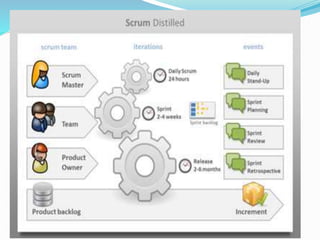
 Scrum Distilled
 Why Scrum
2
Agenda
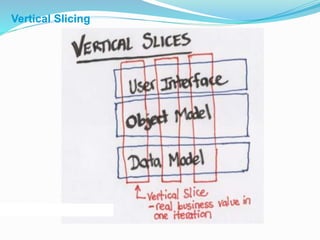
Vertical Slicing
User stories, traditionally written on sticky notes, are short
description of a functionality or feature told from the
perspective of the person who desires the new capability.
They typically follow a simple template:
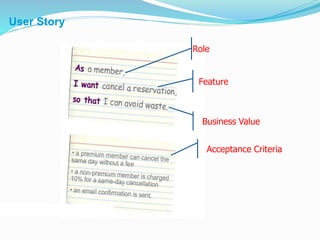
As a <type of user>, I want <some goal> so that <some
reason>.
Objective is to capture:
1. Feature or functionality
2. Business Value of the feature/functionality
3. Persona/Role, who wants this feature/functionality.
User Story
User Story
Role
Feature
Business Value
Acceptance Criteria
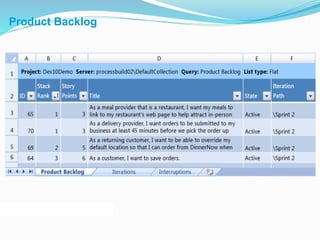
Product Backlog
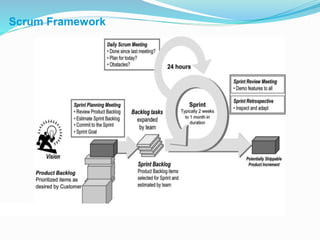
Scrum Framework
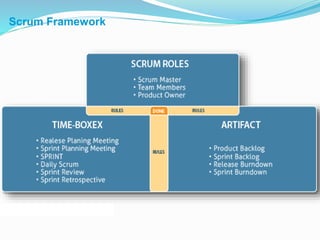
Scrum Framework
9
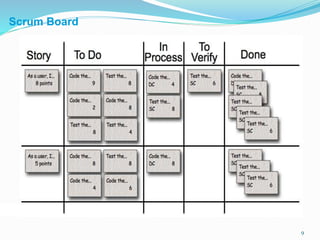
Scrum Board
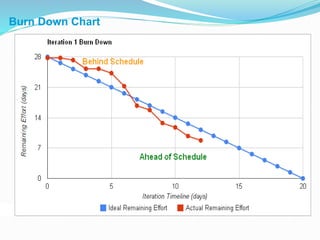
Burn Down Chart
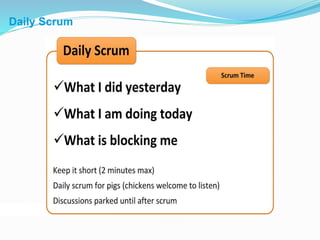
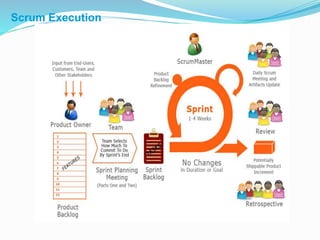
Daily Scrum
Scrum Ceremonies
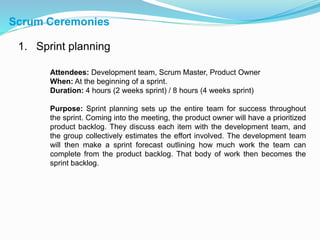
1. Sprint planning
Attendees: Development team, Scrum Master, Product Owner
When: At the beginning of a sprint.
Duration: 4 hours (2 weeks sprint) / 8 hours (4 weeks sprint)
Purpose: Sprint planning sets up the entire team for success throughout
the sprint. Coming into the meeting, the product owner will have a prioritized
product backlog. They discuss each item with the development team, and
the group collectively estimates the effort involved. The development team
will then make a sprint forecast outlining how much work the team can
complete from the product backlog. That body of work then becomes the
sprint backlog.
Scrum Ceremonies
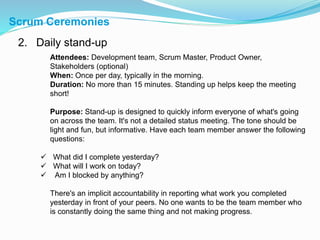
2. Daily stand-up
Attendees: Development team, Scrum Master, Product Owner,
Stakeholders (optional)
When: Once per day, typically in the morning.
Duration: No more than 15 minutes. Standing up helps keep the meeting
short!
Purpose: Stand-up is designed to quickly inform everyone of what's going
on across the team. It's not a detailed status meeting. The tone should be
light and fun, but informative. Have each team member answer the following
questions:
 What did I complete yesterday?
 What will I work on today?
 Am I blocked by anything?
There's an implicit accountability in reporting what work you completed
yesterday in front of your peers. No one wants to be the team member who
is constantly doing the same thing and not making progress.
3. Sprint Review
Attendees: Development team, Scrum Master, Product Owner,
Stakeholders
When: At the end of a sprint or milestone.
Duration: 30-60 minutes.
Purpose: Iteration review is a time to showcase the work of the team.
They can be in a casual format like "demo Fridays", or in a more
formal meeting structure. This is the time for the team to celebrate
their accomplishments, demonstrate work finished within the iteration,
and get immediate feedback from project stakeholders. Remember,
work should be fully demonstrable and meet the team's quality bar to
be considered complete and ready to showcase in the review.
Scrum Ceremonies
15
4. Retrospective
Attendees: Development team, Scrum Master, Product Owner
When: At the end of a sprint.
Duration: 60 minutes.
Purpose: Agile is about getting rapid feedback to make the product and
development culture better. Retrospectives help the team understand
what worked well–and what didn't.
Retrospectives aren't just a time for complaints without action. Use
retrospectives to find out what's working so the team can continue to
focus on those areas. Also, find out what's not working and use the time
to find creative solutions and develop an action plan. Continuous
improvement is what sustains and drives development within an agile
team, and retrospectives are a key part of that.
Whereas the Sprint Review is about the product, the Sprint
Retrospective is about the process – the way in which the Scrum team
works. It is never omitted.
Scrum Ceremonies
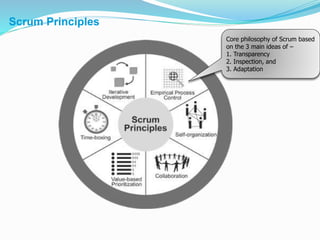
Scrum Principles
Core philosophy of Scrum based
on the 3 main ideas of –
1. Transparency
2. Inspection, and
3. Adaptation
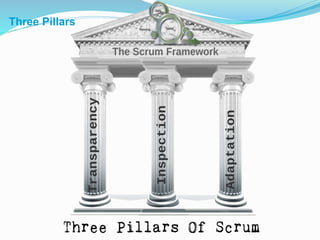
Three Pillars
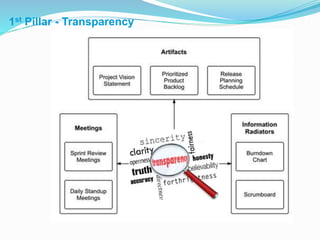
1st Pillar - Transparency
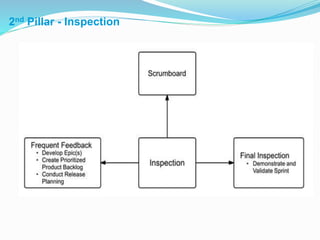
2nd Pillar - Inspection
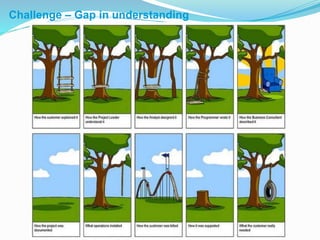
Challenge – Gap in understanding
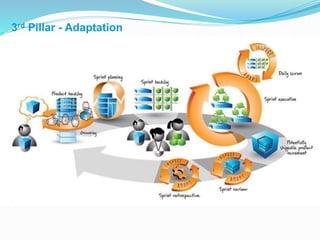
3rd Pillar - Adaptation
Scrum Execution
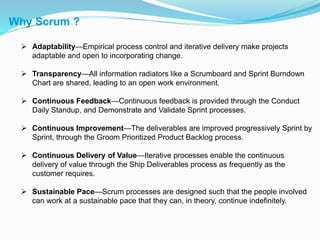
Why Scrum ?
 Adaptability—Empirical process control and iterative delivery make projects
adaptable and open to incorporating change.
 Transparency—All information radiators like a Scrumboard and Sprint Burndown
Chart are shared, leading to an open work environment.
 Continuous Feedback—Continuous feedback is provided through the Conduct
Daily Standup, and Demonstrate and Validate Sprint processes.
 Continuous Improvement—The deliverables are improved progressively Sprint by
Sprint, through the Groom Prioritized Product Backlog process.
 Continuous Delivery of Value—Iterative processes enable the continuous
delivery of value through the Ship Deliverables process as frequently as the
customer requires.
 Sustainable Pace—Scrum processes are designed such that the people involved
can work at a sustainable pace that they can, in theory, continue indefinitely.
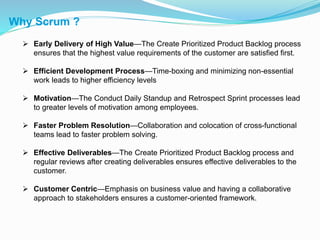
Why Scrum ?
 Early Delivery of High Value—The Create Prioritized Product Backlog process
ensures that the highest value requirements of the customer are satisfied first.
 Efficient Development Process—Time-boxing and minimizing non-essential
work leads to higher efficiency levels
 Motivation—The Conduct Daily Standup and Retrospect Sprint processes lead
to greater levels of motivation among employees.
 Faster Problem Resolution—Collaboration and colocation of cross-functional
teams lead to faster problem solving.
 Effective Deliverables—The Create Prioritized Product Backlog process and
regular reviews after creating deliverables ensures effective deliverables to the
customer.
 Customer Centric—Emphasis on business value and having a collaborative
approach to stakeholders ensures a customer-oriented framework.
Why Scrum ?
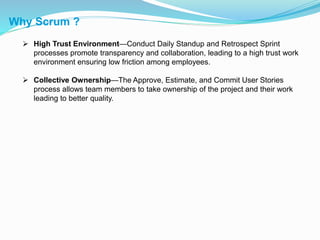
 High Trust Environment—Conduct Daily Standup and Retrospect Sprint
processes promote transparency and collaboration, leading to a high trust work
environment ensuring low friction among employees.
 Collective Ownership—The Approve, Estimate, and Commit User Stories
process allows team members to take ownership of the project and their work
leading to better quality.
Introduction to scrum

Introduction to scrum

  • 1.
  • 2.
     Scrum Framework Scrum Ceremonies  Scrum Principles  Scrum Distilled  Why Scrum 2 Agenda
  • 3.
  • 4.
    User stories, traditionallywritten on sticky notes, are short description of a functionality or feature told from the perspective of the person who desires the new capability. They typically follow a simple template: As a <type of user>, I want <some goal> so that <some reason>. Objective is to capture: 1. Feature or functionality 2. Business Value of the feature/functionality 3. Persona/Role, who wants this feature/functionality. User Story
  • 5.
  • 6.
  • 7.
  • 8.
  • 9.
  • 10.
  • 11.
  • 12.
    Scrum Ceremonies 1. Sprintplanning Attendees: Development team, Scrum Master, Product Owner When: At the beginning of a sprint. Duration: 4 hours (2 weeks sprint) / 8 hours (4 weeks sprint) Purpose: Sprint planning sets up the entire team for success throughout the sprint. Coming into the meeting, the product owner will have a prioritized product backlog. They discuss each item with the development team, and the group collectively estimates the effort involved. The development team will then make a sprint forecast outlining how much work the team can complete from the product backlog. That body of work then becomes the sprint backlog.
  • 13.
    Scrum Ceremonies 2. Dailystand-up Attendees: Development team, Scrum Master, Product Owner, Stakeholders (optional) When: Once per day, typically in the morning. Duration: No more than 15 minutes. Standing up helps keep the meeting short! Purpose: Stand-up is designed to quickly inform everyone of what's going on across the team. It's not a detailed status meeting. The tone should be light and fun, but informative. Have each team member answer the following questions:  What did I complete yesterday?  What will I work on today?  Am I blocked by anything? There's an implicit accountability in reporting what work you completed yesterday in front of your peers. No one wants to be the team member who is constantly doing the same thing and not making progress.
  • 14.
    3. Sprint Review Attendees:Development team, Scrum Master, Product Owner, Stakeholders When: At the end of a sprint or milestone. Duration: 30-60 minutes. Purpose: Iteration review is a time to showcase the work of the team. They can be in a casual format like "demo Fridays", or in a more formal meeting structure. This is the time for the team to celebrate their accomplishments, demonstrate work finished within the iteration, and get immediate feedback from project stakeholders. Remember, work should be fully demonstrable and meet the team's quality bar to be considered complete and ready to showcase in the review. Scrum Ceremonies
  • 15.
    15 4. Retrospective Attendees: Developmentteam, Scrum Master, Product Owner When: At the end of a sprint. Duration: 60 minutes. Purpose: Agile is about getting rapid feedback to make the product and development culture better. Retrospectives help the team understand what worked well–and what didn't. Retrospectives aren't just a time for complaints without action. Use retrospectives to find out what's working so the team can continue to focus on those areas. Also, find out what's not working and use the time to find creative solutions and develop an action plan. Continuous improvement is what sustains and drives development within an agile team, and retrospectives are a key part of that. Whereas the Sprint Review is about the product, the Sprint Retrospective is about the process – the way in which the Scrum team works. It is never omitted. Scrum Ceremonies
  • 16.
    Scrum Principles Core philosophyof Scrum based on the 3 main ideas of – 1. Transparency 2. Inspection, and 3. Adaptation
  • 17.
  • 18.
    1st Pillar -Transparency
  • 19.
    2nd Pillar -Inspection
  • 20.
    Challenge – Gapin understanding
  • 21.
    3rd Pillar -Adaptation
  • 22.
  • 24.
    Why Scrum ? Adaptability—Empirical process control and iterative delivery make projects adaptable and open to incorporating change.  Transparency—All information radiators like a Scrumboard and Sprint Burndown Chart are shared, leading to an open work environment.  Continuous Feedback—Continuous feedback is provided through the Conduct Daily Standup, and Demonstrate and Validate Sprint processes.  Continuous Improvement—The deliverables are improved progressively Sprint by Sprint, through the Groom Prioritized Product Backlog process.  Continuous Delivery of Value—Iterative processes enable the continuous delivery of value through the Ship Deliverables process as frequently as the customer requires.  Sustainable Pace—Scrum processes are designed such that the people involved can work at a sustainable pace that they can, in theory, continue indefinitely.
  • 25.
    Why Scrum ? Early Delivery of High Value—The Create Prioritized Product Backlog process ensures that the highest value requirements of the customer are satisfied first.  Efficient Development Process—Time-boxing and minimizing non-essential work leads to higher efficiency levels  Motivation—The Conduct Daily Standup and Retrospect Sprint processes lead to greater levels of motivation among employees.  Faster Problem Resolution—Collaboration and colocation of cross-functional teams lead to faster problem solving.  Effective Deliverables—The Create Prioritized Product Backlog process and regular reviews after creating deliverables ensures effective deliverables to the customer.  Customer Centric—Emphasis on business value and having a collaborative approach to stakeholders ensures a customer-oriented framework.
  • 26.
    Why Scrum ? High Trust Environment—Conduct Daily Standup and Retrospect Sprint processes promote transparency and collaboration, leading to a high trust work environment ensuring low friction among employees.  Collective Ownership—The Approve, Estimate, and Commit User Stories process allows team members to take ownership of the project and their work leading to better quality.