functionalmovement.com
Improving Operational Performance and
Injury Prevention Strategies through
Functional Movement Screening
Lee Burton, PhD, ATC, CSCS
Director of Athletic Training: Averett University
Functional Movement Systems
functionalmovement.com
What is Happening???
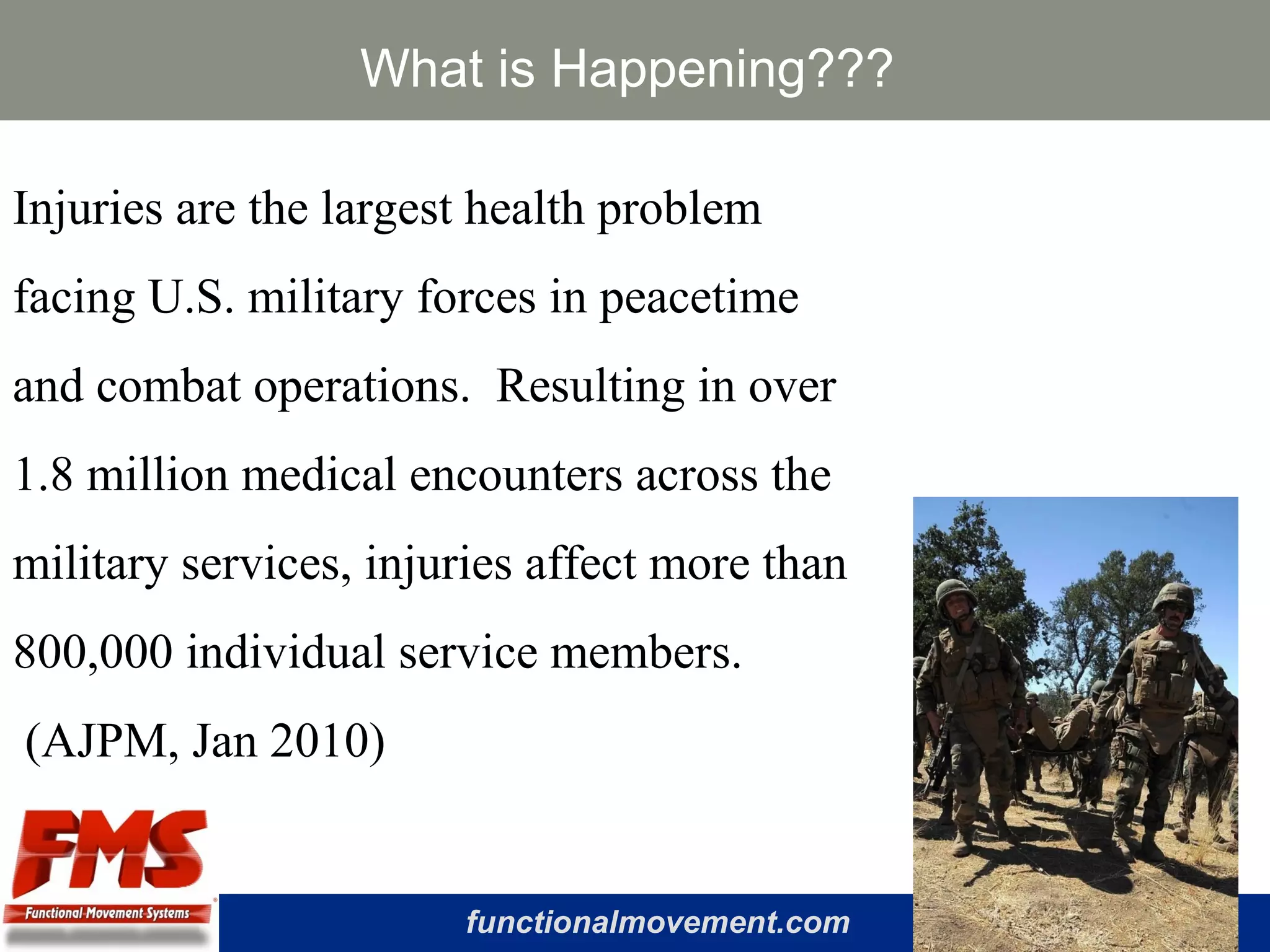
Injuries are the largest health problem
facing U.S. military forces in peacetime
and combat operations. Resulting in over
1.8 million medical encounters across the
military services, injuries affect more than
800,000 individual service members.
(AJPM, Jan 2010)
functionalmovement.com
What is Happening???
Physical training and sports injuries are of particular concern. Based
on the likelihood of success in decreasing injuries having the
greatest impact on military readiness, the Defense Safety Oversight
Council (DSOC) recommends that the greatest reduction of lost
duty days due to injuries across DoD may be achieved via
mitigation efforts focused specifically on sports-and physical
training related injuries.
Reference: Defense Safety Oversight Council (DSOC,) DoD Military Injury Prevention Priorities
Working Group: Leading Injuries, Causes,and Mitigation Recommendations, Feb.2006
functionalmovement.com
Steps in the Injury Control Process
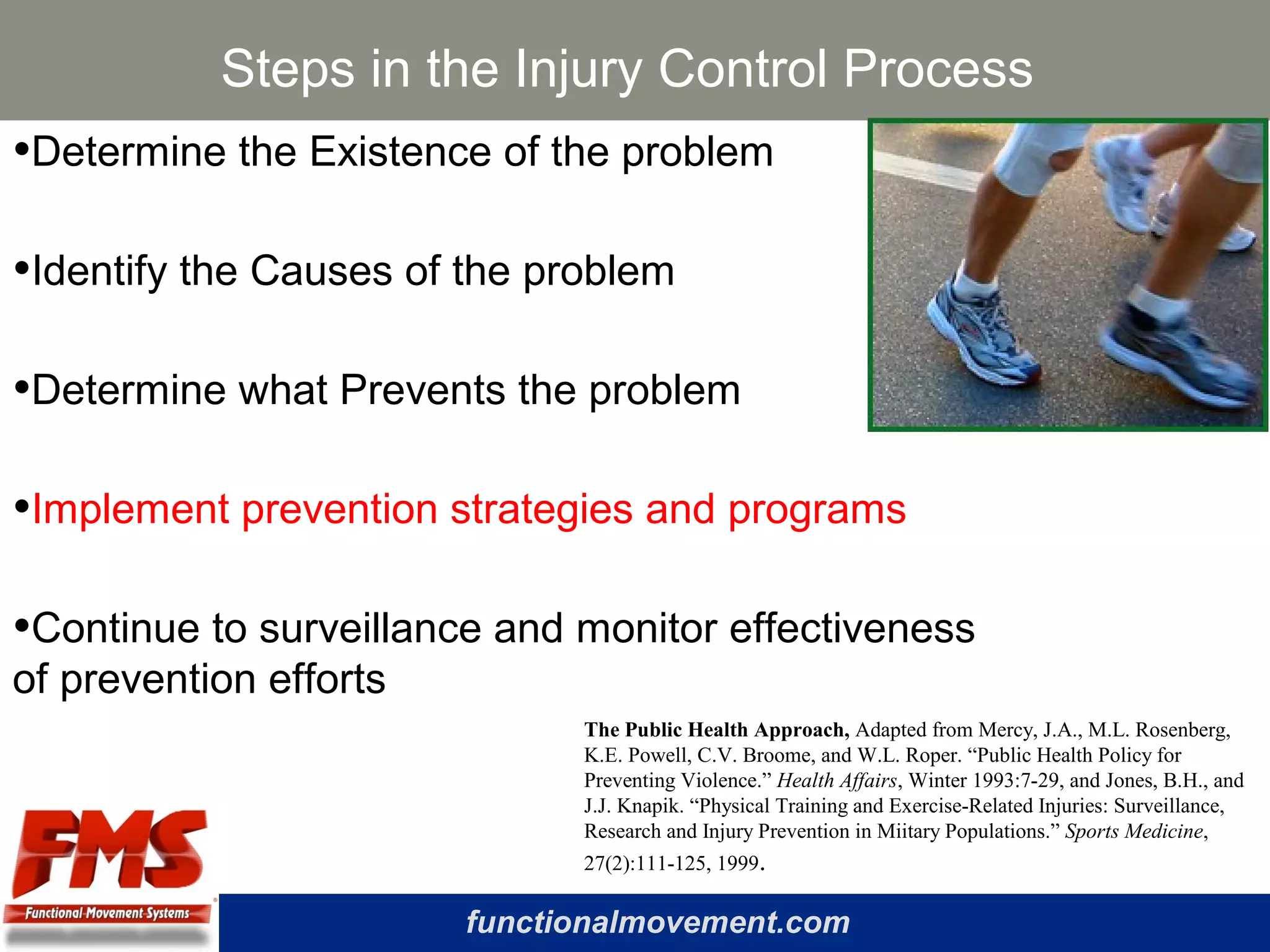
•Determine the Existence of the problem
•Identify the Causes of the problem
•Determine what Prevents the problem
•Implement prevention strategies and programs
•Continue to surveillance and monitor effectiveness
of prevention efforts
The Public Health Approach, Adapted from Mercy, J.A., M.L. Rosenberg,
K.E. Powell, C.V. Broome, and W.L. Roper. “Public Health Policy for
Preventing Violence.” Health Affairs, Winter 1993:7-29, and Jones, B.H., and
J.J. Knapik. “Physical Training and Exercise-Related Injuries: Surveillance,
Research and Injury Prevention in Miitary Populations.” Sports Medicine,
27(2):111-125, 1999.
functionalmovement.com
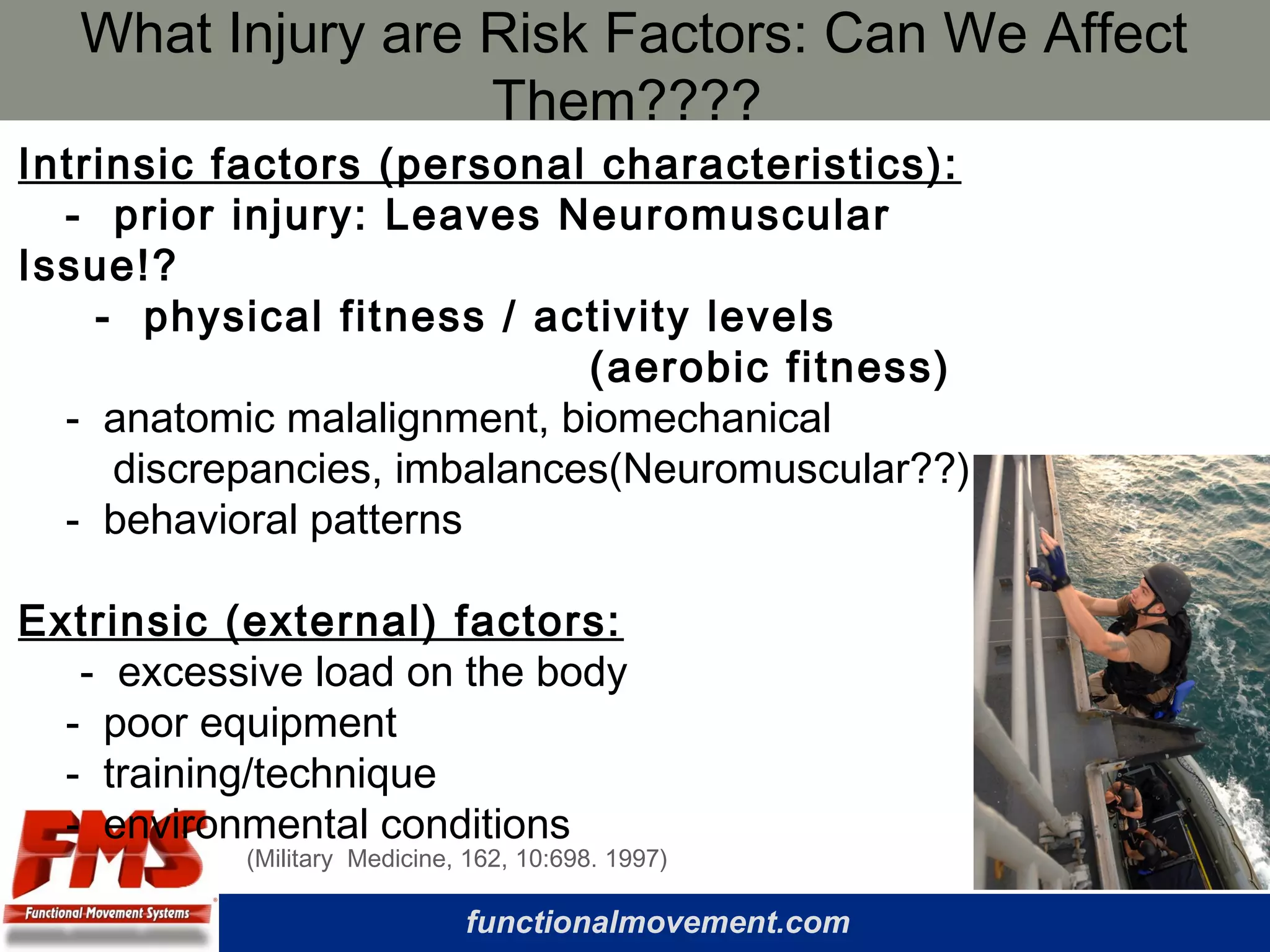
What Injury are Risk Factors: Can We Affect
Them????
Intrinsic factors (personal characteristics):
- prior injury: Leaves Neuromuscular
Issue!?
- physical fitness / activity levels
(aerobic fitness)
- anatomic malalignment, biomechanical
discrepancies, imbalances(Neuromuscular??)
- behavioral patterns
Extrinsic (external) factors:
- excessive load on the body
- poor equipment
- training/technique
- environmental conditions
(Military Medicine, 162, 10:698. 1997)
functionalmovement.com
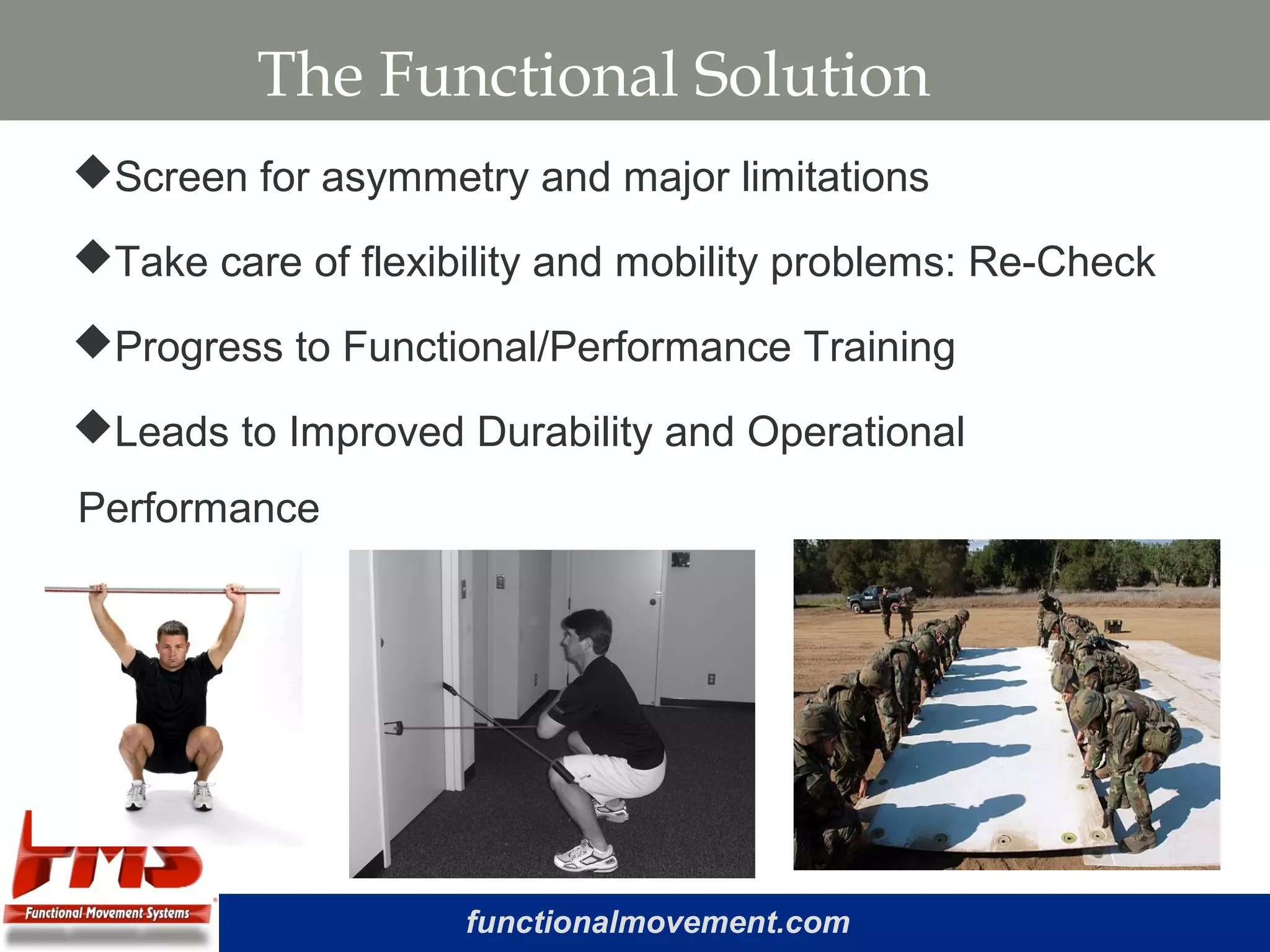
The Functional Solution
Screen for asymmetry and major limitations
Take care of flexibility and mobility problems: Re-Check
Progress to Functional/Performance Training
Leads to Improved Durability and Operational
Performance
functionalmovement.com
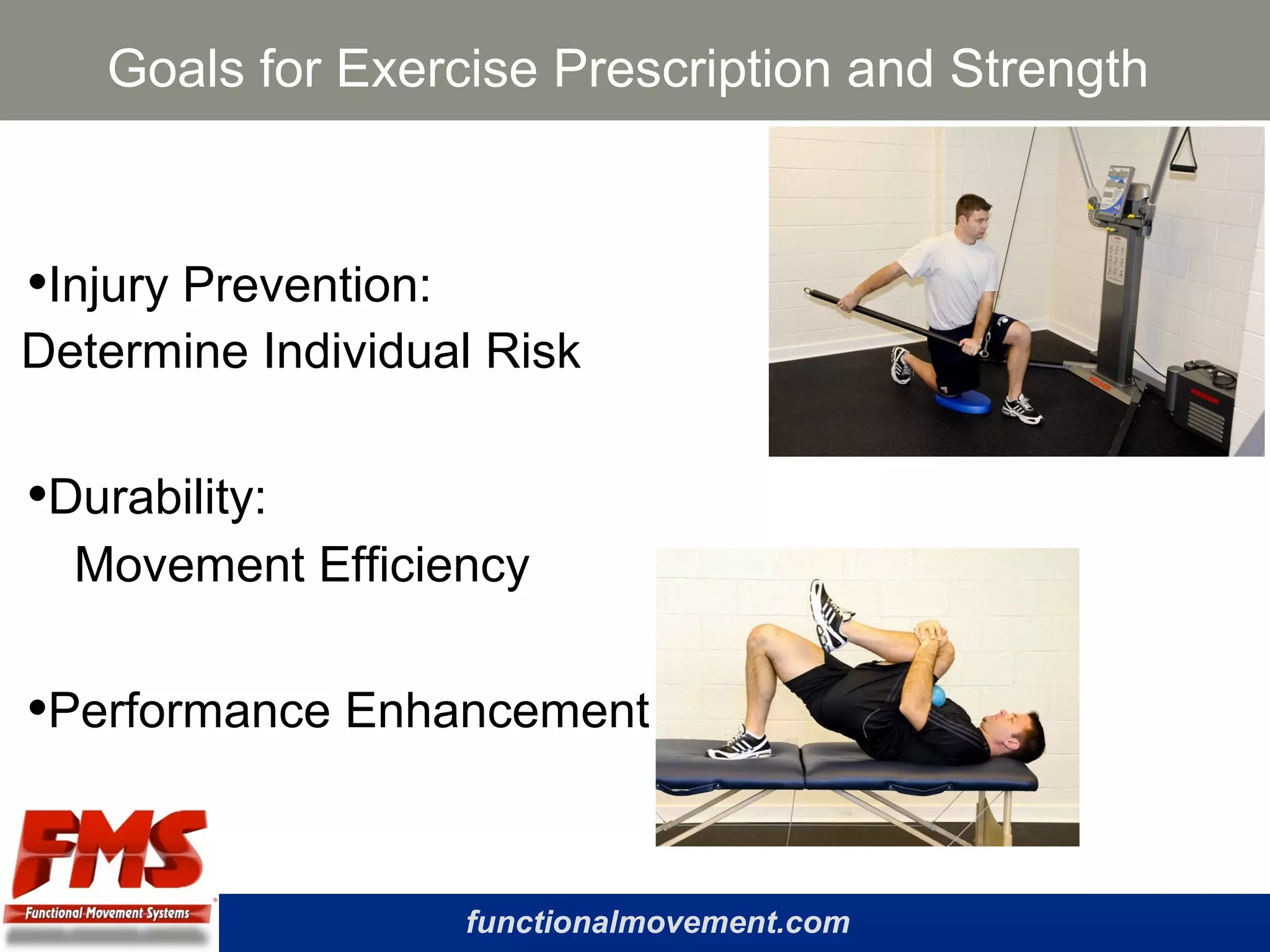
Goals for Exercise Prescription and Strength
•Injury Prevention:
Determine Individual Risk
•Durability:
Movement Efficiency
•Performance Enhancement
functionalmovement.com
start with functional Movement Screening!!!!
• Demonstrate
Movement Limitations
and Asymmetries
• Create a Filter for
Movement
Dysfunction
• Avoid Putting Fitness
on Dysfunction
• Focus on Most
Limited Area
functionalmovement.com
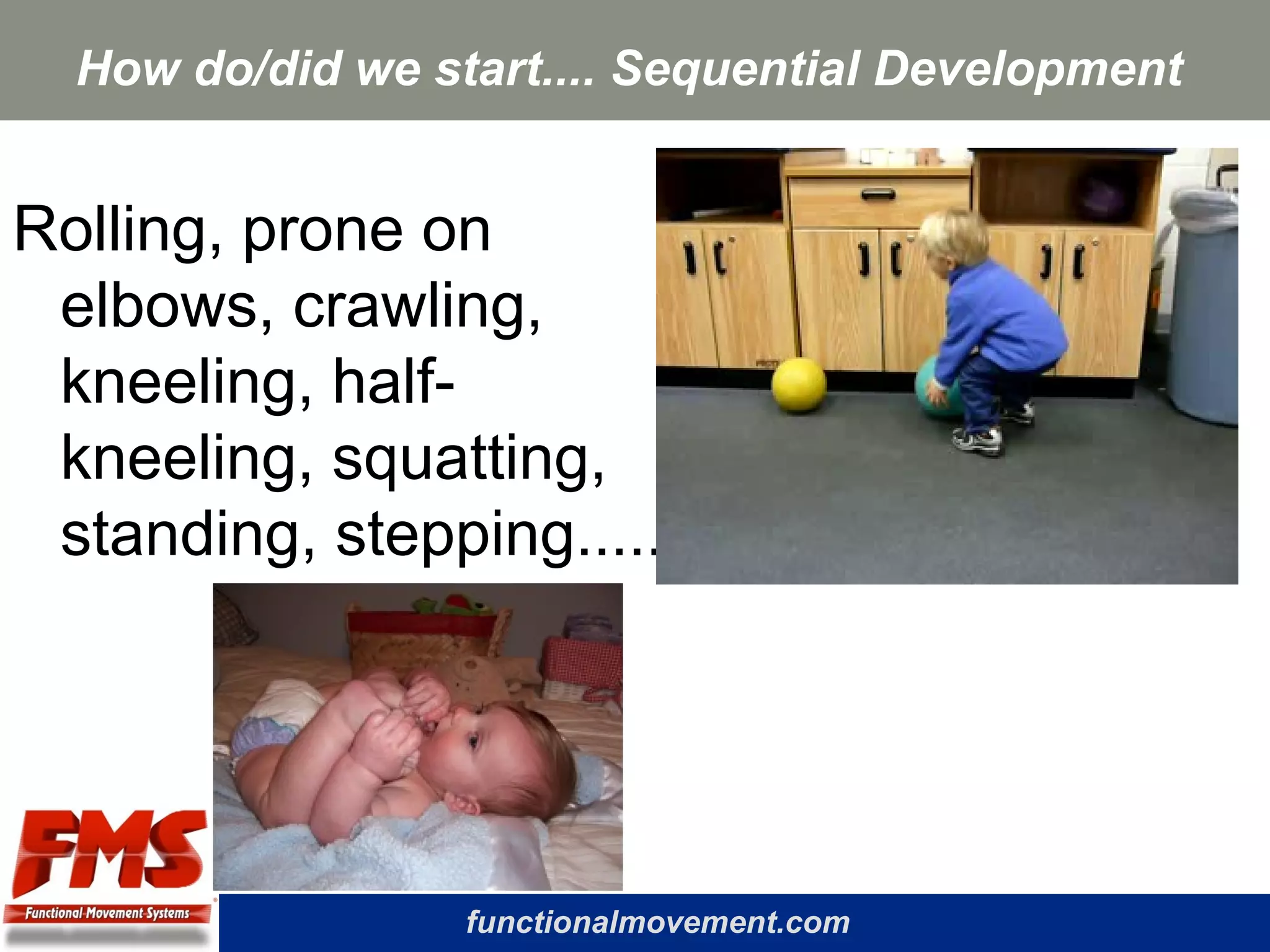
How do/did we start.... Sequential Development
Rolling, prone on
elbows, crawling,
kneeling, half-
kneeling, squatting,
standing, stepping.....
functionalmovement.com
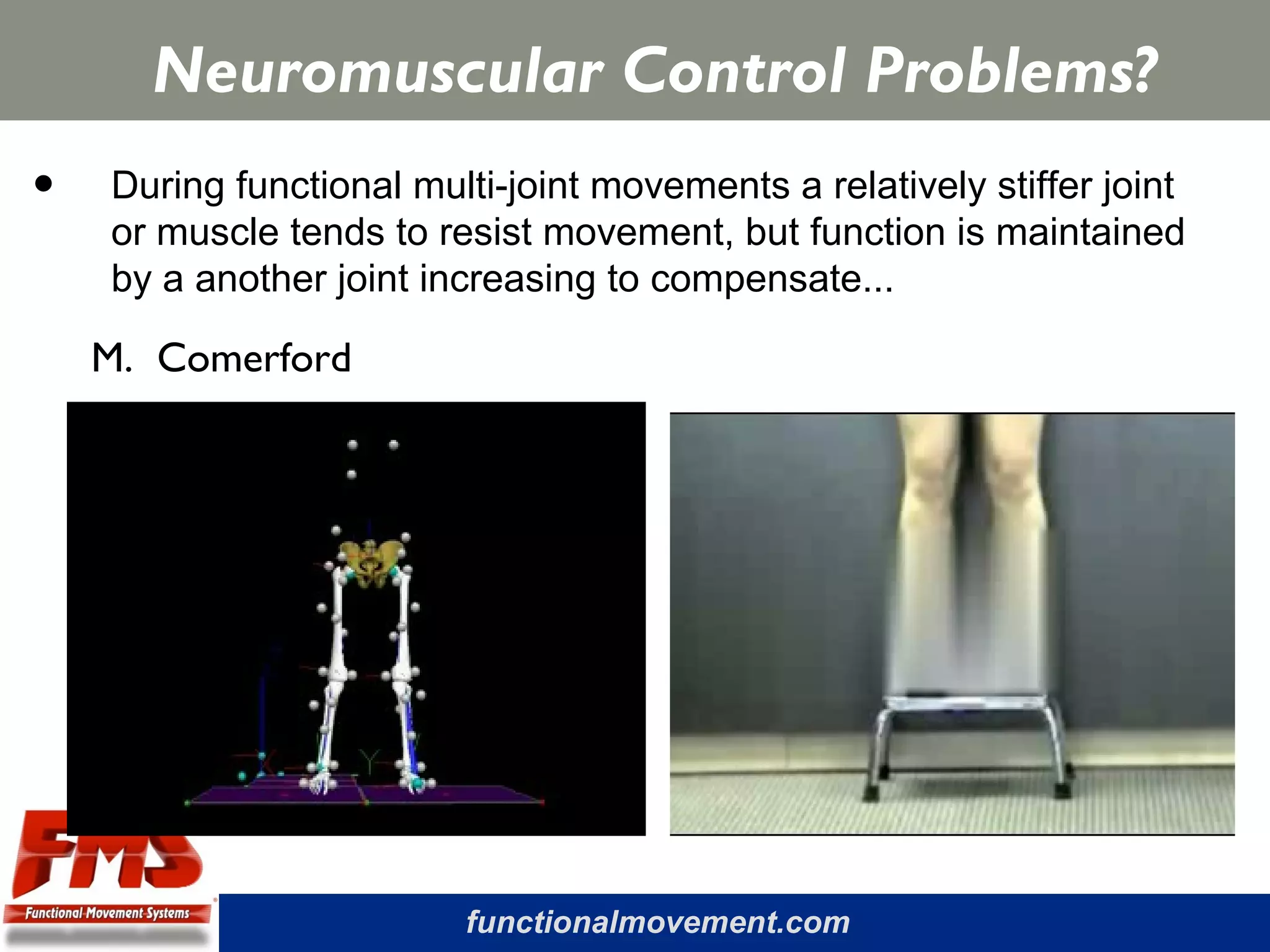
Neuromuscular Control Problems?
• During functional multi-joint movements a relatively stiffer joint
or muscle tends to resist movement, but function is maintained
by a another joint increasing to compensate...
M. Comerford
functionalmovement.com
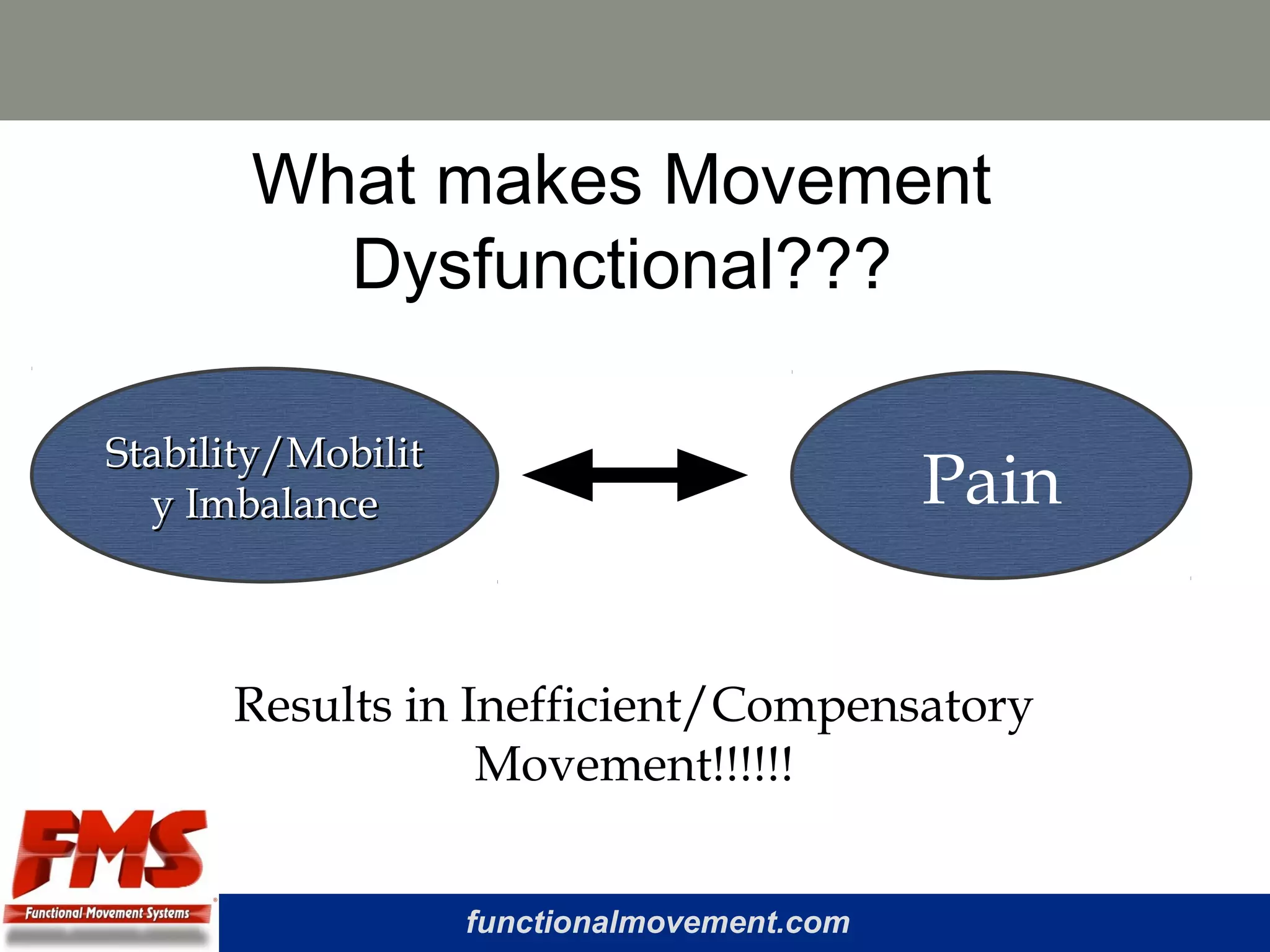
Stability/MobilitStability/Mobilit
y Imbalancey Imbalance Pain
Results in Inefficient/Compensatory
Movement!!!!!!
What makes Movement
Dysfunctional???
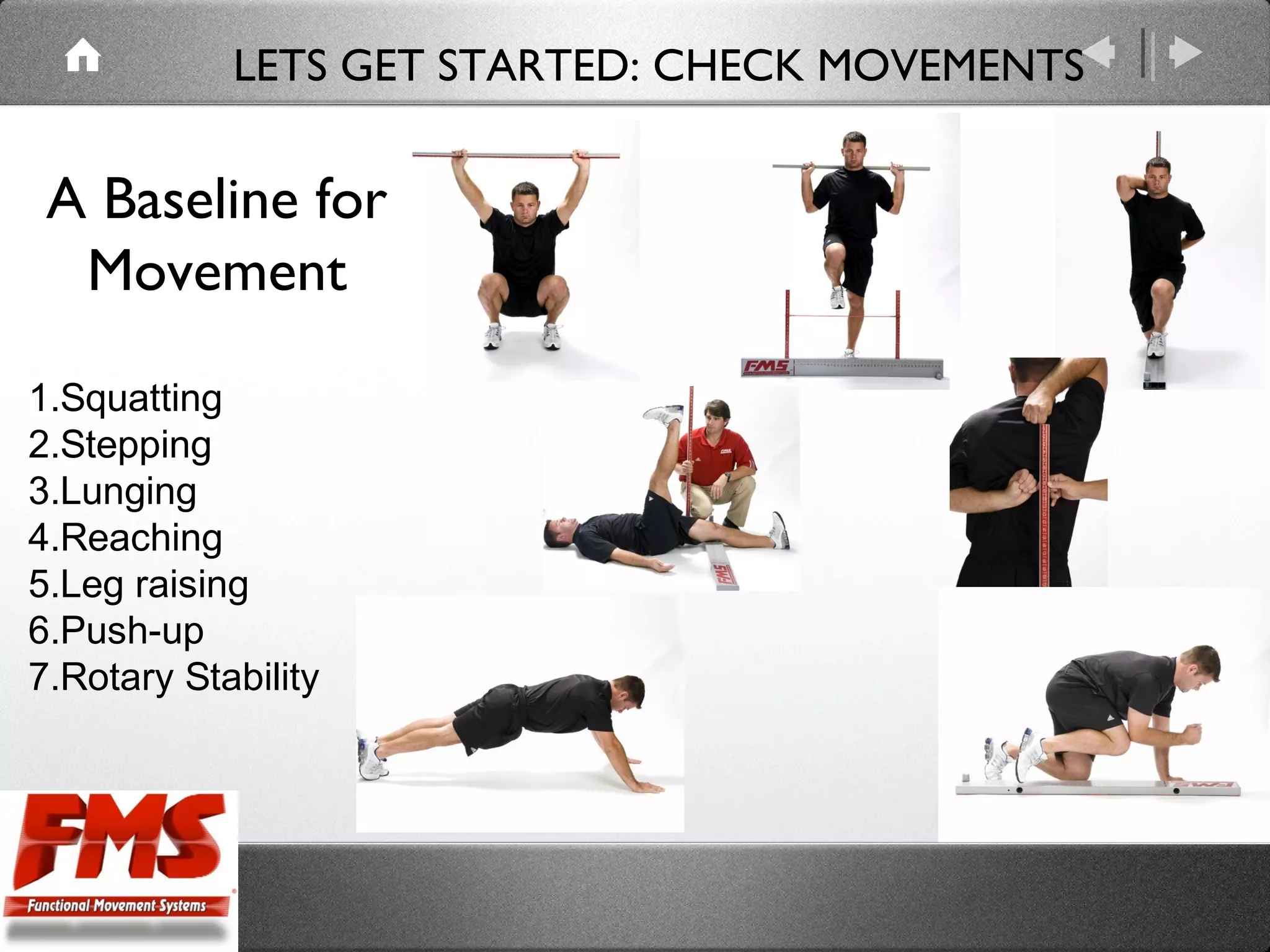
1.Squatting
2.Stepping
3.Lunging
4.Reaching
5.Leg raising
6.Push-up
7.Rotary Stability
LETS GET STARTED: CHECK MOVEMENTS
A Baseline for
Movement
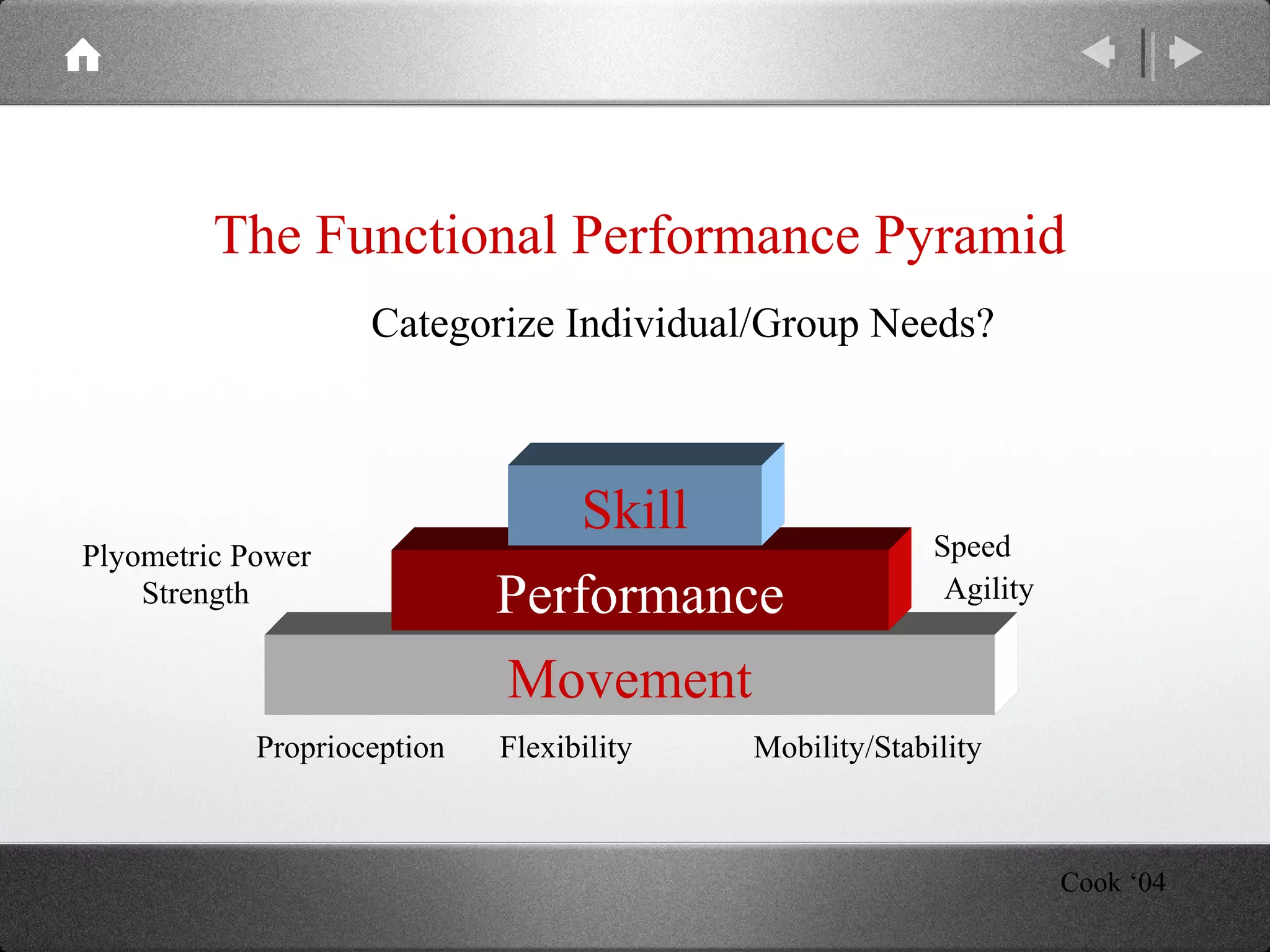
Movement
Performance
Skill
The Functional Performance Pyramid
Cook ‘04
Proprioception Flexibility Mobility/Stability
Plyometric Power
Strength
Speed
Agility
Categorize Individual/Group Needs?
functionalmovement.com
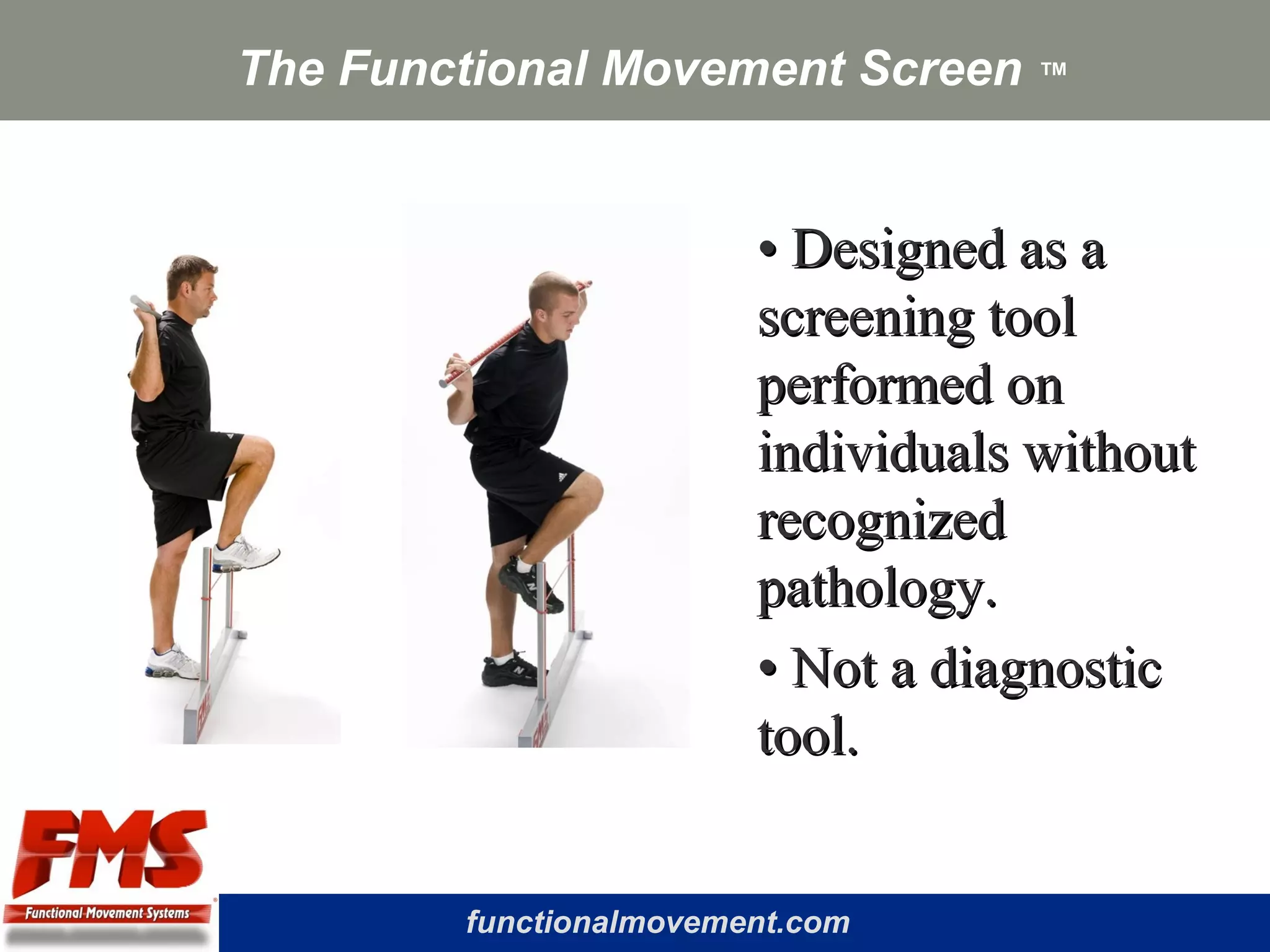
The Functional Movement Screen ™
•• Designed as aDesigned as a
screening toolscreening tool
performed onperformed on
individuals withoutindividuals without
recognizedrecognized
pathology.pathology.
•• Not a diagnosticNot a diagnostic
tool.tool.
functionalmovement.com
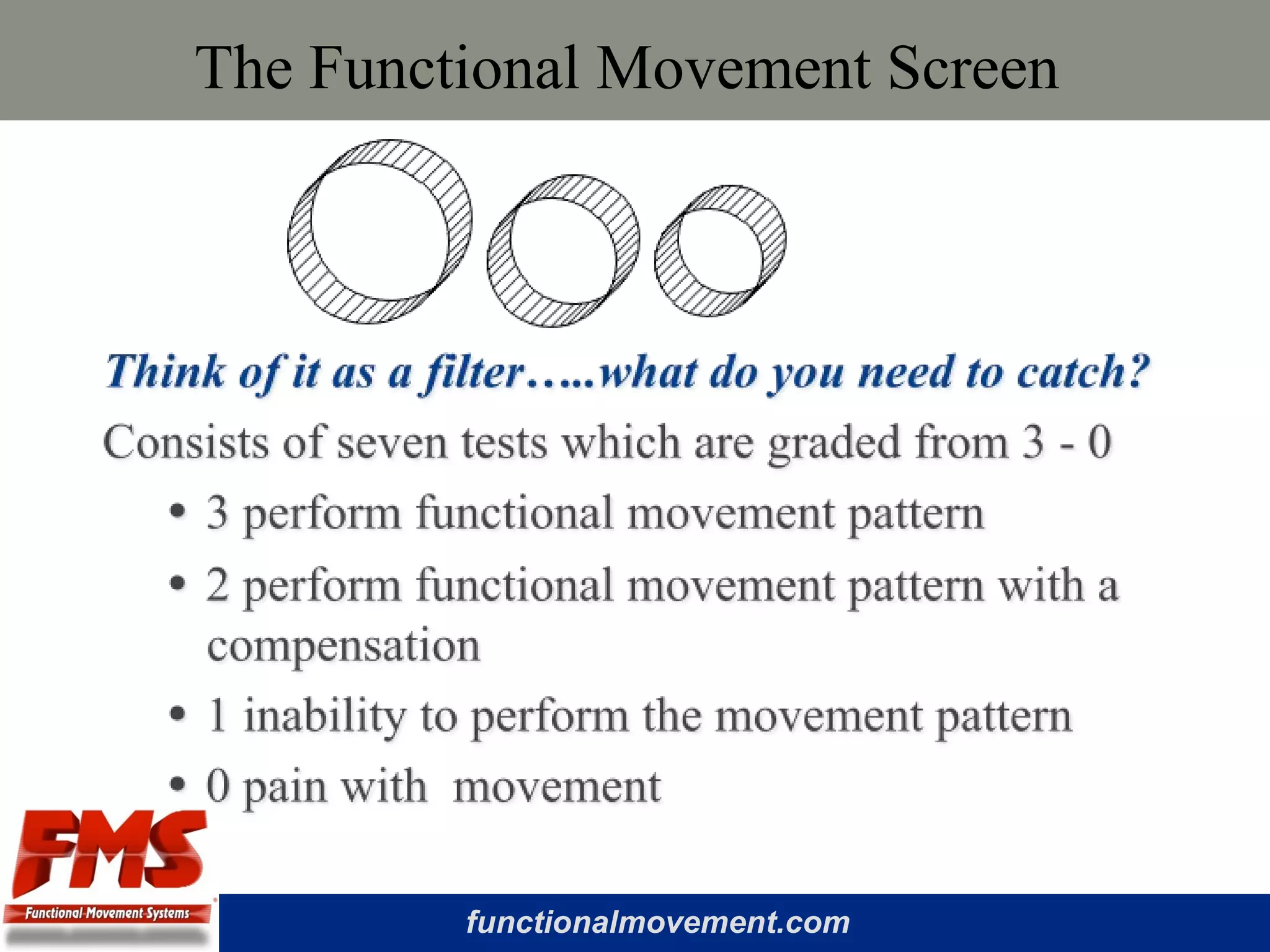
The Functional Movement Screen
functionalmovement.com
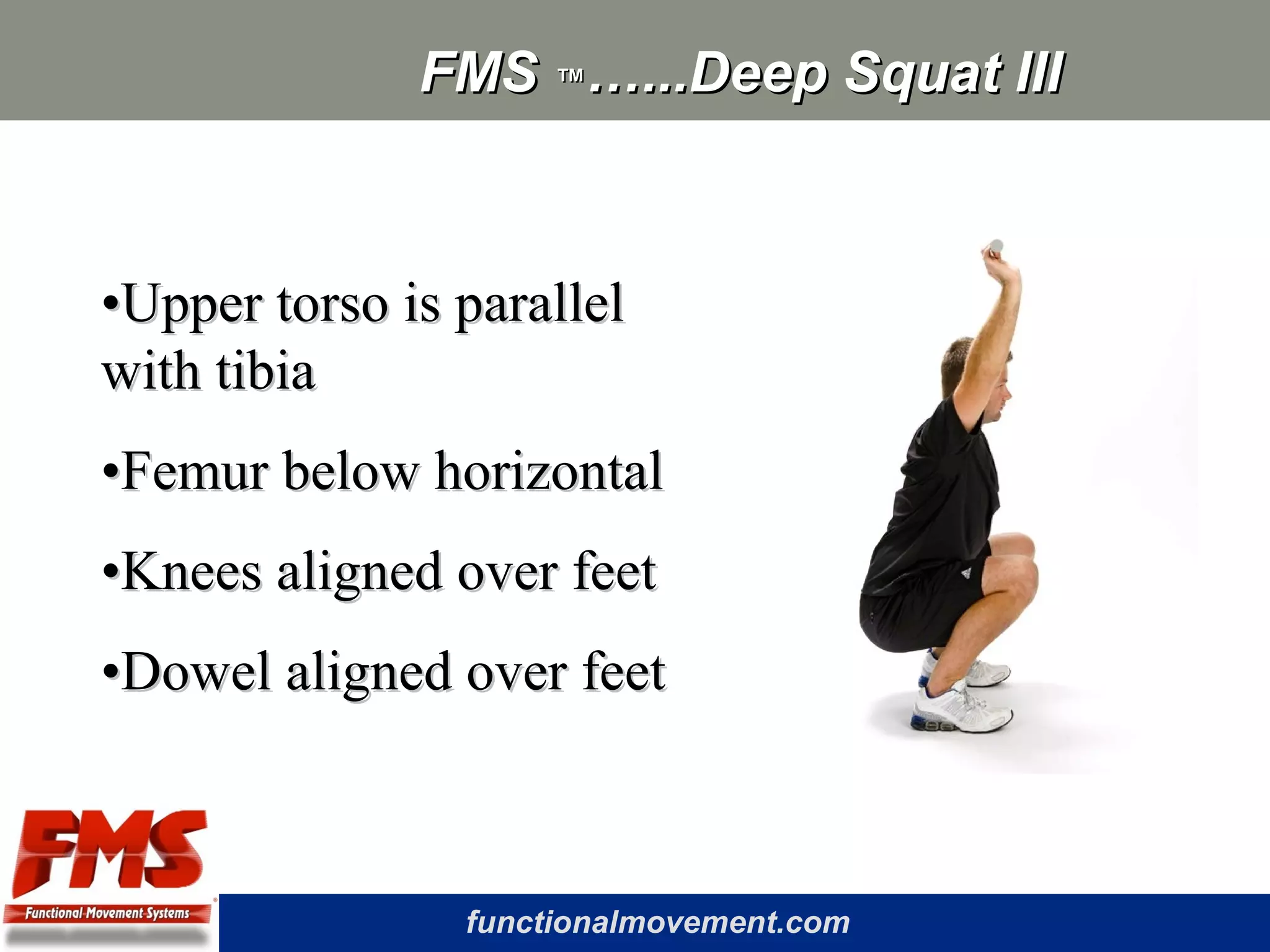
FMSFMS ™™…...Deep Squat III…...Deep Squat III
••Upper torso is parallelUpper torso is parallel
with tibiawith tibia
••Femur below horizontalFemur below horizontal
••Knees aligned over feetKnees aligned over feet
••Dowel aligned over feetDowel aligned over feet
functionalmovement.com
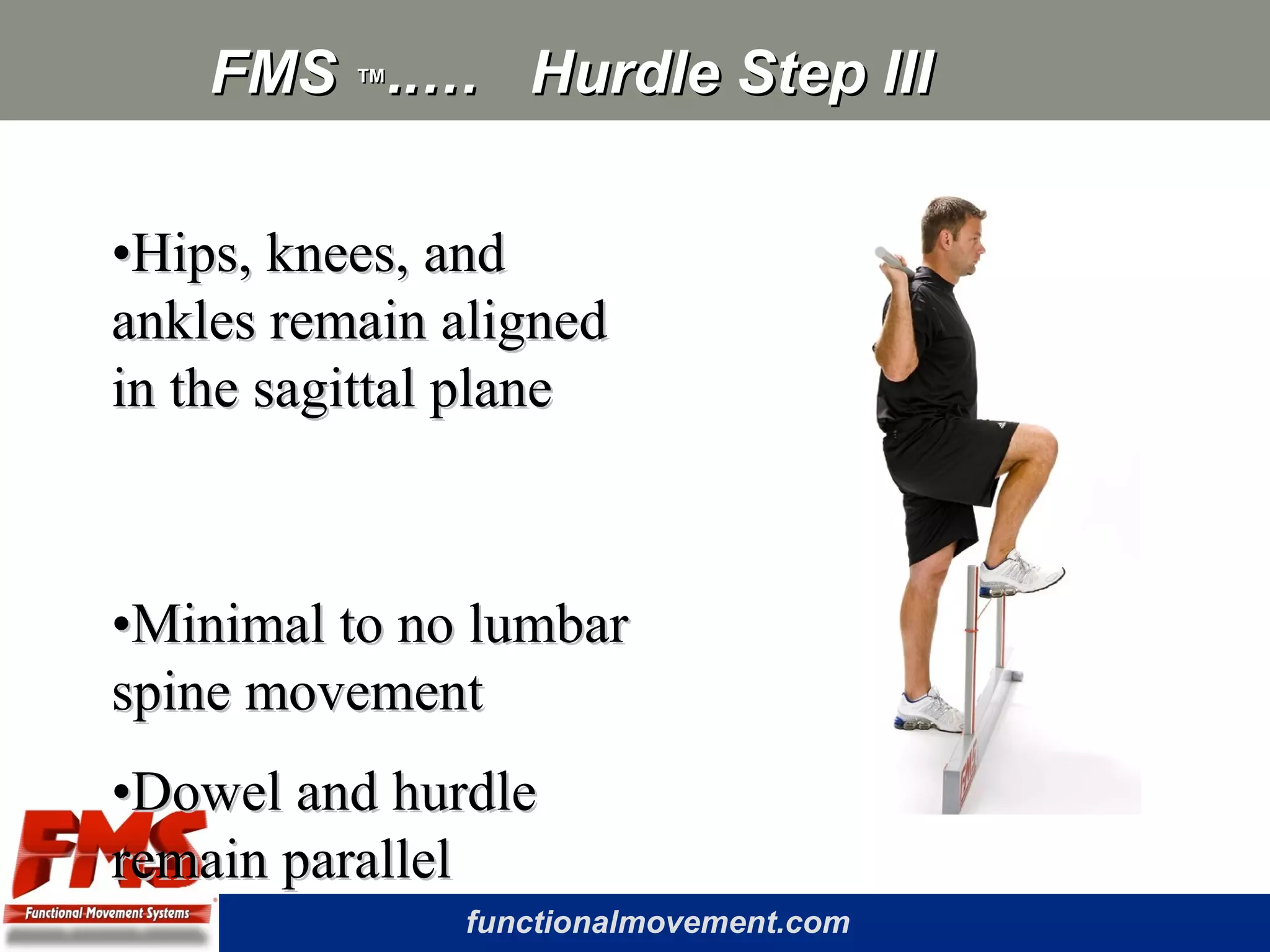
FMSFMS ™™..… Hurdle Step III..… Hurdle Step III
••Hips, knees, andHips, knees, and
ankles remain alignedankles remain aligned
in the sagittal planein the sagittal plane
••Minimal to no lumbarMinimal to no lumbar
spine movementspine movement
••Dowel and hurdleDowel and hurdle
remain parallelremain parallel
functionalmovement.com
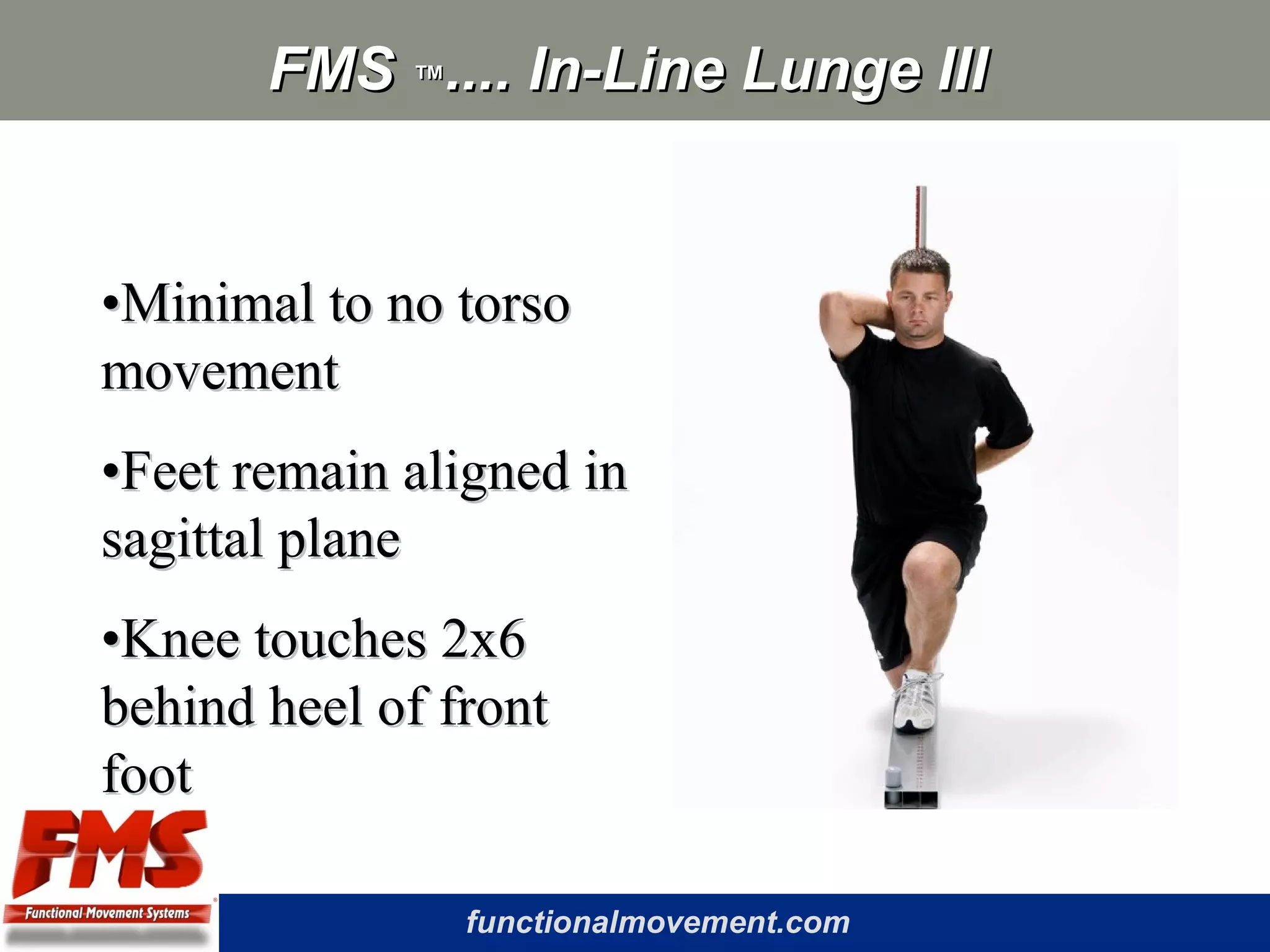
FMSFMS ™™.... In-Line Lunge III.... In-Line Lunge III
••Minimal to no torsoMinimal to no torso
movementmovement
••Feet remain aligned inFeet remain aligned in
sagittal planesagittal plane
••Knee touches 2x6Knee touches 2x6
behind heel of frontbehind heel of front
footfoot
functionalmovement.com
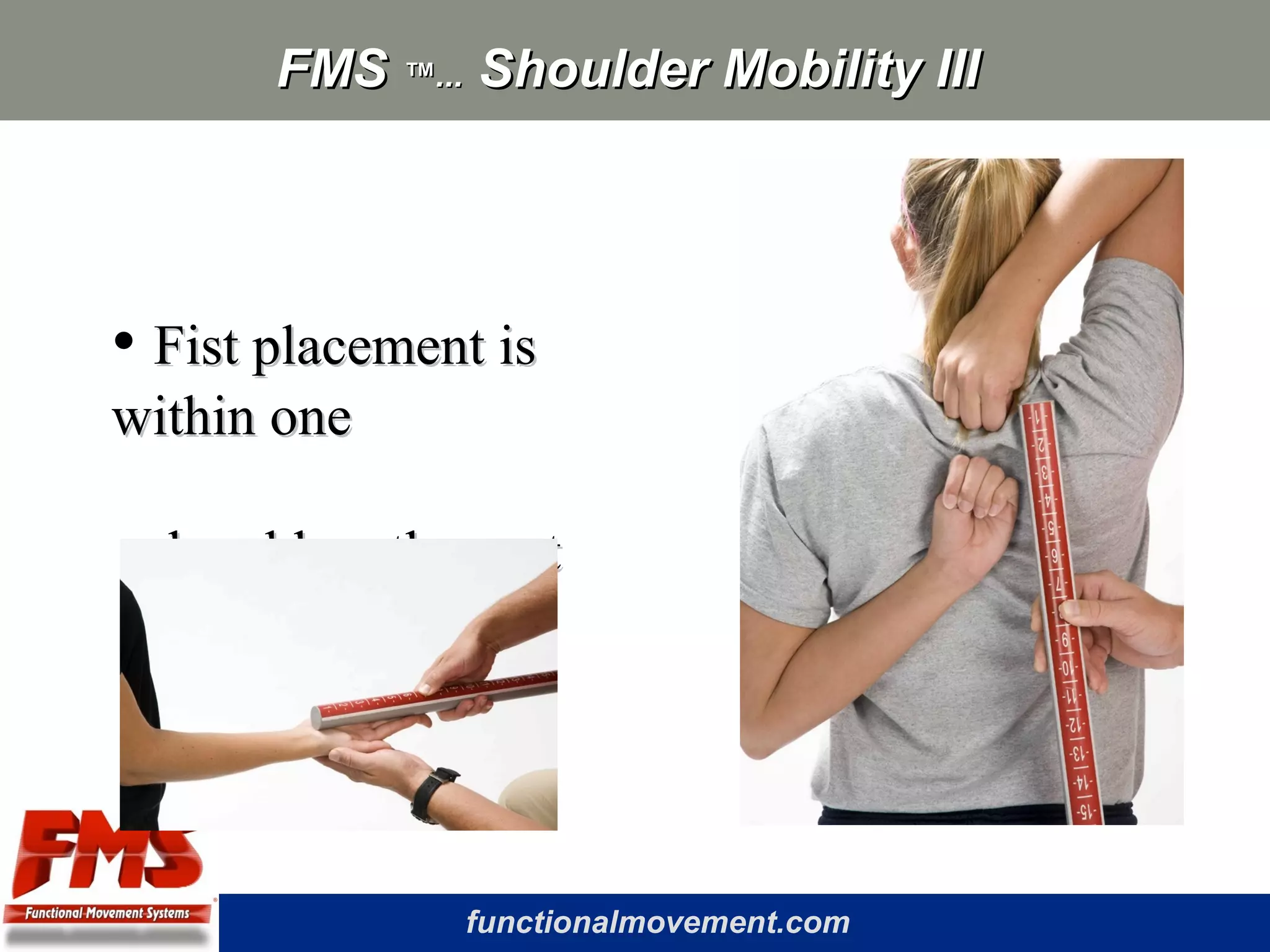
FMSFMS ™...™... Shoulder Mobility IIIShoulder Mobility III
• Fist placement isFist placement is
within onewithin one
hand length aparthand length apart
functionalmovement.com
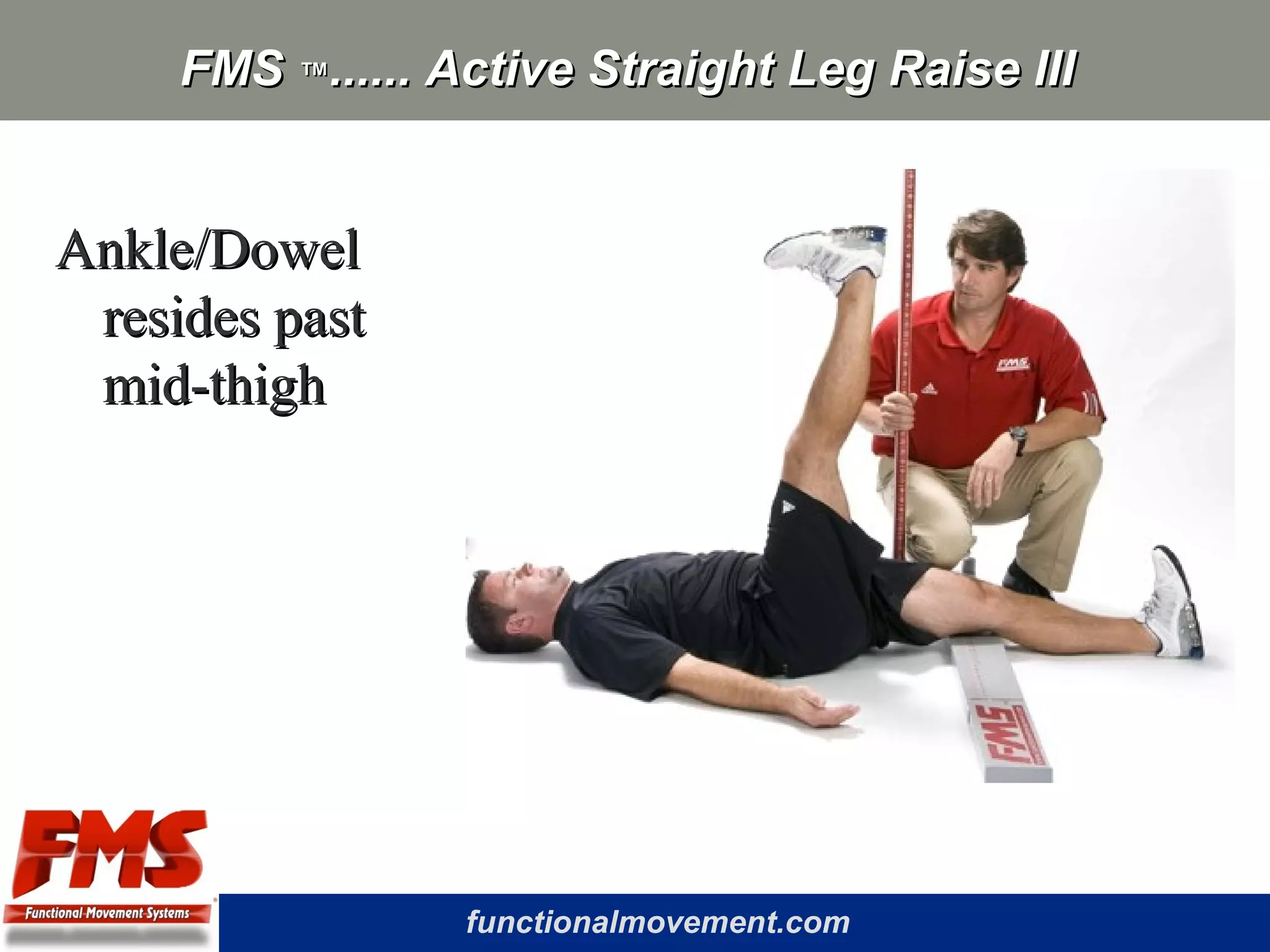
FMSFMS ™™...... Active Straight Leg Raise III...... Active Straight Leg Raise III
Ankle/DowelAnkle/Dowel
resides pastresides past
mid-thighmid-thigh
functionalmovement.com
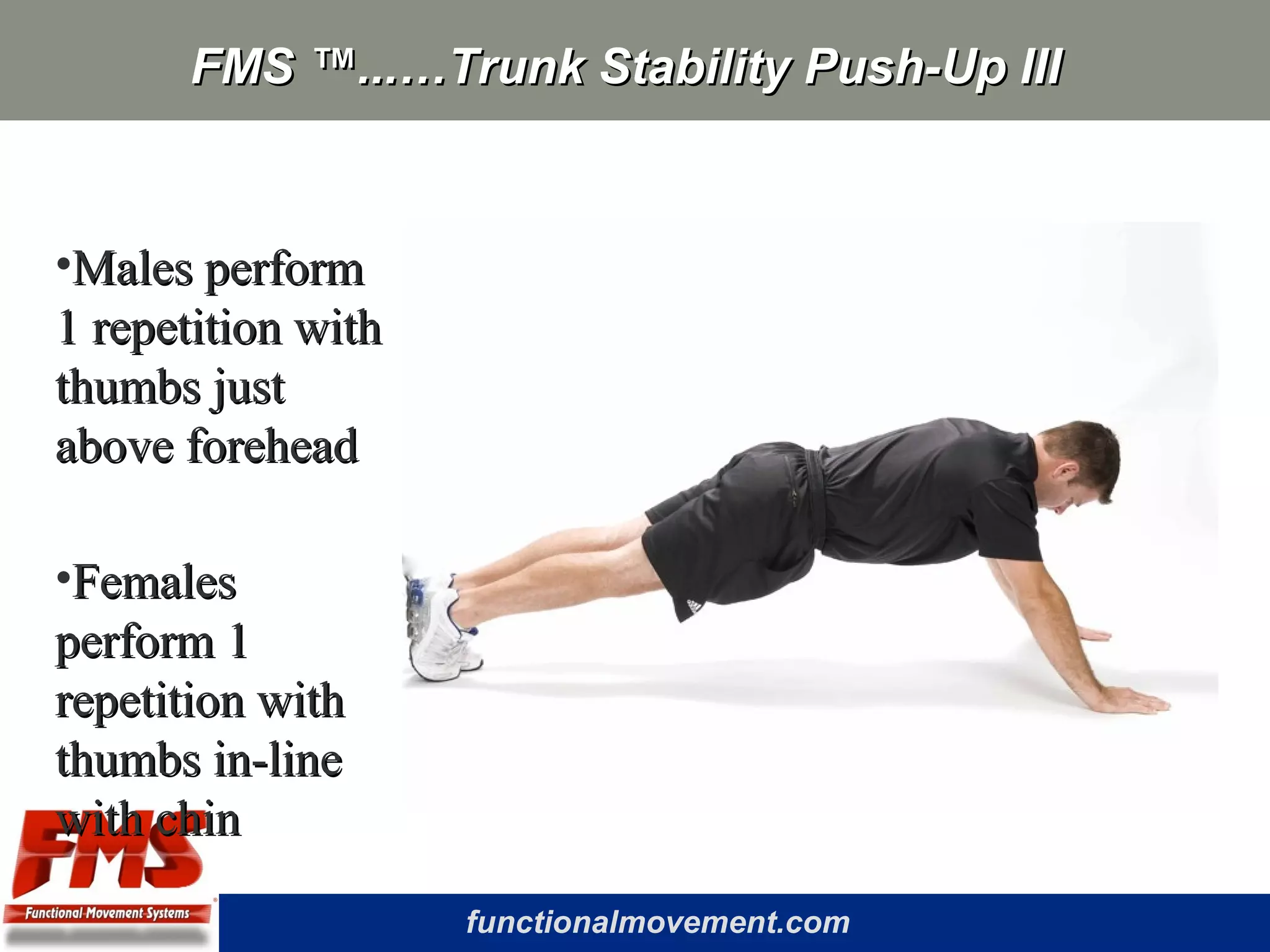
FMS ™...…Trunk Stability Push-Up IIIFMS ™...…Trunk Stability Push-Up III
•Males performMales perform
1 repetition with1 repetition with
thumbs justthumbs just
above foreheadabove forehead
•FemalesFemales
perform 1perform 1
repetition withrepetition with
thumbs in-linethumbs in-line
with chinwith chin
functionalmovement.com
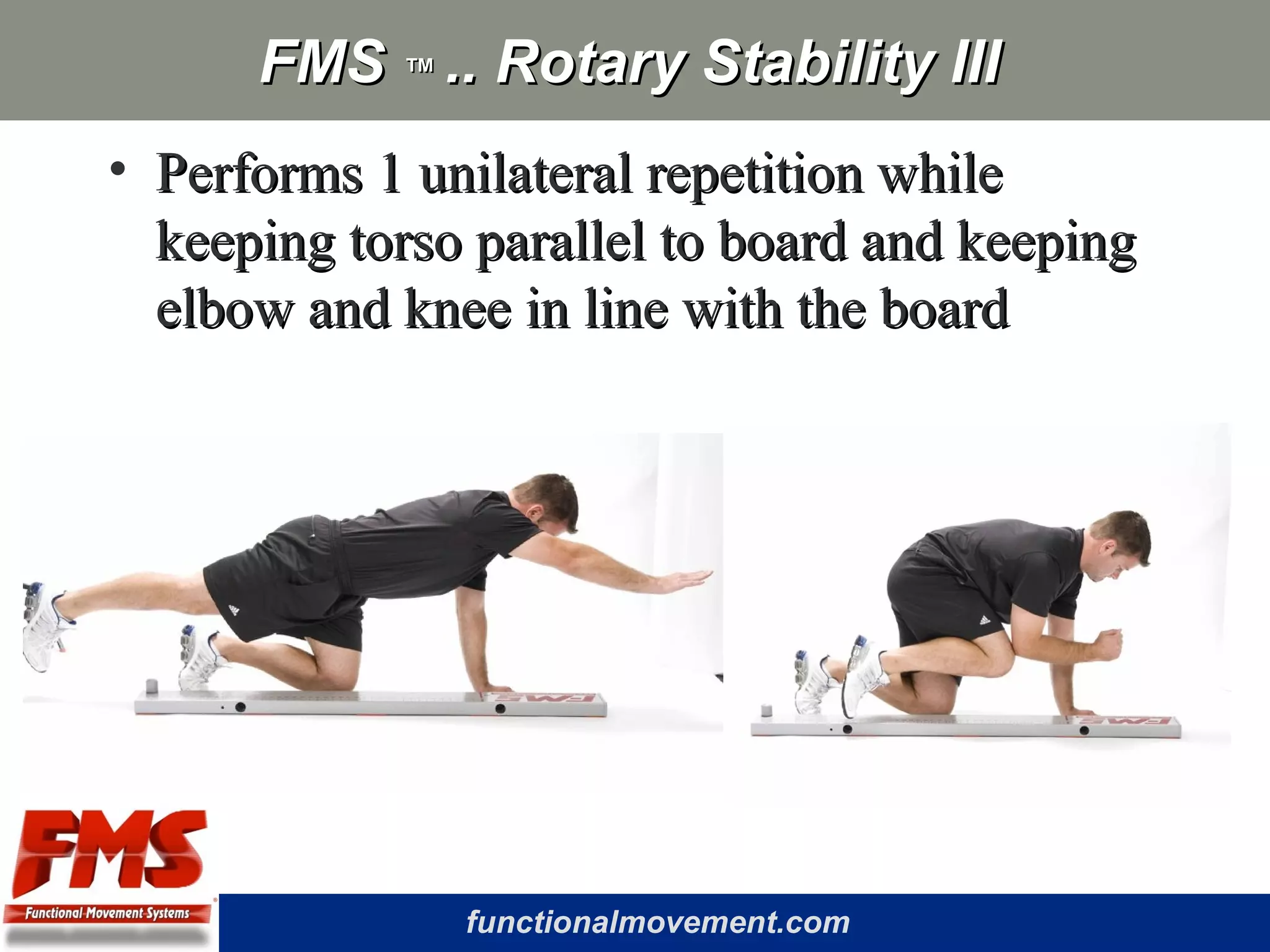
FMSFMS ™™ .. Rotary Stability III.. Rotary Stability III
• Performs 1 unilateral repetition whilePerforms 1 unilateral repetition while
keeping torso parallel to board and keepingkeeping torso parallel to board and keeping
elbow and knee in line with the boardelbow and knee in line with the board
functionalmovement.com
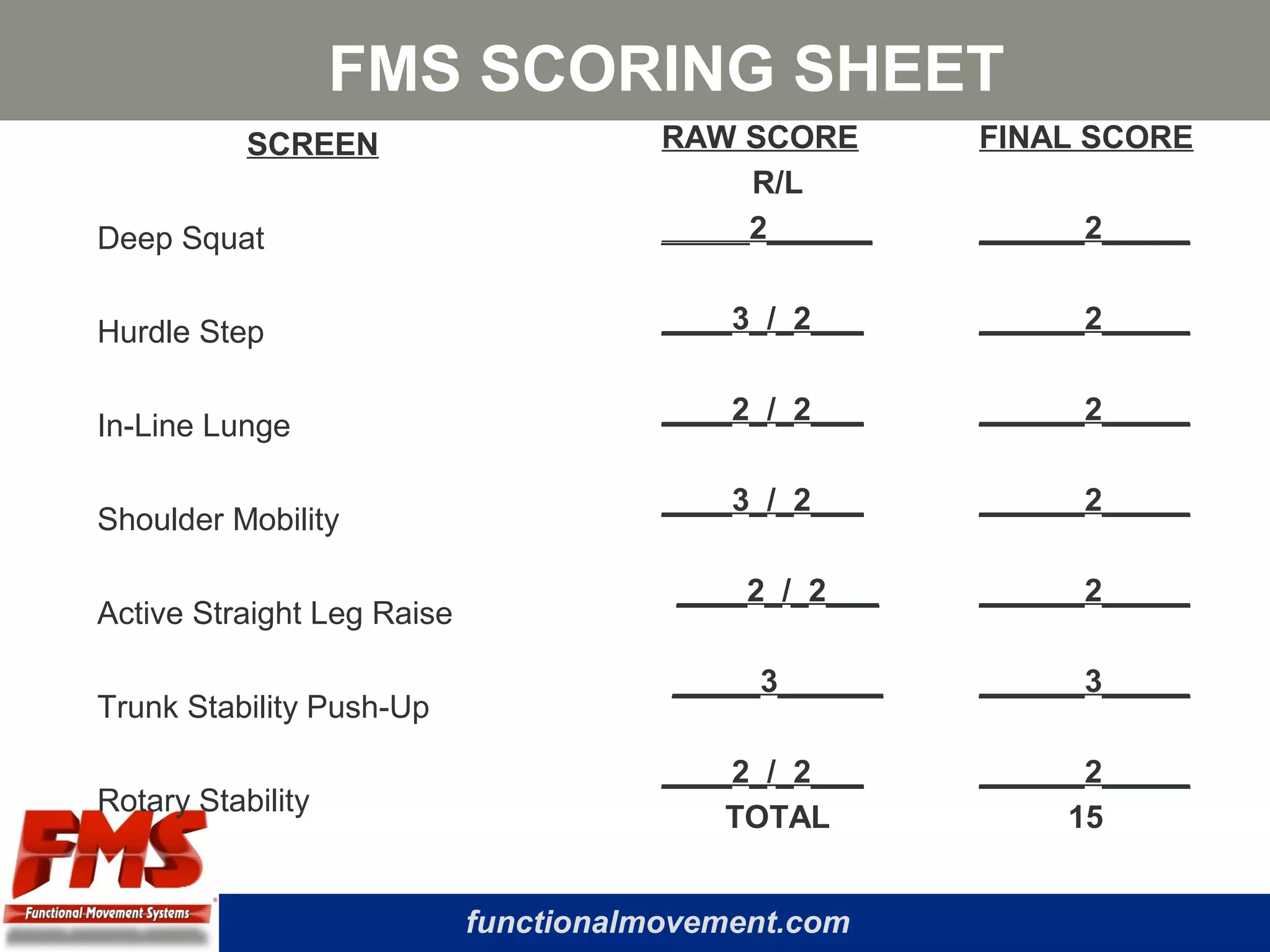
FMS SCORING SHEET
SCREEN
Deep Squat
Hurdle Step
In-Line Lunge
Shoulder Mobility
Active Straight Leg Raise
Trunk Stability Push-Up
Rotary Stability
RAW SCORE
R/L
_____2______
____3_/_2___
____2_/_2___
____3_/_2___
____2_/_2___
_____3______
____2_/_2___
TOTAL
FINAL SCORE
______2_____
______2_____
______2_____
______2_____
______2_____
______3_____
______2_____
15
functionalmovement.com
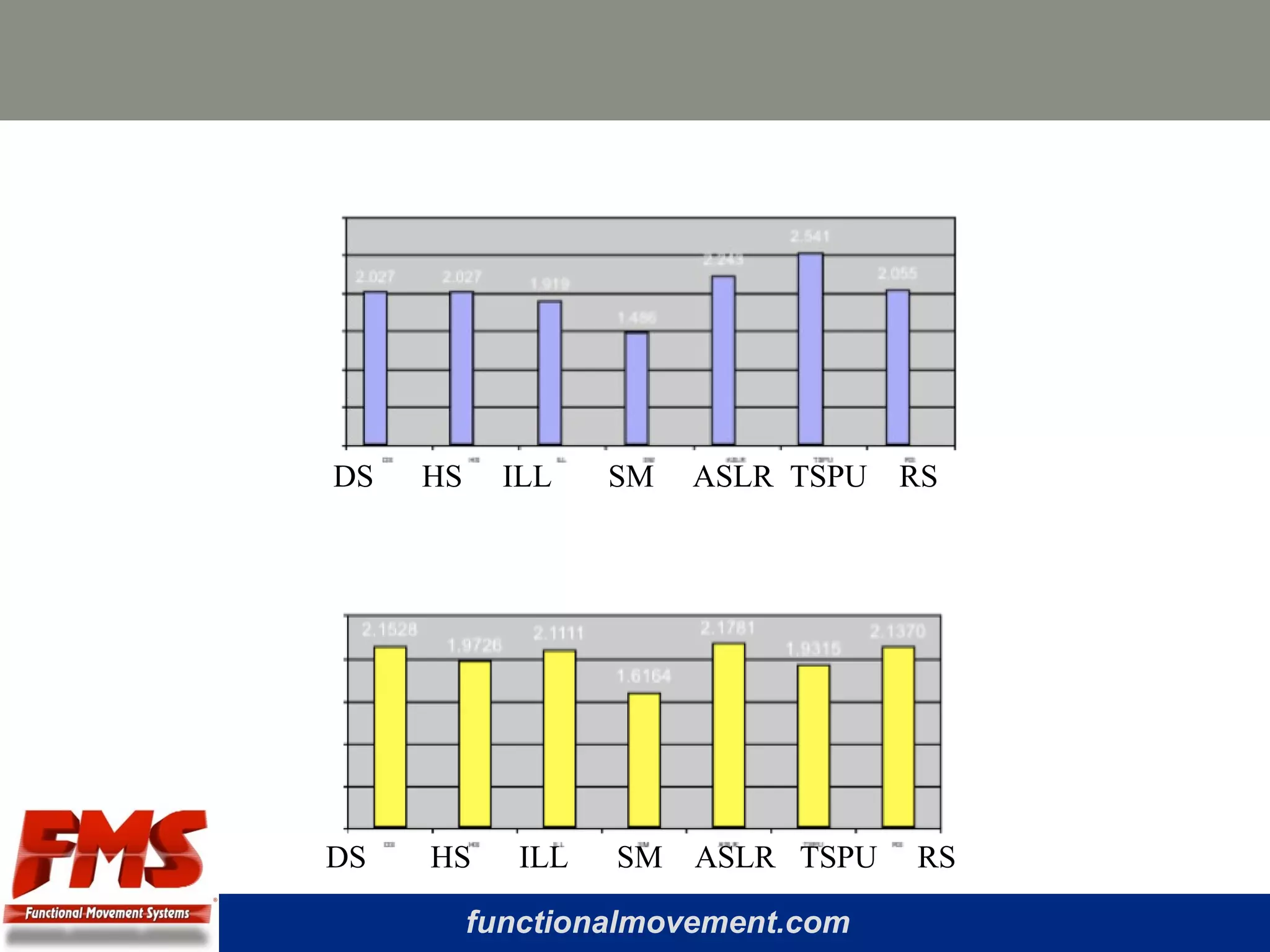
DS HS ILL SM ASLR TSPU RS
functionalmovement.com
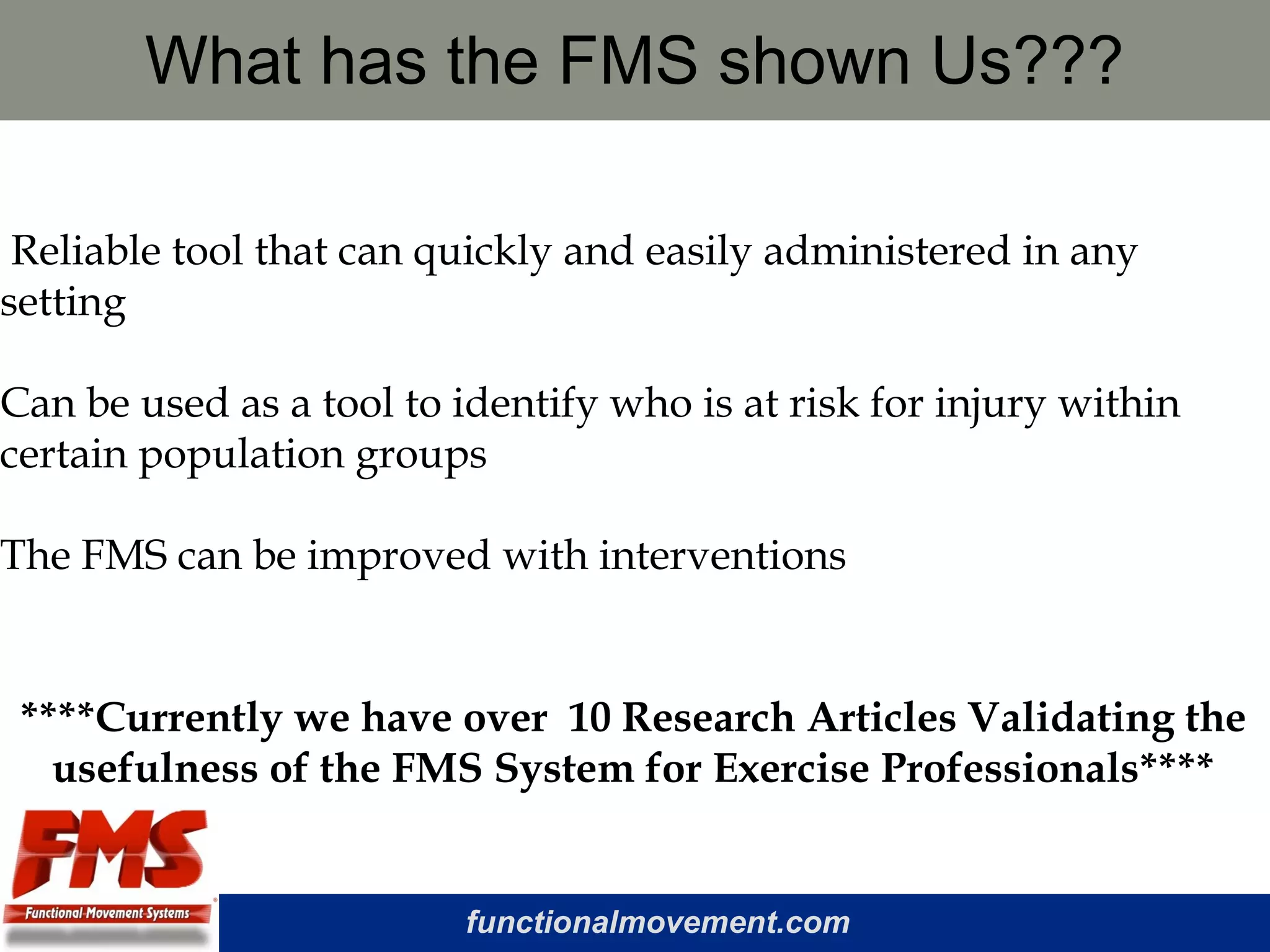
What has the FMS shown Us???
Reliable tool that can quickly and easily administered in any
setting
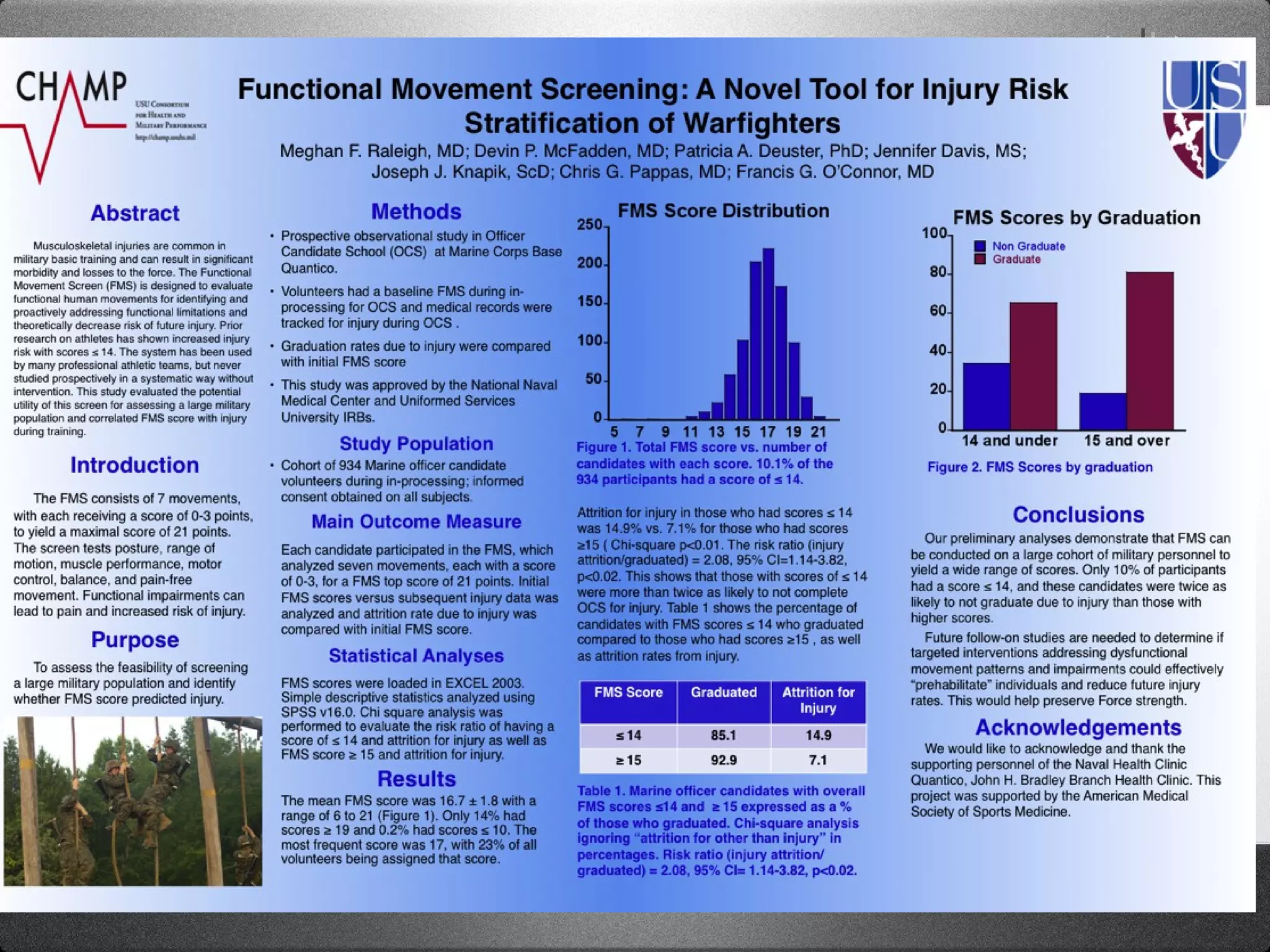
Can be used as a tool to identify who is at risk for injury within
certain population groups
The FMS can be improved with interventions
****Currently we have over 10 Research Articles Validating the
usefulness of the FMS System for Exercise Professionals****
functionalmovement.com
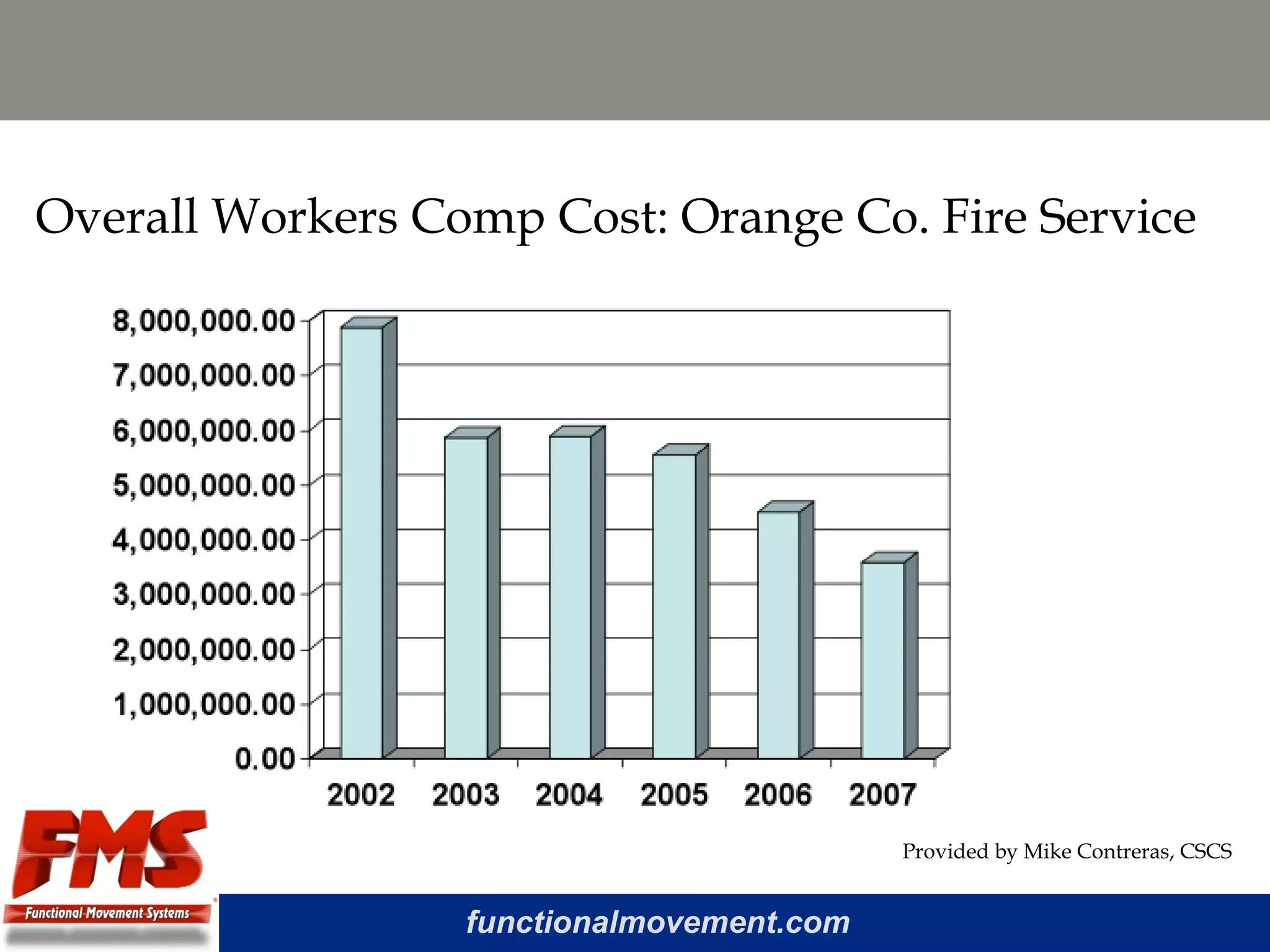
Overall Workers Comp Cost: Orange Co. Fire Service
Provided by Mike Contreras, CSCS
functionalmovement.com
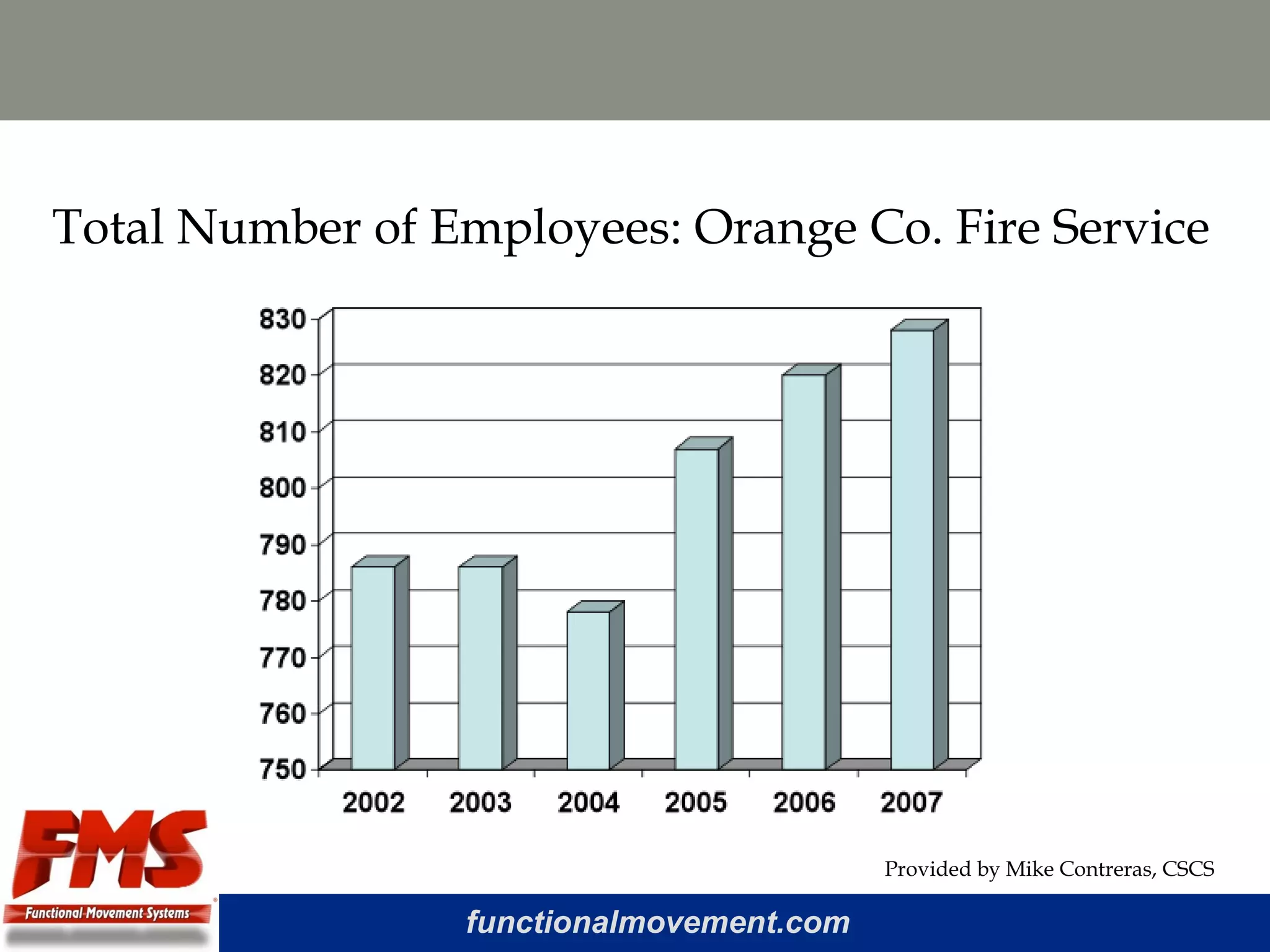
Total Number of Employees: Orange Co. Fire Service
Provided by Mike Contreras, CSCS
functionalmovement.com
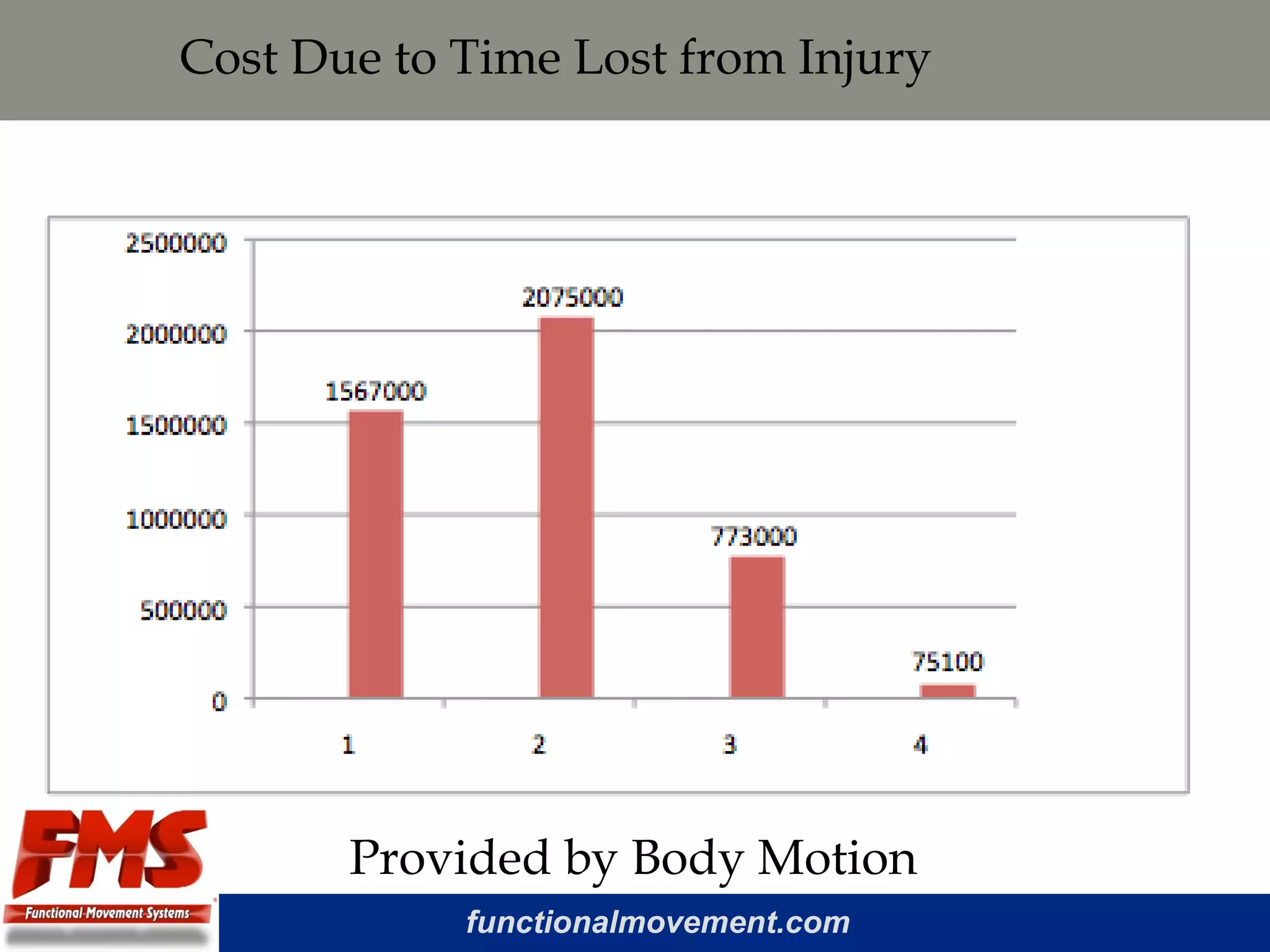
Cost Due to Time Lost from Injury
Provided by Body Motion
functionalmovement.com
Any Questions????

Functional Movement Screen Reduces Injuries

  • 1.
    functionalmovement.com Improving Operational Performanceand Injury Prevention Strategies through Functional Movement Screening Lee Burton, PhD, ATC, CSCS Director of Athletic Training: Averett University Functional Movement Systems
  • 2.
    functionalmovement.com What is Happening??? Injuriesare the largest health problem facing U.S. military forces in peacetime and combat operations. Resulting in over 1.8 million medical encounters across the military services, injuries affect more than 800,000 individual service members. (AJPM, Jan 2010)
  • 3.
    functionalmovement.com What is Happening??? Physicaltraining and sports injuries are of particular concern. Based on the likelihood of success in decreasing injuries having the greatest impact on military readiness, the Defense Safety Oversight Council (DSOC) recommends that the greatest reduction of lost duty days due to injuries across DoD may be achieved via mitigation efforts focused specifically on sports-and physical training related injuries. Reference: Defense Safety Oversight Council (DSOC,) DoD Military Injury Prevention Priorities Working Group: Leading Injuries, Causes,and Mitigation Recommendations, Feb.2006
  • 4.
    functionalmovement.com Steps in theInjury Control Process •Determine the Existence of the problem •Identify the Causes of the problem •Determine what Prevents the problem •Implement prevention strategies and programs •Continue to surveillance and monitor effectiveness of prevention efforts The Public Health Approach, Adapted from Mercy, J.A., M.L. Rosenberg, K.E. Powell, C.V. Broome, and W.L. Roper. “Public Health Policy for Preventing Violence.” Health Affairs, Winter 1993:7-29, and Jones, B.H., and J.J. Knapik. “Physical Training and Exercise-Related Injuries: Surveillance, Research and Injury Prevention in Miitary Populations.” Sports Medicine, 27(2):111-125, 1999.
  • 5.
    functionalmovement.com What Injury areRisk Factors: Can We Affect Them???? Intrinsic factors (personal characteristics): - prior injury: Leaves Neuromuscular Issue!? - physical fitness / activity levels (aerobic fitness) - anatomic malalignment, biomechanical discrepancies, imbalances(Neuromuscular??) - behavioral patterns Extrinsic (external) factors: - excessive load on the body - poor equipment - training/technique - environmental conditions (Military Medicine, 162, 10:698. 1997)
  • 6.
    functionalmovement.com The Functional Solution Screenfor asymmetry and major limitations Take care of flexibility and mobility problems: Re-Check Progress to Functional/Performance Training Leads to Improved Durability and Operational Performance
  • 7.
    functionalmovement.com Goals for ExercisePrescription and Strength •Injury Prevention: Determine Individual Risk •Durability: Movement Efficiency •Performance Enhancement
  • 8.
    functionalmovement.com start with functionalMovement Screening!!!! • Demonstrate Movement Limitations and Asymmetries • Create a Filter for Movement Dysfunction • Avoid Putting Fitness on Dysfunction • Focus on Most Limited Area
  • 9.
    functionalmovement.com How do/did westart.... Sequential Development Rolling, prone on elbows, crawling, kneeling, half- kneeling, squatting, standing, stepping.....
  • 10.
    functionalmovement.com Neuromuscular Control Problems? •During functional multi-joint movements a relatively stiffer joint or muscle tends to resist movement, but function is maintained by a another joint increasing to compensate... M. Comerford
  • 11.
    functionalmovement.com Stability/MobilitStability/Mobilit y Imbalancey ImbalancePain Results in Inefficient/Compensatory Movement!!!!!! What makes Movement Dysfunctional???
  • 12.
  • 13.
    Movement Performance Skill The Functional PerformancePyramid Cook ‘04 Proprioception Flexibility Mobility/Stability Plyometric Power Strength Speed Agility Categorize Individual/Group Needs?
  • 14.
    functionalmovement.com The Functional MovementScreen ™ •• Designed as aDesigned as a screening toolscreening tool performed onperformed on individuals withoutindividuals without recognizedrecognized pathology.pathology. •• Not a diagnosticNot a diagnostic tool.tool.
  • 15.
  • 16.
    functionalmovement.com FMSFMS ™™…...Deep SquatIII…...Deep Squat III ••Upper torso is parallelUpper torso is parallel with tibiawith tibia ••Femur below horizontalFemur below horizontal ••Knees aligned over feetKnees aligned over feet ••Dowel aligned over feetDowel aligned over feet
  • 17.
    functionalmovement.com FMSFMS ™™..… HurdleStep III..… Hurdle Step III ••Hips, knees, andHips, knees, and ankles remain alignedankles remain aligned in the sagittal planein the sagittal plane ••Minimal to no lumbarMinimal to no lumbar spine movementspine movement ••Dowel and hurdleDowel and hurdle remain parallelremain parallel
  • 18.
    functionalmovement.com FMSFMS ™™.... In-LineLunge III.... In-Line Lunge III ••Minimal to no torsoMinimal to no torso movementmovement ••Feet remain aligned inFeet remain aligned in sagittal planesagittal plane ••Knee touches 2x6Knee touches 2x6 behind heel of frontbehind heel of front footfoot
  • 19.
    functionalmovement.com FMSFMS ™...™... ShoulderMobility IIIShoulder Mobility III • Fist placement isFist placement is within onewithin one hand length aparthand length apart
  • 20.
    functionalmovement.com FMSFMS ™™...... ActiveStraight Leg Raise III...... Active Straight Leg Raise III Ankle/DowelAnkle/Dowel resides pastresides past mid-thighmid-thigh
  • 21.
    functionalmovement.com FMS ™...…Trunk StabilityPush-Up IIIFMS ™...…Trunk Stability Push-Up III •Males performMales perform 1 repetition with1 repetition with thumbs justthumbs just above foreheadabove forehead •FemalesFemales perform 1perform 1 repetition withrepetition with thumbs in-linethumbs in-line with chinwith chin
  • 22.
    functionalmovement.com FMSFMS ™™ ..Rotary Stability III.. Rotary Stability III • Performs 1 unilateral repetition whilePerforms 1 unilateral repetition while keeping torso parallel to board and keepingkeeping torso parallel to board and keeping elbow and knee in line with the boardelbow and knee in line with the board
  • 23.
    functionalmovement.com FMS SCORING SHEET SCREEN DeepSquat Hurdle Step In-Line Lunge Shoulder Mobility Active Straight Leg Raise Trunk Stability Push-Up Rotary Stability RAW SCORE R/L _____2______ ____3_/_2___ ____2_/_2___ ____3_/_2___ ____2_/_2___ _____3______ ____2_/_2___ TOTAL FINAL SCORE ______2_____ ______2_____ ______2_____ ______2_____ ______2_____ ______3_____ ______2_____ 15
  • 24.
    functionalmovement.com DS HS ILLSM ASLR TSPU RS DS HS ILL SM ASLR TSPU RS
  • 25.
    functionalmovement.com What has theFMS shown Us??? Reliable tool that can quickly and easily administered in any setting Can be used as a tool to identify who is at risk for injury within certain population groups The FMS can be improved with interventions ****Currently we have over 10 Research Articles Validating the usefulness of the FMS System for Exercise Professionals****
  • 26.
    functionalmovement.com Overall Workers CompCost: Orange Co. Fire Service Provided by Mike Contreras, CSCS
  • 27.
    functionalmovement.com Total Number ofEmployees: Orange Co. Fire Service Provided by Mike Contreras, CSCS
  • 28.
    functionalmovement.com Cost Due toTime Lost from Injury Provided by Body Motion
  • 31.