2. How effective is the combination of your main product and
                               ancillary texts?

• We felt as though it was important to be consistent when combining ‘Tasty Takeaways’
with our ancillary texts. We used the same voiceover in our documentary as we did in our
radio advert. This helped to create a product identity for our audience to associate our work
with. If we did choose a different voice over in our radio advert to the documentary, this
might cause the audience to not have any sort of association between our products and
therefore would be ineffective. Having the same narrator for all of our products is
tremendously important in terms of being a guide for the audience. Audiences watch
documentaries for guidance so that unanswered questions they have from the print or radio
advertisements can be answered.
• Audiences in documentaries prefer it when the narrator gives a third person point of view
because this is much more informative and panoramic. If we had told the narrator to say
words such as ‘I believe this happened because…’ there is less of a chance that the audience
will feel a part of the documentary. This is due to the fact that the narrator is expressing his
own opinion rather than informing the audience into making there own decision like all
unbiased documentaries should do. I believe that we didn’t allow the narrator to express his
own opinion. However, there was one part of the documentary where the narrator said “We
compared a supermarket meal to a similar takeaway and found that it was over £5 cheaper
with a lower content of unhealthy additives”. There was not much evidence on screen to
support what the narrator was saying and therefore we made him sound slightly unjustified.
Radio Advertisement
•   In our Radio advert, there were some clips that were taken from the documentary. These were
    intended as previews for the audience as an attempt of enticement. The radio advertisement
    contains the same music from our documentary. The audio levels of the music go up when there is
    no other audio being played in the same clip. The volume of the music goes down when clips from
    the documentary are played and when the narrator is speaking. This is to try and make the sound
    clear for the audience to understand and my personal opinion is that it was. This opinion is without
    the influence of feedback from the audience.
•   By using “Weird Al” Yankovic’s ‘Eat It’ in our radio advert, it promotes the fact that the documentary
    is not too serious because of how catchy and up beat the song is. If we used a sad song such as
    ‘Mad World’ by Gary Jules, not only would this be inappropriate and inconsistent, it would suggest
    to the audience that the documentary is depressing. This wouldn’t be something that teenagers
    would enjoy watching. It would immediately tell the audience that takeaways are widely thought of
    as a negative problem. A song like this could lead the audience to draw to a conclusion before they
    have even watched the documentary which we strictly did not want them to do.
•   We took some audio snippets from the documentary. These were from either our vox pop
    interviews or from our main interviews. We tried to keep the questions open for the teenagers in
    our vox pops to answer. My main objective of using a question which had been tailored to be open
    for vox pop answers was to try and get the audience to answer the question themselves in their
    head. We used the narrator to link to voices from the vox pops to the restaurant owner together.
    When he says “We are all familiar with the idea of takeaways” it makes the vox pops sound like a
    brief representative of everyone, almost as though he carried out a survey.
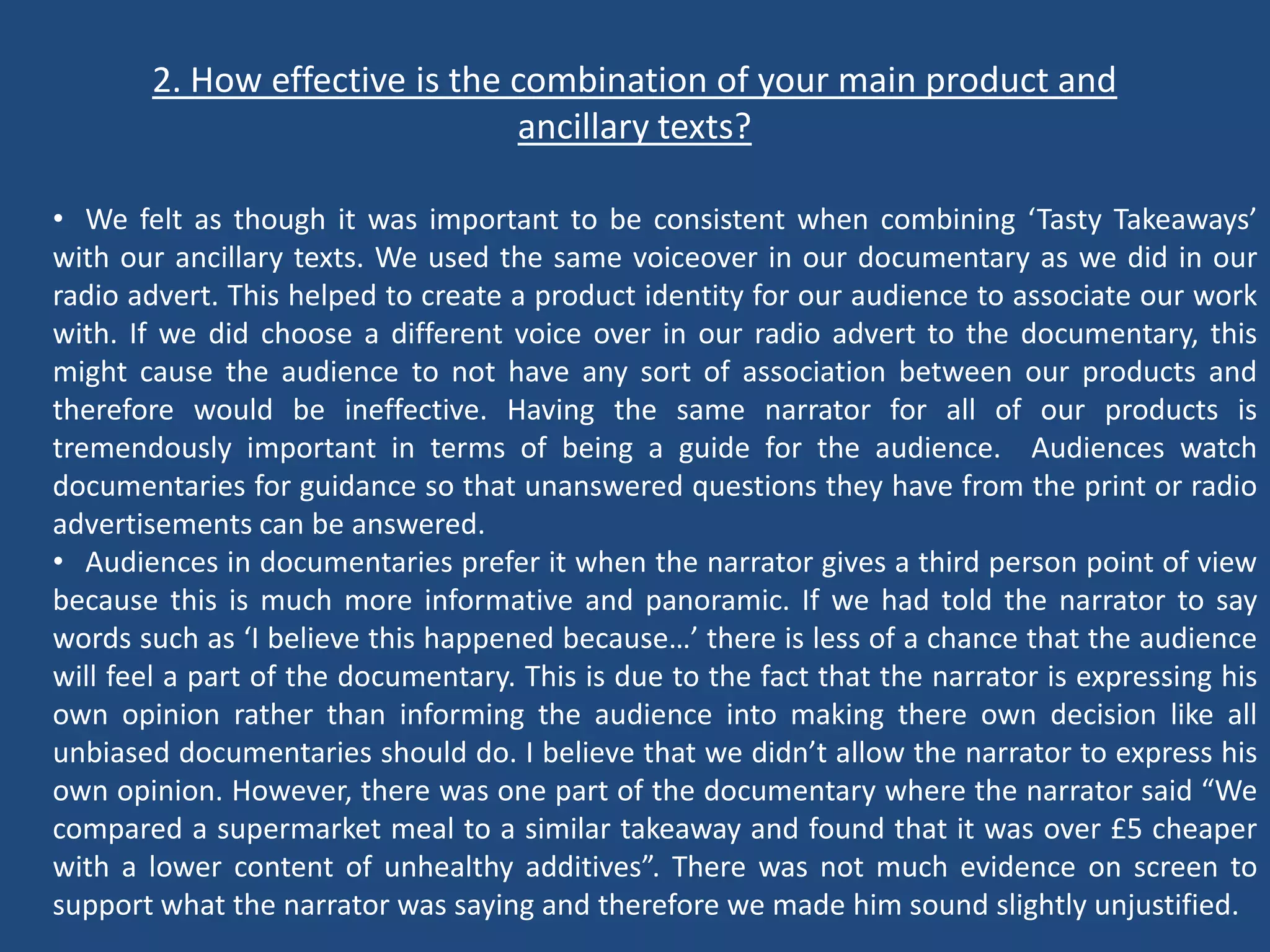
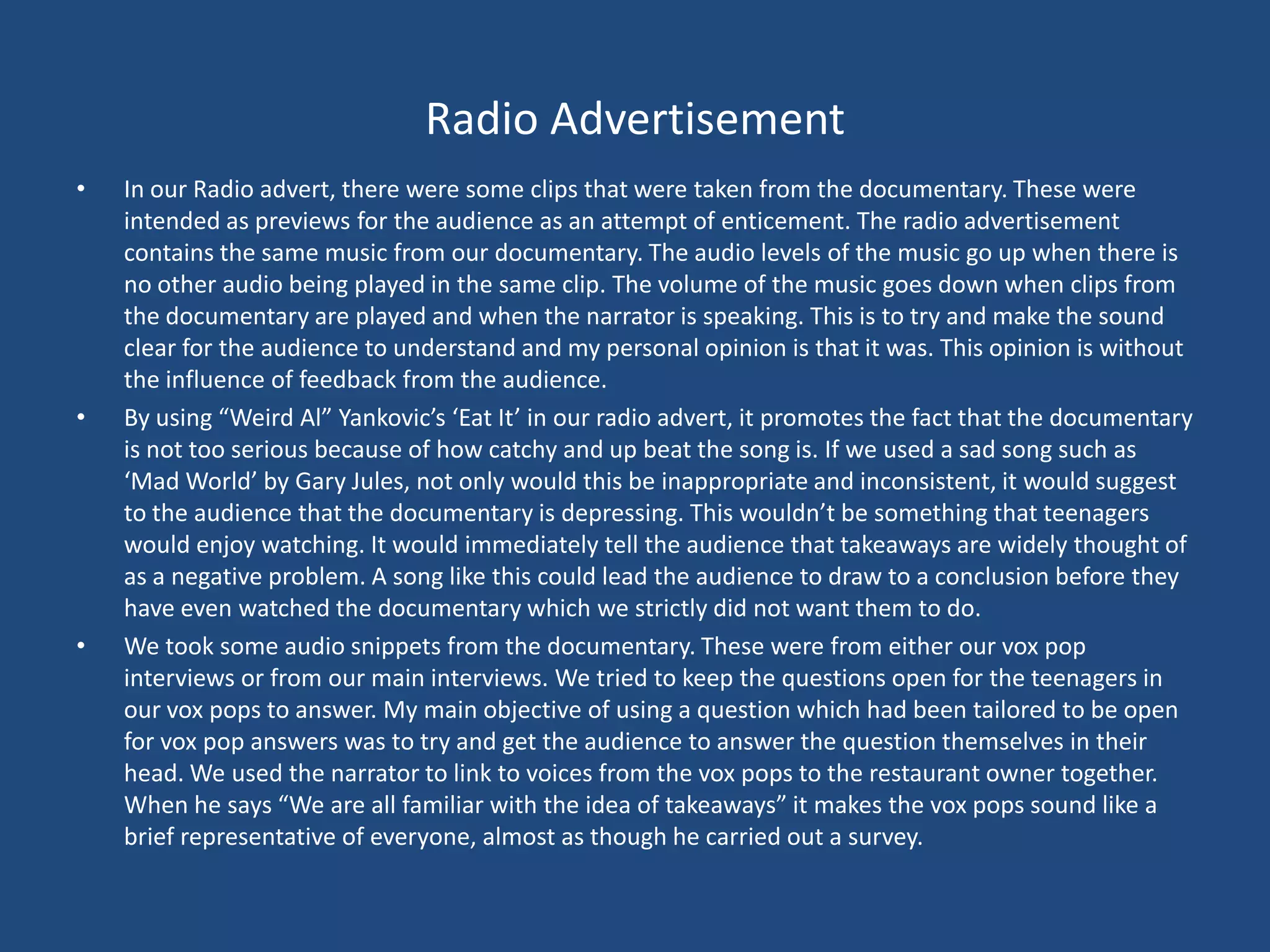
Our Advertisement                                Channel 4’s Advertisement


•   Another point where we were consistent was when we always used the same text in our documentaries as
    we did in our print advertisement. Again, this helps promote their identity as associative products whilst
    they still differentiate from each other.
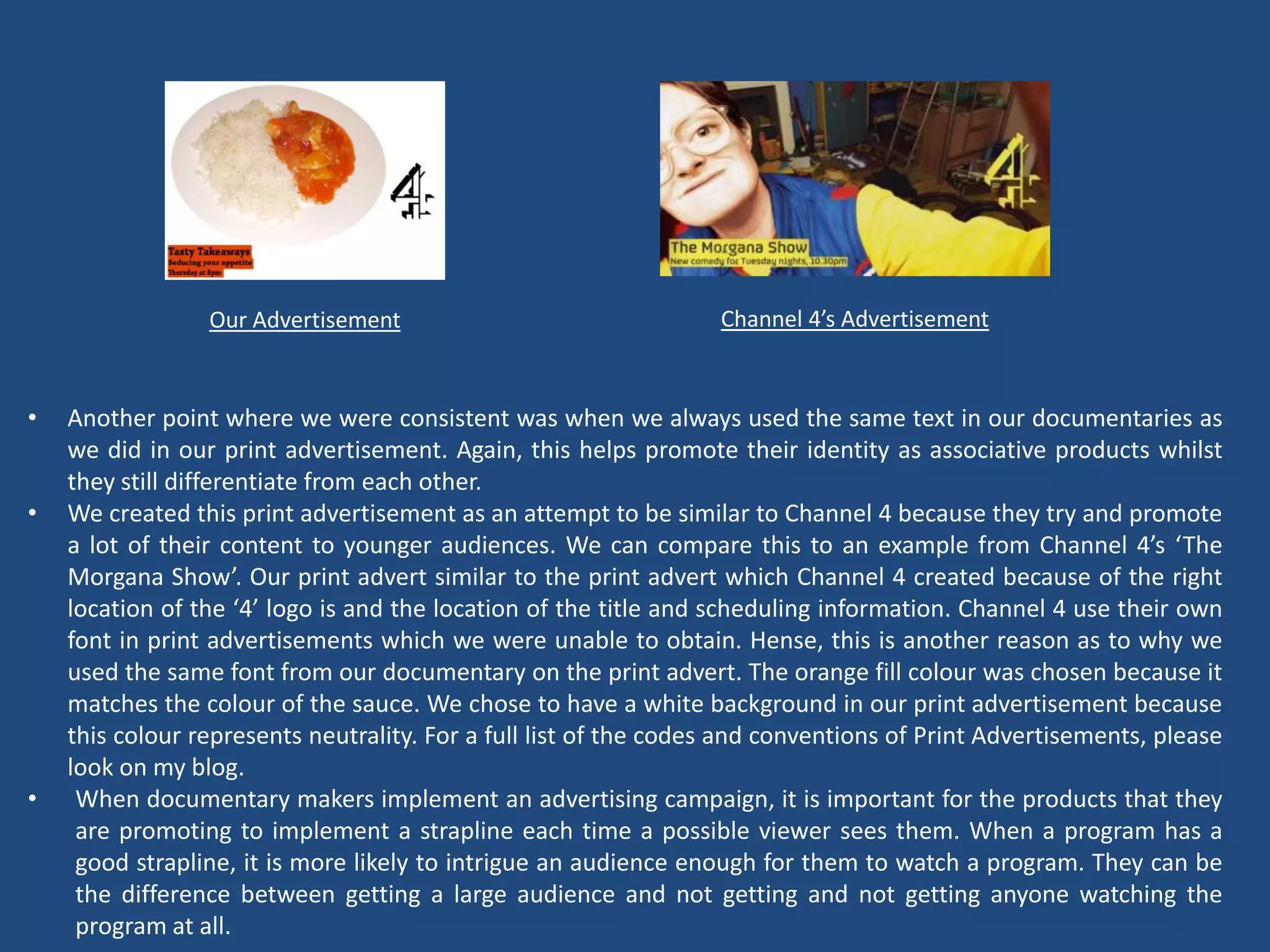
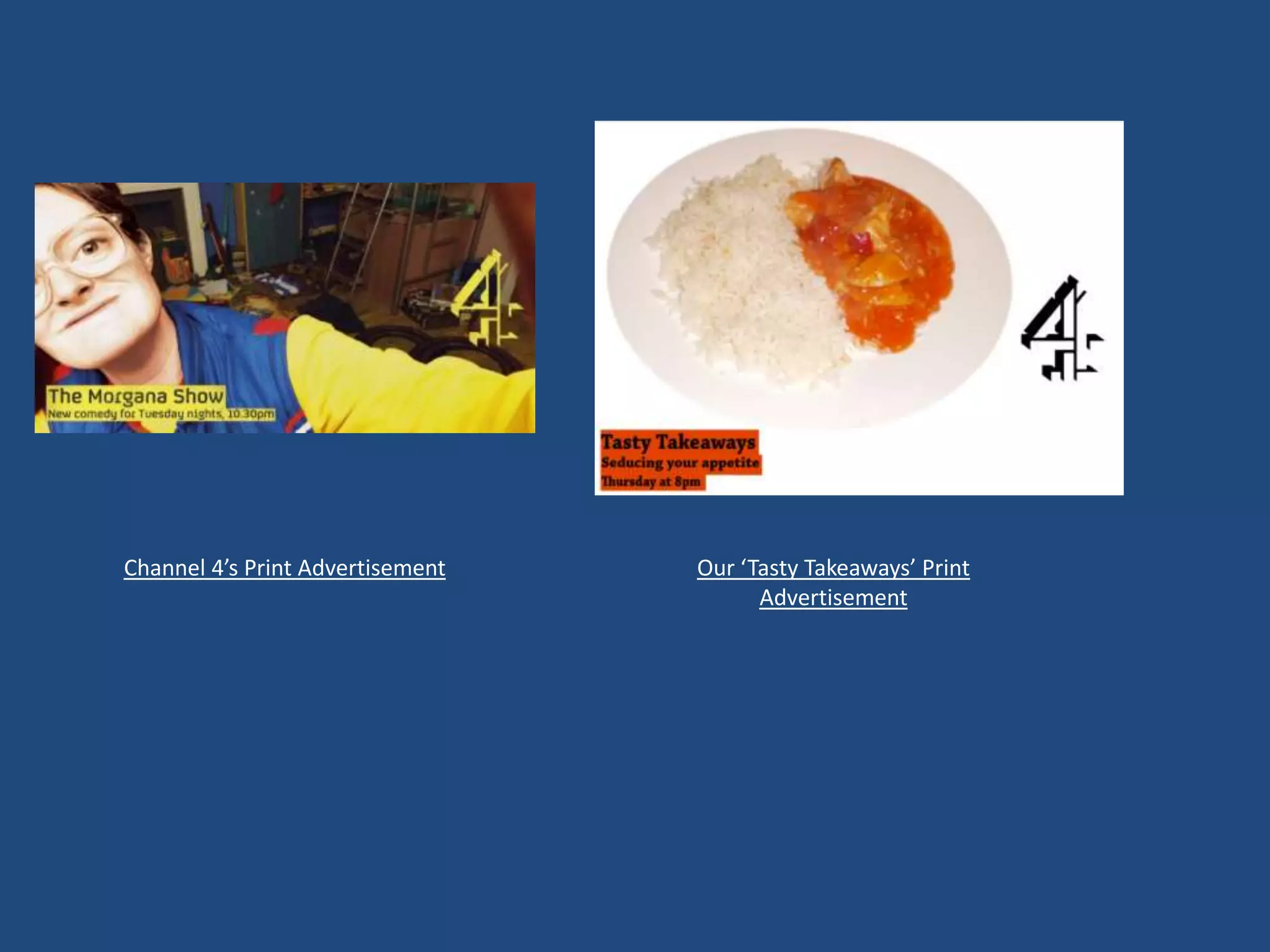
•   We created this print advertisement as an attempt to be similar to Channel 4 because they try and promote
    a lot of their content to younger audiences. We can compare this to an example from Channel 4’s ‘The
    Morgana Show’. Our print advert similar to the print advert which Channel 4 created because of the right
    location of the ‘4’ logo is and the location of the title and scheduling information. Channel 4 use their own
    font in print advertisements which we were unable to obtain. Hense, this is another reason as to why we
    used the same font from our documentary on the print advert. The orange fill colour was chosen because it
    matches the colour of the sauce. We chose to have a white background in our print advertisement because
    this colour represents neutrality. For a full list of the codes and conventions of Print Advertisements, please
    look on my blog.
•    When documentary makers implement an advertising campaign, it is important for the products that they
     are promoting to implement a strapline each time a possible viewer sees them. When a program has a
     good strapline, it is more likely to intrigue an audience enough for them to watch a program. They can be
     the difference between getting a large audience and not getting and not getting anyone watching the
     program at all.
Channel 4’s Print Advertisement   Our ‘Tasty Takeaways’ Print
                                        Advertisement

Question 2

  • 1.
    2. How effectiveis the combination of your main product and ancillary texts? • We felt as though it was important to be consistent when combining ‘Tasty Takeaways’ with our ancillary texts. We used the same voiceover in our documentary as we did in our radio advert. This helped to create a product identity for our audience to associate our work with. If we did choose a different voice over in our radio advert to the documentary, this might cause the audience to not have any sort of association between our products and therefore would be ineffective. Having the same narrator for all of our products is tremendously important in terms of being a guide for the audience. Audiences watch documentaries for guidance so that unanswered questions they have from the print or radio advertisements can be answered. • Audiences in documentaries prefer it when the narrator gives a third person point of view because this is much more informative and panoramic. If we had told the narrator to say words such as ‘I believe this happened because…’ there is less of a chance that the audience will feel a part of the documentary. This is due to the fact that the narrator is expressing his own opinion rather than informing the audience into making there own decision like all unbiased documentaries should do. I believe that we didn’t allow the narrator to express his own opinion. However, there was one part of the documentary where the narrator said “We compared a supermarket meal to a similar takeaway and found that it was over £5 cheaper with a lower content of unhealthy additives”. There was not much evidence on screen to support what the narrator was saying and therefore we made him sound slightly unjustified.
  • 2.
    Radio Advertisement • In our Radio advert, there were some clips that were taken from the documentary. These were intended as previews for the audience as an attempt of enticement. The radio advertisement contains the same music from our documentary. The audio levels of the music go up when there is no other audio being played in the same clip. The volume of the music goes down when clips from the documentary are played and when the narrator is speaking. This is to try and make the sound clear for the audience to understand and my personal opinion is that it was. This opinion is without the influence of feedback from the audience. • By using “Weird Al” Yankovic’s ‘Eat It’ in our radio advert, it promotes the fact that the documentary is not too serious because of how catchy and up beat the song is. If we used a sad song such as ‘Mad World’ by Gary Jules, not only would this be inappropriate and inconsistent, it would suggest to the audience that the documentary is depressing. This wouldn’t be something that teenagers would enjoy watching. It would immediately tell the audience that takeaways are widely thought of as a negative problem. A song like this could lead the audience to draw to a conclusion before they have even watched the documentary which we strictly did not want them to do. • We took some audio snippets from the documentary. These were from either our vox pop interviews or from our main interviews. We tried to keep the questions open for the teenagers in our vox pops to answer. My main objective of using a question which had been tailored to be open for vox pop answers was to try and get the audience to answer the question themselves in their head. We used the narrator to link to voices from the vox pops to the restaurant owner together. When he says “We are all familiar with the idea of takeaways” it makes the vox pops sound like a brief representative of everyone, almost as though he carried out a survey.
  • 3.
    Our Advertisement Channel 4’s Advertisement • Another point where we were consistent was when we always used the same text in our documentaries as we did in our print advertisement. Again, this helps promote their identity as associative products whilst they still differentiate from each other. • We created this print advertisement as an attempt to be similar to Channel 4 because they try and promote a lot of their content to younger audiences. We can compare this to an example from Channel 4’s ‘The Morgana Show’. Our print advert similar to the print advert which Channel 4 created because of the right location of the ‘4’ logo is and the location of the title and scheduling information. Channel 4 use their own font in print advertisements which we were unable to obtain. Hense, this is another reason as to why we used the same font from our documentary on the print advert. The orange fill colour was chosen because it matches the colour of the sauce. We chose to have a white background in our print advertisement because this colour represents neutrality. For a full list of the codes and conventions of Print Advertisements, please look on my blog. • When documentary makers implement an advertising campaign, it is important for the products that they are promoting to implement a strapline each time a possible viewer sees them. When a program has a good strapline, it is more likely to intrigue an audience enough for them to watch a program. They can be the difference between getting a large audience and not getting and not getting anyone watching the program at all.
  • 4.
    Channel 4’s PrintAdvertisement Our ‘Tasty Takeaways’ Print Advertisement