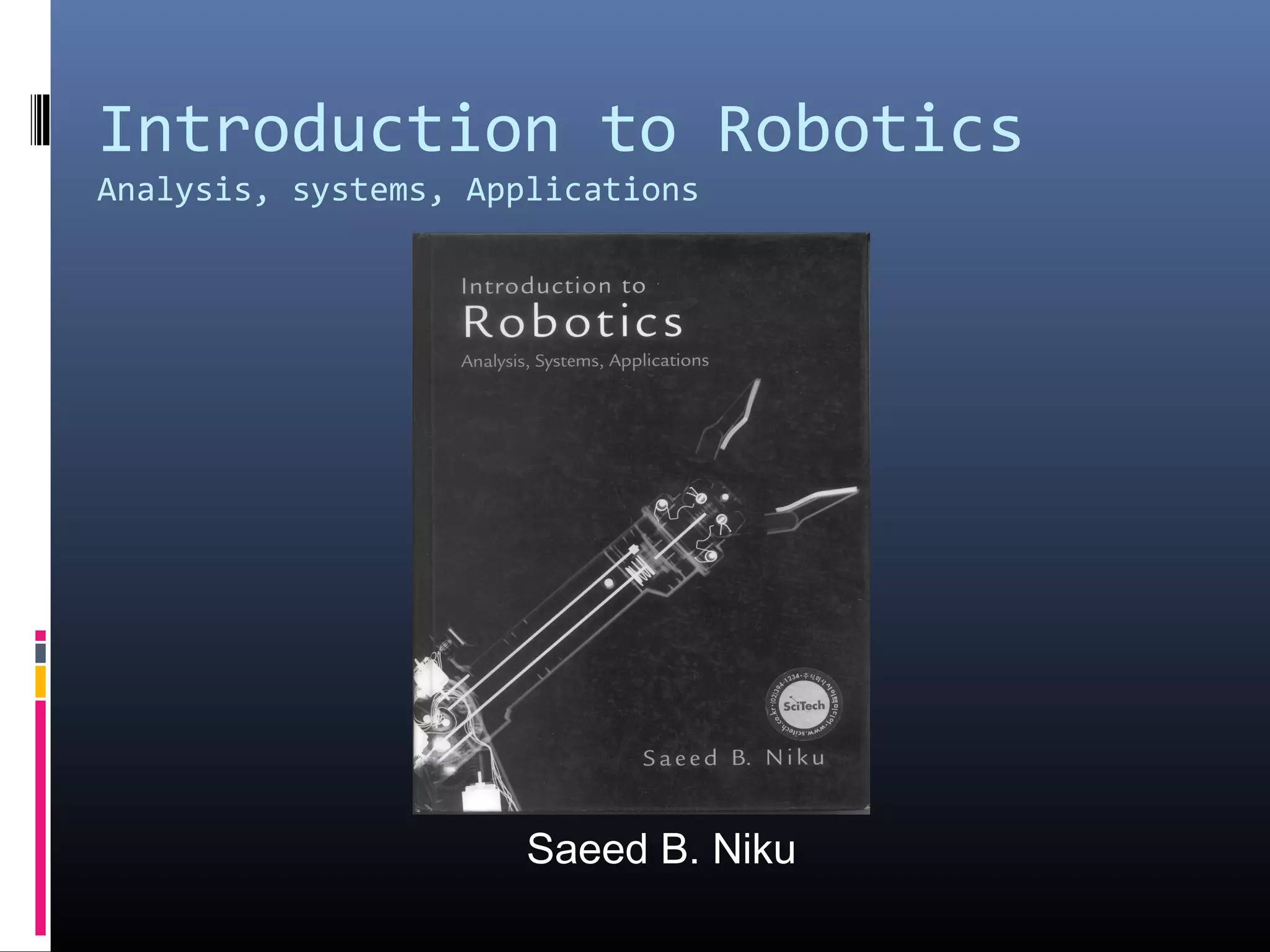
Introduction to Robotics
Analysis, systems, Applications
Saeed B. Niku
Chapter 1
Fundamentals
1. Introduction
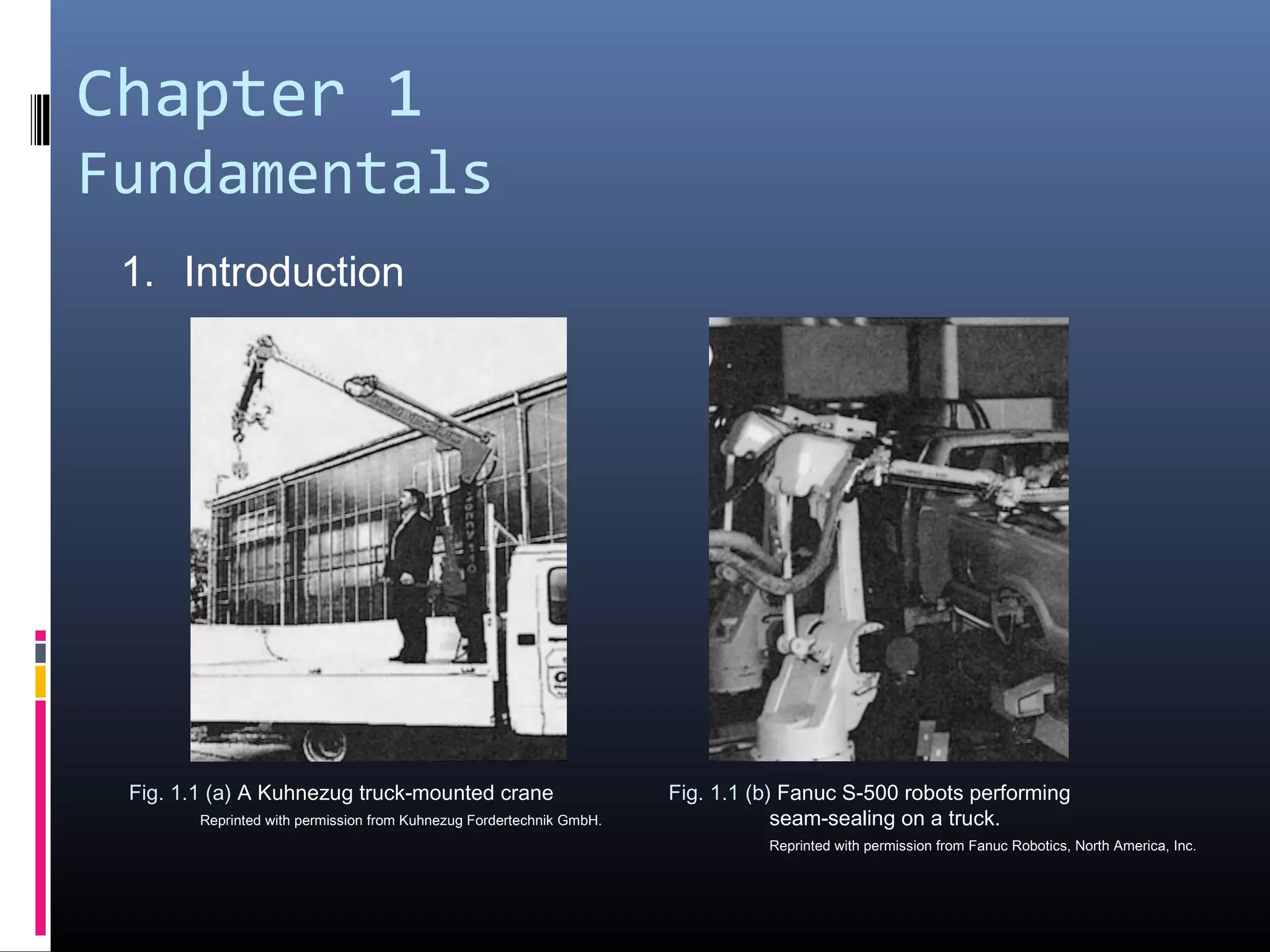
Fig. 1.1 (a) A Kuhnezug truck-mounted crane
Reprinted with permission from Kuhnezug Fordertechnik GmbH.
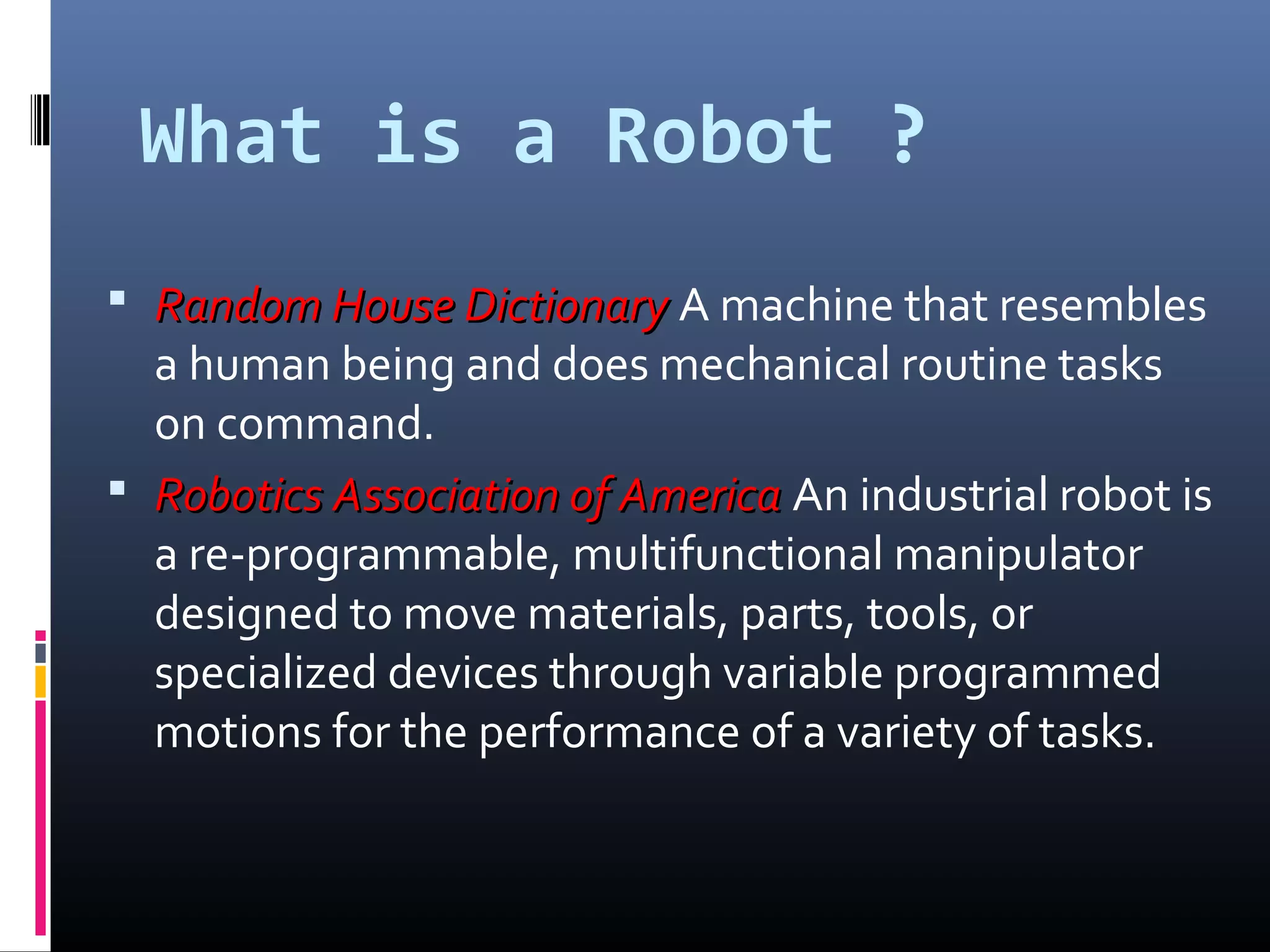
Fig. 1.1 (b) Fanuc S-500 robots performing
seam-sealing on a truck.
Reprinted with permission from Fanuc Robotics, North America, Inc.
What is a Robot ?
 Random House DictionaryRandom House Dictionary A machine that resembles
a human being and does mechanical routine tasks
on command.
 Robotics Association of AmericaRobotics Association of America An industrial robot is
a re-programmable, multifunctional manipulator
designed to move materials, parts, tools, or
specialized devices through variable programmed
motions for the performance of a variety of tasks.
What is a Robot ?
 A manipulator (or an industrial robot) is
composed of a series of links connected to each
other via joints. Each joint usually has an
actuator (a motor for eg.) connected to it.
 These actuators are used to cause relative
motion between successive links. One end of the
manipulator is usually connected to a stable base
and the other end is used to deploy a tool.
Classification of Robots
- JIRA (Japanese Industrial Robot Association)
Class1: Manual-Handling Device
Class2: Fixed Sequence Robot
Class3: Variable Sequence Robot
Class4: Playback Robot
Class5: Numerical Control Robot
Class6: Intelligent Robot
Classification of Robots
- RIA (Robotics Institute of America)
Variable Sequence Robot(Class3)
Playback Robot(Class4)
Numerical Control Robot(Class5)
Intelligent Robot(Class6)
Classification of Robots
- AFR (Association FranÇaise de Robotique)
Type A: Manual Handling Devices/ telerobotics
Type B: Automatic Handling Devices/
predetermined cycles
Type C: Programmable, Servo controlled robot,
continuous point-to-point trajectories
Type D: Same type with C, but it can acquire
information.
Chapter 1
Fundamentals
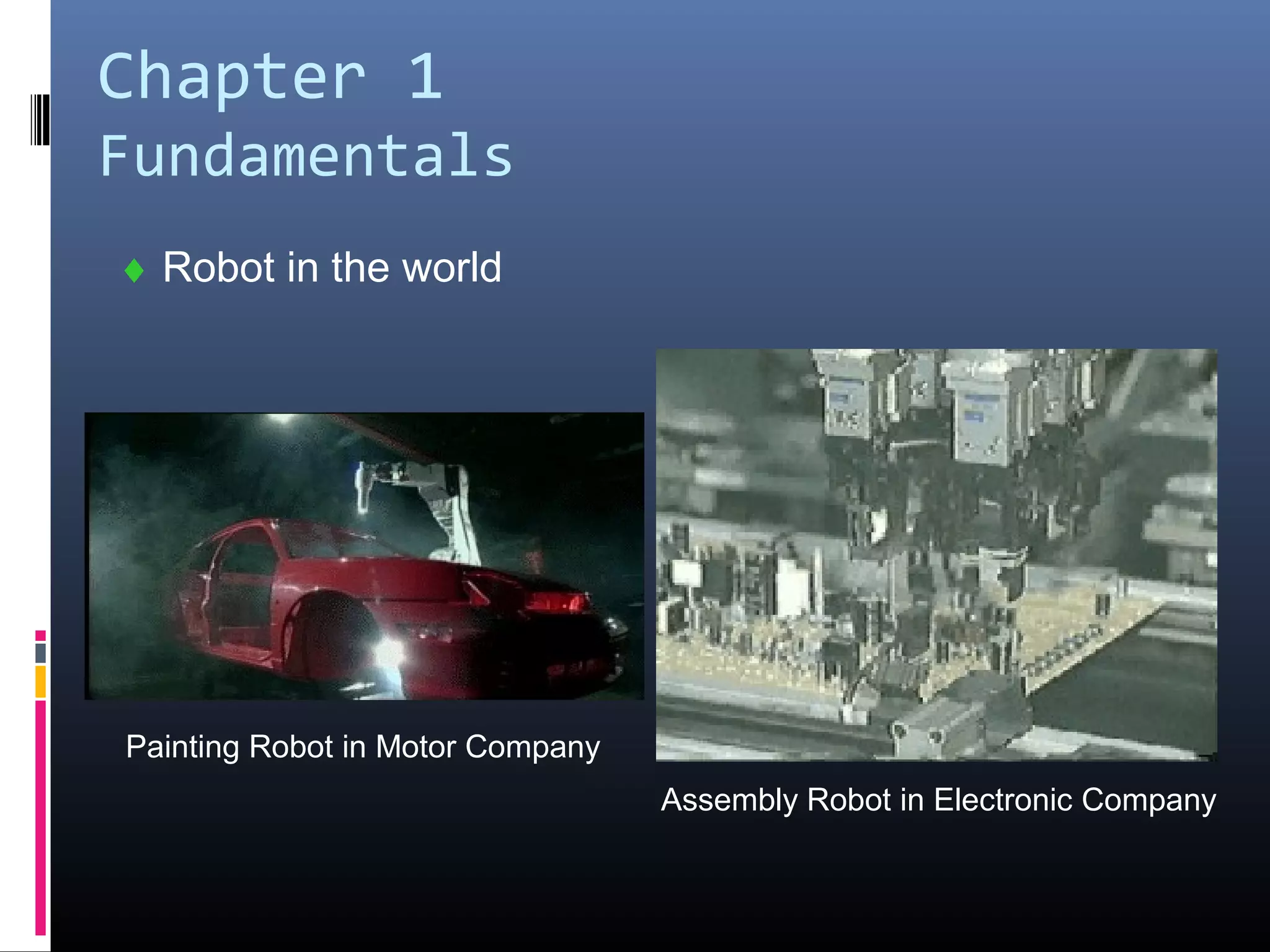
♦ Robot in the world
Painting Robot in Motor Company
Assembly Robot in Electronic Company
Chapter 1
Fundamentals
♦ Robot in the world
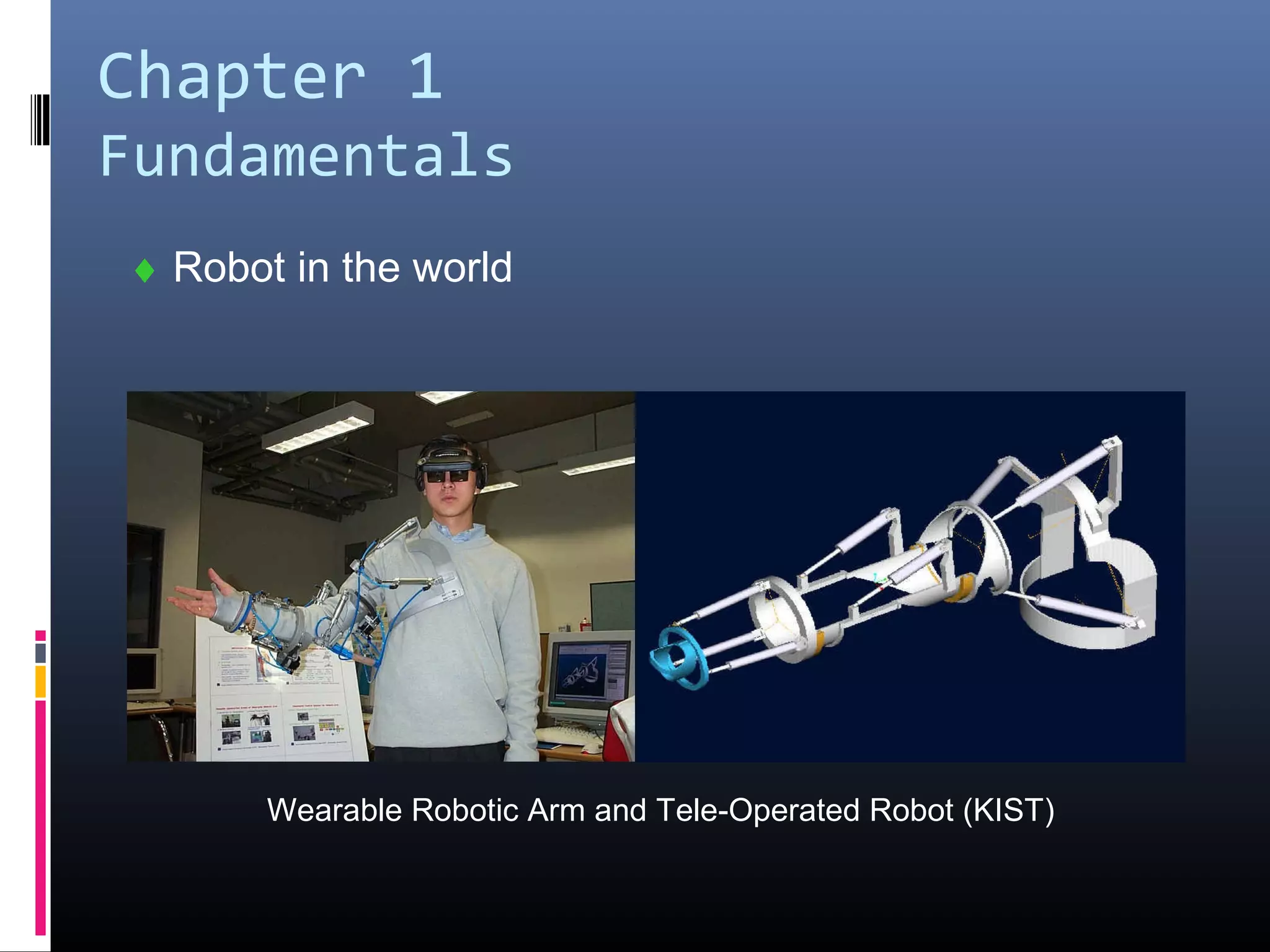
Wearable Robotic Arm and Tele-Operated Robot (KIST)
Chapter 1
Fundamentals
♦ Robot in the world
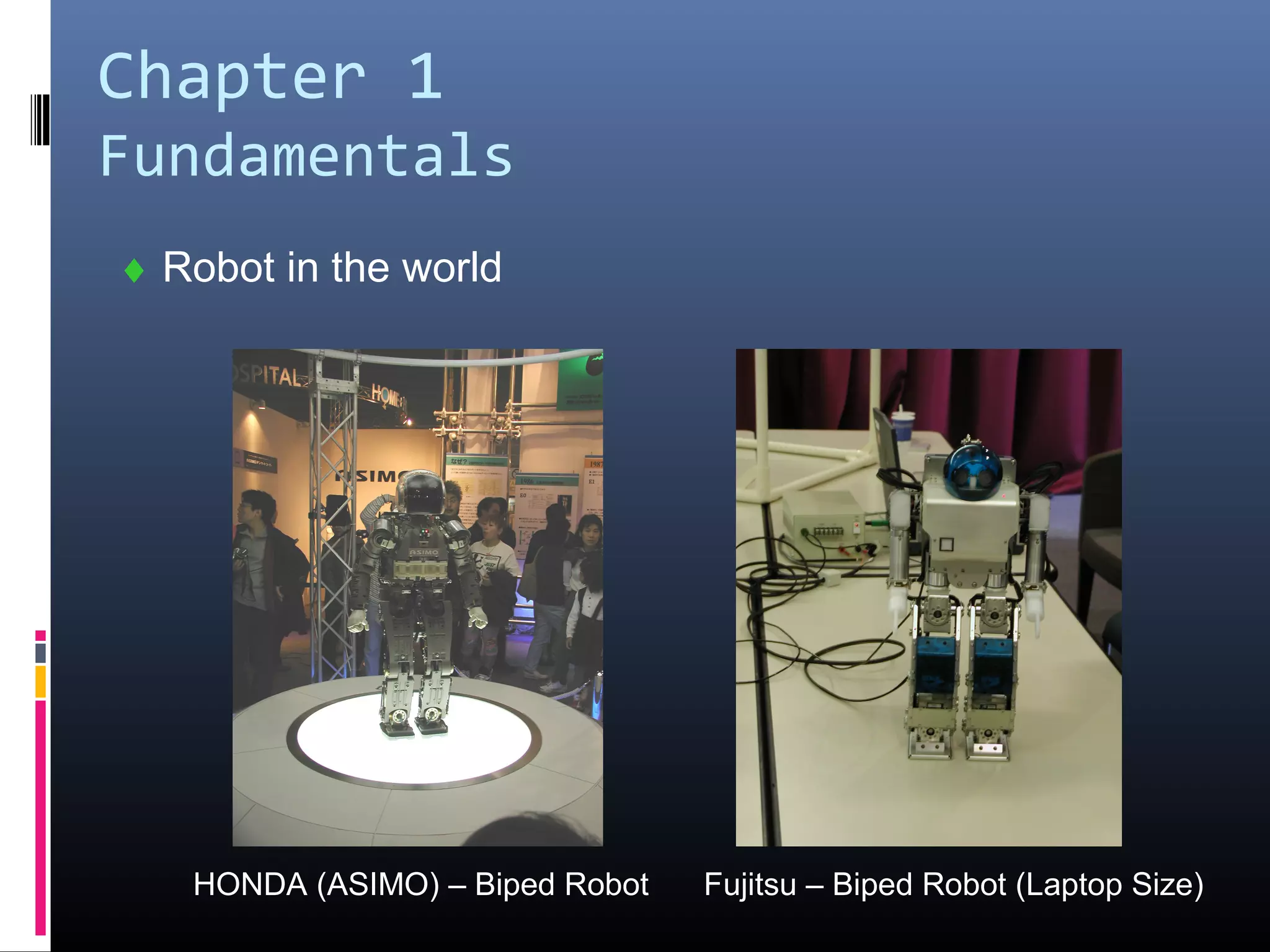
HONDA (ASIMO) – Biped Robot Fujitsu – Biped Robot (Laptop Size)
Chapter 1
Fundamentals
♦ Robot in the world
Sony (AIBO) – Toy robot
What is Robotics?
 Robotics is the art, knowledge base, and the
know-how of designing, applying, and using
robots in human endeavors.
 Robotics is an interdisciplinary subject that
benefits from mechanical engineering,
electrical and electronic engineering,
computer science, biology, and many other
disciplines.
What is Robotics
♦ History of Robotics
1922: Karel Čapek’s novel, Rossum’s Universal Robots, word “Robota”
(worker)
1952: NC machine (MIT)
1955: Denavit-Hartenberg Homogeneous Transformation
1967: Mark II (Unimation Inc.)
1968: Shakey (SRI) - intelligent robot
1973: T3 (Cincinnati Milacron Inc.)
1978: PUMA (Unimation Inc.)
1983: Robotics Courses
21C: Walking Robots, Mobile Robots, Humanoid Robots
Advantages VS. Disadvantages
of Robots
♦ Robots increase productivity, safety, efficiency, quality, and
consistency of products.
♦ Robots can work in hazardous environments without the need.
♦ Robots need no environmental comfort.
♦ Robots work continuously without experiencing fatigue of problem.
♦ Robots have repeatable precision at all times.
♦ Robots can be much more accurate than human.
♦ Robots replace human workers creating economic problems.
♦ Robots can process multiple stimuli or tasks simultaneously.
♦ Robots lack capability to respond in emergencies.
♦ Robots, although superior in certain senses, have limited
capabilities in Degree of freedom, Dexterity, Sensors, Vision
system, real time response.
♦ Robots are costly, due to Initial cost of equipment, Installation
costs, Need for Peripherals, Need for training, Need for
programming.
What are the parts
of a robot?
•Manipulator
•Pedestal
•Controller
•End Effectors
•Power Source
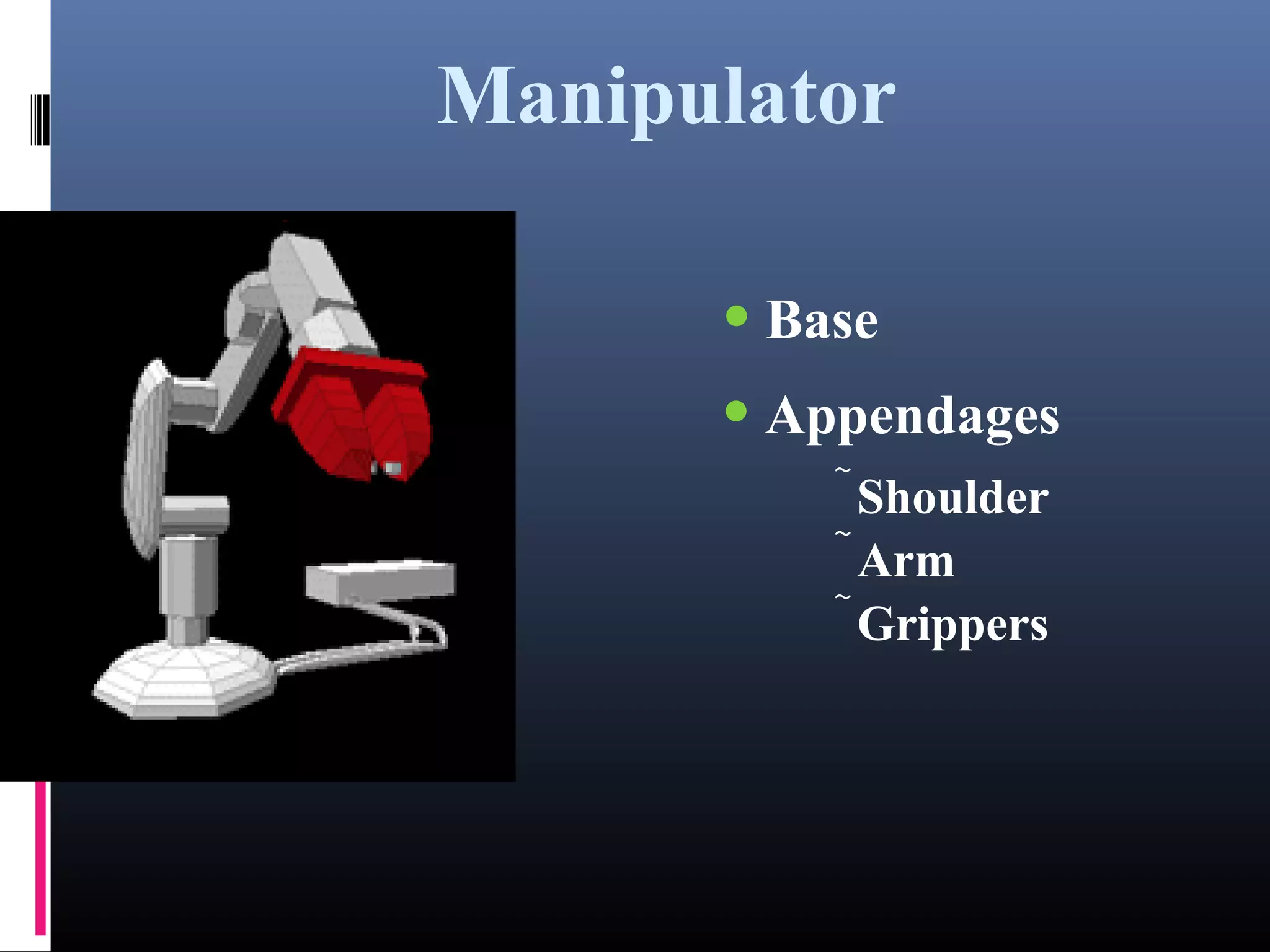
Manipulator
• Base
• Appendages
Shoulder
Arm
Grippers
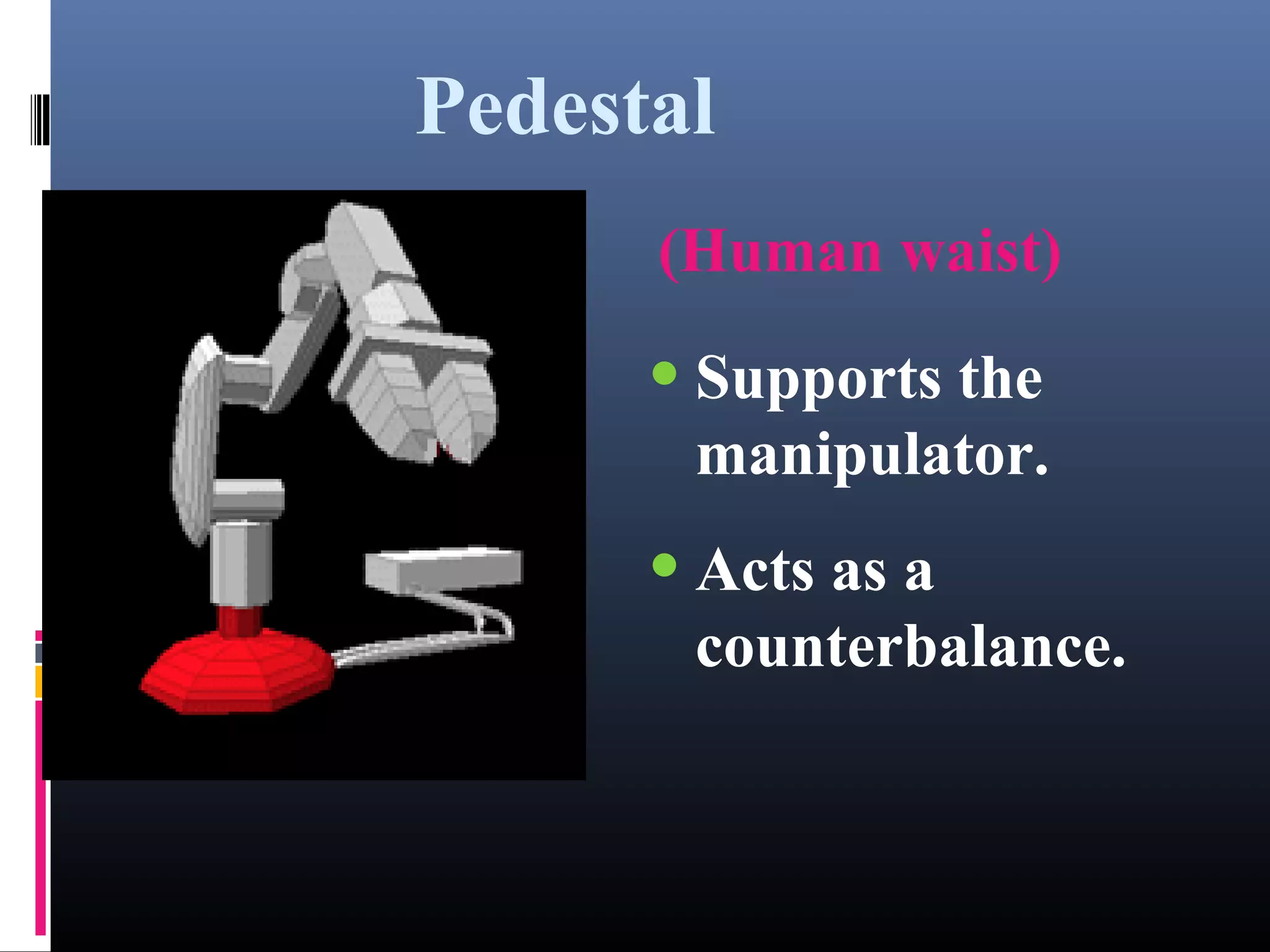
Pedestal
(Human waist)
•Supports the
manipulator.
•Acts as a
counterbalance.
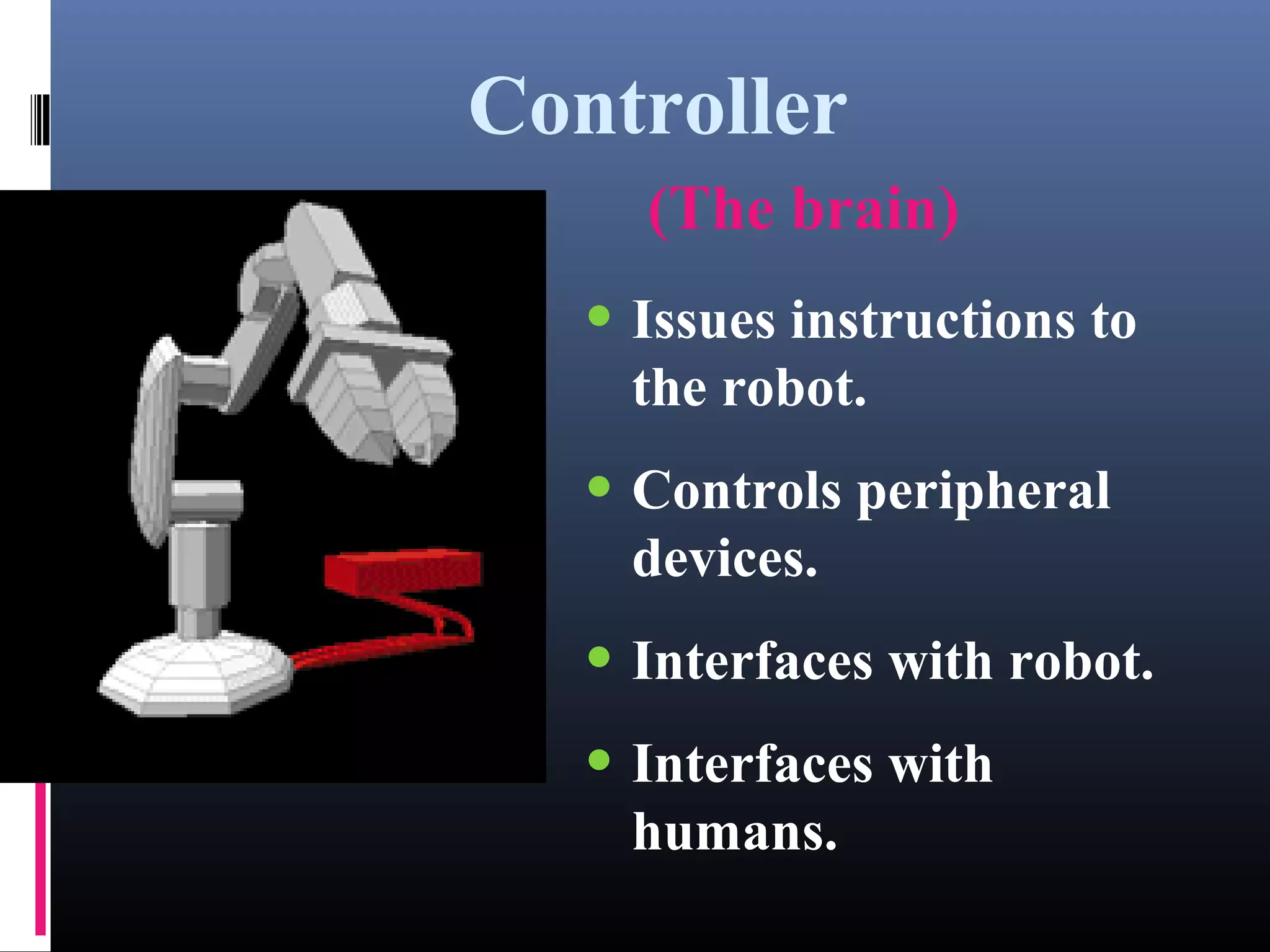
Controller
(The brain)
• Issues instructions to
the robot.
• Controls peripheral
devices.
• Interfaces with robot.
• Interfaces with
humans.
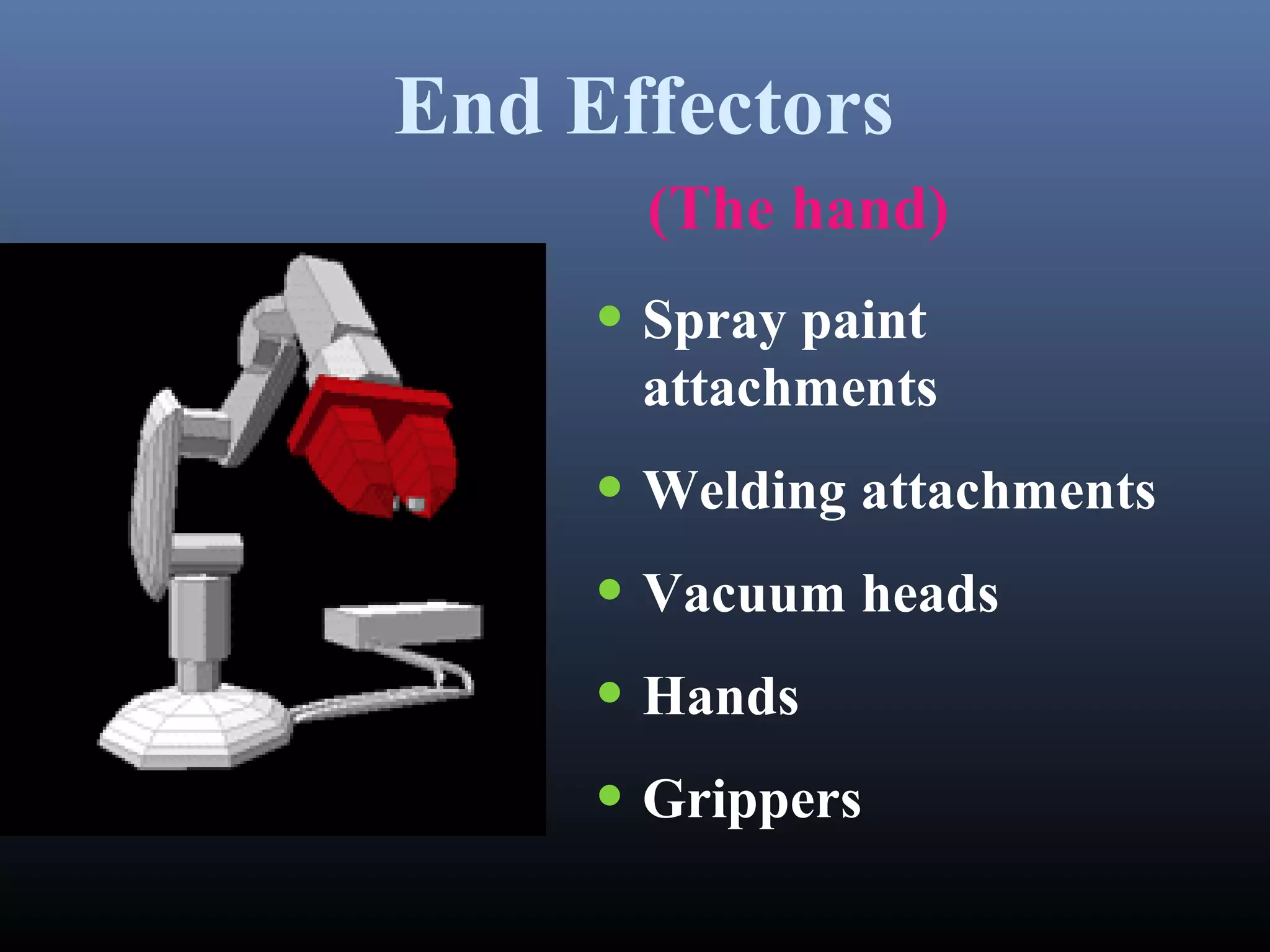
End Effectors
(The hand)
• Spray paint
attachments
• Welding attachments
• Vacuum heads
• Hands
• Grippers
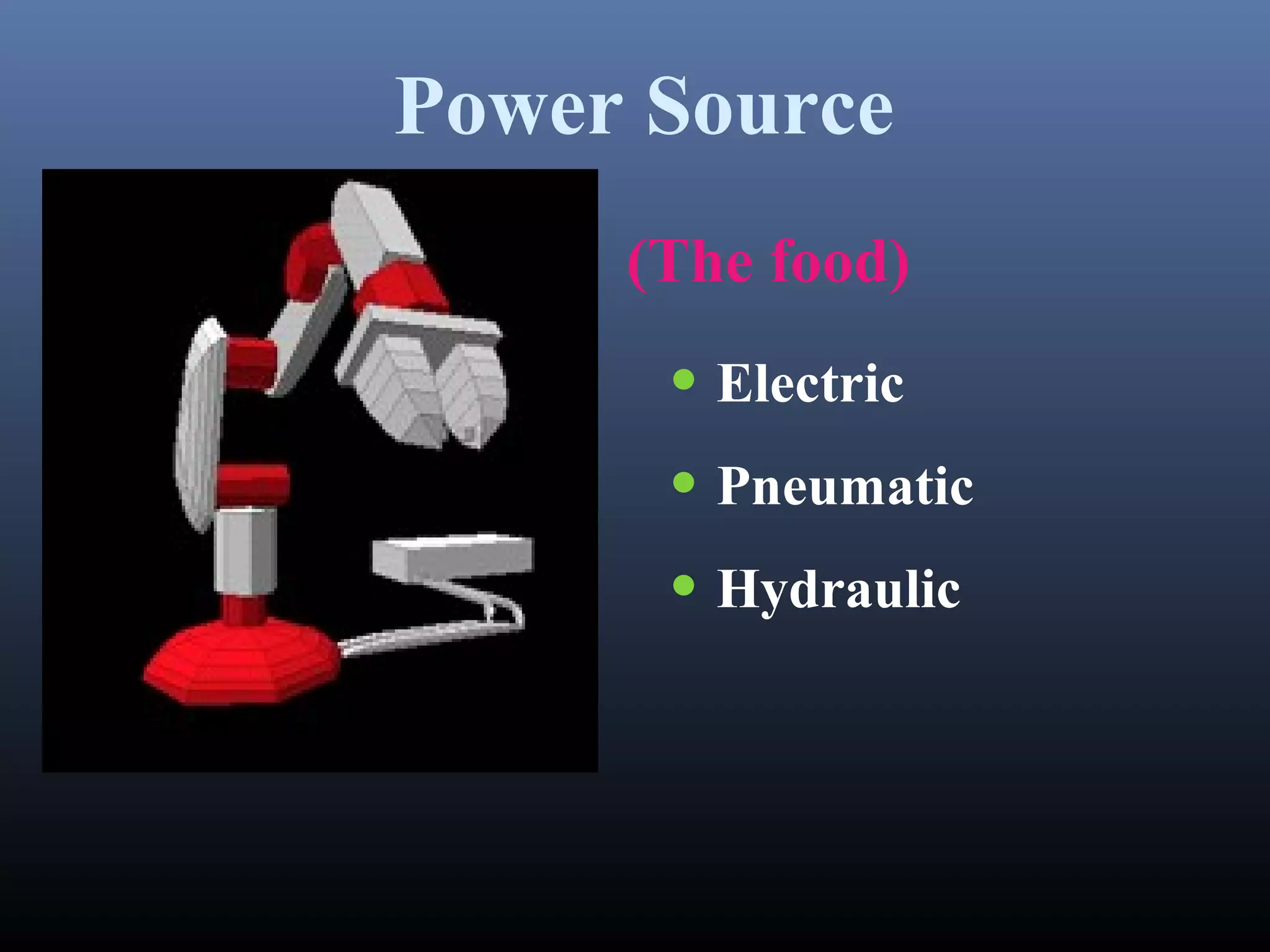
Power Source
(The food)
• Electric
• Pneumatic
• Hydraulic
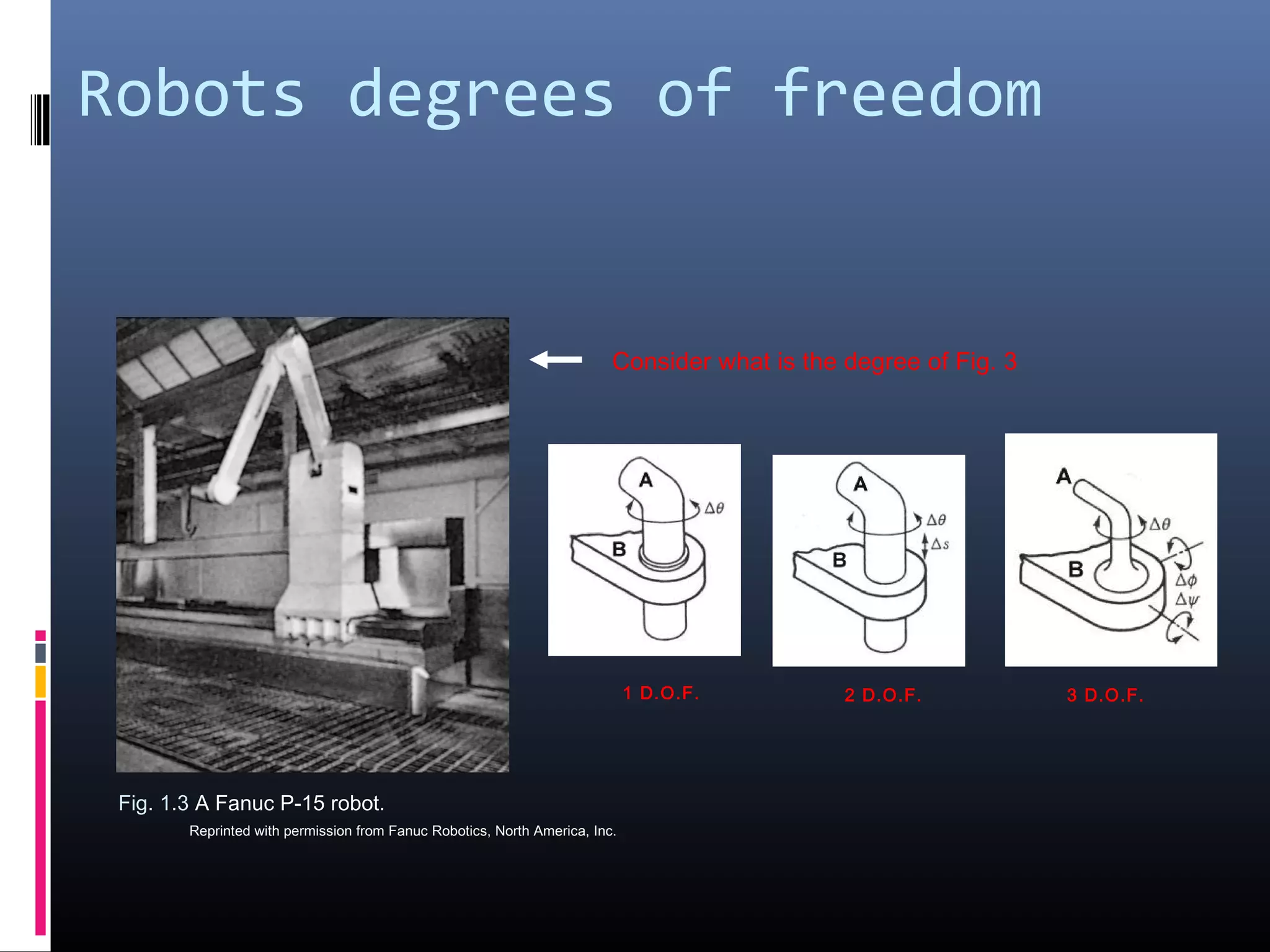
Robots degrees of freedomRobots degrees of freedom
 Degrees of Freedom: Number ofDegrees of Freedom: Number of
independent position variables whichindependent position variables which
would has to be specified to locate allwould has to be specified to locate all
parts of a mechanism.parts of a mechanism.
 In most manipulators this is usually theIn most manipulators this is usually the
number of joints.number of joints.
Fig. 1.3 A Fanuc P-15 robot.
Reprinted with permission from Fanuc Robotics, North America, Inc.
Consider what is the degree of Fig. 3
1 D.O.F. 2 D.O.F. 3 D.O.F.
Robots degrees of freedom
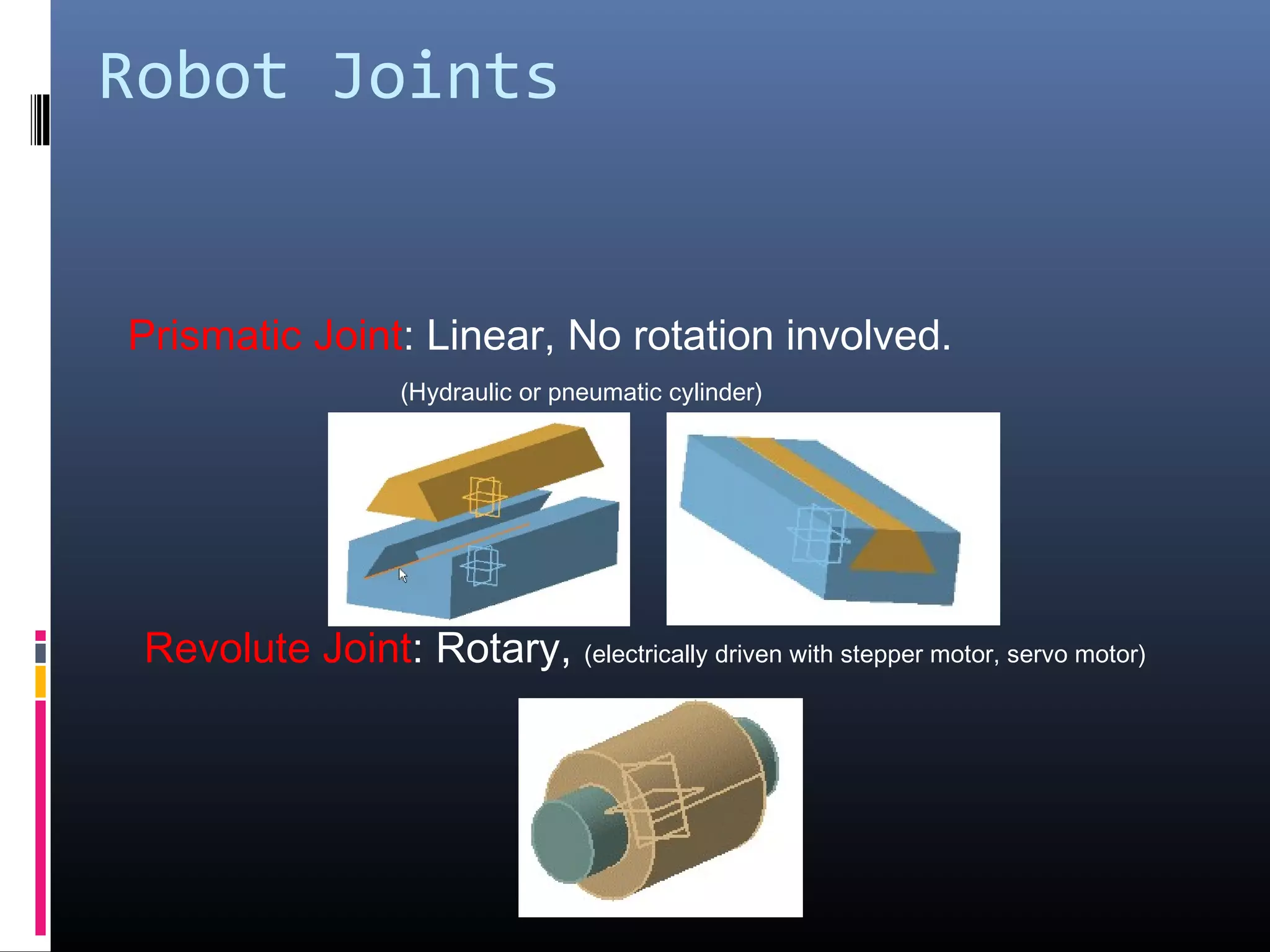
Robot Joints
Prismatic Joint: Linear, No rotation involved.
(Hydraulic or pneumatic cylinder)
Revolute Joint: Rotary, (electrically driven with stepper motor, servo motor)
Robot
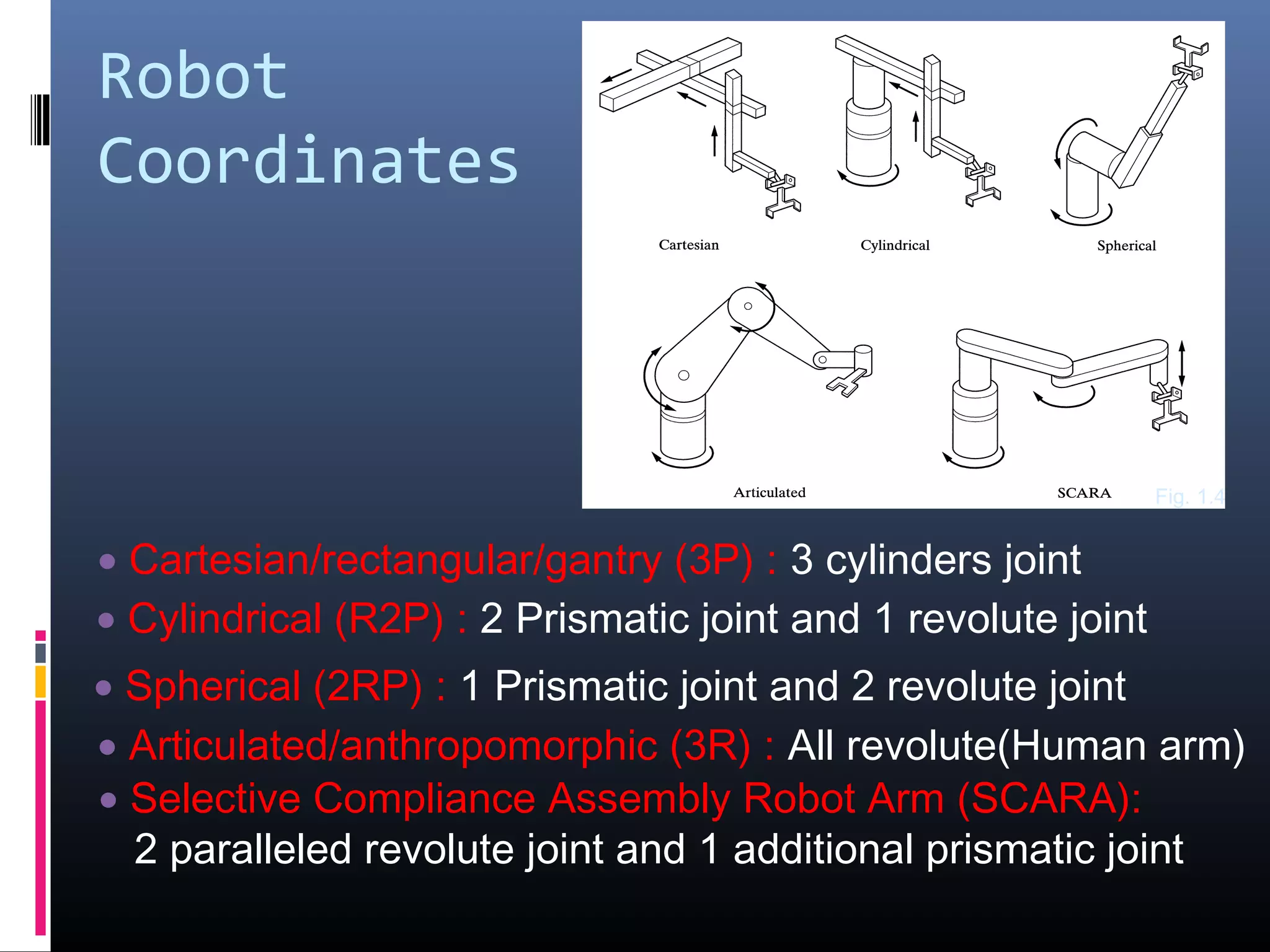
Coordinates
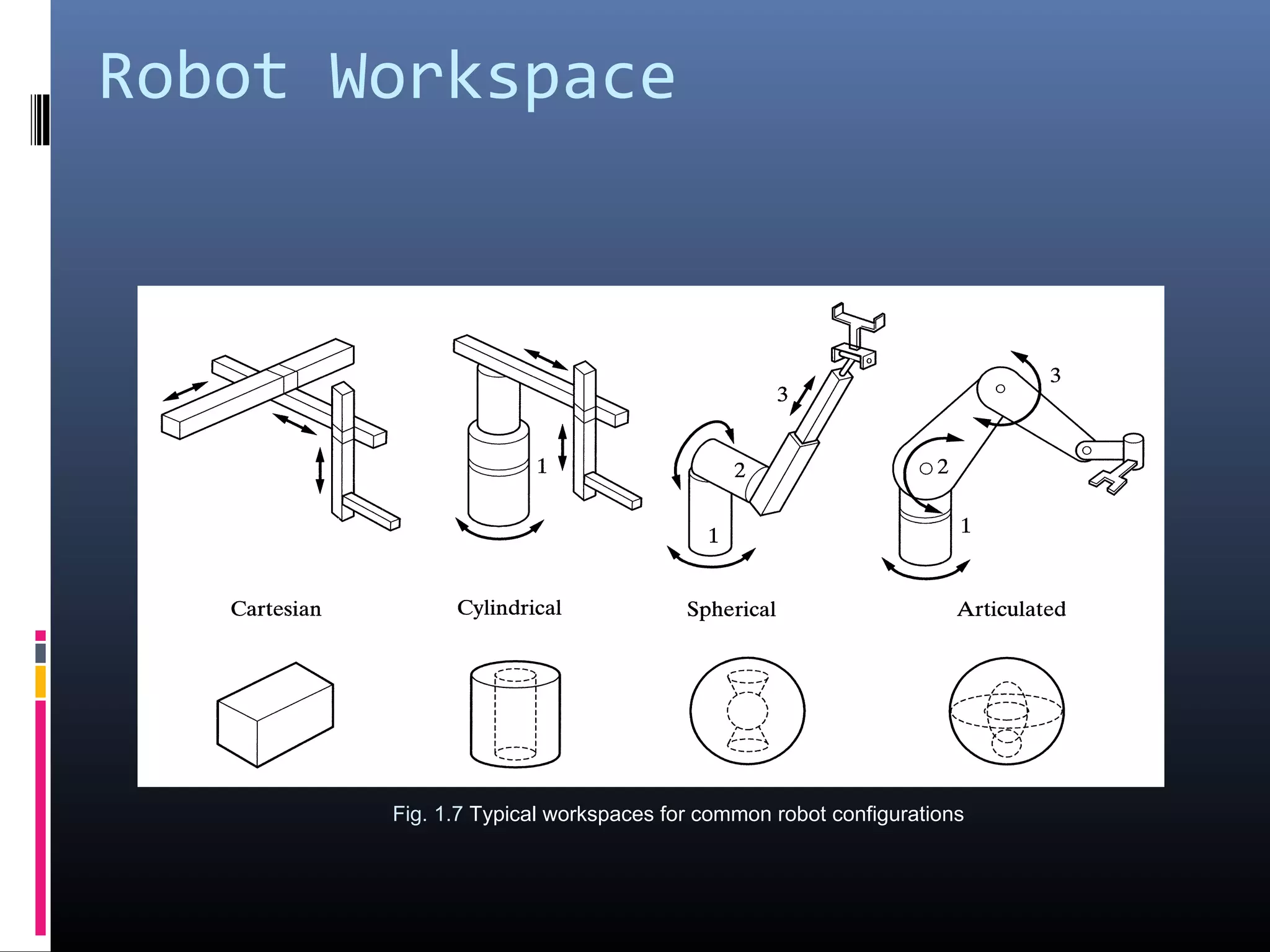
• Cartesian/rectangular/gantry (3P) : 3 cylinders joint
• Cylindrical (R2P) : 2 Prismatic joint and 1 revolute joint
Fig. 1.4
• Spherical (2RP) : 1 Prismatic joint and 2 revolute joint
• Articulated/anthropomorphic (3R) : All revolute(Human arm)
• Selective Compliance Assembly Robot Arm (SCARA):
2 paralleled revolute joint and 1 additional prismatic joint
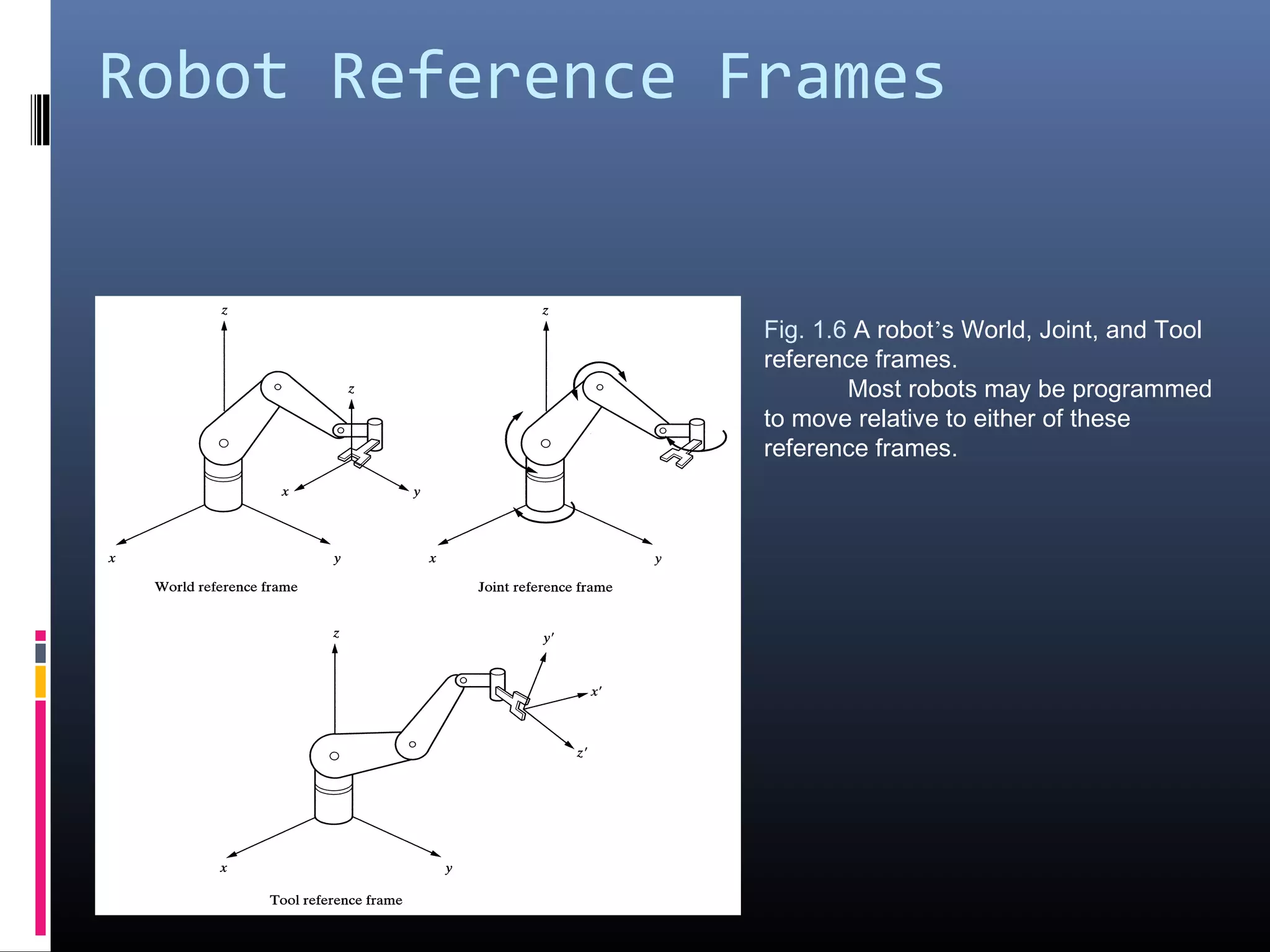
Robot Reference Frames
Fig. 1.6 A robot’s World, Joint, and Tool
reference frames.
Most robots may be programmed
to move relative to either of these
reference frames.
Chapter 1
Fundamentals
♦ Programming Modes
♦ Robot Characteristics
Physical Setup: PLC
Lead Through/ Teach Mode: Teaching Pendant/ Playback, p-to-p
Continuous Walk-Through Mode: Simultaneous joint-movement
Software Mode: Use of feedback information
Payload: Fanuc Robotics LR Mate™ (6.6/ 86 lbs), M- 16i ™(35/ 594 lbs)
Reach: The maximum distance a robot can reach within its work envelope.
Precision (validity): defined as how accurately a specified point
can be reached… 0.001 inch or better.
Repeatability (variability): how accurately the same position can be
reached if the motion is repeated many times.
Robot Workspace
Fig. 1.7 Typical workspaces for common robot configurations
Chapter 1
Fundamentals
♦ Robot Languages
Microcomputer Machine Language Level: the most basic and
very efficient but difficult to understand to follow.
Point-to-Point Level: Funky®
Cincinnati Milacron’s T3©
It lacks branching, sensory information.
Primitive Motion Level: VAL by Unimation™
Interpreter based language.
Structured Programming Level: This is a compiler based
but more difficult to learn.
Task-Oriented Level: Not exist yet and proposed IBM in the 1980s.
Chapter 1
Fundamentals
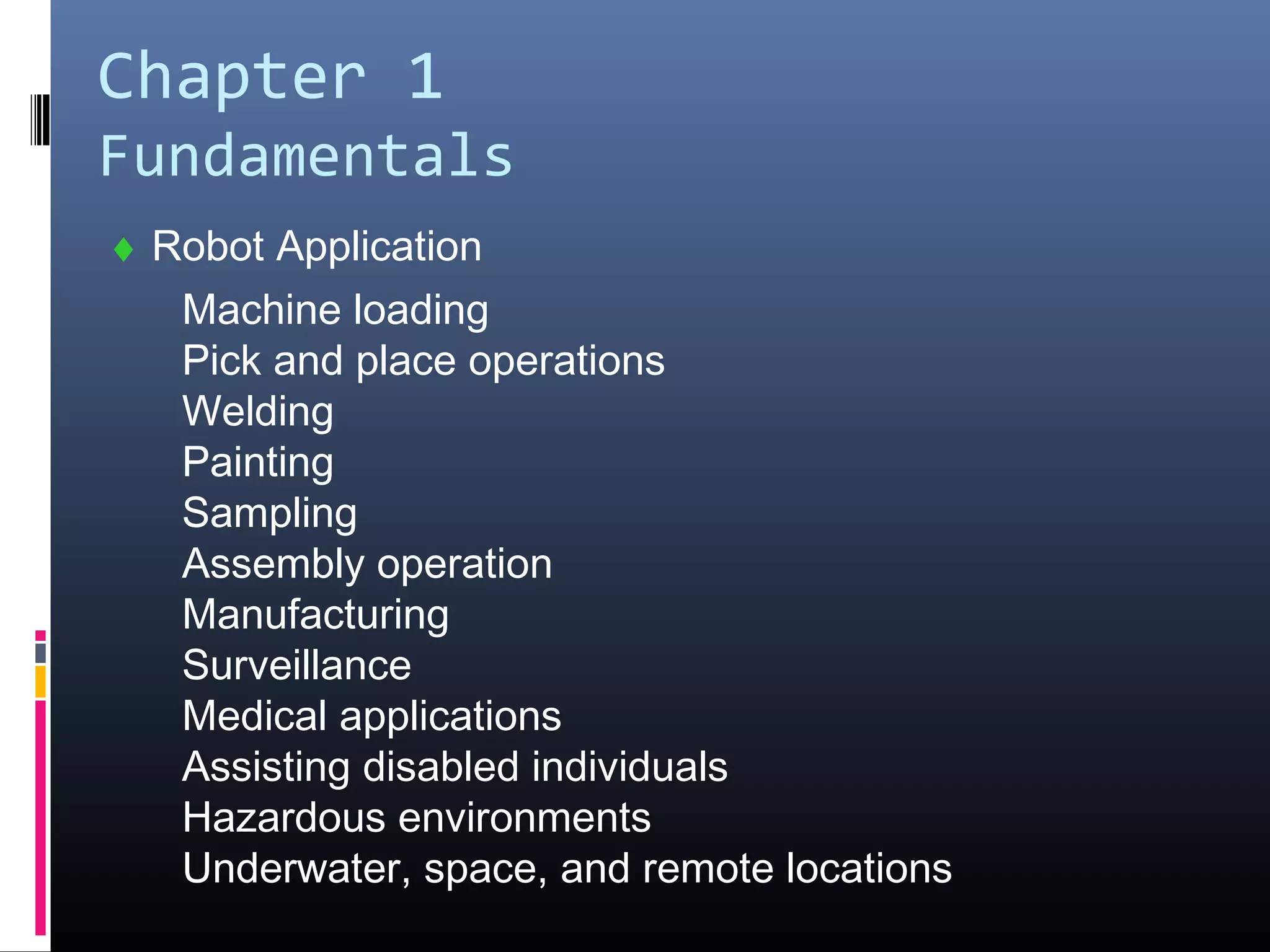
♦ Robot Application
Machine loading
Pick and place operations
Welding
Painting
Sampling
Assembly operation
Manufacturing
Surveillance
Medical applications
Assisting disabled individuals
Hazardous environments
Underwater, space, and remote locations
Chapter 1
Fundamentals
♦ Robot Application
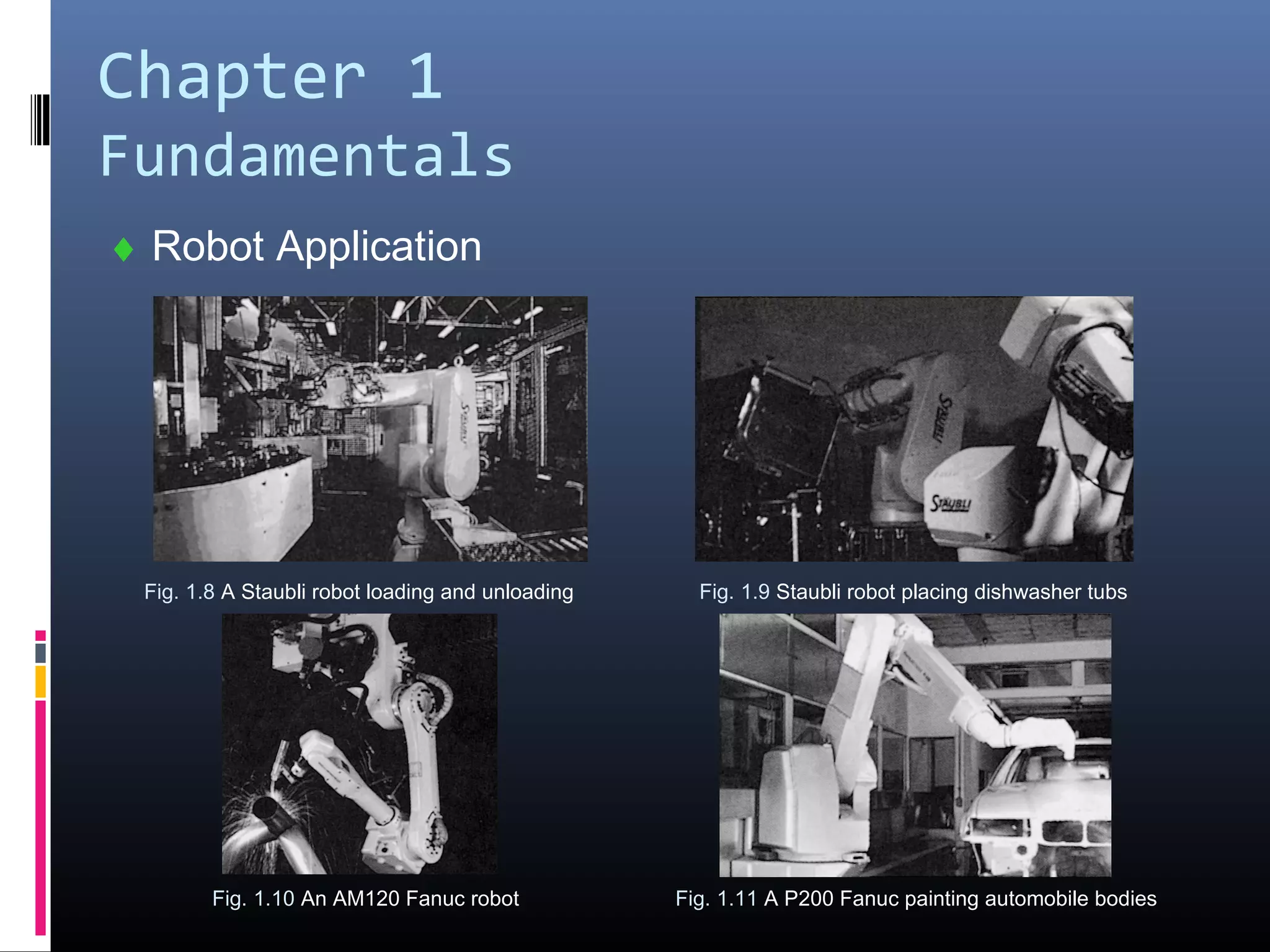
Fig. 1.8 A Staubli robot loading and unloading Fig. 1.9 Staubli robot placing dishwasher tubs
Fig. 1.10 An AM120 Fanuc robot Fig. 1.11 A P200 Fanuc painting automobile bodies
Chapter 1
Fundamentals
♦ Robot Application
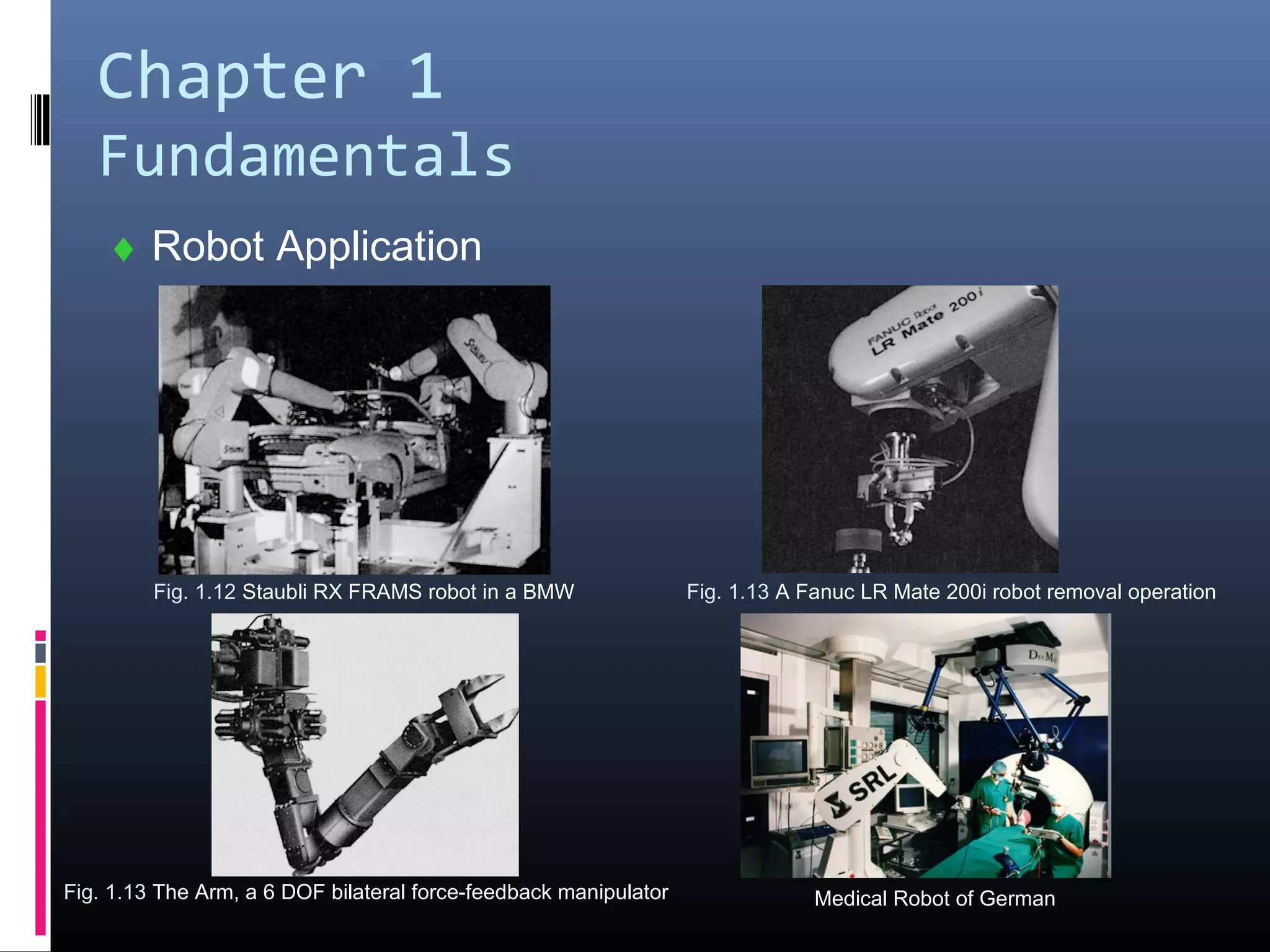
Fig. 1.12 Staubli RX FRAMS robot in a BMW Fig. 1.13 A Fanuc LR Mate 200i robot removal operation
Fig. 1.13 The Arm, a 6 DOF bilateral force-feedback manipulator Medical Robot of German

Introduction

  • 1.
    Introduction to Robotics Analysis,systems, Applications Saeed B. Niku
  • 2.
    Chapter 1 Fundamentals 1. Introduction Fig.1.1 (a) A Kuhnezug truck-mounted crane Reprinted with permission from Kuhnezug Fordertechnik GmbH. Fig. 1.1 (b) Fanuc S-500 robots performing seam-sealing on a truck. Reprinted with permission from Fanuc Robotics, North America, Inc.
  • 3.
    What is aRobot ?  Random House DictionaryRandom House Dictionary A machine that resembles a human being and does mechanical routine tasks on command.  Robotics Association of AmericaRobotics Association of America An industrial robot is a re-programmable, multifunctional manipulator designed to move materials, parts, tools, or specialized devices through variable programmed motions for the performance of a variety of tasks.
  • 4.
    What is aRobot ?  A manipulator (or an industrial robot) is composed of a series of links connected to each other via joints. Each joint usually has an actuator (a motor for eg.) connected to it.  These actuators are used to cause relative motion between successive links. One end of the manipulator is usually connected to a stable base and the other end is used to deploy a tool.
  • 5.
    Classification of Robots -JIRA (Japanese Industrial Robot Association) Class1: Manual-Handling Device Class2: Fixed Sequence Robot Class3: Variable Sequence Robot Class4: Playback Robot Class5: Numerical Control Robot Class6: Intelligent Robot
  • 6.
    Classification of Robots -RIA (Robotics Institute of America) Variable Sequence Robot(Class3) Playback Robot(Class4) Numerical Control Robot(Class5) Intelligent Robot(Class6)
  • 7.
    Classification of Robots -AFR (Association FranÇaise de Robotique) Type A: Manual Handling Devices/ telerobotics Type B: Automatic Handling Devices/ predetermined cycles Type C: Programmable, Servo controlled robot, continuous point-to-point trajectories Type D: Same type with C, but it can acquire information.
  • 8.
    Chapter 1 Fundamentals ♦ Robotin the world Painting Robot in Motor Company Assembly Robot in Electronic Company
  • 9.
    Chapter 1 Fundamentals ♦ Robotin the world Wearable Robotic Arm and Tele-Operated Robot (KIST)
  • 10.
    Chapter 1 Fundamentals ♦ Robotin the world HONDA (ASIMO) – Biped Robot Fujitsu – Biped Robot (Laptop Size)
  • 11.
    Chapter 1 Fundamentals ♦ Robotin the world Sony (AIBO) – Toy robot
  • 12.
    What is Robotics? Robotics is the art, knowledge base, and the know-how of designing, applying, and using robots in human endeavors.  Robotics is an interdisciplinary subject that benefits from mechanical engineering, electrical and electronic engineering, computer science, biology, and many other disciplines.
  • 13.
    What is Robotics ♦History of Robotics 1922: Karel Čapek’s novel, Rossum’s Universal Robots, word “Robota” (worker) 1952: NC machine (MIT) 1955: Denavit-Hartenberg Homogeneous Transformation 1967: Mark II (Unimation Inc.) 1968: Shakey (SRI) - intelligent robot 1973: T3 (Cincinnati Milacron Inc.) 1978: PUMA (Unimation Inc.) 1983: Robotics Courses 21C: Walking Robots, Mobile Robots, Humanoid Robots
  • 14.
    Advantages VS. Disadvantages ofRobots ♦ Robots increase productivity, safety, efficiency, quality, and consistency of products. ♦ Robots can work in hazardous environments without the need. ♦ Robots need no environmental comfort. ♦ Robots work continuously without experiencing fatigue of problem. ♦ Robots have repeatable precision at all times. ♦ Robots can be much more accurate than human. ♦ Robots replace human workers creating economic problems. ♦ Robots can process multiple stimuli or tasks simultaneously. ♦ Robots lack capability to respond in emergencies. ♦ Robots, although superior in certain senses, have limited capabilities in Degree of freedom, Dexterity, Sensors, Vision system, real time response. ♦ Robots are costly, due to Initial cost of equipment, Installation costs, Need for Peripherals, Need for training, Need for programming.
  • 15.
    What are theparts of a robot? •Manipulator •Pedestal •Controller •End Effectors •Power Source
  • 16.
  • 17.
  • 18.
    Controller (The brain) • Issuesinstructions to the robot. • Controls peripheral devices. • Interfaces with robot. • Interfaces with humans.
  • 19.
    End Effectors (The hand) •Spray paint attachments • Welding attachments • Vacuum heads • Hands • Grippers
  • 20.
    Power Source (The food) •Electric • Pneumatic • Hydraulic
  • 21.
    Robots degrees offreedomRobots degrees of freedom  Degrees of Freedom: Number ofDegrees of Freedom: Number of independent position variables whichindependent position variables which would has to be specified to locate allwould has to be specified to locate all parts of a mechanism.parts of a mechanism.  In most manipulators this is usually theIn most manipulators this is usually the number of joints.number of joints.
  • 22.
    Fig. 1.3 AFanuc P-15 robot. Reprinted with permission from Fanuc Robotics, North America, Inc. Consider what is the degree of Fig. 3 1 D.O.F. 2 D.O.F. 3 D.O.F. Robots degrees of freedom
  • 23.
    Robot Joints Prismatic Joint:Linear, No rotation involved. (Hydraulic or pneumatic cylinder) Revolute Joint: Rotary, (electrically driven with stepper motor, servo motor)
  • 24.
    Robot Coordinates • Cartesian/rectangular/gantry (3P): 3 cylinders joint • Cylindrical (R2P) : 2 Prismatic joint and 1 revolute joint Fig. 1.4 • Spherical (2RP) : 1 Prismatic joint and 2 revolute joint • Articulated/anthropomorphic (3R) : All revolute(Human arm) • Selective Compliance Assembly Robot Arm (SCARA): 2 paralleled revolute joint and 1 additional prismatic joint
  • 25.
    Robot Reference Frames Fig.1.6 A robot’s World, Joint, and Tool reference frames. Most robots may be programmed to move relative to either of these reference frames.
  • 26.
    Chapter 1 Fundamentals ♦ ProgrammingModes ♦ Robot Characteristics Physical Setup: PLC Lead Through/ Teach Mode: Teaching Pendant/ Playback, p-to-p Continuous Walk-Through Mode: Simultaneous joint-movement Software Mode: Use of feedback information Payload: Fanuc Robotics LR Mate™ (6.6/ 86 lbs), M- 16i ™(35/ 594 lbs) Reach: The maximum distance a robot can reach within its work envelope. Precision (validity): defined as how accurately a specified point can be reached… 0.001 inch or better. Repeatability (variability): how accurately the same position can be reached if the motion is repeated many times.
  • 27.
    Robot Workspace Fig. 1.7Typical workspaces for common robot configurations
  • 28.
    Chapter 1 Fundamentals ♦ RobotLanguages Microcomputer Machine Language Level: the most basic and very efficient but difficult to understand to follow. Point-to-Point Level: Funky® Cincinnati Milacron’s T3© It lacks branching, sensory information. Primitive Motion Level: VAL by Unimation™ Interpreter based language. Structured Programming Level: This is a compiler based but more difficult to learn. Task-Oriented Level: Not exist yet and proposed IBM in the 1980s.
  • 29.
    Chapter 1 Fundamentals ♦ RobotApplication Machine loading Pick and place operations Welding Painting Sampling Assembly operation Manufacturing Surveillance Medical applications Assisting disabled individuals Hazardous environments Underwater, space, and remote locations
  • 30.
    Chapter 1 Fundamentals ♦ RobotApplication Fig. 1.8 A Staubli robot loading and unloading Fig. 1.9 Staubli robot placing dishwasher tubs Fig. 1.10 An AM120 Fanuc robot Fig. 1.11 A P200 Fanuc painting automobile bodies
  • 31.
    Chapter 1 Fundamentals ♦ RobotApplication Fig. 1.12 Staubli RX FRAMS robot in a BMW Fig. 1.13 A Fanuc LR Mate 200i robot removal operation Fig. 1.13 The Arm, a 6 DOF bilateral force-feedback manipulator Medical Robot of German