WHERE TO FROM HERE
– OIL AND GAS IN WA
Francis Norman
2015 WA Division President
Overview
•  Recent history of projects in WA
•  Workforce changes and challenges
•  Future opportunities and challenges
•  EA FLNG report
•  Questions…
Disclaimers
•  Much of the following is drawn from my own views
and beliefs, much of what I will discuss derives from
individual discussions, media commentary and
publically available research material.
•  As with many things, it is best to form your own
opinion…
WA PROJECT HISTORY
Recent history
•  By late 2017 if everything goes to plan we will
have increased the WA LNG export capacity from
20mtpa to 50mtpa through the construction of
Pluto, Wheatstone, Gorgon and Prelude.
•  At the same time, additional capacity has been
added in NT and Qld
•  We should be the largest LNG export nation in the
world
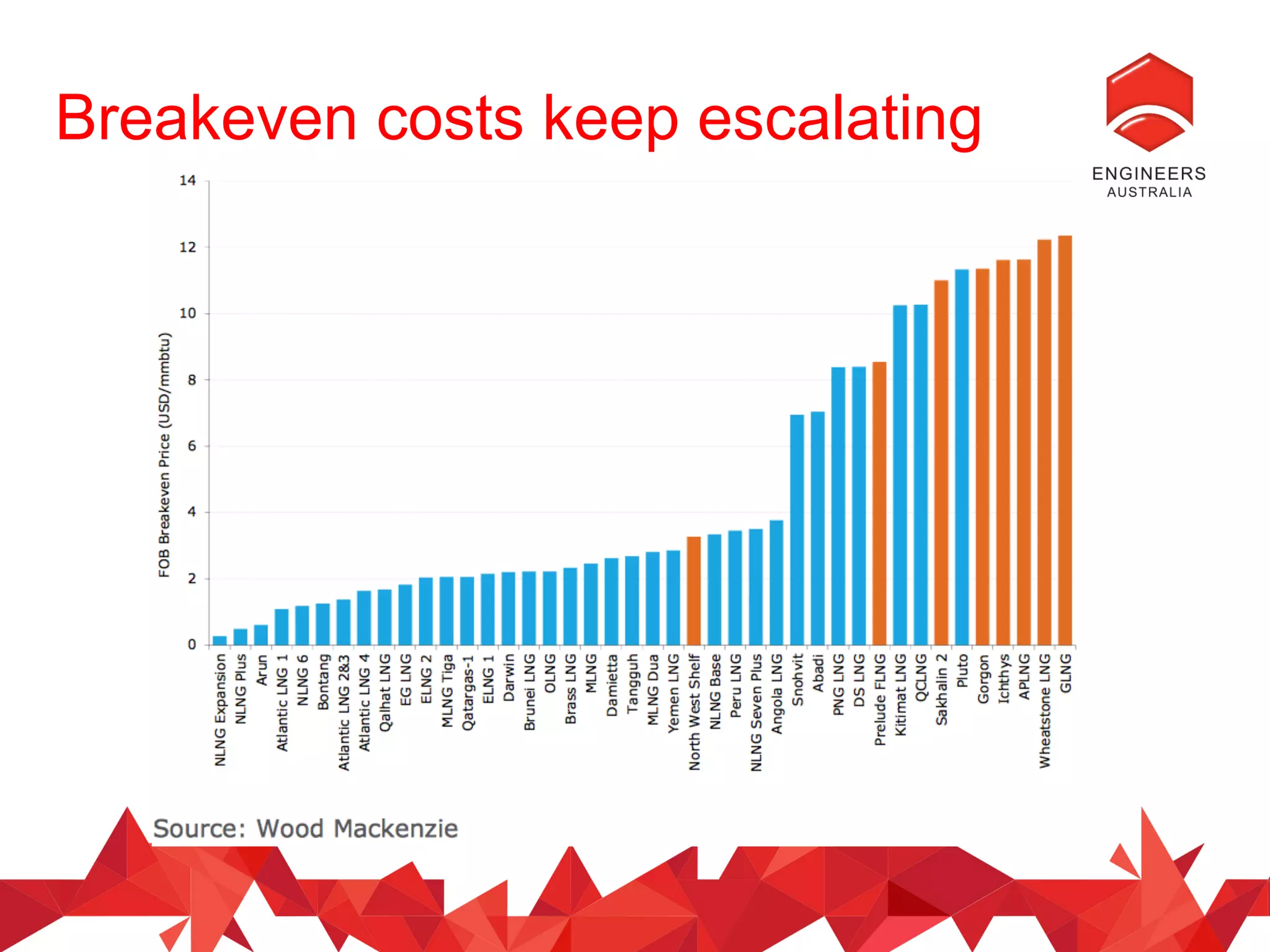
•  How well did we do?
Breakeven costs keep escalating
Project costs
Project timeline
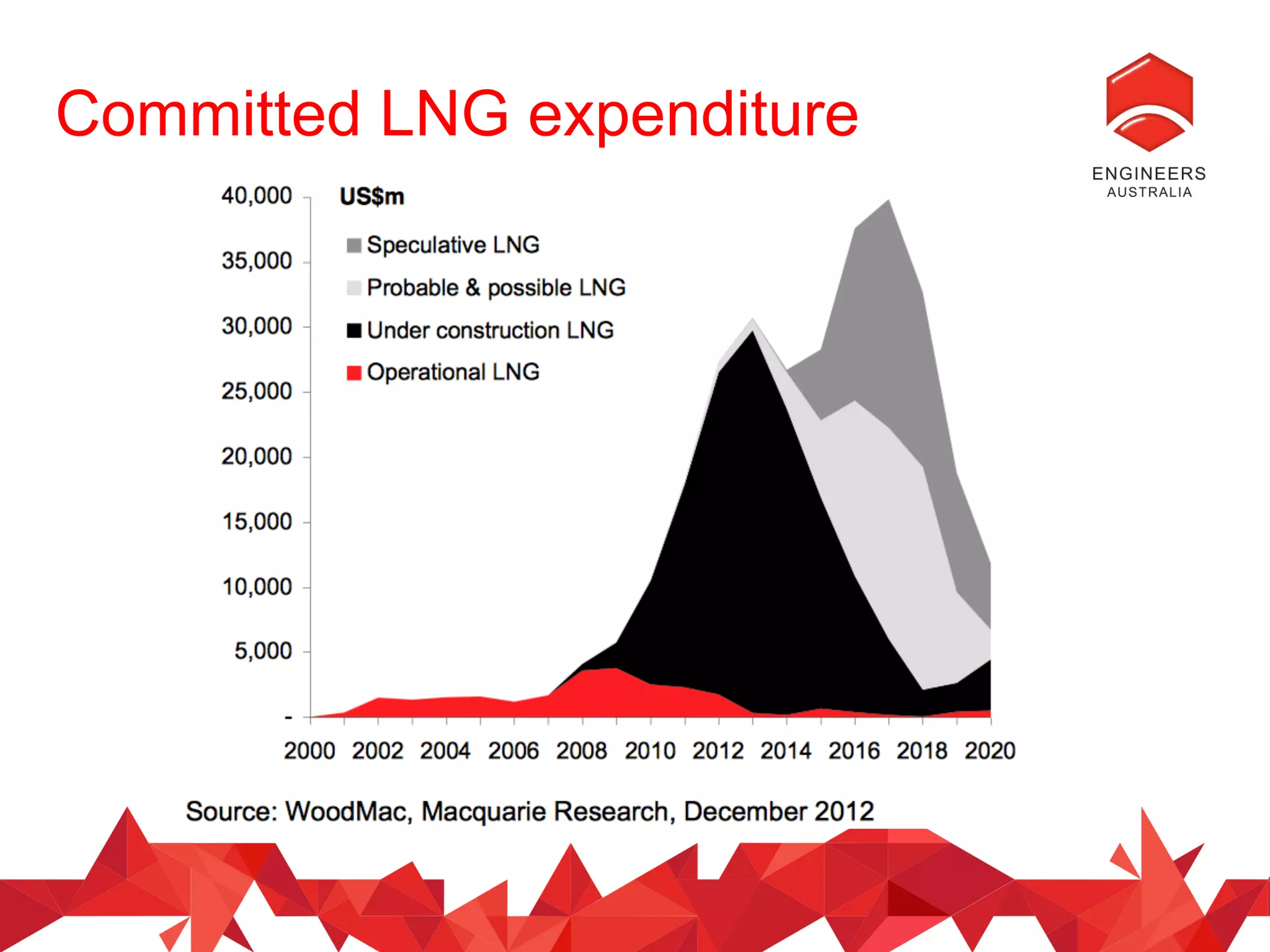
Committed LNG expenditure
Cost increases reducing
competiveness
Growth in costs
So, what is our reputation
•  Are we seen as a high skill, experienced, reliable,
stable workforce who delivers on time and has
realistic demands
Or
•  Are we seen as a moderate skill, demanding,
unpredictably mobile workforce who’s projects are
always late and over budget?
WORKFORCE CHANGES AND
CHALLENGES
Demographic challenges
FUTURE OPPORTUNITIES
Changing profile of opportunities
•  WA has, for the majority of the past decade and for
the majority of engineers been the province of
greenfield developments, characterised by massive
local and international spend.
•  Much of this is now over, and may not repeat for
several years as the current new assets come on
stream and are optimised.
•  Our next few years are likely to be characterised by
small brownfield developments and expansions.
•  Are we ready?
Potential upcoming projects
Major new projects
•  Hess Equus - Semi
•  Browse – 3? x FLNG
•  Scarborough - FLNG
Expansion projects
•  Backfill to DLNG
•  Ichthys Phase II
•  Gorgon Phase II
The Australian Oil & Gas Market – Key projects and prospects
Ichthys	
  
	
  Wheatstone	
  
Gorgon	
  
	
  Prelude	
  
Legend	
  
Pre	
  execu5on	
  
In	
  Execu5on	
  
Phase	
  
	
  Equus	
   Laverda	
  
Crown	
   Crux	
  
Poseidon	


  Gorgon	
  Expansion	
  
Palta	
  
Wheatstone	
  
Expansion	


  Zola	
  &	
  Olympus	
  
	
  Scarborough	
  
	
  Pluto	
  expansion	
  
Sunrise	
   Heron	
   Evans	
  Shoal	
  
Caldita	
  Barossa	
  
Browse	
  
Cooper	
  Basin	
  
Region	
  
Bass	
  Strait	
  
Canning	
  Basin	
  
Surat	
  &	
  Bowen	
  
Basins	
  
Bonaparte	
  
Cash	
  Maple	
  
Canning Basin
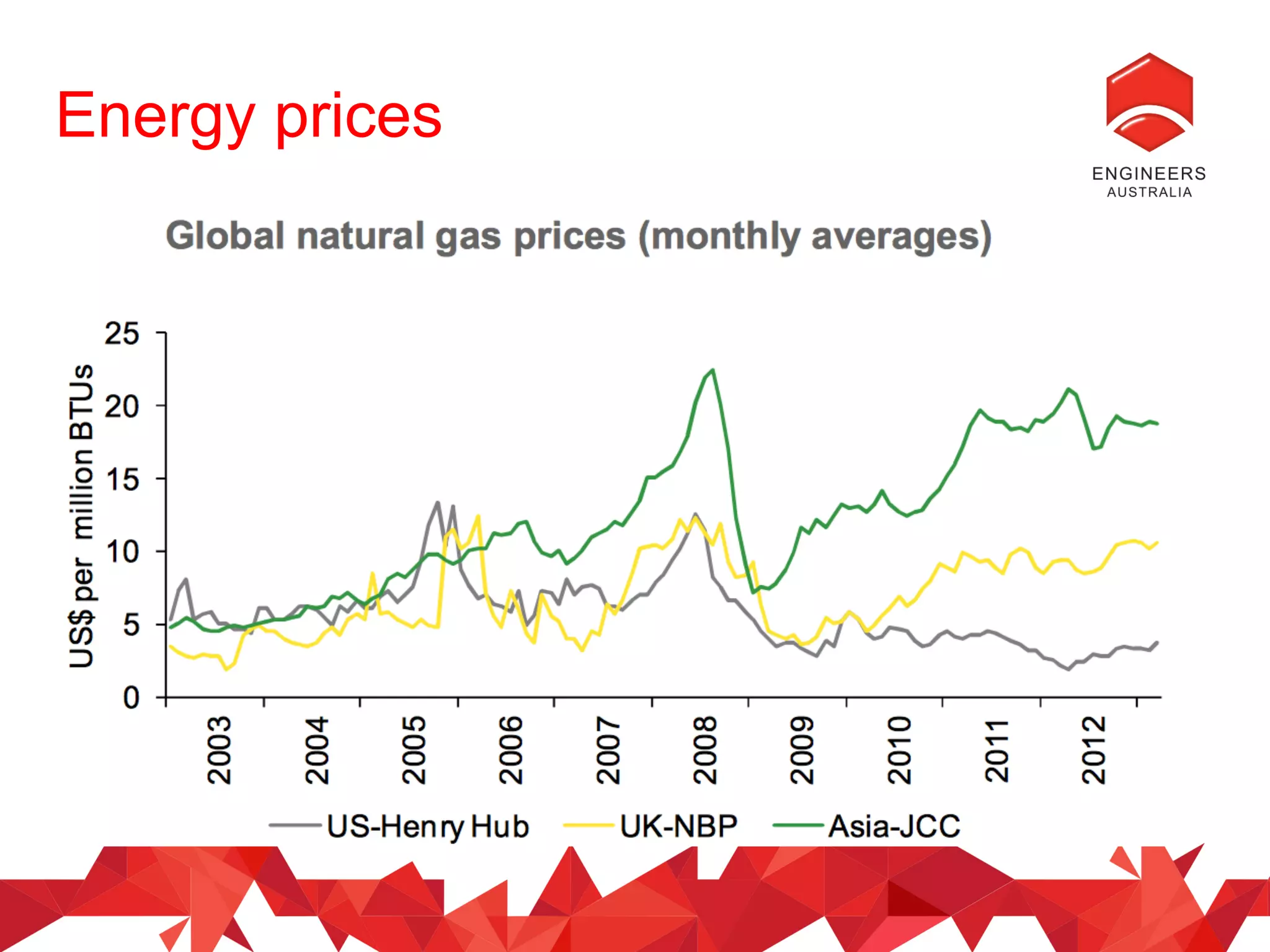
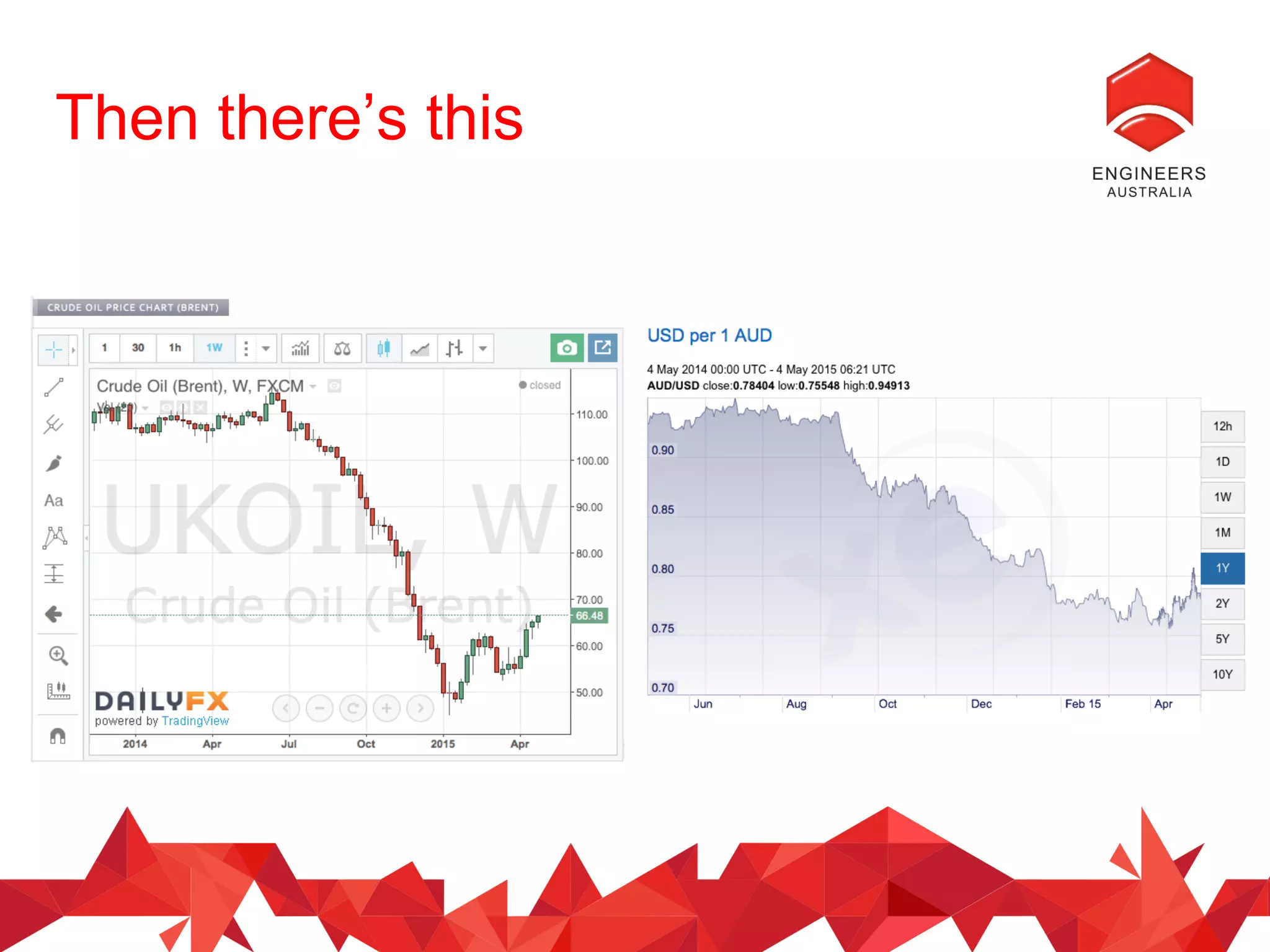
Energy prices
Then there’s this
Global LNG demand projection
Potential future trends
•  Subsea processing
•  Operations and maintenance
•  Subsea – Design and fabrication
•  Remote operations
•  Big data
FLNG FUTURE REPORT
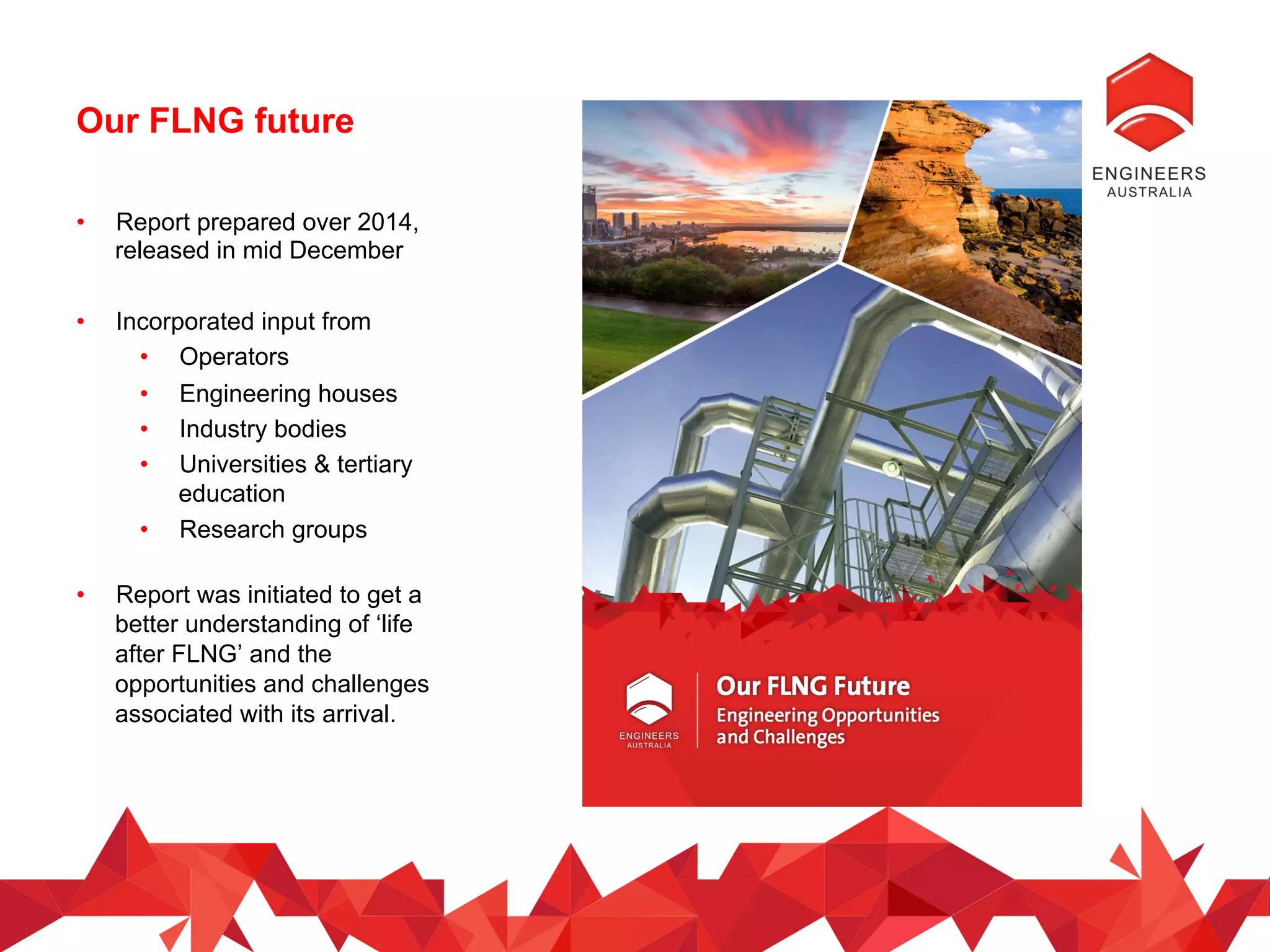
Our FLNG future
•  Report prepared over 2014,
released in mid December
•  Incorporated input from
•  Operators
•  Engineering houses
•  Industry bodies
•  Universities & tertiary
education
•  Research groups
•  Report was initiated to get a
better understanding of ‘life
after FLNG’ and the
opportunities and challenges
associated with its arrival.
Key findings
•  The engineering workforce in Western Australia has a
large number of skills directly relevant to support the
installation, commissioning, operations, maintenance,
ongoing development and eventual decommissioning of
FLNG facilities. These skills are spread across industry
and academia.
•  There is a strong desire among all parties for the local
engineering workforce to be as heavily engaged in
FLNG as possible.
Key findings
•  There is a real appetite for close and meaningful
collaboration among all parties: for operators to work together
across project boundaries to rationalise and optimise the
sharing of information; for engineering companies to
collaborate in supporting the operations of the facilities; and
for academia to collaborate on impactful research.
•  With Western Australia being the first location for the
deployment at scale of FLNG, the state has the opportunity to
establish itself as a centre of knowledge and excellence in
the operations and maintenance of the technology. If properly
managed, these skills could then be marketed to
organisations deploying FLNG into other regions of the world.
Recommendations
•  That all operators of FLNG in Australian waters,
regardless of the state or territory in which they may be
based (WA and NT), collaborate as openly as possible in
the sharing of knowledge, facilities and experience.
•  That the industry as a whole works to identify deficiencies
and opportunities in the current skills pool and to find
ways to fill those gaps through development of local
personnel, through focused education and where
necessary through targeted importation of skills.
Recommendations
•  That a regular (annual) researcher and industry
conference be held to allow academia to showcase
research to industry and industry to advise researchers of
their current needs. That the conference be mindful of
competition such as from Singapore, Norway and
Scotland but be open to organisations wishing to attend.
•  That Industry, in the form of both operators and
engineering companies contribute both financially and in
kind (for example through the provision of time for
personnel) to support the coordination efforts of Engineers
Australia.
Recommendations
•  That the Federal and WA State governments provide
grants, tax incentives and marketing support to stimulate
the involvement and growth of the Western Australian
engineering sector in FLNG.
•  That methods are found to include all Western Australian
universities in the research work being undertaken around
FLNG. This could be by specific activities that leverage
the skills of each university or by groups such as WA:ERA
(or the new Floating Systems Centre) expanding to
potentially include CDU, Murdoch and ECU.
Sources
•  Macquarie private wealth – Australian LNG, strangling the golden goose, Dec 2012,
http://www.macquarie.com.au/dafiles/Internet/mgl/au/apps/retail-newsletter/docs/
2012_12/AustralianLNGOutlook071212e.pdf
•  Ernst & Young, Global LNG trends, May 2013,
http://www.ey.com/Publication/vwLUAssets/Baku-event-LNG/$FILE/Baku-event-LNG.pdf
•  Hays Recruitment, Oil & Gas Global Salary Survey 2015
QUESTIONS

Where to From Here - Oil and Gas in WA

  • 1.
    WHERE TO FROMHERE – OIL AND GAS IN WA Francis Norman 2015 WA Division President
  • 2.
    Overview •  Recent historyof projects in WA •  Workforce changes and challenges •  Future opportunities and challenges •  EA FLNG report •  Questions…
  • 3.
    Disclaimers •  Much ofthe following is drawn from my own views and beliefs, much of what I will discuss derives from individual discussions, media commentary and publically available research material. •  As with many things, it is best to form your own opinion…
  • 4.
  • 5.
    Recent history •  Bylate 2017 if everything goes to plan we will have increased the WA LNG export capacity from 20mtpa to 50mtpa through the construction of Pluto, Wheatstone, Gorgon and Prelude. •  At the same time, additional capacity has been added in NT and Qld •  We should be the largest LNG export nation in the world •  How well did we do?
  • 7.
  • 8.
  • 9.
  • 10.
  • 11.
  • 12.
  • 14.
    So, what isour reputation •  Are we seen as a high skill, experienced, reliable, stable workforce who delivers on time and has realistic demands Or •  Are we seen as a moderate skill, demanding, unpredictably mobile workforce who’s projects are always late and over budget?
  • 15.
  • 16.
  • 17.
  • 18.
    Changing profile ofopportunities •  WA has, for the majority of the past decade and for the majority of engineers been the province of greenfield developments, characterised by massive local and international spend. •  Much of this is now over, and may not repeat for several years as the current new assets come on stream and are optimised. •  Our next few years are likely to be characterised by small brownfield developments and expansions. •  Are we ready?
  • 19.
    Potential upcoming projects Majornew projects •  Hess Equus - Semi •  Browse – 3? x FLNG •  Scarborough - FLNG Expansion projects •  Backfill to DLNG •  Ichthys Phase II •  Gorgon Phase II
  • 20.
    The Australian Oil& Gas Market – Key projects and prospects Ichthys    Wheatstone   Gorgon    Prelude   Legend   Pre  execu5on   In  Execu5on   Phase    Equus   Laverda   Crown   Crux   Poseidon      Gorgon  Expansion   Palta   Wheatstone   Expansion      Zola  &  Olympus    Scarborough    Pluto  expansion   Sunrise   Heron   Evans  Shoal   Caldita  Barossa   Browse   Cooper  Basin   Region   Bass  Strait   Canning  Basin   Surat  &  Bowen   Basins   Bonaparte   Cash  Maple  
  • 21.
  • 22.
  • 23.
  • 24.
  • 25.
    Potential future trends • Subsea processing •  Operations and maintenance •  Subsea – Design and fabrication •  Remote operations •  Big data
  • 26.
  • 27.
    Our FLNG future • Report prepared over 2014, released in mid December •  Incorporated input from •  Operators •  Engineering houses •  Industry bodies •  Universities & tertiary education •  Research groups •  Report was initiated to get a better understanding of ‘life after FLNG’ and the opportunities and challenges associated with its arrival.
  • 28.
    Key findings •  Theengineering workforce in Western Australia has a large number of skills directly relevant to support the installation, commissioning, operations, maintenance, ongoing development and eventual decommissioning of FLNG facilities. These skills are spread across industry and academia. •  There is a strong desire among all parties for the local engineering workforce to be as heavily engaged in FLNG as possible.
  • 29.
    Key findings •  Thereis a real appetite for close and meaningful collaboration among all parties: for operators to work together across project boundaries to rationalise and optimise the sharing of information; for engineering companies to collaborate in supporting the operations of the facilities; and for academia to collaborate on impactful research. •  With Western Australia being the first location for the deployment at scale of FLNG, the state has the opportunity to establish itself as a centre of knowledge and excellence in the operations and maintenance of the technology. If properly managed, these skills could then be marketed to organisations deploying FLNG into other regions of the world.
  • 30.
    Recommendations •  That alloperators of FLNG in Australian waters, regardless of the state or territory in which they may be based (WA and NT), collaborate as openly as possible in the sharing of knowledge, facilities and experience. •  That the industry as a whole works to identify deficiencies and opportunities in the current skills pool and to find ways to fill those gaps through development of local personnel, through focused education and where necessary through targeted importation of skills.
  • 31.
    Recommendations •  That aregular (annual) researcher and industry conference be held to allow academia to showcase research to industry and industry to advise researchers of their current needs. That the conference be mindful of competition such as from Singapore, Norway and Scotland but be open to organisations wishing to attend. •  That Industry, in the form of both operators and engineering companies contribute both financially and in kind (for example through the provision of time for personnel) to support the coordination efforts of Engineers Australia.
  • 32.
    Recommendations •  That theFederal and WA State governments provide grants, tax incentives and marketing support to stimulate the involvement and growth of the Western Australian engineering sector in FLNG. •  That methods are found to include all Western Australian universities in the research work being undertaken around FLNG. This could be by specific activities that leverage the skills of each university or by groups such as WA:ERA (or the new Floating Systems Centre) expanding to potentially include CDU, Murdoch and ECU.
  • 33.
    Sources •  Macquarie privatewealth – Australian LNG, strangling the golden goose, Dec 2012, http://www.macquarie.com.au/dafiles/Internet/mgl/au/apps/retail-newsletter/docs/ 2012_12/AustralianLNGOutlook071212e.pdf •  Ernst & Young, Global LNG trends, May 2013, http://www.ey.com/Publication/vwLUAssets/Baku-event-LNG/$FILE/Baku-event-LNG.pdf •  Hays Recruitment, Oil & Gas Global Salary Survey 2015
  • 34.