Dialects- English Social Dialects2006130938 박윤경2010130738 이다현
CONTENTS1Introduction to Dialects2Social Dialects vs. Regional Dialects3Examples of Social Dialects in England4The Background of English Social Dialects5The significance of Social Dialect Studies
What is a Dialect? A variety of a language that is a characteristic of a particular group of the language's speakers
 A dialect is very different from accent
 Standard English
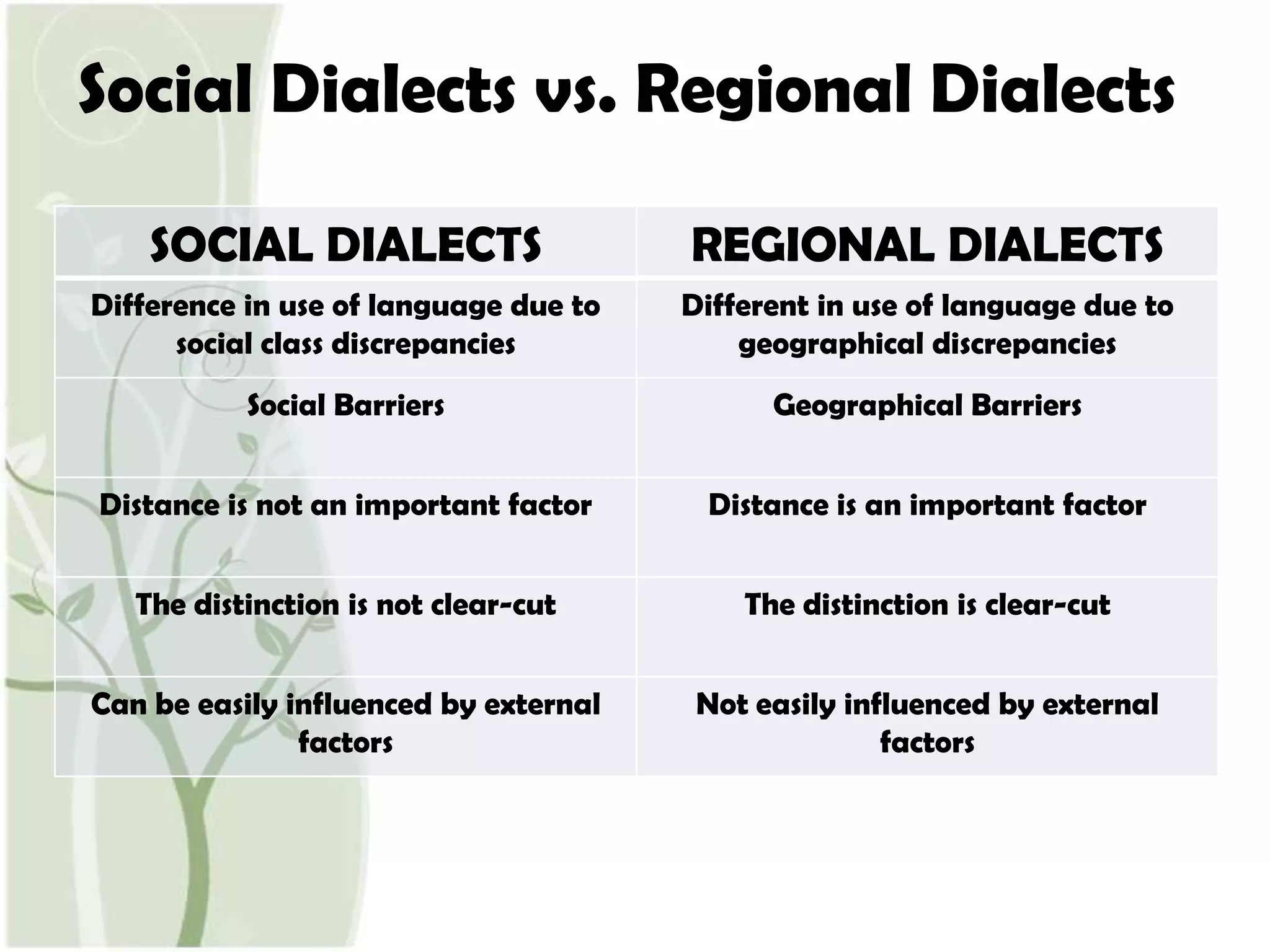
Dialect can be divided into two types : Regional and Social.Social Dialects vs. Regional Dialects
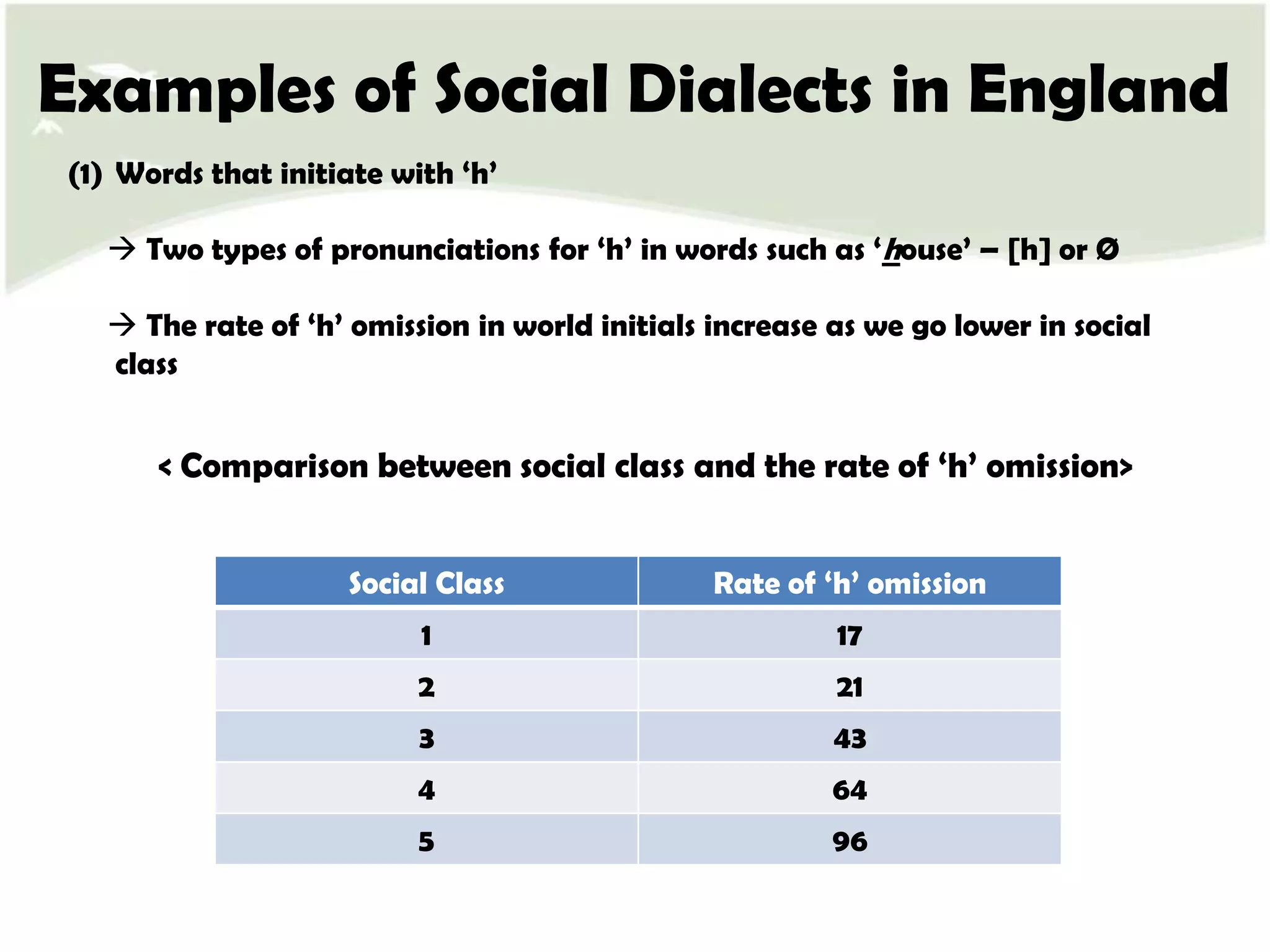
Examples of Social Dialects in EnglandWords that initiate with ‘h’     Two types of pronunciations for ‘h’ in words such as ‘house’ – [h] or Ø      The rate of ‘h’ omission in world initials increase as we go lower in social class< Comparison between social class and the rate of ‘h’ omission>
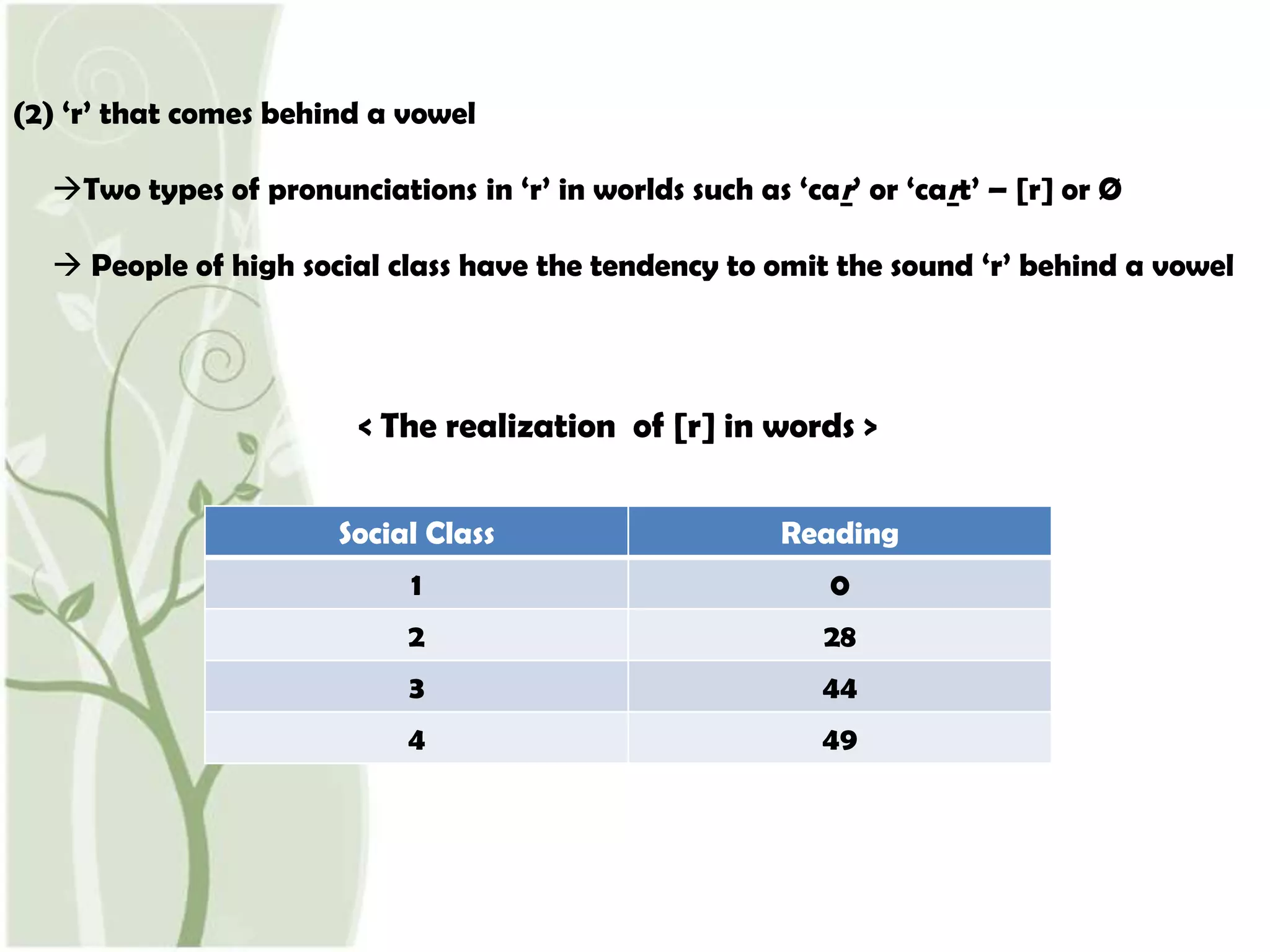
(2) ‘r’ that comes behind a vowelTwo types of pronunciations in ‘r’ in worlds such as ‘car’ or ‘cart’ – [r] or Ø People of high social class have the tendency to omit the sound ‘r’ behind a vowel< The realization  of [r] in words >
(3) Suffix ‘-ing’ Two types of pronunciation in ‘-ing’ in words such as ‘swimming’ and ‘sleeping’ – [in] or [iŋ] Higher social classes use more [in] compared to [iŋ]< Use of pronunciation [iŋ] for suffix ‘-ing’>
The Background of English Social DialectsPrefix ‘h’‘h’ in Old English
The evolution of sound ‘h’ after the Norman Conquest
‘h’ pronounciation in early modern englsih

Social Dialects in English

  • 1.
    Dialects- English SocialDialects2006130938 박윤경2010130738 이다현
  • 2.
    CONTENTS1Introduction to Dialects2SocialDialects vs. Regional Dialects3Examples of Social Dialects in England4The Background of English Social Dialects5The significance of Social Dialect Studies
  • 3.
    What is aDialect? A variety of a language that is a characteristic of a particular group of the language's speakers
  • 4.
    A dialectis very different from accent
  • 5.
  • 6.
    Dialect can bedivided into two types : Regional and Social.Social Dialects vs. Regional Dialects
  • 7.
    Examples of SocialDialects in EnglandWords that initiate with ‘h’  Two types of pronunciations for ‘h’ in words such as ‘house’ – [h] or Ø  The rate of ‘h’ omission in world initials increase as we go lower in social class< Comparison between social class and the rate of ‘h’ omission>
  • 8.
    (2) ‘r’ thatcomes behind a vowelTwo types of pronunciations in ‘r’ in worlds such as ‘car’ or ‘cart’ – [r] or Ø People of high social class have the tendency to omit the sound ‘r’ behind a vowel< The realization of [r] in words >
  • 9.
    (3) Suffix ‘-ing’Two types of pronunciation in ‘-ing’ in words such as ‘swimming’ and ‘sleeping’ – [in] or [iŋ] Higher social classes use more [in] compared to [iŋ]< Use of pronunciation [iŋ] for suffix ‘-ing’>
  • 10.
    The Background ofEnglish Social DialectsPrefix ‘h’‘h’ in Old English
  • 11.
    The evolution ofsound ‘h’ after the Norman Conquest
  • 12.
    ‘h’ pronounciation inearly modern englsih
  • 13.
    ‘h’ during the18th centuryExampleCharles Dickens’ – Great Expectation (1860)Joe : Old orlick he’s been a bustin’ open a dwelling-ousePip : Whose?Joe : Not, I grant you, but what his manners is given to blusterouse, still an Englishmen’s ‘ouseis his castle, and castles must not be busted ‘cept when done in war time. And wotsume’er the failing on his part, he were a corn and seedman in his heartPip : Is it Pumblechook’shouse that has been broken into then?
  • 14.
    (2) ‘r’ thatcomes behind a vowel ‘r’ in Old English
  • 15.
    ‘r’ pronunciation in the 17th Century
  • 16.
    Omission of ‘r’ in South – East England ExampleChales Dickens – Great Expectation (1860)Pip : Yes, Joe. I tell you, I heard her. Joe : Which I meantersay, Pip, it might be that her meaning were.
  • 17.
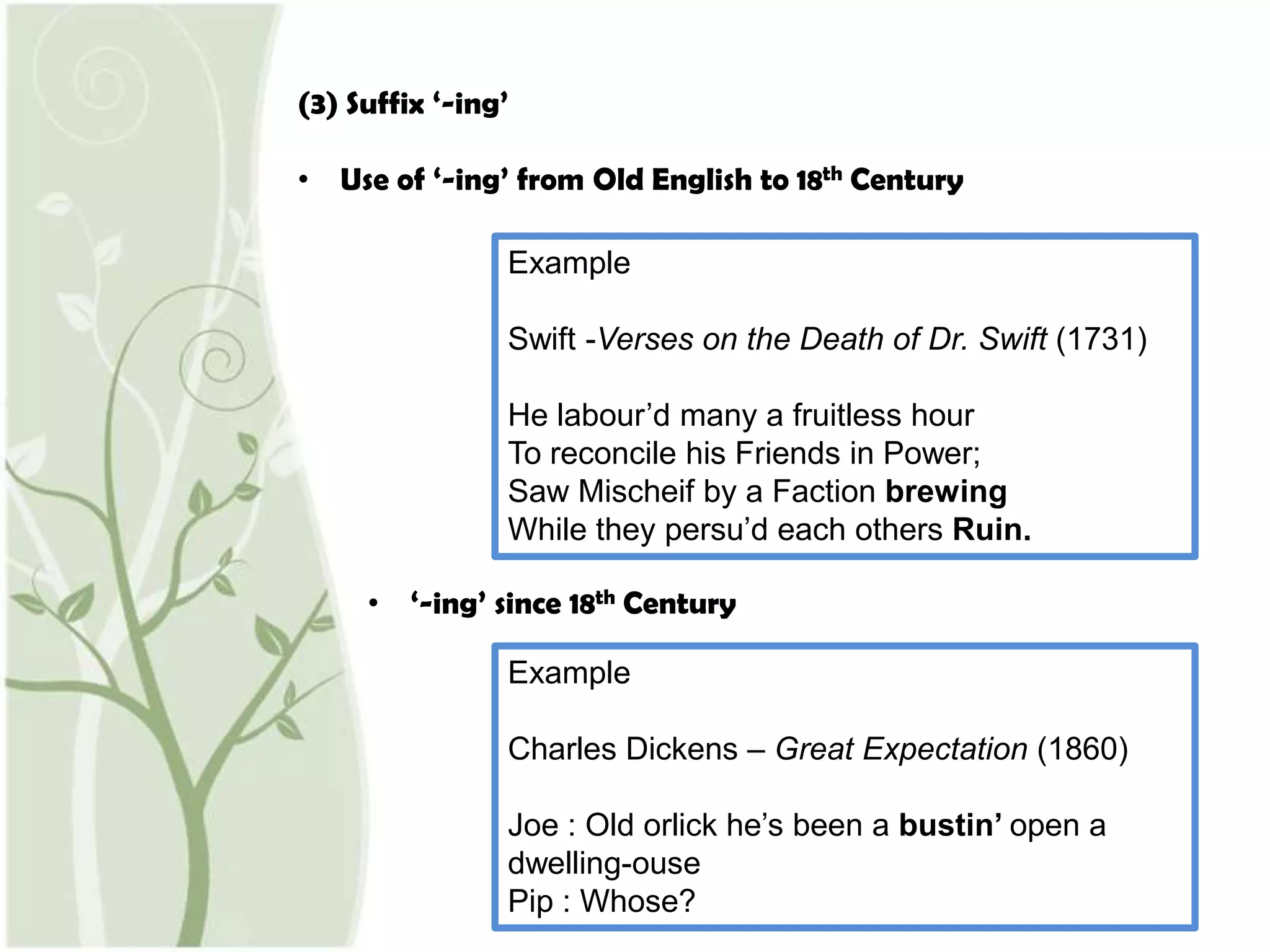
    (3) Suffix ‘-ing’ Use of ‘-ing’ from Old English to 18th CenturyExampleSwift -Verses on the Death of Dr. Swift (1731)He labour’d many a fruitless hourTo reconcile his Friends in Power;Saw Mischeif by a Faction brewing While they persu’d each others Ruin. ‘-ing’ since 18th CenturyExampleCharles Dickens – Great Expectation (1860)Joe : Oldorlick he’s been a bustin’ open a dwelling-ousePip : Whose?
  • 18.
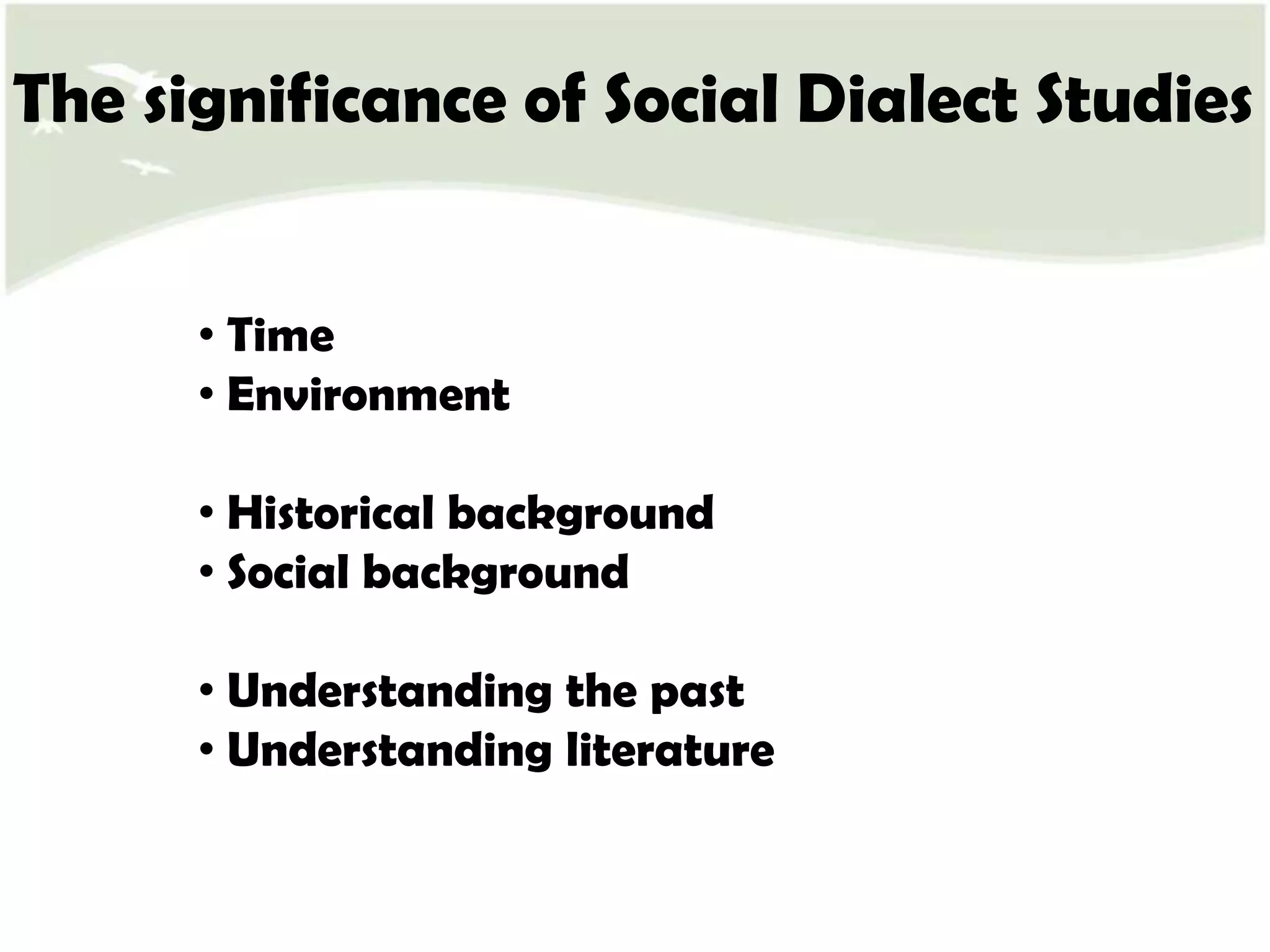
    The significance ofSocial Dialect Studies Time
  • 19.
  • 20.
  • 21.
  • 22.
  • 23.