Business Intelligence
By Almog Ramrajkar
The Decision Making Process
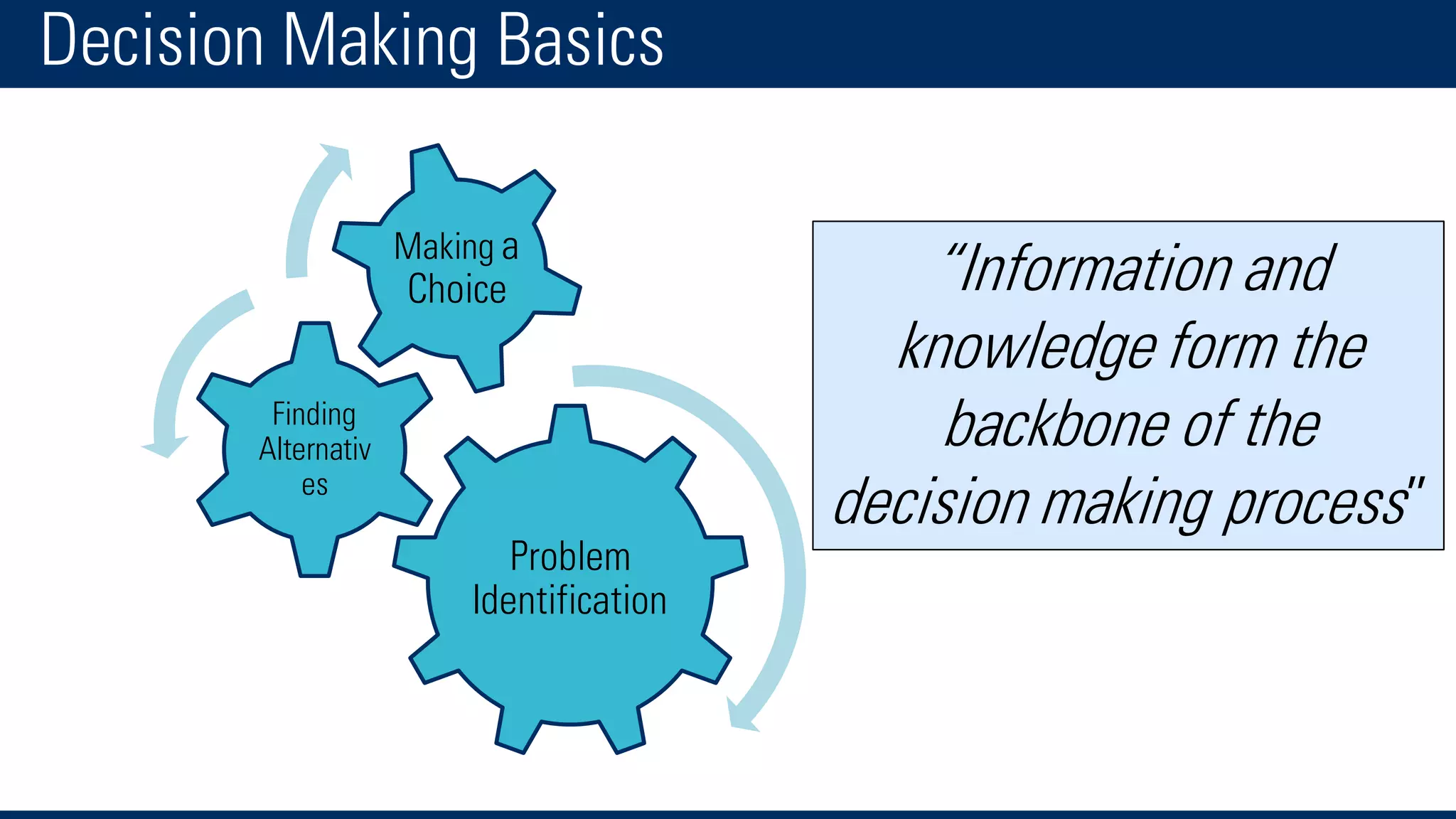
Decision Making Basics
Problem
Identification
Finding
Alternativ
es
Making a
Choice “Information and
knowledge form the
backbone of the
decision making process”
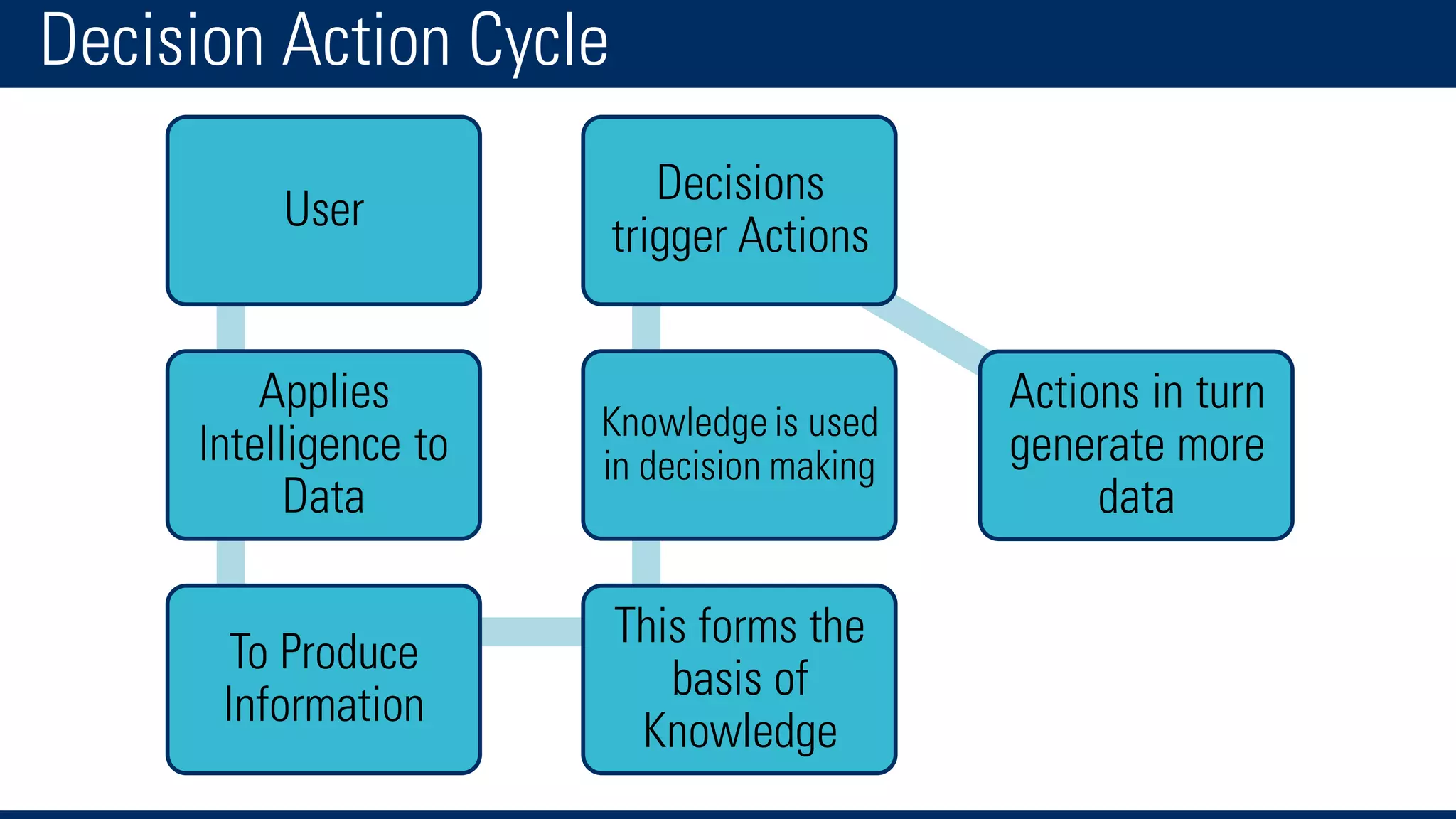
Decision Action Cycle
User
Applies
Intelligence to
Data
To Produce
Information
This forms the
basis of
Knowledge
Knowledge is used
in decision making
Decisions
trigger Actions
Actions in turn
generate more
data
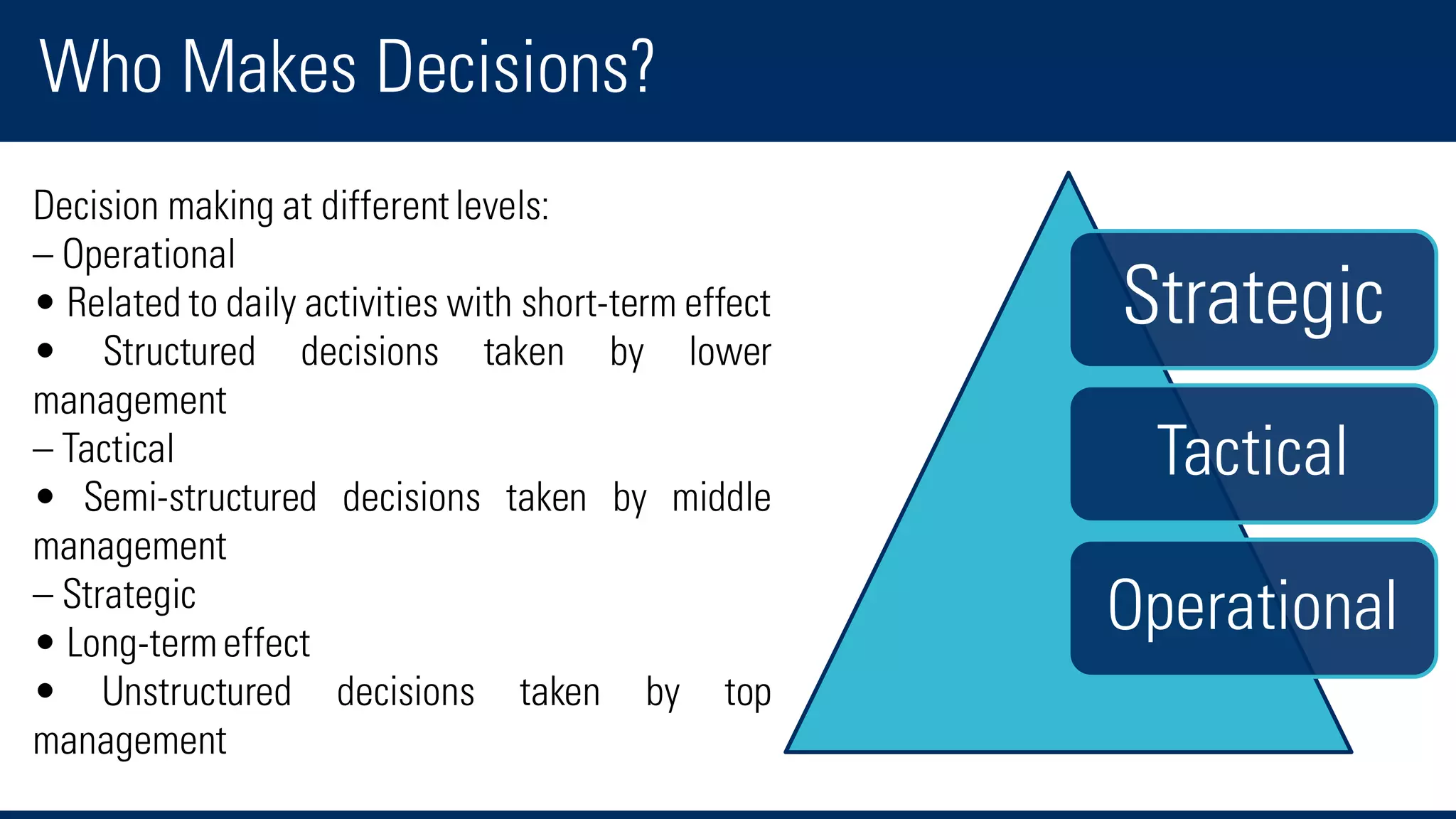
Who Makes Decisions?
Decision making at differentlevels:
– Operational
• Related to daily activities with short-term effect
• Structured decisions taken by lower
management
– Tactical
• Semi-structured decisions taken by middle
management
– Strategic
• Long-termeffect
• Unstructured decisions taken by top
management
Strategic
Tactical
Operational
Introduction to Business Intelligence
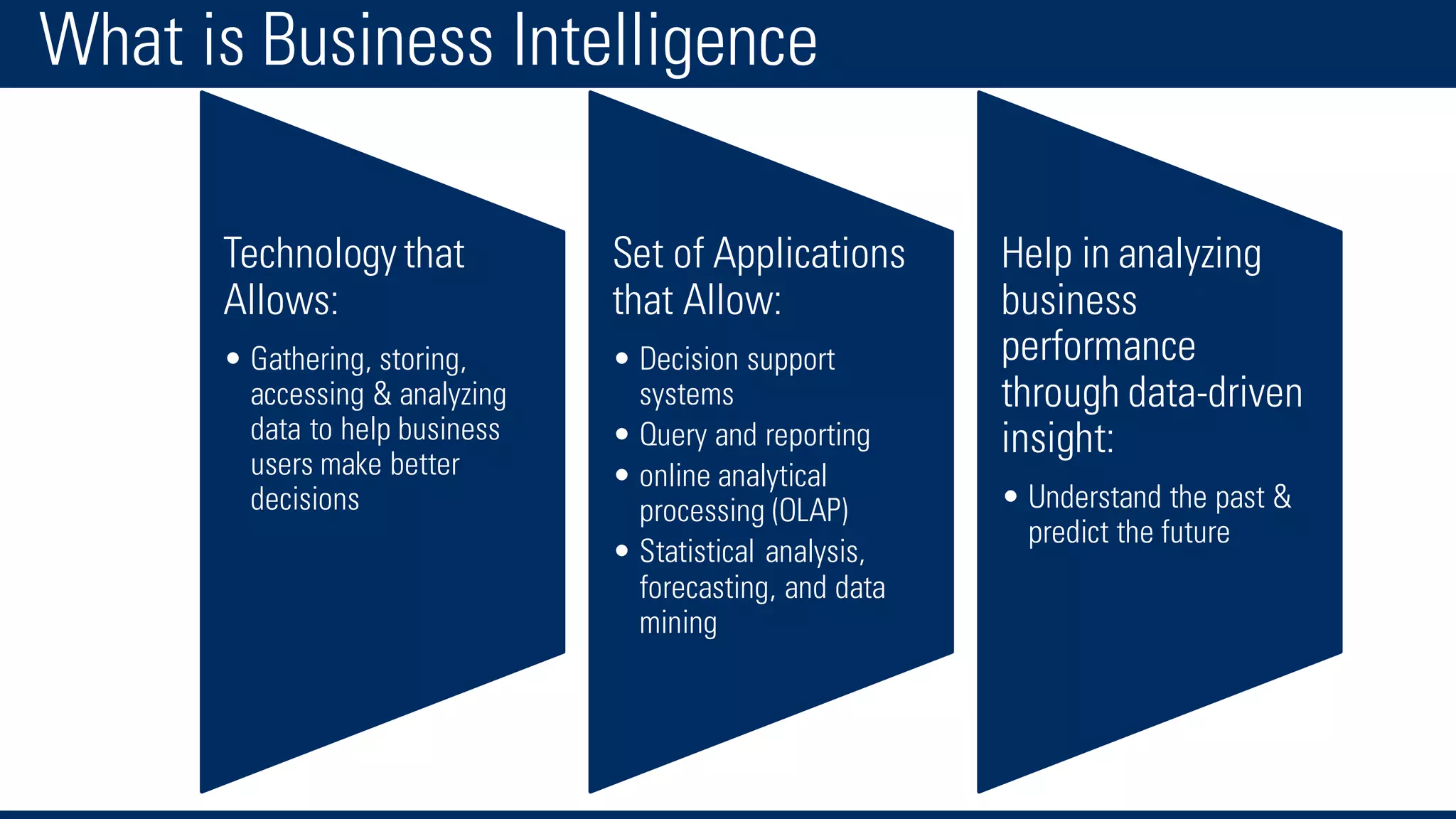
What is Business Intelligence
Technology that
Allows:
• Gathering, storing,
accessing & analyzing
data to help business
users make better
decisions
Set of Applications
that Allow:
• Decision support
systems
• Query and reporting
• online analytical
processing (OLAP)
• Statistical analysis,
forecasting, and data
mining
Help in analyzing
business
performance
through data-driven
insight:
• Understand the past &
predict the future
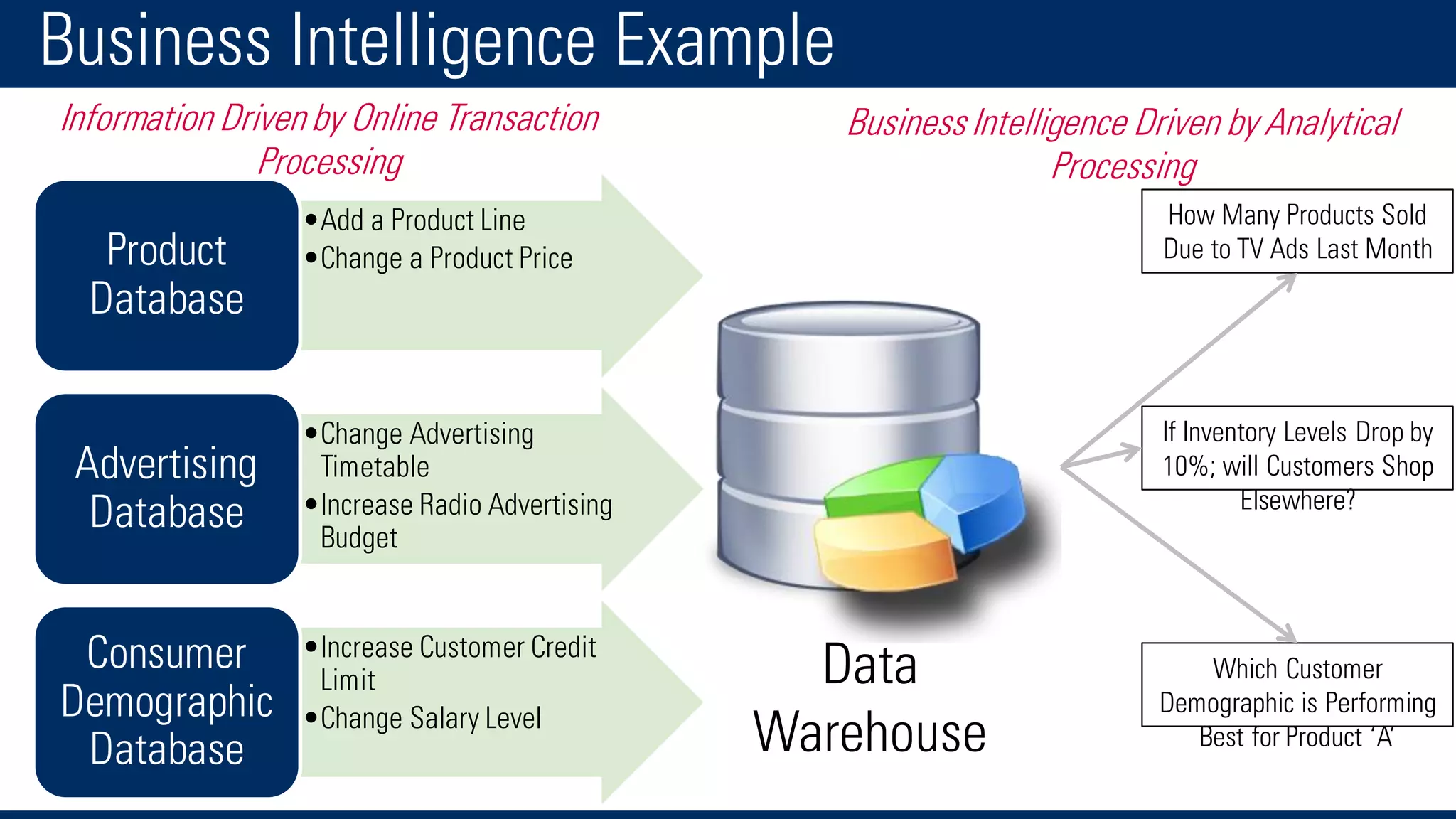
Business Intelligence Example
•Add a Product Line
•Change a Product PriceProduct
Database
•Change Advertising
Timetable
•Increase Radio Advertising
Budget
Advertising
Database
•Increase Customer Credit
Limit
•Change Salary Level
Consumer
Demographic
Database
How Many Products Sold
Due to TV Ads Last Month
If Inventory Levels Drop by
10%; will Customers Shop
Elsewhere?
Which Customer
Demographic is Performing
Best for Product ‘A’
Data
Warehouse
Information Driven by Online Transaction
Processing
Business Intelligence Driven by Analytical
Processing
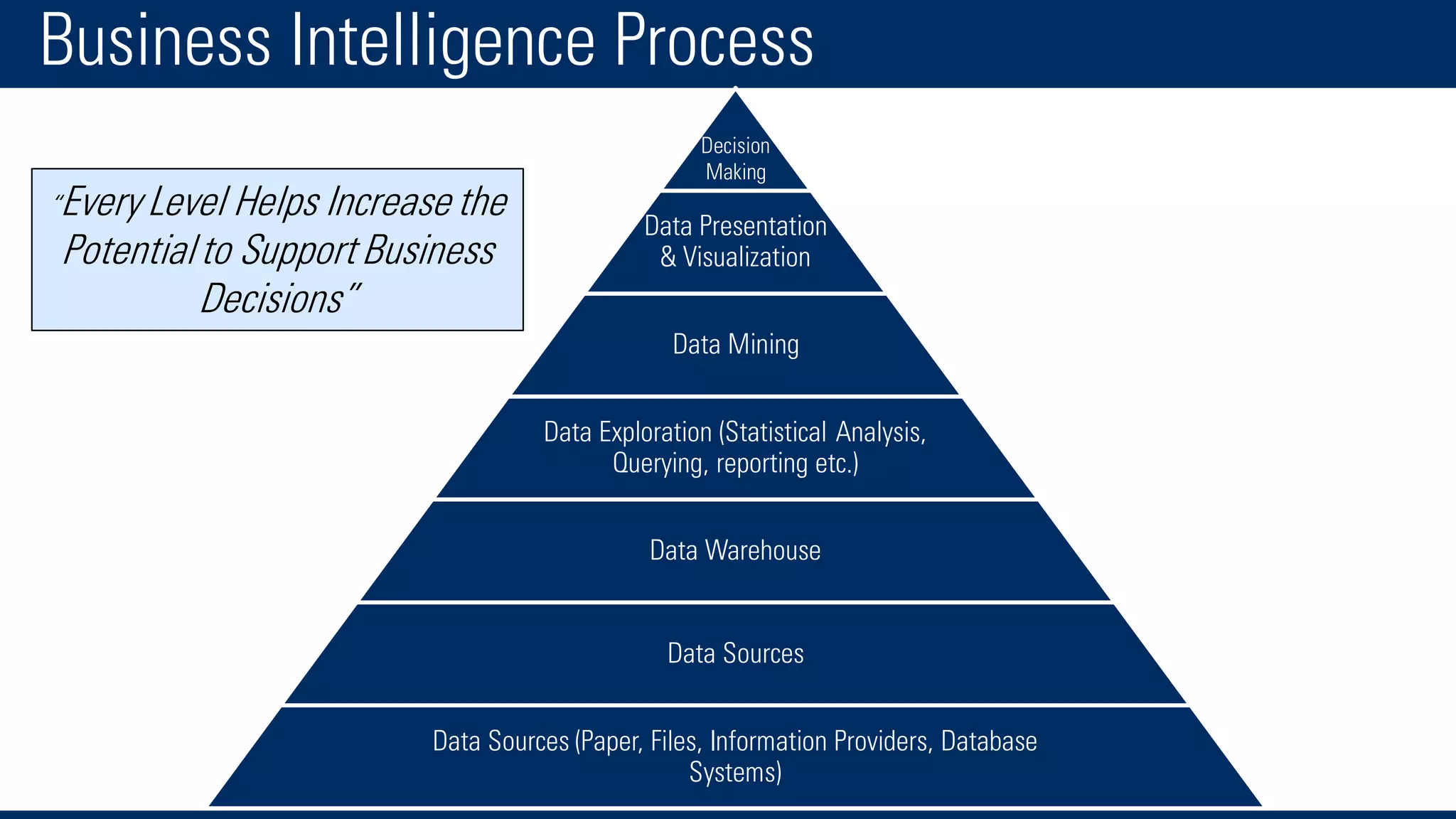
Business Intelligence Process
Decisions
Data Presentation
& Visualization
Data Mining
Data Exploration (Statistical Analysis,
Querying, reporting etc.)
Data Warehouse
Data Sources
Data Sources (Paper, Files, Information Providers, Database
Systems)
Decision
Making
“Every Level Helps Increase the
Potentialto Support Business
Decisions”
Business Intelligence Components
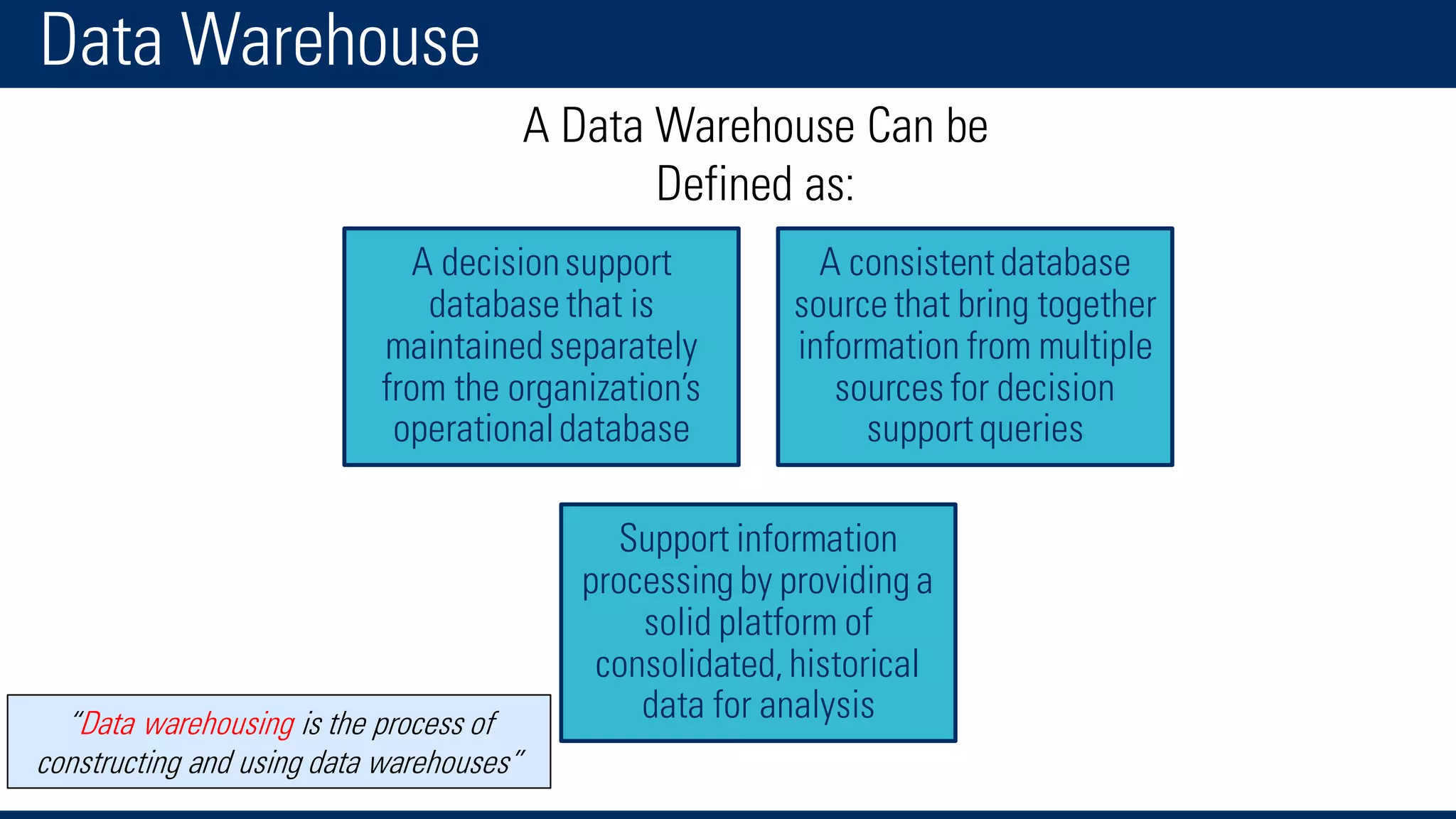
Data Warehouse
A decisionsupport
database that is
maintained separately
from the organization’s
operationaldatabase
A consistentdatabase
source that bring together
information from multiple
sources for decision
support queries
Support information
processing by providing a
solid platform of
consolidated, historical
data for analysis“Data warehousing is the process of
constructing and using data warehouses”
A Data Warehouse Can be
Defined as:
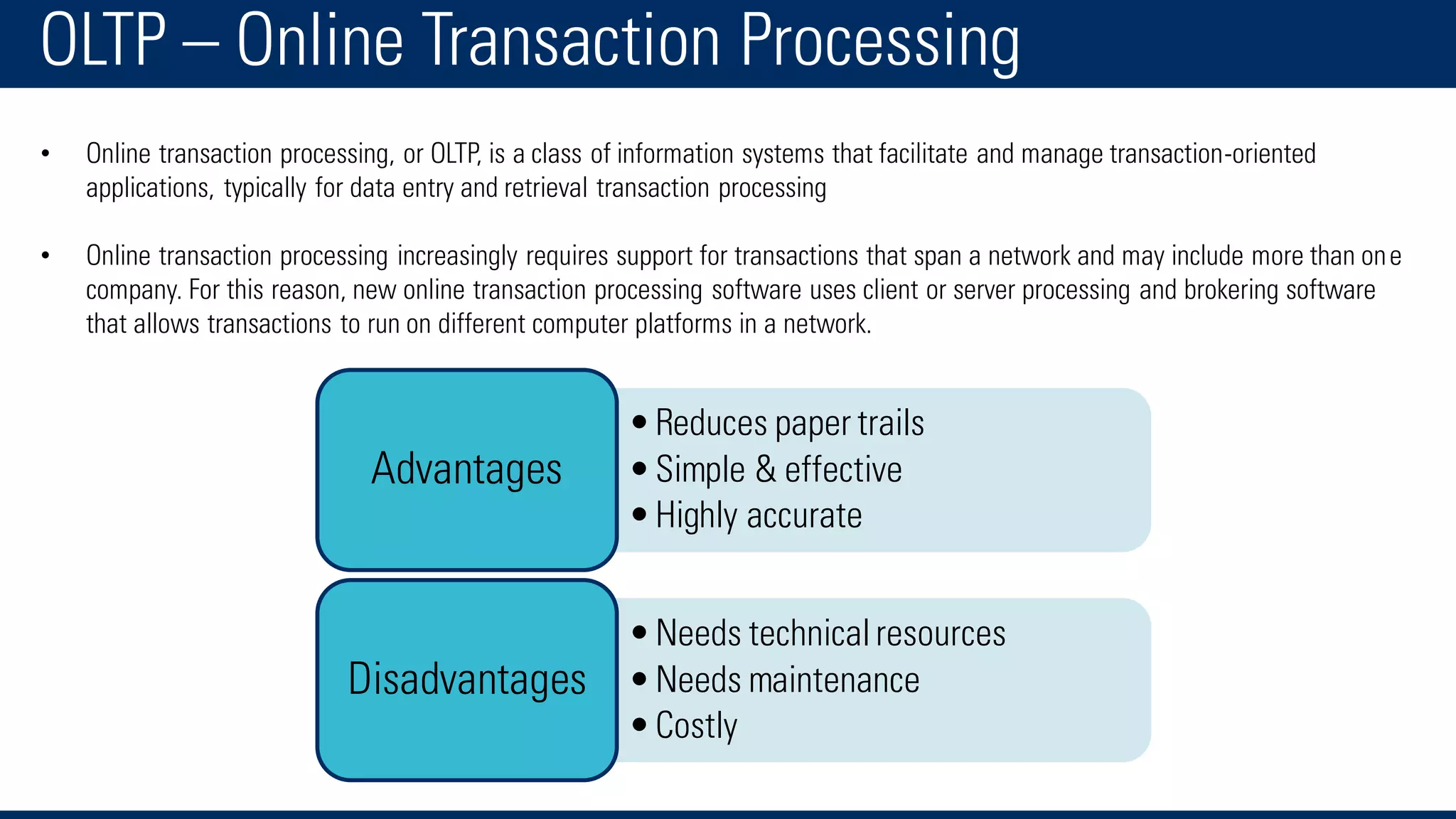
OLTP – Online Transaction Processing
• Online transaction processing, or OLTP, is a class of information systems that facilitate and manage transaction-oriented
applications, typically for data entry and retrieval transaction processing
• Online transaction processing increasingly requires support for transactions that span a network and may include more than one
company. For this reason, new online transaction processing software uses client or server processing and brokering software
that allows transactions to run on different computer platforms in a network.
•Reduces paper trails
•Simple & effective
•Highly accurate
Advantages
•Needs technicalresources
•Needs maintenance
•Costly
Disadvantages
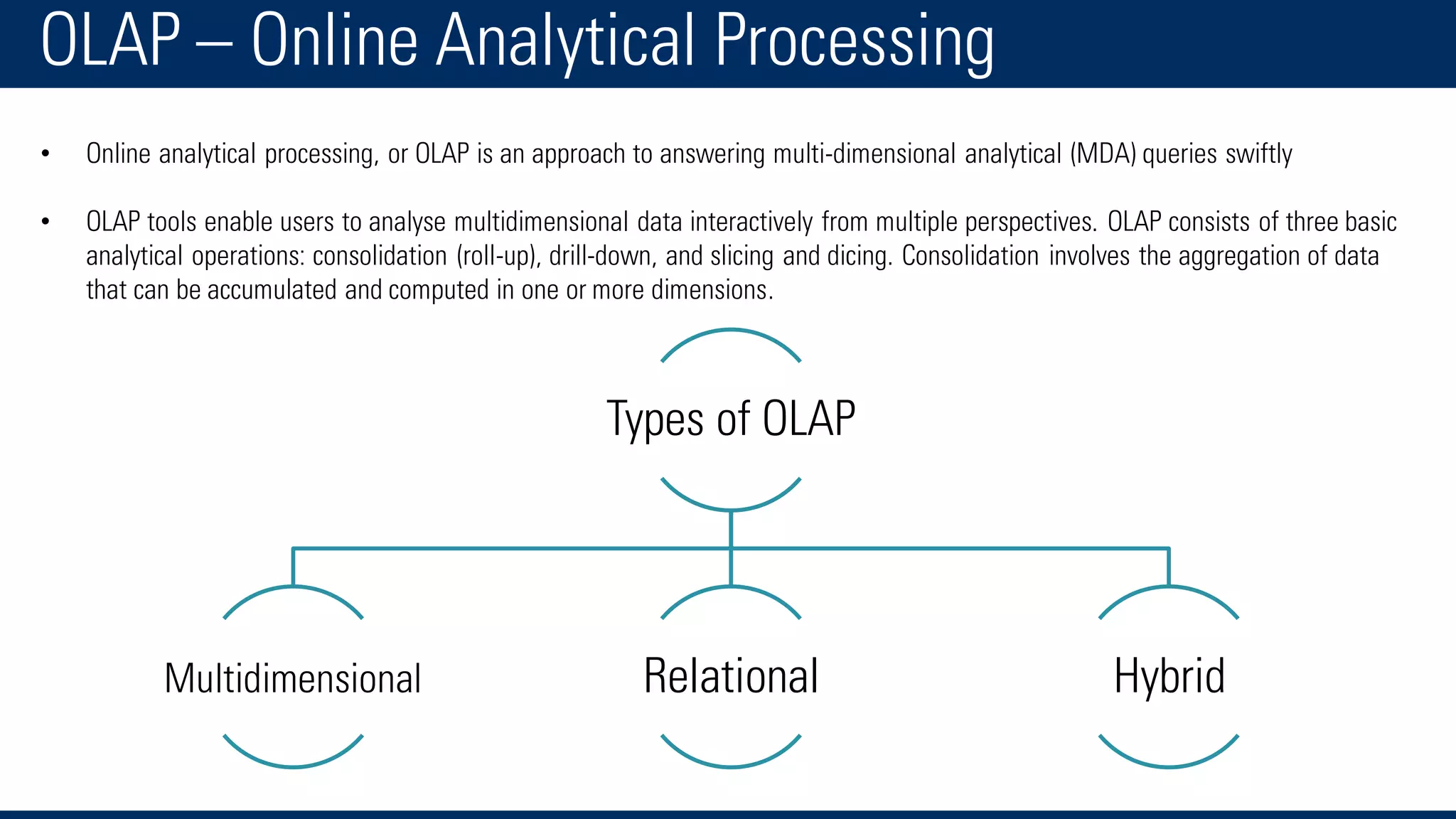
OLAP – Online Analytical Processing
• Online analytical processing, or OLAP is an approach to answering multi-dimensional analytical (MDA) queries swiftly
• OLAP tools enable users to analyse multidimensional data interactively from multiple perspectives. OLAP consists of three basic
analytical operations: consolidation (roll-up), drill-down, and slicing and dicing. Consolidation involves the aggregation of data
that can be accumulated and computed in one or more dimensions.
Types of OLAP
Multidimensional Relational Hybrid
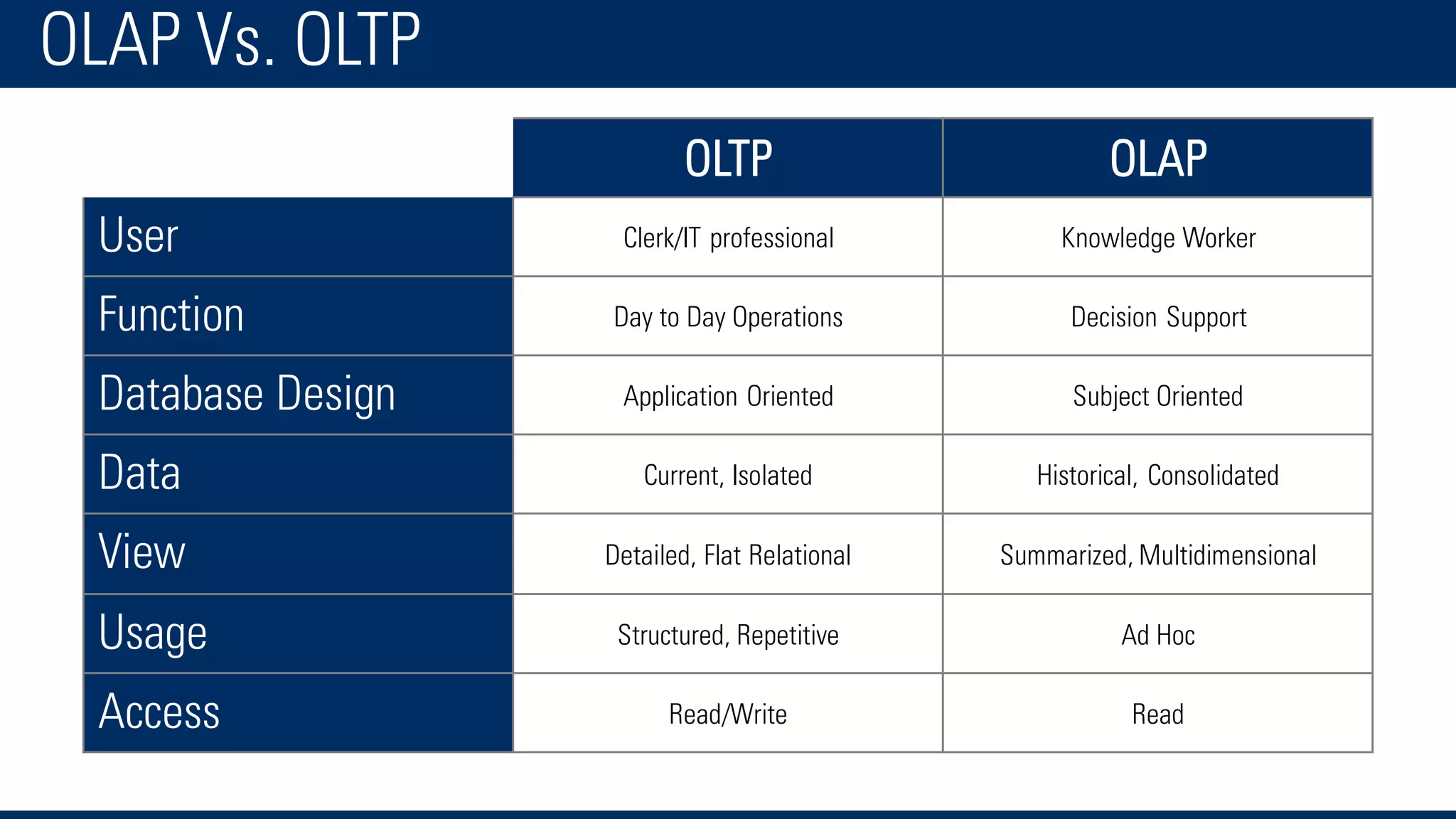
OLAP Vs. OLTP
OLTP OLAP
User Clerk/IT professional Knowledge Worker
Function Day to Day Operations Decision Support
Database Design Application Oriented Subject Oriented
Data Current, Isolated Historical, Consolidated
View Detailed, Flat Relational Summarized, Multidimensional
Usage Structured, Repetitive Ad Hoc
Access Read/Write Read
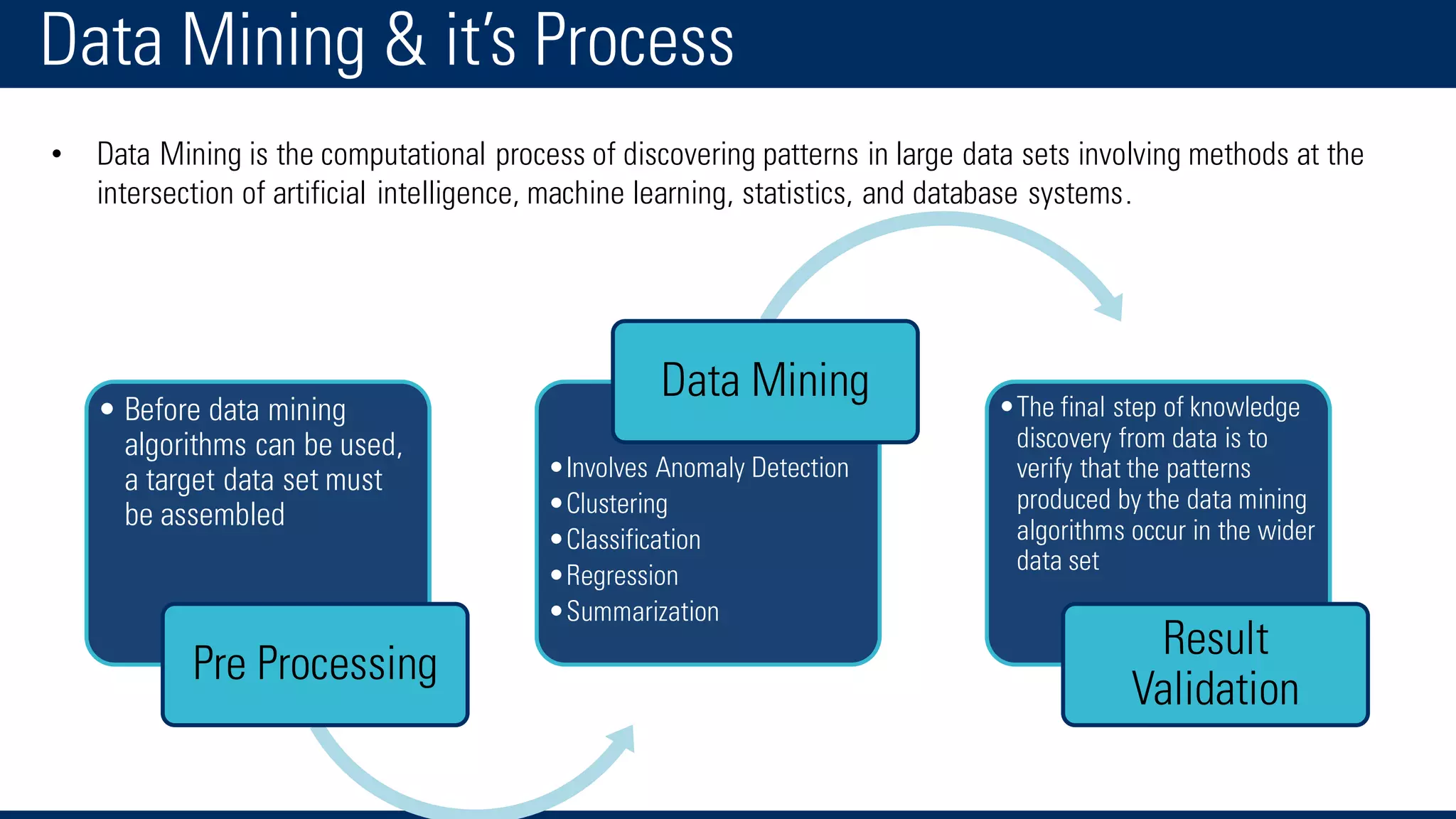
Data Mining & it’s Process
• Data Mining is the computational process of discovering patterns in large data sets involving methods at the
intersection of artificial intelligence, machine learning, statistics, and database systems.
• Before data mining
algorithms can be used,
a target data set must
be assembled
Pre Processing
•Involves Anomaly Detection
•Clustering
•Classification
•Regression
•Summarization
Data Mining •The final step of knowledge
discovery from data is to
verify that the patterns
produced by the data mining
algorithms occur in the wider
data set
Result
Validation
Layers of Business Intelligence
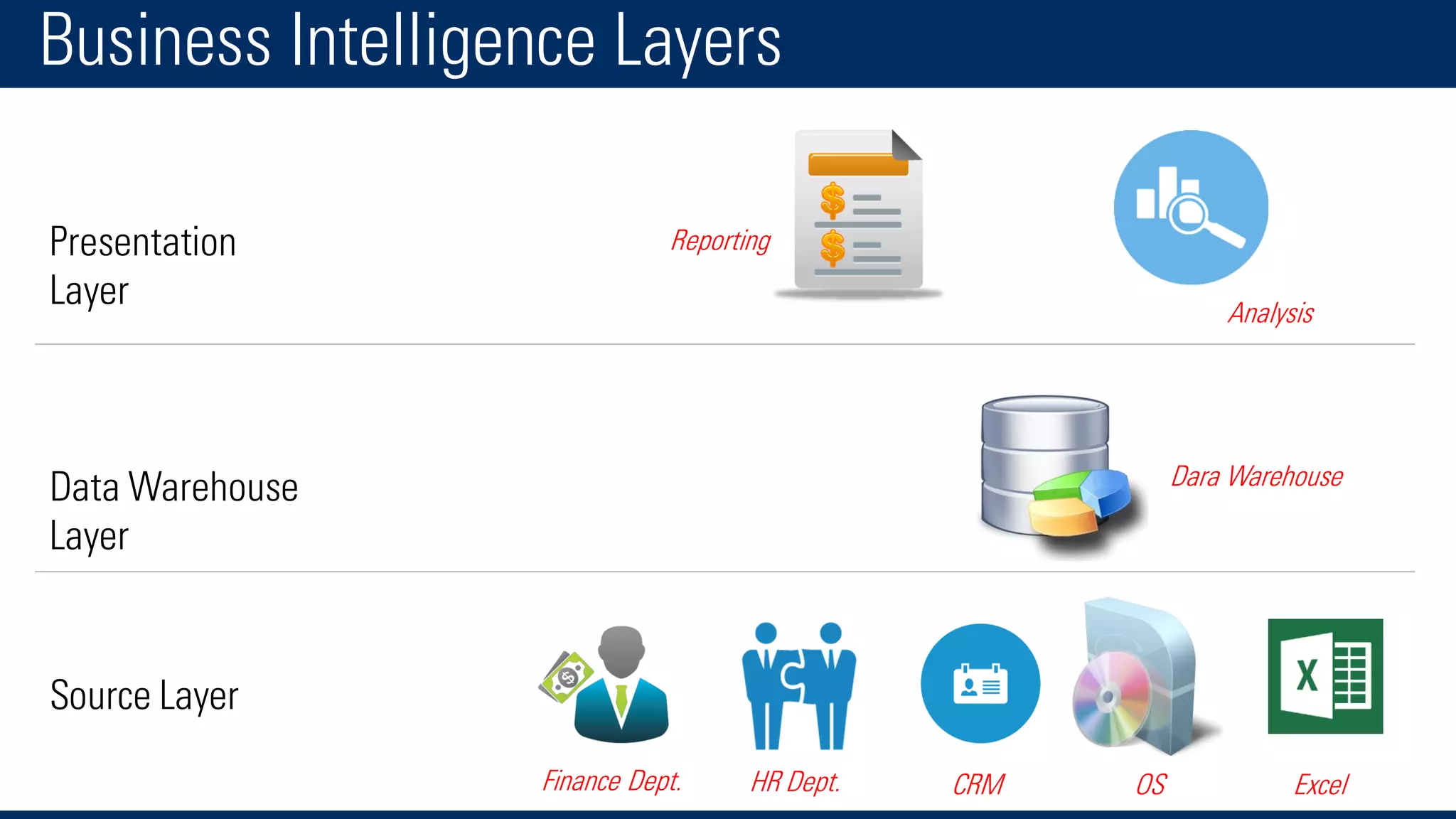
Business Intelligence Layers
Presentation
Layer
Data Warehouse
Layer
Source Layer
Reporting
Analysis
Dara Warehouse
Finance Dept. HR Dept. CRM OS Excel
Thank You

Introduction to Business Intelligence

  • 1.
  • 2.
  • 3.
    Decision Making Basics Problem Identification Finding Alternativ es Makinga Choice “Information and knowledge form the backbone of the decision making process”
  • 4.
    Decision Action Cycle User Applies Intelligenceto Data To Produce Information This forms the basis of Knowledge Knowledge is used in decision making Decisions trigger Actions Actions in turn generate more data
  • 5.
    Who Makes Decisions? Decisionmaking at differentlevels: – Operational • Related to daily activities with short-term effect • Structured decisions taken by lower management – Tactical • Semi-structured decisions taken by middle management – Strategic • Long-termeffect • Unstructured decisions taken by top management Strategic Tactical Operational
  • 6.
  • 7.
    What is BusinessIntelligence Technology that Allows: • Gathering, storing, accessing & analyzing data to help business users make better decisions Set of Applications that Allow: • Decision support systems • Query and reporting • online analytical processing (OLAP) • Statistical analysis, forecasting, and data mining Help in analyzing business performance through data-driven insight: • Understand the past & predict the future
  • 8.
    Business Intelligence Example •Adda Product Line •Change a Product PriceProduct Database •Change Advertising Timetable •Increase Radio Advertising Budget Advertising Database •Increase Customer Credit Limit •Change Salary Level Consumer Demographic Database How Many Products Sold Due to TV Ads Last Month If Inventory Levels Drop by 10%; will Customers Shop Elsewhere? Which Customer Demographic is Performing Best for Product ‘A’ Data Warehouse Information Driven by Online Transaction Processing Business Intelligence Driven by Analytical Processing
  • 9.
    Business Intelligence Process Decisions DataPresentation & Visualization Data Mining Data Exploration (Statistical Analysis, Querying, reporting etc.) Data Warehouse Data Sources Data Sources (Paper, Files, Information Providers, Database Systems) Decision Making “Every Level Helps Increase the Potentialto Support Business Decisions”
  • 10.
  • 11.
    Data Warehouse A decisionsupport databasethat is maintained separately from the organization’s operationaldatabase A consistentdatabase source that bring together information from multiple sources for decision support queries Support information processing by providing a solid platform of consolidated, historical data for analysis“Data warehousing is the process of constructing and using data warehouses” A Data Warehouse Can be Defined as:
  • 12.
    OLTP – OnlineTransaction Processing • Online transaction processing, or OLTP, is a class of information systems that facilitate and manage transaction-oriented applications, typically for data entry and retrieval transaction processing • Online transaction processing increasingly requires support for transactions that span a network and may include more than one company. For this reason, new online transaction processing software uses client or server processing and brokering software that allows transactions to run on different computer platforms in a network. •Reduces paper trails •Simple & effective •Highly accurate Advantages •Needs technicalresources •Needs maintenance •Costly Disadvantages
  • 13.
    OLAP – OnlineAnalytical Processing • Online analytical processing, or OLAP is an approach to answering multi-dimensional analytical (MDA) queries swiftly • OLAP tools enable users to analyse multidimensional data interactively from multiple perspectives. OLAP consists of three basic analytical operations: consolidation (roll-up), drill-down, and slicing and dicing. Consolidation involves the aggregation of data that can be accumulated and computed in one or more dimensions. Types of OLAP Multidimensional Relational Hybrid
  • 14.
    OLAP Vs. OLTP OLTPOLAP User Clerk/IT professional Knowledge Worker Function Day to Day Operations Decision Support Database Design Application Oriented Subject Oriented Data Current, Isolated Historical, Consolidated View Detailed, Flat Relational Summarized, Multidimensional Usage Structured, Repetitive Ad Hoc Access Read/Write Read
  • 15.
    Data Mining &it’s Process • Data Mining is the computational process of discovering patterns in large data sets involving methods at the intersection of artificial intelligence, machine learning, statistics, and database systems. • Before data mining algorithms can be used, a target data set must be assembled Pre Processing •Involves Anomaly Detection •Clustering •Classification •Regression •Summarization Data Mining •The final step of knowledge discovery from data is to verify that the patterns produced by the data mining algorithms occur in the wider data set Result Validation
  • 16.
    Layers of BusinessIntelligence
  • 17.
    Business Intelligence Layers Presentation Layer DataWarehouse Layer Source Layer Reporting Analysis Dara Warehouse Finance Dept. HR Dept. CRM OS Excel
  • 18.