42U Confidential   ©2008 42U All rights reserved  Slide  Data Center Energy Efficiency Best-Practices  – Insights Into The ROI On  Best-Practices December 3, 2008 ________________________________
Overview Importance of Best-Practices Strategic Fundamentals Advanced Air Flow Cooling Technologies Power Technologies Summary Q&A 42U Confidential   ©2008 42U All rights reserved  Slide
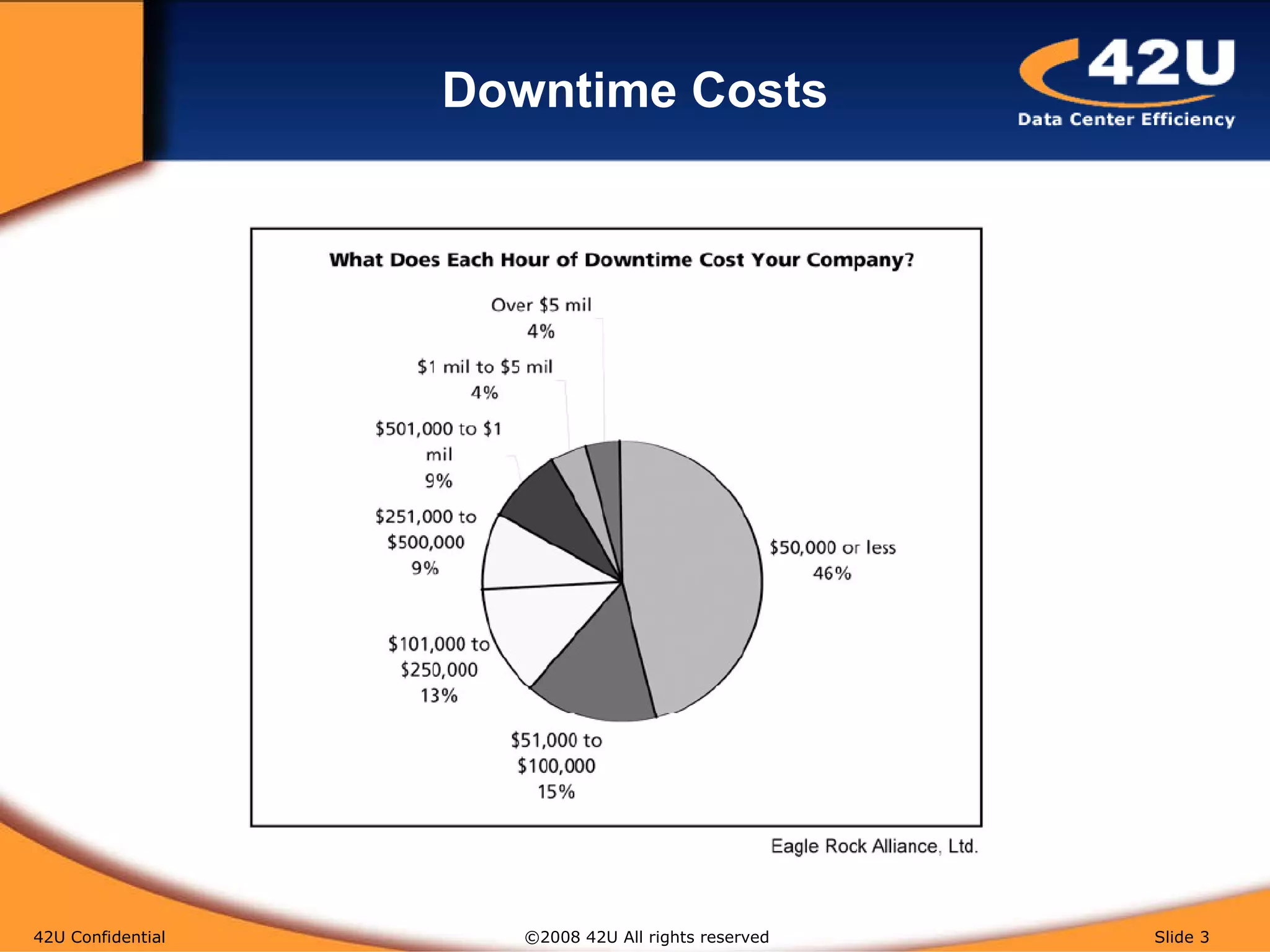
Downtime Costs 42U Confidential   ©2008 42U All rights reserved  Slide
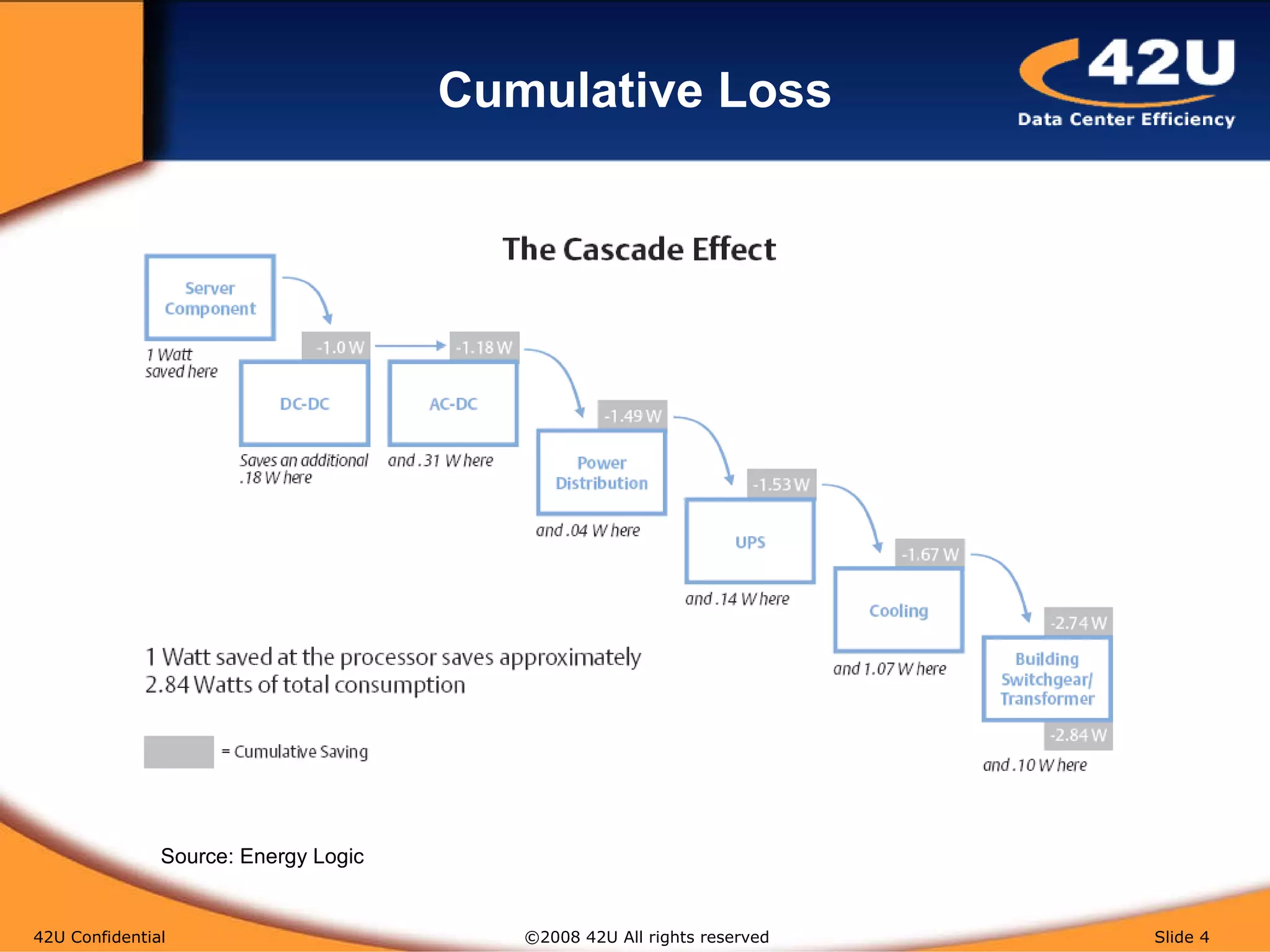
Cumulative Loss 42U Confidential   ©2008 42U All rights reserved  Slide  Source: Energy Logic
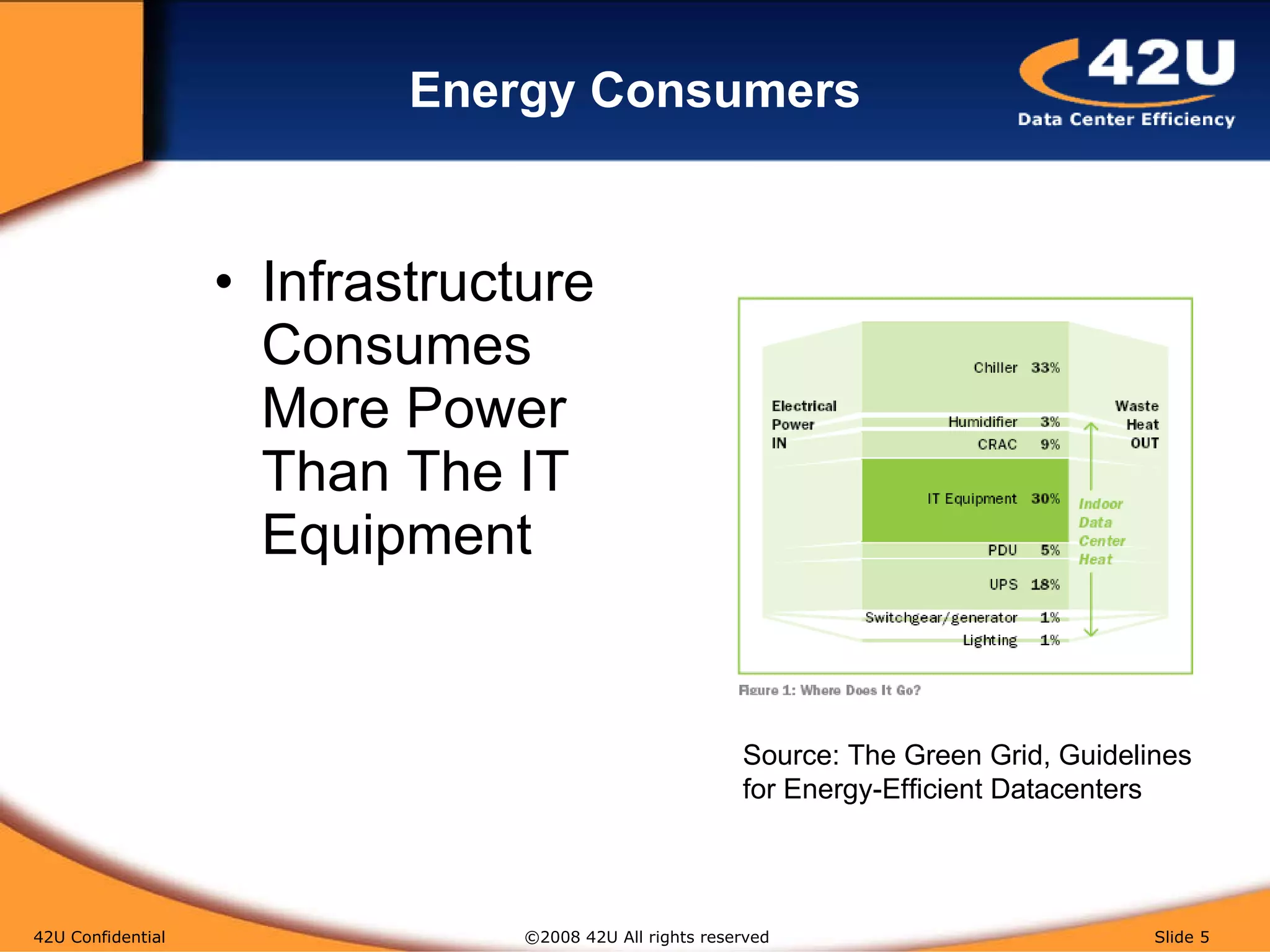
Energy Consumers Infrastructure Consumes More Power Than The IT Equipment 42U Confidential   ©2008 42U All rights reserved  Slide  Source: The Green Grid, Guidelines  for Energy-Efficient Datacenters
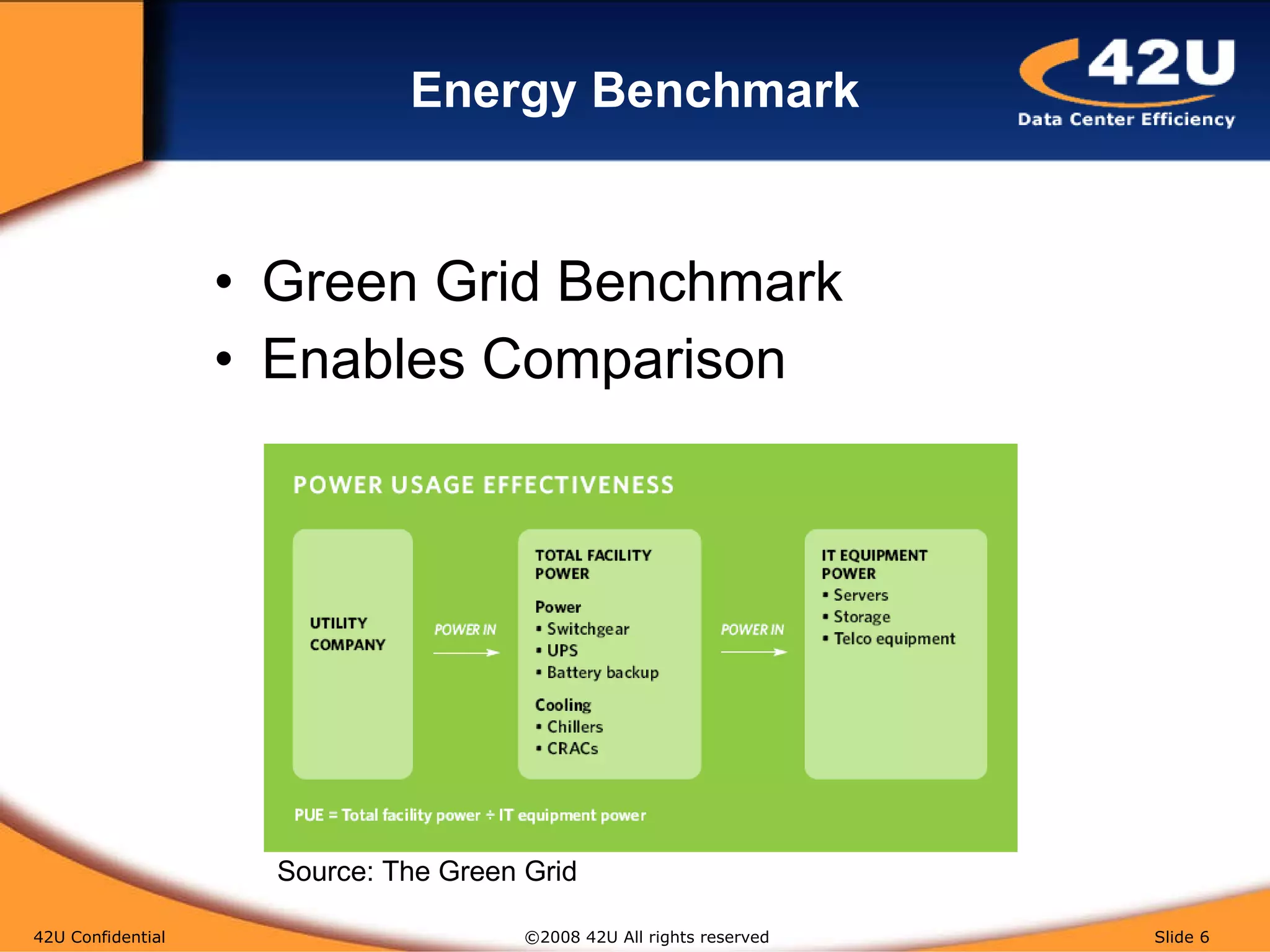
Energy Benchmark Green Grid Benchmark Enables Comparison 42U Confidential   ©2008 42U All rights reserved  Slide  Source: The Green Grid
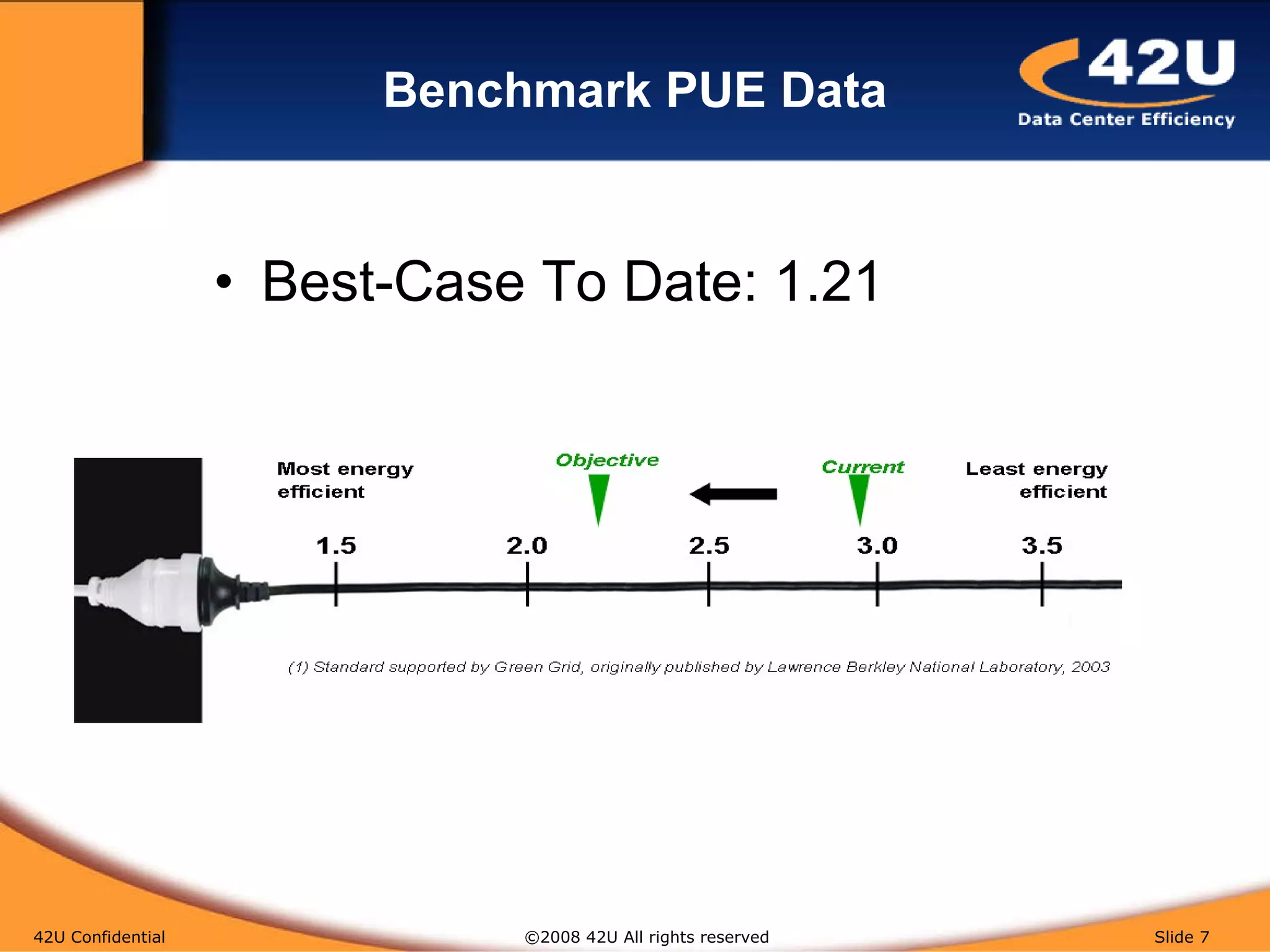
Benchmark PUE Data Best-Case To Date: 1.21 42U Confidential   ©2008 42U All rights reserved  Slide
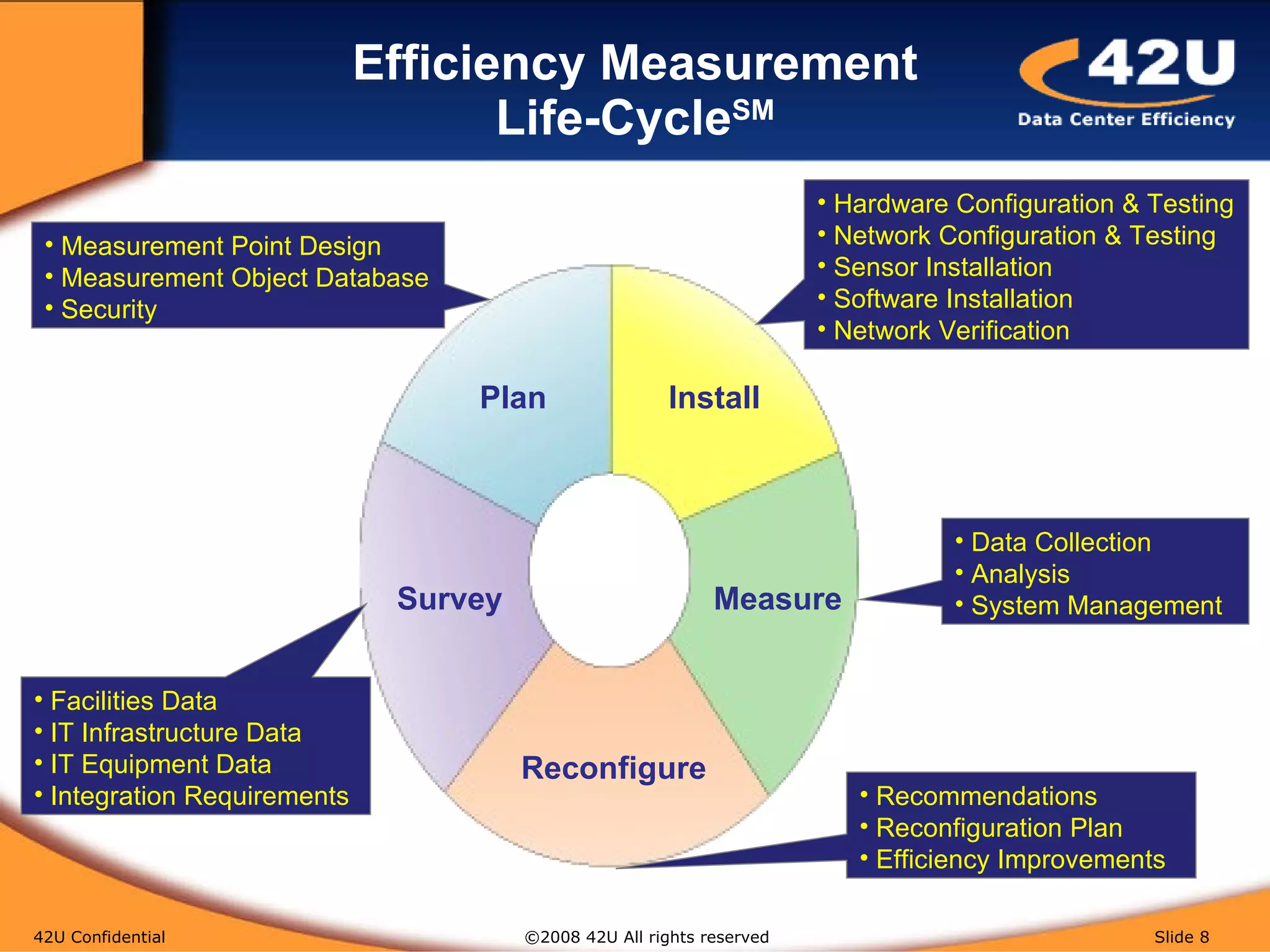
Efficiency Measurement Life-Cycle SM 42U Confidential   ©2008 42U All rights reserved  Slide  Measurement Point Design Measurement Object Database Security Hardware Configuration & Testing Network Configuration & Testing Sensor Installation Software Installation Network Verification Data Collection Analysis System Management Facilities Data IT Infrastructure Data IT Equipment Data Integration Requirements Recommendations Reconfiguration Plan Efficiency Improvements Survey Plan Install Measure Reconfigure
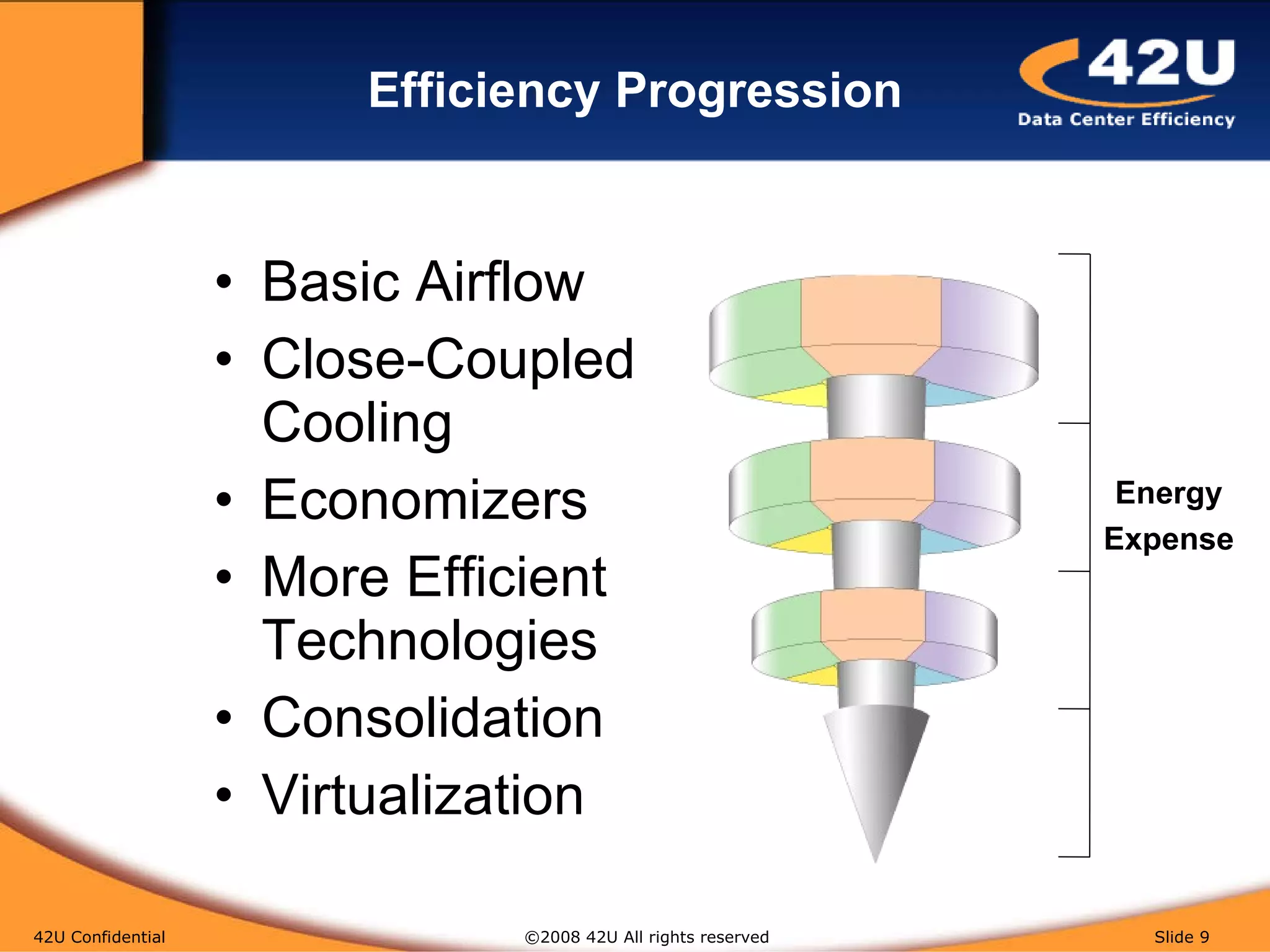
Efficiency Progression Basic Airflow Close-Coupled Cooling Economizers More Efficient Technologies Consolidation Virtualization 42U Confidential   ©2008 42U All rights reserved  Slide  Energy Expense
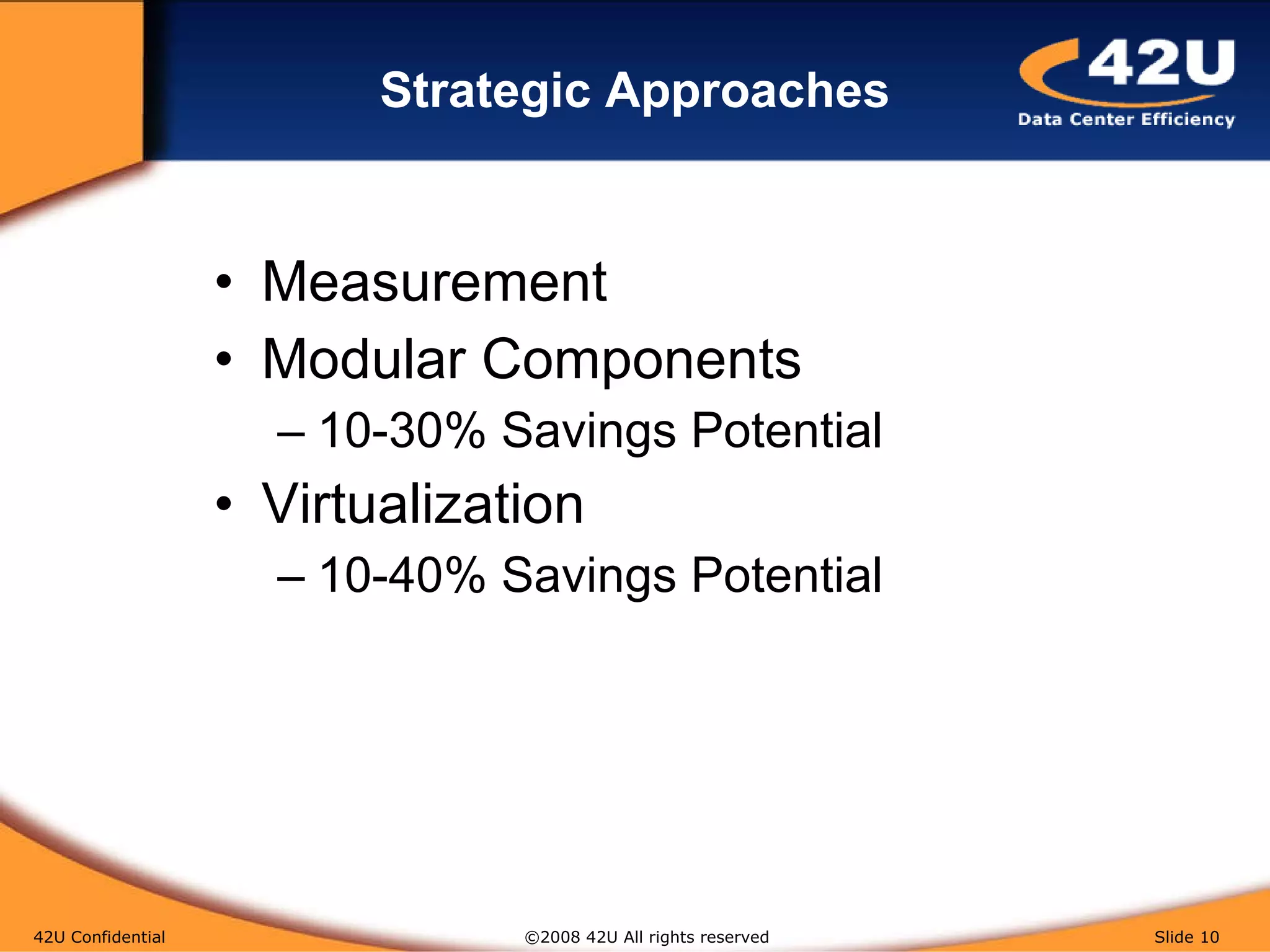
Strategic Approaches Measurement Modular Components 10-30% Savings Potential Virtualization 10-40% Savings Potential 42U Confidential   ©2008 42U All rights reserved  Slide
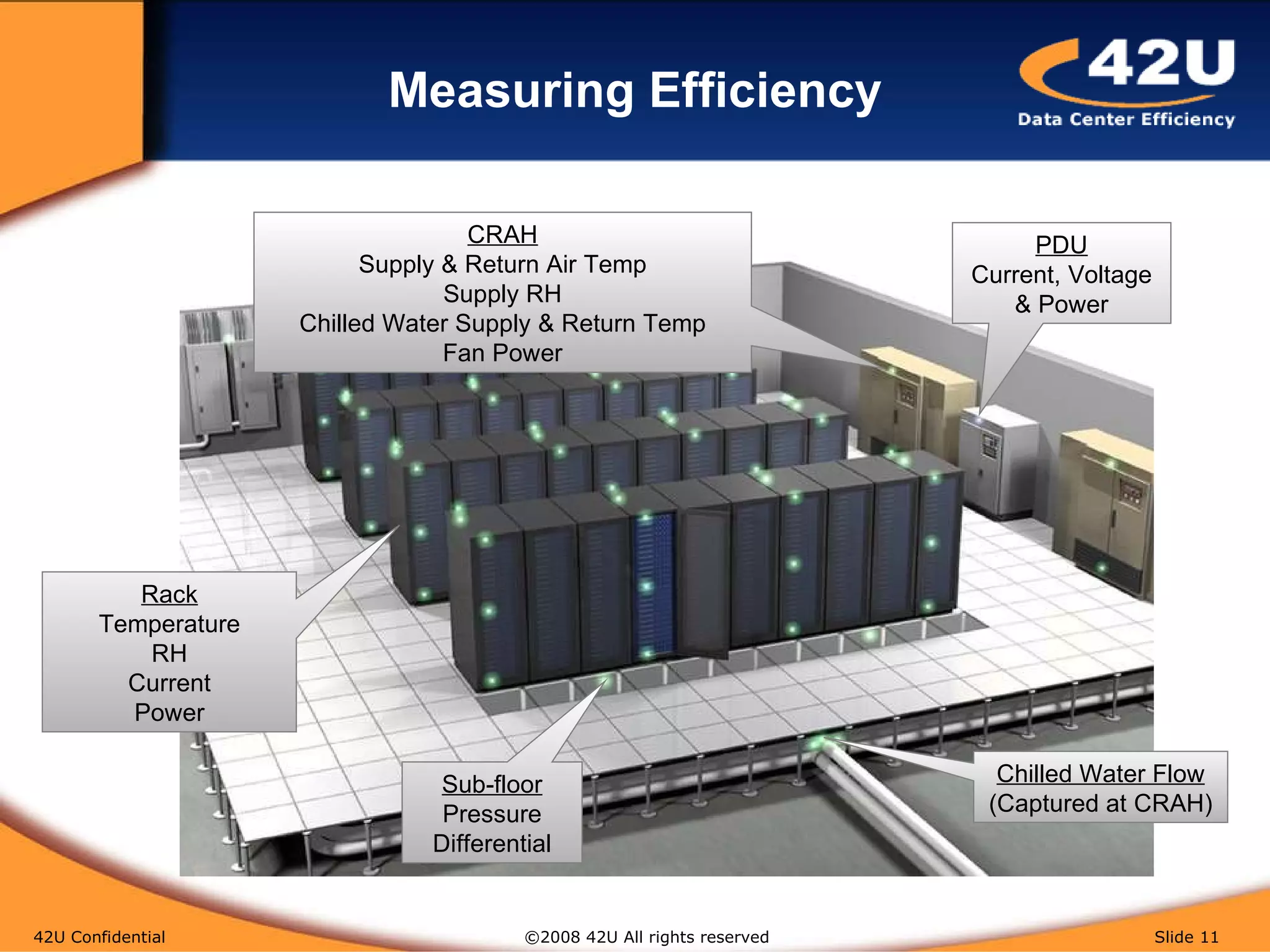
Measuring Efficiency 42U Confidential   ©2008 42U All rights reserved  Slide  Rack Temperature RH Current Power Sub-floor Pressure Differential CRAH Supply & Return Air Temp Supply RH Chilled Water Supply & Return Temp Fan Power Chilled Water Flow (Captured at CRAH) PDU Current, Voltage & Power
Fundamentals Air Flow Management Blanking Panels Floor Tile Management Floor Management Design Maintenance 42U Confidential   ©2008 42U All rights reserved  Slide
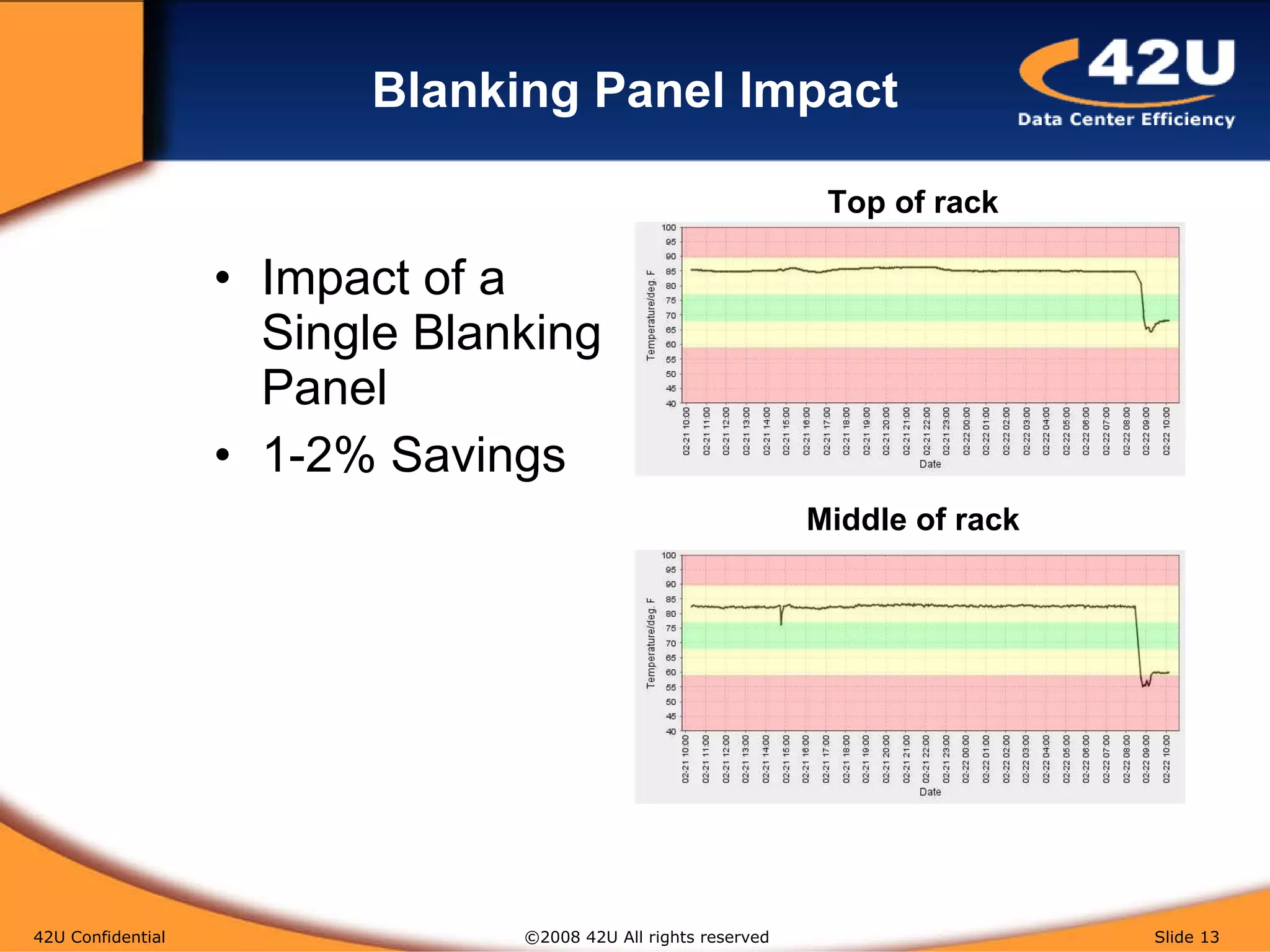
Blanking Panel Impact Impact of a Single Blanking Panel 1-2% Savings 42U Confidential   ©2008 42U All rights reserved  Slide  Top of rack Middle of rack
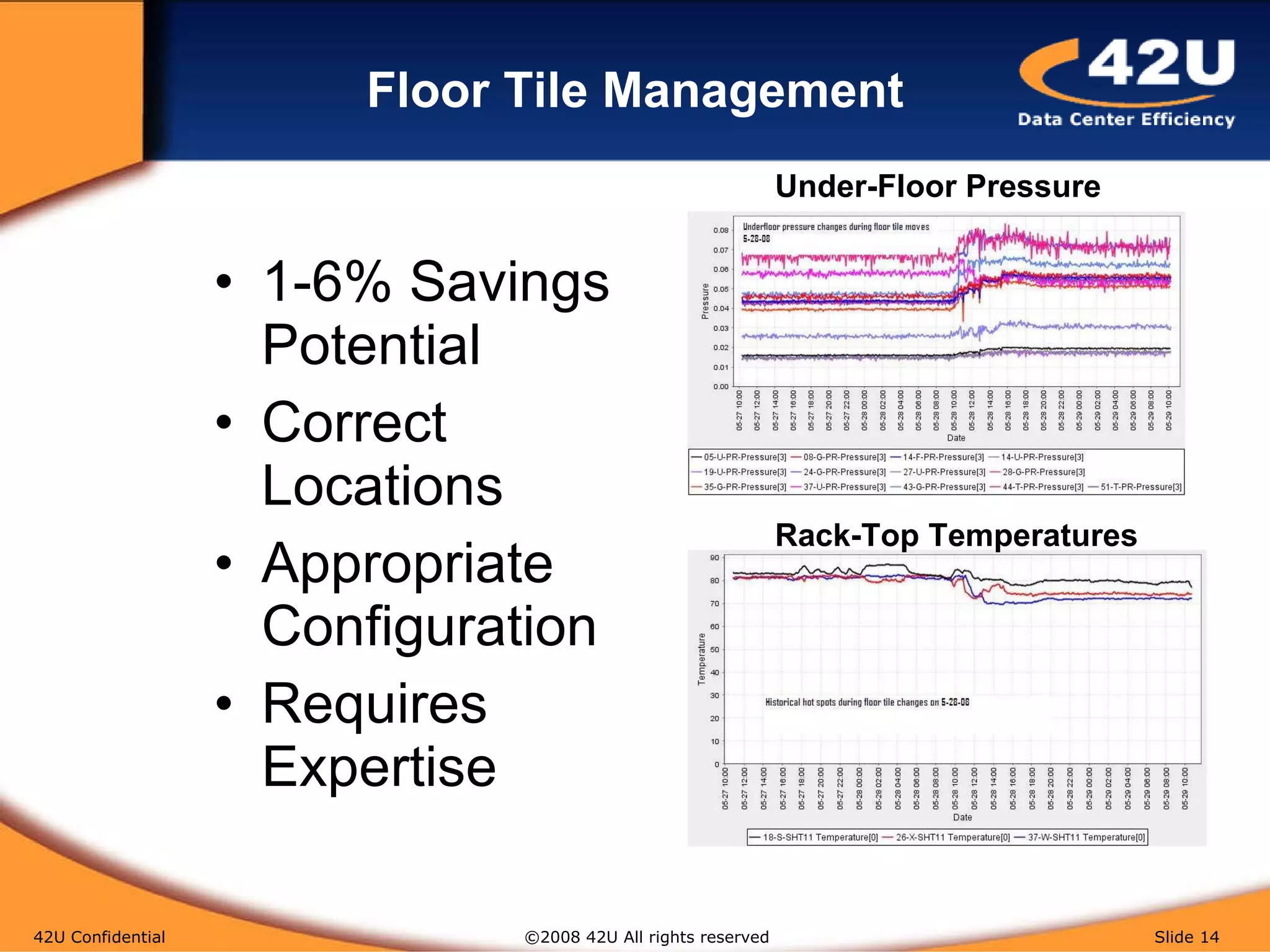
Floor Tile Management 1-6% Savings Potential Correct Locations Appropriate Configuration Requires Expertise 42U Confidential   ©2008 42U All rights reserved  Slide  Under-Floor Pressure Rack-Top Temperatures
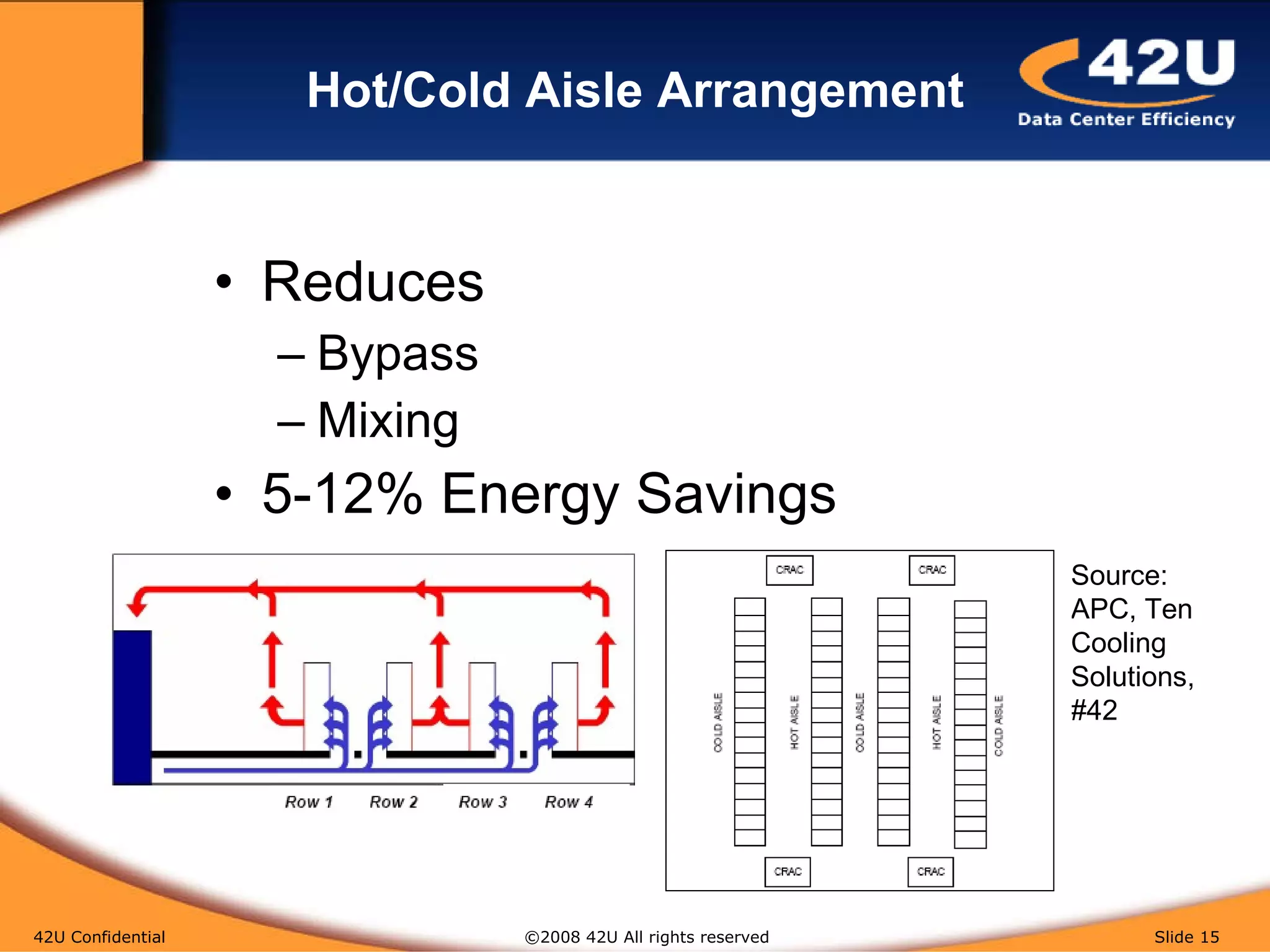
Hot/Cold Aisle Arrangement Reduces Bypass Mixing 5-12% Energy Savings 42U Confidential   ©2008 42U All rights reserved  Slide  Source: APC, Ten Cooling Solutions, #42
Advanced Air Flow Containment Hot Aisle Cold Aisle Level 1-3 Coordination Dead Band Set Points 42U Confidential   ©2008 42U All rights reserved  Slide
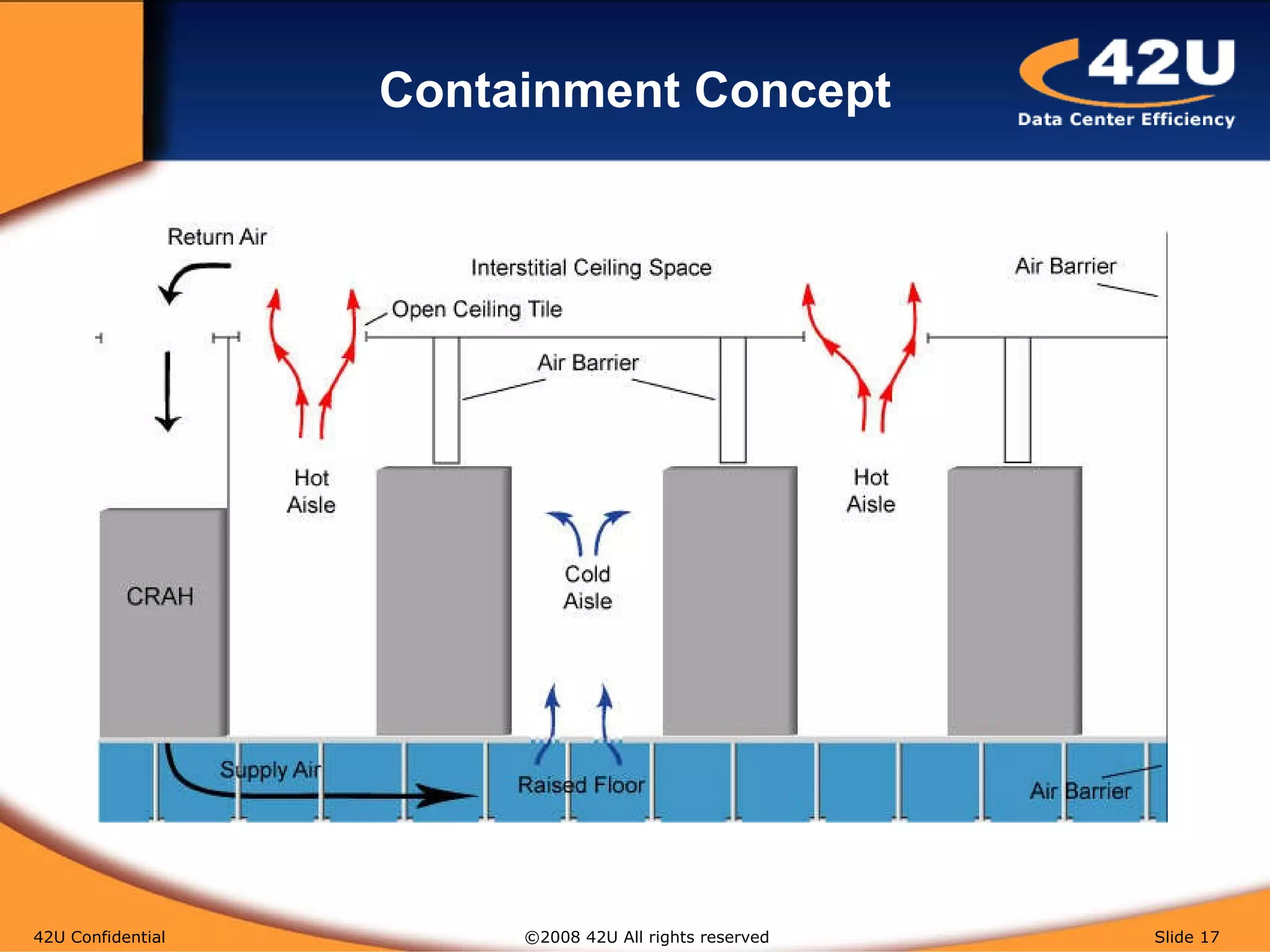
Containment Concept 42U Confidential   ©2008 42U All rights reserved  Slide
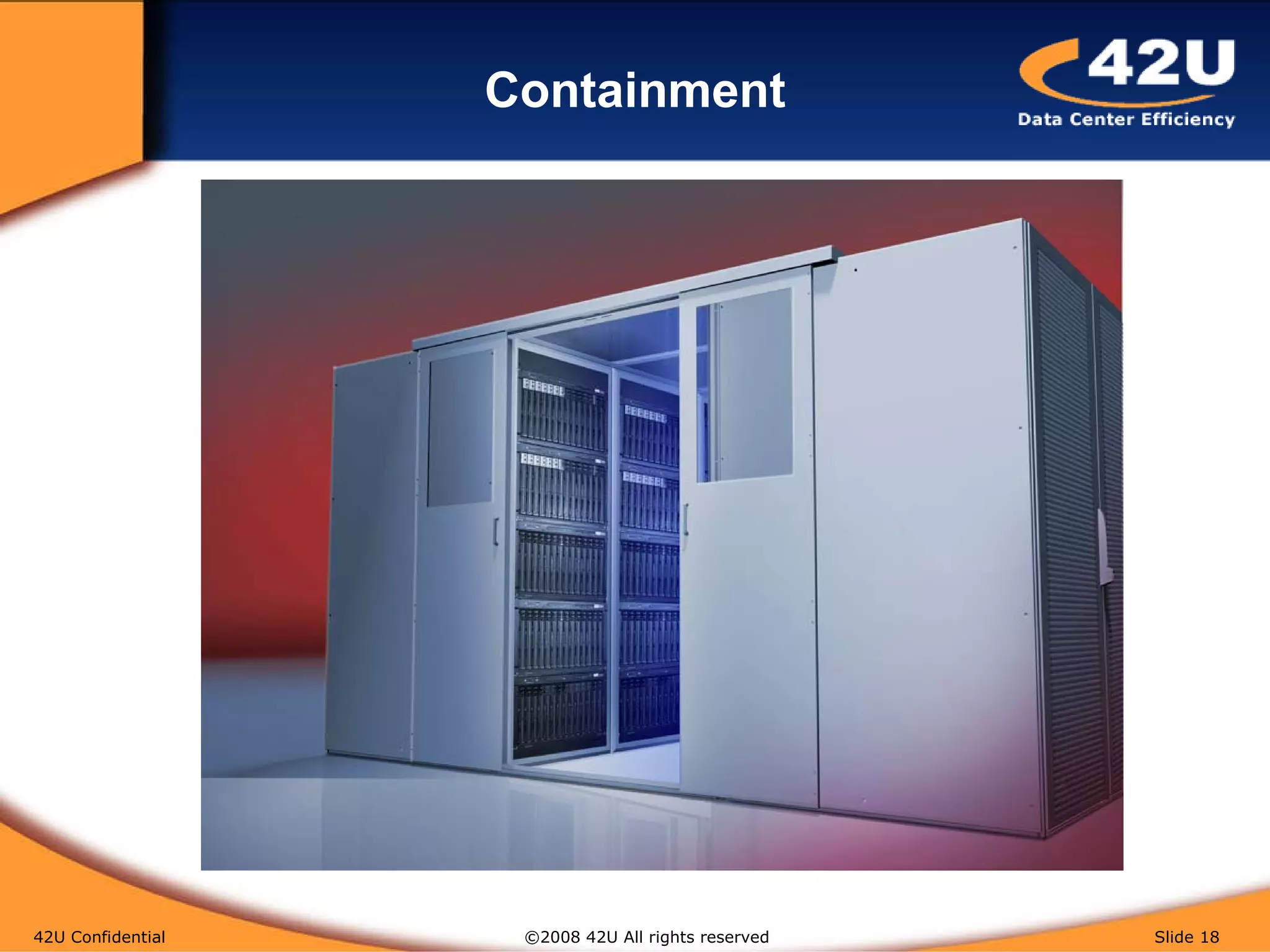
Containment 42U Confidential   ©2008 42U All rights reserved  Slide
Coordination 0-10% Savings Potential Detailed Analysis Required Dead Band Sensitivity Points 42U Confidential   ©2008 42U All rights reserved  Slide
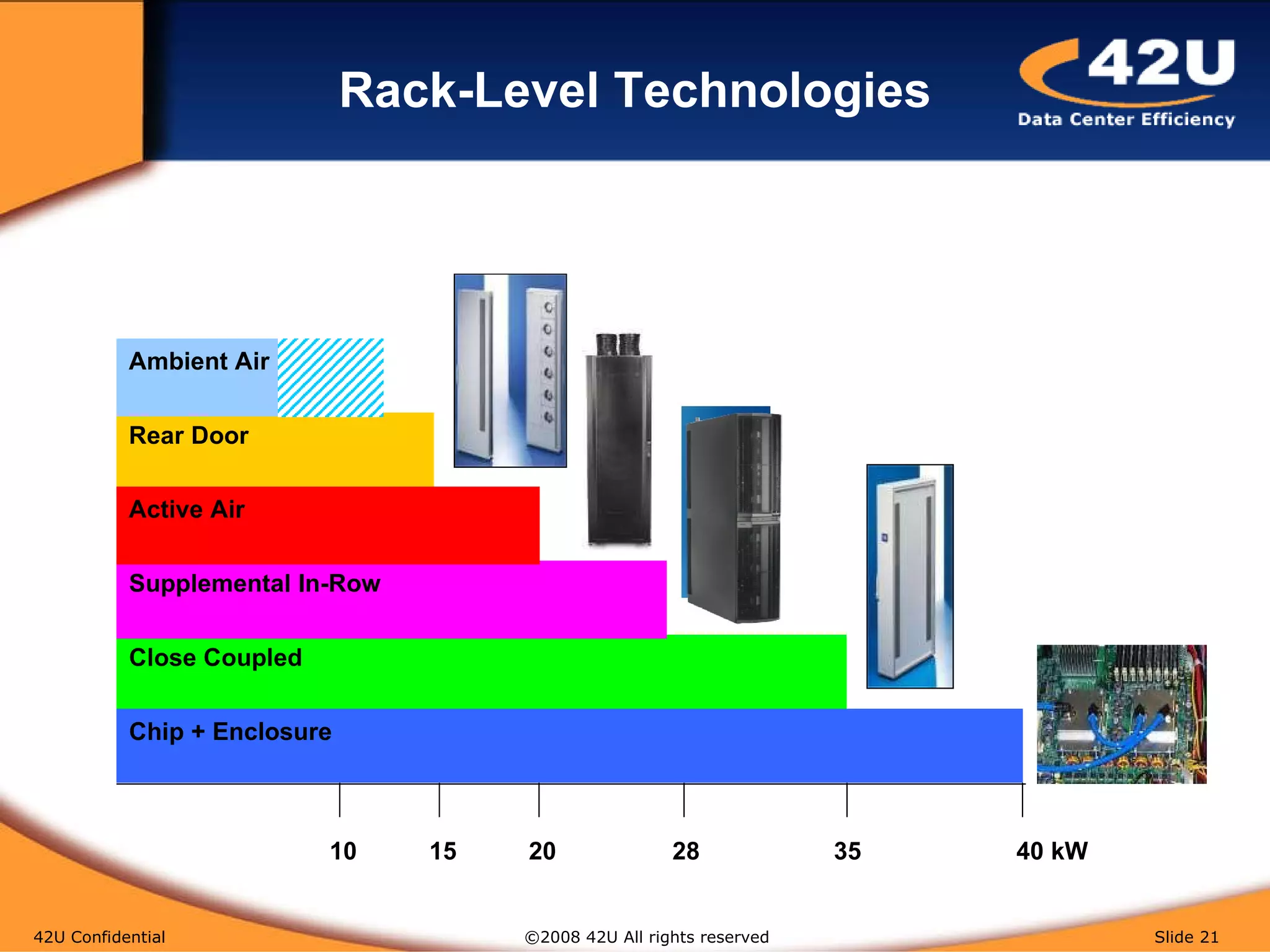
Cooling Technologies Rack-Level 7-15% Savings Potential Room-Level 4-15% Savings Potential Coolants 42U Confidential   ©2008 42U All rights reserved  Slide
Rack-Level Technologies 42U Confidential   ©2008 42U All rights reserved  Slide  Close Coupled Rear Door Ambient Air Supplemental In-Row Active Air 10 15 20 28 35 40 kW Chip + Enclosure
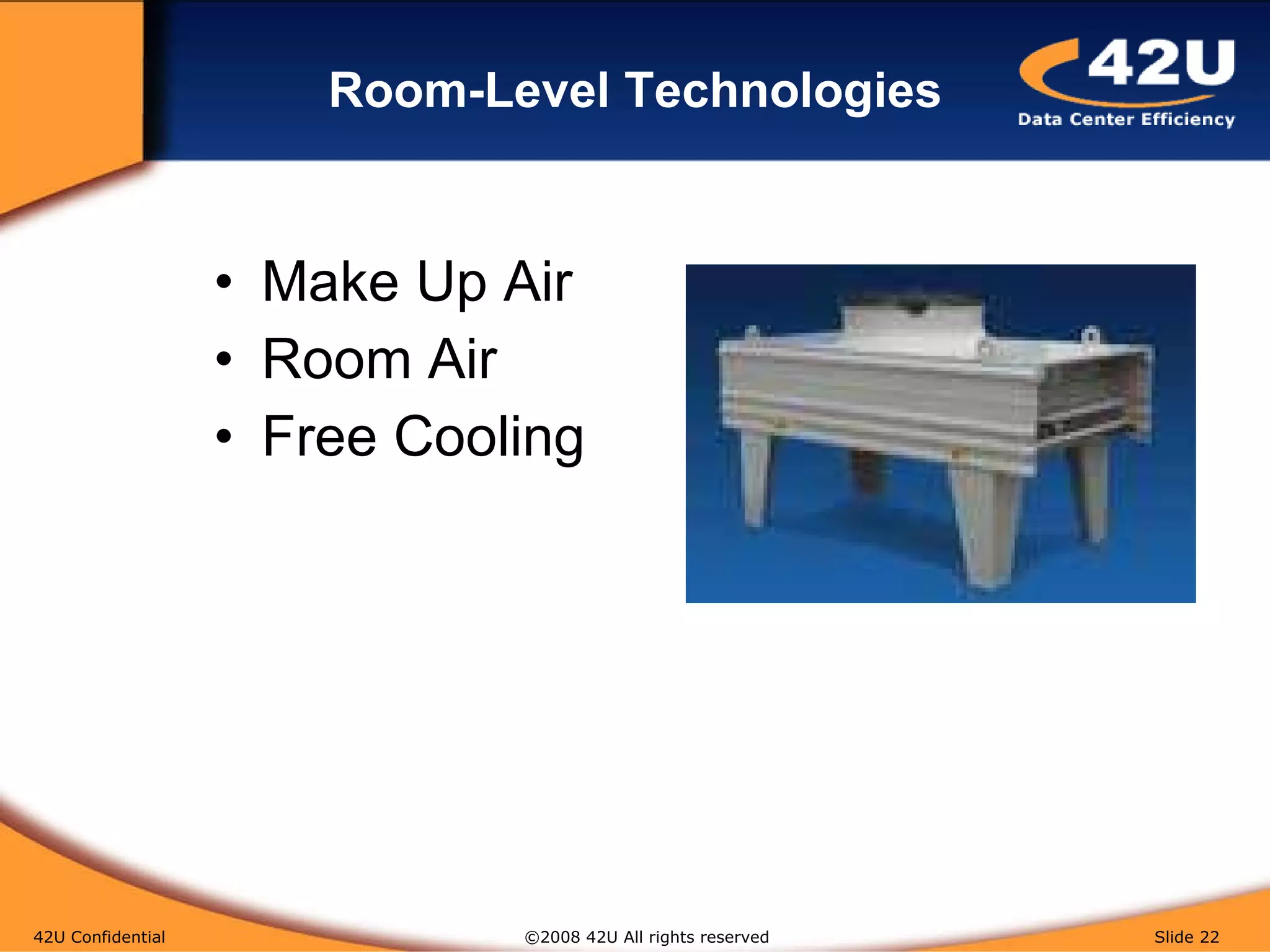
Room-Level Technologies Make Up Air Room Air Free Cooling 42U Confidential   ©2008 42U All rights reserved  Slide
Power Technologies 4-10% Savings Potential Sizing Best Practice 3-Phase Power Distribution Line-Interactive UPS High Efficiency UPS 42U Confidential   ©2008 42U All rights reserved  Slide
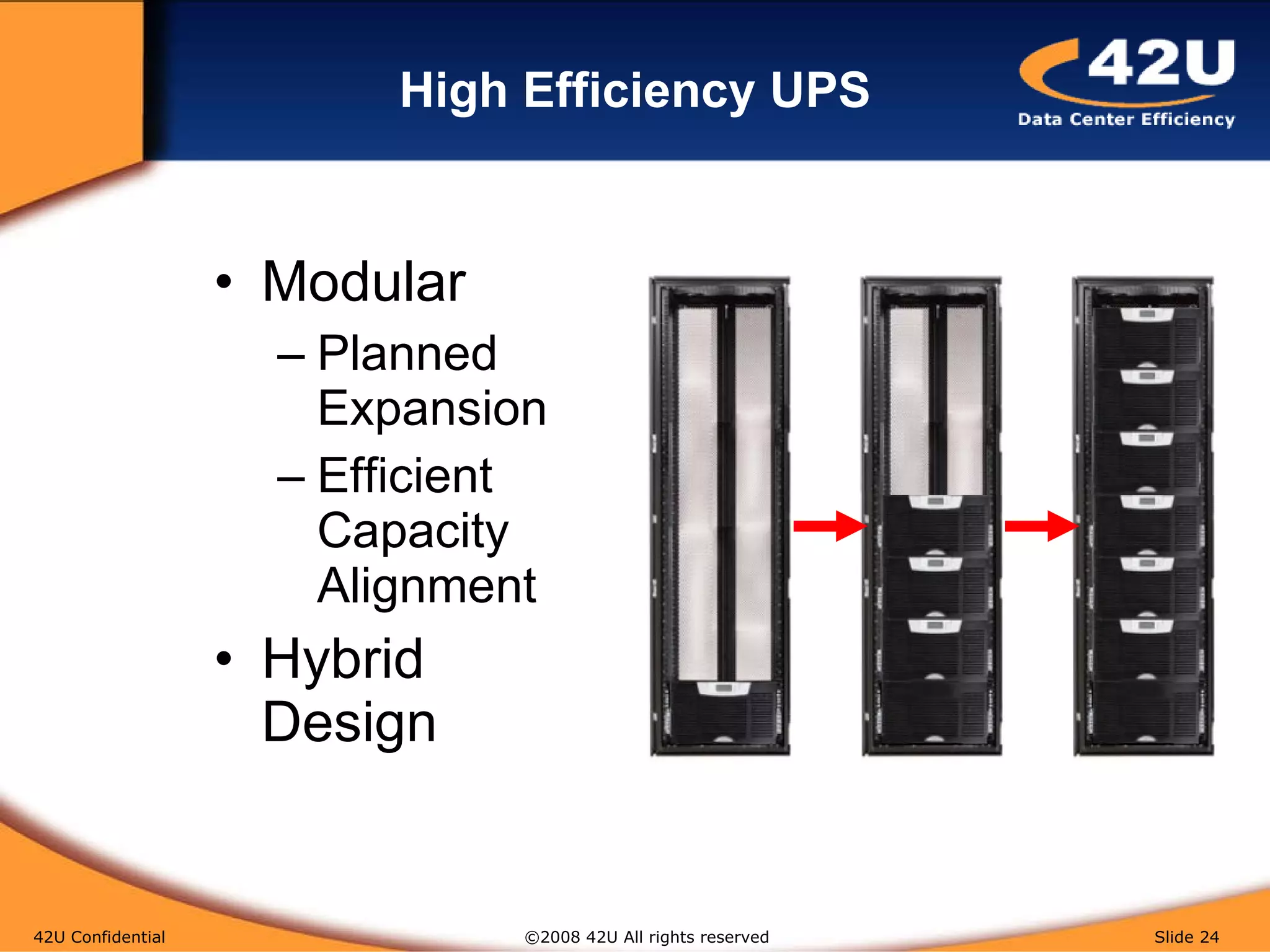
High Efficiency UPS Modular Planned Expansion Efficient Capacity Alignment Hybrid Design 42U Confidential   ©2008 42U All rights reserved  Slide
Remote Power Proactive Approach Internet Access to Infrastructure Predetermined Alerting Immediate Response to Alerts 42U Confidential   ©2008 42U All rights reserved  Slide
Remote Power ROI 72% of Technician Calls are Resolved with a Re-Boot Average Service Call Cost is $500 Downtime Reduced from 1.5 Hours to Minutes 42U Confidential   ©2008 42U All rights reserved  Slide
Additional Efficiency Programs Lighting LED Lighting Proximity Sensors In-Cabinet Extend Return Ducts 42U Confidential   ©2008 42U All rights reserved  Slide
Summary Value of Best-Practices Fundamentals Advanced Air Flow Cooling Technologies Power Technologies 42U Confidential   ©2008 42U All rights reserved  Slide
E 3  Estimator Estimation of Data Center Energy Costs Industry Benchmark Basis Multiple Research Resources Availability Spreadsheet Now 42U Website Soon 42U Confidential   ©2008 42U All rights reserved  Slide
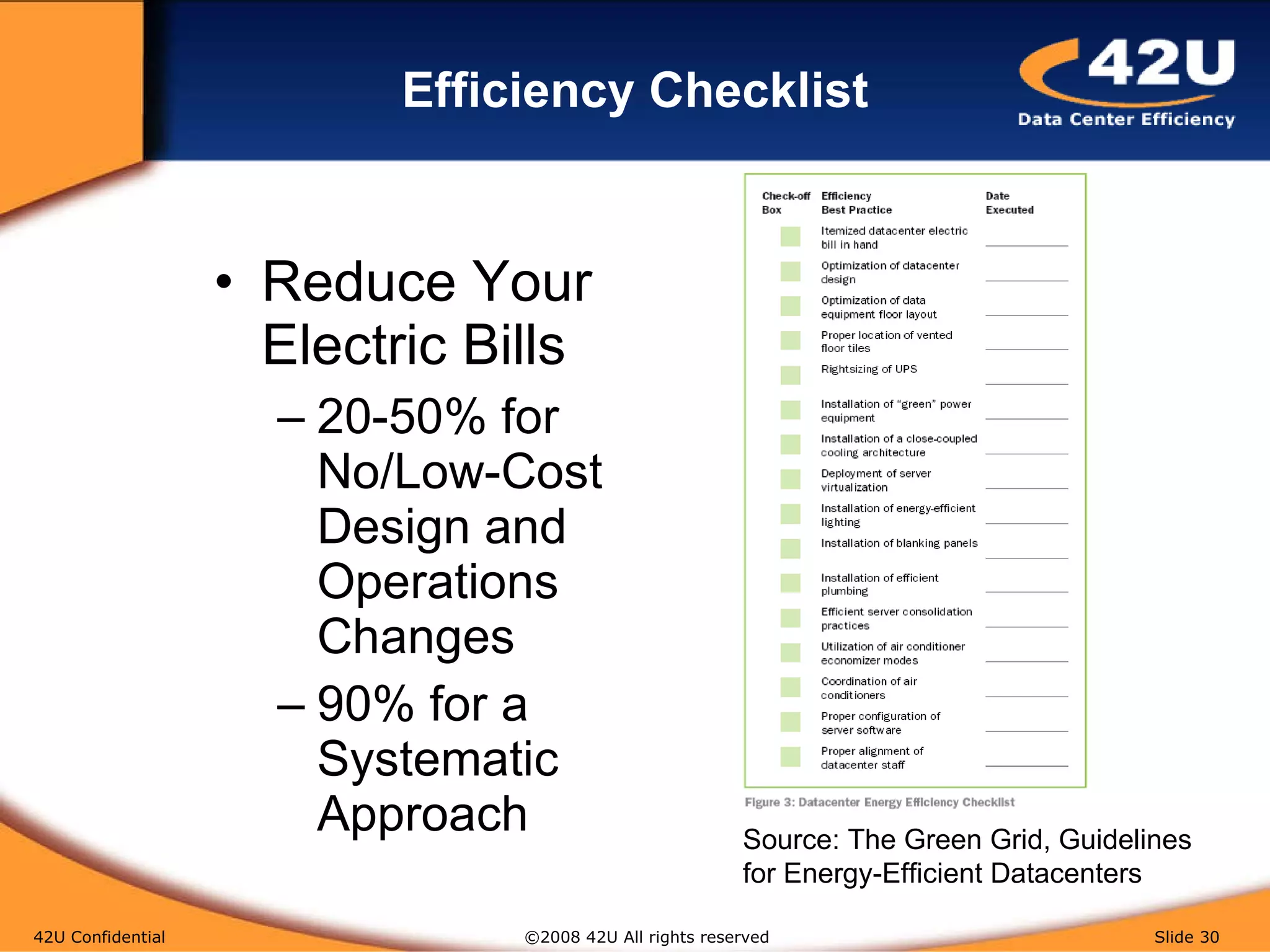
Efficiency Checklist Reduce Your Electric Bills 20-50% for No/Low-Cost Design and Operations Changes 90% for a Systematic Approach 42U Confidential   ©2008 42U All rights reserved  Slide  Source: The Green Grid, Guidelines for Energy-Efficient Datacenters
Q&A 42U Confidential   ©2008 42U All rights reserved  Slide  For More Information Contact Your 42U Data Center Efficiency Consultant: 1-800-638-2638 or  www.42U.com For a Copy of Today’s Presentation Email: [email_address] Thank You

Data Center Energy Efficiency Best Practices

  • 1.
    42U Confidential ©2008 42U All rights reserved Slide Data Center Energy Efficiency Best-Practices – Insights Into The ROI On Best-Practices December 3, 2008 ________________________________
  • 2.
    Overview Importance ofBest-Practices Strategic Fundamentals Advanced Air Flow Cooling Technologies Power Technologies Summary Q&A 42U Confidential ©2008 42U All rights reserved Slide
  • 3.
    Downtime Costs 42UConfidential ©2008 42U All rights reserved Slide
  • 4.
    Cumulative Loss 42UConfidential ©2008 42U All rights reserved Slide Source: Energy Logic
  • 5.
    Energy Consumers InfrastructureConsumes More Power Than The IT Equipment 42U Confidential ©2008 42U All rights reserved Slide Source: The Green Grid, Guidelines for Energy-Efficient Datacenters
  • 6.
    Energy Benchmark GreenGrid Benchmark Enables Comparison 42U Confidential ©2008 42U All rights reserved Slide Source: The Green Grid
  • 7.
    Benchmark PUE DataBest-Case To Date: 1.21 42U Confidential ©2008 42U All rights reserved Slide
  • 8.
    Efficiency Measurement Life-CycleSM 42U Confidential ©2008 42U All rights reserved Slide Measurement Point Design Measurement Object Database Security Hardware Configuration & Testing Network Configuration & Testing Sensor Installation Software Installation Network Verification Data Collection Analysis System Management Facilities Data IT Infrastructure Data IT Equipment Data Integration Requirements Recommendations Reconfiguration Plan Efficiency Improvements Survey Plan Install Measure Reconfigure
  • 9.
    Efficiency Progression BasicAirflow Close-Coupled Cooling Economizers More Efficient Technologies Consolidation Virtualization 42U Confidential ©2008 42U All rights reserved Slide Energy Expense
  • 10.
    Strategic Approaches MeasurementModular Components 10-30% Savings Potential Virtualization 10-40% Savings Potential 42U Confidential ©2008 42U All rights reserved Slide
  • 11.
    Measuring Efficiency 42UConfidential ©2008 42U All rights reserved Slide Rack Temperature RH Current Power Sub-floor Pressure Differential CRAH Supply & Return Air Temp Supply RH Chilled Water Supply & Return Temp Fan Power Chilled Water Flow (Captured at CRAH) PDU Current, Voltage & Power
  • 12.
    Fundamentals Air FlowManagement Blanking Panels Floor Tile Management Floor Management Design Maintenance 42U Confidential ©2008 42U All rights reserved Slide
  • 13.
    Blanking Panel ImpactImpact of a Single Blanking Panel 1-2% Savings 42U Confidential ©2008 42U All rights reserved Slide Top of rack Middle of rack
  • 14.
    Floor Tile Management1-6% Savings Potential Correct Locations Appropriate Configuration Requires Expertise 42U Confidential ©2008 42U All rights reserved Slide Under-Floor Pressure Rack-Top Temperatures
  • 15.
    Hot/Cold Aisle ArrangementReduces Bypass Mixing 5-12% Energy Savings 42U Confidential ©2008 42U All rights reserved Slide Source: APC, Ten Cooling Solutions, #42
  • 16.
    Advanced Air FlowContainment Hot Aisle Cold Aisle Level 1-3 Coordination Dead Band Set Points 42U Confidential ©2008 42U All rights reserved Slide
  • 17.
    Containment Concept 42UConfidential ©2008 42U All rights reserved Slide
  • 18.
    Containment 42U Confidential ©2008 42U All rights reserved Slide
  • 19.
    Coordination 0-10% SavingsPotential Detailed Analysis Required Dead Band Sensitivity Points 42U Confidential ©2008 42U All rights reserved Slide
  • 20.
    Cooling Technologies Rack-Level7-15% Savings Potential Room-Level 4-15% Savings Potential Coolants 42U Confidential ©2008 42U All rights reserved Slide
  • 21.
    Rack-Level Technologies 42UConfidential ©2008 42U All rights reserved Slide Close Coupled Rear Door Ambient Air Supplemental In-Row Active Air 10 15 20 28 35 40 kW Chip + Enclosure
  • 22.
    Room-Level Technologies MakeUp Air Room Air Free Cooling 42U Confidential ©2008 42U All rights reserved Slide
  • 23.
    Power Technologies 4-10%Savings Potential Sizing Best Practice 3-Phase Power Distribution Line-Interactive UPS High Efficiency UPS 42U Confidential ©2008 42U All rights reserved Slide
  • 24.
    High Efficiency UPSModular Planned Expansion Efficient Capacity Alignment Hybrid Design 42U Confidential ©2008 42U All rights reserved Slide
  • 25.
    Remote Power ProactiveApproach Internet Access to Infrastructure Predetermined Alerting Immediate Response to Alerts 42U Confidential ©2008 42U All rights reserved Slide
  • 26.
    Remote Power ROI72% of Technician Calls are Resolved with a Re-Boot Average Service Call Cost is $500 Downtime Reduced from 1.5 Hours to Minutes 42U Confidential ©2008 42U All rights reserved Slide
  • 27.
    Additional Efficiency ProgramsLighting LED Lighting Proximity Sensors In-Cabinet Extend Return Ducts 42U Confidential ©2008 42U All rights reserved Slide
  • 28.
    Summary Value ofBest-Practices Fundamentals Advanced Air Flow Cooling Technologies Power Technologies 42U Confidential ©2008 42U All rights reserved Slide
  • 29.
    E 3 Estimator Estimation of Data Center Energy Costs Industry Benchmark Basis Multiple Research Resources Availability Spreadsheet Now 42U Website Soon 42U Confidential ©2008 42U All rights reserved Slide
  • 30.
    Efficiency Checklist ReduceYour Electric Bills 20-50% for No/Low-Cost Design and Operations Changes 90% for a Systematic Approach 42U Confidential ©2008 42U All rights reserved Slide Source: The Green Grid, Guidelines for Energy-Efficient Datacenters
  • 31.
    Q&A 42U Confidential ©2008 42U All rights reserved Slide For More Information Contact Your 42U Data Center Efficiency Consultant: 1-800-638-2638 or www.42U.com For a Copy of Today’s Presentation Email: [email_address] Thank You

Editor's Notes

  • #4 <J> Just in case you don’t know, and I’m sure most of you listening are painfully aware of these numbers, it’s costly to have downtime.
  • #5 Here is a view of the typical conversion losses… From this slide, we see as the power cascades back from the server to its original source at the utility we are losing wattage each step of the way. These small wattage savings can add up to a significant number as you multiply it across your entire facility. Any positive changes you can make to the efficiency of this process are extremely beneficial. If you implement best practices you can leverage this information to further improve efficiency.
  • #6 <J> Here are the results of a study done by The Green Grid. They found that for the data centers measured just 30% of the energy consumed went to the actual IT equpment. <Michael> And this is only 1 approach, IDC states 48% for Overhead, and 52% for IT
  • #7 <J> I prefer to use independent sources of information as opposed to those supplied by vendors. Power use efficiency is an alternative use of the acronym. Also characterized as Energy Efficiency Ratio (EER) by the EPA. <Michael> So as we focus on that gray area in the middle, we are looking at numbers in the 30%-50% range
  • #8 <J> Here is another view of The Green Grid research. <Michael> Lawrence Berkeley National Laboratory did a separate study of 24 California Data centers and found the average there to be closer to the objective shown here, and many were close to the 1.5 level. <J> Interesting. California does have a more aggressive energy policy. In fact, we’ve seen PUE measurements as low as 1.21, again a California-based data center.
  • #9 Start with Survey. Note that installation phase could be minimal with point-in-time measurements.
  • #10 <Michael> Based on the Efficiency Measurement Life-Cycle process, 42U advises that clients first set the baseline values, implement a targeted efficiency best practice and then measure the efficiency gains. Then, repeating the process with increasingly more sophisticated technologies. Have established relationships with specialty companies for consolidation and virtualization.
  • #11 Measurement is critical to establishing the savings of programs. ASHRAE TC 9.9: Adjustments for IT; operating temperature range expanded from 68-77 to 64.4-80.6, refresh rate of IT equipment is 2-5 years, building cooling is 10-25 years Modular systems, such as modular UPS systems. Recall slide 6 cascade. Permits more precise sizing of infrastructure to match computing loads. Virtualization- typically results in 1:10 up to 1:20 server reductions
  • #12 This shows the various points at which we can measure. All the components are broken down to categories. Energy flows from utility to the facility, and then out to IT internal to the racks Again as you can see there are various points at which you can monitor.. You should design your power infrastructure to support business requirements These requirements typically have to do with SLAs, what are the standard practices and procedures the organization has to follow, or charge backs, am I sharing the space and how can I accurately charge our customers for the energy they use.
  • #13 Reduce bypass airflow as well as mixing Ensure ALL uncontrolled airflow is managed; wall gaps, all service access points, CRAC covers on idle systems Floor management: Hot/cold aisle Clearing subfloor plenum of cables and other blockages CFD tools, vortex example Maintenance: Manage moves adds and changes Eliminate idle servers Remove unused cabling Close off and prevent airflow gaps On-going measurement program will identify issues in this area
  • #14 <M> Here is an example of the measurable impact of adding one 12” blanking panel to the middle of a rack <J> This is then the best best practice, right? <M> Exactly. Conventional wisdom is correct: blanking panes are essential
  • #15 <M> Feedback on floor-tile tuning: with instrumentation, we can observe results in real time When airflow is restricted, Under-floor pressure increases Rack-top temperatures decrease <J> This is pretty complex isn’t it? <M> Yes. Without monitoring and visualization, this process is guesswork How many or which tiles to remove? Other data center clichĂ©s also borne out Eliminate leaks in floor Manage floor tile permeability
  • #16 <M> At all rack design points hot/cold aisle configurations will be more efficient Diagrams show an end view of aisles on left, with CRAC moved to side for illustration purposes, and an overhead view illustrating best-practice CRAC locations. Effective cable management moves savings to higher levels by avoiding airflow blockage in the cabinet Ensure gaps between cabinets are also blocked. <J> Should clients keep empty cabinets with blanking panels in rows to close gaps? <M> Yes, either that or use other containment technologies Low heat racks on ends of aisles to reduce mixing around ends of rows In addition to aisle arrangement, best-practice placement of cooling equipment is an important aspect of this best practice
  • #17 Level 1-3 = 42U branded containment model
  • #18 <M> Containment is simply controlling airflow in an efficient manner. Containment can focus on either the hot aisle or the cold aisle. Hot aisle containment is less efficient and can make OSHA compliance less challenging. Cold aisle containment is more efficient, but raises ambient room temperature 42U has defined a modular containment model to enable clients to achieve immediate savings with a minimal investment. The concept defines three levels of containment; level 1 is closing off aisle ends to eliminate mixing around row ends and to keep chilled air in front of cabinets. Level 2 extends baffling above racks to further reduce mixing over rack tops. Level 3 is complete containment where containment technology covers the entire aisle.
  • #19 <M> Here is an example of one cold aisle containment technology. Achieves higher-end of savings potential. Range of technologies are available depending on specific client requirements, including existing vs new build and tailored to data center configuration.
  • #20 <M> This is essentially coordination of cooling technologies. In larger data centers multiple cooling systems can actually compete. For example, one CRAC can detect low humidity and begin humidifying. A neighboring CRAC detects the increase in humidity and begins de-humidifying, resulting in gross energy waste. <J> Moving set-points to supply side rather than the current approach of the return Deadband speaks to setting sensitivity points to a wider range, for example from +/– 2 degrees to +/– 10 degrees, so that the equipment does not compete. Moving set-points to supply side rather than the current approach of the return
  • #21 Rack-Level: In Row and Close Coupled Room-Level: Brief coverage of pros and cons of water versus refrigerant: water is more efficient, less costly; refrigerant less risky, reduced footprint
  • #23 Economizers: air-side and water-side Adiabatic: sprays a mist of water around heat exchanger to improve efficiency Heat Wheel: reduces air mixing Dry Coolers
  • #24 Best practice is to size for light load efficiency, NOT peak load efficiency Line-Interactive UPS: widely adopted UPS technology in Europe, not yet adopted in US as it can’t be integrated into an existing environment. New UPS is 70% more efficient
  • #25 Now lets take a step back to the UPS Commission as you go vs. commission build out Modular, shared buss bar, N+1 redundancy internal to the configuration 12kVA increments, 60kVA N+1
  • #26 <M> Remote power allows you to take a proactive approach to managing your power. The Best practice for remote power management is to deploy Switched PDUs IP UPS Monitoring tools at the breaker……. Access power infrastructure anywhere, anytime you have access to internet Alerting based on predetermined events or thresholds Ability to act on alerts instantly It may seem like a daunting/costly undertaking to implement a remote power strategy but the ROI is rather simple to calculate.
  • #27 <M> Most of you on the line are probably nodding rite now. Studies have shown that 72% of all technician calls are solved by simply bouncing a server. The average cost of this service is roughly $500 and the time associated with the call can take hours depending on the time of day and distance to the facility. With remote power management you can decrease this service time to minutes One other factor not listed here are the service level penalties associated with downtime.. The take away here is there are many opportunities to improve the efficiency of your data center through the implementation of a power management strategy. Each approach detailed will yield significant savings to your organization and the approaches are customizable to meet your business requirements.
  • #28 These too should be considered, but they are more difficult to measure and establish hard ROIs
  • #30 E3 Is a calculator we developed to help our clients have a starting point for understanding the cost associated with their energy consumption. E3 stands for Estimated Energy Expense. What we found in many organizations is a disconnect between facilities and IT. This calculator helps the IT manager understand the cost of energy. The calculator is comprised of 5 key factors: kW/hour rate kW/rack design point # of racks in data center Overhead factor (infrastructure required to power and cool the equipment) Uptime requirement (how many 9s of uptime) If you do not have all 5 factors we will use industry averages. The only data you need to supply is the number of racks. Contact a 42U efficiency consultant for more information and to evaluate your energy consumption.