Cooling Solutions Presented by Paul Almond – Datacentre UK
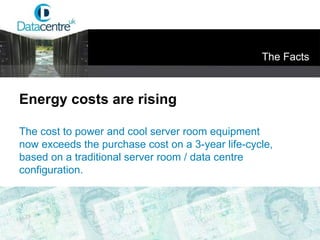
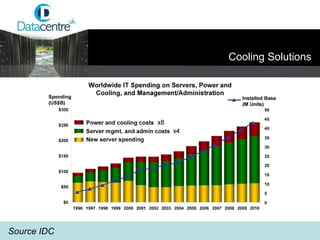
The Facts Energy costs are rising The cost to power and cool server room equipment now exceeds the purchase cost on a 3-year life-cycle, based on a traditional server room / data centre configuration.
Source IDC Cooling Solutions
•   Reduce energy usage •   Create more efficient rack space Cooling Solutions The Aim The government will be introducing a carbon tax in 2009 All companies will have to report power usage by law
Recent studies reveal that data centre power densities have  increased   ten-fold  in the last  10 years   and that cooling represents upwards of  60-70%  of the total data centre power spend for the majority of customers. These costs are driven by the data centre power requirements and the volume of cooling airflow required Source HP Industry Studies
Agility  – the ability of a system to adapt to change – increasing and unpredictable power densities driven by ever-changing business requirements. Availability  – to eliminate hotspots and vertical temperature gradients at the face of the rack and to assure redundancy when required. Lifecycle costs   – to optimise capital investment and available space – the ability to accelerate speed of deployment and lower maintenance costs, increase ROI and maximise operational efficiency. Manageability   – Simple and intuitive configuration – predictive failure analysis and provision of cooling performance data. Serviceability   – Decrease mean time to recover – simplify complexity – easier service procedures – minimise multi-vendor solutions. What are the cooling challenges in today’s data centres? Cooling Challenges
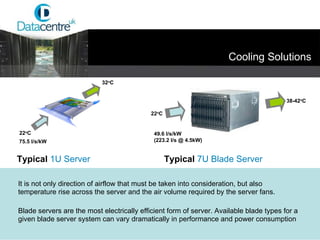
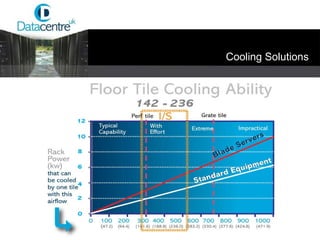
38-42 o C 32 o C It is not only direction of airflow that must be taken into consideration, but also temperature rise across the server and the air volume required by the server fans. Blade servers are the most electrically efficient form of server. Available blade types for a  given blade server system can vary dramatically in performance and power consumption Cooling Solutions 49.6 l/s/kW (223.2 l/s @ 4.5kW) Typical   7U Blade Server 22 o C Typical   1U Server 75.5 l/s/kW 22 o C
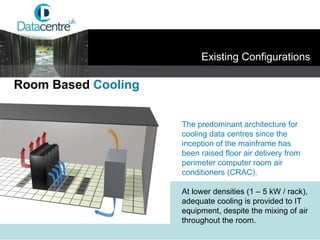
The predominant architecture for cooling data centres since the inception of the mainframe has been raised floor air delivery from perimeter computer room air conditioners (CRAC). At lower densities (1 – 5 kW / rack), adequate cooling is provided to IT equipment, despite the mixing of air throughout the room. Existing Configurations Room Based  Cooling
Cooling Solutions
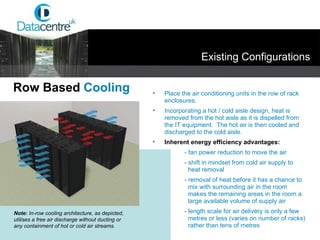
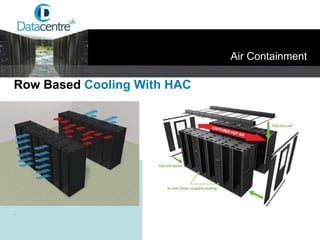
Note:  In-row cooling architecture, as depicted, utilises a free air discharge without ducting or any containment of hot or cold air streams. Place the air conditioning units in the row of rack enclosures. Incorporating a hot / cold aisle design, heat is removed from the hot aisle as it is dispelled from the IT equipment.  The hot air is then cooled and discharged to the cold aisle. Inherent energy efficiency advantages: - fan power reduction to move the air - shift in mindset from cold air supply to   heat removal - removal of heat before it has a chance to    mix with surrounding air in the room    makes the remaining areas in the room a    large available volume of supply air - length scale for air delivery is only a few    metres or less (varies on number of racks)    rather than tens of metres Existing Configurations Row Based  Cooling
Cooling Solutions Eliminate the supply air from the equation Capture all the heat where it is generated, from the hot aisle Remove the heat before it mixes with air streams outside the hot aisle No obstructions to block the air path Avoid complex engineering Variable speed fans to match cooling capacity to power load in each aisle Room temperatures will be easier to maintain with less warm air escaping the hot aisle Close Coupled  Cooling
Cooling Solutions How do I cool my  data centre for   FREE?
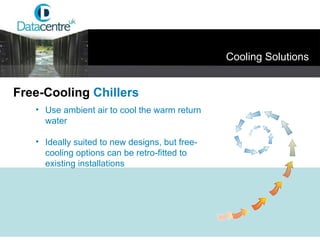
Cooling Solutions Use ambient air to cool the warm return  water Ideally suited to new designs, but free-cooling options can be retro-fitted to existing installations Free-Cooling  Chillers
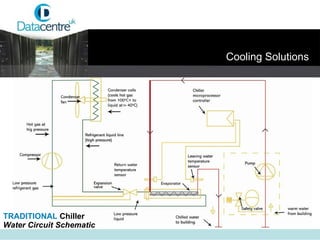
TRADITIONAL  Chiller  Water Circuit Schematic Cooling Solutions
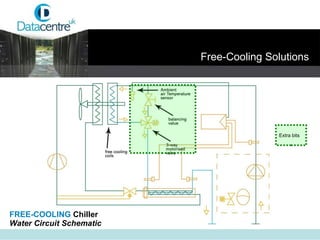
Free-Cooling Solutions FREE-COOLING  Chiller  Water Circuit Schematic Extra bits
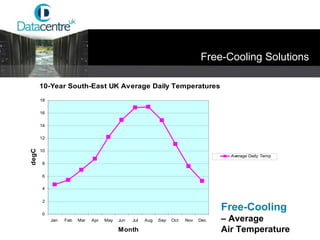
Free-Cooling Solutions Free-Cooling  –  Average Air Temperature
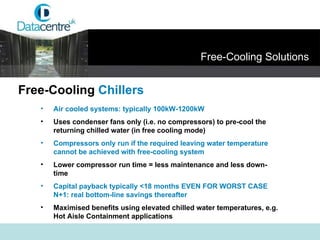
Free-Cooling Solutions Free-Cooling  –  Air Temperature vs Free-Cooling %
Free-Cooling Solutions Free-Cooling  Chillers Air cooled systems: typically 100kW-1200kW Uses condenser fans only (i.e. no compressors) to pre-cool the returning chilled water (in free cooling mode) Compressors only run if the required leaving water temperature cannot be achieved with free-cooling system Lower compressor run time = less maintenance and less down- time Capital payback typically <18 months EVEN FOR WORST CASE N+1: real bottom-line savings thereafter Maximised benefits using elevated chilled water temperatures, e.g. Hot Aisle Containment applications
What do I need to do to be able to utilise free cooling? Create predictable air flow Capture and Contain hot air to maximise return air temp Raise entering water temperature Water is 350% more efficient than air at transferring and transporting heat Free-Cooling  Chillers Free-Cooling Solutions
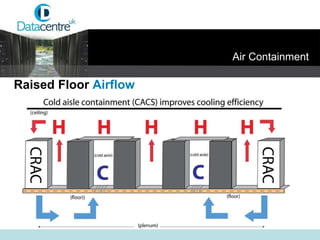
Raised Floor  Airflow Air Containment
. Air Containment Row Based  Cooling With HAC
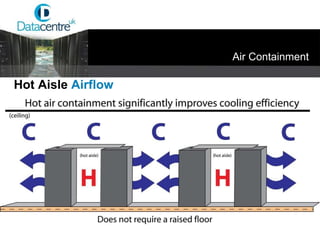
Hot Aisle  Airflow Air Containment
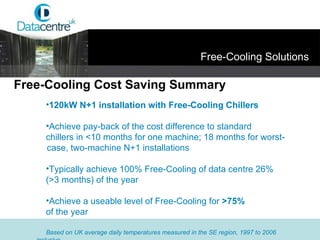
Free-Cooling Solutions Free-Cooling Cost Saving Summary 120kW N+1 installation with Free-Cooling Chillers Achieve pay-back of the cost difference to standard chillers in <10 months for one machine; 18 months for worst-   case, two-machine N+1 installations Typically achieve 100% Free-Cooling of data centre 26%  (>3 months) of the year Achieve a useable level of Free-Cooling for  >75% of the year Based on UK average daily temperatures measured in the SE region, 1997 to 2006 inclusive
Alternative options for energy  efficient cooling solutions Turbocor Chillers Very high efficiency, especially at lower loads Centrifugal compressor with magnetic bearings  eliminates oil and the maintenance / efficiency losses associated with traditional systems Combine with  FREE-COOLING  for maximum effect Cooling Solutions
Government ECA approval status   Excellent full load energy efficiency Further improved part load performance Lower energy bills, reduced carbon footprint Virtually no mechanical wear Unrivalled reliability No oil to degrade the system over time Low noise No vibration Full remote monitoring capability 30% lower overall life cycle costs Turbocor Summary  Benefits Cooling Solutions
* Carbon Trust Energy–Efficiency Loans Interest-free unsecured loans of between £5,000 and £100,000 are available for small and medium sized businesses who are investing in an energy-saving project. Coupled with the ECA scheme this offers business really significant savings. * Free Energy Surveys If your energy bill is higher than £50,000 per year, then you may qualify for a FREE energy survey to provide you with a practical action plan of energy saving measures tailored to your business. * Free Cooling -  If you’re still not convinced... Cooling Solutions
Two major benefits for business   The Enhanced Capital Allowance (ECA) Scheme and the Energy  Technology List   Energy savings Products listed on the ETL are highly energy efficient, and should produce significant long-term financial benefits by reducing your energy bills and Climate Change Levy payments. The Bottom Line Cooling Solutions
Thank You Cooling Solutions

Datacentre Uk

  • 1.
    Cooling Solutions Presentedby Paul Almond – Datacentre UK
  • 2.
    The Facts Energycosts are rising The cost to power and cool server room equipment now exceeds the purchase cost on a 3-year life-cycle, based on a traditional server room / data centre configuration.
  • 3.
  • 4.
    •  Reduceenergy usage •  Create more efficient rack space Cooling Solutions The Aim The government will be introducing a carbon tax in 2009 All companies will have to report power usage by law
  • 5.
    Recent studies revealthat data centre power densities have increased ten-fold in the last 10 years and that cooling represents upwards of 60-70% of the total data centre power spend for the majority of customers. These costs are driven by the data centre power requirements and the volume of cooling airflow required Source HP Industry Studies
  • 6.
    Agility –the ability of a system to adapt to change – increasing and unpredictable power densities driven by ever-changing business requirements. Availability – to eliminate hotspots and vertical temperature gradients at the face of the rack and to assure redundancy when required. Lifecycle costs – to optimise capital investment and available space – the ability to accelerate speed of deployment and lower maintenance costs, increase ROI and maximise operational efficiency. Manageability – Simple and intuitive configuration – predictive failure analysis and provision of cooling performance data. Serviceability – Decrease mean time to recover – simplify complexity – easier service procedures – minimise multi-vendor solutions. What are the cooling challenges in today’s data centres? Cooling Challenges
  • 7.
    38-42 o C32 o C It is not only direction of airflow that must be taken into consideration, but also temperature rise across the server and the air volume required by the server fans. Blade servers are the most electrically efficient form of server. Available blade types for a given blade server system can vary dramatically in performance and power consumption Cooling Solutions 49.6 l/s/kW (223.2 l/s @ 4.5kW) Typical 7U Blade Server 22 o C Typical 1U Server 75.5 l/s/kW 22 o C
  • 8.
    The predominant architecturefor cooling data centres since the inception of the mainframe has been raised floor air delivery from perimeter computer room air conditioners (CRAC). At lower densities (1 – 5 kW / rack), adequate cooling is provided to IT equipment, despite the mixing of air throughout the room. Existing Configurations Room Based Cooling
  • 9.
  • 10.
    Note: In-rowcooling architecture, as depicted, utilises a free air discharge without ducting or any containment of hot or cold air streams. Place the air conditioning units in the row of rack enclosures. Incorporating a hot / cold aisle design, heat is removed from the hot aisle as it is dispelled from the IT equipment. The hot air is then cooled and discharged to the cold aisle. Inherent energy efficiency advantages: - fan power reduction to move the air - shift in mindset from cold air supply to heat removal - removal of heat before it has a chance to mix with surrounding air in the room makes the remaining areas in the room a large available volume of supply air - length scale for air delivery is only a few metres or less (varies on number of racks) rather than tens of metres Existing Configurations Row Based Cooling
  • 11.
    Cooling Solutions Eliminatethe supply air from the equation Capture all the heat where it is generated, from the hot aisle Remove the heat before it mixes with air streams outside the hot aisle No obstructions to block the air path Avoid complex engineering Variable speed fans to match cooling capacity to power load in each aisle Room temperatures will be easier to maintain with less warm air escaping the hot aisle Close Coupled Cooling
  • 12.
    Cooling Solutions Howdo I cool my data centre for FREE?
  • 13.
    Cooling Solutions Useambient air to cool the warm return water Ideally suited to new designs, but free-cooling options can be retro-fitted to existing installations Free-Cooling Chillers
  • 14.
    TRADITIONAL Chiller Water Circuit Schematic Cooling Solutions
  • 15.
    Free-Cooling Solutions FREE-COOLING Chiller Water Circuit Schematic Extra bits
  • 16.
    Free-Cooling Solutions Free-Cooling – Average Air Temperature
  • 17.
    Free-Cooling Solutions Free-Cooling – Air Temperature vs Free-Cooling %
  • 18.
    Free-Cooling Solutions Free-Cooling Chillers Air cooled systems: typically 100kW-1200kW Uses condenser fans only (i.e. no compressors) to pre-cool the returning chilled water (in free cooling mode) Compressors only run if the required leaving water temperature cannot be achieved with free-cooling system Lower compressor run time = less maintenance and less down- time Capital payback typically <18 months EVEN FOR WORST CASE N+1: real bottom-line savings thereafter Maximised benefits using elevated chilled water temperatures, e.g. Hot Aisle Containment applications
  • 19.
    What do Ineed to do to be able to utilise free cooling? Create predictable air flow Capture and Contain hot air to maximise return air temp Raise entering water temperature Water is 350% more efficient than air at transferring and transporting heat Free-Cooling Chillers Free-Cooling Solutions
  • 20.
    Raised Floor Airflow Air Containment
  • 21.
    . Air ContainmentRow Based Cooling With HAC
  • 22.
    Hot Aisle Airflow Air Containment
  • 23.
    Free-Cooling Solutions Free-CoolingCost Saving Summary 120kW N+1 installation with Free-Cooling Chillers Achieve pay-back of the cost difference to standard chillers in <10 months for one machine; 18 months for worst- case, two-machine N+1 installations Typically achieve 100% Free-Cooling of data centre 26% (>3 months) of the year Achieve a useable level of Free-Cooling for >75% of the year Based on UK average daily temperatures measured in the SE region, 1997 to 2006 inclusive
  • 24.
    Alternative options forenergy efficient cooling solutions Turbocor Chillers Very high efficiency, especially at lower loads Centrifugal compressor with magnetic bearings eliminates oil and the maintenance / efficiency losses associated with traditional systems Combine with FREE-COOLING for maximum effect Cooling Solutions
  • 25.
    Government ECA approvalstatus Excellent full load energy efficiency Further improved part load performance Lower energy bills, reduced carbon footprint Virtually no mechanical wear Unrivalled reliability No oil to degrade the system over time Low noise No vibration Full remote monitoring capability 30% lower overall life cycle costs Turbocor Summary Benefits Cooling Solutions
  • 26.
    * Carbon TrustEnergy–Efficiency Loans Interest-free unsecured loans of between £5,000 and £100,000 are available for small and medium sized businesses who are investing in an energy-saving project. Coupled with the ECA scheme this offers business really significant savings. * Free Energy Surveys If your energy bill is higher than £50,000 per year, then you may qualify for a FREE energy survey to provide you with a practical action plan of energy saving measures tailored to your business. * Free Cooling - If you’re still not convinced... Cooling Solutions
  • 27.
    Two major benefitsfor business   The Enhanced Capital Allowance (ECA) Scheme and the Energy Technology List   Energy savings Products listed on the ETL are highly energy efficient, and should produce significant long-term financial benefits by reducing your energy bills and Climate Change Levy payments. The Bottom Line Cooling Solutions
  • 28.

Editor's Notes

  • #3 Fact 1: Power and cooling costs increasingly limit scalability of your data center, and consume an ever-larger share of budget resources. The 3-year energy cost of highly dense servers is roughly equivalent to their acquisition cost. 1 Fact 2:  Advances in compute density, such as blade servers, have resulted in highly dense servers that require significantly more power and cooling than traditional server configurations. Industry analyst Gartner wrote, “The leading server vendors recognize the problems associated with highly dense hardware and, in particular, with the rapid uptake of high-density blades.  As such, they are attempting to develop solutions to deal with those problems.” 2 Fact 3:  The power and associated costs to cool the datacenter can be as much or more than the cost of powering the IT equipment (servers, storage, and networking). [3] A study by HP and The Uptime Institute suggests that in a majority of the world&apos;s data centers 63% of a datacenter’s power is associated with the power of cooling the IT equipment. 4 While the rest of the industry is narrowly focused on only one aspect of the problem -- reducing the power of chips and other components, HP is also addressing the need to reduce the power requirements and costs associated with cooling the datacenters themselves.  Fact 4:  Reducing the energy required to cool a datacenter can result in significant cost savings (and reduction in CO2 emissions) or the ability to deploy more IT equipment in the same space -- or a mixture of the two.  
  • #6 Why The onset of high density computing including blades
  • #8 Blade servers both offer increased computing density and a significant performance per watt benefit. These inherent advantages of blades when matched with advanced power and cooling infrastructure, can assist to drive out waste in the physical environment and drive up efficiencies.
  • #9 Major obstacle is the length scale of air delivery - distance between cooling units and heat load make it difficult to properly remove the heat generated from IT equipment without mixing with supply air - results in hot spots and a complicated design approach to air distribution