This document reviews various procurement strategies within the building industry, outlining methods such as traditional, design and build, turnkey, direct labor, public-private partnerships, and management procurement. Each method is analyzed for its attributes, advantages, and disadvantages, while also highlighting the complexities involved and risks associated with selecting the optimal strategy. Overall, it emphasizes the importance of understanding and managing risks in the procurement process.
Introduces procurement strategies in the building industry. Discusses the concept and methods, including attributes, pros, cons, and comparison.
Defines procurement as a risk management process in the building industry. Highlights the difficulty of selecting optimal procurement methods due to inherent risks.
Covers the Traditional method (Design-Bid-Build), its structure, phases, advantages like price certainty, and disadvantages such as lengthy processes.
Defines Design-Build procurement, highlighting its attributes like efficiency and advantages such as faster delivery and fewer disputes, along with its drawbacks.
Describes Turnkey procurement, emphasizing that projects are built for operational readiness, along with advantages like contractor ownership and client simplicity.
Details Direct Labour method, where clients manage projects directly, discussing its advantages like cost efficiency and disadvantages such as limited complexity handling.
Defines PPP as a risk-shared contract between government and business, detailing advantages like project efficiency and potential disadvantages of high costs.
Explains Management Bid forms including Management & Construction Management, focusing on role assignments between clients and contractors.
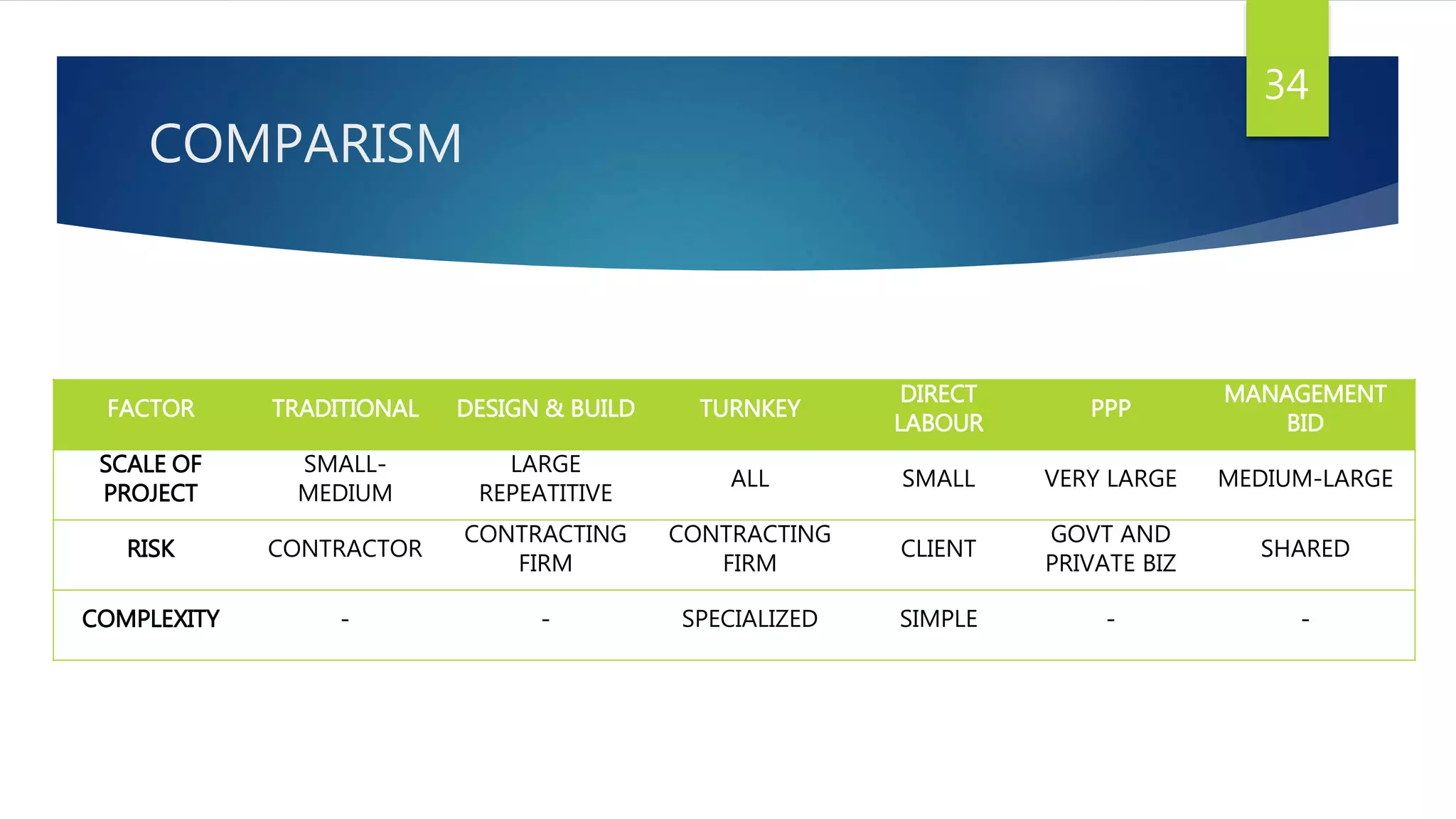
Compares various procurement strategies across different factors like project scale, risk sharing, and complexity.
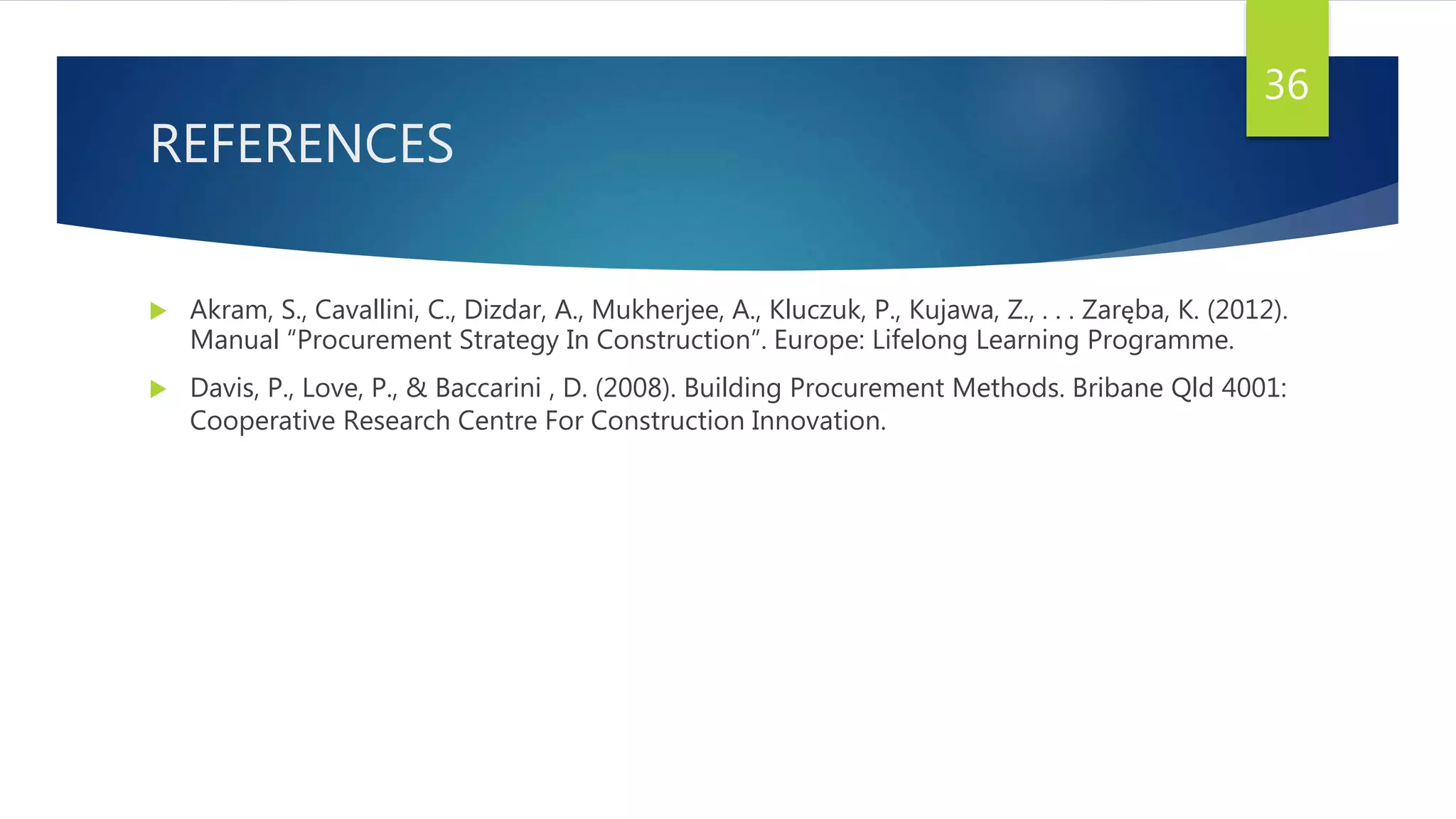
Summarizes key points about procurement methods, attributes, pros and cons, and the comparative analysis of strategies.
Presents references used in the presentation and concludes the discussion.
STRATEGIES IN BUILDINGPROCUREMENT
Briefly explain the concept of procurement
Establish the methods of building procurement
Highlight the attributes, pros and cons of each strategy
Briefly compare the strategies
2
IN THIS SLIDE WE INTEND TO:
3.
STRATEGIES IN BUILDINGPROCUREMENT
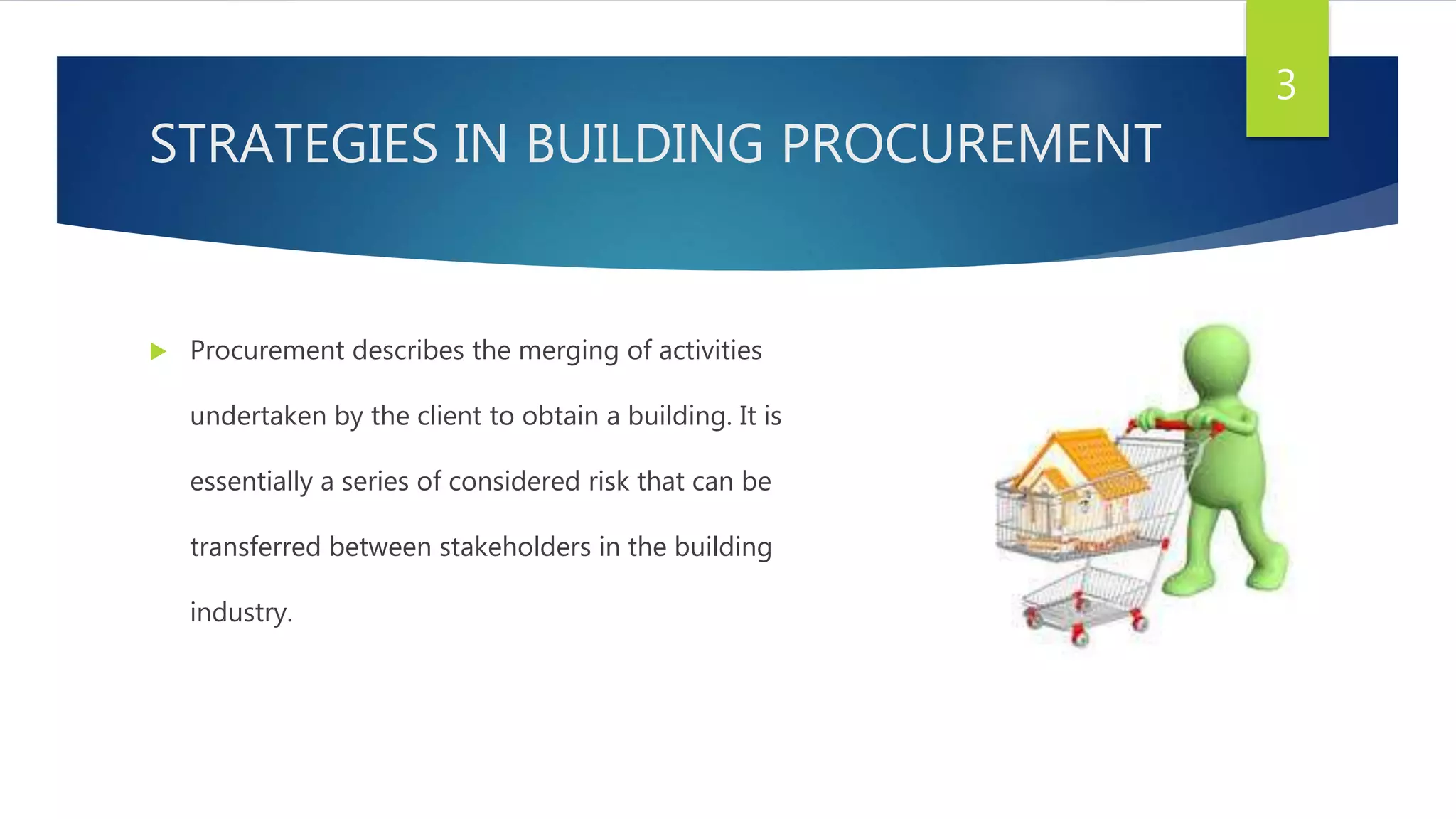
Procurement describes the merging of activities
undertaken by the client to obtain a building. It is
essentially a series of considered risk that can be
transferred between stakeholders in the building
industry.
3
4.
STRATEGIES IN BUILDINGPROCUREMENT
Traditional procurement method
Design and build procurement method
Turnkey procurement method
Direct labor procurement method
Public private partnership method
Management Method
4
BASIC METHODS OF PROCUREMENT
5.
STRATEGIES IN BUILDINGPROCUREMENT
Selection of an absolute optimal procurement method is
difficult, because even the most experienced client or
contractor does not know all the potential benefits or
risks for each method. Procurement is, therefore, a
succession of ‘calculated risks’
5
6.
TRADITIONAL PROCUREMENT METHOD
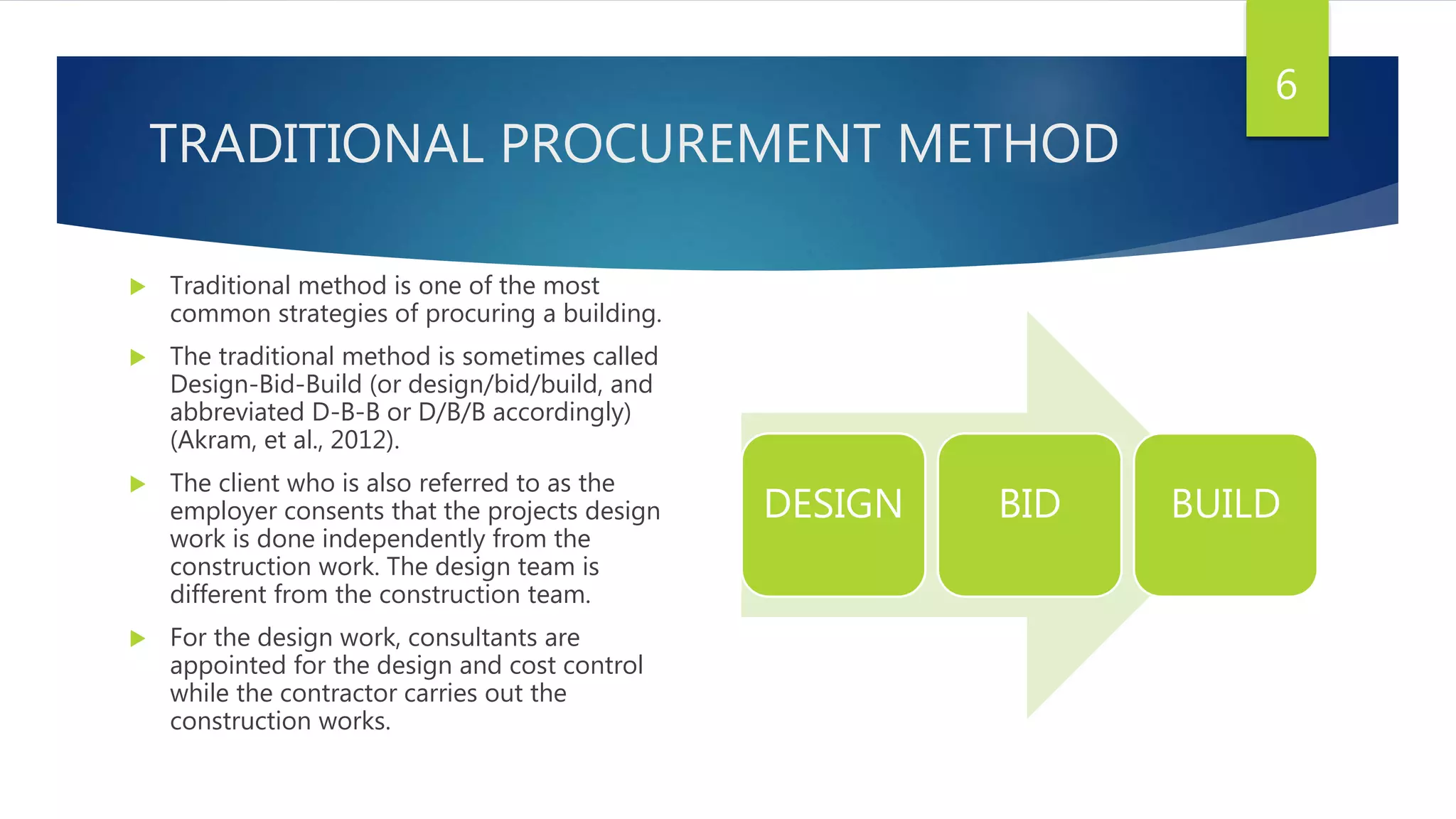
Traditional method is one of the most
common strategies of procuring a building.
The traditional method is sometimes called
Design-Bid-Build (or design/bid/build, and
abbreviated D-B-B or D/B/B accordingly)
(Akram, et al., 2012).
The client who is also referred to as the
employer consents that the projects design
work is done independently from the
construction work. The design team is
different from the construction team.
For the design work, consultants are
appointed for the design and cost control
while the contractor carries out the
construction works.
DESIGN BID BUILD
6
7.
TRADITIONAL PROCUREMENT METHOD
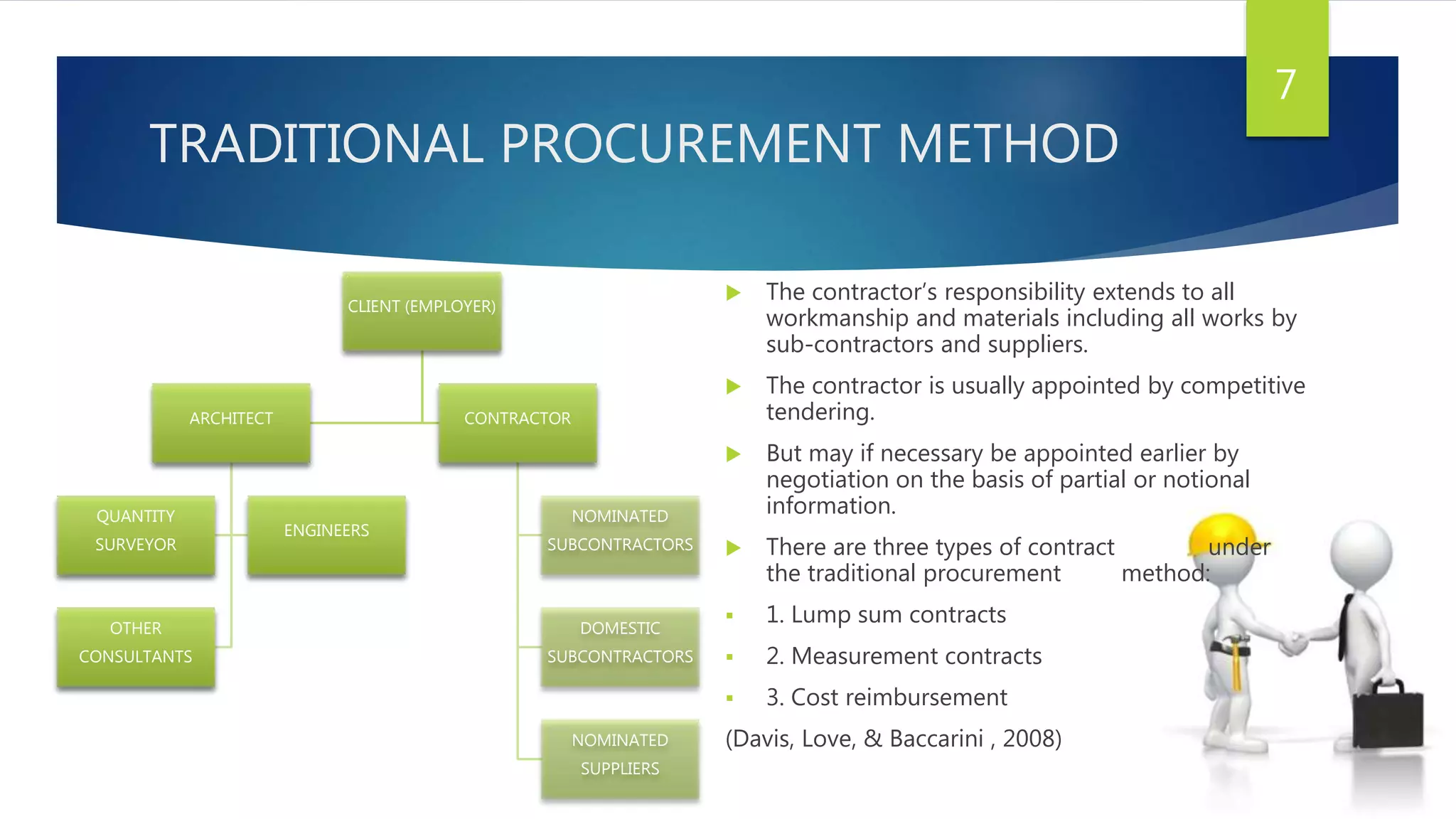
CLIENT(EMPLOYER)
ARCHITECT
QUANTITY
SURVEYOR
ENGINEERS
OTHER
CONSULTANTS
CONTRACTOR
NOMINATED
SUBCONTRACTORS
DOMESTIC
SUBCONTRACTORS
NOMINATED
SUPPLIERS
The contractor’s responsibility extends to all
workmanship and materials including all works by
sub-contractors and suppliers.
The contractor is usually appointed by competitive
tendering.
But may if necessary be appointed earlier by
negotiation on the basis of partial or notional
information.
There are three types of contract under
the traditional procurement method:
1. Lump sum contracts
2. Measurement contracts
3. Cost reimbursement
(Davis, Love, & Baccarini , 2008)
7
8.
SEQUENTIAL PHASES TOTHE
TRADITIONAL DELIVERY METHOD
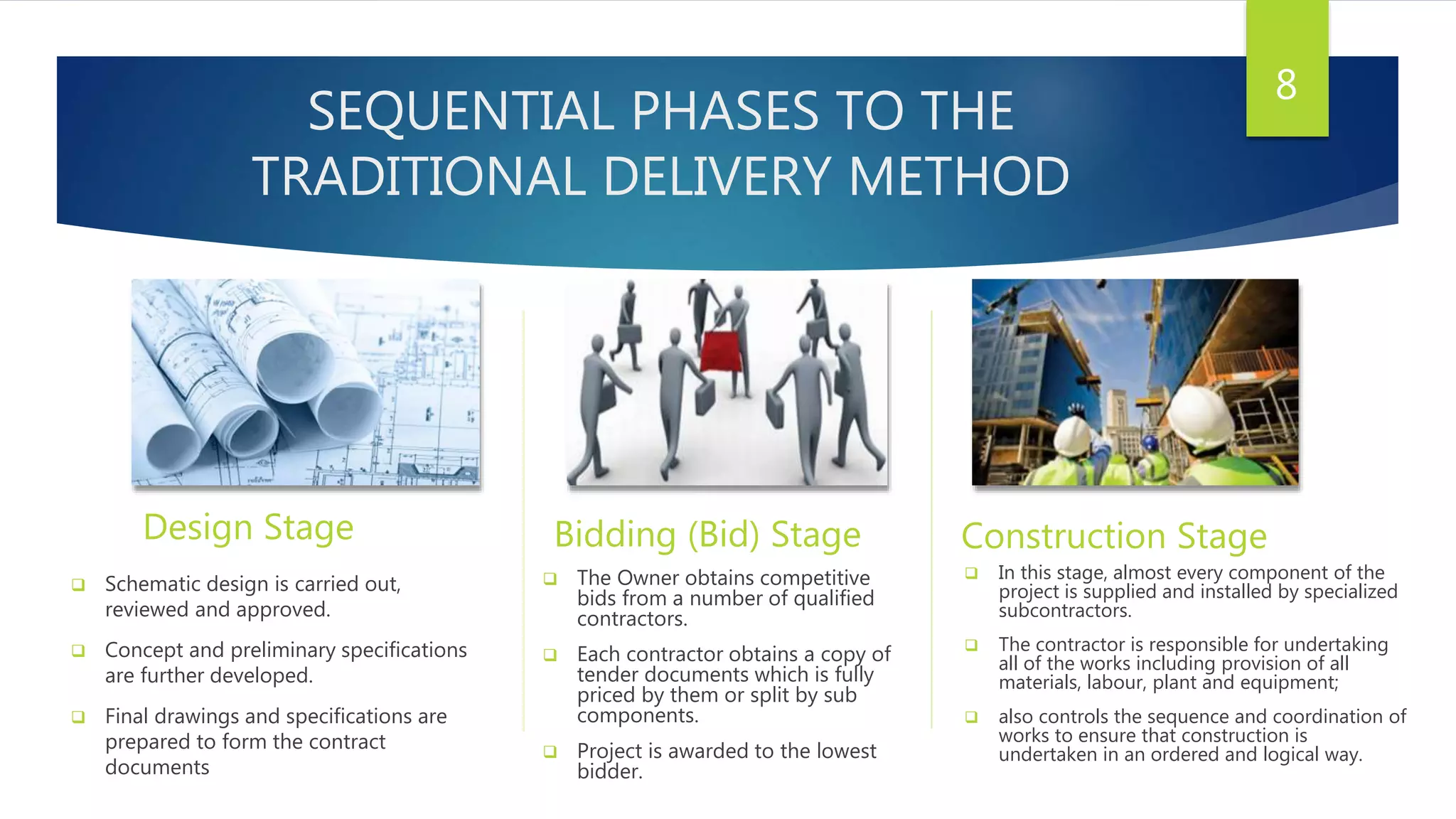
Design Stage
Schematic design is carried out,
reviewed and approved.
Concept and preliminary specifications
are further developed.
Final drawings and specifications are
prepared to form the contract
documents
Bidding (Bid) Stage
The Owner obtains competitive
bids from a number of qualified
contractors.
Each contractor obtains a copy of
tender documents which is fully
priced by them or split by sub
components.
Project is awarded to the lowest
bidder.
Construction Stage
In this stage, almost every component of the
project is supplied and installed by specialized
subcontractors.
The contractor is responsible for undertaking
all of the works including provision of all
materials, labour, plant and equipment;
also controls the sequence and coordination of
works to ensure that construction is
undertaken in an ordered and logical way.
8
9.
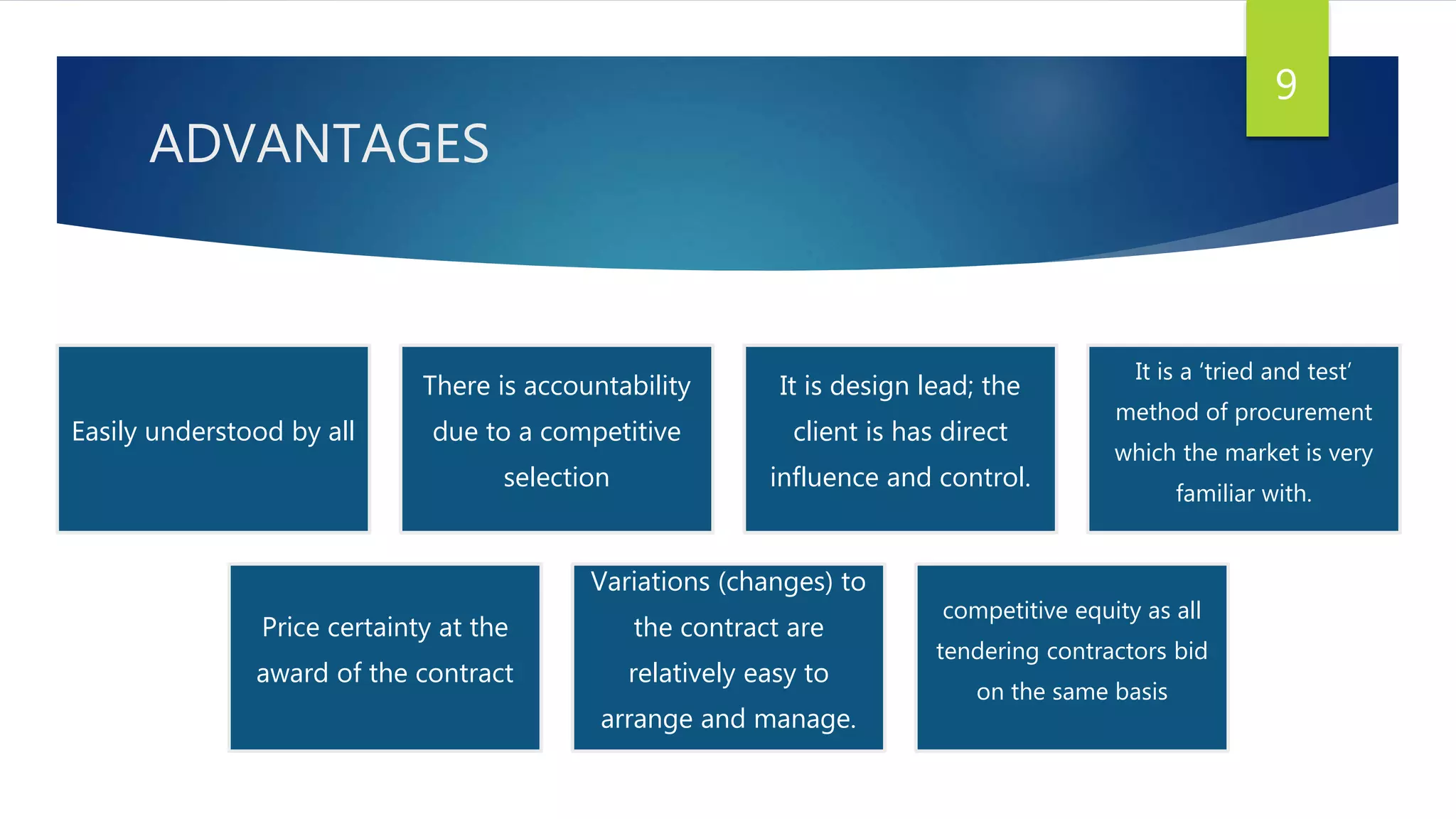
ADVANTAGES
9
Easily understood byall
There is accountability
due to a competitive
selection
It is design lead; the
client is has direct
influence and control.
It is a ‘tried and test’
method of procurement
which the market is very
familiar with.
Price certainty at the
award of the contract
Variations (changes) to
the contract are
relatively easy to
arrange and manage.
competitive equity as all
tendering contractors bid
on the same basis
10.
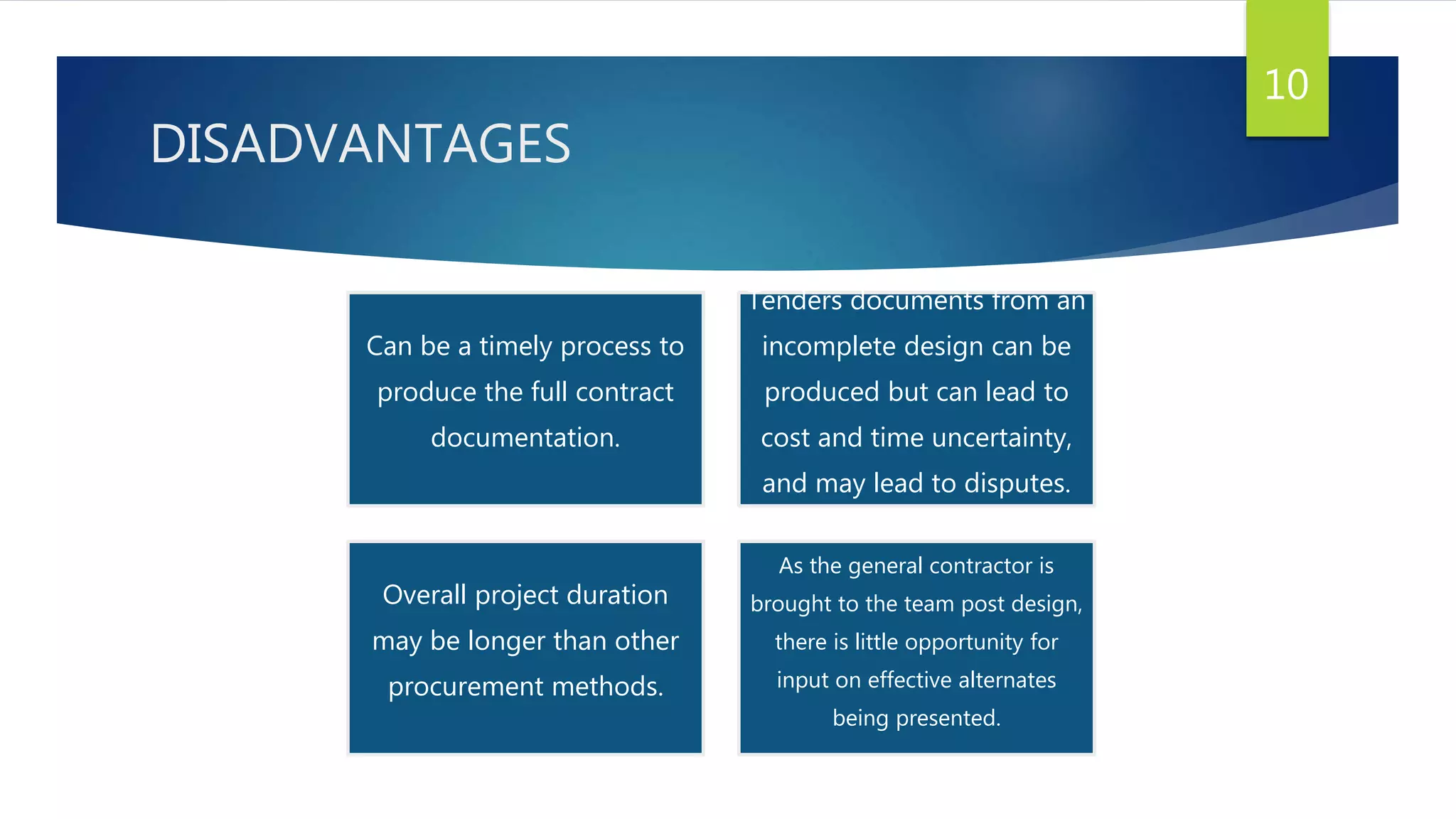
DISADVANTAGES
10
Can be atimely process to
produce the full contract
documentation.
Tenders documents from an
incomplete design can be
produced but can lead to
cost and time uncertainty,
and may lead to disputes.
Overall project duration
may be longer than other
procurement methods.
As the general contractor is
brought to the team post design,
there is little opportunity for
input on effective alternates
being presented.
11.
DESIGN AND BUILDPROCUREMENT
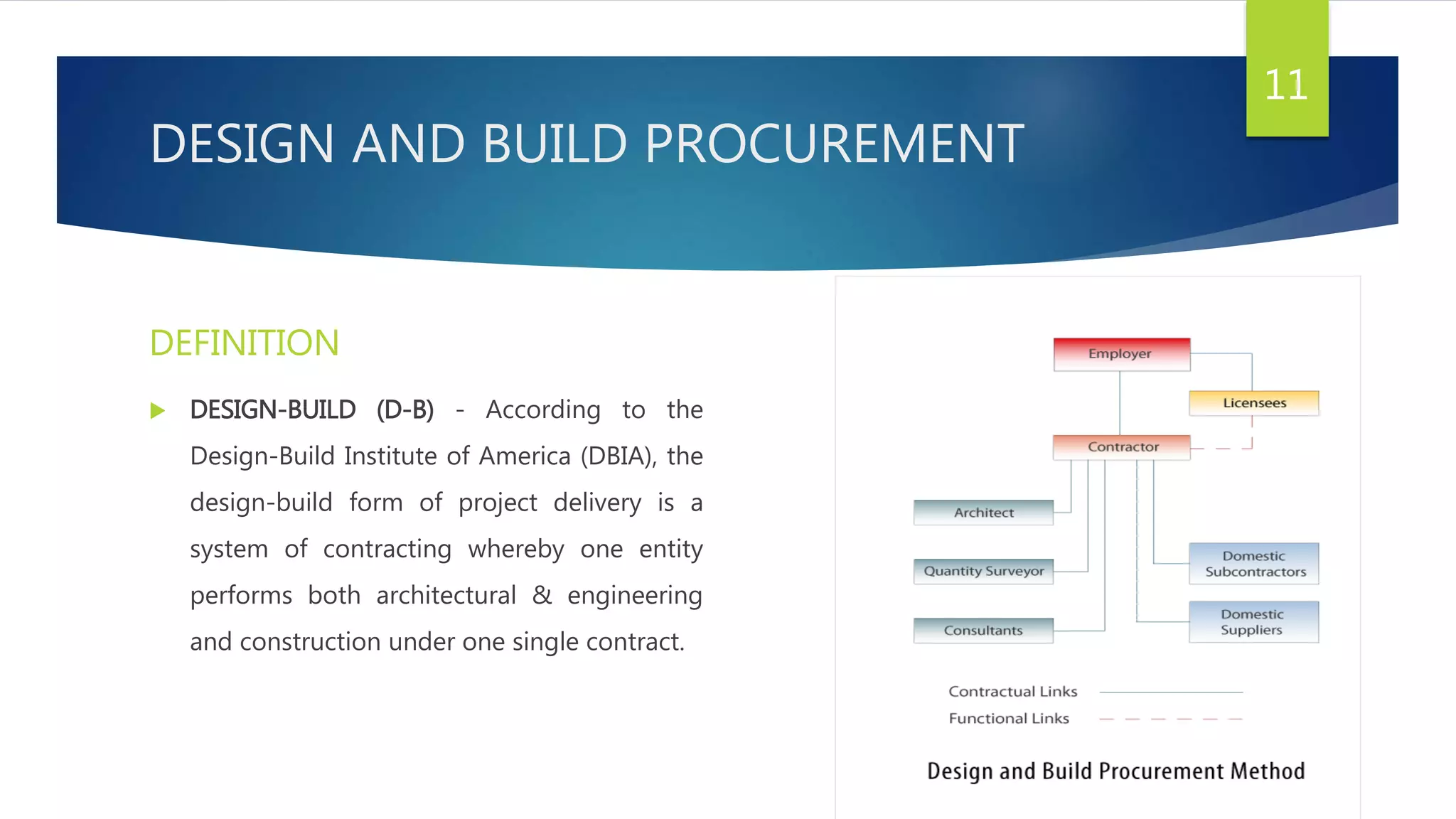
DEFINITION
DESIGN-BUILD (D-B) - According to the
Design-Build Institute of America (DBIA), the
design-build form of project delivery is a
system of contracting whereby one entity
performs both architectural & engineering
and construction under one single contract.
11
12.
DESIGN AND BUILDPROCUREMENT
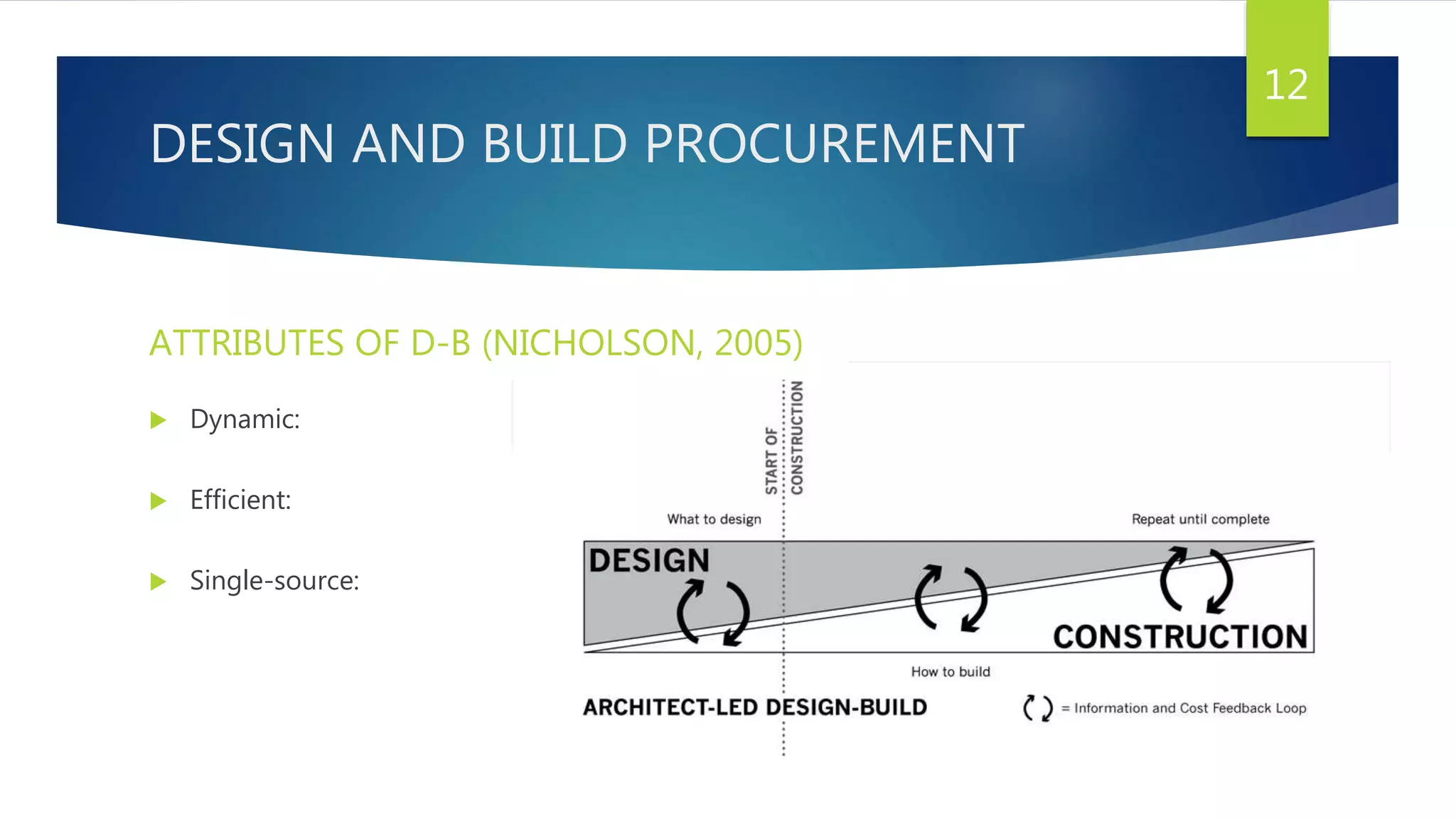
ATTRIBUTES OF D-B (NICHOLSON, 2005)
Dynamic:
Efficient:
Single-source:
12
13.
DESIGN AND BUILDPROCUREMENT
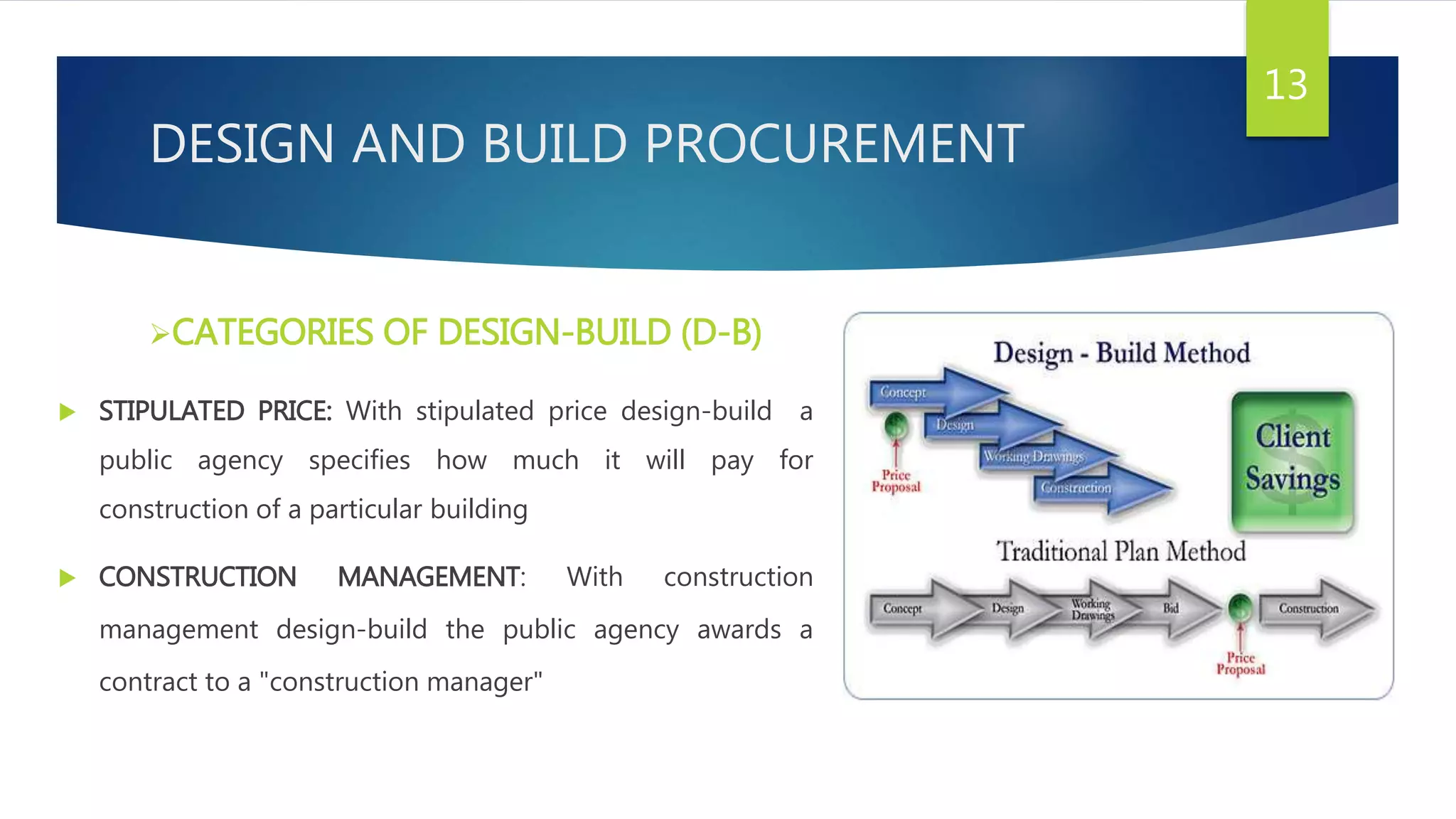
CATEGORIES OF DESIGN-BUILD (D-B)
STIPULATED PRICE: With stipulated price design-build a
public agency specifies how much it will pay for
construction of a particular building
CONSTRUCTION MANAGEMENT: With construction
management design-build the public agency awards a
contract to a "construction manager"
13
14.
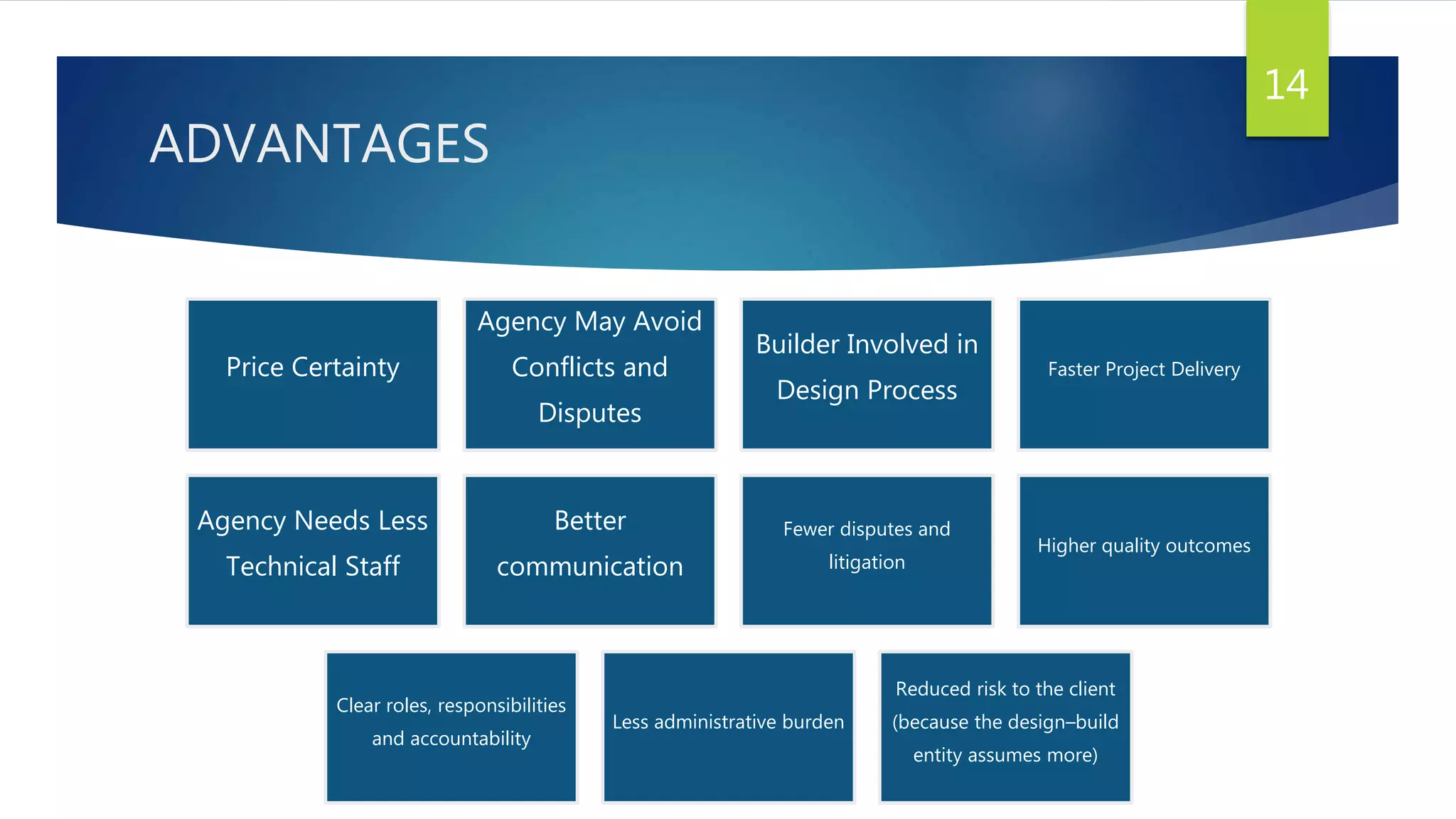
ADVANTAGES
14
Price Certainty
Agency MayAvoid
Conflicts and
Disputes
Builder Involved in
Design Process
Faster Project Delivery
Agency Needs Less
Technical Staff
Better
communication
Fewer disputes and
litigation
Higher quality outcomes
Clear roles, responsibilities
and accountability
Less administrative burden
Reduced risk to the client
(because the design–build
entity assumes more)
15.
DISADVANTAGES
15
Limited assurance of
qualitycontrol.
Subjective Contract Award
Limited access for small
contractors.
Typical project management
issues (establishing liability,
writing contracts, scoping
estimates and schedule)
Conflict of interest and
ethical issues
Greater business and
financial risks associated with
architect taking on general
contractor responsibilities
16.
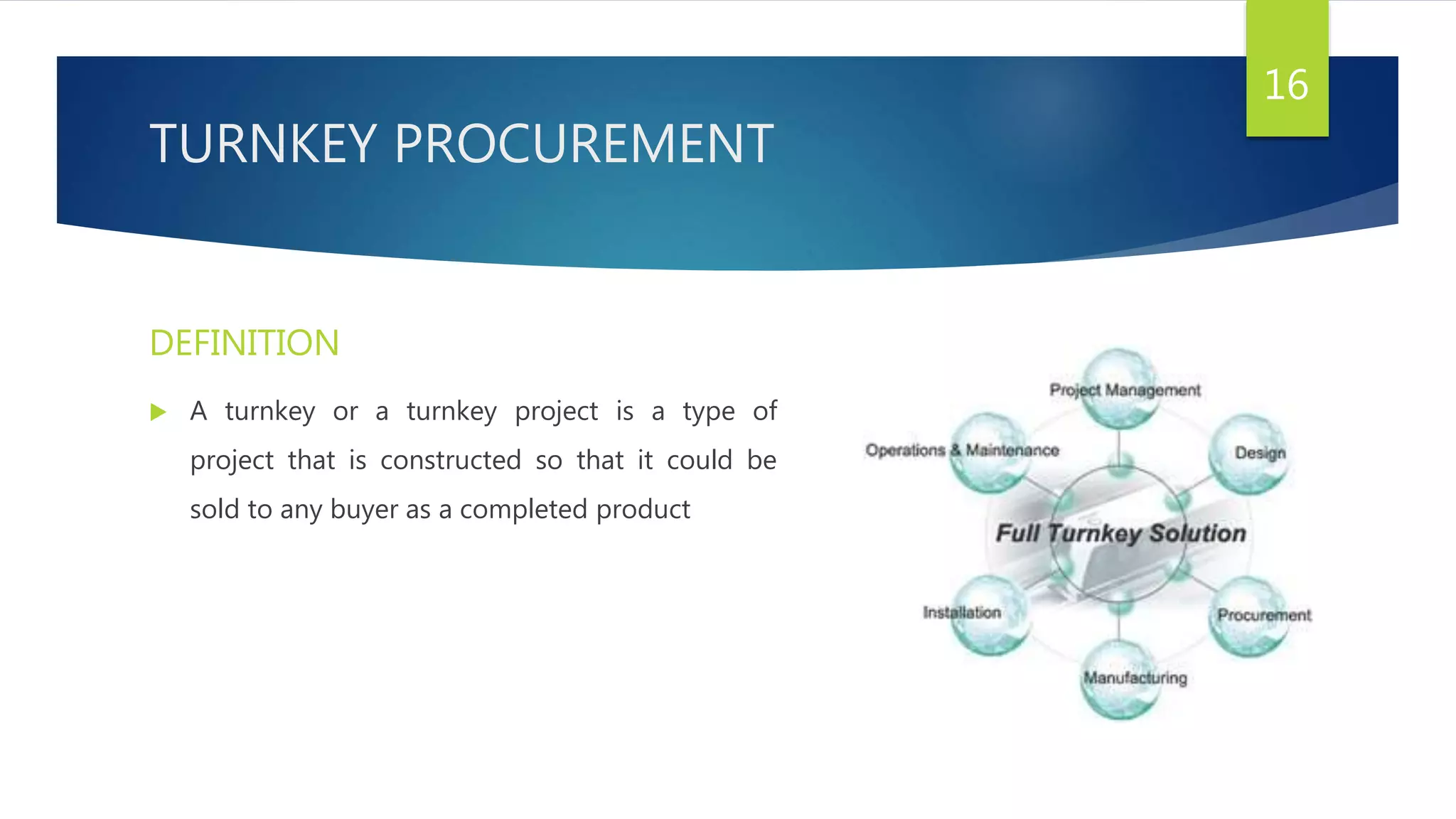
TURNKEY PROCUREMENT
DEFINITION
Aturnkey or a turnkey project is a type of
project that is constructed so that it could be
sold to any buyer as a completed product
16
17.
TURNKEY PROCUREMENT
DEFINITION
Itis also described as a contract which a firm
agrees to fully design, construct and equip a
manufacturing, business, service facility and turn
the project over to the purchaser when it is
ready for operation for remuneration.
17
18.
ADVANTAGES
18
The project isusually
owned by the
contractor.
It gives the client
enough time to seek
financing.
There is no room for
inexperienced clients
to make wrong
decisions.
Contractual
relationship with one
person.
Total commitment
from the contractor.
19.
DISADVANTAGES
19
Lack of controlby
the client.
Remuneration is
usually high.
Difficult to find
clients.
No intervention by
the client.
20.
TURNKEY PROCUREMENT
SUMMARY
Theproject is usually owned by the contractor
until the end of the project.
Lack of control by the client over design
decisions.
It takes more time to setup initially.
20
21.
DIRECT LABOUR PROCUREMENT
DEFINITION
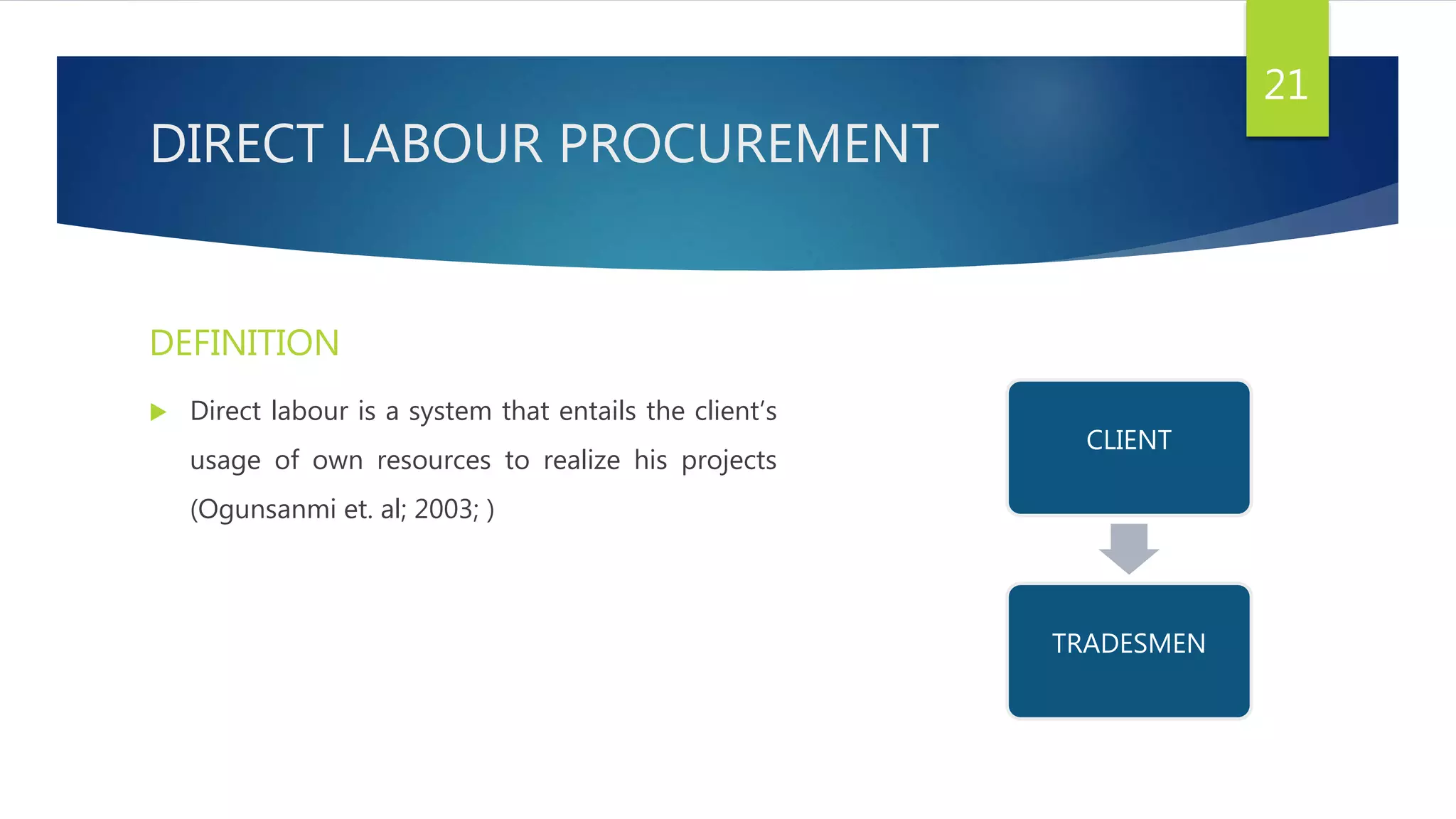
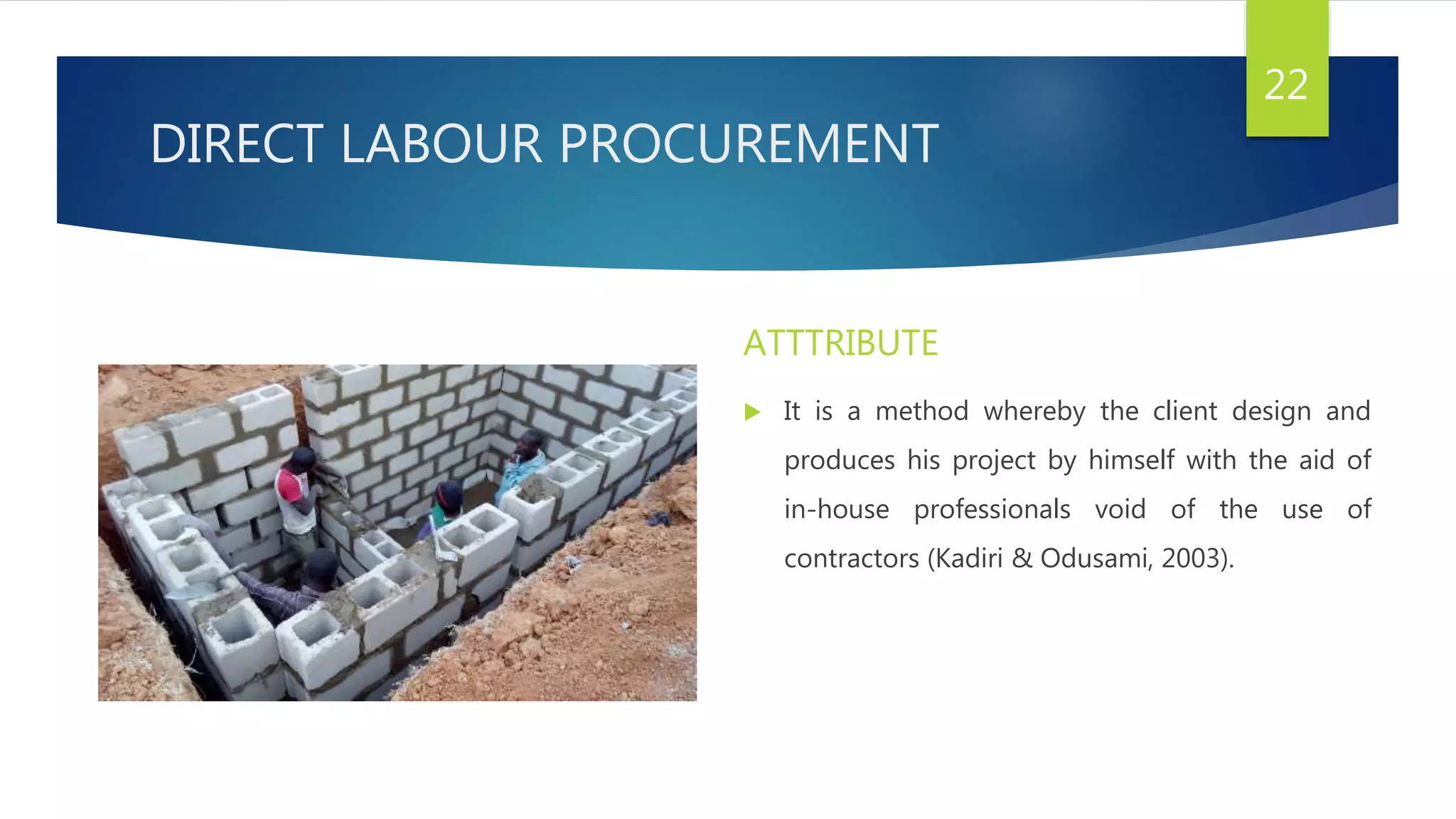
Direct labour is a system that entails the client’s
usage of own resources to realize his projects
(Ogunsanmi et. al; 2003; )
21
CLIENT
TRADESMEN
22.
DIRECT LABOUR PROCUREMENT
ATTTRIBUTE
It is a method whereby the client design and
produces his project by himself with the aid of
in-house professionals void of the use of
contractors (Kadiri & Odusami, 2003).
22
23.
ADVANTAGES
23
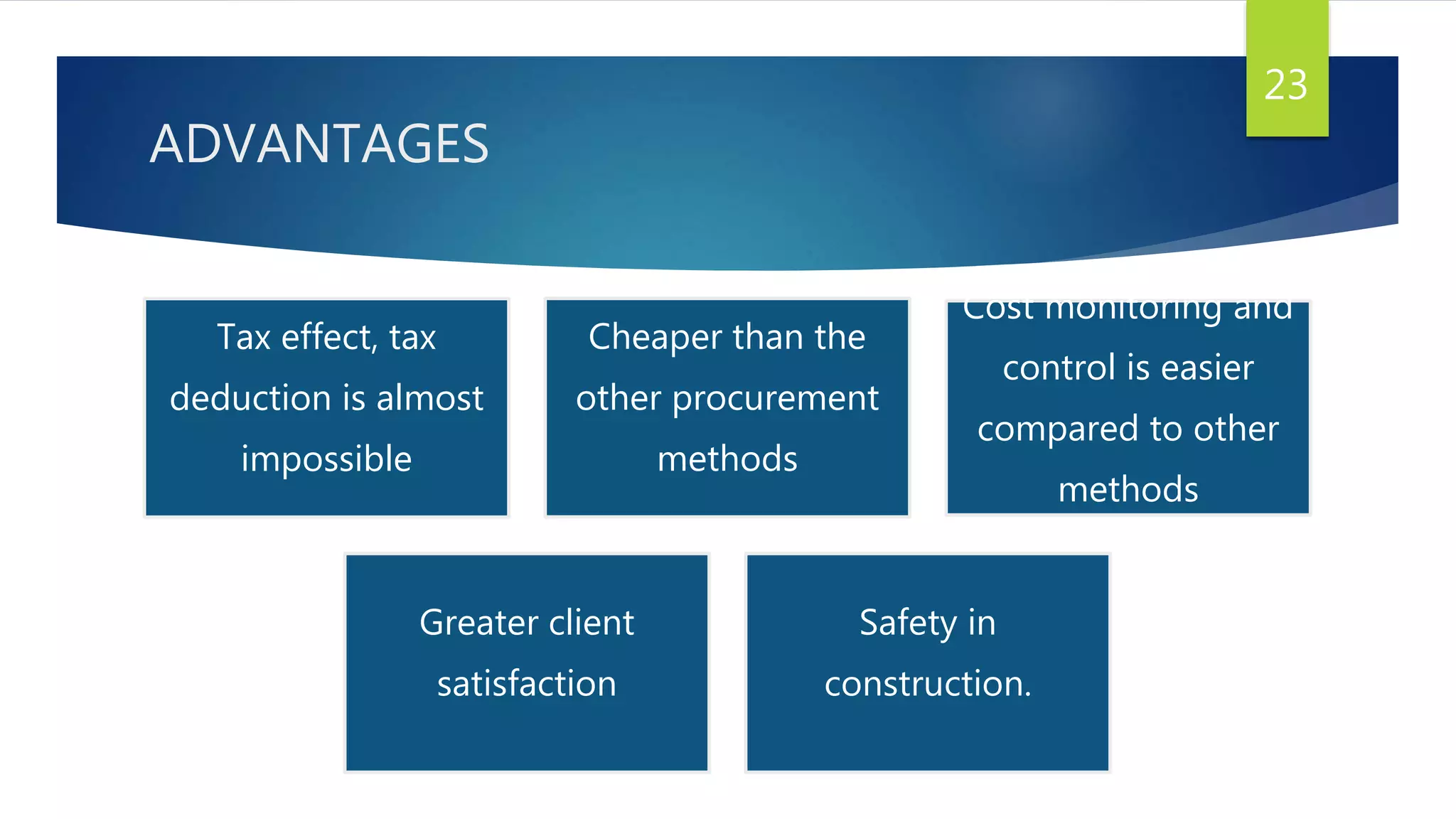
Tax effect, tax
deductionis almost
impossible
Cheaper than the
other procurement
methods
Cost monitoring and
control is easier
compared to other
methods
Greater client
satisfaction
Safety in
construction.
24.
DISADVANTAGES
24
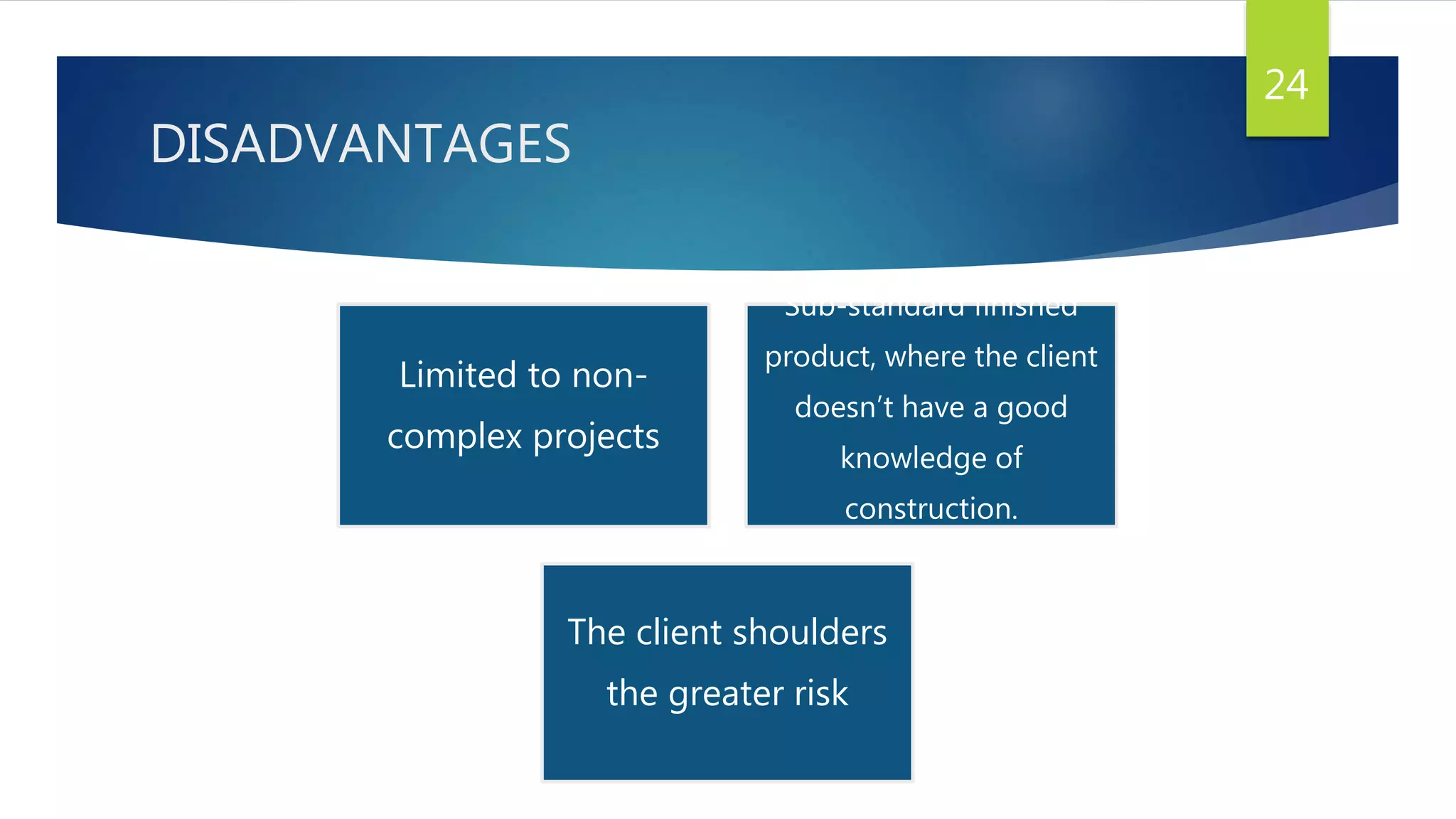
Limited to non-
complexprojects
Sub-standard finished
product, where the client
doesn’t have a good
knowledge of
construction.
The client shoulders
the greater risk
25.
PUBLIC PRIVATE PARTNERSHIP(PPP)
PROCUREMENT
DEFINITION
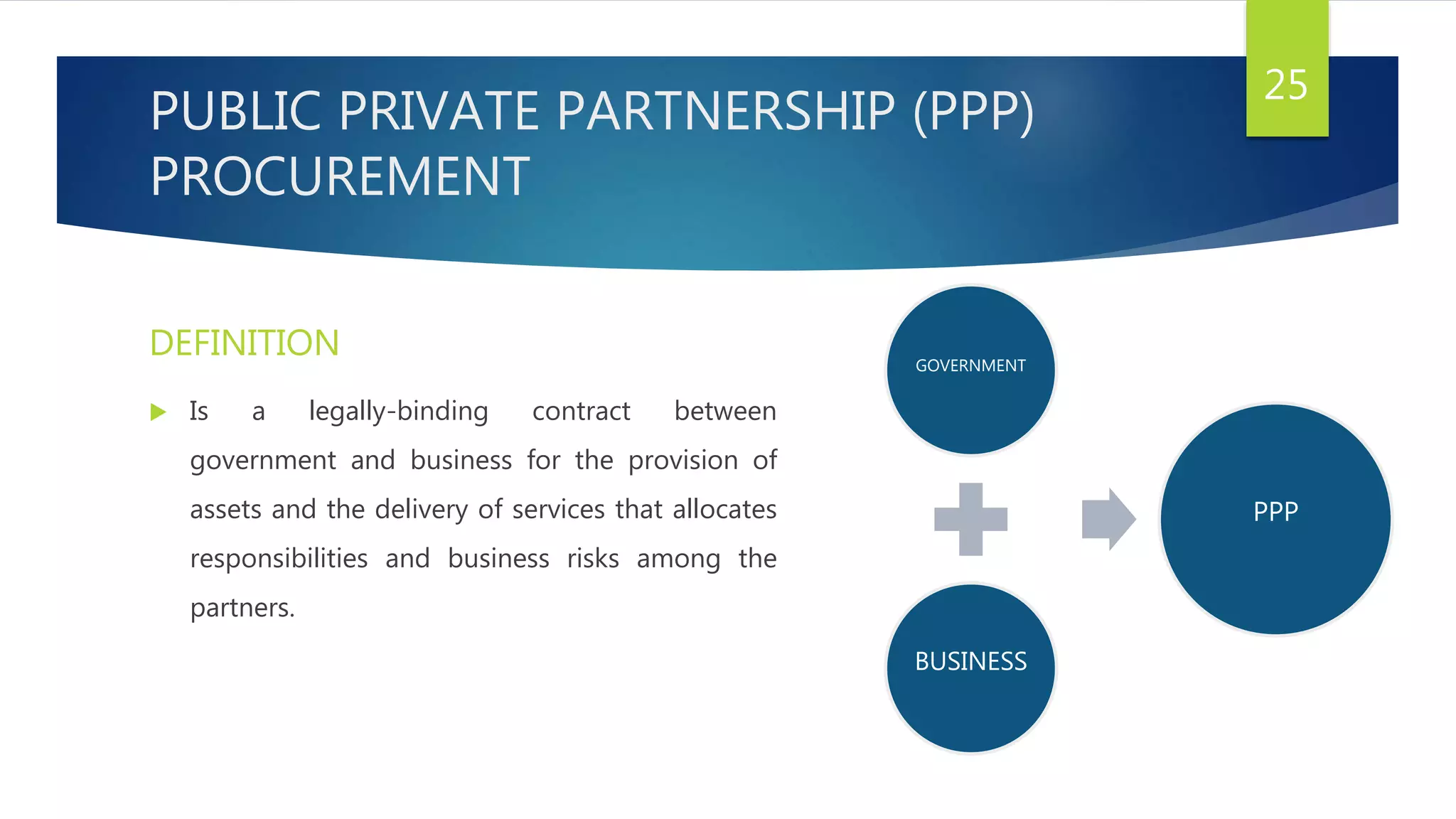
Is a legally-binding contract between
government and business for the provision of
assets and the delivery of services that allocates
responsibilities and business risks among the
partners.
25
GOVERNMENT
BUSINESS
PPP
26.
PUBLIC PRIVATE PARTNERSHIP(PPP)
PROCUREMENT
ATTRIBUTES
In a P3s method, the government remains actively
involved throughout the project’s life cycle.
The private sector is responsible for the more
commercial function such as PROJECT DESIGN,
CONSTRUCTION, FINANCE & OPERATIONS.
The goal is to combine the best capabilities of both
partners for mutual benefits.
26
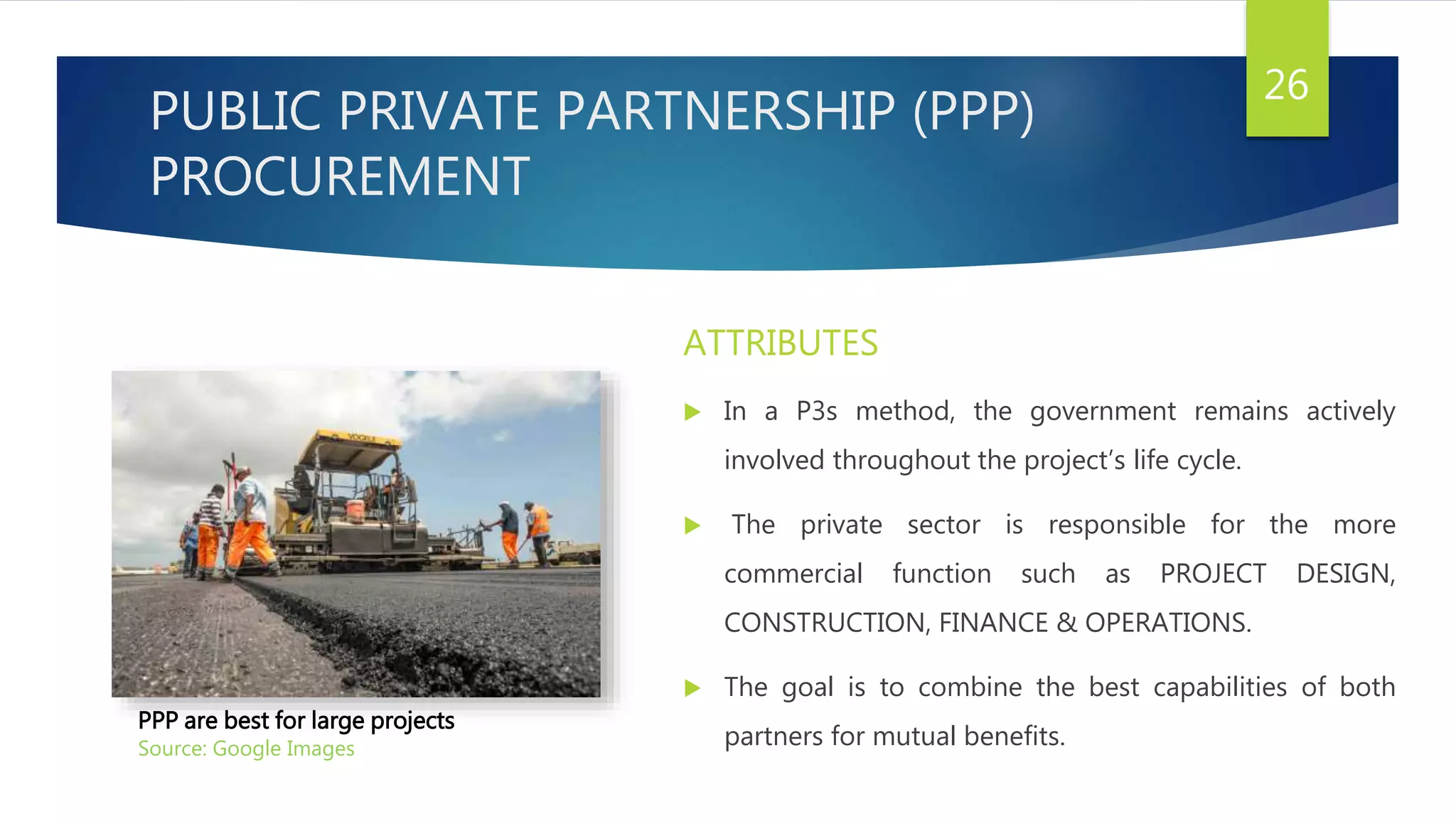
PPP are best for large projects
Source: Google Images
27.
PUBLIC PRIVATE PARTNERSHIP(PPP)
PROCUREMENT
CHARACTERISTICS
Executed between public and private sectors.
Risk sharing between the parties.
Long-term relationship between the parties.
Ultimate regulatory responsibility remains in the public
sector.
Encompass diverse types of infrastructure.
27
28.
ADVANTAGES
28
Increase in efficiency
ofa project’s
delivery, operations
& management.
Availability of additional
resources to meet the
growing need of
investment in the sector.
Reduces public
sector risks.
Makes better use of
assets.
Encourages “Life
cycle” approach to
planning &
budgeting.
29.
DISADVANTAGES
29
The Private sectormight not be
interested in a project due to perceived
high risks or may lack technical,
financial or managerial capacity to
implement the project.
A P3s project may be more costly.
30.
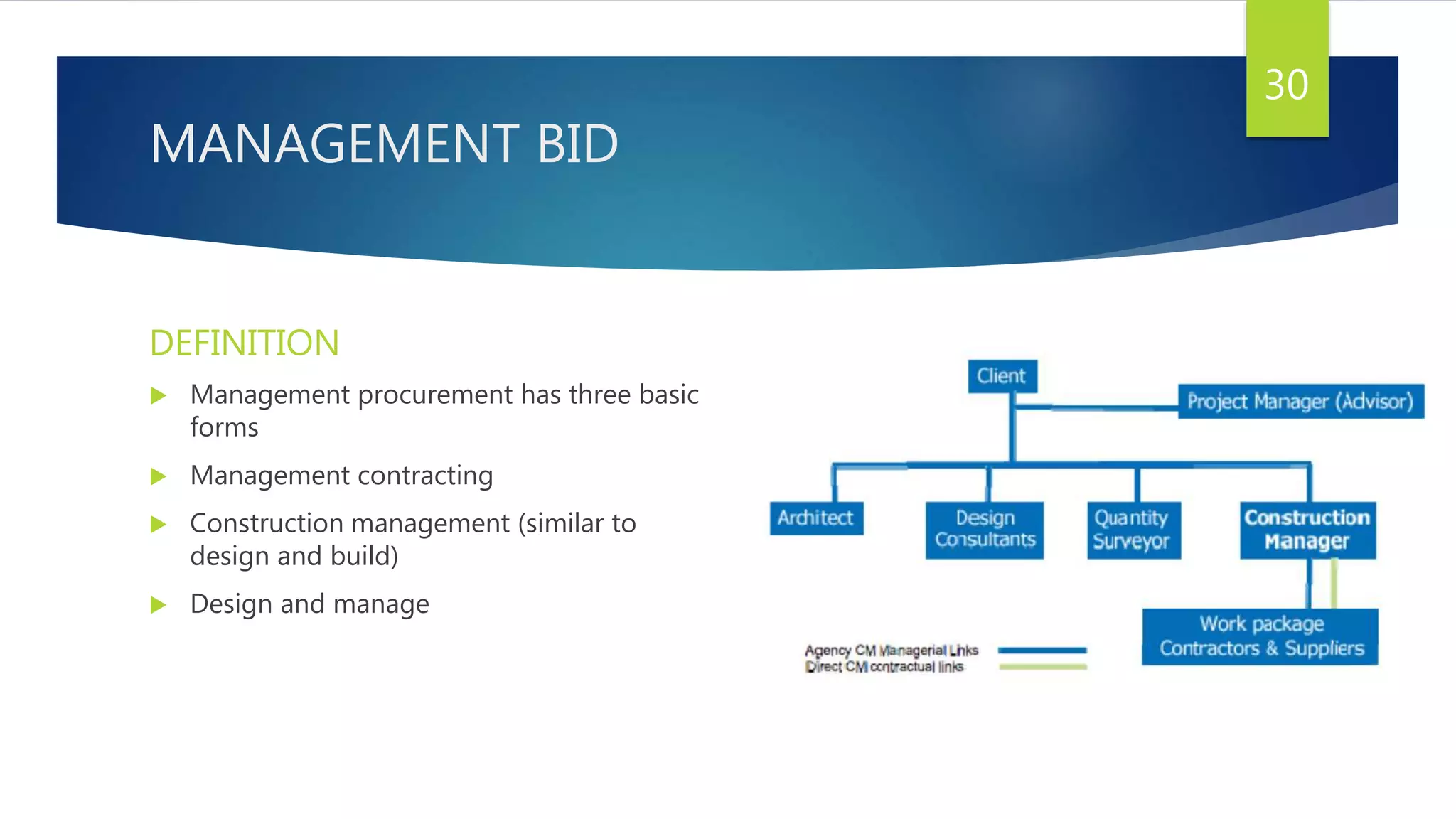
MANAGEMENT BID
DEFINITION
Managementprocurement has three basic
forms
Management contracting
Construction management (similar to
design and build)
Design and manage
30
31.
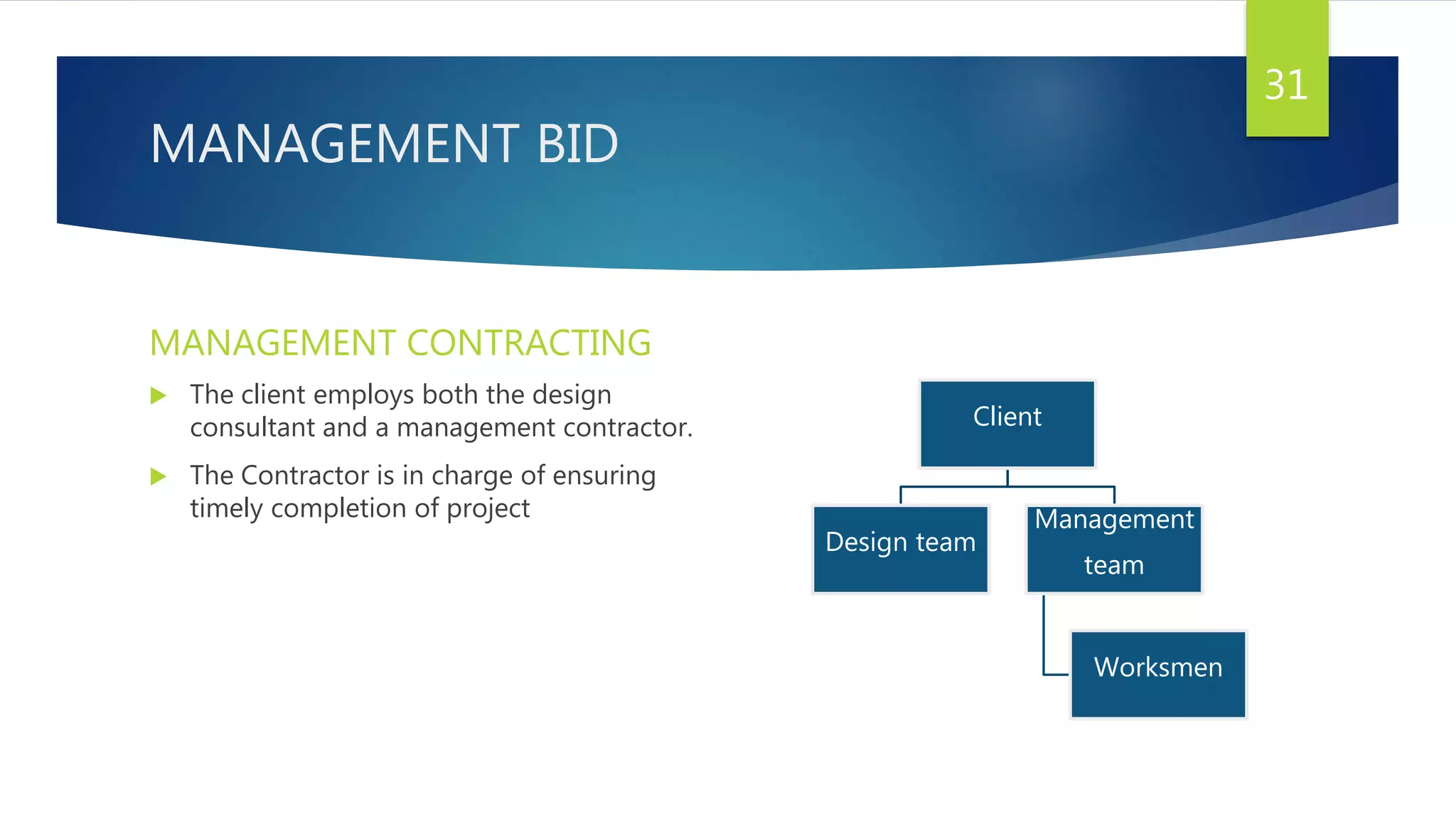
MANAGEMENT BID
Theclient employs both the design
consultant and a management contractor.
The Contractor is in charge of ensuring
timely completion of project
31
MANAGEMENT CONTRACTING
Client
Design team
Management
team
Worksmen
32.
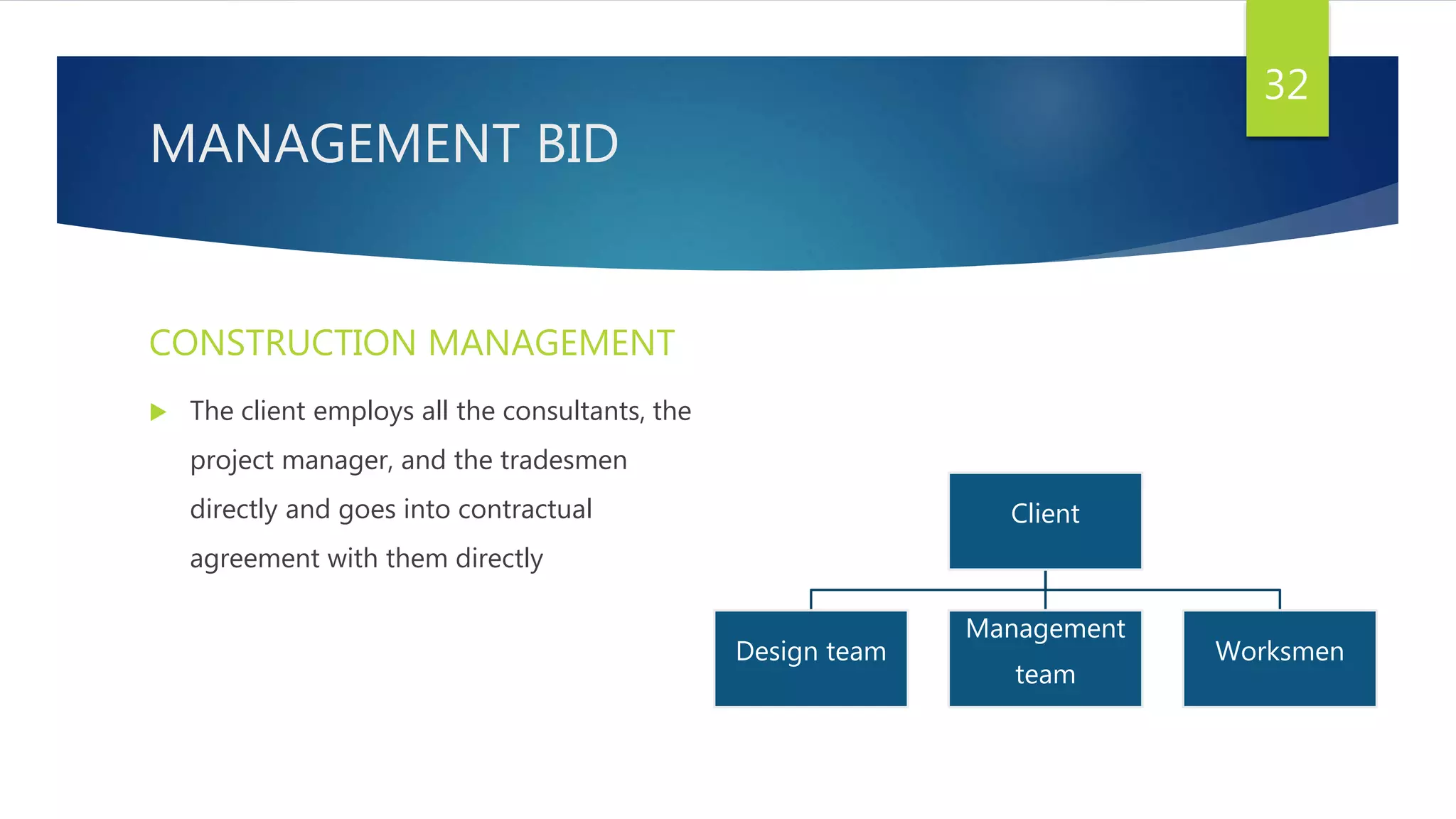
MANAGEMENT BID
Theclient employs all the consultants, the
project manager, and the tradesmen
directly and goes into contractual
agreement with them directly
32
CONSTRUCTION MANAGEMENT
Client
Design team
Management
team
Worksmen
33.
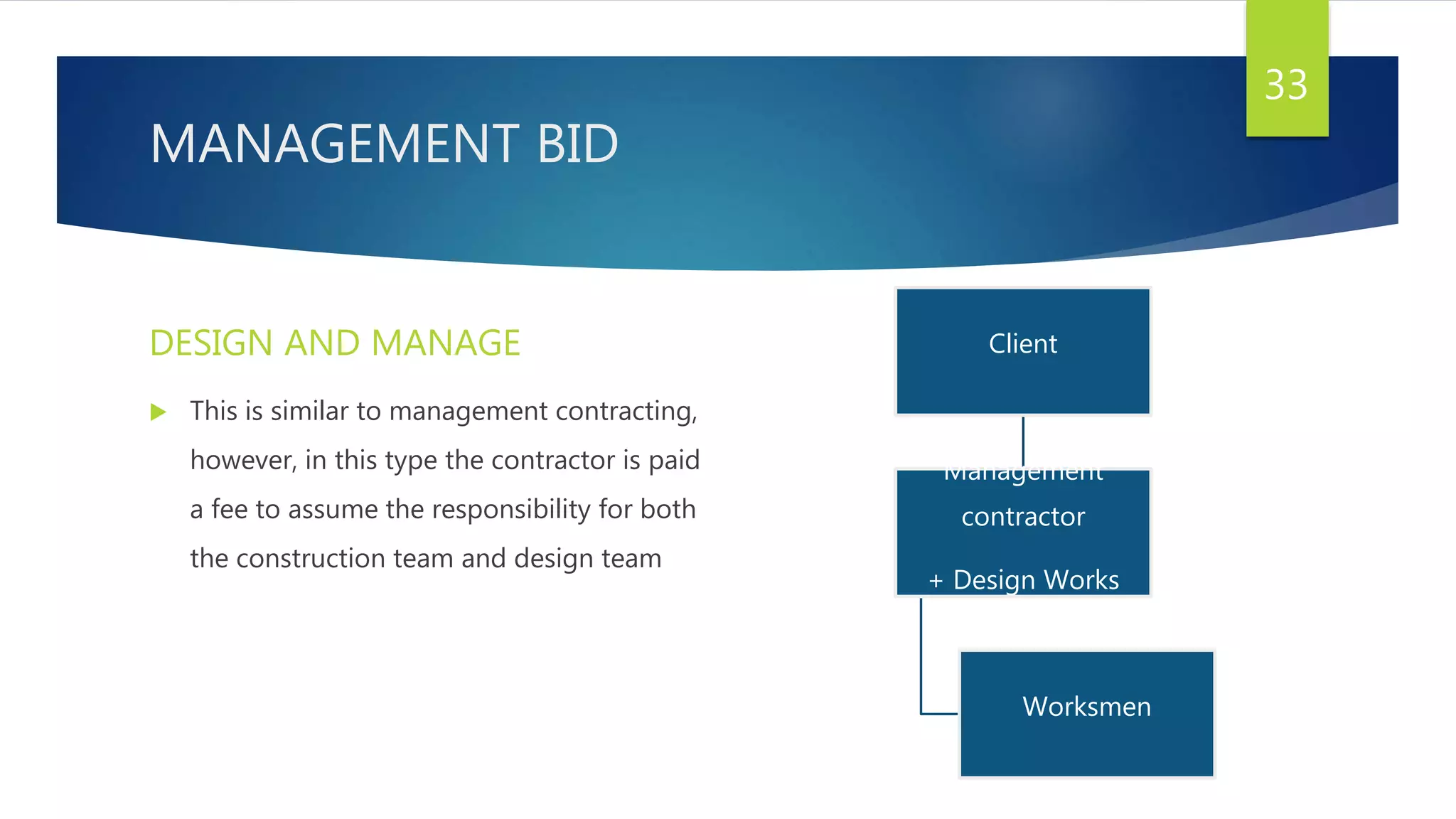
MANAGEMENT BID
Thisis similar to management contracting,
however, in this type the contractor is paid
a fee to assume the responsibility for both
the construction team and design team
33
DESIGN AND MANAGE Client
Management
contractor
+ Design Works
Worksmen
34.
COMPARISM
FACTOR TRADITIONAL DESIGN& BUILD TURNKEY
DIRECT
LABOUR
PPP
MANAGEMENT
BID
SCALE OF
PROJECT
SMALL-
MEDIUM
LARGE
REPEATITIVE
ALL SMALL VERY LARGE MEDIUM-LARGE
RISK CONTRACTOR
CONTRACTING
FIRM
CONTRACTING
FIRM
CLIENT
GOVT AND
PRIVATE BIZ
SHARED
COMPLEXITY - - SPECIALIZED SIMPLE - -
34
35.
STRATEGIES IN BUILDINGPROCUREMENT
Briefly explain the concept of procurement
Establish the methods of building procurement
Highlight the attributes, pros and cons of each strategy
Briefly compare the strategies
35
RECAP: WE HOPE WE HAVE BEEN ABLE TO:
36.
REFERENCES
Akram, S.,Cavallini, C., Dizdar, A., Mukherjee, A., Kluczuk, P., Kujawa, Z., . . . Zaręba, K. (2012).
Manual “Procurement Strategy In Construction”. Europe: Lifelong Learning Programme.
Davis, P., Love, P., & Baccarini , D. (2008). Building Procurement Methods. Bribane Qld 4001:
Cooperative Research Centre For Construction Innovation.
36