SPM Professional Technical Talk Series
1
Teoh Wooi Sin
Arcadis Project
Management Pte Ltd
2
1. Current Norms
2. ECI Evolution
3. ECI Drivers and Benefits
4. ECI Pre-Q
5. Case Studies
– ECI Timeline and Process
– ECI Process – Briefing to
Tenderers
– ECI Process – AIP / Tender Doc
Issuance
– ECI – Tenderers’ Deliverables
– ECI Tender Evaluation
6. Lessons Learned
7. Pros and Cons – Tender’s
Perspective
8. Conclusion
9. Recommendation
AGENDA
3
CURRENT NORMS
• No contractor involvement
• Design process / construction requirements : dichotomy of objectives
4
CURRENT NORMS
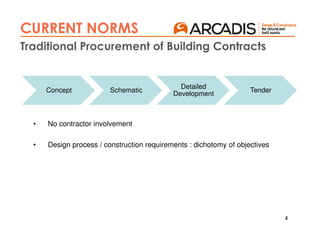
Traditional Procurement of Building Contracts
Concept Schematic
Detailed
Development
Tender
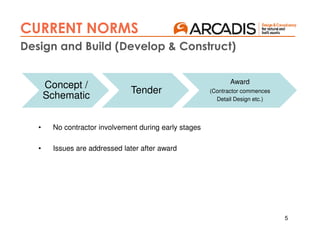
• No contractor involvement during early stages
• Issues are addressed later after award
5
CURRENT NORMS
Design and Build (Develop & Construct)
Concept /
Schematic
Tender
Award
(Contractor commences
Detail Design etc.)
6
ECI EVOLUTION
7
ECI EVOLUTION
History of ECI in Langdon & Seah
• In the early 1990s, our management foresaw the importance of early
engagement of contractors especially during the pre-tendering stages
• Attributed to the persistent shortcomings posed by the traditional
procurement method whereby the contractors are engaged only after the
designs have been finalised which resulted in unnecessary cost and time
overruns
8
ECI EVOLUTION
Early Objectives
• Early Start – rising land cost (and financing cost)
• Better Construction / Pricing – more capital for land bids
• More buildable solutions – enhance speed of construction
9
ECI EVOLUTION
Procurement Methods
• Early Start – Forward Planning
• Piling commence within 3 months after Building Agreement was
signed (compared to 9 months in normal case)
Better Construction / Pricing
• Developers agree building construction costs prior to land bid – either
with selected contractor lump sums or Unit Costs per GFA
• Contractors will offer the best in terms buildable and constructable
designs, easier / faster methods and sequence of construction etc.
which will translate to both time and cost savings
10
ECI EVOLUTION
A Reflection of Earlier Approach on ECI…
ECI through Initial Engagement with Contractor to agree on construction cost on
lump sum basis or unit cost per GFA
… Earlier Approaches have not harnessed the full benefits of ECI and the initial
engagement is not a full ECI process.
What is ECI ??
11
What is ECI?
Early Contractors’ Involvement
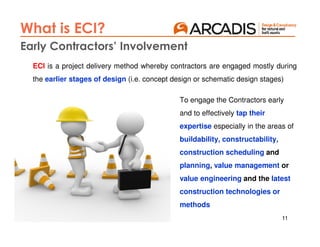
ECI is a project delivery method whereby contractors are engaged mostly during
the earlier stages of design (i.e. concept design or schematic design stages)
To engage the Contractors early
and to effectively tap their
expertise especially in the areas of
buildability, constructability,
construction scheduling and
planning, value management or
value engineering and the latest
construction technologies or
methods
12
PUBLIC SECTOR ECI
BCA ECI Guide & Models
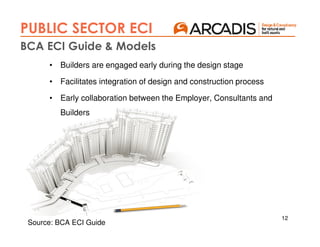
• Builders are engaged early during the design stage
• Facilitates integration of design and construction process
• Early collaboration between the Employer, Consultants and
Builders
Source: BCA ECI Guide
13
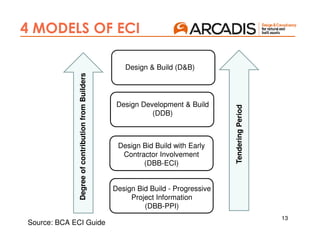
4 MODELS OF ECI
Design Bid Build - Progressive
Project Information
(DBB-PPI)
Design Bid Build with Early
Contractor Involvement
(DBB-ECI)
Design Development & Build
(DDB)
Design & Build (D&B)
DegreeofcontributionfromBuilders
TenderingPeriod
Source: BCA ECI Guide
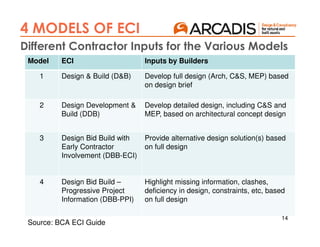
Model ECI Inputs by Builders
1 Design & Build (D&B) Develop full design (Arch, C&S, MEP) based
on design brief
2 Design Development &
Build (DDB)
Develop detailed design, including C&S and
MEP, based on architectural concept design
3 Design Bid Build with
Early Contractor
Involvement (DBB-ECI)
Provide alternative design solution(s) based
on full design
4 Design Bid Build –
Progressive Project
Information (DBB-PPI)
Highlight missing information, clashes,
deficiency in design, constraints, etc, based
on full design
14
4 MODELS OF ECI
Different Contractor Inputs for the Various Models
Source: BCA ECI Guide
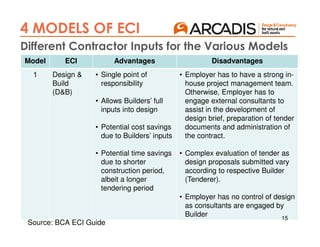
Model ECI Advantages Disadvantages
1 Design &
Build
(D&B)
• Single point of
responsibility
• Allows Builders’ full
inputs into design
• Potential cost savings
due to Builders’ inputs
• Potential time savings
due to shorter
construction period,
albeit a longer
tendering period
• Employer has to have a strong in-
house project management team.
Otherwise, Employer has to
engage external consultants to
assist in the development of
design brief, preparation of tender
documents and administration of
the contract.
• Complex evaluation of tender as
design proposals submitted vary
according to respective Builder
(Tenderer).
• Employer has no control of design
as consultants are engaged by
Builder 15
4 MODELS OF ECI
Different Contractor Inputs for the Various Models
Source: BCA ECI Guide
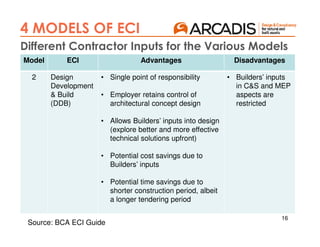
Model ECI Advantages Disadvantages
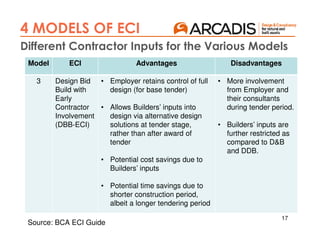
2 Design
Development
& Build
(DDB)
• Single point of responsibility
• Employer retains control of
architectural concept design
• Allows Builders’ inputs into design
(explore better and more effective
technical solutions upfront)
• Potential cost savings due to
Builders’ inputs
• Potential time savings due to
shorter construction period, albeit
a longer tendering period
• Builders’ inputs
in C&S and MEP
aspects are
restricted
16
4 MODELS OF ECI
Different Contractor Inputs for the Various Models
Source: BCA ECI Guide
Model ECI Advantages Disadvantages
3 Design Bid
Build with
Early
Contractor
Involvement
(DBB-ECI)
• Employer retains control of full
design (for base tender)
• Allows Builders’ inputs into
design via alternative design
solutions at tender stage,
rather than after award of
tender
• Potential cost savings due to
Builders’ inputs
• Potential time savings due to
shorter construction period,
albeit a longer tendering period
• More involvement
from Employer and
their consultants
during tender period.
• Builders’ inputs are
further restricted as
compared to D&B
and DDB.
17
4 MODELS OF ECI
Different Contractor Inputs for the Various Models
Source: BCA ECI Guide
18
4 MODELS OF ECI
Different Contractor Inputs for the Various Models
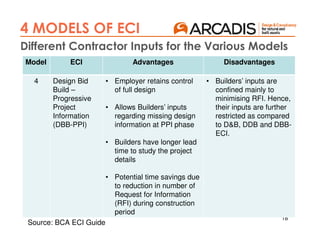
Model ECI Advantages Disadvantages
4 Design Bid
Build –
Progressive
Project
Information
(DBB-PPI)
• Employer retains control
of full design
• Allows Builders’ inputs
regarding missing design
information at PPI phase
• Builders have longer lead
time to study the project
details
• Potential time savings due
to reduction in number of
Request for Information
(RFI) during construction
period
• Builders’ inputs are
confined mainly to
minimising RFI. Hence,
their inputs are further
restricted as compared
to D&B, DDB and DBB-
ECI.
Source: BCA ECI Guide
19
ECI
VALUE DRIVERS AND BENEFITS
20
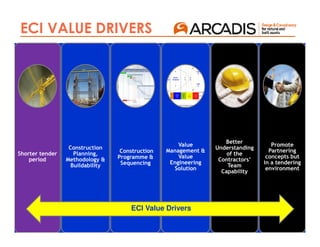
ECI VALUE DRIVERS
Shorter tender
period
Construction
Planning,
Methodology &
Buildability
Construction
Programme &
Sequencing
Value
Management &
Value
Engineering
Solution
Better
Understanding
of the
Contractors’
Team
Capability
Promote
Partnering
concepts but
in a tendering
environment
ECI Value Drivers
21
BENEFITS OF ECI
• Achieve more favourable results than traditional procurement routes especially
on contractors’ expertise areas
• Harness the latest knowledge and technologies from the contractors
• Initiate greater commitment and sense of ownership from the contractors
• Better awareness and understanding of project risks
• Better forecast of project outcomes
• Lean construction cost as contractors have lower risk to buffer in their price
• Joint problem solving, addressing unknowns and difficult environments
• Reduce the risk of litigation
• Shorten tender period
22
ECI PRE-QUALIFICATION
23
ECI PRE-Q
• Prior to ECI being put in place, it is recommended to have a
Pre-Qualification exercise (Pre-Q) to select the most suitable
contractors to tender for the project
• For Public Sector projects, Pre-Q is conducted through open
tender (2nd stage Pre-Q during subsequent ECI tender not
allowed)
• The Pre-Q process to be carried out should cover the following
criteria:-
• Financial Strength,
• Resources & Capabilities,
• Relevant experience, and
• Current project commitments
• It is recommended that the shortlisted number of tenderers for
ECI be limited to between 3 to 5.
24
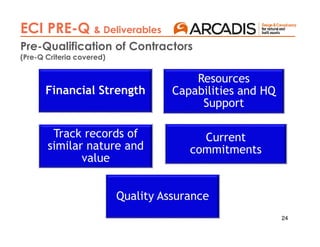
ECI PRE-Q & Deliverables
Pre-Qualification of Contractors
(Pre-Q Criteria covered)
Financial Strength
Resources
Capabilities and HQ
Support
Track records of
similar nature and
value
Current
commitments
Quality Assurance
25
CASE STUDIES
26
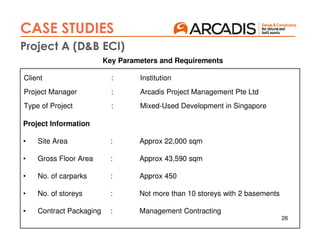
CASE STUDIES
Project A (D&B ECI)
Key Parameters and Requirements
Project Information
• Site Area : Approx 22,000 sqm
• Gross Floor Area : Approx 43,590 sqm
• No. of carparks : Approx 450
• No. of storeys : Not more than 10 storeys with 2 basements
• Contract Packaging : Management Contracting
Client : Institution
Project Manager : Arcadis Project Management Pte Ltd
Type of Project : Mixed-Used Development in Singapore
27
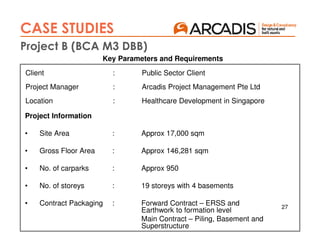
CASE STUDIES
Project B (BCA M3 DBB)
Project Information
• Site Area : Approx 17,000 sqm
• Gross Floor Area : Approx 146,281 sqm
• No. of carparks : Approx 950
• No. of storeys : 19 storeys with 4 basements
• Contract Packaging : Forward Contract – ERSS and
Earthwork to formation level
Main Contract – Piling, Basement and
Superstructure
Client : Public Sector Client
Project Manager : Arcadis Project Management Pte Ltd
Location : Healthcare Development in Singapore
Key Parameters and Requirements
28
ECI
TIMELINES & PROCESSES
29
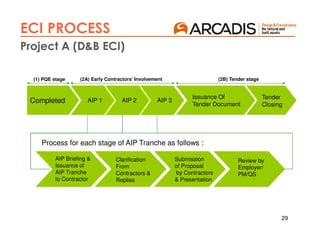
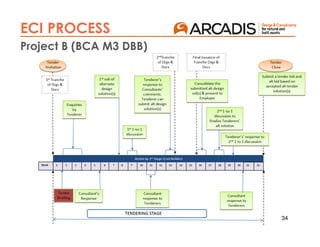
ECI PROCESS
Review by
Employer/
PM/QS
Process for each stage of AIP Tranche as follows :
AIP Briefing &
Issuance of
AIP Tranche
to Contractor
Clarification
From
Contractors &
Replies
Submission
of Proposal
by Contractors
& Presentation
Completed AIP 1
Issuance Of
Tender Document
AIP 2 AIP 3
(1) PQE stage (2A) Early Contractors’ Involvement (2B) Tender stage
Tender
Closing
Project A (D&B ECI)
30
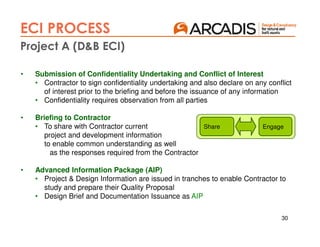
• Submission of Confidentiality Undertaking and Conflict of Interest
• Contractor to sign confidentiality undertaking and also declare on any conflict
of interest prior to the briefing and before the issuance of any information
• Confidentiality requires observation from all parties
• Briefing to Contractor
• To share with Contractor current
project and development information
to enable common understanding as well
as the responses required from the Contractor
• Advanced Information Package (AIP)
• Project & Design Information are issued in tranches to enable Contractor to
study and prepare their Quality Proposal
• Design Brief and Documentation Issuance as AIP
Share Engage
ECI PROCESS
Project A (D&B ECI)
31
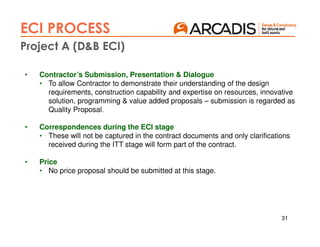
• Contractor’s Submission, Presentation & Dialogue
• To allow Contractor to demonstrate their understanding of the design
requirements, construction capability and expertise on resources, innovative
solution, programming & value added proposals – submission is regarded as
Quality Proposal.
• Correspondences during the ECI stage
• These will not be captured in the contract documents and only clarifications
received during the ITT stage will form part of the contract.
• Price
• No price proposal should be submitted at this stage.
ECI PROCESS
Project A (D&B ECI)
32
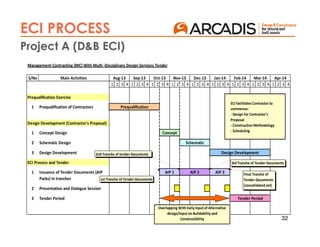
Management Contracting (MC) With Multi -Disciplinary Design Services Tender
S/No Main Activities
1 2 3 4 1 2 3 4 1 2 3 4 1 2 3 4 1 2 3 4 1 2 3 4 1 2 3 4 1 2 3 4 1 2 3 4
1
1 Concept Design
2 Schematic Design
3 Design Development
1
2 Presentation and Dialogue Session
3 Tender Period
ECI facilitates Contractor to
commence:
- Design for Contractor's
Proposal
- Construction Methodology
- Scheduling
Prequalification of Contractors
Aug-13 Sep-13 Oct-13
Prequalification
Prequalification Exercise
Mar-14 Apr-14Nov-13 Dec-13 Jan-14 Feb-14
Design Development (Contractor's Proposal)
ECI Process and Tender
Issuance of Tender Documents (AIP
Packs) in tranches
Concept
AIP 2
Schematic
Overlapping With Early Input of Alternative
design/Input on Buildability and
Constructibility
Design Development
Tender Period
AIP 1 AIP 3
1st Tranche of Tender Documents
2nd Tranche of tender Documents
3rd Tranche of Tender Documents
Final Tranche of
Tender Documents
(consolidated set)
ECI PROCESS
Project A (D&B ECI)
33
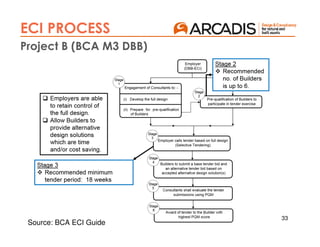
ECI PROCESS
Project B (BCA M3 DBB)
Source: BCA ECI Guide
34
ECI PROCESS
Project B (BCA M3 DBB)
35
ECI PROCESS –
BRIEFING TO TENDERERS
36
BRIEFING TO TENDERERS
1. Project Information
a. Site location & Existing Site conditions
b. Project parameters & requirements
c. Key Stakeholders & Project Organization
2. Project Programme Overview
3. ECI Process and Timeline
a. ECI process & timeline
b. AIP content and issuance
c. Tenderers’ deliverables submission and
presentation
d. Rules of Engagement
4. Design Concept of Development
a. Experiences for Users, Connectivity and circulation
b. Theme
c. Building design, sustainability, Universal Design,
Buildability and constuctability
d. Synergy and operational Requirements
e. Urban design guidelines and authority requirements
5. Spatial Adjacency Diagrams
Project A (D&B ECI)
37
Sample of Spatial Adjacency Diagram
Project A (D&B ECI)
BRIEFING TO TENDERERS
38
1. Introduction
2. Project Targets
3. Architectural
4. Structural
5. M&E
6. Early Contractor Involvement Process (ECI) and Timeline
7. Evaluation Criteria
8. Tender Submissions
9. Clarification and deadline for returns
Project B (BCA M3 DBB)
BRIEFING TO TENDERERS
39
ECI PROCESS –
AIP / TENDER DOC ISSUANCE
40
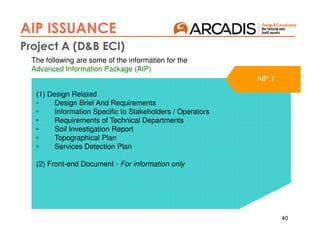
AIP ISSUANCE
The following are some of the information for the
Advanced Information Package (AIP)
AIP 1
(1) Design Related
• Design Brief And Requirements
• Information Specific to Stakeholders / Operators
• Requirements of Technical Departments
• Soil Investigation Report
• Topographical Plan
• Services Detection Plan
(2) Front-end Document - For information only
Project A (D&B ECI)
41
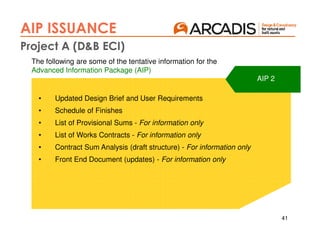
AIP 1
The following are some of the tentative information for the
Advanced Information Package (AIP)
AIP 2
• Updated Design Brief and User Requirements
• Schedule of Finishes
• List of Provisional Sums - For information only
• List of Works Contracts - For information only
• Contract Sum Analysis (draft structure) - For information only
• Front End Document (updates) - For information only
AIP ISSUANCE
Project A (D&B ECI)
42
AIP 1AIP 2
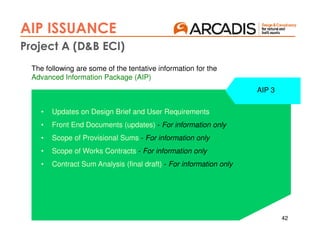
The following are some of the tentative information for the
Advanced Information Package (AIP)
AIP 3
• Updates on Design Brief and User Requirements
• Front End Documents (updates) - For information only
• Scope of Provisional Sums - For information only
• Scope of Works Contracts - For information only
• Contract Sum Analysis (final draft) - For information only
AIP ISSUANCE
Project A (D&B ECI)
43
AIP 1AIP 2
• Updated documents issued earlier
Tender
Project A (D&B ECI)
TENDER DOC ISSUANCE
44
TENDER DOC ISSUANCE
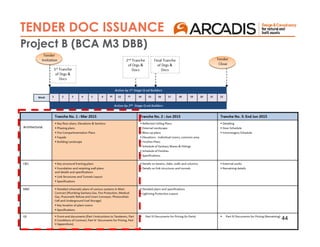
Project B (BCA M3 DBB)
Architectural
45
ECI PROCESS –
TENDERERS DELIVERABLES
46
TENDERER DELIVERABLES
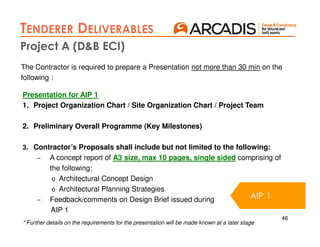
Presentation for AIP 1
1. Project Organization Chart / Site Organization Chart / Project Team
2. Preliminary Overall Programme (Key Milestones)
3. Contractor’s Proposals shall include but not limited to the following:
– A concept report of A3 size, max 10 pages, single sided comprising of
the following:
o Architectural Concept Design
o Architectural Planning Strategies
– Feedback/comments on Design Brief issued during
AIP 1
AIP 1
The Contractor is required to prepare a Presentation not more than 30 min on the
following :
Project A (D&B ECI)
* Further details on the requirements for the presentation will be made known at a later stage
47
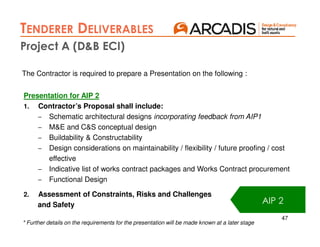
The Contractor is required to prepare a Presentation on the following :
Presentation for AIP 2
1. Contractor’s Proposal shall include:
– Schematic architectural designs incorporating feedback from AIP1
– M&E and C&S conceptual design
– Buildability & Constructability
– Design considerations on maintainability / flexibility / future proofing / cost
effective
– Indicative list of works contract packages and Works Contract procurement
– Functional Design
2. Assessment of Constraints, Risks and Challenges
and Safety AIP 2
Project A (D&B ECI)
TENDERER DELIVERABLES
* Further details on the requirements for the presentation will be made known at a later stage
48
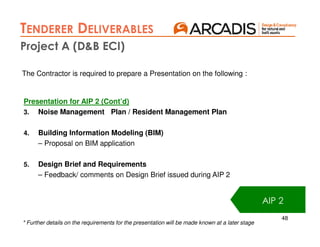
Presentation for AIP 2 (Cont’d)
3. Noise Management Plan / Resident Management Plan
4. Building Information Modeling (BIM)
– Proposal on BIM application
5. Design Brief and Requirements
– Feedback/ comments on Design Brief issued during AIP 2
AIP 2
The Contractor is required to prepare a Presentation on the following :
* Further details on the requirements for the presentation will be made known at a later stage
Project A (D&B ECI)
TENDERER DELIVERABLES
AIP 2
49
AIP 2
The Contractor is required to prepare a Presentation on the following :
* Further details on the requirements for the presentation will be made known at a later stage
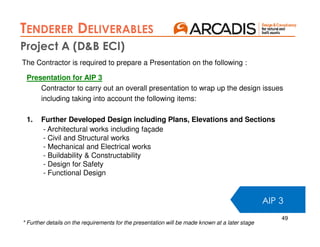
Presentation for AIP 3
Contractor to carry out an overall presentation to wrap up the design issues
including taking into account the following items:
1. Further Developed Design including Plans, Elevations and Sections
- Architectural works including façade
- Civil and Structural works
- Mechanical and Electrical works
- Buildability & Constructability
- Design for Safety
- Functional Design
Project A (D&B ECI)
TENDERER DELIVERABLES
AIP 3
50
AIP 2
The Contractor is required to prepare a Presentation on the following :
AIP 2
* Further details on the requirements for the presentation will be made known at a later stage
Presentation for AIP 3 (Cont’d)
2. Schedules
- Finishes
- Doors and Windows/ External Façade
3. Programme
Project A (D&B ECI)
TENDERER DELIVERABLES
AIP 3
51
AIP 2
TENDERER DELIVERABLES
AIP 3
Project B (BCA M3 DBB)
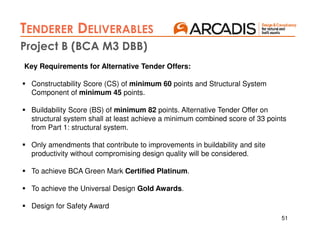
Key Requirements for Alternative Tender Offers:
Constructability Score (CS) of minimum 60 points and Structural System
Component of minimum 45 points.
Buildability Score (BS) of minimum 82 points. Alternative Tender Offer on
structural system shall at least achieve a minimum combined score of 33 points
from Part 1: structural system.
Only amendments that contribute to improvements in buildability and site
productivity without compromising design quality will be considered.
To achieve BCA Green Mark Certified Platinum.
To achieve the Universal Design Gold Awards.
Design for Safety Award
52
AIP 2
TENDERER DELIVERABLES
AIP 3
Project B (BCA M3 DBB)
Note: Failure to comply with all of the above may result in rejection of the Alternative Tender Offer.
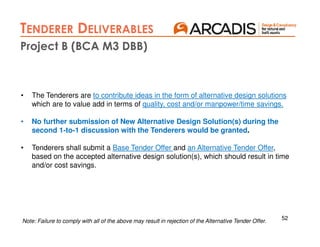
• The Tenderers are to contribute ideas in the form of alternative design solutions
which are to value add in terms of quality, cost and/or manpower/time savings.
• No further submission of New Alternative Design Solution(s) during the
second 1-to-1 discussion with the Tenderers would be granted.
• Tenderers shall submit a Base Tender Offer and an Alternative Tender Offer,
based on the accepted alternative design solution(s), which should result in time
and/or cost savings.
53
AIP 2
TENDERER DELIVERABLES
AIP 3
Project B (BCA M3 DBB)
Note: Failure to comply with all of the above may result in rejection of the Alternative Tender Offer.
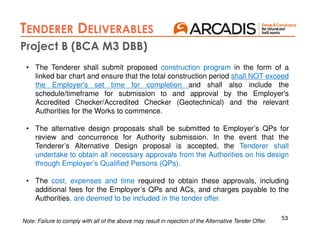
• The Tenderer shall submit proposed construction program in the form of a
linked bar chart and ensure that the total construction period shall NOT exceed
the Employer's set time for completion and shall also include the
schedule/timeframe for submission to and approval by the Employer's
Accredited Checker/Accredited Checker (Geotechnical) and the relevant
Authorities for the Works to commence.
• The alternative design proposals shall be submitted to Employer’s QPs for
review and concurrence for Authority submission. In the event that the
Tenderer’s Alternative Design proposal is accepted, the Tenderer shall
undertake to obtain all necessary approvals from the Authorities on his design
through Employer’s Qualified Persons (QPs).
• The cost, expenses and time required to obtain these approvals, including
additional fees for the Employer’s QPs and ACs, and charges payable to the
Authorities, are deemed to be included in the tender offer.
54
AIP 2
TENDERER DELIVERABLES
AIP 3
Project B (BCA M3 DBB)
Note: Failure to comply with all of the above may result in rejection of the Alternative Tender Offer.
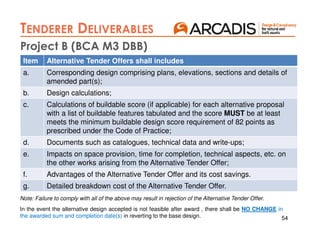
Item Alternative Tender Offers shall includes
a. Corresponding design comprising plans, elevations, sections and details of
amended part(s);
b. Design calculations;
c. Calculations of buildable score (if applicable) for each alternative proposal
with a list of buildable features tabulated and the score MUST be at least
meets the minimum buildable design score requirement of 82 points as
prescribed under the Code of Practice;
d. Documents such as catalogues, technical data and write-ups;
e. Impacts on space provision, time for completion, technical aspects, etc. on
the other works arising from the Alternative Tender Offer;
f. Advantages of the Alternative Tender Offer and its cost savings.
g. Detailed breakdown cost of the Alternative Tender Offer.
In the event the alternative design accepted is not feasible after award , there shall be NO CHANGE in
the awarded sum and completion date(s) in reverting to the base design.
55
AIP 2
TENDERER DELIVERABLES
AIP 3
Project B (BCA M3 DBB)
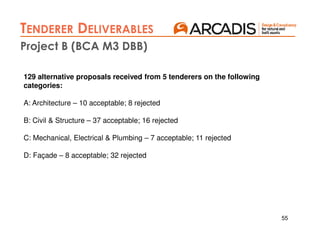
129 alternative proposals received from 5 tenderers on the following
categories:
A: Architecture – 10 acceptable; 8 rejected
B: Civil & Structure – 37 acceptable; 16 rejected
C: Mechanical, Electrical & Plumbing – 7 acceptable; 11 rejected
D: Façade – 8 acceptable; 32 rejected
56
AIP 2
TENDERER DELIVERABLES
AIP 3
Project B (BCA M3 DBB)
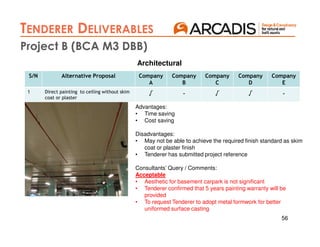
Advantages:
• Time saving
• Cost saving
Disadvantages:
• May not be able to achieve the required finish standard as skim
coat or plaster finish
• Tenderer has submitted project reference
Consultants’ Query / Comments:
Acceptable
• Aesthetic for basement carpark is not significant
• Tenderer confirmed that 5 years painting warranty will be
provided
• To request Tenderer to adopt metal formwork for better
uniformed surface casting
S/N Alternative Proposal Company
A
Company
B
Company
C
Company
D
Company
E
1 Direct painting to ceiling without skim
coat or plaster
√ - √ √ -
Architectural
57
AIP 2
TENDERER DELIVERABLES
AIP 3
Project B (BCA M3 DBB)
S/N Alternative Proposal Company
A
Company
B
Company
C
Company
D
Company
E
8 Optimisation of Basement Floor Height
Height - √ - √ -
Advantages:
- Reduced depth of excavation by 0.6m (about 15,300m3)
- Moderate ramp slopes to basement parking lot w/ reduced floor-to-floor height
- Construction time and cost savings w/ reduced amount of excavation
Disadvantages:
Consultants’ Query / Comments:
Alternate Design
[ Section A ]
[ Section B ]
L1
B1
B2
L1
B1
B2
3.2m Ceiling Height
May Work considering
Originally Proposed
3.2m Ceiling Height at
2nd Basement
Not Acceptable:
2m soil depth below the ground as required by LTA.
4.5m headroom clearance for articulated vehicle as required in
Code of Practice Vehicle Parking Provision in Development
Proposals (2011 Edition).
M&E ceiling space for basement ventilation of at least 2m below the
beam level
Architectural
58
AIP 2
TENDERER DELIVERABLES
AIP 3
Project B (BCA M3 DBB)
S/N Alternative Proposal Company
A
Company
B
Company
C
Company
D
Company
E
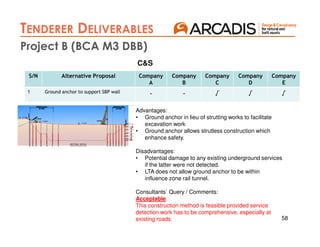
1 Ground anchor to support SBP wall - - √ √ √
C&S
Advantages:
• Ground anchor in lieu of strutting works to facilitate
excavation work
• Ground anchor allows strutless construction which
enhance safety.
Disadvantages:
• Potential damage to any existing underground services
if the latter were not detected.
• LTA does not allow ground anchor to be within
influence zone rail tunnel.
Consultants` Query / Comments:
Acceptable
This construction method is feasible provided service
detection work has to be comprehensive, especially at
existing roads.
59
AIP 2
TENDERER DELIVERABLES
AIP 3
Project B (BCA M3 DBB)
S/N Alternative Proposal Company
A
Company
B
Company
C
Company
D
Company
E
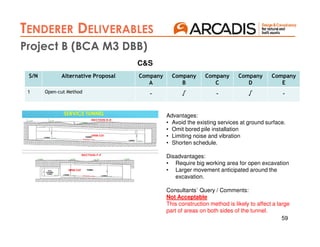
1 Open-cut Method - √ - √ -
C&S
Advantages:
• Avoid the existing services at ground surface.
• Omit bored pile installation
• Limiting noise and vibration
• Shorten schedule.
Disadvantages:
• Require big working area for open excavation
• Larger movement anticipated around the
excavation.
Consultants` Query / Comments:
Not Acceptable
This construction method is likely to affect a large
part of areas on both sides of the tunnel.
60
AIP 2
TENDERER DELIVERABLES
AIP 3
Project B (BCA M3 DBB)
S/N Alternative Proposal Company
A
Company
B
Company
C
Company
D
Company
E
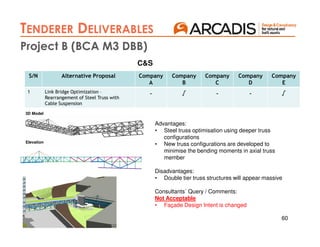
1 Link Bridge Optimization –
Rearrangement of Steel Truss with
Cable Suspension
- √ - - √
C&S
Advantages:
• Steel truss optimisation using deeper truss
configurations
• New truss configurations are developed to
minimise the bending moments in axial truss
member
Disadvantages:
• Double tier truss structures will appear massive
Consultants` Query / Comments:
Not Acceptable
• Façade Design Intent is changed
3D Model
Elevation
61
AIP 2
TENDERER DELIVERABLES
AIP 3
Project B (BCA M3 DBB)
S/N Alternative Proposal Company
A
Company
B
Company
C
Company
D
Company
E
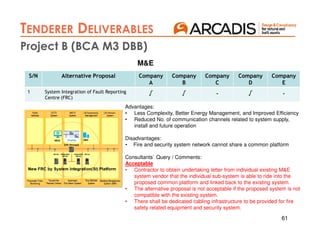
1 System Integration of Fault Reporting
Centre (FRC)
√ √ - √ -
M&E
Advantages:
• Less Complexity, Better Energy Management, and Improved Efficiency
• Reduced No. of communication channels related to system supply,
install and future operation
Disadvantages:
• Fire and security system network cannot share a common platform
Consultants` Query / Comments:
Acceptable
• Contractor to obtain undertaking letter from individual existing M&E
system vendor that the individual sub-system is able to ride into the
proposed common platform and linked back to the existing system.
• The alternative proposal is not acceptable if the proposed system is not
compatible with the existing system.
• There shall be dedicated cabling infrastructure to be provided for fire
safety related equipment and security system.
62
AIP 2
TENDERER DELIVERABLES
AIP 3
Project B (BCA M3 DBB)
S/N Alternative Proposal Company
A
Company
B
Company
C
Company
D
Company
E
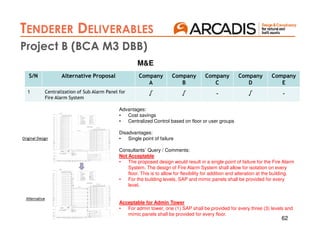
1 Centralization of Sub Alarm Panel for
Fire Alarm System
√ √ - √ -
M&E
Advantages:
• Cost savings
• Centralized Control based on floor or user groups
Disadvantages:
• Single point of failure
Consultants` Query / Comments:
Not Acceptable
• The proposed design would result in a single point of failure for the Fire Alarm
System. The design of Fire Alarm System shall allow for isolation on every
floor. This is to allow for flexibility for addition and alteration at the building.
• For the building levels, SAP and mimic panels shall be provided for every
level.
Acceptable for Admin Tower
• For admin tower, one (1) SAP shall be provided for every three (3) levels and
mimic panels shall be provided for every floor.
63
AIP 2
TENDERER DELIVERABLES
AIP 3
Project B (BCA M3 DBB)
S/N Alternative Proposal Company
A
Company
B
Company
C
Company
D
Company
E
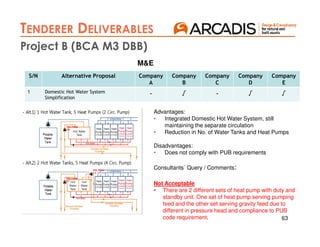
1 Domestic Hot Water System
Simplification
- √ - √ √
M&E
Advantages:
• Integrated Domestic Hot Water System, still
maintaining the separate circulation
• Reduction in No. of Water Tanks and Heat Pumps
Disadvantages:
• Does not comply with PUB requirements
Consultants` Query / Comments:
Not Acceptable
• There are 2 different sets of heat pump with duty and
standby unit. One set of heat pump serving pumping
feed and the other set serving gravity feed due to
different in pressure head and compliance to PUB
code requirement.
64
AIP 2
TENDERER DELIVERABLES
AIP 3
Project B (BCA M3 DBB)
S/N Alternative Proposal Company
A
Company
B
Company
C
Company
D
Company
E
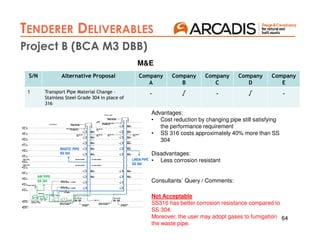
1 Transport Pipe Material Change –
Stainless Steel Grade 304 in place of
316
- √ - √ -
M&E
Advantages:
• Cost reduction by changing pipe still satisfying
the performance requirement
• SS 316 costs approximately 40% more than SS
304
Disadvantages:
• Less corrosion resistant
Consultants` Query / Comments:
Not Acceptable
SS316 has better corrosion resistance compared to
SS 304.
Moreover, the user may adopt gases to fumigation
the waste pipe.
WASTE PIPE
SS 304
LINEN PIPE
SS 304
AIR PIPE
SS 304
65
AIP 2
TENDERER DELIVERABLES
AIP 3
Project B (BCA M3 DBB)
S/N Alternative Proposal Company
A
Company
B
Company
C
Company
D
Company
E
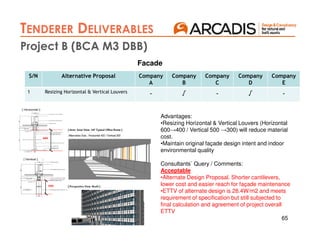
1 Resizing Horizontal & Vertical Louvers - √ - √ -
Facade
Advantages:
•Resizing Horizontal & Vertical Louvers (Horizontal
600→400 / Vertical 500 →300) will reduce material
cost.
•Maintain original façade design intent and indoor
environmental quality
Consultants` Query / Comments:
Acceptable
•Alternate Design Proposal. Shorter cantilevers,
lower cost and easier reach for façade maintenance
•ETTV of alternate design is 28.4W/m2 and meets
requirement of specification but still subjected to
final calculation and agreement of project overall
ETTV
66
AIP 2
TENDERER DELIVERABLES
AIP 3
Project B (BCA M3 DBB)
S/N Alternative Proposal Company
A
Company
B
Company
C
Company
D
Company
E
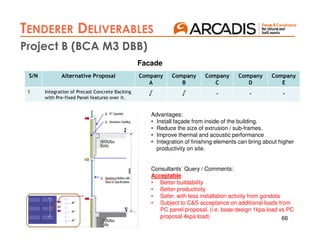
1 Integration of Precast Concrete Backing
with Pre-fixed Panel features over it.
√ √ - - -
Facade
Advantages:
• Install façade from inside of the building.
• Reduce the size of extrusion / sub-frames.
• Improve thermal and acoustic performance
• Integration of finishing elements can bring about higher
productivity on site.
Consultants` Query / Comments:
Acceptable
• Better buildability
• Better productivity
• Safer. with less installation activity from gondola
• Subject to C&S acceptance on additional loads from
PC panel proposal. (i.e. base design 1kpa load vs PC
proposal 4kpa load)
67
AIP 2
TENDERER DELIVERABLES
AIP 3
Project B (BCA M3 DBB)
S/N Alternative Proposal Company
A
Company
B
Company
C
Company
D
Company
E
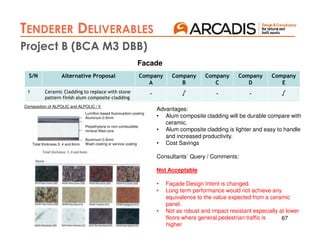
1 Ceramic Cladding to replace with stone
pattern finish alum composite cladding
- √ - - √
Facade
Advantages:
• Alum composite cladding will be durable compare with
ceramic.
• Alum composite cladding is lighter and easy to handle
and increased productivity.
• Cost Savings
Consultants` Query / Comments:
Not Acceptable
• Façade Design Intent is changed.
• Long term performance would not achieve any
equivalence to the value expected from a ceramic
panel.
• Not as robust and impact resistant especially at lower
floors where general pedestrian traffic is
higher
Composition of ALPOLIC and ALPOLIC / fr
Lumiflon-based fluorocarbon coating
Aluminum 0.5mm
Polyethylene or non-combustible
mineral filled core
Aluminum 0.5mm
Wash coating or service coatingTotal thickness 3, 4 and 6mm
68
AIP 2
TENDERER DELIVERABLES
AIP 3
Project B (BCA M3 DBB)
S/N Alternative Proposal Company
A
Company
B
Company
C
Company
D
Company
E
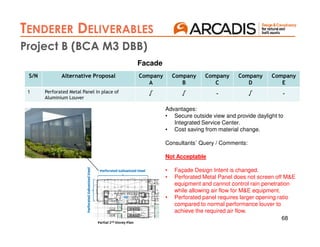
1 Perforated Metal Panel in place of
Aluminium Louver
√ √ - √ -
Facade
Advantages:
• Secure outside view and provide daylight to
Integrated Service Center.
• Cost saving from material change.
Consultants` Query / Comments:
Not Acceptable
• Façade Design Intent is changed.
• Perforated Metal Panel does not screen off M&E
equipment and cannot control rain penetration
while allowing air flow for M&E equipment.
• Perforated panel requires larger opening ratio
compared to normal performance louver to
achieve the required air flow.
69
ECI TENDER EVALUATION
70
Project A (D&B ECI)
ECI TENDER EVALUATION
S/
N
Evaluation Criteria
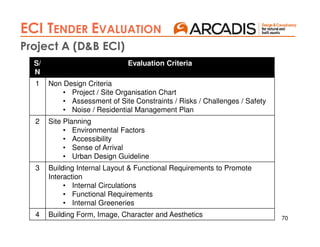
1 Non Design Criteria
• Project / Site Organisation Chart
• Assessment of Site Constraints / Risks / Challenges / Safety
• Noise / Residential Management Plan
2 Site Planning
• Environmental Factors
• Accessibility
• Sense of Arrival
• Urban Design Guideline
3 Building Internal Layout & Functional Requirements to Promote
Interaction
• Internal Circulations
• Functional Requirements
• Internal Greeneries
4 Building Form, Image, Character and Aesthetics
71
Project A (D&B ECI)
ECI TENDER EVALUATION
S/
N
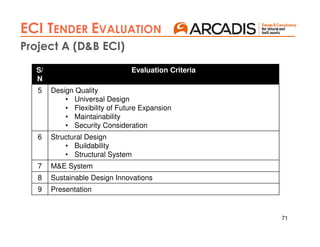
Evaluation Criteria
5 Design Quality
• Universal Design
• Flexibility of Future Expansion
• Maintainability
• Security Consideration
6 Structural Design
• Buildability
• Structural System
7 M&E System
8 Sustainable Design Innovations
9 Presentation
72
Project A (D&B ECI)
ECI TENDER EVALUATION
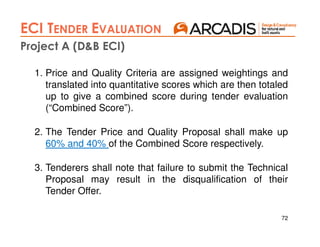
1. Price and Quality Criteria are assigned weightings and
translated into quantitative scores which are then totaled
up to give a combined score during tender evaluation
(“Combined Score”).
2. The Tender Price and Quality Proposal shall make up
60% and 40% of the Combined Score respectively.
3. Tenderers shall note that failure to submit the Technical
Proposal may result in the disqualification of their
Tender Offer.
73
Project A (D&B ECI)
ECI TENDER EVALUATION
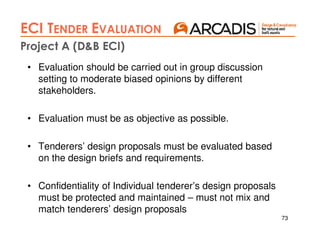
• Evaluation should be carried out in group discussion
setting to moderate biased opinions by different
stakeholders.
• Evaluation must be as objective as possible.
• Tenderers’ design proposals must be evaluated based
on the design briefs and requirements.
• Confidentiality of Individual tenderer’s design proposals
must be protected and maintained – must not mix and
match tenderers’ design proposals
74
ECI TENDER EVALUATION
Project B (BCA M3 DBB)
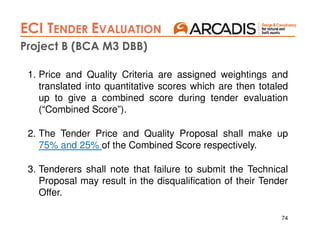
1. Price and Quality Criteria are assigned weightings and
translated into quantitative scores which are then totaled
up to give a combined score during tender evaluation
(“Combined Score”).
2. The Tender Price and Quality Proposal shall make up
75% and 25% of the Combined Score respectively.
3. Tenderers shall note that failure to submit the Technical
Proposal may result in the disqualification of their Tender
Offer.
75
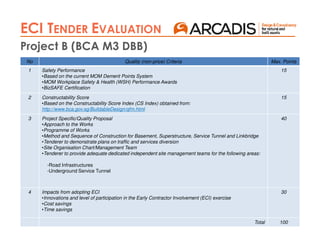
ECI TENDER EVALUATION
Project B (BCA M3 DBB)
No Quality (non-price) Criteria Max. Points
1 Safety Performance
•Based on the current MOM Demerit Points System
•MOM Workplace Safety & Health (WSH) Performance Awards
•BizSAFE Certification
15
2 Constructability Score
•Based on the Constructability Score Index (CS Index) obtained from:
http://www.bca.gov.sg/BuildableDesign/qfm.html
15
3 Project Specific/Quality Proposal
•Approach to the Works
•Programme of Works
•Method and Sequence of Construction for Basement, Superstructure, Service Tunnel and Linkbridge
•Tenderer to demonstrate plans on traffic and services diversion
•Site Organisation Chart/Management Team
•Tenderer to provide adequate dedicated independent site management teams for the following areas:
-Outram Community Hospital (OCH)
-Road Infrastructures
-Underground Service Tunnel
40
4 Impacts from adopting ECI
•Innovations and level of participation in the Early Contractor Involvement (ECI) exercise
•Cost savings
•Time savings
30
Total 100
76
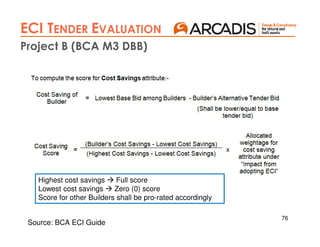
ECI TENDER EVALUATION
Project B (BCA M3 DBB)
Highest cost savings Full score
Lowest cost savings Zero (0) score
Score for other Builders shall be pro-rated accordingly
Source: BCA ECI Guide
77
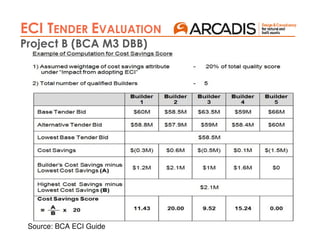
ECI TENDER EVALUATION
Project B (BCA M3 DBB)
Source: BCA ECI Guide
78
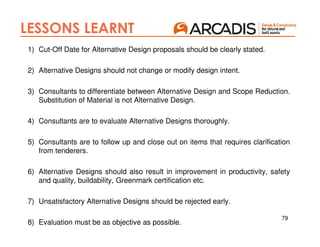
LESSONS LEARNT
79
LESSONS LEARNT
1) Cut-Off Date for Alternative Design proposals should be clearly stated.
2) Alternative Designs should not change or modify design intent.
3) Consultants to differentiate between Alternative Design and Scope Reduction.
Substitution of Material is not Alternative Design.
4) Consultants are to evaluate Alternative Designs thoroughly.
5) Consultants are to follow up and close out on items that requires clarification
from tenderers.
6) Alternative Designs should also result in improvement in productivity, safety
and quality, buildability, Greenmark certification etc.
7) Unsatisfactory Alternative Designs should be rejected early.
8) Evaluation must be as objective as possible.
80
ECI PROs & CONs –
TENDERERS’ PERSPECTIVES
81
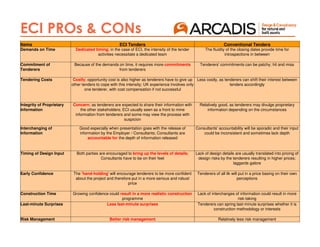
ECI PROs & CONs
Items ECI Tenders Conventional Tenders
Demands on Time Dedicated timing; in the case of ECI, the intensity of the tender
activities necessitate a dedicated team
The fluidity of the closing dates provide time for
introspections in between
Commitment of
Tenderers
Because of the demands on time, it requires more commitments
from tenderers
Tenderers' commitments can be patchy; hit and miss
Tendering Costs Costly; opportunity cost is also higher as tenderers have to give up
other tenders to cope with this intensity; UK experience involves only
one tenderer, with cost compensation if not successful
Less costly, as tenderers can shift their interest between
tenders accordingly
Integrity of Proprietary
Information
Concern; as tenderers are expected to share their information with
the other stakeholders; ECI usually seen as a front to mine
information from tenderers and some may view the process with
suspicion
Relatively good, as tenderers may divulge proprietary
information depending on the circumstances
Interchanging of
Information
Good especially when presentation goes with the release of
information by the Employer / Consultants; Consultants are
accountable for the depth of information released
Consultants' accountability will be sporadic and their input
could be inconsistent and sometimes lack depth
Timing of Design Input Both parties are encouraged to bring up the levels of details;
Consultants have to be on their feet
Lack of design details are usually translated into pricing of
design risks by the tenderers resulting in higher prices;
laggards galore
Early Confidence The 'hand-holding' will encourage tenderers to be more confident
about the project and therefore put in a more serious and robust
price
Tenderers of all ilk will put in a price basing on their own
perceptions
Construction Time Growing confidence could result in a more realistic construction
programme
Lack of interchanges of information could result in more
risk-taking
Last-minute Surprises Less last-minute surprises Tenderers can spring last-minute surprises whether it is
construction methodology or interests
Risk Management Better risk management Relatively less risk management
82
CONCLUSION
83
CONCLUSION
• ECI can be adopted in Traditional, Design & Build or Develop & Construct
Procurement Method
• Paradigm Shift – Need for a mindset & culture change for all parties involved :
Open communication, Sharing & Engagement; as opposed to traditional tender
environment
• Promotes Partnering in Tendering environment;
maintains a healthy and competitive tender environment
• Enhances greater productivity – enable better understanding on programming
constructability issues (for consultants) and better understanding on the design &
project (for contractors)
84
RECOMMENDATION
85
RECOMMENDATION
• ECI should only be considered for bigger size projects e.g. S$200 million
and above, or very complicated projects.
• The number of tenderers shortlisted for the ECI should only be between
3 to 5.
• Evaluation criteria must be as objective as possible inparticular in Design
and Build ECI.
• Confidentiality of tenderers design or alternative proposals must be
maintained and protected.
• Honorarium should be considered for unsuccessful tenderers in view of
the efforts put in by them.
Early contractor involvement (eci) procurement approach   spm talk 2016

Early contractor involvement (eci) procurement approach spm talk 2016

  • 1.
    SPM Professional TechnicalTalk Series 1 Teoh Wooi Sin Arcadis Project Management Pte Ltd
  • 2.
    2 1. Current Norms 2.ECI Evolution 3. ECI Drivers and Benefits 4. ECI Pre-Q 5. Case Studies – ECI Timeline and Process – ECI Process – Briefing to Tenderers – ECI Process – AIP / Tender Doc Issuance – ECI – Tenderers’ Deliverables – ECI Tender Evaluation 6. Lessons Learned 7. Pros and Cons – Tender’s Perspective 8. Conclusion 9. Recommendation AGENDA
  • 3.
  • 4.
    • No contractorinvolvement • Design process / construction requirements : dichotomy of objectives 4 CURRENT NORMS Traditional Procurement of Building Contracts Concept Schematic Detailed Development Tender
  • 5.
    • No contractorinvolvement during early stages • Issues are addressed later after award 5 CURRENT NORMS Design and Build (Develop & Construct) Concept / Schematic Tender Award (Contractor commences Detail Design etc.)
  • 6.
  • 7.
    7 ECI EVOLUTION History ofECI in Langdon & Seah • In the early 1990s, our management foresaw the importance of early engagement of contractors especially during the pre-tendering stages • Attributed to the persistent shortcomings posed by the traditional procurement method whereby the contractors are engaged only after the designs have been finalised which resulted in unnecessary cost and time overruns
  • 8.
    8 ECI EVOLUTION Early Objectives •Early Start – rising land cost (and financing cost) • Better Construction / Pricing – more capital for land bids • More buildable solutions – enhance speed of construction
  • 9.
    9 ECI EVOLUTION Procurement Methods •Early Start – Forward Planning • Piling commence within 3 months after Building Agreement was signed (compared to 9 months in normal case) Better Construction / Pricing • Developers agree building construction costs prior to land bid – either with selected contractor lump sums or Unit Costs per GFA • Contractors will offer the best in terms buildable and constructable designs, easier / faster methods and sequence of construction etc. which will translate to both time and cost savings
  • 10.
    10 ECI EVOLUTION A Reflectionof Earlier Approach on ECI… ECI through Initial Engagement with Contractor to agree on construction cost on lump sum basis or unit cost per GFA … Earlier Approaches have not harnessed the full benefits of ECI and the initial engagement is not a full ECI process. What is ECI ??
  • 11.
    11 What is ECI? EarlyContractors’ Involvement ECI is a project delivery method whereby contractors are engaged mostly during the earlier stages of design (i.e. concept design or schematic design stages) To engage the Contractors early and to effectively tap their expertise especially in the areas of buildability, constructability, construction scheduling and planning, value management or value engineering and the latest construction technologies or methods
  • 12.
    12 PUBLIC SECTOR ECI BCAECI Guide & Models • Builders are engaged early during the design stage • Facilitates integration of design and construction process • Early collaboration between the Employer, Consultants and Builders Source: BCA ECI Guide
  • 13.
    13 4 MODELS OFECI Design Bid Build - Progressive Project Information (DBB-PPI) Design Bid Build with Early Contractor Involvement (DBB-ECI) Design Development & Build (DDB) Design & Build (D&B) DegreeofcontributionfromBuilders TenderingPeriod Source: BCA ECI Guide
  • 14.
    Model ECI Inputsby Builders 1 Design & Build (D&B) Develop full design (Arch, C&S, MEP) based on design brief 2 Design Development & Build (DDB) Develop detailed design, including C&S and MEP, based on architectural concept design 3 Design Bid Build with Early Contractor Involvement (DBB-ECI) Provide alternative design solution(s) based on full design 4 Design Bid Build – Progressive Project Information (DBB-PPI) Highlight missing information, clashes, deficiency in design, constraints, etc, based on full design 14 4 MODELS OF ECI Different Contractor Inputs for the Various Models Source: BCA ECI Guide
  • 15.
    Model ECI AdvantagesDisadvantages 1 Design & Build (D&B) • Single point of responsibility • Allows Builders’ full inputs into design • Potential cost savings due to Builders’ inputs • Potential time savings due to shorter construction period, albeit a longer tendering period • Employer has to have a strong in- house project management team. Otherwise, Employer has to engage external consultants to assist in the development of design brief, preparation of tender documents and administration of the contract. • Complex evaluation of tender as design proposals submitted vary according to respective Builder (Tenderer). • Employer has no control of design as consultants are engaged by Builder 15 4 MODELS OF ECI Different Contractor Inputs for the Various Models Source: BCA ECI Guide
  • 16.
    Model ECI AdvantagesDisadvantages 2 Design Development & Build (DDB) • Single point of responsibility • Employer retains control of architectural concept design • Allows Builders’ inputs into design (explore better and more effective technical solutions upfront) • Potential cost savings due to Builders’ inputs • Potential time savings due to shorter construction period, albeit a longer tendering period • Builders’ inputs in C&S and MEP aspects are restricted 16 4 MODELS OF ECI Different Contractor Inputs for the Various Models Source: BCA ECI Guide
  • 17.
    Model ECI AdvantagesDisadvantages 3 Design Bid Build with Early Contractor Involvement (DBB-ECI) • Employer retains control of full design (for base tender) • Allows Builders’ inputs into design via alternative design solutions at tender stage, rather than after award of tender • Potential cost savings due to Builders’ inputs • Potential time savings due to shorter construction period, albeit a longer tendering period • More involvement from Employer and their consultants during tender period. • Builders’ inputs are further restricted as compared to D&B and DDB. 17 4 MODELS OF ECI Different Contractor Inputs for the Various Models Source: BCA ECI Guide
  • 18.
    18 4 MODELS OFECI Different Contractor Inputs for the Various Models Model ECI Advantages Disadvantages 4 Design Bid Build – Progressive Project Information (DBB-PPI) • Employer retains control of full design • Allows Builders’ inputs regarding missing design information at PPI phase • Builders have longer lead time to study the project details • Potential time savings due to reduction in number of Request for Information (RFI) during construction period • Builders’ inputs are confined mainly to minimising RFI. Hence, their inputs are further restricted as compared to D&B, DDB and DBB- ECI. Source: BCA ECI Guide
  • 19.
  • 20.
    20 ECI VALUE DRIVERS Shortertender period Construction Planning, Methodology & Buildability Construction Programme & Sequencing Value Management & Value Engineering Solution Better Understanding of the Contractors’ Team Capability Promote Partnering concepts but in a tendering environment ECI Value Drivers
  • 21.
    21 BENEFITS OF ECI •Achieve more favourable results than traditional procurement routes especially on contractors’ expertise areas • Harness the latest knowledge and technologies from the contractors • Initiate greater commitment and sense of ownership from the contractors • Better awareness and understanding of project risks • Better forecast of project outcomes • Lean construction cost as contractors have lower risk to buffer in their price • Joint problem solving, addressing unknowns and difficult environments • Reduce the risk of litigation • Shorten tender period
  • 22.
  • 23.
    23 ECI PRE-Q • Priorto ECI being put in place, it is recommended to have a Pre-Qualification exercise (Pre-Q) to select the most suitable contractors to tender for the project • For Public Sector projects, Pre-Q is conducted through open tender (2nd stage Pre-Q during subsequent ECI tender not allowed) • The Pre-Q process to be carried out should cover the following criteria:- • Financial Strength, • Resources & Capabilities, • Relevant experience, and • Current project commitments • It is recommended that the shortlisted number of tenderers for ECI be limited to between 3 to 5.
  • 24.
    24 ECI PRE-Q &Deliverables Pre-Qualification of Contractors (Pre-Q Criteria covered) Financial Strength Resources Capabilities and HQ Support Track records of similar nature and value Current commitments Quality Assurance
  • 25.
  • 26.
    26 CASE STUDIES Project A(D&B ECI) Key Parameters and Requirements Project Information • Site Area : Approx 22,000 sqm • Gross Floor Area : Approx 43,590 sqm • No. of carparks : Approx 450 • No. of storeys : Not more than 10 storeys with 2 basements • Contract Packaging : Management Contracting Client : Institution Project Manager : Arcadis Project Management Pte Ltd Type of Project : Mixed-Used Development in Singapore
  • 27.
    27 CASE STUDIES Project B(BCA M3 DBB) Project Information • Site Area : Approx 17,000 sqm • Gross Floor Area : Approx 146,281 sqm • No. of carparks : Approx 950 • No. of storeys : 19 storeys with 4 basements • Contract Packaging : Forward Contract – ERSS and Earthwork to formation level Main Contract – Piling, Basement and Superstructure Client : Public Sector Client Project Manager : Arcadis Project Management Pte Ltd Location : Healthcare Development in Singapore Key Parameters and Requirements
  • 28.
  • 29.
    29 ECI PROCESS Review by Employer/ PM/QS Processfor each stage of AIP Tranche as follows : AIP Briefing & Issuance of AIP Tranche to Contractor Clarification From Contractors & Replies Submission of Proposal by Contractors & Presentation Completed AIP 1 Issuance Of Tender Document AIP 2 AIP 3 (1) PQE stage (2A) Early Contractors’ Involvement (2B) Tender stage Tender Closing Project A (D&B ECI)
  • 30.
    30 • Submission ofConfidentiality Undertaking and Conflict of Interest • Contractor to sign confidentiality undertaking and also declare on any conflict of interest prior to the briefing and before the issuance of any information • Confidentiality requires observation from all parties • Briefing to Contractor • To share with Contractor current project and development information to enable common understanding as well as the responses required from the Contractor • Advanced Information Package (AIP) • Project & Design Information are issued in tranches to enable Contractor to study and prepare their Quality Proposal • Design Brief and Documentation Issuance as AIP Share Engage ECI PROCESS Project A (D&B ECI)
  • 31.
    31 • Contractor’s Submission,Presentation & Dialogue • To allow Contractor to demonstrate their understanding of the design requirements, construction capability and expertise on resources, innovative solution, programming & value added proposals – submission is regarded as Quality Proposal. • Correspondences during the ECI stage • These will not be captured in the contract documents and only clarifications received during the ITT stage will form part of the contract. • Price • No price proposal should be submitted at this stage. ECI PROCESS Project A (D&B ECI)
  • 32.
    32 Management Contracting (MC)With Multi -Disciplinary Design Services Tender S/No Main Activities 1 2 3 4 1 2 3 4 1 2 3 4 1 2 3 4 1 2 3 4 1 2 3 4 1 2 3 4 1 2 3 4 1 2 3 4 1 1 Concept Design 2 Schematic Design 3 Design Development 1 2 Presentation and Dialogue Session 3 Tender Period ECI facilitates Contractor to commence: - Design for Contractor's Proposal - Construction Methodology - Scheduling Prequalification of Contractors Aug-13 Sep-13 Oct-13 Prequalification Prequalification Exercise Mar-14 Apr-14Nov-13 Dec-13 Jan-14 Feb-14 Design Development (Contractor's Proposal) ECI Process and Tender Issuance of Tender Documents (AIP Packs) in tranches Concept AIP 2 Schematic Overlapping With Early Input of Alternative design/Input on Buildability and Constructibility Design Development Tender Period AIP 1 AIP 3 1st Tranche of Tender Documents 2nd Tranche of tender Documents 3rd Tranche of Tender Documents Final Tranche of Tender Documents (consolidated set) ECI PROCESS Project A (D&B ECI)
  • 33.
    33 ECI PROCESS Project B(BCA M3 DBB) Source: BCA ECI Guide
  • 34.
  • 35.
  • 36.
    36 BRIEFING TO TENDERERS 1.Project Information a. Site location & Existing Site conditions b. Project parameters & requirements c. Key Stakeholders & Project Organization 2. Project Programme Overview 3. ECI Process and Timeline a. ECI process & timeline b. AIP content and issuance c. Tenderers’ deliverables submission and presentation d. Rules of Engagement 4. Design Concept of Development a. Experiences for Users, Connectivity and circulation b. Theme c. Building design, sustainability, Universal Design, Buildability and constuctability d. Synergy and operational Requirements e. Urban design guidelines and authority requirements 5. Spatial Adjacency Diagrams Project A (D&B ECI)
  • 37.
    37 Sample of SpatialAdjacency Diagram Project A (D&B ECI) BRIEFING TO TENDERERS
  • 38.
    38 1. Introduction 2. ProjectTargets 3. Architectural 4. Structural 5. M&E 6. Early Contractor Involvement Process (ECI) and Timeline 7. Evaluation Criteria 8. Tender Submissions 9. Clarification and deadline for returns Project B (BCA M3 DBB) BRIEFING TO TENDERERS
  • 39.
    39 ECI PROCESS – AIP/ TENDER DOC ISSUANCE
  • 40.
    40 AIP ISSUANCE The followingare some of the information for the Advanced Information Package (AIP) AIP 1 (1) Design Related • Design Brief And Requirements • Information Specific to Stakeholders / Operators • Requirements of Technical Departments • Soil Investigation Report • Topographical Plan • Services Detection Plan (2) Front-end Document - For information only Project A (D&B ECI)
  • 41.
    41 AIP 1 The followingare some of the tentative information for the Advanced Information Package (AIP) AIP 2 • Updated Design Brief and User Requirements • Schedule of Finishes • List of Provisional Sums - For information only • List of Works Contracts - For information only • Contract Sum Analysis (draft structure) - For information only • Front End Document (updates) - For information only AIP ISSUANCE Project A (D&B ECI)
  • 42.
    42 AIP 1AIP 2 Thefollowing are some of the tentative information for the Advanced Information Package (AIP) AIP 3 • Updates on Design Brief and User Requirements • Front End Documents (updates) - For information only • Scope of Provisional Sums - For information only • Scope of Works Contracts - For information only • Contract Sum Analysis (final draft) - For information only AIP ISSUANCE Project A (D&B ECI)
  • 43.
    43 AIP 1AIP 2 •Updated documents issued earlier Tender Project A (D&B ECI) TENDER DOC ISSUANCE
  • 44.
    44 TENDER DOC ISSUANCE ProjectB (BCA M3 DBB) Architectural
  • 45.
  • 46.
    46 TENDERER DELIVERABLES Presentation forAIP 1 1. Project Organization Chart / Site Organization Chart / Project Team 2. Preliminary Overall Programme (Key Milestones) 3. Contractor’s Proposals shall include but not limited to the following: – A concept report of A3 size, max 10 pages, single sided comprising of the following: o Architectural Concept Design o Architectural Planning Strategies – Feedback/comments on Design Brief issued during AIP 1 AIP 1 The Contractor is required to prepare a Presentation not more than 30 min on the following : Project A (D&B ECI) * Further details on the requirements for the presentation will be made known at a later stage
  • 47.
    47 The Contractor isrequired to prepare a Presentation on the following : Presentation for AIP 2 1. Contractor’s Proposal shall include: – Schematic architectural designs incorporating feedback from AIP1 – M&E and C&S conceptual design – Buildability & Constructability – Design considerations on maintainability / flexibility / future proofing / cost effective – Indicative list of works contract packages and Works Contract procurement – Functional Design 2. Assessment of Constraints, Risks and Challenges and Safety AIP 2 Project A (D&B ECI) TENDERER DELIVERABLES * Further details on the requirements for the presentation will be made known at a later stage
  • 48.
    48 Presentation for AIP2 (Cont’d) 3. Noise Management Plan / Resident Management Plan 4. Building Information Modeling (BIM) – Proposal on BIM application 5. Design Brief and Requirements – Feedback/ comments on Design Brief issued during AIP 2 AIP 2 The Contractor is required to prepare a Presentation on the following : * Further details on the requirements for the presentation will be made known at a later stage Project A (D&B ECI) TENDERER DELIVERABLES AIP 2
  • 49.
    49 AIP 2 The Contractoris required to prepare a Presentation on the following : * Further details on the requirements for the presentation will be made known at a later stage Presentation for AIP 3 Contractor to carry out an overall presentation to wrap up the design issues including taking into account the following items: 1. Further Developed Design including Plans, Elevations and Sections - Architectural works including façade - Civil and Structural works - Mechanical and Electrical works - Buildability & Constructability - Design for Safety - Functional Design Project A (D&B ECI) TENDERER DELIVERABLES AIP 3
  • 50.
    50 AIP 2 The Contractoris required to prepare a Presentation on the following : AIP 2 * Further details on the requirements for the presentation will be made known at a later stage Presentation for AIP 3 (Cont’d) 2. Schedules - Finishes - Doors and Windows/ External Façade 3. Programme Project A (D&B ECI) TENDERER DELIVERABLES AIP 3
  • 51.
    51 AIP 2 TENDERER DELIVERABLES AIP3 Project B (BCA M3 DBB) Key Requirements for Alternative Tender Offers: Constructability Score (CS) of minimum 60 points and Structural System Component of minimum 45 points. Buildability Score (BS) of minimum 82 points. Alternative Tender Offer on structural system shall at least achieve a minimum combined score of 33 points from Part 1: structural system. Only amendments that contribute to improvements in buildability and site productivity without compromising design quality will be considered. To achieve BCA Green Mark Certified Platinum. To achieve the Universal Design Gold Awards. Design for Safety Award
  • 52.
    52 AIP 2 TENDERER DELIVERABLES AIP3 Project B (BCA M3 DBB) Note: Failure to comply with all of the above may result in rejection of the Alternative Tender Offer. • The Tenderers are to contribute ideas in the form of alternative design solutions which are to value add in terms of quality, cost and/or manpower/time savings. • No further submission of New Alternative Design Solution(s) during the second 1-to-1 discussion with the Tenderers would be granted. • Tenderers shall submit a Base Tender Offer and an Alternative Tender Offer, based on the accepted alternative design solution(s), which should result in time and/or cost savings.
  • 53.
    53 AIP 2 TENDERER DELIVERABLES AIP3 Project B (BCA M3 DBB) Note: Failure to comply with all of the above may result in rejection of the Alternative Tender Offer. • The Tenderer shall submit proposed construction program in the form of a linked bar chart and ensure that the total construction period shall NOT exceed the Employer's set time for completion and shall also include the schedule/timeframe for submission to and approval by the Employer's Accredited Checker/Accredited Checker (Geotechnical) and the relevant Authorities for the Works to commence. • The alternative design proposals shall be submitted to Employer’s QPs for review and concurrence for Authority submission. In the event that the Tenderer’s Alternative Design proposal is accepted, the Tenderer shall undertake to obtain all necessary approvals from the Authorities on his design through Employer’s Qualified Persons (QPs). • The cost, expenses and time required to obtain these approvals, including additional fees for the Employer’s QPs and ACs, and charges payable to the Authorities, are deemed to be included in the tender offer.
  • 54.
    54 AIP 2 TENDERER DELIVERABLES AIP3 Project B (BCA M3 DBB) Note: Failure to comply with all of the above may result in rejection of the Alternative Tender Offer. Item Alternative Tender Offers shall includes a. Corresponding design comprising plans, elevations, sections and details of amended part(s); b. Design calculations; c. Calculations of buildable score (if applicable) for each alternative proposal with a list of buildable features tabulated and the score MUST be at least meets the minimum buildable design score requirement of 82 points as prescribed under the Code of Practice; d. Documents such as catalogues, technical data and write-ups; e. Impacts on space provision, time for completion, technical aspects, etc. on the other works arising from the Alternative Tender Offer; f. Advantages of the Alternative Tender Offer and its cost savings. g. Detailed breakdown cost of the Alternative Tender Offer. In the event the alternative design accepted is not feasible after award , there shall be NO CHANGE in the awarded sum and completion date(s) in reverting to the base design.
  • 55.
    55 AIP 2 TENDERER DELIVERABLES AIP3 Project B (BCA M3 DBB) 129 alternative proposals received from 5 tenderers on the following categories: A: Architecture – 10 acceptable; 8 rejected B: Civil & Structure – 37 acceptable; 16 rejected C: Mechanical, Electrical & Plumbing – 7 acceptable; 11 rejected D: Façade – 8 acceptable; 32 rejected
  • 56.
    56 AIP 2 TENDERER DELIVERABLES AIP3 Project B (BCA M3 DBB) Advantages: • Time saving • Cost saving Disadvantages: • May not be able to achieve the required finish standard as skim coat or plaster finish • Tenderer has submitted project reference Consultants’ Query / Comments: Acceptable • Aesthetic for basement carpark is not significant • Tenderer confirmed that 5 years painting warranty will be provided • To request Tenderer to adopt metal formwork for better uniformed surface casting S/N Alternative Proposal Company A Company B Company C Company D Company E 1 Direct painting to ceiling without skim coat or plaster √ - √ √ - Architectural
  • 57.
    57 AIP 2 TENDERER DELIVERABLES AIP3 Project B (BCA M3 DBB) S/N Alternative Proposal Company A Company B Company C Company D Company E 8 Optimisation of Basement Floor Height Height - √ - √ - Advantages: - Reduced depth of excavation by 0.6m (about 15,300m3) - Moderate ramp slopes to basement parking lot w/ reduced floor-to-floor height - Construction time and cost savings w/ reduced amount of excavation Disadvantages: Consultants’ Query / Comments: Alternate Design [ Section A ] [ Section B ] L1 B1 B2 L1 B1 B2 3.2m Ceiling Height May Work considering Originally Proposed 3.2m Ceiling Height at 2nd Basement Not Acceptable: 2m soil depth below the ground as required by LTA. 4.5m headroom clearance for articulated vehicle as required in Code of Practice Vehicle Parking Provision in Development Proposals (2011 Edition). M&E ceiling space for basement ventilation of at least 2m below the beam level Architectural
  • 58.
    58 AIP 2 TENDERER DELIVERABLES AIP3 Project B (BCA M3 DBB) S/N Alternative Proposal Company A Company B Company C Company D Company E 1 Ground anchor to support SBP wall - - √ √ √ C&S Advantages: • Ground anchor in lieu of strutting works to facilitate excavation work • Ground anchor allows strutless construction which enhance safety. Disadvantages: • Potential damage to any existing underground services if the latter were not detected. • LTA does not allow ground anchor to be within influence zone rail tunnel. Consultants` Query / Comments: Acceptable This construction method is feasible provided service detection work has to be comprehensive, especially at existing roads.
  • 59.
    59 AIP 2 TENDERER DELIVERABLES AIP3 Project B (BCA M3 DBB) S/N Alternative Proposal Company A Company B Company C Company D Company E 1 Open-cut Method - √ - √ - C&S Advantages: • Avoid the existing services at ground surface. • Omit bored pile installation • Limiting noise and vibration • Shorten schedule. Disadvantages: • Require big working area for open excavation • Larger movement anticipated around the excavation. Consultants` Query / Comments: Not Acceptable This construction method is likely to affect a large part of areas on both sides of the tunnel.
  • 60.
    60 AIP 2 TENDERER DELIVERABLES AIP3 Project B (BCA M3 DBB) S/N Alternative Proposal Company A Company B Company C Company D Company E 1 Link Bridge Optimization – Rearrangement of Steel Truss with Cable Suspension - √ - - √ C&S Advantages: • Steel truss optimisation using deeper truss configurations • New truss configurations are developed to minimise the bending moments in axial truss member Disadvantages: • Double tier truss structures will appear massive Consultants` Query / Comments: Not Acceptable • Façade Design Intent is changed 3D Model Elevation
  • 61.
    61 AIP 2 TENDERER DELIVERABLES AIP3 Project B (BCA M3 DBB) S/N Alternative Proposal Company A Company B Company C Company D Company E 1 System Integration of Fault Reporting Centre (FRC) √ √ - √ - M&E Advantages: • Less Complexity, Better Energy Management, and Improved Efficiency • Reduced No. of communication channels related to system supply, install and future operation Disadvantages: • Fire and security system network cannot share a common platform Consultants` Query / Comments: Acceptable • Contractor to obtain undertaking letter from individual existing M&E system vendor that the individual sub-system is able to ride into the proposed common platform and linked back to the existing system. • The alternative proposal is not acceptable if the proposed system is not compatible with the existing system. • There shall be dedicated cabling infrastructure to be provided for fire safety related equipment and security system.
  • 62.
    62 AIP 2 TENDERER DELIVERABLES AIP3 Project B (BCA M3 DBB) S/N Alternative Proposal Company A Company B Company C Company D Company E 1 Centralization of Sub Alarm Panel for Fire Alarm System √ √ - √ - M&E Advantages: • Cost savings • Centralized Control based on floor or user groups Disadvantages: • Single point of failure Consultants` Query / Comments: Not Acceptable • The proposed design would result in a single point of failure for the Fire Alarm System. The design of Fire Alarm System shall allow for isolation on every floor. This is to allow for flexibility for addition and alteration at the building. • For the building levels, SAP and mimic panels shall be provided for every level. Acceptable for Admin Tower • For admin tower, one (1) SAP shall be provided for every three (3) levels and mimic panels shall be provided for every floor.
  • 63.
    63 AIP 2 TENDERER DELIVERABLES AIP3 Project B (BCA M3 DBB) S/N Alternative Proposal Company A Company B Company C Company D Company E 1 Domestic Hot Water System Simplification - √ - √ √ M&E Advantages: • Integrated Domestic Hot Water System, still maintaining the separate circulation • Reduction in No. of Water Tanks and Heat Pumps Disadvantages: • Does not comply with PUB requirements Consultants` Query / Comments: Not Acceptable • There are 2 different sets of heat pump with duty and standby unit. One set of heat pump serving pumping feed and the other set serving gravity feed due to different in pressure head and compliance to PUB code requirement.
  • 64.
    64 AIP 2 TENDERER DELIVERABLES AIP3 Project B (BCA M3 DBB) S/N Alternative Proposal Company A Company B Company C Company D Company E 1 Transport Pipe Material Change – Stainless Steel Grade 304 in place of 316 - √ - √ - M&E Advantages: • Cost reduction by changing pipe still satisfying the performance requirement • SS 316 costs approximately 40% more than SS 304 Disadvantages: • Less corrosion resistant Consultants` Query / Comments: Not Acceptable SS316 has better corrosion resistance compared to SS 304. Moreover, the user may adopt gases to fumigation the waste pipe. WASTE PIPE SS 304 LINEN PIPE SS 304 AIR PIPE SS 304
  • 65.
    65 AIP 2 TENDERER DELIVERABLES AIP3 Project B (BCA M3 DBB) S/N Alternative Proposal Company A Company B Company C Company D Company E 1 Resizing Horizontal & Vertical Louvers - √ - √ - Facade Advantages: •Resizing Horizontal & Vertical Louvers (Horizontal 600→400 / Vertical 500 →300) will reduce material cost. •Maintain original façade design intent and indoor environmental quality Consultants` Query / Comments: Acceptable •Alternate Design Proposal. Shorter cantilevers, lower cost and easier reach for façade maintenance •ETTV of alternate design is 28.4W/m2 and meets requirement of specification but still subjected to final calculation and agreement of project overall ETTV
  • 66.
    66 AIP 2 TENDERER DELIVERABLES AIP3 Project B (BCA M3 DBB) S/N Alternative Proposal Company A Company B Company C Company D Company E 1 Integration of Precast Concrete Backing with Pre-fixed Panel features over it. √ √ - - - Facade Advantages: • Install façade from inside of the building. • Reduce the size of extrusion / sub-frames. • Improve thermal and acoustic performance • Integration of finishing elements can bring about higher productivity on site. Consultants` Query / Comments: Acceptable • Better buildability • Better productivity • Safer. with less installation activity from gondola • Subject to C&S acceptance on additional loads from PC panel proposal. (i.e. base design 1kpa load vs PC proposal 4kpa load)
  • 67.
    67 AIP 2 TENDERER DELIVERABLES AIP3 Project B (BCA M3 DBB) S/N Alternative Proposal Company A Company B Company C Company D Company E 1 Ceramic Cladding to replace with stone pattern finish alum composite cladding - √ - - √ Facade Advantages: • Alum composite cladding will be durable compare with ceramic. • Alum composite cladding is lighter and easy to handle and increased productivity. • Cost Savings Consultants` Query / Comments: Not Acceptable • Façade Design Intent is changed. • Long term performance would not achieve any equivalence to the value expected from a ceramic panel. • Not as robust and impact resistant especially at lower floors where general pedestrian traffic is higher Composition of ALPOLIC and ALPOLIC / fr Lumiflon-based fluorocarbon coating Aluminum 0.5mm Polyethylene or non-combustible mineral filled core Aluminum 0.5mm Wash coating or service coatingTotal thickness 3, 4 and 6mm
  • 68.
    68 AIP 2 TENDERER DELIVERABLES AIP3 Project B (BCA M3 DBB) S/N Alternative Proposal Company A Company B Company C Company D Company E 1 Perforated Metal Panel in place of Aluminium Louver √ √ - √ - Facade Advantages: • Secure outside view and provide daylight to Integrated Service Center. • Cost saving from material change. Consultants` Query / Comments: Not Acceptable • Façade Design Intent is changed. • Perforated Metal Panel does not screen off M&E equipment and cannot control rain penetration while allowing air flow for M&E equipment. • Perforated panel requires larger opening ratio compared to normal performance louver to achieve the required air flow.
  • 69.
  • 70.
    70 Project A (D&BECI) ECI TENDER EVALUATION S/ N Evaluation Criteria 1 Non Design Criteria • Project / Site Organisation Chart • Assessment of Site Constraints / Risks / Challenges / Safety • Noise / Residential Management Plan 2 Site Planning • Environmental Factors • Accessibility • Sense of Arrival • Urban Design Guideline 3 Building Internal Layout & Functional Requirements to Promote Interaction • Internal Circulations • Functional Requirements • Internal Greeneries 4 Building Form, Image, Character and Aesthetics
  • 71.
    71 Project A (D&BECI) ECI TENDER EVALUATION S/ N Evaluation Criteria 5 Design Quality • Universal Design • Flexibility of Future Expansion • Maintainability • Security Consideration 6 Structural Design • Buildability • Structural System 7 M&E System 8 Sustainable Design Innovations 9 Presentation
  • 72.
    72 Project A (D&BECI) ECI TENDER EVALUATION 1. Price and Quality Criteria are assigned weightings and translated into quantitative scores which are then totaled up to give a combined score during tender evaluation (“Combined Score”). 2. The Tender Price and Quality Proposal shall make up 60% and 40% of the Combined Score respectively. 3. Tenderers shall note that failure to submit the Technical Proposal may result in the disqualification of their Tender Offer.
  • 73.
    73 Project A (D&BECI) ECI TENDER EVALUATION • Evaluation should be carried out in group discussion setting to moderate biased opinions by different stakeholders. • Evaluation must be as objective as possible. • Tenderers’ design proposals must be evaluated based on the design briefs and requirements. • Confidentiality of Individual tenderer’s design proposals must be protected and maintained – must not mix and match tenderers’ design proposals
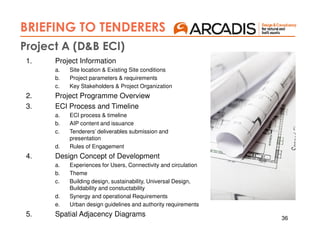
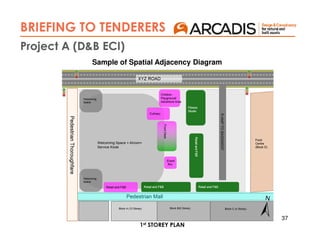
  • 74.
    74 ECI TENDER EVALUATION ProjectB (BCA M3 DBB) 1. Price and Quality Criteria are assigned weightings and translated into quantitative scores which are then totaled up to give a combined score during tender evaluation (“Combined Score”). 2. The Tender Price and Quality Proposal shall make up 75% and 25% of the Combined Score respectively. 3. Tenderers shall note that failure to submit the Technical Proposal may result in the disqualification of their Tender Offer.
  • 75.
    75 ECI TENDER EVALUATION ProjectB (BCA M3 DBB) No Quality (non-price) Criteria Max. Points 1 Safety Performance •Based on the current MOM Demerit Points System •MOM Workplace Safety & Health (WSH) Performance Awards •BizSAFE Certification 15 2 Constructability Score •Based on the Constructability Score Index (CS Index) obtained from: http://www.bca.gov.sg/BuildableDesign/qfm.html 15 3 Project Specific/Quality Proposal •Approach to the Works •Programme of Works •Method and Sequence of Construction for Basement, Superstructure, Service Tunnel and Linkbridge •Tenderer to demonstrate plans on traffic and services diversion •Site Organisation Chart/Management Team •Tenderer to provide adequate dedicated independent site management teams for the following areas: -Outram Community Hospital (OCH) -Road Infrastructures -Underground Service Tunnel 40 4 Impacts from adopting ECI •Innovations and level of participation in the Early Contractor Involvement (ECI) exercise •Cost savings •Time savings 30 Total 100
  • 76.
    76 ECI TENDER EVALUATION ProjectB (BCA M3 DBB) Highest cost savings Full score Lowest cost savings Zero (0) score Score for other Builders shall be pro-rated accordingly Source: BCA ECI Guide
  • 77.
    77 ECI TENDER EVALUATION ProjectB (BCA M3 DBB) Source: BCA ECI Guide
  • 78.
  • 79.
    79 LESSONS LEARNT 1) Cut-OffDate for Alternative Design proposals should be clearly stated. 2) Alternative Designs should not change or modify design intent. 3) Consultants to differentiate between Alternative Design and Scope Reduction. Substitution of Material is not Alternative Design. 4) Consultants are to evaluate Alternative Designs thoroughly. 5) Consultants are to follow up and close out on items that requires clarification from tenderers. 6) Alternative Designs should also result in improvement in productivity, safety and quality, buildability, Greenmark certification etc. 7) Unsatisfactory Alternative Designs should be rejected early. 8) Evaluation must be as objective as possible.
  • 80.
    80 ECI PROs &CONs – TENDERERS’ PERSPECTIVES
  • 81.
    81 ECI PROs &CONs Items ECI Tenders Conventional Tenders Demands on Time Dedicated timing; in the case of ECI, the intensity of the tender activities necessitate a dedicated team The fluidity of the closing dates provide time for introspections in between Commitment of Tenderers Because of the demands on time, it requires more commitments from tenderers Tenderers' commitments can be patchy; hit and miss Tendering Costs Costly; opportunity cost is also higher as tenderers have to give up other tenders to cope with this intensity; UK experience involves only one tenderer, with cost compensation if not successful Less costly, as tenderers can shift their interest between tenders accordingly Integrity of Proprietary Information Concern; as tenderers are expected to share their information with the other stakeholders; ECI usually seen as a front to mine information from tenderers and some may view the process with suspicion Relatively good, as tenderers may divulge proprietary information depending on the circumstances Interchanging of Information Good especially when presentation goes with the release of information by the Employer / Consultants; Consultants are accountable for the depth of information released Consultants' accountability will be sporadic and their input could be inconsistent and sometimes lack depth Timing of Design Input Both parties are encouraged to bring up the levels of details; Consultants have to be on their feet Lack of design details are usually translated into pricing of design risks by the tenderers resulting in higher prices; laggards galore Early Confidence The 'hand-holding' will encourage tenderers to be more confident about the project and therefore put in a more serious and robust price Tenderers of all ilk will put in a price basing on their own perceptions Construction Time Growing confidence could result in a more realistic construction programme Lack of interchanges of information could result in more risk-taking Last-minute Surprises Less last-minute surprises Tenderers can spring last-minute surprises whether it is construction methodology or interests Risk Management Better risk management Relatively less risk management
  • 82.
  • 83.
    83 CONCLUSION • ECI canbe adopted in Traditional, Design & Build or Develop & Construct Procurement Method • Paradigm Shift – Need for a mindset & culture change for all parties involved : Open communication, Sharing & Engagement; as opposed to traditional tender environment • Promotes Partnering in Tendering environment; maintains a healthy and competitive tender environment • Enhances greater productivity – enable better understanding on programming constructability issues (for consultants) and better understanding on the design & project (for contractors)
  • 84.
  • 85.
    85 RECOMMENDATION • ECI shouldonly be considered for bigger size projects e.g. S$200 million and above, or very complicated projects. • The number of tenderers shortlisted for the ECI should only be between 3 to 5. • Evaluation criteria must be as objective as possible inparticular in Design and Build ECI. • Confidentiality of tenderers design or alternative proposals must be maintained and protected. • Honorarium should be considered for unsuccessful tenderers in view of the efforts put in by them.