BanksmanAwareness
Training
What is a Banksman?
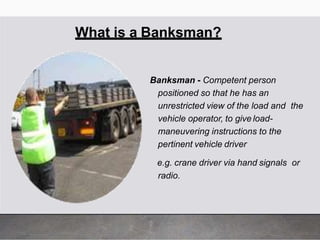
Banksman - Competent person
positioned so that he has an
unrestricted view of the load and the
vehicle operator, to give load-
maneuvering instructions to the
pertinent vehicle driver
e.g. crane driver via hand signals or
radio.
Importance of using a Banksman
• Workplace transport is used in a great variety of situations but
sadly remains the second biggest cause of fatal injury in the
workplace.
Workplace transport is one of the most "multi-factoral" risk
control issues duty holders have to cope with. Adequately
controlling the risks, especially the vehicle movement risks,
depends on duty-holders establishing and sustaining control over
a wide range of matters
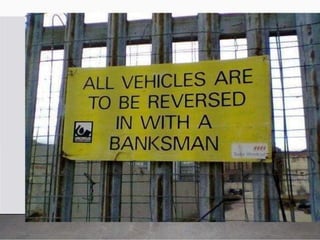
• A Banksman should be used where necessary, both tokeep he
reversing area free of pedestrians and to guide drivers.
Benefits of a Vehicle Banksman
Statistics show that almost 25% of all deaths that involve a
heavy vehicle at work happen during reversing – something that
can be easily avoided with the inclusion of a banksman.
It’s not just injury to people that a banksman can help to stop:
damage can be prevented too, both to the vehicle itself and
any other onsite equipment that may come into its path. This
could potentially save businesses thousandsin replacing
machinery and vehicles, while simultaneously helping them to
meet health and safetyrequirements
Duties of
• Directs site traffBico
an
na
kc
o
sn
ms
t
r
u
ac
t
ni
o
nsite.
• Understand the risks involved with directing off highwaytraffic and
be able to carry out the role of vehicle banksman with confidence
• Use a clear, agreed system of signaling.
• Be visible to drivers at all times.
• Stand in a safe position, from which to guide the reversing
vehicle without being in its way.
• Wear high visibility clothing, and ensure that signals are clearly
seen.
Associated
Risks
• Using Banksmen to control reversing operations can put the
Banksman in the potential danger area of a reversing vehicle.
Every year Banksmen suffer serious and fatal injuries whilst at
work.
• If you do use Banksmen, make sure they are trained tocarry out
their duties safely. There must be a safe system of work that
ensures the Banksman and driver are using standard signals, so
that they are easily understood, and that the driver knows to stop
the vehicle immediately if the Banksman disappears from view.
Vehicle Banksman Training
The importance and responsibility of this job means it requires Banksmen to
be fully trained. In turn, the training for any Vehicle Banksman needs to be
thorough and comprehensive. It’s essential to have knowledge of all the health
and safety aspects associated with this job. This includes things like:
• Knowing what responsibilities a Vehicle Banksman has
• The main causes of accidents
• How to prevent common accidents
• Understanding equipment and machinery
The correct procedures for maneuvering equipment
It’s a job which is always in demand and highly valued, not just by employers
but by work colleagues.According to statistics, nearly one in four deaths
which involve a vehicle at work, are when it’s reversing. It’s easy to see, with
this fact alone, why a Vehicle Banksman has such an important role to play in
any work area.
Why Do you Need a Vehicle?
• As well as deaths and injuries, there can be significant and costly damage
to vehicles and other on-site equipment in an uncontrolled environment. A
Vehicle Banksman has the important responsibility of trying to ensure
these accidents don’t happen. The other side of this is that being a
Vehicle Banksman can be an extremely rewarding job, one which repays
training with giving any individual a fulfilling, rewarding and satisfying role
in the workplace.
• With training and qualifications, a Banksman can be vital in a number of
different working environments such as docks, factories, loading bays and
storage depots. Places such as building sites, for instance, which often
have large vehicles, trucks, diggers and cranes all in one relatively
enclosed space need a good Vehicle Banksman to take control and direct
vehicle operations. In simple terms, the better the training, the better the
Banksman – which is why when it comes to training you should make sure
you always go to a recognized training company which is well respected
within the industry.
Can we still use Banksman for
reversing vehicles?
Yes, but only if trained and authorized . There is a hierarchy of control which
places segregation at the top. Banksman should only be used in
circumstances where other control measures are not possible.
Nearly a quarter of all deaths involving vehicles at work occur during
reversing. Many other reversing accidents do not result in injury but cause
costly damage to vehicles, equipment and premises
Remove the need for reversing altogether, by setting up one-way systems, for
example drive-through loading and unloading positions. Where reversing is
unavoidable, routes should be organized to minimize the need for reversing.
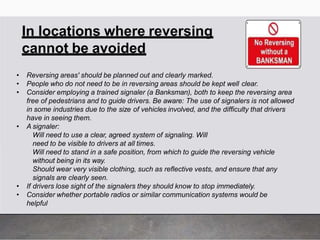
In locations where reversing
cannot be avoided
• Reversing areas' should be planned out and clearly marked.
• People who do not need to be in reversing areas should be kept well clear.
• Consider employing a trained signaler (a Banksman), both to keep the reversing area
free of pedestrians and to guide drivers. Be aware: The use of signalers is not allowed
in some industries due to the size of vehicles involved, and the difficulty that drivers
have in seeing them.
• A signaler:
Will need to use a clear, agreed system of signaling. Will
need to be visible to drivers at all times.
Will need to stand in a safe position, from which to guide the reversing vehicle
without being in its way.
Should wear very visible clothing, such as reflective vests, and ensure that any
signals are clearly seen.
• If drivers lose sight of the signalers they should know to stop immediately.
• Consider whether portable radios or similar communication systems would be
helpful
Steps might help to reduce the risk of
reversing accidents
• Site layouts can be designed (or modified) to increase visibility for drivers and
pedestrians, for example:
By increasing the area allowed for reversing. By
installing fixed mirrors in smaller areas.
• Reducing the dangers caused by 'blind-spots':
Most vehicles already have external side-mounted and rear-view mirrors fitted.
These need to be kept clean and in good repair.
Refractive lenses fitted to rear windows or closed-circuit television systems can
be used to help drivers to see behind the vehicle.
• Reversing alarms can be fitted:
These should be kept in working order.
where an audible alarm might not stand out from the background noise,
flashing warning lights can be used.
• Stops such as barriers, or buffers at loading bays can be used. They should be
highly visible, and sensibly positioned.
• Where vehicles reverse up to structures or edges, barriers or wheel stops can be
used to warn drivers that they need to stop.
• White lines on the floor can help the driver position the vehicle accurately.
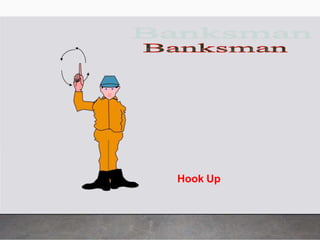
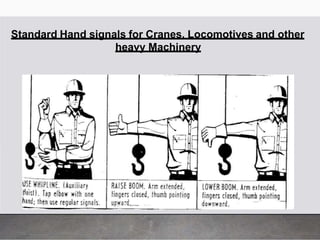
Hook Up
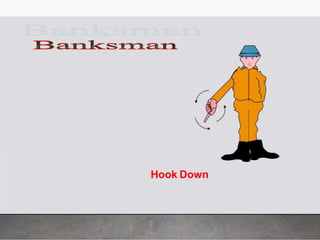
Hook Down
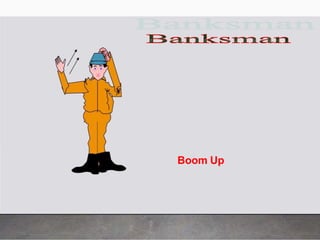
Boom Up
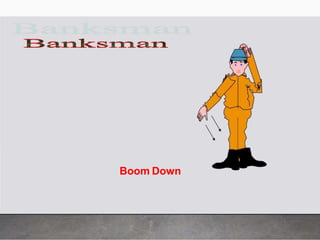
Boom Down
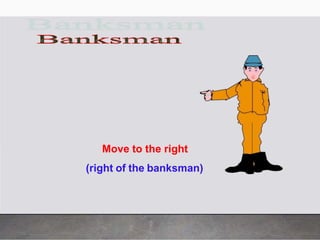
Move to the right
(right of the banksman)
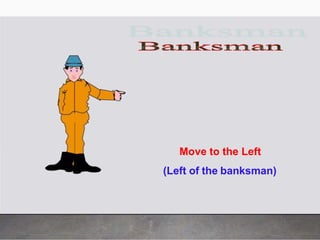
Move to the Left
(Left of the banksman)
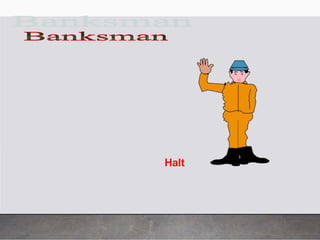
Halt
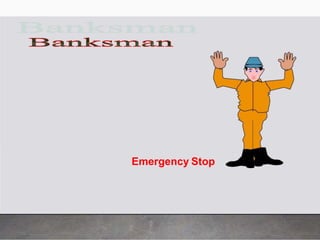
Emergency Stop
Easy Easy
Standard Hand signals for Cranes, Locomotives and other
heavy Machinery
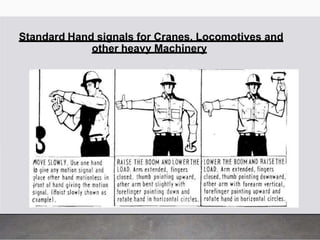
Standard Hand signals for Cranes, Locomotives and
other heavy Machinery
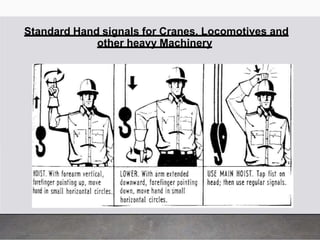
Standard Hand signals for Cranes, Locomotives and
other heavy Machinery
SUMMAR
Y
• Can the Crane Op see your signals
• Use a radio if needed
• Speak slowly & clearly
• Establish & confirm radio contact with the Crane Operator
• Be aware of background noise
• Regularly check the battery

banksman awareness ppt.pptx

  • 1.
  • 2.
    What is aBanksman? Banksman - Competent person positioned so that he has an unrestricted view of the load and the vehicle operator, to give load- maneuvering instructions to the pertinent vehicle driver e.g. crane driver via hand signals or radio.
  • 3.
    Importance of usinga Banksman • Workplace transport is used in a great variety of situations but sadly remains the second biggest cause of fatal injury in the workplace. Workplace transport is one of the most "multi-factoral" risk control issues duty holders have to cope with. Adequately controlling the risks, especially the vehicle movement risks, depends on duty-holders establishing and sustaining control over a wide range of matters • A Banksman should be used where necessary, both tokeep he reversing area free of pedestrians and to guide drivers.
  • 4.
    Benefits of aVehicle Banksman Statistics show that almost 25% of all deaths that involve a heavy vehicle at work happen during reversing – something that can be easily avoided with the inclusion of a banksman. It’s not just injury to people that a banksman can help to stop: damage can be prevented too, both to the vehicle itself and any other onsite equipment that may come into its path. This could potentially save businesses thousandsin replacing machinery and vehicles, while simultaneously helping them to meet health and safetyrequirements
  • 5.
    Duties of • Directssite traffBico an na kc o sn ms t r u ac t ni o nsite. • Understand the risks involved with directing off highwaytraffic and be able to carry out the role of vehicle banksman with confidence • Use a clear, agreed system of signaling. • Be visible to drivers at all times. • Stand in a safe position, from which to guide the reversing vehicle without being in its way. • Wear high visibility clothing, and ensure that signals are clearly seen.
  • 7.
    Associated Risks • Using Banksmento control reversing operations can put the Banksman in the potential danger area of a reversing vehicle. Every year Banksmen suffer serious and fatal injuries whilst at work. • If you do use Banksmen, make sure they are trained tocarry out their duties safely. There must be a safe system of work that ensures the Banksman and driver are using standard signals, so that they are easily understood, and that the driver knows to stop the vehicle immediately if the Banksman disappears from view.
  • 8.
    Vehicle Banksman Training Theimportance and responsibility of this job means it requires Banksmen to be fully trained. In turn, the training for any Vehicle Banksman needs to be thorough and comprehensive. It’s essential to have knowledge of all the health and safety aspects associated with this job. This includes things like: • Knowing what responsibilities a Vehicle Banksman has • The main causes of accidents • How to prevent common accidents • Understanding equipment and machinery The correct procedures for maneuvering equipment It’s a job which is always in demand and highly valued, not just by employers but by work colleagues.According to statistics, nearly one in four deaths which involve a vehicle at work, are when it’s reversing. It’s easy to see, with this fact alone, why a Vehicle Banksman has such an important role to play in any work area.
  • 9.
    Why Do youNeed a Vehicle? • As well as deaths and injuries, there can be significant and costly damage to vehicles and other on-site equipment in an uncontrolled environment. A Vehicle Banksman has the important responsibility of trying to ensure these accidents don’t happen. The other side of this is that being a Vehicle Banksman can be an extremely rewarding job, one which repays training with giving any individual a fulfilling, rewarding and satisfying role in the workplace. • With training and qualifications, a Banksman can be vital in a number of different working environments such as docks, factories, loading bays and storage depots. Places such as building sites, for instance, which often have large vehicles, trucks, diggers and cranes all in one relatively enclosed space need a good Vehicle Banksman to take control and direct vehicle operations. In simple terms, the better the training, the better the Banksman – which is why when it comes to training you should make sure you always go to a recognized training company which is well respected within the industry.
  • 10.
    Can we stilluse Banksman for reversing vehicles? Yes, but only if trained and authorized . There is a hierarchy of control which places segregation at the top. Banksman should only be used in circumstances where other control measures are not possible. Nearly a quarter of all deaths involving vehicles at work occur during reversing. Many other reversing accidents do not result in injury but cause costly damage to vehicles, equipment and premises Remove the need for reversing altogether, by setting up one-way systems, for example drive-through loading and unloading positions. Where reversing is unavoidable, routes should be organized to minimize the need for reversing.
  • 11.
    In locations wherereversing cannot be avoided • Reversing areas' should be planned out and clearly marked. • People who do not need to be in reversing areas should be kept well clear. • Consider employing a trained signaler (a Banksman), both to keep the reversing area free of pedestrians and to guide drivers. Be aware: The use of signalers is not allowed in some industries due to the size of vehicles involved, and the difficulty that drivers have in seeing them. • A signaler: Will need to use a clear, agreed system of signaling. Will need to be visible to drivers at all times. Will need to stand in a safe position, from which to guide the reversing vehicle without being in its way. Should wear very visible clothing, such as reflective vests, and ensure that any signals are clearly seen. • If drivers lose sight of the signalers they should know to stop immediately. • Consider whether portable radios or similar communication systems would be helpful
  • 12.
    Steps might helpto reduce the risk of reversing accidents • Site layouts can be designed (or modified) to increase visibility for drivers and pedestrians, for example: By increasing the area allowed for reversing. By installing fixed mirrors in smaller areas. • Reducing the dangers caused by 'blind-spots': Most vehicles already have external side-mounted and rear-view mirrors fitted. These need to be kept clean and in good repair. Refractive lenses fitted to rear windows or closed-circuit television systems can be used to help drivers to see behind the vehicle. • Reversing alarms can be fitted: These should be kept in working order. where an audible alarm might not stand out from the background noise, flashing warning lights can be used. • Stops such as barriers, or buffers at loading bays can be used. They should be highly visible, and sensibly positioned. • Where vehicles reverse up to structures or edges, barriers or wheel stops can be used to warn drivers that they need to stop. • White lines on the floor can help the driver position the vehicle accurately.
  • 13.
  • 14.
  • 15.
  • 16.
  • 17.
    Move to theright (right of the banksman)
  • 18.
    Move to theLeft (Left of the banksman)
  • 19.
  • 20.
  • 21.
  • 22.
    Standard Hand signalsfor Cranes, Locomotives and other heavy Machinery
  • 23.
    Standard Hand signalsfor Cranes, Locomotives and other heavy Machinery
  • 24.
    Standard Hand signalsfor Cranes, Locomotives and other heavy Machinery
  • 25.
    SUMMAR Y • Can theCrane Op see your signals • Use a radio if needed • Speak slowly & clearly • Establish & confirm radio contact with the Crane Operator • Be aware of background noise • Regularly check the battery