Prof. Yohimar Sivira
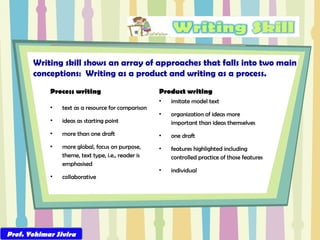
Writing skill shows an array of approaches that falls into two main conceptions:  Writing as a product and writing as a process.  Prof. Yohimar Sivira Process writing  Product writing  text as a resource for comparison ideas as starting point more than one draft more global, focus on purpose, theme, text type, i.e., reader is emphasised collaborative  imitate model text organization of ideas more important than ideas themselves one draft features highlighted including controlled practice of those features individual
Prof. Yohimar Sivira
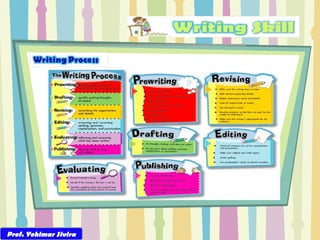
After figuring out your assignment - you need to generate ideas before you begin drafting. Forget about the end product for a bit and just get creative. Try listing, mapping, free-writing, journalist questions or any other method that works for you. Prof. Yohimar Sivira
Listing is a good way to quickly gather many ideas on paper. Simply make a list of as many ideas as come to you as quickly as possible. Topic: Essay About An Important Place List: Bed, my comfy chair, the mountains, the ocean, my office, the garden, anywhere with a book, home, the shower, the right state of mind… Prof. Yohimar Sivira
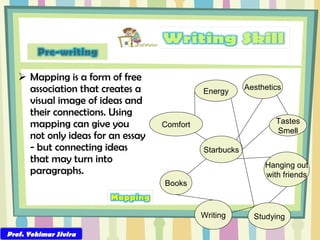
Mapping is a form of free association that creates a visual image of ideas and their connections. Using mapping can give you not only ideas for an essay - but connecting ideas that may turn into paragraphs. Comfort Starbucks Aesthetics Books Tastes Smell Hanging out with friends Writing Studying Energy Prof. Yohimar Sivira
An outline is a general plan of the material that is to be presented in a speech or a paper. The outline shows the order of the various topics, the relative importance of each, and the relationship between the various parts. Prof. Yohimar Sivira
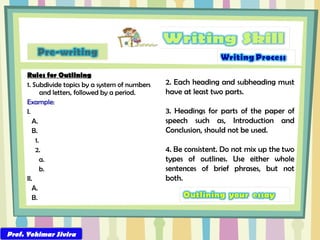
Rules for Outlining 1. Subdivide topics by a system of numbers and letters, followed by a period. Example : I.      A.      B.          1.          2.              a.              b. II.      A.      B. Prof. Yohimar Sivira 2. Each heading and subheading must have at least two parts. 3. Headings for parts of the paper of speech such as, Introduction and Conclusion, should not be used. 4. Be consistent. Do not mix up the two types of outlines. Use either whole sentences of brief phrases, but not both.
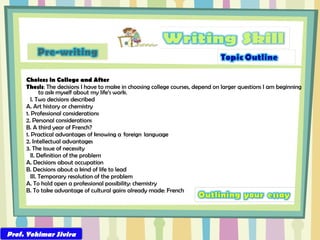
Choices in College and After Thesis : The decisions I have to make in choosing college courses, depend on larger questions I am beginning to ask myself about my life’s work.      I. Two decisions described A. Art history or chemistry 1. Professional considerations  2. Personal considerations  B. A third year of French? 1. Practical advantages of knowing a  foreign  language 2. Intellectual advantages 3. The issue of necessity      II. Definition of the problem A. Decisions about occupation B. Decisions about a kind of life to lead      III. Temporary resolution of the problem A. To hold open a professional possibility: chemistry B. To take advantage of cultural gains already made: French  Prof. Yohimar Sivira
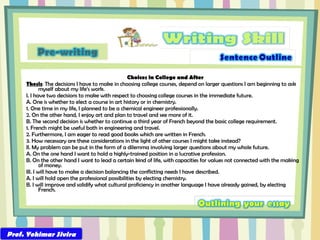
Choices in College and After Thesis : The decisions I have to make in choosing college courses, depend on larger questions I am beginning to ask myself about my life’s work. I. I have two decisions to make with respect to choosing college courses in the immediate future. A. One is whether to elect a course in art history or in chemistry. 1. One time in my life, I planned to be a chemical engineer professionally. 2. On the other hand, I enjoy art and plan to travel and see more of it. B. The second decision is whether to continue a third year of French beyond the basic college requirement. 1. French might be useful both in engineering and travel. 2. Furthermore, I am eager to read good books which are written in French. 3. How necessary are these considerations in the light of other courses I might take instead? II. My problem can be put in the form of a dilemma involving larger questions about my whole future. A. On the one hand I want to hold a highly-trained position in a lucrative profession. B. On the other hand I want to lead a certain kind of life, with capacities for values not connected with the making of money. III. I will have to make a decision balancing the conflicting needs I have described. A. I will hold open the professional possibilities by electing chemistry. B. I will improve and solidify what cultural proficiency in another language I have already gained, by electing French.  Prof. Yohimar Sivira
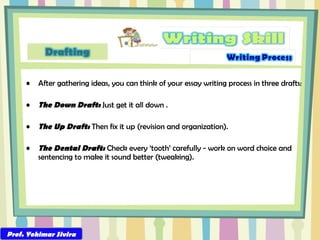
After gathering ideas, you can think of your essay writing process in three drafts: The Down Draft:  Just get it all down . The Up Draft:  Then fix it up (revision and organization). The Dental Draft:  Check every ‘tooth’ carefully - work on word choice and sentencing to make it sound better (tweaking).  Prof. Yohimar Sivira
During the revision phase - read your paper slowly, out loud to yourself. Better yet, read it out loud to a friend or tutor. Even better - have someone read it out loud to you! You will be amazed what paper issues you can ‘hear’ that you missed when reading. If parts are awkward, confusing, choppy or repetitive, you’ll notice. You might feel a little silly - but it may mean the difference in your paper grade. Prof. Yohimar Sivira
Prof. Yohimar Sivira Academic writing tasks aim to find out how well you can research a topic, argue  a point of view, evaluate evidence, and organize your thinking.
Prof. Yohimar Sivira Introductory Paragraph:  introduces the topic, narrows it down, and then states the thesis of the essay. Body paragraphs: provides supporting information and arguments for the overall thesis of the composition Concluding Paragraphs: its function is to re-emphasize the thesis statement and to provide clousure
Prof. Yohimar Sivira
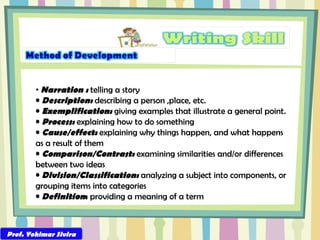
Prof. Yohimar Sivira Narration :  telling a story Description:  describing a person ,place, etc. Exemplification:  giving examples that illustrate a general point . Process:  explaining how to do something  Cause/effect:  explaining why things happen, and what happens as a result of them Comparison/Contrast:  examining similarities and/or differences between two ideas Division/Classification:  analyzing a subject into components, or grouping items into categories  Definition :  providing a meaning of a term

Writing

  • 1.
  • 2.
    Writing skill showsan array of approaches that falls into two main conceptions: Writing as a product and writing as a process. Prof. Yohimar Sivira Process writing Product writing text as a resource for comparison ideas as starting point more than one draft more global, focus on purpose, theme, text type, i.e., reader is emphasised collaborative imitate model text organization of ideas more important than ideas themselves one draft features highlighted including controlled practice of those features individual
  • 3.
  • 4.
    After figuring outyour assignment - you need to generate ideas before you begin drafting. Forget about the end product for a bit and just get creative. Try listing, mapping, free-writing, journalist questions or any other method that works for you. Prof. Yohimar Sivira
  • 5.
    Listing is agood way to quickly gather many ideas on paper. Simply make a list of as many ideas as come to you as quickly as possible. Topic: Essay About An Important Place List: Bed, my comfy chair, the mountains, the ocean, my office, the garden, anywhere with a book, home, the shower, the right state of mind… Prof. Yohimar Sivira
  • 6.
    Mapping is aform of free association that creates a visual image of ideas and their connections. Using mapping can give you not only ideas for an essay - but connecting ideas that may turn into paragraphs. Comfort Starbucks Aesthetics Books Tastes Smell Hanging out with friends Writing Studying Energy Prof. Yohimar Sivira
  • 7.
    An outline isa general plan of the material that is to be presented in a speech or a paper. The outline shows the order of the various topics, the relative importance of each, and the relationship between the various parts. Prof. Yohimar Sivira
  • 8.
    Rules for Outlining1. Subdivide topics by a system of numbers and letters, followed by a period. Example : I.     A.     B.         1.         2.             a.             b. II.     A.     B. Prof. Yohimar Sivira 2. Each heading and subheading must have at least two parts. 3. Headings for parts of the paper of speech such as, Introduction and Conclusion, should not be used. 4. Be consistent. Do not mix up the two types of outlines. Use either whole sentences of brief phrases, but not both.
  • 9.
    Choices in Collegeand After Thesis : The decisions I have to make in choosing college courses, depend on larger questions I am beginning to ask myself about my life’s work.     I. Two decisions described A. Art history or chemistry 1. Professional considerations 2. Personal considerations B. A third year of French? 1. Practical advantages of knowing a  foreign  language 2. Intellectual advantages 3. The issue of necessity     II. Definition of the problem A. Decisions about occupation B. Decisions about a kind of life to lead     III. Temporary resolution of the problem A. To hold open a professional possibility: chemistry B. To take advantage of cultural gains already made: French Prof. Yohimar Sivira
  • 10.
    Choices in Collegeand After Thesis : The decisions I have to make in choosing college courses, depend on larger questions I am beginning to ask myself about my life’s work. I. I have two decisions to make with respect to choosing college courses in the immediate future. A. One is whether to elect a course in art history or in chemistry. 1. One time in my life, I planned to be a chemical engineer professionally. 2. On the other hand, I enjoy art and plan to travel and see more of it. B. The second decision is whether to continue a third year of French beyond the basic college requirement. 1. French might be useful both in engineering and travel. 2. Furthermore, I am eager to read good books which are written in French. 3. How necessary are these considerations in the light of other courses I might take instead? II. My problem can be put in the form of a dilemma involving larger questions about my whole future. A. On the one hand I want to hold a highly-trained position in a lucrative profession. B. On the other hand I want to lead a certain kind of life, with capacities for values not connected with the making of money. III. I will have to make a decision balancing the conflicting needs I have described. A. I will hold open the professional possibilities by electing chemistry. B. I will improve and solidify what cultural proficiency in another language I have already gained, by electing French.  Prof. Yohimar Sivira
  • 11.
    After gathering ideas,you can think of your essay writing process in three drafts: The Down Draft: Just get it all down . The Up Draft: Then fix it up (revision and organization). The Dental Draft: Check every ‘tooth’ carefully - work on word choice and sentencing to make it sound better (tweaking). Prof. Yohimar Sivira
  • 12.
    During the revisionphase - read your paper slowly, out loud to yourself. Better yet, read it out loud to a friend or tutor. Even better - have someone read it out loud to you! You will be amazed what paper issues you can ‘hear’ that you missed when reading. If parts are awkward, confusing, choppy or repetitive, you’ll notice. You might feel a little silly - but it may mean the difference in your paper grade. Prof. Yohimar Sivira
  • 13.
    Prof. Yohimar SiviraAcademic writing tasks aim to find out how well you can research a topic, argue a point of view, evaluate evidence, and organize your thinking.
  • 14.
    Prof. Yohimar SiviraAcademic writing tasks aim to find out how well you can research a topic, argue a point of view, evaluate evidence, and organize your thinking.
  • 15.
    Prof. Yohimar SiviraIntroductory Paragraph: introduces the topic, narrows it down, and then states the thesis of the essay. Body paragraphs: provides supporting information and arguments for the overall thesis of the composition Concluding Paragraphs: its function is to re-emphasize the thesis statement and to provide clousure
  • 16.
  • 17.
    Prof. Yohimar SiviraNarration : telling a story Description: describing a person ,place, etc. Exemplification: giving examples that illustrate a general point . Process: explaining how to do something Cause/effect: explaining why things happen, and what happens as a result of them Comparison/Contrast: examining similarities and/or differences between two ideas Division/Classification: analyzing a subject into components, or grouping items into categories Definition : providing a meaning of a term