Speaking Skill
        English Teaching Media


     M. Agustia Nugraha N / 03110901
Introduction
 Speaking is a skill of the oral mode
productively. Speaking is the delivery of
    language through the mouth.
Spoken Language
•   Auditory
•   Temporary immediate reception
•   Rhythm , Stress intonation
•   Immediate feedback
•   Planning and Editing Limited
Kind of Speaking
• Interactive
• Partially interactive
• Non-interactive
Micro Skill in Speaking
• Pronouns the distinctive sounds of language clearly.
• Use stress and rhythmic patterns and intonation
  patterns of the language.
• Use the correct form words.
• Use vocabulary appropriately.
Speaking Skill
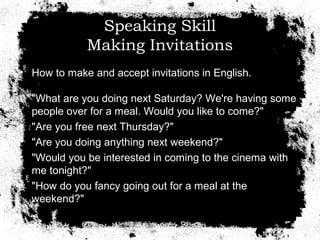
               Making Invitations
• How to make and accept invitations in English.

    "What are you doing next Saturday? We're having some
    people over for a meal. Would you like to come?"
•   "Are you free next Thursday?"
•   "Are you doing anything next weekend?"
•   "Would you be interested in coming to the cinema with
    me tonight?"
•   "How do you fancy going out for a meal at the
    weekend?"
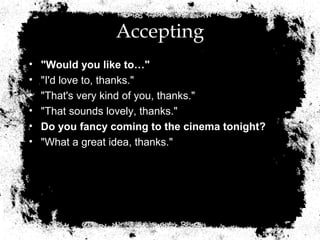
Accepting
•   "Would you like to…"
•   "I'd love to, thanks."
•   "That's very kind of you, thanks."
•   "That sounds lovely, thanks."
•   Do you fancy coming to the cinema tonight?
•   "What a great idea, thanks."
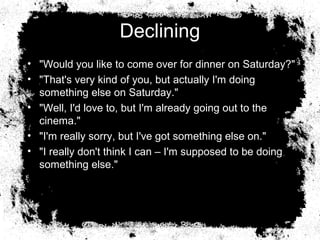
Declining
• "Would you like to come over for dinner on Saturday?"
• "That's very kind of you, but actually I'm doing
  something else on Saturday."
• "Well, I'd love to, but I'm already going out to the
  cinema."
• "I'm really sorry, but I've got something else on."
• "I really don't think I can – I'm supposed to be doing
  something else."
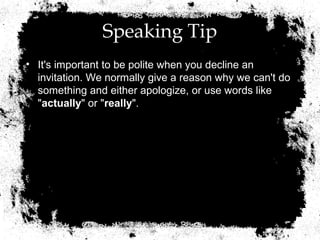
Speaking Tip
• It's important to be polite when you decline an
  invitation. We normally give a reason why we can't do
  something and either apologize, or use words like
  "actually" or "really".
Speaking Skill

  • 1.
    Speaking Skill English Teaching Media M. Agustia Nugraha N / 03110901
  • 2.
    Introduction Speaking isa skill of the oral mode productively. Speaking is the delivery of language through the mouth.
  • 3.
    Spoken Language • Auditory • Temporary immediate reception • Rhythm , Stress intonation • Immediate feedback • Planning and Editing Limited
  • 4.
    Kind of Speaking •Interactive • Partially interactive • Non-interactive
  • 5.
    Micro Skill inSpeaking • Pronouns the distinctive sounds of language clearly. • Use stress and rhythmic patterns and intonation patterns of the language. • Use the correct form words. • Use vocabulary appropriately.
  • 6.
    Speaking Skill Making Invitations • How to make and accept invitations in English. "What are you doing next Saturday? We're having some people over for a meal. Would you like to come?" • "Are you free next Thursday?" • "Are you doing anything next weekend?" • "Would you be interested in coming to the cinema with me tonight?" • "How do you fancy going out for a meal at the weekend?"
  • 7.
    Accepting • "Would you like to…" • "I'd love to, thanks." • "That's very kind of you, thanks." • "That sounds lovely, thanks." • Do you fancy coming to the cinema tonight? • "What a great idea, thanks."
  • 8.
    Declining • "Would youlike to come over for dinner on Saturday?" • "That's very kind of you, but actually I'm doing something else on Saturday." • "Well, I'd love to, but I'm already going out to the cinema." • "I'm really sorry, but I've got something else on." • "I really don't think I can – I'm supposed to be doing something else."
  • 9.
    Speaking Tip • It'simportant to be polite when you decline an invitation. We normally give a reason why we can't do something and either apologize, or use words like "actually" or "really".