Components to
Write a Good Essay
Students: Alma Pinzon | Diana Martinez | Rossana Guerra
Before to start,
remember :
To write a good essay, first of
all, you must know what an
essay is and what is the
purpose of your writing.
The word essay comes from a
French word which means
“to attempt”, or “to try”.
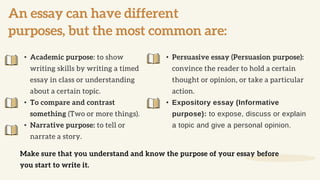
An essay can have different
purposes, but the most common are:
• Academic purpose: to show
writing skills by writing a timed
essay in class or understanding
about a certain topic.
• To compare and contrast
something (Two or more things).
• Narrative purpose: to tell or
narrate a story.
• Persuasive essay (Persuasion purpose):
convince the reader to hold a certain
thought or opinion, or take a particular
action.
• Expository essay (Informative
purpose): to expose, discuss or explain
a topic and give a personal opinion.
Make sure that you understand and know the purpose of your essay before
you start to write it.
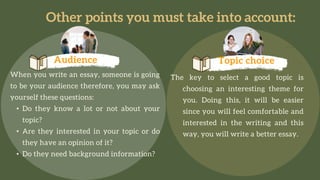
When you write an essay, someone is going
to be your audience therefore, you may ask
yourself these questions:
• Do they know a lot or not about your
topic?
• Are they interested in your topic or do
they have an opinion of it?
• Do they need background information?
The key to select a good topic is
choosing an interesting theme for
you. Doing this, it will be easier
since you will feel comfortable and
interested in the writing and this
way, you will write a better essay.
Other points you must take into account:
Audience Topic choice
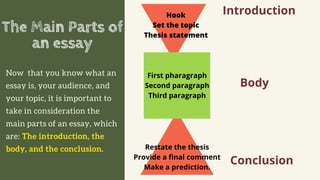
Now that you know what an
essay is, your audience, and
your topic, it is important to
take in consideration the
main parts of an essay, which
are: The introduction, the
body, and the conclusion.
The Main Parts of
an essay
Introduction
Body
Conclusion
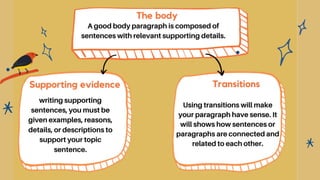
First pharagraph
Second paragraph
Third paragraph
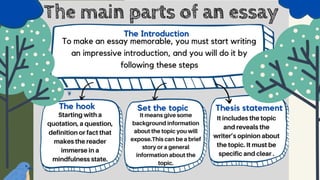
Hook
Set the topic
Thesis statement
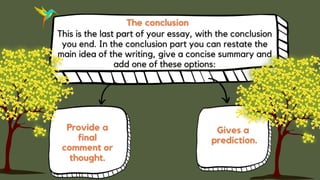
Restate the thesis
Provide a final comment
Make a prediction.
Now it is time to start
writing your essay!
Here you have some tips that will
help you before writing, while you
are in the process, and after it. If you
follow these steps, It will be easier
for you to write an outstanding
essay.
Pre-Writing
Pre-writing
• Draw something:
As many people work better with didactic
activities like drawing, this can be a great
option to know more about the details of your
future writing. Example: if your topic is
writing about your dream vacation you can
search images or draw from your imagination
in order to organize better the main points or
details.
The drawing does not have to be perfect, a sketch
is enough to pick up the starting ideas.
Brainstorming
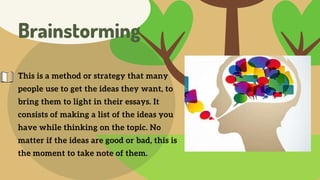
This is a method or strategy that many
people use to get the ideas they want, to
bring them to light in their essays. It
consists of making a list of the ideas you
have while thinking on the topic. No
matter if the ideas are good or bad, this is
the moment to take note of them.
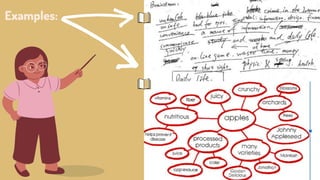
Examples:
Outlining
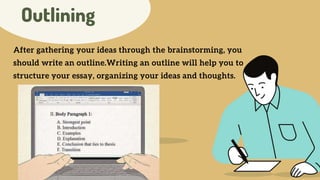
After gathering your ideas through the brainstorming, you
should write an outline.Writing an outline will help you to
structure your essay, organizing your ideas and thoughts.
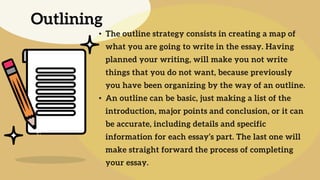
• The outline strategy consists in creating a map of
what you are going to write in the essay. Having
planned your writing, will make you not write
things that you do not want, because previously
you have been organizing by the way of an outline.
• An outline can be basic, just making a list of the
introduction, major points and conclusion, or it can
be accurate, including details and specific
information for each essay’s part. The last one will
make straight forward the process of completing
your essay.
Outlining
During
Writing
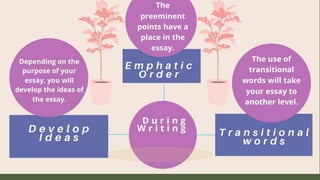
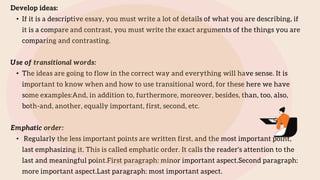
Develop ideas:
• If it is a descriptive essay, you must write a lot of details of what you are describing, if
it is a compare and contrast, you must write the exact arguments of the things you are
comparing and contrasting.
Use of transitional words:
• The ideas are going to flow in the correct way and everything will have sense. It is
important to know when and how to use transitional word, for these here we have
some examples:And, in addition to, furthermore, moreover, besides, than, too, also,
both-and, another, equally important, first, second, etc.
Emphatic order:
• Regularly the less important points are written first, and the most important point,
last emphasizing it. This is called emphatic order. It calls the reader's attention to the
last and meaningful point.First paragraph: minor important aspect.Second paragraph:
more important aspect.Last paragraph: most important aspect.
Post
Writing
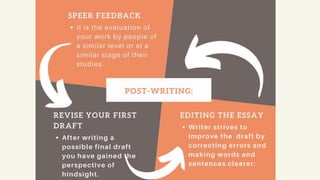
Peer feedback
Giving and receiving feedback can
be a bit uncomfortable since we
are not sure to provide or receive
useful information, but this
interaction means getting new
perspectives to the writing, and
can be invaluable to your own
development as a writer. It is
really easy to be blind to mistakes
in our own texts, mistakes that a
second reader can detect easily.
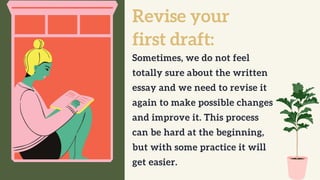
Revise your
first draft:
Sometimes, we do not feel
totally sure about the written
essay and we need to revise it
again to make possible changes
and improve it. This process
can be hard at the beginning,
but with some practice it will
get easier.
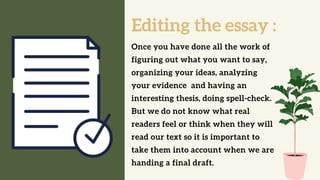
Editing the essay :
Once you have done all the work of
figuring out what you want to say,
organizing your ideas, analyzing
your evidence and having an
interesting thesis, doing spell-check.
But we do not know what real
readers feel or think when they will
read our text so it is important to
take them into account when we are
handing a final draft.
We hope this guide
will be helpful for you

Components to write a good essay

  • 1.
    Components to Write aGood Essay Students: Alma Pinzon | Diana Martinez | Rossana Guerra
  • 2.
    Before to start, remember: To write a good essay, first of all, you must know what an essay is and what is the purpose of your writing. The word essay comes from a French word which means “to attempt”, or “to try”.
  • 3.
    An essay canhave different purposes, but the most common are: • Academic purpose: to show writing skills by writing a timed essay in class or understanding about a certain topic. • To compare and contrast something (Two or more things). • Narrative purpose: to tell or narrate a story. • Persuasive essay (Persuasion purpose): convince the reader to hold a certain thought or opinion, or take a particular action. • Expository essay (Informative purpose): to expose, discuss or explain a topic and give a personal opinion. Make sure that you understand and know the purpose of your essay before you start to write it.
  • 4.
    When you writean essay, someone is going to be your audience therefore, you may ask yourself these questions: • Do they know a lot or not about your topic? • Are they interested in your topic or do they have an opinion of it? • Do they need background information? The key to select a good topic is choosing an interesting theme for you. Doing this, it will be easier since you will feel comfortable and interested in the writing and this way, you will write a better essay. Other points you must take into account: Audience Topic choice
  • 5.
    Now that youknow what an essay is, your audience, and your topic, it is important to take in consideration the main parts of an essay, which are: The introduction, the body, and the conclusion. The Main Parts of an essay Introduction Body Conclusion First pharagraph Second paragraph Third paragraph Hook Set the topic Thesis statement Restate the thesis Provide a final comment Make a prediction.
  • 9.
    Now it istime to start writing your essay! Here you have some tips that will help you before writing, while you are in the process, and after it. If you follow these steps, It will be easier for you to write an outstanding essay.
  • 10.
  • 11.
    Pre-writing • Draw something: Asmany people work better with didactic activities like drawing, this can be a great option to know more about the details of your future writing. Example: if your topic is writing about your dream vacation you can search images or draw from your imagination in order to organize better the main points or details. The drawing does not have to be perfect, a sketch is enough to pick up the starting ideas.
  • 12.
    Brainstorming This is amethod or strategy that many people use to get the ideas they want, to bring them to light in their essays. It consists of making a list of the ideas you have while thinking on the topic. No matter if the ideas are good or bad, this is the moment to take note of them.
  • 13.
  • 14.
    Outlining After gathering yourideas through the brainstorming, you should write an outline.Writing an outline will help you to structure your essay, organizing your ideas and thoughts.
  • 15.
    • The outlinestrategy consists in creating a map of what you are going to write in the essay. Having planned your writing, will make you not write things that you do not want, because previously you have been organizing by the way of an outline. • An outline can be basic, just making a list of the introduction, major points and conclusion, or it can be accurate, including details and specific information for each essay’s part. The last one will make straight forward the process of completing your essay. Outlining
  • 16.
  • 18.
    Develop ideas: • Ifit is a descriptive essay, you must write a lot of details of what you are describing, if it is a compare and contrast, you must write the exact arguments of the things you are comparing and contrasting. Use of transitional words: • The ideas are going to flow in the correct way and everything will have sense. It is important to know when and how to use transitional word, for these here we have some examples:And, in addition to, furthermore, moreover, besides, than, too, also, both-and, another, equally important, first, second, etc. Emphatic order: • Regularly the less important points are written first, and the most important point, last emphasizing it. This is called emphatic order. It calls the reader's attention to the last and meaningful point.First paragraph: minor important aspect.Second paragraph: more important aspect.Last paragraph: most important aspect.
  • 19.
  • 21.
    Peer feedback Giving andreceiving feedback can be a bit uncomfortable since we are not sure to provide or receive useful information, but this interaction means getting new perspectives to the writing, and can be invaluable to your own development as a writer. It is really easy to be blind to mistakes in our own texts, mistakes that a second reader can detect easily.
  • 23.
    Revise your first draft: Sometimes,we do not feel totally sure about the written essay and we need to revise it again to make possible changes and improve it. This process can be hard at the beginning, but with some practice it will get easier.
  • 25.
    Editing the essay: Once you have done all the work of figuring out what you want to say, organizing your ideas, analyzing your evidence and having an interesting thesis, doing spell-check. But we do not know what real readers feel or think when they will read our text so it is important to take them into account when we are handing a final draft.
  • 27.
    We hope thisguide will be helpful for you