
A Dance of the Forests
By Wole Soyinka
Yesha Bhatt
M. K. Bhavnagar, University
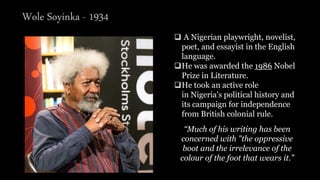
Wole Soyinka - 1934
 A Nigerian playwright, novelist,
poet, and essayist in the English
language.
He was awarded the 1986 Nobel
Prize in Literature.
He took an active role
in Nigeria's political history and
its campaign for independence
from British colonial rule.
“Much of his writing has been
concerned with "the oppressive
boot and the irrelevance of the
colour of the foot that wears it.”
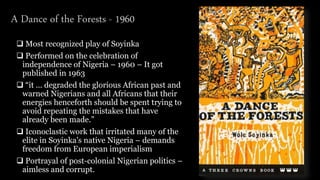
 Most recognized play of Soyinka
 Performed on the celebration of
independence of Nigeria – 1960 – It got
published in 1963
 “it ... degraded the glorious African past and
warned Nigerians and all Africans that their
energies henceforth should be spent trying to
avoid repeating the mistakes that have
already been made.”
 Iconoclastic work that irritated many of the
elite in Soyinka's native Nigeria – demands
freedom from European imperialism
 Portrayal of post-colonial Nigerian politics –
aimless and corrupt.
A Dance of the Forests - 1960
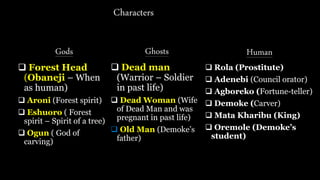
Characters
Gods
 Forest Head
(Obaneji – When
as human)
 Aroni (Forest spirit)
 Eshuoro ( Forest
spirit – Spirit of a tree)
 Ogun ( God of
carving)
Ghosts
 Dead man
(Warrior – Soldier
in past life)
 Dead Woman (Wife
of Dead Man and was
pregnant in past life)
 Old Man (Demoke’s
father)
Human
 Rola (Prostitute)
 Adenebi (Council orator)
 Agboreko (Fortune-teller)
 Demoke (Carver)
 Mata Kharibu (King)
 Oremole (Demoke’s
student)
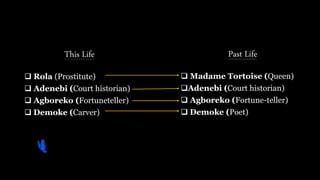
This Life
 Rola (Prostitute)
 Adenebi (Court historian)
 Agboreko (Fortuneteller)
 Demoke (Carver)
Past Life
 Madame Tortoise (Queen)
Adenebi (Court historian)
 Agboreko (Fortune-teller)
 Demoke (Poet)
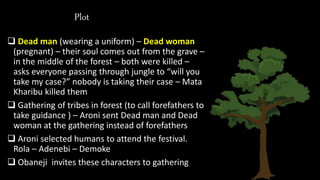
Plot
 Dead man (wearing a uniform) – Dead woman
(pregnant) – their soul comes out from the grave –
in the middle of the forest – both were killed –
asks everyone passing through jungle to “will you
take my case?” nobody is taking their case – Mata
Kharibu killed them
 Gathering of tribes in forest (to call forefathers to
take guidance ) – Aroni sent Dead man and Dead
woman at the gathering instead of forefathers
 Aroni selected humans to attend the festival.
Rola – Adenebi – Demoke
 Obaneji invites these characters to gathering
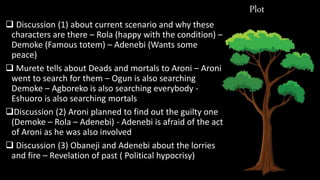
Plot
 Discussion (1) about current scenario and why these
characters are there – Rola (happy with the condition) –
Demoke (Famous totem) – Adenebi (Wants some
peace)
 Murete tells about Deads and mortals to Aroni – Aroni
went to search for them – Ogun is also searching
Demoke – Agboreko is also searching everybody -
Eshuoro is also searching mortals
Discussion (2) Aroni planned to find out the guilty one
(Demoke – Rola – Adenebi) - Adenebi is afraid of the act
of Aroni as he was also involved
 Discussion (3) Obaneji and Adenebi about the lorries
and fire – Revelation of past ( Political hypocrisy)
Plot
 Discussion (4) Death – How would you like to die?
(Past deeds – Life to death – Becoming a reason for
other’s death)
 Discussion (5) – Revelation of identity) (Rola –
Demoke – Adenebi is afraid)
 Agboreko and Old man talk about the plan of Aroni
 Eshuoro complains about Forest head and deeds of
human - Demoke
 All spirits enter and discusses about the human
 Forest head took all in past
Plot
 The story moves eight centuries ago – Court of
Mata Kharibu – the whole story of injustice –
Madame’s behaviour and making dead man
eunuch.
 Eshuoro and Oremole arguments about
Oremole and Demoke – Eshuoro left
All spirits give speech about the condition of
forest
 Woman enter with half-child – symbol of
incompleteness – Not alive nor dead
 Questioner(Eshuoro) enters and asks Dead
woman why she died – tries to ask Dead man
something but Aroni arrives and reveals that he
is Eshuoro
Plot
 Eshuoro tries to kill Demoke
and Ogun saves him.
 Agboreko – Rola and Old man
(Demoke’s father) is there. Old
man asks Demoke
“Have you learned anything?”
 Demoke did not reply
 Play ends.
Themes
 Reparation or
compensation to dead
 Past life – present life
(deeds of characters)
 Characters are waiting for
punishment
 Dead man and woman are
there to make characters
realize their pain
 Realization is everything
 Mata Kharibu –
Madame Tortoise
 All who have authority
are not correct
 Corruption is
everywhere - Superiority
 Punishment by Mata
Kharibu
 Powerful exploits
powerless
 Political hypocrisy
Atonement Corrupted Power
Themes
 Traumatic incidents of
past
 Psychological effects of
that incident
 Past haunts and hurts
 Dead man and woman
 Demoke – realisation
 Aroni and Forest head
helps them to move on.
 Characters have multiple
haunting memory of past
 Bad deeds of all characters
 Past v/s present (mistakes)
 Play is all about recalling
past – learning from it –
moving on from it
 Mortals v/s immortals
 “Have you learned
anything?”
Wounds - Trauma The Past
Themes
 The play takes place in
forest
 Spirits and Forest head is
involved
 Various spirits like river,
stone, palm trees,
mountain visits ceremony
 All parts of nature talks
about activities of human
which is harming nature
 Natural world – Human
world
 Dead woman got killed
when she was pregnant
“Half-child”
 A baby born who is dead
from its birth
 It symbolises the wrong
things happened with Dead
man and Dead Woman
 Child has an influence of
spirits but will never be
able to go to the normal life
of humans
Nature Birth
Themes
 Tradition and ritual is at the centre
 Ceremony – Self-discovering
 Revealing secrets and sins through
ceremonial tendencies
 Narrative is going through rituals only
 Agboreko – Half-child – Welcome dance
– Questioning – Speech by Spirits –
Revelation of past
 The whole play is centred with gathering
of tribes
Ritual
Wole Soyinka's dystopian/utopian
vision in A Dance of the Forests
 A metaphorical commentary of the sociopolitical situation in Nigeria.
 The structure of the play in which Soyinka traces the past to the
present to forecast a dystopian future.
 Utopian past – Dystopian present –> Utopian future
 The hopeless past with the fruitless present to project a bleak future
 Post-independence disillusionment
 Clash of Past (Human atrocities) and Present (quests for a futurity
that is utopian)
 Present is reflection of past (Dystopian) – Future can be imagined by
present (again dystopian – but one can still hope for utopian society)
Soyinka’s A dance of the forests: a
postmodern conceptualization
 Re-reading of the play - relevance in the twenty-first century
Nigerian cum African society - deconstructive reading
 The failure of vision and lack of cohesion in the society
 Demythologizes old myths of progress - demythologizes old myths of
progress
 Such paradox can lead to demythologizes old myths of progress.
 All characters are suffering from within – The play does not contain
an idea of any progressive nation – Past is full of mistakes
 Murder – reflects demythologizes old myths of progress
A spectacle of protest against war in Soyinka’s a
dance of the forests
 an allegory of cosmic dimensions
 Half-child is newly born Nation
 Celebration of freedom is conducted by recalling forefathers – In
play spirits and ghosts are being called
 Metaphysical and aesthetic way of presenting the things
 Nature – medium to find spiritual meaning of life
 Ritual format to express his consciousness of sociopolitical
imperatives
 A play offered to a nation on the euphoric occasion of its
Independence, the immediate victim of the satire is that nation itself;
Thank
You

A dance of the forests

  • 1.
    A Dance ofthe Forests By Wole Soyinka Yesha Bhatt M. K. Bhavnagar, University
  • 2.
    Wole Soyinka -1934  A Nigerian playwright, novelist, poet, and essayist in the English language. He was awarded the 1986 Nobel Prize in Literature. He took an active role in Nigeria's political history and its campaign for independence from British colonial rule. “Much of his writing has been concerned with "the oppressive boot and the irrelevance of the colour of the foot that wears it.”
  • 3.
     Most recognizedplay of Soyinka  Performed on the celebration of independence of Nigeria – 1960 – It got published in 1963  “it ... degraded the glorious African past and warned Nigerians and all Africans that their energies henceforth should be spent trying to avoid repeating the mistakes that have already been made.”  Iconoclastic work that irritated many of the elite in Soyinka's native Nigeria – demands freedom from European imperialism  Portrayal of post-colonial Nigerian politics – aimless and corrupt. A Dance of the Forests - 1960
  • 4.
    Characters Gods  Forest Head (Obaneji– When as human)  Aroni (Forest spirit)  Eshuoro ( Forest spirit – Spirit of a tree)  Ogun ( God of carving) Ghosts  Dead man (Warrior – Soldier in past life)  Dead Woman (Wife of Dead Man and was pregnant in past life)  Old Man (Demoke’s father) Human  Rola (Prostitute)  Adenebi (Council orator)  Agboreko (Fortune-teller)  Demoke (Carver)  Mata Kharibu (King)  Oremole (Demoke’s student)
  • 5.
    This Life  Rola(Prostitute)  Adenebi (Court historian)  Agboreko (Fortuneteller)  Demoke (Carver) Past Life  Madame Tortoise (Queen) Adenebi (Court historian)  Agboreko (Fortune-teller)  Demoke (Poet)
  • 6.
    Plot  Dead man(wearing a uniform) – Dead woman (pregnant) – their soul comes out from the grave – in the middle of the forest – both were killed – asks everyone passing through jungle to “will you take my case?” nobody is taking their case – Mata Kharibu killed them  Gathering of tribes in forest (to call forefathers to take guidance ) – Aroni sent Dead man and Dead woman at the gathering instead of forefathers  Aroni selected humans to attend the festival. Rola – Adenebi – Demoke  Obaneji invites these characters to gathering
  • 7.
    Plot  Discussion (1)about current scenario and why these characters are there – Rola (happy with the condition) – Demoke (Famous totem) – Adenebi (Wants some peace)  Murete tells about Deads and mortals to Aroni – Aroni went to search for them – Ogun is also searching Demoke – Agboreko is also searching everybody - Eshuoro is also searching mortals Discussion (2) Aroni planned to find out the guilty one (Demoke – Rola – Adenebi) - Adenebi is afraid of the act of Aroni as he was also involved  Discussion (3) Obaneji and Adenebi about the lorries and fire – Revelation of past ( Political hypocrisy)
  • 8.
    Plot  Discussion (4)Death – How would you like to die? (Past deeds – Life to death – Becoming a reason for other’s death)  Discussion (5) – Revelation of identity) (Rola – Demoke – Adenebi is afraid)  Agboreko and Old man talk about the plan of Aroni  Eshuoro complains about Forest head and deeds of human - Demoke  All spirits enter and discusses about the human  Forest head took all in past
  • 9.
    Plot  The storymoves eight centuries ago – Court of Mata Kharibu – the whole story of injustice – Madame’s behaviour and making dead man eunuch.  Eshuoro and Oremole arguments about Oremole and Demoke – Eshuoro left All spirits give speech about the condition of forest  Woman enter with half-child – symbol of incompleteness – Not alive nor dead  Questioner(Eshuoro) enters and asks Dead woman why she died – tries to ask Dead man something but Aroni arrives and reveals that he is Eshuoro
  • 10.
    Plot  Eshuoro triesto kill Demoke and Ogun saves him.  Agboreko – Rola and Old man (Demoke’s father) is there. Old man asks Demoke “Have you learned anything?”  Demoke did not reply  Play ends.
  • 11.
    Themes  Reparation or compensationto dead  Past life – present life (deeds of characters)  Characters are waiting for punishment  Dead man and woman are there to make characters realize their pain  Realization is everything  Mata Kharibu – Madame Tortoise  All who have authority are not correct  Corruption is everywhere - Superiority  Punishment by Mata Kharibu  Powerful exploits powerless  Political hypocrisy Atonement Corrupted Power
  • 12.
    Themes  Traumatic incidentsof past  Psychological effects of that incident  Past haunts and hurts  Dead man and woman  Demoke – realisation  Aroni and Forest head helps them to move on.  Characters have multiple haunting memory of past  Bad deeds of all characters  Past v/s present (mistakes)  Play is all about recalling past – learning from it – moving on from it  Mortals v/s immortals  “Have you learned anything?” Wounds - Trauma The Past
  • 13.
    Themes  The playtakes place in forest  Spirits and Forest head is involved  Various spirits like river, stone, palm trees, mountain visits ceremony  All parts of nature talks about activities of human which is harming nature  Natural world – Human world  Dead woman got killed when she was pregnant “Half-child”  A baby born who is dead from its birth  It symbolises the wrong things happened with Dead man and Dead Woman  Child has an influence of spirits but will never be able to go to the normal life of humans Nature Birth
  • 14.
    Themes  Tradition andritual is at the centre  Ceremony – Self-discovering  Revealing secrets and sins through ceremonial tendencies  Narrative is going through rituals only  Agboreko – Half-child – Welcome dance – Questioning – Speech by Spirits – Revelation of past  The whole play is centred with gathering of tribes Ritual
  • 15.
    Wole Soyinka's dystopian/utopian visionin A Dance of the Forests  A metaphorical commentary of the sociopolitical situation in Nigeria.  The structure of the play in which Soyinka traces the past to the present to forecast a dystopian future.  Utopian past – Dystopian present –> Utopian future  The hopeless past with the fruitless present to project a bleak future  Post-independence disillusionment  Clash of Past (Human atrocities) and Present (quests for a futurity that is utopian)  Present is reflection of past (Dystopian) – Future can be imagined by present (again dystopian – but one can still hope for utopian society)
  • 16.
    Soyinka’s A danceof the forests: a postmodern conceptualization  Re-reading of the play - relevance in the twenty-first century Nigerian cum African society - deconstructive reading  The failure of vision and lack of cohesion in the society  Demythologizes old myths of progress - demythologizes old myths of progress  Such paradox can lead to demythologizes old myths of progress.  All characters are suffering from within – The play does not contain an idea of any progressive nation – Past is full of mistakes  Murder – reflects demythologizes old myths of progress
  • 17.
    A spectacle ofprotest against war in Soyinka’s a dance of the forests  an allegory of cosmic dimensions  Half-child is newly born Nation  Celebration of freedom is conducted by recalling forefathers – In play spirits and ghosts are being called  Metaphysical and aesthetic way of presenting the things  Nature – medium to find spiritual meaning of life  Ritual format to express his consciousness of sociopolitical imperatives  A play offered to a nation on the euphoric occasion of its Independence, the immediate victim of the satire is that nation itself;
  • 18.