“A Dance of the
Forest”
by
Wole Soyinka
Department of English, MKBU.
Prepared by
● Aakash Chavda
● Dhatri Parmar
Wole Soyinka
● Playwright, poet, novelist, and political
activist.
● First Black African to win the Nobel Prize for
Literature in 1986.
“who in a wide cultural perspective and with
poetic overtones fashions the drama of
existence”
● Advocated for Nigerian democracy and
opposed authoritarianism.
● Imprisoned during the Nigerian Civil War
(1967–69).
● He bases his writing on the mythology of his
A Dance of the Forest (1960)
"one of the finest poetical playwrights that
have written in English.”
● Commissioned for Nigerian independence,
the play critiques political corruption.
● Soyinka drew from Yoruba folklore after
returning from England.
● The play reveals that spirits are as flawed as
mortals, challenging idealized beliefs.
● Warns Nigerians against complacency and
over-romanticizing pre-colonial Africa.
● Hailed as one of Soyinka's greatest works
His Works
Plays
● The Swamp Dwellers – 1958
● The Trials of Brother Jero – 1960
● A Dance of the Forests – 1960 (published in 1963)
● The Lion and the Jewel – 1960 (published in 1963)
● The Road – 1965
Poems
● Idanre & Other Poems – 1967
● Poems from Prison – 1969
● A Shuttle in the Crypt – 1972 (expanded edition of Poems from
Prison)
● Ogun Abibimañ – 1976
● Mandela’s Earth and Other Poems – 1988
Novels
● The Interpreters. – London : Andre
Deutsch, 1965
● The Man Died : Prison Notes. –
London : Rex Collings, 1972
● Season of Anomy. – London : Rex
Collings, 1973
Characters
● Rola - Prostitute, once Madame Tortoise in a past life
● Demoke, the Carver - who was once a poet in a past life
● Oremole - Demoke’s student
● Adenebi - Court Historian
● Agboreko- Soothsayer
● Mata Kharibu - King
● Dead Men and Dead Wife
● Old Man - Demoke’s Father
● Forest Head - Obaneji
● Eshuoro - Forest Spirit
● Ogun - God of Carves and Iron
● Aroni, the lame one - Spirit
Plot Structure
● The structure of this play has nothing in common with the
usual five-act structure of traditional western drama.
● Divided into two parts / unconventional plot
● The first part deals with the adventures of the characters in
the present time.
● The second part takes us in a flashback to the court of Mata
Kharibu where the characters we have already been
introduced to double up as characters from the past.
● Contrast between past and present.
Plot Overview
● Aroni - “Feast of Human Community”
● The play begins with a Dead Man and a Dead Woman breaking free
from their burial in the soil in the middle of a forest.
● illustrious ancestors to attend the gathering of the tribe.
● Welcoming the dead - ritual.
● Aroni summoned the wronged spiritis, and no one is ready to greet
them.
● Aroni has selected Rola, Adenebi, Agboreko, and Demoke to gain
knowledge about their past lives and to atone for their sins.
● Forest head invites these character for the welcome dance for Dead
Men and Women.
● Eshuore seeks revenge from Demoke.
Part Two
● Flashback in the court of Mata Kharibu.
● All of the characters from the earlier part of the play (but from later
in time) are seen as the court counselors of Kharibu.
● The Dead Man and Dead Woman's return exposes the mortals' past
sins, intertwining their destinies with the spirits and highlighting the
cycles of guilt and redemption.
● Dead Women - the Half-Child symbolizes unborn possibilities and
innocence.
● Demoke, representing human frailty and courage, confronts his guilt
through a perilous act.
● At last, lesson learned but tension remian unsloved.
A Dance of the Forests Glossary
1. tortoise (noun)
an animal similar to a large turtle, with a longer lifespan and living
exclusively on land.
2. araba tree (noun)
A type of tree found in Africa.
3. carver (noun)
A person who carves wood, stone, or other materials professionally
4. canary (noun)
an African finch with a melodious song.
5. reveler (noun)
A person enjoying themselves in a lively way.
6. garb (noun)
distinctive or specific clothing.
7. flog (verb)
beat someone with a whip or a stick.
8. totem (noun)
object or animal regarded as having spiritual significance and standing in as a
symbolic emblem.
9. quarry (noun)
A place from which stone or materials are extracted.
10. cicatrize (verb)
heal through formation of a scar.
"No one to meet
me. I know this is
the place."
Dead Woman
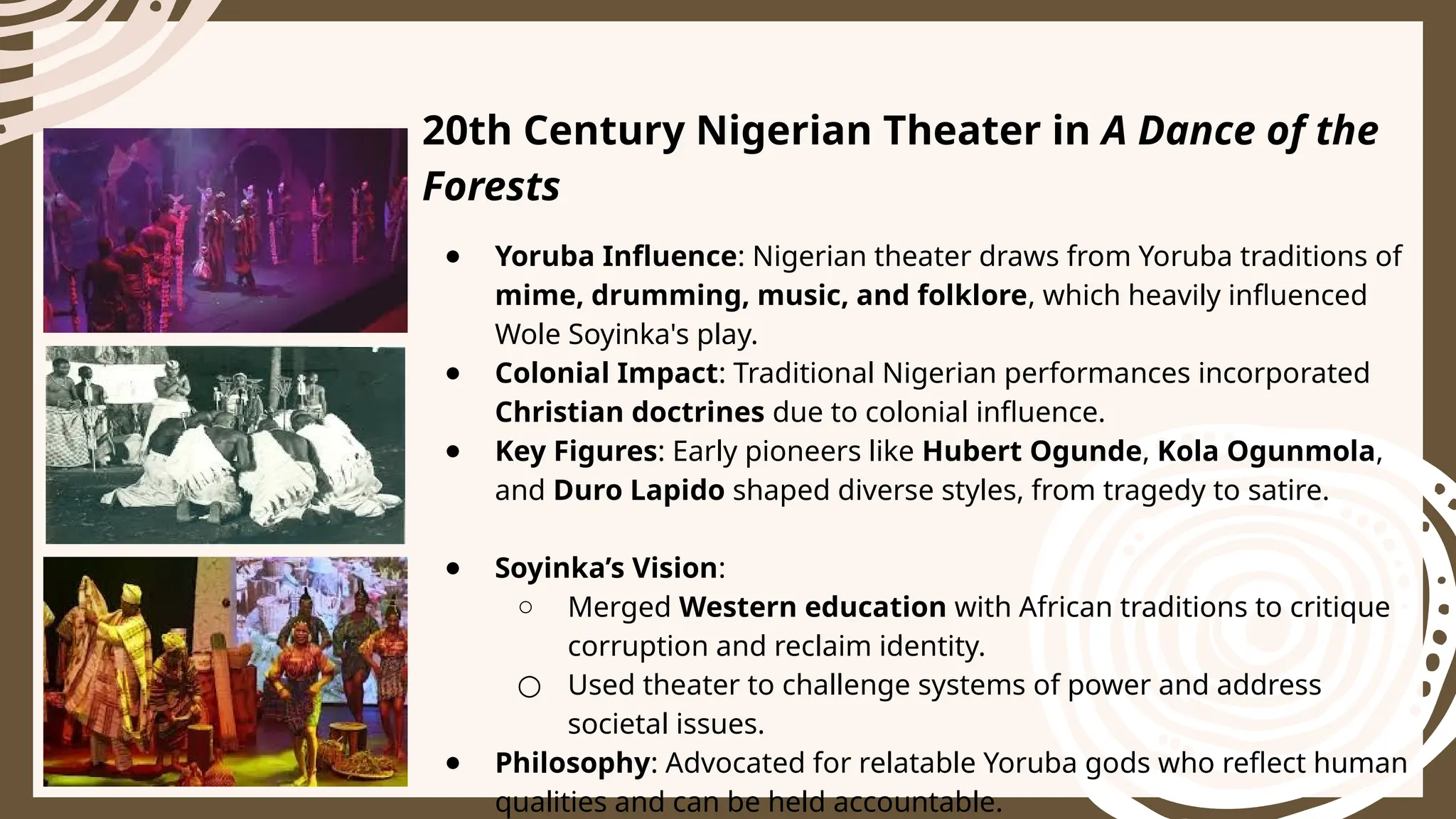
20th Century Nigerian Theater in A Dance of the
Forests
● Yoruba Influence: Nigerian theater draws from Yoruba traditions of
mime, drumming, music, and folklore, which heavily influenced
Wole Soyinka's play.
● Colonial Impact: Traditional Nigerian performances incorporated
Christian doctrines due to colonial influence.
● Key Figures: Early pioneers like Hubert Ogunde, Kola Ogunmola,
and Duro Lapido shaped diverse styles, from tragedy to satire.
● Soyinka’s Vision:
○ Merged Western education with African traditions to critique
corruption and reclaim identity.
○ Used theater to challenge systems of power and address
societal issues.
● Philosophy: Advocated for relatable Yoruba gods who reflect human
qualities and can be held accountable.
Them
e
Description
Atonem
ent
The necessity for characters to confront and make amends for
past transgressions. The Dead Man and Dead Woman's return
serves as a catalyst for this self-reflection.
Corrup
ted
Power
An exploration of how authority can lead to moral decay,
exemplified by figures like Mata Kharibu and Madame Tortoise,
who misuse their positions for personal gain.
The
Past's
Shado
w
The persistent influence of history on the present, highlighting
that unresolved issues continue to affect current circumstances.
The play underscores the importance of acknowledging and
learning from past mistakes.
Natur
e and
Spirit
uality
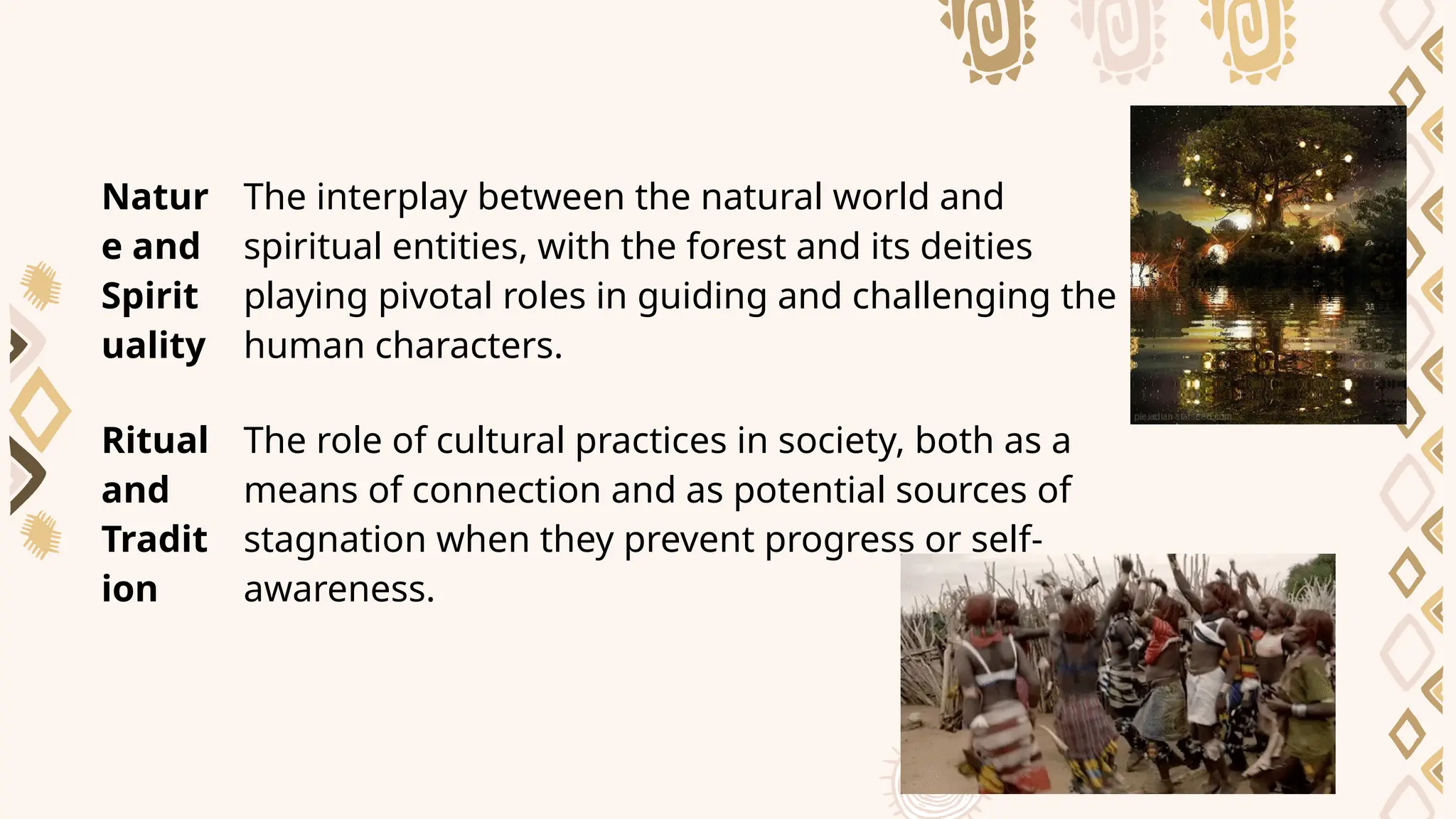
The interplay between the natural world and
spiritual entities, with the forest and its deities
playing pivotal roles in guiding and challenging the
human characters.
Ritual
and
Tradit
ion
The role of cultural practices in society, both as a
means of connection and as potential sources of
stagnation when they prevent progress or self-
awareness.
Symbols in A Dance of the Forests
● Smoking out the Forest:
○ The Old Man uses petrol fumes to disrupt the forest to find his son.
○ Symbolizes humanity's willingness to destroy nature for personal gain.
● Coin Purse:
○ In Mata Kharibu's court, the Slave-Dealer bribes the Historian with a coin
purse.
○ Represents bribery, corruption, and the greed that blinds individuals to
injustice.
● Out of the Soil:
○ The Dead Man and Dead Woman rise from the soil, symbolizing their
journey from death to the living world.
○ Highlights unresolved issues and the act of bringing buried truths to
light.
Motifs in A Dance of the Forests
Music and Ritual:
Music, poetry, ritual, and possession reflect Yoruba traditions.
Abstracts the narrative, illuminating spiritual, emotional, and ethical truths.
Helps make sense of supernatural elements, such as the Dead Woman's
Half-Child.
Allegory for Nigerian Politics
Initially performed to celebrate Nigerian independence in 1960.
Criticized for attacking Nigerian politics and exposing post-colonial
corruption.
Represents the challenge of shedding colonial structures and forging a new
identity.
Metaphors in A Dance of the Forests
● Forest Head (Metaphor):
○ Represents the forest and its spirits as embodiments of the natural
world.
○ Acts as a personification of inanimate elements in nature.
● Dead Man and Dead Woman (Metaphor):
○ Representations of death and unfinished business.
○ Symbolize the connection between the living and the dead.
● "Perhaps I have started a new disease that spreads quickly"
(Metaphor):
○ Spoken by the Warrior to describe dissent and rebellion among
warriors.
○ Frames rebellion as a contagious disease threatening the status quo.
● "I also have no pity for the one who invested foolishly..." (Metaphor):
Conclusion
The play ends with a message about learning from the past to
create a better future. The characters are forced to face their
mistakes and the wrongs they have done. The Forest Head reminds
them that if they do not change, they will keep repeating the same
problems.
It shows that understanding and accepting our history is important
for personal and societal growth. The play leaves us with hope that
people can improve, but only if they are honest with themselves
and willing to make changes.
● GradeSaver "A Dance of the Forests Summary". GradeSaver, 27 January 2025. Web.
27 January 2025.
● Soyinka, Wole. A Dance of the Forests. Oxford University Press, 1963.
● “Wole Soyinka – Biographical - NobelPrize.org.” Nobel Prize,
https://www.nobelprize.org/prizes/literature/1986/soyinka/biographical/. Accessed 27
January 2025.
● “Wole Soyinka | Biography, Plays, Books, & Facts.” Britannica, 10 December 2024,
https://www.britannica.com/biography/Wole-Soyinka. Accessed 27 January 2025.
References :
Thank you

A Dance of the Forest by Wole Soyinka (1).pptx

  • 1.
    “A Dance ofthe Forest” by Wole Soyinka Department of English, MKBU. Prepared by ● Aakash Chavda ● Dhatri Parmar
  • 2.
    Wole Soyinka ● Playwright,poet, novelist, and political activist. ● First Black African to win the Nobel Prize for Literature in 1986. “who in a wide cultural perspective and with poetic overtones fashions the drama of existence” ● Advocated for Nigerian democracy and opposed authoritarianism. ● Imprisoned during the Nigerian Civil War (1967–69). ● He bases his writing on the mythology of his
  • 3.
    A Dance ofthe Forest (1960) "one of the finest poetical playwrights that have written in English.” ● Commissioned for Nigerian independence, the play critiques political corruption. ● Soyinka drew from Yoruba folklore after returning from England. ● The play reveals that spirits are as flawed as mortals, challenging idealized beliefs. ● Warns Nigerians against complacency and over-romanticizing pre-colonial Africa. ● Hailed as one of Soyinka's greatest works
  • 4.
    His Works Plays ● TheSwamp Dwellers – 1958 ● The Trials of Brother Jero – 1960 ● A Dance of the Forests – 1960 (published in 1963) ● The Lion and the Jewel – 1960 (published in 1963) ● The Road – 1965 Poems ● Idanre & Other Poems – 1967 ● Poems from Prison – 1969 ● A Shuttle in the Crypt – 1972 (expanded edition of Poems from Prison) ● Ogun Abibimañ – 1976 ● Mandela’s Earth and Other Poems – 1988 Novels ● The Interpreters. – London : Andre Deutsch, 1965 ● The Man Died : Prison Notes. – London : Rex Collings, 1972 ● Season of Anomy. – London : Rex Collings, 1973
  • 5.
    Characters ● Rola -Prostitute, once Madame Tortoise in a past life ● Demoke, the Carver - who was once a poet in a past life ● Oremole - Demoke’s student ● Adenebi - Court Historian ● Agboreko- Soothsayer ● Mata Kharibu - King ● Dead Men and Dead Wife ● Old Man - Demoke’s Father ● Forest Head - Obaneji ● Eshuoro - Forest Spirit ● Ogun - God of Carves and Iron ● Aroni, the lame one - Spirit
  • 6.
    Plot Structure ● Thestructure of this play has nothing in common with the usual five-act structure of traditional western drama. ● Divided into two parts / unconventional plot ● The first part deals with the adventures of the characters in the present time. ● The second part takes us in a flashback to the court of Mata Kharibu where the characters we have already been introduced to double up as characters from the past. ● Contrast between past and present.
  • 7.
    Plot Overview ● Aroni- “Feast of Human Community” ● The play begins with a Dead Man and a Dead Woman breaking free from their burial in the soil in the middle of a forest. ● illustrious ancestors to attend the gathering of the tribe. ● Welcoming the dead - ritual. ● Aroni summoned the wronged spiritis, and no one is ready to greet them. ● Aroni has selected Rola, Adenebi, Agboreko, and Demoke to gain knowledge about their past lives and to atone for their sins. ● Forest head invites these character for the welcome dance for Dead Men and Women. ● Eshuore seeks revenge from Demoke.
  • 8.
    Part Two ● Flashbackin the court of Mata Kharibu. ● All of the characters from the earlier part of the play (but from later in time) are seen as the court counselors of Kharibu. ● The Dead Man and Dead Woman's return exposes the mortals' past sins, intertwining their destinies with the spirits and highlighting the cycles of guilt and redemption. ● Dead Women - the Half-Child symbolizes unborn possibilities and innocence. ● Demoke, representing human frailty and courage, confronts his guilt through a perilous act. ● At last, lesson learned but tension remian unsloved.
  • 9.
    A Dance ofthe Forests Glossary 1. tortoise (noun) an animal similar to a large turtle, with a longer lifespan and living exclusively on land. 2. araba tree (noun) A type of tree found in Africa. 3. carver (noun) A person who carves wood, stone, or other materials professionally 4. canary (noun) an African finch with a melodious song. 5. reveler (noun) A person enjoying themselves in a lively way.
  • 10.
    6. garb (noun) distinctiveor specific clothing. 7. flog (verb) beat someone with a whip or a stick. 8. totem (noun) object or animal regarded as having spiritual significance and standing in as a symbolic emblem. 9. quarry (noun) A place from which stone or materials are extracted. 10. cicatrize (verb) heal through formation of a scar.
  • 11.
    "No one tomeet me. I know this is the place." Dead Woman
  • 12.
    20th Century NigerianTheater in A Dance of the Forests ● Yoruba Influence: Nigerian theater draws from Yoruba traditions of mime, drumming, music, and folklore, which heavily influenced Wole Soyinka's play. ● Colonial Impact: Traditional Nigerian performances incorporated Christian doctrines due to colonial influence. ● Key Figures: Early pioneers like Hubert Ogunde, Kola Ogunmola, and Duro Lapido shaped diverse styles, from tragedy to satire. ● Soyinka’s Vision: ○ Merged Western education with African traditions to critique corruption and reclaim identity. ○ Used theater to challenge systems of power and address societal issues. ● Philosophy: Advocated for relatable Yoruba gods who reflect human qualities and can be held accountable.
  • 13.
    Them e Description Atonem ent The necessity forcharacters to confront and make amends for past transgressions. The Dead Man and Dead Woman's return serves as a catalyst for this self-reflection. Corrup ted Power An exploration of how authority can lead to moral decay, exemplified by figures like Mata Kharibu and Madame Tortoise, who misuse their positions for personal gain. The Past's Shado w The persistent influence of history on the present, highlighting that unresolved issues continue to affect current circumstances. The play underscores the importance of acknowledging and learning from past mistakes.
  • 14.
    Natur e and Spirit uality The interplaybetween the natural world and spiritual entities, with the forest and its deities playing pivotal roles in guiding and challenging the human characters. Ritual and Tradit ion The role of cultural practices in society, both as a means of connection and as potential sources of stagnation when they prevent progress or self- awareness.
  • 15.
    Symbols in ADance of the Forests ● Smoking out the Forest: ○ The Old Man uses petrol fumes to disrupt the forest to find his son. ○ Symbolizes humanity's willingness to destroy nature for personal gain. ● Coin Purse: ○ In Mata Kharibu's court, the Slave-Dealer bribes the Historian with a coin purse. ○ Represents bribery, corruption, and the greed that blinds individuals to injustice. ● Out of the Soil: ○ The Dead Man and Dead Woman rise from the soil, symbolizing their journey from death to the living world. ○ Highlights unresolved issues and the act of bringing buried truths to light.
  • 16.
    Motifs in ADance of the Forests Music and Ritual: Music, poetry, ritual, and possession reflect Yoruba traditions. Abstracts the narrative, illuminating spiritual, emotional, and ethical truths. Helps make sense of supernatural elements, such as the Dead Woman's Half-Child. Allegory for Nigerian Politics Initially performed to celebrate Nigerian independence in 1960. Criticized for attacking Nigerian politics and exposing post-colonial corruption. Represents the challenge of shedding colonial structures and forging a new identity.
  • 17.
    Metaphors in ADance of the Forests ● Forest Head (Metaphor): ○ Represents the forest and its spirits as embodiments of the natural world. ○ Acts as a personification of inanimate elements in nature. ● Dead Man and Dead Woman (Metaphor): ○ Representations of death and unfinished business. ○ Symbolize the connection between the living and the dead. ● "Perhaps I have started a new disease that spreads quickly" (Metaphor): ○ Spoken by the Warrior to describe dissent and rebellion among warriors. ○ Frames rebellion as a contagious disease threatening the status quo. ● "I also have no pity for the one who invested foolishly..." (Metaphor):
  • 18.
    Conclusion The play endswith a message about learning from the past to create a better future. The characters are forced to face their mistakes and the wrongs they have done. The Forest Head reminds them that if they do not change, they will keep repeating the same problems. It shows that understanding and accepting our history is important for personal and societal growth. The play leaves us with hope that people can improve, but only if they are honest with themselves and willing to make changes.
  • 19.
    ● GradeSaver "ADance of the Forests Summary". GradeSaver, 27 January 2025. Web. 27 January 2025. ● Soyinka, Wole. A Dance of the Forests. Oxford University Press, 1963. ● “Wole Soyinka – Biographical - NobelPrize.org.” Nobel Prize, https://www.nobelprize.org/prizes/literature/1986/soyinka/biographical/. Accessed 27 January 2025. ● “Wole Soyinka | Biography, Plays, Books, & Facts.” Britannica, 10 December 2024, https://www.britannica.com/biography/Wole-Soyinka. Accessed 27 January 2025. References :
  • 20.