POLICY
FRAMEWORK
Is a logical structure that is established to
organize policy documentation into groupings
and categories that make it easier for
employees to find and understand the contents
of various policy documents.
Is a broad guideline for decision making that
links the formulation of a strategy with its
implementation.
 Definition of Policy
(it tells us What to do & Why)
 Rule
 Standard
 Guidelines
 Philosophy
 Objective
A policy is a direct link between an
organization’s vision and day-to-day
operations.
 Major in nature
 Identify company rules
 Explain why they exist
 Tell when the rule applies
 Describe who it covers
 Describe the consequences
 Are described using simple sentences and
paragraphs
Employees are provided with information that allows them
freedom to carry out their jobs and make decisions within
defined boundaries.
Policies enable the workforce to clearly understand
individual and team responsibilities.
Employees understand the constraints of their job without
using a “trial & error” approach.
Clearly written policies allow managers to exercise control
by exception rather than “micro manage” their staff.
Policies provide guidance on how to handle issues
properly.
Sticking to policies it can help reduce the chances of things
going wrong and ensure consistency and professionalism.
1. BOARD POLICY (high level policy)
2. MANAGEMENT POLICY
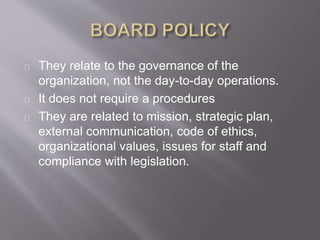
They relate to the governance of the
organization, not the day-to-day operations.
It does not require a procedures
They are related to mission, strategic plan,
external communication, code of ethics,
organizational values, issues for staff and
compliance with legislation.
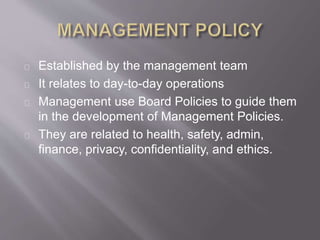
Established by the management team
It relates to day-to-day operations
Management use Board Policies to guide them
in the development of Management Policies.
They are related to health, safety, admin,
finance, privacy, confidentiality, and ethics.
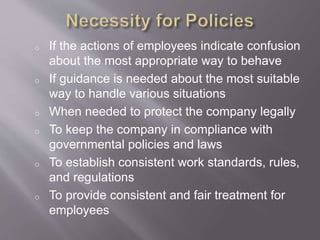
o If the actions of employees indicate confusion
about the most appropriate way to behave
o If guidance is needed about the most suitable
way to handle various situations
o When needed to protect the company legally
o To keep the company in compliance with
governmental policies and laws
o To establish consistent work standards, rules,
and regulations
o To provide consistent and fair treatment for
employees
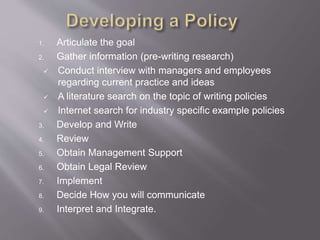
1. Articulate the goal
2. Gather information (pre-writing research)
 Conduct interview with managers and employees
regarding current practice and ideas
 A literature search on the topic of writing policies
 Internet search for industry specific example policies
3. Develop and Write
4. Review
5. Obtain Management Support
6. Obtain Legal Review
7. Implement
8. Decide How you will communicate
9. Interpret and Integrate.
• Use plain language
• Establish a core
vocabulary
• Avoid weasel words
• Make it easy to find
information
• Use a constant format
• Use action writing for
procedures
• Write actions sentences
(active voice)
• Use straight order
•Use present tense
•Use second or third person
•Use short sentences
•Use authoritative and definitive
tone
•Spell out acronyms
•Avoid time sensitive
information
•Avoid use of jargon, slang or
overly technical words
•Be factual
1) Context
2) Consistency
3) Completeness
4) Control
5) Compliance
6) Correctness
7) Clarity
 Use logical, structured format
 A modular format allows for quick and easy
modification
 Readers should know what to expect
 Most readers need to find information quickly.
Communication Strategy (has
two goals)
 Notifying employees by sharing
information
 Improving performance
The strategy includes:
a. Statement of the scope (target
audience)
b. Appropriate communication
methods
c. Schedule and time line for
applying the communication
strategy
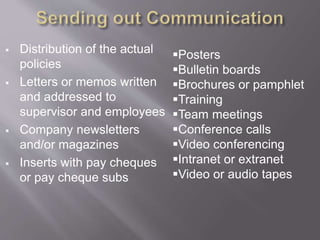
 Distribution of the actual
policies
 Letters or memos written
and addressed to
supervisor and employees
 Company newsletters
and/or magazines
 Inserts with pay cheques
or pay cheque subs
Posters
Bulletin boards
Brochures or pamphlet
Training
Team meetings
Conference calls
Video conferencing
Intranet or extranet
Video or audio tapes
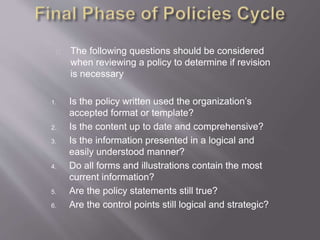
The following questions should be considered
when reviewing a policy to determine if revision
is necessary
1. Is the policy written used the organization’s
accepted format or template?
2. Is the content up to date and comprehensive?
3. Is the information presented in a logical and
easily understood manner?
4. Do all forms and illustrations contain the most
current information?
5. Are the policy statements still true?
6. Are the control points still logical and strategic?
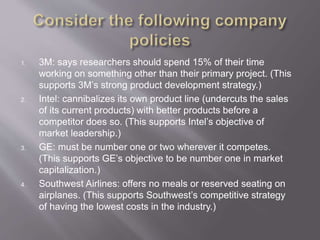
1. 3M: says researchers should spend 15% of their time
working on something other than their primary project. (This
supports 3M’s strong product development strategy.)
2. Intel: cannibalizes its own product line (undercuts the sales
of its current products) with better products before a
competitor does so. (This supports Intel’s objective of
market leadership.)
3. GE: must be number one or two wherever it competes.
(This supports GE’s objective to be number one in market
capitalization.)
4. Southwest Airlines: offers no meals or reserved seating on
airplanes. (This supports Southwest’s competitive strategy
of having the lowest costs in the industry.)
THANK YOU!

Policy Framework

  • 1.
  • 2.
    Is a logicalstructure that is established to organize policy documentation into groupings and categories that make it easier for employees to find and understand the contents of various policy documents.
  • 3.
    Is a broadguideline for decision making that links the formulation of a strategy with its implementation.
  • 4.
     Definition ofPolicy (it tells us What to do & Why)  Rule  Standard  Guidelines  Philosophy  Objective
  • 5.
    A policy isa direct link between an organization’s vision and day-to-day operations.
  • 6.
     Major innature  Identify company rules  Explain why they exist  Tell when the rule applies  Describe who it covers  Describe the consequences  Are described using simple sentences and paragraphs
  • 7.
    Employees are providedwith information that allows them freedom to carry out their jobs and make decisions within defined boundaries. Policies enable the workforce to clearly understand individual and team responsibilities. Employees understand the constraints of their job without using a “trial & error” approach. Clearly written policies allow managers to exercise control by exception rather than “micro manage” their staff. Policies provide guidance on how to handle issues properly. Sticking to policies it can help reduce the chances of things going wrong and ensure consistency and professionalism.
  • 8.
    1. BOARD POLICY(high level policy) 2. MANAGEMENT POLICY
  • 9.
    They relate tothe governance of the organization, not the day-to-day operations. It does not require a procedures They are related to mission, strategic plan, external communication, code of ethics, organizational values, issues for staff and compliance with legislation.
  • 10.
    Established by themanagement team It relates to day-to-day operations Management use Board Policies to guide them in the development of Management Policies. They are related to health, safety, admin, finance, privacy, confidentiality, and ethics.
  • 11.
    o If theactions of employees indicate confusion about the most appropriate way to behave o If guidance is needed about the most suitable way to handle various situations o When needed to protect the company legally o To keep the company in compliance with governmental policies and laws o To establish consistent work standards, rules, and regulations o To provide consistent and fair treatment for employees
  • 12.
    1. Articulate thegoal 2. Gather information (pre-writing research)  Conduct interview with managers and employees regarding current practice and ideas  A literature search on the topic of writing policies  Internet search for industry specific example policies 3. Develop and Write 4. Review 5. Obtain Management Support 6. Obtain Legal Review 7. Implement 8. Decide How you will communicate 9. Interpret and Integrate.
  • 13.
    • Use plainlanguage • Establish a core vocabulary • Avoid weasel words • Make it easy to find information • Use a constant format • Use action writing for procedures • Write actions sentences (active voice) • Use straight order •Use present tense •Use second or third person •Use short sentences •Use authoritative and definitive tone •Spell out acronyms •Avoid time sensitive information •Avoid use of jargon, slang or overly technical words •Be factual
  • 14.
    1) Context 2) Consistency 3)Completeness 4) Control 5) Compliance 6) Correctness 7) Clarity
  • 15.
     Use logical,structured format  A modular format allows for quick and easy modification  Readers should know what to expect  Most readers need to find information quickly.
  • 16.
    Communication Strategy (has twogoals)  Notifying employees by sharing information  Improving performance The strategy includes: a. Statement of the scope (target audience) b. Appropriate communication methods c. Schedule and time line for applying the communication strategy
  • 17.
     Distribution ofthe actual policies  Letters or memos written and addressed to supervisor and employees  Company newsletters and/or magazines  Inserts with pay cheques or pay cheque subs Posters Bulletin boards Brochures or pamphlet Training Team meetings Conference calls Video conferencing Intranet or extranet Video or audio tapes
  • 18.
    The following questionsshould be considered when reviewing a policy to determine if revision is necessary 1. Is the policy written used the organization’s accepted format or template? 2. Is the content up to date and comprehensive? 3. Is the information presented in a logical and easily understood manner? 4. Do all forms and illustrations contain the most current information? 5. Are the policy statements still true? 6. Are the control points still logical and strategic?
  • 19.
    1. 3M: saysresearchers should spend 15% of their time working on something other than their primary project. (This supports 3M’s strong product development strategy.) 2. Intel: cannibalizes its own product line (undercuts the sales of its current products) with better products before a competitor does so. (This supports Intel’s objective of market leadership.) 3. GE: must be number one or two wherever it competes. (This supports GE’s objective to be number one in market capitalization.) 4. Southwest Airlines: offers no meals or reserved seating on airplanes. (This supports Southwest’s competitive strategy of having the lowest costs in the industry.)
  • 20.