[course site]
Day 3 Lecture 1
Backpropagation
Elisa Sayrol
2
Acknowledgements
Kevin McGuinness
kevin.mcguinness@dcu.ie
Research Fellow
Insight Centre for Data Analytics
Dublin City University
…in our last lecture
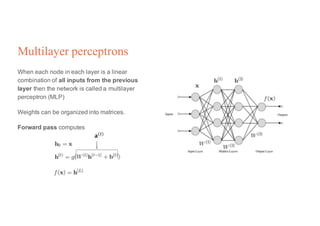
Multilayer perceptrons
When each node in each layer is a linear
combination of all inputs from the previous
layer then the network is called a multilayer
perceptron (MLP)
Weights can be organized into matrices.
Forward pass computes
𝐚(#)
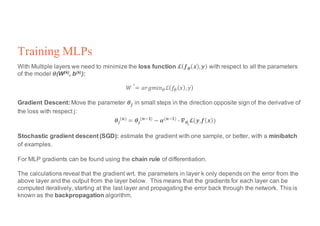
Training MLPs
With Multiple layers we need to minimize the loss function 𝓛 𝒇 𝜽 𝒙 , 𝒚 with respect to all the parameters
of the model 𝜽(W(k), b(k)):
𝑊
∗
= 𝑎𝑟𝑔𝑚𝑖𝑛4ℒ 𝑓4 𝑥 , 𝑦
Gradient Descent: Move the parameter 𝜽𝒋		in small steps in the direction opposite sign of the derivative of
the loss with respect j:
𝜽𝒋
(𝒏) = 𝜽𝒋
(𝒏<𝟏) − 𝜶(𝒏<𝟏) @ 𝜵 𝜽𝒋
𝓛(𝒚,𝒇 𝒙 )
Stochastic gradient descent (SGD): estimate the gradient with one sample, or better, with a minibatch
of examples.
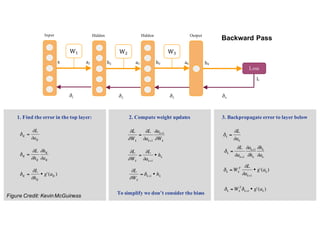
For MLP gradients can be found using the chain rule of differentiation.
The calculations reveal that the gradient wrt. the parameters in layer k only depends on the error from the
above layer and the output from the layer below. This means that the gradients for each layer can be
computed iteratively, starting at the last layer and propagating the error back through the network. This is
known as the backpropagation algorithm.
• Computational Graphs
• Examples applying chain of rule in simple graphs
• Backpropagation applied to Multilayer Perceptron
• Issues on Backpropagation and training
Backpropagation algorithm
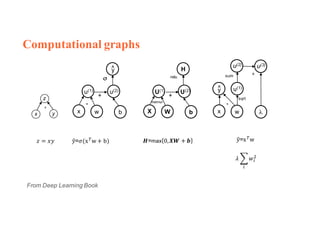
Computational graphs
z
x y
x
u(1) u(2)
·
+
y^
x w b
σ
U(1) U(2)
matmul
+
H
X W b
relu
u(1)
u(2)
·
y^
x w λ
x
u(3)
sum
sqrt
𝑧 = 𝑥𝑦 𝑦C=𝜎(xFw + b) 𝑯=max 0, 𝑿𝑾 + 𝒃 𝑦C=xFw
𝜆 P 𝑤R
S
R
From Deep Learning Book
Computational graphs
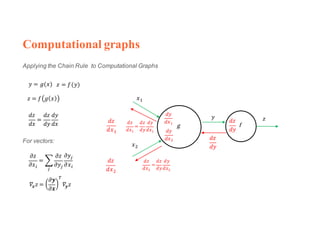
Applying the Chain Rule to Computational Graphs
𝑦 = 𝑔(𝑥)
𝑧 = 𝑓 𝑔 𝑥
𝑑𝑧
𝑑𝑥
=
𝑑𝑧
𝑑𝑦
𝑑𝑦
𝑑𝑥
𝜕𝑧
𝜕𝑥R
= P
𝜕𝑧
𝜕𝑦V
𝜕𝑦V
𝜕𝑥RV
𝛻𝒙 𝑧 =
𝜕𝒚
𝜕𝒙
F
𝛻𝒚 𝑧
𝑑𝑧
𝑑𝑦
𝑑𝑦
𝑑𝑥X
𝑑𝑦
𝑑𝑥S
𝑑𝑧
𝑑𝑥X
𝑑𝑧
𝑑𝑥S
𝑑𝑧
𝑑𝑥X
=
𝑑𝑧
𝑑𝑦
𝑑𝑦
𝑑𝑥X
𝑑𝑧
𝑑𝑥S
=
𝑑𝑧
𝑑𝑦
𝑑𝑦
𝑑𝑥S
For vectors:
𝑥X
𝑥S
𝑦 𝑧
fg
𝑑𝑧
𝑑𝑦
𝑧 = 𝑓(𝑦)
Computational graphs
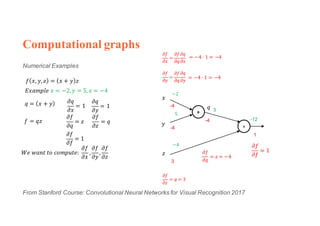
Numerical Examples
From Stanford Course: Convolutional Neural Networks for Visual Recognition 2017
+
x
𝑓 𝑥, 𝑦, 𝑧 = 𝑥 + 𝑦 𝑧
𝑥
𝑦
𝑧
𝑞
−2
5
−4
-12
3
𝑞 = 𝑥 + 𝑦
𝑓 = 𝑞𝑧
𝜕𝑞
𝜕𝑥
= 1
𝜕𝑞
𝜕𝑦
= 1
𝜕𝑓
𝜕𝑞
= 𝑧
𝜕𝑓
𝜕𝑧
= 𝑞
𝑊𝑒	𝑤𝑎𝑛𝑡	𝑡𝑜	𝑐𝑜𝑚𝑝𝑢𝑡𝑒:	
𝜕𝑓
𝜕𝑥
,
𝜕𝑓
𝜕𝑦
,
𝜕𝑓
𝜕𝑧
𝐸𝑥𝑎𝑚𝑝𝑙𝑒	𝑥 = −2, 𝑦 = 5, 𝑧 = −4
𝜕𝑓
𝜕𝑓
= 1
𝜕𝑓
𝜕𝑓
= 1
1
𝜕𝑓
𝜕𝑞
= 𝑧 = −4
-4
𝜕𝑓
𝜕𝑧
= 𝑞 = 3
𝜕𝑓
𝜕𝑥
=
𝜕𝑓
𝜕𝑞
𝜕𝑞
𝜕𝑥
= −4 · 1 = −4
𝜕𝑓
𝜕𝑦
=
𝜕𝑓
𝜕𝑞
𝜕𝑞
𝜕𝑦
= −4 · 1 = −4
-4
-4
3
Computational graphs
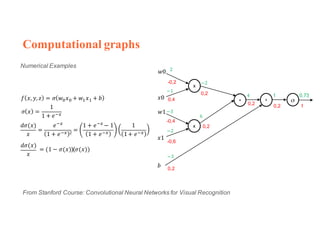
Numerical Examples
x
+𝑓 𝑥, 𝑦, 𝑧 = 𝜎 𝑤k 𝑥k + 𝑤X 𝑥X + 𝑏
𝑤0
𝑥0
𝑏
x
𝑤1
𝑥1
+ σ
𝑑𝜎(𝑥)
𝑥
=
𝑒<m
1 + 𝑒<m 2
=
1 + 𝑒<m
− 1
1 + 𝑒<m
1
1+ 𝑒<m
𝜎 𝑥 =
1
1 + 𝑒<m
2
−1
−3
−2
−3
−2
6
4 1 0.73
1
𝑑𝜎(𝑥)
𝑥
= (1 − 𝜎(𝑥))(𝜎(𝑥))
0,20,2
0,2
-0,2
0,2
0,2
0,4
-0,4
-0,6
From Stanford Course: Convolutional Neural Networks for Visual Recognition
Computational graphs
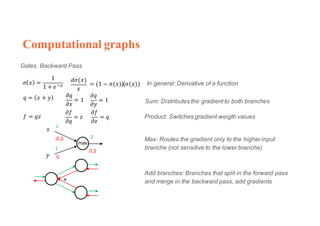
Gates. Backward Pass
𝜎 𝑥 =
1
1 + 𝑒<m
𝑑𝜎(𝑥)
𝑥
= (1 − 𝜎(𝑥))(𝜎(𝑥))
𝑞 = 𝑥 + 𝑦 𝜕𝑞
𝜕𝑥
= 1
𝜕𝑞
𝜕𝑦
= 1
𝑓 = 𝑞𝑧
𝜕𝑓
𝜕𝑞
= 𝑧
𝜕𝑓
𝜕𝑧
= 𝑞
Sum: Distributes the gradient to both branches
Product: Switches gradient weigth values
Max: Routes the gradient only to the higher input
branche (not sensitive to the lower branche)
𝑥
𝑦
-0,2
0,2
0
max
2
1
2
+
In general: Derivative of a function
Add branches: Branches that split in the forward pass
and merge in the backward pass, add gradients
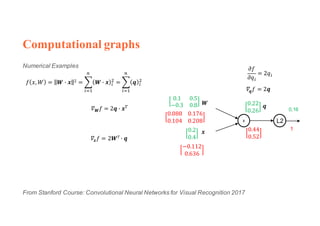
Computational graphs
Numerical Examples
From Stanford Course: Convolutional Neural Networks for Visual Recognition 2017
x
𝑓 𝑥, 𝑊 = 𝑾 @ 𝒙 2 = P 𝑾 @ 𝒙 R
S = P 𝒒 R
S
p
RqX
p
RqX
𝑾
𝒙
𝒒 0,16
𝜕𝑓
𝜕𝑞R
= 2𝑞R
1
𝛻 𝑾 𝑓 = 2𝒒 @ 𝒙F
L2
0.1 0.5
−0.3 0.8
0.2
0.4
0.22
0.26
0.44
0.52
0.088 0.176
0.104 0.208
𝛻𝒒 𝑓 = 2𝒒
𝛻𝒙 𝑓 = 2𝑾 𝑇 @ 𝒒
−0.112
0.636
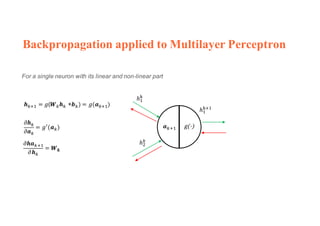
Backpropagation applied to Multilayer Perceptron
For a single neuron with its linear and non-linear part
ℎX
w
g(·)
ℎS
x
ℎX
wyX
𝒂xyX
𝒉xyX = 𝑔(𝑾x 𝒉x +𝒃x) = 𝑔(𝒂xyX)
𝜕𝒉x
𝜕𝒂x
= 𝑔|(𝒂x)
𝜕𝒉𝒂xyX
𝜕𝒉x
= 𝑾 𝒌
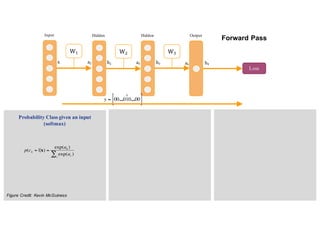
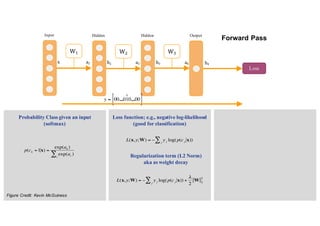
Probability Class given an input
(softmax)
h2 h3a3 a4 h4
Loss
Hidden Hidden Output
W2 W3
x a2
Input
W1
Figure Credit: Kevin McGuiness
Forward Pass
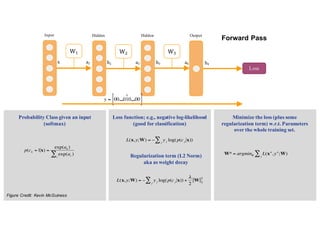
Probability Class given an input
(softmax)
Loss function; e.g., negative log-likelihood
(good for classification)
h2 h3a3 a4 h4
Loss
Hidden Hidden Output
W2 W3
x a2
Input
W1
Regularization term (L2 Norm)
aka as weight decay
Figure Credit: Kevin McGuiness
Forward Pass
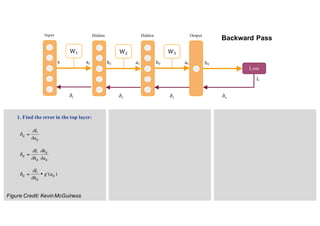
Probability Class given an input
(softmax)
Minimize the loss (plus some
regularization term) w.r.t. Parameters
over the whole training set.
Loss function; e.g., negative log-likelihood
(good for classification)
h2 h3a3 a4 h4
Loss
Hidden Hidden Output
W2 W3
x a2
Input
W1
Regularization term (L2 Norm)
aka as weight decay
Figure Credit: Kevin McGuiness
Forward Pass
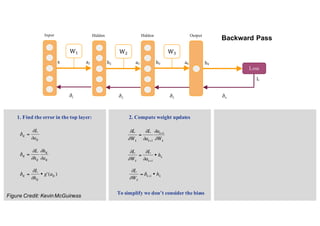
1. Find the error in the top layer:
h2 h3a3 a4 h4
Loss
Hidden Hidden Output
W2 W3
x a2
Input
W1
L
Figure Credit: Kevin McGuiness
Backward Pass
1. Find the error in the top layer: 2. Compute weight updates
h2 h3a3 a4 h4
Loss
Hidden Hidden Output
W2 W3
x a2
Input
W1
L
Figure Credit: Kevin McGuiness
Backward Pass
To simplify we don’t consider the biass
1. Find the error in the top layer: 3. Backpropagate error to layer below2. Compute weight updates
h2 h3a3 a4 h4
Loss
Hidden Hidden Output
W2 W3
x a2
Input
W1
L
Figure Credit: Kevin McGuiness
Backward Pass
To simplify we don’t consider the biass
Issues on Backpropagation and Training
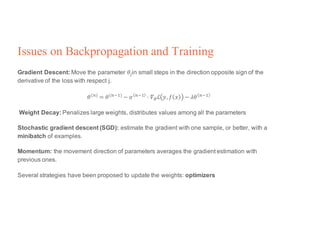
Gradient Descent: Move the parameter 𝜃Vin small steps in the direction opposite sign of the
derivative of the loss with respect j.
𝜃(p) = 𝜃(p<X) − 𝛼 p<X @ 𝛻4ℒ 𝑦, 𝑓 𝑥 − 𝜆𝜃 p<X
Weight Decay: Penalizes large weights, distributes values among all the parameters
Stochastic gradient descent (SGD): estimate the gradient with one sample, or better, with a
minibatch of examples.
Momentum: the movement direction of parameters averages the gradient estimation with
previous ones.
Several strategies have been proposed to update the weights: optimizers
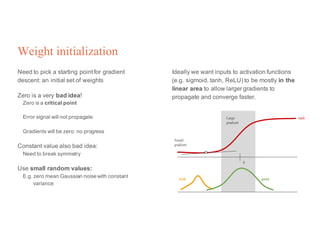
Weight initialization
Need to pick a starting point for gradient
descent: an initial set of weights
Zero is a very bad idea!
Zero is a critical point
Error signal will not propagate
Gradients will be zero: no progress
Constant value also bad idea:
Need to break symmetry
Use small random values:
E.g. zero mean Gaussian noise with constant
variance
Ideally we want inputs to activation functions
(e.g. sigmoid, tanh, ReLU) to be mostly in the
linear area to allow larger gradients to
propagate and converge faster.
0
tanh
Small
gradient
Large
gradient
bad good
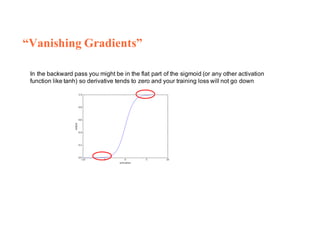
In the backward pass you might be in the flat part of the sigmoid (or any other activation
function like tanh) so derivative tends to zero and your training loss will not go down
“Vanishing Gradients”
Note on hyperparameters
So far we have lots of hyperparameters to choose:
1. Learning rate (α)
2. Regularization constant (λ)
3. Number of epochs
4. Number of hidden layers
5. Nodes in each hidden layer
6. Weight initialization strategy
7. Loss function
8. Activation functions
9. …

Backpropagation (DLAI D3L1 2017 UPC Deep Learning for Artificial Intelligence)

  • 1.
    [course site] Day 3Lecture 1 Backpropagation Elisa Sayrol
  • 2.
  • 3.
  • 4.
    Multilayer perceptrons When eachnode in each layer is a linear combination of all inputs from the previous layer then the network is called a multilayer perceptron (MLP) Weights can be organized into matrices. Forward pass computes 𝐚(#)
  • 5.
    Training MLPs With Multiplelayers we need to minimize the loss function 𝓛 𝒇 𝜽 𝒙 , 𝒚 with respect to all the parameters of the model 𝜽(W(k), b(k)): 𝑊 ∗ = 𝑎𝑟𝑔𝑚𝑖𝑛4ℒ 𝑓4 𝑥 , 𝑦 Gradient Descent: Move the parameter 𝜽𝒋 in small steps in the direction opposite sign of the derivative of the loss with respect j: 𝜽𝒋 (𝒏) = 𝜽𝒋 (𝒏<𝟏) − 𝜶(𝒏<𝟏) @ 𝜵 𝜽𝒋 𝓛(𝒚,𝒇 𝒙 ) Stochastic gradient descent (SGD): estimate the gradient with one sample, or better, with a minibatch of examples. For MLP gradients can be found using the chain rule of differentiation. The calculations reveal that the gradient wrt. the parameters in layer k only depends on the error from the above layer and the output from the layer below. This means that the gradients for each layer can be computed iteratively, starting at the last layer and propagating the error back through the network. This is known as the backpropagation algorithm.
  • 6.
    • Computational Graphs •Examples applying chain of rule in simple graphs • Backpropagation applied to Multilayer Perceptron • Issues on Backpropagation and training Backpropagation algorithm
  • 7.
    Computational graphs z x y x u(1)u(2) · + y^ x w b σ U(1) U(2) matmul + H X W b relu u(1) u(2) · y^ x w λ x u(3) sum sqrt 𝑧 = 𝑥𝑦 𝑦C=𝜎(xFw + b) 𝑯=max 0, 𝑿𝑾 + 𝒃 𝑦C=xFw 𝜆 P 𝑤R S R From Deep Learning Book
  • 8.
    Computational graphs Applying theChain Rule to Computational Graphs 𝑦 = 𝑔(𝑥) 𝑧 = 𝑓 𝑔 𝑥 𝑑𝑧 𝑑𝑥 = 𝑑𝑧 𝑑𝑦 𝑑𝑦 𝑑𝑥 𝜕𝑧 𝜕𝑥R = P 𝜕𝑧 𝜕𝑦V 𝜕𝑦V 𝜕𝑥RV 𝛻𝒙 𝑧 = 𝜕𝒚 𝜕𝒙 F 𝛻𝒚 𝑧 𝑑𝑧 𝑑𝑦 𝑑𝑦 𝑑𝑥X 𝑑𝑦 𝑑𝑥S 𝑑𝑧 𝑑𝑥X 𝑑𝑧 𝑑𝑥S 𝑑𝑧 𝑑𝑥X = 𝑑𝑧 𝑑𝑦 𝑑𝑦 𝑑𝑥X 𝑑𝑧 𝑑𝑥S = 𝑑𝑧 𝑑𝑦 𝑑𝑦 𝑑𝑥S For vectors: 𝑥X 𝑥S 𝑦 𝑧 fg 𝑑𝑧 𝑑𝑦 𝑧 = 𝑓(𝑦)
  • 9.
    Computational graphs Numerical Examples FromStanford Course: Convolutional Neural Networks for Visual Recognition 2017 + x 𝑓 𝑥, 𝑦, 𝑧 = 𝑥 + 𝑦 𝑧 𝑥 𝑦 𝑧 𝑞 −2 5 −4 -12 3 𝑞 = 𝑥 + 𝑦 𝑓 = 𝑞𝑧 𝜕𝑞 𝜕𝑥 = 1 𝜕𝑞 𝜕𝑦 = 1 𝜕𝑓 𝜕𝑞 = 𝑧 𝜕𝑓 𝜕𝑧 = 𝑞 𝑊𝑒 𝑤𝑎𝑛𝑡 𝑡𝑜 𝑐𝑜𝑚𝑝𝑢𝑡𝑒: 𝜕𝑓 𝜕𝑥 , 𝜕𝑓 𝜕𝑦 , 𝜕𝑓 𝜕𝑧 𝐸𝑥𝑎𝑚𝑝𝑙𝑒 𝑥 = −2, 𝑦 = 5, 𝑧 = −4 𝜕𝑓 𝜕𝑓 = 1 𝜕𝑓 𝜕𝑓 = 1 1 𝜕𝑓 𝜕𝑞 = 𝑧 = −4 -4 𝜕𝑓 𝜕𝑧 = 𝑞 = 3 𝜕𝑓 𝜕𝑥 = 𝜕𝑓 𝜕𝑞 𝜕𝑞 𝜕𝑥 = −4 · 1 = −4 𝜕𝑓 𝜕𝑦 = 𝜕𝑓 𝜕𝑞 𝜕𝑞 𝜕𝑦 = −4 · 1 = −4 -4 -4 3
  • 10.
    Computational graphs Numerical Examples x +𝑓𝑥, 𝑦, 𝑧 = 𝜎 𝑤k 𝑥k + 𝑤X 𝑥X + 𝑏 𝑤0 𝑥0 𝑏 x 𝑤1 𝑥1 + σ 𝑑𝜎(𝑥) 𝑥 = 𝑒<m 1 + 𝑒<m 2 = 1 + 𝑒<m − 1 1 + 𝑒<m 1 1+ 𝑒<m 𝜎 𝑥 = 1 1 + 𝑒<m 2 −1 −3 −2 −3 −2 6 4 1 0.73 1 𝑑𝜎(𝑥) 𝑥 = (1 − 𝜎(𝑥))(𝜎(𝑥)) 0,20,2 0,2 -0,2 0,2 0,2 0,4 -0,4 -0,6 From Stanford Course: Convolutional Neural Networks for Visual Recognition
  • 11.
    Computational graphs Gates. BackwardPass 𝜎 𝑥 = 1 1 + 𝑒<m 𝑑𝜎(𝑥) 𝑥 = (1 − 𝜎(𝑥))(𝜎(𝑥)) 𝑞 = 𝑥 + 𝑦 𝜕𝑞 𝜕𝑥 = 1 𝜕𝑞 𝜕𝑦 = 1 𝑓 = 𝑞𝑧 𝜕𝑓 𝜕𝑞 = 𝑧 𝜕𝑓 𝜕𝑧 = 𝑞 Sum: Distributes the gradient to both branches Product: Switches gradient weigth values Max: Routes the gradient only to the higher input branche (not sensitive to the lower branche) 𝑥 𝑦 -0,2 0,2 0 max 2 1 2 + In general: Derivative of a function Add branches: Branches that split in the forward pass and merge in the backward pass, add gradients
  • 12.
    Computational graphs Numerical Examples FromStanford Course: Convolutional Neural Networks for Visual Recognition 2017 x 𝑓 𝑥, 𝑊 = 𝑾 @ 𝒙 2 = P 𝑾 @ 𝒙 R S = P 𝒒 R S p RqX p RqX 𝑾 𝒙 𝒒 0,16 𝜕𝑓 𝜕𝑞R = 2𝑞R 1 𝛻 𝑾 𝑓 = 2𝒒 @ 𝒙F L2 0.1 0.5 −0.3 0.8 0.2 0.4 0.22 0.26 0.44 0.52 0.088 0.176 0.104 0.208 𝛻𝒒 𝑓 = 2𝒒 𝛻𝒙 𝑓 = 2𝑾 𝑇 @ 𝒒 −0.112 0.636
  • 13.
    Backpropagation applied toMultilayer Perceptron For a single neuron with its linear and non-linear part ℎX w g(·) ℎS x ℎX wyX 𝒂xyX 𝒉xyX = 𝑔(𝑾x 𝒉x +𝒃x) = 𝑔(𝒂xyX) 𝜕𝒉x 𝜕𝒂x = 𝑔|(𝒂x) 𝜕𝒉𝒂xyX 𝜕𝒉x = 𝑾 𝒌
  • 14.
    Probability Class givenan input (softmax) h2 h3a3 a4 h4 Loss Hidden Hidden Output W2 W3 x a2 Input W1 Figure Credit: Kevin McGuiness Forward Pass
  • 15.
    Probability Class givenan input (softmax) Loss function; e.g., negative log-likelihood (good for classification) h2 h3a3 a4 h4 Loss Hidden Hidden Output W2 W3 x a2 Input W1 Regularization term (L2 Norm) aka as weight decay Figure Credit: Kevin McGuiness Forward Pass
  • 16.
    Probability Class givenan input (softmax) Minimize the loss (plus some regularization term) w.r.t. Parameters over the whole training set. Loss function; e.g., negative log-likelihood (good for classification) h2 h3a3 a4 h4 Loss Hidden Hidden Output W2 W3 x a2 Input W1 Regularization term (L2 Norm) aka as weight decay Figure Credit: Kevin McGuiness Forward Pass
  • 17.
    1. Find theerror in the top layer: h2 h3a3 a4 h4 Loss Hidden Hidden Output W2 W3 x a2 Input W1 L Figure Credit: Kevin McGuiness Backward Pass
  • 18.
    1. Find theerror in the top layer: 2. Compute weight updates h2 h3a3 a4 h4 Loss Hidden Hidden Output W2 W3 x a2 Input W1 L Figure Credit: Kevin McGuiness Backward Pass To simplify we don’t consider the biass
  • 19.
    1. Find theerror in the top layer: 3. Backpropagate error to layer below2. Compute weight updates h2 h3a3 a4 h4 Loss Hidden Hidden Output W2 W3 x a2 Input W1 L Figure Credit: Kevin McGuiness Backward Pass To simplify we don’t consider the biass
  • 20.
    Issues on Backpropagationand Training Gradient Descent: Move the parameter 𝜃Vin small steps in the direction opposite sign of the derivative of the loss with respect j. 𝜃(p) = 𝜃(p<X) − 𝛼 p<X @ 𝛻4ℒ 𝑦, 𝑓 𝑥 − 𝜆𝜃 p<X Weight Decay: Penalizes large weights, distributes values among all the parameters Stochastic gradient descent (SGD): estimate the gradient with one sample, or better, with a minibatch of examples. Momentum: the movement direction of parameters averages the gradient estimation with previous ones. Several strategies have been proposed to update the weights: optimizers
  • 21.
    Weight initialization Need topick a starting point for gradient descent: an initial set of weights Zero is a very bad idea! Zero is a critical point Error signal will not propagate Gradients will be zero: no progress Constant value also bad idea: Need to break symmetry Use small random values: E.g. zero mean Gaussian noise with constant variance Ideally we want inputs to activation functions (e.g. sigmoid, tanh, ReLU) to be mostly in the linear area to allow larger gradients to propagate and converge faster. 0 tanh Small gradient Large gradient bad good
  • 22.
    In the backwardpass you might be in the flat part of the sigmoid (or any other activation function like tanh) so derivative tends to zero and your training loss will not go down “Vanishing Gradients”
  • 23.
    Note on hyperparameters Sofar we have lots of hyperparameters to choose: 1. Learning rate (α) 2. Regularization constant (λ) 3. Number of epochs 4. Number of hidden layers 5. Nodes in each hidden layer 6. Weight initialization strategy 7. Loss function 8. Activation functions 9. …