TASK-BASED SYLLABUS DESIGN: SELECTING, GRADING AND SEQUENCING TASKSWilson Burgos ArocaMaster’s Degree on English Language Teaching
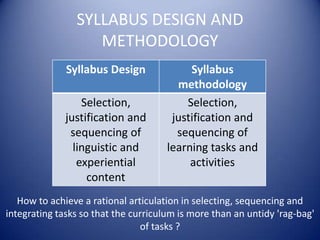
SYLLABUS DESIGN AND METHODOLOGYHow to achieve a rational articulation in selecting, sequencing and integrating tasks so that the curriculum is more than an untidy 'rag-bag' of tasks ?
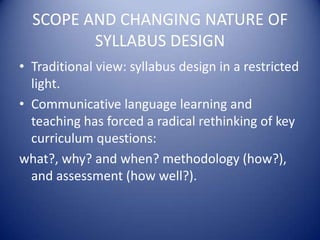
SCOPE AND CHANGING NATURE OF SYLLABUS DESIGNTraditional view: syllabus design in a restricted light.Communicative language learning and teaching has forced a radical rethinking of key curriculum questions: what?, why? and when? methodology (how?), and assessment (how well?).
TRADITIONAL AND COMMUNICATIVE CURRICULUM MODELS COMPAREDQuestion for discussion: Why must we follow a communicative approach to curriculum design?
COMMUNICATIVE TASKSWhat do you think are the teacher’s roles in communicative tasks? What are the learners’ ones?
IMPORTANT CONSIDERATIONS ON COMMUNICATIVE TASKSCommunicative needs.Authentic material.Content familiarity.information organization; familiarity of topic; explicitness and sufficiency of information; referring expressions.Two-way tasks and one-way tasks.Length of speaking.Variation on learners’ task preferences.Required information exchange tasks and optional information exchange tasks.Convergent and divergent tasks.Teacher’s VS students’ task preferences.
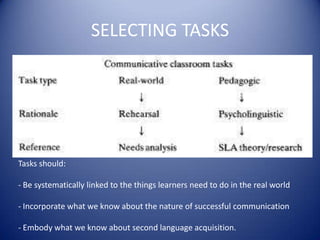
SELECTING TASKSTasks should: Be systematically linked to the things learners need to do in the real world
 Incorporate what we know about the nature of successful communication
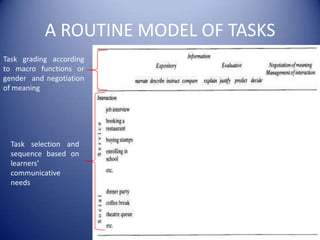
 Embody what we know about second language acquisition.A ROUTINE MODEL OF TASKSTask grading according to macro functions or gender  and negotiation of meaningTask selection and sequence based on learners’ communicative needs
CONCLUSIONSWe must adopt a more communicative view of curriculum, where knowledge is not mostly pre-stablished.Tasks must be selected and sequenced according to the learners’ communicative needs, those which they need to do outside the classroom.Communicative tasks must graded according to the management of interaction, the negotiation of meaning and the macro functions.Research has put a lot of emphasis on psycholinguistic tasks but not on the importance of ‘real world’ ones.More than pedagogic, we must select “real world” tasks, where learners approximate the sort of tasks required of them in the world beyond the classroom.A method based on task routines can be used to select, sequence and grade communicative tasks.

Task Based Syllabus Design

  • 1.
    TASK-BASED SYLLABUS DESIGN:SELECTING, GRADING AND SEQUENCING TASKSWilson Burgos ArocaMaster’s Degree on English Language Teaching
  • 2.
    SYLLABUS DESIGN ANDMETHODOLOGYHow to achieve a rational articulation in selecting, sequencing and integrating tasks so that the curriculum is more than an untidy 'rag-bag' of tasks ?
  • 3.
    SCOPE AND CHANGINGNATURE OF SYLLABUS DESIGNTraditional view: syllabus design in a restricted light.Communicative language learning and teaching has forced a radical rethinking of key curriculum questions: what?, why? and when? methodology (how?), and assessment (how well?).
  • 4.
    TRADITIONAL AND COMMUNICATIVECURRICULUM MODELS COMPAREDQuestion for discussion: Why must we follow a communicative approach to curriculum design?
  • 5.
    COMMUNICATIVE TASKSWhat doyou think are the teacher’s roles in communicative tasks? What are the learners’ ones?
  • 6.
    IMPORTANT CONSIDERATIONS ONCOMMUNICATIVE TASKSCommunicative needs.Authentic material.Content familiarity.information organization; familiarity of topic; explicitness and sufficiency of information; referring expressions.Two-way tasks and one-way tasks.Length of speaking.Variation on learners’ task preferences.Required information exchange tasks and optional information exchange tasks.Convergent and divergent tasks.Teacher’s VS students’ task preferences.
  • 7.
    SELECTING TASKSTasks should:Be systematically linked to the things learners need to do in the real world
  • 8.
    Incorporate whatwe know about the nature of successful communication
  • 9.
    Embody whatwe know about second language acquisition.A ROUTINE MODEL OF TASKSTask grading according to macro functions or gender and negotiation of meaningTask selection and sequence based on learners’ communicative needs
  • 10.
    CONCLUSIONSWe must adopta more communicative view of curriculum, where knowledge is not mostly pre-stablished.Tasks must be selected and sequenced according to the learners’ communicative needs, those which they need to do outside the classroom.Communicative tasks must graded according to the management of interaction, the negotiation of meaning and the macro functions.Research has put a lot of emphasis on psycholinguistic tasks but not on the importance of ‘real world’ ones.More than pedagogic, we must select “real world” tasks, where learners approximate the sort of tasks required of them in the world beyond the classroom.A method based on task routines can be used to select, sequence and grade communicative tasks.