EXPERIENTIAL
LEARNING
Seta A. Wicaksana
Founder and CEO of www.humanikaconsulting.com and hipotest.com
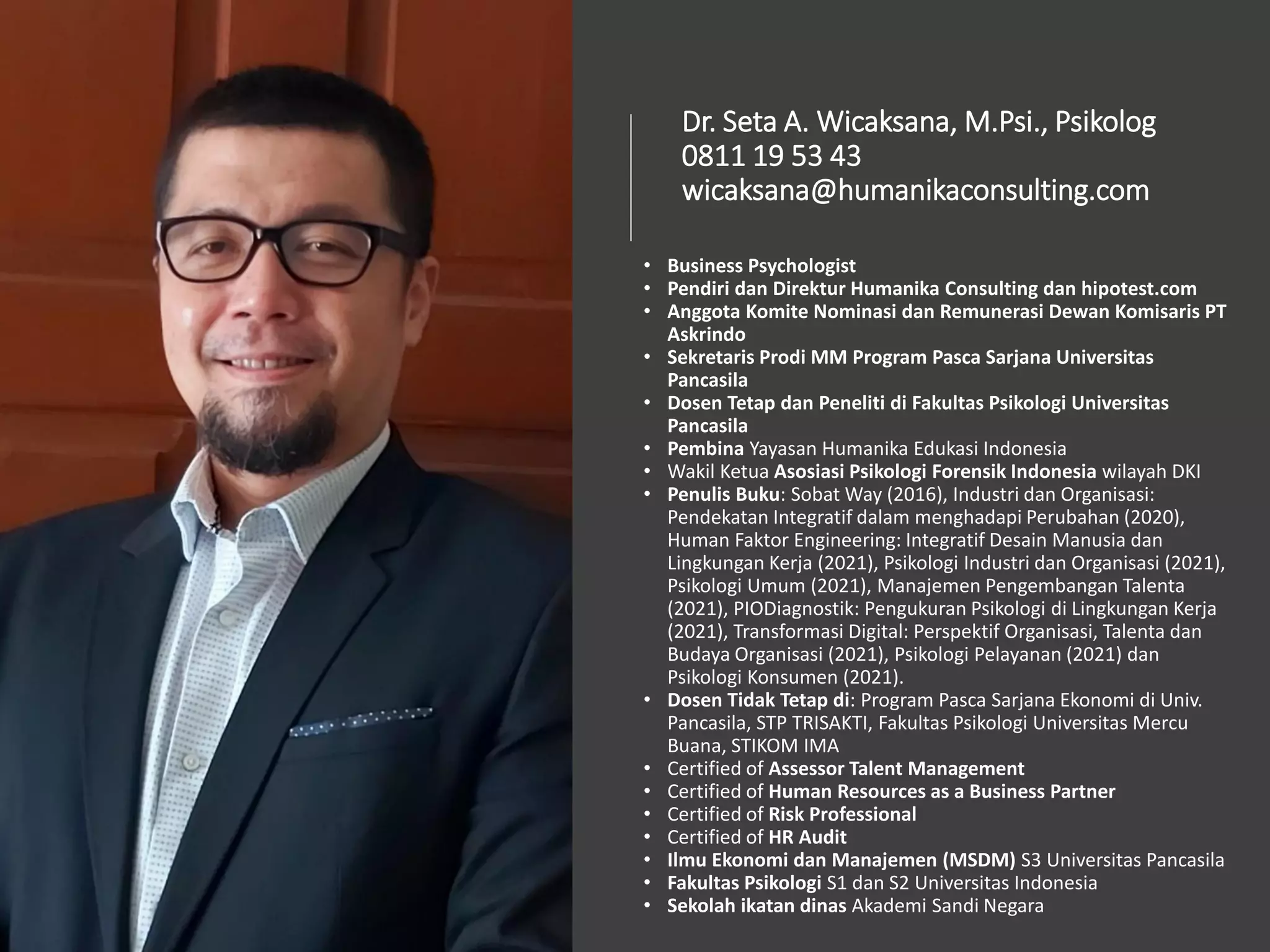
Dr. Seta A. Wicaksana, M.Psi., Psikolog
0811 19 53 43
wicaksana@humanikaconsulting.com
• Business Psychologist
• Pendiri dan Direktur Humanika Consulting dan hipotest.com
• Anggota Komite Nominasi dan Remunerasi Dewan Komisaris PT
Askrindo
• Sekretaris Prodi MM Program Pasca Sarjana Universitas
Pancasila
• Dosen Tetap dan Peneliti di Fakultas Psikologi Universitas
Pancasila
• Pembina Yayasan Humanika Edukasi Indonesia
• Wakil Ketua Asosiasi Psikologi Forensik Indonesia wilayah DKI
• Penulis Buku: Sobat Way (2016), Industri dan Organisasi:
Pendekatan Integratif dalam menghadapi Perubahan (2020),
Human Faktor Engineering: Integratif Desain Manusia dan
Lingkungan Kerja (2021), Psikologi Industri dan Organisasi (2021),
Psikologi Umum (2021), Manajemen Pengembangan Talenta
(2021), PIODiagnostik: Pengukuran Psikologi di Lingkungan Kerja
(2021), Transformasi Digital: Perspektif Organisasi, Talenta dan
Budaya Organisasi (2021), Psikologi Pelayanan (2021) dan
Psikologi Konsumen (2021).
• Dosen Tidak Tetap di: Program Pasca Sarjana Ekonomi di Univ.
Pancasila, STP TRISAKTI, Fakultas Psikologi Universitas Mercu
Buana, STIKOM IMA
• Certified of Assessor Talent Management
• Certified of Human Resources as a Business Partner
• Certified of Risk Professional
• Certified of HR Audit
• Ilmu Ekonomi dan Manajemen (MSDM) S3 Universitas Pancasila
• Fakultas Psikologi S1 dan S2 Universitas Indonesia
• Sekolah ikatan dinas Akademi Sandi Negara
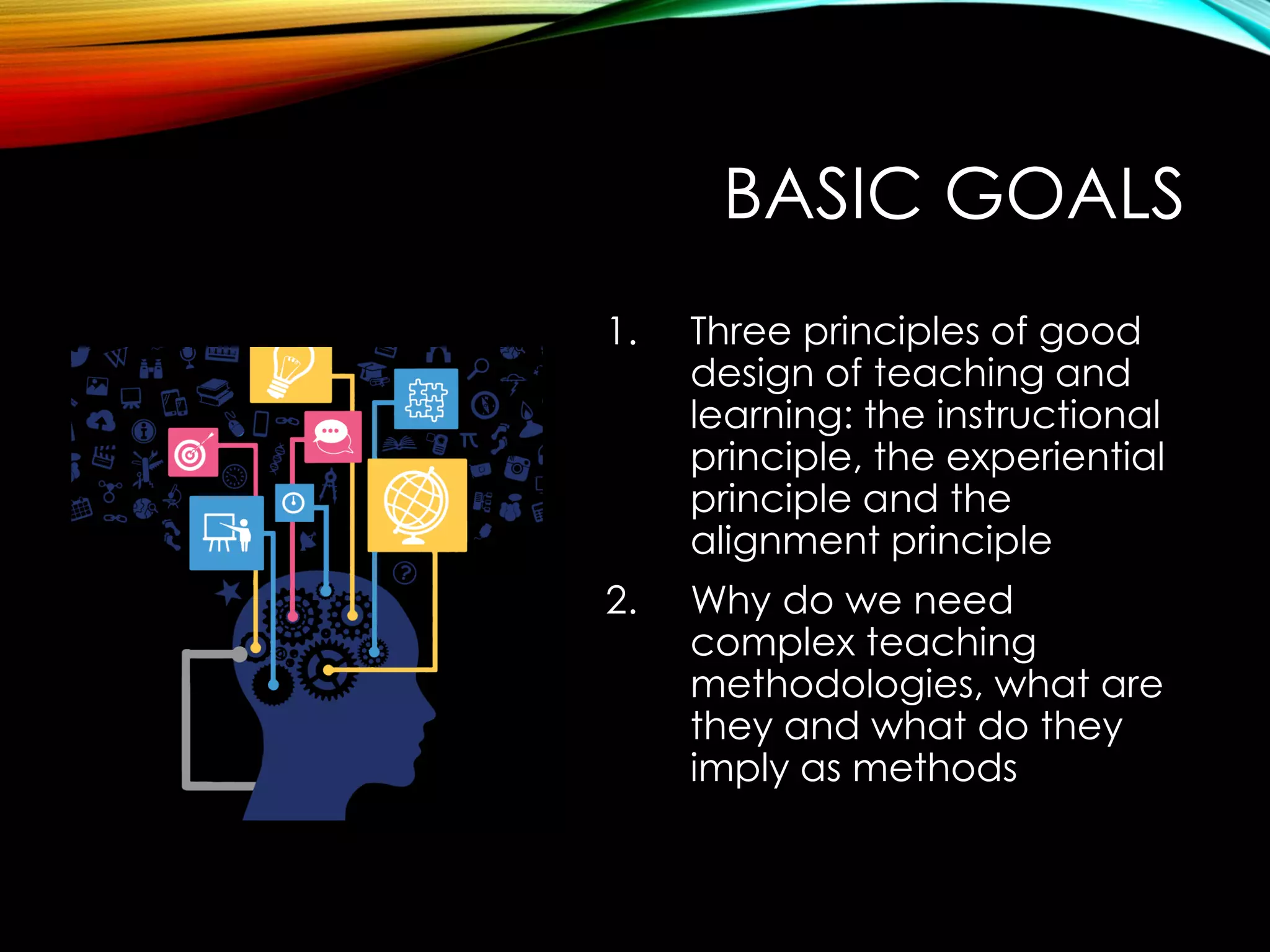
BASIC GOALS
1. Three principles of good
design of teaching and
learning: the instructional
principle, the experiential
principle and the
alignment principle
2. Why do we need
complex teaching
methodologies, what are
they and what do they
imply as methods
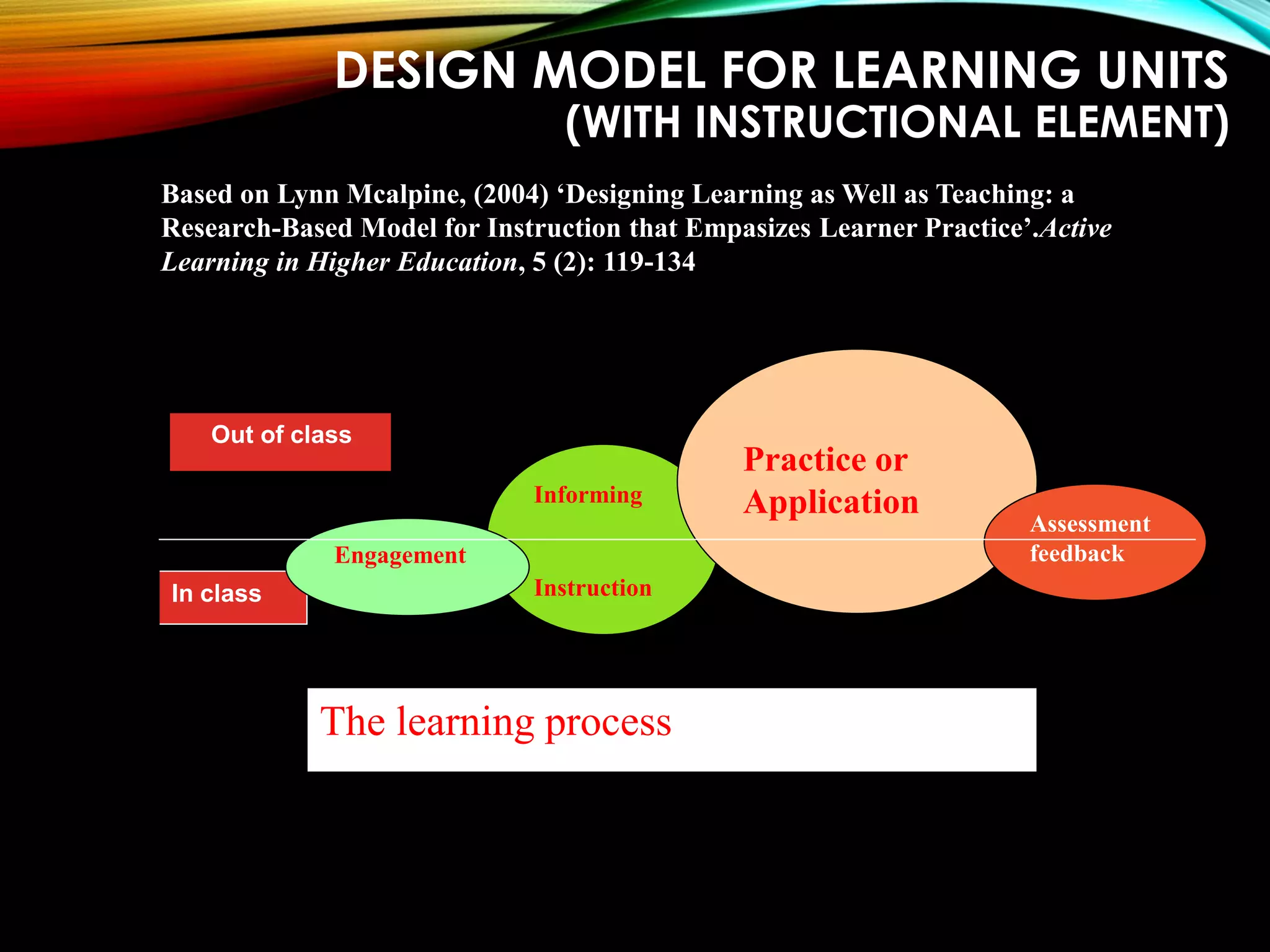
DESIGN MODEL FOR LEARNING UNITS
(WITH INSTRUCTIONAL ELEMENT)
Based on Lynn Mcalpine, (2004) ‘Designing Learning as Well as Teaching: a
Research-Based Model for Instruction that Empasizes Learner Practice’.Active
Learning in Higher Education, 5 (2): 119-134
Out of class
Informing
Instruction
Engagement
Practice or
Application
Assessment
feedback
The learning process
In class
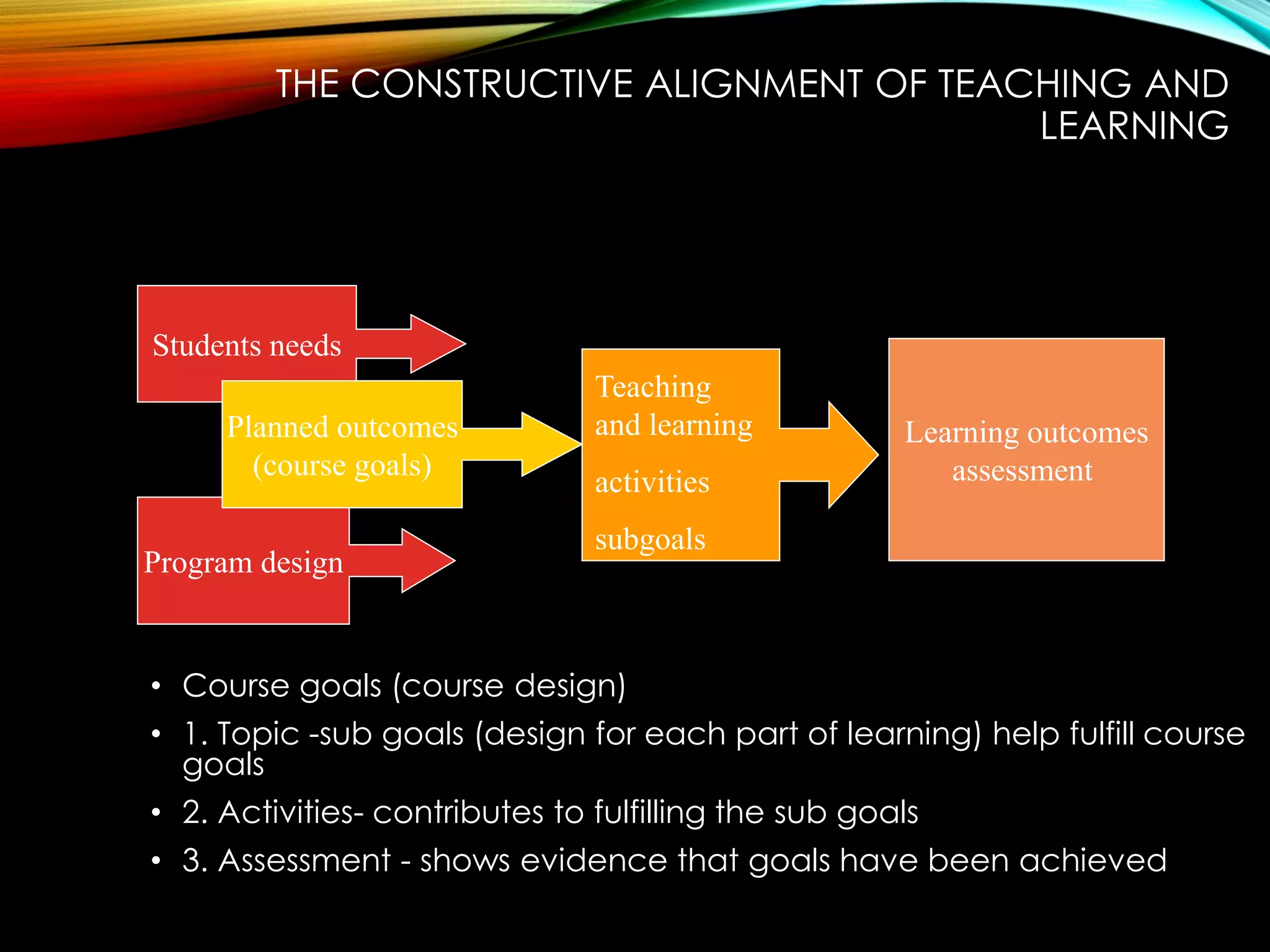
THE CONSTRUCTIVE ALIGNMENT OF TEACHING AND
LEARNING
• Course goals (course design)
• 1. Topic -sub goals (design for each part of learning) help fulfill course
goals
• 2. Activities- contributes to fulfilling the sub goals
• 3. Assessment - shows evidence that goals have been achieved
Students needs
Program design
Planned outcomes
(course goals)
Teaching
and learning
activities
subgoals
Learning outcomes
assessment
Based on Biggs, John. (2003) Teaching for Quality Learning at University,
Buckingham: SRHE and Open University Press, pp. 19-27
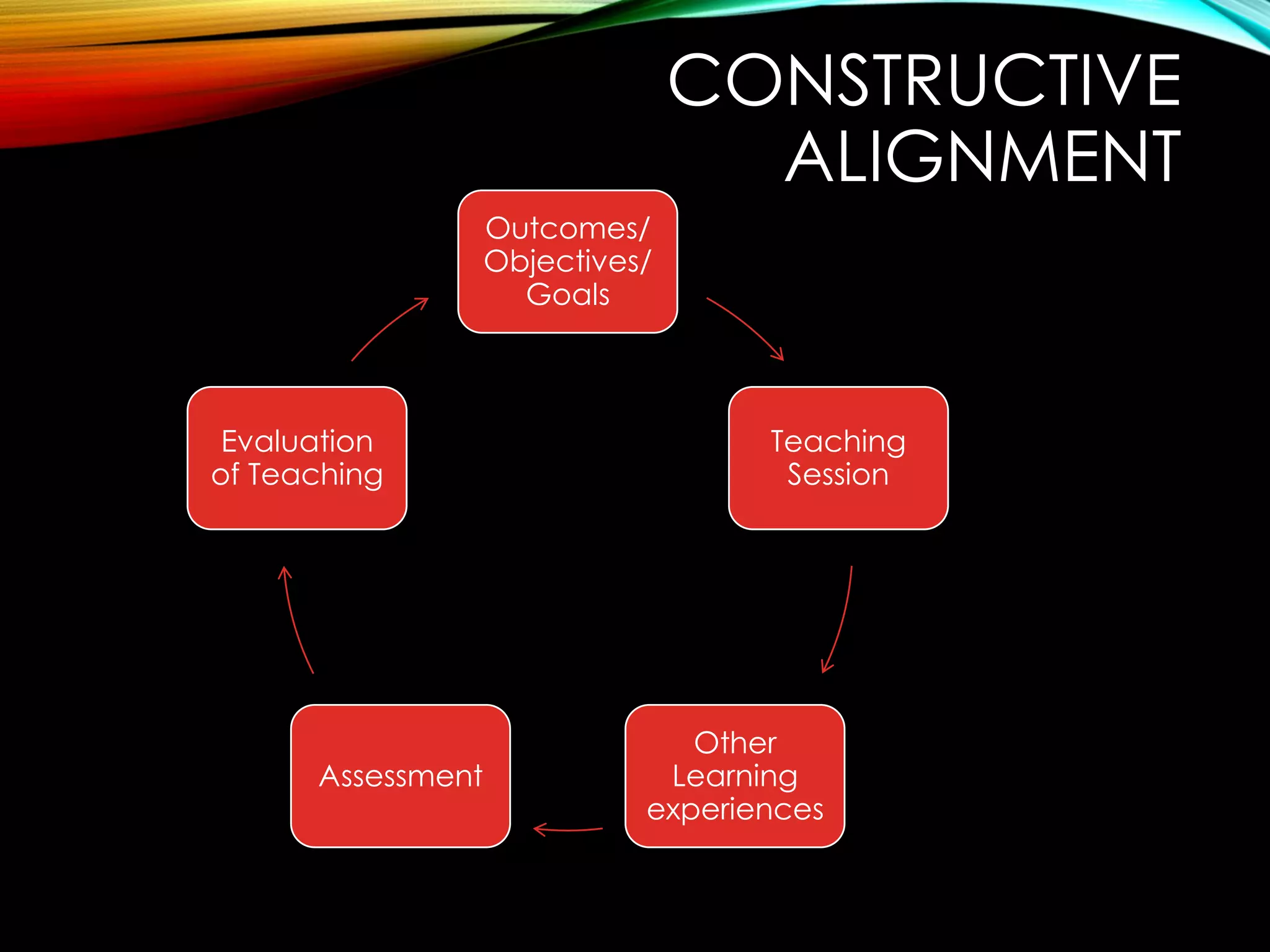
CONSTRUCTIVE
ALIGNMENT
Outcomes/
Objectives/
Goals
Teaching
Session
Other
Learning
experiences
Assessment
Evaluation
of Teaching
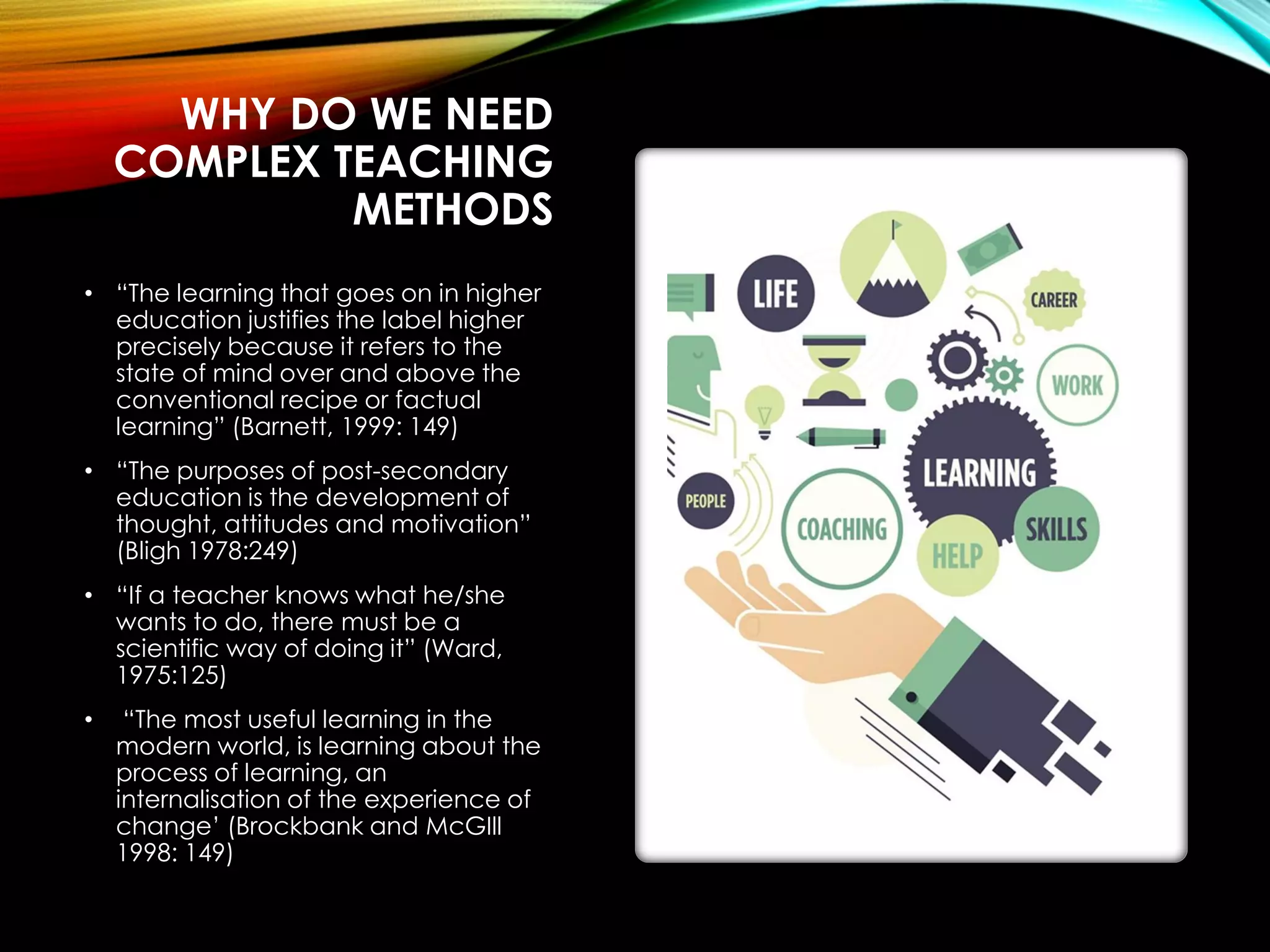
WHY DO WE NEED
COMPLEX TEACHING
METHODS
• “The learning that goes on in higher
education justifies the label higher
precisely because it refers to the
state of mind over and above the
conventional recipe or factual
learning” (Barnett, 1999: 149)
• “The purposes of post-secondary
education is the development of
thought, attitudes and motivation”
(Bligh 1978:249)
• “If a teacher knows what he/she
wants to do, there must be a
scientific way of doing it” (Ward,
1975:125)
• “The most useful learning in the
modern world, is learning about the
process of learning, an
internalisation of the experience of
change’ (Brockbank and McGIll
1998: 149)
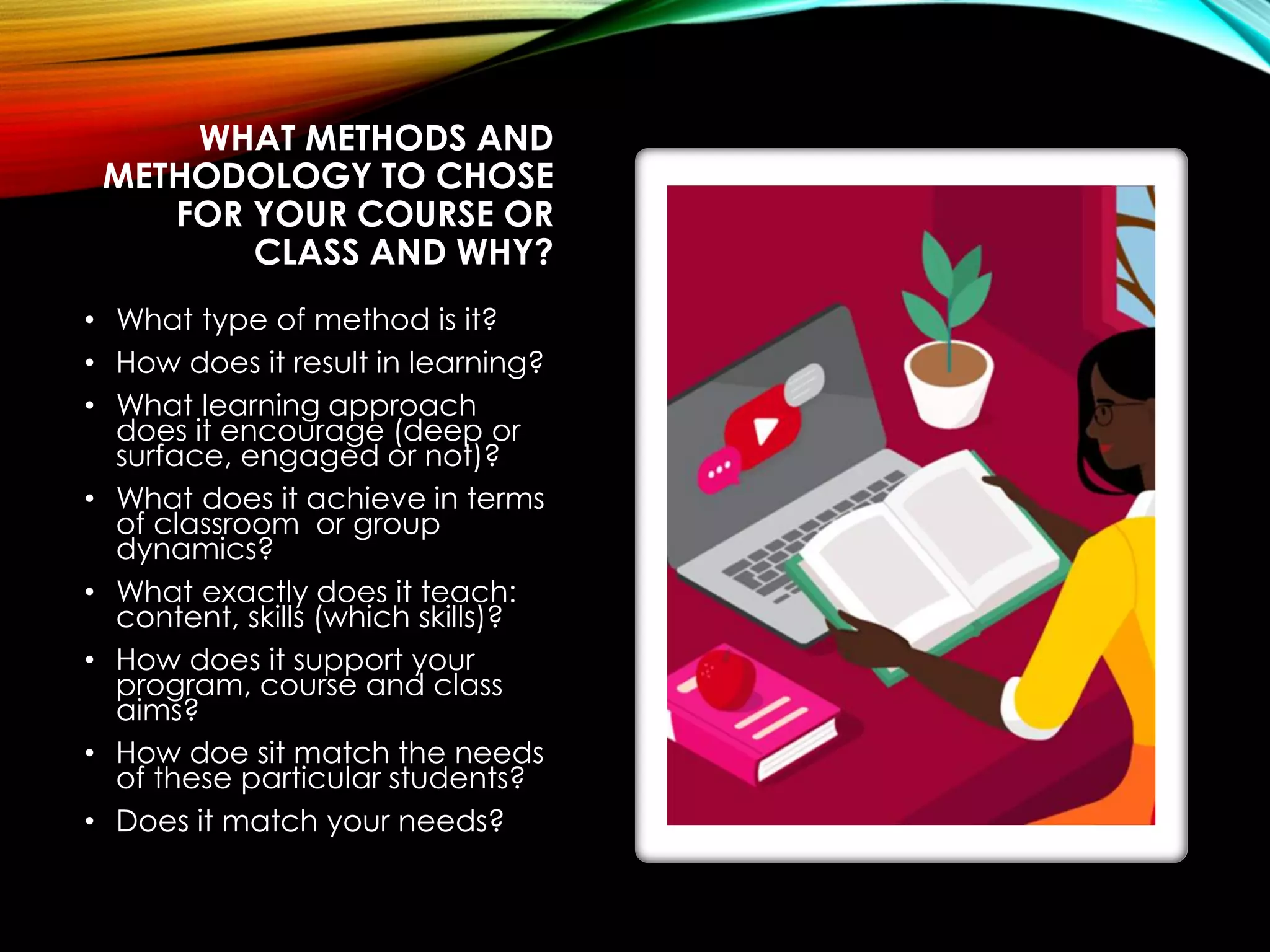
WHAT METHODS AND
METHODOLOGY TO CHOSE
FOR YOUR COURSE OR
CLASS AND WHY?
• What type of method is it?
• How does it result in learning?
• What learning approach
does it encourage (deep or
surface, engaged or not)?
• What does it achieve in terms
of classroom or group
dynamics?
• What exactly does it teach:
content, skills (which skills)?
• How does it support your
program, course and class
aims?
• How doe sit match the needs
of these particular students?
• Does it match your needs?
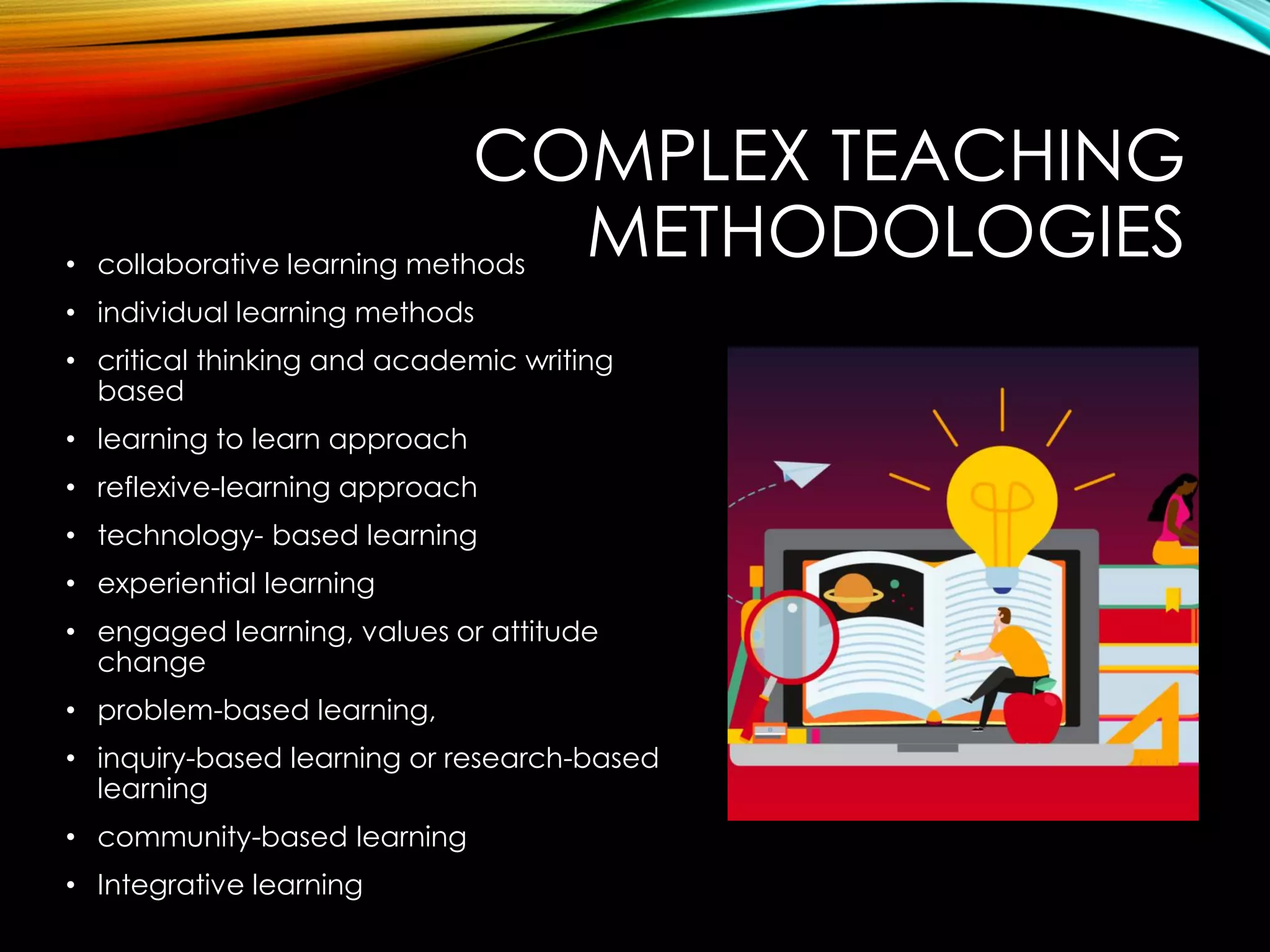
COMPLEX TEACHING
METHODOLOGIES
• collaborative learning methods
• individual learning methods
• critical thinking and academic writing
based
• learning to learn approach
• reflexive-learning approach
• technology- based learning
• experiential learning
• engaged learning, values or attitude
change
• problem-based learning,
• inquiry-based learning or research-based
learning
• community-based learning
• Integrative learning
COMPLEX TEACHING METHODS:
EXPERIENTIAL LEARNING
AGENDA
1.WHY COMPLEX
METHODS.
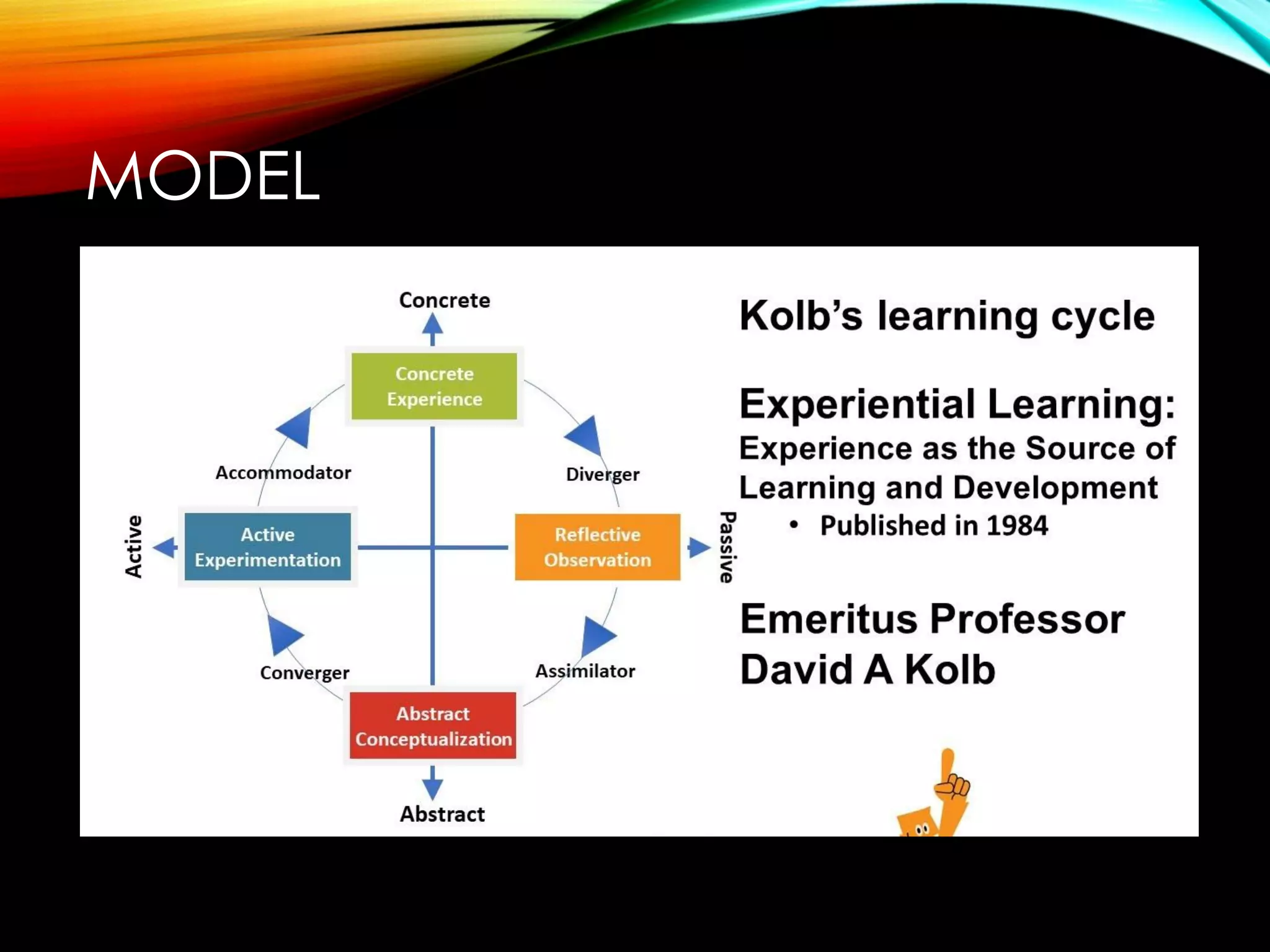
2.DEFINITION. 3. PHILOSOPHY. 4.MODEL. 5.CONDITIONS.
6.ADVANTAGES. 7.ASSESSMENT. 8.EXAMPLES.
WHY DO
WE NEED
COMPLEX
TEACHING
METHODS?
* Complexity of higher
education learning
* Emphasis on outcome
* Shift to student
centered approaches
* Focus on
transferability,
engagement.
DEFINITION
INVOLVE
STUDENTS IN REAL
EXPERIENCE.
EXPERIENCE IS OF
CRITICAL
IMPORTANCE.
LEARNING BY
DOING.
REFLECTION.
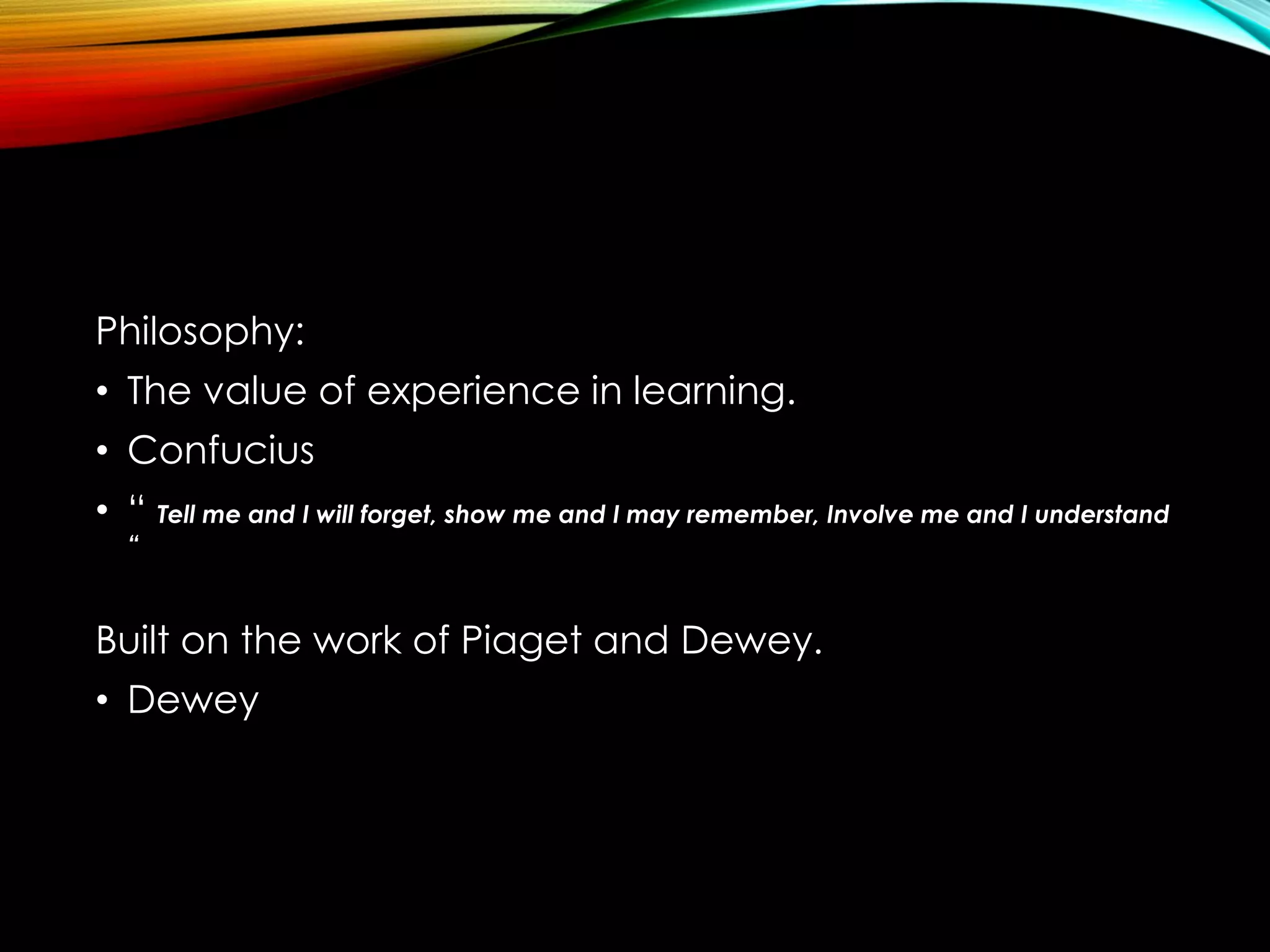
Philosophy:
• The value of experience in learning.
• Confucius
• “ Tell me and I will forget, show me and I may remember, Involve me and I understand
“
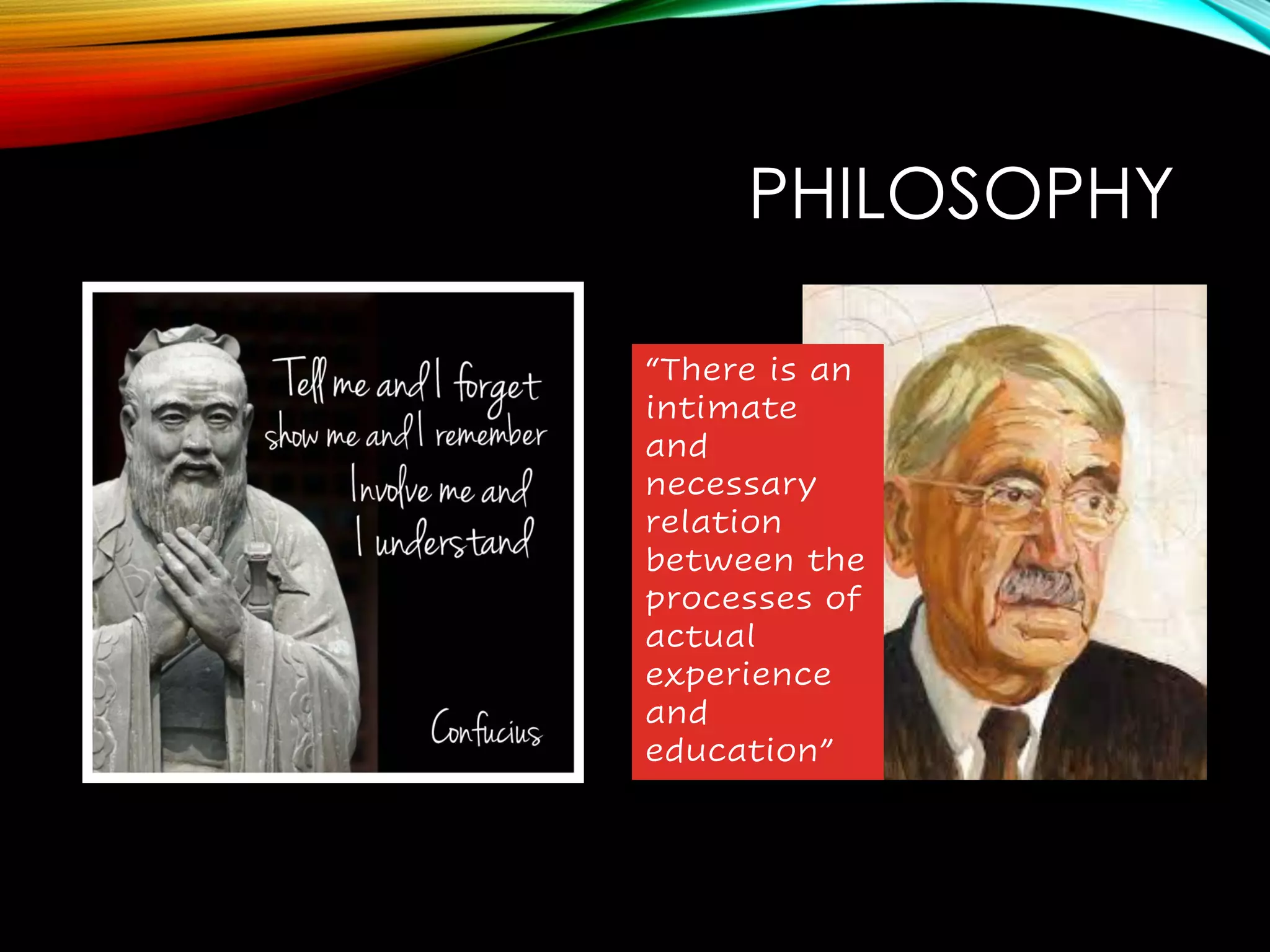
Built on the work of Piaget and Dewey.
• Dewey
PHILOSOPHY
“There is an
intimate
and
necessary
relation
between the
processes of
actual
experience
and
education”
MODEL
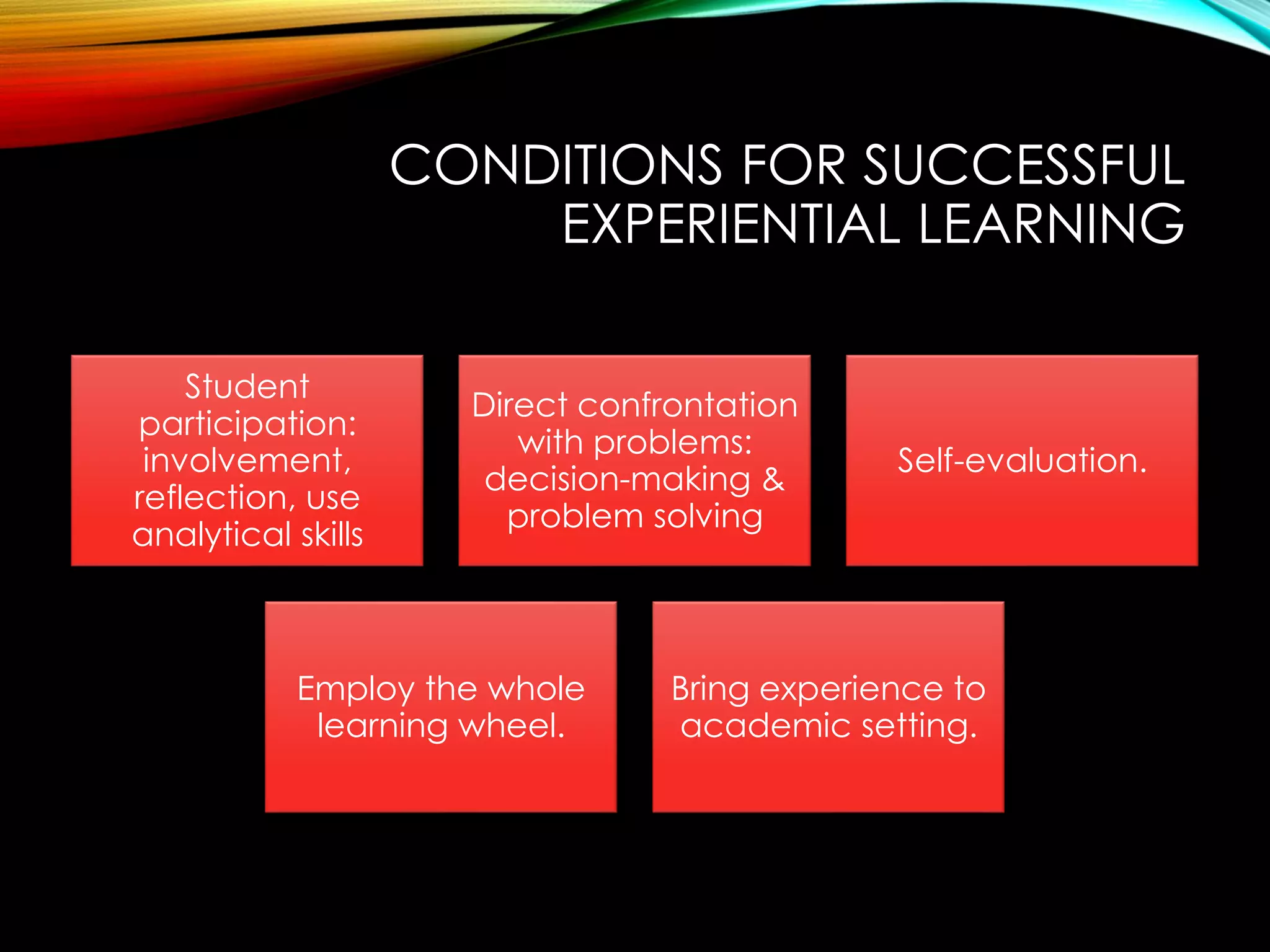
CONDITIONS FOR SUCCESSFUL
EXPERIENTIAL LEARNING
Student
participation:
involvement,
reflection, use
analytical skills
Direct confrontation
with problems:
decision-making &
problem solving
Self-evaluation.
Employ the whole
learning wheel.
Bring experience to
academic setting.
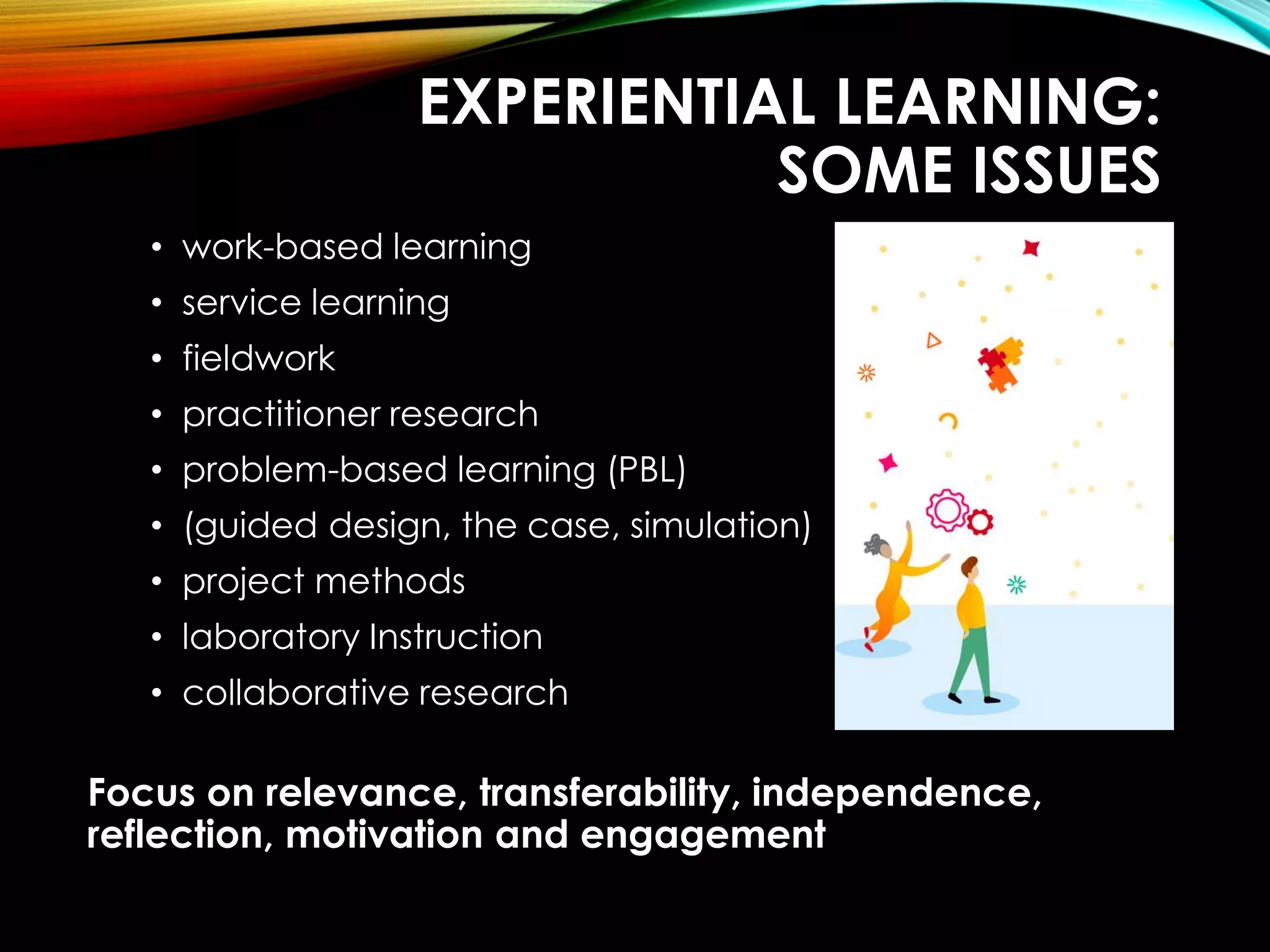
EXPERIENTIAL LEARNING:
SOME ISSUES
• work-based learning
• service learning
• fieldwork
• practitioner research
• problem-based learning (PBL)
• (guided design, the case, simulation)
• project methods
• laboratory Instruction
• collaborative research
Focus on relevance, transferability, independence,
reflection, motivation and engagement
ADVANTAGES
• Addressing the needs of the
learner.
• Self-initiative & self evaluation.
• Learning new skills, attitudes,
new ways of thinking.
• Service for society.
• Motivation.
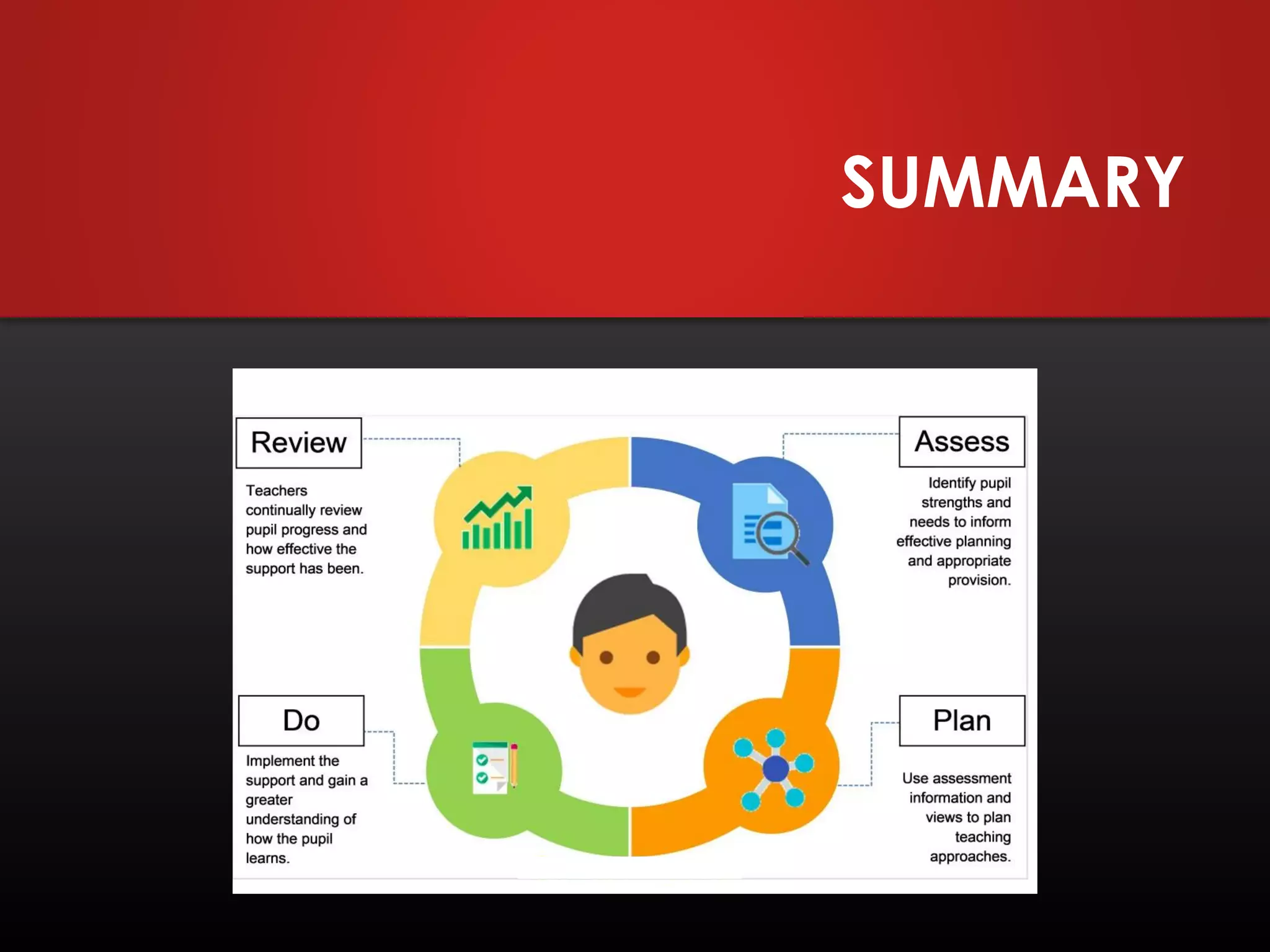
SUMMARY
REFERENCES
• References:^
• Itin, C. M. (1999). Reasserting the Philosophy of Experiential Education as a Vehicle for Change in the 21st
Century. The Journal of Experiential Education,.22(2), 91-98.
• ^ Bynum, W.F. and Porter, R. (eds) (2005) Oxford Dictionary of Scientific Quotations. Oxford University Press.
21:9.
• ^ Itin, C. M. (1999). Reasserting the Philosophy of Experiential Education as a Vehicle for Change in the
21st Century. The Journal of Experiential Education,.22(2), 91-98.
• ^ Merriam, S. B., Caffarella, R. S., & Baumgartner, L. M. (2007). Learning in adulthood: a comprehensive
guide. San Francisco: John Wiley & Sons, Inc.
• ^ Lindeman, E. C. (1961). The meaning of adult education in the United States. New York: Harvest House.
• ^ Dewey, J. (1938). Experience and education. New York: Collier Books.
• ^ Greenberg, D. (1992) "'Ethics' is a Course Taught By Life Experience," Education in America - A View from
Sudbury Valley.
• ^ Greenberg, D. (1987) "Teaching Justice Through Experience," The Sudbury Valley School Experience.
• ^ Greenberg, D. (1992) "Democracy Must be Experienced to be Learned," Education in America - A View
from Sudbury Valley.
• ^ Greenberg, D. (1987) "The Sorcerer's Apprentice," Free at Last - The Sudbury Valley School.
• ^ Stavenga de Jong, J.A., Wierstra, R.F.A. and Hermanussen, J. (2006) "An exploration of the relationship
between academic and experiential learning approaches in vocational education," British Journal of
Educational Psychology. 76;1. pp. 155-169.
LEARNING AND GIVING
FOR BETTER INDONESIA
www.humanikaconsulting.com

Experiential Learning

  • 1.
    EXPERIENTIAL LEARNING Seta A. Wicaksana Founderand CEO of www.humanikaconsulting.com and hipotest.com
  • 2.
    Dr. Seta A.Wicaksana, M.Psi., Psikolog 0811 19 53 43 wicaksana@humanikaconsulting.com • Business Psychologist • Pendiri dan Direktur Humanika Consulting dan hipotest.com • Anggota Komite Nominasi dan Remunerasi Dewan Komisaris PT Askrindo • Sekretaris Prodi MM Program Pasca Sarjana Universitas Pancasila • Dosen Tetap dan Peneliti di Fakultas Psikologi Universitas Pancasila • Pembina Yayasan Humanika Edukasi Indonesia • Wakil Ketua Asosiasi Psikologi Forensik Indonesia wilayah DKI • Penulis Buku: Sobat Way (2016), Industri dan Organisasi: Pendekatan Integratif dalam menghadapi Perubahan (2020), Human Faktor Engineering: Integratif Desain Manusia dan Lingkungan Kerja (2021), Psikologi Industri dan Organisasi (2021), Psikologi Umum (2021), Manajemen Pengembangan Talenta (2021), PIODiagnostik: Pengukuran Psikologi di Lingkungan Kerja (2021), Transformasi Digital: Perspektif Organisasi, Talenta dan Budaya Organisasi (2021), Psikologi Pelayanan (2021) dan Psikologi Konsumen (2021). • Dosen Tidak Tetap di: Program Pasca Sarjana Ekonomi di Univ. Pancasila, STP TRISAKTI, Fakultas Psikologi Universitas Mercu Buana, STIKOM IMA • Certified of Assessor Talent Management • Certified of Human Resources as a Business Partner • Certified of Risk Professional • Certified of HR Audit • Ilmu Ekonomi dan Manajemen (MSDM) S3 Universitas Pancasila • Fakultas Psikologi S1 dan S2 Universitas Indonesia • Sekolah ikatan dinas Akademi Sandi Negara
  • 3.
    BASIC GOALS 1. Threeprinciples of good design of teaching and learning: the instructional principle, the experiential principle and the alignment principle 2. Why do we need complex teaching methodologies, what are they and what do they imply as methods
  • 4.
    DESIGN MODEL FORLEARNING UNITS (WITH INSTRUCTIONAL ELEMENT) Based on Lynn Mcalpine, (2004) ‘Designing Learning as Well as Teaching: a Research-Based Model for Instruction that Empasizes Learner Practice’.Active Learning in Higher Education, 5 (2): 119-134 Out of class Informing Instruction Engagement Practice or Application Assessment feedback The learning process In class
  • 5.
    THE CONSTRUCTIVE ALIGNMENTOF TEACHING AND LEARNING • Course goals (course design) • 1. Topic -sub goals (design for each part of learning) help fulfill course goals • 2. Activities- contributes to fulfilling the sub goals • 3. Assessment - shows evidence that goals have been achieved Students needs Program design Planned outcomes (course goals) Teaching and learning activities subgoals Learning outcomes assessment Based on Biggs, John. (2003) Teaching for Quality Learning at University, Buckingham: SRHE and Open University Press, pp. 19-27
  • 6.
  • 7.
    WHY DO WENEED COMPLEX TEACHING METHODS • “The learning that goes on in higher education justifies the label higher precisely because it refers to the state of mind over and above the conventional recipe or factual learning” (Barnett, 1999: 149) • “The purposes of post-secondary education is the development of thought, attitudes and motivation” (Bligh 1978:249) • “If a teacher knows what he/she wants to do, there must be a scientific way of doing it” (Ward, 1975:125) • “The most useful learning in the modern world, is learning about the process of learning, an internalisation of the experience of change’ (Brockbank and McGIll 1998: 149)
  • 8.
    WHAT METHODS AND METHODOLOGYTO CHOSE FOR YOUR COURSE OR CLASS AND WHY? • What type of method is it? • How does it result in learning? • What learning approach does it encourage (deep or surface, engaged or not)? • What does it achieve in terms of classroom or group dynamics? • What exactly does it teach: content, skills (which skills)? • How does it support your program, course and class aims? • How doe sit match the needs of these particular students? • Does it match your needs?
  • 9.
    COMPLEX TEACHING METHODOLOGIES • collaborativelearning methods • individual learning methods • critical thinking and academic writing based • learning to learn approach • reflexive-learning approach • technology- based learning • experiential learning • engaged learning, values or attitude change • problem-based learning, • inquiry-based learning or research-based learning • community-based learning • Integrative learning
  • 10.
  • 12.
    AGENDA 1.WHY COMPLEX METHODS. 2.DEFINITION. 3.PHILOSOPHY. 4.MODEL. 5.CONDITIONS. 6.ADVANTAGES. 7.ASSESSMENT. 8.EXAMPLES.
  • 13.
    WHY DO WE NEED COMPLEX TEACHING METHODS? *Complexity of higher education learning * Emphasis on outcome * Shift to student centered approaches * Focus on transferability, engagement.
  • 14.
    DEFINITION INVOLVE STUDENTS IN REAL EXPERIENCE. EXPERIENCEIS OF CRITICAL IMPORTANCE. LEARNING BY DOING. REFLECTION.
  • 15.
    Philosophy: • The valueof experience in learning. • Confucius • “ Tell me and I will forget, show me and I may remember, Involve me and I understand “ Built on the work of Piaget and Dewey. • Dewey
  • 16.
    PHILOSOPHY “There is an intimate and necessary relation betweenthe processes of actual experience and education”
  • 17.
  • 18.
    CONDITIONS FOR SUCCESSFUL EXPERIENTIALLEARNING Student participation: involvement, reflection, use analytical skills Direct confrontation with problems: decision-making & problem solving Self-evaluation. Employ the whole learning wheel. Bring experience to academic setting.
  • 19.
    EXPERIENTIAL LEARNING: SOME ISSUES •work-based learning • service learning • fieldwork • practitioner research • problem-based learning (PBL) • (guided design, the case, simulation) • project methods • laboratory Instruction • collaborative research Focus on relevance, transferability, independence, reflection, motivation and engagement
  • 20.
    ADVANTAGES • Addressing theneeds of the learner. • Self-initiative & self evaluation. • Learning new skills, attitudes, new ways of thinking. • Service for society. • Motivation.
  • 21.
  • 22.
    REFERENCES • References:^ • Itin,C. M. (1999). Reasserting the Philosophy of Experiential Education as a Vehicle for Change in the 21st Century. The Journal of Experiential Education,.22(2), 91-98. • ^ Bynum, W.F. and Porter, R. (eds) (2005) Oxford Dictionary of Scientific Quotations. Oxford University Press. 21:9. • ^ Itin, C. M. (1999). Reasserting the Philosophy of Experiential Education as a Vehicle for Change in the 21st Century. The Journal of Experiential Education,.22(2), 91-98. • ^ Merriam, S. B., Caffarella, R. S., & Baumgartner, L. M. (2007). Learning in adulthood: a comprehensive guide. San Francisco: John Wiley & Sons, Inc. • ^ Lindeman, E. C. (1961). The meaning of adult education in the United States. New York: Harvest House. • ^ Dewey, J. (1938). Experience and education. New York: Collier Books. • ^ Greenberg, D. (1992) "'Ethics' is a Course Taught By Life Experience," Education in America - A View from Sudbury Valley. • ^ Greenberg, D. (1987) "Teaching Justice Through Experience," The Sudbury Valley School Experience. • ^ Greenberg, D. (1992) "Democracy Must be Experienced to be Learned," Education in America - A View from Sudbury Valley. • ^ Greenberg, D. (1987) "The Sorcerer's Apprentice," Free at Last - The Sudbury Valley School. • ^ Stavenga de Jong, J.A., Wierstra, R.F.A. and Hermanussen, J. (2006) "An exploration of the relationship between academic and experiential learning approaches in vocational education," British Journal of Educational Psychology. 76;1. pp. 155-169.
  • 23.
    LEARNING AND GIVING FORBETTER INDONESIA www.humanikaconsulting.com