Improving Biomedical Literature Search Skills within Evidence-Based Dentistry  Vince Mariano CDM 3530  Health Professions Division Library March 26, 2008
Learning Objectives Topics covered in this presentation include: Identify and distinguish between Bibliographic Databases and  Evidence-Based Practice (EBP) databases  Assessing the scope of the major dental information sources Overview of the Evidence-Based Practice process Developing a search strategy which can be applied to all bibliographic and full-text databases Learn how to conduct a literature search to find the best evidence to support decision-making in clinical situations
Databases Covering the Dental Literature Two types of databases encompass what is the biomedical literature, including the dental literature: Bibliographic Databases These databases index and abstract the primary journal literature  No value-added information or additional analysis provided beyond what is stated by the authors within each individual article/study. Evidence Based Medicine (EBM) Databases Contain research publications which constitute the most authoritative statements of evidence on clinical therapeutic interventions.  The information in these databases appraise the quality of studies and often make recommendations for practice. Contain what is referred to as “filtered” or “critically appraised” information & data.
PubMed/MEDLINE PubMed/MEDLINE is the pre-eminent biomedical database in the world, covering the fields of medicine, nursing, dentistry, pharmacy/pharmacology, the health care system, and the preclinical sciences.  PubMed/MEDLINE contains bibliographic citations and author abstracts from more than 4,900 biomedical journals. The database contains over 17 million citations dating back to the mid-1800s.  250 Journals indexed are Dentistry-specific, and PubMed contains approximately 500,000 dental and oral medicine articles- indexes all high-impact dental journals. Coverage of journals is worldwide, but most records are from English-language sources or have English abstracts  Data Type- abstract-level coverage with some links to full-text articles PubMed is the first database to query when starting your research
EMBASE.com EMBASE.com indexes over 4,800 journals from 70 countries; is updated weekly; coverage goes back to 1974, with MEDLINE records from 1966. Database contains More than 18 million records. abstracts and citations.  The European “counterpart” to PubMed/MEDLINE. EMBASE indexes  journals emanating primarily from Europe and Asia.  Approximately 35% overlap of journals covered with PubMed – indexes about 1,800 journals which PubMed does not Provides comprehensive coverage of pharmacy, pharmacology, toxicology, with detailed subject headings for drugs – indexers use Manufacturers' and drug trade names more frequently than PubMed- Excellent resource for identifying foreign drugs Indexes 37 Dentistry/Stomatology specific journals  Data Type- Abstract-level coverage with links to Full-Text
CINAHL – Cumulative Index to Nursing and Allied Health Literature Covers the Nursing and Allied Health Literature from 1937-present. Dental Hygiene is the primary dental specialty covered Data Type – Abstract-level coverage with some full-text articles
ISI Web of Science Web interface to the  Science Citation Index Expanded Social Sciences Citation Index Arts & Humanities Citation Index Indexes 54 journals in Dentistry, Oral Surgery & Medicine Best resource for cited reference searching/citation searching Cover-to-cover indexing of over 8,700 journals Data Type- Abstract-level coverage - Citation Database Records
Evidence-Based Practice (EBP) databases The information contained within EBP databases is not merely peer-reviewed information, but has also undergone several more levels of analysis- it is “critically appraised” or “filtered” information, distinct from the primary literature Filtered Information types include Systematic Reviews, Critically Appraised Topics, Critically Appraised Articles, and Clinical Practice Guidelines Study Design Types ranked in order of authority- Randomized Controlled Trials, Clinical Trials, Cohort Studies, Case Series, and individual Case Reports
Evidence-Based Practice (EBP) databases EBP databases can be queried to answer either complex clinical questions or general care questions, but are usually queried to answer  “Foreground Questions”, which are narrowly-focused clinical questions directly relating to the patient. Background Questions are clinical questions that ask for  "general knowledge" regarding disease management or a disease process  What constitutes the “Evidence-Based” Literature is a very small subset of the  much broader biomedical literature Higher levels of evidence may not exist for all clinical questions because of the nature of medical problems, as well as research and ethical considerations
Cochrane Database of Systematic Reviews This database contains the full text of systematic reviews prepared by the Cochrane Collaboration.  Systematic reviews  are generally regarded as the highest level of medical research evidence. If you find a systematic review on your therapeutic modality, you have likely identified the most authoritative statement of evidence on that therapeutic intervention. Systematic reviews are a summary of the medical literature on a specific clinical question which include a clearly defined question, comprehensive search strategy, explicit inclusion criteria, assessment of methodological quality of included studies, synthesis of the data, summary of results, & recommendations for practice. CDSR contains 146 completed systematic reviews authored by the Cochrane Oral Health Group, based @ University of Manchester, UK.. Data Type- Full Text of Systematic Reviews
Cochrane Central Register of Controlled Trials (CENTRAL) CENTRAL is a bibliographic database of definitive controlled trials.  The register provides bibliographic information (i.e. abstracts rather than full-text) on over 415,000 reports of trials identified by contributors to the Cochrane Collaboration.  Only well-designed trials with sound methodologies are accepted into the database. This source attempts to identify and include Clinical Trials from the international biomedical literature. It includes studies published in MEDLINE, EMBASE and other electronic databases, as well as reports published in conference proceedings and other sources not currently listed in MEDLINE or other bibliographic databases. CENTRAL indexes approximately 25,000 oral and dental medicine related clinical trials Data Type- abstract and bibliographic information of clinical trials
Database of Abstracts of Reviews of Effectiveness (DARE) DARE is a Full Text database containing critical assessments of systematic reviews from a variety of medical journals that have been critically appraised by reviewers DARE contains approximately 3000 structured reviews of systematic reviews  About 150 of these structured reviews are on oral/dental medicine topics Data Type- Structured Abstracts- Critical Assessments of selected Systematic Reviews
Clinical Evidence Clinical Evidence summarizes the current literature on over 200 common medical conditions and provides the best available evidence on prevention and treatment. There are a number reviews of conditions relating to oral/dental medicine contained within Clinical Evidence.  Data Type- Full Text Topical Reviews
UpToDate Widely-used Clinical Reference/Electronic Textbook database containing regularly updated topic reviews in internal medicine, family medicine, pediatrics, and other specialties Provides evidence-based answers to commonly asked questions in clinical practice.  Physicians-authored topic-reviews on thousands of topics, some containing a level-of-evidence rating Contains topical Review-length articles on numerous diseases and conditions within dentistry, oral health & medicine Data Type-  Topical Review Articles
Other Evidence-Based Dentistry Sources   American Dental Association- www.ada.org  Directory of Systematic Reviews - http://www.ada.org/prof/resources/ebd/reviews/index.asp Compiled index of published systematic reviews of direct clinical relevance to dentistry identified in the literature  Topics cover a wide range of topics from amalgam to wisdom teeth ADA strongly encouraging the authorship of systematic reviews addressing key topics and clinical questions Dentists have a need for quality information and synthesized evidence, which ultimately saves time
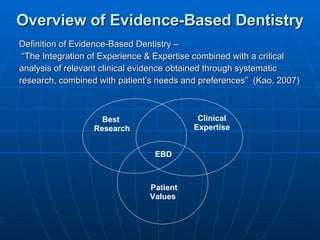
Overview of Evidence-Based Dentistry Definition of Evidence-Based Dentistry – “ The Integration of Experience & Expertise combined with a critical analysis of relevant clinical evidence obtained through systematic research, combined with patient’s needs and preferences”  (Kao, 2007) EBD Best  Research Clinical Expertise Patient Values
Overview of Evidence-Based Dentistry Dental Practitioners generally support the concept of using evidence-based disease prevention and treatments, but have been slow to incorporate the principle into practice. Reasons to incorporate EBD into practice- -Rapidly expanding knowledge base and literature  - 500 dental journals, 2 million new articles published in biomedical  journals annually  -Influx of new Dental Materials and Techniques -Many claims made in commercial information marketed to dental professionals are not always evidence-based -Patients today are better informed consumers & want answers to questions concerning marketing information directed at them –direct-to-consumer advertising
Overview of Evidence-Based Dentistry The goal of Evidence-Based Dentistry is to effectively apply the growing body of dental knowledge into effective dental practice to yield better patient outcomes The practice of EBD implies lifelong learning throughout your professional career Barriers to the implementation of EBD- Time Third-Party payers may deny coverage of newer services or techniques Clinicians may be unmotivated to change practice – financial concerns for new equipment / technology / facility design / staffing Many key clinical questions within dentistry remain without definitive answers due to lack of published evidence
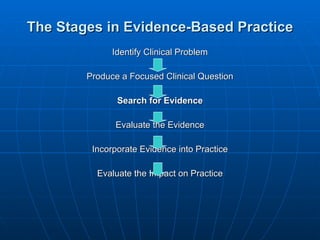
The Stages in Evidence-Based Practice Identify Clinical Problem Produce a Focused Clinical Question Search for Evidence Evaluate the Evidence Incorporate Evidence into Practice Evaluate the Impact on Practice
Levels of Evidence in EBD Different types of evidence have different kinds of authority. Level I – Evidence from Systematic Reviews of Randomized Controlled Trials Level II – Evidence from Randomized Controlled Trials Level III – Evidence from Non-randomized controlled trials OR cohort studies Level IV – Evidence from Case Series Articles such as single case reports, technical notes, animal studies, laboratory studies, non-systematic literature reviews, and expert opinion are all considered lower classes of evidence within EBD.
Different Types of Research Practical Searching vs. Systematic Searching What types of research projects, questions, or other factors necessitate one or the other? Practical Searching Rapid scan of the current literature to find quick answers to specific clinical questions or references on specific topics Time Constraints Short Essay/Communication/Paper Need 5 most recent references/Literature from last X years Need to answer to clinical question in 15 minutes or less Not an exhaustive search Clinicians querying literature more often within their own practices
Different Types of Research Systematic Searching Exhaustive search of the literature in an attempt to identify every relevant reference relating to a topic or question Literature Review Thesis/Dissertation Research Project –Capstone Project Critically Appraised Topics (CATs) Writing for Publication- Research or Review Article  Cochrane- Systematic Review/Meta-Analysis – exhaustive search required  Component of Evidence Based Practice Requires full documentation of all search terms AND sources searched to allow for replication and to avoid duplication
The Search Process Steps in the process of conducting a systematic search of the literature include:  Formulating your focused clinical question  – P-I-C-O Strategy Problem/Patient – Intervention – Comparison – Outcome Dissecting a question into its component parts or concepts  to facilitate finding the best evidence – a fundamental skill of evidence-based practitioners Literature searches most likely to be successful if they’re based on clinically relevant, well-formulated questions  – Etiology, Diagnosis, Therapy, Harm, Prognosis categories of clinical questions  Example- What is a myocardial infarction and how would a history of infarction affect the delivery and timing of dental care?
The Search Process Consider all of the variant terminology that can be used to express your concepts- synonyms, acronyms Example – Primary Teeth = Deciduous Teeth Limiting your retrieval  to appropriate references or citations (i.e., English language, human, age groups, years of publication, publication types, etc.) – e.g. - PubMed Clinical Queries Filter Document each of your searches to avoid immediate duplication and enable future replication Hand-searching of journals not indexed by databases and grey literature may be necessary to complete your due diligence Repeat this process until “point of diminishing returns” is reached

Improving Biomedical Literature Search Skills within Evidence-Based Dentistry

  • 1.
    Improving Biomedical LiteratureSearch Skills within Evidence-Based Dentistry Vince Mariano CDM 3530 Health Professions Division Library March 26, 2008
  • 2.
    Learning Objectives Topicscovered in this presentation include: Identify and distinguish between Bibliographic Databases and Evidence-Based Practice (EBP) databases Assessing the scope of the major dental information sources Overview of the Evidence-Based Practice process Developing a search strategy which can be applied to all bibliographic and full-text databases Learn how to conduct a literature search to find the best evidence to support decision-making in clinical situations
  • 3.
    Databases Covering theDental Literature Two types of databases encompass what is the biomedical literature, including the dental literature: Bibliographic Databases These databases index and abstract the primary journal literature No value-added information or additional analysis provided beyond what is stated by the authors within each individual article/study. Evidence Based Medicine (EBM) Databases Contain research publications which constitute the most authoritative statements of evidence on clinical therapeutic interventions. The information in these databases appraise the quality of studies and often make recommendations for practice. Contain what is referred to as “filtered” or “critically appraised” information & data.
  • 4.
    PubMed/MEDLINE PubMed/MEDLINE isthe pre-eminent biomedical database in the world, covering the fields of medicine, nursing, dentistry, pharmacy/pharmacology, the health care system, and the preclinical sciences. PubMed/MEDLINE contains bibliographic citations and author abstracts from more than 4,900 biomedical journals. The database contains over 17 million citations dating back to the mid-1800s. 250 Journals indexed are Dentistry-specific, and PubMed contains approximately 500,000 dental and oral medicine articles- indexes all high-impact dental journals. Coverage of journals is worldwide, but most records are from English-language sources or have English abstracts Data Type- abstract-level coverage with some links to full-text articles PubMed is the first database to query when starting your research
  • 5.
    EMBASE.com EMBASE.com indexesover 4,800 journals from 70 countries; is updated weekly; coverage goes back to 1974, with MEDLINE records from 1966. Database contains More than 18 million records. abstracts and citations. The European “counterpart” to PubMed/MEDLINE. EMBASE indexes journals emanating primarily from Europe and Asia. Approximately 35% overlap of journals covered with PubMed – indexes about 1,800 journals which PubMed does not Provides comprehensive coverage of pharmacy, pharmacology, toxicology, with detailed subject headings for drugs – indexers use Manufacturers' and drug trade names more frequently than PubMed- Excellent resource for identifying foreign drugs Indexes 37 Dentistry/Stomatology specific journals Data Type- Abstract-level coverage with links to Full-Text
  • 6.
    CINAHL – CumulativeIndex to Nursing and Allied Health Literature Covers the Nursing and Allied Health Literature from 1937-present. Dental Hygiene is the primary dental specialty covered Data Type – Abstract-level coverage with some full-text articles
  • 7.
    ISI Web ofScience Web interface to the Science Citation Index Expanded Social Sciences Citation Index Arts & Humanities Citation Index Indexes 54 journals in Dentistry, Oral Surgery & Medicine Best resource for cited reference searching/citation searching Cover-to-cover indexing of over 8,700 journals Data Type- Abstract-level coverage - Citation Database Records
  • 8.
    Evidence-Based Practice (EBP)databases The information contained within EBP databases is not merely peer-reviewed information, but has also undergone several more levels of analysis- it is “critically appraised” or “filtered” information, distinct from the primary literature Filtered Information types include Systematic Reviews, Critically Appraised Topics, Critically Appraised Articles, and Clinical Practice Guidelines Study Design Types ranked in order of authority- Randomized Controlled Trials, Clinical Trials, Cohort Studies, Case Series, and individual Case Reports
  • 9.
    Evidence-Based Practice (EBP)databases EBP databases can be queried to answer either complex clinical questions or general care questions, but are usually queried to answer “Foreground Questions”, which are narrowly-focused clinical questions directly relating to the patient. Background Questions are clinical questions that ask for "general knowledge" regarding disease management or a disease process What constitutes the “Evidence-Based” Literature is a very small subset of the much broader biomedical literature Higher levels of evidence may not exist for all clinical questions because of the nature of medical problems, as well as research and ethical considerations
  • 10.
    Cochrane Database ofSystematic Reviews This database contains the full text of systematic reviews prepared by the Cochrane Collaboration. Systematic reviews are generally regarded as the highest level of medical research evidence. If you find a systematic review on your therapeutic modality, you have likely identified the most authoritative statement of evidence on that therapeutic intervention. Systematic reviews are a summary of the medical literature on a specific clinical question which include a clearly defined question, comprehensive search strategy, explicit inclusion criteria, assessment of methodological quality of included studies, synthesis of the data, summary of results, & recommendations for practice. CDSR contains 146 completed systematic reviews authored by the Cochrane Oral Health Group, based @ University of Manchester, UK.. Data Type- Full Text of Systematic Reviews
  • 11.
    Cochrane Central Registerof Controlled Trials (CENTRAL) CENTRAL is a bibliographic database of definitive controlled trials. The register provides bibliographic information (i.e. abstracts rather than full-text) on over 415,000 reports of trials identified by contributors to the Cochrane Collaboration. Only well-designed trials with sound methodologies are accepted into the database. This source attempts to identify and include Clinical Trials from the international biomedical literature. It includes studies published in MEDLINE, EMBASE and other electronic databases, as well as reports published in conference proceedings and other sources not currently listed in MEDLINE or other bibliographic databases. CENTRAL indexes approximately 25,000 oral and dental medicine related clinical trials Data Type- abstract and bibliographic information of clinical trials
  • 12.
    Database of Abstractsof Reviews of Effectiveness (DARE) DARE is a Full Text database containing critical assessments of systematic reviews from a variety of medical journals that have been critically appraised by reviewers DARE contains approximately 3000 structured reviews of systematic reviews About 150 of these structured reviews are on oral/dental medicine topics Data Type- Structured Abstracts- Critical Assessments of selected Systematic Reviews
  • 13.
    Clinical Evidence ClinicalEvidence summarizes the current literature on over 200 common medical conditions and provides the best available evidence on prevention and treatment. There are a number reviews of conditions relating to oral/dental medicine contained within Clinical Evidence. Data Type- Full Text Topical Reviews
  • 14.
    UpToDate Widely-used ClinicalReference/Electronic Textbook database containing regularly updated topic reviews in internal medicine, family medicine, pediatrics, and other specialties Provides evidence-based answers to commonly asked questions in clinical practice. Physicians-authored topic-reviews on thousands of topics, some containing a level-of-evidence rating Contains topical Review-length articles on numerous diseases and conditions within dentistry, oral health & medicine Data Type- Topical Review Articles
  • 15.
    Other Evidence-Based DentistrySources American Dental Association- www.ada.org Directory of Systematic Reviews - http://www.ada.org/prof/resources/ebd/reviews/index.asp Compiled index of published systematic reviews of direct clinical relevance to dentistry identified in the literature Topics cover a wide range of topics from amalgam to wisdom teeth ADA strongly encouraging the authorship of systematic reviews addressing key topics and clinical questions Dentists have a need for quality information and synthesized evidence, which ultimately saves time
  • 16.
    Overview of Evidence-BasedDentistry Definition of Evidence-Based Dentistry – “ The Integration of Experience & Expertise combined with a critical analysis of relevant clinical evidence obtained through systematic research, combined with patient’s needs and preferences” (Kao, 2007) EBD Best Research Clinical Expertise Patient Values
  • 17.
    Overview of Evidence-BasedDentistry Dental Practitioners generally support the concept of using evidence-based disease prevention and treatments, but have been slow to incorporate the principle into practice. Reasons to incorporate EBD into practice- -Rapidly expanding knowledge base and literature - 500 dental journals, 2 million new articles published in biomedical journals annually -Influx of new Dental Materials and Techniques -Many claims made in commercial information marketed to dental professionals are not always evidence-based -Patients today are better informed consumers & want answers to questions concerning marketing information directed at them –direct-to-consumer advertising
  • 18.
    Overview of Evidence-BasedDentistry The goal of Evidence-Based Dentistry is to effectively apply the growing body of dental knowledge into effective dental practice to yield better patient outcomes The practice of EBD implies lifelong learning throughout your professional career Barriers to the implementation of EBD- Time Third-Party payers may deny coverage of newer services or techniques Clinicians may be unmotivated to change practice – financial concerns for new equipment / technology / facility design / staffing Many key clinical questions within dentistry remain without definitive answers due to lack of published evidence
  • 19.
    The Stages inEvidence-Based Practice Identify Clinical Problem Produce a Focused Clinical Question Search for Evidence Evaluate the Evidence Incorporate Evidence into Practice Evaluate the Impact on Practice
  • 20.
    Levels of Evidencein EBD Different types of evidence have different kinds of authority. Level I – Evidence from Systematic Reviews of Randomized Controlled Trials Level II – Evidence from Randomized Controlled Trials Level III – Evidence from Non-randomized controlled trials OR cohort studies Level IV – Evidence from Case Series Articles such as single case reports, technical notes, animal studies, laboratory studies, non-systematic literature reviews, and expert opinion are all considered lower classes of evidence within EBD.
  • 21.
    Different Types ofResearch Practical Searching vs. Systematic Searching What types of research projects, questions, or other factors necessitate one or the other? Practical Searching Rapid scan of the current literature to find quick answers to specific clinical questions or references on specific topics Time Constraints Short Essay/Communication/Paper Need 5 most recent references/Literature from last X years Need to answer to clinical question in 15 minutes or less Not an exhaustive search Clinicians querying literature more often within their own practices
  • 22.
    Different Types ofResearch Systematic Searching Exhaustive search of the literature in an attempt to identify every relevant reference relating to a topic or question Literature Review Thesis/Dissertation Research Project –Capstone Project Critically Appraised Topics (CATs) Writing for Publication- Research or Review Article Cochrane- Systematic Review/Meta-Analysis – exhaustive search required Component of Evidence Based Practice Requires full documentation of all search terms AND sources searched to allow for replication and to avoid duplication
  • 23.
    The Search ProcessSteps in the process of conducting a systematic search of the literature include: Formulating your focused clinical question – P-I-C-O Strategy Problem/Patient – Intervention – Comparison – Outcome Dissecting a question into its component parts or concepts to facilitate finding the best evidence – a fundamental skill of evidence-based practitioners Literature searches most likely to be successful if they’re based on clinically relevant, well-formulated questions – Etiology, Diagnosis, Therapy, Harm, Prognosis categories of clinical questions Example- What is a myocardial infarction and how would a history of infarction affect the delivery and timing of dental care?
  • 24.
    The Search ProcessConsider all of the variant terminology that can be used to express your concepts- synonyms, acronyms Example – Primary Teeth = Deciduous Teeth Limiting your retrieval to appropriate references or citations (i.e., English language, human, age groups, years of publication, publication types, etc.) – e.g. - PubMed Clinical Queries Filter Document each of your searches to avoid immediate duplication and enable future replication Hand-searching of journals not indexed by databases and grey literature may be necessary to complete your due diligence Repeat this process until “point of diminishing returns” is reached