Presented by,
Basith Basheer
Joel Joseph
Richard Brahma
Sonas kumar
Vishaka Jain
isanybehaviourthatresultsin
exchangeofmeaning
-AmericanManagement
Association
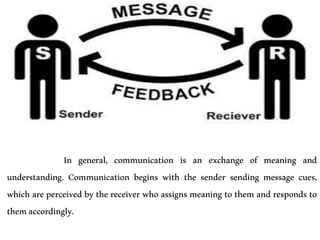
In general, communication is an exchange of meaning and
understanding. Communication begins with the sender sending message cues,
which are perceived by the receiver who assigns meaning to them and responds to
themaccordingly.
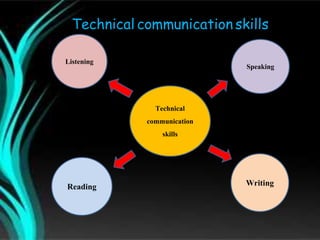
Technical communication skills
Technical
communication
skills
Listening Speaking
Reading Writing
Listening
Listening skills are probably one of the most important language skills that
you need in order to be successful in your academic and professional pursuits. The
following table will show various types of listening skills under three categories,
General:
• Casual conversation
• Formal conversation
• Social interaction
• Public speeches
• Announcements
• Radio
• Television programmes
• News reports
Academic:
Listening to/ during
• Lectures
• Tutorials and practicals
• Seminars andworkshops
• Technical presentations
• Academic discussions
• Academic interactions
• Viva voce
Professional:
• Professional interactions
• Meetings
• Conferences
• Interviews
• Professional discussions
• Professional presentations
• Teleconferencing
• videoconferencing
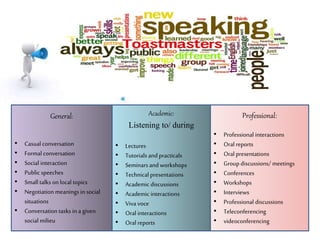
Speaking skills are also important
for a person’s professional survival and growth.
A person requires effective oral communication
skills in several formal communicative
situations.
• Oral communication not only makes professional interaction possible, it
develops information and understanding essential for decision making in
meetings, conferences and other similar oral communicative skills.
• As oral communication is a tool of professional and business interactions,
one should be able to use it fluently, effectively and confidently.
General:
• Casual conversation
• Formal conversation
• Social interaction
• Public speeches
• Small talks on local topics
• Negotiation meanings in social
situations
• Conversation tasks ina given
social milieu
Academic:
Listening to/ during
• Lectures
• Tutorials and practicals
• Seminars and workshops
• Technical presentations
• Academic discussions
• Academic interactions
• Viva voce
• Oral interactions
• Oral reports
Professional:
• Professional interactions
• Oral reports
• Oral presentations
• Group discussions/ meetings
• Conferences
• Workshops
• Interviews
• Professional discussions
• Teleconferencing
• videoconferencing
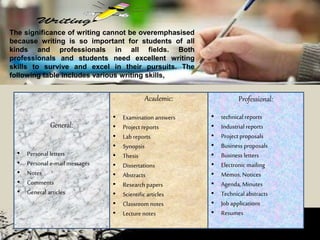
The significance of writing cannot be overemphasised
because writing is so important for students of all
kinds and professionals in all fields. Both
professionals and students need excellent writing
skills to survive and excel in their pursuits. The
following table includes various writing skills,
General:
• Personal letters
• Personal e-mail messages
• Notes
• Comments
• Generalarticles
Academic:
• Examination answers
• Project reports
• Lab reports
• Synopsis
• Thesis
• Dissertations
• Abstracts
• Research papers
• Scientific articles
• Classroom notes
• Lecture notes
Professional:
• technical reports
• Industrial reports
• Project proposals
• Business proposals
• Business letters
• Electronic mailing
• Memos, Notices
• Agenda, Minutes
• Technical abstracts
• Job applications
• Resumes
Like listening and speaking, reading is also
important for effective communication. You need
effective reading skills as you may be required to
read several kinds of reading material for different
general, academic and professional purposes. It
includes,
General:
• Newspapers
• Magazines
• Journals
• Novels
• Stories
• Articles
• Personal letters
• Emails
• Generalbooks
• Entertainmentliterature
Academic:
• Text books
• Journals
• Research papers
• Scientific articles
• Classroom notes
• Lecture notes
• Thesis
• Dissertations
• Abstracts
Professional:
• Business reports
• Proposals
• Business letters
• Memos
• Email messages
• Notes &notices
• Circulars
• Promotional bulletins
• Catalogues
• Instruction manuals
• Corporate brouchers
Technical communication skills

Technical communication skills

  • 1.
    Presented by, Basith Basheer JoelJoseph Richard Brahma Sonas kumar Vishaka Jain
  • 2.
  • 3.
    In general, communicationis an exchange of meaning and understanding. Communication begins with the sender sending message cues, which are perceived by the receiver who assigns meaning to them and responds to themaccordingly.
  • 4.
  • 5.
    Listening Listening skills areprobably one of the most important language skills that you need in order to be successful in your academic and professional pursuits. The following table will show various types of listening skills under three categories, General: • Casual conversation • Formal conversation • Social interaction • Public speeches • Announcements • Radio • Television programmes • News reports Academic: Listening to/ during • Lectures • Tutorials and practicals • Seminars andworkshops • Technical presentations • Academic discussions • Academic interactions • Viva voce Professional: • Professional interactions • Meetings • Conferences • Interviews • Professional discussions • Professional presentations • Teleconferencing • videoconferencing
  • 6.
    Speaking skills arealso important for a person’s professional survival and growth. A person requires effective oral communication skills in several formal communicative situations. • Oral communication not only makes professional interaction possible, it develops information and understanding essential for decision making in meetings, conferences and other similar oral communicative skills. • As oral communication is a tool of professional and business interactions, one should be able to use it fluently, effectively and confidently.
  • 7.
    General: • Casual conversation •Formal conversation • Social interaction • Public speeches • Small talks on local topics • Negotiation meanings in social situations • Conversation tasks ina given social milieu Academic: Listening to/ during • Lectures • Tutorials and practicals • Seminars and workshops • Technical presentations • Academic discussions • Academic interactions • Viva voce • Oral interactions • Oral reports Professional: • Professional interactions • Oral reports • Oral presentations • Group discussions/ meetings • Conferences • Workshops • Interviews • Professional discussions • Teleconferencing • videoconferencing
  • 8.
    The significance ofwriting cannot be overemphasised because writing is so important for students of all kinds and professionals in all fields. Both professionals and students need excellent writing skills to survive and excel in their pursuits. The following table includes various writing skills, General: • Personal letters • Personal e-mail messages • Notes • Comments • Generalarticles Academic: • Examination answers • Project reports • Lab reports • Synopsis • Thesis • Dissertations • Abstracts • Research papers • Scientific articles • Classroom notes • Lecture notes Professional: • technical reports • Industrial reports • Project proposals • Business proposals • Business letters • Electronic mailing • Memos, Notices • Agenda, Minutes • Technical abstracts • Job applications • Resumes
  • 9.
    Like listening andspeaking, reading is also important for effective communication. You need effective reading skills as you may be required to read several kinds of reading material for different general, academic and professional purposes. It includes, General: • Newspapers • Magazines • Journals • Novels • Stories • Articles • Personal letters • Emails • Generalbooks • Entertainmentliterature Academic: • Text books • Journals • Research papers • Scientific articles • Classroom notes • Lecture notes • Thesis • Dissertations • Abstracts Professional: • Business reports • Proposals • Business letters • Memos • Email messages • Notes &notices • Circulars • Promotional bulletins • Catalogues • Instruction manuals • Corporate brouchers