Introduction to CSR Corporate Social Responsibility
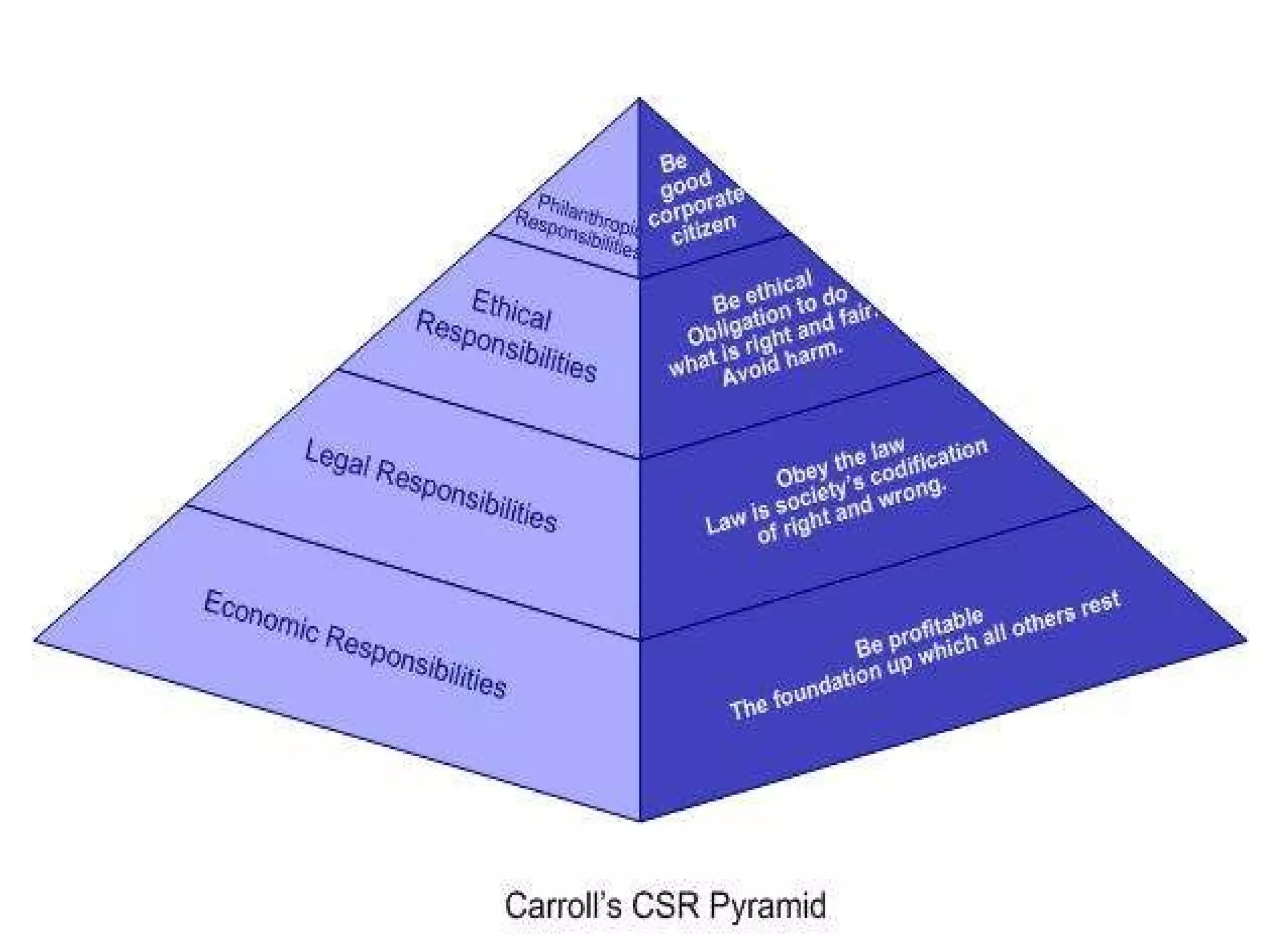
Definition  of CSR Meaning of CSR Should corporations be involved in CSR? Two views of CSR : Shareholder or Stakeholders The pros and cons of CSR Carroll’s CSR pyramid. Chapter overview:
“ Companies with a defined corporate commitment to ethical principles do better financially than companies that don't”. DePaul University, 1997 Definition of CSR
“ CSR is continuing commitment to behave ethically and contribute to economic development while improving the quality of life of the workforce and their families as well as the local community and society at large”. Moir, 2001   What is CSR?
“ Only social -welfare-promoting actions performed over and above the economic and legal requirements of business in a country qualify as corporate social responsibility. Archie B. Carroll, 1979 What is CSR?
“ The idea that business has a duty to serve society in general as well as the financial interests of stockholders”. Pearce & Robinson What is CSR?
Meaning of CSR CSR is the integration by companies of social and environmental concerns in their business operations and in their interaction with their stakeholders on a voluntary basis. " The concept of social responsibility means going beyond the fulfillment of legal requirements by investing  more  in human capital, the environment, and relations with stakeholders.
Meaning of CSR It is a voluntary instrument, but must be implemented reliably so that it fosters trust and confidence among stakeholders.
Customers and clients are influenced by a company's  reputation  in social and environmental areas.  The  employment  market is competitive and good recruits want to work for and stay with companies that care.  Social performance increasingly influences  investors'  decisions, as the ethical investment market grows evermore quickly.  CSR enables the  strategic management  of internal and external risks in social as well as environmental areas.  Existing  socially responsible actions  become more visible and are better communicated.  Social and environmental responsibility has been demonstrated to  reduce operating costs .  Why is CSR important?
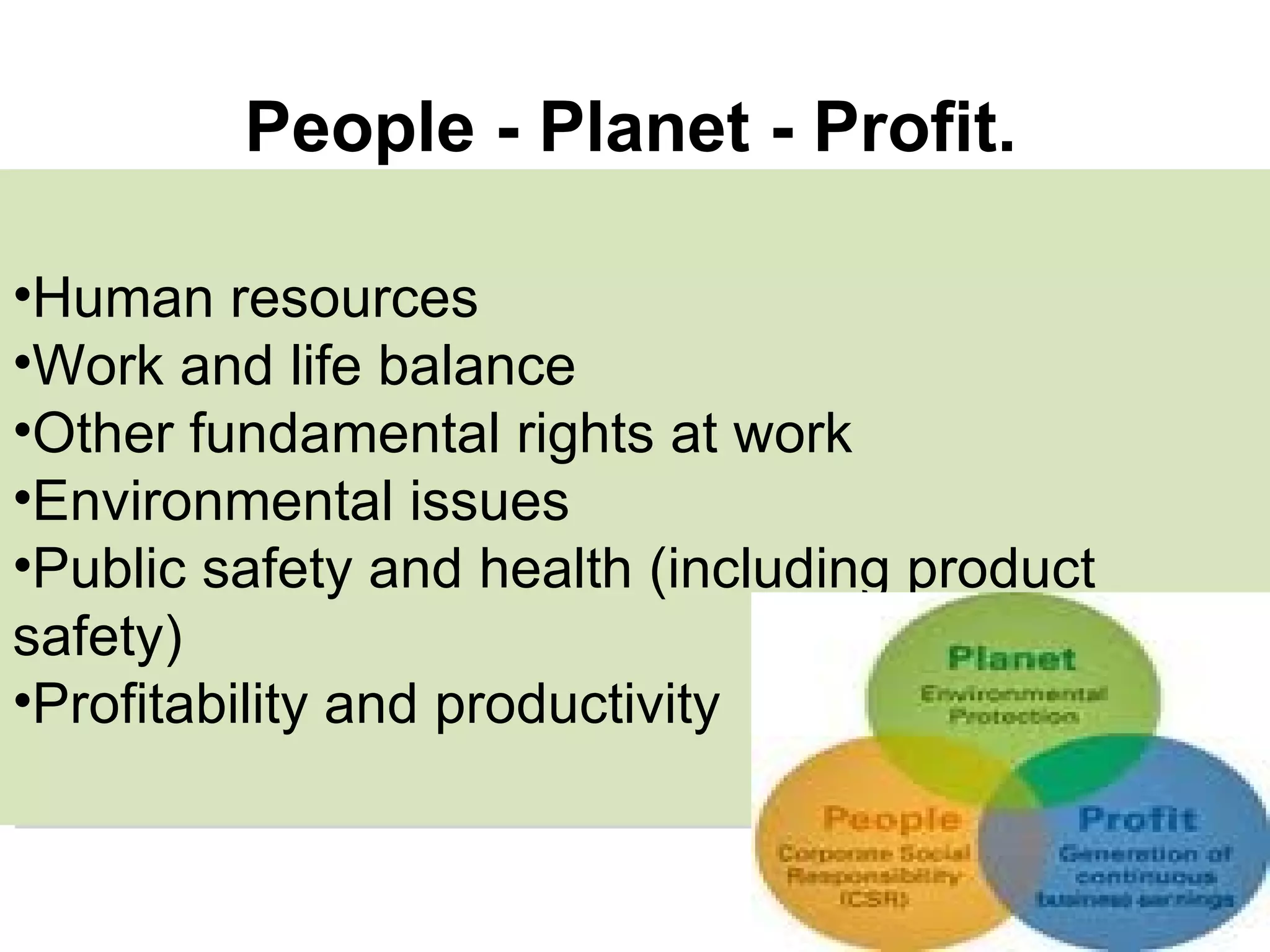
People - Planet - Profit.   Human resources  Work and life balance  Other fundamental rights at work  Environmental issues  Public safety and health (including product safety)  Profitability and productivity
Two views of corporate social  responsibility
The only social responsibility of business is to create shareholder wealth. Corporate management cannot decide what is in the social interest. The costs of social responsibility which do not increase the value of  stock, will be passed on to consumers.  The shareholder view
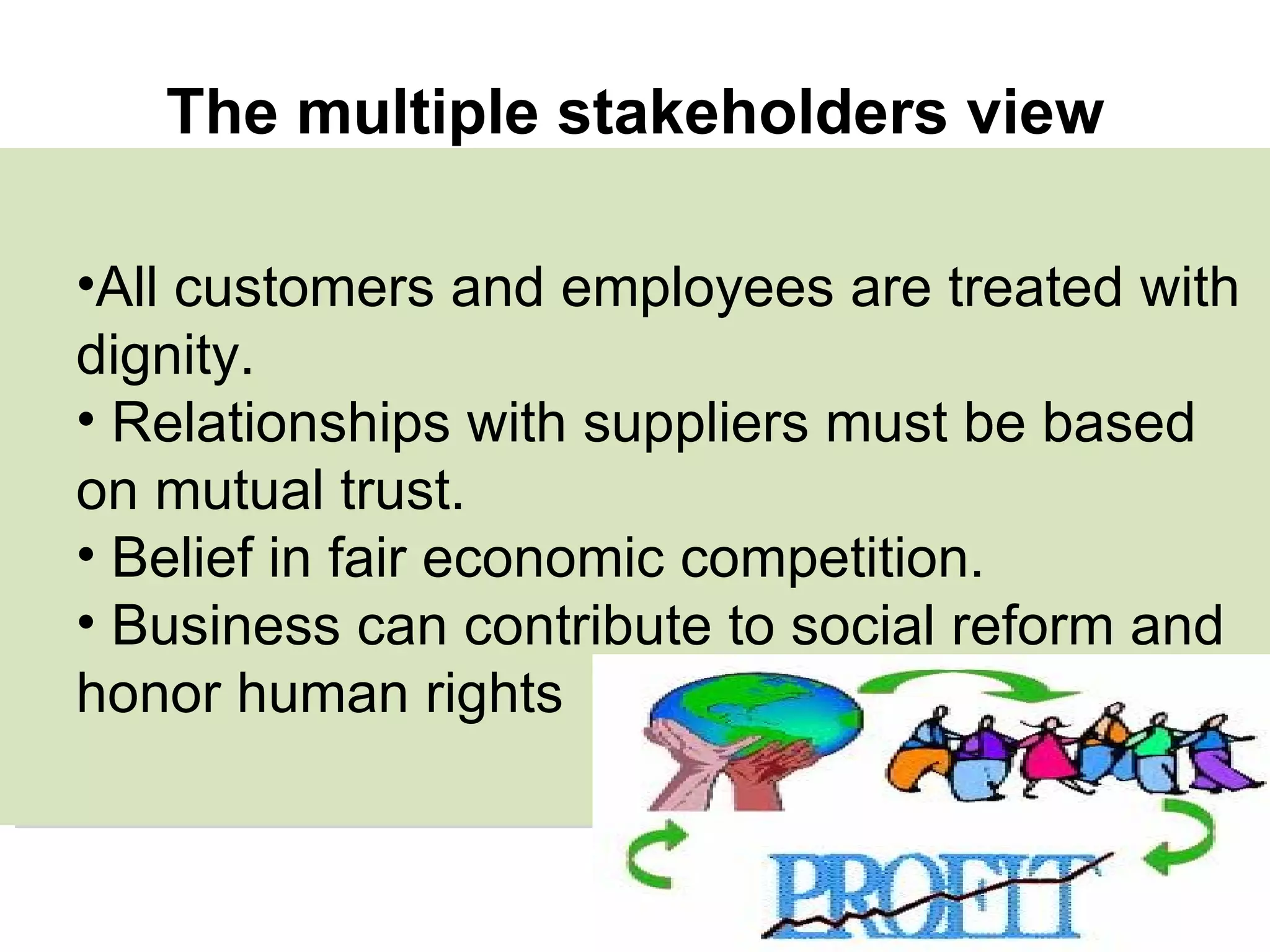
All customers and employees are treated with dignity. Relationships with suppliers must be based on mutual trust. Belief in fair economic competition. Business can contribute to social reform and honor human rights The multiple stakeholders view
Should Corporations be involved in CSR? Classical view:  Behavioral view:  Few trends would so thoroughly undermine the very foundations of our free society as the acceptance by corporate officials of a social responsibility other than to  make as much money for their shareholders as they possibly can ” “ In addition to making a profit,  business should help to solve social problems  whether or not business helps to create those problems even if there is probably no short-run or long-run profit potential”
Arguments for CSR Balancing Corporate power with Corporate responsibility Discouraging the creation and imposition of Government Regulation. Focusing on Social problems .
Arguments against CSR Stakeholders bear the costs of corporate social actions (shareholders, employees and consumers) which affect a “ corporation’s operating efficiency and weaken competitive position and advantage.” Mismatch of the roles and expectations between the organization and society. The prospect of corporations becoming powerful – exercising considerable power over society. Management trained in functional areas of management
 
The face of today
 

Introduction to csr

  • 1.
    Introduction to CSRCorporate Social Responsibility
  • 2.
    Definition ofCSR Meaning of CSR Should corporations be involved in CSR? Two views of CSR : Shareholder or Stakeholders The pros and cons of CSR Carroll’s CSR pyramid. Chapter overview:
  • 3.
    “ Companies witha defined corporate commitment to ethical principles do better financially than companies that don't”. DePaul University, 1997 Definition of CSR
  • 4.
    “ CSR iscontinuing commitment to behave ethically and contribute to economic development while improving the quality of life of the workforce and their families as well as the local community and society at large”. Moir, 2001 What is CSR?
  • 5.
    “ Only social-welfare-promoting actions performed over and above the economic and legal requirements of business in a country qualify as corporate social responsibility. Archie B. Carroll, 1979 What is CSR?
  • 6.
    “ The ideathat business has a duty to serve society in general as well as the financial interests of stockholders”. Pearce & Robinson What is CSR?
  • 7.
    Meaning of CSRCSR is the integration by companies of social and environmental concerns in their business operations and in their interaction with their stakeholders on a voluntary basis. " The concept of social responsibility means going beyond the fulfillment of legal requirements by investing more in human capital, the environment, and relations with stakeholders.
  • 8.
    Meaning of CSRIt is a voluntary instrument, but must be implemented reliably so that it fosters trust and confidence among stakeholders.
  • 9.
    Customers and clientsare influenced by a company's reputation in social and environmental areas. The employment market is competitive and good recruits want to work for and stay with companies that care. Social performance increasingly influences investors' decisions, as the ethical investment market grows evermore quickly. CSR enables the strategic management of internal and external risks in social as well as environmental areas. Existing socially responsible actions become more visible and are better communicated. Social and environmental responsibility has been demonstrated to reduce operating costs . Why is CSR important?
  • 10.
    People - Planet- Profit. Human resources Work and life balance Other fundamental rights at work Environmental issues Public safety and health (including product safety) Profitability and productivity
  • 11.
    Two views ofcorporate social responsibility
  • 12.
    The only socialresponsibility of business is to create shareholder wealth. Corporate management cannot decide what is in the social interest. The costs of social responsibility which do not increase the value of stock, will be passed on to consumers. The shareholder view
  • 13.
    All customers andemployees are treated with dignity. Relationships with suppliers must be based on mutual trust. Belief in fair economic competition. Business can contribute to social reform and honor human rights The multiple stakeholders view
  • 14.
    Should Corporations beinvolved in CSR? Classical view: Behavioral view: Few trends would so thoroughly undermine the very foundations of our free society as the acceptance by corporate officials of a social responsibility other than to make as much money for their shareholders as they possibly can ” “ In addition to making a profit, business should help to solve social problems whether or not business helps to create those problems even if there is probably no short-run or long-run profit potential”
  • 15.
    Arguments for CSRBalancing Corporate power with Corporate responsibility Discouraging the creation and imposition of Government Regulation. Focusing on Social problems .
  • 16.
    Arguments against CSRStakeholders bear the costs of corporate social actions (shareholders, employees and consumers) which affect a “ corporation’s operating efficiency and weaken competitive position and advantage.” Mismatch of the roles and expectations between the organization and society. The prospect of corporations becoming powerful – exercising considerable power over society. Management trained in functional areas of management
  • 17.
  • 18.
  • 19.