WHAT IS CSR?
■ (CSR) - A view of the corporation and its role in society that assumes a
responsibility among firms to pursue goals in addition to profit
maximization and a responsibility among a firm’s stakeholders to hold the
firm accountable for its actions.
■ The entirety of CSR can be discerned from the three words this phrase
contains: corporate, social, and responsibility. CSR covers the relationship
between corporations (or other for-profit organizations) and the societies with
which they interact. CSR also includes the responsibilities that are inherent on
both sides of these relationships. CSR defines society in its widest sense and,
on many levels, to include all stakeholder and constituent groups that
maintain an ongoing interest in the organization’s operations.
CORPORATE SOCIAL RESPONSIBILITY
WHAT IS CSR?
■ A stakeholder in an organization is (by definition) any group or individual who can
affect or is affected by the achievement of the organization’s objectives
A Firm’s Stakeholders
WHAT IS CSR?
■ What is the relationship between a firm and the societies within which it
operates?
■ What responsibility does a firm owe society to self-regulate its actions in
pursuit of profit?
Relevant Questions
WHAT IS CSR?
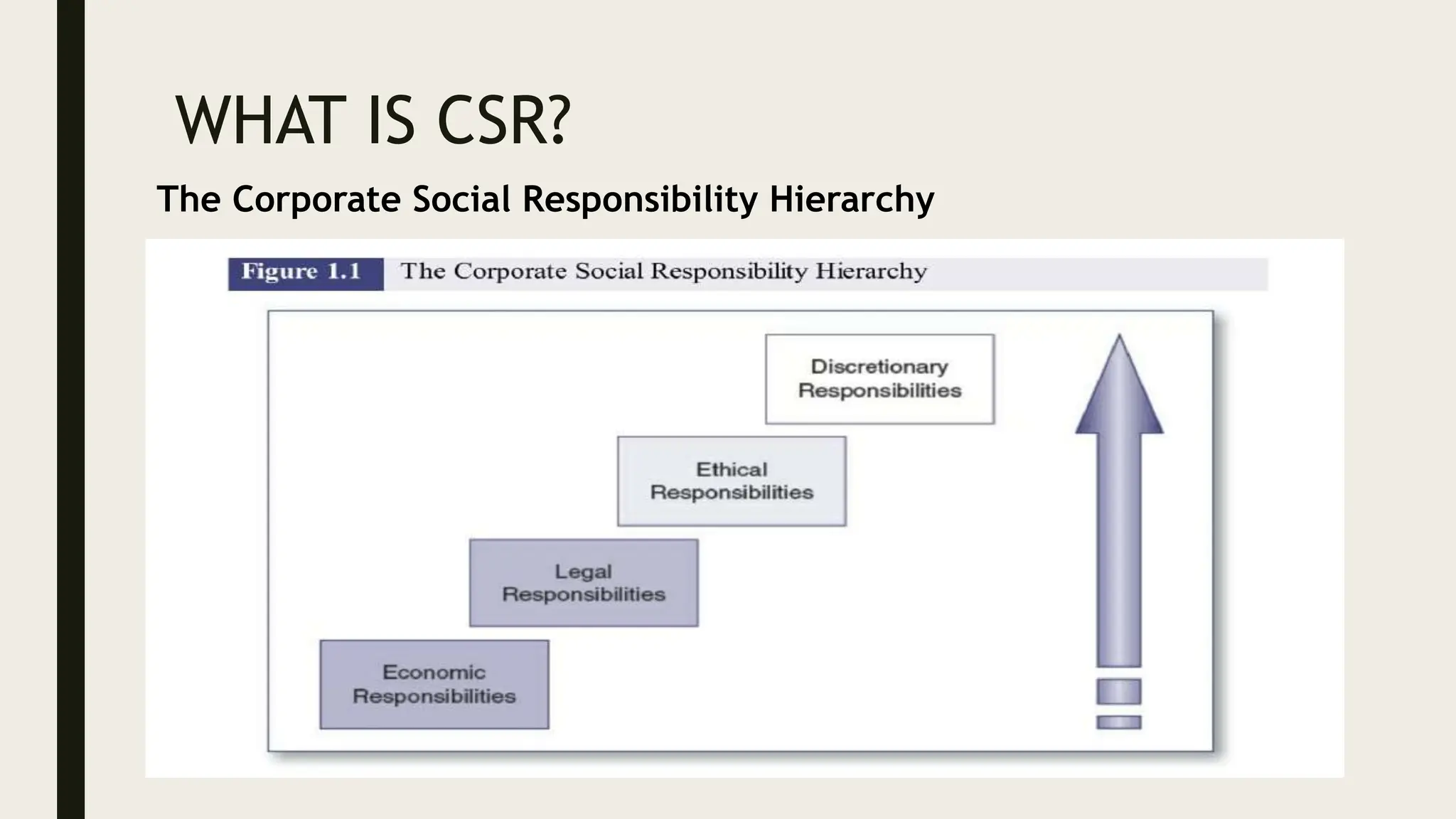
The Corporate Social Responsibility Hierarchy
WHAT IS CSR?
Archie Carroll was one of the first academics to make a distinction between different
kinds of organizational responsibilities. He referred to this distinction as a firm’s
“pyramid of corporate social responsibility.”
■ Fundamentally, a firm’s economic responsibility is to produce an acceptable return
on its owners’ investment.
■ An important component of pursuing economic gain within a law-based society,
however, is a legal responsibility—a duty to act within the legal framework drawn up
by the government and judiciary.
■ Taken one step further, a firm has an ethical responsibility to do no harm to its
stakeholders and within its operating environment.
■ Finally, firms have a discretionary responsibility, which represents more proactive,
strategic behaviors that can benefit the firm and society, or both.
The Corporate Social Responsibility Hierarchy
WHAT IS CSR?
■ United States: “CSR is about how companies manage the business processes to
produce an overall positive impact on society.”
■ United Nations: “Corporate Social Responsibility (CSR) can be understood as a
management concept and a process that integrates social and environmental
concerns in business operations and a company’s interactions with the full range of
its stakeholders.
■ European Union: “[A] process to integrate social, environmental, ethical and human
rights concerns into their business operations and core strategy in 54 close
collaboration with their stakeholders.”
■ United Kingdom: “CSR is about businesses and other organizations going beyond the
legal obligations to manage the impact they have on the environment and society. In
particular, this could include how organizations interact with their employees,
suppliers, customers and the communities in which they operate, as well as the
extent they attempt to protect the environment.”
CSR Definitions Across
Cultures
WHAT IS CSR?
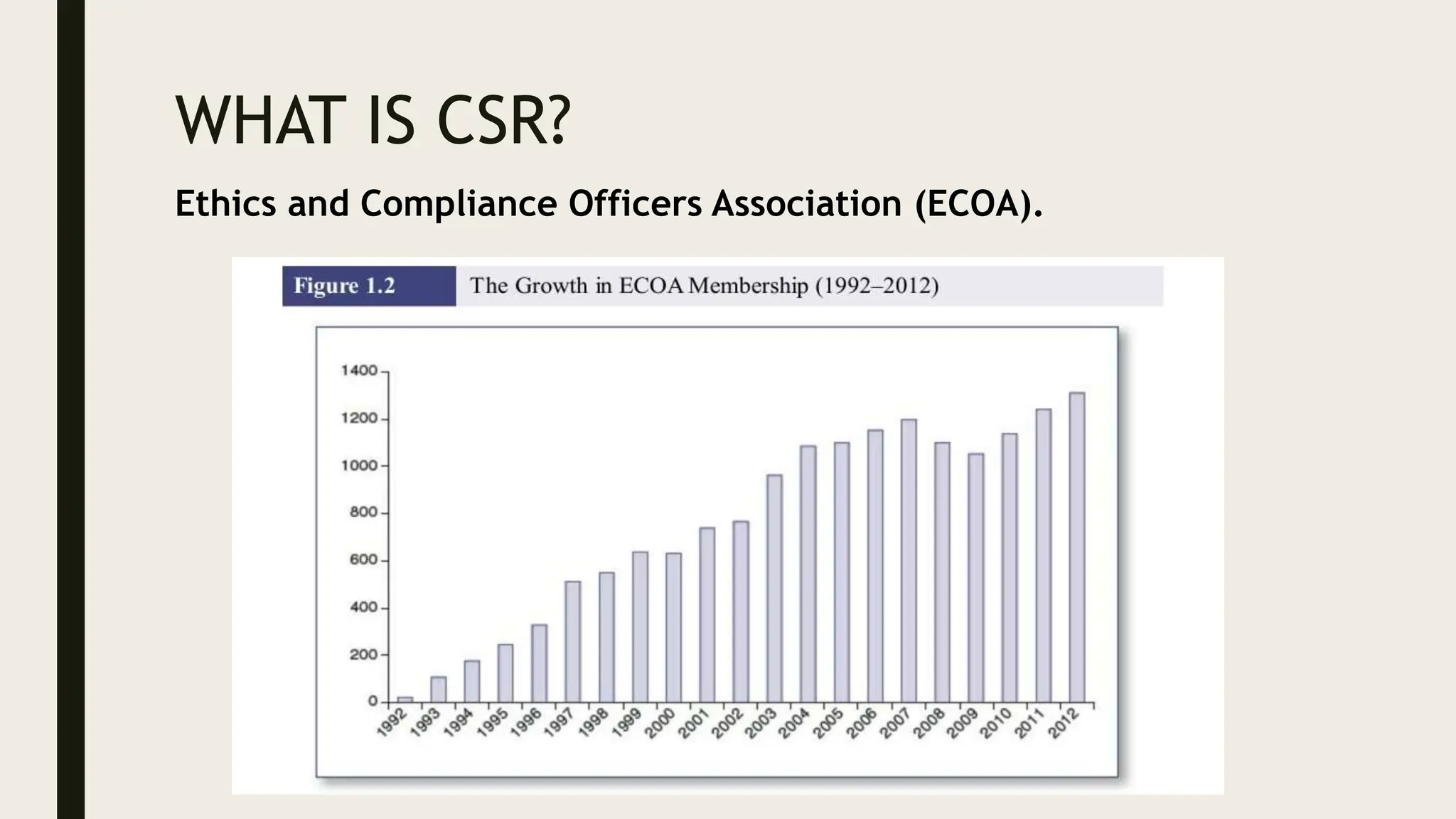
Ethics and Compliance Officers Association (ECOA).
STRATEGY AND CSR
■ Strategy strives to provide the business with a source of sustainable
competitive advantage. For any competitive advantage to be sustainable,
however, the strategy must be acceptable to the wider environment in which
the firm competes. CSR, therefore, is a key element of business strategy. In
the words of The Economist, it is “just good business.” CSR implemented
ineffectively—or, worse, completely ignored—may threaten whatever
comparative advantage the firm holds within its industry.
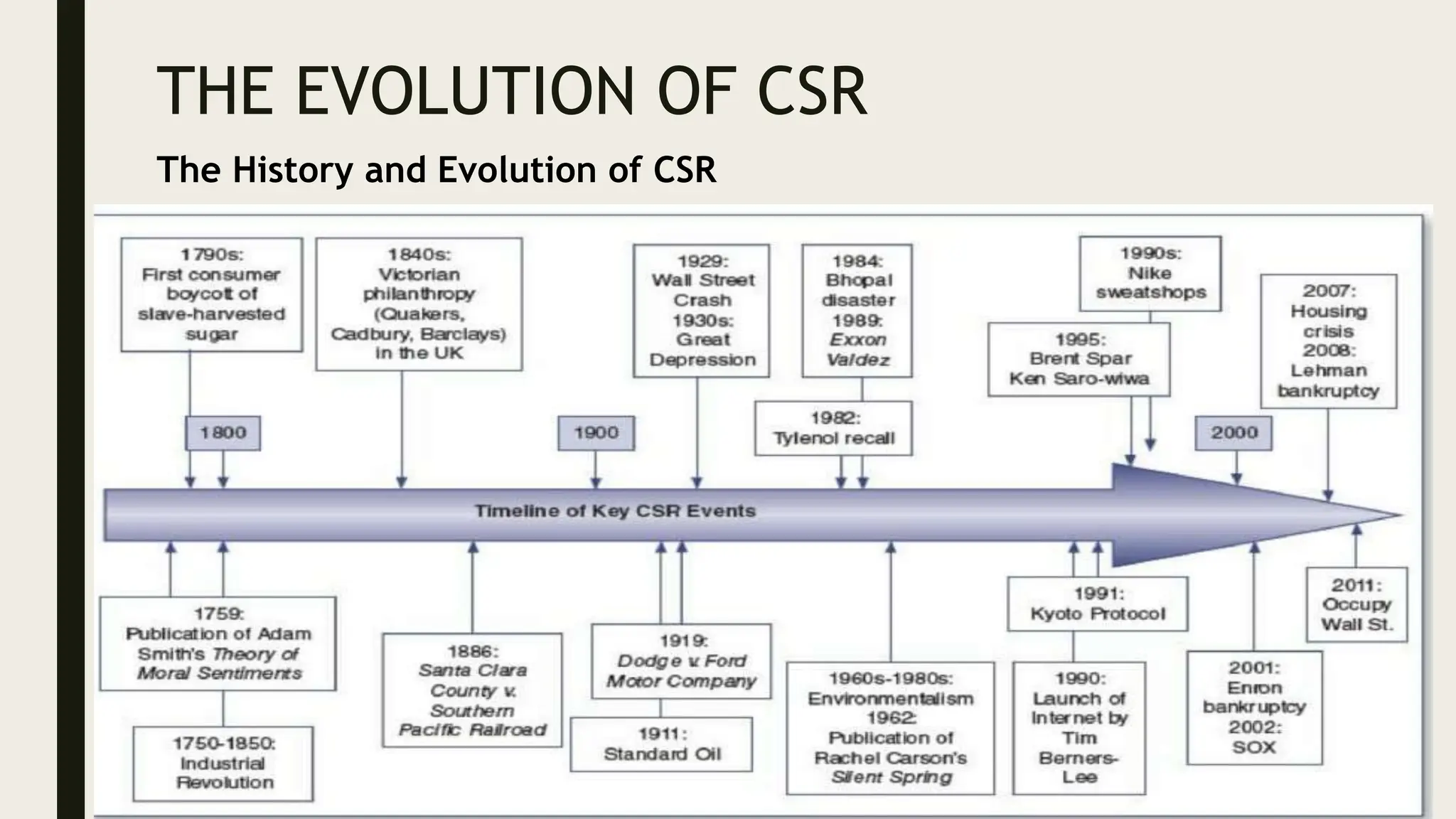
THE EVOLUTION OF CSR
The History and Evolution of CSR
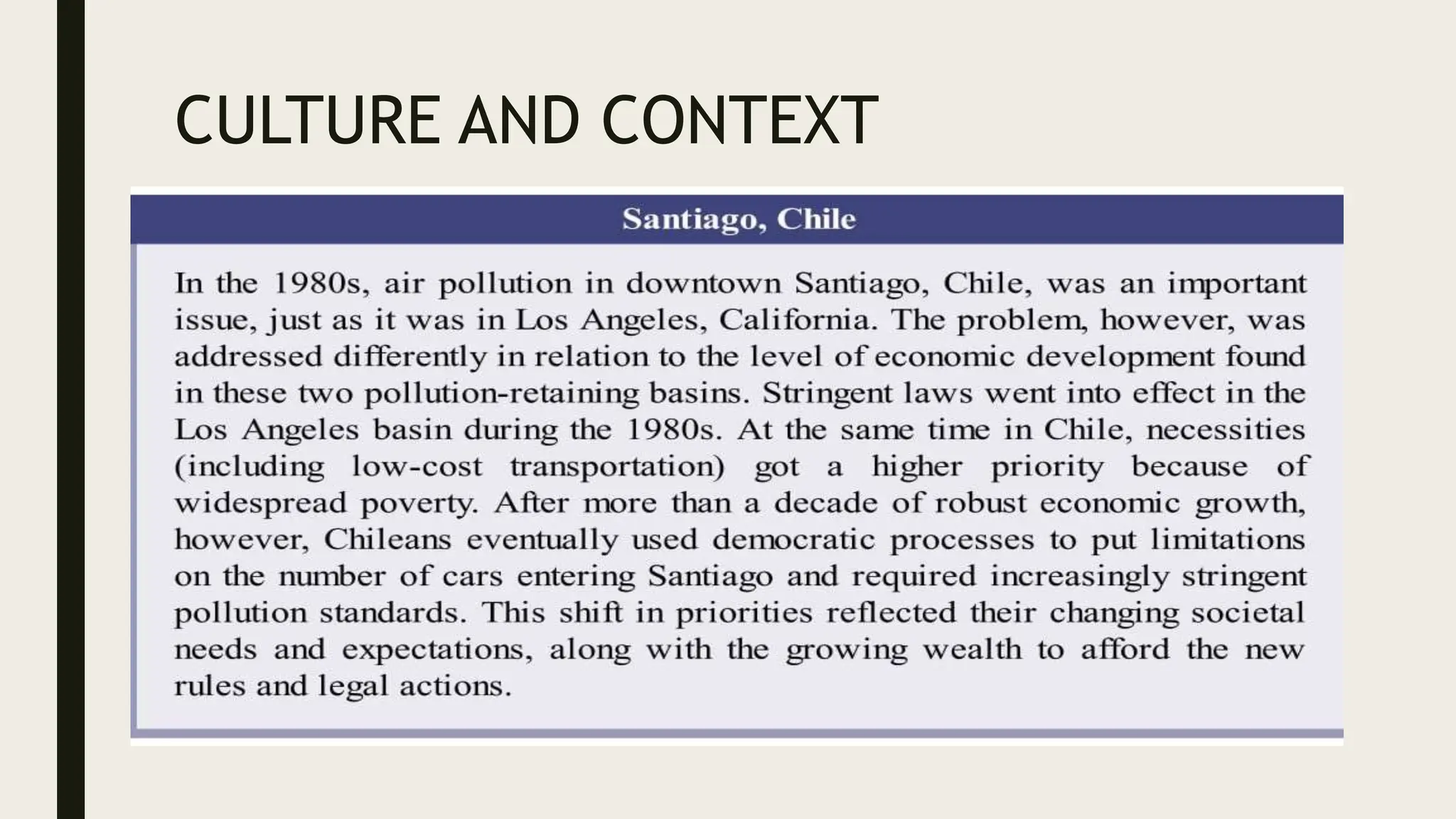
CULTURE AND CONTEXT
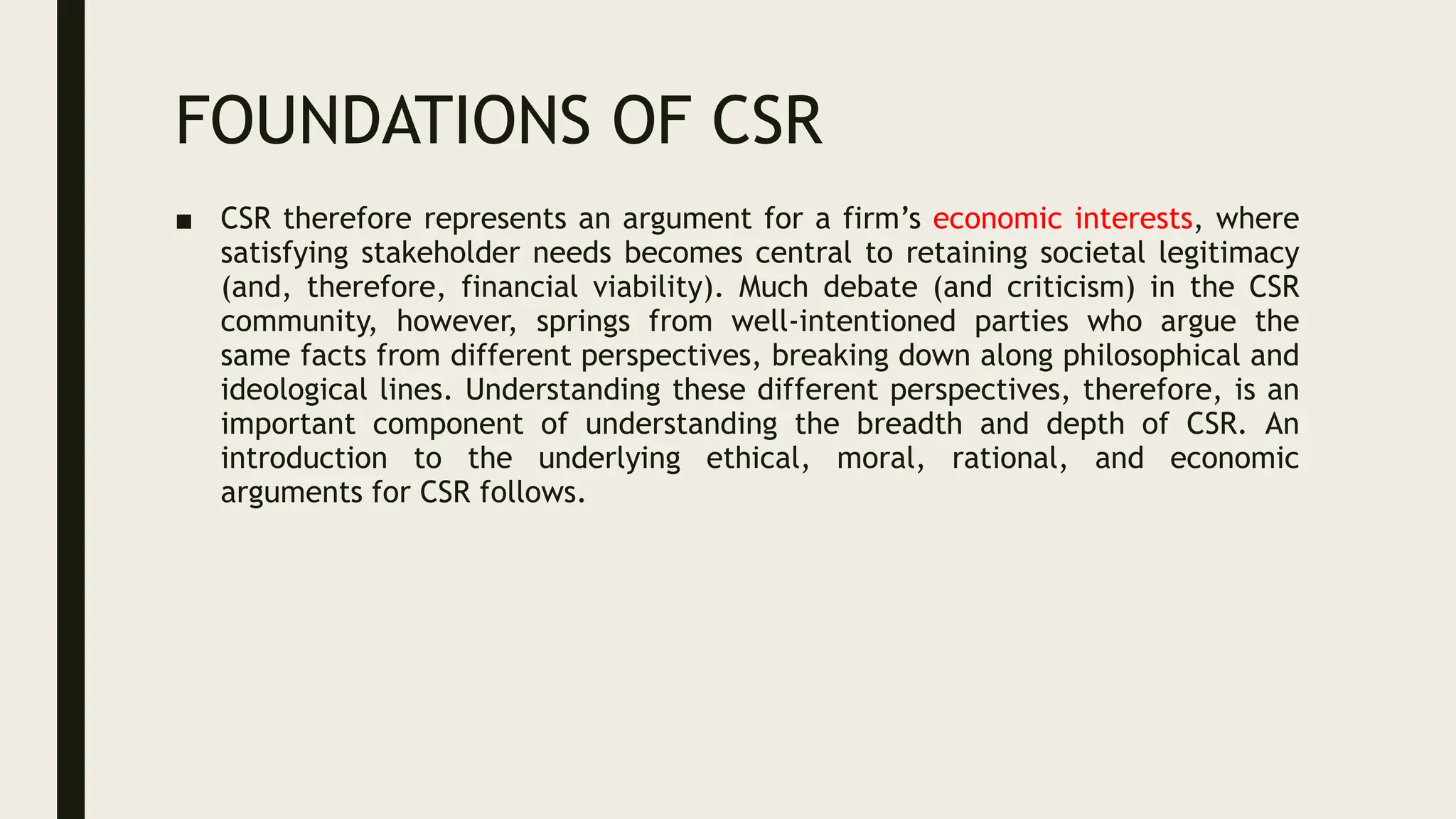
FOUNDATIONS OF CSR
■ CSR therefore represents an argument for a firm’s economic interests, where
satisfying stakeholder needs becomes central to retaining societal legitimacy
(and, therefore, financial viability). Much debate (and criticism) in the CSR
community, however, springs from well-intentioned parties who argue the
same facts from different perspectives, breaking down along philosophical and
ideological lines. Understanding these different perspectives, therefore, is an
important component of understanding the breadth and depth of CSR. An
introduction to the underlying ethical, moral, rational, and economic
arguments for CSR follows.
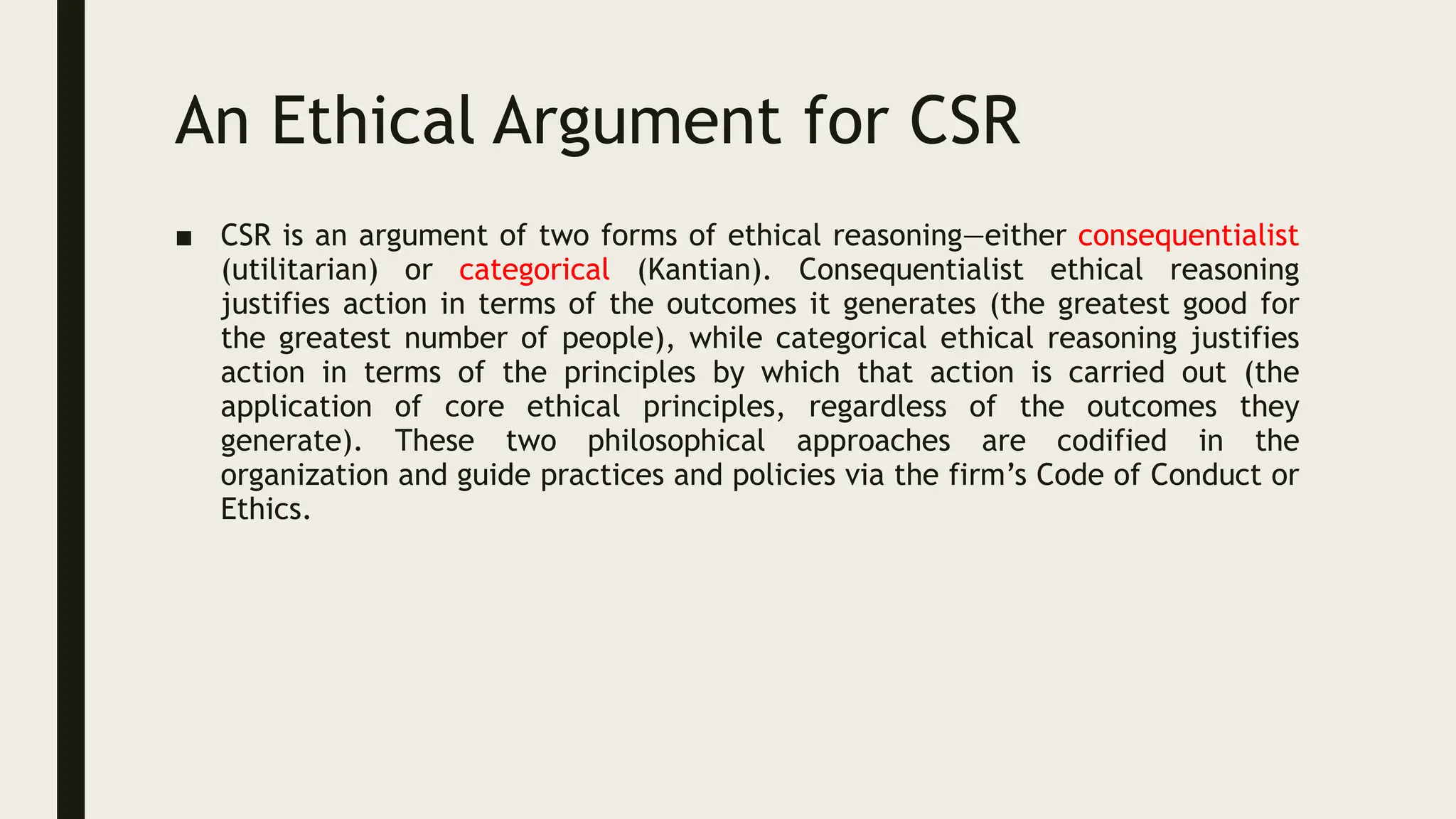
An Ethical Argument for CSR
■ CSR is an argument of two forms of ethical reasoning—either consequentialist
(utilitarian) or categorical (Kantian). Consequentialist ethical reasoning
justifies action in terms of the outcomes it generates (the greatest good for
the greatest number of people), while categorical ethical reasoning justifies
action in terms of the principles by which that action is carried out (the
application of core ethical principles, regardless of the outcomes they
generate). These two philosophical approaches are codified in the
organization and guide practices and policies via the firm’s Code of Conduct or
Ethics.
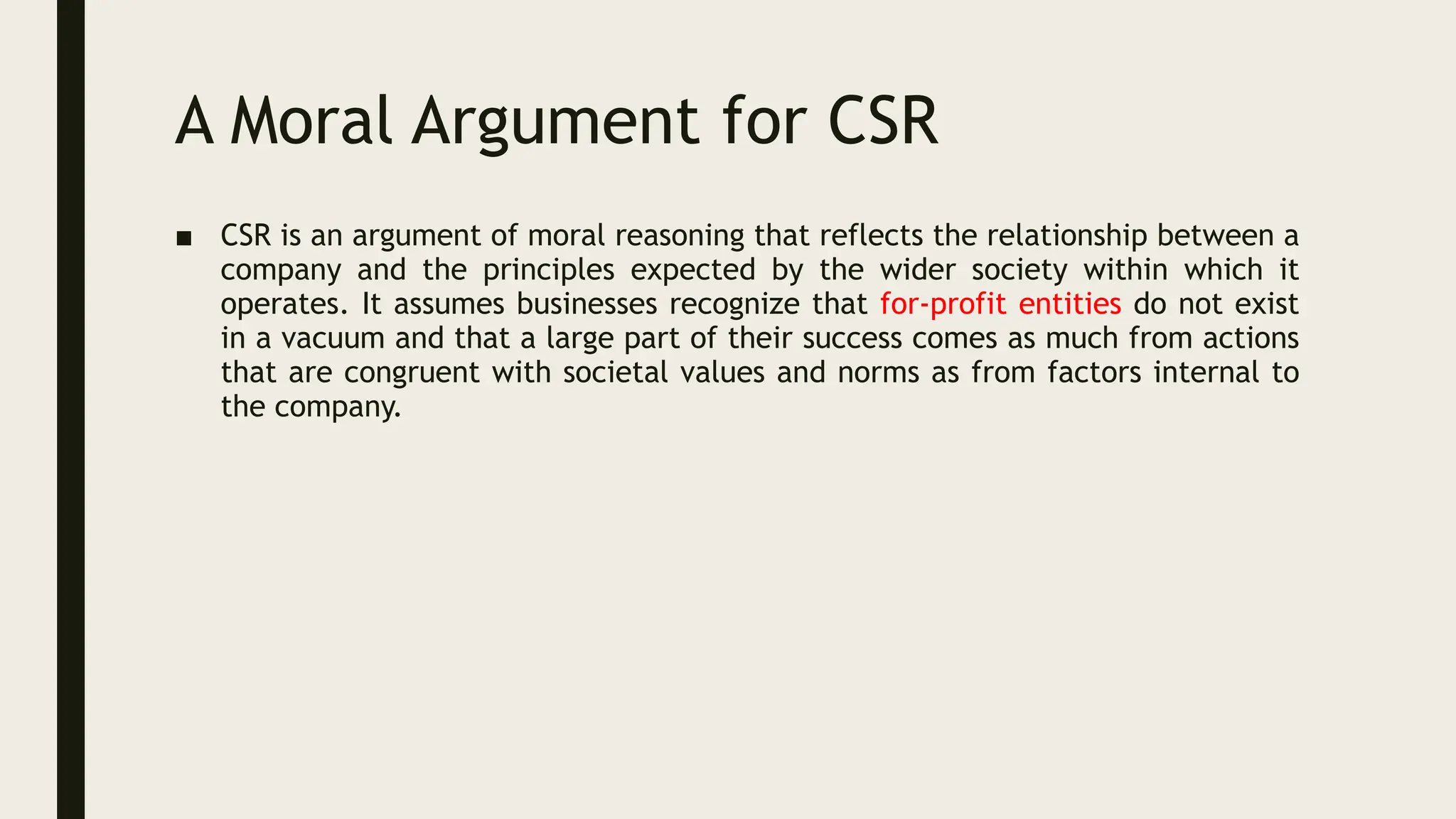
A Moral Argument for CSR
■ CSR is an argument of moral reasoning that reflects the relationship between a
company and the principles expected by the wider society within which it
operates. It assumes businesses recognize that for-profit entities do not exist
in a vacuum and that a large part of their success comes as much from actions
that are congruent with societal values and norms as from factors internal to
the company.
A Rational Argument for CSR
■ CSR is a rational argument for businesses seeking to maximize their
performance by minimizing restrictions on operations. In today’s globalized
world, where individuals and activist organizations feel empowered to enact
change, CSR represents a means of anticipating and reflecting societal
concerns to minimize operational and financial constraints on business.
An Economic Argument for CSR
■ CSR is an argument of economic self-interest for business. CSR adds value
because it allows companies to reflect the needs and concerns of their various
stakeholder groups. By doing so, a company is more likely to retain its societal
legitimacy and maximize its financial viability over the medium to long term.
Simply put, CSR is a way of matching corporate operations with societal values
and expectations that are constantly evolving.
FIVE DRIVING FORCES OF CSR
■ Affluence
■ Sustainability
■ Globalization
■ Media
■ Brands
FIVE DRIVING FORCES OF CSR
■ A poor society, in need of work and inward investment, is less likely to enforce strict
regulations and penalize organizations that might otherwise take their business and
money elsewhere. Consumers in developed societies, on the other hand, can afford
to choose the products they buy and, as a consequence, expect more from the
companies whose products they buy. This sense has increased in the wake of the
corporate scandals at the turn of this century and the current financial crisis, both of
which reduced public trust in corporations and the finance industry, in particular, and
public confidence in the ability of regulatory agencies to control corporate excess.
Affluence matters and leads to changing societal expectations. Firms operating in
affluent societies, therefore, face a higher burden to demonstrate they are socially
responsible. As a result, increasing affluence on a global basis will continue to push
CSR up the agendas of corporations worldwide.
Affluence
FIVE DRIVING FORCES OF CSR
■ An increase in general affluence and changing societal expectations is enhanced by a
growing concern for the environment. When the Alaskan pipeline was built in the 1970s,
crews could drive on the hardened permafrost 200 days a year. Today, climate changes
leave the permafrost solid for only 100 days each year, while NASA photographs reveal
that the Arctic ice cap “has shrunk more than 20 percent” since 1979, 89 a rate of
decrease that is accelerating. 90 Increasing raw materials prices, rising mutation rates
among amphibian populations, shrinking biodiversity, and other empirical indicators all
support what is intuitive—that the Earth has ecological limits. The speed at which we are
approaching the earth’s limits and the potential consequences of our actions are
complicated issues about which experts do not agree. however, is that human economic
activity is depleting the world’s resources and causing dramatic changes to the earth’s
atmosphere—changes that could become irreversible in the near future. As a result, firms
that are perceived to be indifferent to their environmental responsibilities are likely to
be criticized and penalized. Examples include court imposed fines (Exxon Valdez), 91
negative publicity (Monsanto’s genetically modified foods), 92 or confrontations by
activist groups (Friends of the Earth).
Sustainability
FIVE DRIVING FORCES OF CSR
■ Increasingly, corporations conduct business in a global environment. Operating in
multiple countries and cultures magnifies the complexity of business exponentially. Not
only are there more laws and regulations to understand, but many more social norms and
cultural subtleties to navigate. In addition, the range of stakeholders to whom
multinational firms are held accountable increases, as does the potential for conflict
among competing stakeholder demands. While globalization has increased the potential
for efficiencies gained from production across borders, it has also increased the potential
to be exposed to a global audience if a firm’s actions fail to meet the needs and
expectations of the local community.
Globalization
FIVE DRIVING FORCES OF CSR
■ The growing influence of social media makes sure that any CSR lapses by companies are
brought rapidly to the attention of the worldwide public, often instantaneously. Scandal
is news, and yesterday’s eyewitnesses are today armed with pocket-size video cameras
and mobile phones that provide all the evidence necessary to convict by video, blog, or
instant message. In addition, the Internet fuels communication among activist groups and
like-minded individuals, empowering them to spread their message while giving them the
means to coordinate collective action. Such technologies are reaching beyond the control
of autocratic governments and allowing people to find new ways to mobilize and protest
Media
FIVE DRIVING FORCES OF CSR
■ Brands today are often a focal point of corporate success. Companies try to establish
popular brands in consumers’ minds because doing so increases their competitive
advantage, which then results in 80 higher sales and revenue. In addition, consumers are
more likely to pay a premium for a brand they know and trust.
Brands
QUESTIONS FOR DISCUSSION AND REVIEW
■ Why do firms exist? What value do businesses serve for society?
■ Define corporate social responsibility. What arguments in favor of CSR seem most
important to you? How is CSR different from strategic CSR?
■ Name the four responsibilities of a firm outlined in Archie Carroll’s “Pyramid of CSR”
model. Illustrate your definitions of each level with corporate examples.
■ Milton Friedman argued that, “Few trends could so thoroughly undermine the 81 very
foundations of our free society as the acceptance by corporate officials of a social
responsibility other than to make as much money for their stockholders as possible.”
Give two arguments in support of Friedman’s assertion and two against.
■ Define and discuss briefly the ethical, moral, rational, and economic arguments for CSR?
■ What five driving forces make CSR more relevant today?
■ Of these five factors, is there any one that you feel is more important than the others?
Defend your choice with examples from your own experiences and knowledge.
Home Task
■ www.sagepub.com/chandler3e
STUDENT STUDY
SITE
Thank You!

chp 1.pptx Business CSR activities Slide

  • 1.
    WHAT IS CSR? ■(CSR) - A view of the corporation and its role in society that assumes a responsibility among firms to pursue goals in addition to profit maximization and a responsibility among a firm’s stakeholders to hold the firm accountable for its actions. ■ The entirety of CSR can be discerned from the three words this phrase contains: corporate, social, and responsibility. CSR covers the relationship between corporations (or other for-profit organizations) and the societies with which they interact. CSR also includes the responsibilities that are inherent on both sides of these relationships. CSR defines society in its widest sense and, on many levels, to include all stakeholder and constituent groups that maintain an ongoing interest in the organization’s operations. CORPORATE SOCIAL RESPONSIBILITY
  • 2.
    WHAT IS CSR? ■A stakeholder in an organization is (by definition) any group or individual who can affect or is affected by the achievement of the organization’s objectives A Firm’s Stakeholders
  • 3.
    WHAT IS CSR? ■What is the relationship between a firm and the societies within which it operates? ■ What responsibility does a firm owe society to self-regulate its actions in pursuit of profit? Relevant Questions
  • 4.
    WHAT IS CSR? TheCorporate Social Responsibility Hierarchy
  • 5.
    WHAT IS CSR? ArchieCarroll was one of the first academics to make a distinction between different kinds of organizational responsibilities. He referred to this distinction as a firm’s “pyramid of corporate social responsibility.” ■ Fundamentally, a firm’s economic responsibility is to produce an acceptable return on its owners’ investment. ■ An important component of pursuing economic gain within a law-based society, however, is a legal responsibility—a duty to act within the legal framework drawn up by the government and judiciary. ■ Taken one step further, a firm has an ethical responsibility to do no harm to its stakeholders and within its operating environment. ■ Finally, firms have a discretionary responsibility, which represents more proactive, strategic behaviors that can benefit the firm and society, or both. The Corporate Social Responsibility Hierarchy
  • 6.
    WHAT IS CSR? ■United States: “CSR is about how companies manage the business processes to produce an overall positive impact on society.” ■ United Nations: “Corporate Social Responsibility (CSR) can be understood as a management concept and a process that integrates social and environmental concerns in business operations and a company’s interactions with the full range of its stakeholders. ■ European Union: “[A] process to integrate social, environmental, ethical and human rights concerns into their business operations and core strategy in 54 close collaboration with their stakeholders.” ■ United Kingdom: “CSR is about businesses and other organizations going beyond the legal obligations to manage the impact they have on the environment and society. In particular, this could include how organizations interact with their employees, suppliers, customers and the communities in which they operate, as well as the extent they attempt to protect the environment.” CSR Definitions Across Cultures
  • 7.
    WHAT IS CSR? Ethicsand Compliance Officers Association (ECOA).
  • 8.
    STRATEGY AND CSR ■Strategy strives to provide the business with a source of sustainable competitive advantage. For any competitive advantage to be sustainable, however, the strategy must be acceptable to the wider environment in which the firm competes. CSR, therefore, is a key element of business strategy. In the words of The Economist, it is “just good business.” CSR implemented ineffectively—or, worse, completely ignored—may threaten whatever comparative advantage the firm holds within its industry.
  • 9.
    THE EVOLUTION OFCSR The History and Evolution of CSR
  • 10.
  • 11.
    FOUNDATIONS OF CSR ■CSR therefore represents an argument for a firm’s economic interests, where satisfying stakeholder needs becomes central to retaining societal legitimacy (and, therefore, financial viability). Much debate (and criticism) in the CSR community, however, springs from well-intentioned parties who argue the same facts from different perspectives, breaking down along philosophical and ideological lines. Understanding these different perspectives, therefore, is an important component of understanding the breadth and depth of CSR. An introduction to the underlying ethical, moral, rational, and economic arguments for CSR follows.
  • 12.
    An Ethical Argumentfor CSR ■ CSR is an argument of two forms of ethical reasoning—either consequentialist (utilitarian) or categorical (Kantian). Consequentialist ethical reasoning justifies action in terms of the outcomes it generates (the greatest good for the greatest number of people), while categorical ethical reasoning justifies action in terms of the principles by which that action is carried out (the application of core ethical principles, regardless of the outcomes they generate). These two philosophical approaches are codified in the organization and guide practices and policies via the firm’s Code of Conduct or Ethics.
  • 13.
    A Moral Argumentfor CSR ■ CSR is an argument of moral reasoning that reflects the relationship between a company and the principles expected by the wider society within which it operates. It assumes businesses recognize that for-profit entities do not exist in a vacuum and that a large part of their success comes as much from actions that are congruent with societal values and norms as from factors internal to the company.
  • 14.
    A Rational Argumentfor CSR ■ CSR is a rational argument for businesses seeking to maximize their performance by minimizing restrictions on operations. In today’s globalized world, where individuals and activist organizations feel empowered to enact change, CSR represents a means of anticipating and reflecting societal concerns to minimize operational and financial constraints on business.
  • 15.
    An Economic Argumentfor CSR ■ CSR is an argument of economic self-interest for business. CSR adds value because it allows companies to reflect the needs and concerns of their various stakeholder groups. By doing so, a company is more likely to retain its societal legitimacy and maximize its financial viability over the medium to long term. Simply put, CSR is a way of matching corporate operations with societal values and expectations that are constantly evolving.
  • 16.
    FIVE DRIVING FORCESOF CSR ■ Affluence ■ Sustainability ■ Globalization ■ Media ■ Brands
  • 17.
    FIVE DRIVING FORCESOF CSR ■ A poor society, in need of work and inward investment, is less likely to enforce strict regulations and penalize organizations that might otherwise take their business and money elsewhere. Consumers in developed societies, on the other hand, can afford to choose the products they buy and, as a consequence, expect more from the companies whose products they buy. This sense has increased in the wake of the corporate scandals at the turn of this century and the current financial crisis, both of which reduced public trust in corporations and the finance industry, in particular, and public confidence in the ability of regulatory agencies to control corporate excess. Affluence matters and leads to changing societal expectations. Firms operating in affluent societies, therefore, face a higher burden to demonstrate they are socially responsible. As a result, increasing affluence on a global basis will continue to push CSR up the agendas of corporations worldwide. Affluence
  • 18.
    FIVE DRIVING FORCESOF CSR ■ An increase in general affluence and changing societal expectations is enhanced by a growing concern for the environment. When the Alaskan pipeline was built in the 1970s, crews could drive on the hardened permafrost 200 days a year. Today, climate changes leave the permafrost solid for only 100 days each year, while NASA photographs reveal that the Arctic ice cap “has shrunk more than 20 percent” since 1979, 89 a rate of decrease that is accelerating. 90 Increasing raw materials prices, rising mutation rates among amphibian populations, shrinking biodiversity, and other empirical indicators all support what is intuitive—that the Earth has ecological limits. The speed at which we are approaching the earth’s limits and the potential consequences of our actions are complicated issues about which experts do not agree. however, is that human economic activity is depleting the world’s resources and causing dramatic changes to the earth’s atmosphere—changes that could become irreversible in the near future. As a result, firms that are perceived to be indifferent to their environmental responsibilities are likely to be criticized and penalized. Examples include court imposed fines (Exxon Valdez), 91 negative publicity (Monsanto’s genetically modified foods), 92 or confrontations by activist groups (Friends of the Earth). Sustainability
  • 19.
    FIVE DRIVING FORCESOF CSR ■ Increasingly, corporations conduct business in a global environment. Operating in multiple countries and cultures magnifies the complexity of business exponentially. Not only are there more laws and regulations to understand, but many more social norms and cultural subtleties to navigate. In addition, the range of stakeholders to whom multinational firms are held accountable increases, as does the potential for conflict among competing stakeholder demands. While globalization has increased the potential for efficiencies gained from production across borders, it has also increased the potential to be exposed to a global audience if a firm’s actions fail to meet the needs and expectations of the local community. Globalization
  • 20.
    FIVE DRIVING FORCESOF CSR ■ The growing influence of social media makes sure that any CSR lapses by companies are brought rapidly to the attention of the worldwide public, often instantaneously. Scandal is news, and yesterday’s eyewitnesses are today armed with pocket-size video cameras and mobile phones that provide all the evidence necessary to convict by video, blog, or instant message. In addition, the Internet fuels communication among activist groups and like-minded individuals, empowering them to spread their message while giving them the means to coordinate collective action. Such technologies are reaching beyond the control of autocratic governments and allowing people to find new ways to mobilize and protest Media
  • 21.
    FIVE DRIVING FORCESOF CSR ■ Brands today are often a focal point of corporate success. Companies try to establish popular brands in consumers’ minds because doing so increases their competitive advantage, which then results in 80 higher sales and revenue. In addition, consumers are more likely to pay a premium for a brand they know and trust. Brands
  • 22.
    QUESTIONS FOR DISCUSSIONAND REVIEW ■ Why do firms exist? What value do businesses serve for society? ■ Define corporate social responsibility. What arguments in favor of CSR seem most important to you? How is CSR different from strategic CSR? ■ Name the four responsibilities of a firm outlined in Archie Carroll’s “Pyramid of CSR” model. Illustrate your definitions of each level with corporate examples. ■ Milton Friedman argued that, “Few trends could so thoroughly undermine the 81 very foundations of our free society as the acceptance by corporate officials of a social responsibility other than to make as much money for their stockholders as possible.” Give two arguments in support of Friedman’s assertion and two against. ■ Define and discuss briefly the ethical, moral, rational, and economic arguments for CSR? ■ What five driving forces make CSR more relevant today? ■ Of these five factors, is there any one that you feel is more important than the others? Defend your choice with examples from your own experiences and knowledge.
  • 23.
  • 24.