Assessing Disability
World Health Organization
Disability Assessment Checklist
Mr. Vaikunthan Rajaratnam
Senior Consultant Hand Surgeon
Singapore
Chapter 16 Human Machine Interface for Technology in Healthcare N A Rahman, and V Rajaratnam
Experiences of living with leprosy: A systematic review and qualitative evidence synthesis – Accepted PLOS
Number of articles included in review (n = 49)
Total patients 1209 people with leprosy from 12 countries
Disability
and Impact
DISABILITY
RESIDUAL
HEALTH
TREATMENT
INJURY
ILLNESS
IMPACT
ON LIVE
BIOPHYSICAL
PSYCOLOGICAL
SOCIAL
ECONOMIC
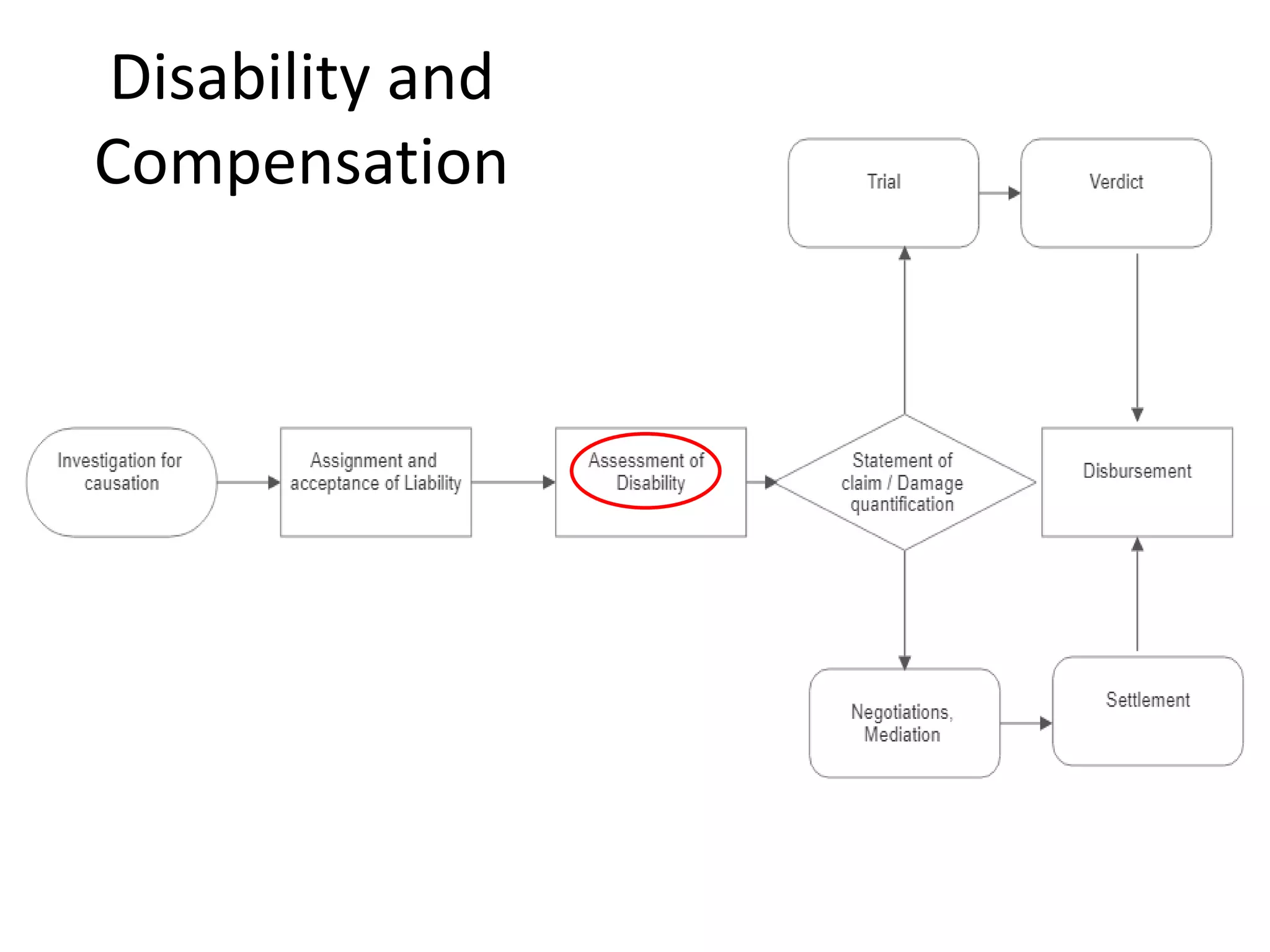
Disability and
Compensation
Defining
•
Impairment: any loss or abnormality of
psychological, physiological or anatomical
structure or function.
•
Disability: any restriction or lack of ability to
perform an activity in the manner or within the
range considered normal for a human being
resulting from an impairment.
•
Handicap: a disadvantage for a given individual
that limits or prevents the fulfilment of a role
that is normal
•
As traditionally used, impairment refers to a
problem with a structure or organ of the body;
disability is a functional limitation with regard
to a particular activity; and handicap refers to a
disadvantage in filling a role in life relative to a
peer group.
• WHO 1980
International Classification
of Functioning, Disability
and Health (ICF)
International standard to describe
and measure health and disability.
http://apps.who.int/classifications/icfbrowser/
ICIDH (International Classification of Impairments, Disabilities and
Handicaps) to ICF
Engel GL. The need for a new medical model: a
challenge for biomedicine. Science. 1977 Apr
Psychometrics
Classical test theory
• Reliability .
– Pearson correlation
coefficient and is often
called test-retest reliability.
– index of reliability
is Cronbach's α
• Validity
– concurrent validity;
– predictive validity,
– construct validity,
– Content validity
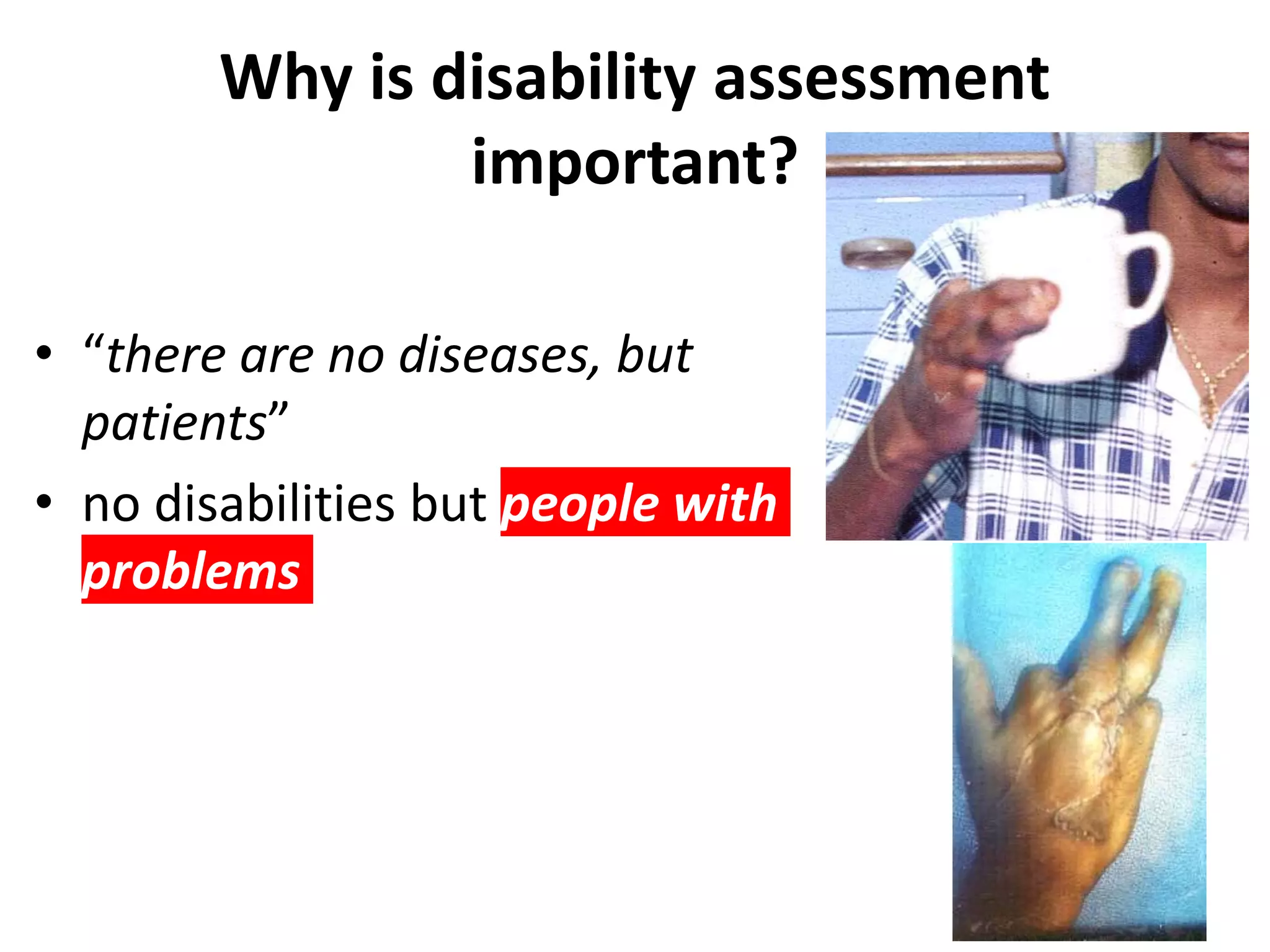
Why is disability assessment
important?
• “there are no diseases, but
patients”
• no disabilities but people with
problems
Why develop a method to assess
disability?
• “a decrement in each functioning domain”
– Body, person and society
• International Classification of Functioning,
Disability and Health (ICF) – impractical for
daily use
• WHODAS 2.0 – practical, reliable and valid
Why learn and use a disability
measure?
• patient’s needs
• level of care
• outcome of the condition
• length of hospitalization
• receipt of disability benefits
• work performance
• social integration
Disability
assessment
• identifying needs
• matching treatments and interventions
• measuring outcomes and effectiveness
• setting priorities
• allocating resources.
WHODAS 2.0
• Generic instrument
• Standardized method for health
and disability
• Developed from International
Classification of Functioning,
Disability and Health (ICF)
• Cross cultural
– Applicability
– Utility
– Reliability and
– Validity
ISBN 978 92 4 154759 8 (NLM classification: W 15) © World Health Organization 2010
http://p.ideaday.de/104.2/icf/en/index.html
WHODAS 2.0
Full version 36 items - short version 12 items
Common
metric
Generic
measure
Design,
monitor and
evaluate
interventions
Etiologically
neutral
Focus on
functioning
and
disability
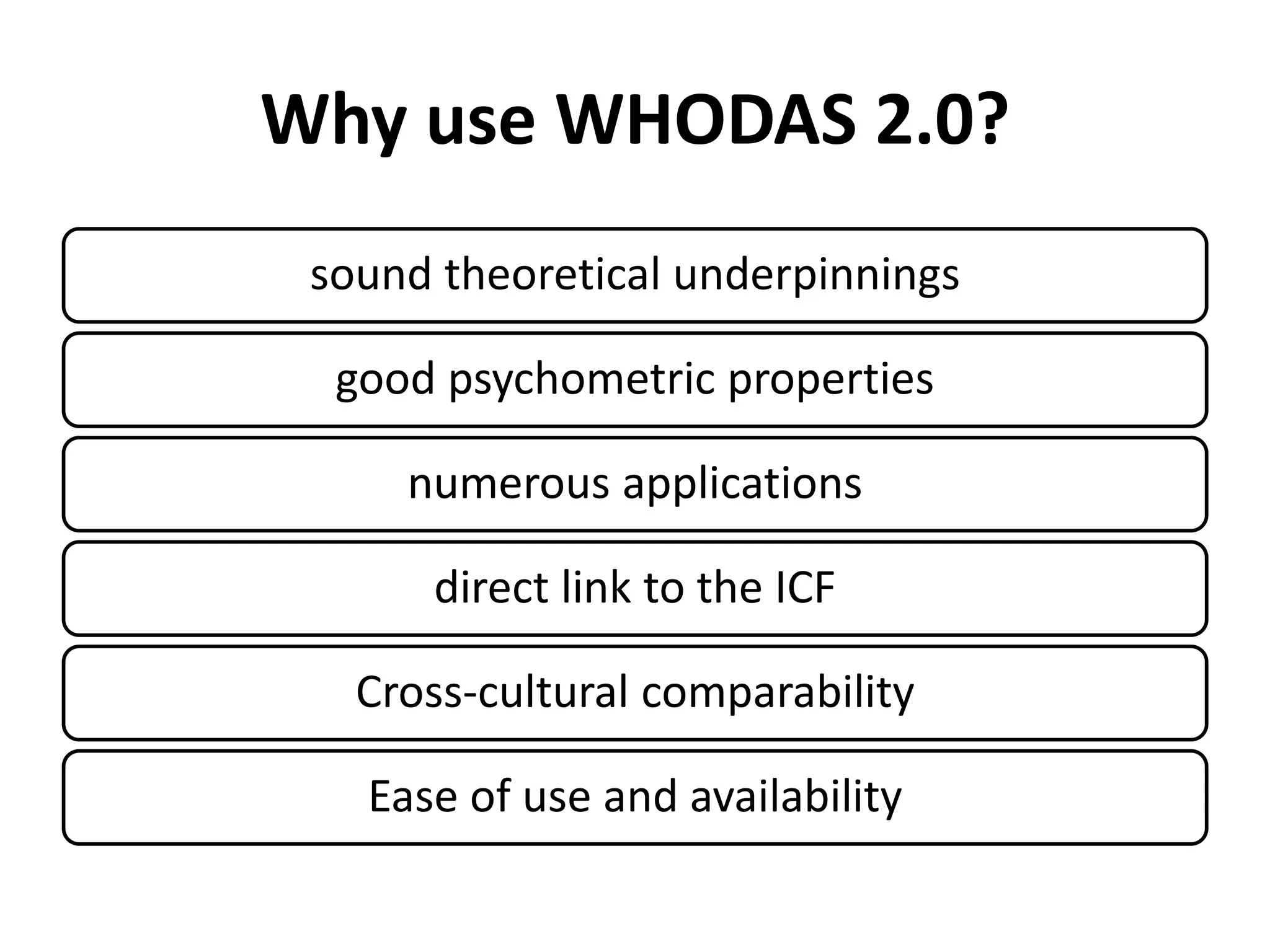
Why use WHODAS 2.0?
sound theoretical underpinnings
good psychometric properties
numerous applications
direct link to the ICF
Cross-cultural comparability
Ease of use and availability
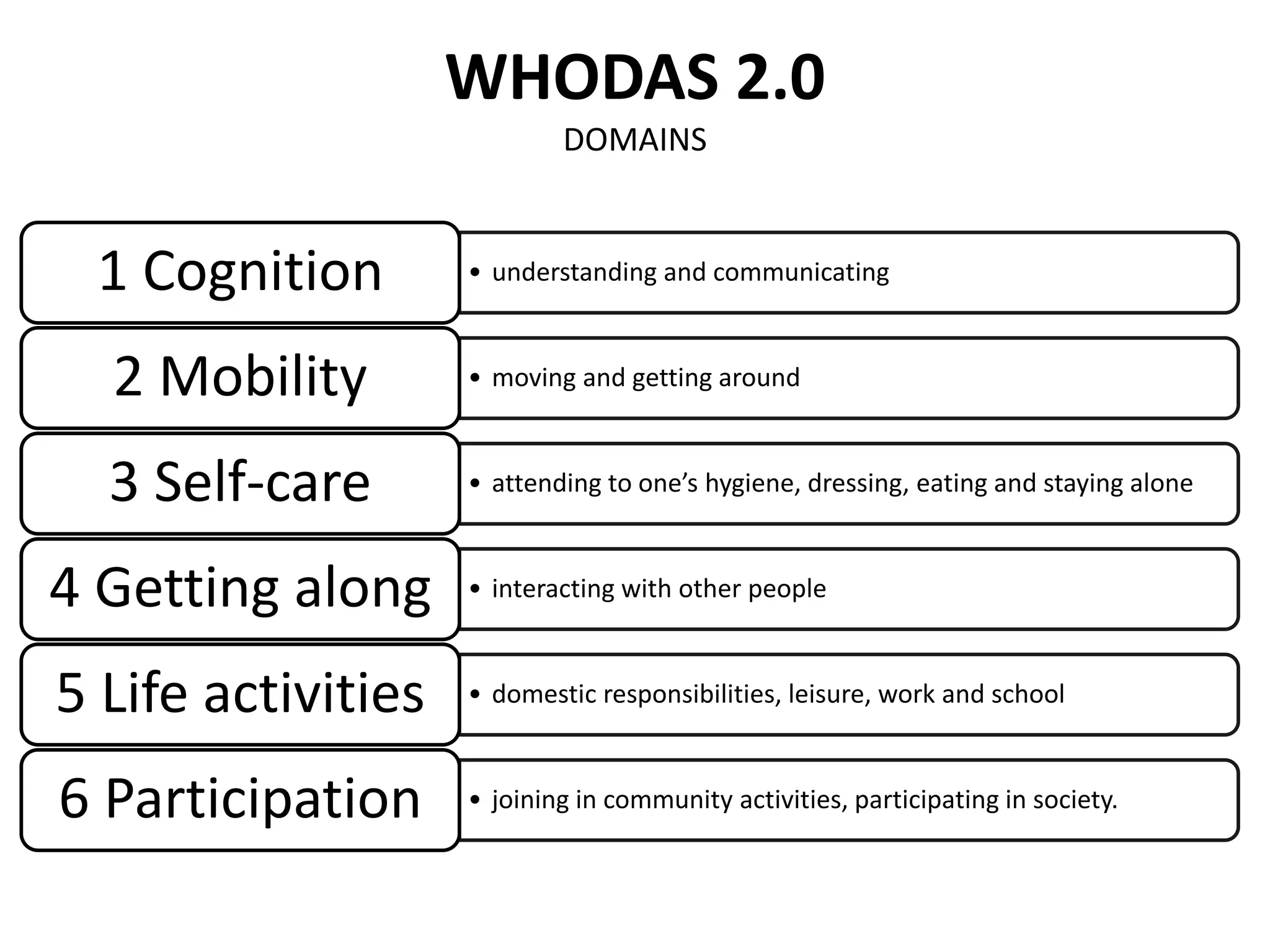
WHODAS 2.0
DOMAINS
• understanding and communicating
1 Cognition
• moving and getting around
2 Mobility
• attending to one’s hygiene, dressing, eating and staying alone
3 Self-care
• interacting with other people
4 Getting along
• domestic responsibilities, leisure, work and school
5 Life activities
• joining in community activities, participating in society.
6 Participation
Biopsychosocial model of ICF
• disability is
multidimensional
• interaction of person’s
physical, social and
attitudinal environment
IMPACT
ON LIVE
BIOPHYSICAL
PSYCOLOGICAL
SOCIAL
ECONOMIC
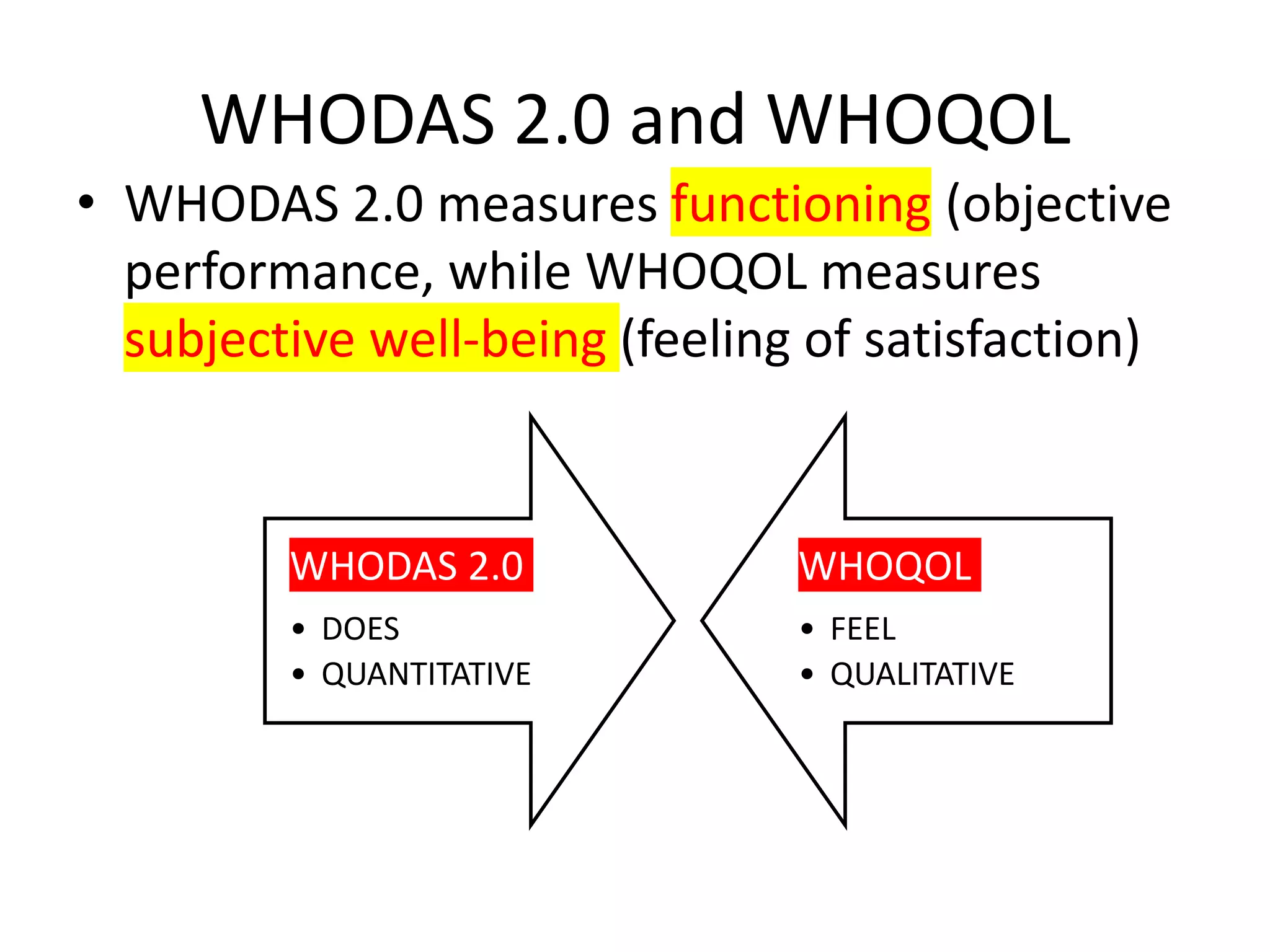
WHODAS 2.0 and WHOQOL
• WHODAS 2.0 measures functioning (objective
performance, while WHOQOL measures
subjective well-being (feeling of satisfaction)
WHODAS 2.0
• DOES
• QUANTITATIVE
WHOQOL
• FEEL
• QUALITATIVE
Reliability & Validity
Psychometric properties
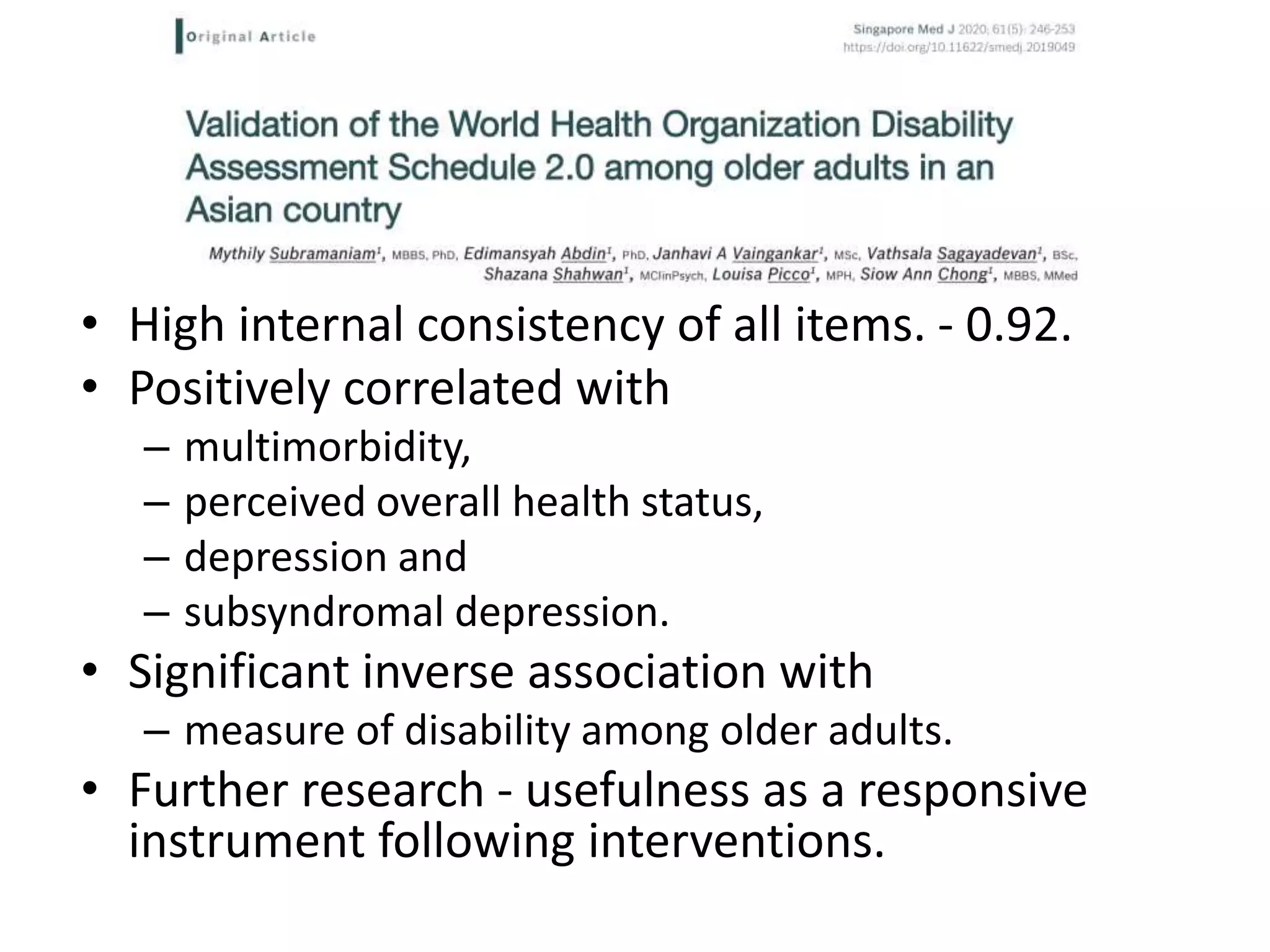
• Test–retest reliability and internal consistency -
Cronbach’s alpha 0.98
• Face , Construct and Content Validity
– Most questions fitted in their assigned domains,
confirming the unidimensionality of domains
• Summary scores unaffected by sociodemography
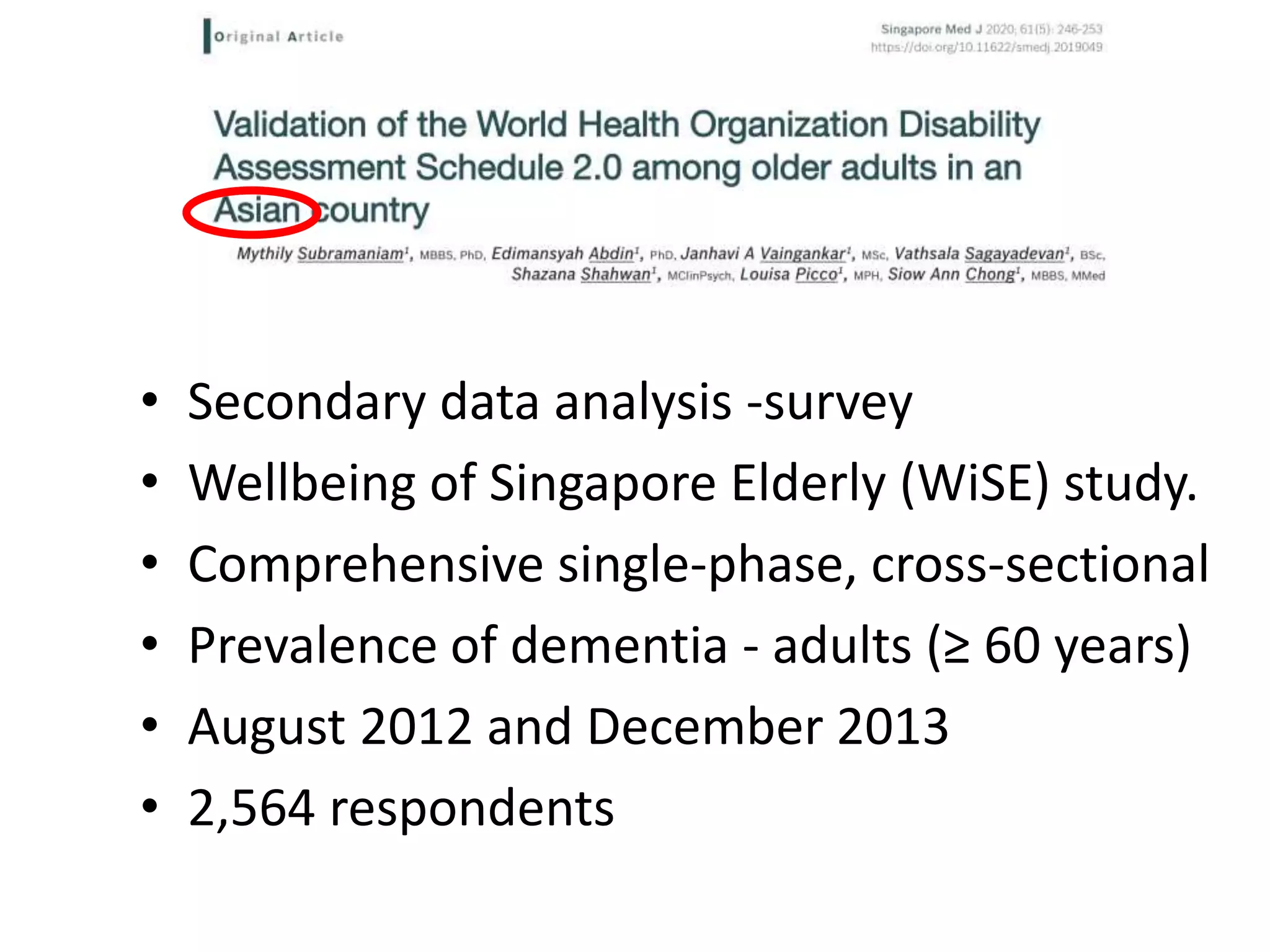
• Secondary data analysis -survey
• Wellbeing of Singapore Elderly (WiSE) study.
• Comprehensive single-phase, cross-sectional
• Prevalence of dementia - adults (≥ 60 years)
• August 2012 and December 2013
• 2,564 respondents
• High internal consistency of all items. - 0.92.
• Positively correlated with
– multimorbidity,
– perceived overall health status,
– depression and
– subsyndromal depression.
• Significant inverse association with
– measure of disability among older adults.
• Further research - usefulness as a responsive
instrument following interventions.
12-item version
Brief assessments of overall
functioning
Administration
interviewer/self/proxy
Explains 81% of the variance
of the 36-item version
Five minutes.
36-item version
Administration -
interviewer/self/proxy
Detailed
20 minutes.
12+24-item version
• Hybrid
• Based on positive responses to the initial 12
items, respondents may be given up to 24
additional questions
• Administered by interview or computer-
adaptive testing (CAT).
• 20 minutes.
WHODAS 2.0
QUESTIONS
Practical aspects of
administering and scoring
• Privacy
• frame 1 – degree of difficulty
• frame 2 – due to health conditions
• frame 3 – in the past 30 days
• frame 4 – averaging good and bad days
• frame 5 – as the respondent usually does the
activity
• frame 6 – items not experienced in the past 30
days are not rated.
Frame of reference 1 – degree of
difficulty
• increased effort
• discomfort or pain
• slowness
• changes in way person does the activity.
Frame of reference
2 – due to health
conditions
• diseases, illnesses or
other health problems
• injuries
• mental or emotional
problems
• problems with alcohol
• problems with drugs
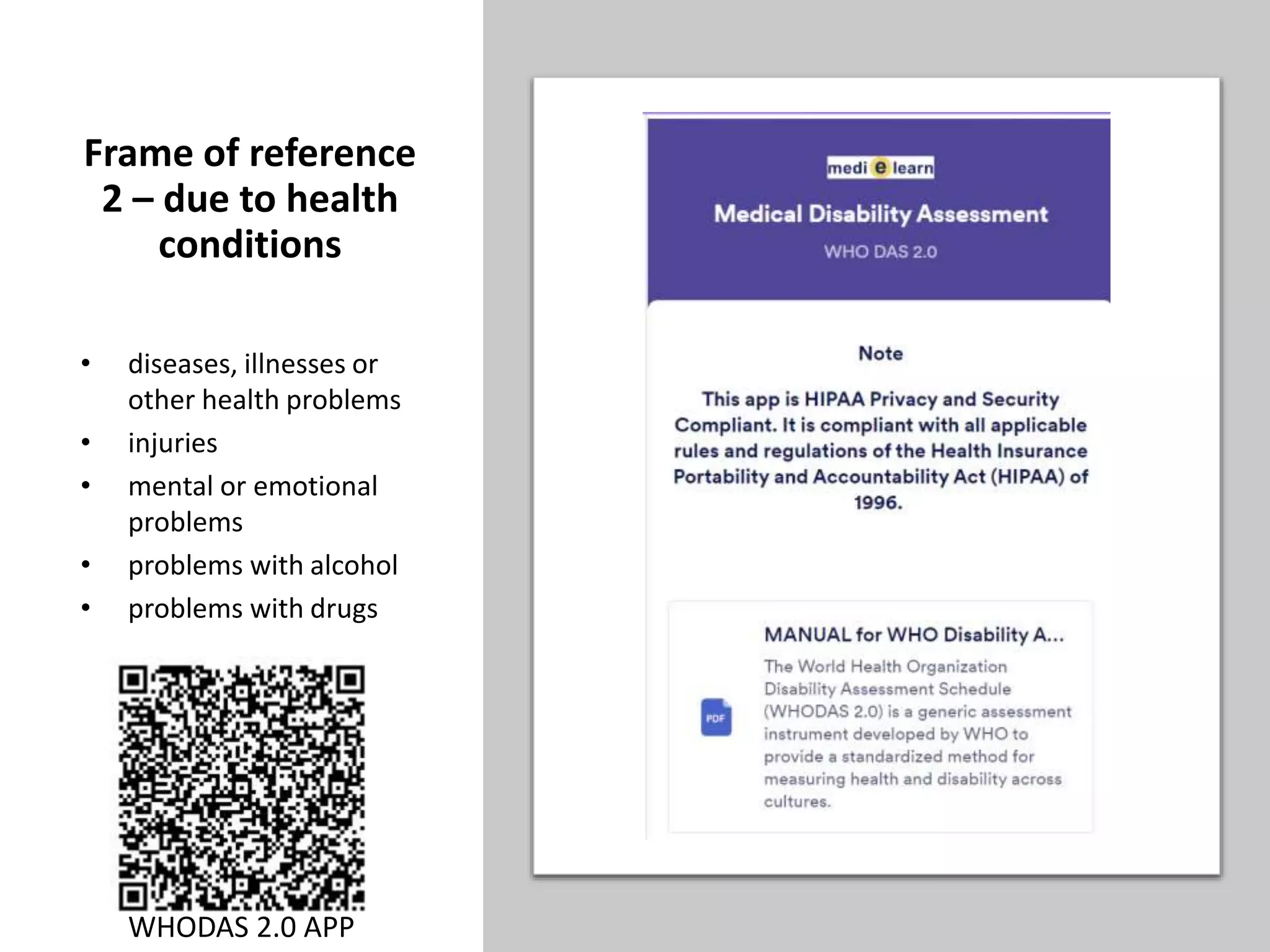
WHODAS 2.0 APP
PERCEPTIONS & EXPECTATIONS
THANK YOU
vaikunthan@gmail.com

Disability Assessment 2022 WHODAS2.0 v2.pptx

  • 1.
    Assessing Disability World HealthOrganization Disability Assessment Checklist Mr. Vaikunthan Rajaratnam Senior Consultant Hand Surgeon Singapore
  • 2.
    Chapter 16 HumanMachine Interface for Technology in Healthcare N A Rahman, and V Rajaratnam
  • 3.
    Experiences of livingwith leprosy: A systematic review and qualitative evidence synthesis – Accepted PLOS Number of articles included in review (n = 49) Total patients 1209 people with leprosy from 12 countries
  • 4.
  • 5.
  • 6.
    Defining • Impairment: any lossor abnormality of psychological, physiological or anatomical structure or function. • Disability: any restriction or lack of ability to perform an activity in the manner or within the range considered normal for a human being resulting from an impairment. • Handicap: a disadvantage for a given individual that limits or prevents the fulfilment of a role that is normal • As traditionally used, impairment refers to a problem with a structure or organ of the body; disability is a functional limitation with regard to a particular activity; and handicap refers to a disadvantage in filling a role in life relative to a peer group. • WHO 1980
  • 7.
    International Classification of Functioning,Disability and Health (ICF) International standard to describe and measure health and disability. http://apps.who.int/classifications/icfbrowser/ ICIDH (International Classification of Impairments, Disabilities and Handicaps) to ICF Engel GL. The need for a new medical model: a challenge for biomedicine. Science. 1977 Apr
  • 8.
    Psychometrics Classical test theory •Reliability . – Pearson correlation coefficient and is often called test-retest reliability. – index of reliability is Cronbach's α • Validity – concurrent validity; – predictive validity, – construct validity, – Content validity
  • 9.
    Why is disabilityassessment important? • “there are no diseases, but patients” • no disabilities but people with problems
  • 10.
    Why develop amethod to assess disability? • “a decrement in each functioning domain” – Body, person and society • International Classification of Functioning, Disability and Health (ICF) – impractical for daily use • WHODAS 2.0 – practical, reliable and valid
  • 11.
    Why learn anduse a disability measure? • patient’s needs • level of care • outcome of the condition • length of hospitalization • receipt of disability benefits • work performance • social integration
  • 12.
    Disability assessment • identifying needs •matching treatments and interventions • measuring outcomes and effectiveness • setting priorities • allocating resources.
  • 13.
    WHODAS 2.0 • Genericinstrument • Standardized method for health and disability • Developed from International Classification of Functioning, Disability and Health (ICF) • Cross cultural – Applicability – Utility – Reliability and – Validity ISBN 978 92 4 154759 8 (NLM classification: W 15) © World Health Organization 2010 http://p.ideaday.de/104.2/icf/en/index.html
  • 14.
    WHODAS 2.0 Full version36 items - short version 12 items Common metric Generic measure Design, monitor and evaluate interventions Etiologically neutral Focus on functioning and disability
  • 15.
    Why use WHODAS2.0? sound theoretical underpinnings good psychometric properties numerous applications direct link to the ICF Cross-cultural comparability Ease of use and availability
  • 16.
    WHODAS 2.0 DOMAINS • understandingand communicating 1 Cognition • moving and getting around 2 Mobility • attending to one’s hygiene, dressing, eating and staying alone 3 Self-care • interacting with other people 4 Getting along • domestic responsibilities, leisure, work and school 5 Life activities • joining in community activities, participating in society. 6 Participation
  • 17.
    Biopsychosocial model ofICF • disability is multidimensional • interaction of person’s physical, social and attitudinal environment IMPACT ON LIVE BIOPHYSICAL PSYCOLOGICAL SOCIAL ECONOMIC
  • 18.
    WHODAS 2.0 andWHOQOL • WHODAS 2.0 measures functioning (objective performance, while WHOQOL measures subjective well-being (feeling of satisfaction) WHODAS 2.0 • DOES • QUANTITATIVE WHOQOL • FEEL • QUALITATIVE
  • 19.
  • 20.
    Psychometric properties • Test–retestreliability and internal consistency - Cronbach’s alpha 0.98 • Face , Construct and Content Validity – Most questions fitted in their assigned domains, confirming the unidimensionality of domains • Summary scores unaffected by sociodemography
  • 21.
    • Secondary dataanalysis -survey • Wellbeing of Singapore Elderly (WiSE) study. • Comprehensive single-phase, cross-sectional • Prevalence of dementia - adults (≥ 60 years) • August 2012 and December 2013 • 2,564 respondents
  • 22.
    • High internalconsistency of all items. - 0.92. • Positively correlated with – multimorbidity, – perceived overall health status, – depression and – subsyndromal depression. • Significant inverse association with – measure of disability among older adults. • Further research - usefulness as a responsive instrument following interventions.
  • 23.
    12-item version Brief assessmentsof overall functioning Administration interviewer/self/proxy Explains 81% of the variance of the 36-item version Five minutes.
  • 24.
  • 25.
    12+24-item version • Hybrid •Based on positive responses to the initial 12 items, respondents may be given up to 24 additional questions • Administered by interview or computer- adaptive testing (CAT). • 20 minutes.
  • 26.
  • 29.
    Practical aspects of administeringand scoring • Privacy • frame 1 – degree of difficulty • frame 2 – due to health conditions • frame 3 – in the past 30 days • frame 4 – averaging good and bad days • frame 5 – as the respondent usually does the activity • frame 6 – items not experienced in the past 30 days are not rated.
  • 30.
    Frame of reference1 – degree of difficulty • increased effort • discomfort or pain • slowness • changes in way person does the activity.
  • 31.
    Frame of reference 2– due to health conditions • diseases, illnesses or other health problems • injuries • mental or emotional problems • problems with alcohol • problems with drugs WHODAS 2.0 APP
  • 32.
    PERCEPTIONS & EXPECTATIONS THANKYOU vaikunthan@gmail.com