WHO
Global Disability Action Plan 2014-2021:
Better health for all people with disability
Alarcos Cieza
Blindness and Deafness Prevention,
Disability and Rehabilitation
Disability is
the outcome between health condition and
environmental factors
The International Classification
of Functioning, Disability and
Health
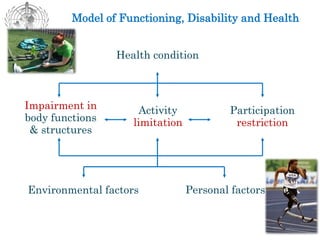
Environmental factors Personal factors
Health condition
Impairment in
body functions
& structures
Activity
limitation
Participation
restriction
Model of Functioning, Disability and Health
3
Persons with disabilities include those who have
long-term physical, mental, intellectual or sensory
impairments which in interaction with various
barriers may hinder their full and effective
participation in society on an equal basis with
others.
4
3
http://www.who.int/disabilities/worl
d_report/2011/en/
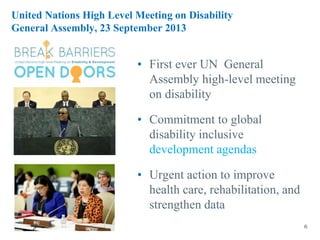
• First ever UN General
Assembly high-level meeting
on disability
• Commitment to global
disability inclusive
development agendas
• Urgent action to improve
health care, rehabilitation, and
strengthen data
6
United Nations High Level Meeting on Disability
General Assembly, 23 September 2013
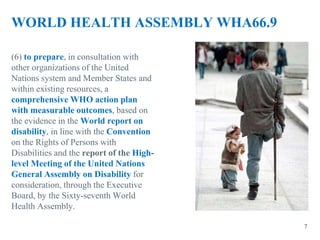
(6) to prepare, in consultation with
other organizations of the United
Nations system and Member States and
within existing resources, a
comprehensive WHO action plan
with measurable outcomes, based on
the evidence in the World report on
disability, in line with the Convention
on the Rights of Persons with
Disabilities and the report of the High-
level Meeting of the United Nations
General Assembly on Disability for
consideration, through the Executive
Board, by the Sixty-seventh World
Health Assembly.
7
WORLD HEALTH ASSEMBLY WHA66.9
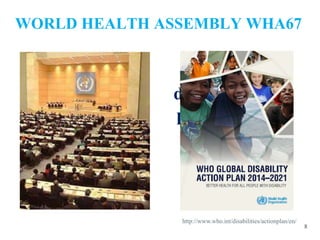
WHO global
disability action
plan 2014-2021
8
WORLD HEALTH ASSEMBLY WHA67
http://www.who.int/disabilities/actionplan/en/
• Disability prevalence is
increasing
• Disproportionately
affects vulnerable
populations: women,
older people and poor
households
9
Global Situation
10Low ExtremeDisability
Distribution of the world population on the
disability continuumNumberofpersons
15% of the world
population
Environment
Internal capacity
• Education
• Employment
• Social & political life
• Community
participation
• Health
11
People with disabilities face barriers in all
areas of life
Barriers to health care
12
Costs are a major barrier
13
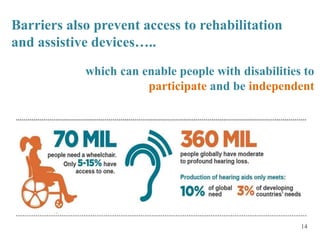
Barriers also prevent access to rehabilitation
and assistive devices…..
14
which can enable people with disabilities to
participate and be independent
1. To remove barriers and improve access to health
services and programmes.
2. To strengthen and extend rehabilitation, habilitation,
assistive technology, assistance and support
services, and community-based rehabilitation.
3. …
15
Objectives
Disability Rates from national surveys across the World
0
5
10
15
20
25
30
35
Syria
Bangladesh
Tunisia
Lebanon
Sudan
Algeria
Benin
Thailand
Brazil
Libya
SriLanka
Jordan
Japan
Malawi
Philippines
Egypt
Italy
China
Colombia
Germany
Netherlands
Sweden
Austria
Spain
USA
Canada
Uruguay
Australia
NewZealand
Norway
Source: DISTAT – UNSD 2003
1. To remove barriers and improve access to health
services and programmes.
2. To strengthen and extend rehabilitation, habilitation,
assistive technology, assistance and support
services, and community-based rehabilitation.
3. To strengthen collection of relevant and internationally
comparable data on disability, and support research
on disability and related services.
17
Objectives
Indicators of
success
1.3 – Proportion of
persons with
disabilities who
have access to the
health services that
they need.
Inputs from
WHO Secretariat
Member States
National and
international
partner
18
For each objective …
Actions
1.2 Develop
leadership and
governance for
disability-inclusive
health
1.3 Remove
barriers to
financing and
affordability
Disability in WHO
Triple track approach
1. Mainstreaming disability within the
organisation WHO
Task Force on Disability
WHO buildings, information products, employment
opportunities are inclusive of and accessible to people with
disabilities, in compliance with the CRPD
Disability in WHO
Triple track approach
2. Mainstreaming Disability in technical work and
programmes of other units and department
– Ageing and Life Course
– Department of Mental health and substance abuse
– Maternal, Newborn, Child and Adolescent Health
– Public Health, Innovation and Intellectual Property
– Health Statistics and Informatics
– Health systems financing
– Chronic Diseases and Health Promotion
– Management of Noncommunicable Diseases
– Prevention of Noncommunicable Diseases
– Emergency response
Disability in WHO
Triple track approach
3. Mainstreaming disability in the
implementation activities of the Disability
Action Plan
• Guidance on disability inclusive Universal
Health Coverage
• Guidance on disability inclusive public health
22
Objective 1
To remove barriers and improve access to
health services and programmes
• Work with countries so that rehabilitation
services are part of Universal Health Coverage
• Minimum Standards for Rehabilitation in
Emergencies: A Guidance Document for Foreign
Medical Teams
• CBR as a strategy or Community-Based
Inclusive development
23
Objective 2
To strengthen and extend
rehabilitation,…, and CBR
• The Model Disability Survey is per definition a
survey that mainstream disability
24
Objective 3
To strengthen collection of relevant and
internationally comparable data on
disability ...
Disablingbarriers–Breaktoinclude
Model Disability Survey (MDS)
Environmental factors Personal factors
Health condition
Impairment in
body functions
& structures
Activity
limitation
Participation
restriction
Model of Functioning, Disability and Health
26
Environmental factors Personal factors
Impairment in
body functions
& structures
Activity
limitation
Participation
restriction
27
28
Impairment in
body functions &
structures
Activity
limitation
Participation
restriction
29
Problems in every day life Intrinsic capacity
30
Intrinsic capacity
I4040: How much of a
problem do you have with
joining community
activities, such as festivities,
religious or other activities?
32
Difficulties in
in capacity
N No
problem
Problem
No 27 96.3 3.7
Mild 144 95.1 4.9
Moderate 200 77.0 23.0
Severe 128 43.0 57.0
Difficulties in
in capacity
N No
problem
Problem
No 27 96.3 3.7
Mild 142 94.4 5.6
Moderate 197 83.2 16.8
Severe 122 55.7 44.3
I4042: How much of a
problem did you have with
voting in the last elections?
I3057: Do you get to make
the big decisions in your
life? For example, like
deciding where to live, or
who to live with, how to
spend your money.
33
Difficulties in
in capacity
N Yes No
No 27 74.1 25.9
Mild 144 69.4 30.6
Moderate 200 58.5 41.5
Severe 127 55.1 44.9
I4048: How much of a
problem is using public or
private transportation?
34
Transportation
Difficulties in
in capacity
N No
problem
Problem
No 27 74.1 25.9
Mild 143 70.6 29.4
Moderate 200 44.0 56.0
Severe 122 20.5 79.5
I3006: To what extent does
the transportation you need
or want to use make it easy
or hard for you to use it?
Difficulties in
in capacity
N Facili-
tating
Hinde-
ring
No 27 100.0 0.0
Mild 144 97.2 2.8
Moderate 199 95.0 5.0
Severe 127 78.0 22.0
AFRO
N=16
EURO
N=109
EMRO
N=2
AMRO
N=22
SEARO
N=7
WPRO
N=23
Identification of 179 health and disability surveys
http://www.who.int/disabilities/data/en/
Institutions
• Statistics Norway, Norway
• National Center for Health Statistics, US
• Institute for Survey Research, University of Michigan, US
Countries
• Cambodia, China, Malawi, Nepal, Norway and US
• UK
38
Cognitive testing
• Finished: Cambodia, Chile and Malawi
• Planned: Brazil
• Regional survey: Pakistan
39
Pilot Studies
FUNCTIONING
Broad environment:
- Hindering or facilitating environment
- Support and relationships
- Attitudes
- Access to information
Functioning questions
CAPACITY
General Health Question
WG 6 Questions
Additional capacity questions
Health conditions
PERSONALASSISTANCE, ASSISTIVE DEVICES
AND FACILITATORS
Personal assistance
Assistive devices: mobility and self-care, seeing,
hearing & communication
Facilitators: education, work and at home
Health conditions
WORK HISTORYAND BENEFITS
23 Questions based on ILO survey
HEALTH CARE UTILISATION
Inpatient care
Outpatient care or care at home
Responsiveness of the health system
SATISFACTION, PERSONALITY AND WELL-
BEING
CHILDREN
41
National Disability Surveys
• In process: Chile, Sri Lanka, Oman
• Regional Implementation
1. Training on data collection
2. Training on data analyses
• Continue the MDS development
– Full version (1 hour)
– Brief version (20 minutes)
42
Next steps
Alarcos Cieza, MSc, MPH, PhD
Blindness and Deafness Prevention,
Disability and Rehabilitation (DAR)
World Health Organization
Avenue Appia 20
1211 Geneva 27
Switzerland
Tel.: +41 22 791 1998
Fax: +41 22 791 4874
Email: ciezaa@who.int
Website: www.who.int/disabilities/
43
2001 2006 2010 2013 2014 2015
DFAT WHO Partnership
2008 2011
WHO Task Force on Disability
Disability staff from WHO from
central budget
2008 2011
IMPACT

WHO Global disability plan 2014-2021

  • 1.
    WHO Global Disability ActionPlan 2014-2021: Better health for all people with disability Alarcos Cieza Blindness and Deafness Prevention, Disability and Rehabilitation
  • 2.
    Disability is the outcomebetween health condition and environmental factors The International Classification of Functioning, Disability and Health
  • 3.
    Environmental factors Personalfactors Health condition Impairment in body functions & structures Activity limitation Participation restriction Model of Functioning, Disability and Health 3
  • 4.
    Persons with disabilitiesinclude those who have long-term physical, mental, intellectual or sensory impairments which in interaction with various barriers may hinder their full and effective participation in society on an equal basis with others. 4
  • 5.
  • 6.
    • First everUN General Assembly high-level meeting on disability • Commitment to global disability inclusive development agendas • Urgent action to improve health care, rehabilitation, and strengthen data 6 United Nations High Level Meeting on Disability General Assembly, 23 September 2013
  • 7.
    (6) to prepare,in consultation with other organizations of the United Nations system and Member States and within existing resources, a comprehensive WHO action plan with measurable outcomes, based on the evidence in the World report on disability, in line with the Convention on the Rights of Persons with Disabilities and the report of the High- level Meeting of the United Nations General Assembly on Disability for consideration, through the Executive Board, by the Sixty-seventh World Health Assembly. 7 WORLD HEALTH ASSEMBLY WHA66.9
  • 8.
    WHO global disability action plan2014-2021 8 WORLD HEALTH ASSEMBLY WHA67 http://www.who.int/disabilities/actionplan/en/
  • 9.
    • Disability prevalenceis increasing • Disproportionately affects vulnerable populations: women, older people and poor households 9 Global Situation
  • 10.
    10Low ExtremeDisability Distribution ofthe world population on the disability continuumNumberofpersons 15% of the world population Environment Internal capacity
  • 11.
    • Education • Employment •Social & political life • Community participation • Health 11 People with disabilities face barriers in all areas of life
  • 12.
  • 13.
    Costs are amajor barrier 13
  • 14.
    Barriers also preventaccess to rehabilitation and assistive devices….. 14 which can enable people with disabilities to participate and be independent
  • 15.
    1. To removebarriers and improve access to health services and programmes. 2. To strengthen and extend rehabilitation, habilitation, assistive technology, assistance and support services, and community-based rehabilitation. 3. … 15 Objectives
  • 16.
    Disability Rates fromnational surveys across the World 0 5 10 15 20 25 30 35 Syria Bangladesh Tunisia Lebanon Sudan Algeria Benin Thailand Brazil Libya SriLanka Jordan Japan Malawi Philippines Egypt Italy China Colombia Germany Netherlands Sweden Austria Spain USA Canada Uruguay Australia NewZealand Norway Source: DISTAT – UNSD 2003
  • 17.
    1. To removebarriers and improve access to health services and programmes. 2. To strengthen and extend rehabilitation, habilitation, assistive technology, assistance and support services, and community-based rehabilitation. 3. To strengthen collection of relevant and internationally comparable data on disability, and support research on disability and related services. 17 Objectives
  • 18.
    Indicators of success 1.3 –Proportion of persons with disabilities who have access to the health services that they need. Inputs from WHO Secretariat Member States National and international partner 18 For each objective … Actions 1.2 Develop leadership and governance for disability-inclusive health 1.3 Remove barriers to financing and affordability
  • 19.
    Disability in WHO Tripletrack approach 1. Mainstreaming disability within the organisation WHO Task Force on Disability WHO buildings, information products, employment opportunities are inclusive of and accessible to people with disabilities, in compliance with the CRPD
  • 20.
    Disability in WHO Tripletrack approach 2. Mainstreaming Disability in technical work and programmes of other units and department – Ageing and Life Course – Department of Mental health and substance abuse – Maternal, Newborn, Child and Adolescent Health – Public Health, Innovation and Intellectual Property – Health Statistics and Informatics – Health systems financing – Chronic Diseases and Health Promotion – Management of Noncommunicable Diseases – Prevention of Noncommunicable Diseases – Emergency response
  • 21.
    Disability in WHO Tripletrack approach 3. Mainstreaming disability in the implementation activities of the Disability Action Plan
  • 22.
    • Guidance ondisability inclusive Universal Health Coverage • Guidance on disability inclusive public health 22 Objective 1 To remove barriers and improve access to health services and programmes
  • 23.
    • Work withcountries so that rehabilitation services are part of Universal Health Coverage • Minimum Standards for Rehabilitation in Emergencies: A Guidance Document for Foreign Medical Teams • CBR as a strategy or Community-Based Inclusive development 23 Objective 2 To strengthen and extend rehabilitation,…, and CBR
  • 24.
    • The ModelDisability Survey is per definition a survey that mainstream disability 24 Objective 3 To strengthen collection of relevant and internationally comparable data on disability ...
  • 25.
  • 26.
    Environmental factors Personalfactors Health condition Impairment in body functions & structures Activity limitation Participation restriction Model of Functioning, Disability and Health 26
  • 27.
    Environmental factors Personalfactors Impairment in body functions & structures Activity limitation Participation restriction 27
  • 28.
    28 Impairment in body functions& structures Activity limitation Participation restriction
  • 29.
    29 Problems in everyday life Intrinsic capacity
  • 30.
  • 31.
    I4040: How muchof a problem do you have with joining community activities, such as festivities, religious or other activities? 32 Difficulties in in capacity N No problem Problem No 27 96.3 3.7 Mild 144 95.1 4.9 Moderate 200 77.0 23.0 Severe 128 43.0 57.0 Difficulties in in capacity N No problem Problem No 27 96.3 3.7 Mild 142 94.4 5.6 Moderate 197 83.2 16.8 Severe 122 55.7 44.3 I4042: How much of a problem did you have with voting in the last elections?
  • 32.
    I3057: Do youget to make the big decisions in your life? For example, like deciding where to live, or who to live with, how to spend your money. 33 Difficulties in in capacity N Yes No No 27 74.1 25.9 Mild 144 69.4 30.6 Moderate 200 58.5 41.5 Severe 127 55.1 44.9
  • 33.
    I4048: How muchof a problem is using public or private transportation? 34 Transportation Difficulties in in capacity N No problem Problem No 27 74.1 25.9 Mild 143 70.6 29.4 Moderate 200 44.0 56.0 Severe 122 20.5 79.5 I3006: To what extent does the transportation you need or want to use make it easy or hard for you to use it? Difficulties in in capacity N Facili- tating Hinde- ring No 27 100.0 0.0 Mild 144 97.2 2.8 Moderate 199 95.0 5.0 Severe 127 78.0 22.0
  • 34.
    AFRO N=16 EURO N=109 EMRO N=2 AMRO N=22 SEARO N=7 WPRO N=23 Identification of 179health and disability surveys http://www.who.int/disabilities/data/en/
  • 35.
    Institutions • Statistics Norway,Norway • National Center for Health Statistics, US • Institute for Survey Research, University of Michigan, US Countries • Cambodia, China, Malawi, Nepal, Norway and US • UK 38 Cognitive testing
  • 36.
    • Finished: Cambodia,Chile and Malawi • Planned: Brazil • Regional survey: Pakistan 39 Pilot Studies
  • 37.
    FUNCTIONING Broad environment: - Hinderingor facilitating environment - Support and relationships - Attitudes - Access to information Functioning questions CAPACITY General Health Question WG 6 Questions Additional capacity questions Health conditions PERSONALASSISTANCE, ASSISTIVE DEVICES AND FACILITATORS Personal assistance Assistive devices: mobility and self-care, seeing, hearing & communication Facilitators: education, work and at home Health conditions WORK HISTORYAND BENEFITS 23 Questions based on ILO survey HEALTH CARE UTILISATION Inpatient care Outpatient care or care at home Responsiveness of the health system SATISFACTION, PERSONALITY AND WELL- BEING CHILDREN
  • 38.
    41 National Disability Surveys •In process: Chile, Sri Lanka, Oman
  • 39.
    • Regional Implementation 1.Training on data collection 2. Training on data analyses • Continue the MDS development – Full version (1 hour) – Brief version (20 minutes) 42 Next steps
  • 40.
    Alarcos Cieza, MSc,MPH, PhD Blindness and Deafness Prevention, Disability and Rehabilitation (DAR) World Health Organization Avenue Appia 20 1211 Geneva 27 Switzerland Tel.: +41 22 791 1998 Fax: +41 22 791 4874 Email: ciezaa@who.int Website: www.who.int/disabilities/ 43
  • 41.
    2001 2006 20102013 2014 2015 DFAT WHO Partnership 2008 2011 WHO Task Force on Disability Disability staff from WHO from central budget 2008 2011 IMPACT