principles of logo design
Have you ever noticed how certain logo designs stand out
from the crowd?
Take, for example, the logos for companies like Coca-Cola,
Microsoft, Toyota, Sears, Kelloggs and Nike.
These corporate logos also have certain innate qualities
that make them more memorable and easier to distinguish
from other corporate symbols. .
Here is a list of these qualities and short descriptions as to
how they work together to create a logo design that’s both
original and unforgettable:
principles of logo design
simplicity
Simplicity is one element all effective logo designs
have in common.
People are drawn to clean, uncluttered logo
designs that can easily be recognized at a glance.
Busy, crowded logos, such as designs featuring
many intricate details, images or pictures are
distracting to the viewer and tend not to be as well
recognized as cleaner designs.
principles of logo design
proportionality
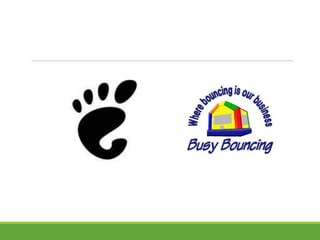
Ideally, a logo should function as a discrete unit with a
width not much greater than its height (think of shapes that
can fit in a square or circle).
Remember that a logo design should work well on anything
from a business card to a billboard, and logos that are too
long or too tall become difficult to read when they are
reduced or enlarged.
principles of logo design
small colour palette
It is no coincidence that 80% of the world’s most widely
recognized logos use either one or two colours.
Few good logo designs use more than three colours; this is
because using more than three colours usually turns a logo
to mud.
A basic colour palette of one to three colours (which may or
may not include black) keeps things simple and allows the
selected colours to clearly convey a mood or emotion.
Use CONTRASTING COLOURS for visual impact.
principles of logo design
easy-to-read fonts
Creating a logo design in elaborate script fonts may look
classy, but what good is a logo if nobody can read it?
Your best bet is to choose a font that is distinctive but still
easy to read.
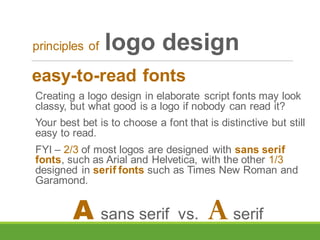
FYI – 2/3 of most logos are designed with sans serif
fonts, such as Arial and Helvetica, with the other 1/3
designed in serif fonts such as Times New Roman and
Garamond.
principles of logo design
A sans serif vs. A serif
practical & adaptable
What this means is that a logo design should be practically
designed so it can be affordably and easily used in a
variety of mediums. For example, a logo:
Shouldn’t be designed with so many colours that it costs
you a mint every time you want to print business cards or
letterhead.
Shouldn’t be designed with a gradient (such as a picture),
which is difficult to reproduce.
Should be created so it can be easily converted to black-&-
white.
Should be created using Web-safe colours so your online
logo looks the same as your printed logo.
principles of logo design
originality
A primary task of a logo design is to clearly distinguish a
company from its competitors, which means a logo design
should be unique, one-of-a-kind and “ownable” - meaning
the company should be able to trademark the logo within
Canada.
This means it cannot “borrow” too heavily from existing
logo designs. This is copyright infringement.
principles of logo design
works within industry
conventions
Often there are consistencies among logos in certain
industries, and following these conventions can help
customers more easily identify what you do or what you
sell (such as many car companies using circular shapes for
their logos – name a few!).
This doesn’t mean you should sacrifice originality, but it
does mean you (or the firm creating your logo design)
should be aware of patterns among logos in your industry
and somehow incorporate these consistencies into your
design.
principles of logo design
the process
1. Start Without the Computer:
◦ The computer can be a wonderful tool for designing.
You can work up ten variations of a design in a
matter of minutes, often designs that might not have
even occurred to you without the flexibility of a
computer.
◦ Designing without the computer really forces you to
focus on the job at hand. Instead of just grabbing the
rectangle or ellipse tool, you begin to really think
about what that rectangle or circle says about the
company.
principles of logo design
the process
1. Start Without the Computer (contd.):
◦ You don't have to show anyone your initial sketches.
It only matters that they have meaning to you.
Sketches, or thumbnails, are the visual equivalent of
brainstorming.
◦ Be sure to make some notes on your scribbles so
you remember where you were going with that idea.
◦ Make as many sketches as possible, then look them
over and pick the best to develop further on the
computer.
principles of logo design
the process
1. Start Without the Computer (contd.):
◦ The thumbnail process serves another function: it
saturates your brain with the logo you're working on,
and visual images are often more powerful than
words.
◦ You may very well have one of those "aha!"
moments when you sit down at your computer:
suddenly the logo just comes together.
◦ That's because your brain has been working on it
subconsciously from the time you started making
sketches to the time you sat in front of your
computer.
principles of logo design
the process
2. Start Designing in Black & White:
◦ It's easy to change a black and white logo into
colour, but the reverse is not necessarily true.
◦ In addition, most companies need a black and white
version of their logo for fax or copying purposes.
◦ Do yourself a favour, begin designing in black and
white.
principles of logo design
the process
4. K.I.S.S.
◦ KISS stands for keep it simple, stupid.
◦ The best logos tend to be simple logos.
◦ Think IBM, AT&T, Apple. If you've used two
graphics in the logo, can you get the same
impact with one graphic?
◦ Do you need graphics at all, or will a simple text
treatment be eye-catching?
◦ Will one typeface be better than two?
principles of logo design
the process
5. Use Appropriate Colours, Fonts & Shapes:
◦ Serif fonts tend to be traditional: you'd use a serif
font for a lawyer or a doctor, for instance.
◦ Sans serif fonts tend to be modern: computer and
tech companies often use sans serif fonts.
◦ Handwriting fonts tend to be used for companies
that cater to kids, such as daycare or children's
software. Script fonts can be viewed as feminine,
and sometimes traditional, too.
principles of logo design
the process
5. Use Appropriate Colours, Fonts & Shapes (contd.):
◦ Colour can play an important role in logo design.
◦ Your customer doesn't want to hear that you chose
that blue because it looks cool; they want to know
what psychological connotations it has.
◦ The next slide discusses some common colour
associations…
principles of logo design
the process
5. Use Appropriate Colours, Fonts & Shapes
(contd.):
◦ Blue: trust, loyalty, water, relaxing, power, dignity
◦ Yellow: energy, joy, light, hope
◦ Pink: calming, feminine
◦ Green: life, growth, money, jealousy, nature, fertility
principles of logo design
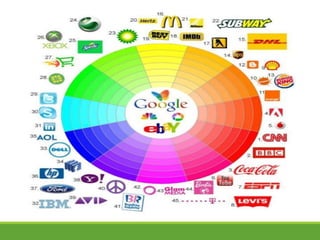
For more psychologyof colour…
http://visual.ly/color-psychology-logo-design
the process
5. Use Appropriate Colours, Fonts & Shapes
(contd.):
 Purple: richness, power, love, sophistication
 Brown: credibility, stability
 White: purity, cleanliness, innocence
 Red: heat, passion, danger, power
principles of logo design
the process
5. Use Appropriate Colours, Fonts & Shapes (contd.):
◦ The shape of the logo can also effect the company's
image. Below are some of the associations we make
with common shapes:
◦ Circle: connection, community, movement, safety
◦ Rectangle: solid, security
◦ Triangle: exciting, powerful, aggression
principles of logo design
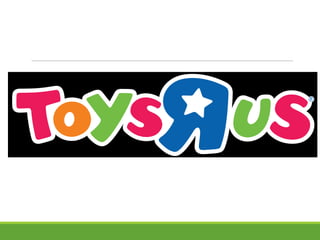
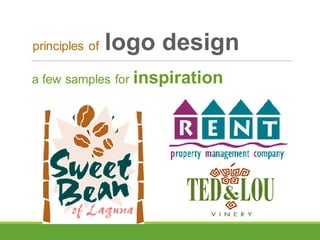
a few samples for inspiration
principles of logo design
a few samples for inspiration
principles of logo design
a few samples for inspiration
principles of logo design
a few samples for inspiration
principles of logo design
a few samples for inspiration
principles of logo design
a few samples for inspiration
principles of logo design
a few samples for inspiration
principles of logo design
a few samples for inspiration
principles of logo design
a few samples for inspiration
principles of logo design
a few samples for inspiration
principles of logo design
a few samples for inspiration
principles of logo design
a few samples for inspiration
principles of logo design
a few samples for inspiration
principles of logo design

Principles of logo_design

  • 1.
  • 2.
    Have you evernoticed how certain logo designs stand out from the crowd? Take, for example, the logos for companies like Coca-Cola, Microsoft, Toyota, Sears, Kelloggs and Nike. These corporate logos also have certain innate qualities that make them more memorable and easier to distinguish from other corporate symbols. . Here is a list of these qualities and short descriptions as to how they work together to create a logo design that’s both original and unforgettable: principles of logo design
  • 3.
    simplicity Simplicity is oneelement all effective logo designs have in common. People are drawn to clean, uncluttered logo designs that can easily be recognized at a glance. Busy, crowded logos, such as designs featuring many intricate details, images or pictures are distracting to the viewer and tend not to be as well recognized as cleaner designs. principles of logo design
  • 8.
    proportionality Ideally, a logoshould function as a discrete unit with a width not much greater than its height (think of shapes that can fit in a square or circle). Remember that a logo design should work well on anything from a business card to a billboard, and logos that are too long or too tall become difficult to read when they are reduced or enlarged. principles of logo design
  • 10.
    small colour palette Itis no coincidence that 80% of the world’s most widely recognized logos use either one or two colours. Few good logo designs use more than three colours; this is because using more than three colours usually turns a logo to mud. A basic colour palette of one to three colours (which may or may not include black) keeps things simple and allows the selected colours to clearly convey a mood or emotion. Use CONTRASTING COLOURS for visual impact. principles of logo design
  • 13.
    easy-to-read fonts Creating alogo design in elaborate script fonts may look classy, but what good is a logo if nobody can read it? Your best bet is to choose a font that is distinctive but still easy to read. FYI – 2/3 of most logos are designed with sans serif fonts, such as Arial and Helvetica, with the other 1/3 designed in serif fonts such as Times New Roman and Garamond. principles of logo design A sans serif vs. A serif
  • 15.
    practical & adaptable Whatthis means is that a logo design should be practically designed so it can be affordably and easily used in a variety of mediums. For example, a logo: Shouldn’t be designed with so many colours that it costs you a mint every time you want to print business cards or letterhead. Shouldn’t be designed with a gradient (such as a picture), which is difficult to reproduce. Should be created so it can be easily converted to black-&- white. Should be created using Web-safe colours so your online logo looks the same as your printed logo. principles of logo design
  • 16.
    originality A primary taskof a logo design is to clearly distinguish a company from its competitors, which means a logo design should be unique, one-of-a-kind and “ownable” - meaning the company should be able to trademark the logo within Canada. This means it cannot “borrow” too heavily from existing logo designs. This is copyright infringement. principles of logo design
  • 17.
    works within industry conventions Oftenthere are consistencies among logos in certain industries, and following these conventions can help customers more easily identify what you do or what you sell (such as many car companies using circular shapes for their logos – name a few!). This doesn’t mean you should sacrifice originality, but it does mean you (or the firm creating your logo design) should be aware of patterns among logos in your industry and somehow incorporate these consistencies into your design. principles of logo design
  • 20.
    the process 1. StartWithout the Computer: ◦ The computer can be a wonderful tool for designing. You can work up ten variations of a design in a matter of minutes, often designs that might not have even occurred to you without the flexibility of a computer. ◦ Designing without the computer really forces you to focus on the job at hand. Instead of just grabbing the rectangle or ellipse tool, you begin to really think about what that rectangle or circle says about the company. principles of logo design
  • 21.
    the process 1. StartWithout the Computer (contd.): ◦ You don't have to show anyone your initial sketches. It only matters that they have meaning to you. Sketches, or thumbnails, are the visual equivalent of brainstorming. ◦ Be sure to make some notes on your scribbles so you remember where you were going with that idea. ◦ Make as many sketches as possible, then look them over and pick the best to develop further on the computer. principles of logo design
  • 22.
    the process 1. StartWithout the Computer (contd.): ◦ The thumbnail process serves another function: it saturates your brain with the logo you're working on, and visual images are often more powerful than words. ◦ You may very well have one of those "aha!" moments when you sit down at your computer: suddenly the logo just comes together. ◦ That's because your brain has been working on it subconsciously from the time you started making sketches to the time you sat in front of your computer. principles of logo design
  • 23.
    the process 2. StartDesigning in Black & White: ◦ It's easy to change a black and white logo into colour, but the reverse is not necessarily true. ◦ In addition, most companies need a black and white version of their logo for fax or copying purposes. ◦ Do yourself a favour, begin designing in black and white. principles of logo design
  • 24.
    the process 4. K.I.S.S. ◦KISS stands for keep it simple, stupid. ◦ The best logos tend to be simple logos. ◦ Think IBM, AT&T, Apple. If you've used two graphics in the logo, can you get the same impact with one graphic? ◦ Do you need graphics at all, or will a simple text treatment be eye-catching? ◦ Will one typeface be better than two? principles of logo design
  • 25.
    the process 5. UseAppropriate Colours, Fonts & Shapes: ◦ Serif fonts tend to be traditional: you'd use a serif font for a lawyer or a doctor, for instance. ◦ Sans serif fonts tend to be modern: computer and tech companies often use sans serif fonts. ◦ Handwriting fonts tend to be used for companies that cater to kids, such as daycare or children's software. Script fonts can be viewed as feminine, and sometimes traditional, too. principles of logo design
  • 26.
    the process 5. UseAppropriate Colours, Fonts & Shapes (contd.): ◦ Colour can play an important role in logo design. ◦ Your customer doesn't want to hear that you chose that blue because it looks cool; they want to know what psychological connotations it has. ◦ The next slide discusses some common colour associations… principles of logo design
  • 27.
    the process 5. UseAppropriate Colours, Fonts & Shapes (contd.): ◦ Blue: trust, loyalty, water, relaxing, power, dignity ◦ Yellow: energy, joy, light, hope ◦ Pink: calming, feminine ◦ Green: life, growth, money, jealousy, nature, fertility principles of logo design
  • 28.
    For more psychologyofcolour… http://visual.ly/color-psychology-logo-design
  • 30.
    the process 5. UseAppropriate Colours, Fonts & Shapes (contd.):  Purple: richness, power, love, sophistication  Brown: credibility, stability  White: purity, cleanliness, innocence  Red: heat, passion, danger, power principles of logo design
  • 31.
    the process 5. UseAppropriate Colours, Fonts & Shapes (contd.): ◦ The shape of the logo can also effect the company's image. Below are some of the associations we make with common shapes: ◦ Circle: connection, community, movement, safety ◦ Rectangle: solid, security ◦ Triangle: exciting, powerful, aggression principles of logo design
  • 32.
    a few samplesfor inspiration principles of logo design
  • 33.
    a few samplesfor inspiration principles of logo design
  • 34.
    a few samplesfor inspiration principles of logo design
  • 35.
    a few samplesfor inspiration principles of logo design
  • 36.
    a few samplesfor inspiration principles of logo design
  • 37.
    a few samplesfor inspiration principles of logo design
  • 38.
    a few samplesfor inspiration principles of logo design
  • 39.
    a few samplesfor inspiration principles of logo design
  • 40.
    a few samplesfor inspiration principles of logo design
  • 41.
    a few samplesfor inspiration principles of logo design
  • 42.
    a few samplesfor inspiration principles of logo design
  • 43.
    a few samplesfor inspiration principles of logo design
  • 44.
    a few samplesfor inspiration principles of logo design