Feature Engineering in
Machine Learning
Chun-Liang Li (李俊良)
chunlial@cs.cmu.edu
About Me
2
Academic Competition
Working
• NTU CSIE BS/MS (2012/2013)
• Advisor: Prof. Hsuan-Tien Lin

• CMU MLD PhD (2014-)
• Advisor: Prof. Jeff Schneider
Prof. Barnabás Póczos
• KDD Cup 2011 Champions

KDD Cup 2013 Champions
• With Prof. Chih-Jen Lin

Prof. Hsuan-Tien Lin

Prof. Shou-De Lin

Many students
(2012 intern) (2015 intern)
What is Machine Learning?
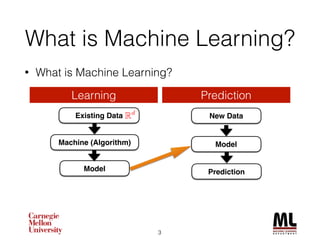
• What is Machine Learning?

3
Learning Prediction
Existing Data
Machine (Algorithm)
Model
New Data
Model
Prediction
Data: Several length-d vectors
Data? Algorithm?
• In academic
• Assume we are given good enough data (in d-dimensional
of course )
• Focus on designing better algorithms

Sometimes complicated algorithms imply publications
• In practice
• Where is your good enough data?
• Or, how to transform your data into a d-dimensional one?
4
From Zero to One:
Create your features by your observations
5
An Apple
6
How to describe this picture?
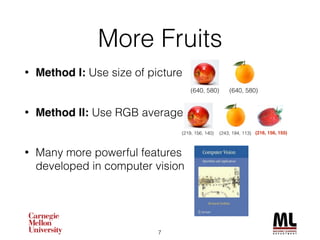
More Fruits
• Method I: Use size of picture

• Method II: Use RGB average

• Many more powerful features 

developed in computer vision
7
(640, 580) (640, 580)
(219, 156, 140) (243, 194, 113) (216, 156, 155)
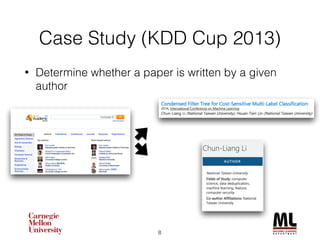
Case Study (KDD Cup 2013)
• Determine whether a paper is written by a given
author
8
We are given raw text 

of these
Data: https://www.kaggle.com/c/kdd-cup-2013-author-paper-identification-challenge
NTU Approaches
9
Feature Engineering
Several Algorithms
Combining Different Models
Pipeline Feature Engineering
Observation
Encode into Feature
Result
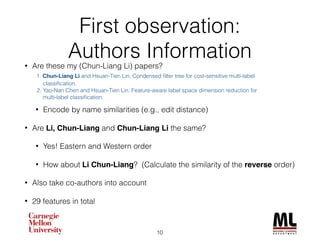
First observation:
Authors Information• Are these my (Chun-Liang Li) papers? (Easy! check author names)

1. Chun-Liang Li and Hsuan-Tien Lin. Condensed filter tree for cost-sensitive multi-label 

classification.

2. Yao-Nan Chen and Hsuan-Tien Lin. Feature-aware label space dimension reduction for 

multi-label classification.
• Encode by name similarities (e.g., how many characters are the same)
• Are Li, Chun-Liang and Chun-Liang Li the same?
• Yes! Eastern and Western order
• How about Li Chun-Liang? (Calculate the similarity of the reverse order)
• Also take co-authors into account
• 29 features in total
10
Second Observation:
Affiliations
• Are Dr. Chi-Jen Lu and Prof. Chih-Jen Lin the same?
• Similar name: Chi-Jen Lu v.s. Chih-Jen Lin
• Shared co-author (me!)
• Take affiliations into account!
• Academia Sinica v.s. National Taiwan University
• 13 features in total
11
Last of KDD Cup 2013
• Many other features, including
• Can you live for more than 100 years? At least I
think I can’t do research after 100 years
• More advanced: social network features
12
Summary
The 97 features designed by students won the competition
Furthermore
• If I can access the content, can I do better? 

13
Author: Robert Galbraith
Who is Robert Galbraith?
“I thought it was by a very 

mature writer, and not a 

first-timer.” — Peter James
Definitely
Writing Style?
• “I was testing things like word length, sentence
length, paragraph length, frequency of particular
words and the pattern of punctuation” 

— Peter Millican (University of Oxford)
14
1 2
3 4
5
15
Game Changing Point:
Deep Learning
Common Type of Data
• Image


• Text
16
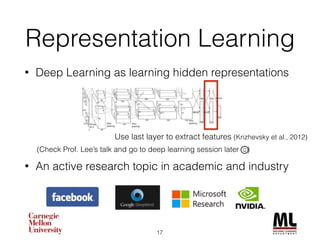
Representation Learning
• Deep Learning as learning hidden representations


• An active research topic in academia and industry
17
Use last layer to extract features (Krizhevsky et al., 2012)
(Check Prof. Lee’s talk and go to deep learning session later )
Raw data
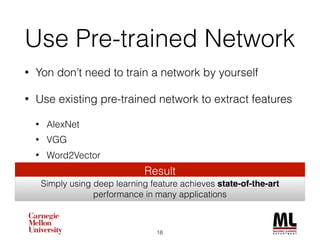
Use Pre-trained Network
• Yon don’t need to train a network by yourself
• Use existing pre-trained network to extract features
• AlexNet
• VGG
• Word2Vector
18
Result
Simply using deep learning features achieves state-of-the-art
performance in many applications
Successful Example
• The PASCAL Visual Object Classes Challenge
19
MeanAverage
Precision
0
0.15
0.3
0.45
0.6
2005 2007 2008 2009 2010 2012 2013 2014
Deep learning result

(Girshick et al. 2014)
HoG feature Slow progress on feature engineering and 

algorithms before deep learning
20
Curse of Dimensionality:
Feature Selection and Dimension Reduction
The more, the better?
21
Practice
If we have 1,000,000 data
with 100,000 dimensions,
how much memory do we
need?


Ans:
Theory
Without any assumption,
you need data to
achieve error for d-
dimensional data
106
⇥ 105
⇥ 8
= 8 ⇥ 1011
(B)
= 800 (GB)
✏
O(
1
✏d
)
Noisy Feature
Is every feature useful?
Redundancy?
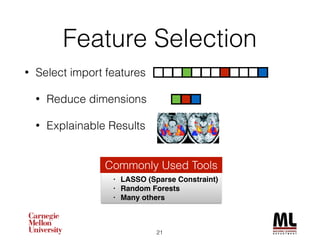
Feature Selection
• Select import features
• Reduce dimensions
• Explainable Results
22
Commonly Used Tools
• LASSO (Sparse Constraint)
• Random Forests
• Many others
KDD Cup Again
• In KDD Cup 2013, we actually generated more
than 200 features (some secrets you won’t see in the paper )
• Use random forests to select only 97 features,
since many features are unimportant and even
harmful, but why?
23
Non-useful Features
• Duplicated features
• Example I: Country (Taiwan) v.s. Coordinates (121, 23.5)
• Example II: Date of birth (1990) v.s. Age (26)
• Noisy features
• Noisy information (something wrong in your data)
• Missing values (something missing in your data)
• What if we still have too many features?
24
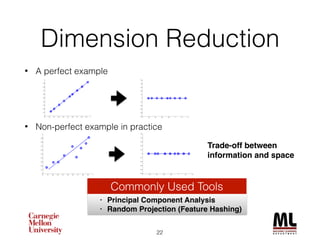
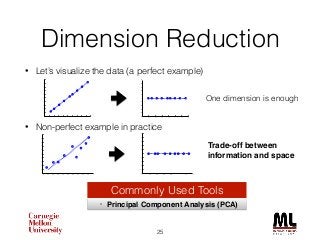
Dimension Reduction
• Let’s visualize the data (a perfect example)


• Non-perfect example in practice
25
Commonly Used Tools
• Principal Component Analysis (PCA)
0 0.1 0.2 0.3 0.4 0.5 0.6 0.7 0.8 0.9 1
0
0.1
0.2
0.3
0.4
0.5
0.6
0.7
0.8
0.9
1
0 0.2 0.4 0.6 0.8 1 1.2 1.4
−0.5
−0.4
−0.3
−0.2
−0.1
0
0.1
0.2
0.3
0.4
0.5
0 0.1 0.2 0.3 0.4 0.5 0.6 0.7 0.8 0.9 1
0
0.1
0.2
0.3
0.4
0.5
0.6
0.7
0.8
0.9
1
0 0.2 0.4 0.6 0.8 1 1.2 1.4
−0.5
−0.4
−0.3
−0.2
−0.1
0
0.1
0.2
0.3
0.4
0.5
Trade-off between 

information and space
One dimension is enough
PCA — Intuition
• Let’s apply PCA on these faces 

(raw pixels) and visualize the 

coordinates
26
0 0.1 0.2 0.3 0.4 0.5 0.6 0.7 0.8 0.9 1
0
0.1
0.2
0.3
0.4
0.5
0.6
0.7
0.8
0.9
1
http://comp435p.tk/
PCA — Intuition (cont.)
• We can use very few base faces to approximate
(describe) the original faces
27
http://comp435p.tk/
(Sirovich and Kirby, Low-dimensional procedure for the characterization of human faces)
1 2 3 4 5 6 7 8 9
PCA — Case Study
• CIFAR-10 image classification 

with raw pixels as features and 

using approximated kernel SVM
28
Dimensions Accuracy Time
3072 (all) 63.1% ~2 Hrs
100 (PCA) 59.8% 250 s
(Li and Pòczos, Utilize Old Coordinates: Faster Doubly Stochastic Gradients for
Kernel Methods, UAI 2016)
Trade-off between information, space and time
PCA in Practice
• Practical concern:
• Time complexity:
• Space complexity:
• Remark: Use fast approximation for large-scale problem (e.g.,
>100k dimensions)
1. PCA with random projection (implemented in scikit-learn)

(Halko et al., Finding Structure with Randomness, 2011)
2. Stochastic algorithms (easy to implement from scratch)

(Li et al., Rivalry of Two Families of Algorithms for Memory-Restricted Streaming PCA,
AISTATS 2016)
29
O(Nd2
)
O(d2
)
Small Problem
PCA takes <10 seconds for
CIFAR-10 dataset (d=3072) by
using 12 cores (E5-2620)
Conclusion
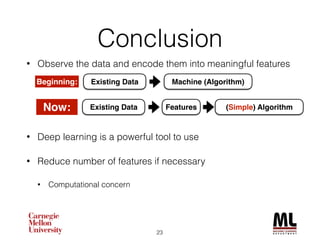
• Observe the data and encode them into meaningful features


• Deep learning is a powerful tool to use
• Reduce number of features if necessary
• Reduce non-useful features
• Computational concern
30
Existing Data Machine (Algorithm)
Features (Simple) AlgorithmExisting Data
Beginning:
Now:
31
Thanks!
Any Question?

李俊良/Feature Engineering in Machine Learning

  • 1.
    Feature Engineering in MachineLearning Chun-Liang Li (李俊良) chunlial@cs.cmu.edu
  • 2.
    About Me 2 Academic Competition Working •NTU CSIE BS/MS (2012/2013) • Advisor: Prof. Hsuan-Tien Lin
 • CMU MLD PhD (2014-) • Advisor: Prof. Jeff Schneider Prof. Barnabás Póczos • KDD Cup 2011 Champions
 KDD Cup 2013 Champions • With Prof. Chih-Jen Lin
 Prof. Hsuan-Tien Lin
 Prof. Shou-De Lin
 Many students (2012 intern) (2015 intern)
  • 3.
    What is MachineLearning? • What is Machine Learning?
 3 Learning Prediction Existing Data Machine (Algorithm) Model New Data Model Prediction Data: Several length-d vectors
  • 4.
    Data? Algorithm? • Inacademic • Assume we are given good enough data (in d-dimensional of course ) • Focus on designing better algorithms
 Sometimes complicated algorithms imply publications • In practice • Where is your good enough data? • Or, how to transform your data into a d-dimensional one? 4
  • 5.
    From Zero toOne: Create your features by your observations 5
  • 6.
    An Apple 6 How todescribe this picture?
  • 7.
    More Fruits • MethodI: Use size of picture
 • Method II: Use RGB average
 • Many more powerful features 
 developed in computer vision 7 (640, 580) (640, 580) (219, 156, 140) (243, 194, 113) (216, 156, 155)
  • 8.
    Case Study (KDDCup 2013) • Determine whether a paper is written by a given author 8 We are given raw text 
 of these Data: https://www.kaggle.com/c/kdd-cup-2013-author-paper-identification-challenge
  • 9.
    NTU Approaches 9 Feature Engineering SeveralAlgorithms Combining Different Models Pipeline Feature Engineering Observation Encode into Feature Result
  • 10.
    First observation: Authors Information•Are these my (Chun-Liang Li) papers? (Easy! check author names)
 1. Chun-Liang Li and Hsuan-Tien Lin. Condensed filter tree for cost-sensitive multi-label 
 classification.
 2. Yao-Nan Chen and Hsuan-Tien Lin. Feature-aware label space dimension reduction for 
 multi-label classification. • Encode by name similarities (e.g., how many characters are the same) • Are Li, Chun-Liang and Chun-Liang Li the same? • Yes! Eastern and Western order • How about Li Chun-Liang? (Calculate the similarity of the reverse order) • Also take co-authors into account • 29 features in total 10
  • 11.
    Second Observation: Affiliations • AreDr. Chi-Jen Lu and Prof. Chih-Jen Lin the same? • Similar name: Chi-Jen Lu v.s. Chih-Jen Lin • Shared co-author (me!) • Take affiliations into account! • Academia Sinica v.s. National Taiwan University • 13 features in total 11
  • 12.
    Last of KDDCup 2013 • Many other features, including • Can you live for more than 100 years? At least I think I can’t do research after 100 years • More advanced: social network features 12 Summary The 97 features designed by students won the competition
  • 13.
    Furthermore • If Ican access the content, can I do better? 
 13 Author: Robert Galbraith Who is Robert Galbraith? “I thought it was by a very 
 mature writer, and not a 
 first-timer.” — Peter James Definitely
  • 14.
    Writing Style? • “Iwas testing things like word length, sentence length, paragraph length, frequency of particular words and the pattern of punctuation” 
 — Peter Millican (University of Oxford) 14 1 2 3 4 5
  • 15.
  • 16.
    Common Type ofData • Image
 
 
 • Text 16
  • 17.
    Representation Learning • DeepLearning as learning hidden representations


 • An active research topic in academia and industry 17 Use last layer to extract features (Krizhevsky et al., 2012) (Check Prof. Lee’s talk and go to deep learning session later ) Raw data
  • 18.
    Use Pre-trained Network •Yon don’t need to train a network by yourself • Use existing pre-trained network to extract features • AlexNet • VGG • Word2Vector 18 Result Simply using deep learning features achieves state-of-the-art performance in many applications
  • 19.
    Successful Example • ThePASCAL Visual Object Classes Challenge 19 MeanAverage Precision 0 0.15 0.3 0.45 0.6 2005 2007 2008 2009 2010 2012 2013 2014 Deep learning result
 (Girshick et al. 2014) HoG feature Slow progress on feature engineering and 
 algorithms before deep learning
  • 20.
    20 Curse of Dimensionality: FeatureSelection and Dimension Reduction
  • 21.
    The more, thebetter? 21 Practice If we have 1,000,000 data with 100,000 dimensions, how much memory do we need? 
 Ans: Theory Without any assumption, you need data to achieve error for d- dimensional data 106 ⇥ 105 ⇥ 8 = 8 ⇥ 1011 (B) = 800 (GB) ✏ O( 1 ✏d ) Noisy Feature Is every feature useful? Redundancy?
  • 22.
    Feature Selection • Selectimport features • Reduce dimensions • Explainable Results 22 Commonly Used Tools • LASSO (Sparse Constraint) • Random Forests • Many others
  • 23.
    KDD Cup Again •In KDD Cup 2013, we actually generated more than 200 features (some secrets you won’t see in the paper ) • Use random forests to select only 97 features, since many features are unimportant and even harmful, but why? 23
  • 24.
    Non-useful Features • Duplicatedfeatures • Example I: Country (Taiwan) v.s. Coordinates (121, 23.5) • Example II: Date of birth (1990) v.s. Age (26) • Noisy features • Noisy information (something wrong in your data) • Missing values (something missing in your data) • What if we still have too many features? 24
  • 25.
    Dimension Reduction • Let’svisualize the data (a perfect example)
 
 
 • Non-perfect example in practice 25 Commonly Used Tools • Principal Component Analysis (PCA) 0 0.1 0.2 0.3 0.4 0.5 0.6 0.7 0.8 0.9 1 0 0.1 0.2 0.3 0.4 0.5 0.6 0.7 0.8 0.9 1 0 0.2 0.4 0.6 0.8 1 1.2 1.4 −0.5 −0.4 −0.3 −0.2 −0.1 0 0.1 0.2 0.3 0.4 0.5 0 0.1 0.2 0.3 0.4 0.5 0.6 0.7 0.8 0.9 1 0 0.1 0.2 0.3 0.4 0.5 0.6 0.7 0.8 0.9 1 0 0.2 0.4 0.6 0.8 1 1.2 1.4 −0.5 −0.4 −0.3 −0.2 −0.1 0 0.1 0.2 0.3 0.4 0.5 Trade-off between 
 information and space One dimension is enough
  • 26.
    PCA — Intuition •Let’s apply PCA on these faces 
 (raw pixels) and visualize the 
 coordinates 26 0 0.1 0.2 0.3 0.4 0.5 0.6 0.7 0.8 0.9 1 0 0.1 0.2 0.3 0.4 0.5 0.6 0.7 0.8 0.9 1 http://comp435p.tk/
  • 27.
    PCA — Intuition(cont.) • We can use very few base faces to approximate (describe) the original faces 27 http://comp435p.tk/ (Sirovich and Kirby, Low-dimensional procedure for the characterization of human faces) 1 2 3 4 5 6 7 8 9
  • 28.
    PCA — CaseStudy • CIFAR-10 image classification 
 with raw pixels as features and 
 using approximated kernel SVM 28 Dimensions Accuracy Time 3072 (all) 63.1% ~2 Hrs 100 (PCA) 59.8% 250 s (Li and Pòczos, Utilize Old Coordinates: Faster Doubly Stochastic Gradients for Kernel Methods, UAI 2016) Trade-off between information, space and time
  • 29.
    PCA in Practice •Practical concern: • Time complexity: • Space complexity: • Remark: Use fast approximation for large-scale problem (e.g., >100k dimensions) 1. PCA with random projection (implemented in scikit-learn)
 (Halko et al., Finding Structure with Randomness, 2011) 2. Stochastic algorithms (easy to implement from scratch)
 (Li et al., Rivalry of Two Families of Algorithms for Memory-Restricted Streaming PCA, AISTATS 2016) 29 O(Nd2 ) O(d2 ) Small Problem PCA takes <10 seconds for CIFAR-10 dataset (d=3072) by using 12 cores (E5-2620)
  • 30.
    Conclusion • Observe thedata and encode them into meaningful features


 • Deep learning is a powerful tool to use • Reduce number of features if necessary • Reduce non-useful features • Computational concern 30 Existing Data Machine (Algorithm) Features (Simple) AlgorithmExisting Data Beginning: Now:
  • 31.