Introduction to Financial Markets and
Money
Financial Economics
Financial Markets and Monetary Policy
Financial Economics
What is Money?
Financial Economics
Characteristics and Functions of Money
1. Durability i.e. it needs to last
2. Portable i.e. easy to carry around, convenient, easy to
use
3. Divisible i.e. it can be broken down into smaller
denominations
4. Hard to counterfeit - i.e. it can’t easily be faked or
copied
5. Must be generally accepted by a population
6. Valuable – generally holds value over time
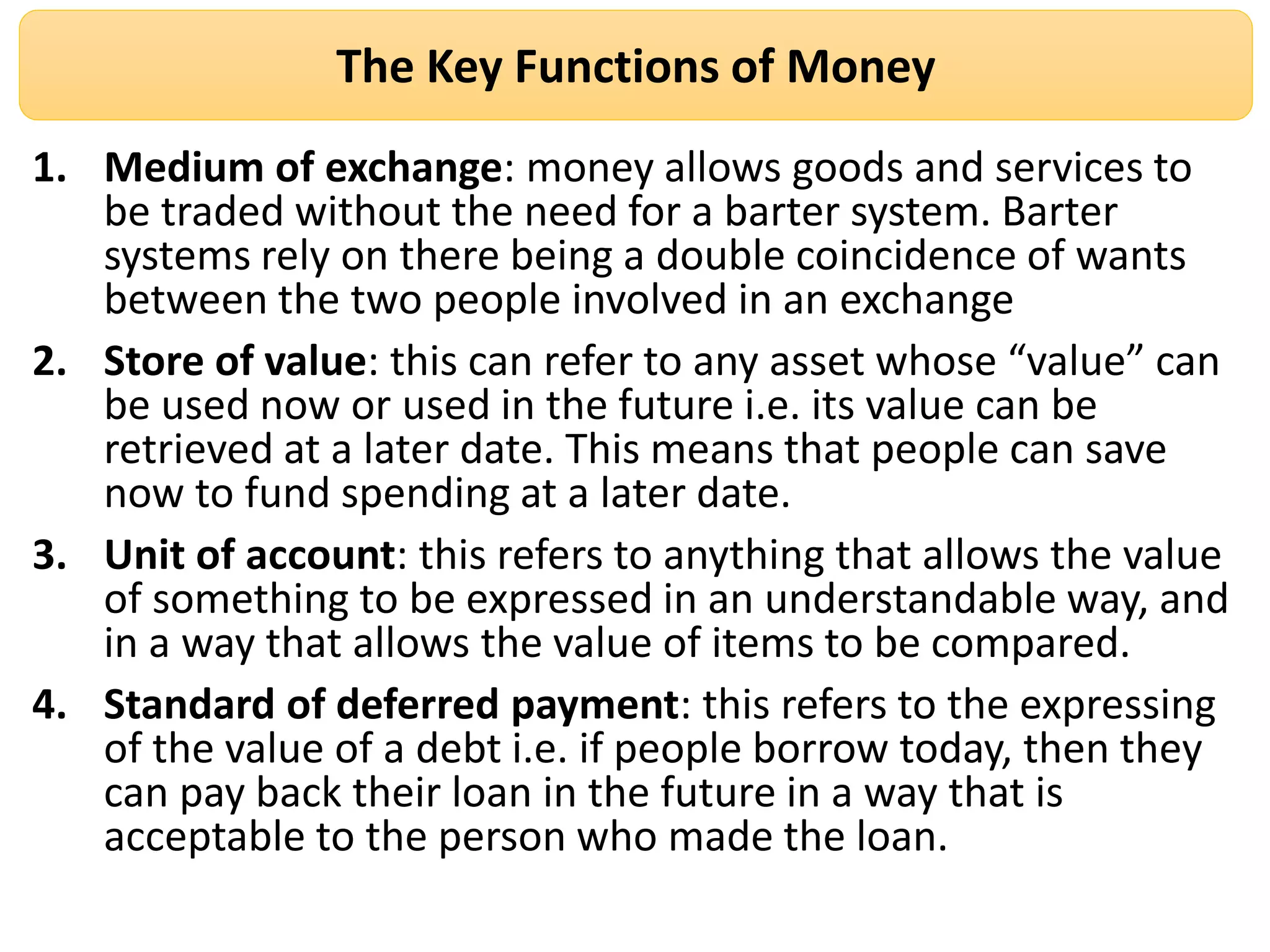
The Key Functions of Money
1. Medium of exchange: money allows goods and services to
be traded without the need for a barter system. Barter
systems rely on there being a double coincidence of wants
between the two people involved in an exchange
2. Store of value: this can refer to any asset whose “value” can
be used now or used in the future i.e. its value can be
retrieved at a later date. This means that people can save
now to fund spending at a later date.
3. Unit of account: this refers to anything that allows the value
of something to be expressed in an understandable way, and
in a way that allows the value of items to be compared.
4. Standard of deferred payment: this refers to the expressing
of the value of a debt i.e. if people borrow today, then they
can pay back their loan in the future in a way that is
acceptable to the person who made the loan.
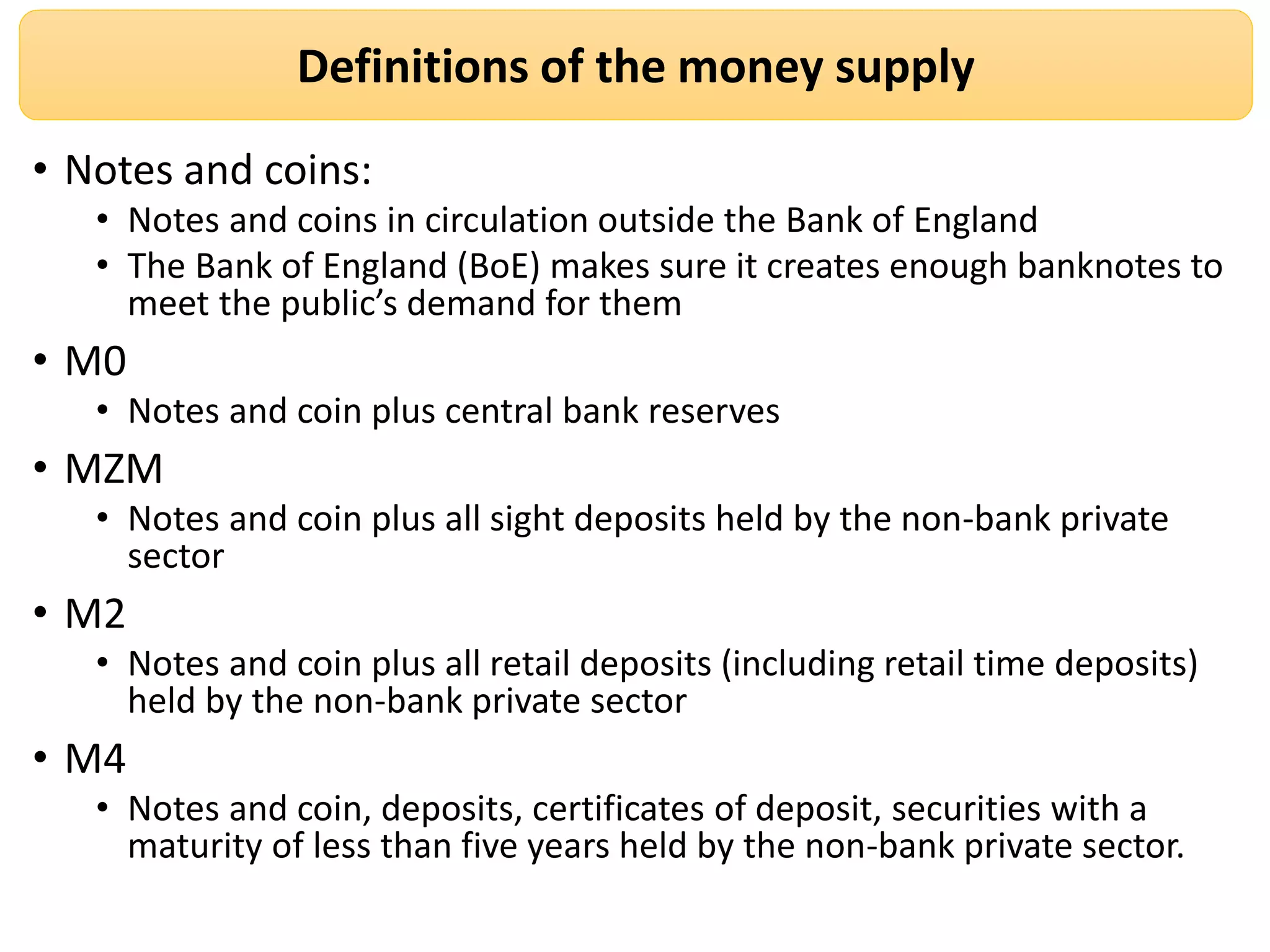
Definitions of the money supply
• Notes and coins:
• Notes and coins in circulation outside the Bank of England
• The Bank of England (BoE) makes sure it creates enough banknotes to
meet the public’s demand for them
• M0
• Notes and coin plus central bank reserves
• MZM
• Notes and coin plus all sight deposits held by the non-bank private
sector
• M2
• Notes and coin plus all retail deposits (including retail time deposits)
held by the non-bank private sector
• M4
• Notes and coin, deposits, certificates of deposit, securities with a
maturity of less than five years held by the non-bank private sector.
Distinction between narrow money and broad money
• Narrow Money
• The narrow money definition of the money supply is a measure
of the value coins and notes in circulation and other money
equivalents that are easily convertible into cash such as short
term deposits in the banking system
• Broad Money
• Broad money is a measure of the total amount of money held by
households and companies in the economy
• Broad money is made up mainly of commercial bank deposits —
which are essentially IOUs from commercial banks to
households and companies — and currency — mostly IOUs from
the central bank
Is Bitcoin Real Money?
• Bitcoin is a digital currency that was launched by a secretive entrepreneur
in October 2008, with the aim of being “a new electronic cash system that
is fully peer-to-peer with no trusted third party”.
• Bitcoins are created by users (a.k.a. “miners”) who allow the Bitcoin
system to use their computing power to process Bitcoin transactions
• These miners are also rewarded with the some of the transaction fees paid
by those who use Bitcoin.
• A few retailers, especially online, accept Bitcoin, partly because the
transaction fees are lower than those of credit cards.
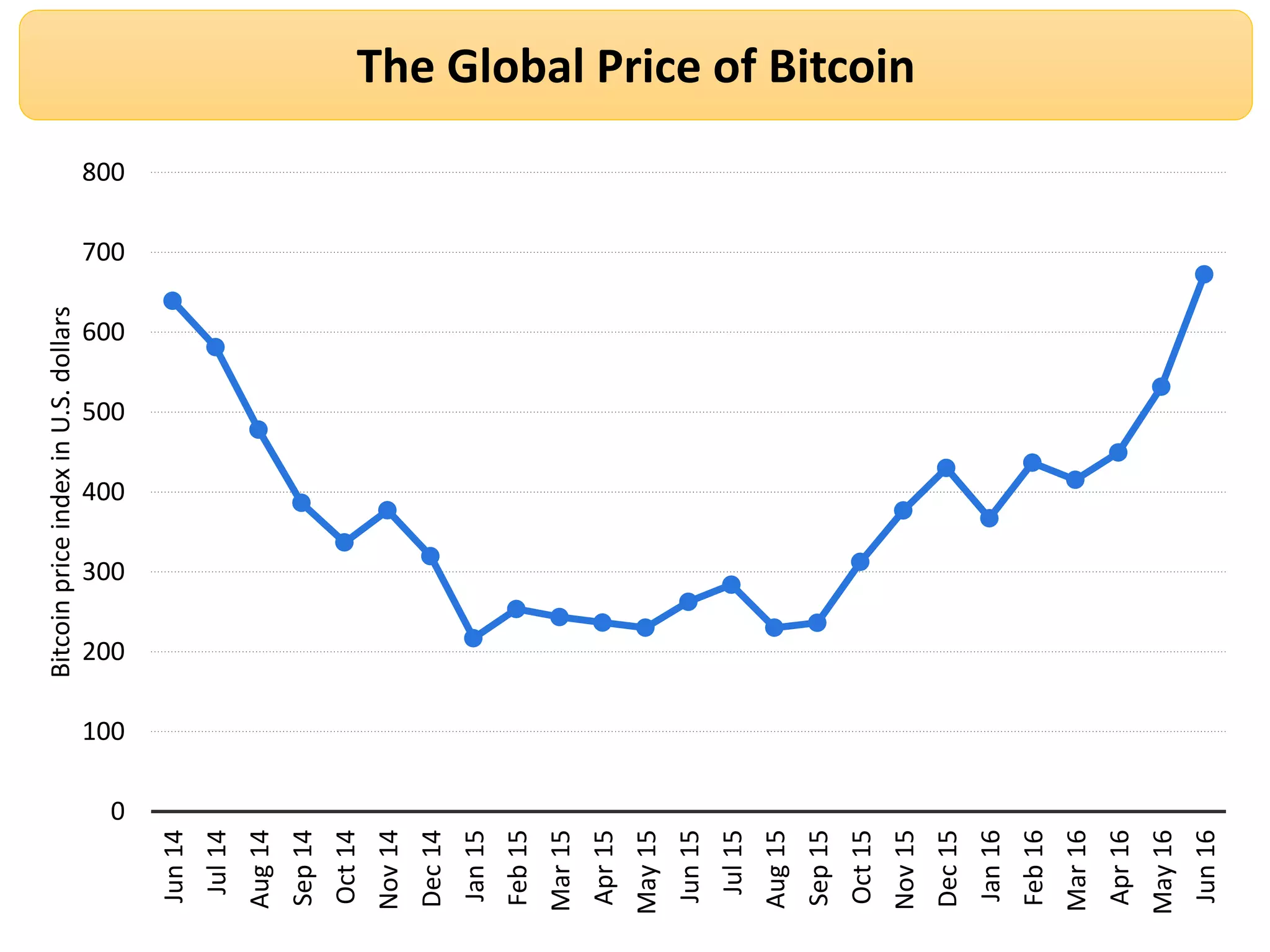
• However, Bitcoin’s value has been volatile
• Fewer retailers than expected have signed up to accept Bitcoin because
any transactions made in Bitcoin are not protected by financial regulation.
• Bitcoin is special it is made possible by special cryptographic techniques so
that it can not be faked
• Each Bitcoin can only be spent by the same person just once.
• The peer-to-peer nature of Bitcoin bypasses the need for banks, allowing
people to lend to or borrow directly from others.
The Global Price of Bitcoin
0
100
200
300
400
500
600
700
800 Jun14
Jul14
Aug14
Sep14
Oct14
Nov14
Dec14
Jan15
Feb15
Mar15
Apr15
May15
Jun15
Jul15
Aug15
Sep15
Oct15
Nov15
Dec15
Jan16
Feb16
Mar16
Apr16
May16
Jun16
BitcoinpriceindexinU.S.dollars
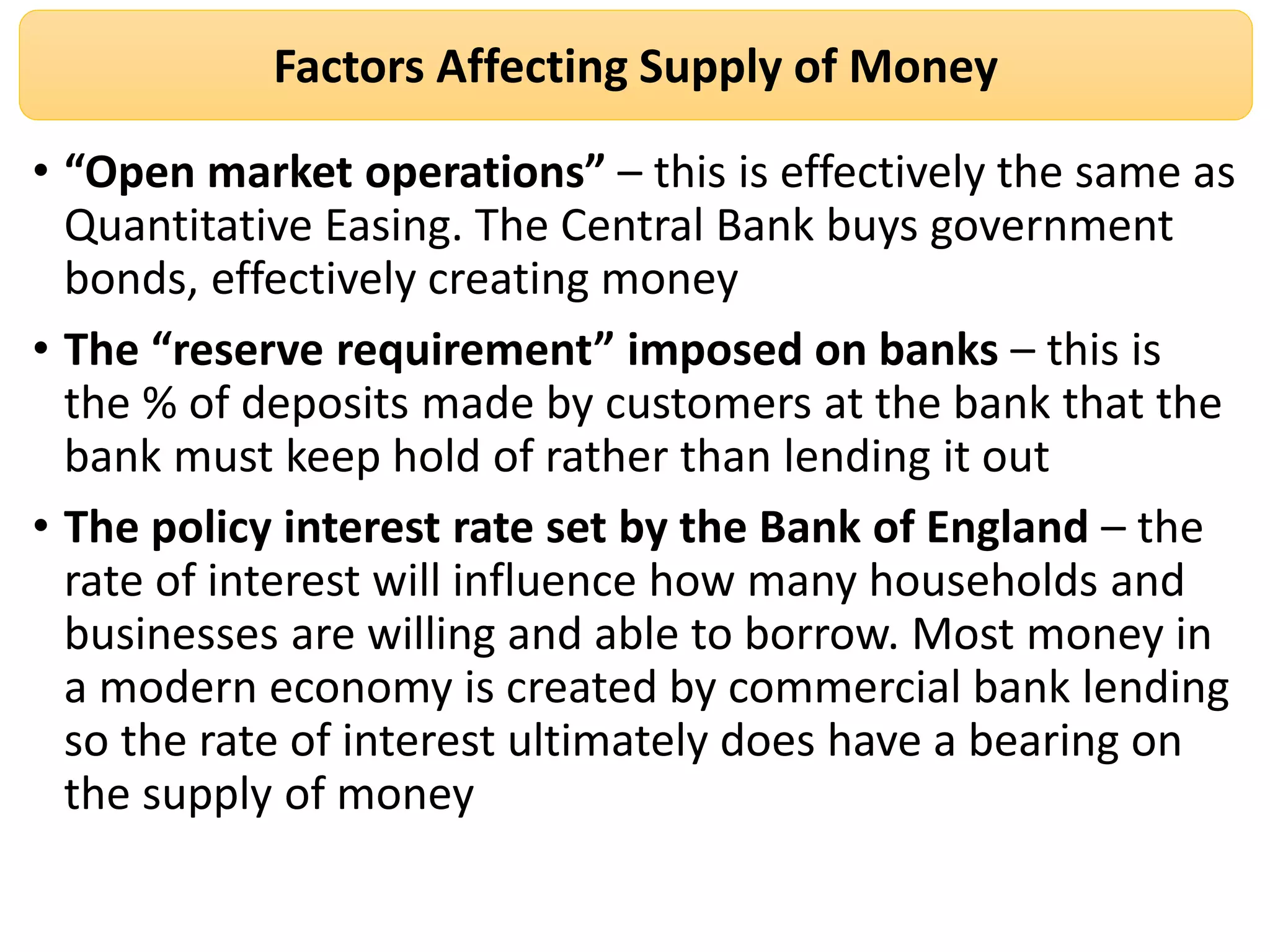
Factors Affecting Supply of Money
• “Open market operations” – this is effectively the same as
Quantitative Easing. The Central Bank buys government
bonds, effectively creating money
• The “reserve requirement” imposed on banks – this is
the % of deposits made by customers at the bank that the
bank must keep hold of rather than lending it out
• The policy interest rate set by the Bank of England – the
rate of interest will influence how many households and
businesses are willing and able to borrow. Most money in
a modern economy is created by commercial bank lending
so the rate of interest ultimately does have a bearing on
the supply of money
Factors Affecting Demand for Money
• The rate of interest on loans
• The number / value of monetary transactions that we
expect to carry out
• The extent to which we also want to hold other financial
assets, such as bonds, property, saving (this is also
influenced by the rate of interest) – this is known as the
speculative motive for holding money
• Changes in GDP
• The extent to which it is possible to use debit cards /
credit cards i.e. the pace of financial innovation
• The extent to which we might have to pay out large
unexpected payments, for example, for i.e. the
precautionary motive
• The rate of anticipated inflation
UK Savings and Lending Interest Rates
0.00
2.00
4.00
6.00
8.00
10.00
12.00
Jan2006
Jun2006
Nov2006
Apr2007
Sep2007
Feb2008
Jul2008
Dec2008
May2009
Oct2009
Mar2010
Aug2010
Jan2011
Jun2011
Nov2011
Apr2012
Sep2012
Feb2013
Jul2013
Dec2013
May2014
Oct2014
Mar2015
Aug2015
Jan2016
Household deposit and lending interest rates
£10,000 unsecured loan Two-year, fixed-rate mortgage, 90% loan to value
Two-year, fixed-rate mortgage, 75% loan to value New fixed-rate time deposit
Money, capital & foreign exchange markets
Money
Market
Market for short term loan finance for businesses
and households
Money is borrowed and lent normally for up to 12
months
Includes inter-bank lending i.e. the commercial
banks providing liquidity for each other
Includes short term government borrowing e.g. 3-
12 month Treasury Bills – to help fund the
government’s budget (fiscal) deficit
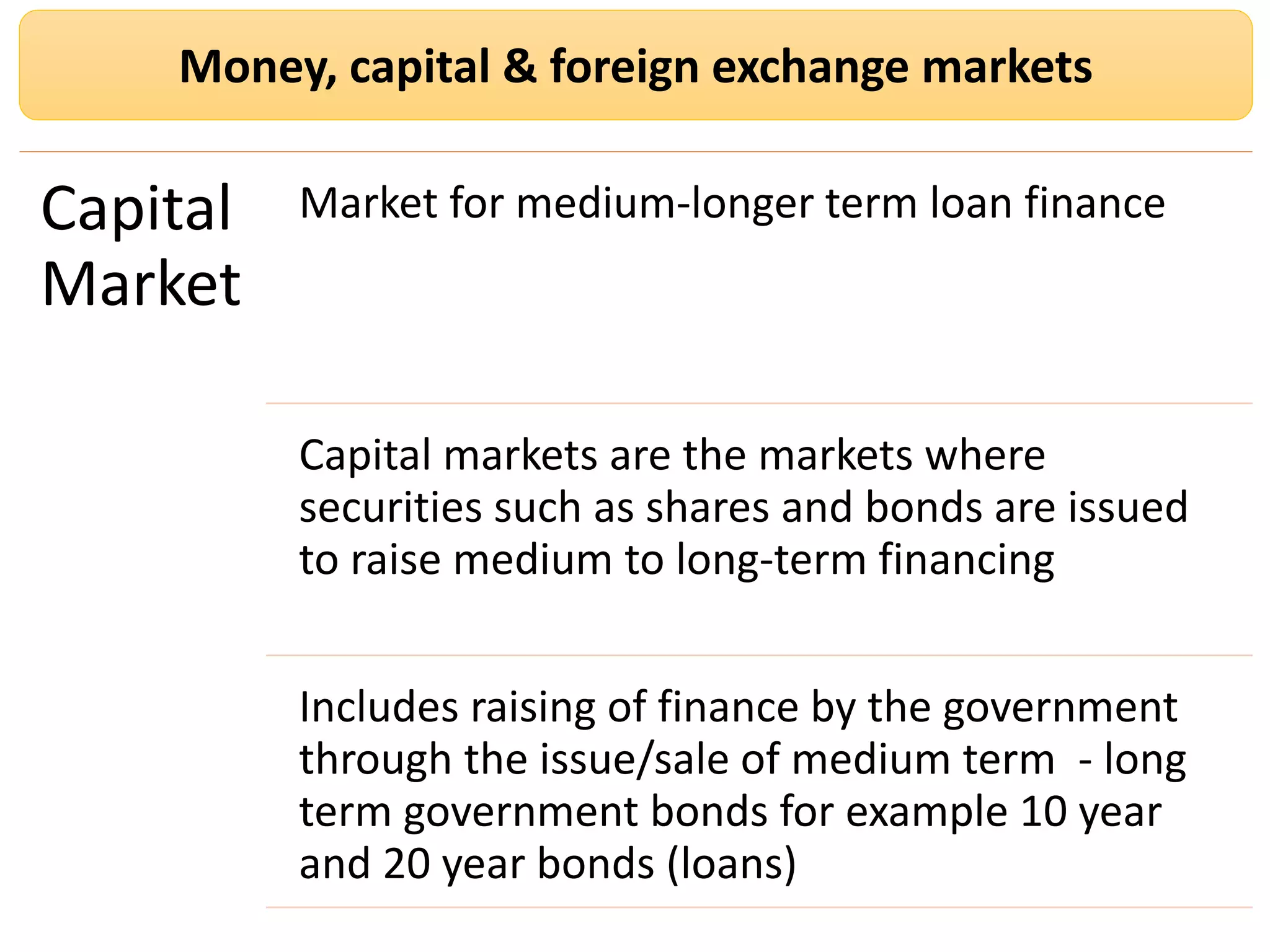
Money, capital & foreign exchange markets
Capital
Market
Market for medium-longer term loan finance
Capital markets are the markets where
securities such as shares and bonds are issued
to raise medium to long-term financing
Includes raising of finance by the government
through the issue/sale of medium term - long
term government bonds for example 10 year
and 20 year bonds (loans)
Money, capital & foreign exchange markets
Foreign
exchange
market
A market where currencies (foreign exchange) are
traded. There is no single currency market – it is
made up of the thousands of trading floors
Gains or losses are made from the movement of
exchange rates – speculative activity in the
currency market is often high
The spot exchange rate is the price of a currency
to be delivered now, rather than in the future.
The forward exchange rate is a fixed price given
for buying a currency today to be delivered in the
future
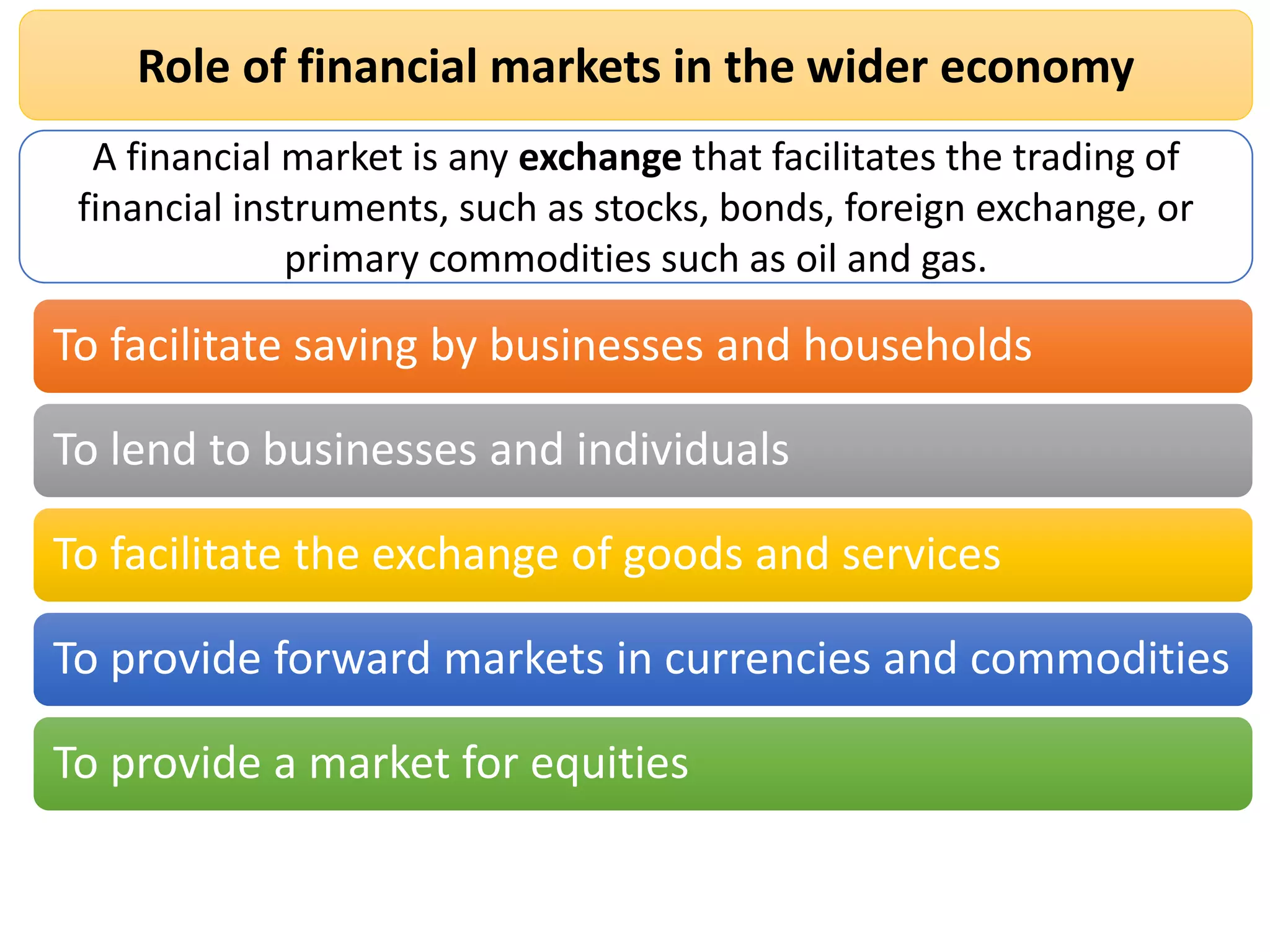
Role of financial markets in the wider economy
To facilitate saving by businesses and households
To lend to businesses and individuals
To facilitate the exchange of goods and services
To provide forward markets in currencies and commodities
To provide a market for equities
A financial market is any exchange that facilitates the trading of
financial instruments, such as stocks, bonds, foreign exchange, or
primary commodities such as oil and gas.

Introduction to Financial Markets and Money

  • 1.
    Introduction to FinancialMarkets and Money Financial Economics
  • 2.
    Financial Markets andMonetary Policy Financial Economics
  • 3.
  • 4.
    Characteristics and Functionsof Money 1. Durability i.e. it needs to last 2. Portable i.e. easy to carry around, convenient, easy to use 3. Divisible i.e. it can be broken down into smaller denominations 4. Hard to counterfeit - i.e. it can’t easily be faked or copied 5. Must be generally accepted by a population 6. Valuable – generally holds value over time
  • 5.
    The Key Functionsof Money 1. Medium of exchange: money allows goods and services to be traded without the need for a barter system. Barter systems rely on there being a double coincidence of wants between the two people involved in an exchange 2. Store of value: this can refer to any asset whose “value” can be used now or used in the future i.e. its value can be retrieved at a later date. This means that people can save now to fund spending at a later date. 3. Unit of account: this refers to anything that allows the value of something to be expressed in an understandable way, and in a way that allows the value of items to be compared. 4. Standard of deferred payment: this refers to the expressing of the value of a debt i.e. if people borrow today, then they can pay back their loan in the future in a way that is acceptable to the person who made the loan.
  • 6.
    Definitions of themoney supply • Notes and coins: • Notes and coins in circulation outside the Bank of England • The Bank of England (BoE) makes sure it creates enough banknotes to meet the public’s demand for them • M0 • Notes and coin plus central bank reserves • MZM • Notes and coin plus all sight deposits held by the non-bank private sector • M2 • Notes and coin plus all retail deposits (including retail time deposits) held by the non-bank private sector • M4 • Notes and coin, deposits, certificates of deposit, securities with a maturity of less than five years held by the non-bank private sector.
  • 7.
    Distinction between narrowmoney and broad money • Narrow Money • The narrow money definition of the money supply is a measure of the value coins and notes in circulation and other money equivalents that are easily convertible into cash such as short term deposits in the banking system • Broad Money • Broad money is a measure of the total amount of money held by households and companies in the economy • Broad money is made up mainly of commercial bank deposits — which are essentially IOUs from commercial banks to households and companies — and currency — mostly IOUs from the central bank
  • 8.
    Is Bitcoin RealMoney? • Bitcoin is a digital currency that was launched by a secretive entrepreneur in October 2008, with the aim of being “a new electronic cash system that is fully peer-to-peer with no trusted third party”. • Bitcoins are created by users (a.k.a. “miners”) who allow the Bitcoin system to use their computing power to process Bitcoin transactions • These miners are also rewarded with the some of the transaction fees paid by those who use Bitcoin. • A few retailers, especially online, accept Bitcoin, partly because the transaction fees are lower than those of credit cards. • However, Bitcoin’s value has been volatile • Fewer retailers than expected have signed up to accept Bitcoin because any transactions made in Bitcoin are not protected by financial regulation. • Bitcoin is special it is made possible by special cryptographic techniques so that it can not be faked • Each Bitcoin can only be spent by the same person just once. • The peer-to-peer nature of Bitcoin bypasses the need for banks, allowing people to lend to or borrow directly from others.
  • 9.
    The Global Priceof Bitcoin 0 100 200 300 400 500 600 700 800 Jun14 Jul14 Aug14 Sep14 Oct14 Nov14 Dec14 Jan15 Feb15 Mar15 Apr15 May15 Jun15 Jul15 Aug15 Sep15 Oct15 Nov15 Dec15 Jan16 Feb16 Mar16 Apr16 May16 Jun16 BitcoinpriceindexinU.S.dollars
  • 10.
    Factors Affecting Supplyof Money • “Open market operations” – this is effectively the same as Quantitative Easing. The Central Bank buys government bonds, effectively creating money • The “reserve requirement” imposed on banks – this is the % of deposits made by customers at the bank that the bank must keep hold of rather than lending it out • The policy interest rate set by the Bank of England – the rate of interest will influence how many households and businesses are willing and able to borrow. Most money in a modern economy is created by commercial bank lending so the rate of interest ultimately does have a bearing on the supply of money
  • 11.
    Factors Affecting Demandfor Money • The rate of interest on loans • The number / value of monetary transactions that we expect to carry out • The extent to which we also want to hold other financial assets, such as bonds, property, saving (this is also influenced by the rate of interest) – this is known as the speculative motive for holding money • Changes in GDP • The extent to which it is possible to use debit cards / credit cards i.e. the pace of financial innovation • The extent to which we might have to pay out large unexpected payments, for example, for i.e. the precautionary motive • The rate of anticipated inflation
  • 12.
    UK Savings andLending Interest Rates 0.00 2.00 4.00 6.00 8.00 10.00 12.00 Jan2006 Jun2006 Nov2006 Apr2007 Sep2007 Feb2008 Jul2008 Dec2008 May2009 Oct2009 Mar2010 Aug2010 Jan2011 Jun2011 Nov2011 Apr2012 Sep2012 Feb2013 Jul2013 Dec2013 May2014 Oct2014 Mar2015 Aug2015 Jan2016 Household deposit and lending interest rates £10,000 unsecured loan Two-year, fixed-rate mortgage, 90% loan to value Two-year, fixed-rate mortgage, 75% loan to value New fixed-rate time deposit
  • 13.
    Money, capital &foreign exchange markets Money Market Market for short term loan finance for businesses and households Money is borrowed and lent normally for up to 12 months Includes inter-bank lending i.e. the commercial banks providing liquidity for each other Includes short term government borrowing e.g. 3- 12 month Treasury Bills – to help fund the government’s budget (fiscal) deficit
  • 14.
    Money, capital &foreign exchange markets Capital Market Market for medium-longer term loan finance Capital markets are the markets where securities such as shares and bonds are issued to raise medium to long-term financing Includes raising of finance by the government through the issue/sale of medium term - long term government bonds for example 10 year and 20 year bonds (loans)
  • 15.
    Money, capital &foreign exchange markets Foreign exchange market A market where currencies (foreign exchange) are traded. There is no single currency market – it is made up of the thousands of trading floors Gains or losses are made from the movement of exchange rates – speculative activity in the currency market is often high The spot exchange rate is the price of a currency to be delivered now, rather than in the future. The forward exchange rate is a fixed price given for buying a currency today to be delivered in the future
  • 16.
    Role of financialmarkets in the wider economy To facilitate saving by businesses and households To lend to businesses and individuals To facilitate the exchange of goods and services To provide forward markets in currencies and commodities To provide a market for equities A financial market is any exchange that facilitates the trading of financial instruments, such as stocks, bonds, foreign exchange, or primary commodities such as oil and gas.