Money
- is any object or record that is generally accepted
as payment for goods and services and repayment
of debts in a given socio-economic context or country.
Main Functions of Money
-a medium of exchange;
-a unit of account;
-a store of value; and,
-occasionally in the past, a standard of deferred payment
Any kind of object or secure verifiable record that fulfils these
functions can be considered money.
Money is historically an emergent market
phenomenon establishing commodity money, but nearly
all contemporary money systems are based on fiat
money. Fiat money, like any check or note of debt, is
without intrinsic use value as a physical commodity. It
derives its value by being declared by a government to
be legal tender; that is, it must be accepted as a form of
payment within the boundaries of the country, for "all
debts, public and private". Such laws in practice cause
fiat money to acquire the value of any of the goods and
services that it may be traded for within the nation that
issues it.
Chapter 5
A. Concept of Money
The money supply of a country consists
of currency (banknotes and coins) and bank money(the
balance held in checking accounts and savings
accounts). Bank money, which consists only of records
(mostly computerized in modern banking), forms by far the
largest part of the money supply in developed nations.
Money is any asset that is acceptable in the
settlement of a debt. For an asset to be widely used as
money, it should be portable, divisible, durable and stable in
value.
Some assets fulfil the role of money much better than
other ones. Gold and silver have frequently been used as
money, given their divisibility into bars and coins. The
introduction of paper money by the Chinese marked a
significant development in the evolution of money, especially
given the ease with which different denominations could be
created, and the portability of paper money in comparison
with gold or coinage.
The advent of money as a medium of
exchange replaced the need for exchange through barter and
enabled producers and factor owners to specialise and sell
their output for money. The money earned could then be used
to trade with other producers and factor owners. It is clear
that the evolution of money as a medium of exchange, and as
a store of wealth, had a considerable impact on the
development of modern economic commerce, international
trade, and global prosperity.
In modern economies, notes and coins represent only
a small fraction of the total money supply, with most money
being in the form of digital bank accounts.
Chapter 5
B. Monetary Policy Defined
Types of Monetary Policies
Inflation Targeting
Inflation targeting revolves around
meeting publicly announced, preset rates of
inflation. The standard used is typically a
price index of a basket of consumer
goods, such as the Consumer Price
Index (CPI) in the United States. It
intends to bring actual inflation to their
desired numbers by bringing about changes
in interest rates, open market
operations, and other monetary tools.
Price Level Targeting
Price level targeting involves keeping overall
price levels stable, or meeting a predetermined price
level. Similar to inflation targeting, the central bank
alters interest rates to be able to keep the index level
constant throughout the years. Flourishing and
advanced economies opt not to use this method as it is
generally perceived to be risky and uncertain.
Monetary Aggregates
This approach focuses on controlling monetary
quantities. Once monetary aggregates grow too
rapidly, central banks might be triggered to increase
interest rates, because of the fear of inflation.
Fixed Exchange Rate
Fixed exchange rate is also often called
“Pegged Exchange Rate”. Here, a currency‟s value is
pegged to the value of a single currency, or to a basket
of other currencies or measure of value, such as gold.
The focus of this monetary system is to maintain a
nation‟s currency within a narrow band.
Gold Standard
In Gold Standard, the government allows its
currency to be converted into fixed amounts of
gold, and vice versa. This may be regarded as a
special kind of Fixed Rate Exchange policy, or of
Price Level Targeting. This monetary policy is
considered flawed because of the need for large gold
reserves of countries to keep up with the demand and
Chapter 5
C. Monetary Theories
Monetary theory suggests
that different monetary policies can
benefit nations depending on their
unique set of resources and
limitations. It is based on core
ideas about how factors like the
size of the money supply, price
levels and benchmark interest rates
affect the economy.
Money supply
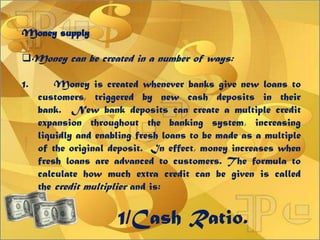
Money can be created in a number of ways:
1. Money is created whenever banks give new loans to
customers, triggered by new cash deposits in their
bank. New bank deposits can create a multiple credit
expansion throughout the banking system, increasing
liquidly and enabling fresh loans to be made as a multiple
of the original deposit. In effect, money increases when
fresh loans are advanced to customers. The formula to
calculate how much extra credit can be given is called
the credit multiplier and is:
1/Cash Ratio.
Money supply
2. Secondly, issuing Treasury bills can also add to the
money supply, and this happens when the government
borrows from the money market by issuing Treasury
bills. Banks treat these bills as being 'as good as
cash', and continue to make the same amount of loans to
their customers. This is despite the fact they have lost
liquidity by buying bills from the Treasury. The net
effect is that money supply in the economy increases.
Money supply
3. Thirdly, the central bank, the Bank of England, can print
new money if the normal flow of liquidity is disrupted, as in
the recent financial crisis. The Bank can use this new
money to buy up existing government debt, including bonds
held with private firms, so injecting new liquidity into the
system. This process is called quantitative easing.
The demand for money
According to Keynes‟ Liquidity
Preference theory, people demand money, that is liquidity, and
hold their wealth in a monetary form for three reasons:
1. To engage in real transactions
2. As a precaution in the event of unexpected spending
3. To engage in speculative transactions
The demand for money
The different components of the demand for
money can be plotted against interest rates.
Together, they represent the demand for
money, which may also be called 'liquidity
preference'.
Money supply
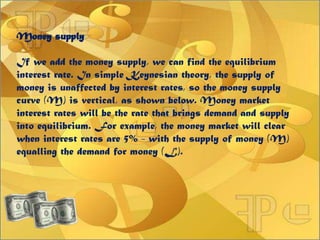
If we add the money supply, we can find the equilibrium
interest rate. In simple Keynesian theory, the supply of
money is unaffected by interest rates, so the money supply
curve (M) is vertical, as shown below. Money market
interest rates will be the rate that brings demand and supply
into equilibrium. For example, the money market will clear
when interest rates are 5% - with the supply of money (M)
equalling the demand for money (L).
The supply of money
The different components of the
demand for money can be plotted
against interest rates.
Modern money markets
The UK money market includes banks, building
societies, and specialist securities dealers who buy and sell
money. The market is controlled by the Bank of England, and
regulation is shared between the Bank of England, the
Treasury, and the Financial Services Authority (FSA).
Monetarism
Monetarism is closely associated
with Classical economics and is an economic philosophy
which believes that economic prosperity depends upon
understanding and manipulating the link between money and the
real economy - that is, prices, output and employment. In
addition, monetarism stresses the effective control of the
money supply as the main method of stabilising the macro-
economy.
Although monetarism dates back to English
philosophers of the 18th Century, its modern origins can be
traced to the work of Irving Fisher of Yale
University, writing in the early 20th century. Modern
quantity theorists, including Milton Friedman of Chicago
University, developed Fisher‟s work further.
Monetarists, such as Friedman, believe that:
1. Money can be defined - money is defined as „anything
generally acceptable with which to settle a debt‟.
2. Money can be controlled - monetary authorities can
increase or decrease the amount of money in the economy.
3. Changes in money have a direct and measurable effect on
the rest of the economy - indeed, the money supply has a
significant effect on the spending of households and firms.
4. Inflation and deflation are always and everywhere a
monetary phenomenon - changes in money are always the
cause of price changes.
Money and inflation - The Fisher equation
Fisher proposed that there was a stable and
predictable relationship between the quantity of money in
circulation in an economy, and the price level, using his famous
equation:
MV = PT, where:
M = the stock of money
V = the velocity of circulation
P = average prices
T = the number of transactions
If we assume V and T are constant, as the economy
approaches full employment, then changes in M must lead to
the same proportionate changes in P.
The main policy implication is that the monetary
authorities should ensure that money supply is effectively
controlled, because controlling the money supply means that
average prices can be stabilised.
Controlling the money supply
Despite the difficulties of directly manipulating the
economy through interest rates, especially in a
recession, authorities usually find that, under normal economic
conditions, it is easier and more effective to influence interest
rates than control the money supply.
There are several reasons for this, including:
1. Money is difficult to define and control
Money is not always easy to measure, or at least it is not
easy to agree which measure to use. Any asset could be used
to settle debts, so new forms of money can be introduced that
cannot easily be controlled.
2. Unpredictable effects
Changes in the money supply, or a component of the
money supply, do not always have a predictable effect on the
inflation rate. One explanation for this is contained
in Goodhart‟s Law. This states that, once a particular
instrument is used for policy purposes, the relationship
between the instrument, such as MO, and the
objective, stable prices, begins to weaken. As soon as a
monetary authority attempts to regulate the money supply to
reduce inflationary pressure, the stable relationship that might
have existed between money (M) and prices (P) will break
down, and attempting to control M is likely to
fail. Therefore, rather than control the money supply, which is
perhaps uncontrollable, monetary authorities control monetary
conditions by setting short term interest rates, which work via
their effect on the demand for money, rather than supply.
Monetary instruments are
stocks, bonds, treasury bills, bank
drafts, promissory notes, and money orders, in
bearer form or in such other form that title
passes on delivery. They also include unsigned
traveller's cheques and endorsed cheques.
Chapter 5
D. Monetary Instruments
The capital stock (or stock) of an incorporated
business constitutes the equity stake of its
owners. It represents the residual assets of the
company that would be due to stockholders after
discharge of all senior claims such as secured
and unsecured debt. Stockholders' equity cannot
be withdrawn from the company in a way that is
intended to be detrimental to the company's
creditors.
a bond is an instrument of indebtedness of the
bond issuer to the holders. It is a debt
security, under which the issuer owes the holders
a debt and, depending on the terms of the bond, is
obliged to pay them interest (the coupon) or to
repay the principal at a later date, termed the
maturity. Interest is usually payable at fixed
intervals (semi-annual, annual, and sometimes
monthly). Very often the bond is negotiable, i.e.
the ownership of the instrument can be transferred
in the secondary market.
Treasury Bills (T-bills) are the most
marketable money market security. Their
popularity is mainly due to their simplicity.
Essentially, T-bills are a way for the U.S.
government to raise money from the public. In
this tutorial, we are referring to T-bills issued
by the U.S. government, but many other
governments issue T-bills in a similar fashion.
T-bills are short-term securities that mature in one year or
less from their issue date. They are issued with three-
month, six-month and one-year maturities. T-bills are
purchased for a price that is less than their par (face)
value; when they mature, the government pays the holder the
full par value. Effectively, your interest is the difference
between the purchase price of the security and what you
get at maturity. For example, if you bought a 90-day T-
bill at $9,800 and held it until maturity, you would earn
$200 on your investment. This differs from coupon
bonds, which pay interest semi-annually.
Treasury bills (as well as notes and bonds) are
issued through a competitive bidding process at
auctions. If you want to buy a T-bill, you submit
a bid that is prepared either non-competitively or
competitively. In non-competitive bidding, you'll
receive the full amount of the security you want at
the return determined at the auction. With
competitive bidding, you have to specify the return
that you would like to receive. If the return you
specify is too high, you might not receive any
securities, or just a portion of what you bid for.
A promissory note is a legal instrument (more
particularly, a financial instrument), in which
one party (the maker or issuer) promises in
writing to pay a determinate sum of money to
the other (the payee), either at a fixed or
determinable future time or on demand of the
payee, under specific terms. If the promissory
note is unconditional and readily salable, it is
called a negotiable instrument.
Referred to as a note payable in accounting (as
distinguished from accounts payable), or
commonly as just a "note", it is internationally
defined by the Convention providing a uniform
law for bills of exchange and promissory
notes, although regional variations exist. Bank
note is frequently referred to as a promissory
note: a promissory note made by a bank and
payable to bearer on demand. Mortgage
notes are another prominent example.
A money order is a payment order for a pre-
specified amount of money. Because it is
required that the funds be prepaid for the amount
shown on it, it is a more trusted method of
payment than a cheque.
Endorsed Cheque
A cheque on which the person the cheque is
made out to has written someone else's name so
that the other person can receive the money.
A traveller's cheque (also traveller's
cheque, travellers cheque, traveller's
check or traveller's check) is a pre-printed, fixed-
amount cheque designed to allow the person
signing it to make an unconditional payment to
someone else as a result of having paid the
issuer for that privilege.
They were generally used by people on vacation
instead of cash as many businesses used to
accept traveller's cheques as currency. If a
traveller's cheque were lost or stolen, they could
be replaced by the issuing financial institution.
Their use has been in decline since the 1990s
as alternatives, such as credit cards, debit
cards, and automated teller machines became
more widely available and were easier and more
convenient for travellers.
Presented by:
Dennis Jr O. Amuguis
Mar Jhon Salavaria
Joycelle Rapadas
Lealyn Borja
Janela Mangulabnan

Monetary policy institutions

  • 2.
    Money - is anyobject or record that is generally accepted as payment for goods and services and repayment of debts in a given socio-economic context or country. Main Functions of Money -a medium of exchange; -a unit of account; -a store of value; and, -occasionally in the past, a standard of deferred payment Any kind of object or secure verifiable record that fulfils these functions can be considered money.
  • 3.
    Money is historicallyan emergent market phenomenon establishing commodity money, but nearly all contemporary money systems are based on fiat money. Fiat money, like any check or note of debt, is without intrinsic use value as a physical commodity. It derives its value by being declared by a government to be legal tender; that is, it must be accepted as a form of payment within the boundaries of the country, for "all debts, public and private". Such laws in practice cause fiat money to acquire the value of any of the goods and services that it may be traded for within the nation that issues it. Chapter 5 A. Concept of Money
  • 4.
    The money supplyof a country consists of currency (banknotes and coins) and bank money(the balance held in checking accounts and savings accounts). Bank money, which consists only of records (mostly computerized in modern banking), forms by far the largest part of the money supply in developed nations.
  • 5.
    Money is anyasset that is acceptable in the settlement of a debt. For an asset to be widely used as money, it should be portable, divisible, durable and stable in value. Some assets fulfil the role of money much better than other ones. Gold and silver have frequently been used as money, given their divisibility into bars and coins. The introduction of paper money by the Chinese marked a significant development in the evolution of money, especially given the ease with which different denominations could be created, and the portability of paper money in comparison with gold or coinage.
  • 6.
    The advent ofmoney as a medium of exchange replaced the need for exchange through barter and enabled producers and factor owners to specialise and sell their output for money. The money earned could then be used to trade with other producers and factor owners. It is clear that the evolution of money as a medium of exchange, and as a store of wealth, had a considerable impact on the development of modern economic commerce, international trade, and global prosperity. In modern economies, notes and coins represent only a small fraction of the total money supply, with most money being in the form of digital bank accounts.
  • 7.
    Chapter 5 B. MonetaryPolicy Defined Types of Monetary Policies Inflation Targeting Inflation targeting revolves around meeting publicly announced, preset rates of inflation. The standard used is typically a price index of a basket of consumer goods, such as the Consumer Price Index (CPI) in the United States. It intends to bring actual inflation to their desired numbers by bringing about changes in interest rates, open market operations, and other monetary tools.
  • 8.
    Price Level Targeting Pricelevel targeting involves keeping overall price levels stable, or meeting a predetermined price level. Similar to inflation targeting, the central bank alters interest rates to be able to keep the index level constant throughout the years. Flourishing and advanced economies opt not to use this method as it is generally perceived to be risky and uncertain. Monetary Aggregates This approach focuses on controlling monetary quantities. Once monetary aggregates grow too rapidly, central banks might be triggered to increase interest rates, because of the fear of inflation.
  • 9.
    Fixed Exchange Rate Fixedexchange rate is also often called “Pegged Exchange Rate”. Here, a currency‟s value is pegged to the value of a single currency, or to a basket of other currencies or measure of value, such as gold. The focus of this monetary system is to maintain a nation‟s currency within a narrow band. Gold Standard In Gold Standard, the government allows its currency to be converted into fixed amounts of gold, and vice versa. This may be regarded as a special kind of Fixed Rate Exchange policy, or of Price Level Targeting. This monetary policy is considered flawed because of the need for large gold reserves of countries to keep up with the demand and
  • 10.
    Chapter 5 C. MonetaryTheories Monetary theory suggests that different monetary policies can benefit nations depending on their unique set of resources and limitations. It is based on core ideas about how factors like the size of the money supply, price levels and benchmark interest rates affect the economy.
  • 11.
    Money supply Money canbe created in a number of ways: 1. Money is created whenever banks give new loans to customers, triggered by new cash deposits in their bank. New bank deposits can create a multiple credit expansion throughout the banking system, increasing liquidly and enabling fresh loans to be made as a multiple of the original deposit. In effect, money increases when fresh loans are advanced to customers. The formula to calculate how much extra credit can be given is called the credit multiplier and is: 1/Cash Ratio.
  • 12.
    Money supply 2. Secondly,issuing Treasury bills can also add to the money supply, and this happens when the government borrows from the money market by issuing Treasury bills. Banks treat these bills as being 'as good as cash', and continue to make the same amount of loans to their customers. This is despite the fact they have lost liquidity by buying bills from the Treasury. The net effect is that money supply in the economy increases.
  • 13.
    Money supply 3. Thirdly,the central bank, the Bank of England, can print new money if the normal flow of liquidity is disrupted, as in the recent financial crisis. The Bank can use this new money to buy up existing government debt, including bonds held with private firms, so injecting new liquidity into the system. This process is called quantitative easing.
  • 14.
    The demand formoney According to Keynes‟ Liquidity Preference theory, people demand money, that is liquidity, and hold their wealth in a monetary form for three reasons: 1. To engage in real transactions 2. As a precaution in the event of unexpected spending 3. To engage in speculative transactions
  • 15.
    The demand formoney The different components of the demand for money can be plotted against interest rates. Together, they represent the demand for money, which may also be called 'liquidity preference'.
  • 16.
    Money supply If weadd the money supply, we can find the equilibrium interest rate. In simple Keynesian theory, the supply of money is unaffected by interest rates, so the money supply curve (M) is vertical, as shown below. Money market interest rates will be the rate that brings demand and supply into equilibrium. For example, the money market will clear when interest rates are 5% - with the supply of money (M) equalling the demand for money (L).
  • 17.
    The supply ofmoney The different components of the demand for money can be plotted against interest rates.
  • 18.
    Modern money markets TheUK money market includes banks, building societies, and specialist securities dealers who buy and sell money. The market is controlled by the Bank of England, and regulation is shared between the Bank of England, the Treasury, and the Financial Services Authority (FSA). Monetarism Monetarism is closely associated with Classical economics and is an economic philosophy which believes that economic prosperity depends upon understanding and manipulating the link between money and the real economy - that is, prices, output and employment. In addition, monetarism stresses the effective control of the money supply as the main method of stabilising the macro- economy.
  • 19.
    Although monetarism datesback to English philosophers of the 18th Century, its modern origins can be traced to the work of Irving Fisher of Yale University, writing in the early 20th century. Modern quantity theorists, including Milton Friedman of Chicago University, developed Fisher‟s work further. Monetarists, such as Friedman, believe that: 1. Money can be defined - money is defined as „anything generally acceptable with which to settle a debt‟. 2. Money can be controlled - monetary authorities can increase or decrease the amount of money in the economy. 3. Changes in money have a direct and measurable effect on the rest of the economy - indeed, the money supply has a significant effect on the spending of households and firms. 4. Inflation and deflation are always and everywhere a monetary phenomenon - changes in money are always the cause of price changes.
  • 20.
    Money and inflation- The Fisher equation Fisher proposed that there was a stable and predictable relationship between the quantity of money in circulation in an economy, and the price level, using his famous equation: MV = PT, where: M = the stock of money V = the velocity of circulation P = average prices T = the number of transactions If we assume V and T are constant, as the economy approaches full employment, then changes in M must lead to the same proportionate changes in P. The main policy implication is that the monetary authorities should ensure that money supply is effectively controlled, because controlling the money supply means that average prices can be stabilised.
  • 21.
    Controlling the moneysupply Despite the difficulties of directly manipulating the economy through interest rates, especially in a recession, authorities usually find that, under normal economic conditions, it is easier and more effective to influence interest rates than control the money supply. There are several reasons for this, including: 1. Money is difficult to define and control Money is not always easy to measure, or at least it is not easy to agree which measure to use. Any asset could be used to settle debts, so new forms of money can be introduced that cannot easily be controlled.
  • 22.
    2. Unpredictable effects Changesin the money supply, or a component of the money supply, do not always have a predictable effect on the inflation rate. One explanation for this is contained in Goodhart‟s Law. This states that, once a particular instrument is used for policy purposes, the relationship between the instrument, such as MO, and the objective, stable prices, begins to weaken. As soon as a monetary authority attempts to regulate the money supply to reduce inflationary pressure, the stable relationship that might have existed between money (M) and prices (P) will break down, and attempting to control M is likely to fail. Therefore, rather than control the money supply, which is perhaps uncontrollable, monetary authorities control monetary conditions by setting short term interest rates, which work via their effect on the demand for money, rather than supply.
  • 23.
    Monetary instruments are stocks,bonds, treasury bills, bank drafts, promissory notes, and money orders, in bearer form or in such other form that title passes on delivery. They also include unsigned traveller's cheques and endorsed cheques. Chapter 5 D. Monetary Instruments
  • 24.
    The capital stock(or stock) of an incorporated business constitutes the equity stake of its owners. It represents the residual assets of the company that would be due to stockholders after discharge of all senior claims such as secured and unsecured debt. Stockholders' equity cannot be withdrawn from the company in a way that is intended to be detrimental to the company's creditors.
  • 25.
    a bond isan instrument of indebtedness of the bond issuer to the holders. It is a debt security, under which the issuer owes the holders a debt and, depending on the terms of the bond, is obliged to pay them interest (the coupon) or to repay the principal at a later date, termed the maturity. Interest is usually payable at fixed intervals (semi-annual, annual, and sometimes monthly). Very often the bond is negotiable, i.e. the ownership of the instrument can be transferred in the secondary market.
  • 26.
    Treasury Bills (T-bills)are the most marketable money market security. Their popularity is mainly due to their simplicity. Essentially, T-bills are a way for the U.S. government to raise money from the public. In this tutorial, we are referring to T-bills issued by the U.S. government, but many other governments issue T-bills in a similar fashion.
  • 27.
    T-bills are short-termsecurities that mature in one year or less from their issue date. They are issued with three- month, six-month and one-year maturities. T-bills are purchased for a price that is less than their par (face) value; when they mature, the government pays the holder the full par value. Effectively, your interest is the difference between the purchase price of the security and what you get at maturity. For example, if you bought a 90-day T- bill at $9,800 and held it until maturity, you would earn $200 on your investment. This differs from coupon bonds, which pay interest semi-annually.
  • 28.
    Treasury bills (aswell as notes and bonds) are issued through a competitive bidding process at auctions. If you want to buy a T-bill, you submit a bid that is prepared either non-competitively or competitively. In non-competitive bidding, you'll receive the full amount of the security you want at the return determined at the auction. With competitive bidding, you have to specify the return that you would like to receive. If the return you specify is too high, you might not receive any securities, or just a portion of what you bid for.
  • 29.
    A promissory noteis a legal instrument (more particularly, a financial instrument), in which one party (the maker or issuer) promises in writing to pay a determinate sum of money to the other (the payee), either at a fixed or determinable future time or on demand of the payee, under specific terms. If the promissory note is unconditional and readily salable, it is called a negotiable instrument.
  • 30.
    Referred to asa note payable in accounting (as distinguished from accounts payable), or commonly as just a "note", it is internationally defined by the Convention providing a uniform law for bills of exchange and promissory notes, although regional variations exist. Bank note is frequently referred to as a promissory note: a promissory note made by a bank and payable to bearer on demand. Mortgage notes are another prominent example.
  • 31.
    A money orderis a payment order for a pre- specified amount of money. Because it is required that the funds be prepaid for the amount shown on it, it is a more trusted method of payment than a cheque. Endorsed Cheque A cheque on which the person the cheque is made out to has written someone else's name so that the other person can receive the money.
  • 32.
    A traveller's cheque(also traveller's cheque, travellers cheque, traveller's check or traveller's check) is a pre-printed, fixed- amount cheque designed to allow the person signing it to make an unconditional payment to someone else as a result of having paid the issuer for that privilege.
  • 33.
    They were generallyused by people on vacation instead of cash as many businesses used to accept traveller's cheques as currency. If a traveller's cheque were lost or stolen, they could be replaced by the issuing financial institution. Their use has been in decline since the 1990s as alternatives, such as credit cards, debit cards, and automated teller machines became more widely available and were easier and more convenient for travellers.
  • 36.
    Presented by: Dennis JrO. Amuguis Mar Jhon Salavaria Joycelle Rapadas Lealyn Borja Janela Mangulabnan