NAME: RITIKA SHARMA
B.COM SEMESTER 1
ROLL NO.: 228053
TOPIC: MONETARY STANDARDS
ACKNOWLEDGEMENT
I WOULD LIKE TO EXPRESS MY SPECIAL THANKS AND
GRATITUDE TO MS. AFREEN MAAM AS WELL AS OUR
PRINCIPAL MAAM MRS. V RAKASH WHO GAVE ME THE
GOLDEN OPPORTUNITY TO DO THE ASSIGNMENT ON
THE TOPIC MONETARY STANDARDS.
I CAME TO KNOW ABOUT NEW THINGS BY EXPLORING
THE TECHNOLOGY WHICH DOES NOT ADD UP MY
PRESENT KNOWLEDGE BUT ALSO HELP ME TO
UNDERSTAND IT BETTER IN FUTURE.
INDEX
INTRODUCTION 5
CLASSIFICATION 6-7
SILVER STANDARD 8
GOLD STANDARD [INDIRECT] 9-12
CONCLUSION 13
BIBLIOGRAPHY 14
MONETARY STANDARDS-
MONO METALLISM
[SILVER AND GOLD
STANDARDS]
CBE PRESENTATION BY:
RITIKA SHARMA
MONETARY STANDARDS
● Monetary standards denotes the legal tender money of an
economy it is the currency issue and regulated by the
country for meeting out all types of transactions. It is the
standard money accepted freely and having specific value
for determining and regulating the exchange value of
goods and services.
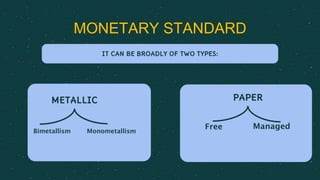
MONETARY STANDARD
IT CAN BE BROADLY OF TWO TYPES:
METALLIC PAPER
Bimetallism Monometallism
Free Managed
SILVER
STANDARD
MONOMETALLISM
GOLD
STANDARD
DIRECT INDIRECT
SILVER STANDARD
● In this standard the value of currency unit is fixed in terms of content of
silver coins.
● Free coinage was allowed.
● They were considered unlimited legal tender.
● No restriction on import of silver.
● Generally upto1873 silver standard period is considered.
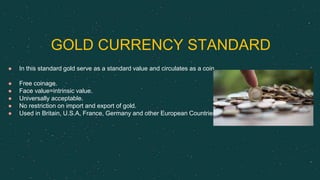
GOLD CURRENCY STANDARD
● In this standard gold serve as a standard value and circulates as a coin.
● Free coinage.
● Face value=intrinsic value.
● Universally acceptable.
● No restriction on import and export of gold.
● Used in Britain, U.S.A, France, Germany and other European Countries.
INDIRECT GOLD STANDARDS
GOLD BULLION STANDARD
● In this system the value of currency is fixed in terms of gold by making
such currency convertible to gold.
● No restriction on import and export of gold.
● No gold coins circulated.
● Gold only used for foreign payments.
● Adopted in India in year 1927 on recommendation of young Hilton
commission.
GOLD EXCHANGE STANDARD
● In this standard gold coins are used for foreign payments only. Inside the
country people use paper money for exchange.
● Restriction on import and export of gold prevailed by the developed
countries only.
● Have to keep reserve for paper notes
GOLD RESERVE STANDARD
● Its main objective was to maintain stability in exchange rate.
● Gold was kept hidden and not disclosed to general public and local
currency was in circulation.
● This standard was adopted after three developed countries i.e. Britain,
U.S.A, and France abolished the gold standard.
● It was done by maintaining an exchange equalisation fund account.
GOLD PARITY STANDARD
● Under this system gold is not served as a medium of exchange. The
internal currency consist largely of notes which is not convertible into
gold like other standards.
● This standard is introduced by IMF[international monetary fund]
● The IMF used to calculate the monetary value of each member country.
CONCLUSION
● Silver standard was abounded due to its high negative feature i.e. high
rate fluctuation in the prices of silver and instability in the external value
of currency.
● Under gold standard the monetary unit or its value is determined in terms
of gold. It is most widely accepted standard till now.
BIBLIOGRAPHY
● SOURCE:
• https://www.investopedia.com
• http://www.wikipedia.org
• Currency Banking And Exchange [Sahitya Bhawan
Publications].
monetary standards .pptx

monetary standards .pptx

  • 1.
    NAME: RITIKA SHARMA B.COMSEMESTER 1 ROLL NO.: 228053 TOPIC: MONETARY STANDARDS
  • 2.
    ACKNOWLEDGEMENT I WOULD LIKETO EXPRESS MY SPECIAL THANKS AND GRATITUDE TO MS. AFREEN MAAM AS WELL AS OUR PRINCIPAL MAAM MRS. V RAKASH WHO GAVE ME THE GOLDEN OPPORTUNITY TO DO THE ASSIGNMENT ON THE TOPIC MONETARY STANDARDS. I CAME TO KNOW ABOUT NEW THINGS BY EXPLORING THE TECHNOLOGY WHICH DOES NOT ADD UP MY PRESENT KNOWLEDGE BUT ALSO HELP ME TO UNDERSTAND IT BETTER IN FUTURE.
  • 3.
    INDEX INTRODUCTION 5 CLASSIFICATION 6-7 SILVERSTANDARD 8 GOLD STANDARD [INDIRECT] 9-12 CONCLUSION 13 BIBLIOGRAPHY 14
  • 4.
    MONETARY STANDARDS- MONO METALLISM [SILVERAND GOLD STANDARDS] CBE PRESENTATION BY: RITIKA SHARMA
  • 5.
    MONETARY STANDARDS ● Monetarystandards denotes the legal tender money of an economy it is the currency issue and regulated by the country for meeting out all types of transactions. It is the standard money accepted freely and having specific value for determining and regulating the exchange value of goods and services.
  • 6.
    MONETARY STANDARD IT CANBE BROADLY OF TWO TYPES: METALLIC PAPER Bimetallism Monometallism Free Managed
  • 7.
  • 8.
    SILVER STANDARD ● Inthis standard the value of currency unit is fixed in terms of content of silver coins. ● Free coinage was allowed. ● They were considered unlimited legal tender. ● No restriction on import of silver. ● Generally upto1873 silver standard period is considered.
  • 9.
    GOLD CURRENCY STANDARD ●In this standard gold serve as a standard value and circulates as a coin. ● Free coinage. ● Face value=intrinsic value. ● Universally acceptable. ● No restriction on import and export of gold. ● Used in Britain, U.S.A, France, Germany and other European Countries. INDIRECT GOLD STANDARDS
  • 10.
    GOLD BULLION STANDARD ●In this system the value of currency is fixed in terms of gold by making such currency convertible to gold. ● No restriction on import and export of gold. ● No gold coins circulated. ● Gold only used for foreign payments. ● Adopted in India in year 1927 on recommendation of young Hilton commission.
  • 11.
    GOLD EXCHANGE STANDARD ●In this standard gold coins are used for foreign payments only. Inside the country people use paper money for exchange. ● Restriction on import and export of gold prevailed by the developed countries only. ● Have to keep reserve for paper notes
  • 12.
    GOLD RESERVE STANDARD ●Its main objective was to maintain stability in exchange rate. ● Gold was kept hidden and not disclosed to general public and local currency was in circulation. ● This standard was adopted after three developed countries i.e. Britain, U.S.A, and France abolished the gold standard. ● It was done by maintaining an exchange equalisation fund account.
  • 13.
    GOLD PARITY STANDARD ●Under this system gold is not served as a medium of exchange. The internal currency consist largely of notes which is not convertible into gold like other standards. ● This standard is introduced by IMF[international monetary fund] ● The IMF used to calculate the monetary value of each member country.
  • 14.
    CONCLUSION ● Silver standardwas abounded due to its high negative feature i.e. high rate fluctuation in the prices of silver and instability in the external value of currency. ● Under gold standard the monetary unit or its value is determined in terms of gold. It is most widely accepted standard till now.
  • 15.
    BIBLIOGRAPHY ● SOURCE: • https://www.investopedia.com •http://www.wikipedia.org • Currency Banking And Exchange [Sahitya Bhawan Publications].