Dr Karl Ulrich Petry
Head of department of gynaecology Klinikum
Wolfsburg; Germany
Performance standards-
how to assess the quality of
colposcopy in
daily practice?
K. Ulrich Petry, Germany
5th EFC satellite meeting Brussel
December 16-17th 2017
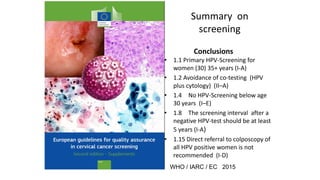
Summary on
screening
Conclusions
• 1.1 Primary HPV-Screening for
women (30) 35+ years (I-A)
• 1.2 Avoidance of co-testing (HPV
plus cytology) (II–A)
• 1.4 No HPV-Screening below age
30 years (I–E)
• 1.8 The screening interval after a
negative HPV-test should be at least
5 years (I-A)
• 1.15 Direct referral to colposcopy of
all HPV positive women is not
recommended (I-D)
036
WHO / IARC / EC 2015
1
29
2
3
4
5
6
78
9 10
13
16
17
19
20
12
11
21
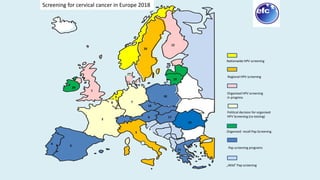
Screening for cervical cancer in Europe 2018
Pap screening programs
Nationwide HPV screening
Organised HPV screening
in progress
„Wild“ Pap screening
Regional HPV screening
Organised recall Pap Screening
Political decision for organised
HPV Screening (co-testing)
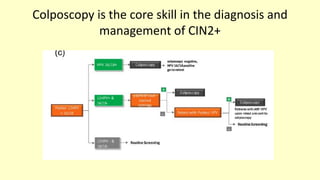
Colposcopy is the core skill in the diagnosis and
management of CIN2+
How good is colposcopy as „gold standard“ ?
o Screening-Colposcopy showed poor sensitivity and specificity
Schneider A, IJC 2000
o HPV-Vaccine trials showed poor sensitivity of colposcopy
impression for CIN3+ Stoler M, IJC 2011
o Randomized controlled studies showed that a standardized
colposcopy protocol detected as many CIN3+ as immediate LEEP
TOMBOLA, BMJ 2010
o Sensitivity of colposcopy guided biopsies for CIN3 ranged from 29-
93% in a US trial Pretorius R, JLGTD 2011
o The failure rate of colposcopy (missed CIN3+) is significantly
increased in women with positive HPV tests but normal cytology
Petry KU, GynOncol 2013
We need to assure quality of
colposcopy
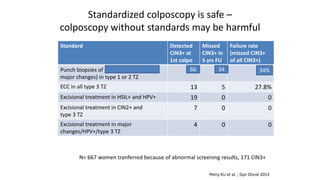
Standardized colposcopy is safe –
colposcopy without standards may be harmful
Standard Detected
CIN3+ at
1st colpo
Missed
CIN3+ in
5 yrs FU
Failure rate
(missed CIN3+
of all CIN3+)
Punch biopsies of any lesion (minor and
major changes) in type 1 or 2 TZ
97 3 3%
ECC in all type 3 TZ 13 5 27.8%
Excisional treatment in HSIL+ and HPV+ 19 0 0
Excisional treatment in CIN2+ and
type 3 TZ
7 0 0
Excisional treatment in major
changes/HPV+/type 3 TZ
4 0 0
N= 667 women tranferred because of abnormal screening results, 171 CIN3+
Petry KU et al. , Gyn Oncol 2013
66 34 34%
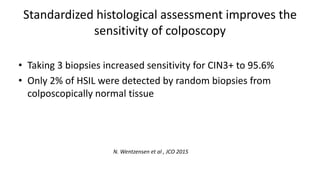
Standardized histological assessment improves the
sensitivity of colposcopy
• Taking 3 biopsies increased sensitivity for CIN3+ to 95.6%
• Only 2% of HSIL were detected by random biopsies from
colposcopically normal tissue
N. Wentzensen et al , JCO 2015
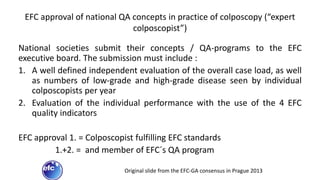
EFC approval of national QA concepts in practice of colposcopy (“expert
colposcopist”)
National societies submit their concepts / QA-programs to the EFC
executive board. The submission must include :
1. A well defined independent evaluation of the overall case load, as well
as numbers of low-grade and high-grade disease seen by individual
colposcopists per year
2. Evaluation of the individual performance with the use of the 4 EFC
quality indicators
EFC approval 1. = Colposcopist fulfilling EFC standards
1.+2. = and member of EFC´s QA program
Original slide from the EFC-GA consensus in Prague 2013
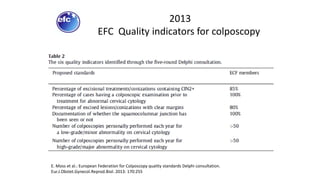
2013
EFC Quality indicators for colposcopy
E. Moss et al.: European Federation for Colposcopy quality standards Delphi consultation.
Eur.J.Obstet.Gynecol.Reprod.Biol. 2013: 170:255
• Use the quality parameters to assess quality in colposcopy.
• Use the quality assessment to evaluate the quality parameters
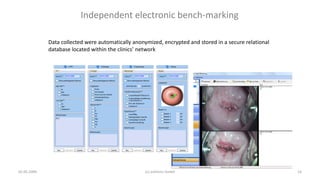
Independent electronic bench-marking
02.05.2009 14(c) asthenis GmbH
Data collected were automatically anonymized, encrypted and stored in a secure relational
database located within the clinics’ network
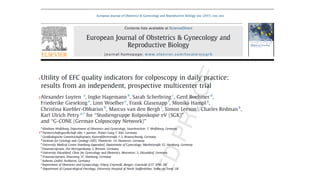
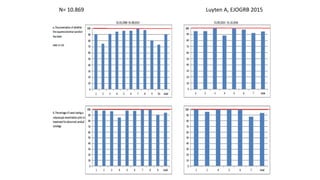
N= 10.869 Luyten A, EJOGRB 2015
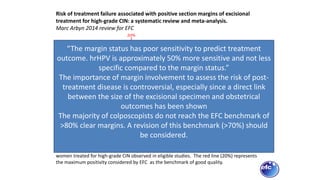
Figure 6. Histogram representing the distribution of the proportion of positive margins in
women treated for high-grade CIN observed in eligible studies. The red line (20%) represents
the maximum positivity considered by EFC as the benchmark of good quality.
Risk of treatment failure associated with positive section margins of excisional
treatment for high-grade CIN: a systematic review and meta-analysis.
Marc Arbyn 2014 review for EFC
“The margin status has poor sensitivity to predict treatment
outcome. hrHPV is approximately 50% more sensitive and not less
specific compared to the margin status.”
The importance of margin involvement to assess the risk of post-
treatment disease is controversial, especially since a direct link
between the size of the excisional specimen and obstetrical
outcomes has been shown
The majority of colposcopists do not reach the EFC benchmark of
>80% clear margins. A revision of this benchmark (>70%) should
be considered.
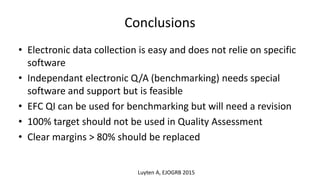
Conclusions
• Electronic data collection is easy and does not relie on specific
software
• Independant electronic Q/A (benchmarking) needs special
software and support but is feasible
• EFC QI can be used for benchmarking but will need a revision
• 100% target should not be used in Quality Assessment
• Clear margins > 80% should be replaced
Luyten A, EJOGRB 2015
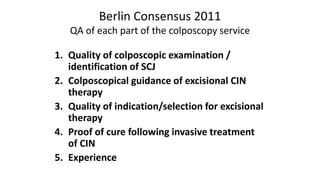
Berlin Consensus 2011
QA of each part of the colposcopy service
1. Quality of colposcopic examination /
identification of SCJ
2. Colposcopical guidance of excisional CIN
therapy
3. Quality of indication/selection for excisional
therapy
4. Proof of cure following invasive treatment
of CIN
5. Experience
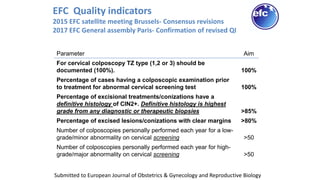
EFC Quality indicators
2015 EFC satellite meeting Brussels- Consensus revisions
2017 EFC General assembly Paris- Confirmation of revised QI
Parameter Aim
For cervical colposcopy TZ type (1,2 or 3) should be
documented (100%). 100%
Percentage of cases having a colposcopic examination prior
to treatment for abnormal cervical screening test 100%
Percentage of excisional treatments/conizations have a
definitive histology of CIN2+. Definitive histology is highest
grade from any diagnostic or therapeutic biopsies >85%
Percentage of excised lesions/conizations with clear margins >80%
Number of colposcopies personally performed each year for a low-
grade/minor abnormality on cervical screening >50
Number of colposcopies personally performed each year for high-
grade/major abnormality on cervical screening >50
Submitted to European Journal of Obstetrics & Gynecology and Reproductive Biology
0.01
0.05
0.1
0.5
1
5
10
20
50
80
90
95
99
99.5
99.9
Post-testProbability(%) 0.01
0.05
0.1
0.5
1
5
10
20
50
80
90
95
99
99.5
99.9
Pre-testProbability(%)
Pre
(6.90%)
Post(+)
(17.50%)
Post(-)
(3.80%)
Margin status
0.01
0.05
0.1
0.5
1
5
10
20
50
80
90
95
99
99.5
99.9
Post-testProbability(%)
0.01
0.05
0.1
0.5
1
5
10
20
50
80
90
95
99
99.5
99.9
Pre-testProbability(%)
Pre
(6.90%)
Post(+)
(26.08%)
Post(-)
(0.78%)
hrHPV
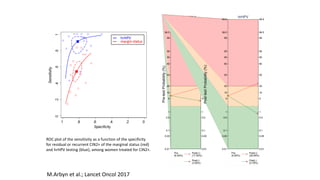
ROC plot of the sensitivity as a function of the specificity
for residual or recurrent CIN2+ of the marginal status (red)
and hrHPV testing (blue), among women treated for CIN2+.
M.Arbyn et al.; Lancet Oncol 2017
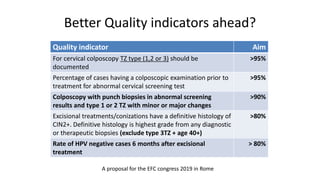
Better Quality indicators ahead?
Quality indicator Aim
For cervical colposcopy TZ type (1,2 or 3) should be
documented
>95%
Percentage of cases having a colposcopic examination prior to
treatment for abnormal cervical screening test
>95%
Colposcopy with punch biopsies in abnormal screening
results and type 1 or 2 TZ with minor or major changes
>90%
Excisional treatments/conizations have a definitive histology of
CIN2+. Definitive histology is highest grade from any diagnostic
or therapeutic biopsies (exclude type 3TZ + age 40+)
>80%
Rate of HPV negative cases 6 months after excisional
treatment
> 80%
A proposal for the EFC congress 2019 in Rome
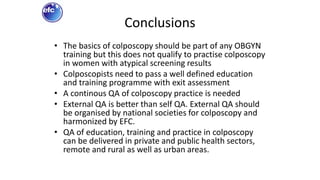
Conclusions
• The basics of colposcopy should be part of any OBGYN
training but this does not qualify to practise colposcopy
in women with atypical screening results
• Colposcopists need to pass a well defined education
and training programme with exit assessment
• A continous QA of colposcopy practice is needed
• External QA is better than self QA. External QA should
be organised by national societies for colposcopy and
harmonized by EFC.
• QA of education, training and practice in colposcopy
can be delivered in private and public health sectors,
remote and rural as well as urban areas.
Outlook
• Full publication of EFC´s revised Quality indicators, core
competencies, standards in education and training.
• Ongoing improvement of Quality Indicators and standards
• Search for financial support to develop a European Colposcopy
Benchmarking Pilot Project based on EFC QI and standards

Karl Ulrich Petry - Performance standards

  • 2.
    Dr Karl UlrichPetry Head of department of gynaecology Klinikum Wolfsburg; Germany
  • 3.
    Performance standards- how toassess the quality of colposcopy in daily practice? K. Ulrich Petry, Germany 5th EFC satellite meeting Brussel December 16-17th 2017
  • 4.
    Summary on screening Conclusions • 1.1Primary HPV-Screening for women (30) 35+ years (I-A) • 1.2 Avoidance of co-testing (HPV plus cytology) (II–A) • 1.4 No HPV-Screening below age 30 years (I–E) • 1.8 The screening interval after a negative HPV-test should be at least 5 years (I-A) • 1.15 Direct referral to colposcopy of all HPV positive women is not recommended (I-D) 036 WHO / IARC / EC 2015
  • 5.
    1 29 2 3 4 5 6 78 9 10 13 16 17 19 20 12 11 21 Screening forcervical cancer in Europe 2018 Pap screening programs Nationwide HPV screening Organised HPV screening in progress „Wild“ Pap screening Regional HPV screening Organised recall Pap Screening Political decision for organised HPV Screening (co-testing)
  • 6.
    Colposcopy is thecore skill in the diagnosis and management of CIN2+
  • 7.
    How good iscolposcopy as „gold standard“ ? o Screening-Colposcopy showed poor sensitivity and specificity Schneider A, IJC 2000 o HPV-Vaccine trials showed poor sensitivity of colposcopy impression for CIN3+ Stoler M, IJC 2011 o Randomized controlled studies showed that a standardized colposcopy protocol detected as many CIN3+ as immediate LEEP TOMBOLA, BMJ 2010 o Sensitivity of colposcopy guided biopsies for CIN3 ranged from 29- 93% in a US trial Pretorius R, JLGTD 2011 o The failure rate of colposcopy (missed CIN3+) is significantly increased in women with positive HPV tests but normal cytology Petry KU, GynOncol 2013 We need to assure quality of colposcopy
  • 8.
    Standardized colposcopy issafe – colposcopy without standards may be harmful Standard Detected CIN3+ at 1st colpo Missed CIN3+ in 5 yrs FU Failure rate (missed CIN3+ of all CIN3+) Punch biopsies of any lesion (minor and major changes) in type 1 or 2 TZ 97 3 3% ECC in all type 3 TZ 13 5 27.8% Excisional treatment in HSIL+ and HPV+ 19 0 0 Excisional treatment in CIN2+ and type 3 TZ 7 0 0 Excisional treatment in major changes/HPV+/type 3 TZ 4 0 0 N= 667 women tranferred because of abnormal screening results, 171 CIN3+ Petry KU et al. , Gyn Oncol 2013 66 34 34%
  • 9.
    Standardized histological assessmentimproves the sensitivity of colposcopy • Taking 3 biopsies increased sensitivity for CIN3+ to 95.6% • Only 2% of HSIL were detected by random biopsies from colposcopically normal tissue N. Wentzensen et al , JCO 2015
  • 10.
    EFC approval ofnational QA concepts in practice of colposcopy (“expert colposcopist”) National societies submit their concepts / QA-programs to the EFC executive board. The submission must include : 1. A well defined independent evaluation of the overall case load, as well as numbers of low-grade and high-grade disease seen by individual colposcopists per year 2. Evaluation of the individual performance with the use of the 4 EFC quality indicators EFC approval 1. = Colposcopist fulfilling EFC standards 1.+2. = and member of EFC´s QA program Original slide from the EFC-GA consensus in Prague 2013
  • 11.
    2013 EFC Quality indicatorsfor colposcopy E. Moss et al.: European Federation for Colposcopy quality standards Delphi consultation. Eur.J.Obstet.Gynecol.Reprod.Biol. 2013: 170:255
  • 12.
    • Use thequality parameters to assess quality in colposcopy. • Use the quality assessment to evaluate the quality parameters
  • 14.
    Independent electronic bench-marking 02.05.200914(c) asthenis GmbH Data collected were automatically anonymized, encrypted and stored in a secure relational database located within the clinics’ network
  • 15.
    N= 10.869 LuytenA, EJOGRB 2015
  • 16.
    Figure 6. Histogramrepresenting the distribution of the proportion of positive margins in women treated for high-grade CIN observed in eligible studies. The red line (20%) represents the maximum positivity considered by EFC as the benchmark of good quality. Risk of treatment failure associated with positive section margins of excisional treatment for high-grade CIN: a systematic review and meta-analysis. Marc Arbyn 2014 review for EFC “The margin status has poor sensitivity to predict treatment outcome. hrHPV is approximately 50% more sensitive and not less specific compared to the margin status.” The importance of margin involvement to assess the risk of post- treatment disease is controversial, especially since a direct link between the size of the excisional specimen and obstetrical outcomes has been shown The majority of colposcopists do not reach the EFC benchmark of >80% clear margins. A revision of this benchmark (>70%) should be considered.
  • 17.
    Conclusions • Electronic datacollection is easy and does not relie on specific software • Independant electronic Q/A (benchmarking) needs special software and support but is feasible • EFC QI can be used for benchmarking but will need a revision • 100% target should not be used in Quality Assessment • Clear margins > 80% should be replaced Luyten A, EJOGRB 2015
  • 18.
    Berlin Consensus 2011 QAof each part of the colposcopy service 1. Quality of colposcopic examination / identification of SCJ 2. Colposcopical guidance of excisional CIN therapy 3. Quality of indication/selection for excisional therapy 4. Proof of cure following invasive treatment of CIN 5. Experience
  • 19.
    EFC Quality indicators 2015EFC satellite meeting Brussels- Consensus revisions 2017 EFC General assembly Paris- Confirmation of revised QI Parameter Aim For cervical colposcopy TZ type (1,2 or 3) should be documented (100%). 100% Percentage of cases having a colposcopic examination prior to treatment for abnormal cervical screening test 100% Percentage of excisional treatments/conizations have a definitive histology of CIN2+. Definitive histology is highest grade from any diagnostic or therapeutic biopsies >85% Percentage of excised lesions/conizations with clear margins >80% Number of colposcopies personally performed each year for a low- grade/minor abnormality on cervical screening >50 Number of colposcopies personally performed each year for high- grade/major abnormality on cervical screening >50 Submitted to European Journal of Obstetrics & Gynecology and Reproductive Biology
  • 20.
  • 21.
    Better Quality indicatorsahead? Quality indicator Aim For cervical colposcopy TZ type (1,2 or 3) should be documented >95% Percentage of cases having a colposcopic examination prior to treatment for abnormal cervical screening test >95% Colposcopy with punch biopsies in abnormal screening results and type 1 or 2 TZ with minor or major changes >90% Excisional treatments/conizations have a definitive histology of CIN2+. Definitive histology is highest grade from any diagnostic or therapeutic biopsies (exclude type 3TZ + age 40+) >80% Rate of HPV negative cases 6 months after excisional treatment > 80% A proposal for the EFC congress 2019 in Rome
  • 22.
    Conclusions • The basicsof colposcopy should be part of any OBGYN training but this does not qualify to practise colposcopy in women with atypical screening results • Colposcopists need to pass a well defined education and training programme with exit assessment • A continous QA of colposcopy practice is needed • External QA is better than self QA. External QA should be organised by national societies for colposcopy and harmonized by EFC. • QA of education, training and practice in colposcopy can be delivered in private and public health sectors, remote and rural as well as urban areas.
  • 23.
    Outlook • Full publicationof EFC´s revised Quality indicators, core competencies, standards in education and training. • Ongoing improvement of Quality Indicators and standards • Search for financial support to develop a European Colposcopy Benchmarking Pilot Project based on EFC QI and standards