(Inter)National, Multicentred
     Appendicectomy Audit


           Aneel Bhangu
     General Surgery Registrar
West Midlands Research Collaborative
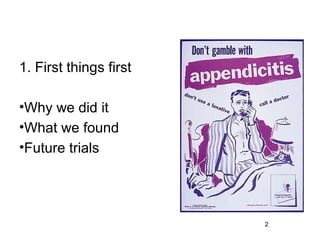
1. First things first

•Why we did it
•What we found
•Future trials


                        2
National Collaborative
•   3rd National meeting
•   National Research Collaborative
•   Simple, easy, accessible idea
•   “All” trainees and hospitals
•   Many questions
    – Feasibility, Structure, Organisation
Aim
• Aim: a national (international),
  multicentred, audit of appendicectomy
• Primary outcome: negative rate
• Secondary outcomes: laparoscopy
  rates, adverse event rates
• Inclusion: appendicectomy, all ages
• Exclude: diagnostic lap
Method
•   Protocol – reviewed by Prof Alderson
•   2 week 5 centre pilot in West Mids
•   2 month multi-centred audit
•   30 centres will recruit approximately 1000
    patients
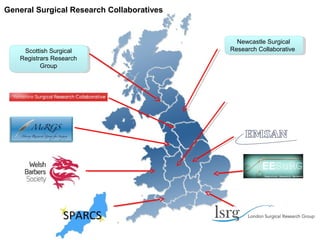
    – LSRG, WMRC, Mersey, EoE, Trent, Sparcs, PSTRN
    – Hong Kong, Aus, New Zealand
General Surgical Research Collaboratives


                                             Newcastle Surgical
    Scottish Surgical                      Research Collaborative
   Registrars Research
          Group
Data collection
• May 1st- June 30th, 30 day FU
• Access Database with guidance notes
• Strict confidentiality - only anonymised data
  submitted via nhs.net
• Audit registration
• Centrally collated
• Authorship model
To date
• Over 60 centres registered
• 30 have confirmed via unit questionnaire or audit
  registration form
• 15*30 = 450 patients to date
• Database


                                            8
Results
•   95 centres
•   3326 patients
•   89 UK centres
•   6 international centres


                               9
Results II
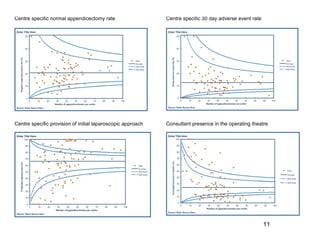
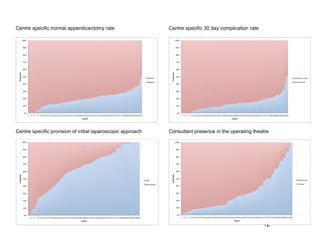
• (Initial) open appendicectomy: 33.7% (range 3.3-36.8%
  in centres>25 appendicectomies)
• Initial lap approach: 66.3% (8.7-100%)
• Lap conversion in 6.9% (of total)
• A consultant was present in theatre: 23.8% (1.9-84.6%)
• Histologically normal appendix: 20.6% (3.3-36.8%).


                                                 10
Centre specific normal appendicectomy rate                   Centre specific 30 day adverse event rate


Centre specific provision of initial laparoscopic approach   Consultant presence in the operating theatre


                                                                                                         11
Centre specific normal appendicectomy rate                   Centre specific 30 day complication rate


Centre specific provision of initial laparoscopic approach   Consultant presence in the operating theatre


                                                                                                        12
What we did well
• Communication networks
• Speed
• Volume


                            13
Where we could have improved
• Definitions and outcomes
• Even wider communication
• Data collection tools (teething problems only)


                                            14
Summary of aims
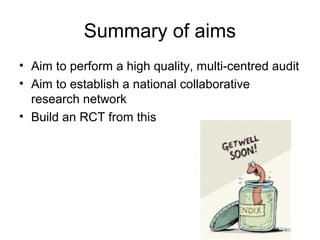
• Aim to perform a high quality, multi-centred audit
• Aim to establish a national collaborative
  research network
• Build an RCT from this
Future trials
1.   Lap v open appendicectomy
2.   Lap normal appendix
3.   Right iliac fossa pain of uncertain cause
4.   Operative versus antibiotic treatment


                                         16
Lap normal appendix
• Rationale: no evidence to guide practice at present.
• What we can add: a multicenter trial
• Difficulties:
  – need to randomize everyone to capture target market.
    Combining as an arm of another study is feasible, but will
    increase sample size significantly.
  – Needs one year FU.
  – Endpoint: Reducing LoS; readmissions; adverse events.


                                                            17
lap v open appendicectomy
• Rationale:
  – 0-100% lap rate from 95 centres in the national audit
  – Current 62 RCTs from a Cochrane review mostly single centre
    (only 3 were >3 centres)
  – Mostly used length of stay as primary outcome
• What we can add:
  – a multicenter, national RCT with adverse events as an outcome.
  – Could aim for 1000 patients which may help stablise use of lap
    rates in the UK and beyond.


                                                          18
Difficulties
• High volume centres with lap pathways/ centres with
  high lap rates unlikely to participate, leaving medium size
  centres who currently have mixed rates.
• Learning curves for trainees.
• Need to convince the community of the need for another
  trial on this topic.
• This idea could be trimmed down to selected patients
  rather than all-comers (e.g. those with risk factors for
  post-op adverse events)


                                                    19
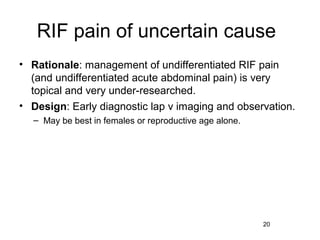
RIF pain of uncertain cause
• Rationale: management of undifferentiated RIF pain
  (and undifferentiated acute abdominal pain) is very
  topical and very under-researched.
• Design: Early diagnostic lap v imaging and observation.
  – May be best in females or reproductive age alone.


                                                        20
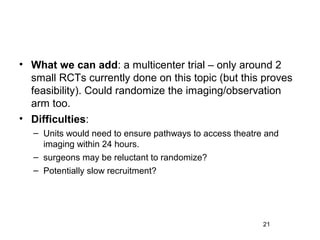
• What we can add: a multicenter trial – only around 2
  small RCTs currently done on this topic (but this proves
  feasibility). Could randomize the imaging/observation
  arm too.
• Difficulties:
   – Units would need to ensure pathways to access theatre and
     imaging within 24 hours.
   – surgeons may be reluctant to randomize?
   – Potentially slow recruitment?


                                                          21
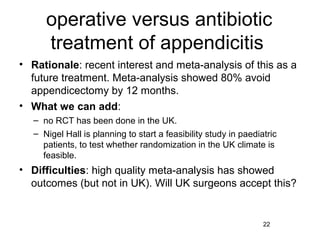
operative versus antibiotic
      treatment of appendicitis
• Rationale: recent interest and meta-analysis of this as a
  future treatment. Meta-analysis showed 80% avoid
  appendicectomy by 12 months.
• What we can add:
   – no RCT has been done in the UK.
   – Nigel Hall is planning to start a feasibility study in paediatric
     patients, to test whether randomization in the UK climate is
     feasible.
• Difficulties: high quality meta-analysis has showed
  outcomes (but not in UK). Will UK surgeons accept this?


                                                                  22
23
• Questions and discussion


                             24

Appendicectomy national meeting

  • 1.
    (Inter)National, Multicentred Appendicectomy Audit Aneel Bhangu General Surgery Registrar West Midlands Research Collaborative
  • 2.
    1. First thingsfirst •Why we did it •What we found •Future trials 2
  • 3.
    National Collaborative • 3rd National meeting • National Research Collaborative • Simple, easy, accessible idea • “All” trainees and hospitals • Many questions – Feasibility, Structure, Organisation
  • 4.
    Aim • Aim: anational (international), multicentred, audit of appendicectomy • Primary outcome: negative rate • Secondary outcomes: laparoscopy rates, adverse event rates • Inclusion: appendicectomy, all ages • Exclude: diagnostic lap
  • 5.
    Method • Protocol – reviewed by Prof Alderson • 2 week 5 centre pilot in West Mids • 2 month multi-centred audit • 30 centres will recruit approximately 1000 patients – LSRG, WMRC, Mersey, EoE, Trent, Sparcs, PSTRN – Hong Kong, Aus, New Zealand
  • 6.
    General Surgical ResearchCollaboratives Newcastle Surgical Scottish Surgical Research Collaborative Registrars Research Group
  • 7.
    Data collection • May1st- June 30th, 30 day FU • Access Database with guidance notes • Strict confidentiality - only anonymised data submitted via nhs.net • Audit registration • Centrally collated • Authorship model
  • 8.
    To date • Over60 centres registered • 30 have confirmed via unit questionnaire or audit registration form • 15*30 = 450 patients to date • Database 8
  • 9.
    Results • 95 centres • 3326 patients • 89 UK centres • 6 international centres 9
  • 10.
    Results II • (Initial)open appendicectomy: 33.7% (range 3.3-36.8% in centres>25 appendicectomies) • Initial lap approach: 66.3% (8.7-100%) • Lap conversion in 6.9% (of total) • A consultant was present in theatre: 23.8% (1.9-84.6%) • Histologically normal appendix: 20.6% (3.3-36.8%). 10
  • 11.
    Centre specific normalappendicectomy rate Centre specific 30 day adverse event rate Centre specific provision of initial laparoscopic approach Consultant presence in the operating theatre 11
  • 12.
    Centre specific normalappendicectomy rate Centre specific 30 day complication rate Centre specific provision of initial laparoscopic approach Consultant presence in the operating theatre 12
  • 13.
    What we didwell • Communication networks • Speed • Volume 13
  • 14.
    Where we couldhave improved • Definitions and outcomes • Even wider communication • Data collection tools (teething problems only) 14
  • 15.
    Summary of aims •Aim to perform a high quality, multi-centred audit • Aim to establish a national collaborative research network • Build an RCT from this
  • 16.
    Future trials 1. Lap v open appendicectomy 2. Lap normal appendix 3. Right iliac fossa pain of uncertain cause 4. Operative versus antibiotic treatment 16
  • 17.
    Lap normal appendix •Rationale: no evidence to guide practice at present. • What we can add: a multicenter trial • Difficulties: – need to randomize everyone to capture target market. Combining as an arm of another study is feasible, but will increase sample size significantly. – Needs one year FU. – Endpoint: Reducing LoS; readmissions; adverse events. 17
  • 18.
    lap v openappendicectomy • Rationale: – 0-100% lap rate from 95 centres in the national audit – Current 62 RCTs from a Cochrane review mostly single centre (only 3 were >3 centres) – Mostly used length of stay as primary outcome • What we can add: – a multicenter, national RCT with adverse events as an outcome. – Could aim for 1000 patients which may help stablise use of lap rates in the UK and beyond. 18
  • 19.
    Difficulties • High volumecentres with lap pathways/ centres with high lap rates unlikely to participate, leaving medium size centres who currently have mixed rates. • Learning curves for trainees. • Need to convince the community of the need for another trial on this topic. • This idea could be trimmed down to selected patients rather than all-comers (e.g. those with risk factors for post-op adverse events) 19
  • 20.
    RIF pain ofuncertain cause • Rationale: management of undifferentiated RIF pain (and undifferentiated acute abdominal pain) is very topical and very under-researched. • Design: Early diagnostic lap v imaging and observation. – May be best in females or reproductive age alone. 20
  • 21.
    • What wecan add: a multicenter trial – only around 2 small RCTs currently done on this topic (but this proves feasibility). Could randomize the imaging/observation arm too. • Difficulties: – Units would need to ensure pathways to access theatre and imaging within 24 hours. – surgeons may be reluctant to randomize? – Potentially slow recruitment? 21
  • 22.
    operative versus antibiotic treatment of appendicitis • Rationale: recent interest and meta-analysis of this as a future treatment. Meta-analysis showed 80% avoid appendicectomy by 12 months. • What we can add: – no RCT has been done in the UK. – Nigel Hall is planning to start a feasibility study in paediatric patients, to test whether randomization in the UK climate is feasible. • Difficulties: high quality meta-analysis has showed outcomes (but not in UK). Will UK surgeons accept this? 22
  • 23.
  • 24.
    • Questions anddiscussion 24