Use of new image capturing and sharing systems in
colposcopy training
Ameli Tropé
Use of new image capturing and
sharing systems in colposcopy
training
Ameli Tropé, MD, PhD
Head of the Norwegian Cervical Cancer Screening Programme
ameli.trope@kreftregisteret.no
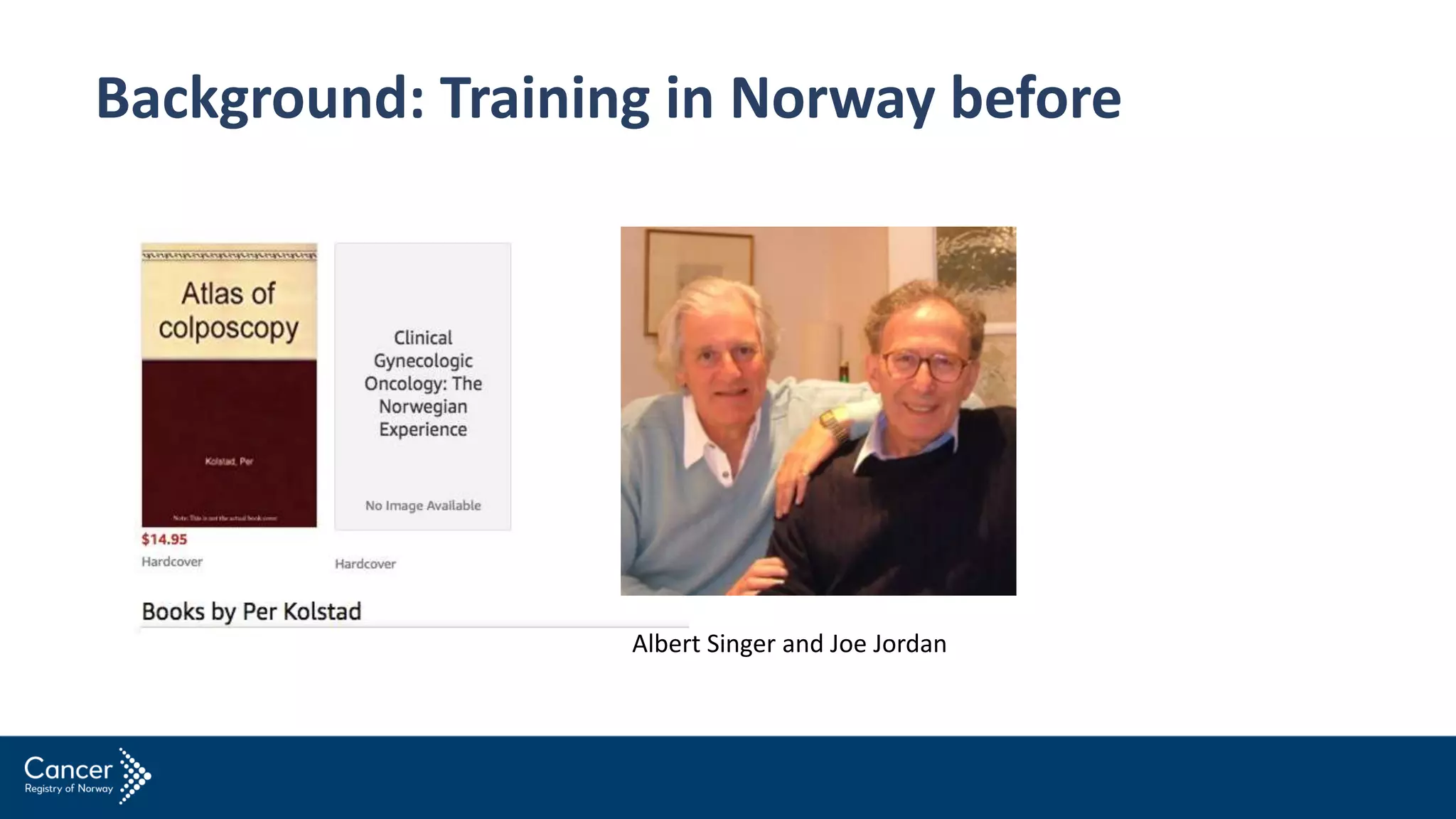
Background: Training in Norway before
Albert Singer and Joe Jordan
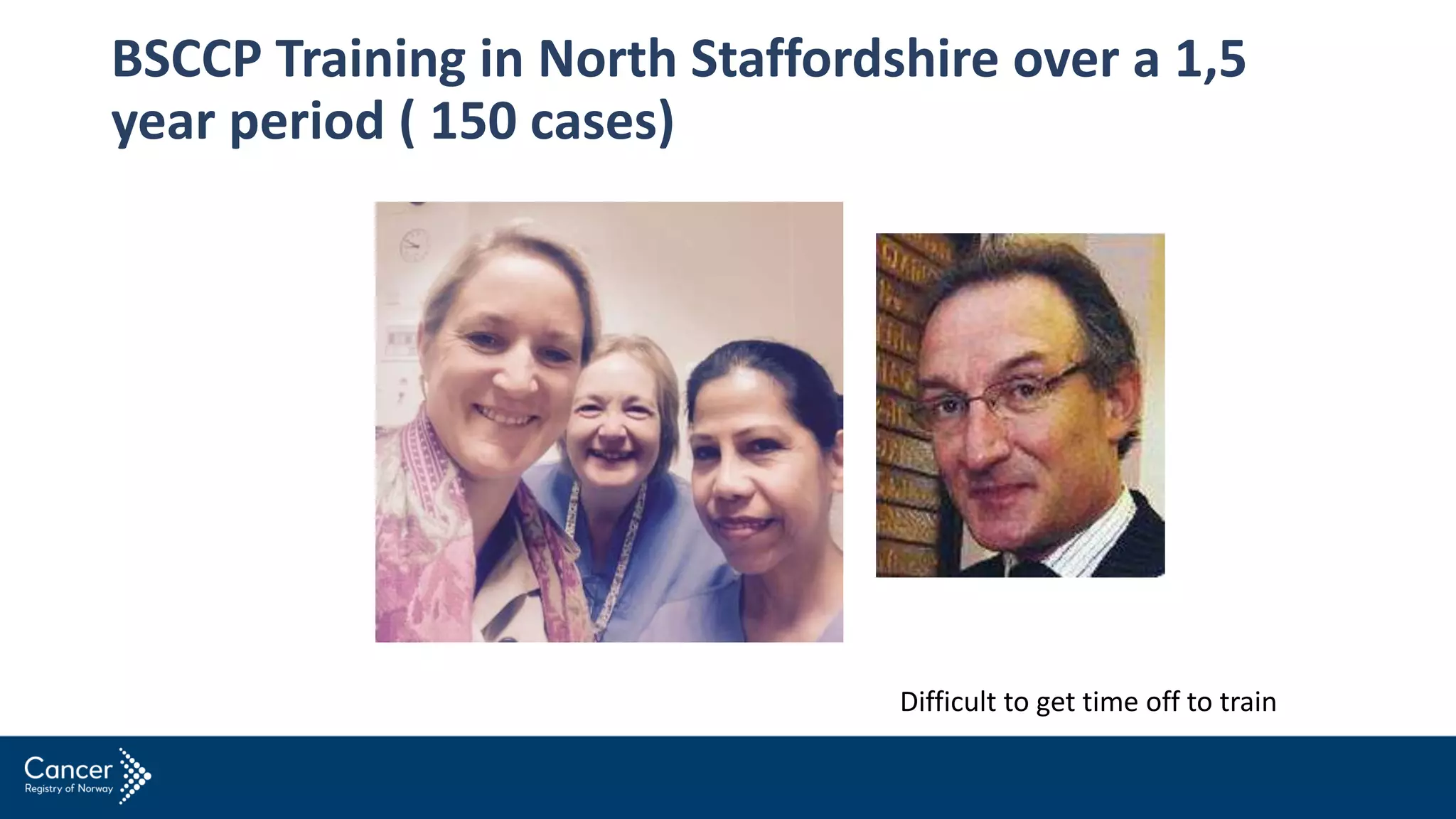
BSCCP Training in North Staffordshire over a 1,5
year period ( 150 cases)
Difficult to get time off to train
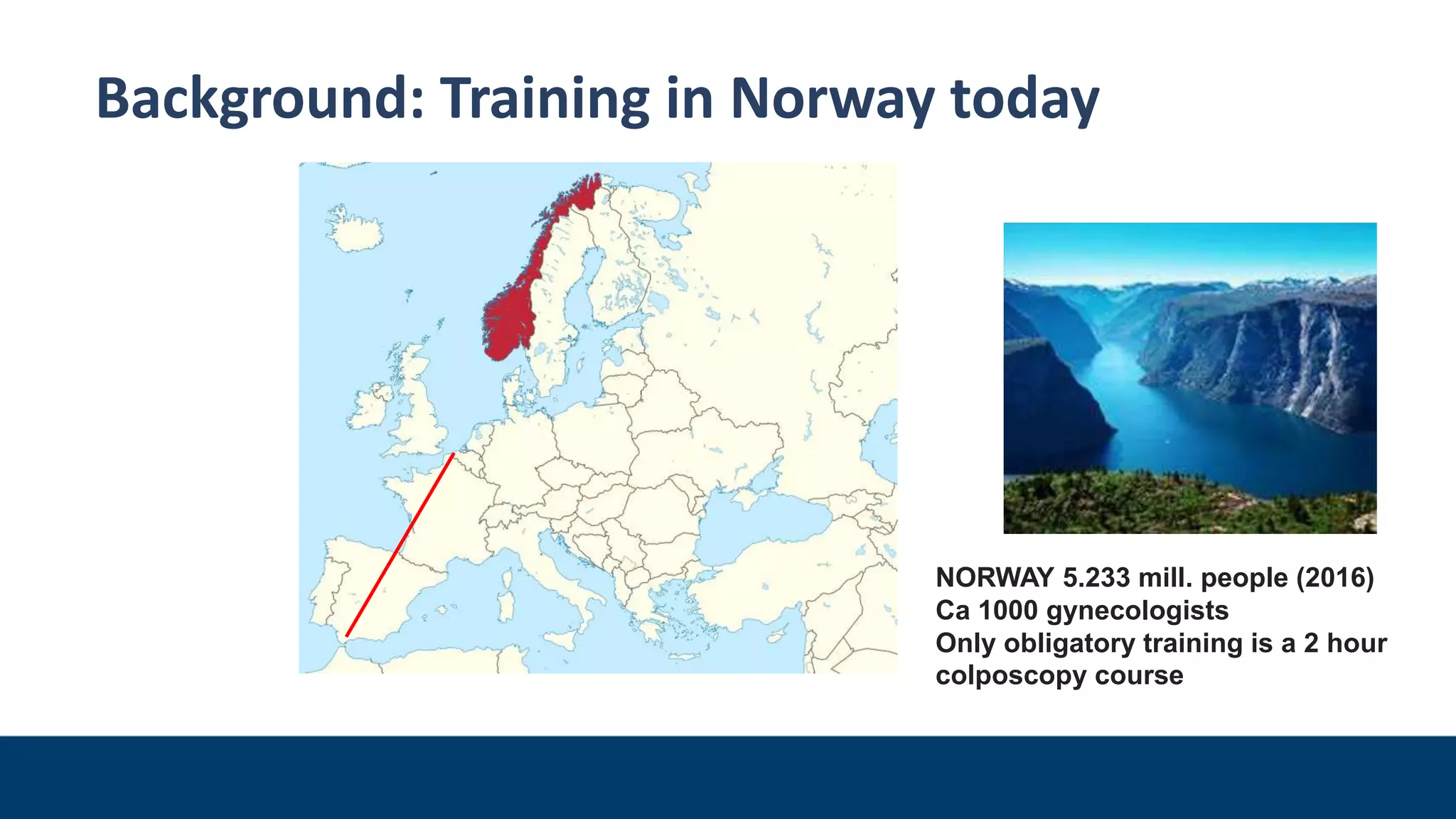
NORWAY 5.233 mill. people (2016)
Ca 1000 gynecologists
Only obligatory training is a 2 hour
colposcopy course
Background: Training in Norway today
Courses since 2014
-trainers in the clinics
Other arenas of teaching
• Colposcopy courses abroad
• E- learning course
• Travelling around to clinics to give colposcopy lectures
• Presentations at Gynecological meetings
• Writing easy read articles in gynecology magazine
• Asking students attending courses to teach at clinics
• But we have no organized training at the clinics and few
qualified trainers
• Where do we start?
EFC training programme criteria (2014)
Trainee Caseload
• minimum of 100 cases, but individual Societies would have the right to
require more cases
• minimum of 50 new cases
• minimum of 30 of the cases seen should have both a colposcopic and
histological proven abnormality
• The training should be completed within 24 months
Electronic Log-book
• It is recommended that cases seen should be documented using the EFC
electronic log-book
Exit Assessment
• Each Society should, at some time in the future, introduce some form of exit
assessment at the completion of training
• In some countries none or not enough trained teachers/coaches
• Accreditation difficult
• HPV primary screening means more colposcopy
• Decreased PPV of colposcopy in HPV vaccinated populations
• Need for centralization of expertise with decreasing PPV of colposcopy
• Increasing cervical cancer burden in low income countries
Colposcopy training problems – now/future
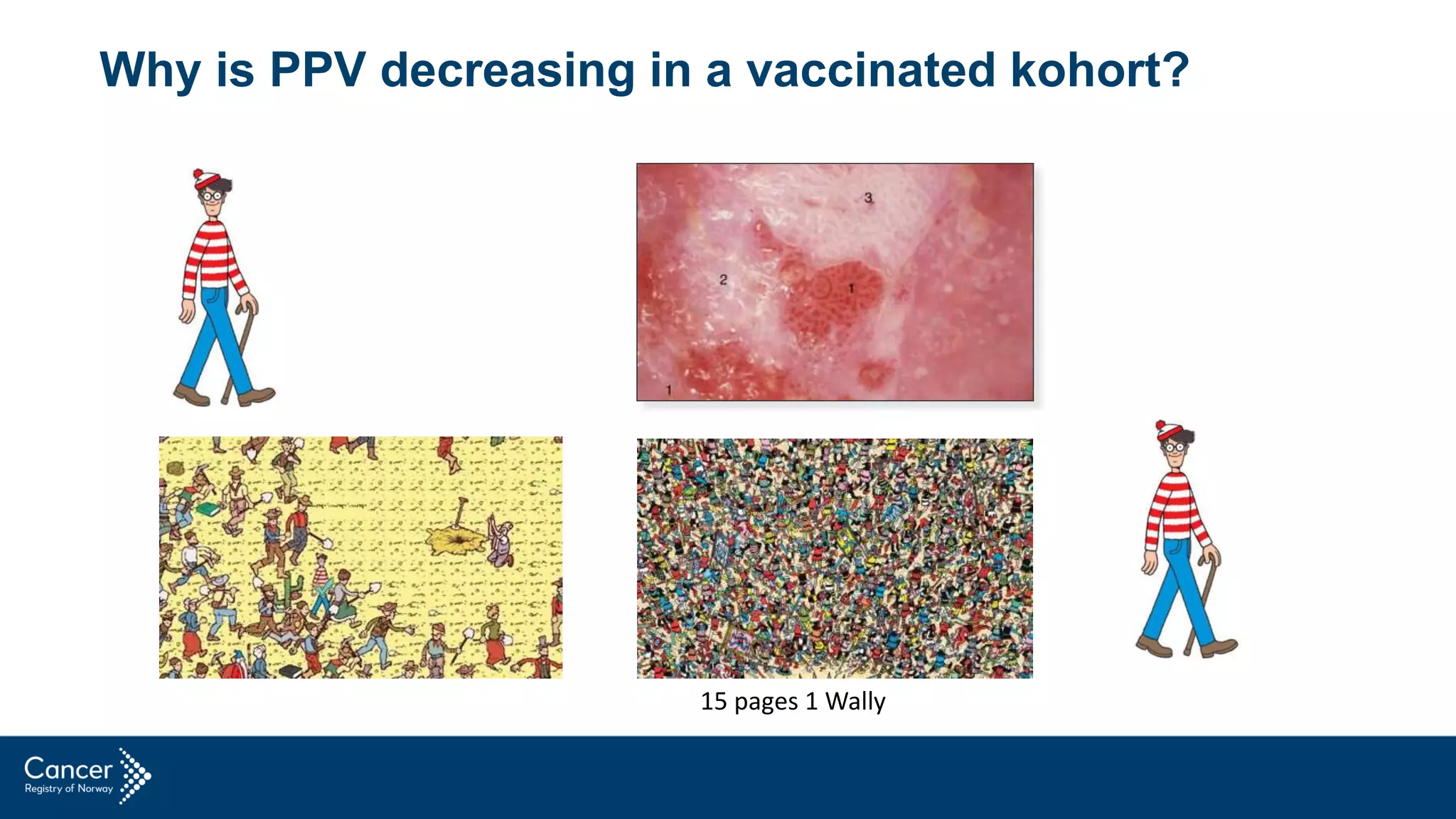
Why is PPV decreasing in a vaccinated kohort?
15 pages 1 Wally
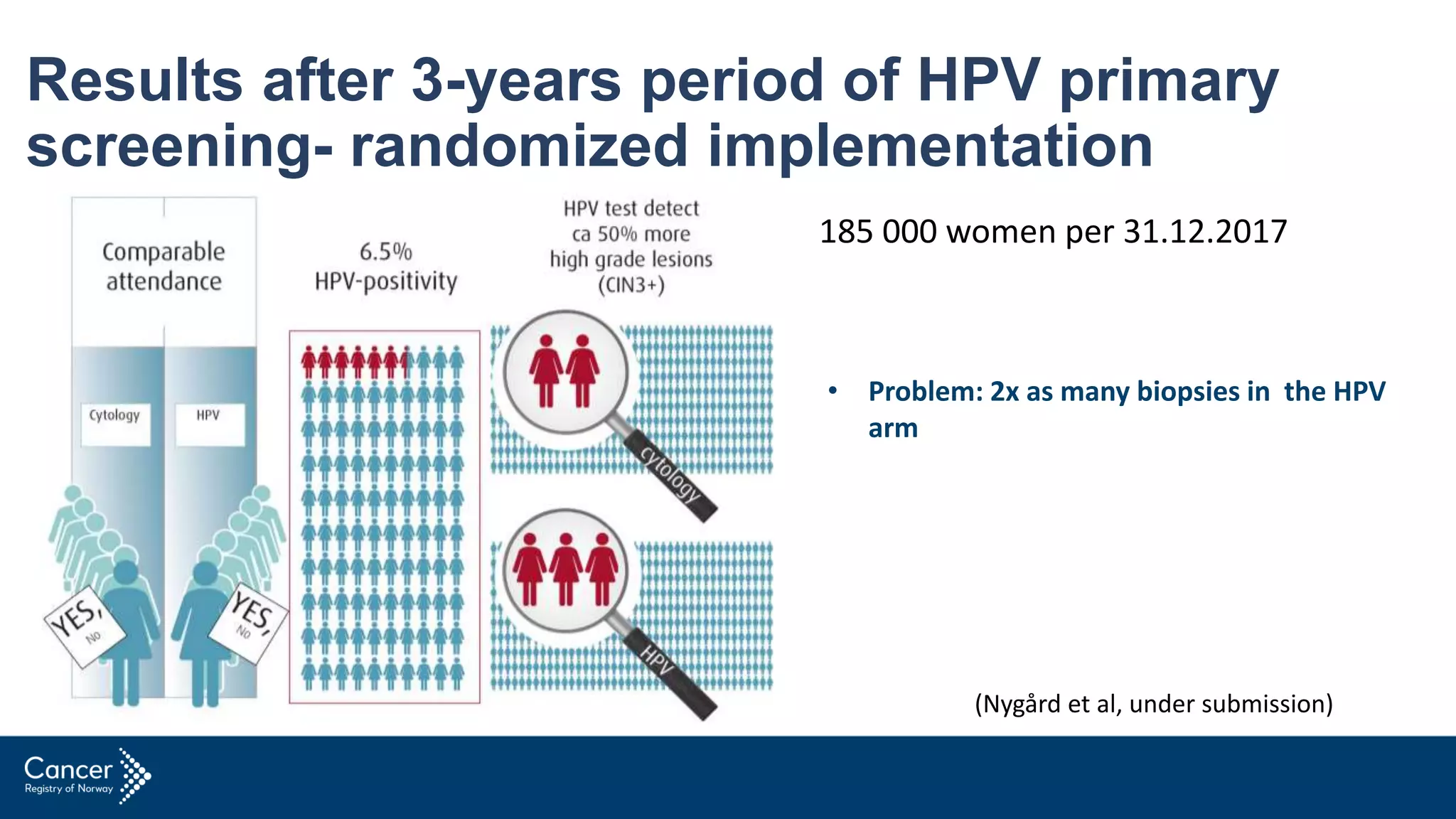
Results after 3-years period of HPV primary
screening- randomized implementation
(Nygård et al, under submission)
185 000 women per 31.12.2017
• Problem: 2x as many biopsies in the HPV
arm
Problem in countries like Norway
• When normal or colposcopy TZ1 we can’t have guidelines saying that
women should come back in ex. 3 years since we can’t yet trust the level
of colposcopy
• Overload of women staying in a loop of controls when persistent HPV
positive. Some stop coming back.
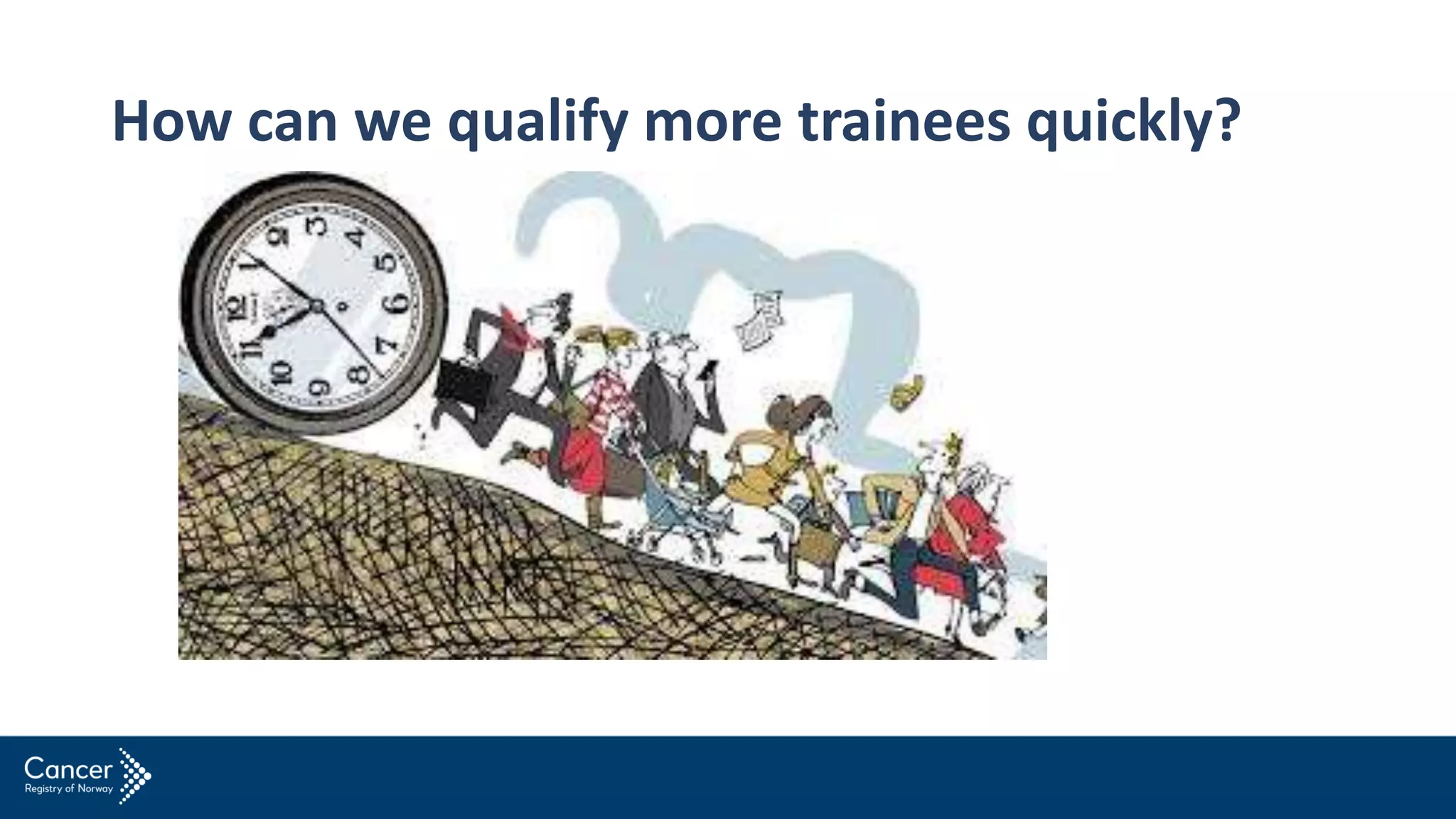
How can we qualify more trainees quickly?
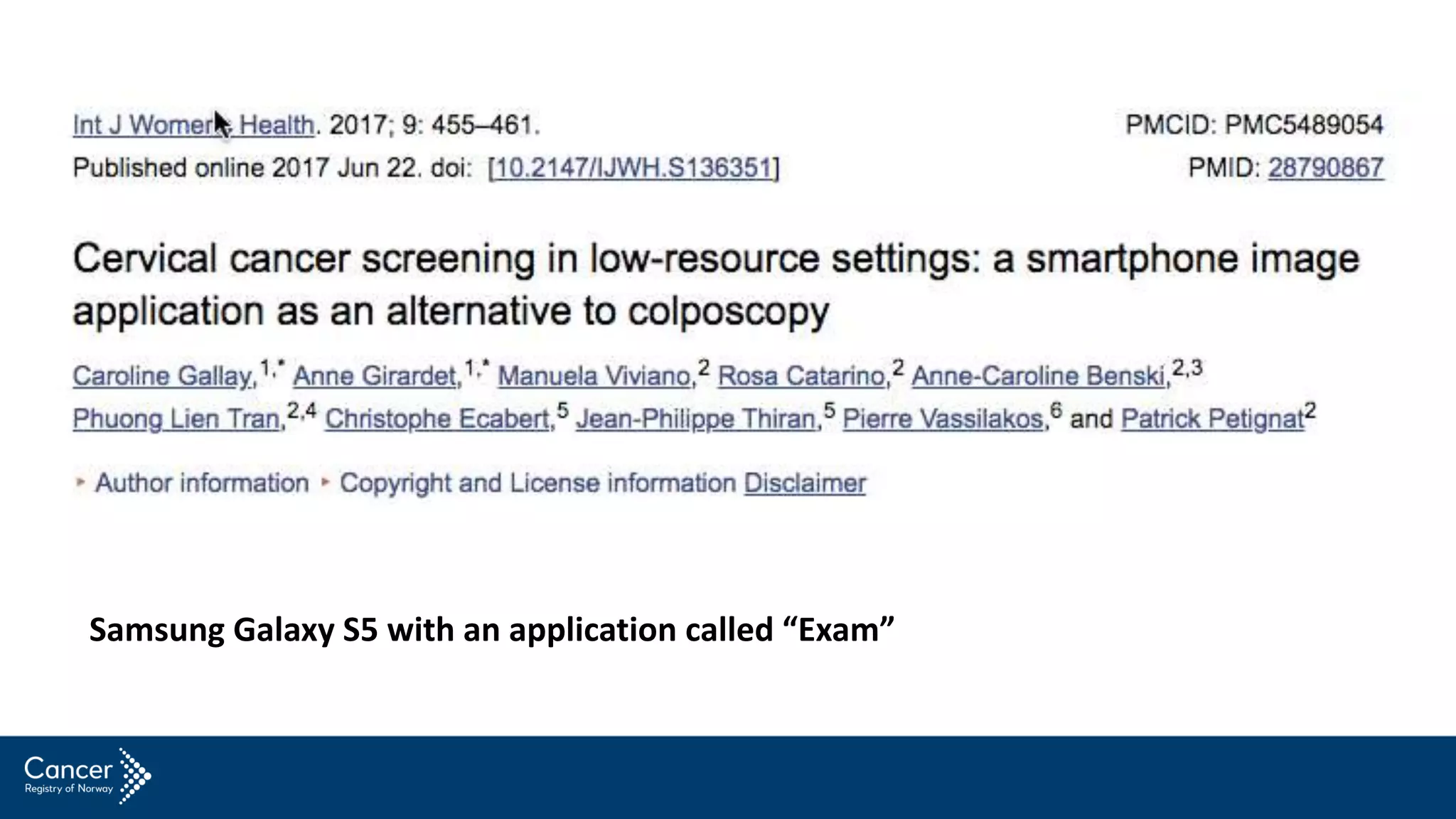
Samsung Galaxy S5 with an application called “Exam”
• This smartphone application allows the acquisition of good
quality images for VIA/VILI diagnosis.
• The classification of images in a patient database makes
them accessible to on- and off-site experts, and allows
continuous clinical education.
• Smartphone applications may offer an alternative to
colposcopy for CC screening in LMIC.
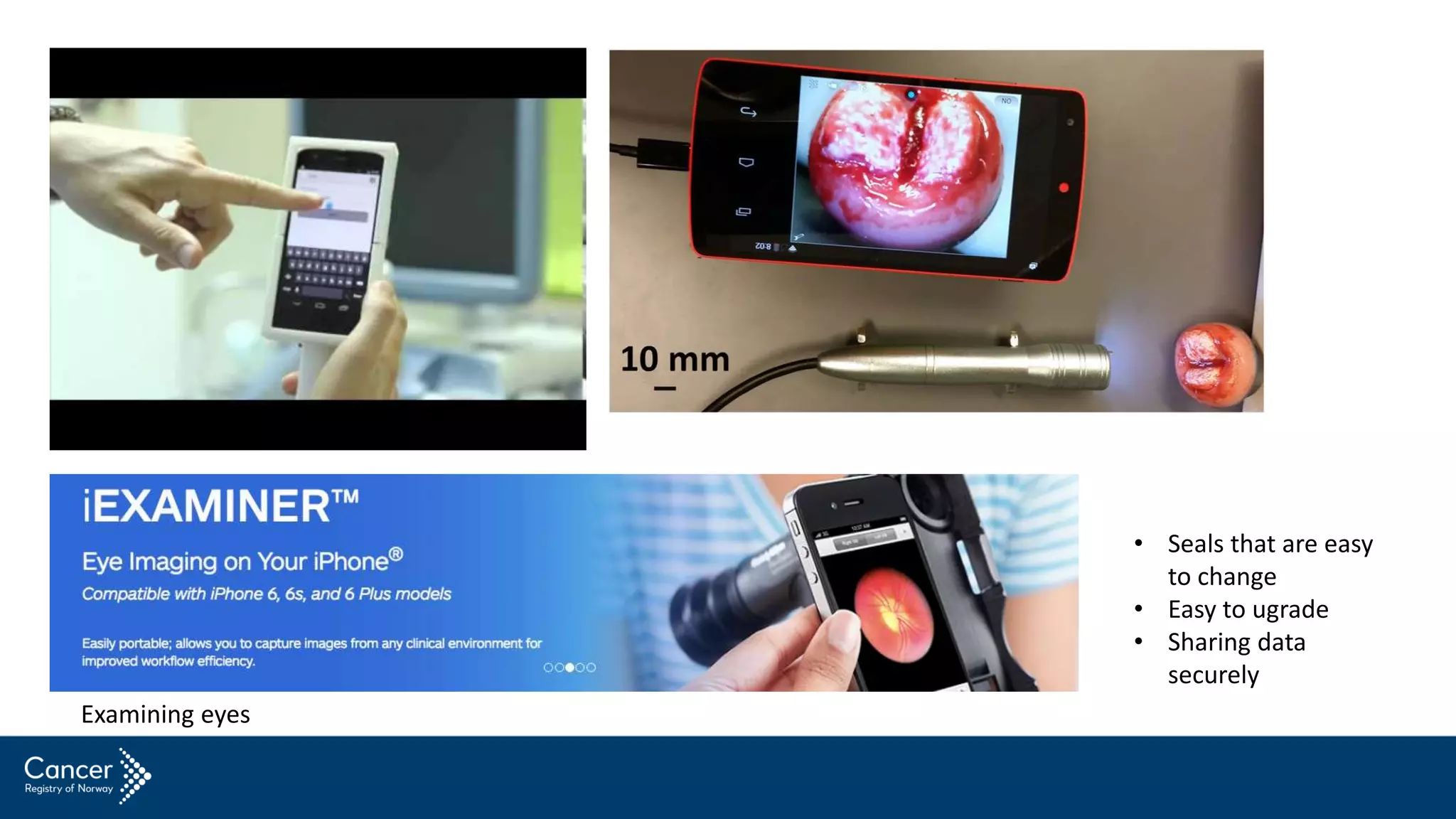
• Seals that are easy
to change
• Easy to ugrade
• Sharing data
securely
Examining eyes
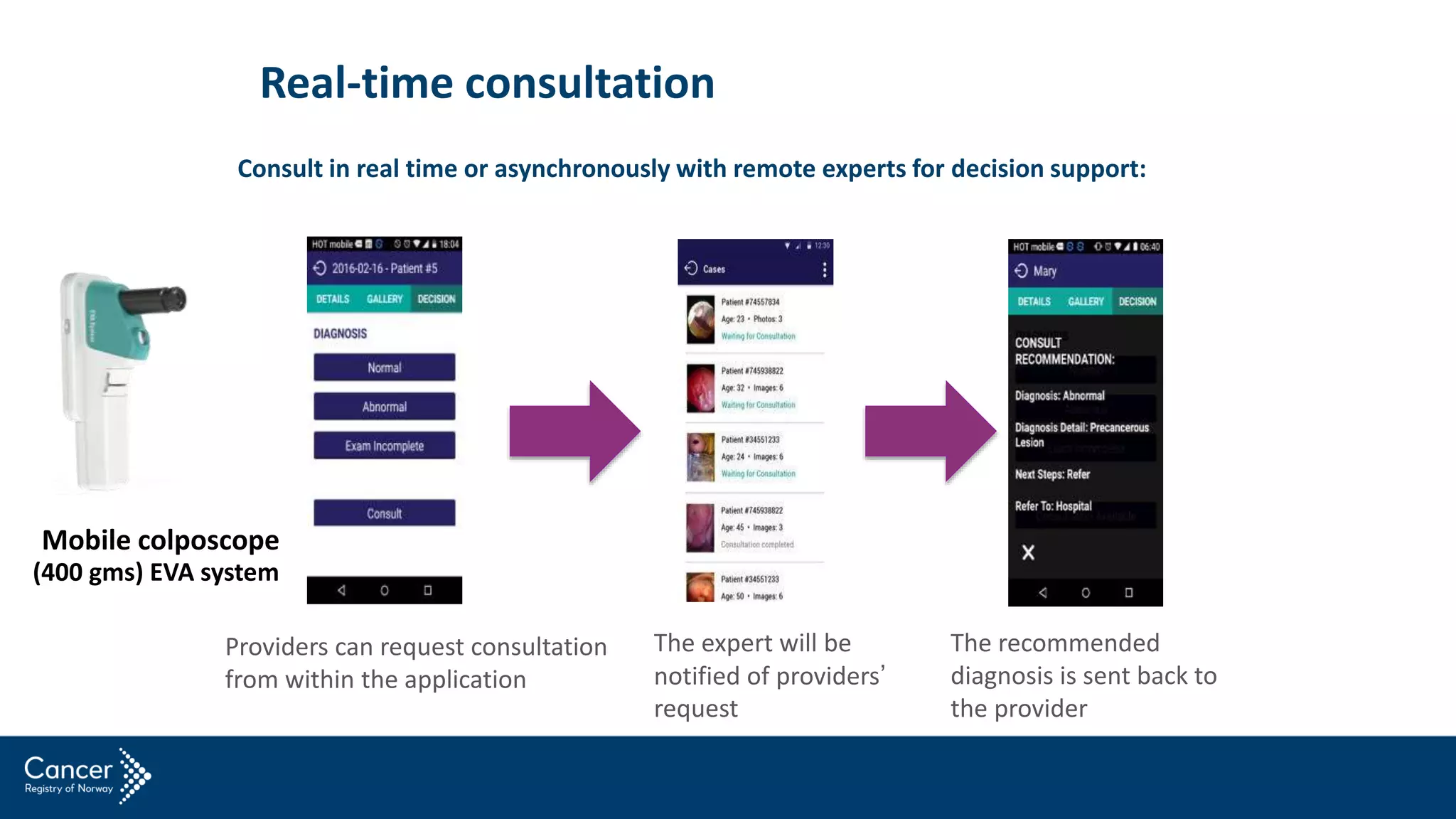
Real-time consultation
Consult in real time or asynchronously with remote experts for decision support:
Providers can request consultation
from within the application
The expert will be
notified of providers’
request
The recommended
diagnosis is sent back to
the provider
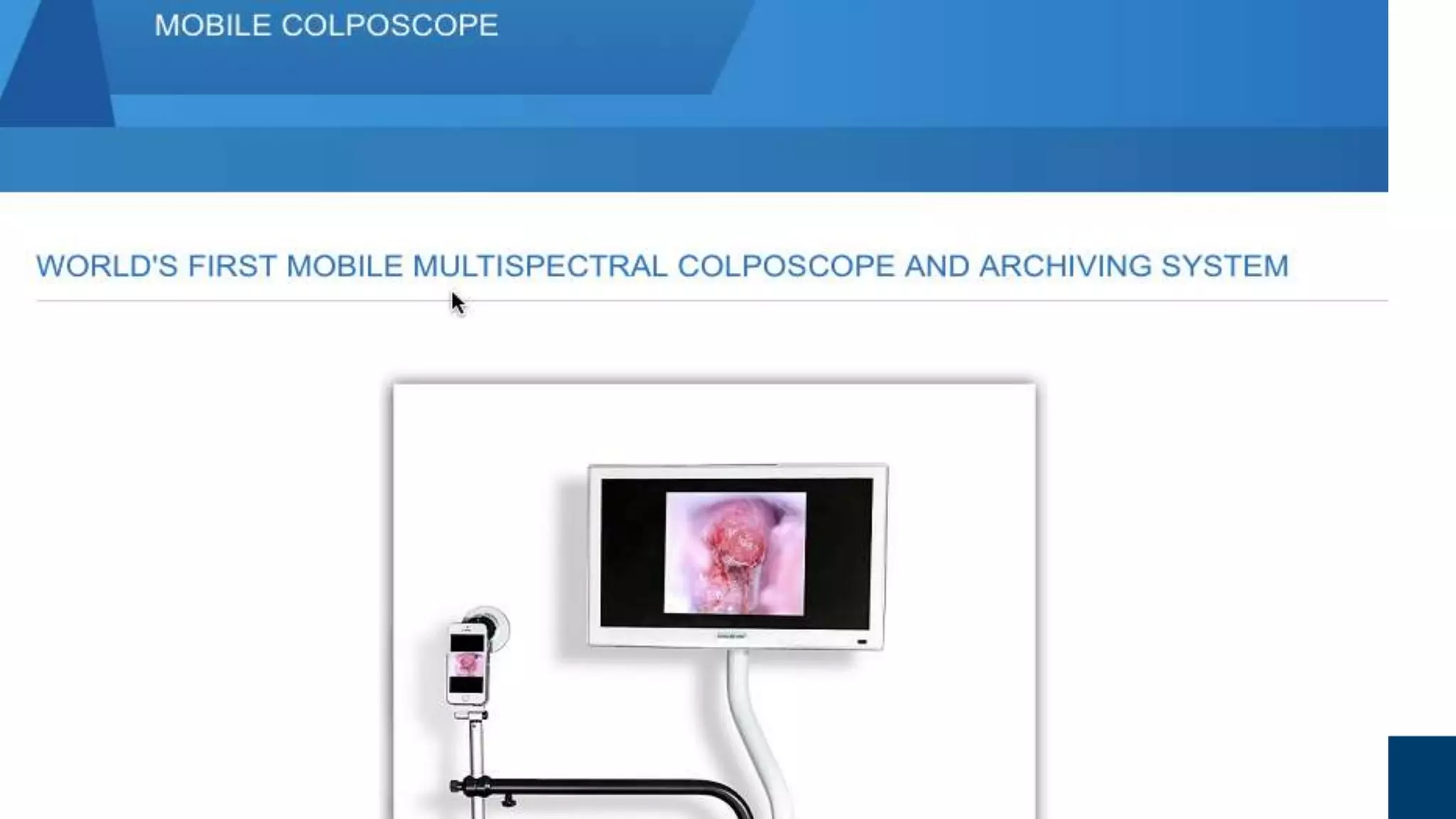
(400 gms) EVA system
Mobile colposcope
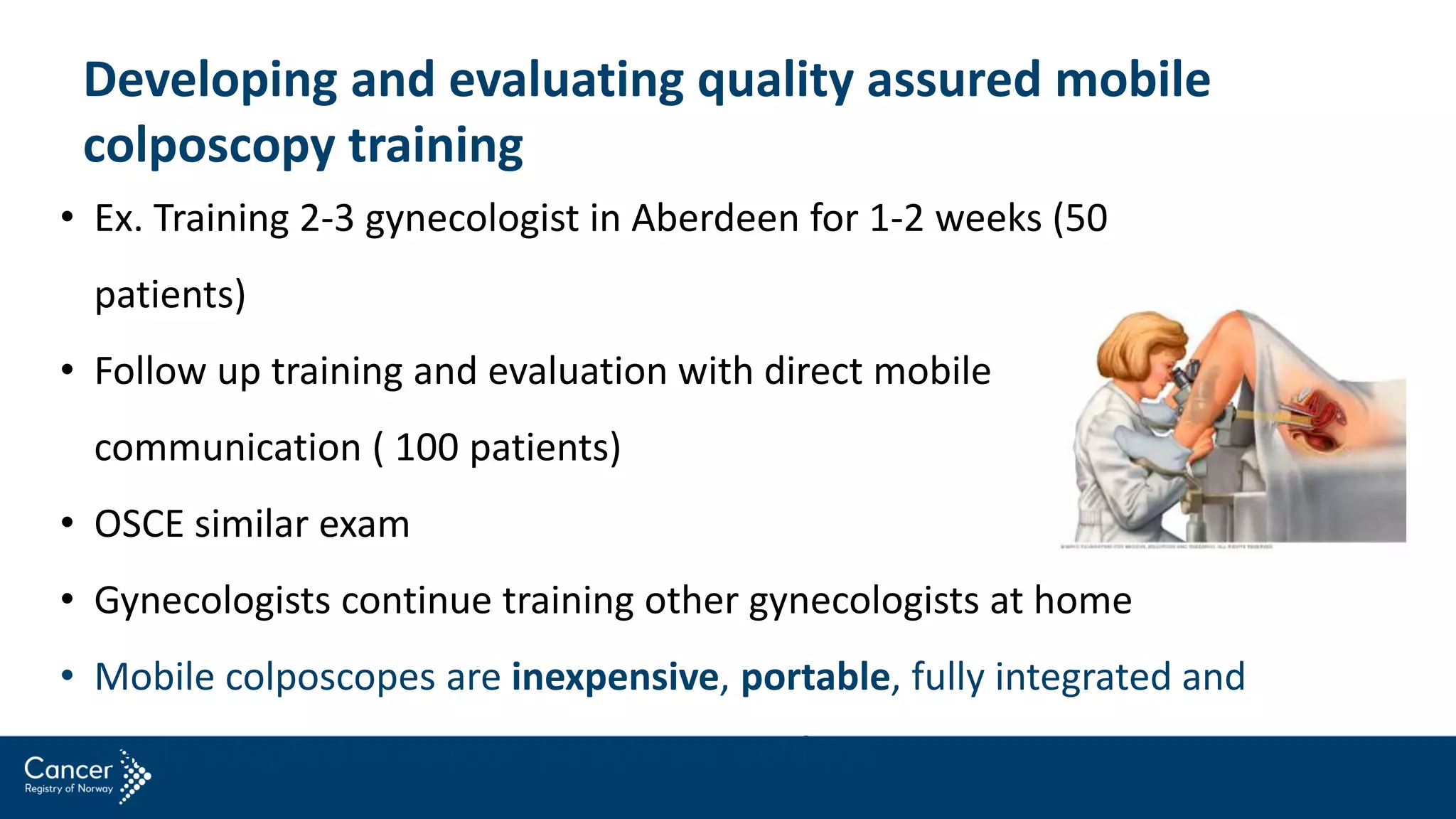
Developing and evaluating quality assured mobile
colposcopy training
• Ex. Training 2-3 gynecologist in Aberdeen for 1-2 weeks (50
patients)
• Follow up training and evaluation with direct mobile
communication ( 100 patients)
• OSCE similar exam
• Gynecologists continue training other gynecologists at home
• Mobile colposcopes are inexpensive, portable, fully integrated and
easily adopted in various healthcare settings
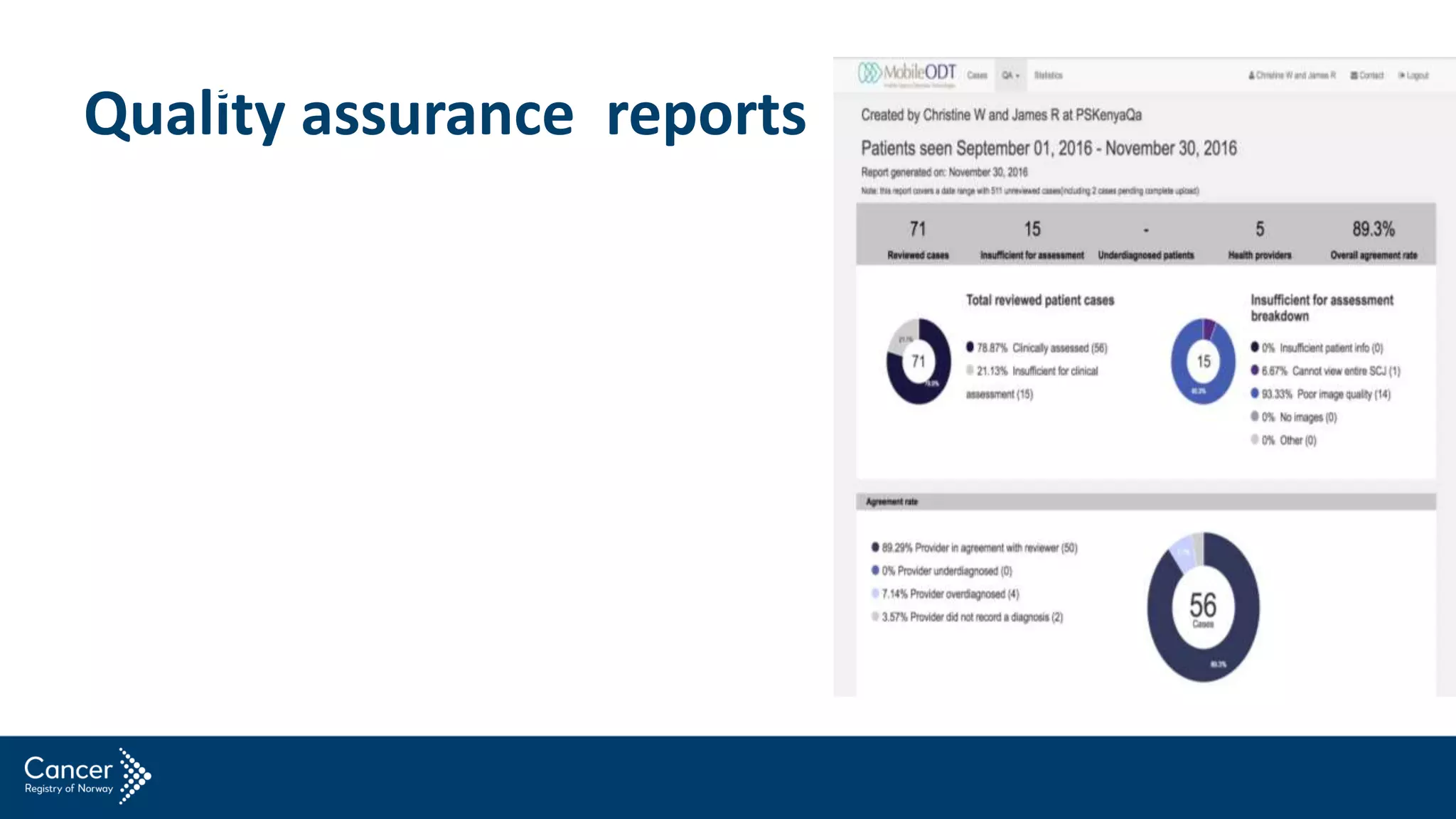
Quality assurance reports
3
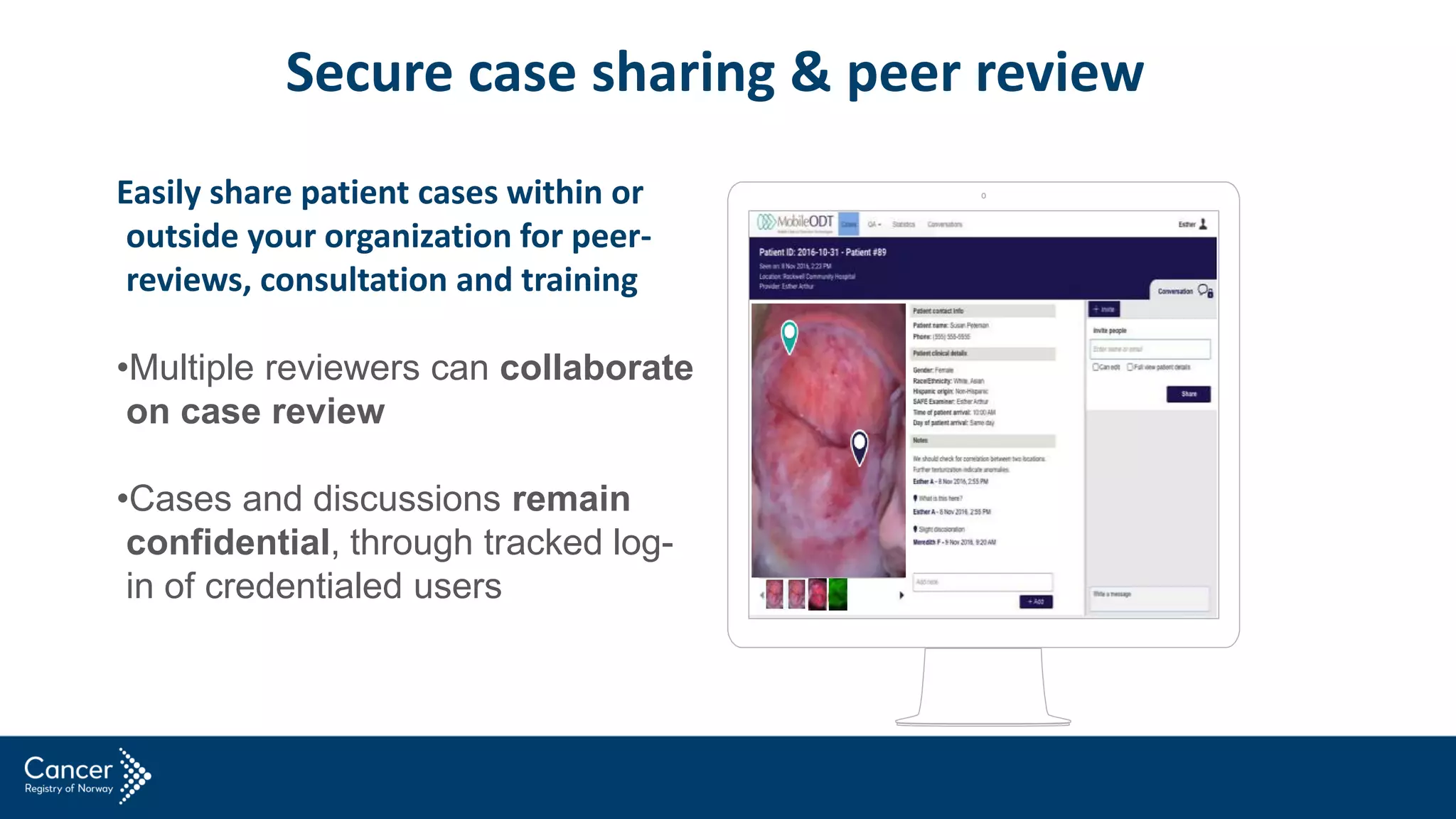
Easily share patient cases within or
outside your organization for peer-
reviews, consultation and training
•Multiple reviewers can collaborate
on case review
•Cases and discussions remain
confidential, through tracked log-
in of credentialed users
2 Secure case sharing & peer review
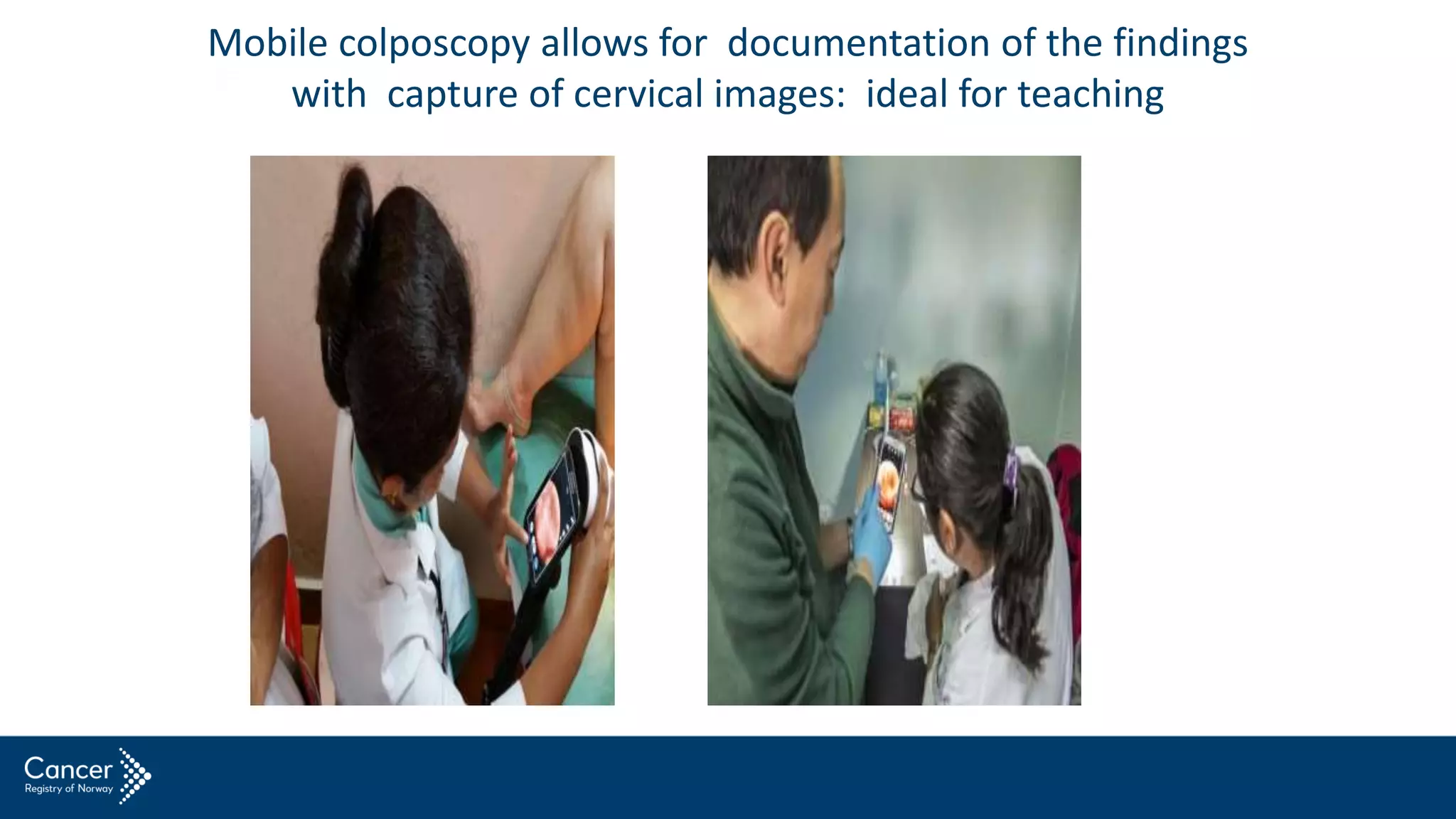
Mobile colposcopy allows for documentation of the findings
with capture of cervical images: ideal for teaching
24
“Colposcopy Telemedicine: Live Swede score versus
Static Swede score and accuracy in detecting CIN2+”
Close correlation of live colposcopic expert examination
and expert static evaluators
PRESENTED AT IFCCP MEETING, ORLANDO MARCH 2017
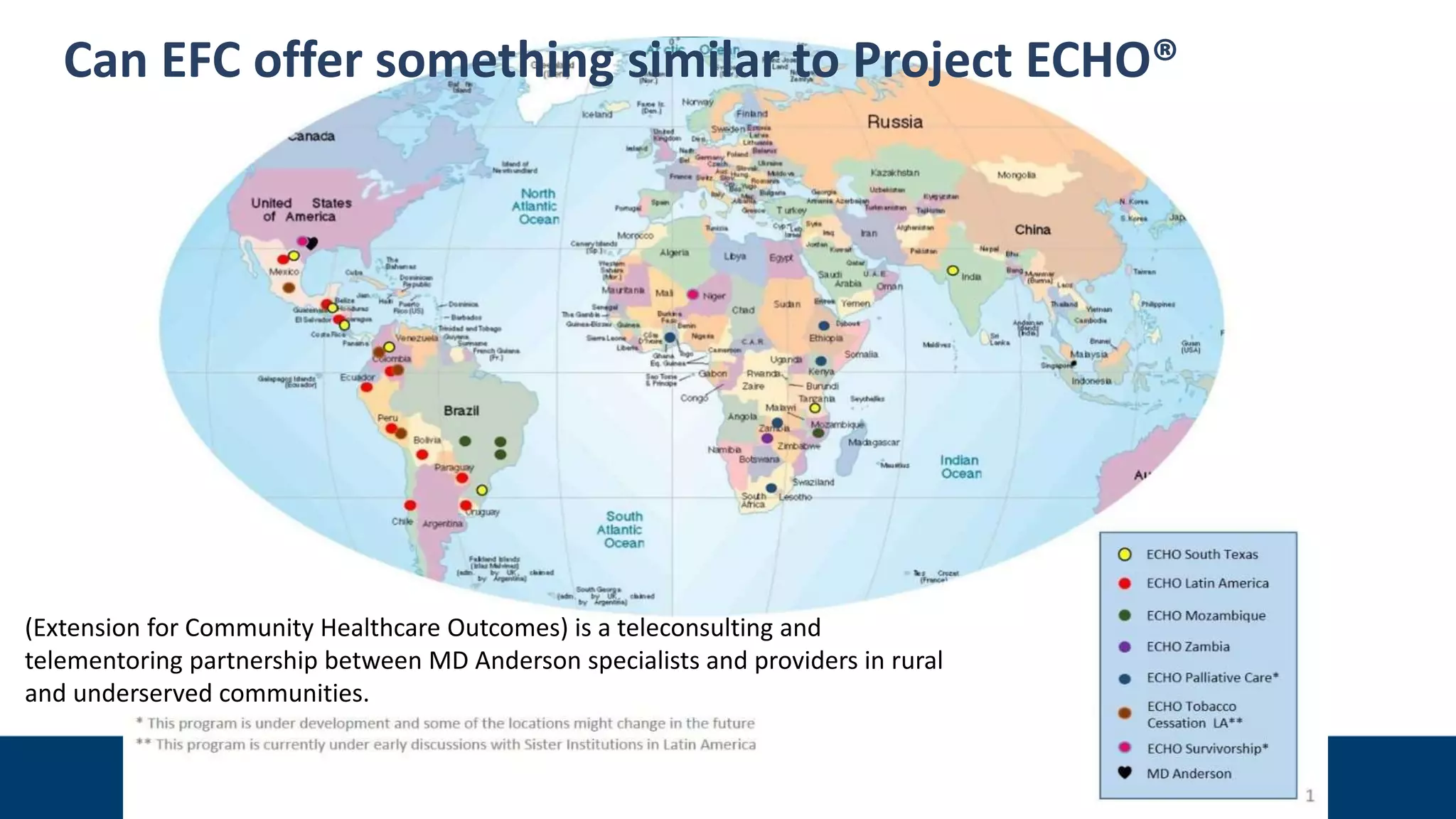
Can EFC offer something similar to Project ECHO®
(Extension for Community Healthcare Outcomes) is a teleconsulting and
telementoring partnership between MD Anderson specialists and providers in rural
and underserved communities.
Part of Moonshot project:
Precision/personalized prevention of cancer
Computing Applications for Individualized Cancer Control Programs
Anonymized data from
Norwegian cervical cancer
screening program
Screening and diagnostic tests
10,7 M tests
1,7 M subjects
Information on risks
tobacco, hormones, etc.
30 K subjects
& 200 K tests
HPC and Data Intensive Resources at LLNL
Vulcan 393,216 cores across
24,578 nodes with 16 cores per
node
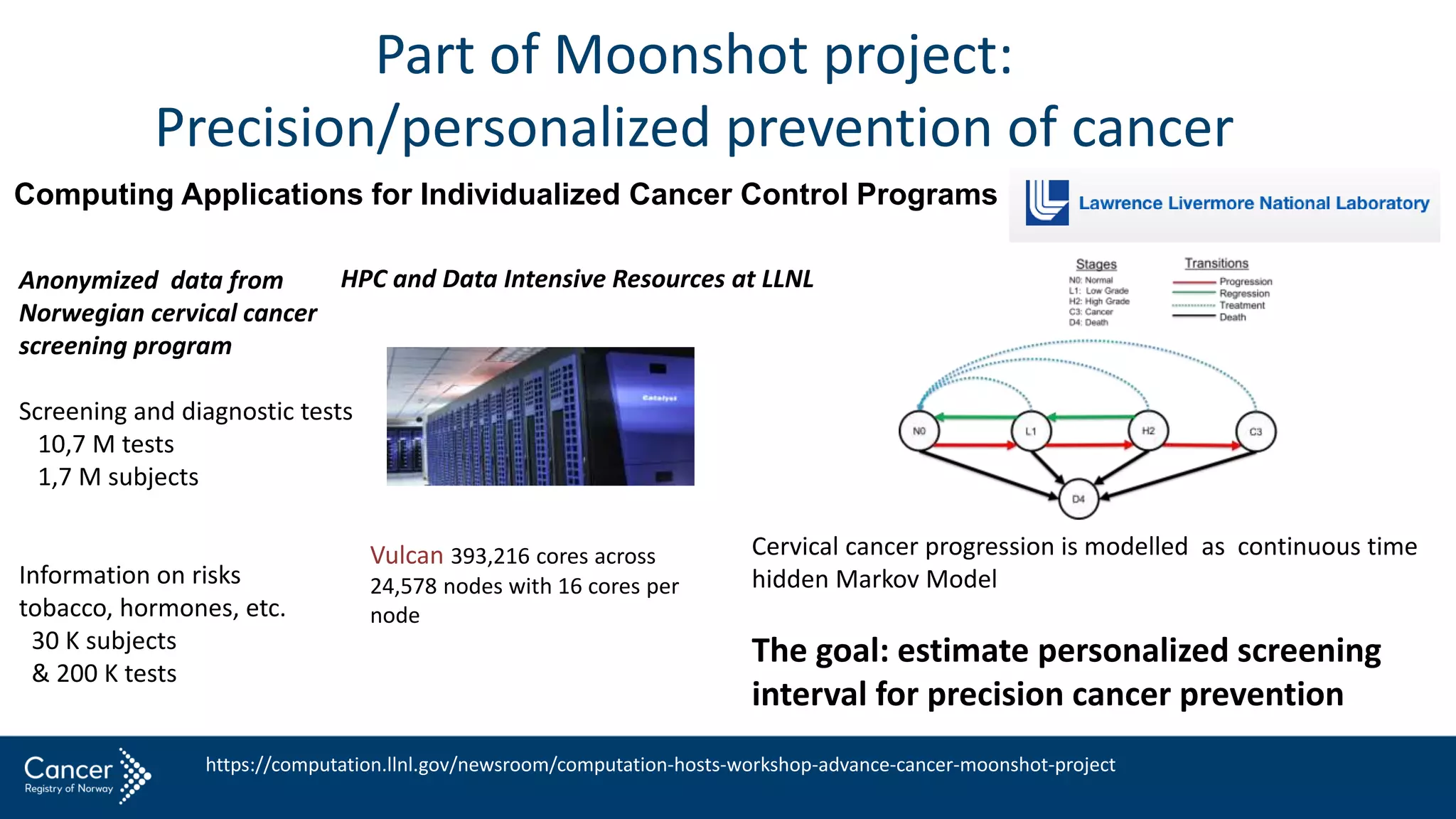
Cervical cancer progression is modelled as continuous time
hidden Markov Model
The goal: estimate personalized screening
interval for precision cancer prevention
4 SOPER, NYGARD, ABDULLA, MENG, NYGARD
Figur e 1. Continuous-time Markov model of cervical cancer and “ death” .
The solid lines represent possible transitions in the Markov chain while
dashed lines represent instantaneous resets due to treatment.
It is expected that age has a strong e↵ect on the transition rates between states. As such
we consider the transition intensities λsr to be functions of the patient’s age. In the case
of cervical cancer, age may not have a monotonic e↵ect on disease progression/ regression.
This is primarily due to the increased exposure to the HPV virus of young, sexually active
women. For this reason we define multiple indicator variables based on specific age ranges.
Recall ai
j is the age of patient i at the time of her j th screening. For all patients in the
data we have 0 < ai
j < 100. Thus we define a partition of the interval (0, 100) by the q+ 1
ages, ⌧0, ⌧1, ⌧2, ..., ⌧q, satisfying
0 = ⌧0 < ⌧1 < ⌧2 < ··· < ⌧q− 1 < ⌧q = 100.
Then patient i at observation j has the covariate xr
ij for each r = 1, 2, ..., q defined as
follows:
xr
ij =
(
1 if ⌧r − 1 < ai
j ⌧r ,
https://computation.llnl.gov/newsroom/computation-hosts-workshop-advance-cancer-moonshot-project
Continue project with colposcopy pictures
Need good documentation of
• good quality pictures
• colposcopy evaluation
• histology results
• collaborate to get these data
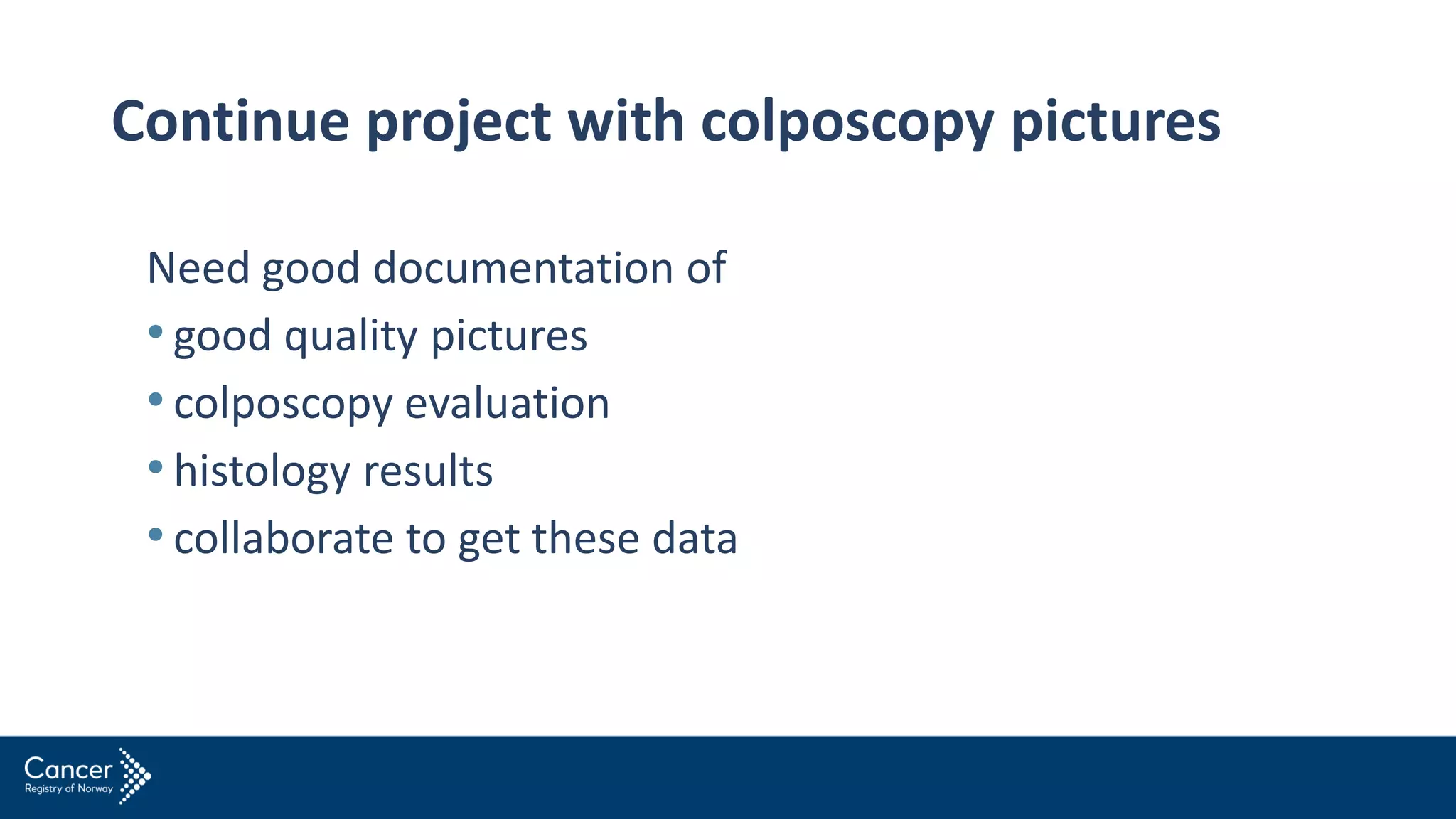
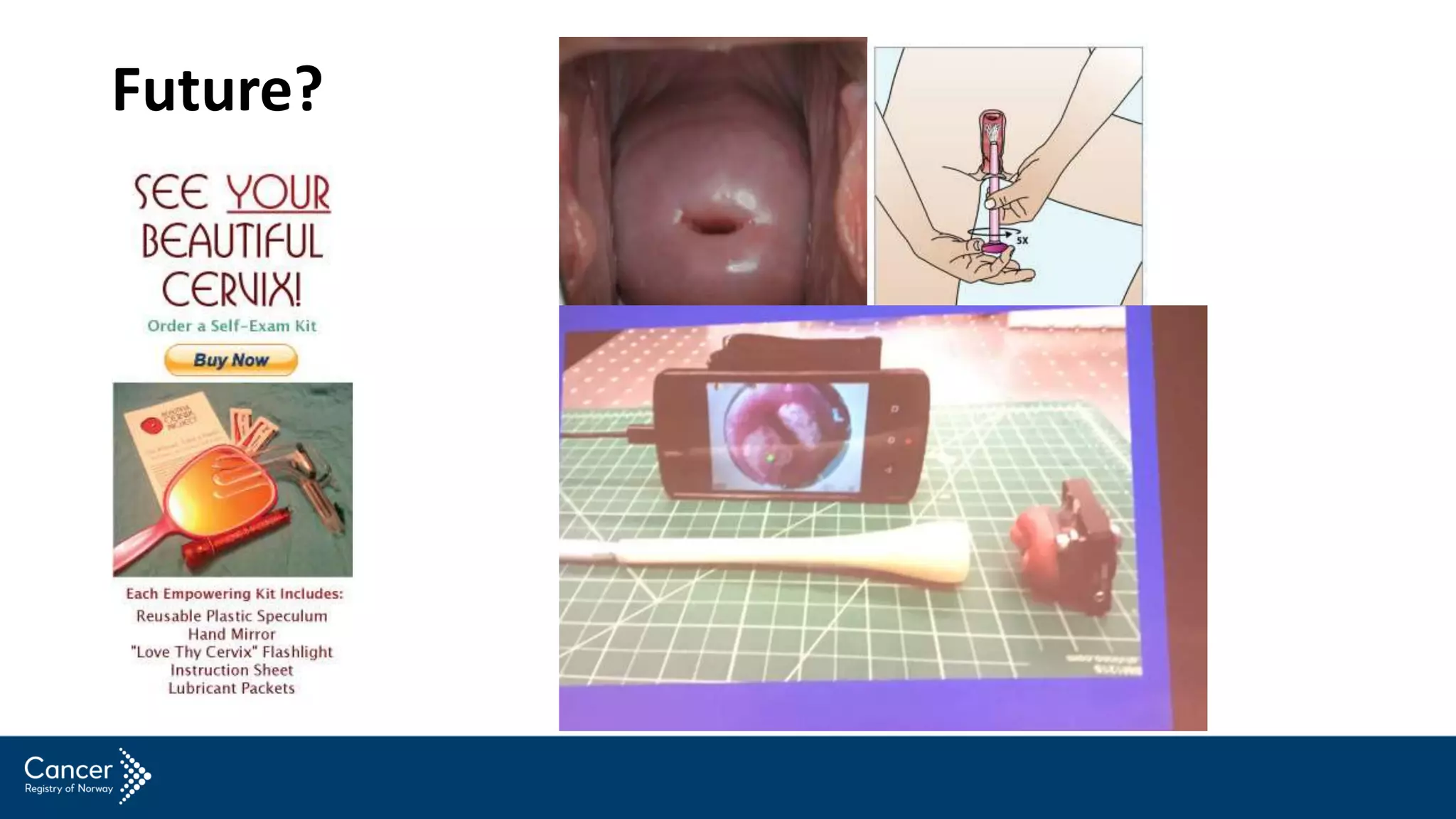
Future?
Thank you!
Albert Singer for slides and for being a great mentor
Kahoot time

Use of new image capturing and sharing systems in colposcopy training Ameli Tropé

  • 2.
    Use of newimage capturing and sharing systems in colposcopy training Ameli Tropé
  • 3.
    Use of newimage capturing and sharing systems in colposcopy training Ameli Tropé, MD, PhD Head of the Norwegian Cervical Cancer Screening Programme ameli.trope@kreftregisteret.no
  • 4.
    Background: Training inNorway before Albert Singer and Joe Jordan
  • 5.
    BSCCP Training inNorth Staffordshire over a 1,5 year period ( 150 cases) Difficult to get time off to train
  • 6.
    NORWAY 5.233 mill.people (2016) Ca 1000 gynecologists Only obligatory training is a 2 hour colposcopy course Background: Training in Norway today
  • 7.
  • 8.
    Other arenas ofteaching • Colposcopy courses abroad • E- learning course • Travelling around to clinics to give colposcopy lectures • Presentations at Gynecological meetings • Writing easy read articles in gynecology magazine • Asking students attending courses to teach at clinics • But we have no organized training at the clinics and few qualified trainers • Where do we start?
  • 9.
    EFC training programmecriteria (2014) Trainee Caseload • minimum of 100 cases, but individual Societies would have the right to require more cases • minimum of 50 new cases • minimum of 30 of the cases seen should have both a colposcopic and histological proven abnormality • The training should be completed within 24 months Electronic Log-book • It is recommended that cases seen should be documented using the EFC electronic log-book Exit Assessment • Each Society should, at some time in the future, introduce some form of exit assessment at the completion of training
  • 10.
    • In somecountries none or not enough trained teachers/coaches • Accreditation difficult • HPV primary screening means more colposcopy • Decreased PPV of colposcopy in HPV vaccinated populations • Need for centralization of expertise with decreasing PPV of colposcopy • Increasing cervical cancer burden in low income countries Colposcopy training problems – now/future
  • 11.
    Why is PPVdecreasing in a vaccinated kohort? 15 pages 1 Wally
  • 12.
    Results after 3-yearsperiod of HPV primary screening- randomized implementation (Nygård et al, under submission) 185 000 women per 31.12.2017 • Problem: 2x as many biopsies in the HPV arm
  • 13.
    Problem in countrieslike Norway • When normal or colposcopy TZ1 we can’t have guidelines saying that women should come back in ex. 3 years since we can’t yet trust the level of colposcopy • Overload of women staying in a loop of controls when persistent HPV positive. Some stop coming back.
  • 14.
    How can wequalify more trainees quickly?
  • 15.
    Samsung Galaxy S5with an application called “Exam”
  • 16.
    • This smartphoneapplication allows the acquisition of good quality images for VIA/VILI diagnosis. • The classification of images in a patient database makes them accessible to on- and off-site experts, and allows continuous clinical education. • Smartphone applications may offer an alternative to colposcopy for CC screening in LMIC.
  • 18.
    • Seals thatare easy to change • Easy to ugrade • Sharing data securely Examining eyes
  • 19.
    Real-time consultation Consult inreal time or asynchronously with remote experts for decision support: Providers can request consultation from within the application The expert will be notified of providers’ request The recommended diagnosis is sent back to the provider (400 gms) EVA system Mobile colposcope
  • 20.
    Developing and evaluatingquality assured mobile colposcopy training • Ex. Training 2-3 gynecologist in Aberdeen for 1-2 weeks (50 patients) • Follow up training and evaluation with direct mobile communication ( 100 patients) • OSCE similar exam • Gynecologists continue training other gynecologists at home • Mobile colposcopes are inexpensive, portable, fully integrated and easily adopted in various healthcare settings
  • 21.
  • 22.
    Easily share patientcases within or outside your organization for peer- reviews, consultation and training •Multiple reviewers can collaborate on case review •Cases and discussions remain confidential, through tracked log- in of credentialed users 2 Secure case sharing & peer review
  • 23.
    Mobile colposcopy allowsfor documentation of the findings with capture of cervical images: ideal for teaching
  • 24.
    24 “Colposcopy Telemedicine: LiveSwede score versus Static Swede score and accuracy in detecting CIN2+” Close correlation of live colposcopic expert examination and expert static evaluators PRESENTED AT IFCCP MEETING, ORLANDO MARCH 2017
  • 25.
    Can EFC offersomething similar to Project ECHO® (Extension for Community Healthcare Outcomes) is a teleconsulting and telementoring partnership between MD Anderson specialists and providers in rural and underserved communities.
  • 26.
    Part of Moonshotproject: Precision/personalized prevention of cancer Computing Applications for Individualized Cancer Control Programs Anonymized data from Norwegian cervical cancer screening program Screening and diagnostic tests 10,7 M tests 1,7 M subjects Information on risks tobacco, hormones, etc. 30 K subjects & 200 K tests HPC and Data Intensive Resources at LLNL Vulcan 393,216 cores across 24,578 nodes with 16 cores per node Cervical cancer progression is modelled as continuous time hidden Markov Model The goal: estimate personalized screening interval for precision cancer prevention 4 SOPER, NYGARD, ABDULLA, MENG, NYGARD Figur e 1. Continuous-time Markov model of cervical cancer and “ death” . The solid lines represent possible transitions in the Markov chain while dashed lines represent instantaneous resets due to treatment. It is expected that age has a strong e↵ect on the transition rates between states. As such we consider the transition intensities λsr to be functions of the patient’s age. In the case of cervical cancer, age may not have a monotonic e↵ect on disease progression/ regression. This is primarily due to the increased exposure to the HPV virus of young, sexually active women. For this reason we define multiple indicator variables based on specific age ranges. Recall ai j is the age of patient i at the time of her j th screening. For all patients in the data we have 0 < ai j < 100. Thus we define a partition of the interval (0, 100) by the q+ 1 ages, ⌧0, ⌧1, ⌧2, ..., ⌧q, satisfying 0 = ⌧0 < ⌧1 < ⌧2 < ··· < ⌧q− 1 < ⌧q = 100. Then patient i at observation j has the covariate xr ij for each r = 1, 2, ..., q defined as follows: xr ij = ( 1 if ⌧r − 1 < ai j ⌧r , https://computation.llnl.gov/newsroom/computation-hosts-workshop-advance-cancer-moonshot-project
  • 27.
    Continue project withcolposcopy pictures Need good documentation of • good quality pictures • colposcopy evaluation • histology results • collaborate to get these data
  • 28.
  • 29.
    Thank you! Albert Singerfor slides and for being a great mentor Kahoot time

Editor's Notes

  • #20 High quality imaging (revisit after messaging meeting)
  • #21 Do long-term non-attenders prefer self-sampling? Which self-sampling delivery mode is most efficient? How can follow-up of HPV-positive women be efficiently implemented? Trial during 2018-2019 Funded by Cancer Society
  • #27 Develop mathematical model by using machine learning and to predict personalized screening intensity based on age, Screening history, test results and personal risk profile. Combining Anonymized data from Norwegian cervical cancer screening program which contain About 10 million Screening and diagnostic tests for 1,7 millon women Furthermore, we have information on relevant risks-factors collected through the questionnaire studies about tobacco, reproductive health, hormones, alcohol etc. 30 K subjects & 200 K tests LLNL har infrastructure and expertise fof r using Bid data analytics. It turns out that learniong medical data is extremely data intensive, the catalyst, was able efficiently learn model parameters with 100,000 patients’ data : which was not enough , so we move over to a new machine, Vulcan to utilize over 1 million patients data. We model Disease progression/Screening as continuous Time Hidden Markov Model, but we experiment with recurrent neural networks, transfer learning and othermachine learning methods This allows us to write down a probability distribution for the unobserved and observed data from the entire screening population and ”learn” the best model parameters