QI update and next steps
Karl Ulrich Petry
EFC Quality Indicators in Colposcopy
Update and next steps
K. Ulrich Petry, Wolfsburg
Germany
Berlin Consensus 2011
QA of each part of the colposcopy service
1. Quality of colposcopic examination /
identification of SCJ
2. Colposcopical guidance of excisional CIN
therapy
3. Quality of indication/selection for excisional
therapy
4. Proof of cure following invasive treatment
of CIN
5. Experience
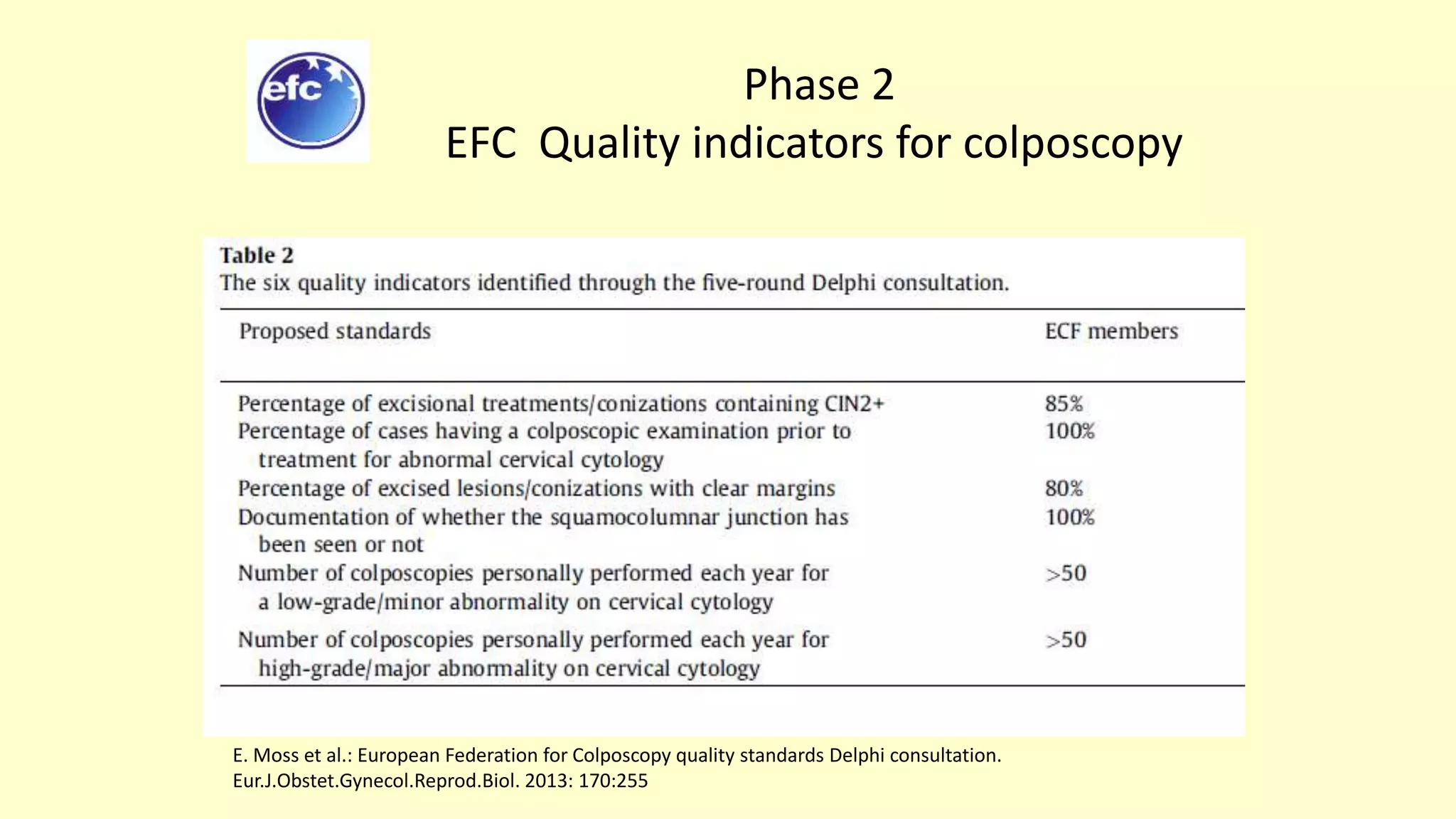
Phase 2
EFC Quality indicators for colposcopy
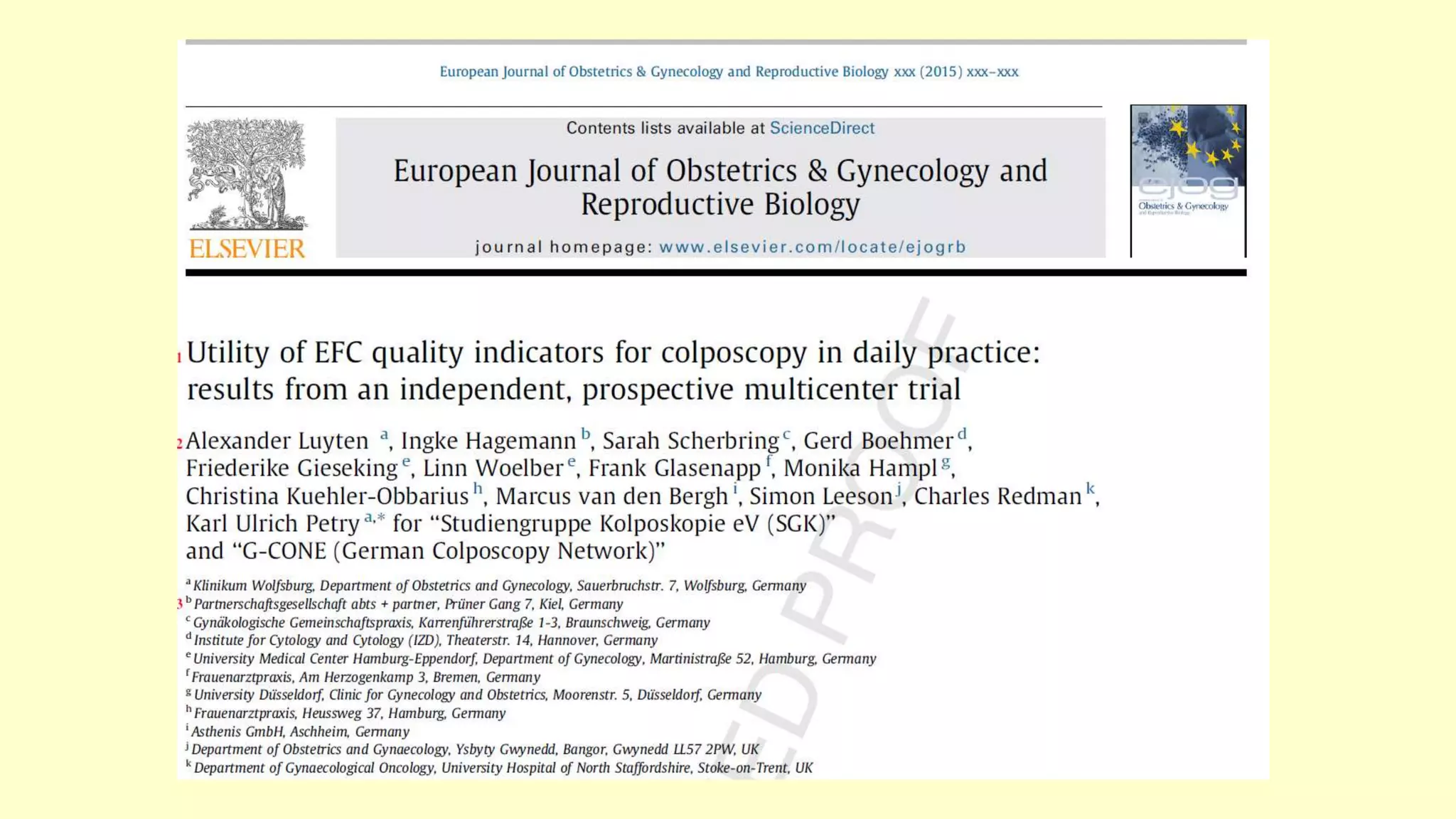
E. Moss et al.: European Federation for Colposcopy quality standards Delphi consultation.
Eur.J.Obstet.Gynecol.Reprod.Biol. 2013: 170:255
• Use the quality parameters to assess quality in colposcopy.
• Use the quality assessment to evaluate the quality parameters
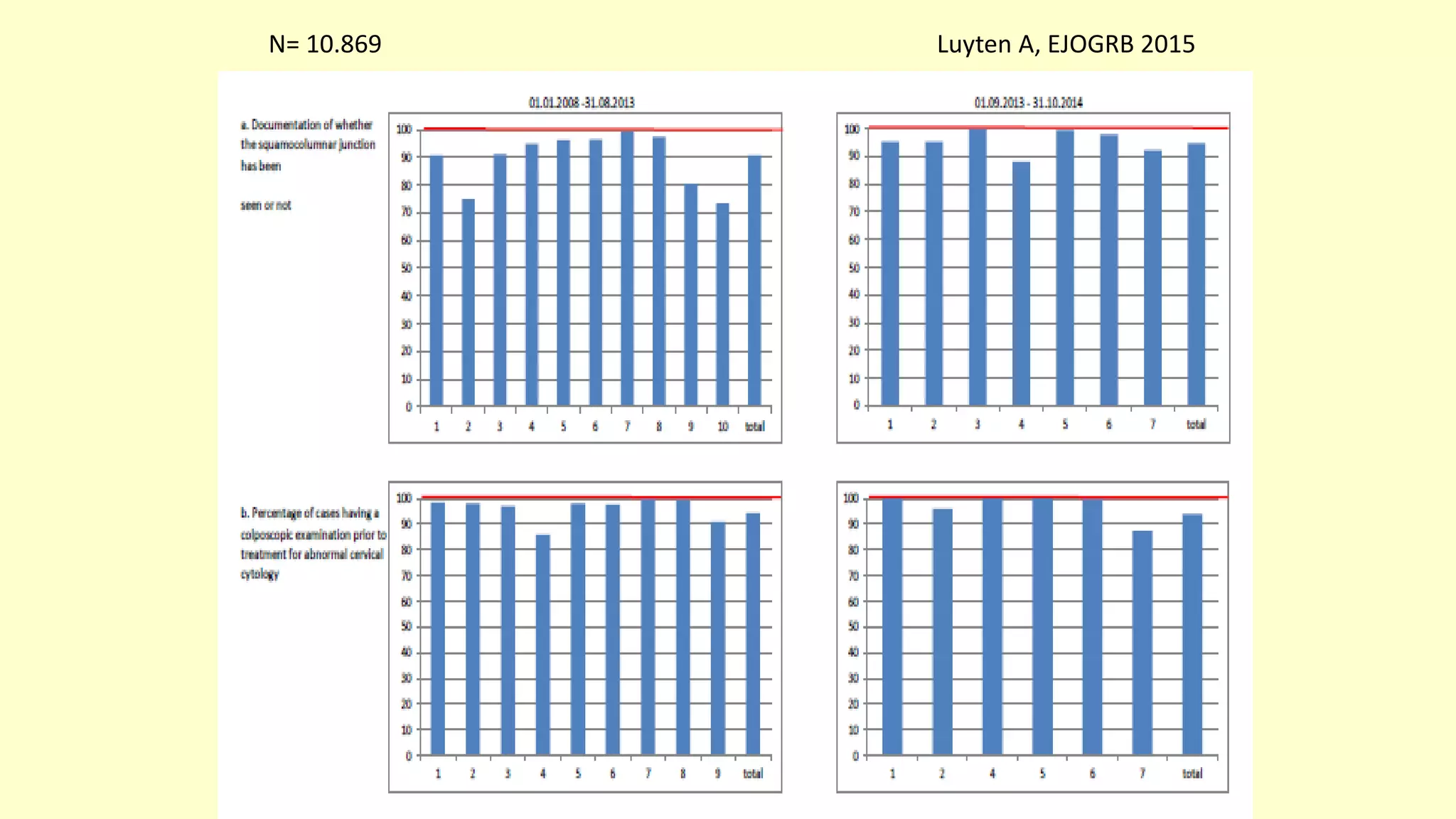
N= 10.869 Luyten A, EJOGRB 2015
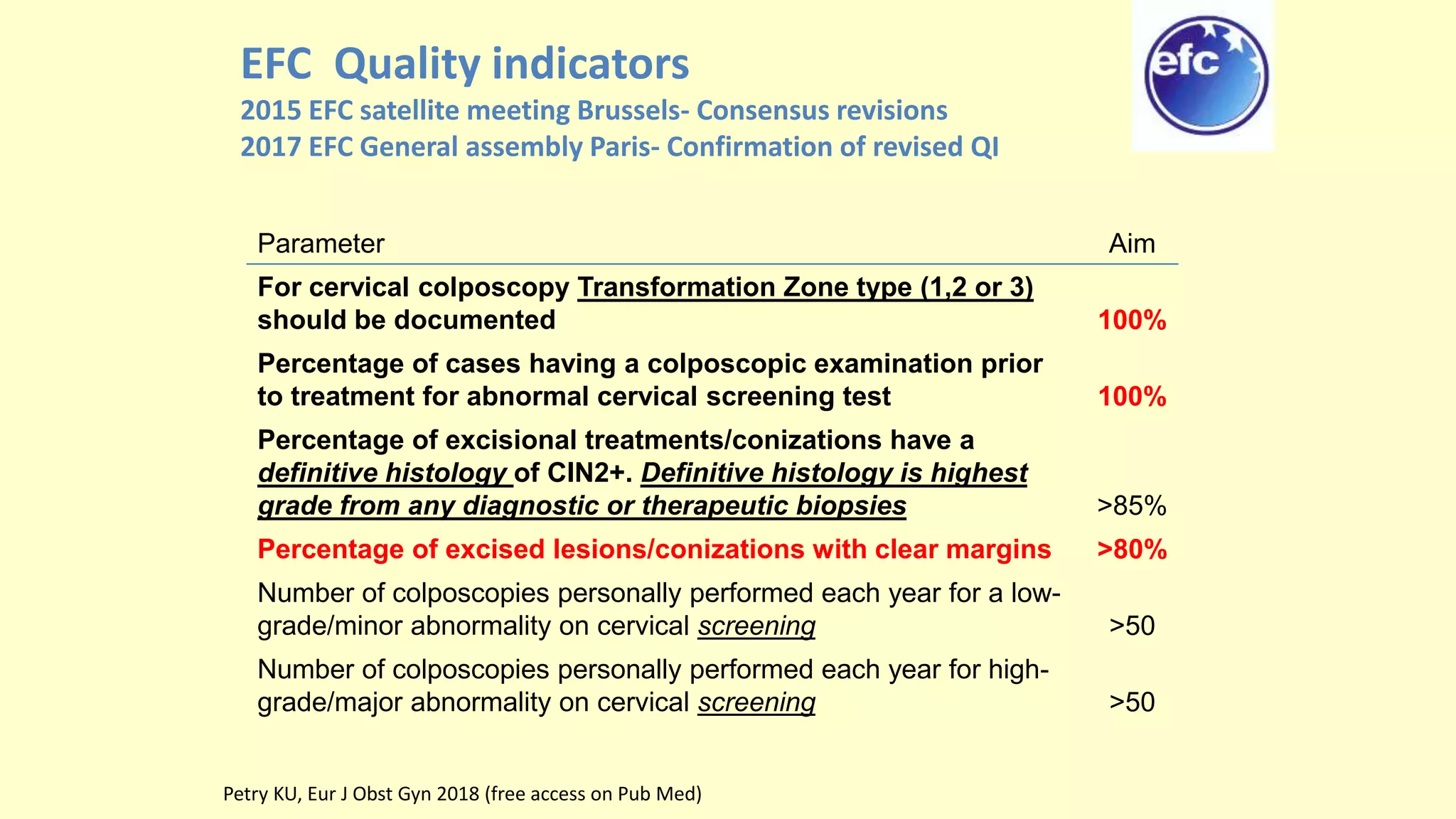
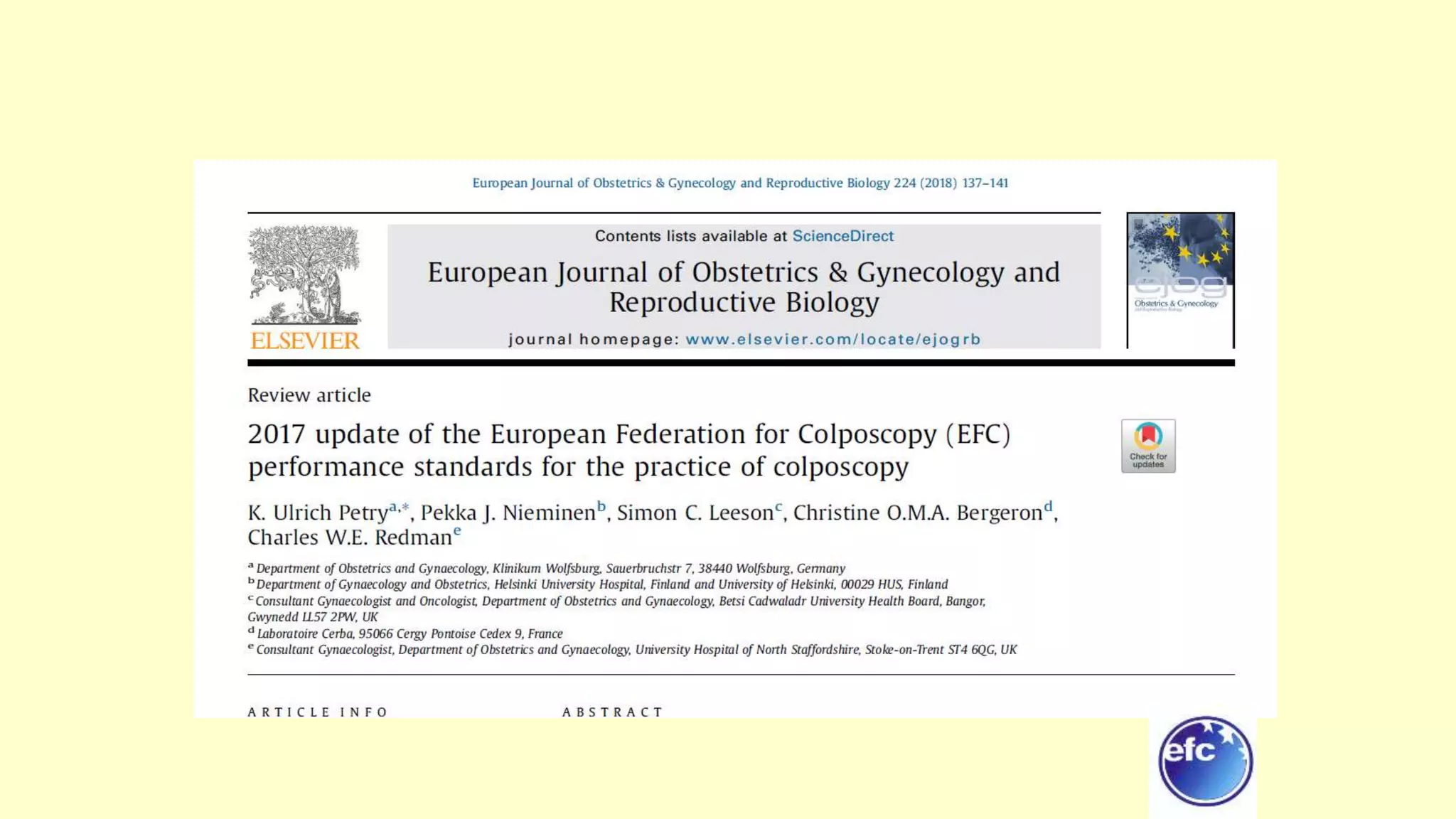
EFC Quality indicators
2015 EFC satellite meeting Brussels- Consensus revisions
2017 EFC General assembly Paris- Confirmation of revised QI
Parameter Aim
For cervical colposcopy Transformation Zone type (1,2 or 3)
should be documented 100%
Percentage of cases having a colposcopic examination prior
to treatment for abnormal cervical screening test 100%
Percentage of excisional treatments/conizations have a
definitive histology of CIN2+. Definitive histology is highest
grade from any diagnostic or therapeutic biopsies >85%
Percentage of excised lesions/conizations with clear margins >80%
Number of colposcopies personally performed each year for a low-
grade/minor abnormality on cervical screening >50
Number of colposcopies personally performed each year for high-
grade/major abnormality on cervical screening >50
Petry KU, Eur J Obst Gyn 2018 (free access on Pub Med)
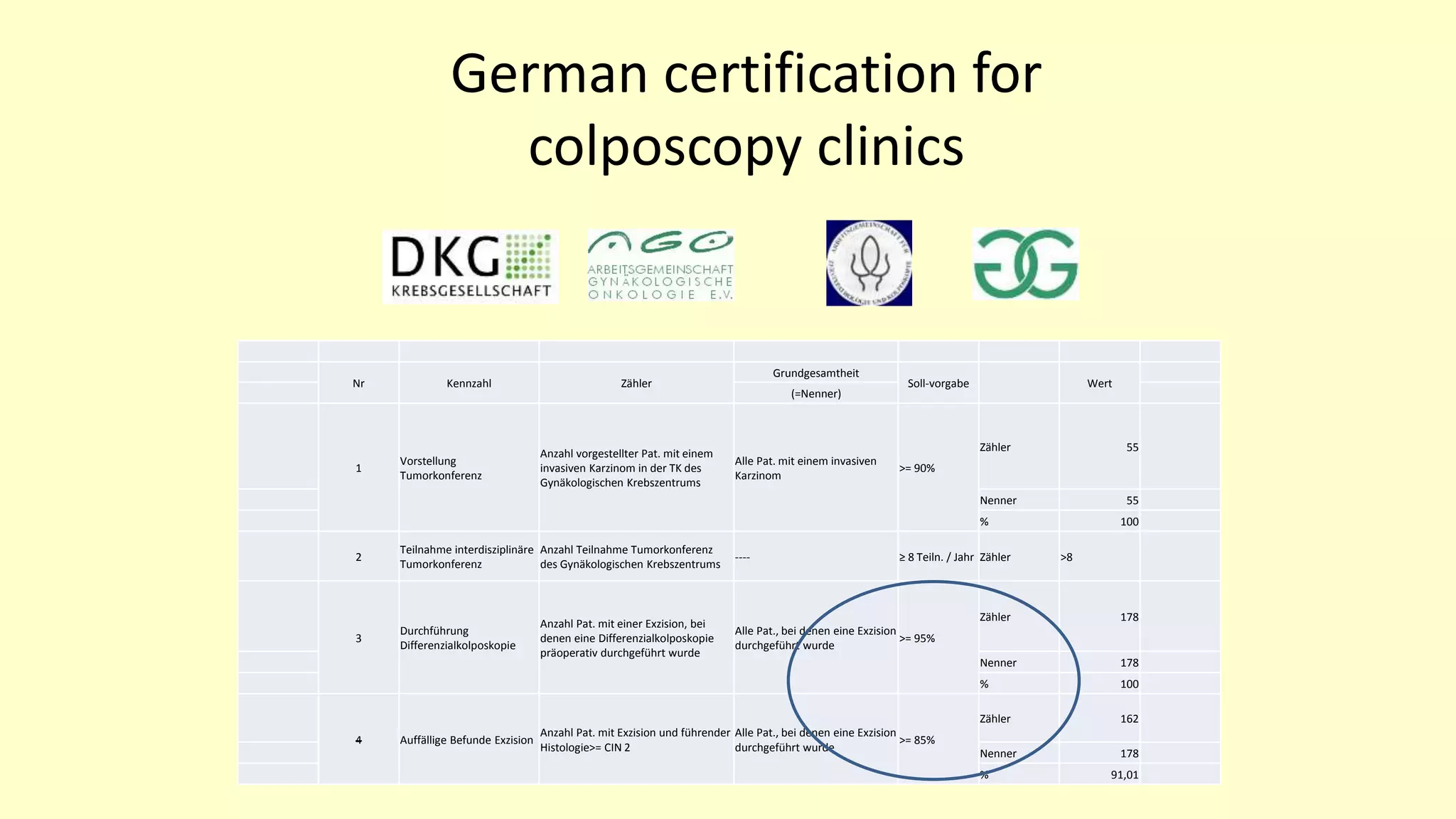
German certification for
colposcopy clinics
Nr Kennzahl Zähler
Grundgesamtheit
Soll-vorgabe Wert
(=Nenner)
1
Vorstellung
Tumorkonferenz
Anzahl vorgestellter Pat. mit einem
invasiven Karzinom in der TK des
Gynäkologischen Krebszentrums
Alle Pat. mit einem invasiven
Karzinom
>= 90%
Zähler 55
Nenner 55
% 100
2
Teilnahme interdisziplinäre
Tumorkonferenz
Anzahl Teilnahme Tumorkonferenz
des Gynäkologischen Krebszentrums
---- ≥ 8 Teiln. / Jahr Zähler >8
3
Durchführung
Differenzialkolposkopie
Anzahl Pat. mit einer Exzision, bei
denen eine Differenzialkolposkopie
präoperativ durchgeführt wurde
Alle Pat., bei denen eine Exzision
durchgeführt wurde
>= 95%
Zähler 178
Nenner 178
% 100
4 Auffällige Befunde Exzision
Anzahl Pat. mit Exzision und führender
Histologie>= CIN 2
Alle Pat., bei denen eine Exzision
durchgeführt wurde
>= 85%
Zähler 162
Nenner 178
% 91,01
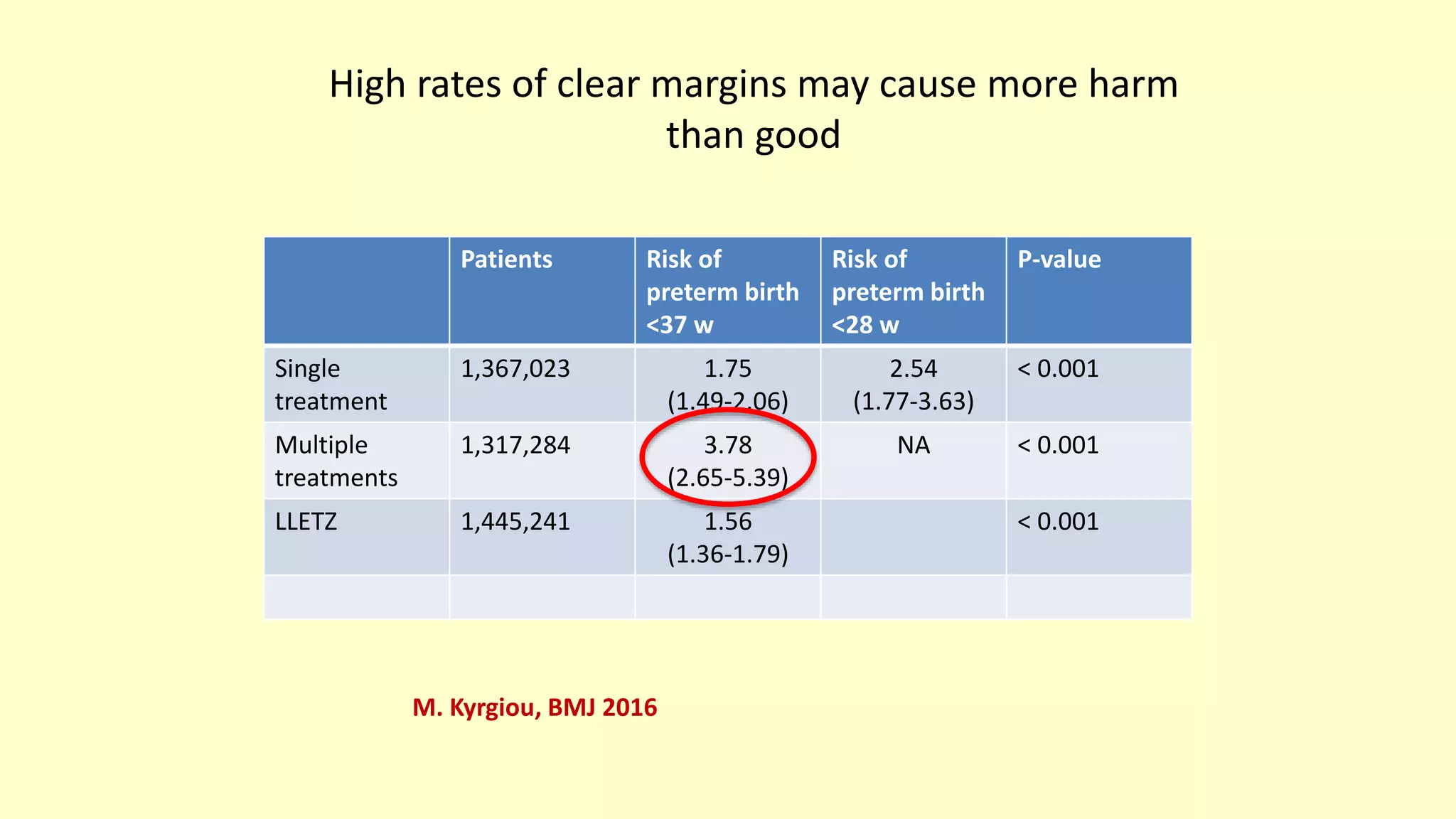
High rates of clear margins may cause more harm
than good
Patients Risk of
preterm birth
<37 w
Risk of
preterm birth
<28 w
P-value
Single
treatment
1,367,023 1.75
(1.49-2.06)
2.54
(1.77-3.63)
< 0.001
Multiple
treatments
1,317,284 3.78
(2.65-5.39)
NA < 0.001
LLETZ 1,445,241 1.56
(1.36-1.79)
< 0.001
M. Kyrgiou, BMJ 2016
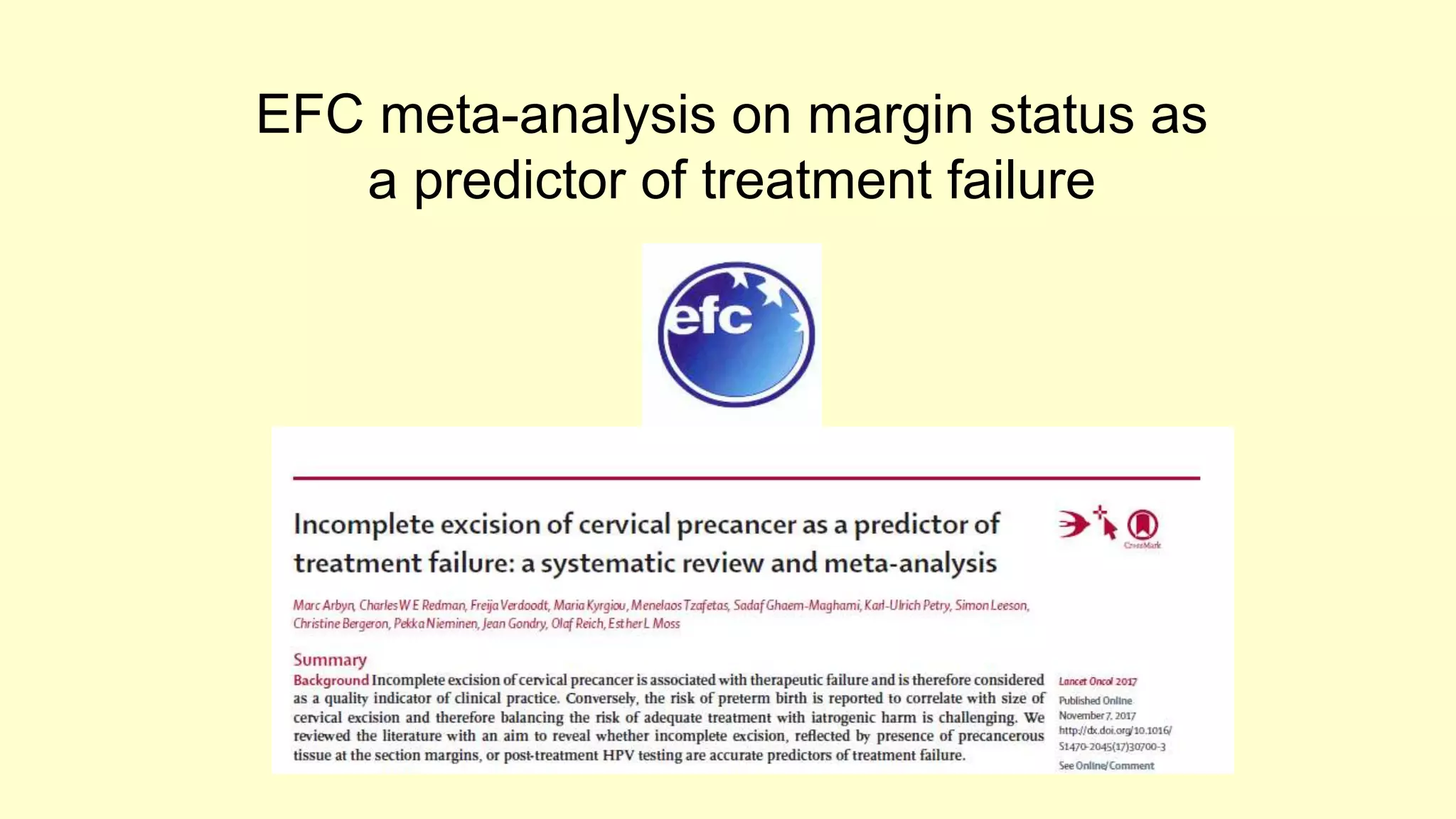
EFC meta-analysis on margin status as
a predictor of treatment failure
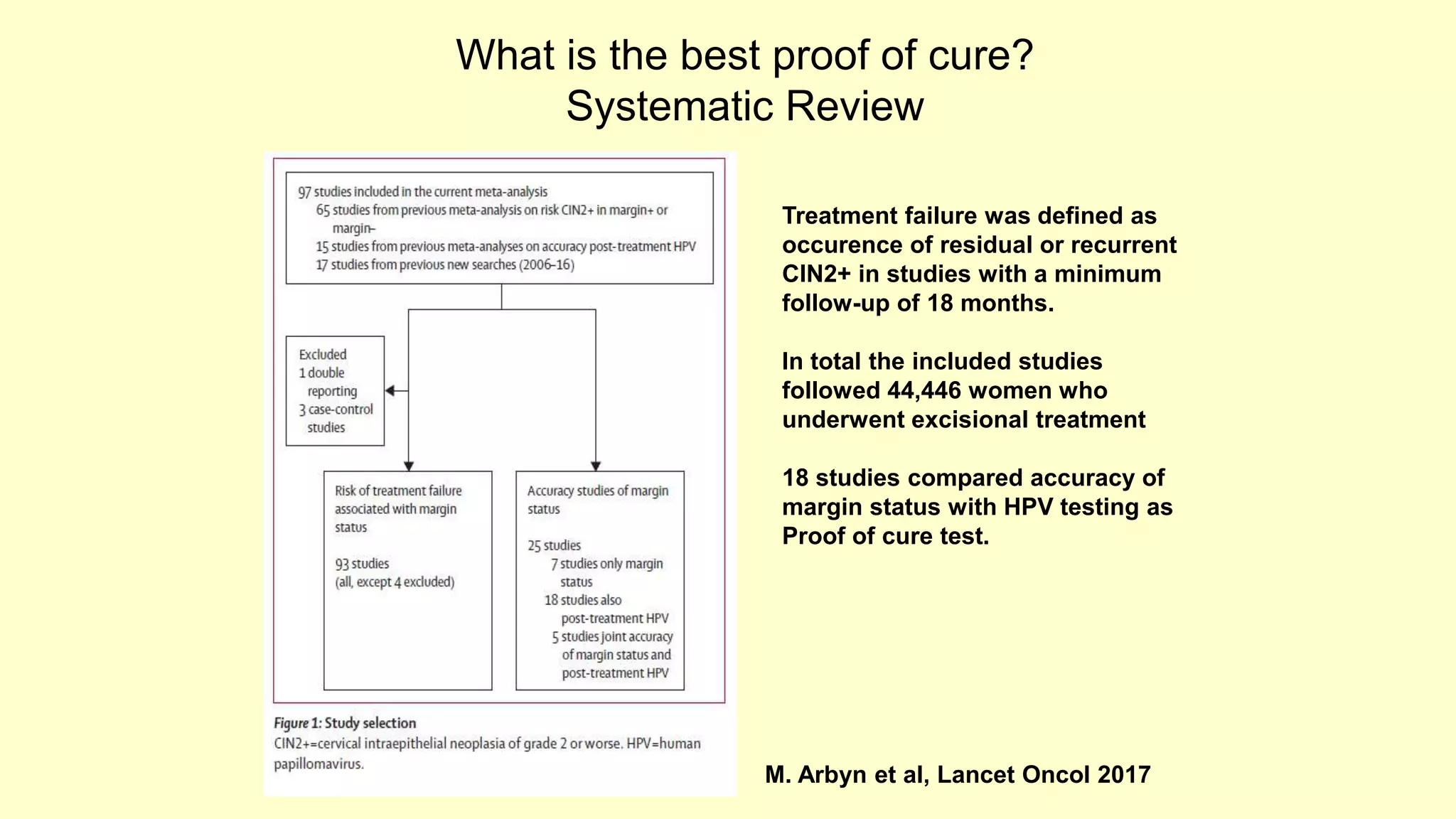
What is the best proof of cure?
Systematic Review
Treatment failure was defined as
occurence of residual or recurrent
CIN2+ in studies with a minimum
follow-up of 18 months.
In total the included studies
followed 44,446 women who
underwent excisional treatment
18 studies compared accuracy of
margin status with HPV testing as
Proof of cure test.
M. Arbyn et al, Lancet Oncol 2017
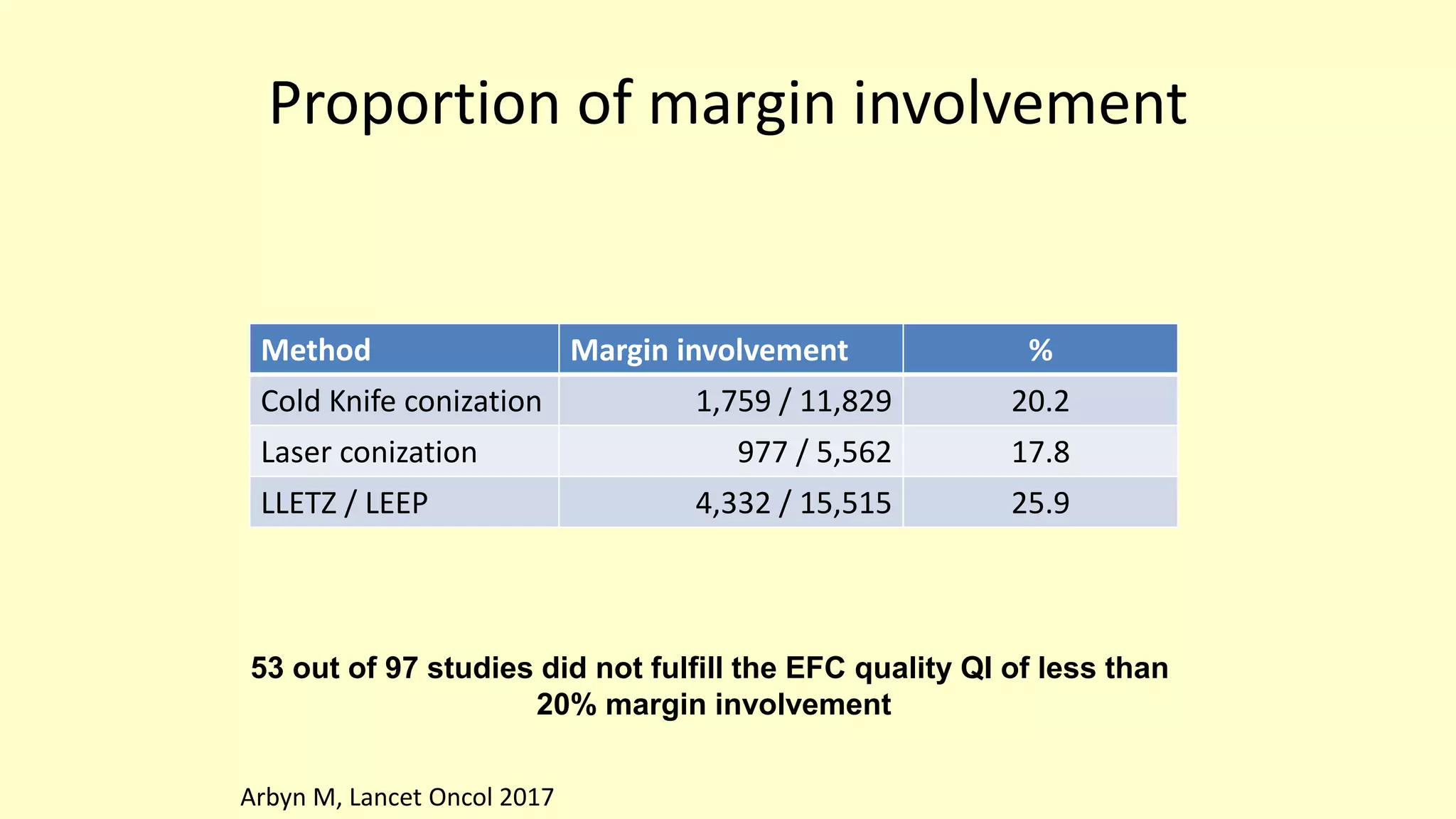
Proportion of margin involvement
Method Margin involvement %
Cold Knife conization 1,759 / 11,829 20.2
Laser conization 977 / 5,562 17.8
LLETZ / LEEP 4,332 / 15,515 25.9
53 out of 97 studies did not fulfill the EFC quality QI of less than
20% margin involvement
Arbyn M, Lancet Oncol 2017
0.01
0.05
0.1
0.5
1
5
10
20
50
80
90
95
99
99.5
99.9
Post-testProbability(%) 0.01
0.05
0.1
0.5
1
5
10
20
50
80
90
95
99
99.5
99.9
Pre-testProbability(%)
Pre
(6.90%)
Post(+)
(17.50%)
Post(-)
(3.80%)
Margin status
0.01
0.05
0.1
0.5
1
5
10
20
50
80
90
95
99
99.5
99.9
Post-testProbability(%)
0.01
0.05
0.1
0.5
1
5
10
20
50
80
90
95
99
99.5
99.9
Pre-testProbability(%)
Pre
(6.90%)
Post(+)
(26.08%)
Post(-)
(0.78%)
hrHPV
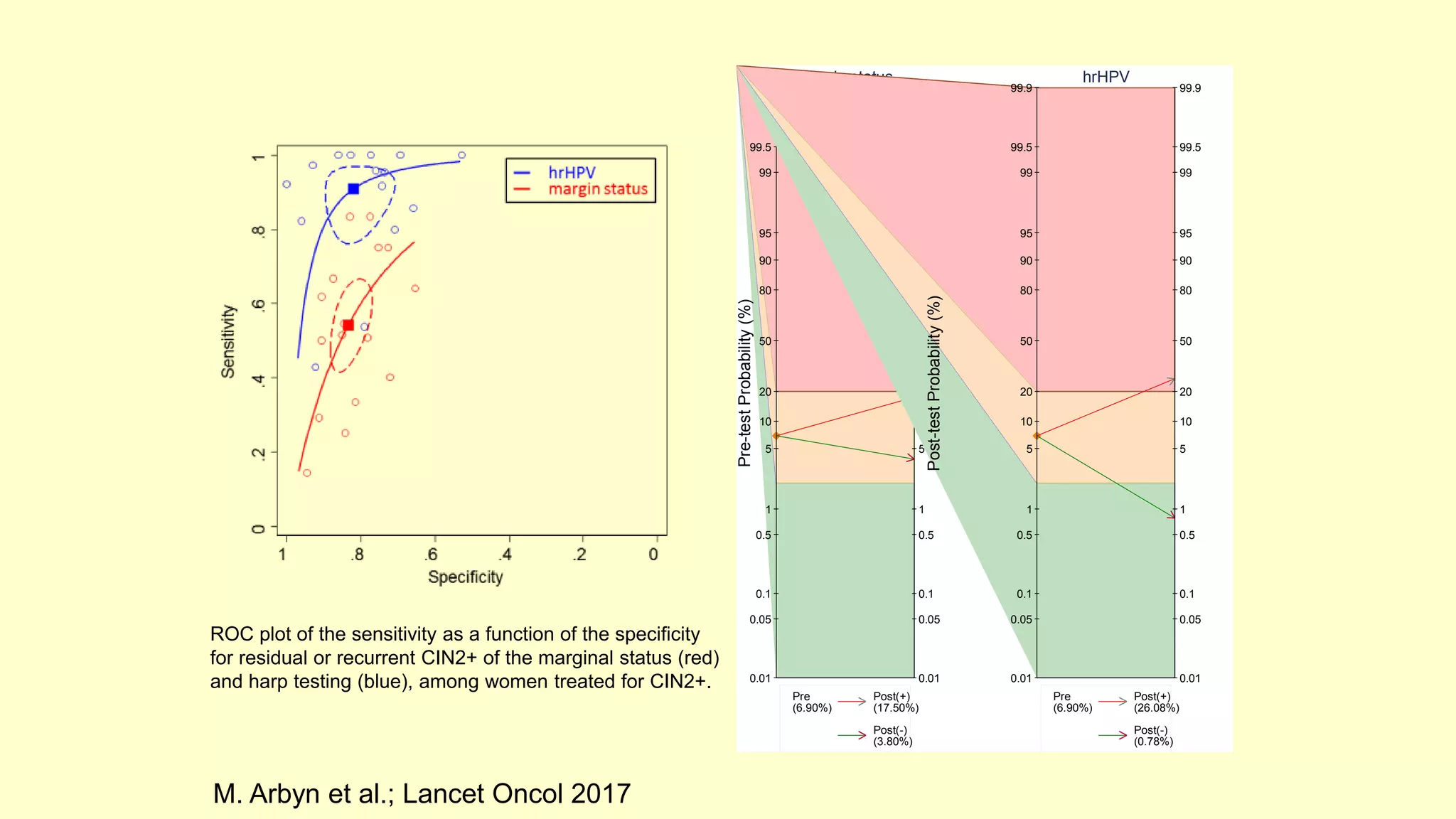
ROC plot of the sensitivity as a function of the specificity
for residual or recurrent CIN2+ of the marginal status (red)
and harp testing (blue), among women treated for CIN2+.
M. Arbyn et al.; Lancet Oncol 2017
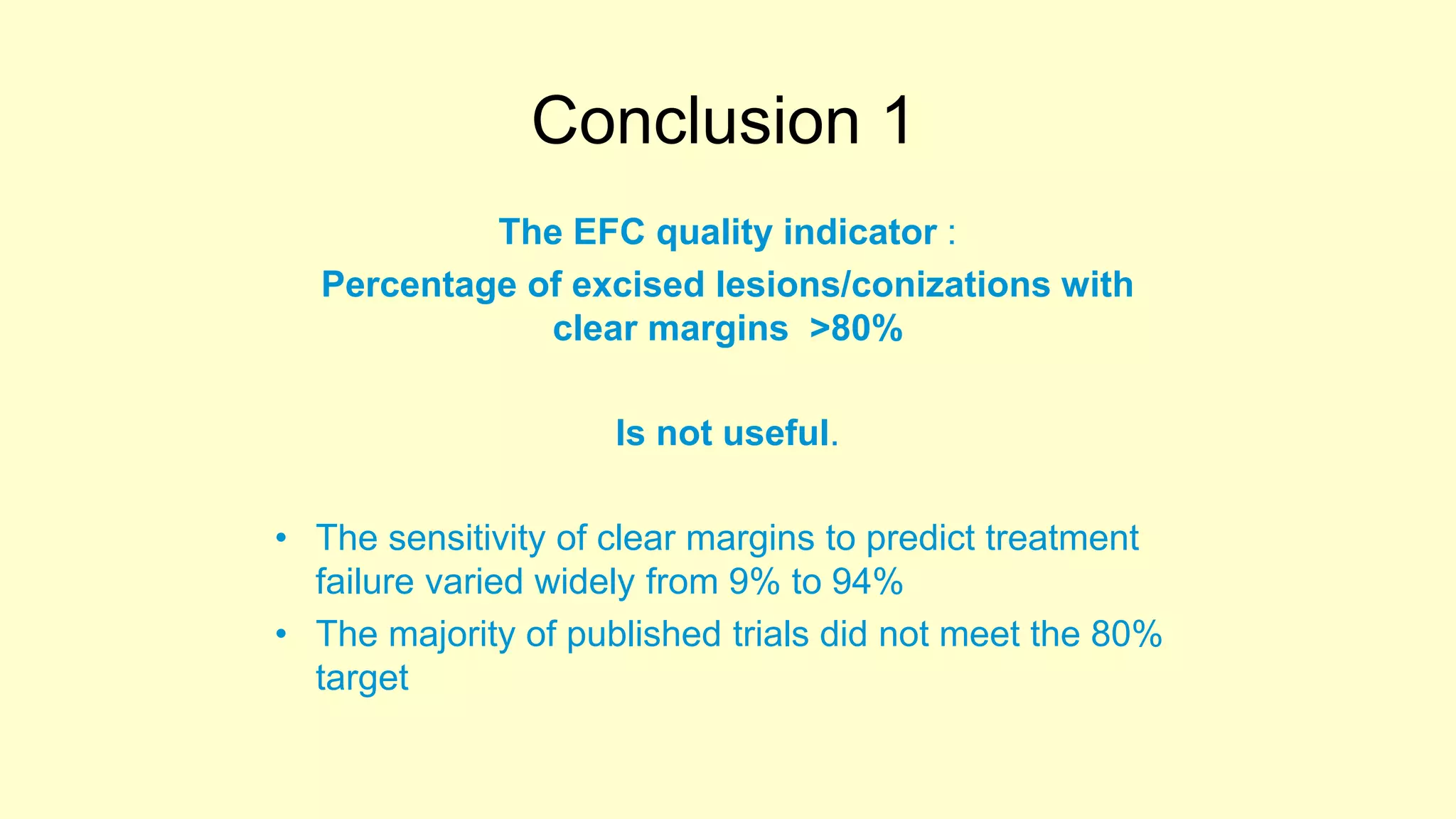
Conclusion 1
The EFC quality indicator :
Percentage of excised lesions/conizations with
clear margins >80%
Is not useful.
• The sensitivity of clear margins to predict treatment
failure varied widely from 9% to 94%
• The majority of published trials did not meet the 80%
target
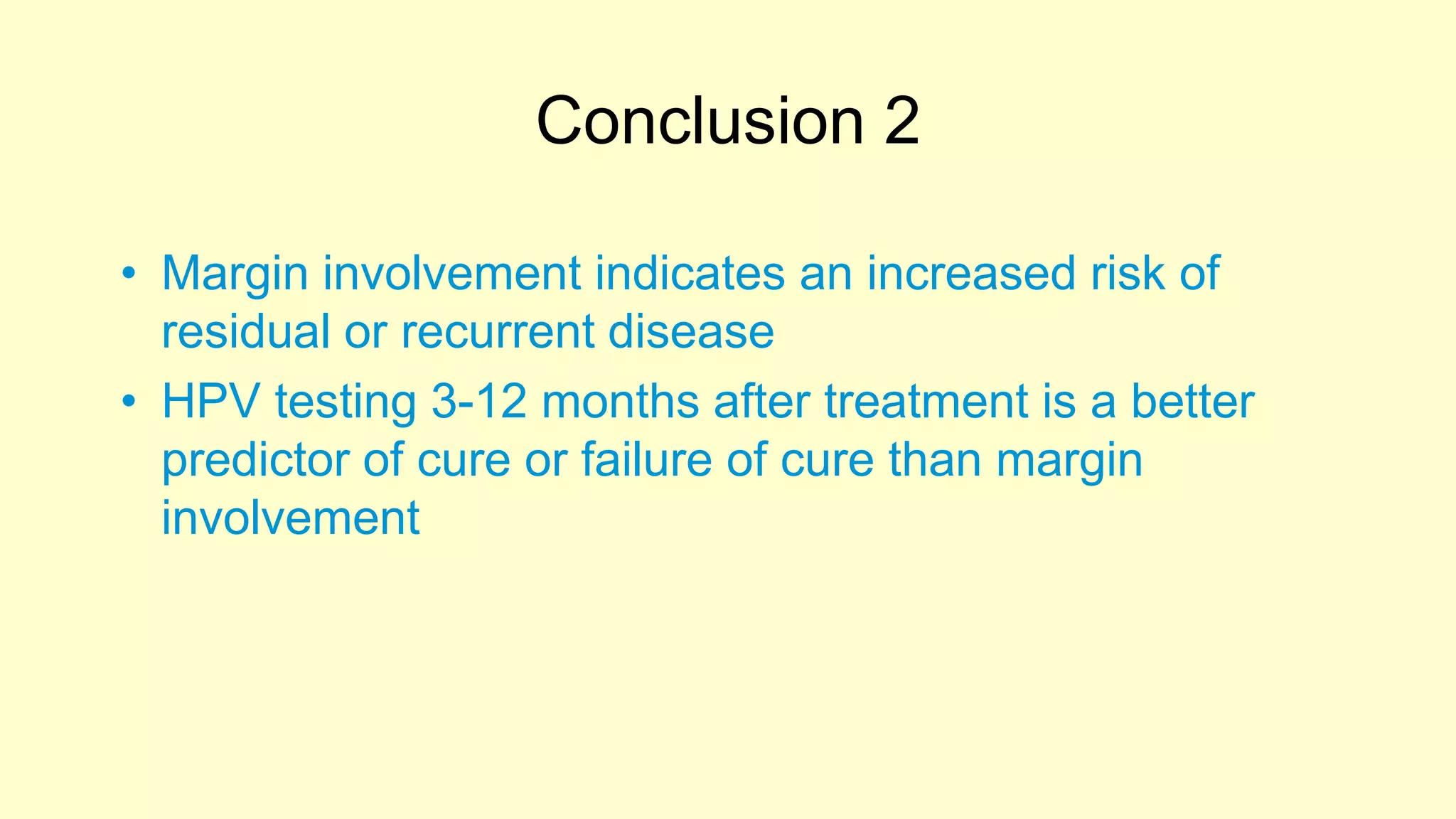
Conclusion 2
• Margin involvement indicates an increased risk of
residual or recurrent disease
• HPV testing 3-12 months after treatment is a better
predictor of cure or failure of cure than margin
involvement
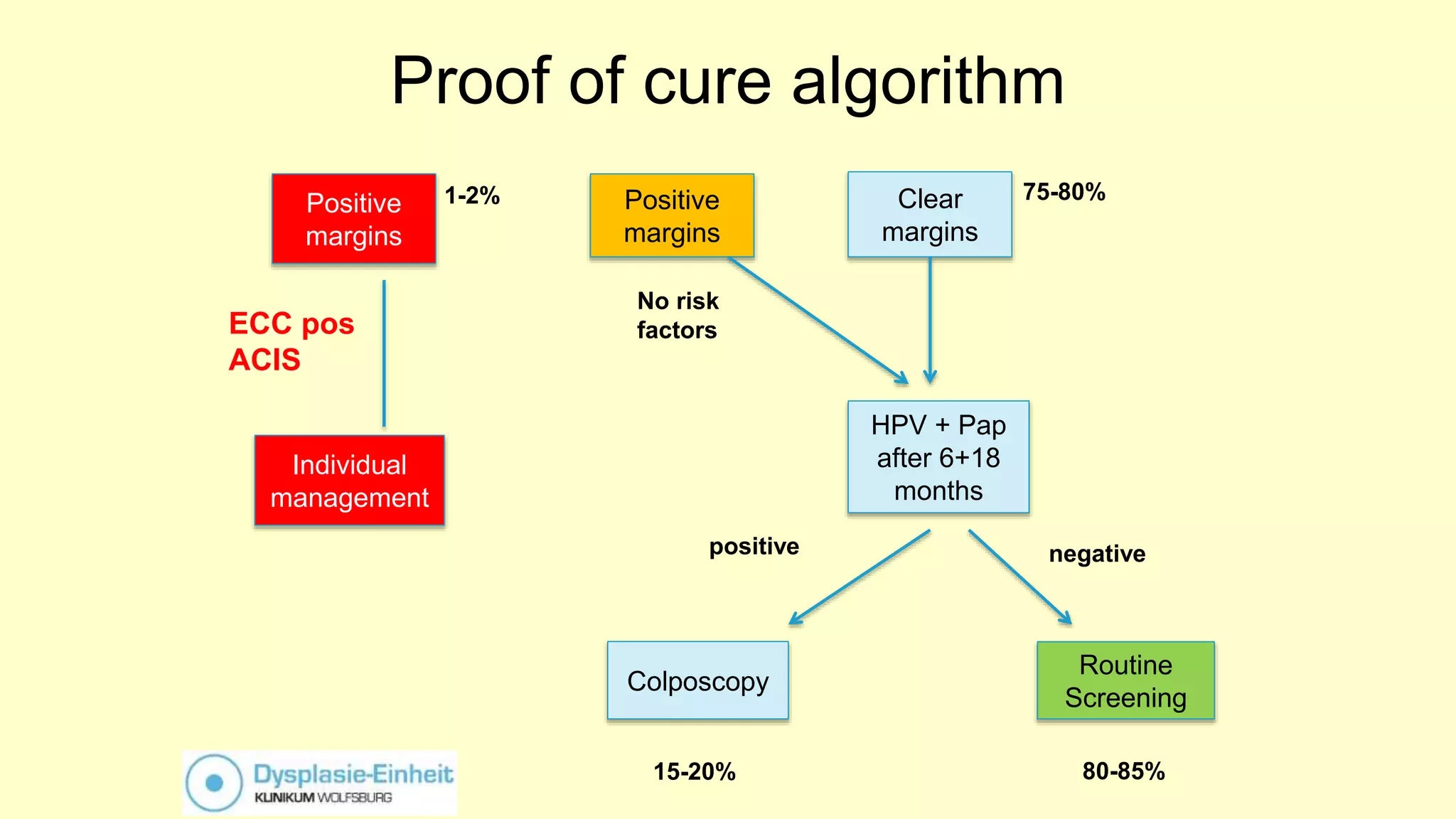
Proof of cure algorithm
Positive
margins
Routine
Screening
Colposcopy
HPV + Pap
after 6+18
months
Positive
margins
Clear
margins
negative
No risk
factorsECC pos
ACIS
Individual
management
75-80%1-2%
positive
80-85%15-20%
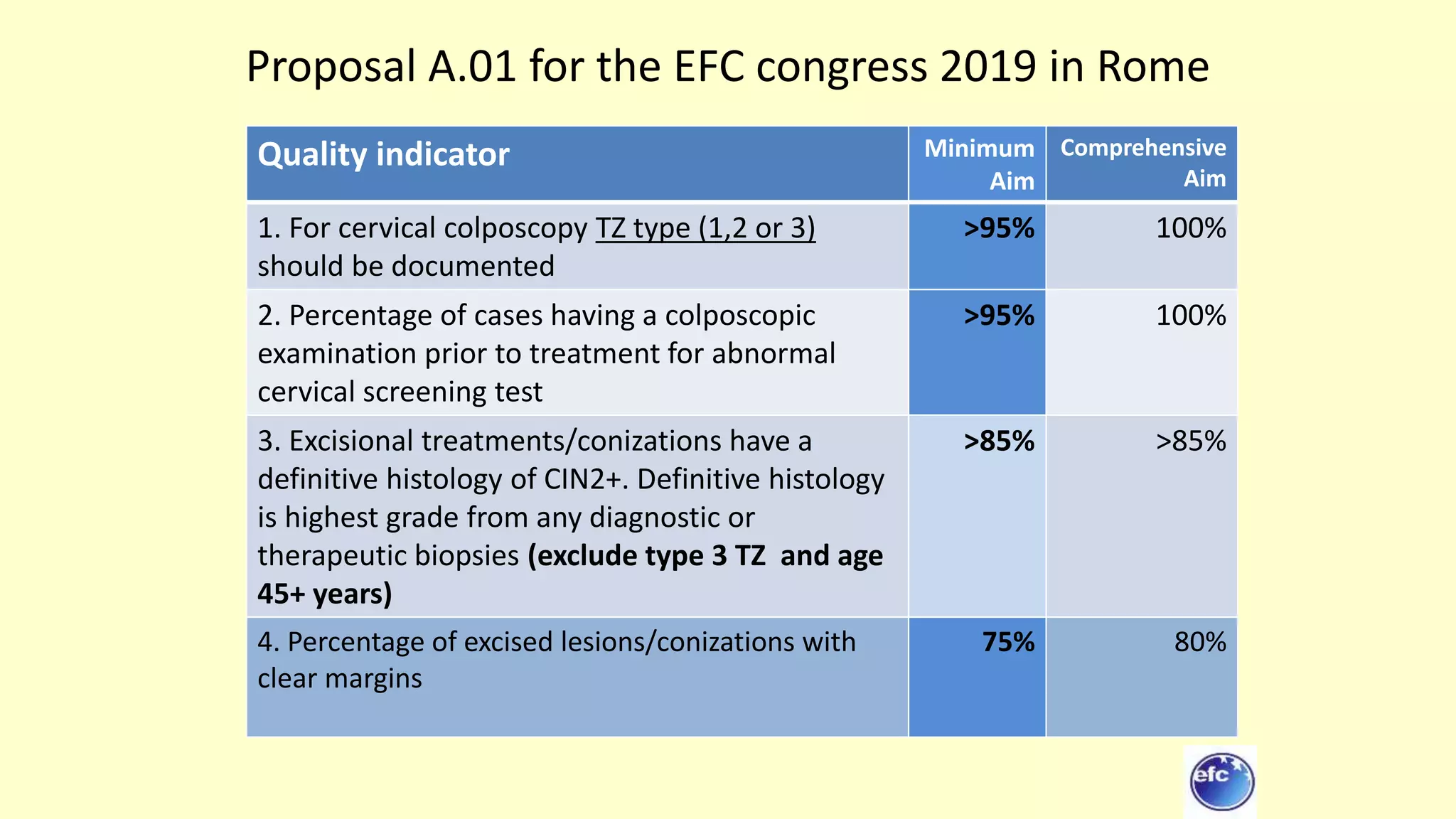
Proposal A.01 for the EFC congress 2019 in Rome
Quality indicator Minimum
Aim
Comprehensive
Aim
1. For cervical colposcopy TZ type (1,2 or 3)
should be documented
>95% 100%
2. Percentage of cases having a colposcopic
examination prior to treatment for abnormal
cervical screening test
>95% 100%
3. Excisional treatments/conizations have a
definitive histology of CIN2+. Definitive histology
is highest grade from any diagnostic or
therapeutic biopsies (exclude type 3 TZ and age
45+ years)
>85% >85%
4. Percentage of excised lesions/conizations with
clear margins
75% 80%
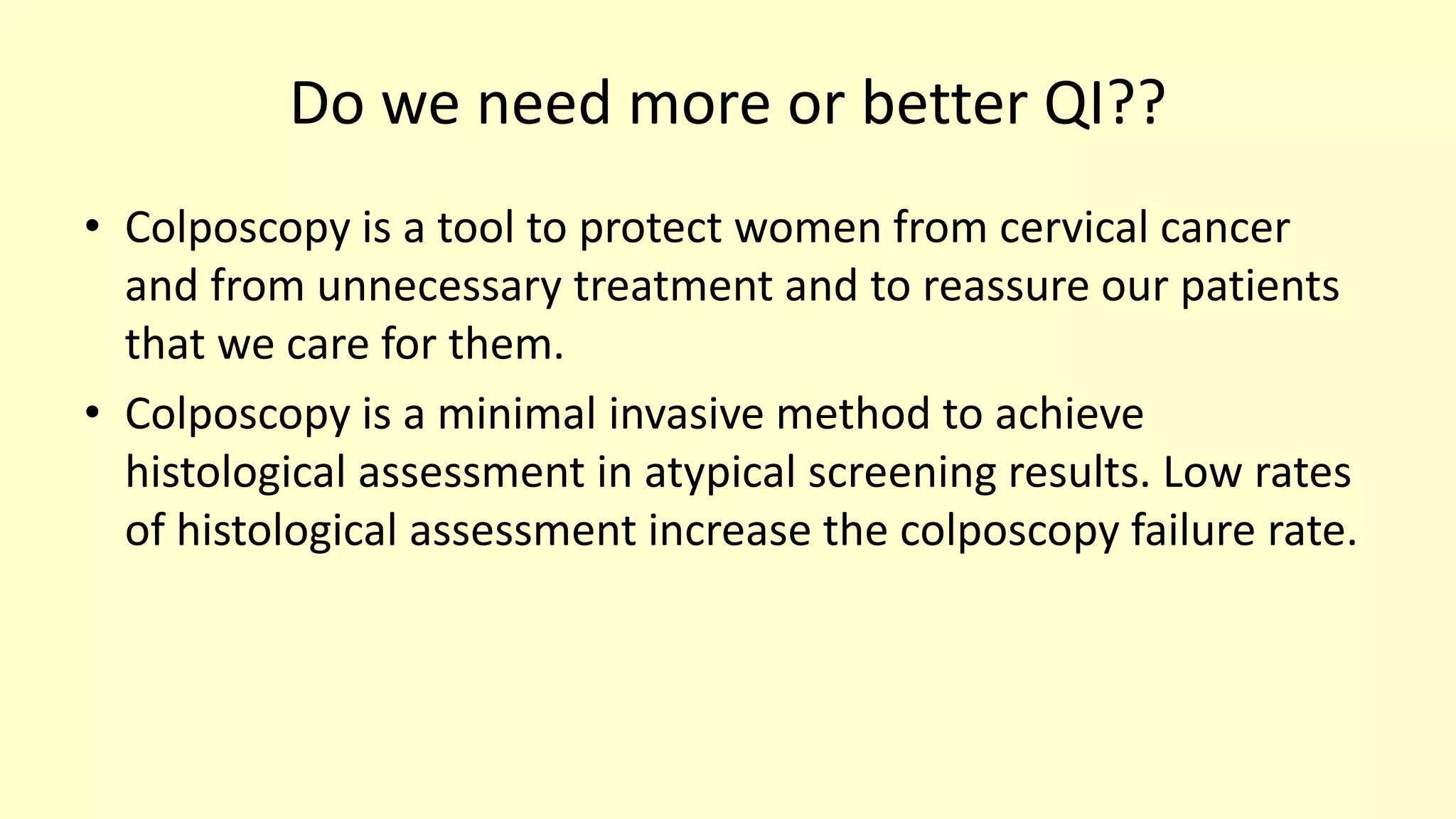
Do we need more or better QI??
• Colposcopy is a tool to protect women from cervical cancer
and from unnecessary treatment and to reassure our patients
that we care for them.
• Colposcopy is a minimal invasive method to achieve
histological assessment in atypical screening results. Low rates
of histological assessment increase the colposcopy failure rate.
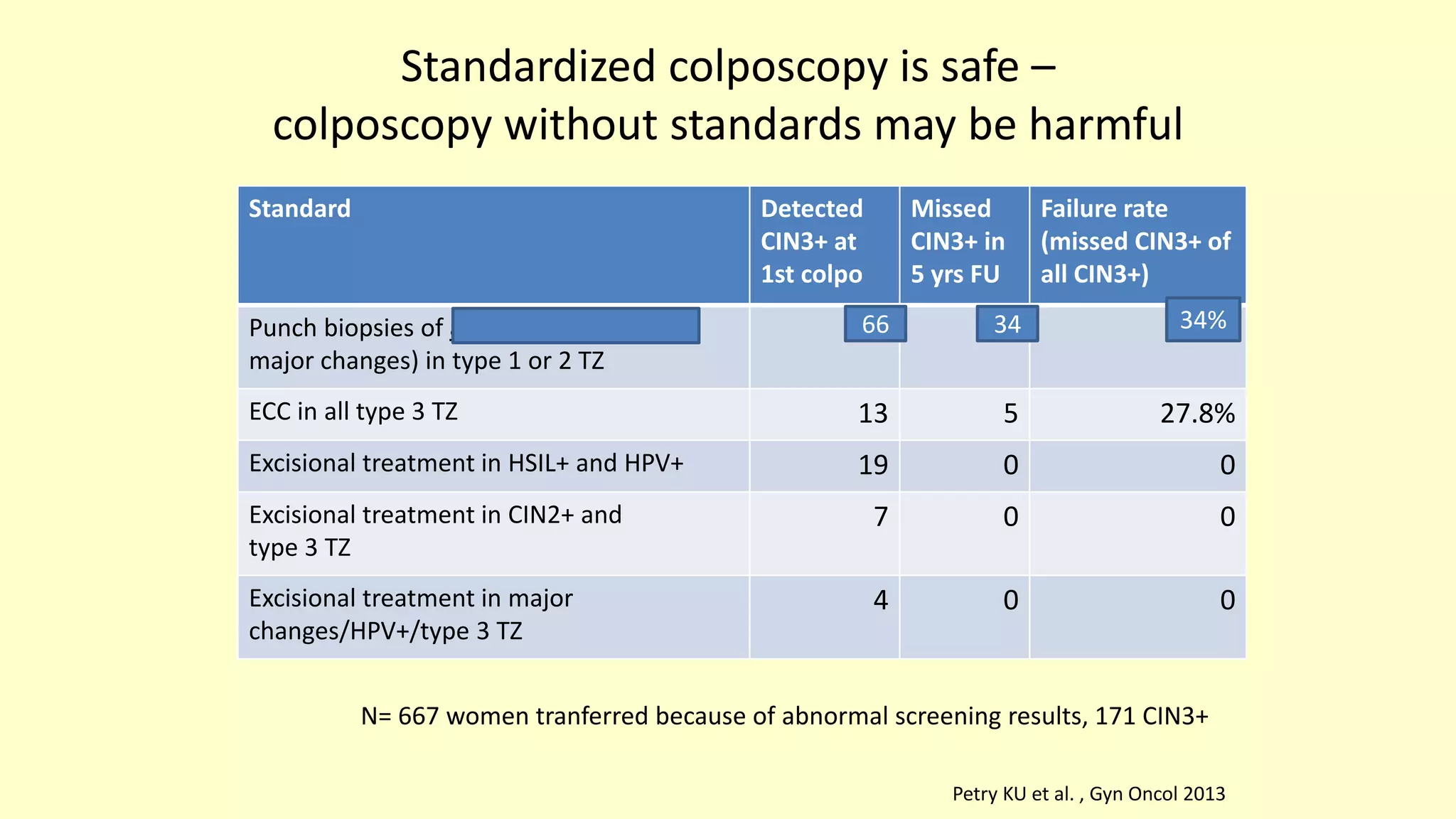
Standardized colposcopy is safe –
colposcopy without standards may be harmful
Standard Detected
CIN3+ at
1st colpo
Missed
CIN3+ in
5 yrs FU
Failure rate
(missed CIN3+ of
all CIN3+)
Punch biopsies of any lesion (minor and
major changes) in type 1 or 2 TZ
97 3 3%
ECC in all type 3 TZ 13 5 27.8%
Excisional treatment in HSIL+ and HPV+ 19 0 0
Excisional treatment in CIN2+ and
type 3 TZ
7 0 0
Excisional treatment in major
changes/HPV+/type 3 TZ
4 0 0
N= 667 women tranferred because of abnormal screening results, 171 CIN3+
Petry KU et al. , Gyn Oncol 2013
66 34 34%
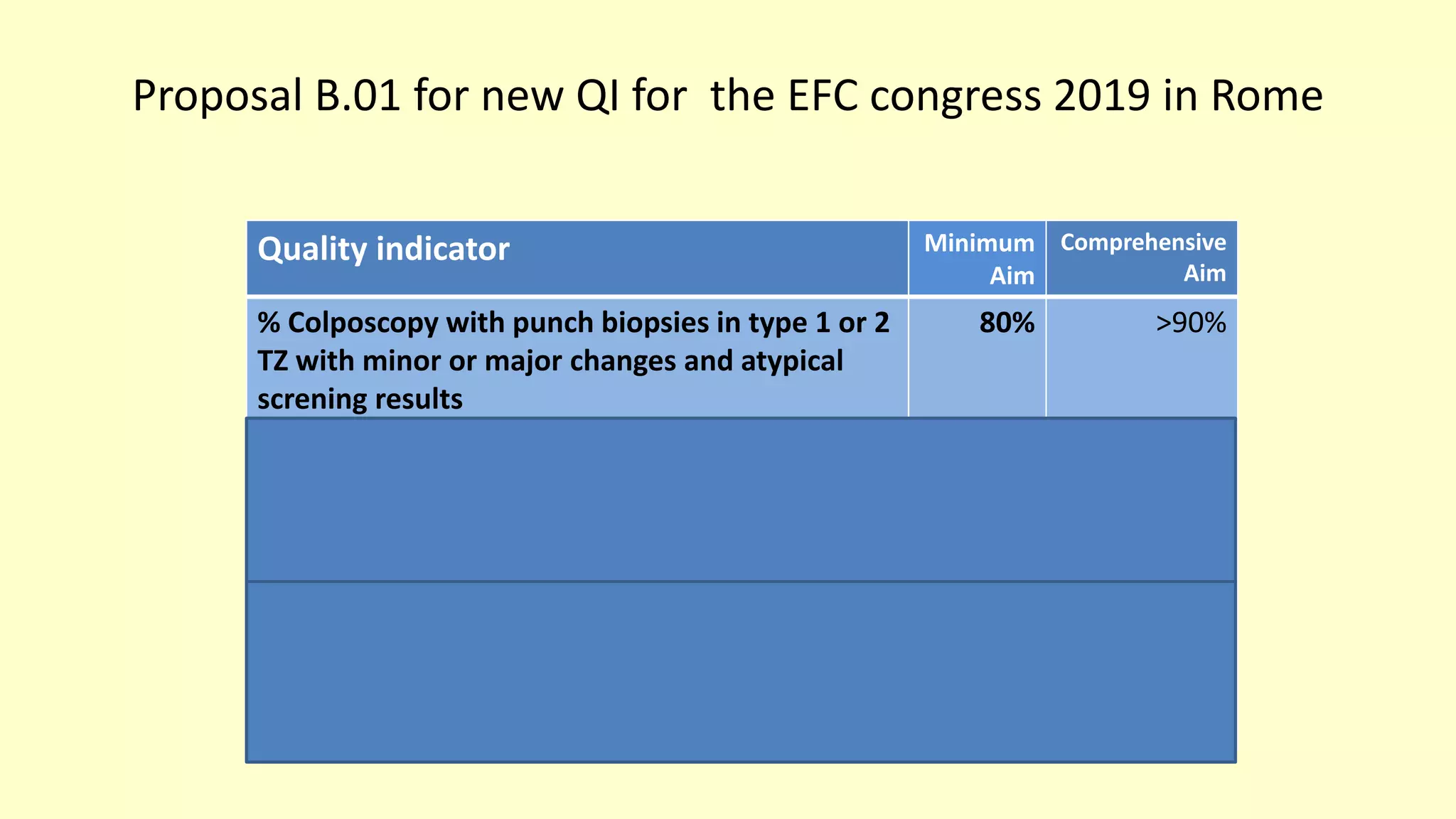
Proposal B.01 for new QI for the EFC congress 2019 in Rome
Quality indicator Minimum
Aim
Comprehensive
Aim
% Colposcopy with punch biopsies in type 1 or 2
TZ with minor or major changes and atypical
screning results
80% >90%
% of patients after excisional treatment with
margin involvement that tested negative for
HPV 6-18 months after treatment or were called
for colposcopy
90% 100%
% of patients writing love letters, Twitter likes ,
enthusiastic press reports etc because of the
sensitive counselling, treatment and the overall
empathy of the colposcopist in charge
100% 100%
QI update and next steps Karl Ulrich Petry

QI update and next steps Karl Ulrich Petry

  • 2.
    QI update andnext steps Karl Ulrich Petry
  • 3.
    EFC Quality Indicatorsin Colposcopy Update and next steps K. Ulrich Petry, Wolfsburg Germany
  • 4.
    Berlin Consensus 2011 QAof each part of the colposcopy service 1. Quality of colposcopic examination / identification of SCJ 2. Colposcopical guidance of excisional CIN therapy 3. Quality of indication/selection for excisional therapy 4. Proof of cure following invasive treatment of CIN 5. Experience
  • 5.
    Phase 2 EFC Qualityindicators for colposcopy E. Moss et al.: European Federation for Colposcopy quality standards Delphi consultation. Eur.J.Obstet.Gynecol.Reprod.Biol. 2013: 170:255
  • 6.
    • Use thequality parameters to assess quality in colposcopy. • Use the quality assessment to evaluate the quality parameters
  • 8.
    N= 10.869 LuytenA, EJOGRB 2015
  • 9.
    EFC Quality indicators 2015EFC satellite meeting Brussels- Consensus revisions 2017 EFC General assembly Paris- Confirmation of revised QI Parameter Aim For cervical colposcopy Transformation Zone type (1,2 or 3) should be documented 100% Percentage of cases having a colposcopic examination prior to treatment for abnormal cervical screening test 100% Percentage of excisional treatments/conizations have a definitive histology of CIN2+. Definitive histology is highest grade from any diagnostic or therapeutic biopsies >85% Percentage of excised lesions/conizations with clear margins >80% Number of colposcopies personally performed each year for a low- grade/minor abnormality on cervical screening >50 Number of colposcopies personally performed each year for high- grade/major abnormality on cervical screening >50 Petry KU, Eur J Obst Gyn 2018 (free access on Pub Med)
  • 11.
    German certification for colposcopyclinics Nr Kennzahl Zähler Grundgesamtheit Soll-vorgabe Wert (=Nenner) 1 Vorstellung Tumorkonferenz Anzahl vorgestellter Pat. mit einem invasiven Karzinom in der TK des Gynäkologischen Krebszentrums Alle Pat. mit einem invasiven Karzinom >= 90% Zähler 55 Nenner 55 % 100 2 Teilnahme interdisziplinäre Tumorkonferenz Anzahl Teilnahme Tumorkonferenz des Gynäkologischen Krebszentrums ---- ≥ 8 Teiln. / Jahr Zähler >8 3 Durchführung Differenzialkolposkopie Anzahl Pat. mit einer Exzision, bei denen eine Differenzialkolposkopie präoperativ durchgeführt wurde Alle Pat., bei denen eine Exzision durchgeführt wurde >= 95% Zähler 178 Nenner 178 % 100 4 Auffällige Befunde Exzision Anzahl Pat. mit Exzision und führender Histologie>= CIN 2 Alle Pat., bei denen eine Exzision durchgeführt wurde >= 85% Zähler 162 Nenner 178 % 91,01
  • 12.
    High rates ofclear margins may cause more harm than good Patients Risk of preterm birth <37 w Risk of preterm birth <28 w P-value Single treatment 1,367,023 1.75 (1.49-2.06) 2.54 (1.77-3.63) < 0.001 Multiple treatments 1,317,284 3.78 (2.65-5.39) NA < 0.001 LLETZ 1,445,241 1.56 (1.36-1.79) < 0.001 M. Kyrgiou, BMJ 2016
  • 13.
    EFC meta-analysis onmargin status as a predictor of treatment failure
  • 14.
    What is thebest proof of cure? Systematic Review Treatment failure was defined as occurence of residual or recurrent CIN2+ in studies with a minimum follow-up of 18 months. In total the included studies followed 44,446 women who underwent excisional treatment 18 studies compared accuracy of margin status with HPV testing as Proof of cure test. M. Arbyn et al, Lancet Oncol 2017
  • 15.
    Proportion of margininvolvement Method Margin involvement % Cold Knife conization 1,759 / 11,829 20.2 Laser conization 977 / 5,562 17.8 LLETZ / LEEP 4,332 / 15,515 25.9 53 out of 97 studies did not fulfill the EFC quality QI of less than 20% margin involvement Arbyn M, Lancet Oncol 2017
  • 16.
  • 17.
    Conclusion 1 The EFCquality indicator : Percentage of excised lesions/conizations with clear margins >80% Is not useful. • The sensitivity of clear margins to predict treatment failure varied widely from 9% to 94% • The majority of published trials did not meet the 80% target
  • 18.
    Conclusion 2 • Margininvolvement indicates an increased risk of residual or recurrent disease • HPV testing 3-12 months after treatment is a better predictor of cure or failure of cure than margin involvement
  • 19.
    Proof of curealgorithm Positive margins Routine Screening Colposcopy HPV + Pap after 6+18 months Positive margins Clear margins negative No risk factorsECC pos ACIS Individual management 75-80%1-2% positive 80-85%15-20%
  • 20.
    Proposal A.01 forthe EFC congress 2019 in Rome Quality indicator Minimum Aim Comprehensive Aim 1. For cervical colposcopy TZ type (1,2 or 3) should be documented >95% 100% 2. Percentage of cases having a colposcopic examination prior to treatment for abnormal cervical screening test >95% 100% 3. Excisional treatments/conizations have a definitive histology of CIN2+. Definitive histology is highest grade from any diagnostic or therapeutic biopsies (exclude type 3 TZ and age 45+ years) >85% >85% 4. Percentage of excised lesions/conizations with clear margins 75% 80%
  • 21.
    Do we needmore or better QI?? • Colposcopy is a tool to protect women from cervical cancer and from unnecessary treatment and to reassure our patients that we care for them. • Colposcopy is a minimal invasive method to achieve histological assessment in atypical screening results. Low rates of histological assessment increase the colposcopy failure rate.
  • 22.
    Standardized colposcopy issafe – colposcopy without standards may be harmful Standard Detected CIN3+ at 1st colpo Missed CIN3+ in 5 yrs FU Failure rate (missed CIN3+ of all CIN3+) Punch biopsies of any lesion (minor and major changes) in type 1 or 2 TZ 97 3 3% ECC in all type 3 TZ 13 5 27.8% Excisional treatment in HSIL+ and HPV+ 19 0 0 Excisional treatment in CIN2+ and type 3 TZ 7 0 0 Excisional treatment in major changes/HPV+/type 3 TZ 4 0 0 N= 667 women tranferred because of abnormal screening results, 171 CIN3+ Petry KU et al. , Gyn Oncol 2013 66 34 34%
  • 23.
    Proposal B.01 fornew QI for the EFC congress 2019 in Rome Quality indicator Minimum Aim Comprehensive Aim % Colposcopy with punch biopsies in type 1 or 2 TZ with minor or major changes and atypical screning results 80% >90% % of patients after excisional treatment with margin involvement that tested negative for HPV 6-18 months after treatment or were called for colposcopy 90% 100% % of patients writing love letters, Twitter likes , enthusiastic press reports etc because of the sensitive counselling, treatment and the overall empathy of the colposcopist in charge 100% 100%