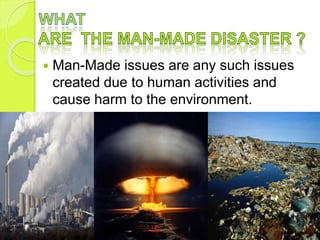
 Man-Made issues are any such issues
created due to human activities and
cause harm to the environment.
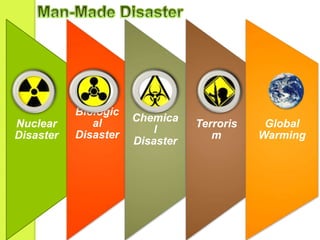
Nuclear
Disaster
Biologic
al
Disaster
Chemica
l
Disaster
Terroris
m
Global
Warming
 When nuclear weapons are detonated or
nuclear containment systems are
otherwise compromised, airborne
radioactive particles (nuclear fallout) can
scatter and irradiate large areas. Not only

is it deadly, but it also has a long-term
effect on the next generation for those
who are contaminated. Ionizing radiation
is hazardous to living things, and in such
a case much of the affected area could
be unsafe for human habitation.
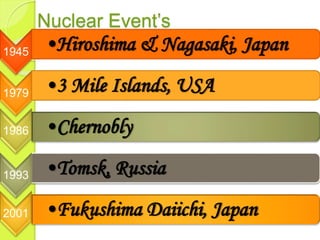
Nuclear Event’s
1945 •Hiroshima & Nagasaki, Japan
1979 •3 Mile Islands, USA
2001
•Chernobly1986
•Tomsk, Russia1993
•Fukushima Daiichi, Japan
3 Mile Islands, USA
 The Three Mile Island accident was a
partial nuclear meltdown that occurred on
March 28, 1979, in one of the two Three
Mile Island nuclear reactors in Dauphin
County, Pennsylvania, United States. It
was the worst accident in U.S.
commercial nuclear power plant history.
The incident was rated a five on the
seven-point International Nuclear Event
Scale: Accident With Wider
Consequences.
Hiroshima & Nagasaki, Japan
 In August 1945, during the final stage
of the Second World War , the United
States dropped atomic bombs on the
Japanese cities of Hiroshima and
Nagasaki. The two bombings, which
killed at least 129,000 people, remain
the only use of nuclear
weapons for warfare in history.
Chernobly
 The Chernobyl disaster was a
catastrophic nuclear accident that
occurred on 26 April 1986 at the
Chernobyl Nuclear Power Plant in
Ukraine , which was under the direct
jurisdiction of the central authorities of
the Soviet Union. An explosion and fire
released large quantities of radioactive
particles into the atmosphere, which
spread over much of the western USSR
and Europe.
Tomsk, Russia
 There was a nuclear accident at the
Tomsk-7 Reprocessing Complex on April
6, 1993, when a tank exploded while being
cleaned with nitric acid. The explosion
released a cloud of radioactive gas. TIME
magazine has identified the Tomsk-7
explosion as one of the 10 world's "worst
nuclear disasters".
Fukushima Daiichi, Japan
 The Fukushima Daiichi nuclear disaster
was a nuclear disaster at the Fukushima I
Nuclear Power Plant that began on 2011
and resulted in a nuclear meltdown of
three of the plant's six nuclear
reactors.The failure occurred when the
plant was hit by a tsunami that had been
triggered by the magnitude 9.0 Tōhoku
earthquake.
Biological Disaster
 They are referred as poor man’s nuclear
bomb as they are easy to manufacture,
trans port and have the ability to kill
hundreds and thousands of people. They
are delivered using dusting airplanes or
small perfumes atomizers. They have ability
to generate immediate effects.
Biological Event’s
Plague
Bacilli
Attack
China
Sverdlovsk
Anthrax
Leak ,
Russia
Anthrax
Attack ,
Russia
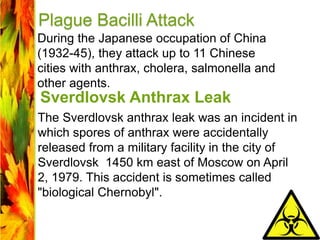
Plague Bacilli Attack
During the Japanese occupation of China
(1932-45), they attack up to 11 Chinese
cities with anthrax, cholera, salmonella and
other agents.
Sverdlovsk Anthrax Leak
The Sverdlovsk anthrax leak was an incident in
which spores of anthrax were accidentally
released from a military facility in the city of
Sverdlovsk 1450 km east of Moscow on April
2, 1979. This accident is sometimes called
"biological Chernobyl".
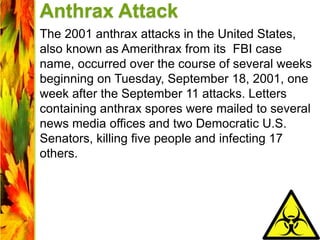
Anthrax Attack
The 2001 anthrax attacks in the United States,
also known as Amerithrax from its FBI case
name, occurred over the course of several weeks
beginning on Tuesday, September 18, 2001, one
week after the September 11 attacks. Letters
containing anthrax spores were mailed to several
news media offices and two Democratic U.S.
Senators, killing five people and infecting 17
others.
Chemical Disaster
 Disasters that are caused by the excessive
use and misuse of chemicals in industries
are called chemical disasters. The
irresponsible handling of powerful
chemicals can cause widespread
devastation. The impacts of chemical
accidents can be deadly for both human
beings and the environments.
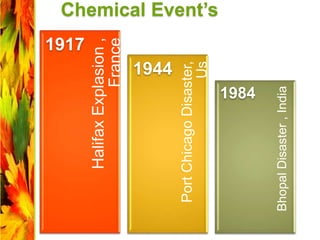
Chemical Event’s
BhopalDisaster,India
PortChicagoDisaster,
Us
HalifaxExplasion,
France
1917
1944
1984
Halifax Explasion
 The Halifax Explosion occurred in Halifax, Nova
Scotia, Canada, on the morning of December 6,
1917. SS Mont-Blanc, a French cargo ship fully
loaded with wartime explosives, was involved in a
collision with the Norwegian vessel SS Imo in the
Narrows, a strait connecting the upper Halifax
Harbour to Bedford Basin. Approximately twenty
minutes later, a fire on board the French ship ignited
her explosive cargo, causing a cataclysmic explosion
that devastated the Richmond District of Halifax.
Approximately 2,000 people were killed by debris,
fires, and collapsed buildings, and it is estimated that
nearly 9,000 others were injured.
Port Chicago Disaster
 The Port Chicago disaster was a deadly
munitions explosion that occurred on July
17, 1944, at the Port Chicago Naval
Magazine in Port Chicago, California,
United States. Munitions detonated while
being loaded onto a cargo vessel bound
for the Pacific Theater of Operations,
killing 320 sailors and civilians and
injuring 390 others. Most of the dead and
injured were enlisted African-American
sailors.
Bhopal Disaster
 The Bhopal disaster, also referred to as the
Bhopal gas tragedy, was a gas leak incident
in India, considered the world's worst
industrial disaster. It occurred on the night of
2–3 December 1984 at the Union Carbide
India Limited (UCIL) pesticide plant in
Bhopal, Madhya Pradesh. Over 500,000
people were exposed to methyl isocyanine
(MIC) gas and other chemicals. The toxic
substance made its way in and around the
shanty towns located near the plant.
Estimates vary on the death toll. The official
immediate death toll was 2,259.
Terrorism
 Environmental terrorism consists of one or
more unlawful actions that harm or destroy
environmental resources and-or deprive
others of their use. More colloquially, the
phrase is also used to label actions seen as
the unnecessary and unjustified destruction
of the environment for personal and-or
corporate gain
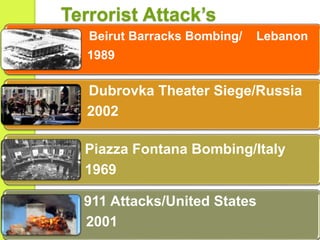
Terrorist Attack’s
Beirut Barracks Bombing/ Lebanon
• 1989
Dubrovka Theater Siege/Russia
• 2002
Piazza Fontana Bombing/Italy
1969
911 Attacks/United States
• 2001
Beirut Barracks Bombing
 The Beirut Barracks Bombings (1983, in
Beirut, Lebanon) occurred during the
Lebanese Civil War when two truck bombs
struck separate buildings housing United
States and French military forces-members of
the Multinational Force in Lebanon-killing 299
American and French servicemen.Dubrovka Theater Siege
The Moscow theater hostage crisis, also known as the
2002 Nord-Ost siege, was the seizure of the crowded
Dubrovka Theater on 2002 by 40 to 50 armed Chechens
who claimed allegiance to the Islamist militant separatist
movement in Chechnya. They took 850 hostages and
demanded the withdrawal of Russian forces from
Chechnya and an end to the Second
Chechen War.
Piazza Fontana Bombing
 The Piazza Fontana Bombing was a terrorist attack that
occurred on , 1969 when a bomb exploded at the
headquarters of National Agrarian Bank in Piazza
Fontana in Milan, Italy, killing 17 people and wounding
88. The same afternoon, three more bombs were
detonated in Rome and Milan, and another was found
undetonated.911 Attacks/United States
The September 11 attacks were a series of four
coordinated terrorist attacks by the Islamic terrorist
group al-Qaeda on the United States in New York City
and the Washington, D.C., metropolitan area on
Tuesday, September 11, 2001. The attacks killed 2,996
people and caused at least $10 billion in property and
infrastructure damage.
Global Warming
 Global warming is the rise in the average
temperature of Earth's atmosphere and oceans
since the late 19th century and its projected
continuation. Since the early 20th century, Earth's
mean surface temperature has increased by
about 0.8 °C with about two-thirds of the increase
occurring since 1980.
 Warming of the climate system is unequivocal,
and scientists are more than 90% certain that it is
primarily caused by increasing concentrations
of greenhouse gases produced by human
activities such as the burning of fossil
fuels and deforestation.
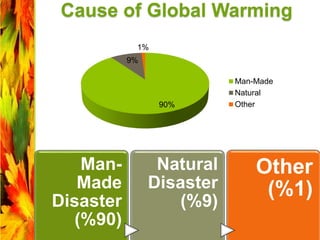
Cause of Global Warming
Man-
Made
Disaster
(%90)
Natural
Disaster
(%9)
Other
(%1)
90%
9%
1%
Man-Made
Natural
Other
The World’s 10 Cleanest
Countries
 Researchers at Yale and Columbia ranked
countries’ environmental performance
based on 25 metrics, including water and
air quality, habitat protection and the
impact of the environment on the health of
the population. European countries make
up more than half of the top 30, while the
U.S. ranks 61st.
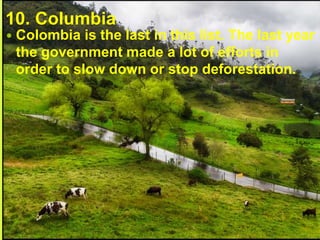
10. Columbia
 Colombia is the last in this list. The last year
the government made a lot of efforts in
order to slow down or stop deforestation.
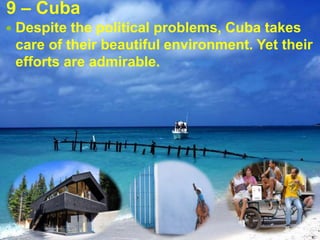
9 – Cuba
 Despite the political problems, Cuba takes
care of their beautiful environment. Yet their
efforts are admirable.
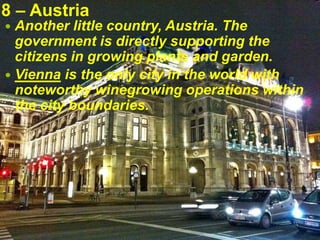
8 – Austria
 Another little country, Austria. The
government is directly supporting the
citizens in growing plants and garden.
 Vienna is the only city in the world with
noteworthy winegrowing operations within
the city boundaries.
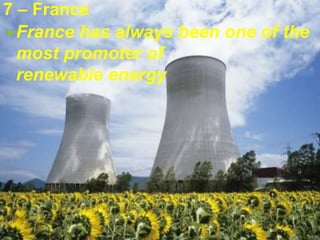
7 – France
France has always been one of the
most promoter of
renewable energy
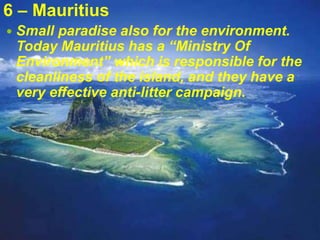
6 – Mauritius
 Small paradise also for the environment.
Today Mauritius has a “Ministry Of
Environment” which is responsible for the
cleanliness of the island, and they have a
very effective anti-litter campaign.
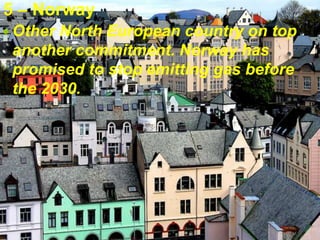
5 – Norway
 Other North European country on top
another commitment. Norway has
promised to stop emitting gas before
the 2030.
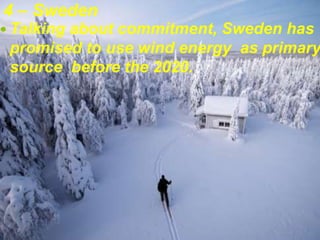
4 – Sweden
 Talking about commitment, Sweden has
promised to use wind energy as primary
source before the 2020.
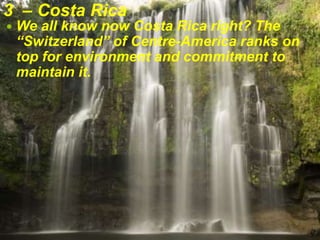
3 – Costa Rica
 We all know now Costa Rica right? The
“Switzerland” of Centre-America ranks on
top for environment and commitment to
maintain it.
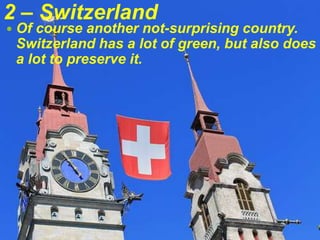
2 – Switzerland
 Of course another not-surprising country.
Switzerland has a lot of green, but also does
a lot to preserve it.
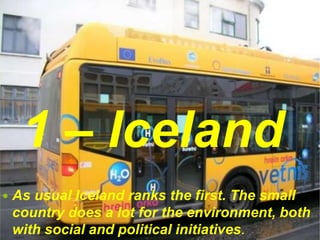
1 – Iceland
 As usual Iceland ranks the first. The small
country does a lot for the environment, both
with social and political initiatives.
THANKS FOR YOUR ;
ATTENTION AND
DISCRETION !

Man made disaster and Most Cleanest Country

  • 2.
     Man-Made issuesare any such issues created due to human activities and cause harm to the environment.
  • 3.
  • 4.
     When nuclearweapons are detonated or nuclear containment systems are otherwise compromised, airborne radioactive particles (nuclear fallout) can scatter and irradiate large areas. Not only is it deadly, but it also has a long-term effect on the next generation for those who are contaminated. Ionizing radiation is hazardous to living things, and in such a case much of the affected area could be unsafe for human habitation.
  • 5.
    Nuclear Event’s 1945 •Hiroshima& Nagasaki, Japan 1979 •3 Mile Islands, USA 2001 •Chernobly1986 •Tomsk, Russia1993 •Fukushima Daiichi, Japan
  • 6.
    3 Mile Islands,USA  The Three Mile Island accident was a partial nuclear meltdown that occurred on March 28, 1979, in one of the two Three Mile Island nuclear reactors in Dauphin County, Pennsylvania, United States. It was the worst accident in U.S. commercial nuclear power plant history. The incident was rated a five on the seven-point International Nuclear Event Scale: Accident With Wider Consequences.
  • 7.
    Hiroshima & Nagasaki,Japan  In August 1945, during the final stage of the Second World War , the United States dropped atomic bombs on the Japanese cities of Hiroshima and Nagasaki. The two bombings, which killed at least 129,000 people, remain the only use of nuclear weapons for warfare in history.
  • 8.
    Chernobly  The Chernobyldisaster was a catastrophic nuclear accident that occurred on 26 April 1986 at the Chernobyl Nuclear Power Plant in Ukraine , which was under the direct jurisdiction of the central authorities of the Soviet Union. An explosion and fire released large quantities of radioactive particles into the atmosphere, which spread over much of the western USSR and Europe.
  • 9.
    Tomsk, Russia  Therewas a nuclear accident at the Tomsk-7 Reprocessing Complex on April 6, 1993, when a tank exploded while being cleaned with nitric acid. The explosion released a cloud of radioactive gas. TIME magazine has identified the Tomsk-7 explosion as one of the 10 world's "worst nuclear disasters".
  • 10.
    Fukushima Daiichi, Japan The Fukushima Daiichi nuclear disaster was a nuclear disaster at the Fukushima I Nuclear Power Plant that began on 2011 and resulted in a nuclear meltdown of three of the plant's six nuclear reactors.The failure occurred when the plant was hit by a tsunami that had been triggered by the magnitude 9.0 Tōhoku earthquake.
  • 11.
    Biological Disaster  Theyare referred as poor man’s nuclear bomb as they are easy to manufacture, trans port and have the ability to kill hundreds and thousands of people. They are delivered using dusting airplanes or small perfumes atomizers. They have ability to generate immediate effects.
  • 12.
  • 13.
    Plague Bacilli Attack Duringthe Japanese occupation of China (1932-45), they attack up to 11 Chinese cities with anthrax, cholera, salmonella and other agents. Sverdlovsk Anthrax Leak The Sverdlovsk anthrax leak was an incident in which spores of anthrax were accidentally released from a military facility in the city of Sverdlovsk 1450 km east of Moscow on April 2, 1979. This accident is sometimes called "biological Chernobyl".
  • 14.
    Anthrax Attack The 2001anthrax attacks in the United States, also known as Amerithrax from its FBI case name, occurred over the course of several weeks beginning on Tuesday, September 18, 2001, one week after the September 11 attacks. Letters containing anthrax spores were mailed to several news media offices and two Democratic U.S. Senators, killing five people and infecting 17 others.
  • 15.
    Chemical Disaster  Disastersthat are caused by the excessive use and misuse of chemicals in industries are called chemical disasters. The irresponsible handling of powerful chemicals can cause widespread devastation. The impacts of chemical accidents can be deadly for both human beings and the environments.
  • 16.
  • 17.
    Halifax Explasion  TheHalifax Explosion occurred in Halifax, Nova Scotia, Canada, on the morning of December 6, 1917. SS Mont-Blanc, a French cargo ship fully loaded with wartime explosives, was involved in a collision with the Norwegian vessel SS Imo in the Narrows, a strait connecting the upper Halifax Harbour to Bedford Basin. Approximately twenty minutes later, a fire on board the French ship ignited her explosive cargo, causing a cataclysmic explosion that devastated the Richmond District of Halifax. Approximately 2,000 people were killed by debris, fires, and collapsed buildings, and it is estimated that nearly 9,000 others were injured.
  • 18.
    Port Chicago Disaster The Port Chicago disaster was a deadly munitions explosion that occurred on July 17, 1944, at the Port Chicago Naval Magazine in Port Chicago, California, United States. Munitions detonated while being loaded onto a cargo vessel bound for the Pacific Theater of Operations, killing 320 sailors and civilians and injuring 390 others. Most of the dead and injured were enlisted African-American sailors.
  • 19.
    Bhopal Disaster  TheBhopal disaster, also referred to as the Bhopal gas tragedy, was a gas leak incident in India, considered the world's worst industrial disaster. It occurred on the night of 2–3 December 1984 at the Union Carbide India Limited (UCIL) pesticide plant in Bhopal, Madhya Pradesh. Over 500,000 people were exposed to methyl isocyanine (MIC) gas and other chemicals. The toxic substance made its way in and around the shanty towns located near the plant. Estimates vary on the death toll. The official immediate death toll was 2,259.
  • 20.
    Terrorism  Environmental terrorismconsists of one or more unlawful actions that harm or destroy environmental resources and-or deprive others of their use. More colloquially, the phrase is also used to label actions seen as the unnecessary and unjustified destruction of the environment for personal and-or corporate gain
  • 21.
    Terrorist Attack’s Beirut BarracksBombing/ Lebanon • 1989 Dubrovka Theater Siege/Russia • 2002 Piazza Fontana Bombing/Italy 1969 911 Attacks/United States • 2001
  • 22.
    Beirut Barracks Bombing The Beirut Barracks Bombings (1983, in Beirut, Lebanon) occurred during the Lebanese Civil War when two truck bombs struck separate buildings housing United States and French military forces-members of the Multinational Force in Lebanon-killing 299 American and French servicemen.Dubrovka Theater Siege The Moscow theater hostage crisis, also known as the 2002 Nord-Ost siege, was the seizure of the crowded Dubrovka Theater on 2002 by 40 to 50 armed Chechens who claimed allegiance to the Islamist militant separatist movement in Chechnya. They took 850 hostages and demanded the withdrawal of Russian forces from Chechnya and an end to the Second Chechen War.
  • 23.
    Piazza Fontana Bombing The Piazza Fontana Bombing was a terrorist attack that occurred on , 1969 when a bomb exploded at the headquarters of National Agrarian Bank in Piazza Fontana in Milan, Italy, killing 17 people and wounding 88. The same afternoon, three more bombs were detonated in Rome and Milan, and another was found undetonated.911 Attacks/United States The September 11 attacks were a series of four coordinated terrorist attacks by the Islamic terrorist group al-Qaeda on the United States in New York City and the Washington, D.C., metropolitan area on Tuesday, September 11, 2001. The attacks killed 2,996 people and caused at least $10 billion in property and infrastructure damage.
  • 24.
    Global Warming  Globalwarming is the rise in the average temperature of Earth's atmosphere and oceans since the late 19th century and its projected continuation. Since the early 20th century, Earth's mean surface temperature has increased by about 0.8 °C with about two-thirds of the increase occurring since 1980.  Warming of the climate system is unequivocal, and scientists are more than 90% certain that it is primarily caused by increasing concentrations of greenhouse gases produced by human activities such as the burning of fossil fuels and deforestation.
  • 25.
    Cause of GlobalWarming Man- Made Disaster (%90) Natural Disaster (%9) Other (%1) 90% 9% 1% Man-Made Natural Other
  • 26.
    The World’s 10Cleanest Countries  Researchers at Yale and Columbia ranked countries’ environmental performance based on 25 metrics, including water and air quality, habitat protection and the impact of the environment on the health of the population. European countries make up more than half of the top 30, while the U.S. ranks 61st.
  • 27.
    10. Columbia  Colombiais the last in this list. The last year the government made a lot of efforts in order to slow down or stop deforestation.
  • 28.
    9 – Cuba Despite the political problems, Cuba takes care of their beautiful environment. Yet their efforts are admirable.
  • 29.
    8 – Austria Another little country, Austria. The government is directly supporting the citizens in growing plants and garden.  Vienna is the only city in the world with noteworthy winegrowing operations within the city boundaries.
  • 30.
    7 – France Francehas always been one of the most promoter of renewable energy
  • 31.
    6 – Mauritius Small paradise also for the environment. Today Mauritius has a “Ministry Of Environment” which is responsible for the cleanliness of the island, and they have a very effective anti-litter campaign.
  • 32.
    5 – Norway Other North European country on top another commitment. Norway has promised to stop emitting gas before the 2030.
  • 33.
    4 – Sweden Talking about commitment, Sweden has promised to use wind energy as primary source before the 2020.
  • 34.
    3 – CostaRica  We all know now Costa Rica right? The “Switzerland” of Centre-America ranks on top for environment and commitment to maintain it.
  • 35.
    2 – Switzerland Of course another not-surprising country. Switzerland has a lot of green, but also does a lot to preserve it.
  • 36.
    1 – Iceland As usual Iceland ranks the first. The small country does a lot for the environment, both with social and political initiatives.
  • 37.
    THANKS FOR YOUR; ATTENTION AND DISCRETION !