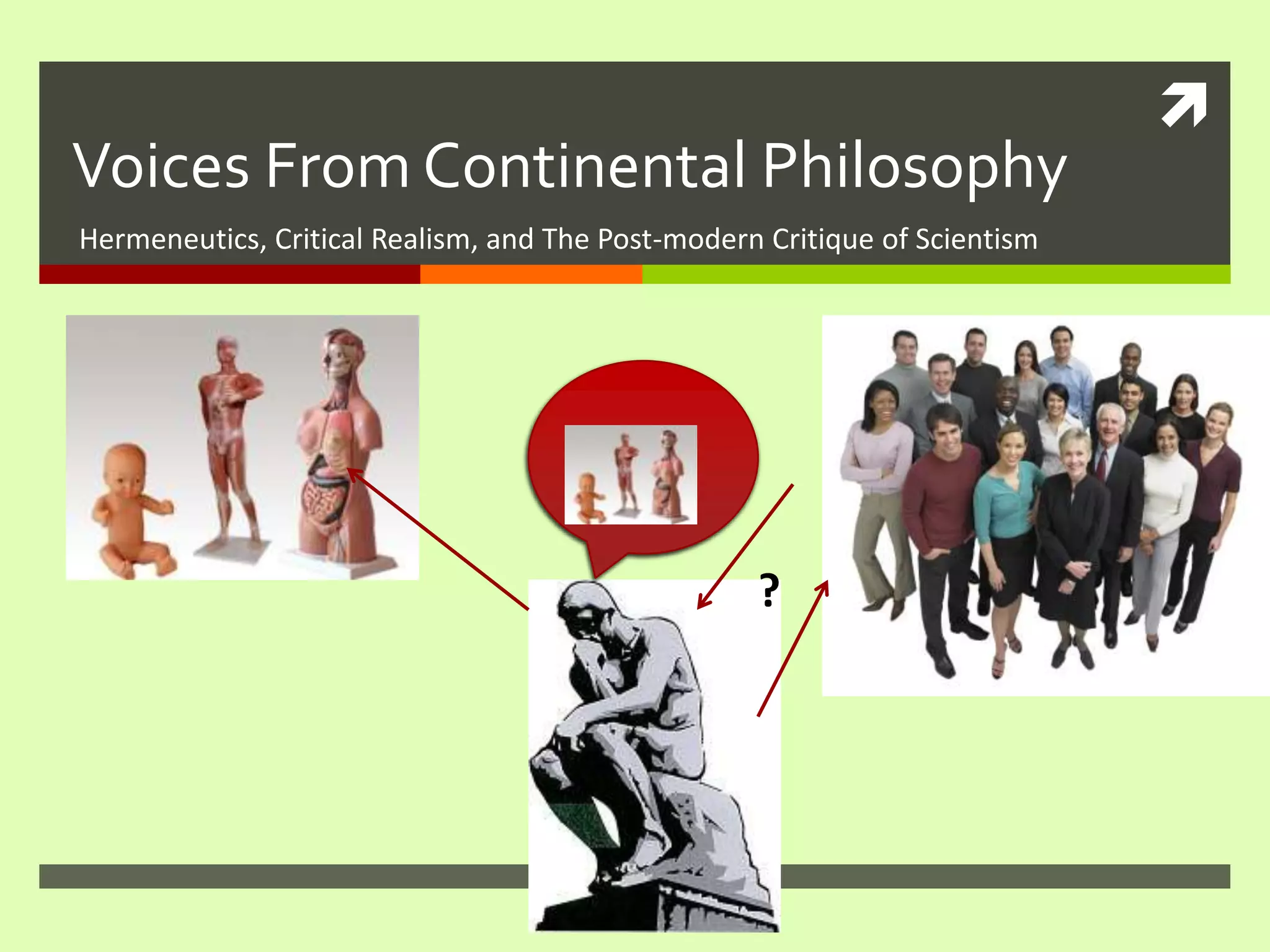
Voices From Continental PhilosophyHermeneutics, Critical Realism, and The Post-modern Critique of Scientism?
Analytic vs. Continental PhilosophyAnalytic PhilosophyA Set of Overlapping Traditions whose main sources of authority are logic, mathematics, and scienceUnderstands their analysis as continuous with, in service to, or subordinate to those of the natural sciencesTreats philosophy as discrete problems, capable of being analyzed apart from their historical originContinental PhilosophyReject the view that the natural sciences are the most accurate way of understanding phenomenaScience is dependent upon a “pre-theoretical substrate of experience.” (Kant)Tends toward historicism; grapples with how space and time, language, culture and history shape experience and knowledge.
Analytic vs. Continental Philosophy (continued)Analytic PhilosophyHas its origins and develops out of Great Britain and North AmericaFathers are Wittgenstein, Russell, Moore, FregeContinental PhilosophyHolds that conscious human agency can change the conditions of possible experienceFathers include Hegel, Nietzche, Heidegger, Gadamer, MarxIncludes ideas from Existentialism, Phenomenology, Marxism, Structuralism, Post-Structuralism, Critical Theory, and post-modernism
Kant’s Noumenon and PhenomenonPhenomenon: The thing as we perceive itWhat shapes how we perceive the world? Culture, language, social structures?Can we ever come to know the Noumenon except the lens of our  Phenomenon?Noumenon: The Thing itself outside of our perception of it
Order of Articles—Ideas—ThinkersAuthor	         Ideas                 ThinkersRichard Rorty    Hermeneutics      Nietzche/Gadamer   		          Pragmatism         DeweyMills	        Post-Modernism	  Foucault                  		        Post-StructuralismLewis                 Critical Realism	Bhaskar, Harre,
Richard Rorty, “Hermeneutics, General Studies and Teaching”1) Links Dewey’s American Pragmatism with the French-German Hermeneutic tradition2) Traces similarity of each tradition3) Touches on various Deweyan notions and the controversies they sparked (including a comparison to vulgar relativism)4) Links Dewey’s pragmatism with Gadamer’s hermeneutics5) Argues that both thinkers replace Plato’s emphasis on reason (truth as correlation) with tradition, community, and human solidarity
Nietzche’s  Criticism of Plato Platonic Emphasis on Reason and truth Hermeneutics: the science and study of interpretation; claim is that truth is contextualNietzche’s assault on Absolute truth—no transcendent goal of inquiry; ought not claim there is an objective truthTruth is problematic if it is based on language (Gadamer); it is not universal but textual and tradition bound.
Gadamer and Dewey –Shared Critique on Objective Claims to truth?Plato and Locke: Words are simply tools to help us express truth which is non-linguistic. Gadamer: Language shapes understandings; truth is contextual and tradition boundVulgar RelativismContextual Truth: Truth with Limits that emerge from communities of traditionPlatonic Absolutism
Hermeneutics and Social ConstructivismIf truth emerges and is dependent upon language, then culture, history, and the structures out of which and in which the individual operates conditions, constructs and confines our understanding of the world
Strengths and Challenges of HermeneuticsStrengthsEmphasizes local truths; can help build up a sense of human community Emphasizes processes of dialogue and communication through which truth emergesCareful not to impose/colonize truths on other communities and traditions (think science)Emphasizes multiple interpretations Acknowledgement of interpreter relativity and biasWeaknessesArgument from perceptual confrontationArgument from moral evilOpenness to vulgar relativismVulnerability to dialogue between traditions turning viciousDifficulty of finding consensus on truth across communities/traditions
Mills on Foucault’s “Power/Knowledge”Institutional Analysis: Foucault examines the Institutional processes at work which establish something as fact or falsityPower/Knowledge: Come out of the post-Marxist tradition, Foucault questions studies by people in power about people not in power. Such studies turn subjects into objects of study. Historically, knowledge had been constructed from a position of power(72, 73), about the powerless
Mills on Foucault’s “Power/Knowledge” Rather then a pure search after truth, power operates in that processing of information leading to something being labeled a fact. Will to Truth—classifies and orders truth (determined by a society’s “regime of truth”) by the rules determined by those in power. In his analysis of this process of knowledge/power construction and maintenance; he observes hegemonic dynamics occurring.
Mills on Foucault’s “Power/Knowledge” Hegemony: When a ruling group controls knowledge to advantage their perspective and disadvantage the powerless. Analysis of the workings of power in the production of knowledge. Solution: Do research and history in a way (like his work with the Group d’Informationsur Les Prisons) whereby the memory and voices of the marginal are expressed by themselves (they thus remain the subject rather than the object)
Lewis, “Realism, Causality and the Problem of Social Structure”What is the relationship between an individual agent and the social structure out of which and in which they operate?
Structure-Agency RelationshipCritical Realist maintain that social structures both constrain as well as respond to human agency.Lewis’s article focuses on the disagreement between Bhaksar and the work of his dissertation direction Ram Harre. Fundamental argument hinges on Harre’s critique of Bhaksar’s categorization of social structures as an independent existing entity that conditions, constrains and has a causal impact on individuals
Harre and VarelaWorking out of micro-social position, Harre and Varela maintain that the causality is not a separate entity but can be explained as an actual fact immanent in people and their practices (255)As Lewis summarizes: “The social world is the joint product of people’s discursive practices.” The referents for class ought not be macro but micro—not objective social structures but subjective and changing discursive practices.
Critique of BhaskarHarre and Varela fear the objectifying of the patterns and dynamics of certain discursive activities as reifying the structures as they are. Such reification and objectification of social structures can lead to the ossification rather than the transformation of such structures: the goal of all critical realists. Lewis clarifies the distinctions and suggests that there are important points made on each sideHe concludes by forwarding a dialectical reconciliation of ideas.

Continental philosophy

  • 1.
    Voices From ContinentalPhilosophyHermeneutics, Critical Realism, and The Post-modern Critique of Scientism?
  • 2.
    Analytic vs. ContinentalPhilosophyAnalytic PhilosophyA Set of Overlapping Traditions whose main sources of authority are logic, mathematics, and scienceUnderstands their analysis as continuous with, in service to, or subordinate to those of the natural sciencesTreats philosophy as discrete problems, capable of being analyzed apart from their historical originContinental PhilosophyReject the view that the natural sciences are the most accurate way of understanding phenomenaScience is dependent upon a “pre-theoretical substrate of experience.” (Kant)Tends toward historicism; grapples with how space and time, language, culture and history shape experience and knowledge.
  • 3.
    Analytic vs. ContinentalPhilosophy (continued)Analytic PhilosophyHas its origins and develops out of Great Britain and North AmericaFathers are Wittgenstein, Russell, Moore, FregeContinental PhilosophyHolds that conscious human agency can change the conditions of possible experienceFathers include Hegel, Nietzche, Heidegger, Gadamer, MarxIncludes ideas from Existentialism, Phenomenology, Marxism, Structuralism, Post-Structuralism, Critical Theory, and post-modernism
  • 4.
    Kant’s Noumenon andPhenomenonPhenomenon: The thing as we perceive itWhat shapes how we perceive the world? Culture, language, social structures?Can we ever come to know the Noumenon except the lens of our Phenomenon?Noumenon: The Thing itself outside of our perception of it
  • 5.
    Order of Articles—Ideas—ThinkersAuthor Ideas ThinkersRichard Rorty Hermeneutics Nietzche/Gadamer Pragmatism DeweyMills Post-Modernism Foucault Post-StructuralismLewis Critical Realism Bhaskar, Harre,
  • 6.
    Richard Rorty, “Hermeneutics,General Studies and Teaching”1) Links Dewey’s American Pragmatism with the French-German Hermeneutic tradition2) Traces similarity of each tradition3) Touches on various Deweyan notions and the controversies they sparked (including a comparison to vulgar relativism)4) Links Dewey’s pragmatism with Gadamer’s hermeneutics5) Argues that both thinkers replace Plato’s emphasis on reason (truth as correlation) with tradition, community, and human solidarity
  • 7.
    Nietzche’s Criticismof Plato Platonic Emphasis on Reason and truth Hermeneutics: the science and study of interpretation; claim is that truth is contextualNietzche’s assault on Absolute truth—no transcendent goal of inquiry; ought not claim there is an objective truthTruth is problematic if it is based on language (Gadamer); it is not universal but textual and tradition bound.
  • 8.
    Gadamer and Dewey–Shared Critique on Objective Claims to truth?Plato and Locke: Words are simply tools to help us express truth which is non-linguistic. Gadamer: Language shapes understandings; truth is contextual and tradition boundVulgar RelativismContextual Truth: Truth with Limits that emerge from communities of traditionPlatonic Absolutism
  • 9.
    Hermeneutics and SocialConstructivismIf truth emerges and is dependent upon language, then culture, history, and the structures out of which and in which the individual operates conditions, constructs and confines our understanding of the world
  • 10.
    Strengths and Challengesof HermeneuticsStrengthsEmphasizes local truths; can help build up a sense of human community Emphasizes processes of dialogue and communication through which truth emergesCareful not to impose/colonize truths on other communities and traditions (think science)Emphasizes multiple interpretations Acknowledgement of interpreter relativity and biasWeaknessesArgument from perceptual confrontationArgument from moral evilOpenness to vulgar relativismVulnerability to dialogue between traditions turning viciousDifficulty of finding consensus on truth across communities/traditions
  • 11.
    Mills on Foucault’s“Power/Knowledge”Institutional Analysis: Foucault examines the Institutional processes at work which establish something as fact or falsityPower/Knowledge: Come out of the post-Marxist tradition, Foucault questions studies by people in power about people not in power. Such studies turn subjects into objects of study. Historically, knowledge had been constructed from a position of power(72, 73), about the powerless
  • 12.
    Mills on Foucault’s“Power/Knowledge” Rather then a pure search after truth, power operates in that processing of information leading to something being labeled a fact. Will to Truth—classifies and orders truth (determined by a society’s “regime of truth”) by the rules determined by those in power. In his analysis of this process of knowledge/power construction and maintenance; he observes hegemonic dynamics occurring.
  • 13.
    Mills on Foucault’s“Power/Knowledge” Hegemony: When a ruling group controls knowledge to advantage their perspective and disadvantage the powerless. Analysis of the workings of power in the production of knowledge. Solution: Do research and history in a way (like his work with the Group d’Informationsur Les Prisons) whereby the memory and voices of the marginal are expressed by themselves (they thus remain the subject rather than the object)
  • 14.
    Lewis, “Realism, Causalityand the Problem of Social Structure”What is the relationship between an individual agent and the social structure out of which and in which they operate?
  • 15.
    Structure-Agency RelationshipCritical Realistmaintain that social structures both constrain as well as respond to human agency.Lewis’s article focuses on the disagreement between Bhaksar and the work of his dissertation direction Ram Harre. Fundamental argument hinges on Harre’s critique of Bhaksar’s categorization of social structures as an independent existing entity that conditions, constrains and has a causal impact on individuals
  • 16.
    Harre and VarelaWorkingout of micro-social position, Harre and Varela maintain that the causality is not a separate entity but can be explained as an actual fact immanent in people and their practices (255)As Lewis summarizes: “The social world is the joint product of people’s discursive practices.” The referents for class ought not be macro but micro—not objective social structures but subjective and changing discursive practices.
  • 17.
    Critique of BhaskarHarreand Varela fear the objectifying of the patterns and dynamics of certain discursive activities as reifying the structures as they are. Such reification and objectification of social structures can lead to the ossification rather than the transformation of such structures: the goal of all critical realists. Lewis clarifies the distinctions and suggests that there are important points made on each sideHe concludes by forwarding a dialectical reconciliation of ideas.