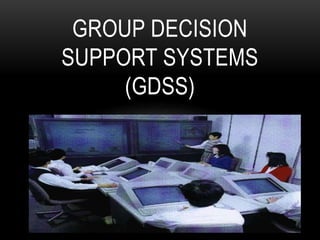
GROUP DECISION
SUPPORT SYSTEMS
(GDSS)
GROUP DECISION SUPPORT SYSTEMS (GDSS)
• Technical developments in electronic communication, computing,
and decision support, coupled with new interest on the part of
organizations to improve meeting effectiveness, are spurring
research in the area of group decision support systems (GDSS).
• A GDSS combines communication, computing, and decision
support technologies to facilitate formulation and solution of
unstructured problems by a group of people.
• Group Decision Support Systems (GDSS) are a class
of electronic meeting systems, a collaboration technology designed
to support meetings and group work.
GROUP DECISION SUPPORT SYSTEMS (GDSS)
• GDSS are distinct from Computer Supported Cooperative Work
(CSCW) technologies as GDSS are more focused on task support,
whereas CSCW tools provide general communication support.
• Group Decision Support Systems (GDSS) were referred to as a
Group Support System (GSS) or an Electronic Meeting System or
Groupware since they shared similar foundations.
• However today's GDSS is characterized by being adapted for a
group of people who collaborate to support integrated systems
thinking for complex decision making.
• Participants use a common computer or network to enable
collaboration.
GROUP DECISION SUPPORT SYSTEMS (DSS)
• Significant research supports the following advantages of GDSS:
- Adapting human factors for these technologies,
- Facilitating interdisciplinary collaboration, and
- Promoting effective organizational learning.
- More participation
- Group synergy
- Automated record keeping
- More structure in the meeting
- higher group satisfaction with the meeting process.
- the new technology has enabled larger groups to meet, resulting in
more information, knowledge, and skills that are brought to bear to
the task at hand.
GROUP DECISION SUPPORT SYSTEMS (GDSS)
• Disadvantages of GDSS:
- Slow Communication: Most people speak much faster than they
type, and thus would usually prefer a verbal environment
- Not all Tasks are Amenable to GDSSs: Group meetings which
involve "one-to-many" communication (for example, a leader
lecturing to the group) would not benefit from a GDSS. Only those
tasks which require group members to exchange ideas or
preferences efficiently ("many-to-many") would benefit.
Gdss

Gdss

  • 1.
  • 2.
    GROUP DECISION SUPPORTSYSTEMS (GDSS) • Technical developments in electronic communication, computing, and decision support, coupled with new interest on the part of organizations to improve meeting effectiveness, are spurring research in the area of group decision support systems (GDSS). • A GDSS combines communication, computing, and decision support technologies to facilitate formulation and solution of unstructured problems by a group of people. • Group Decision Support Systems (GDSS) are a class of electronic meeting systems, a collaboration technology designed to support meetings and group work.
  • 3.
    GROUP DECISION SUPPORTSYSTEMS (GDSS) • GDSS are distinct from Computer Supported Cooperative Work (CSCW) technologies as GDSS are more focused on task support, whereas CSCW tools provide general communication support. • Group Decision Support Systems (GDSS) were referred to as a Group Support System (GSS) or an Electronic Meeting System or Groupware since they shared similar foundations. • However today's GDSS is characterized by being adapted for a group of people who collaborate to support integrated systems thinking for complex decision making. • Participants use a common computer or network to enable collaboration.
  • 4.
    GROUP DECISION SUPPORTSYSTEMS (DSS) • Significant research supports the following advantages of GDSS: - Adapting human factors for these technologies, - Facilitating interdisciplinary collaboration, and - Promoting effective organizational learning. - More participation - Group synergy - Automated record keeping - More structure in the meeting - higher group satisfaction with the meeting process. - the new technology has enabled larger groups to meet, resulting in more information, knowledge, and skills that are brought to bear to the task at hand.
  • 5.
    GROUP DECISION SUPPORTSYSTEMS (GDSS) • Disadvantages of GDSS: - Slow Communication: Most people speak much faster than they type, and thus would usually prefer a verbal environment - Not all Tasks are Amenable to GDSSs: Group meetings which involve "one-to-many" communication (for example, a leader lecturing to the group) would not benefit from a GDSS. Only those tasks which require group members to exchange ideas or preferences efficiently ("many-to-many") would benefit.